Chapter 01 - RBI
Prelims Syllabus
Introduction
Every Year at Least 1 Question is asked
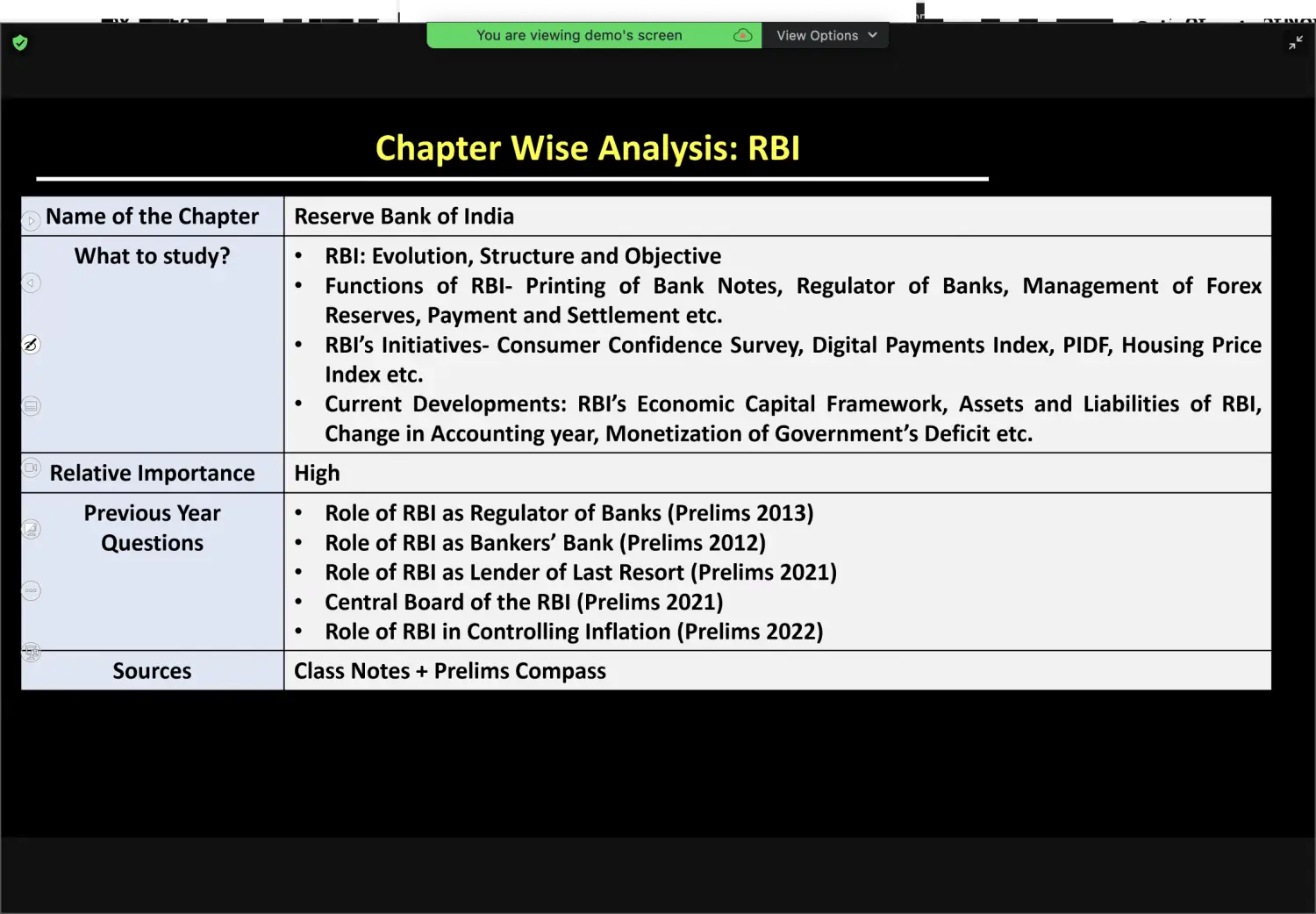
PYQP
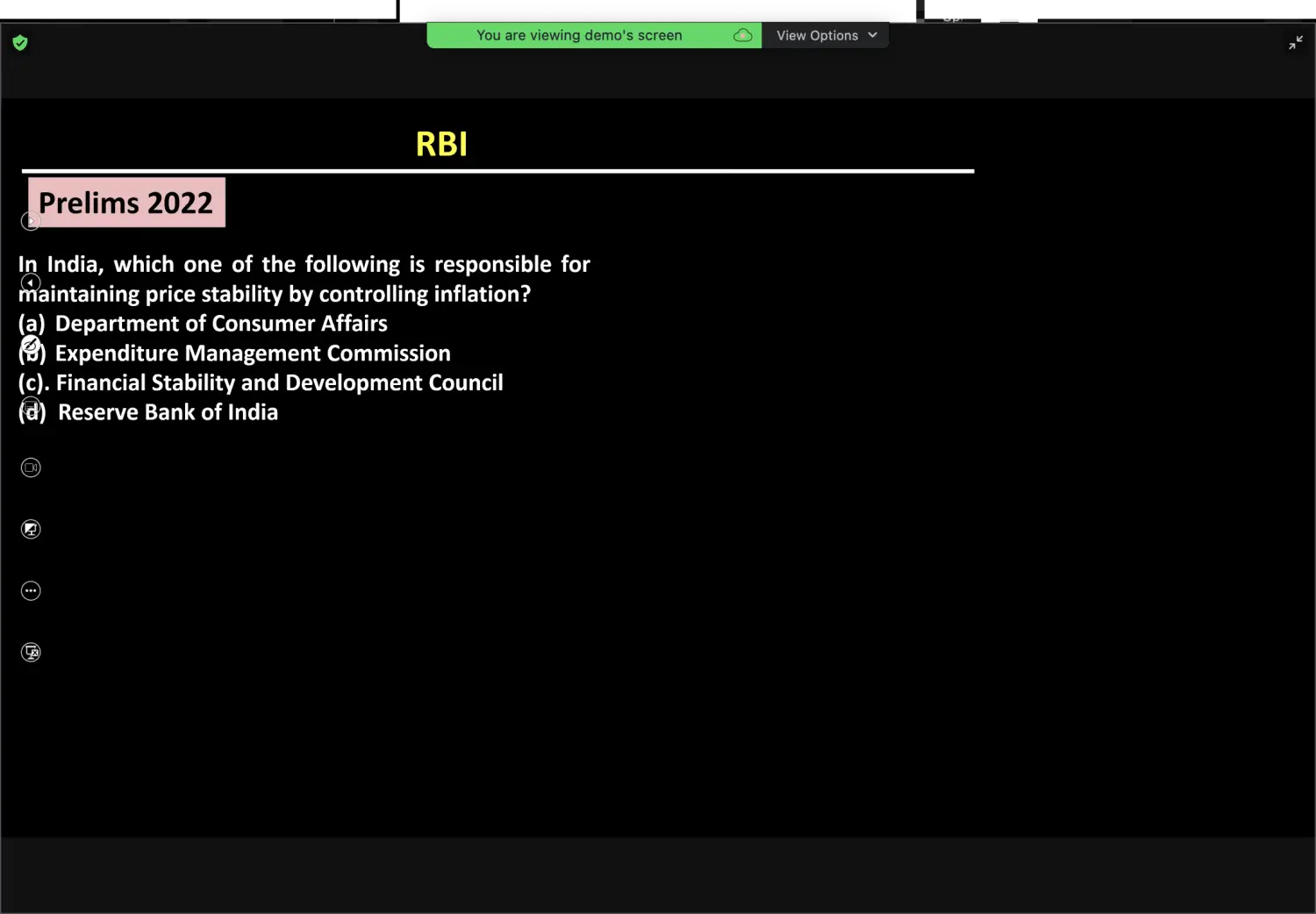
Sample Question from Chapter
Objective of RBI → Answer 1 : D
Structure of RBI → Answer 2 :
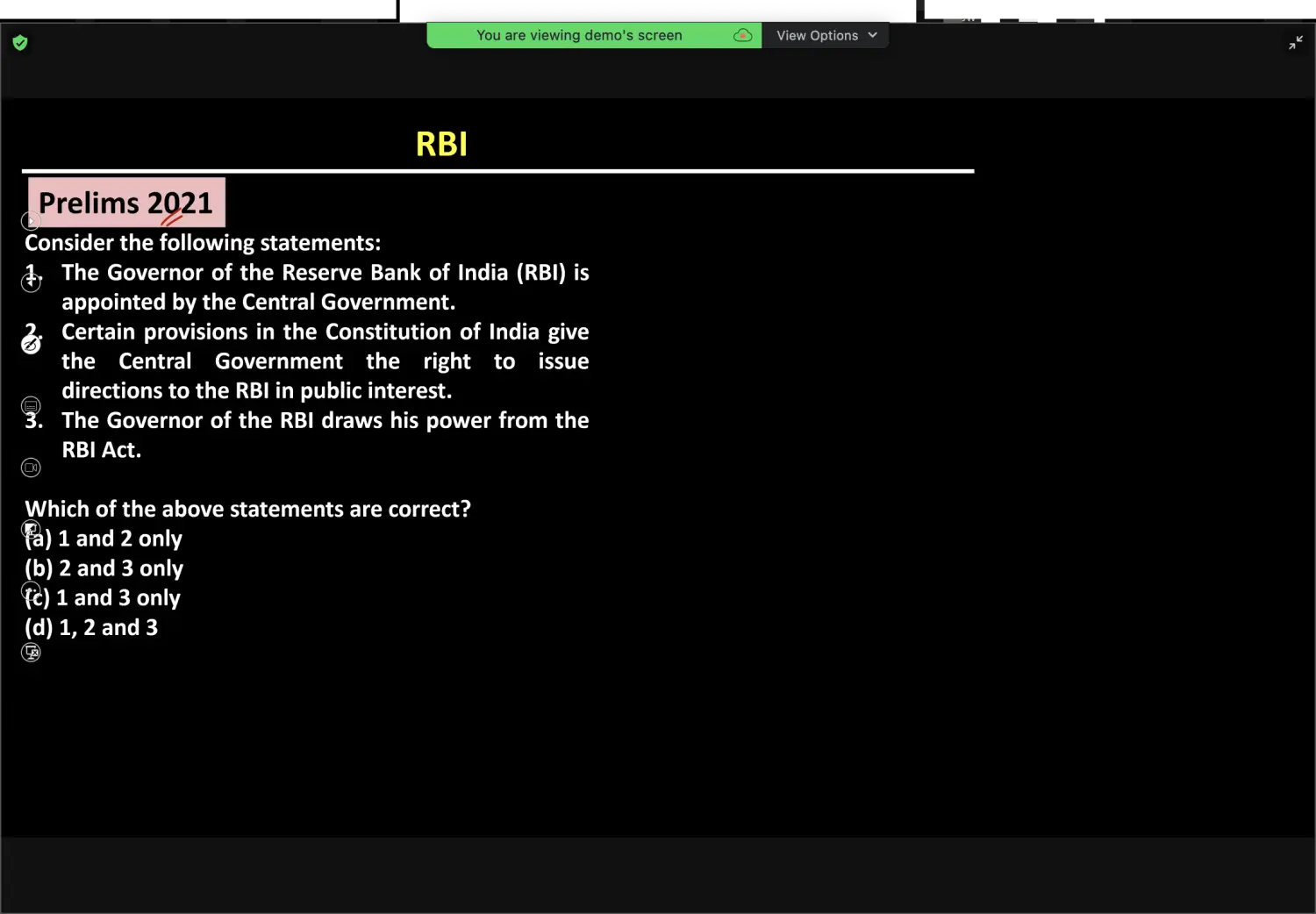
Role & Responsibility of RBI → Answer 3
Expected Question can be - Role of RBI in
Debt Manager to the Govt
Banker to the Govt
Printing Notes for the Govt
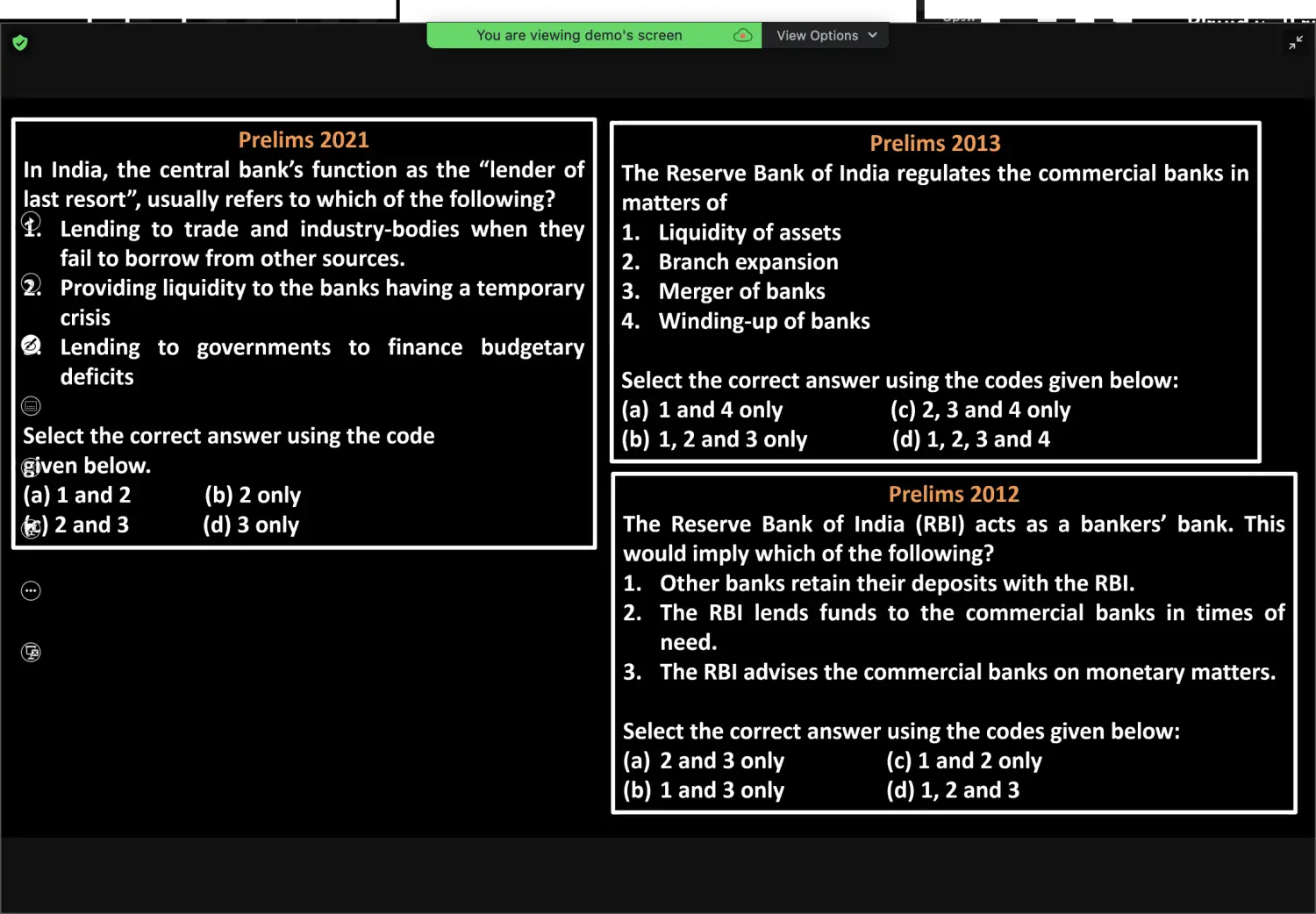
Repetition of Question in Prelims
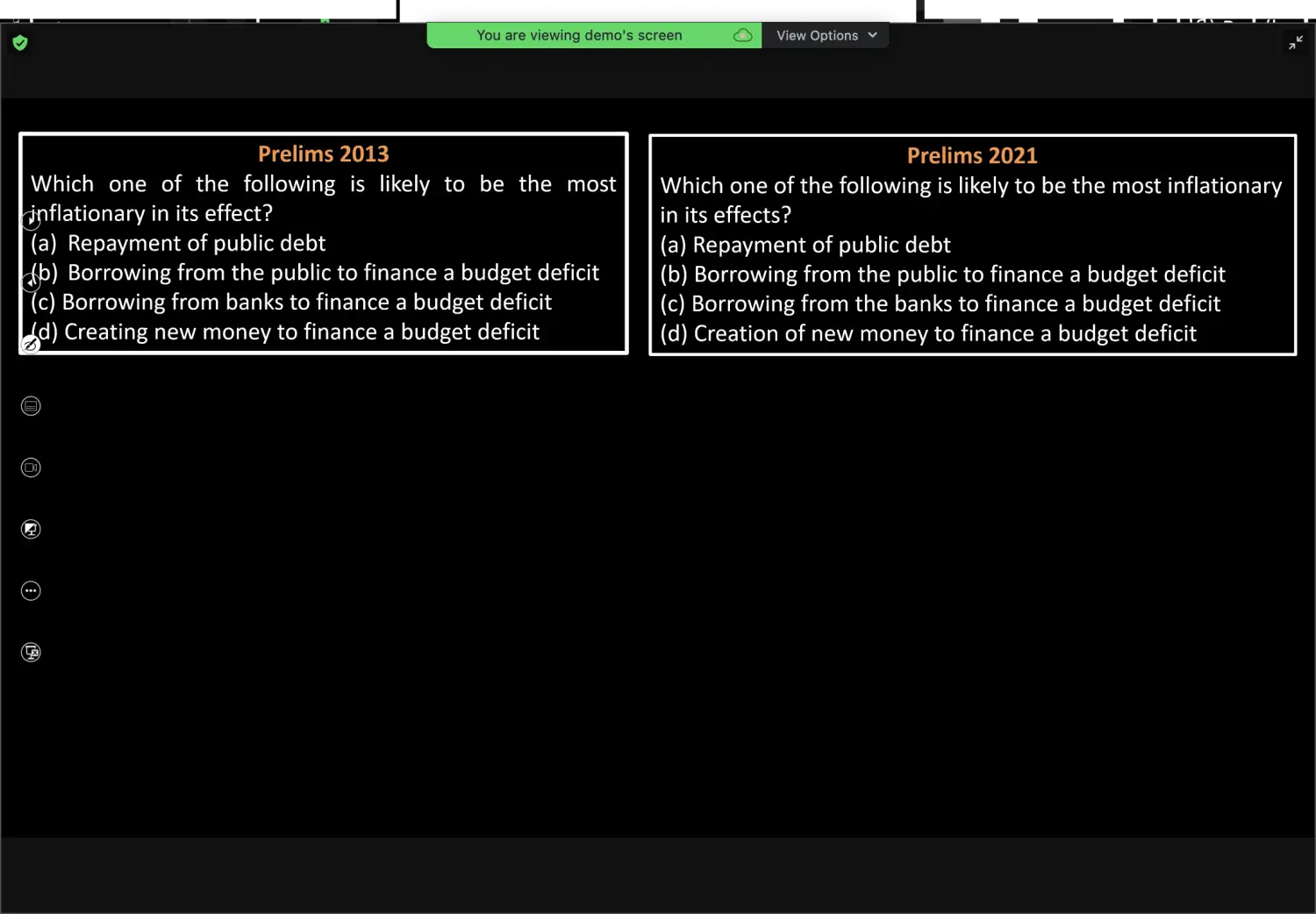
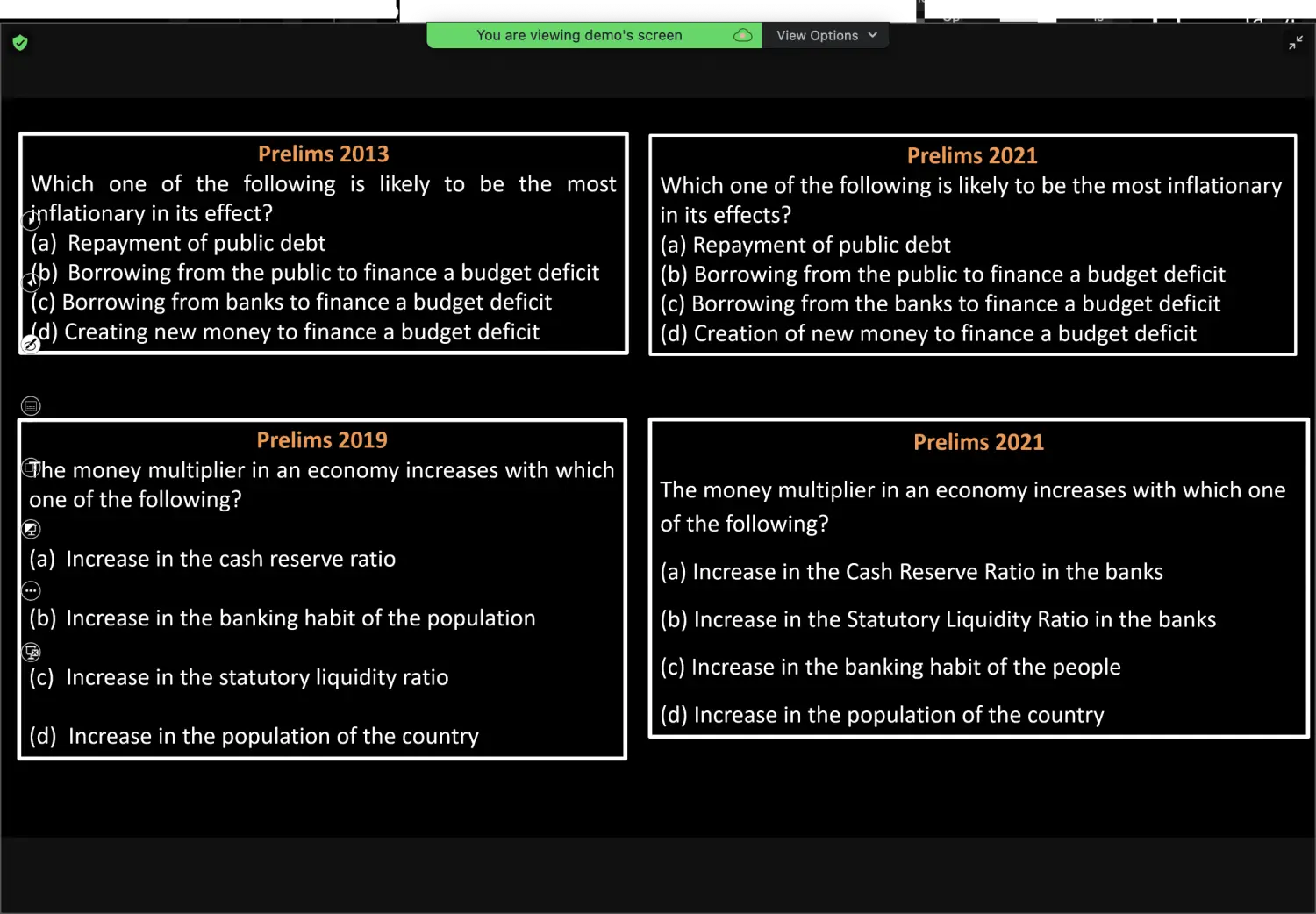
Apex and Commercial Banks
Comparison between Central and Commercial Bank
| Themes | Central Bank | Commercial Bank | | --- | --- | --- | | Nature | Apex Bank | Normal Bank | | Formation | Statutory Body by RBI Act 1934 | 1. Statutory SBI Act 1955 RRB Act 1976 2. Non Statutory - Companies ICICI, Axis, HDFC, IDFC etc
| | Objective | 1. Ensure Growth 2. Manages Demand of Economy - Price Stabilisation High Demand - Suck Low Demand - Inject | Profit Maximisation | | Ownership | Govt Owned | 1. Govt Owned (Pub Sec Bank) PNB, SBI, IOB 2. Pvt Owned ICICI, HDFC | | Roles | 1. More Money - Suck Out Money 2. Less Money - Inject Money | 1. Open Account 2. Minimum Balance in Savings Account 3. Use Bank Account to Accept Payment 4. Use Bank Account to Make Payment 5. Use Bank to Take Loans | | Relationship | Acts as Banker to the Banks Acts as Banker to Govt | Acts as Banker to Public & Enterprises | | Examples | 1. First Ever Central Bank of World - Riksbank (Sweden) 2. Bank of England 3. US Fed Bank 4. RBI 1935 | |
How a Central Bank is Established
- Central Bank is a Statutory Body
- Here the Act is RBI Act, 1934
How is Commercial Bank Established
- Commercial Banks may be Statutory of Non Statutory
Statutory
SBI - SBI Act 1955
RRB - RRB Act 1976
Regional Rural Banks
With Words Gramin
Non Statutory Bank - Registered as Companies
- ICICI, Axis, HDFC etc
- Commercial Banks may be Statutory of Non Statutory
Demand Supply Concept
- Demand and Supply Should Match
- Mismatch
- Inflation → D>S
- Control Method
- Increase Supply - Not Responsibility of RBI, Responsibility of Govt
- Reduce Demand - Responsibility of RBI
- Suck Out Money from Economy - Demand Decreases
- Control Method
- Recession → D<S
- Control Method
- Increase Demand - By RBI
- Inject Money into the Economy
- Lessen the Supply - By Govt
- Increase Demand - By RBI
- Control Method
- Inflation → D>S
Functions of RBI
- Lay Down Criteria of Bank coming into existence
- Lay Down Functions of Company
- Primary Focus of RBI shall be on Controlling Inflation over Promoting Growth
- Acts as a Banker to the Banks
- Normal Persons Bank - HDFC
- Open Account
- Minimum Balance in Savings Account
- Use Bank Account to Accept Payment
- Use Bank Account to Make Payment
- Use Bank to Take Loans
- HDFC’s Banks is RBI
- Open Account in RBI
- Minimum Balance in Account
- Use RBI Account to Accept Payment
- Use RBI Account to Make Payment
- Use RBI to Take Loans
- RBI is a Banker to the Government (Central/State)
- Open Account in RBI
- Minimum Balance in Account
- Use RBI Account to Accept Payment
- Use RBI Account to Make Payment
- Use RBI to Take Loans
Amendment of RBI Act 2016
Amendment took Place in 2016
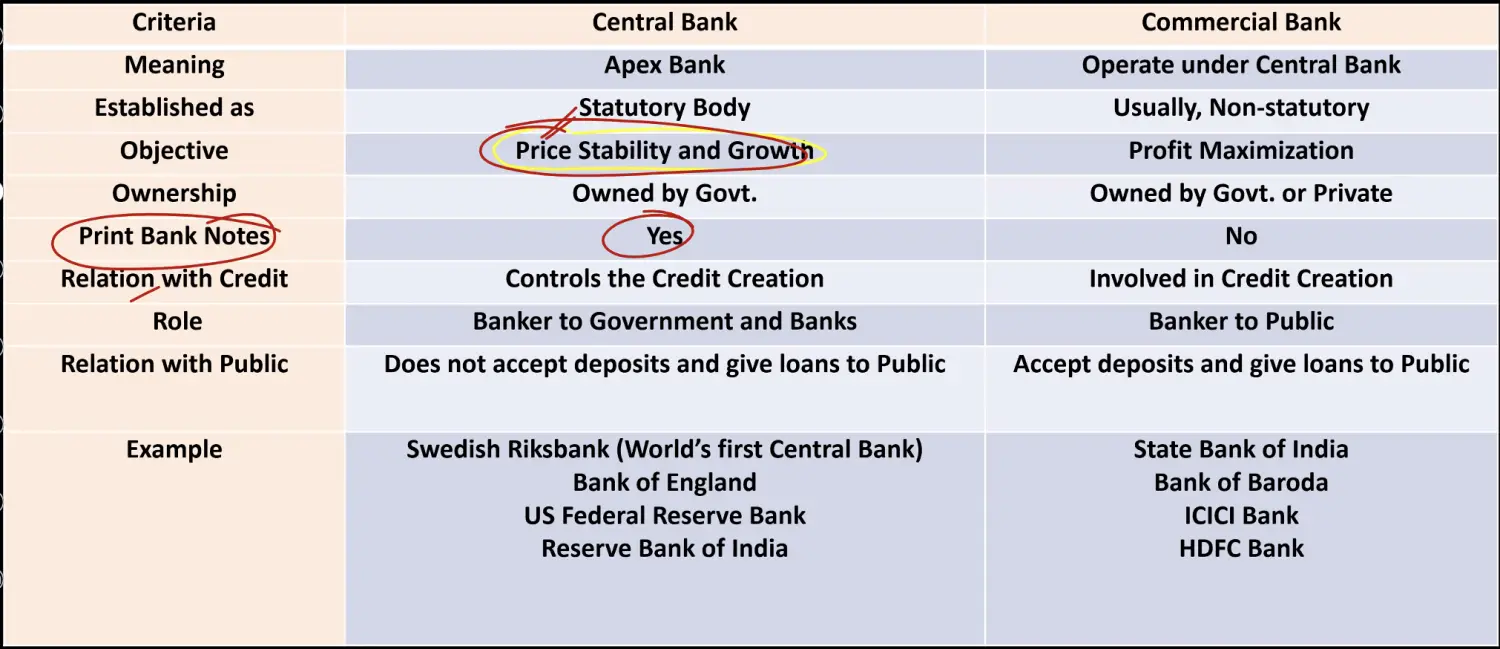
Summary of Difference Between Central and Commercial Bank
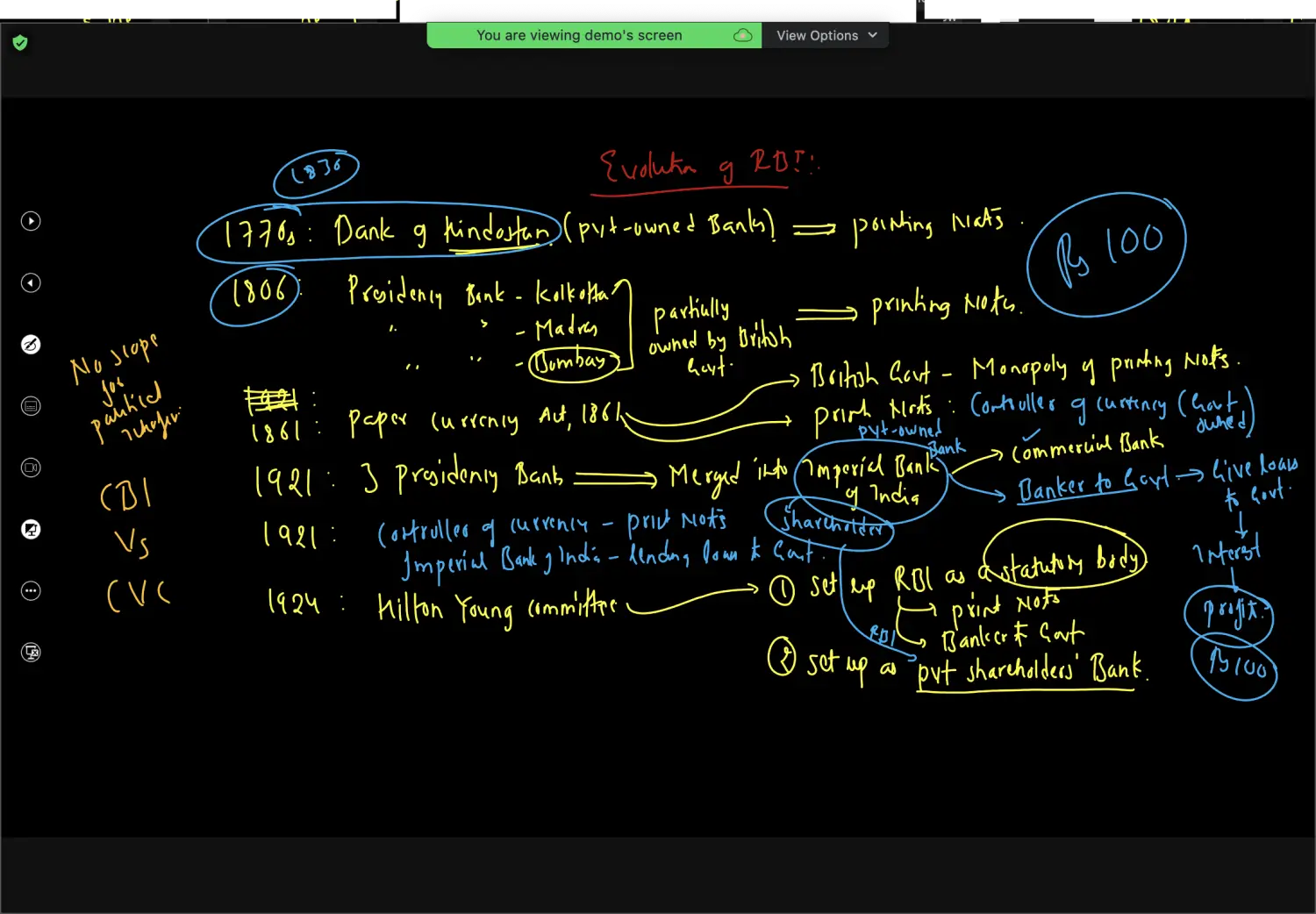
Evolution & Establishment of RBI
1770’s → Bank of Hindustan
- First Kind of Modern Bank
- There was No Hindustani Element
- Setup by Private Traders of East India Company
- It was a Private Owned Bank
- This Bank Started printing Notes and it was brought in circulation
- Closed its operations in 1830’s
1806 → Presidency Banks
- Examples
- Presidency Banks of Kolkata
- Presidency Banks of Madras
- Presidency Banks of Bombay
- They were Partially owned by British Government
- They also Started printing Notes
- Each Banks Note was used in its own Presidency only
- Examples
1861 → Paper Currency Act & CoC
- Under this Act, British Government took over monopoly of printing notes
- Henceforth only British Govt could print notes
- Controller of Currency Agency
- Completely Govt Owned Agency
- Agency under Paper Currency Act 1861
- This was just after Revolt of 1857. More than being a economic necessity it was a Political necessity
1921 → Imperial Bank of India (IBI)
- 3 Presidency Banks were merged to form Imperial Bank of India
- Its Two Fold Role was
- Acting as Commercial Bank to Public
- Acting as Banker to Govt
1921 → CoC & IBI Function
- Controller of Currency - Printing Notes
- Imperial Bank of India - Lending Loans to Govt
1924 → Hilton Young Committee
- to advice how govt can manage printing of notes in India
- Recommendations
- Set up RBI as a Statutory Body
- For it to be Independent & Autonomus Authority
- No Scope for Political Interference
- RBI was supposed to do 2 things
- Print Notes
- Be Banker to Govt
- For this it needed Independence
- Set Up RBI as Pvt Shareholders Bank
- Imperial Bank
- Commercial Nature
- Banker to Bank Nature - Interest from giving loans to Govt
- with RBI, IBI wouldn’t earn this profit
- IBI would be in Loss
- Hence to compensate for this loss
- Whoever, is Owner of IBI can be the owner of RBI
- At that time one Share of RBI was Rs 100
- Anomaly : Statutory body which is a privately owned
- Minimum Capital of Rupees 5 Crore
1934 → RBI Act
Preamble of RBI Act 1934
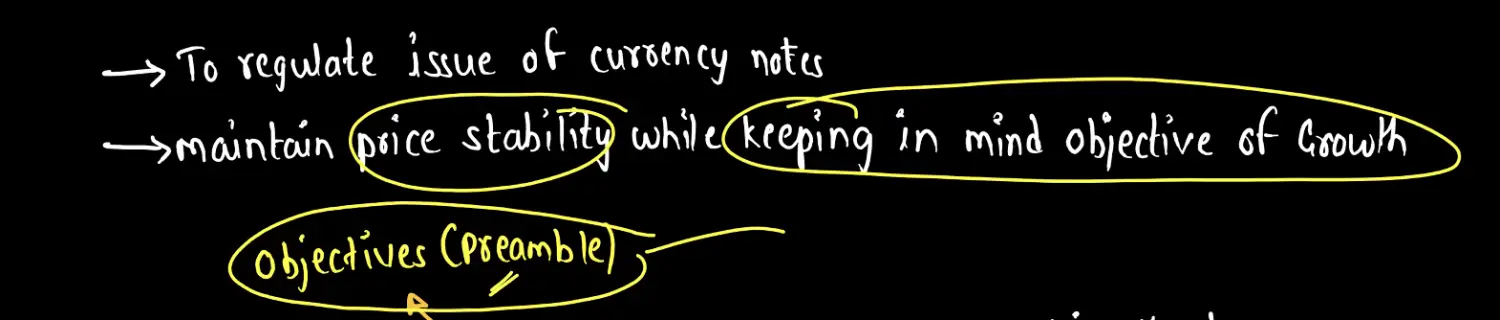
1935 → 1st April 1935 Established
1949 → RBI Nationalised
Summary
Mind Map
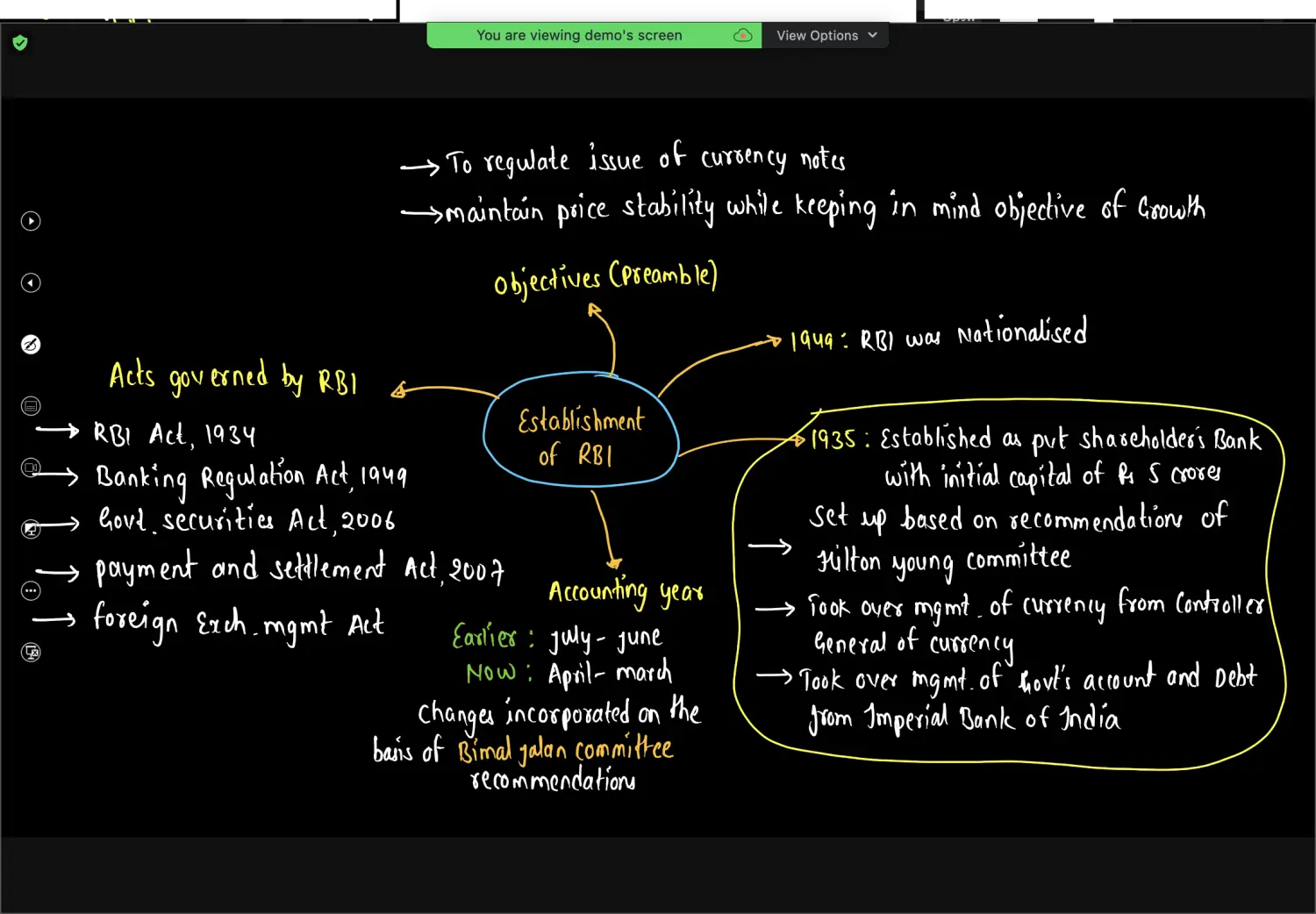
Accounting Year of RBI
- Earlier - July to June
- Now - April to March
- Committee Recommendation of : Bimal Jalan Committee
Acts that Empower RBI
RBI Act, 1934
Establishing Act
Banking Regulations Act, 1949
Power to Regulate Banks
Foreign Exchange Management Act, 1999
Power to Intervene in foreign market
Government Securities Act, 2006
Power of RBI to Manage Govt Securities is by this Act
Payments & Settlements Act, 2007
Power to Regulate Entities like Phone Pe etc
Logo & Share of RBI
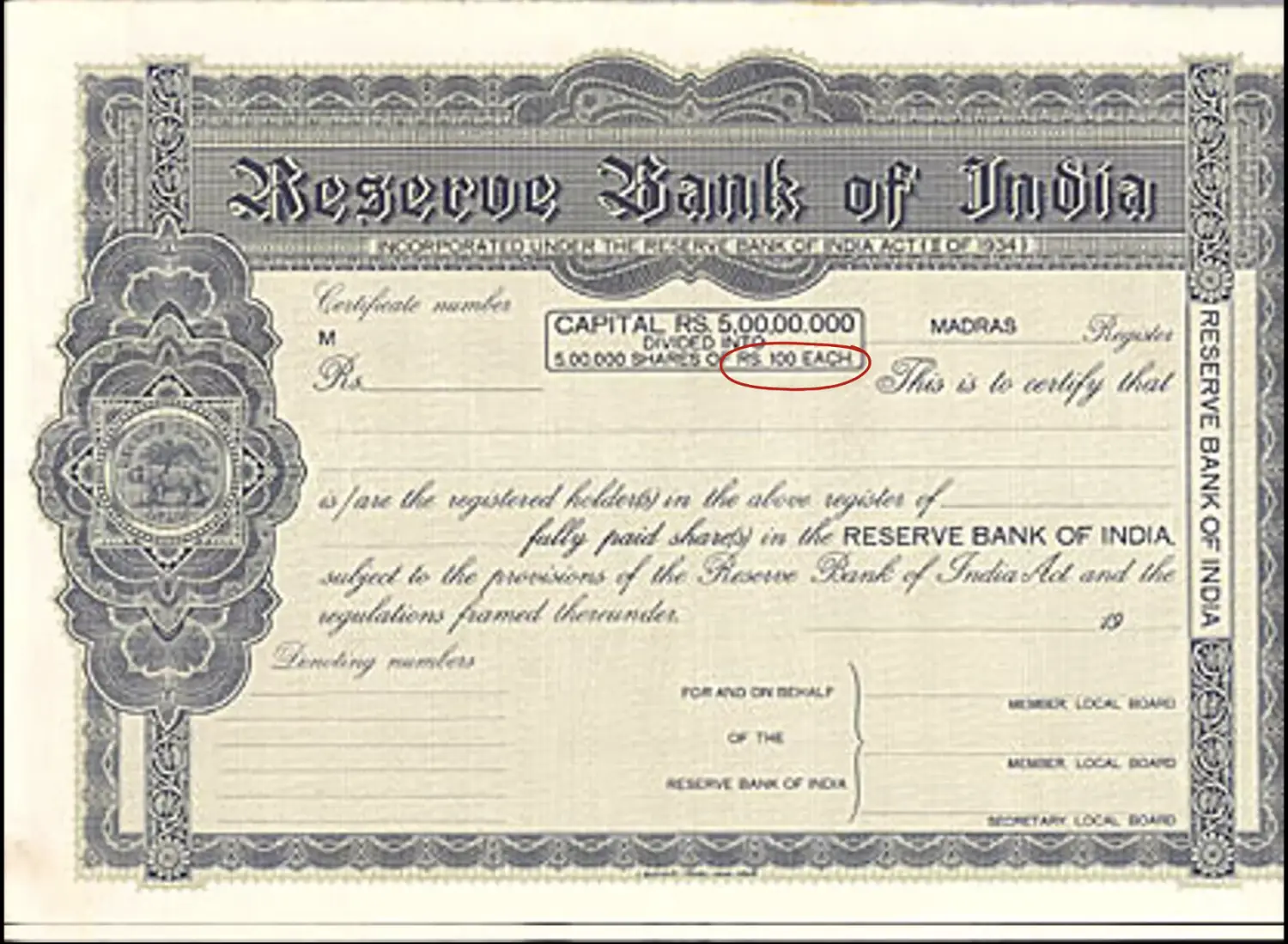
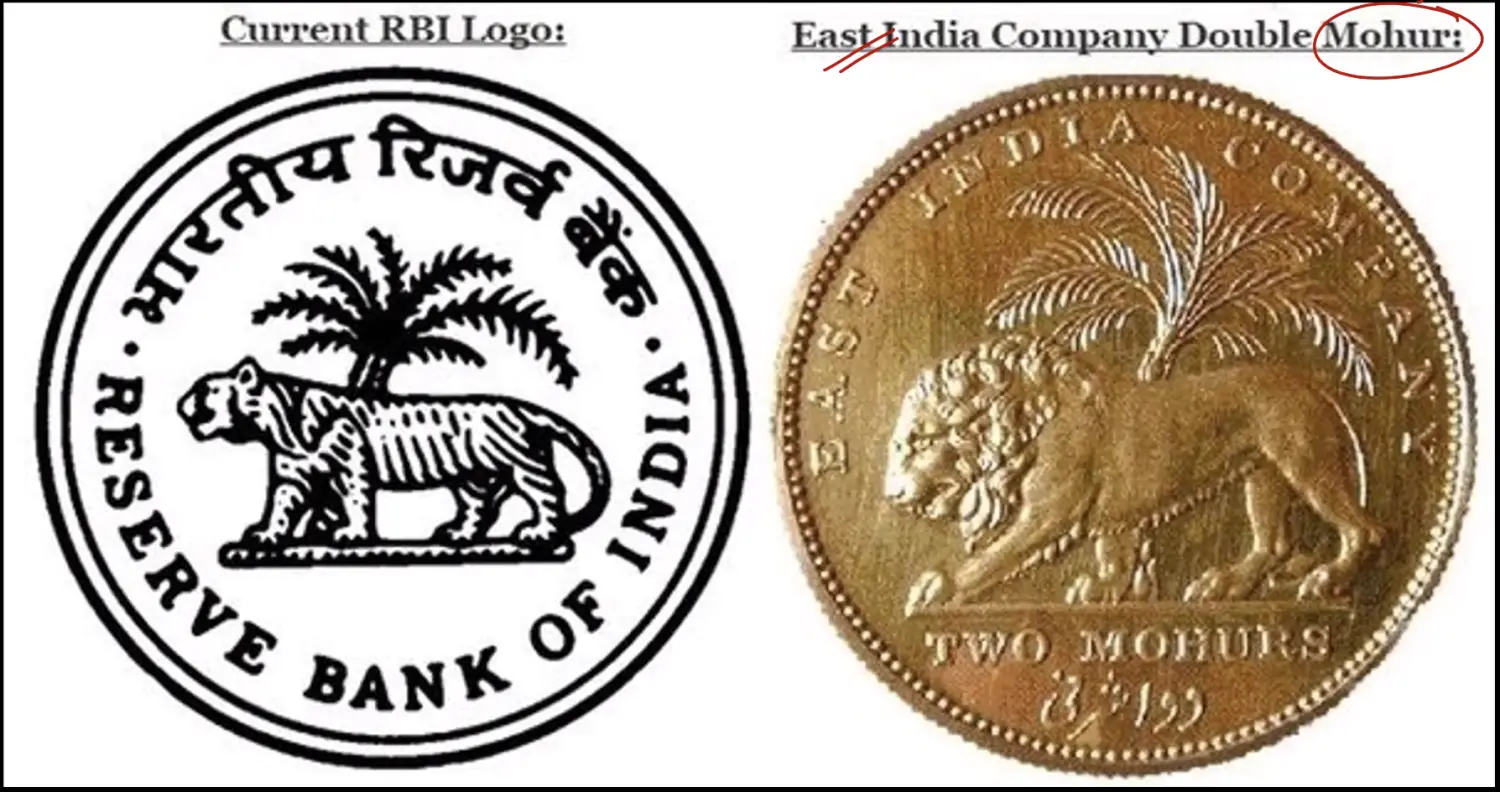
RBI is a different entity - Instead of Lion Tiger was used
It is Under Govt - Used the Same Logo
Structure of RBI
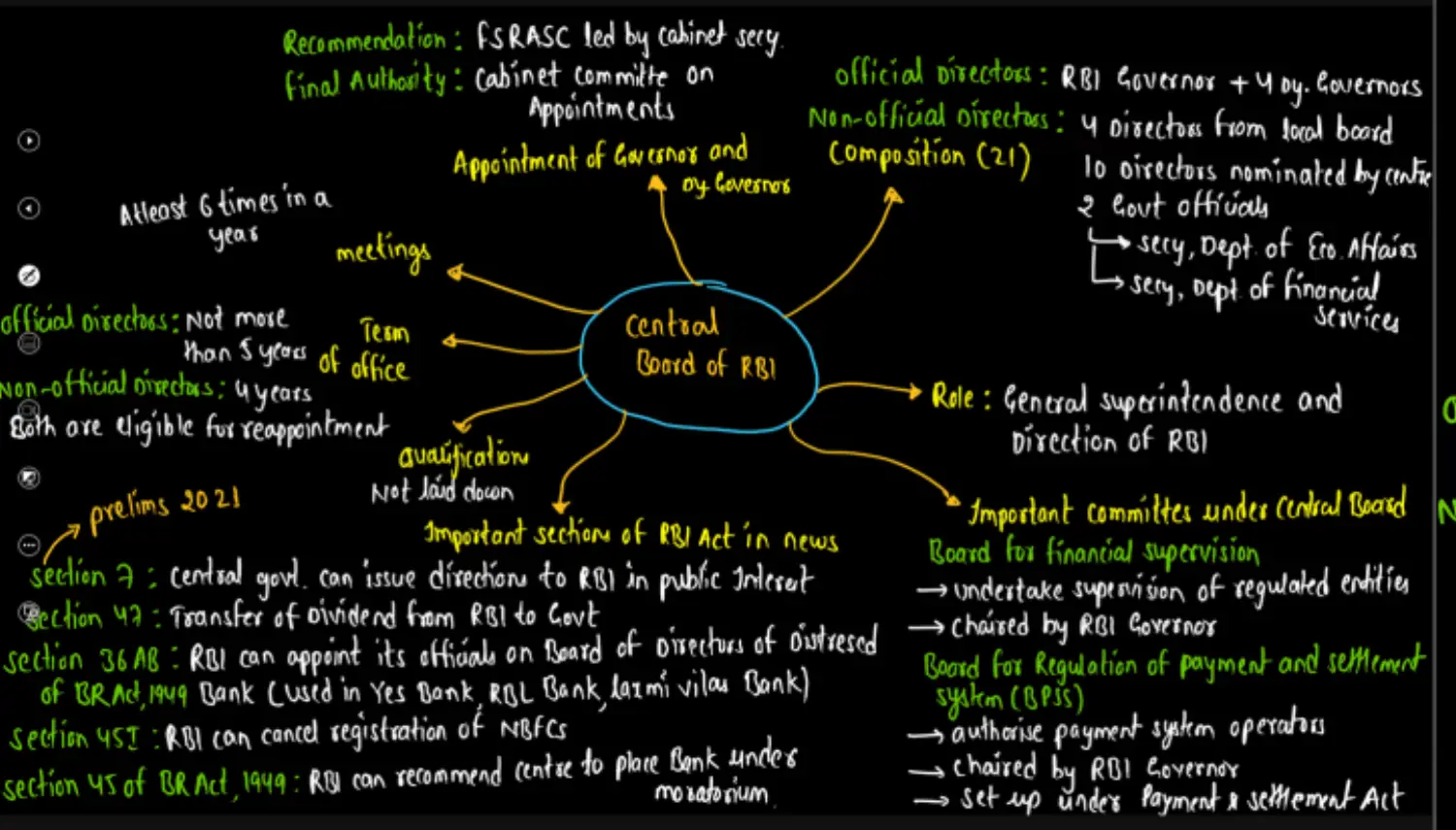
- Establishment : Statutory Body by RBI Act 1934
- Mandate : is that of being a Supreme Authority
- Members : Composition is of 21 Members
- Official Directors
- 1 Member → Governor of RBI
- First Governor of RBI - Sir Osborn Smith
- First Indian to be the Governor of RBI - C D Deshmukh
- Only RBI Governor who became PM of India - Dr Manmohan Singh
- Now - Mr Shaktikanta Das
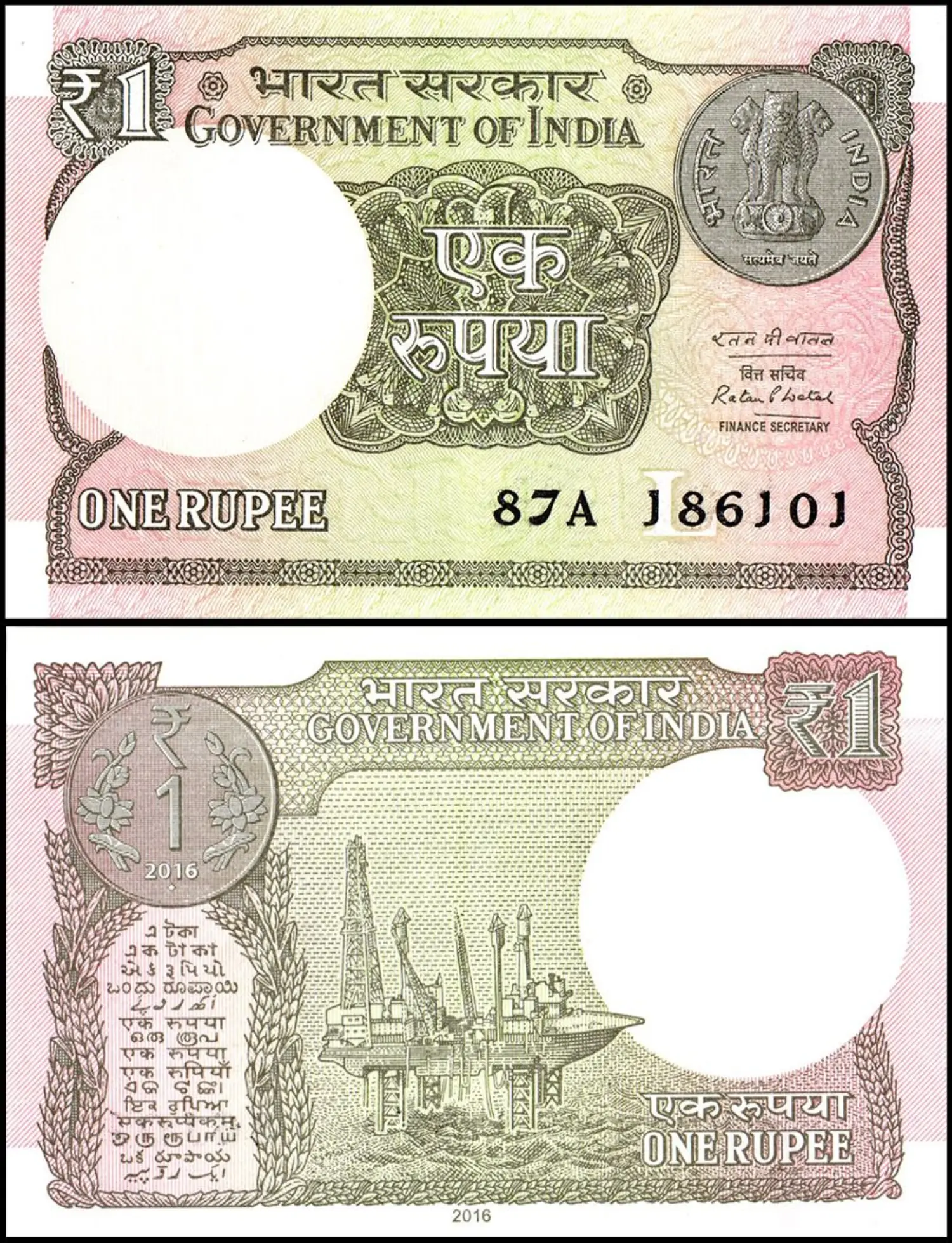
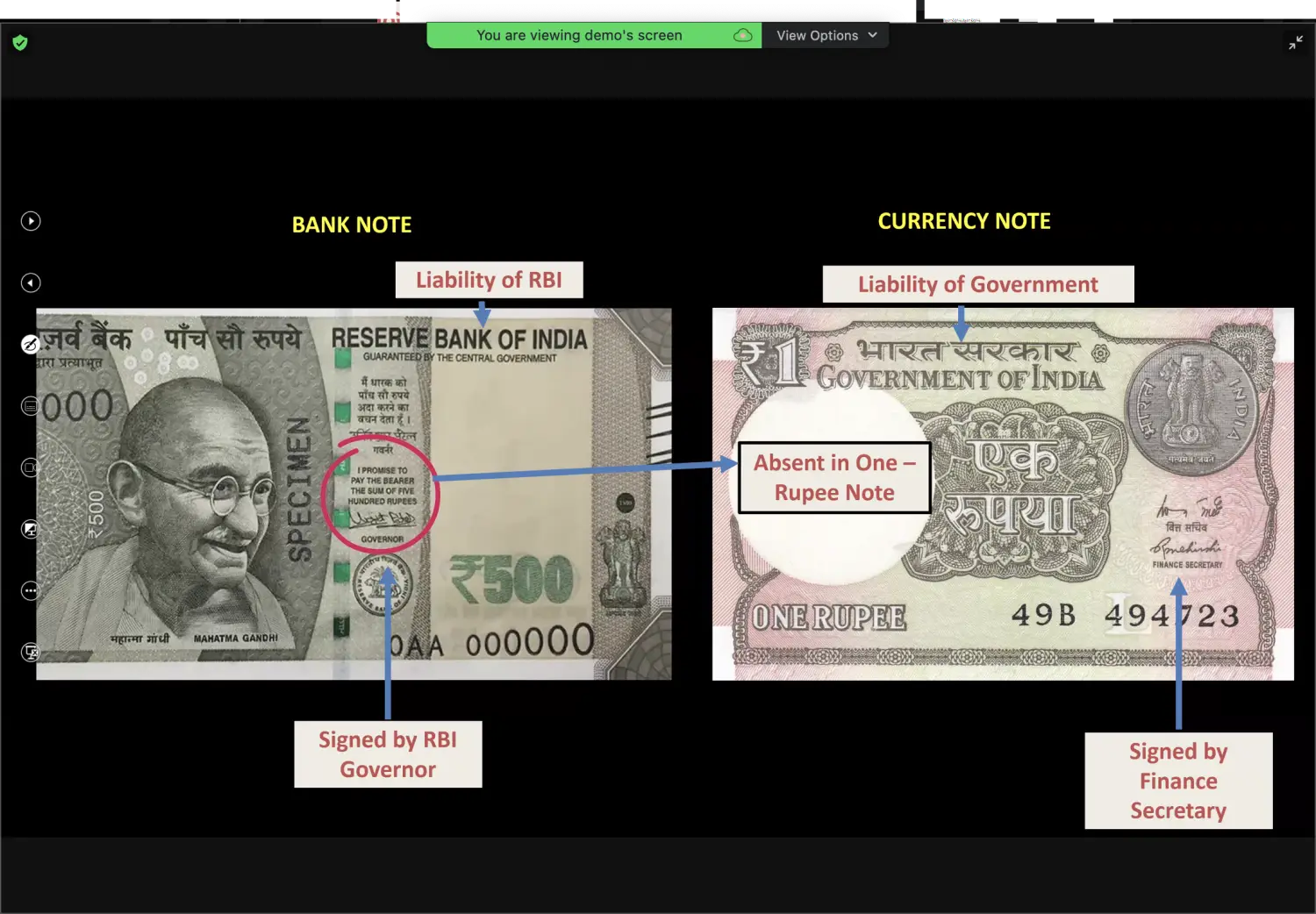
- On One Rupee Note : There is Signature of Finance Secretary
- 4 Members → 4 Deputy Governors of RBI - Incharge of Each Department
- 1 Member → Governor of RBI
- Non Official Directors
4 Members - Heads of Regional HQ of RBI
Basic HQ is in Mumbai ; Initially it was in Calcutta
10 Members - Independent Directors - Nominated by Govt
2 Ex Officio Govt Representatives
- Secretary - Dept of Financial Services
- Secretary - Dept of Economic Affairs
Process : Appointment of Governors and Deputy Governors
RBI Act 1934 does not lay down any qualification for someone being a RBI governor
FSRASC - Financial Sector Regulatory Appointment Search Committee
Headed by Cabinet Secretary
Calls for Application, Interview
They create a Panel of Names
Panel of Names is sent to → Cabinet Committee on Appointments → out of those 2 to 3 → 1 will be appointed as an RBI Governor
People appointed are Eligible for Re Appoint
- Tenure : Official & Non Official Directors
- Official Directors : Max 5 Years
- Initial 3 Years
- Based on Performance extension of 2 Years
- Examples
- Raghuram Rajan - Didn’t Get Extension
- Urjit Patel - Reisgned
- Non Official Directors
- Max Duration of 4 Years
- BFS : Board for Financial Supervision
- Kind of Committee under Central Board of RBI
- Headed by RBI Governor
- BPSS : Board for Regulation of Payment and Settlement System
- Headed by RBI Governor
- by Payment & Settlement Act of 2007
Central Board of RBI Summarised
Functions / Roles of RBI Summarised
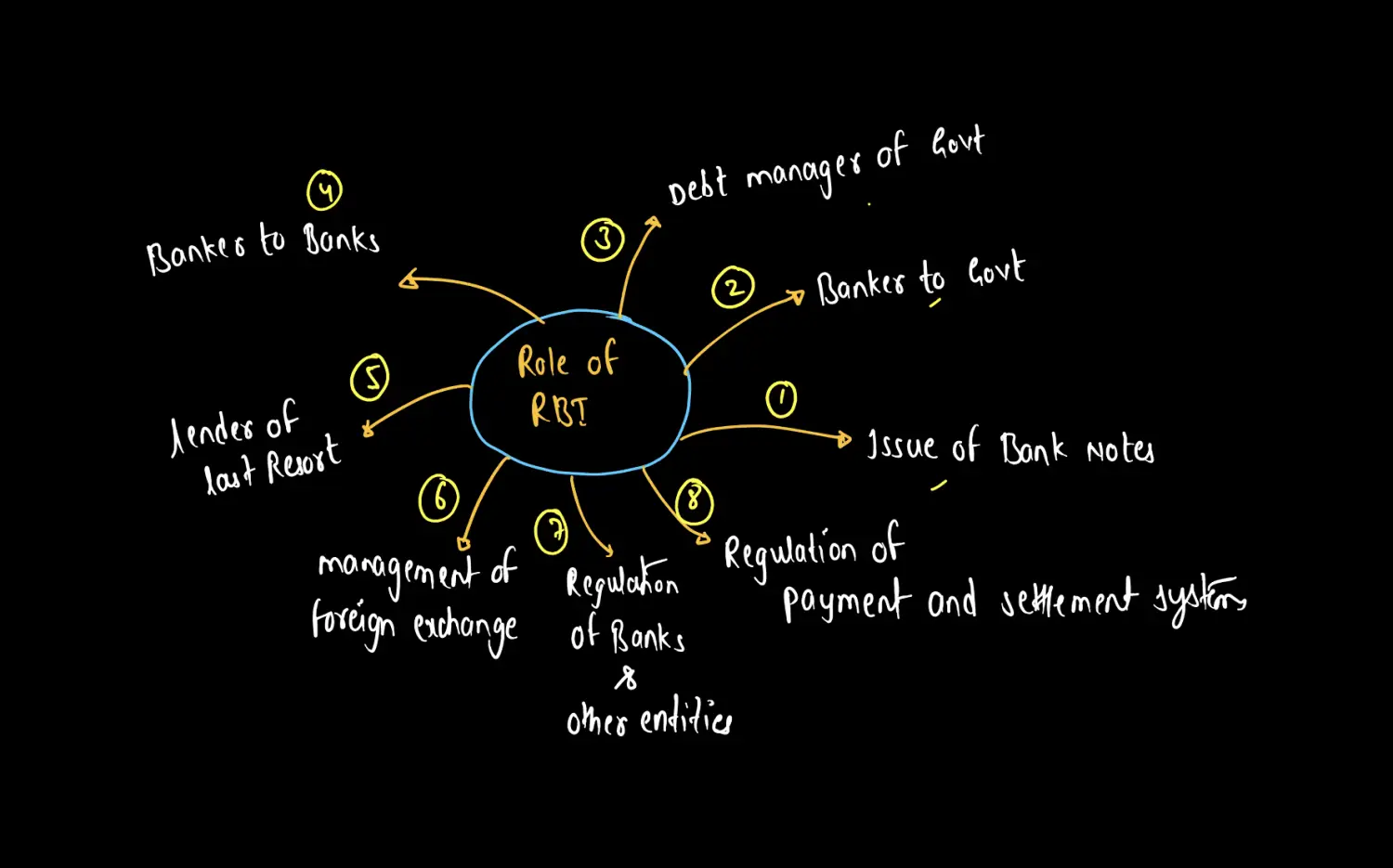
- Issue of Bank Notes
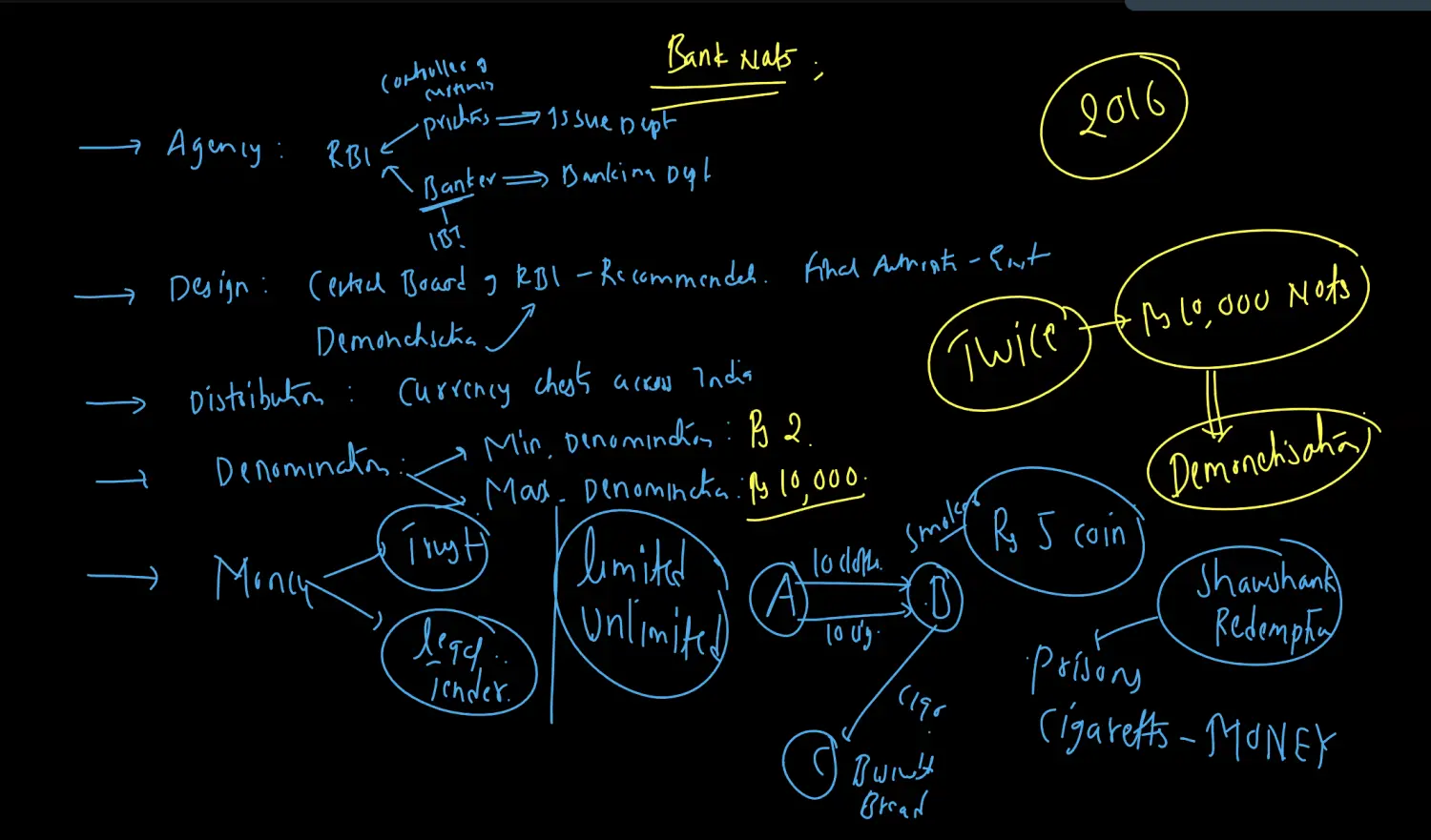
Bank Notes - Rs 2 to Rs 10,000
What are Bank Notes
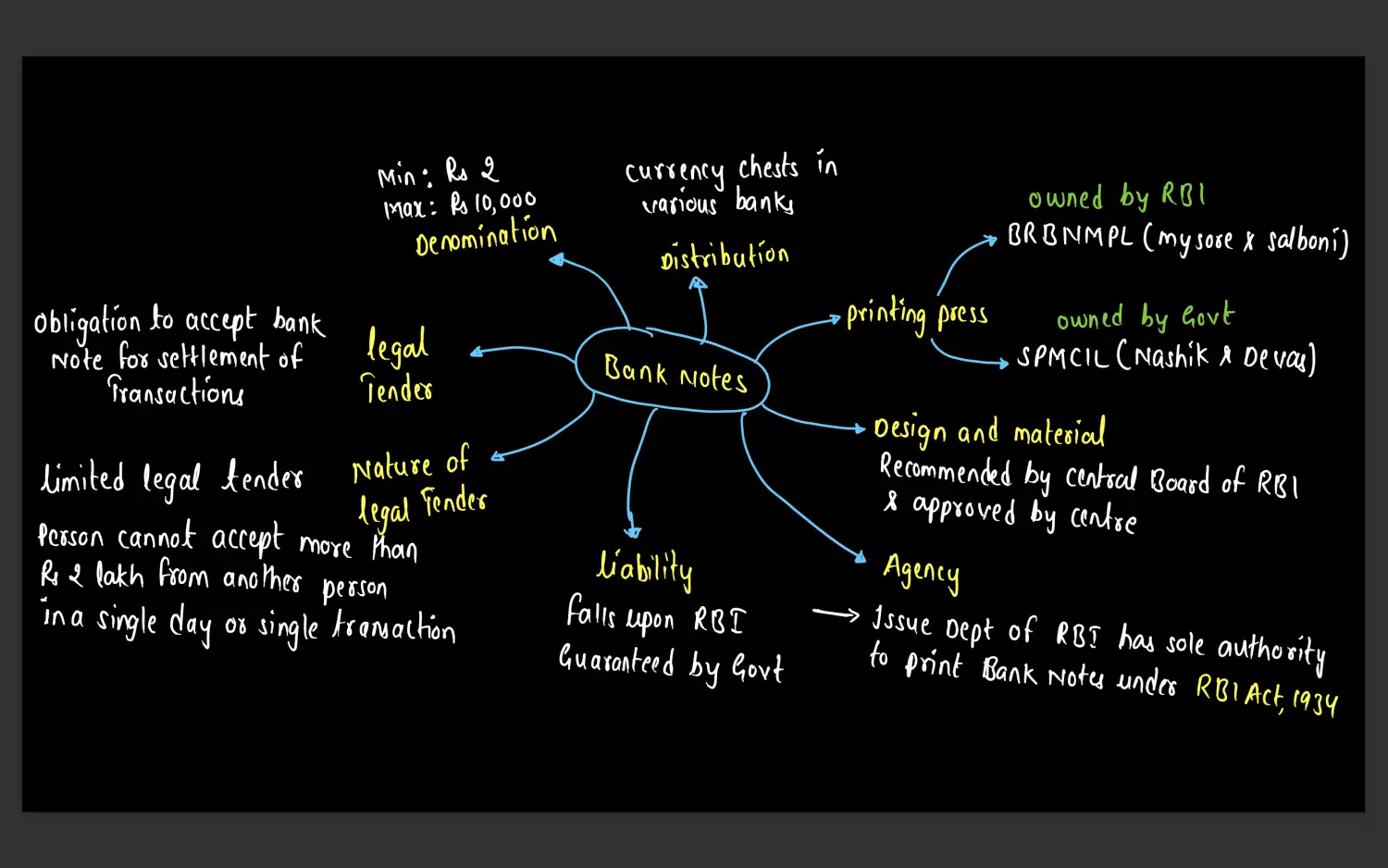
Issue of Bank Notes
Class Slide
Types of Notes
- Bank Notes (Legally) printed by RBI
- Currency Notes (Legally) printed by Govt (Rs 1 Notes)
Agencies in RBI
- Issue Department - CoC - Print Notes
- Banker Department - IBI - Banker
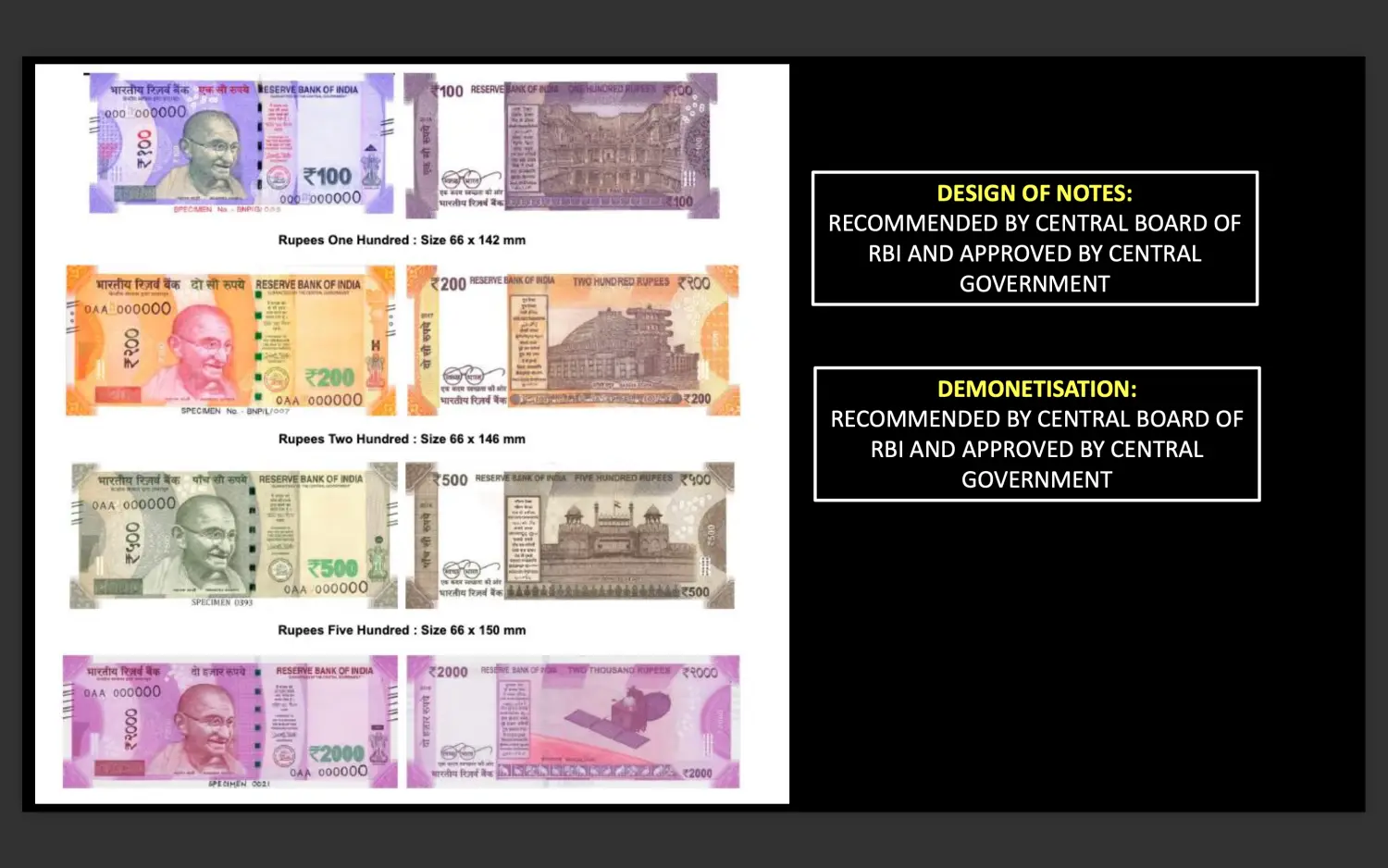
Design of Notes
- Recommendation by Central Board of RBI
- Final Authority by Government
Details of Notes
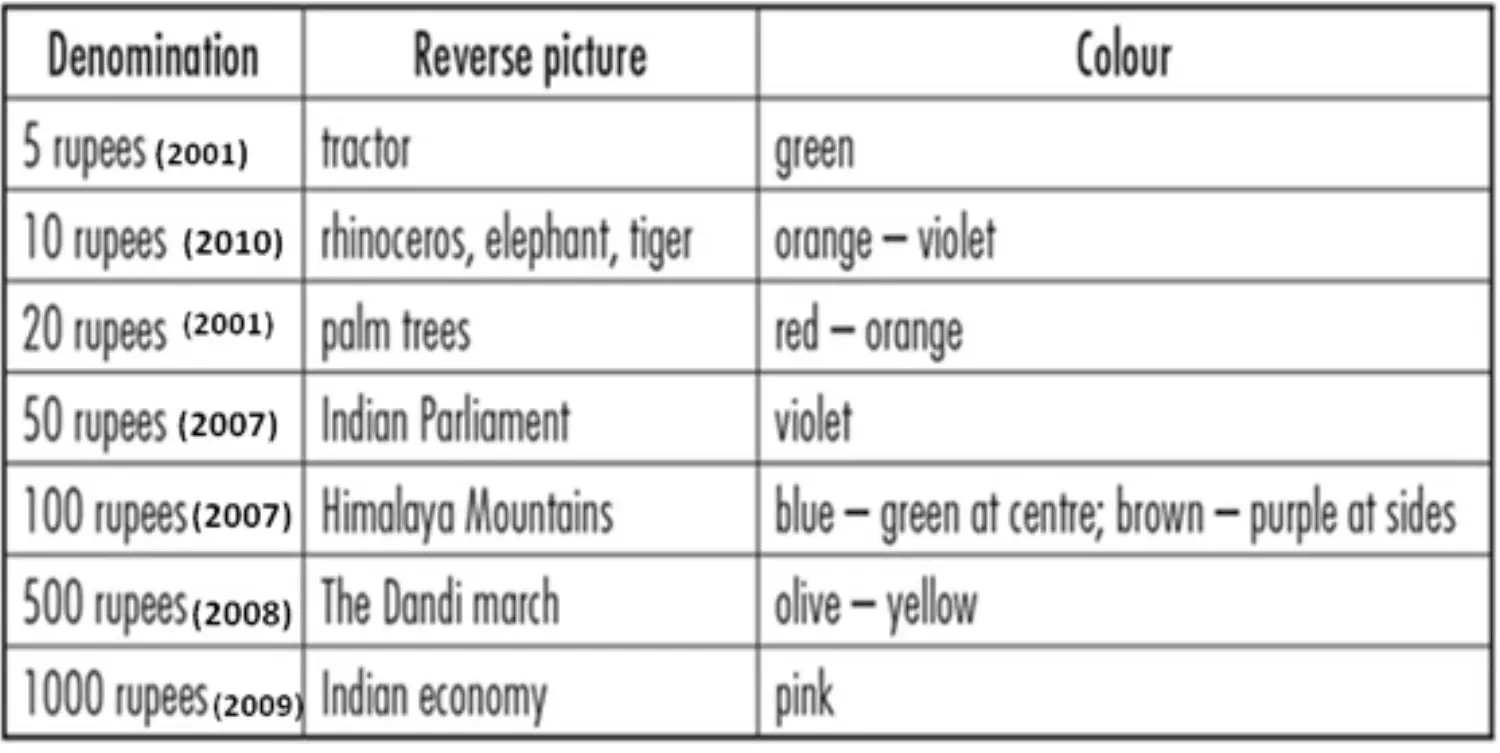
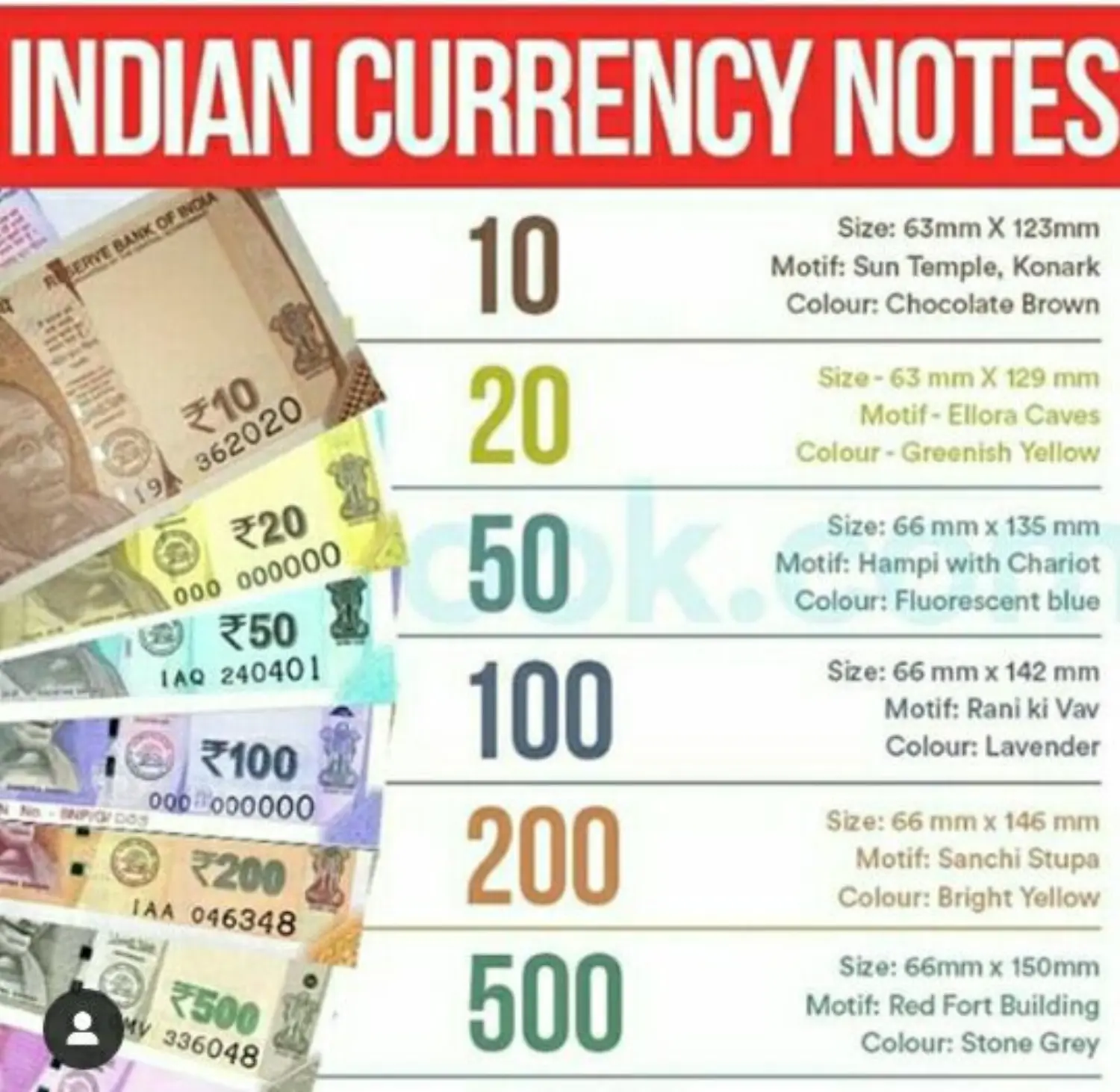
Distribution of Notes
- Currency Chest across India
- In Every District, One Big Branch should be designated as Currency Chests of that District
Denomination of Notes
Value of Notes is Denomination
Minimum Denomination according to RBI Act 1934 - Rs 2
Maximum Denomination according to RBI Act 1934 - Rs 10,000
Currently we don’t have any 10,000 Rs notes in circulations
Bur prior to this RBI has printed 10,000 Rs Notes Twice
- Just After Independence's
- During 1940
After Printing, these high value notes were demonetised
Trust on Note
Reason why people accept notes Signed by Governor
Universal Acceptability by Means of Trust
Like Cigarette in Shawshank Redemption
Non Acceptance of Rs 5 & 10 Coins
Legal Tender
Obligation on Person to compulsorily accept money for settlement of Transactions
You cannot reject the transaction Because its a Legal Tender
There are Two Types of Legal Tenders
- Limited Legal Tender - Prior 2017
- Unlimited Legal Tender - Post 2017
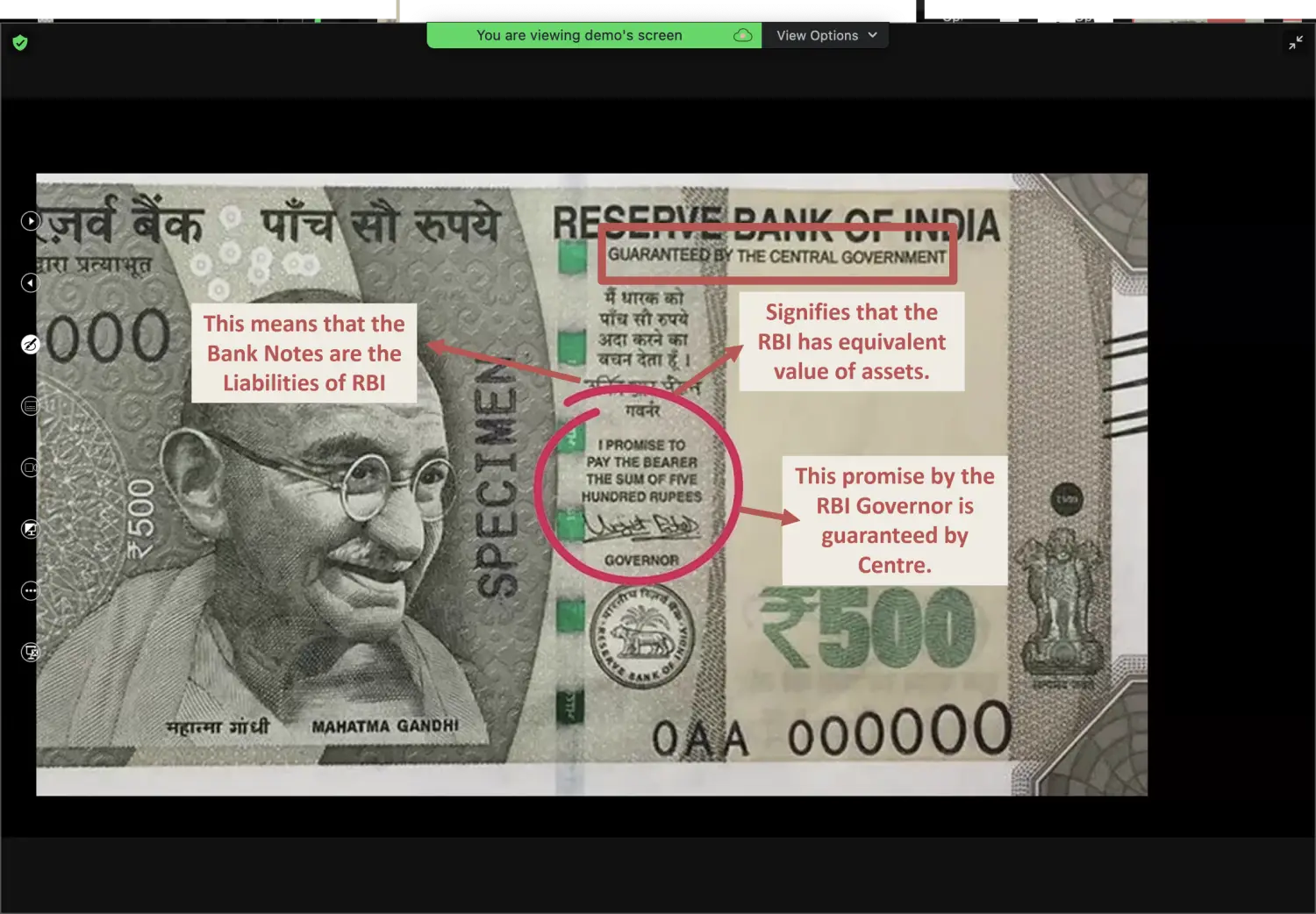
Promise
Difference Between Limited and Unlimited Legal Tender
| Theme | Unlimited | Limited | | --- | --- | --- | | Acceptance Limit | No Matter How Much I Pay you in Cash, You Must Accept it, You cannot reject cash | There is a limit on acceptance of Bank Notes for settlement of Transactions | | Example | Car of 10 Lac being bought
The entire can be purchased in form of Cash | There will be a limit of Rs 2 Lac for Cash Transactions | | In Action By | Since Independence by Laws | Finance Act 2017 | | Limit | No Limit as Such | Limit of Rs 2 Lac Remaining 8 Lacs by Other Means | | What if Limit is Exceeded | No Limit as Such | Extra Cash has to be paid as a Penalty by the Person who has accepted the Cash |
Printing of Bank Notes
- Printing Notes by : Issue Dept of RBI
- Criteria : According to RBI Act, 1934
- Minimum Reserve System
Minimum Reserves of Rs 200 Crores
- 115 Crore Worth - in form of Gold
- 85 Crore Worth - FCA (Foreign Currency Assets)
- Foreign Currency like $ & Euro
- Bonds Issued by Foreign Govt
- Example : US Treasury Bonds
- Bonds are issued by
- Corporates
- Govt
- Features of Sample Bond
- Face Value Rs 100 Crores
- Maturity Period : 10 Years
- Rate : 5%
- Why RBI Will Invest
- has Universal Acceptability
- RBI will earn Interest
- Over All Asset should be same as their Liability
What is the Concept of Assets and Liability
Assets : Ownership Exists
Liability : Doesn’t Belongs to Me
Ones Liability is Another Mans Asset
What are the Assets for RBI ?
- Gold
- FCA - Foreign Currency Assets
- G-Sec - Government Securities
- Coins and One Rupee Notes
How is Value of Asset like Gold whose cost varies is kept in Sync ?
- Gold Value - Increased
- Asset - 10 GM Gold - Rs 3000
- Asset - 10 GM Gold - Rs 6000
- Liability - Rs 3000 - Notes in Circulation
- What will RBI Do
- Sell Gold
- Give to Banking Department
- Gold Value - Decreased
- Asset 10 GM - Rs 3000
- Asset 10 GM - Rs 1500
- Liability 10 GM - Rs 3000
- What will RBI do
- Buy Gold
- Take Money out of Transaction
- Gold Value - Increased
What is the Liability for RBI ?
Note Pe Likha Hua Waada = RBI ka Promise = RBI ki Liability hai
Can RBI have more Assets than Liability
No It cannot, It has to dynamically match
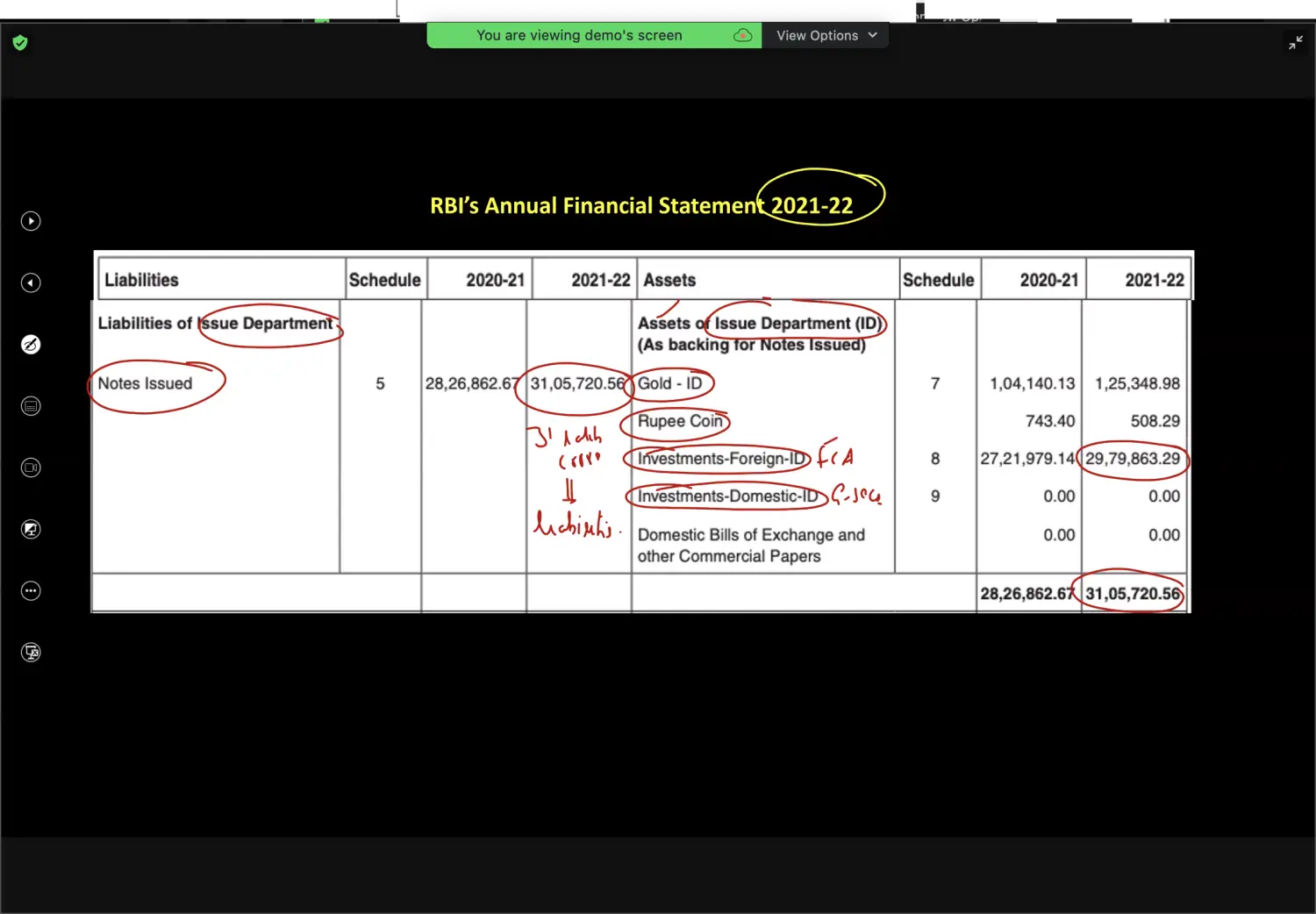
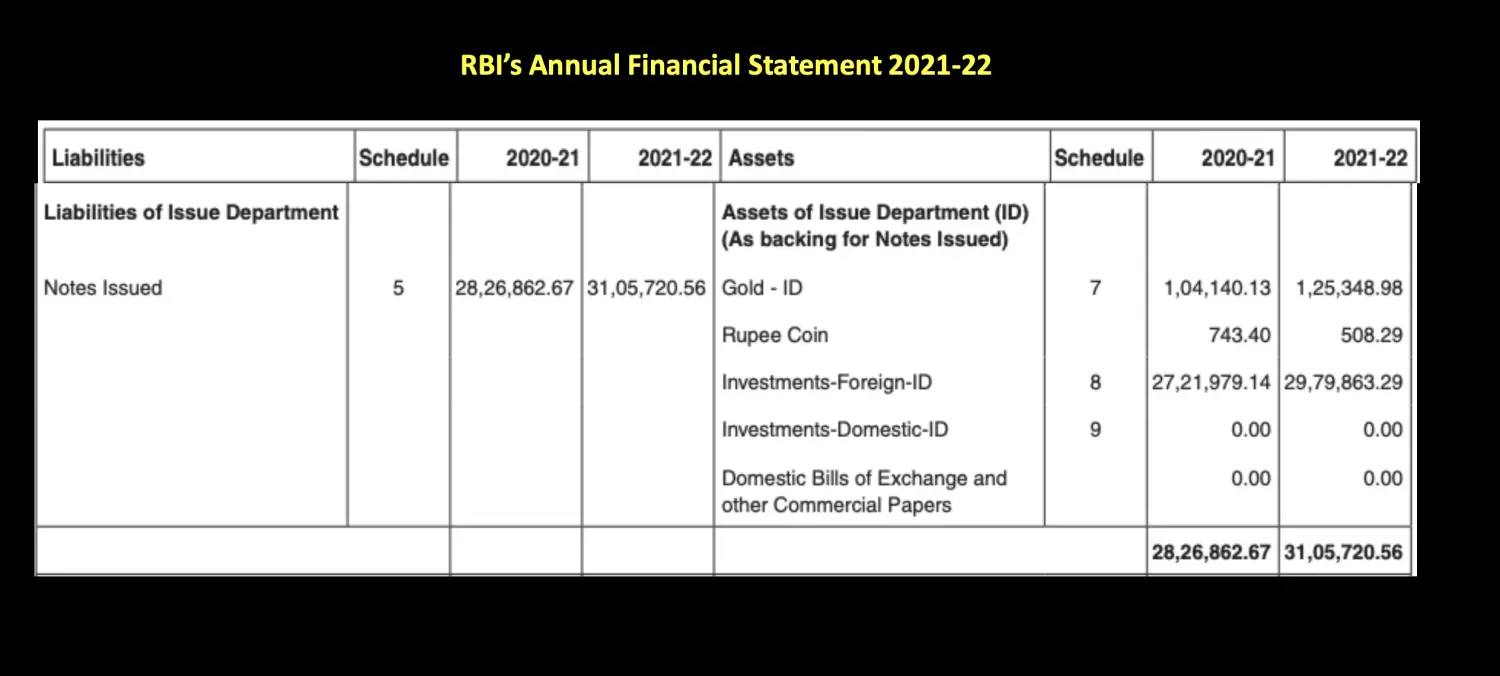
Currency in Circulations by RBI
30 Lac Crores
Hence Assets worth 30 Lac Crores is with RBI
What Happens When you take Rs 500 to RBI Governor
RBI Has Asset
- Case 1 : Assets worth Rs 500
- Case 2 :
- You Cannot Replace one Promise by Another Promise
- 500 - 100*5
- 100 - 10*10
RBI Has No Asset
This is Guaranteed by Central Government in the form of Coins and Rs 1 Notes
Concept of Seignorage
Defintion
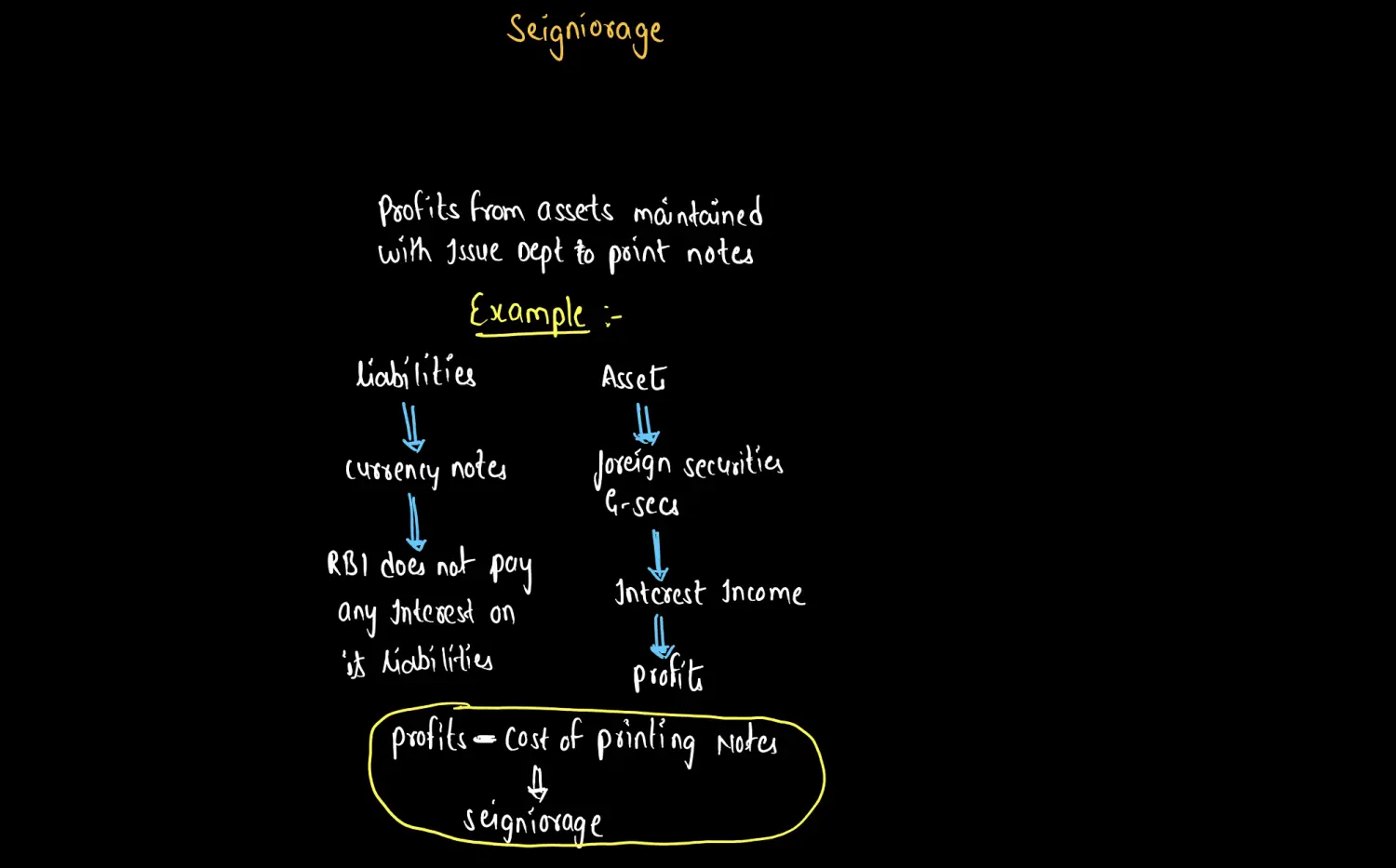
Seignorage is Profit Earned by RBI’s Issue Dept on Account of Printing Notes
Criteria of Printing Notes
- Minimum Reserve System of Rs 200 Crores
- Asset = Liabilities
Concept
RBI has to not pay Interest to anyone in lieu of its promise on notes which is its Liability
RBI Earns Profits from its Assets
Average Profit of RBI is Rs 1 Lac Crores
Profit from
Selling of Gold
Interests from FCA and G Sec
Formula
- Now Net Money = Earning - Expenses
- Expenses = Interests + Printing of Notes Cost
- Seignorage = Earning - (Interests + Printing of Notes Cost)
According to RBI - This Increases Seignorage
- Introduction of CBDC
- Promotion of Cashless Economy
According to RBI - This Decreases Seignorage
Demonetisation
Also think About the Cost, which was used in printing earlier
Also the cost to print new Notes
Mind Map
What Happens to Net Profit (Seignorage) of RBI ?
- Added to Reserves of RBI
- Dividend to Government acc to Sec 47 of RBI Act 1934
Notes
Seignorage is the Net Profit of Issue Department
Assets & Liabilities of Banking Dept of RBI - Detailed
NOTE : Assets of Banking & Issue Department are different. Do Alag Alag Bhai ki Property ki Tarah
| Assets | Liabilities | | --- | --- | | Gold | Deposit of Centre with RBI | | Foreign Security | Deposit of States with RBI | | G Secs | Deposit of Bank with RBI | | Currency Notes are an asset for Banking Dept because they can be used by banking department for giving loans | | | Loans to Centre & States | | | Loans to Banks | |
Assets & Liabilities of Banking Dept of RBI - Summarised
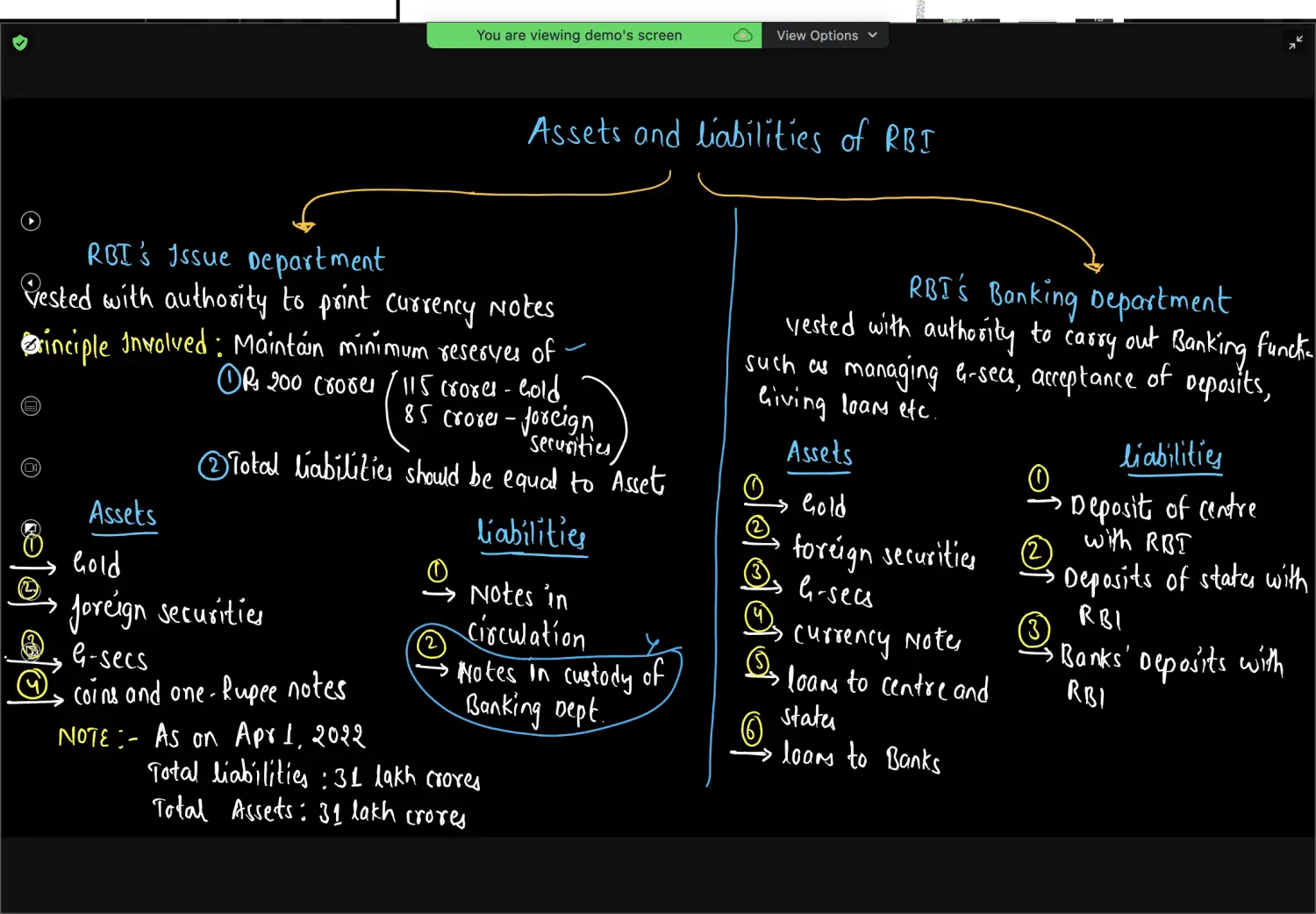
Assets & Liabilities of Issue Dept of RBI - Summarised
Gold, FCA, G Sec, Coins & Re 1 Notes
Designs of all Bank Notes
Currency Notes - Rs 1
Face Value
Why Govt Print 1 Rs Notes
- RBI is Not Allowed to Print
- It is a Form of RBI Guarantee
Is there any limit on Central Government to Print 1 Rs Note
No there is No Limit and There is No Pre Requirement to Print Rs 1 Notes
Mind Map
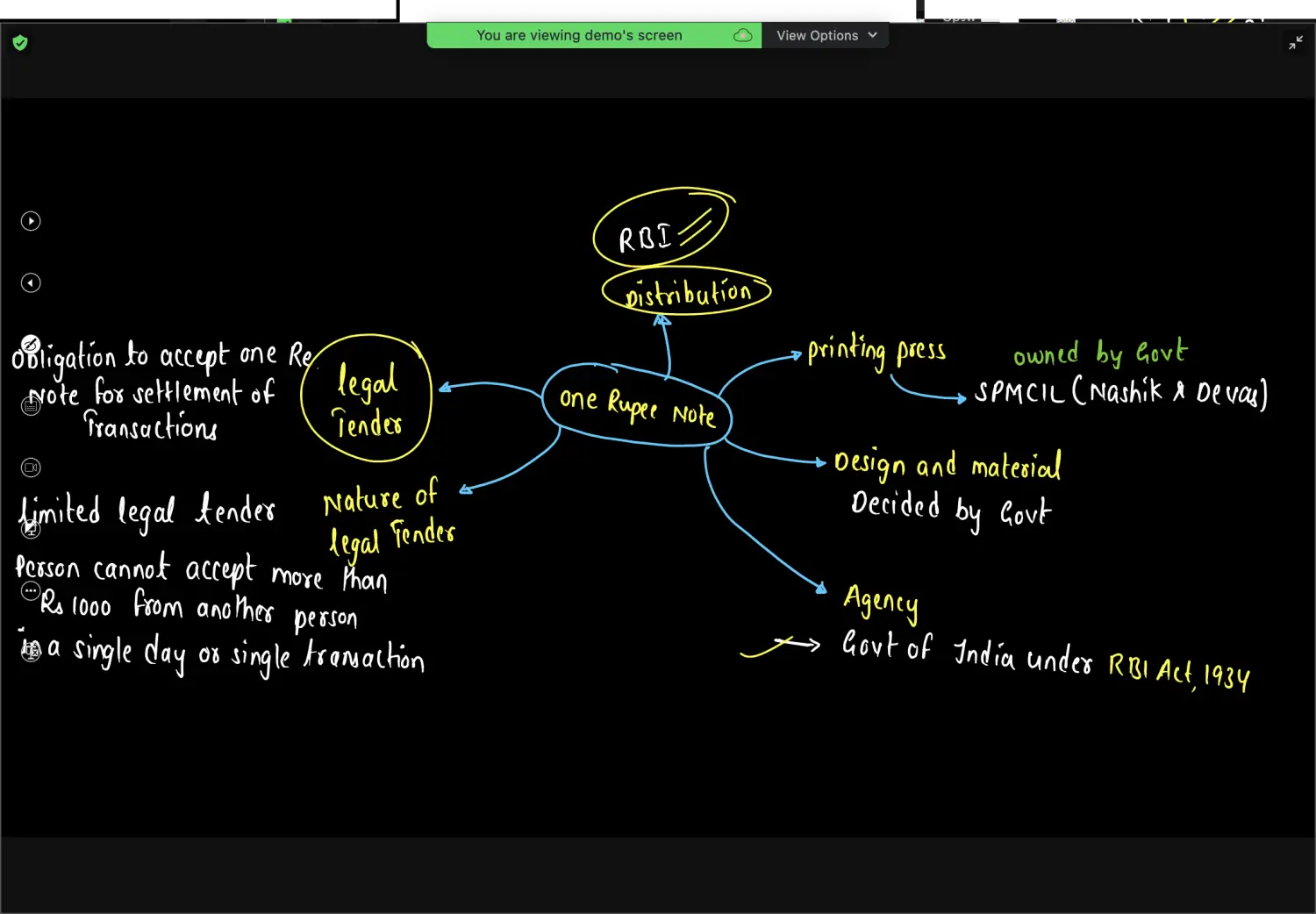
Point to Note
The Limited Legal Tender of Limit of Rs 1000 in Denomination of Rs 1 Notes
Upto 1000 Rs - Compulsorily You have to accept
Above Rs 1000 - Its Upto You, Ig you want to Accept it or not
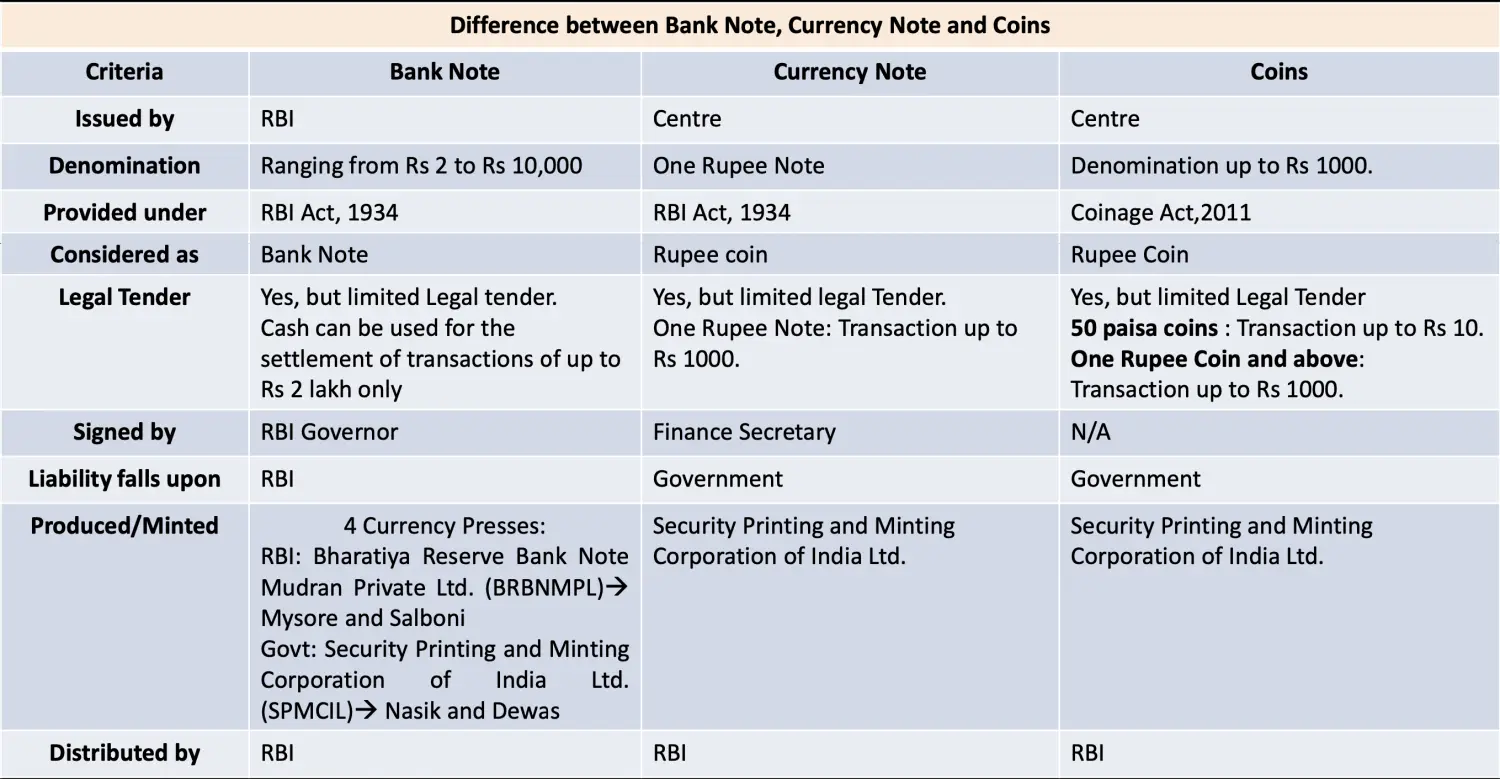
Difference between Bank Notes & Currency Notes
Coins
Mind Map
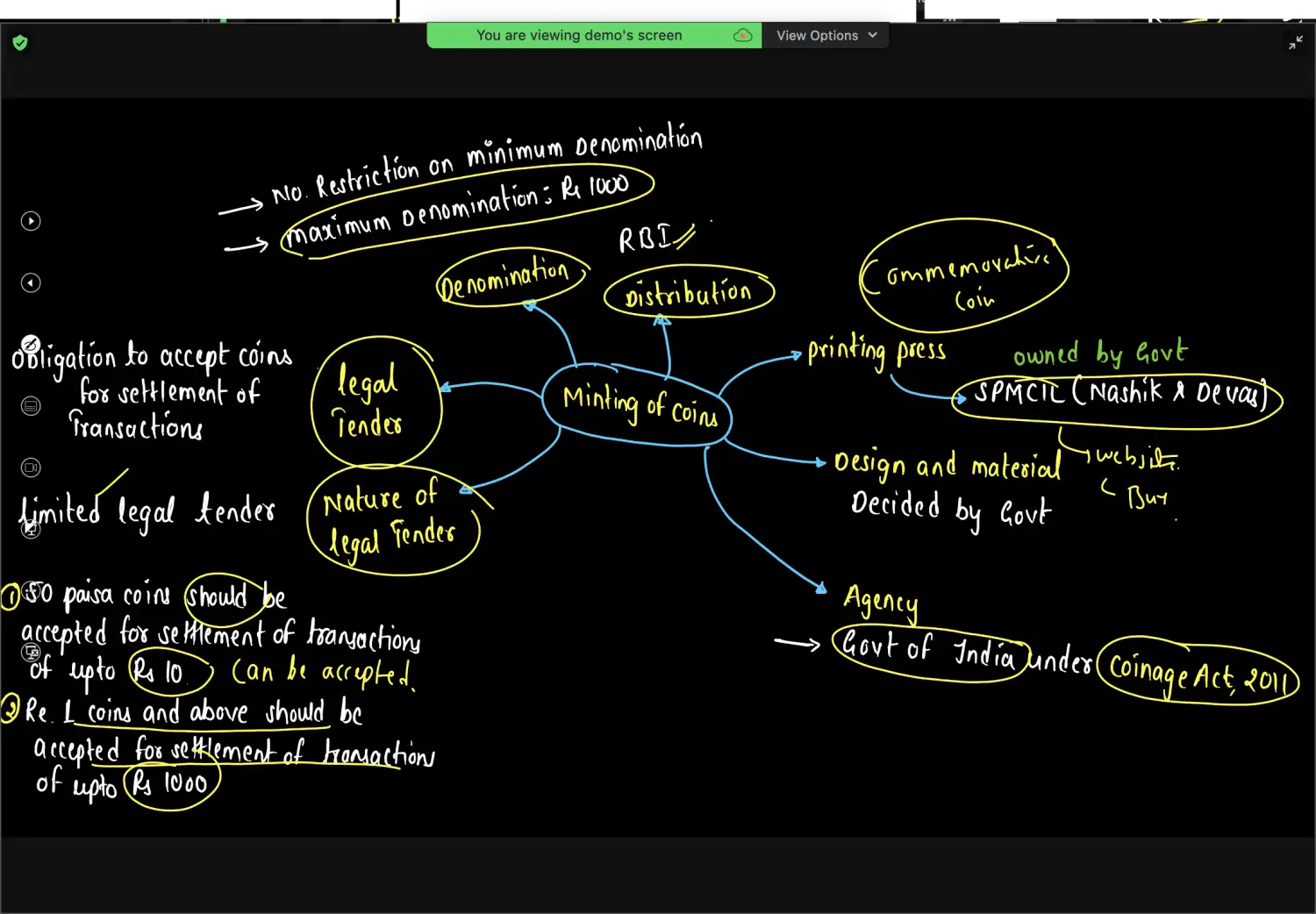
Denomination
No Min Denomination
Max Denomination - Rs 1000
Commemorative Coin - For Example for Mahabalipuram
It is not put into Circulation
It is sold on Auction by SPMCIL
Difference Between Bank Notes, Currency Notes & Coins
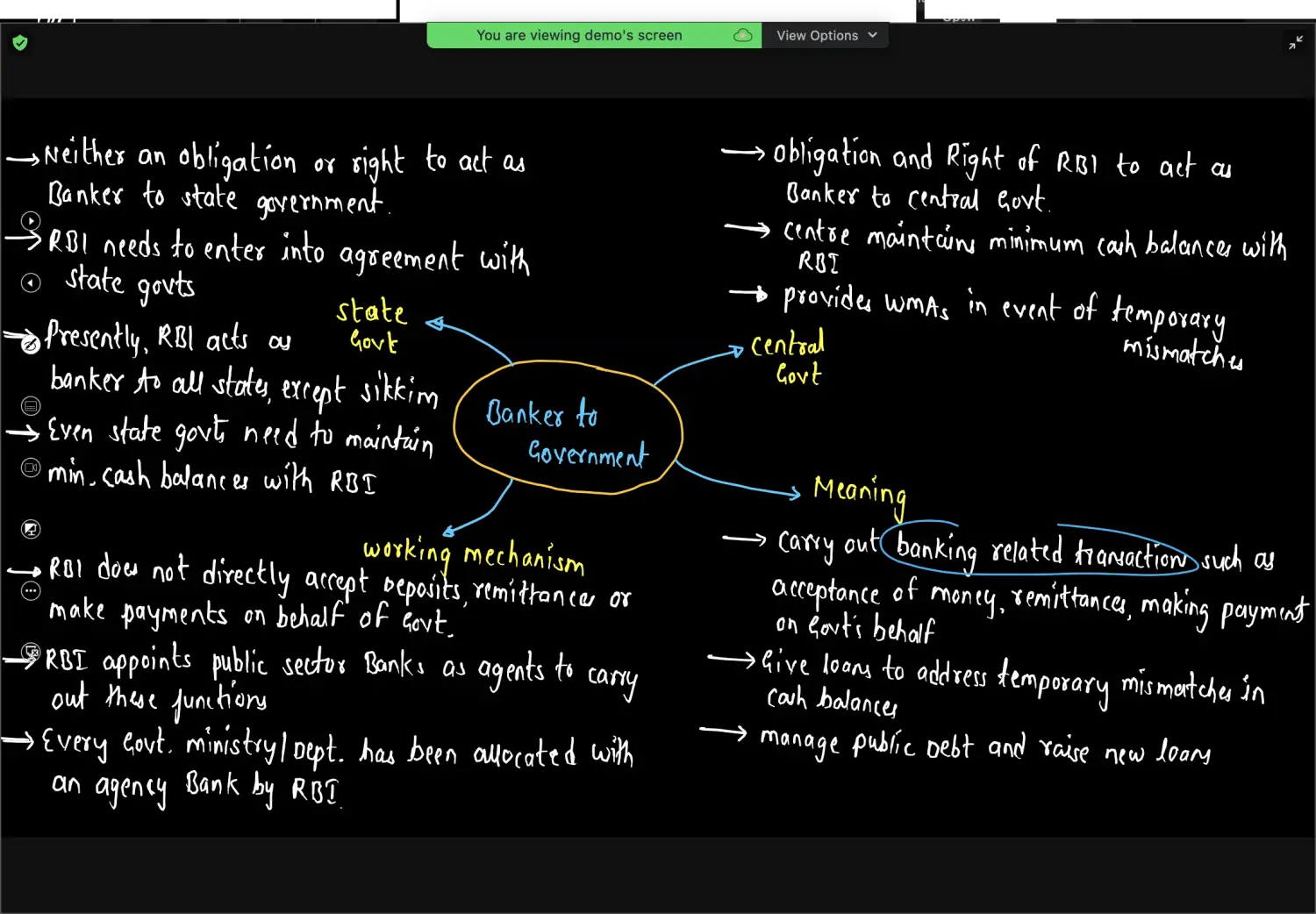
- Bankers to the Government
Functions
By RBI Itself
- RBI will Open Account of Centre & States
- C&S will have to Maintain Minimum Balance with RBI
- RBI will Give Loans to Govt
By Agency Bank appointed by RBI
- RBI will Help Accept Payments - Tax etc
- RBI will Help Make Payments - Salary of Govt Officials
Right & Obligation
- Centre
- RBI Cannot Say No to be the Banker
- Centre has a Obligation to make RBI as its Banker
- State
- RBI Can Say No to be the Banker
- State doesn’t have a Obligation to make RBI as its Banker
- Sikkim Bank is NOT RBI
- Sikkim Special Act, 1975 - Banking Regulations Act 1949 doesn’t apply to Sikkim
- State Bank of Sikkim is State Owned Bank of Sikkim
- State Bank of Sikkim was not under control of RBI until 2019/20
- Centre
Delegation of Functions
Some of the Function of Accepting & Making Payments is done by Agency Banks
for Ministry of Finance RBI may have chosen State Bank of India
Mind Map
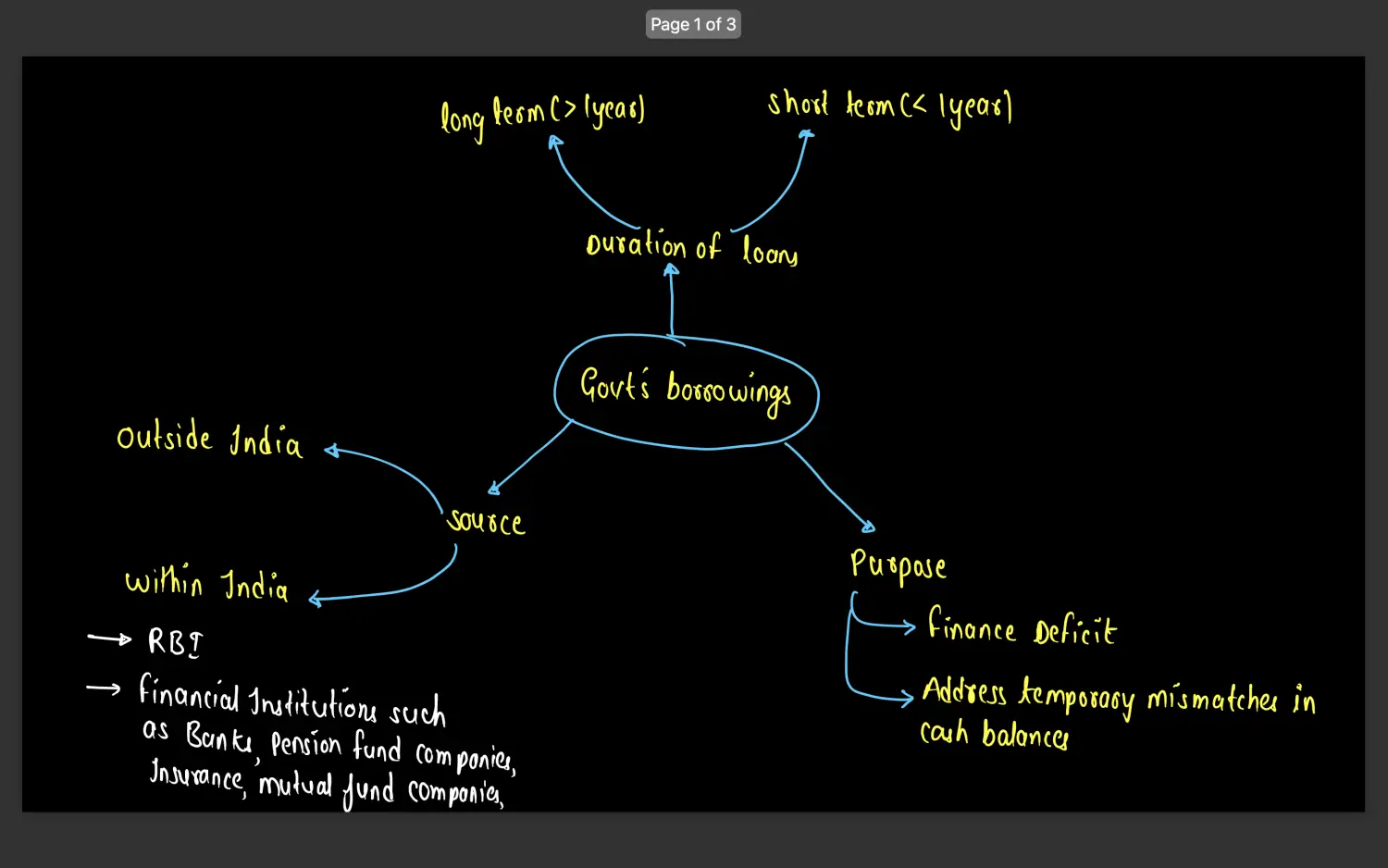
- Debt Manager of Government
Why does Government has to Borrow in the First Place ?
- Income (Amount of Money Tax) < Expenses (Govt Spending Obligation)
- Income 20 Lac Crore < Expense 37 Lac Crore
- Hence, Govt Needs Money of Difference which is 17 Lac Crores
- The Money we Borrowed == Money Govt earns as Income
Why Doesn’t India Cut down its Expenses ?
- For Welfare of People
- For Infrastructure
- Borrowing is Not a Option for India, Its a Necessity
From Where does Government Borrows (Sources) ?
- Outside India
External Debt From Chapters of Taxation From Chapters of External Sector
Two Entities Can Borrow Money from Outside India
- Government - Sovereign Debt
- Private Companies
External Debt of Govt is Managed by Ministry of Finance
RBI does NOT manage India’s External Debt
Money can be Borrowed from
- IMF, WB, ADB, AIIB
- Within India
- Govt can borrow Money from
- RBI
- Domestic Market
- Primary Dealers (Category of Investors)
Who are Primary Dealers
Similar to Corporate Bonds, GoI releases G Secs
These G Secs have Face Value, Maturity Period & RoI
RBI has authorised some dealers to Invest in G Secs called Primary Dealers
Primary Dealers are of Two Types
Bank Primary Dealers
Example
Kotak Securities
ICICI Securities
Standalone Primary Dealers
Why Invest in G Secs
- For Safe and Stable Investments
- Share Costs Vary & Fluctuate Severely but G Sec is Stable
Insurance Companies
Examples - LIC & Aditya Birla etc
They Sit on Huge Amount of Cash
They Need to Make Money out of this money but at the same time maintain safety of these returns
Hence they Invest in G Secs
- Banks
- Pension Fund Companies
- Retail Investors
- RBI Acts as Facilitator for Govt to borrow from Domestic Market (Its Institutions)
- How RBI Felicitates this Process
- Govt can borrow Money from
- Outside India
Mind Map Summarised
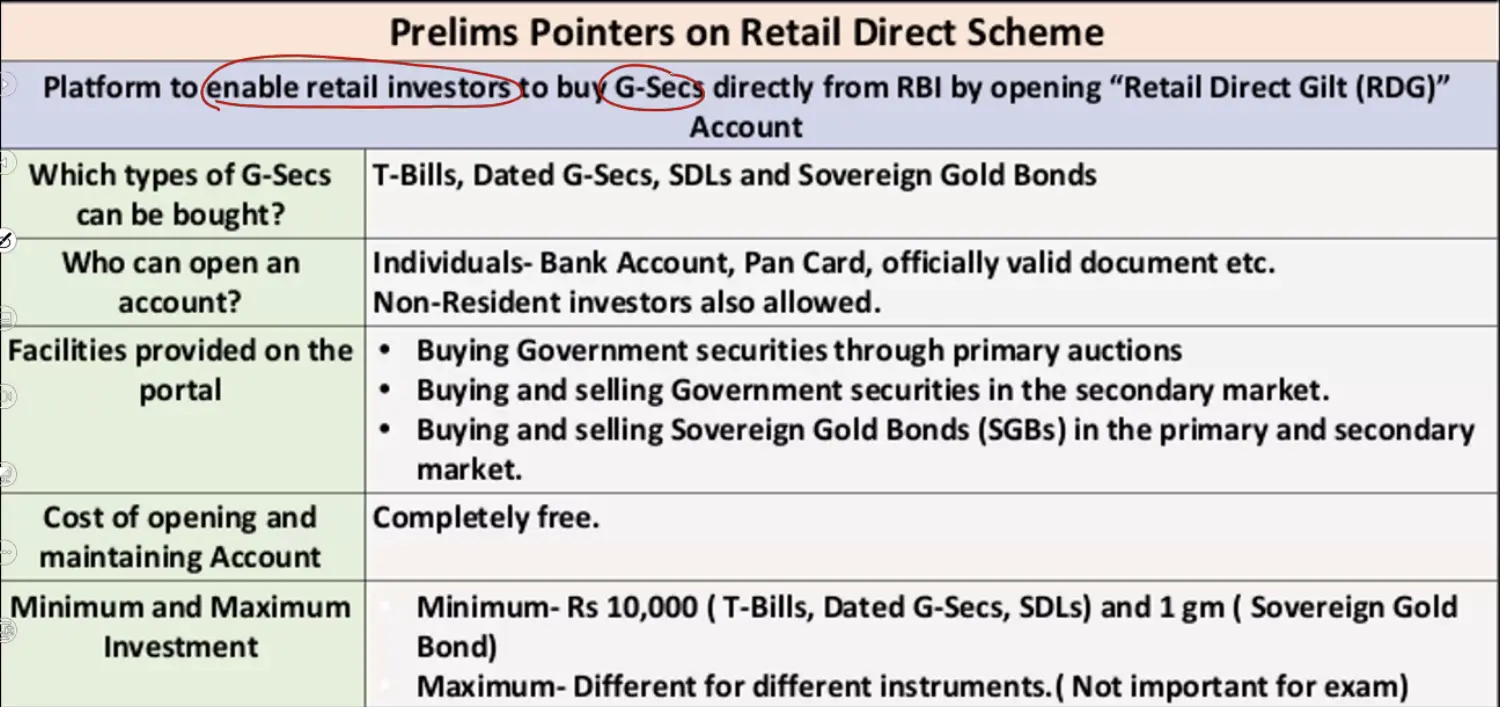
Retail Direct Scheme
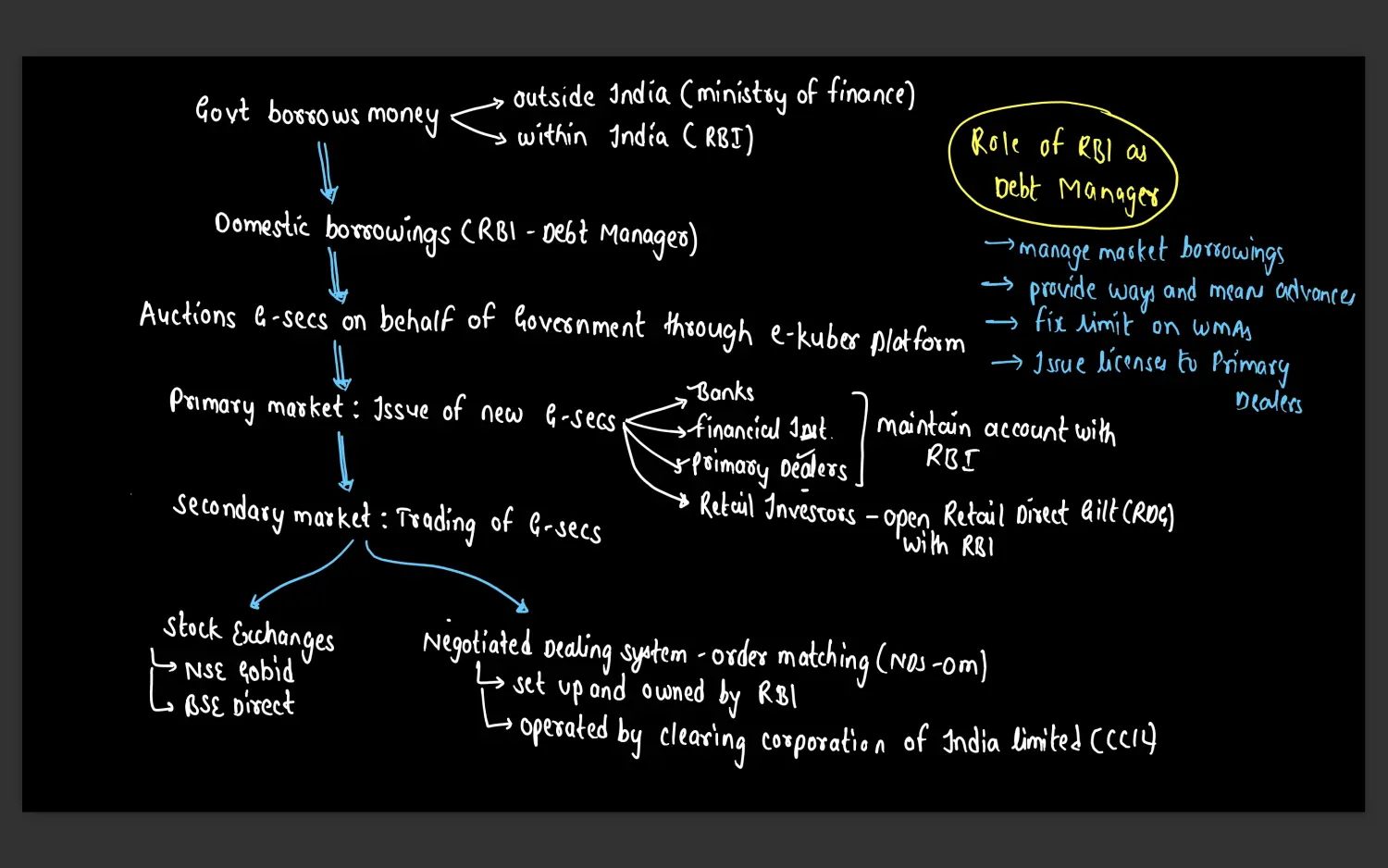
By what power does RBI act as a Debt Manager of Govt
Govt enables RBI to manage its borrowings, Its both a Right and a Obligation
RBI as Debt Manager of Govt in Domestic Market (within India)
For What Purposes Govt Borrows Money ?
To Finance its Deficit This Money is NOT repaid back in the Same Financial Year
Revenue of Govt - 20 LC
Expense of Govt - 37 LC
Deficit = Difference Between Revenue & Expense = 17 LC
To Address Temporary Mismatches in Cash Balances This Money is Repaid Back in the SAME Financial Year
Examples
Revenue/Income - 100
Expense - 150
Deficit - 50
Govt Borrowed & Not Repaid - 50
In What Manner RBI Manages Debt for Govt ?
RBI Lends Loan to Govt Directly
Monetisation of G Sec
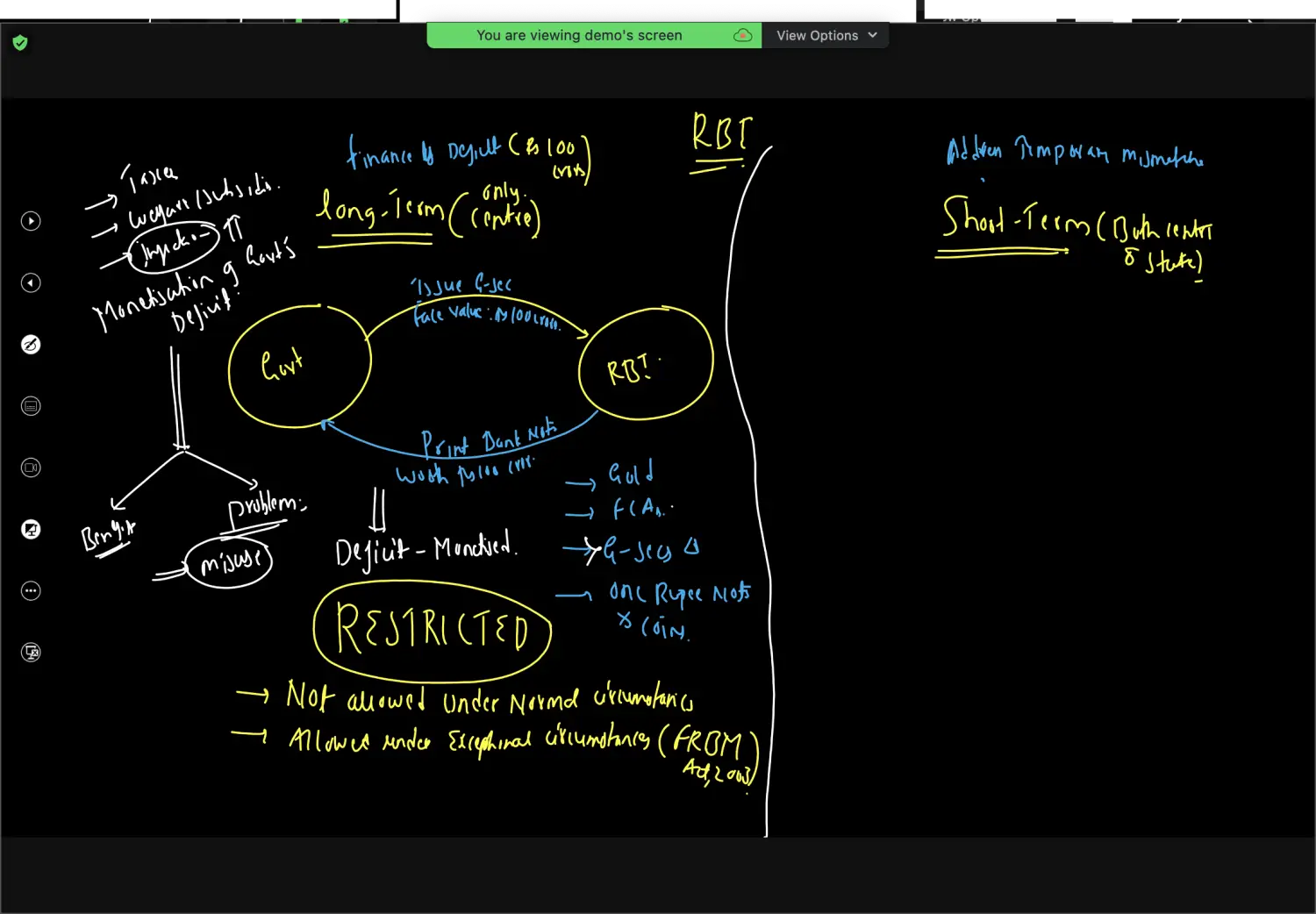
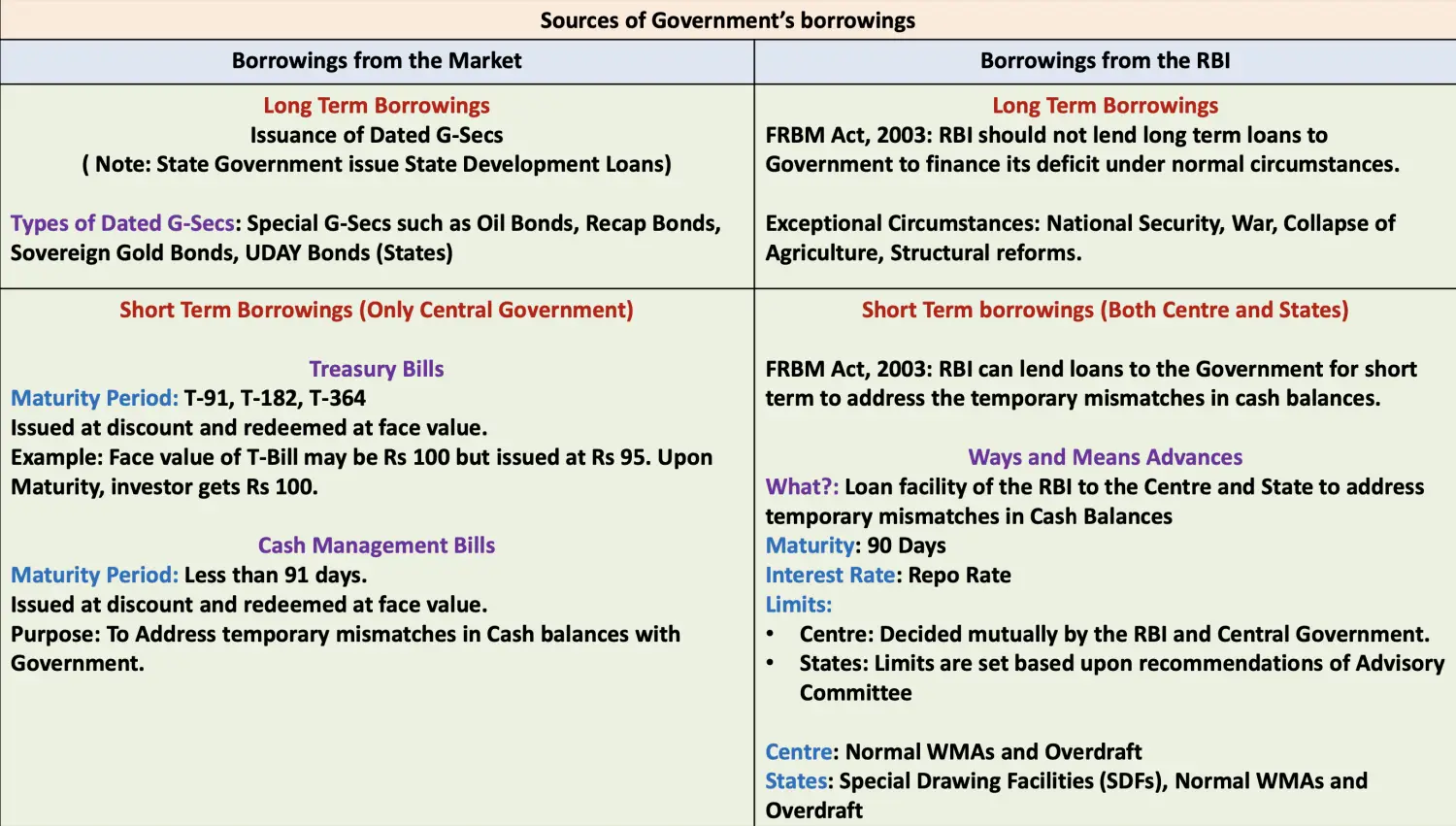
The Detailed Table of Types of Loans
| Long Term | Short Term | | --- | --- | | Only Centre | Both Centre and State | | To Finance Deficit | To Address Temporary Mismatches | | By Monetisation of G Secs | By Ways and Means Advances | | For Centre
Not Allowed under Normal Circumstances
Allowed Under Exceptional Circumstances
Circumstances have been laid down by FRBM Act, 2003 National Security Collapse of Agriculture | For Centre
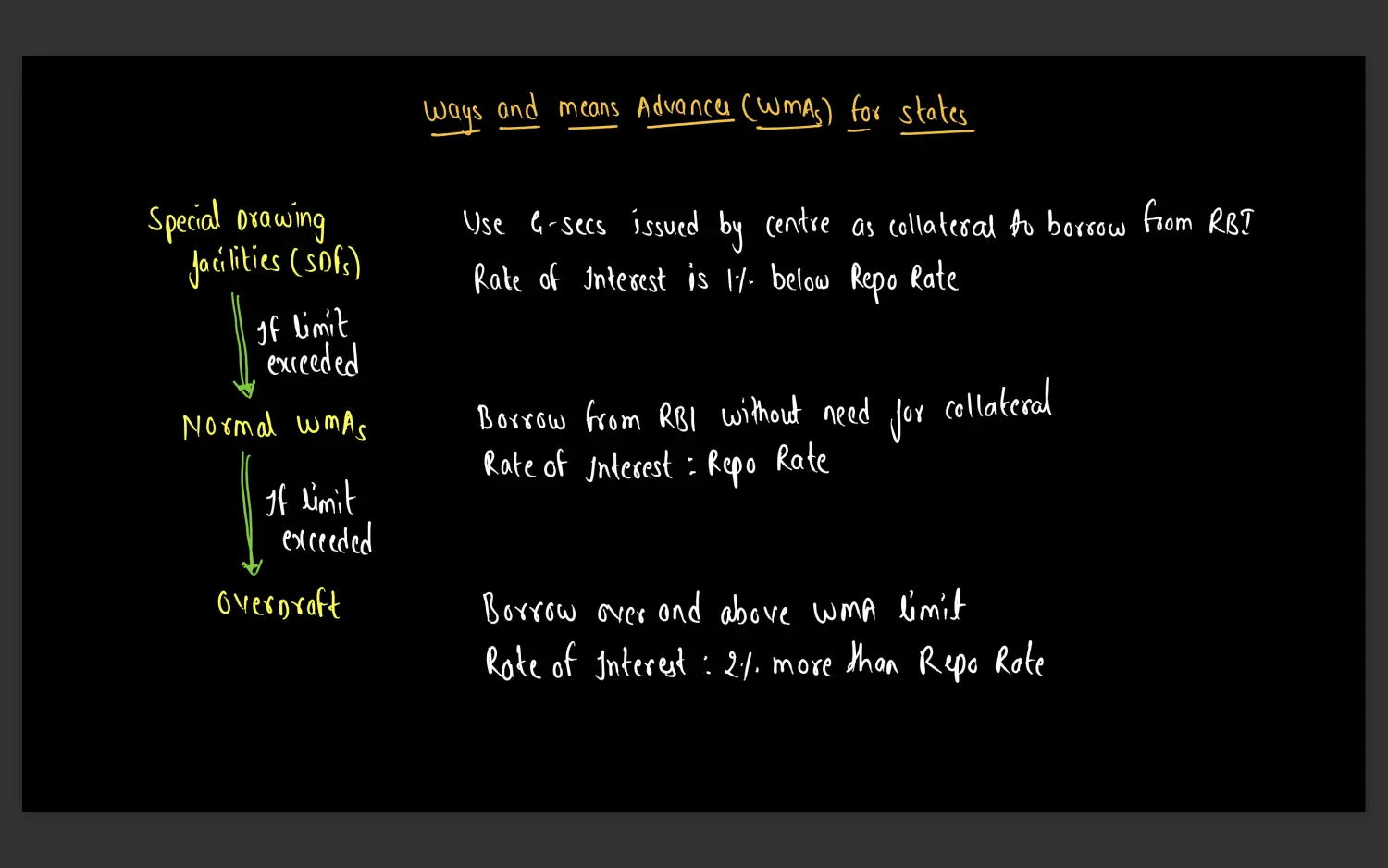
Normal WMA - Limit Fixed by RBI in Consultation with Centre Maturity Period 90 Days
Here, ROI = Repo Rate 2. Overdraft When Apr to Dec 100 Crore Done, Jan to Mar Money is Still Needed
Hence Overdraft is taken Here ROI = Repo Rate + 2% | | For State
Not Allowed to Borrow from RBI | For State 1. Normal WMA - Same as Centre 2. Overdraft - Same as Centre 3. SDF - Special Drawing Facility - for State Only State investing in Centre G Secs Dated Bonds, T Bills, CMB,
This Bond can be used as Collateral to Borrow from RBI
*Here, ROI = Repo Rate - 1%
By this Means, RBI forces state to Invest in Central G Secs* |
Summary of WMA
RBI Helps Govt to take Loan from Domestic Market
RBI Helping in Borrowing Money from the Market
Short Term (< 1 Year) && (Long Term > 1 Year)
ST & LT to be used as abbreviation while practising
Keep in Mind which LT & ST are given to States and which to Govt
The Detailed Table of Types of Loans
| Long Term → > 1 Year | Short Term → < 1 Year | | --- | --- | | Centre & State Both Allowed | Only Centre State Now Allowed | | RBI Issues for Centre: Govt Dated Bonds (GDB)
Face Value: How Much Money Govt is Borrowing
Maturity Period: For How Much time Govt is Borrowing 4 to 40 Years
Rate of Interests : *How Much Interest will Govt Pay * Fixed Rate Govt Bonds - ROI Same for whole Tenure
Floating Rate Govt Bonds - ROI Changes Every 6/12 Months| Treasury Bill (T Bill) is issued by RBI for Centre to Borrow
When You buy a T Bill, You Give Loan to the Govt
Face Value
Maturity Period of 91 Days - T 91 of 182 Days - T 182 of 364 Days - T 364 T 14 has been done away with
Rate of Interests : *There is no Interest on T Bill *The T Bill is Issued at a Discount & Redeemed at Face Value
| | RBI Issues for State: State Development Loan (SDL)
Face Value: How Much Money Govt is Borrowing
Maturity Period: 4 to 40 Years
Rate of Interests : Fixed Rate Govt Bonds - ROI Same for whole Tenure
Floating Rate Govt Bonds - ROI Changes Every 6/12 Months | ***Cash Management Bill (CMB)*** is issued by RBI for Centre to BorrowFace Value:
Maturity Period b/w 1 to 90 Days
Rate of Interests : *There is no Interest on CMB *The CMB is Issued at a Discount & Redeemed at Face Value
Generally Bought to Address the Temporary Mismatch
| | Special Government Securities This is For Both Centre and States
- Oil Bond
- UDAY Bond
- Recap Bonds
- Sovereign Gold Bonds | |
Government Securities - G Sec
- Normal G Secs → 2 Special G Secs → Special Govt Securities
Sources of Govt Borrowings - Summarised
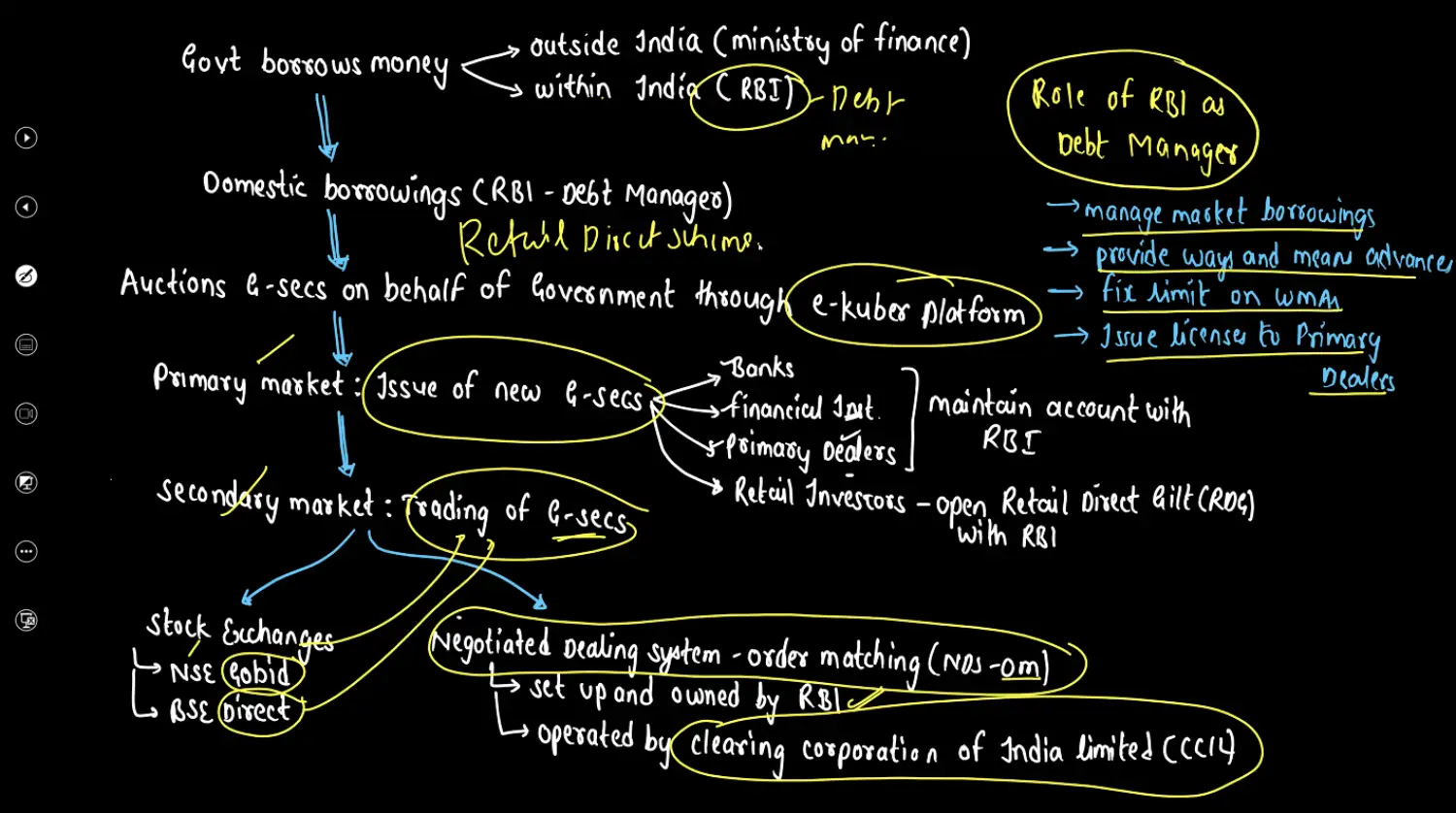
How Exactly RBI Issues G Secs
RBI is Debt Manager
↓Issues G Secs
↓Dated Bonds
CMB
T Bill
SDF
Auctioned Through - E Kuber
- Bank
- Primary Dealers
- Retail Investors
Earlier
- Did Not Open Account with RBI
- Not Allowed to Buy G Sec Directly in Primary Market
- But Retail Investors can buy Indirectly by Means of
- Demat account
- Banks
- Primary Dealers
Now - Retail Direct Scheme
Open Retail Direct Gilt Account (RDG)
Directly from G Sec from RBI
Mind Map - Primary and Secondary Markets
- Bankers to Bank
Framework Mind Map
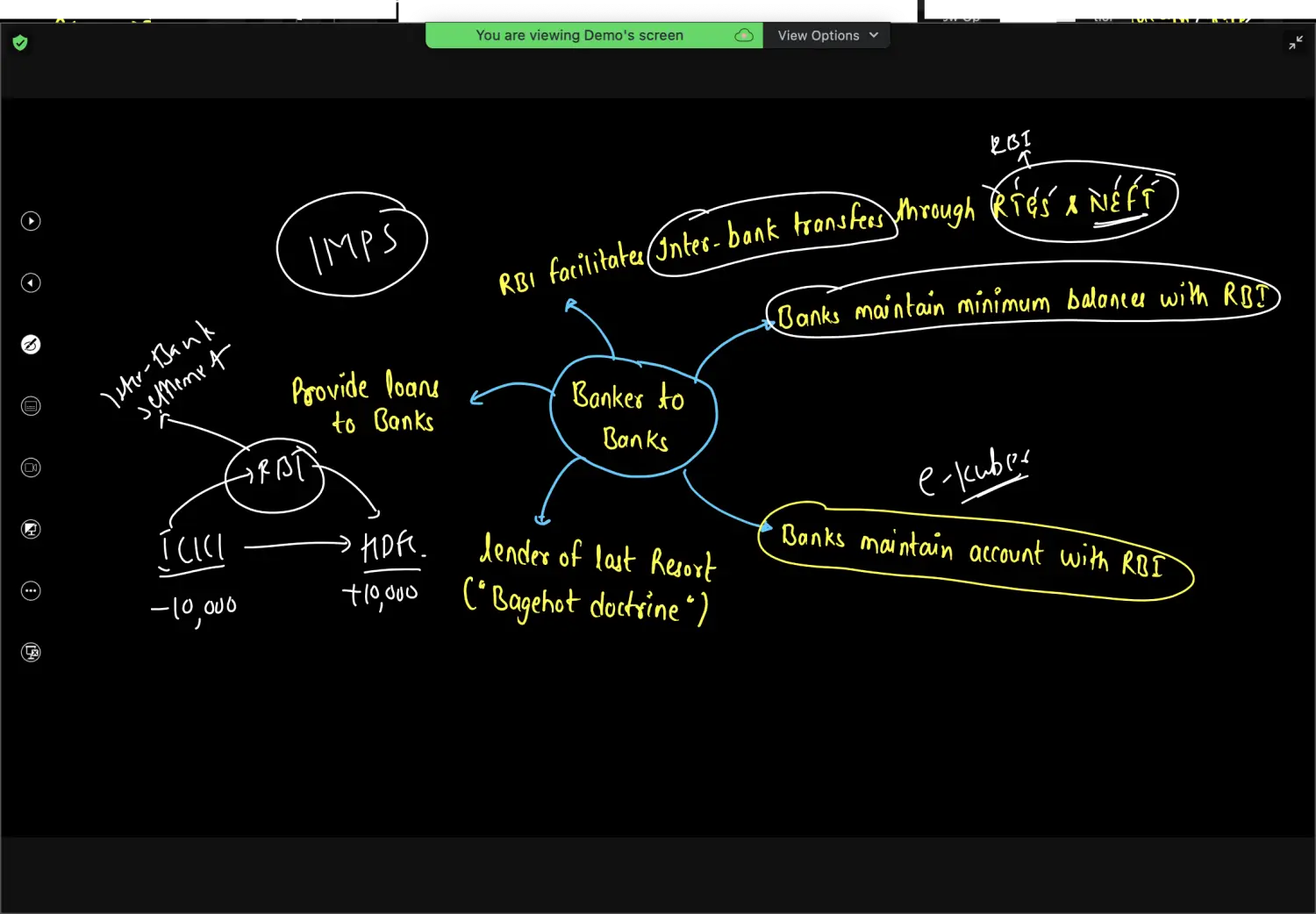
Payment Methods - Payment and Settlement Chapter
- By RBI
- NEFT - National Electronic Fund Transfer
- RTGS - Real Time Gross Settlement
- By NPCI
- IMPS - Immediate Payment Service
- UPI - Unified Payment Interface
- By RBI
Provides Loan to Banks - Monetary Policy Chapter
- Lenders of Last Resort
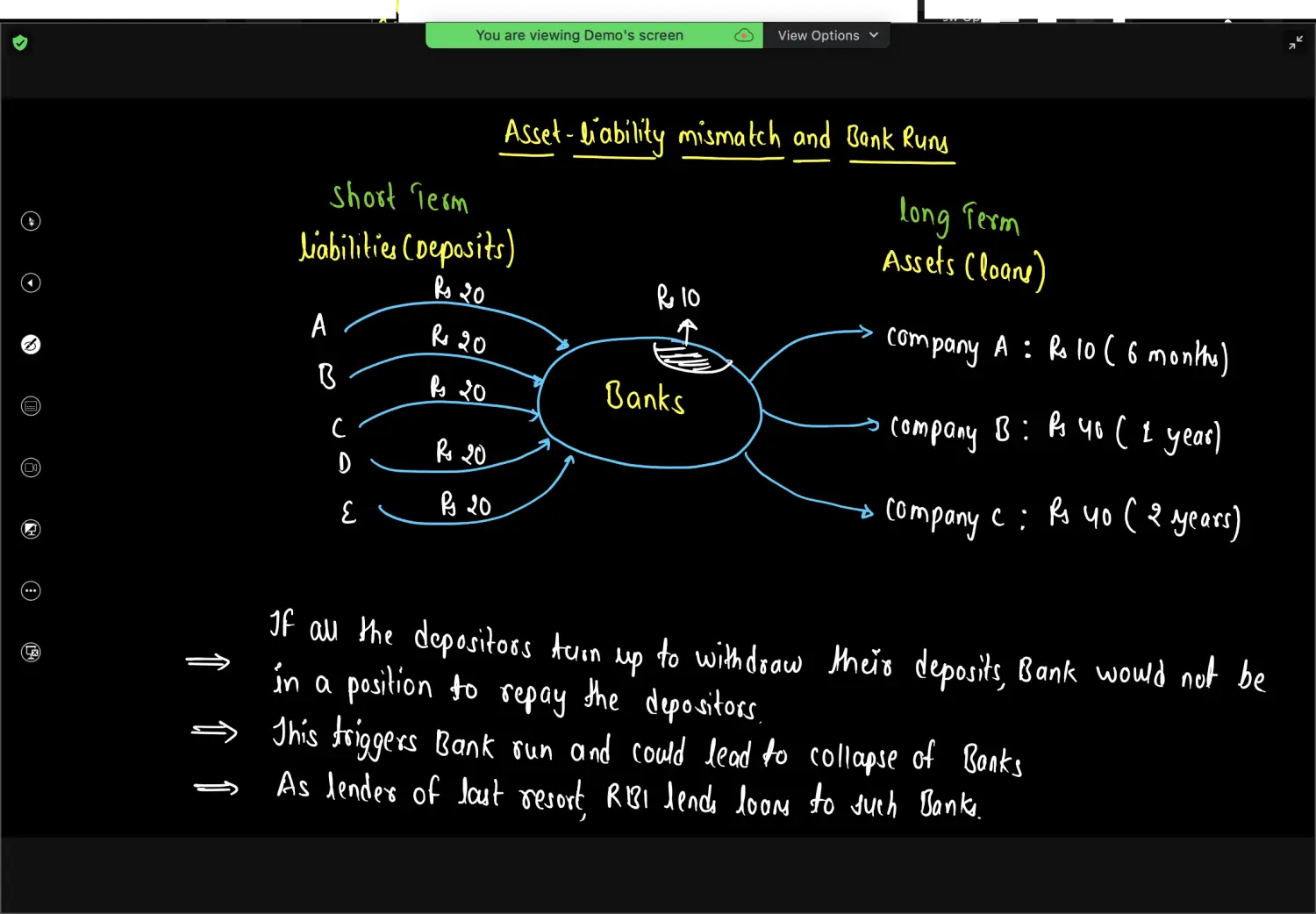
Asset Liability Mismatch and Bank Run - Lender of Last Resort - ”Bagehot Doctrine”
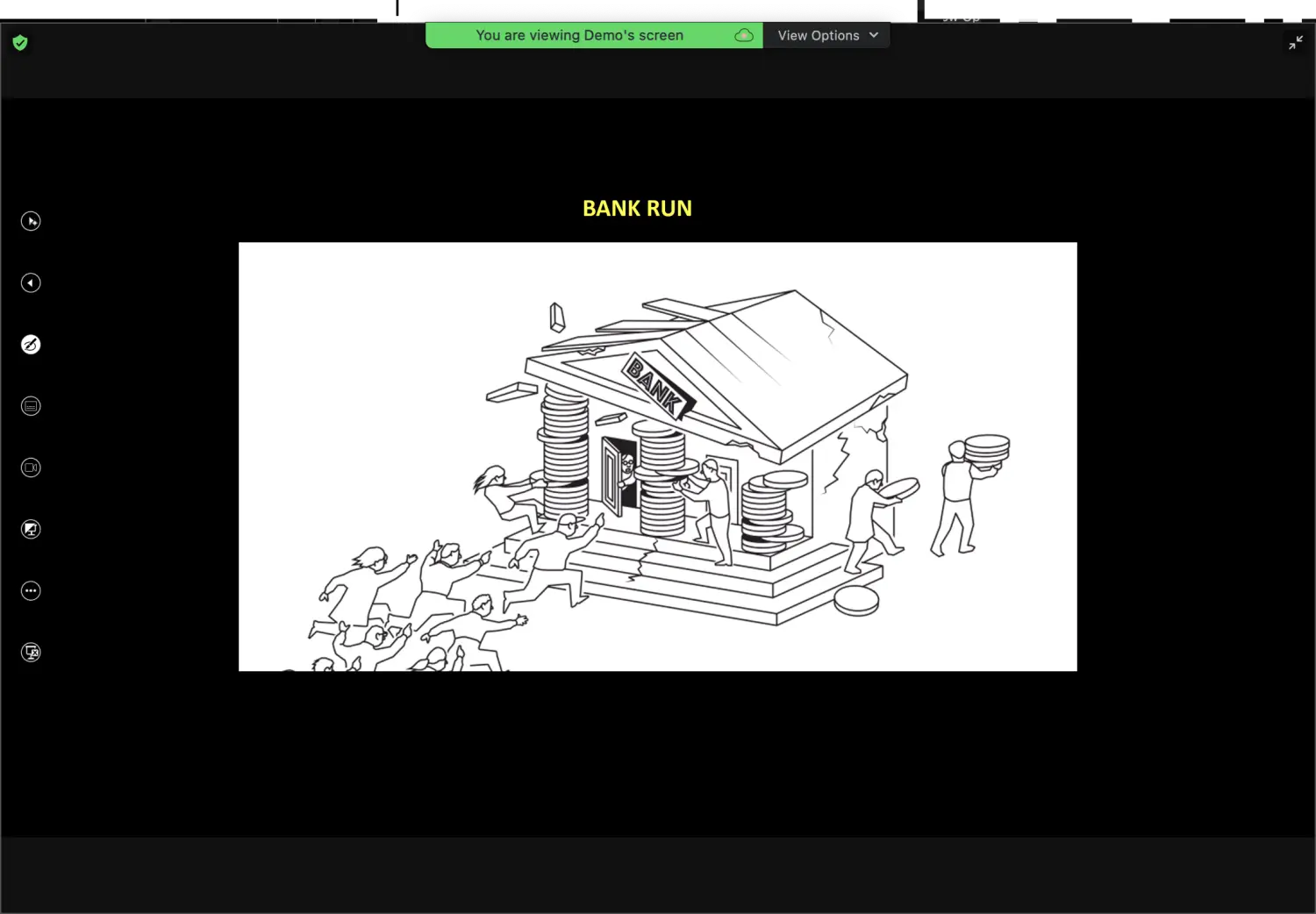

- Regulations of Banks and Other Entities
What is the Meaning of Regulation
Regulation :
- To Ensure that Private Banks are working in the best interest of banks
- To Make banks work in Efficiently
Regulation of Financial Institutions - Banks & NBFC Detailed
What is the Difference Between Private Banks and Public Sector Banks
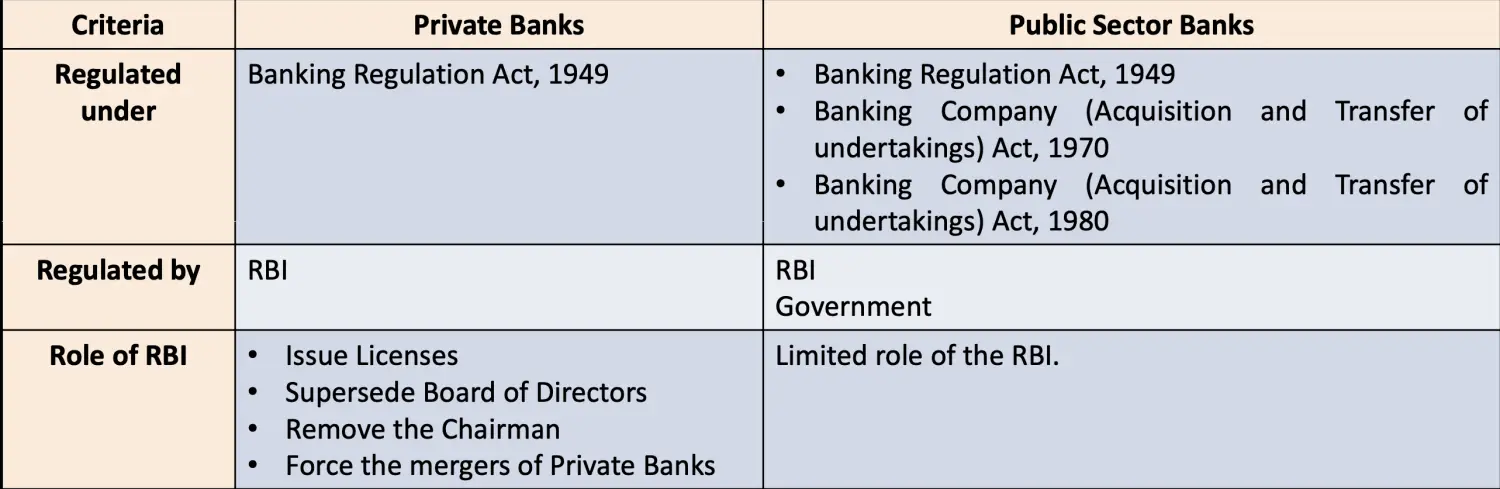
Banks
- Private Sector Banks
Private Banks
Private Banks are Regulated by Private Banks of India
These Banks in India are Registered as Companies under the Companies Act
Parliament of India passed a legislation called Banking Regulation Act, 1949
How is Regulation Ensured
Lays Down Elaborate Eligibility Criteria
- Process
- Earlier - at a time, there is a notice for banks to invite application, submit, scrutinise, approve
- Now - eligibility criteria laid down, no wait for notice inviting application, at any point of time, apply and submit, scrutinise, approve → On Tap Licensing
- Criteria
Min Capital of Rs 500 Crore
Successful Track Record of Bring in the Banking Sector for at least 10 Years
Example : IDFC & Bandhan Bank, Only these sectors were chosen because they were working as MFI’s (Micro Finance Institution)
Large Corporate Houses in india cannot be issued license
Example : Tata, Ambani, Reliance
Problem :
Interconnected Lending
Favourism
- Process
Give Licenses to Banks - India and Foreign
Lay Down Qualifications of Board of Directors of Bank
RBI can supersede BOD of Private Banks
Meaning BOD Removed RBI will appoint its own officials
RBI can undertake merger of Private Banks
- Public Sector Banks
- Originally PSU Bank
- By Legislation of Parliament
- SBI by SBI Act
- Turned into PSU Bank by Nationalisation
- By Nationalisation of Bank in
- 1969
- 1980
- Examples
- Bank of Baroda
- PNB
- Central Bank
- Canara Bank
- By Nationalisation of Bank in
- Originally PSU Bank
- Regulations of Types of Bank
- Private Banks
- Companies Act
- Banking Regulations Act, 1949 - Only BY RBI
- Public Sector Banks (PSB)
Original
- SBI Act, 1955 - By Ministry of Finance (Govt)
- Banking Regulations Act, 1949 - By RBI
Nationalised
- The Banks Own Act - Bank Nationalisation Act, 1970 & 1980
- Banking Regulations Act, 1949
Note : Some Provisions of Banking Regulations Act, 1949 are NOT applicable to Public Sector Banks
The Provisions of Exception for Public Sector Banks are
- No License Required from RBI
- RBI cannot lay down Qualification for BOD of PSB
- RBI cannot supersede BOD of PSB
- RBI cannot force merger of PSB
- Hence it can be said that RBI is handicapped in the case of PSB
- Private Banks
- Privatisation of Public Sector Banks
- The Bank Nationalisation Acts of 1970 & 1980 State that Govt ownership should be always greater than 51%
- For Privatisation, The Govt Ownership should be less than 51%
- Hence, for the Banks to be Privatised, the ownership should be less than 51%
- For this to happen the Bank Nationalisation Acts of 1970 & 1980 which are preventing the Govt to reduce its ownership should be change
- This changes can only be brought in by means of by a amendment act as the Law of Nationalisation is by Parliament
- Private Sector Banks
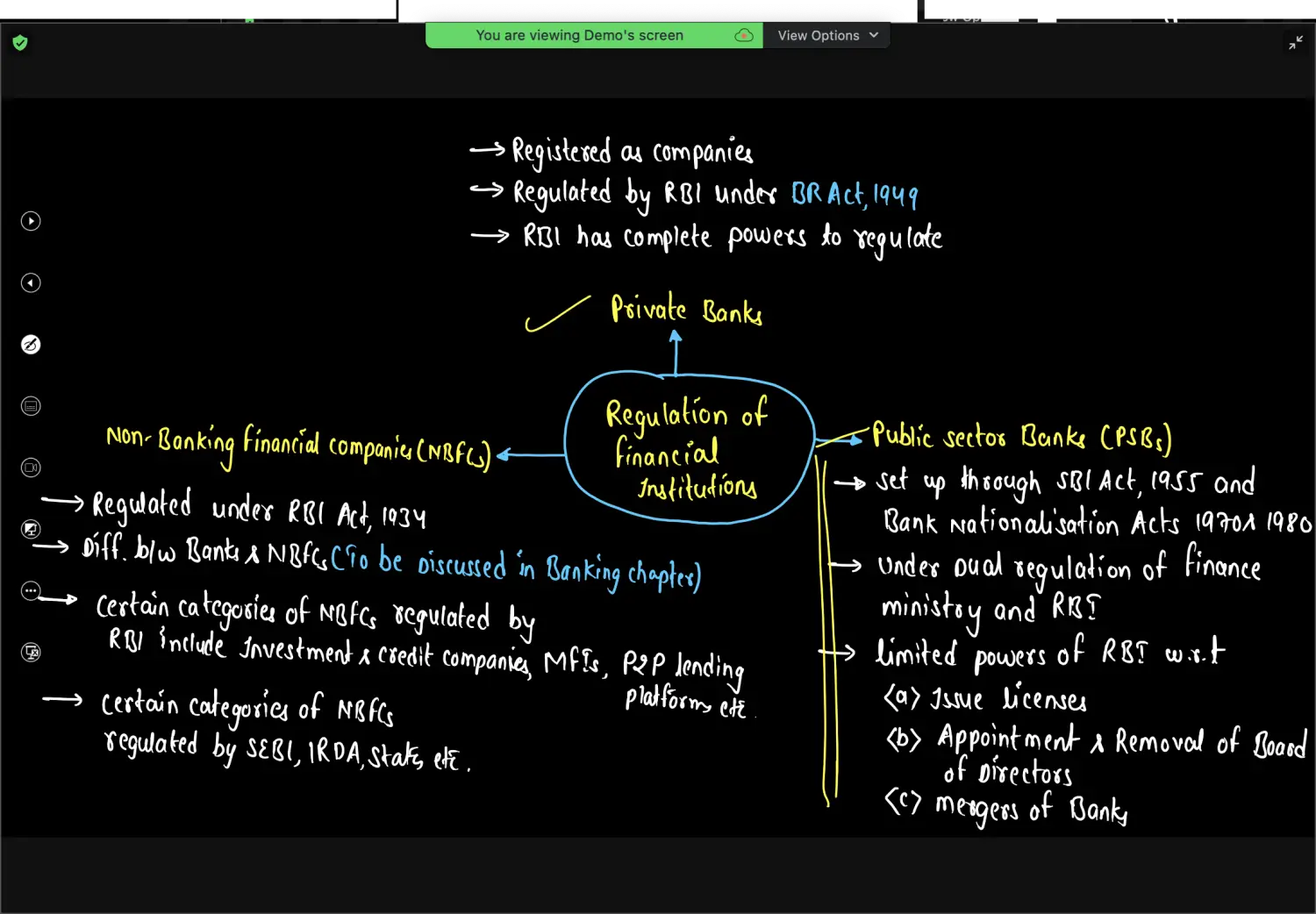
Other Entities - NBFC
- NBFC - Non Banking Financial Companies
Who are they
- They can accept Deposits
- They can give loans
- They don’t have a license of Bank but a License of NBFC from RBI
Examples of NBFC
- MFI
- Credit Companies
- P2P Lenders
Why do MFI Exist ?
- No Small Value Loans are Given by Banks, Hence NBFC is an option for people wanting low value loans
- Banks are Interested in Large Value Loans
Examples
Bajaj Finance
Mahindra Finance
Muthoot Gold Loans
Revision Mind Map
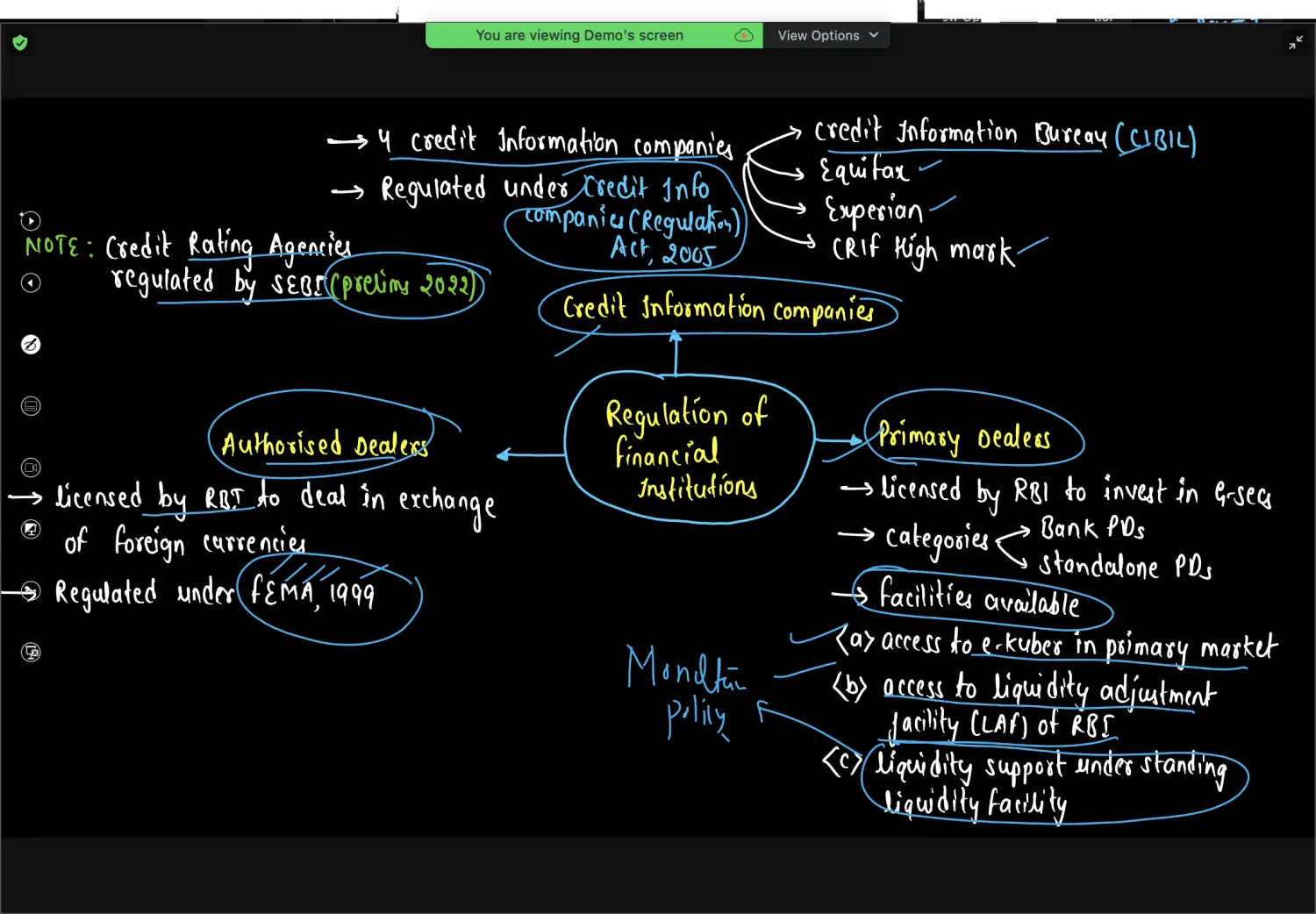
- Credit Information Companies - Regulated by RBI
They Generate CIBIL Score
How Much Loan
Any Pending Loan
Repaid Loan
Income Tax Paid
Credit Rating Agencies - Regulated by SEBI - To Not Get Confused
Some Agencies
International Agencies
They Take into account only GDP Size, Indian Govt is asking for considering the Growth Rate of Indian GDP as well
- S&P
- Moddy’s
- FITCH
Indian Agencies
ICRA - Indian Credit Rating Agencies
Types of Credit Ratings
- AAA+
- AAA
- AAA-
- BBB+
- BBB
- BBB-
- Primary Dealers
- Bank & Standalone PD
- Authorised Dealers
- NBFC - Non Banking Financial Companies
Regulation of Financial Institutions - Banks and NBFC Summarised
Regulation of Financial Institutions - PD, AD & CIC
- Management of Foreign Exchange - Other Chap
Will be Covered in External Sector Chapter
- Regulation of Payment & Settlement System - Other Chap
in Chapter of Banking and Payment & Settlement Systems
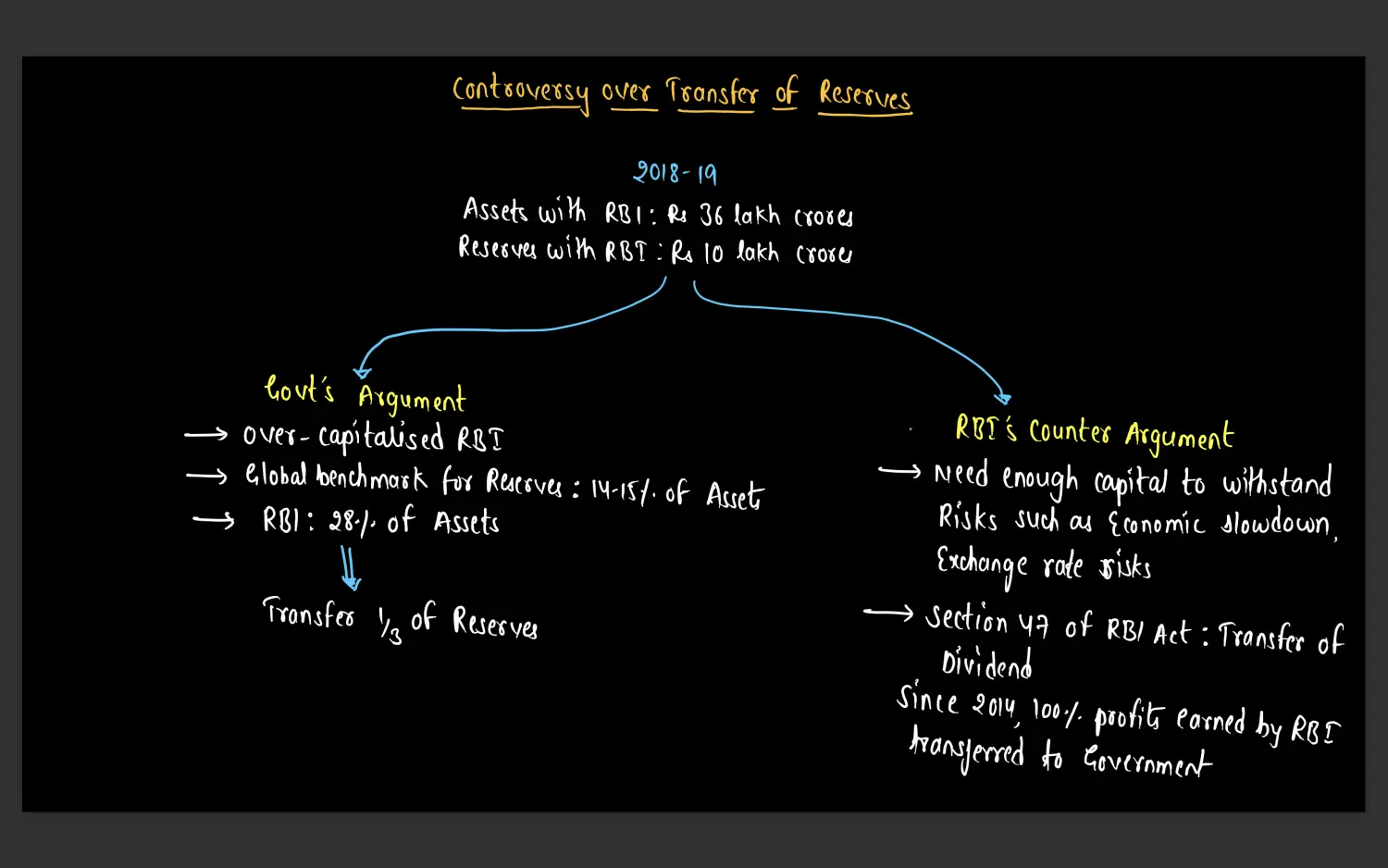
RBI’s Economic Framework
Controversy Over Transfer of Reserves
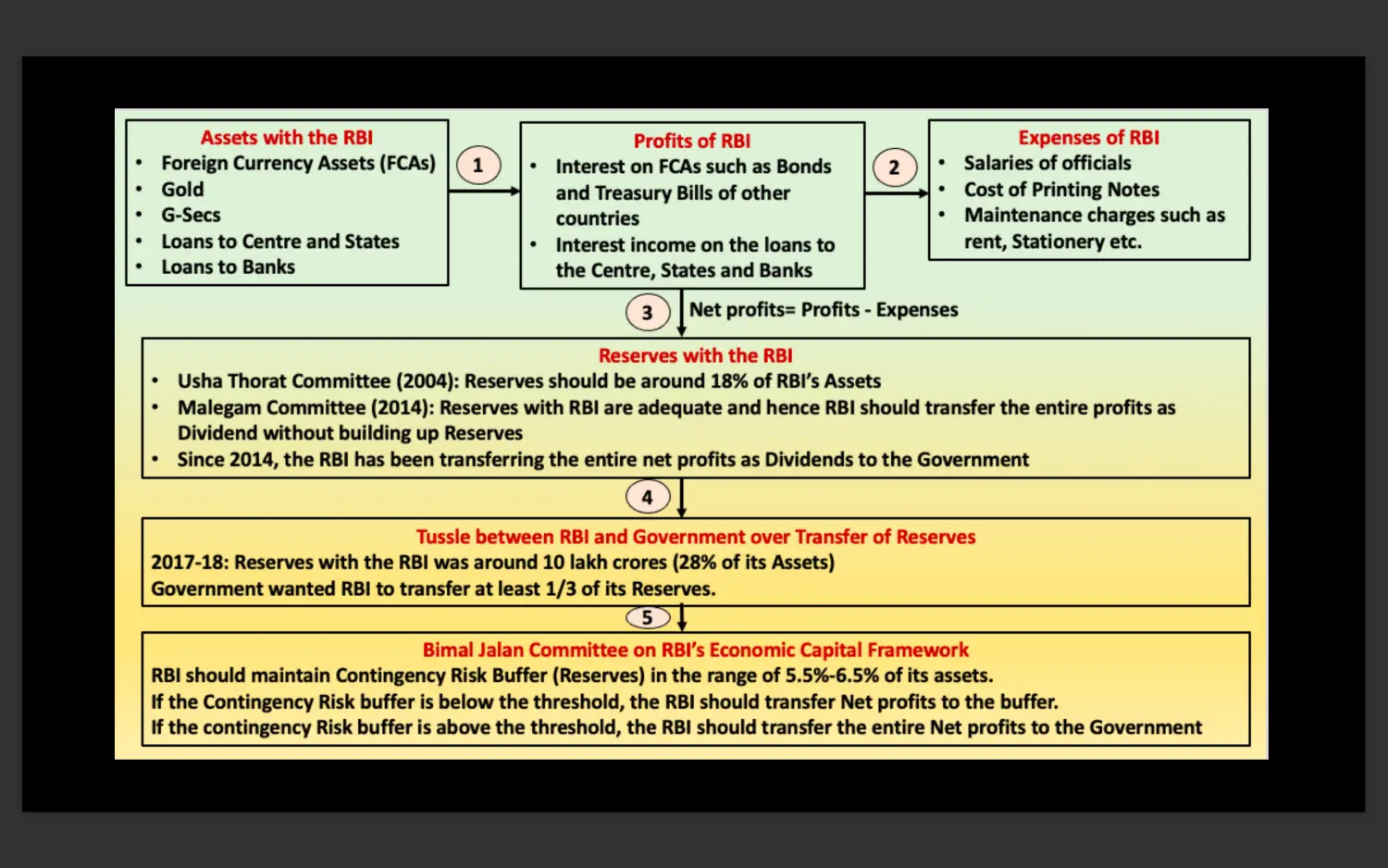
The Whole Timeline
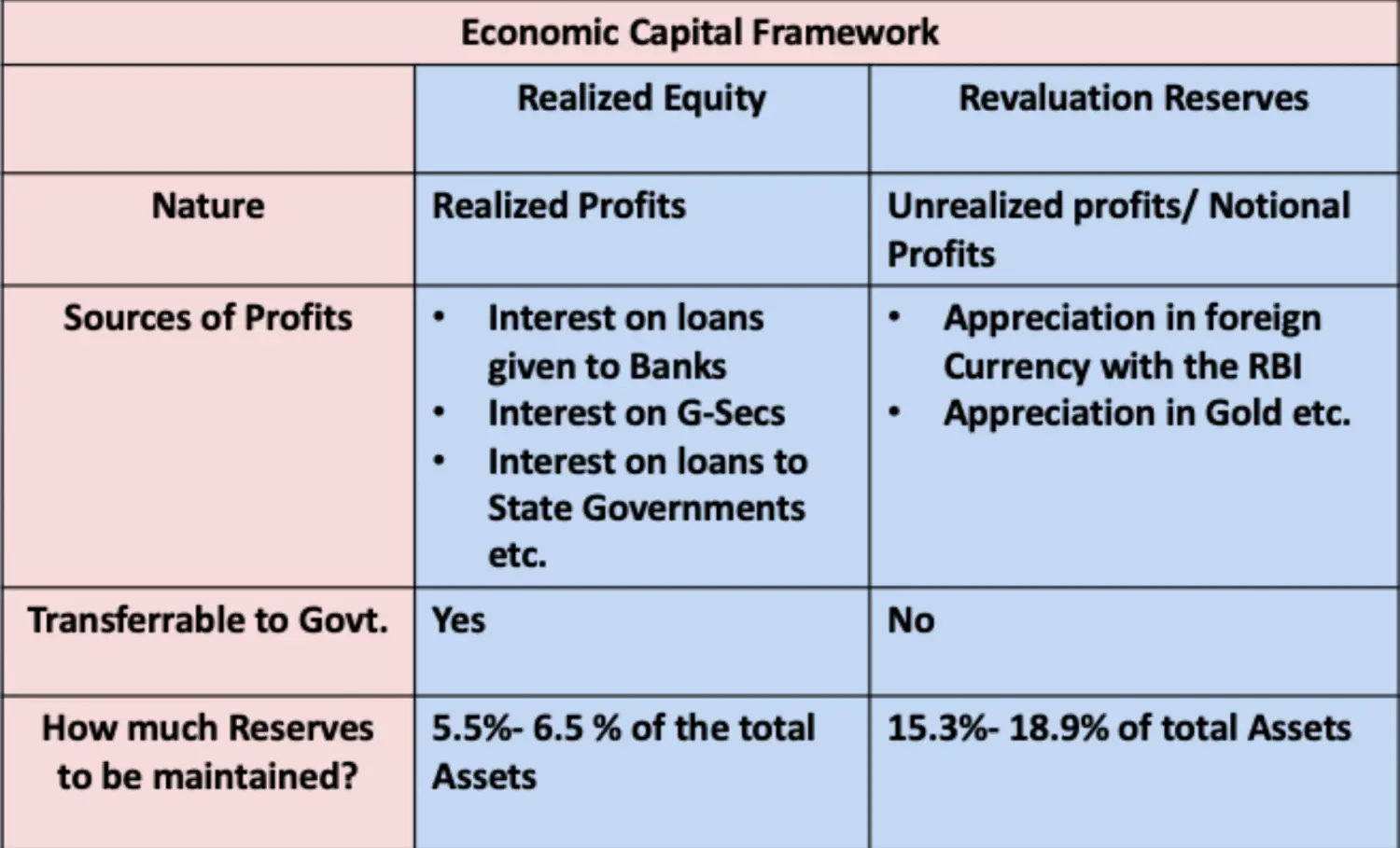
Bimal Jalan’s Committee Recommendation - Realised and Unrealised Profits
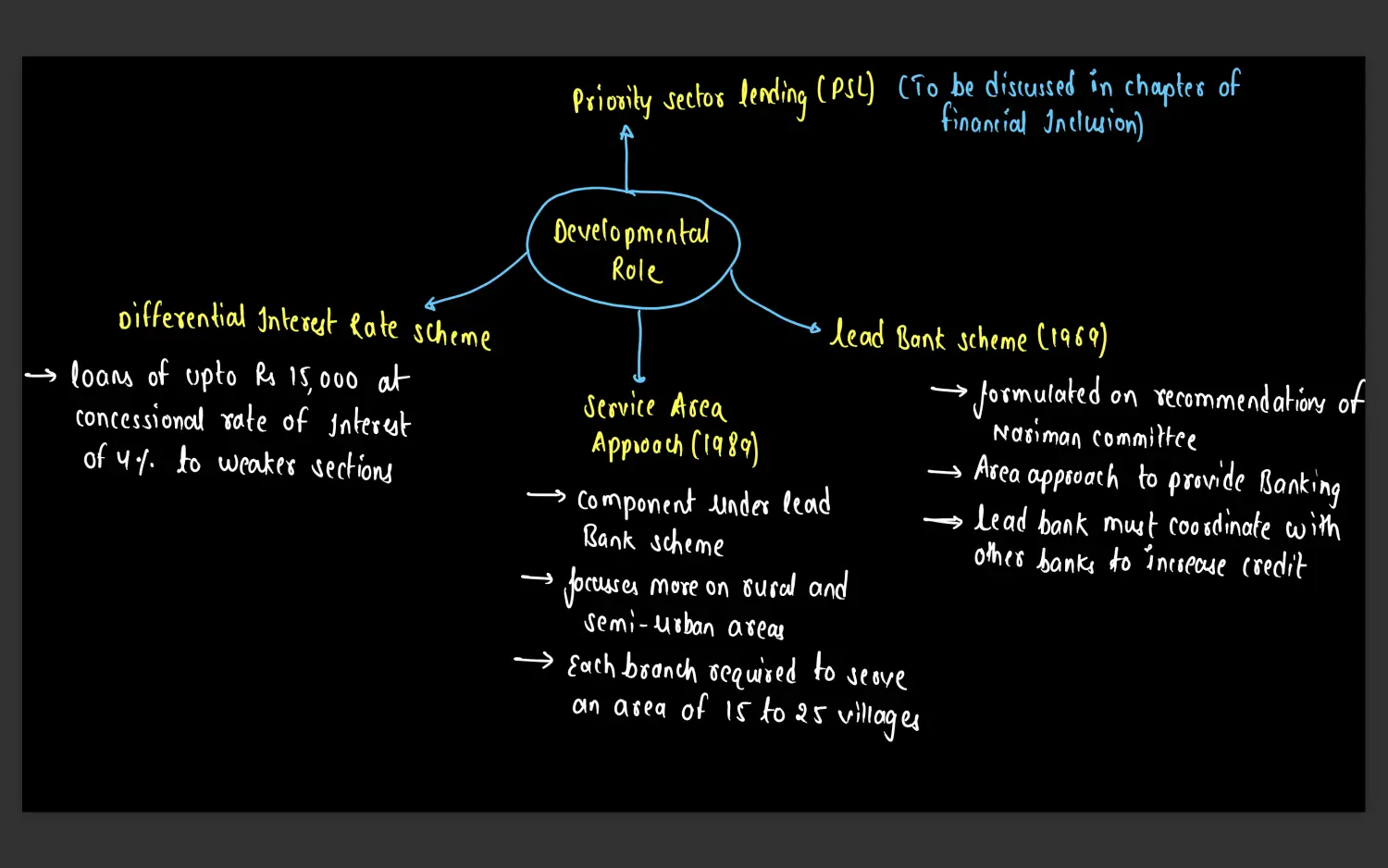
Various Schemes by RBI - PSL, Lead Bank, Service Area, Differential Rate
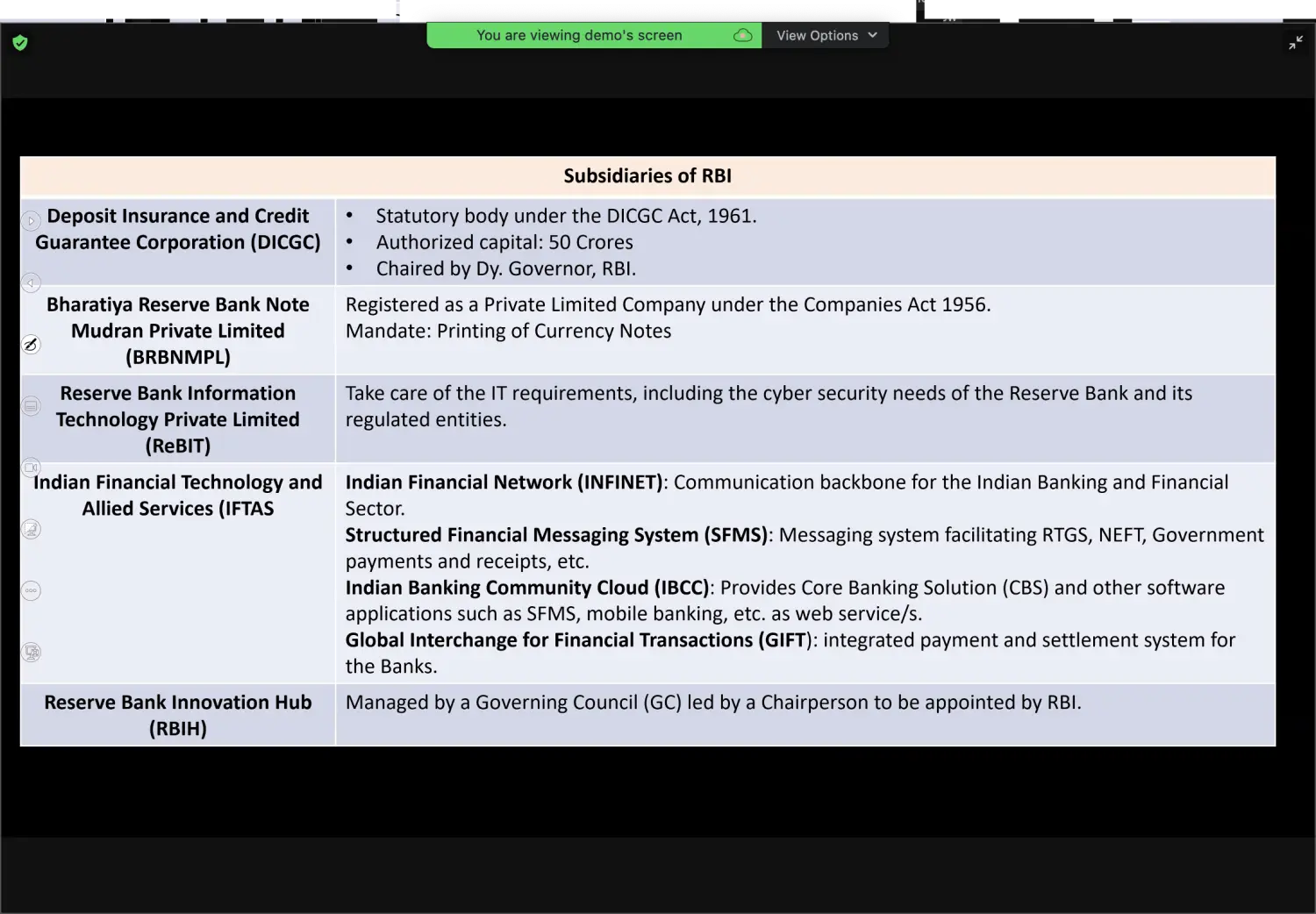
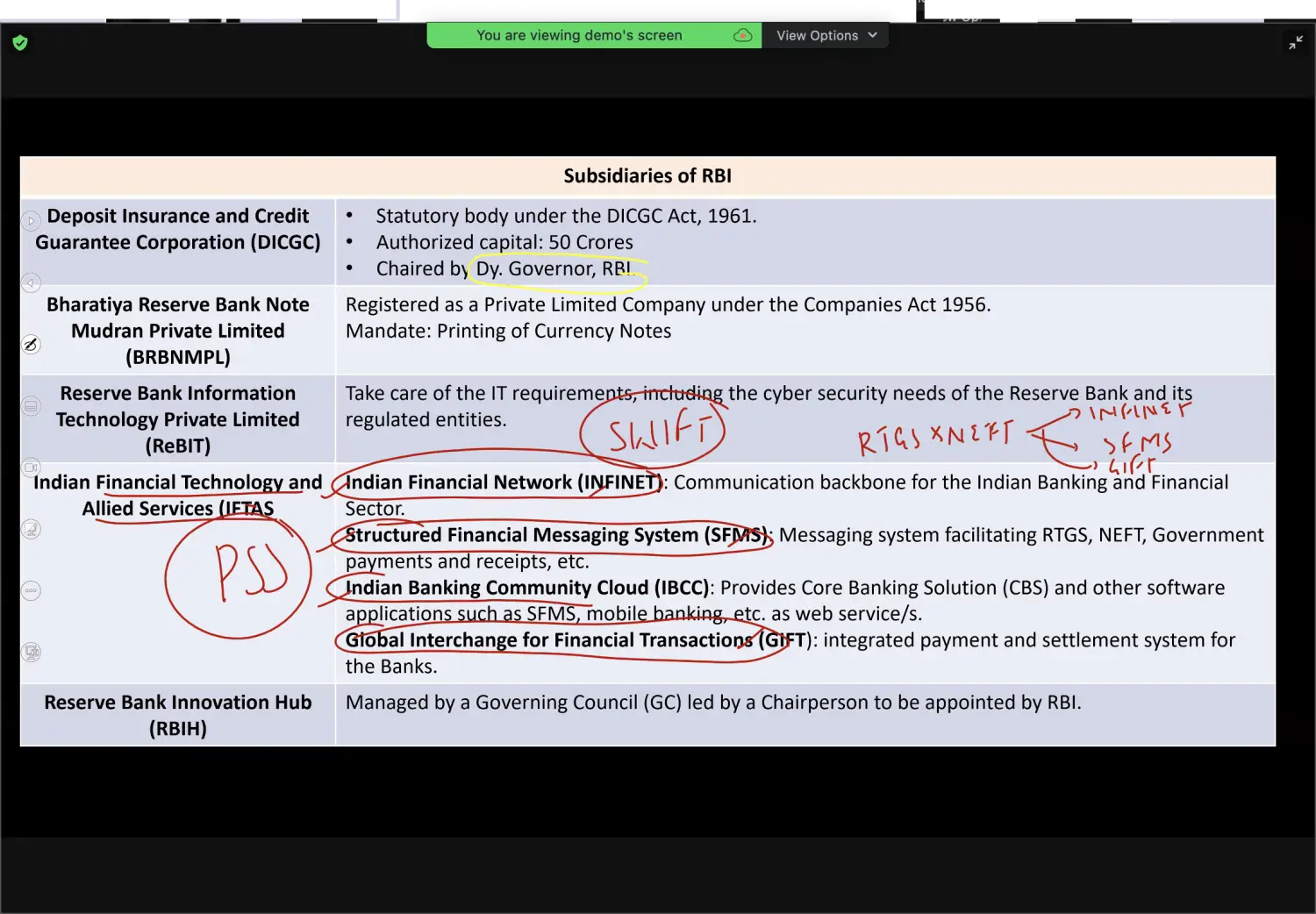
Subsidiaries of RBI
Meaning RBI has a 100% Ownership of the Subsidiary Company. Example is
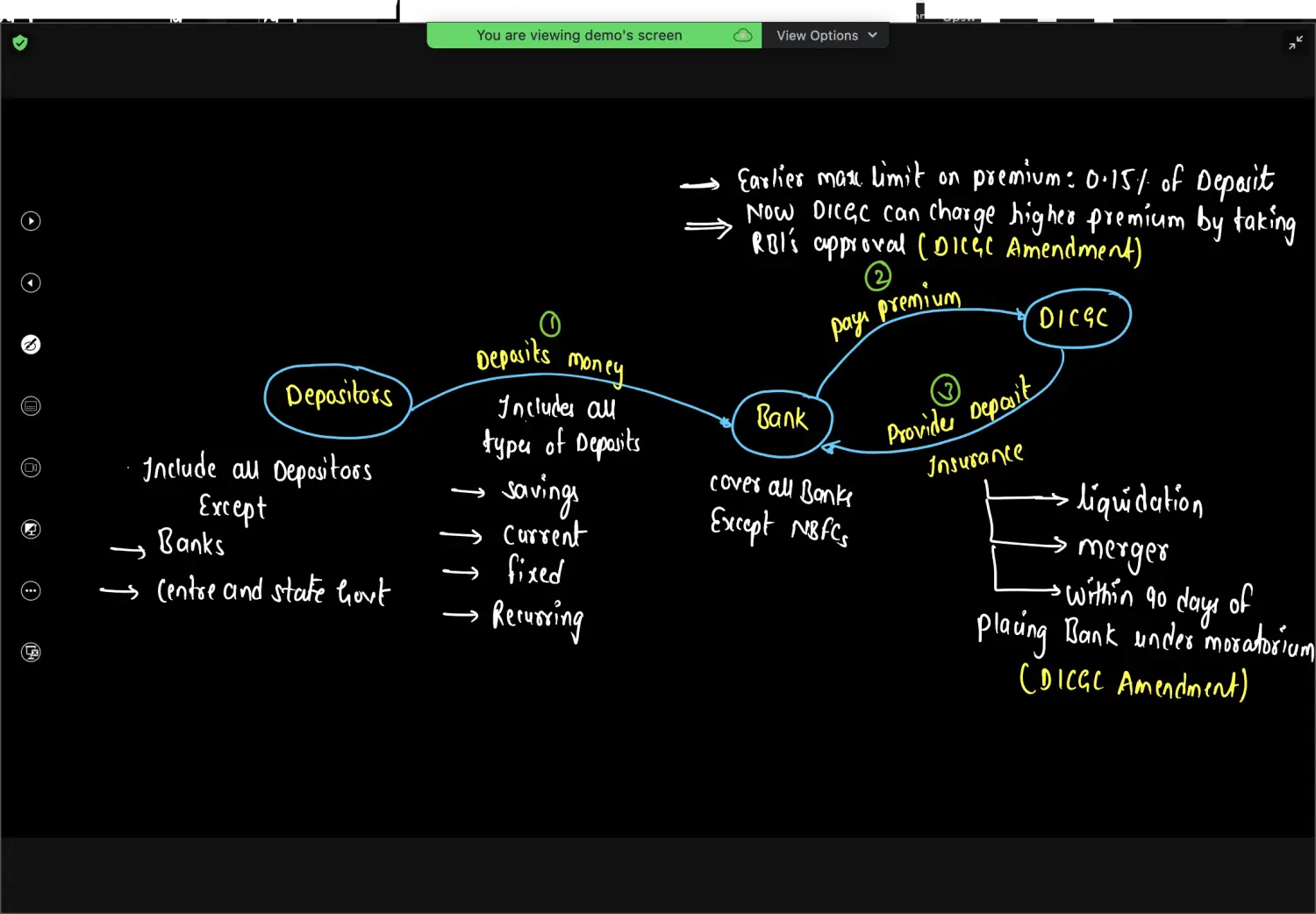
DICGC - Deposit Insurance and Credit Guarantee Corporation
Background
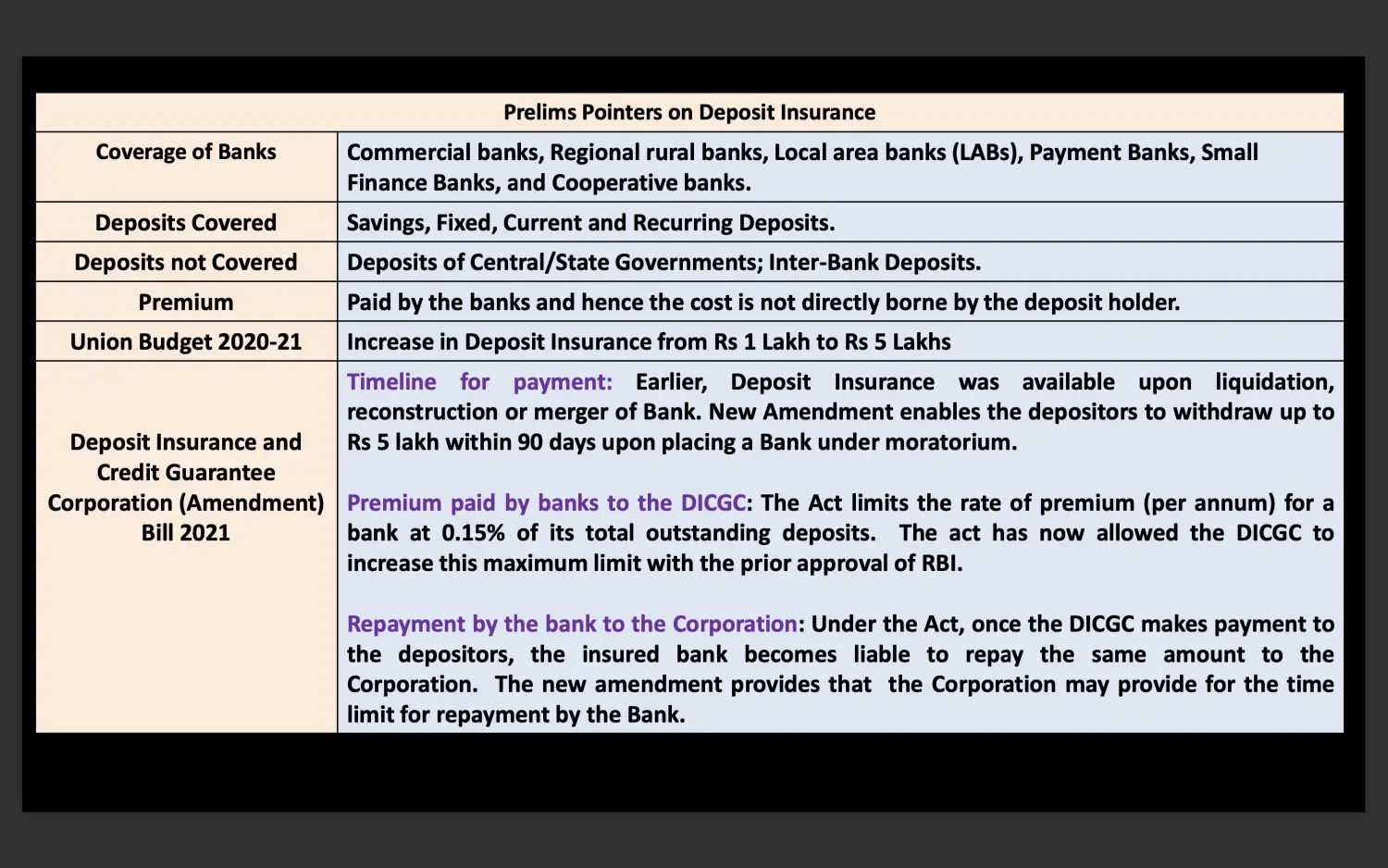
- From Rs 1 Lac of Insurance Cover to 5 Lac of Insurance has been done in case a Bank Collapses
- By Means of DICGC Amendment Act, 2021
Concept of Deposit Insurance
Recent Moratorium Banks
- PMC - Punjab Maharashtra Coperation Bank
- Laxmi Vilas Bank
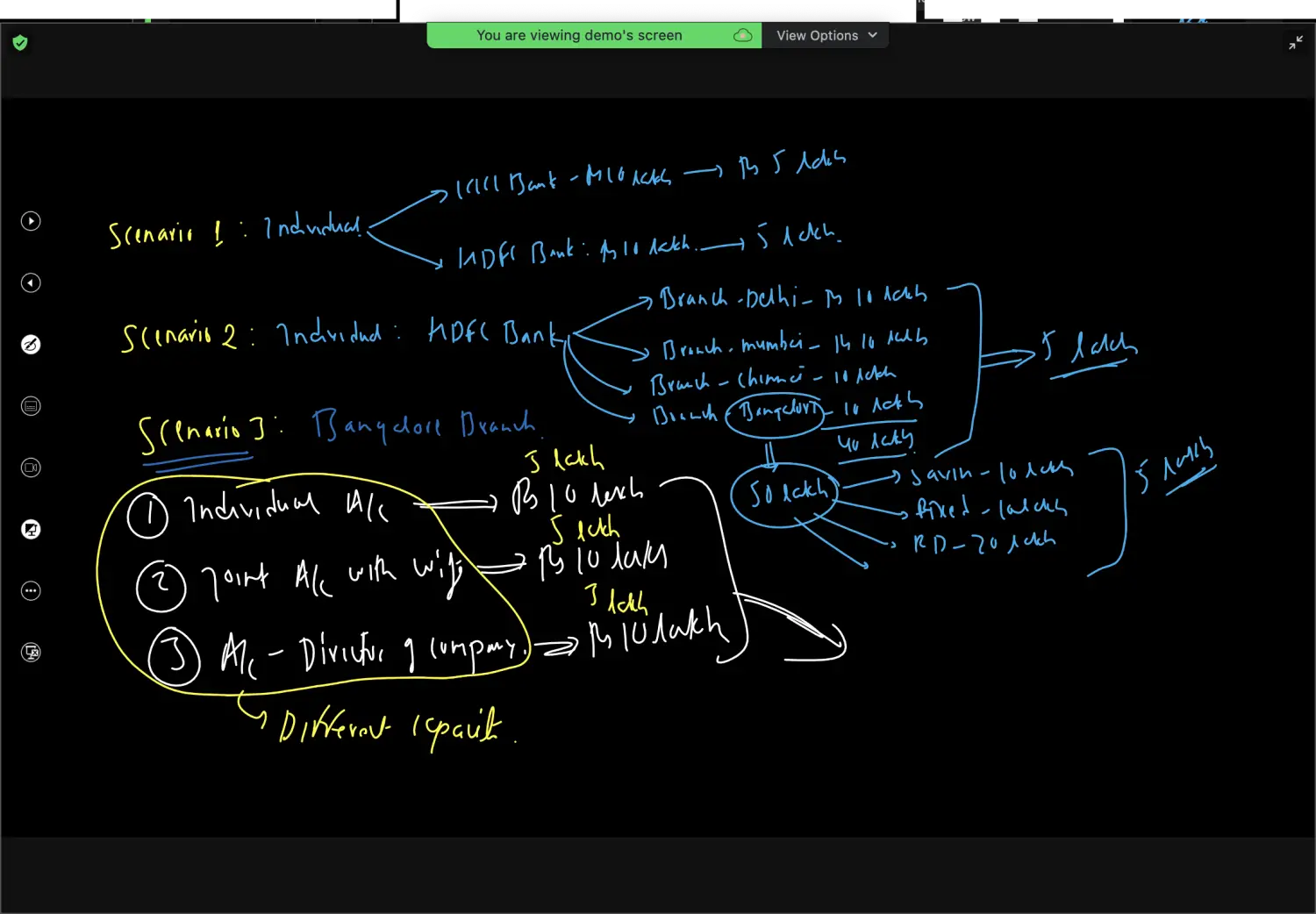
Scenarios of Claiming Insurance for Question Practise Purpose
Note : Deposit Insurance is based on Account
Deposit Insurance Prelims Pointers
Subsidiaries of RBI - Other Subsidiaries & Summary
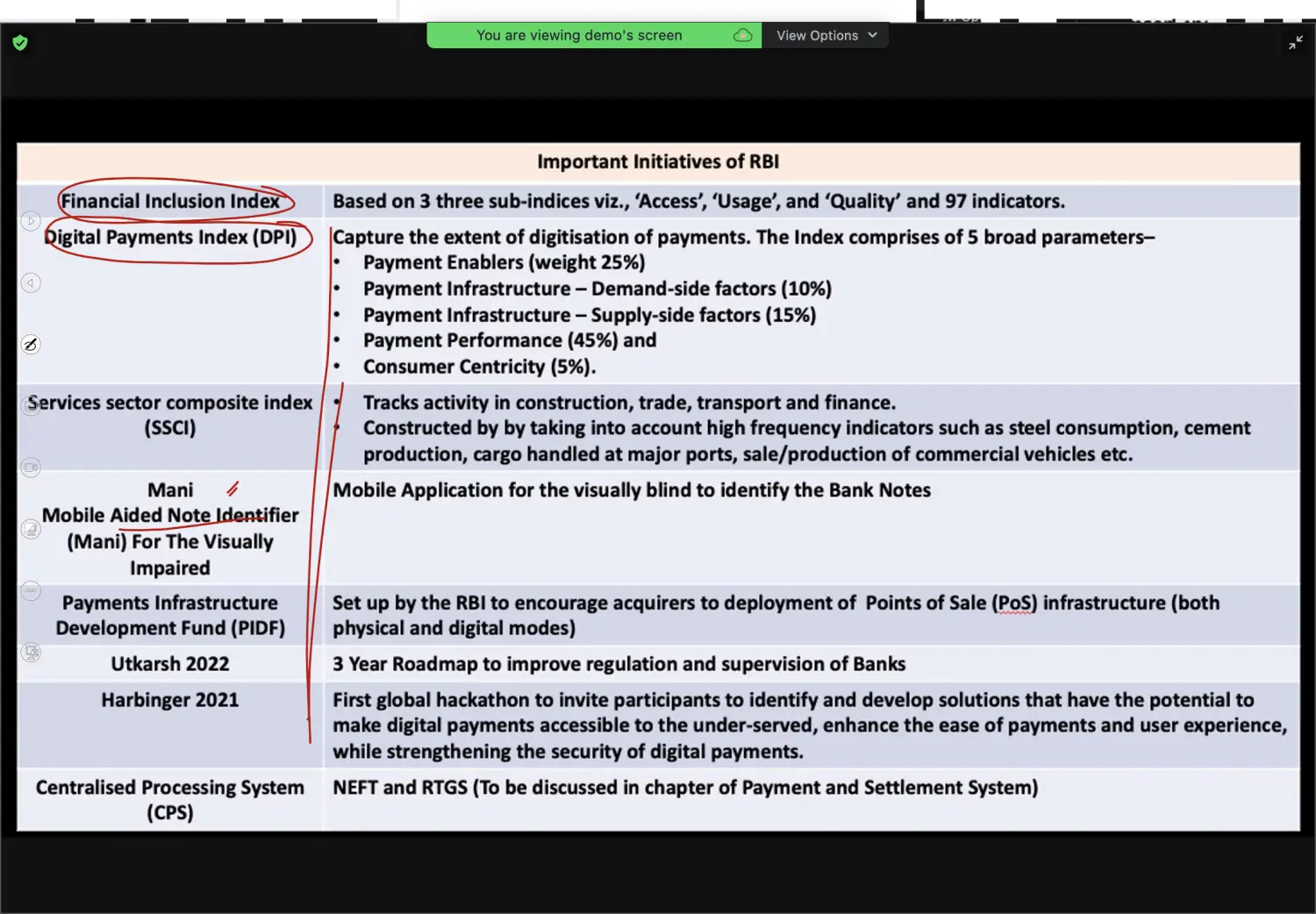
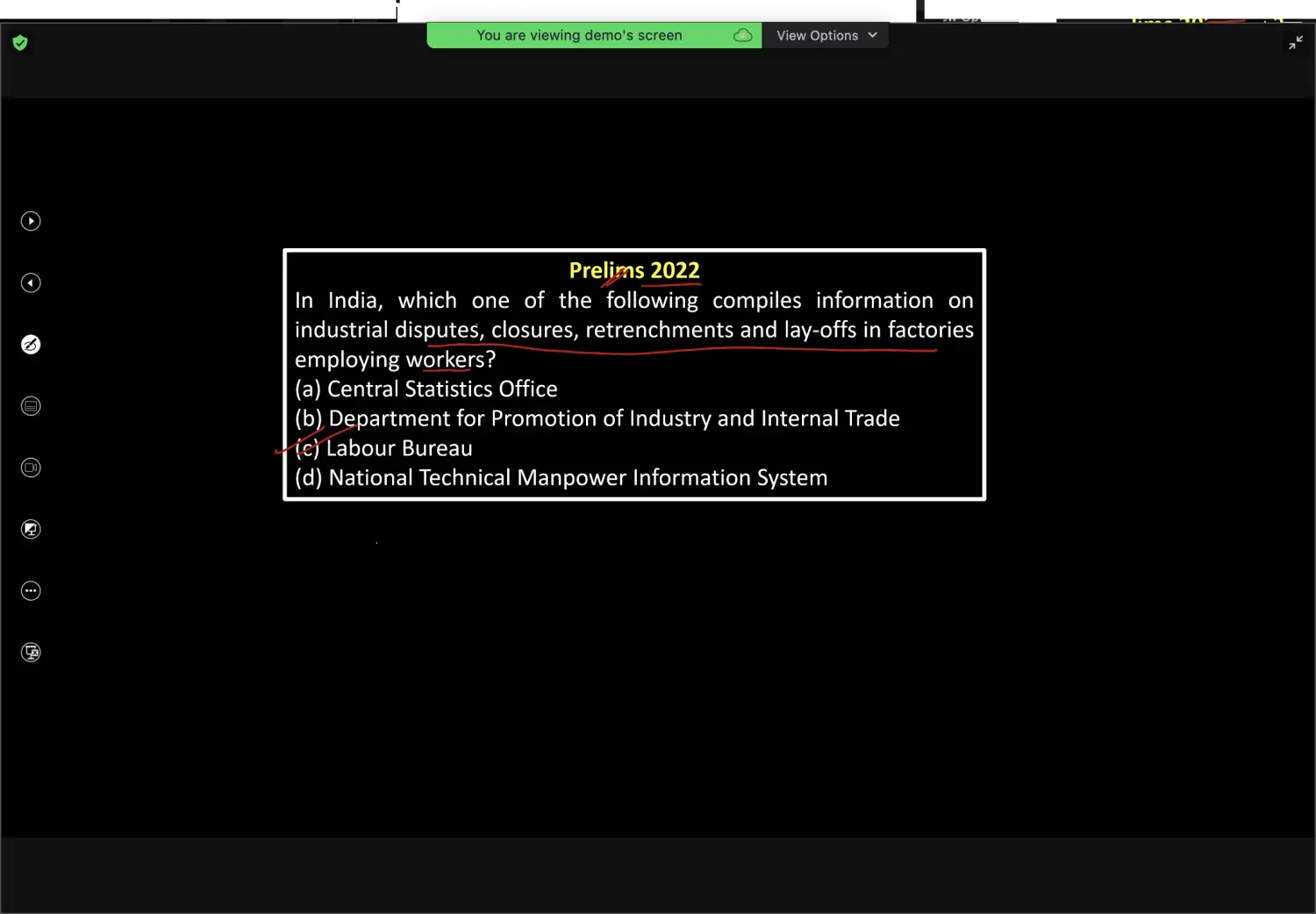
Initiatives of RBI
Why Study the Initiatives
List of Initiatives 1
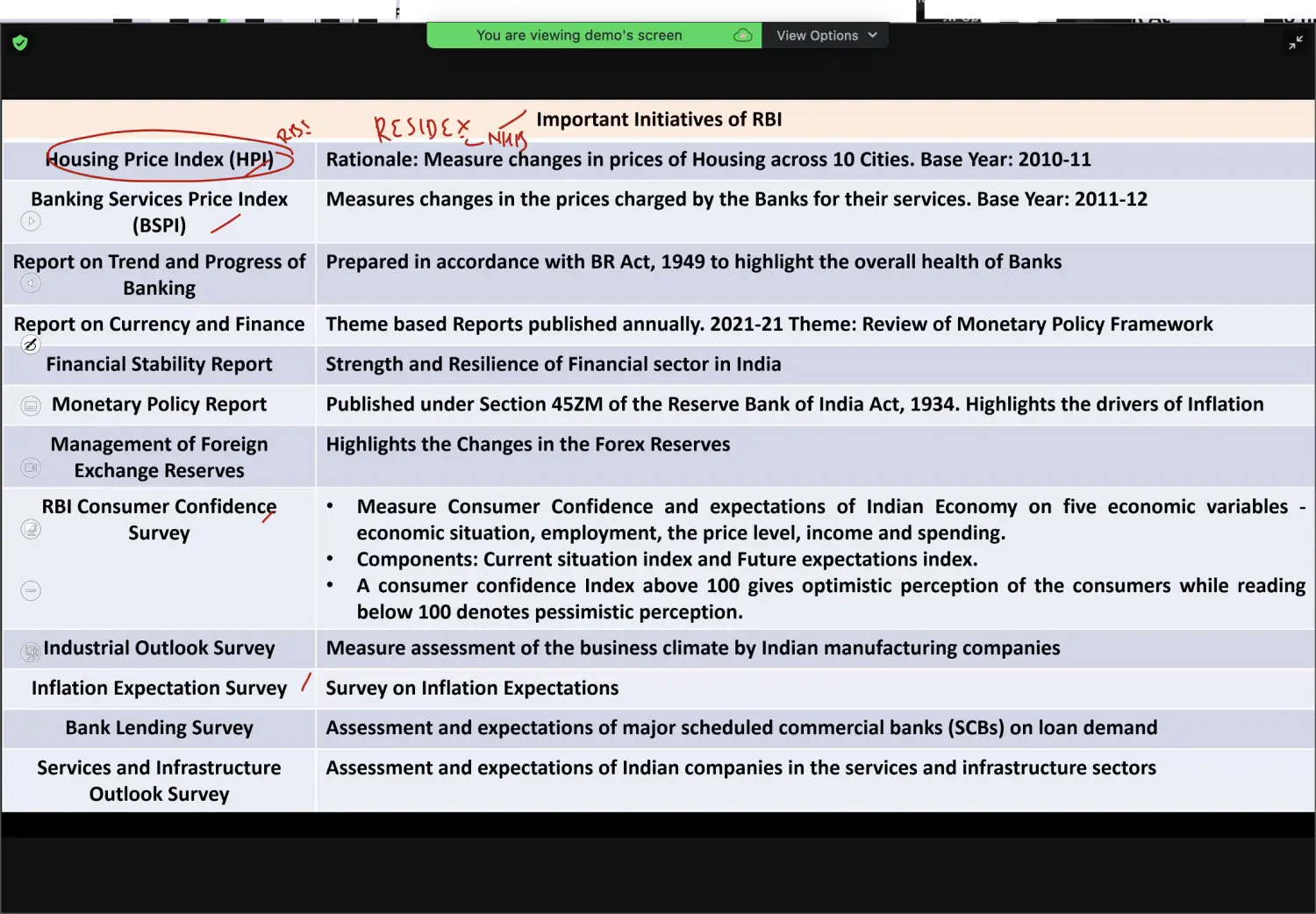
List of Initiatives 2