Part 5 - Tribal Anthropology
- Inputs Needed from
- Social Justice Section of GS 2
- Governance Section of Paper 2
- Government Schemes
- Important Abbreviations Used
- NFHS: National Family Health Survey
- AR: Annual Report
- MOTA: Ministry of Tribal Affairs
- SC: Scheduled Caste
- ST: Scheduled Tribe
- OBC: Other Backward Class
- DOR: Drop Out Ratio
- GPI: Gender Parity Index
- GER: Gross Enrollment Ratio
- IMR: Infant Mortality Rate
- U5MR: Under 5 Mortality Rate
- ID: Institutional Deliveries
- ANM: Auxiliary Nursing Midwife
- ASHA: Accredited Social Health Activist
- NSSO: National Sample Survey Office
- PLFS: Periodic Labour Force Survey
- NSO: National Statistical Organisation
- LFPR: Labour Force Participation Ratio
- NCRB: National Crime Records Bureau
- MHA: Ministry of Home Affairs
- PVTG: Particularly Vulnerable Tribal Group
- TN: Tamil Nadu
- UT: Union Territory
Profile of Scheduled Tribes (AR - MOTA)
General Population
According to Census 2011: 8.6% of India's Population (Nearly 10.45 Crores are Tribals)
Out of the Total Rural Population of India, 11.3% People are Tribals
Out of 28 States and 8 UT in India, 4 do not have any recognised Tribal Population
- Punjab
- Delhi
- Haryana
- Chandigarh
Maximum Proportion of Tribes in States
- Lakshadweep - Nearly 95% Population is Tribal
- Mizoram - Nearly 94.5% Population is Tribal
- Nagaland - Nearly 86% Population is Tribal
- Meghalaya - Nearly 86% Population is Tribal
Maximum Proportion of Tribes in States
- Uttar Pradesh - Less Than 1% of Population is Tribal
- Tamil Nadu - 1%-1.5% of Population is Tribal
- Bihar - 1%-1.5% of Population is Tribal
- Kerala - 1%-1.5% of Population is Tribal
Sex Ratio According to 2011 Census
Sex Ratio of All of India: 943
Sex Ratio of Tribal Population: 990
Sex Ratio of Tribes in J&K: 924 → only State that has sex ratio less than the National Sex Ratio of Tribals
Education
- Literacy Rate
Indian National Average is 74%
Literacy Rate of Tribal Populations
- 2001 Census: 47%
- 2011 Census: 59%
- Female Literacy: 49.5%
- Male Literacy: 68.5%
- Increase in Literacy Rate was Seen in Both Male and Female Literacy Rate
Literacy Rate of Tribal Populations: 71st Round of NSSO Survey in 2014-15
Literacy Rate of Tribals Increased to 67%
Literacy Rate of Tribal Populations: 75th Round of NSSO Survey in 2017-18
Literacy Rate of Tribals Increased to 71%
Conclusion: Gradual Improvement in Literacy Rate of Tribals
- Gross Enrollment Ratio(GER)
- GER in
- Primary (Class 1 to 5)
- Elementary (Class 6 to 8)
- Secondary & Higher Secondary (Class 9 to 12)
- For Primary and Elementary Education, From 2015-16 to 2019-20 is either stagnant or declining in some parts of the country
- Secondary & Higher Secondary, From 2015-16 to 2019-20, is more or less Same
- Hence it can Inferred that: In Coming Years, there will be decline in GER of Secondary & Higher Secondary Levels
- GER in
- Gender Parity Index(GPI)
- GPI for ST was released by UNESCO
- Increased Enrollment of Girls of ST in Higher Secondary Level
- Drop Out Ratio
- According to 75th NSSO
- DOR is Declining in All Three Levels i.e Primary, Upper Primary, Secondary Level
- Maximum Reduction in DOR in Primary, Followed by Upper Primary, Followed by Secondary Level
- Literacy Rate
Health
Health Indicators - IMR, U5MR, Anaemia
- Based on NFHS 3 (2005-06)
- Based on NFHS 4 (2015-16)
- Based on NFHS 5 (2019-21) - Released but Waiting for Tribal Specific Populations
- IMR was 40.7 for India
- IMR was 44.4 for Tribals (It Improved from 62.1 in NFHS 3)
- U5MR is 49 for India
- U5MR is 57 for Tribes (It was 95 in NFHS 3)
- It was Nearly 53% for Over All India
- Anaemia in Women in the Age Group of 15 to 49 Years 59.8% of Tribes are Anaemic as per NFHS 4
- It was > 68% in NFHS 3
Conclusion
- IMR, U5MR, Anaemia
- Over All India is Better than Tribals
- But in Tribals, NFHS 4 is better than NFHS 3 →Thus Gradual Development can be Seen
Health Indicators - Nutritional Status of Children
- 3 Types of Malnourishment
- Stunted - Less Height for a Specific Age
- Wasted - Less Weight for a Specific Height
- Underweight - Less Weight for a Age
- NFHS 4 has shown Improvements in all the 3 Levels
- 3 Types of Malnourishment
Health Indicators - Institutional Deliveries
- According to NFHS 4 Nearly 80% for Over All India
- Whereas it is 68% for Tribals acc to NFHS 4
- But in NFHS 3 ID was only 18%
- Hence, The Improvement in ID is Stark & Drastic. By Means of ASHA Worker and Ground Level Policy Penetration
- A Drastic Improvement was seen in Deliveries Attended by ASHA Worker, ANM & Auxiliaries
Poverty
BPL
Sources of BPL
- Tendulkar Committee’s data was used by Planning Commission for Poverty Estimates in Tribals
- NSSO
Types of Populations
Rural Tribals - In Rural India over all BPL Population is 26% where as 45% of Rural Tribals are BPL
Urban Tribal - In Urban India overall BPL Population is 16%
Nearly 24% of Tribal Population in Urban India was BPL
Maximum BPL Tribals are found in: Odisha
Minimum BPL Tribals are found in: Tamil Nadu
Land Holdings
- According to Agriculture Census of 2015-16
- 8.7% of Total Land Holdings in India belongs to ST’s
Labour Force
- According to PLFS by NSO, LFPR in Tribals is 47.1%
- Unemployment Rate of Tribals is less as compared to overall Unemployment Rate in India because of No Specific Choice of Employment, Participation in Skilled & Artistic Work & Acceptance of even Low Wages
Crimes Against ST Population
Maximum Atrocities and Reported Crimes against ST’s are in
- Madhya Pradesh
- Rajasthan
Article 342 of Constitution provides for Specification of Tribal Communities & Various Groups within them
ST’s are Notified for Specific States or UT’s & this Notification is Valid only within the Jurisdiction of State and UT
Irulas / Irular are PVTG in TN, but until 2018 they weren't even having status of Tribes in the Nearby UT of Puducherry
They Recently Got the Status of ST in Puducherry
Constitutional Provisions for ST
Articles
Art 342: of Constitution is Giving Recognition to Tribals. But it does not define the Term Tribals
- Number of Population Groups notified as ST’s under Art 342 are nearly 700 in number
- Art 342(1): Powers Given to President to Declare any Tribal Group as ST after Consultation with Governor
- Art 342(2): Parliament can pass the Law, to Include any group is the List of ST’s
Art 366(25): Refers to ST’s as those communities which are scheduled in accordance with Art 342 of Constitution
Also, only those communities declared by President in Recommendations of the Governor will be considered as ST’s
Schedules
- Schedule 5 enlists Tribal Area of All the Parts of Country other than those Mentioned in Schedule 6
- No Criteria mentioned in the Constitution to Include a Tribal Area into Schedule 5, but with Practise & Inclusion Practises we came up with Following Features to Include these Area as Tribal Area in Schedule 5
- Preponderance of Tribal Population
- Compactness of Geographical Area
- Viable Administrative Units
- Economic Backwardness as compared to Nearby Areas
- Schedule 6 States are
- Assam
- Tripura
- Meghalaya
- Mizoram
- Why has been States Separately Mentioned in Schedule 6
- Demand for Autonomy
- Internal and External Security Challenges
- Home Work: Read About Schedule 5 and Schedule 6 from Polity
ST & Scheduled Area
Nearly 8.5% of India's Population are found in Nearly 15% of India's Geographical Area
How Does Govt of India Declare a Group as ST
- No Criteria Mentioned in Constitution to Declare Scheduled Tribes but Gradually some criteria came into being by means of commissions and Parliamentary Legislations
1931: Backward Classes Commission
Pre Indepence Backward Classes Commission
1955: Kalelkar Committee
First Backward Classes Commission for India After Independence
1965: Lokur Committee
Revised the Lists of SC’s & ST’s
1969: Chanda Committee
- Some Specification to Declare Tribals based on these Committees and Commissions
- Reluctance or Shyness of Contact
- Indications of Primitive Traits in Life Style
- Geographical Isolation
- Distinctive Culture
- Backwardness - Social, Economic, Technological
- No Criteria Mentioned in Constitution to Declare Scheduled Tribes but Gradually some criteria came into being by means of commissions and Parliamentary Legislations
Tribal Panchsheel *
- Propounded by PM Nehru, Recommendation by Verrier Elwin
Points for Tribal Panchsheel
Tribal Populations Should be Developed along the Lines of their Own Genius.
Hence we should avoid anything being imposed on them → Minimum Imposition
Train and Build a Team of Tribal People to work in Administration and Development of Tribes. Avoiding Introduction of too many outsiders into tribal territory
We should NOT Over Administered Tribal Areas or Overwhelm them with Multiplicity of Schemes
Tribal Rights in Land & Forests should be Safeguarded
We should not judge the Result by statistics or the amount of money spent, but by the Human character evolved
Focus should be on the Quality of Human Resource Created or Human Character Created → Hence it should be Outcome Oriented
Home Work: Add Data from Here
Concept and Definition of Tribe
There is not any official definition of tribe. not in constitution
B.K. Roy Burman
When ever we use a term it refers to a stage of social of transformation in an evolutionary scheme of technology,knowledge,capacity and control of nature + transmission of these to their social groups which is simple small scale ,present in a common territory where these social groups are kinship based.
Ralph Linton
tribe is a grp of bands with a continuous territory under them ,they have the sentiments of unity ,common culture and are frequently contacting with each other
Tribes can be defined based on certain characteristics
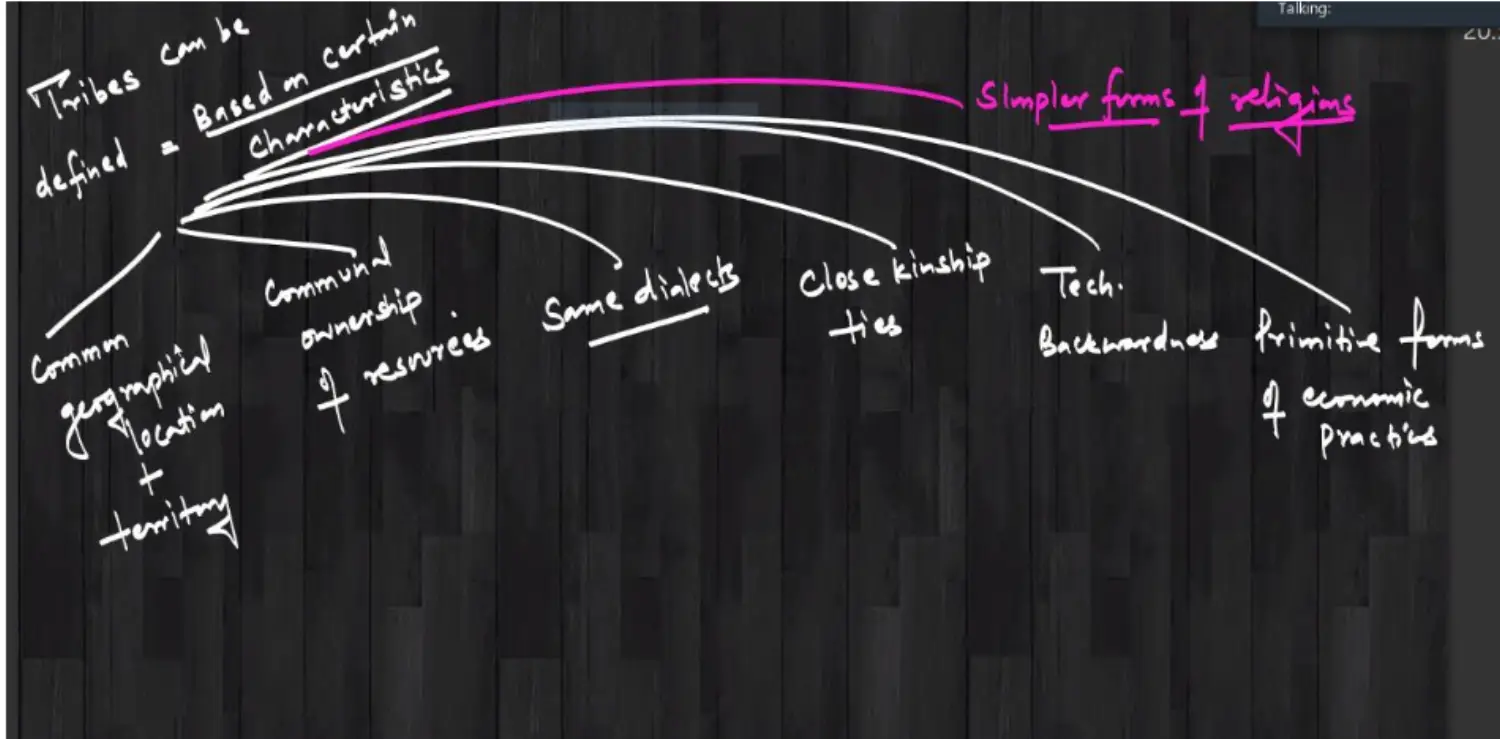
- common geographical location/territory
- communal ownership of resources
- same dialects
- closed kinship ties
- technological backwardness
- primitive forms of economic practices & simpler forms of religion
Virginius XaXa
Said the Definitions are complex - Tribal Population are a kind of stage,they are a kind of society which is simple,relatively less educated and backward societies
Indian Tribe v/s Indigenous People
Introduction
- Not only at India level but at world level also the debate was there
- The debate is about whether to consider tribes as indigenous people or not
- At india level also at UN level there is no official definition of tribe and indigenous people
ILO – international labour organization- gave 2 criteria to understand indigenous people
Subjective
Self identification by the person to whom we are calling indigenous
Objective
- Indigenous people are non dominant group in the society
- Even after restrictions on certain Religious Economic, Political Activities by the gov(s) and authorities ,indigenous people will retain those original elements / non legal things (they can have their own rules)
- Indigenous people are descents of those groups which were present before colonization
- They have affinities towards their territory and natural resources
💡 Indigenous People: People who were present at any location before colonizationUN declaration on rights of indigenous people
Not binding on countries, voluntary acceptance by various countries
UN Declaration on Rights of Indigenous People stress that
indigenous people have all the rights to have their welfare measures (socio-economic development policies)
Ex: Land rights ,FRA 2006 ,PESA 1996 (gram sabha )
Ex: Separate political and electoral status -PESA 1996
Ex: Recognizing and safeguarding the culture,traditions and folklore
- Should we consider Tribals of India as Indigenous or not ?
General Argument
- Tribes as Indigenous → are identified by Indian tribes
- Social, Political, Economic conditions should be different from larger community – they maintain these unique features irrespective of legal status of that feature
By ILO
There are certain criteria given by ILO which are matching with indigenous people of India but
By Andre Bethe
Anthropologist Andre Bethe Said: How can we deny one or the other proliferation/mixing up of characters of Indigenous People from nearby areas
Adivasis, Janajatis, hilly people ,forest people etc these terms are directly hinting about indigenous people
By XaXa
- when you are considering tribal people as indigenous based on their demand, there demand is justified becoz
- in the past 2 century tribals in india has lost their access on natural resources which they used to own
- They are facing discrimination at all the levels starting from the smallest unit of village to the largest unit of parliament
- Hence, Indian Tribes are indigenous people
By Govt. - Indian Tribes are NOT Indigenous People
- As per Government: We have given privileges in our constitution, in the laws/legislations.
- These act as safeguards for them so no need to give them the status of as indigenous people specifically
By World Bank
in its report considers STs of India as its indigenous populations
Socio-Cultural Elements of Tribals in India
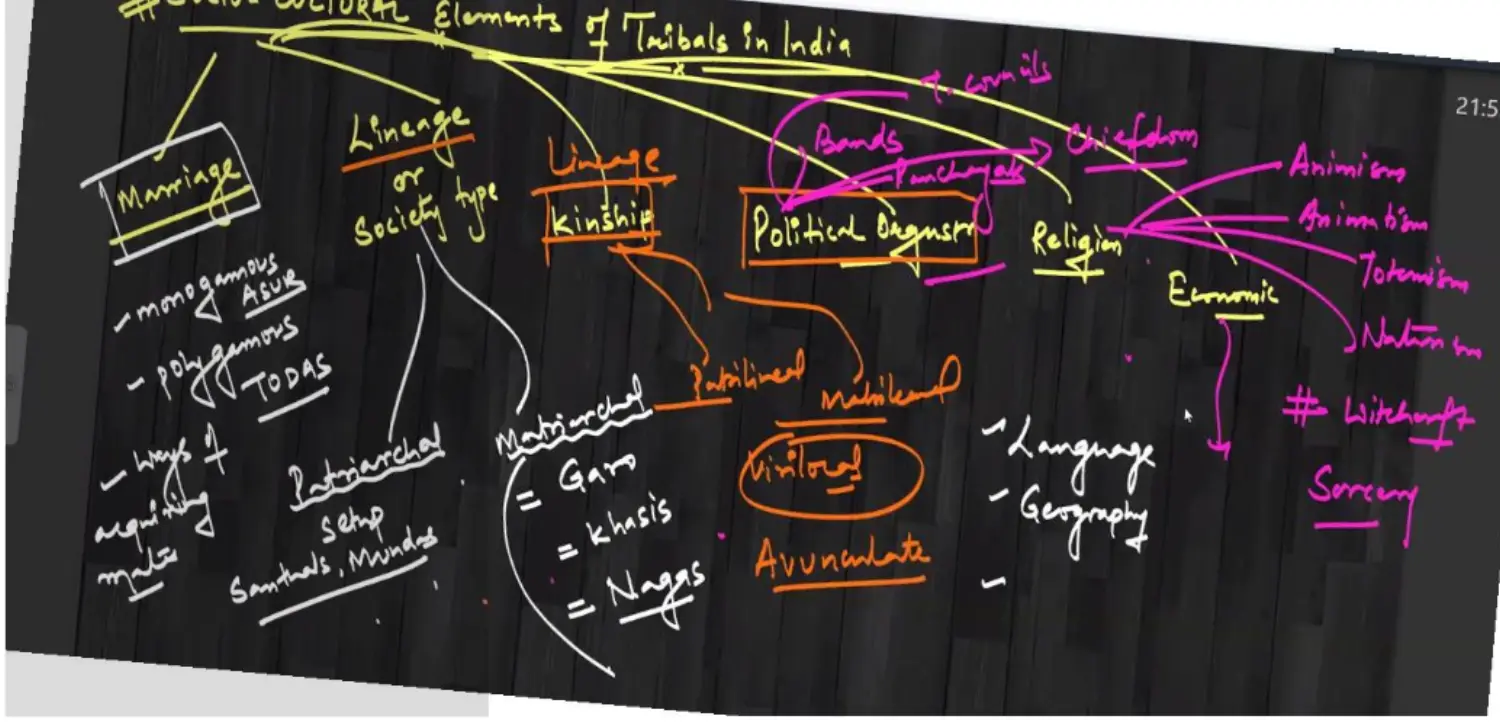
Diversity in Indian Tribes
Question
Diversity of Indian Tribes was studied by many scholars and anthropologist that why is there such biogenetic biodiversity in India Tribes?
Answer
Immigrants did not go back due to assimilative nature of Indian society
Economic factors / resources attracted much outsiders
There was religious persecution in other countries
These factors attracted many outsiders and they settled in india and mixed with these populations
Classification of Indian Tribes
Classification of Indian Tribes by B S Guha
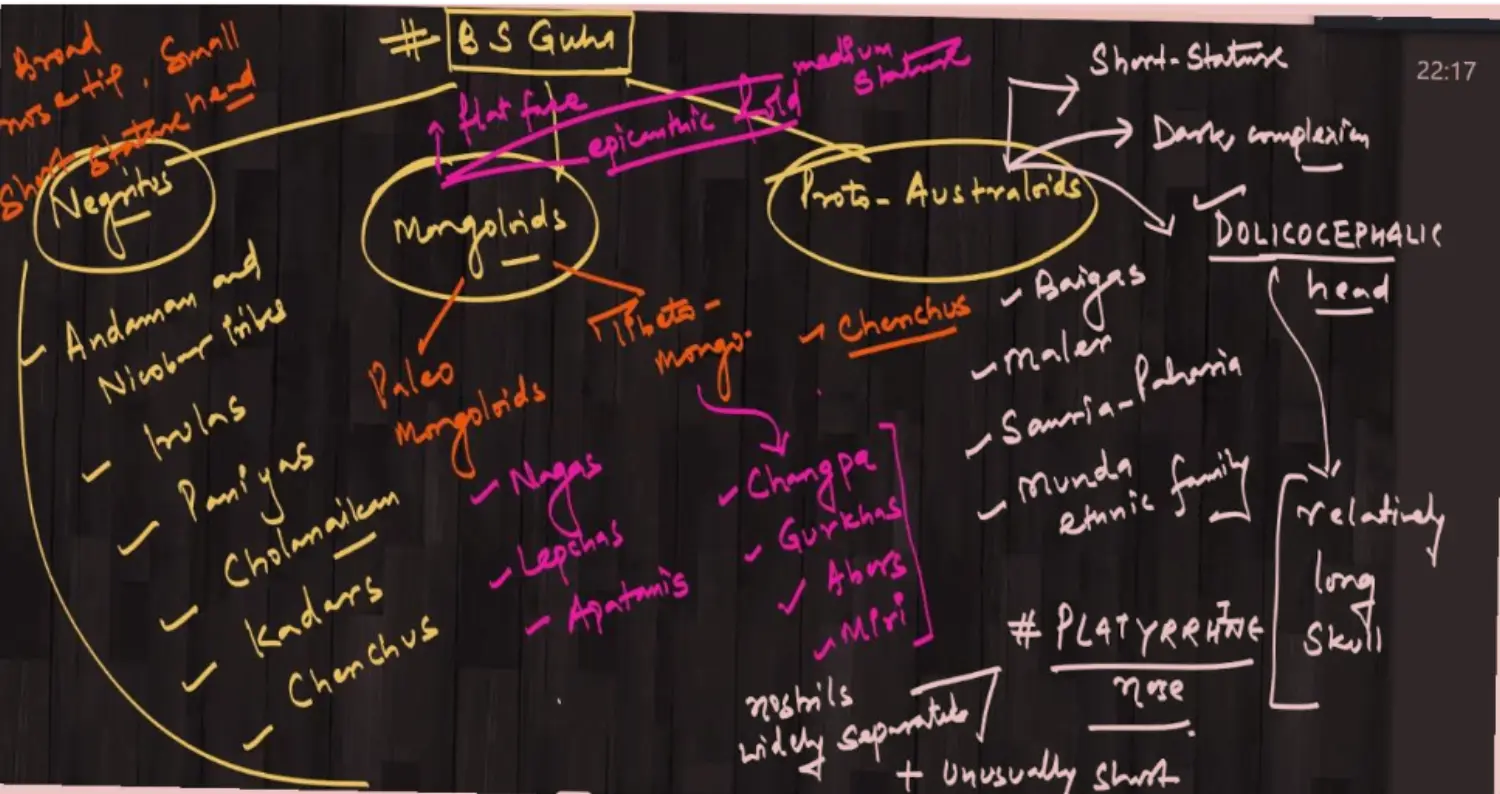
Classification of Indian Tribes By S S Sarkar
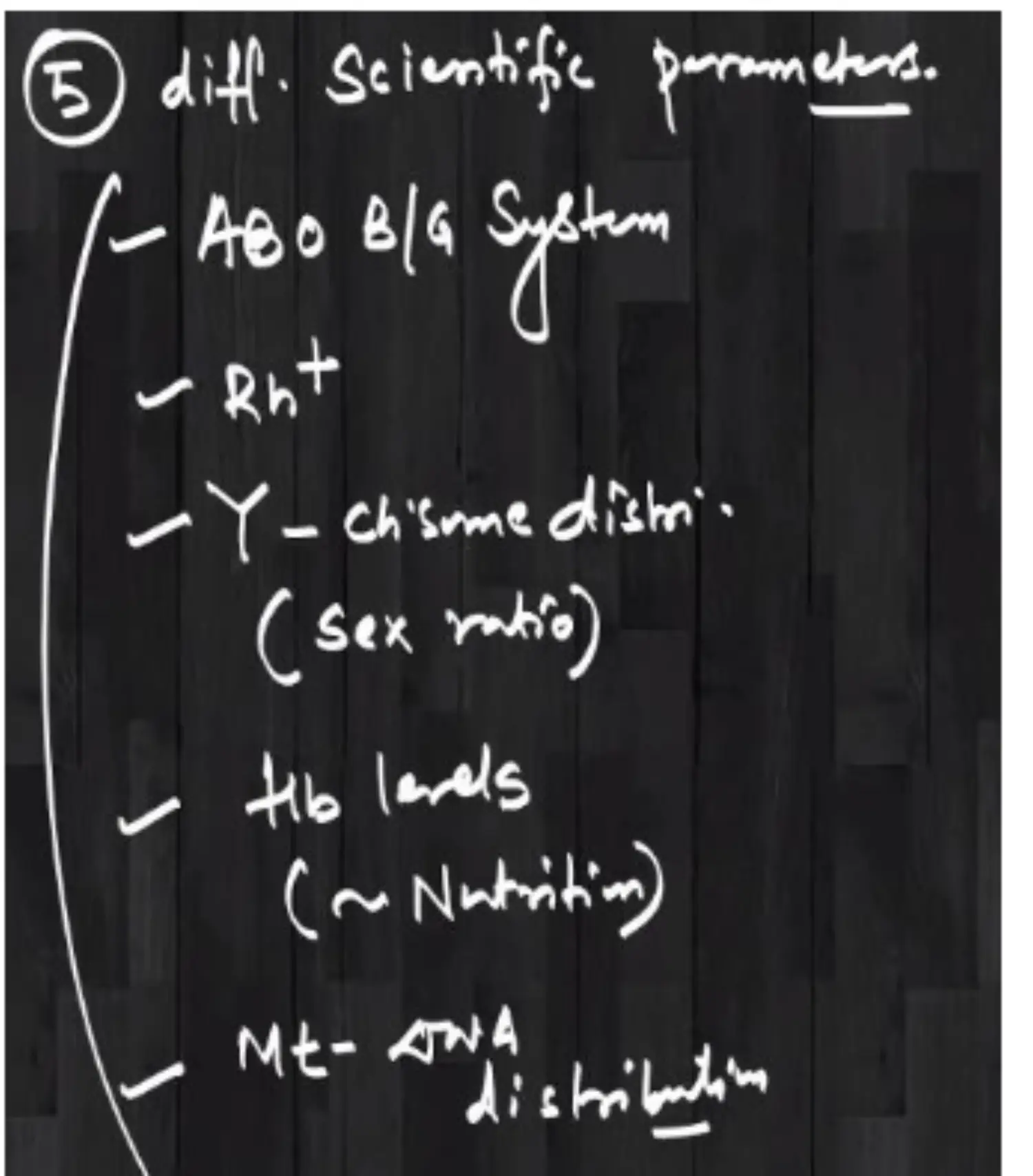
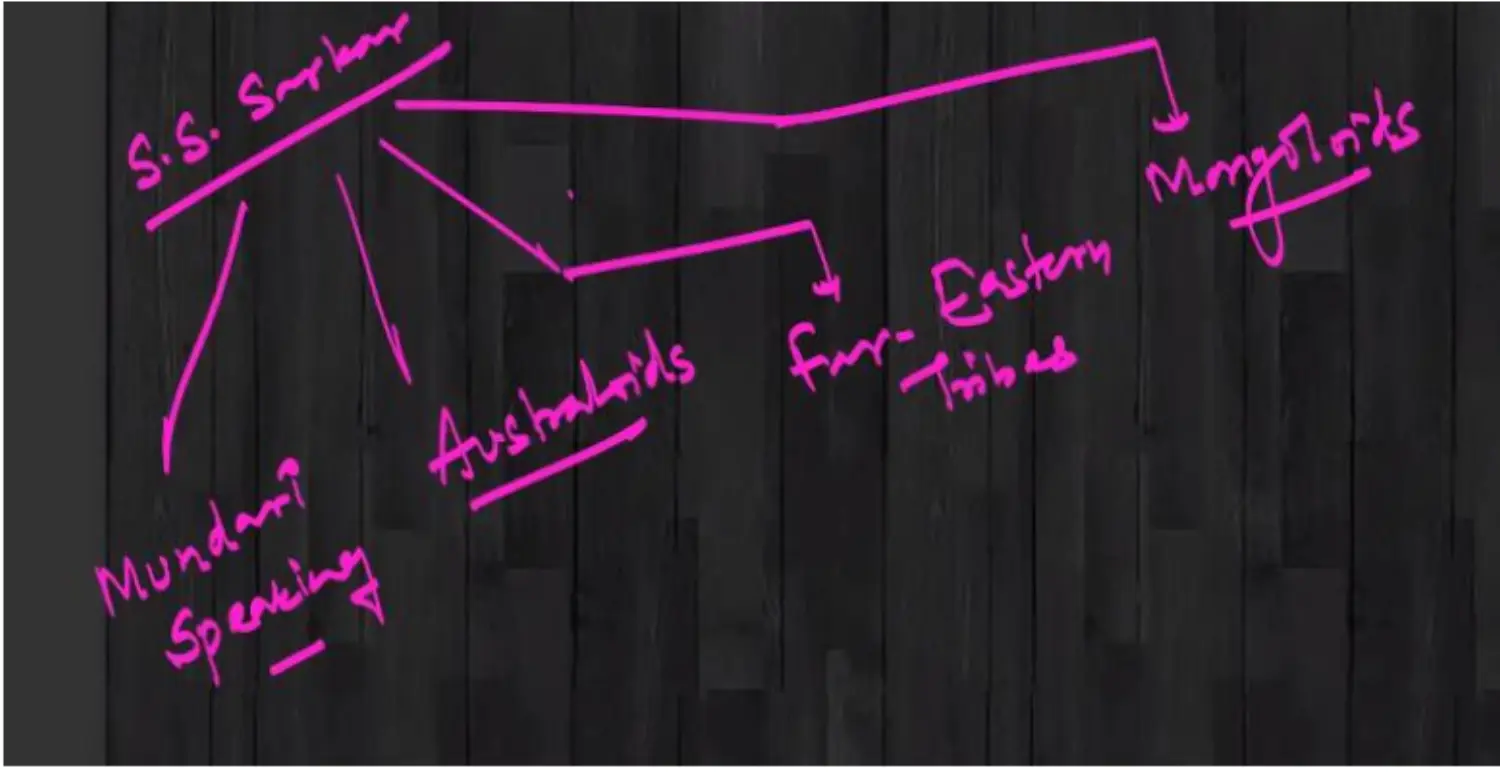
Based on 5 Different Scientific Parameters
Mundari Speaking
East Indian Tribal Belt → West Bengal ,Jharkhand ,Chhattisgarh and Odisha
Australoids
- Pre Dravidian- before Dravidian they are survivin
- Ex: Irrulars , Paniyars, Kanikarars, Kadars
Far-Eastern Tribes
- South part of country(in the context of western ghats)
- N-E states and Himalayas
Classification of Indian Tribes by Grierson ( Based on Tribal Languages)
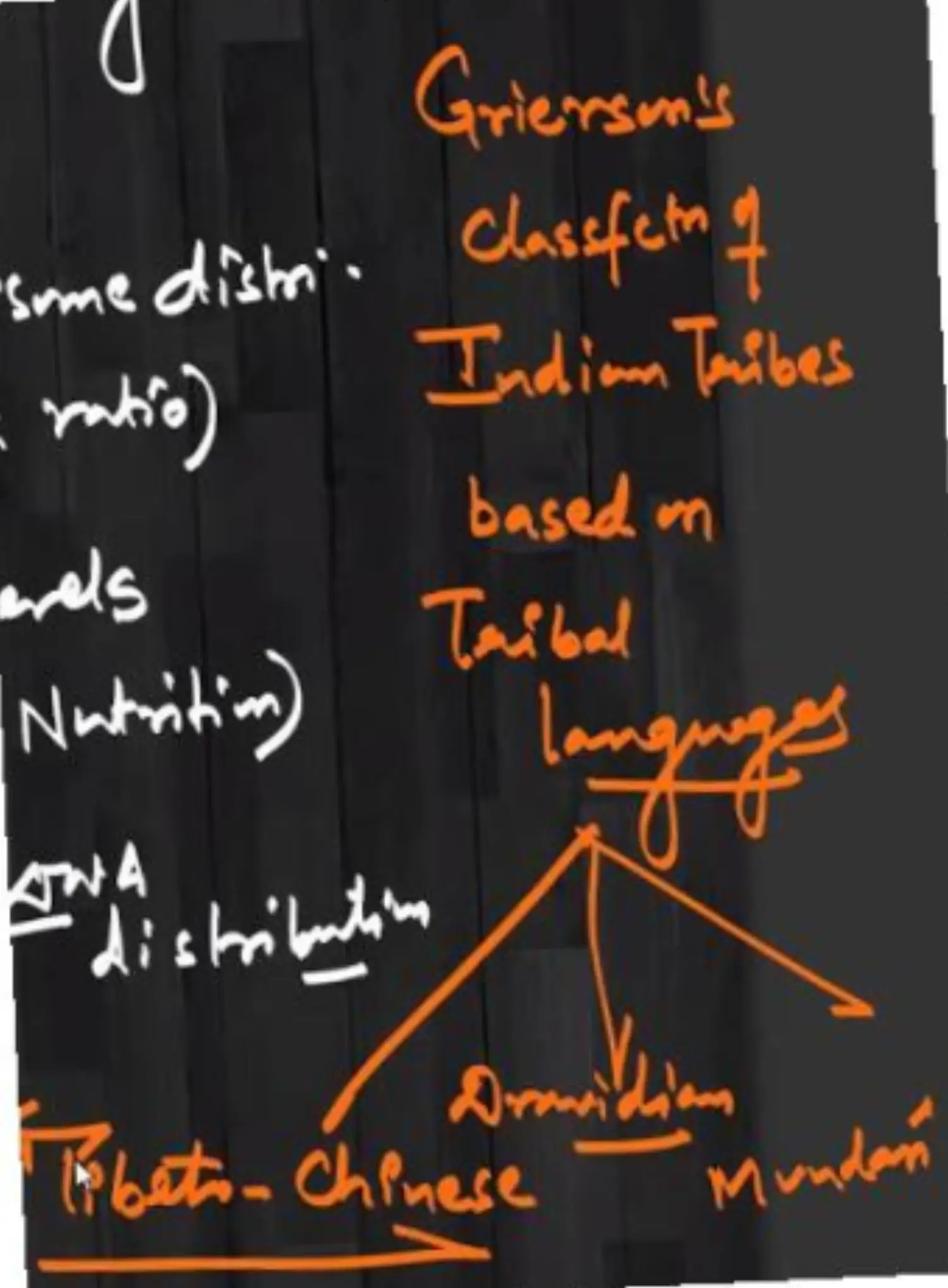
Classification of Language
Four Fold Classification for Languages
- Nishad - Austro Asiatic
- Kirata - Tibeto Chinese Family
- Dravidian
- Indo European Family - Aryan
It was Proposed by LPV & Rai for General Languages
Max Muller an Indologist was the First One to Propose this Kind of Classification for Tribal Languages
DN Majumdar said that all 4 groups Either Pre Aryan or Non Aryan have Racial Affinities or Origin
They Later Picked up the Aryan Languages due to Cultural Contact
According to D N Majumdar, All these 4 Groups of Tribal Families and People have Pre Aryan or Non Aryan Racial Affinities and Origin. The Indo Aryan Family Picked up Aryan Languages because of Cultural Contact
Tribal Languages Facing Threats of Extinction
- Why are they under Threat ?
- Invasion of Other Languages ( Main Stream Language) + Cultural Invsaion
- Declining Tribal Population and Very Low Population Growth Rate
- No Proper Documentation / Scripts / Grammar
- Eductional Improvments / Literacy in Tribals / Over All Dominance in Hindi and English in Educational System
- Urbanisation, Industrialisation and Associated Migration
- Data to Support Extinction of Tribal Dialects
More than 200 Tribal Dialects are Already Extinct after Indiependence
Nearly 200 (197) Tribal Dialects are Endangered,
out of these more than 40 (42) → They are Severly Threatened → Heading Towards Extinction
Example of Language Facing Threats of Extinction
- Bodo
- Dimasa
- Sidi
- Meithei
- Parji - Odisha
- Toto - West Bengal
- Majhi → from Sikkim → Some Say its already Extinct
NGO - Bhasha Research and Publication Centre, It conducts lingusitic Surveys from time to time
- What Needs to be Done ?
Proper Documentation → Literature and Folklore & Grammar
Incorpoation of Tribal Dialects in School Education System in Tribal Area
Separate Academic Programs for Tribal Language Studies
Imp Point: Orissa Model → Publishing of Bilingual Dictionaries
Odia to Tribal Dialects
Tribal Dialects to Odia
Dedicated Linguistic Division for Tribal Languages can be created either with MOTA or MoCulture or with respective state governments
Awareness should be Percolated by Means of Campaigns and Literacy
Central Institue of India Language, Mysore, Karnataka → There should be active role of such insitutuion in preservation of such tribal languages
- Why are they under Threat ?
- Geographical Distribution of Indian Tribes
- As Per People of India Project, 1993 → 636 Tribal Communities Tribal Communities are there in India which is Merely 8.5 & of Indias Population
- MOTA through its Dept of Tribal Development has defined 613 Tribes in India
- Art 342 considers nearly 700 Tribal Groups in India into 5 different geographical belts
- Geographical Belt Division of Indian Tribes
- Island Tribes
- Places
- Lakshadweep
- Andaman & Nicobar Island
- Examples
- Jarawa
- Great Andamanese
- Great Nicobari
- Shompning
- Sentineles
- Places
- North & North Eastern Tribes
- Himalayan Tribes
- Abor, Miri, Mishi, Lepcha, Asatmi, Bhotias, Gaddis
- Central Indian Tribes + East Indian Tribes
- One of the Largest Populations
- Munda, Santhal, Oraons
- West Indian Trbies
- Places
- Western MP
- Raj & Guj
- Some Parts of Maharashtra
- Examples
- Sahariyas
- Bhil
- Meena’s
- Garasia
- Khatodi
- Maldharis
- Places
- South Indian or Dravidian Tribes
- Irular
- Todas
- Kadars
- Kotas
- Kurumbas
- Chanchu
- Khonds
- Cholenaikans
- Island Tribes
- Youth Dormitories
- Small Scale Rural or Tribal Socities → Found in India and Across the World
- At Global Level, Malinowski studied the Youth Dormitories in Trobriand Islander also called as BUKUMATULAS
- Indians who Studied Youth Dormitories
- S C Roy → Oraons Tribe → Dhumkurias
- Ho Tribe → Gitiora
- Gonds Tribe → Gotul
- Konyak Nagas Tribes → Ban (Boys)
- Konyak Nagas Tribes → Yo (Girls)
- Morungs Nagas Tribes → Morung or Marnags
- Socialisation Point for Youth for Young People before Marriage
- Training Centre fro Tribal Youth for
- Teaching Hunting
- Sexual Transformation Education
- Sometimes acts as Centre for Magico Religious Ceremonies
- They are kind of Day Boarding Units for Young Population which are presnet generally at the entrance or central of settlement
- Acc to S C Roy, Youth Dorm is a tool for Social Solidarity for Its Residents → It Embibes Sentiments of feeling of group in young generation
- Problems of Tribal Communities (General View)
Poverty & Indebtedness
Shyness to Assimilate
Primitive Forms of Agriculture & Reliance on Shifting Agriculture
Improper Implementation of Constitutional, Legislative & Administrative Measures
Example: PESA, FRA, Sch 5 & Sch 6
Access to Education, Rising Unawareness
Poor Health & Hygiene, Increasing Malnourishment
Land Encroachment → Development Induced Displacement, Encroachment and Land Alienation
Higher Rate of Unemployment
- Problems of Tribal Communities (According to Syllabus)
Land Alienation
- Current Status
- Since Generation they were living in Forest Area in a Symbiotic Mode of Existence
- Their Entire Socio Economic Life revolves around Land and Forests Only
- They have sentimental and emotional connect with Land and Forest
- Even today more than 90% of Tribal Population in India is Involved in Agriculture & Allied Activities. Hence they are Dependent on Natural Resources of Forest and Land
- Average Land Holding Size in Tribals is more than the National Average
- But Issues with Land Holdings are. Following factors contribute to Less Production
- Shifting Cultivation
- Allmost Zero Agricultural Input
- Poor Fertility
- Technological Backwardness
- Maximum Tribal Population of country is lacking the Agricultural Skills to Improve the Production
- Data to Support
Sample Survey of Rural Development
in 1990 → Nearly 30 50 % of Tribals were affected by Land Alienation
After 2000’s → It is more than 50%
Biggest Reason for this is Mining, Urbanisation & Expansion of Agriculture
Hence Maximum Displacement of Tribals and Land Alienation took place in Mineral Rich Belt of India
For Example: Central India, East India → MP, CG, Odisha, Jharkhand
Census Data 2001
- More than 40% of Tribals are Landless
- Which were nearly 33% in 1981 Census
- Population of Landless Tribals is Increasing
MOTA
- Land Alienation in Tribals is 20 to 30 % more than Non Tribal Populations
- 20% to 30% more Land Alienation is Happening
- Causes of Land Alienation in Tribals
Development Induced Displacement prominently by means of Mining, Hydro Electric Dams, Industry
Ex: Issue of Bauxite Mining in the Niyam Giri Hills of Orissa in Dongariya Khonds
Ex: Sardar Sarovar Damn
Ex: Singur Case
Indebtedness, Unemployment and Moneylender
- Ex: Sarguja District of CG Muslim Money Lenders who are locally termed by Tribals as Miyan
- Ex: Mahajan’s of Jharkhand → by Dr Sachindr Sinha
Lack of Documentation and Records
Environmental Laws and Regulations
Unawareness about Rights & Remedial Measures
Govt Program Started Van Bandhu Kalyan Yojana
Encroachment by Outsiders
Tourism Activity
- Ex: Chenchus & Jarawa's of A&N
Due to Conflicts in there areas like Naxals
- Measures
Govt Measures
- Strengthen PRI, Gram Sabhas
- Effective Implementation of Legislation like PESA 1996 & FRA 2006
- Fulfil Spirit of Schedule 5 & 6 of Constitution
- Land Records Management & Digitisation so that Land Record can be assesses in Real Time. Thus Minimising Alienation
Schemes by Government
- Van Bandhu Kalyan Yojana
- PM Khanij Kshetra Kalyan Yojana
- MGNREGA
- PMJDY → Improved Financial Inclusion and Banking Facility
Supreme Court Directions
Samatha Judgement of 1997
SC Gave Directions to Govt to Return the Land to Tribal Populations in case of Mining
Apex Court directed that the “Public Purpose” should be defined
Narmada (Sardar Sarovar) Dam Case, 2017
SC Said that Land should be given against land
XaXa Committee Recommendations
- Provide Legal Aid to Tribals
- Strengthening of Gram Sabha
- Clear Cut Definition of “Public Purpose”
- Return of Extra Land acquired post project Implementation
- Check or Control on Diversion of Land from Tribals to Non Tribals
- Current Status
Poverty & Indebtedness
Indebtedness
- Basic Background
Nearly 80% of Tribals → Acute / Chronic Indebtedness
Chronic ID Primary Reason → No Money Saving Habit
Except Some NE Tribes → Almost All Tribes are in Indebtedness
Not Borrowing Money from Organised Methods like Banking, Post Office, Cooperatives
They Generally Borrow from Unorganised Means and Methods → Local Shop Keepers & Money Lenders
These are Generally at Very High Interest Rate. Some Case Studies Tell that RoI can be upto 48% too → Money Lenders & Local Shopkeepers take advantage of unawareness amongst the Tribals
Till the Time Forest Resources were with Tribals, Tribals were enjoying a Self Sufficient Economy → Less Poverty & Less Indebtedness
But During British India Period →Barter to Monetary → Unawareness
- Prominent Reasons
- Change in Forest Based Economy of Tribals, Started During British India Time → Aggravated After Independence (Mining, Industrialist, Deforestation, Urbanisation)
- Low Literacy & Unawareness → Trapped by Money Lenders
- Land Alienation & Development Induced Economy
- Less Skills Related to Other Works
- Lack of Records and Collateral Documents of Ownership, Identity and Govt Scheme based Benefits
- Inadequate Financial Inclusion Measures
- Naxal Movements & Less Penetration of Govt Benefits in Some Tribal Areas
- Tribal Way of Life like → Not Spending Money in the Right Place
- Non Saving Habit
- Alcoholism
- Extravagance
- Loopholes in Prohibition of Money Lending Laws
- Basic Background
Poverty
Background
Indebtedness Leads to Poverty & Poverty Leads to Indebtedness. Hence, Poverty & Indebtedness are Interrelated & Connected
Vicious Cycle for Tribals
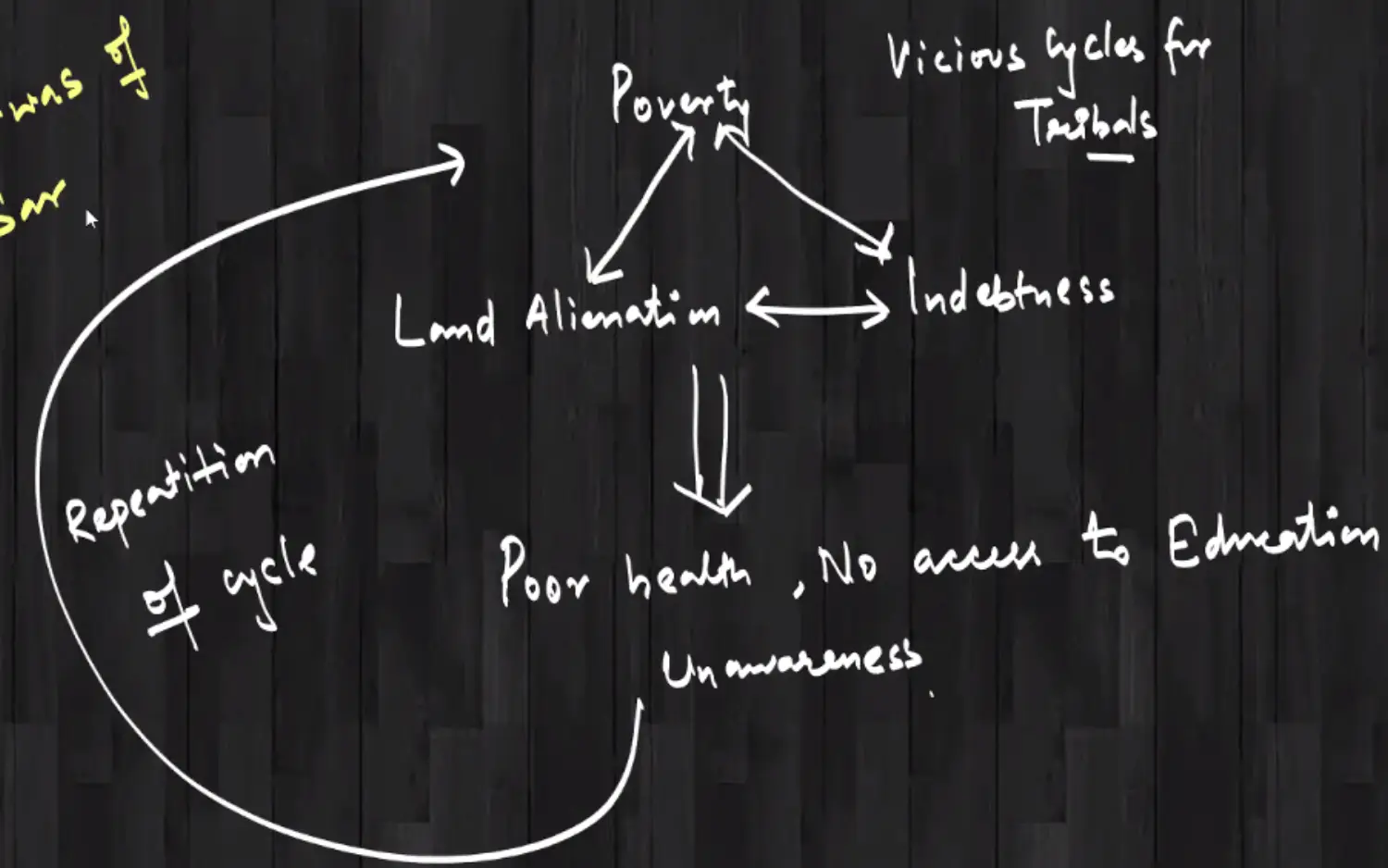
Important Case Studies
- Korwas of Sarguja District of CG
- Dr Sachindra Sinha → Sauria Paharia of Jharkhand
- Tharus of UP
Measures for Poverty & Indebtedness
Various State Govt & Central Govt → Have Framed Legislations to Regulate Money Lending
5th Schedule of Constitution Empowers Governor to Regulate Money Lending
Financial Inclusion & JAM Trinity
- By Means Jan Dhan Aadhar Mobile → Connection of Aadhar Number with Mobile Number
- Including DBT → Direct Benefit Transfer
Minimisation of Fake Beneficiaries, So that Actual Ones can be benefited
Promotion of Cooperatives
SHG → Vandhan Schemes
TRIFED
Dedicated Mission for Skill Development of Tribals
Ex: Kathiawar Youth Driving Training Skills, Gujarat
MGNREGA - For Employment
Targeted PDS for Ensuring Food Security
State Govt have made Licenses mandatory for Money Lending
V XaXa Recommendation 1. Strengthen Gram Sabha in Tribal Area 2. Ensure Financial Inclusion
Case Studies
Case Study: Related to TRIFED
TRIFED - Tribal Cooperative Marketing Development Federation of India
Mankidia and Kandhar Collect Siali Fibres from Forest Areas of Orissa. These Fibres are used in making of Drone Patra for Rituals
Case Study: Tea Estates of Kerala
Due to Tourism Local Tribals are Being Involved as State Owners in Day to Day Activities, like
Picking up the Waste, Tea Stalls, Drivers for Pick and Drop
This Kind of Job is for Unskilled Almost illiterate Youth
Causes of Indebtedness
Poverty Data of Tribals → from Above Data Sheet
Especially from Tendulkar Committee & Finance Commission Recommendations
Causes of Poverty
- Primitive Agricultural Practises → Very Low Productivity
- Loss of Forests and Land Rights
- Land Alienation
- Development Induced Displacement
- Unawareness and InAccessibility to Financial Institutions
- Tribal Way of Life like Non Saving Habits
- Limited Skills and Restricted Occupation
- Psychological State of Deprivation → Non Acceptance to State Help
- Less Transparency & Percolation of Govt Scheme and Efforts
Dhebar Commission Recommendation
Shifting Cultivation to be controlled in a Phased Manner
Seeds Fertilisers and Other Agri Inputs Including the Machinery to be provided to Tribals
Incentivise Tribals for Permanent Agricultural Practises so that they will be motivated for it
Demonstration of Successful Results of Settled Agriculture
Shifting Cultivation changed into Terrace Farming in North East India in Himalayas
Note : Dhebar Commission Recommended the Concept of PTG in 1973 which was renamed as PVTG in 2006
Illiteracy and Education
Background
- Education is the most effective weapon to uplift Individuals, Groups and Societies
- Tribals → Integration into Mainstream Society
- Constitution of India gave Rt to Education
- Gave Equal Rights
- Free & Compulsory Education 6 - 14 Years RTE
- Mid Day Meals
- Hence Govt is Giving → Food + Education + School Dress + Bags + Books
- All these Facilities are Provided so that Enrollment Ratio can be Increased and Dropout Ration can be Decreased
- Examples
- Jawahar Navoday
- Kasturba School
- Eklavya Model
- Kendriya Vidyalaya
- Dedicate Tribal Schools promoted by Various Central and State Govts
- Dropout Rate at Primary is 38% and Secondary is 70% which is a Big Concern
- Quality of Teachers and Absenteeism are Big Concerns
- Lack of Vernacular Education or Local Dialects
Committee and Commissions by Government
- Committees
- XaXa Committee, 2011
- Dhebar Commission, 1961
- Kothari Committee, 1966
Over All they Suggested that there are some
- Govt and Administrative Side Problems
- Less no of Schools in Tribal Area
- Students Have to Walk Longer Distances, Crossing Jungles, Rivers & Mountain Barriers
- Language Constraints
- School Environment is Quite Different from Traditional Tribal Setup
- Syllabus doesn’t have much studies about tribals and students → Hence they don't relate to it
- Discrimination between Tribal and Non Tribal Students
- Sexual Harassment cases against Tribal Students. Example of Certain Ashram Schools of Maharashtra
- There are Certain Tribal Side Problems
- Less Participation in School and More in Jobs
- Poverty
- Tribals Mentality that there are Less Options are there for Govt Sector
- Committees
Constitutional / Legislative & Other Administrative Measures
- Fundamental Rights - Art 15(4) , Art 21 A, Art 30
- DPSP - Art 46
- Fund Duty - Art 51(G)
- Schools - RTE, SSA, MDM, KBV, Tribal Schools, Navodaya School
- Reservation in Education
XaXa Recommendation on Tribal Education
- Local Teachers
- Involve Gram Sabha in School Day to Day Activities
- Increase Jawahar Navodaya Vidyalaya
- Many Nomadic Tribes from One place to another Place, Hence Provide Residential Facilities for Nomadic Tribes
- Special Coachings for Tribals in Higher Education
- Check Discrimination, Abuse and Neglect
Case Studies
- Livelihood College of Bastar & Dantewada Region of CG → Part Time Employment and Skill Based Studies for Easy Jobs
- Prakash Amte from Maharashtra Started Lok Biradari Prakalp
- Gotra Bandhu Model of Kerala - School Appoints Mediator from School for Tribals to convince parents for sending their children to schools
- Dedicated Tribal University by Orissa
Health Challenges & Undernutrition
Add Data from Data Sheet & From Handout
Case Studies
- Khairwar or Khaiwar of MP
- They are almost on the Verge of Extinction due to Syphilis (STI) due to coming in contact with Outsiders
- Misconception : Black Magic is Caused by Baigas
- Jarawas
- They are facing new infections due to outside contact with Tourists and Outsiders
- Singpo of Arunachal
- Drug Addiction Problems
- Bastar Belt
- When Someone is Sick they will first go to
- Magico Religious Functionaries
- Herbal Medicine
- Modern Medicine as the Last Resort
- When Someone is Sick they will first go to
- Study by Bhardhan
- Bhardhan Studied the Bhil Tribes of Madhya Pradesh and Rajasthan
- If someone is ill they will not stop working or take rest unless the person is bedridden
- Now only they would seek Treatment, Here they do not go with Govt or Medical Health Advisories
- They Don't accept the Free Treatment due to their Belief System
- Khairwar or Khaiwar of MP
Recommendations
- General
- Awareness Literacy → to Reduce Superstition
- To Improve Health Hygiene and Sanitation
- Should Promote Vaccination
- Awareness of Govt Schemes
- Map Tribal Area based on Prominent Diseases prevalent over there
- There has to be a Customised Effort for Each Tribe
- Infrastructure > Connectivity, Dr, Hospital
- Promote Health Insurance so that out of pocket expenditure can be minimised
- Train Local Youth in Medical Facilities
- Improved Nutritional Support → Fortification
- Indian System of Medicine should be promoted
- Tribal Knowledge to Health Workers and Awareness about Tribal Way of Healing Clubbed with Modern Medicine Knowledge
- XaXa Committee
- Stressed upon Promotion of Anganwadis for dissemination of Primary Health Knowledge and Health and Hygiene and Nutrition
- He talked about customised Local Planning
- He Recommended the Creation of Dedicated Tribal Health Council
- Like SEARCH NGO Lets Create Tribal Health Assemblies to
- Involve People
- Give Customised Efforts
- There should be a Dedicated Tribal Health Plan
- Increase the Human Resource in Health System in Tribal Areas
- General
Nutrition Issue s
- Anaemia
- Goitre
- Low Body Weight
- Stunting
- Malnutrition
These Things are Quite Common in Tribal Populations, Because
- Less Vitamin and Less Protein Content Diet
- Certain Taboos and Practises
- Taboos Like Not Drinking Milk, like in Meghalaya & Gond Tribes
- There are Taboos related to Cooked Food
- When we eat Raw Food, There is Less Absorption of Minerals & Vitamins etc
- Certain Practises Like Specific Form of Diet → thus Leading to Restricted and Limited Nutrient Contents
- Poverty & Unavailability of Food
- Improper Implementation of PDS
NGO Working for Tribal Welfare
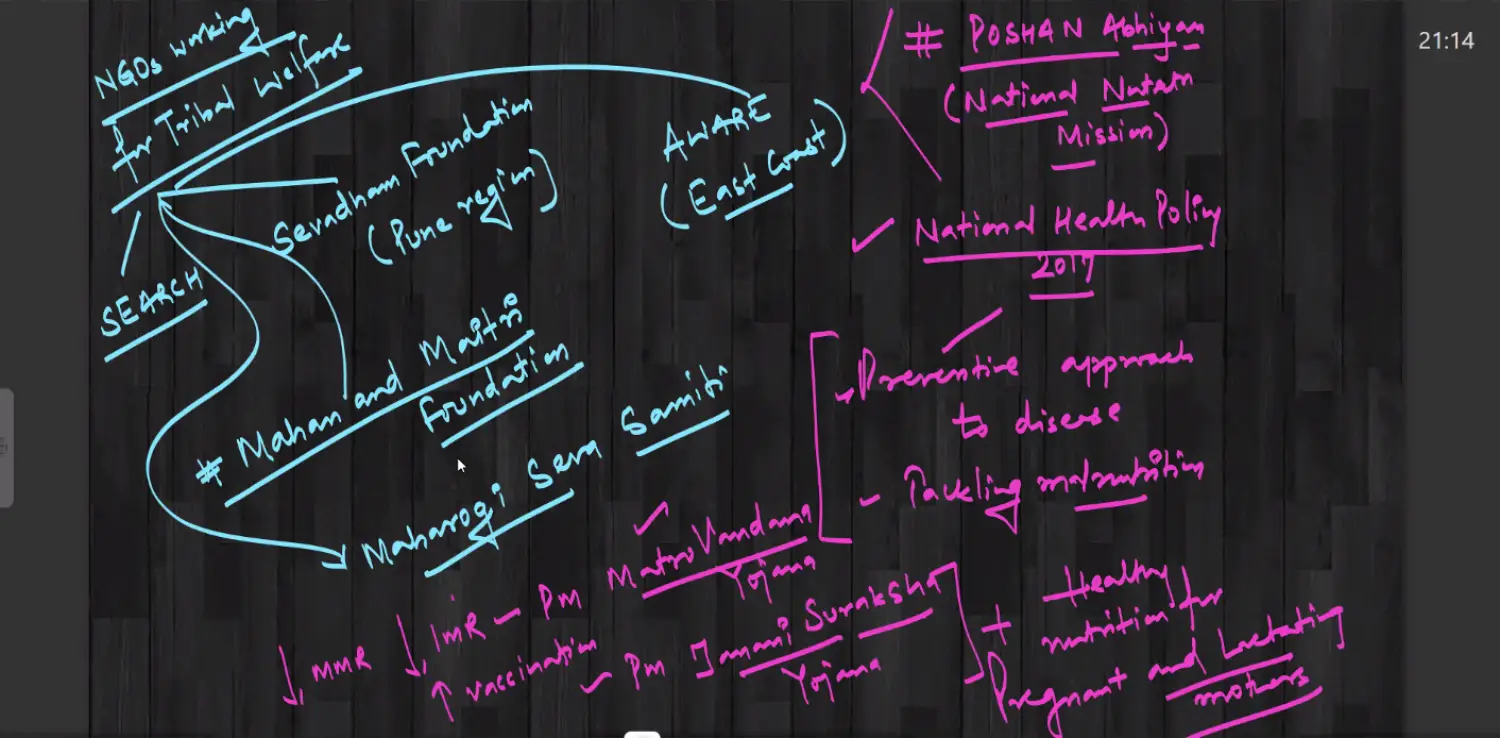
SEARCH
In Gadchiroli Region SEARCH NGO worked with Local People and they asked people about their problems and provided solutions through local peoples only
They Studied Malnourishment in Children in the Maharashtra Region in Chikhaldara Region of Maharashtra
Mahan and Maitri Foundation
Maharogi Seva Samiti
Sevandam Foundation (Pune Region)
Aware (East Coast)
Poshan Abhiyan (National Nutrition Mission)
National Health Policy 2017
- Preventive Approach to Disease
- Tackling Malnutrition
Matri Vandan Yojana
Janani Suraksha Yojana
Unemployment & Under Employment
Introduction
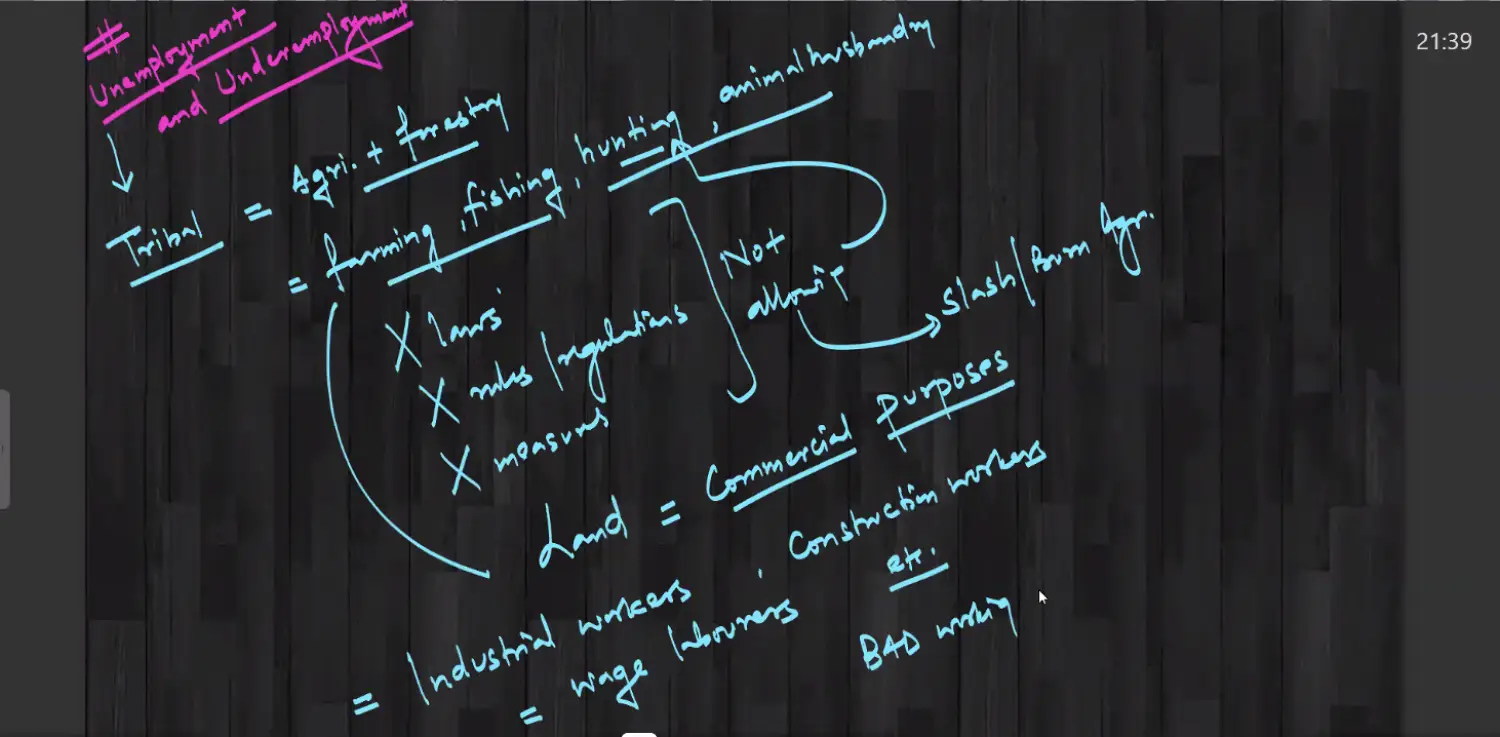
Issues
- Bad Working Conditions
- Middlemen Involved
- Wages Low
- Bonded Labourers
- Daily Wage Labourers in Industry → Hence, No Rights
Census Data
Reasons for
- Lack of Professional Skills & Education
- Intermingling Challenges based on Culture and Discrimination
- Land Alienation - Poverty and Indebtedness
- Low Demand of Tribal Product and Artisan Work due to Industrialisation
- Less Awareness about Government Schemes
- Disturbance caused by Left Wing Extremism
- Lack of Marketing of Tribal Products
- Less Technologically Compatible
- Less Agricultural Productivity
Measures
Trifed
Trifed is working with MOTA, is the APEX Body at the National Level.
TRIFED - Tribal Cooperative Marketing Development Federation of India
Works Under Administrative Control of MOTA
Ban on Bonded Labour
Minimum Wages
Reservation in Education & Jobs
- Development & Tribal Displacement
Industrialisation, Urbanisation, Mining & Hydroelectric Dams →
All these activities displace people settled over there
These Kind of Activities Generally take place in Forest and Nearby Areas which are generally occupied by Tribals
Here, More than 40% people are tribals →
Tribal Places which are Mineral Belts of India →
- Most Affected → Jharkhand, Odisha, Chattisgarh, MP
- Second → Andhra, Karnataka, Maharashtra and West Bengal & Tamil Nadu
- Third → Uttarakhand and HP
- Minimum Affected → Tribal Displacements in North East of the Country
XaXa Said that more than 40% of Displacement is of Tribals
NC Saxena Committee said that Since 1990, more than 55% displacement is of tribals
Overall Most Prominent Reasons for Displacement is by Means of Mining and Dams
- Pros and Cons of Displacements
- Pros
- Organised Economy Participation
- Increased Opportunity of Employment
- Better Educational Opportunities
- Better Health Care, Nutrition & Hygiene
- Reduction in Superstition like Black Magic
- Access to Transport and Communication
- Improvement in Lifestyle & Std of Living
- Better Access to Govt Schemes
- Cons
- Psycho Emotive
- Stress
- Anxiety
- Depression due to cultural shock
- Identity Crisis
- Socio Cultural
- Loss of Elements of Culture
- Loss of Traditional Art and Folklore
- Changes in Marriage, Family, Kinship ties
- Dilution of Rituals
- Loss of Elements of Culture
- Economic Lifestyle
- Self Sufficiency to Livelihood Struggle
- Land Alienation → Improper Compensation
- New Agri Practises to be adopted
- Sometimes Shifting to Settled Agriculture is NOT easy for Tribals
- Seasonal Employment
- Political Impacts
- Losing Political Autonomy
- Tribal Councils Band → Under Authority
- Governing Body to Being Governed
- Env Impacts
- Increased Pace of Deforestation
- Due to Deforestation Soil Erosion
- Increased Disasters due to loss of Natural Check
- Increased Pollution
- Invasive Species - Carrying Capacity of Ecosystem may vary
- Increased Human Animal Conflict
- Psycho Emotive
- Pros
- Examples of Displacement
According to L P Vidyarthi - Tribals who are being displaced by Industrialisation are
“Industrial Nomadism” or “Refugees of Progress”
Case Studies
- Narmada Bachao Andolan ( Sardar Sarovar Dam) > 23,000 People need to be relocated
- Rihand River Dam → Govind Ballabh Pant Sagar Dam (Largest Man Made Reservoir of India)
- Dasgupta and Vidyarthi studied the Tribal Areas in Ranchi → Displacement of HO Tribes
- Suggestions and Recommendation
- Tribal Panchsheel should be fulfilled in Word and Spirit
- Land Against Land in a Near By Area + Redistribution of Extra Land
- Cash Compensation should be Minimum and Avoided
- Public Purpose
- 5th and 6th Schedule Proper Recommendation
- Some Prominent Suggestion by XaXa Committee Reports are
- with EIA of Projects, there should be Social Impact Assessments
- Tribal or People Centric Development not Economy Centric
- Participation of Tribals in Planning Implementation
- Land Against Land or Compensation based on Market Prices not on Govt Prices
- Time Bound Resettlement and Settlement in Near By Areas
- Public Purpose should be Defined Clearly
Industrialisation and Impacts on Tribals
Parallel to Displacements and Aftermaths
Industrialisation → Steel Plants, Thermal Power Plants, Aluminium Industry, Dams and most prominently Mining related industries
Maximum Impacts in States Like Jharkhand Orissa CG
Nearly 50% Displacements due to INdustries and Developmental Activities is of Tribals
According to XaXa its 40%
Impacts and Consequences of Industrialisation
- Positive Consequence
- Diversification of Jobs
- Skills
- Difference Reduced
- Standard of Living
- Reduction in the Superstition
- Negative Consequences
- Socio Cultural
- Economic
- Political
- Psycho Emotive
- Positive Consequence
Case Studies
- Rihand Dam + NALCO
- Industrial Complex (Mining & Steel Plants) Near Ranchi → Ho Tribes → Studied by Vidyarthi and Das Gupta
- Sardar Sarovar Dam Project
Govt Efforts to Safeguard Tribal Rights in Era of Industrialisation and Urbanisation
Schedule 5 & 6 of Constitution →
PESA, 1996 → Panchayat (Extensions) to Scheduled Areas Act, 1996
73rd CAA, 1992 - For Panchayats, Part 9 of Constitution is extended to Schedule 5 on the Recommendations of Dilip Singh Bhuria Committee
Recommended Empowerment of Gram Sabha to Self Govern Minor Resources
FRA, 2006 → Schedule Tribes and Other Traditional Forest Dwellers Recognition of Forest Rights Act, 2006
Objective
- Restitution of Deprived Forests Rights
- To Provide Habitat and Livelihood Rights
PMKKKY - Pradhan Mantri Khanij Kshetra Kalyan Yojana
When Mining and Extraction of Mineral is done some portion of it should be going to District Mineral Foundation which has to be utilised for the welfare & upliftment of Tribals only like for Health, Education,
Vandhan Yojana by (Trifed under MoTA)
- Minor Forest Produce is Centre of Tribal Economy
- Hence, Vandhan Yojana Focuses on Centre of Tribal Economy to be → Minor Forests Produce Livelihood Development of Tribal Gatherers and Artisans
- It seeks to Improve Tribal Income through Value Edition and Marketing of Tribal Products
Vanbandhu Kalyan Yojana
- Holistic Developments
- Education, Skills, Hygiene, Health, Life Standards, Food and Job Security
- It is need based and hence outcome oriented
- It is for All Tribal Populations and All Tribal Populations
- Its Motive is “Sankalp se Siddhi”
- It focused to bring on one Platform of Various Tribal Welfare Programs from State Govt to Central Govt.
- So as to Convergence of Efforts can take place for the Welfare of Tribal Group
Suggestions
- Good Model of Jamshedpur (Dist East Singhbhum)
- It says that Give Jobs to the Tribals in the Industry which you are setting
- Settlement of Tribal Population should be as much near as the Original Place as Possible
- Hence, there will be less resentment and better governance
- XaXa
- National Commission for Scheduled Tribes u/a Art 338 → B D Sharma Committee Recommendations
- Displaced People should be Provided Home & employment as much near as possible
- Training, Skill Development & Entrepreneurial Activities should be Provided
- He Recommended Social Impact Assessment
- Inclusive and Sustainable Development with Tribal Sensitive Programs and Policies
- Good Model of Jamshedpur (Dist East Singhbhum)
Urbanisation and Impacts on Tribals
- Due to Industrialization and Economic Growth, Cities are Reaching Upto Tribals Areas
- MP, WB, CG, Jharkhand, AP & North Eastern India → Witnessed Maximum Urbanisation in Tribal Area
- in North East → Industrialisation is comparatively less marked, here there is more of Administrative Town Establishment like setting up of Distt HQ, Sub Division, Tehsils, Up Tehsils
Impacts of Urbanisation - same as above
Add Pollution, Clean Drinking Water & Usage of Intoxicants
Case Studies
- D N Majumdar
- Das Gupta
- Ho Tribe
- Ranchi Region
- Steel Plants
PESA, 1996 - Add by Self
Details of FRA 2006 - Add by Self
SEED Scheme for De Notified Tribes
Saxena Committee on FRA
- N C Saxena said that FRA is not being implemented in many states
- When Tribals & Other Traditional Forest Dwellers (OTFD) claim their rights (Individual and Community Rights - Gram Sabha). Most of the Rights are Rejected
- Unawareness related to Rights is seen
- Either the Rights on Minor Forest Produce are NOT Recognised, or even if recognised they are getting very less value for that
XaXA Committee Report on FRA
Community Rights are not being Granted, only Individual Rights are being focused upon
Rejection of Rights due to non documentation to support ST Status
Meaning No Document to Support ST Status
Agro Forestry, Social Forestry and Community Forestry is having very Less Involvement of Tribals
Lack of Awareness, Related to FRA and Its Provisions
Here , in FRA Non Tribals are getting more benefits as compared to Tribals
Lack of Active Participation of Gram Sabha
- Development of Forest Policy
- Importance of Forest and Natural Resources to Tribals
- Livelihood
- Culture
- Identity
- Religion
- Symbiotic Relations
- Like Yenadi of Andhra who Protect Olive Ridley Turtle ( They consider it as their totem)
- Maldhari of Gujarat → Lion
- Lisu Tribes of Tibet, Myanmar & Arunachal → Hornbill Conservation
- Tribals always belonged to Forests and Forests Belonged to Tribals
- Importance of Forest and Natural Resources to Tribals
- Forest Policies
Pre Independent India
Pre British Period
Forests = Tribals Synonymous
British Period
Policy of Exploitation
Forced Mass Exodus of Tribals
Independent India
in General
- Maximum Utilisation of Forests and Forests Products for Nation Building
- Tribals were made Part of Forests Based Development
1856
Dalhousie came out with Draft of Forests Policy
Railway Sleepers needed Huge Timber Supply which led to Mass scale Deforestation
Hence British Indian Government Entered into Forests
1864 - Dedicated Forest Dept.
A Dedicated Forests dept was created
1865 - FRA, 1865
Socially Recognised Practises of Tribals to be Regulated by States
Hence, Pastures were to be Regulated
1878 - Forest Act
- Three Types of Forests were there
- Reserved
- Protected
- Village
- Here Grazing and Collection of Produce wasn't allowed
- Three Types of Forests were there
1894 - Draft of National Forest Policy
1924 - First National Forest Policy
- It was proposed to use forests for Public Benefit
- Restrictions and Prohibitions were extended towards Tribals and Forests Dwellers
- Commercial Value of Forests were Identified
- First Time a Forest Official Post was created
- All these led to Gross Land Alienation of Tribals by means of
- Forceful Seizing of Land
- Forced to Evacuate the Forests Area
- There was Huge Opposition and Resentment
- Example : Eka Movement
1927 - India Forest Act
- Further Regulation of Peoples Right Over Forests
- Codified Powers of Forests Official
- Dedicated Indian Forests Service followed by State Forests Service Emerged Here
- Including Rangers, Foresters and Forests Guards
- Gross Misuse of Authority given to officials
- Which in Turn Led to → Further Land and Forest Alienation in Tribals
1952 - National Forests Policy
- Objective was that of Maximum Revenue from Forests to contribute towards Nation Building
- No Special Relief to Tribals
- IFA 1927 Continued → Which Led to Further Land Alienation for Tribals
- Here Environment was Degraded, like
- Soil Erosion
- Usage of Timber should be of that one which can be Generated Quickly
- Trees - Plantations
1973 - Dhebar Commission
Dhebar Commission was formulated to study the impact of forests policies on Tribals and to suggest some corrective measures. it was formulated to understand the Importance of Forests in the Life of Tribals. It said that Forests & Natural Resources is a way of life for Tribals
Commission Criticised the Government for not giving due attention to the rights of Tribals
1988 - National Forest Policy
- it was a watershed development after independence.
- It's important because this policy accepted tribals as forests protectors
- Here Focus was more on Ecological Balance through afforestation, Reforestation and Controlling Deforestation
- This policy extended the concept of Agroforestry, Social Forestry and Join Forests Management
- It proposed that Contractors between Government and Tribals should be abolished and they should be replaced with tribal cooperatives with maximum representation of tribals
- It suggested marketing of Tribal Products through Institutional Mechanisms which later transformed into Trifed
- Its target was to bring at least 1/3 of India Geographical Area under Forest s and Tree Cover
1996 - PESA
2006 - FRA
Add from Written Class Notes
Findings from XaXa & Saxena Committee
- Concept of Social Forestry
Introduction
- Forest and Tree Cover is Created Outside Conventional Forestry in Societal, Community or Panchayat Land.
- Example: Road Side Trees, Canal Side Trees
- Not to Mention in Answer → Ex: Most Mature Form of Social Forestry is Miyawaki Method → Because it is used in Urban Area
- Benefits
- No Damage to Forest
- Increased Green Cover
- Ensuring the Availability of Forest Produce for Tribals and Forest Dwellers
- Land Used in Fallow and Unutilised Land is used for creation of Forests
- Prevention of Soil Erosion
Types of Social Forestry
Agro Forestry
It can be performed on Farming or Agricultural Land → It is called Farm Forestry or Agro Forestry ( Agricultural + Forestry)
Community Forestry
Community Forestry is done on Rural Land & Panchayat Land to Fulfill the Local Demand of Vegetables
Some time the Demand of Honey can be utilised
Social Forestry
Social Forestry has entered into Urban Areas also in the form of Urban Forestry like Miyawaki Method
Its a Japanese Method of Urban Forestry
Kerala and Maharashtra have adopted Miyawaki Method on Large Scale
Green Muffler
It is used to Absorb the Noise of the City. Hence it is also called Green Muffler
A Green Muffler is a Green Covering around the Cities Place to damp the Noise of City
Background & Case Studies on Social Forestry
- 1990’s → Social Forestry Emerged as a Prominent Concept
- In Nearly 20 Years Various Experts did evaluation studies on Social Forestry
Observation Around Social Forestry
- It created awareness about importance of forest and forest resources
- Social Forestry Increased, Green Cover Increased, Still Overgrazing and Deforestation Continued
- Social Forestry Promoted Monoculture Plantations
Example: Like Eucalyptus in Dandakaranya Plateau Region
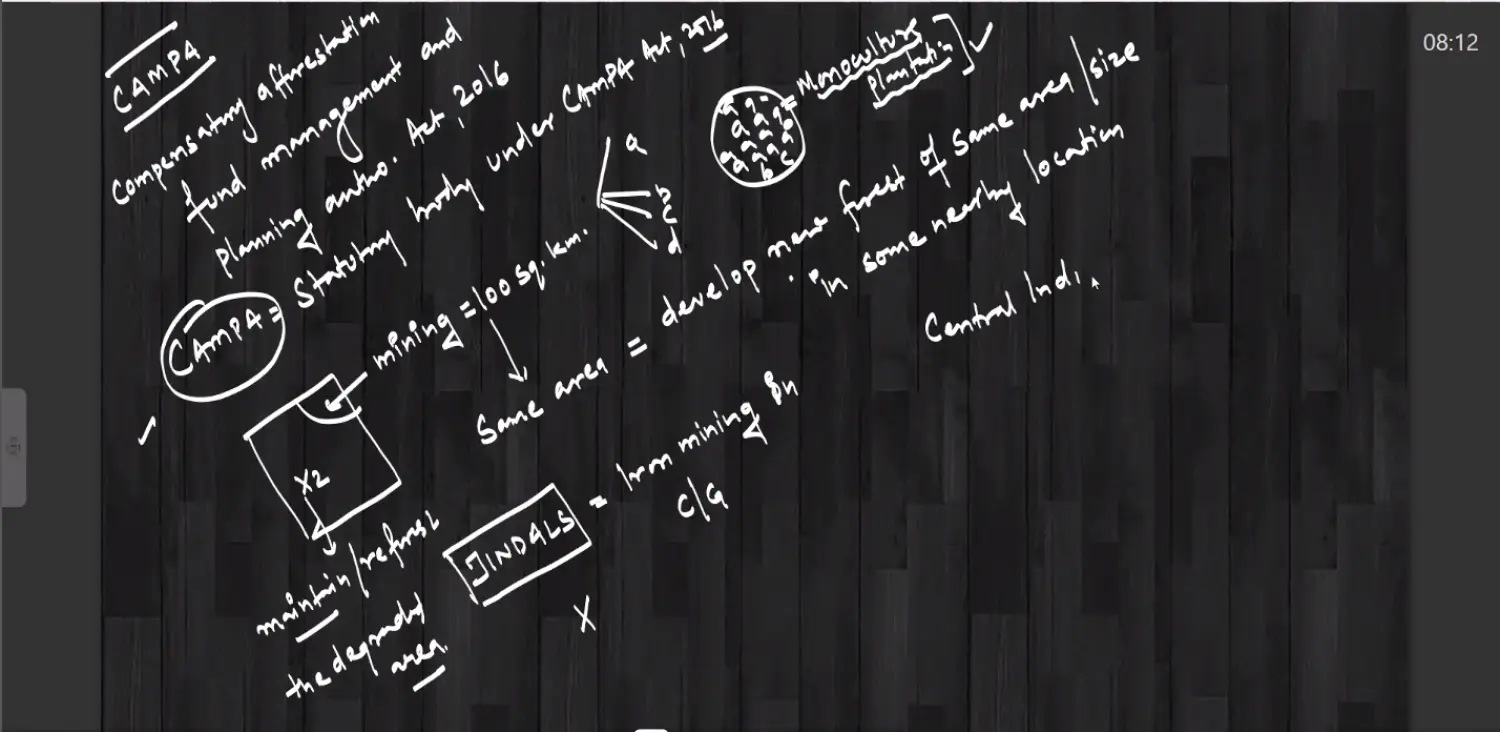
CAMPA Act: Compensatory Afforestation Fund Management and Planning Authority Act, 2016
CAMPA → Statutory Body under CAMPA Act, 2016
Either they have to Find a New Place for Creation of New Forests for Same Area
If No Area is Found, then they have to maintain Double the Area of Degraded Forests
Net Present Value of Deforestation is Rs 100 wrt to Land and entire forest resource, then they have to deposit Rs 100 under Public Accounts Fund of India
10% of this Money - Retained by Centre
90% of this Money - To be Diverted to States
Hence, Every State has its own CAMPA Fund under respective state public account
But here in Compensatory Plantation, the diversity of Forests is reduced because of Monoculture Plantation
In British India, In Central India, there was Teak, Sal, Tendu but when Britishers started using Forest Resources, they replaced Teak, Sal, Tendi, Kusum, Arjun, Mulberry with Sal
In Himalayas, There is Pine Trees Monoculture
- Less Enthusiasm in People (Particularly Forestry) through Social Forestry
- Large time period is required for growth of New Forests
- Joint Forests Management
Introduction
- Lets Manage Forests through Join Effort of Local People like Villagers or Tribals with Forest Officials
- Fringes Area and Outskirts where Population Density is More → People will harness the Resources
- But this Harnessing of the Resources should NOT be overexploitation
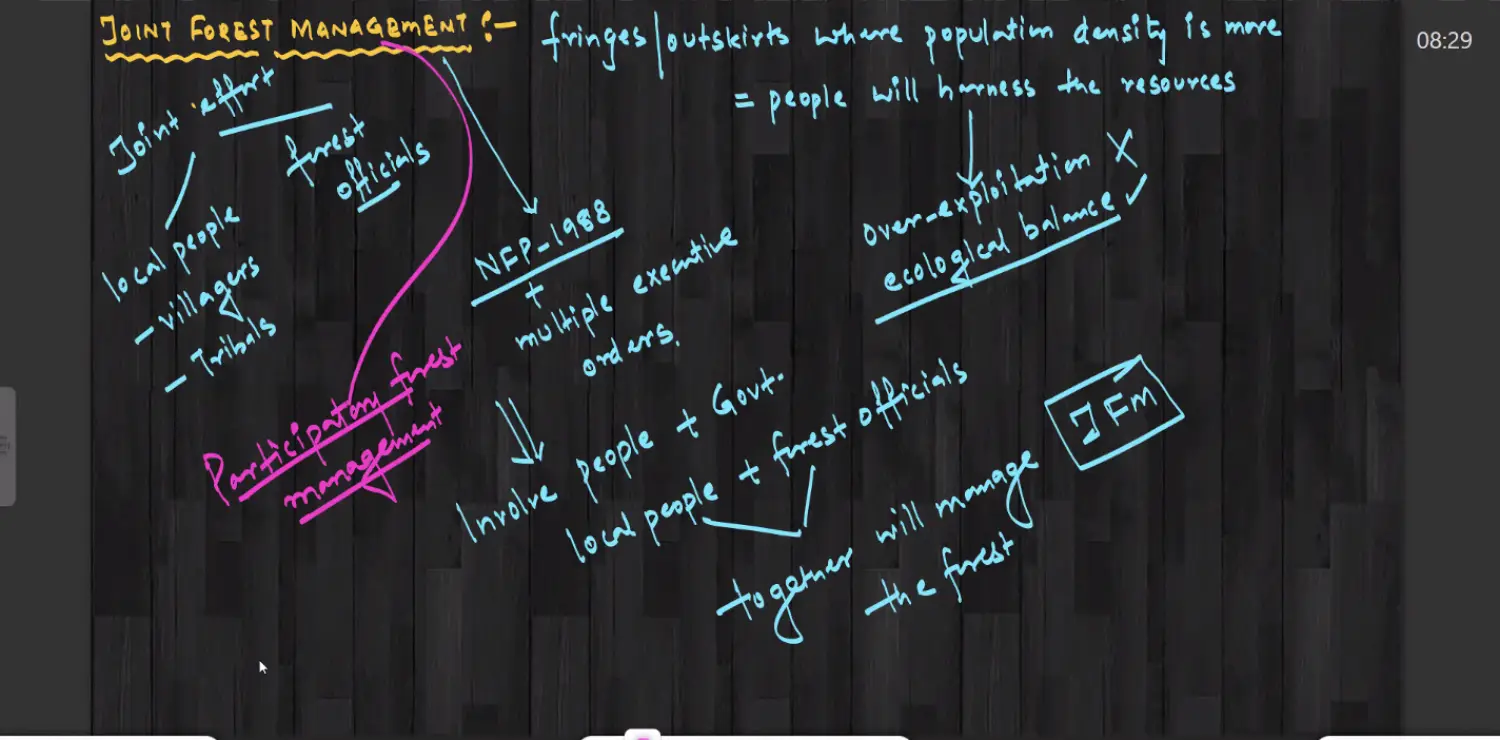
A K Banerjee was a Forest Officer, He Said
Grazing, Minor Forests Produce were used by Tribals. In Return he asked for Protection and Management of Forests from Tribals
This was Kind of Limited Exploitation of Forests
Banerjee tried this with NGO and later came out with JFM Policy
Under JFM, Excess and Exploitation of Forest Resources is allowed on Certain Terms and Conditions like
- maintenance of healthy soil ecosystem
- collection of dry, leaves, woods etc
- planting of saplings and vegetation
- Maintenance of Fallow part of forests
If such conditions are fulfilled, resources of the forest can be open to Limited Exploitation
Village Forest Council
It is Constituted, it is a kind of representative body of villagers
Between Village Forest Council and Govt ( Forest Department) there is a MoU is Signed
Benefits of JFM
People Centric and People Oriented and People Oriented Governance i.e active participation of people in the Governance
There is an improvement in the forest and biodiversity and fulfillment of demand of the resources
JFM is combined with MGNREGA, Hence for Tribals it is a source of income generation with resource allocation from forest
Case Study : Himachal Model of JFM
It reduced Man Animal Conflict as people aren't allowed in Animal Area aren't allowed
Case Study : Meghalaya Forest Village Scheme
- Another Benefit is Marketing of Tribal Products with Quality Assurance by Forests Department
- Quality Assurance by Forest Department
- TRIFED Can be Involved
Case Study : Himachal Model of JFM
- Himachal Made a Rule that every Family should have a women participant
Case Study : Karnataka Model of JFM
- Over 10% of Open Forests, Earlier it was a Fallow Land with very Less Vegetation. But it is now under Green Cover
- Increase in the Green Cover & Increase in the Carbon Stock
Case Studies : Gaddis in Himachal and Gujjars/Bakarwals in Kashmir
- With JFM initiatives there was a Significant Control Seen in Overgrazing within these Tribes
- Which Led to Prevention of Bio Diversity Loss and Along with it It allowed the Growth of Wild Grass
Conclusion
JFM can contribute towards
- Human Resource Development
- Sustainable Management of Forests and Natural Resources
- Livelihood and Sustenance of Tribals and Forests Dwellers, Significantly Reducing the Soil Erosion
- Protection and Conservation of Bio Diversity
- National Forests Policy Draft, 2018 ( Now Withdrawn)
Reasons for withdrawing this policy was non acceptance of Pressure Groups & Corporate World
To bring 1/3rd of total geographical area of country under forests and tree cover
Forests Certification
Example Timber is Forest Produced means → The Timber has not been Produced by any Unsustainable Practices
It was designed by NCCF : Network for Certification and Conservation of Forests
Its an International NGO
This kind of certification is needed because many Developed Countries are Importing Products which are only Forest Certified
Note : Beggars Can't be Choosers
Active Participation of Local People, Tribals & Forest Dwellers in Forest Based Economy
Social Change & Tribals
What is Social Change in General
Gillin & Gillin
According to Gillin and Gillin Social Changes are variations from the accepted mode of life
These can be due to
- Alteration in Geographical Conditions
- Changes in Cultural Components
- Changes in Population Composition
- Changes in Ideology
These Changes can be brought about by Diffusion or Innovation with in (Rationalisation of thoughts) the Group
Maciver & Page
Social Change is a Process responsible for many type of changes like
- changes in conditions of life → Material Conditions
- changes in attitude of people → Thought Process
- changes in belief system → Religious Beliefs and Superstitions
- changes in Physical Nature of Things → Importance of Technological Innovations, Modern Amenities etc
Social Change in Tribals in India
| Before Independence | After Independence | | --- | --- | | Pre British Period | Post British Period | | Less Marked Changes | Well Marked Changes | | Generally until 1800 | Post 1947 |
Before British Period
Suresh Singh (SCA + Sociologists)
He said that Mughals considered Bhils, Gonds, Kols and Minas as most dominant tribal groups in India
He said that → Rajput, Mughal, Early European Powers influenced the Tribal Matrix
For Example:
- Authority System of Rajputs
- Chronological System of Administration
Started leaving some footprints in Tribals like Changes in Agricultural Patterns and Irrigations were accommodated or seen in traces in tribals
Settlement Patterns Emerged in Tribals, Like Reduction in Nomadism
Here, Agents of Sanskritisation Entered into tribal societies
During British Period
In General These Changes Happened
- Changes were studied by Surjeet Singh, Surjeet Singh, F G Bailey, S R Sharma
- Most Prominent Thing seen was → Breakdown of Isolated Life and Isolated Economy of Tribals
- Breakdown of Communal Mode of Production and Consumption
- Intrusion of Outsiders like Moneylenders & Christian Missionaries
- Any Outsider in Tribal Society was called a Dikkus or a Dikky simpley meaning Alien
- Commercialisation of Forests Started
S R Sharma explained Impacts of British Rule on Tribal Life
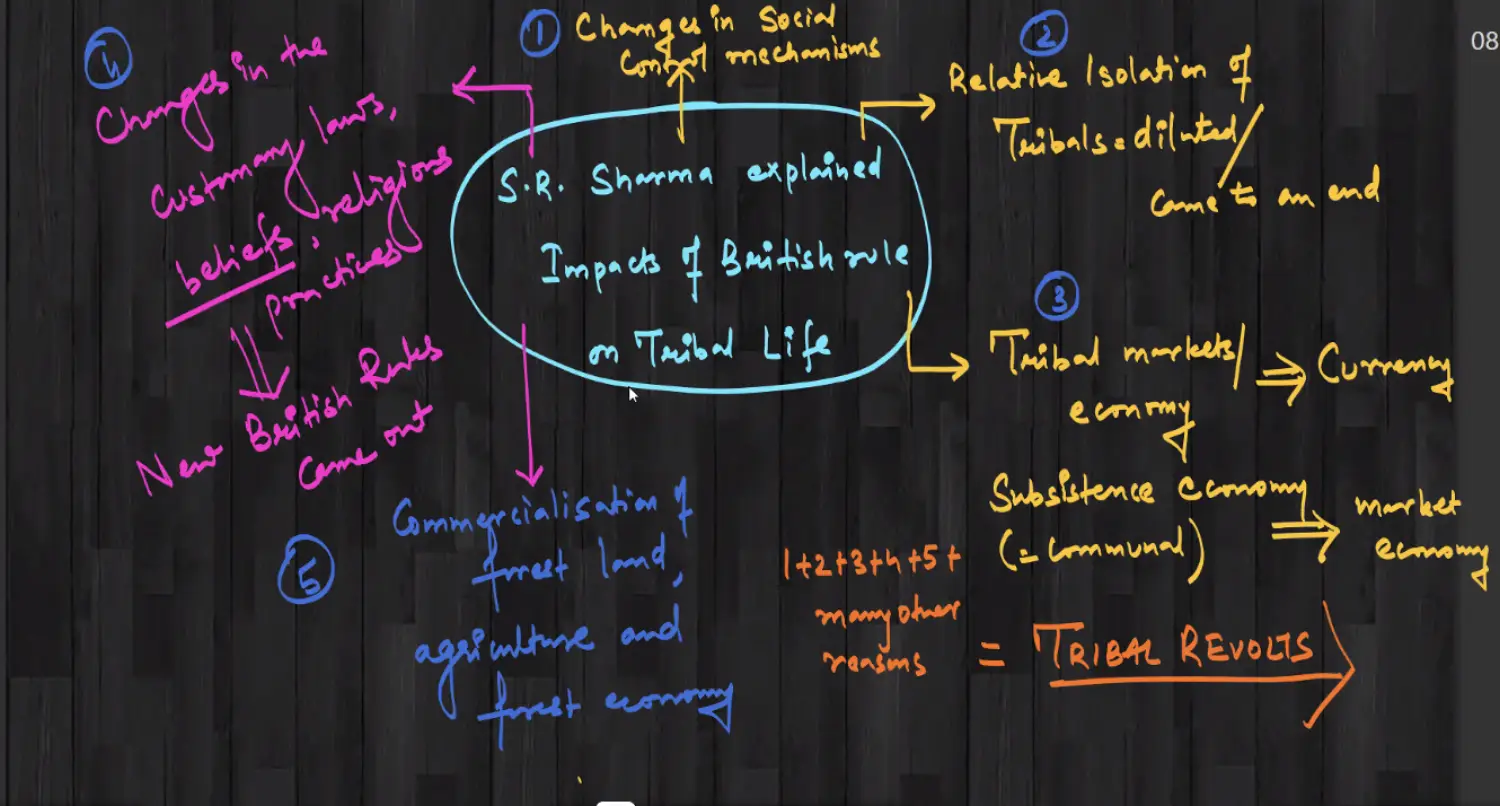
Changes in Social Control Mechanism
Relative Isolation Got Diluted or in some places came to an end
Tribal Markets and Tribal Economy saw entry of currency from barter
Thus witnessing its journey from Communal Economy to Market Economy
Changes in Customary Laws, Beliefs, Religious Practised and New British Practises Came out
Commercialisation of Forest Land, Agriculture and Forest Economy
Due to All the Above Stated Reasons → Multiple Tribal Revolts Took Place
After British Period
Industrialisation, Urbanisation, Westernisation and Modernisation
Social Economic and Political Inclusion (Tribal Panchsheel and Inclusive Measures)
Welfare Measures
Developmental Programs and Policies like Tribal Subplan
Constitutional Provisions for Changes
- 5th Schedule
- 6th Schedule
- PESA
- FR & DPSP
LPG Reforms in Indian Economy
Educational Institutions
Health Infrastructure Development
Connectivity of Earlier Inaccessible Tribal Areas to Larger part of the Country
Political Reorganisation of State Based on Tribal Identities
Social Changes in Independent India
Family
- tilt towards Nuclear Family
- Position of Women Improved at certain Circumstances
- Matriarchal → elements of Patriarchy Entered
Economy
- Barter Economy
Health and Education
Marriage Patterns
- Tribal Exogamy Started
- Changes in Bride price to Dowry
- More Sacred Rituals
- Moving Towards Monogamous Marriages
Political Representation
MP MLA MLC Autonomous Council PRI President Tribal
Political Representation of Women Seen
Religious Beliefs and Practises
- Organised Belief System
- Entry of Sanskritic Rituals
- Impact of Hinduism and Christianity
- Reduction in Traditional Witchcraft Black Magic Extra
Miscellaneous
Case Study by Gadgil and Guha
Asur & Agaris
- They Studied Artisans of CNP → Asur and Agaris
- Ironsmith Technology, Tools and Equipments almost faded
- Now they have Shifted to Agriculture or Daily wage Labour due to introduction of Machines
Dhurvas and Baigas
DHOKDA Craft Making Style of MP CG is almost Extinct Now
Because of No Support from Government and No Skill Development from Artist
Chenchus and Chinchus & Jenu Kurubas
Jenu Kurubas → They are called as the Honey Collectors of Nilgiris
They have no Livelihood, Some are getting Involved as Agricultural Labourers and Some in Criminal Activities
Now Govt is Involving them in Conservation of Wildlife particularly Elephants
Case Study By Animesh Roy
In Mizo Tribe
If Mother is Dead and If she has kid of < 5 Years of Age, She or He was Buried with the Mother
But Missionaries During British Period, Various Orphanages and Govt Bodies like Child Care Departments are taking Responsibility of them
Independent Case Study - Khasi Tribe
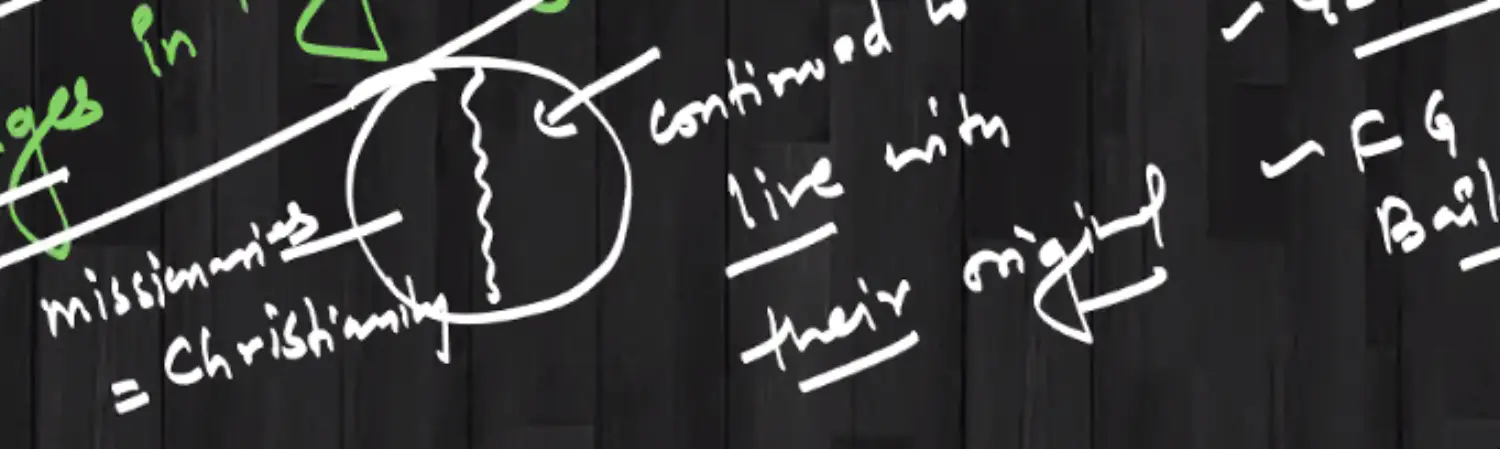
In Khasi Village in Meghalaya, within a Single Tribe there were
One Side of Village Lived with Missionaries and Christanties and Others Continued to Live with their Original Traditions
Hence the Concept of Converts and Non Converts
Policy of Govt Towards the Tribals After Independence
- In Theory - Tribal Panchsheel Exists, But in Practise it is Elusive
- Integrative and Assimilative Approach → There is Still a Lot of Discrimination and Insensitivity towards Tribals
Suggestions
- Tribal Panchsheel Policies should be followed properly
- To Abide by the Recommendations of XaXa Committee
- Effective Job Based and Quick Rehabilitation and Resettlement Strategies should be Implemented
Impact of Modern Democratic Institutions on Indian Tribals
Due to
- Political Institutions
- Constitution of India
- Laws Judgement Policies framed by Parliament or State Legislatures
- PRI and Gram Sabha
- Financial Institutions
- Regional Rural Banks
- Co Operatives
- SHG’s
- Health and Educational Institutional
- Political Institutions
Case Studies in India due to Impact of
Gadgil Guha
Mizo
Khasi
Artisans
B D Sharma (Chairperson of NCST)
He Suggested Rai Sabha of Gonds of Telangana and Odisha
Rai Sabha is means of Tribal Leaders in Village Assembly
Govt allowed by Saying that if it Rai Sabha matches with Panchayati Raj System then there is No Issue
E Prasad - Rural or Tribal Bihar ( Present Day Jharkhand )
Traditional Leadership = Egalitarian Society
New Leaders Based on Modern Democratic Institutions like through PRI’s → Now they are focusing More on Increasing Self Importance
Pol Science calls this process of trying to increase thy self power as Aggrandizement
This Leads to Promotion of Neta Culture within Tribals as wells
Report by National Commission on Scheduled Tribes (NCST)
They mentioned that new modern democratic institutions are not well accepted by Tribals. They Prefer to Maintain Traditional Institutions
Example Khonds → They maintain Sabha of their Elders
These Traditional Institutions do not have any stance or stay in Self Govt Institutions
Leaders or Mechanism of Traditional Institutions should be Incorporated with Modern Democratic Institutions for better acceptance
People of India Project said that Rai Sabha kind of models where Traditional and Modern Democratic Institutions go hand in hand
Welfare Measures - Updated Document to be Received
- Economic Welfare
- Educational Empowerment
- Poverty Alleviation
- Employment
- Health and Hygiene
“An Introduction to Tribal Transformation in India” is a 5 Volume Book by Buddhadeb Chaudhuri → Important
Broad Outcome or Theme of the Study is
Tribals are forcefully being pushed towards market economy without proper resources to survive in the competitions
FELT NEED Approach is Grossly Missing in Government Tribal Policies
This Increases the InSensitivity
Development of Tribals is well below the Expectation due to Defective Policy Formulation and Implementation
Impact of Various Religions and Tribals
General Religion of Tribals
- Naturism
- Animism
- Animatism
- Totemism
- Bongoism
- Fetishism
- Ancestral Worshipping
Hinduism - Major Impact
Answer can be started with this argument that
Even in the Epics like Mahabharata & Ramayana. There are some references of Tribes being Influenced by Hinduism
One Famous Character from Ramayana - Shabari who gave fruits to Lord Rama → She was from Sabari Tribes
Hidimba → Wife of Bhim in Mahabharata was a Tribal Lady
Tana Bhagat Movement - Tana Bhagat was a Tribal from Eastern India who was influenced from Hindu Bhakti Movement
He popularised Hinduism in CNP
More than 90% of Tribal Populations are
- Oriented Towards Hinduism
- Tilted Towards Sanskritic Rituals
- with this they still follow Tribal Beliefs and Practises
Areas in India
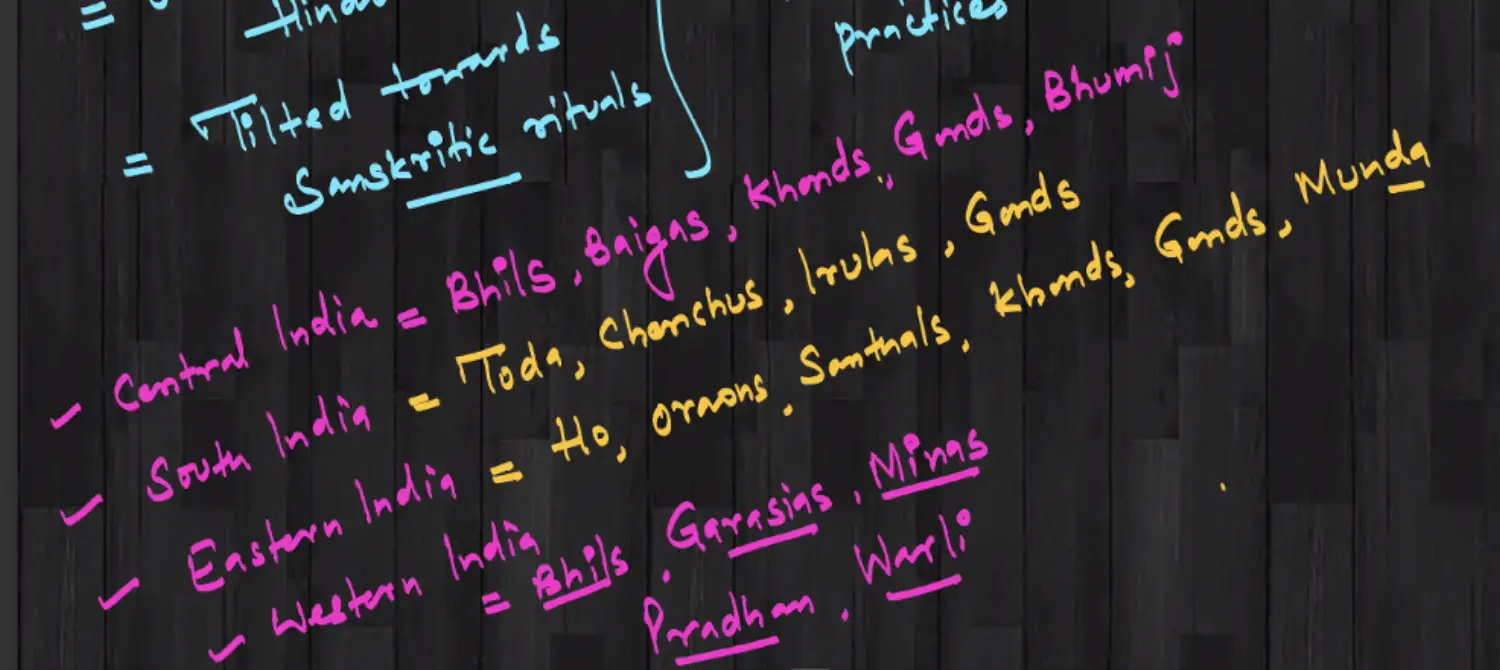
During Britishers
Entry of Outsiders in Forests → Cultural Contact → Acculturation
Due to that Tribals were exposed to larger hindu society
Revenue Administration of British India appointed Intermediaries
Involvement of Money Lenders Increased
Mass Exodus of Tribals → Tribals came in contact with Larger Hindu Society
During Post Independence
Various Agents of Westernisation, Sanskritisation, Modernisation etc
They have Increased the Contact between Outsiders, Mainly Hindus and Tribals
Conclusion
Impact of Hinduism was Not Uniform
- Not Equal on All the Tribes
- Not Equal in All the Time Periods
All these things started the Entry of Hindu Traditions within Tribals
Brahminical Traditions entered into Tribal Life
Example:
- Gonds Following the Rajput Lifestyle
- Bhils following the Brahmins and Rajputs
- Sanskritisation → In Terms of Tribals according to Kshatriyaisation because maximum tribes were adopting Rajput Tribes Lifestyles and Administration
Peasantization within Tribals
- Cultivating Practise
- Harvesting Festivals started in Tribal Studies
Case Studies
- Oraons Case Study by Sachidanand Sinha
- Swami Pooja and Animal Sacrifice at Goddess Mandapa to Priests
- Tana Bhagat is from Oraons
- They Left Beef Eating
- They Started Wearing Sacred Threads
- Bhil Tribes - Referred at People of India Project
- Bhils consider Goddess Parvati belongs to Bhil Tribe
- Hence they Demand Bride Price from Lord Shiva
- Shiva Refused to Pay the Bride Price
- As a Revenge they Killed Nandi (Bull)
- They thought so because they thought that Nandi’s Shoulder had some pearls
- But they Got a Curse from Shiva that they will live in Poverty
- With Curse is the Blessings i.e Vardaan by Shiva → If they will do theft or robbery there poverty will be reduced
- Hence they call themselves as Thieves of Shiva
- N K Bose - Juangs of Odisha
- Juangs were Shifting Cultivators but due to influence of Hindus they started settled settled agriculture coming out of forests
- N K Bose wrote → The Hindu Method of Tribal Absorption
- Oraons Case Study by Sachidanand Sinha
Overall Impacts of Hinduism on Tribals
- Settled Agriculture
- Religious Practises and Worshipping Pattern Changed
- Wearing of Sacred Thread Started
- Dowry
- Changes in Marriage and Family Structure
- Marriage and Family Structure
- Sanskritic Festivals
- Entry of Caste System
- Food Habits (Beef Eating Denounced)
- Decreased Egalitarianism
- Reduction in Importance of Youth Dormitories
- Gender Bias Increased
Christianity - Major Impact
British Legacy primarily when the missionaries came to India → When the Churches were Set Up
Nearly 5% of Tribal is Affected by Christianity
Predominantly in North Eastern Part of Country
Some Pockets in Central and Eastern India & Very Less in Southern India
Impact of Christianity is more in Southern India but Impact of Christianity on Tribes of Southern India is Less
Christian Missionaries were the First Ones who entered with Welfare Measures.
Setting up Hospitals and Educational Institutions
They Set up many Orphanages as well
Tribals accepted Christian Missionaries because
- Against the Social Divisions
- Money Lenders and Middle Men were generally Hindus who were treating tribals badly
- No Caste Based Hierarchy in Christianity
British Administration Intentionally Propagated Christianity
- Charter Act 1813 - Allowed Missionary Activities
- Incentivised Missionaries
- Helped in Infrastructure Development
Portuguese Also Brought in Christianity with them at the West Coast → Christianity in Goa
Case Studies
Khasi Tribes
Two Groups of Christian Convert Khasis and Non Convert Khasis
Mezos
Stopped Burying the Child with Dead Mother
Case Study of K N Sahay
He Studied the Christian Converts of CNP Region
People who converted to Christianity ; Started Considering themselves as Superior to Non Converts
They were with the opinion that they are practising best religions of the World
Due to all these we witnessed division in Oraon
Over All Impact of Christianity
- Secular and Modern Values against Superstition
- Institutionalised Belief System
- Child Marriage + Polygamy → Discouraged
- Welfare Measures in Terms of Health and Education
- Support of Church in Socio Economic Spheres
- Western Lifestyle → Dressing, Food Habits → Started Penetrating in Tribals
- Bifurcation of Society into Converts and Non Converts
- Against Communal Ownership of Resources Private Landholdings were seen
- Decline in the Usage and Functionality of Youth Dormitories
Islam - Minor Impact
Marginal Impact on Tribals → Hardly 0.5 % of Tribal Population in the Country
Due to Certain Fixed & Rigid Dogmas → Islam is Monotheistic Religion
In Hinduism and Christianity → They followed both the Previous and Traditional Practises they followed the new religion as well
Which was NOT the case with Islam
Currently Muslim Tribals are found in the
Gujjars and Bakarwals in Himalayan Belt
Maldharis of Kutch Region of Gujarat
Lakshadweep - 7 Tribal Groups
Malmis, Thakrus, Raveris, Melacheris → Due to Influence of Malabar Coast of Kerala
Preachers and Sufi Saints from Malabar Coast towards Lakshadweep
Scattered Populations in
- Central India
- Western India
No Missionary Involvement
Lakshadweep
Lakshadweep was a Matrilineal Society. Now it is declining due to influence of Islam → Moving Towards Patriarchy
Earlier Certain Puberty Rites for Girls → now no such rights
Now they have Monotheistic Religion, but some previous rituals also continued
People are conforming to Shariat, because of which
Along with Malayalam words of Arabic and Urdu are also being used
Buddhism - Minor Impacts
Very Limited Impacts
Very Few Examples
- Bhotias - Sikkim
- Bhots → Ladakh
- Lepchas → Sikkim
- Chakmas → Tripura
- Naga Lepcha → Arunachal Pradesh
They are affected by Tibetan Buddhism
Even after adopting Buddhism, none of these groups totally buddhistic. They Have Not Adopted Buddhism to the Core
They still follow their traditional social life
No Division based on Converts and Non Converts
They maintain Gompas which act as Sort of Monasteries Only - Here they Put up Pictures of Buddha
They have their priests called Lamas
Case Study by Haimandoff on Nishis of Arunachal
That they are appointing Lamas and still retaining their old practises
Concept of Ethnicity
Literal Meaning of Term Ethnic is Race
It is not restricted to race but also includes
- Sharing Some Common History of Heritage
- Unity Between the People
- Sharing Some Common History / Heritage
- Have Common Belief System
- Region or Religion Specific
Term Ethnicity was Coined by Van Der Berghe
He Said that: An Ethnic Group which is a Collection of Culturally Related People
Living within a Designated Ethnic Boundary
In the Words of Cohen
Ethnicity is a Process of Interaction between the Cultural Groups operating within a Common Social Context
The Concept of Ethnic Boundary was given by Fredrik Barth
He Maintained that “People in a Group are bound by primordial bonds”
In a Broader Term : Today the Term Ethnicity is More Parallel to Nation
but Both Non Ethnic Nations and Multi Ethnic Nations do Survive
Fredrick Bath and Ethnicity
Can be called as Characteristics of an Ethnic Groups
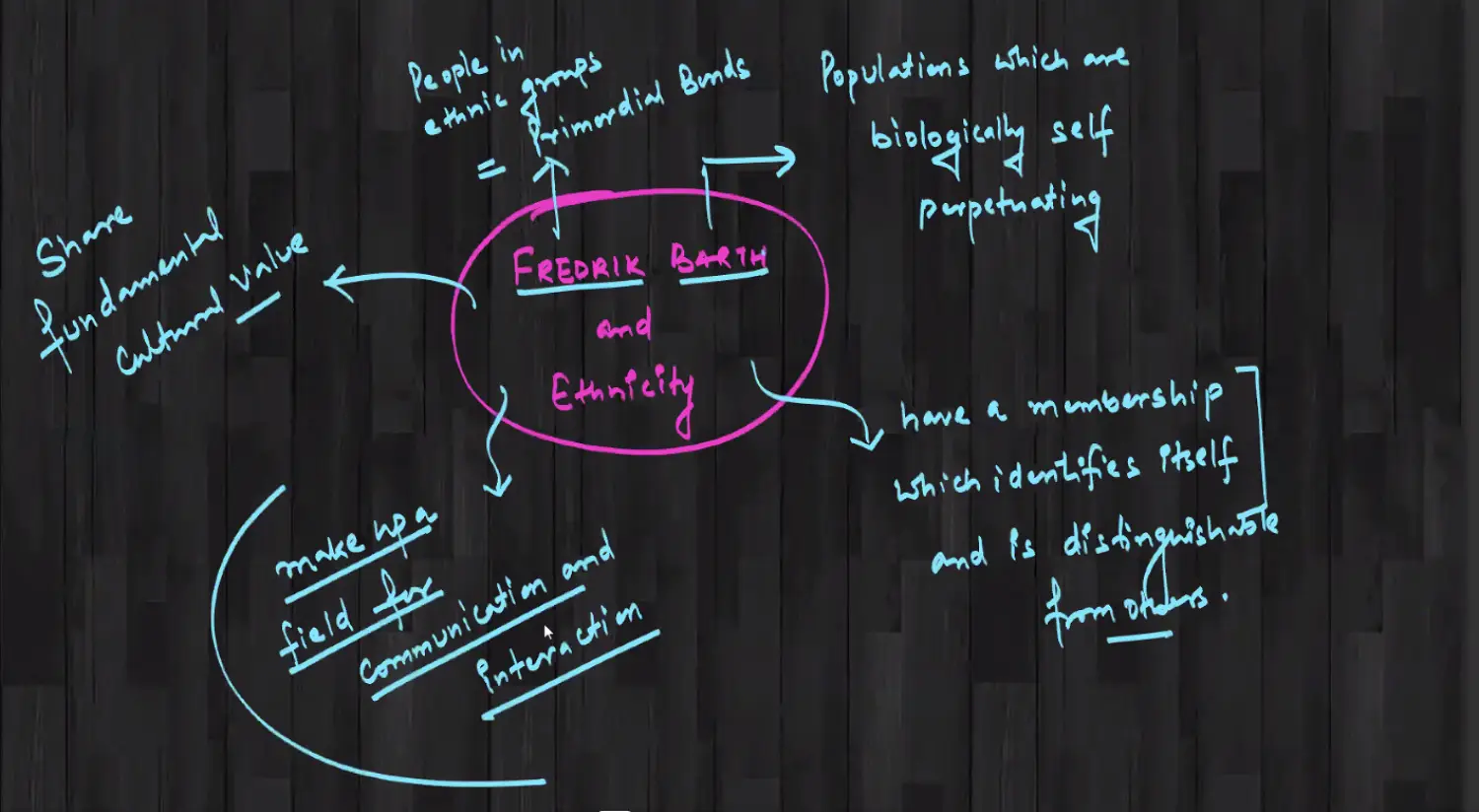
He Maintained that people in Ethnic Groups are bound by Primordial Bonds
Ethnicity is that Population which are Biologically Self Perpetuating
By Means of Biological Production & Not by Migration
An Ethnic Group shares Fundamental Cultural Value
People in Same Ethnicity make up a field for communication and Interaction
They have a Membership which Identifies Itself and is distinguishable from others
Based on Opinions of Various Anthropologists & Sociologists - Features of an Ethnic Group are
- There is Socio Cultural Uniformity
- Membership is by Birth
- Group Feeling - More Focus on we than “I”
- Separated from Other Ethnic Boundaries may be Geographically or Culturally or Biologically
Different Approaches to Elaborate or Define
- Primordial Approach
- It was propagated by Clifford Geertz & some other anthropologists
- This Approach Regards Ethnicity as a Natural Bond Between the People which is the Most Fundamental Reality of their Existence
- This Natural Bond between the People can be based on a Shared Geography or Common Socio Cultural Norms and Features
- This Approach further Argues that such ethnic Sentiments & Attachments can lead to Social Turbulence, may be violence which can be dysfunctional in the development process of civil society or society at large
- Primordial Approach is Basically the Sentiments which are continued since generation and generations
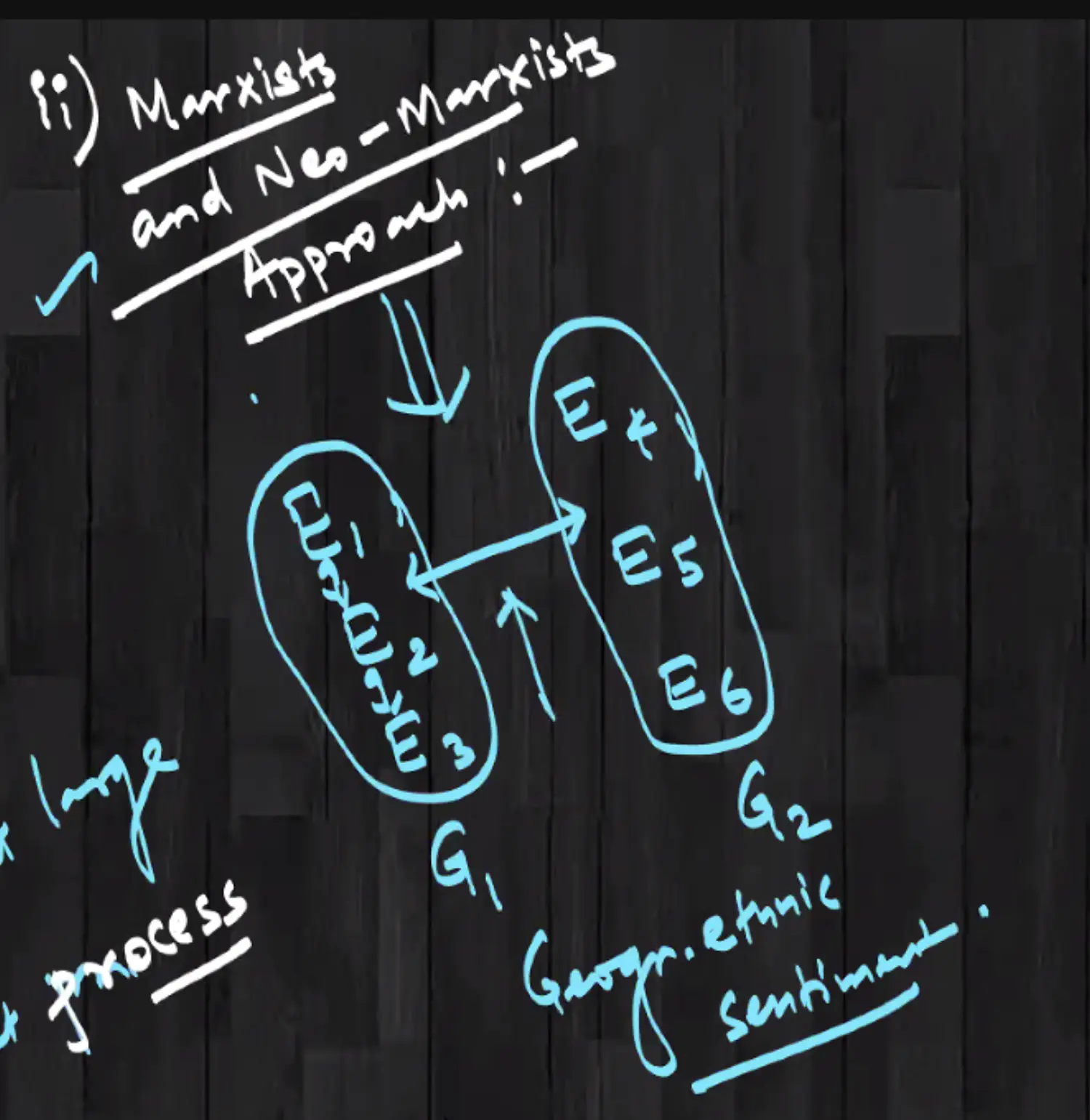
Marxist and Neo Marxist Approach
Ethnic Conflicts will emerge in a Situation where there is a Cultural Division Based on Superiority, Labour ownership of Resources etc i.e
When Members of One Ethnic Group are placed in a Subordinate Position within a Common Geographical Location
Also, when the geographies are different, the sub ethnicities in one geography, can come together in retaliation to, Ethnicities belonging to Different Geographies
Pictorial Representation
- Modernisation & Development Approach of Ethnicity
It states that instead of dissolving ethnic sentiments modernisation and development with associated dynamics have increased ethnic sentiments
- Pluralist Approach of Ethnicity
People in a Multi Ethnic Plural Society Mix, Stay Together but do not combine the ethnic sentiments
Every Group Holds a Particular Religion, Language, Institution which are advocating and Bargaining for the rights of their own ethnic people
These Latent Sentiments of Ethnic Connections can be significant reasons for possible ethnic conflicts in future
Ethnics Connection can be represented at various political fronts to fulfill the demands and political representation at appropriate platforms
Example By:
In the words of Political Analyst Dipankar Gupta, Indian Political System is having diverse varieties of identities, political presentations, regional aspirations etc which can be synergising or diverging based on demand of the situation
For Example
Various Southern States are having multiple interstate disputes, like River Water Disputes which are discussed from time to time.
But at the National Level, if there is a discussion of Hindi as a National Language, all southern states voice together
Dipankar Gupta Said that, Ethnicity is an excellent tool for identification of aspiration of communities, to preserve and safeguard their identities
Ethnic or Cultural Boundaries by Fredrik Bath
Caste Boundaries or Cultural Boundaries → The Concept was promoted by Fredrik Bath with a Basic Argument that
Common Identity or Ethnicity based on different parameters like Geography Belief System or any other parameters will be preserved by its followers, i.e ethnic identities will be retained and maintained
People of Different Ethnic Identities will have a Limited Interaction and Communication i.e Restricted Social Interaction with this to safeguard, preserve and perpetuate, their Own Identity.
The Intra Group Interaction and Communication will be Promoted.
Various Groups maintain social boundary with other groups as a parameter for social exclusion
Different Territorial Boundaries and Geographies, different territorial boundaries and geographies are not always coinciding with different socio cultural boundaries
For Example: Different Forms of Nagas are found in Arunachal, Nagaland, Manipur and Assam
Fredrik Barth Maintained that, people outside ethnic boundaries are not expected to have common characteristics
that is why people of outside group are not expected to confirm to customs and norms of a Particular ethnic Group
These Ethnic Boundaries are important, in separating one ethnic group from another
These boundaries are administered and maintained by Social Boundaries and Institutions like caste council, tribal council, religion mahasabhas etc
Consequences or Impacts of Ethnic Sentiments / Ethnicity
- Functional / Positive Consequences
- Helps People to Preserve their Culture and Identity → More Valid in Multi Ethnic Countries
- Mobilisation of Groups can lead to Rights & Social Justice by acting as Pressure Groups
- Traditional Knowledge with Different Ethnic Groups will be Preserved
- Diverse Ethnicities, Staying Together Leads to Creation of Social Capital
- Negative Consequences
Examples Are : Nagalim, Telangana, Bodoland, Gorkhaland, Khalistan
All these movements created unrest and were threat to national unity and integrity
Demands of Tribals which were legit but were against the unity and integrity of the country cannot be accepted
These are clear case examples of Ethno Political Movements
Ethno Political Movements → When a Group or Several Groups of People, on the basis of identical, racial and cultural characters, unite and fight for their rights and identities under their right under a political banner
Ethnicity or Ethnic Sentiments create InGroup and OutGroup Feelings in the People
which can in turn lead to Violence within the Groups → Inter Religion, Inter Caste Violence
They Lead to Tribal Movements or Tribal Unrests can also be Triggered
Example: Nagalim Movement, Munda / Ho / Santhal Rebellions before Independence
Social Disharmony due to these sentiments, violation of human rights and challenges to minorities (Religious, Linguistic, or Caste Based Minorities)
- Solution / Avoidance
Festivals, Games & Fares etc
Example: Azadi ka Amrit Mahotsav
Example: Ek Bharat Shreshtha Bharat
Example: Khelo India Campaign
Confidence Building Measures like Regular Meetings and Cultural Exchanges
Religious Leaders / Judges / Politicians can act as Agents of Social Harmony
Regional Disparity in Development should be Minimised
Fulfilling the true Spirit of Tribal Panchsheel in Sch 5 and Sch 6 Area
Social Media, Civil Society & Media
- Functional / Positive Consequences
Overview of India in terms of Ethnic Sentiments
In India - Agents of Conflicts Are - Can be used in Introduction
- Religion Based
- Region Based
- Caste Based
- Language Based
- Separatist Movements (like Khalistan and Nagalim Movements)
According to Clifford Geertz → there is a need to build a nation where the essence of unity, overrides all the loyalties related to ethnic groups i.e Ethnic Identities should be Secondary when there is a Question of National Interests
Hence: Rashtra Sarvopari Hai
Example: During British Period, National Sentiments were Over Riding Ethnic Sentiments because Country was not independent
In Post Independent India Ethnic Sentiments are sometimes competing with the National Sentiments
Constitution is Secular but Sentiments are Religious (Not Secular)
Ethnic Conflicts and Associated Political Development
Complex Ethnic Plurality, Based on
- Region
- Religion
- Languages
- Caste
It is almost impossible to demarcate these identities
Development Disparities Leading to Unrest
Role of Non-State Actors → Within the Country
Role of Other State Actors → Outside the Country
Financial and Moral Backup of Chinese Sponsored Left Wing Extremism ( As Per Report of Ministry of Home Affairs)
Political Parties and Interests Groups to get Political or Other Types of Gains
Example of Ethnic Movements Related to India
- Linguistic Reorganisation of States
- Gujarat and Maharashtra
- Punjab and Haryana
- Telugu Speaking Andhra from Erstwhile Madras (Tamil Nadu)
- Movements
- Nagalim Movements
- Bodoland
- Gorkhaland
- Khalistan Movement
- Separation of
- CG from MP → Disparity in Development
- Jharkhand from Bihar → Tribal Identity and Resources of Jharkhand and Development of Bihar
- Uttarakhand from UP → Separate Hill Identity
- North East Status → Based on Practises and Identities
- Anti Hindi as National Language Movement by Southern States
- Linguistic Reorganisation of States
Examples of Tribal Movements Related to India
- Before Independence - Add 1 1 Points from Freedom Struggle
- Santhals
- Mundas
- Ho
- Moplas
- Kuki
- Eka Movement
- Kol
- Koli
- Bhil
- After Independence
Jharkhand Movement
Gond Movement - Adilabad District of Telangana + Involving Parts of CG also
They were Separate State from Gond Populations of Telangana and CG
North East Introduction
- Movement was for Autonomy
- Tribes were Demanding Non INterference by States
- Many Times they were violent in Nature
North East - Nagalim Movement
Many Times they were against state particularly by Nagalim Movement
Nagalim Movement was a Movement for Demand of a Separate Country
Nagalim Movement is Still Active in Many Parts of North East Particularly in Some Parts of Nagaland Bordering Myanmar
NSCN Nationalist Social Council of Nagaland
North East - Bodoland Movement
North East - Gorkhaland - Chicken Neck Corridor to Southern Sikkim
- Before Independence - Add 1 1 Points from Freedom Struggle
Horowitz’s Reasons for Multi Ethnic Conflicts in India
- He is an Anthropologist and Expert of Defence Studies
- He Gave Some Prominent Reasons of Ethnic Conflicts
- Culture, Class, and Culture Based Class
- Feeling of Insecurity, Particularly in Minorities
- Economic Resources and Employments → son of soil feeling
- Historical Reasons like Ethnic Rivalries
- Self Consciousness of Ethnic Group (cultural boundary)
- Elite Interests like Pol Leaders, Rel Leaders, Business Houses etc
Regionalism and Demand for Autonomy
Multi Ethnic Identities of India, Based on Region, Religion, language etc led to various ethnic movements and conflicts in the country & Occasionally Violent Clashes.
They sometimes reach upto demand for separate states at multiple times or may be sometimes for a separate country too
All these events, and the aftermaths instigated demand for autonomy and regionalistic sentiments. Regionalism is a kind of attachment to one's own geographical identity and with the people sharing common conduct, belief and Location.
It is Antithesis to Nationalism
Regionalism can attract, attention of the government towards local or regional level, instead of national level
And Such Regionalism can be a Threat to National Integration and unity of the people
Causes of Regionalism in India
Historical Reasons - Unjustified Boundary Division in the Past
Example: Nagas in Nagaland, Nagas in Southern Part of Arunachal, Nags in Parts of Assam, Nagas in Manipur
Diversity and Variations Between Populations
Political Reasons → Parties, Pressure Groups & Boundary Disputes
Geographical Topographic Region may lead to topographic isolation and thus reginalists sentiments
Land Alienation, Jobs, Employment, Resource, Utilisation
Socio Cultural Variation and Imbalanced Amalgamation - North with and South with North is much more amalgamated than North East than North
Political Destabilisation in Neighboring Countries → Unstable & Weak Government Set Up in Neighbouring Countries
Example: Assam and Tripura due to Illegal Migrants from Bangladesh
Many Reports have highlighted about many demographic changes in Tripura due to illegal migrants
Post Independent States Reorganisation can also contribute to sense of Regionalism
Tribal Unrest in India
- What are the Factors contributing to Triba Unrests
- Cultural Loss
- Identity Crisis
- Exploitation
- Response can be in the form
- Agitation
- Protest
- Movement
- Revolt
- Sometime Some of these are accompanied by Violence
- Hence Tribal Unrest can be defined as Discontent amongst Tribals due to Any Reason
- Multiple Example of Such Agitations and Revolts were seen in
Pre British Period
Not Many Examples are Seen
There were certain tussle between Tribals & Regional Powers due to
- Land Alienation
- Cultural Identity
- Intrusion of Outsiders
Conflicts Between
- Marathas with Bhils
- Marathas with Gonds
- Mughals with Kols
Kol was a General time used to denote the → Central and Eastern India
The Umbrella Included Oraons, Ho, Munda, Santhal
The Term was Promoted by British India
British Period
Unrest Due To
- Land Reforms
- Peasantization in Tribal Areas
- Land Revenue (Tax)
- Forest Policies like Ban on Shifting Cultivation
- Money Lenders
- Initial Resistance to Christian Missionaries in Main Land Central India
These Factors led to Break in the Traditional Setup & Socio Cultural Realms
(1695-1800) First Phase of Tribal Unrest - Initial Phase
- Kol Uprisings → 1730’s to 1770’s
- Kherwar Movement - Santhal Ethnic Group ki Tribe → Late 18th Cen && 1830’s & 1840’s → Bhagirath Majhi
- Broad Santhal Revolt → Late 18th Cen to 1857 → Sidhu Kanu
(1857-1920) Second Phase of Tribal Unrest - Pre Gandhian Phase or Socio Religious Phase
- Introduction
- From First National Revolt to NCM
- Issues Were Due to
- Religious Issues
- First Policy Related Issues
- Economic Issues + Agrarian Unrest
- with Ideological Backing of Socio Religious Reform Movements
- Munda Rebellion of CNP
- Khuntkari System of Land - Communal Ownership of Land
- By Means of Joint Production and Utilisation of Resources
- There was no Concept of Private Land
- Gradually with time this Khuntkari System was Replaced by Zamindari System
- Hence Due to
- Money Lenders
- Agricultural Taxes
- Land Alienation
- Following Occurred
- Indebtedness
- Poverty
- Forced Labour
- Under Dynamic Leadership of Birsa Munda, Munda Rebellion Occurred
- As an Outcome of Munda Rebellion → Government came up with Chota Nagpur Tenancy Act in 1908 → This Act Gave Recognition to Communal Ownership of Land (or the Khuntkari System)
- Tana Bhagat Movement
- Movement of Oraons
- Leader was Tana Bhagat
- Beginning of Gandhian Ideology in Tribals → Oraons adopted Satyagraha as Method of Agitation
- Main Target was Taxation System of British.
- Along with that Money Lenders, Zamindars & Missionaries were Opposed too
- It was influenced by Socio Religious Reform Movements
- Bhil Uprising
- Gond Movements
- Ho or Haribab
- Introduction
(1920-1947) Third Phase of Tribal Unrest - Gandhian Phase
- Introduction
Impact of Gandhian Ideology
Tribal Issues + Merged with National Movements
Here Tribal Leaders became Nationalists
Demand for Autonomy + Tribal Statehood Demand → increased in Different Parts of the Country
- Entry of Tribal Movements in North East
- Bhil, Gond, Munda
- Kuki Movement
- Khasi Uprising
- Zeliangrong Nagas - Rani Gaidinliu of Nagaland
- Introduction
Post Independent
Reasons were
- Identity Crisis
- Discrimination and Exploitation History
- Demand for Autonomy - For Restitution of Tribal Glory
- All these factors made these Tribal Movements → Much Organised as Compared to the Pre Independence Movements
They were More Legit in Nature due to
- Increased Expectations from the our own government
- Protests and Demands to Seek from Govt was Legal by Constitution
Demands were of Two Nature
- To Fulfill the Demand
- for Autonomy or Statehood
- By Unfulfilled and Unheard
- Secessionist Movement - NAGA Movement
- Left Wing Extremism from Naxalbari Movement of West Bengal
- To Fulfill the Demand
B K Roy Burman
Enlisted Prime Reason for Unrest in Tribal India
- Threat to Access and Control on Resources
- Traditional Identity Crisis
- Privacy of Habitat under Forest
- Challenges of Amalgamation and New Identity
- Other Miscellaneous Reason - All that we have studied
- What are the Factors contributing to Triba Unrests
Concept of Pseudo Tribalism
- Meaning of Tribalism
- Communal Ownership and Egalitarianism
- Isolation
- Dependence of Natural Resources
- Strong Ethnic and Cultural Corner
- Strong Group Sentiments - very particular about identity - Very Strong Ethnocentric Sentiments
- Pseudo Tribalism
- It is not False Tribalism
- Rather it is False Sense of Tribalism
- Can be Witnessed in Tribals as well as Non Tribals
- In Context of India
- It is a False Sense of Tribalism which can be witnessed in Tribals and Non Tribals where a tribal movement is politically motivated.
- The common interests of the members is less towards cultural cohesiveness and more directed for fulfillment of economic and political agendas
- These Notions of Pseudo Tribalism can create Temporary Sentiments of Solidarity by suspending the differences between Tribal Groups for the Time Being
- It can involves
Tribalization - MNS
Caste System was not present in Tribals. So the Lower Class People, Particularly the Untouchables, started following the Tribal Life
Hence, It was Tribal Mode of Sanskritisation
Hence, Tribalisation is Movement from Non Tribal Way of Life to Tribal Way of Life
In Bastar Region, Untouchables Started Following Tribal Way of Life and Now they are demanding ST Status
Detribalisation - Surjeet Sinha
Some Tribals gave up Tribal Practises & Tribal Way of Life → But They are demanding that their ST Status should be retained for Reservation and Other Benefits
- Meaning of Tribalism
Tribes and Nation States - Majorly from Handout
Rewatch from Class
Introduction
Nation
Nation is People and Their Shared Belief System
May Be Their Territory is Same, May be Language is Same
State
A State is a Form of Body of Government with Defined Laws Rules, designated government officials within the defined physical boundaries i.e state is what makes a country run from a political and practical standpoint
Nation State is a System of Organisation, It can be political or Military where people with a common identity live inside a country or Nation with Firm Boundaries and a Single Government
Characteristics of Nation State - From Handouts
Tribes and Nation States
Approaches of Nation States Towards the Tribes
Affirmative Action of US & Positive Discrimination India
Affirmative Action:
Preferential Treatment for Minorities, Women, Ab Origins and Black Americans
It attempts to compensate for being denied the opportunities of advancement in past based on discrimination
After 14th CAA of 1954 → Provided for Affirmative Action in US
Here, Constitutional Validity is NOT Clear
It is Mainly for Jobs
Protective Discrimination:
- Constitutional Since Beginning for SC & ST. OBC Added Later
- It is Mainly for Jobs and Political Representation from PRI to SLA to Parliament
Similarity Between Them
- Target Minimisation and end the Discrimination
- Social Justice to All Citizens
- G&D of all groups of Population
Administration of Tribal Areas
Pre Independence - British India
Introduction - Backdrop of Tribals in British India
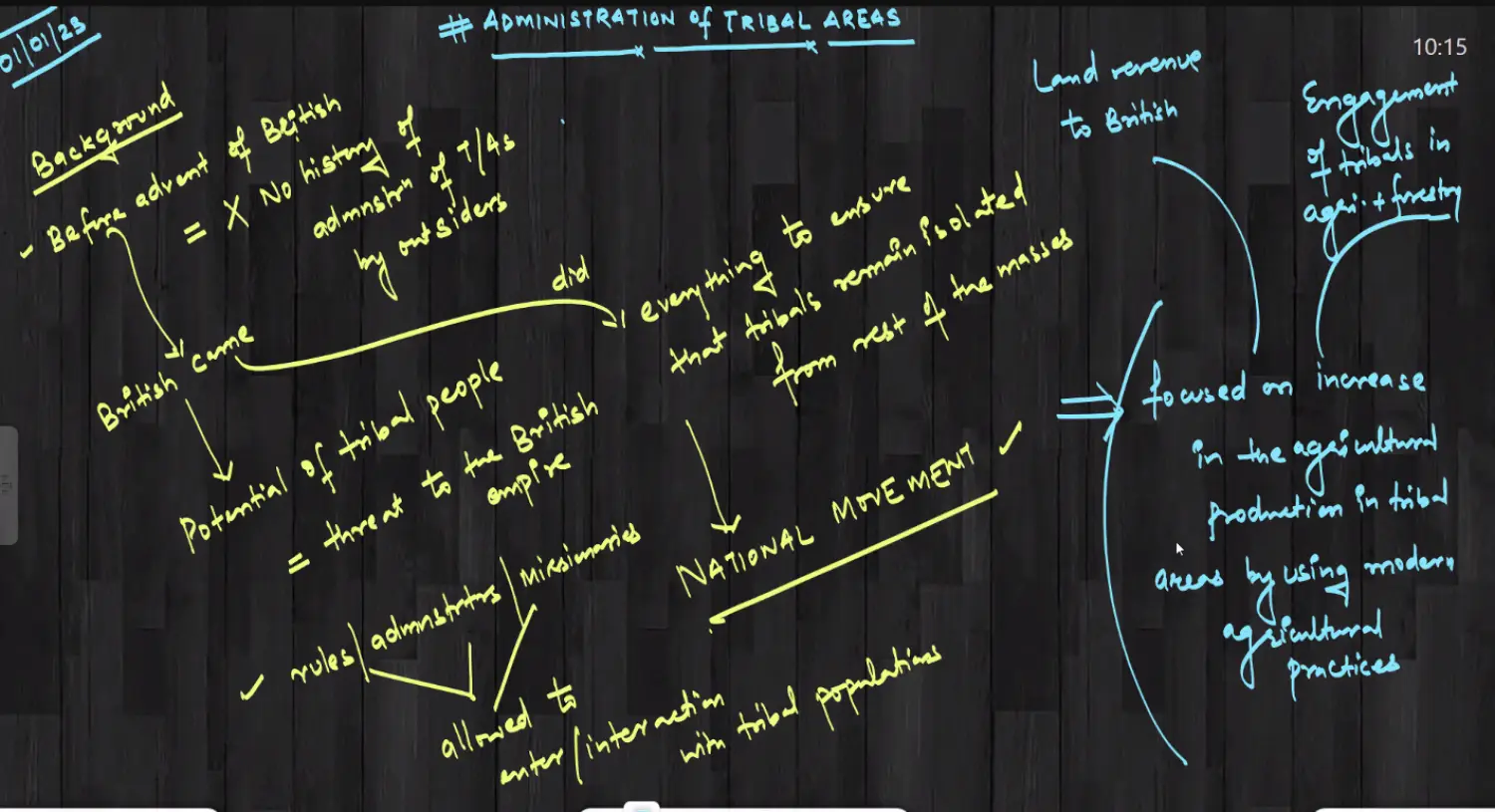
Initially, Tribals Remained Relatively Isolated and British Wanted to Maintain that because of their vested interest to avoid the entry of tribals in freedom struggle
Only Govt Officials and Missionaries would be allowed
1782 - Cleveland’s Special Administration of Tribals of Raj Mahal Hill (Present Day Jharkhand)
- It was an Executive Order
- Ordinary Course weren't allowed to give jurisdiction for tribals of this region
- Because there was a Big Revolt amongst Tribals against the Hindu Zamindars
1796 - Regulation in the form of a Legislative Act
- Separate Tribunals were created with Tribal Chiefs as their heads
- These Tribunals were called Hill Assemblies
- Previous Regulation was restricted to Raj Mahal Hill in 1782. Now Demand started by Other Tribes of Chota Nagpur Plateau
- British Administration repealed the 1796 Regulation in 1827
- as a Result in 1830 - Kol Mutiny or Uprising Occurred
1833 - Bengal Regulation Act
- It was a result of Kol Uprising of 1830
- Now Entire CNP came under special administration → Hence it was now called as a Non Regulated Area
- Non regulated Area Meant
- There will be No Govt Officials
- Only Traditional Village Functionaries in Local Administration
1855 - Another Regulation
Long Term Reasons
Zamindars + Settled Agri + Land Revenue + involvement / Interference in the Belief SYstem
Immediate Reasons - Santhal Uprising of 1855
Led to Creation of Santhal Pargana ( a Special Administrative Zone)
This Administrative Zone was verified by Govt of India Act, 1851
It is also famous for
- Raja of Banaras - Raja Shiv Prasad Singh
- Raja of Patiala - Raja Mahendra Singh
- Sir Dinkar Rao
1874 - Scheduled Districts Act
1919 - GoI Act, 1919 - Montagu Chelmsford Reforms
Backward Tract → Later Became Schedule 5
Those Tribes which were backward as compared to non Tribal Population in the Region
Scheduled Tract → Later Became Schedule 6
Especially in those tribal areas which are having majority of tribal population
Appointment of Special Officers in Tribal Belts
1935 - GoI Act, 1935
Division of Tribal Areas took place as
- Totally Excluded Area (Totally Tribals)
- Where Majority of Population is Tribal
- Non Tribal Population is almost Negligible
- These were administered by the Governors directly
- Excluded Area
- It had both Tribal and Non Tribal Population
- But here Tribal > Non Tribal
- Here Governor has left most of the Administration to CoM ( Governor needs to be consulted for majority of decisions)
- Partially Excluded Areas
- Included Tribal and Non Tribal Populations
- Non Tribal > Tribals
- Governor can seek advice of CoM & CoM can act Independently also
- Totally Excluded Area (Totally Tribals)
Post Independence - Independent India
- Gopinath Bordoloi Committee
- Art 244 → Scheduled and Tribal Area were created
- Sch 5
- Governor + Special Powers to Governor
- Tribal Advisory Council
- PESA
- Sch 6
- Autonomous Council
- Assam, Meghalaya, Tripura, Mizoram
- Sch 5
- Dedicated Ministry of MoTA
- Art 338 A → NCST
- Creation of TRIFED
- FRA, 2006
- Atrocities Against SC ST Act
- Art 46 DPSP
Approaches to Tribal Welfare and Development
- Political Approach
- Policy of Isolation - Totally or Partially Excluded from the mainstream Process - Elwin and Gurye Debate
- Constitutional Safeguard - DPSP, Art 338 A, Art 244
- Legislative Safeguard - Atrocities, PESA, FRA
- Reservation
- Administrative Approach
- Follow Up or Rather Implementation Procedure of Political Approach
- Tribal Panchsheel
- Special Powers to to Administration like the Tribal Advisory Council
- Special Powers to Gram Sabha
- NGO’s and Other Voluntary Organisation Approach
- Red Cross UNHRC
- SEARCH
- AWARE
- Bhartiya Aadim Jaati Sewa Sangh
- 100% Govt Funding for PVTG and PTG is through NGO’s
- for Primary School Education / Primary Health Sector
- Sanitation & Clean Drinking Water
- Socio-Religious / Religious Approach
- Work by Christian Missionaries
- Work by Arya Samaj
- Helped in Assimilation of Tribals in Mainstream Religious Cultures
- Though Effective in Short Bursts, it is less accepted one as it poses challenges to Tribal Identity
- Anthropological Approach
Anthropologists are called as Social Doctors or Tribal Doctors who specialise in Tribal or Social Problems
Not Much Explored Connotation of Anthropology in India
LPV Said that when we know the Socio Cultural Characteristics of Tribe. They should be made a contributing factor in the INtegral Part of Growth & Development
Because Based on this Knowledge → Anthropologist can suggests Practical Suggestions
Hence, LPV Suggested a Four Pronged Approach to Tribal Welfare
- Ecological System and Geo Climatic Factors
- Traditional Economy
- Religion and Belief System and Practises
- Recent Influence and allied changes based on trust
- Political Approach
Needed Approach or Way Forward for Tribal Welfare Development
Panchsheel Approach or Integrative Approach
Separate Tribal Area Development Programs and Policies - Separate Program for Tribal and Non Tribal Areas
Time to Time Surveys seeking their needs and demand and Collection of Tribal Data
Special Courts of Tribunals or Administrative Setups for Tribal Grievances and Redressal - New Zealand Case Study
Minimum Administration
Area Wise Development Approach for Different Tribal Belts
Way Forward for Tribals should Involve this
Involvement of NGOs, Civil Society & Local People in Growth and Development Programs and Policies
PVTG’s / PTG’s
Criteria to Declare a Tribe as a PVTG
- Very Less Population and Very Low Population Growth Rate
- Using Pre Agricultural Levels of Technology like stone tools
- Extremely Low Levels of Literacy
- Still Dependent on Hunting Gathering Kind of Activities
There are Total 75 in India - State Specific List
Maximum in Orissa, Followed by Andhra (including Telangana)
State Govt will send to MoTA
If Accepted → MHA will Notify for PVTG Status → Because its a Census Related Operation → Done by Office of Census Commissioner
Examples
Maldharis are Demanding Habitat Rights under FRA - Still Not Accepted
Denotified Tribes, Nomadic & Semi Nomadic Tribes
Standing Committee of Parliament highlighted that a special grant of 200 Crore was extended for a 5 Years Period starting from 2021 to 2022 for the development of Denotified, Nomadic and Semi Nomadic Tribes ; Interestingly Not even a Single Rupee has been spent in the First Year
Denotified Tribes are also called Vimukta Jati
Denotified Tribes were earlier referred as Criminal Tribes during British India with the prejudiced notion that they are addicted to crime by birth. These Crimes were Mostly Non Bailable in Nature
These were one of the most vulnerable and deprived tribal groups of the country, Once a Tribe is Declared / Notified as Criminal Tribe. All its members were required to register with the magistrate, failing to do so will be considered as a Criminal Activity under IPC
These Groups were notified under Criminal Tribes act of 1871 → Repealed by Govt of India after Independence. Hence this Repealing of Law led to De Notification of Notified (earlier) Tribes, thus called DeNotified Tribes
Many of these Denotified Tribes are Nomadic or Semi Nomadic in Nature w/o any access to private land or home
National Commission to Review the Working of Constitution, 2002 held that Denotified Tribes have been wrongly stigmatised as Crime Addicted. They have been unnecessarily subjected to high headed treatment, exploitation &
NCDNT - National Commission for Denotified, Nomadic & Semi Nomadic Tribe 2006 was constituted by Government
- It is Famously known as Balkrishna Sidram Renke Commission
- The Commission held that
- It is an Irony that these tribes somehow escaped the attention of our constitution, thus they are deprived of constitutional support like ST’s
- Renke Commission estimated that population of these tribes can be even more than crores
- Ministry of Social Justice and Empowerment is implementing various scheme for the welfare of these denotified tribes
- Schemes like
- Dr Ambedkar Scholarship
- Nanaji Deshmukh Hostel Schemes
NGO’s and Tribal Development
- Role of NGO’s in Tribal Development
- Saints and Organisations like Ashram Schools, Brahmo Samaj and RK Mission
- They worked Selflessly for People voluntarily → it can be Considered as Beginning of NGO’s in the World
- They act as a Buffer / Moderator / Connector between Government and Tribals
- as they Involve Local Tribals, Non Tribals & Voluntarily Educated People
- Why are NGO’s Preferred over Government
- Govt Follows Top Down Approach and NGO follows Bottom Up Approach
- Rapport of NGO is Better than Govt
- Negligence of Govt Officials due to Overburden of Work
- Flexibility of Timings and Early Working
- More Sincere Effort and Targeted Delivery of Tasks
- Domains of Work of NGO’s
- Data Collection
- Social Audit
- Motivation
- Training and Capacity Building
- Marketting Tribal Products
- Can be the Agents of Demand Driven Approach
- NGO’s can sensitise Government by acting as Pressure Group advocating Tribal Rights
- Examples
- TRYSEM Program - Training of rural Youth for Self Employment
- Aware and Prayas have been working in the field of
- Health Infra
- Educational
- Institutional Deliveries
- NGO’s are collaborating with Online Portals like Flipkart and Amazon for marketing the Tribal Products
- Challenges
- Lack of Transparency
- Very Less No of Dedicated NGO’s towards Tribal Development
- According to IB Report there are some NGO’s receive foreign funds to act as Pressure Groups and halt the pace of development
- Money Laundering incidents, with functioning of NGO’s
- Act as Agencies to Fulfill Hidden Agendas like Religious Conversion
- Less Accountability → There are apprehensions that in some areas even Naxals are sponsored by NGO’s
Role of Anthropology in Tribal Development
- Anthropologist are Social or Tribal Doctors who better Know the Ground Reality, Socio Economic Conditions and can help in Policy Making
- Insiders Point of View
- Acceptability by Tribals
- Better Implementation Methods
- Ways to Convince People
- Can Help in Avoidance or Better Resolution of Conflicts in the First Place
- Influence of Outside Factors in Tribals and Violence of Secessionist Tendencies can be Avoided
- Modern Day Problems like
- Environmental Impact Assessment
- Social Impact Assessment
- Social Audit
- Surveys
- Action Anthropology - Demand Driven Development Process
- Cultural Relativism Tendencies for a Balanced Development Process
Case Studies of Involvement of Anthropologists in Development of Tribals
Hutton & H H Risley
- Advisors to British Indian Govt
- In the Words of Hutton : Self Governing Tribal Area with Free power of Self Determination
S C Dubey
This Approach was Later Suggested by S C Dubey on Administration of CNP Tribes
Verrier Elwin
Studied Baigas, NEFA, NVF Province
LPV
was advisor to Govt of India after Independence
SC Roy
Most Favourite Tribal Leader. As an Anthropologist, he was Leaders of Tribals in Bihar Legislature
Conclusion
In India there is minimum involvement of anthropologists in development process. In Many Western Countries it has become a norm that an anthropologist and a Psychologist, will necessarily be a part of Govt Committee formulating policies for Tribals, Rural Development and Social Welfare
Role of Anthro in Rural Development
Demand Driven Development Approach - Need Based Development
Socio Cultural Conditions of Health and Malnutrition
Accepted or Non Accepted Food Behaviour
Fortification of those food Items which are consumed more
Anthropologist are Social Mirrors giving Exact Images of Social Reality
Better Policy Making and Best Use of Resources
PRA & RRA Research Methodology of Anthropology
Choice of work under MGNREGa to be employed for a particular area can be chosen by RRA
Health Education Employment and Works Under MGNREGA, SBA, Mid Day Meal Scheme are based on knowledge of Rural India
Study of Caste, Family, Marriages and Associated Changes like Nuclear Family, Dowry are based on Anthropology and will be part of Policy Making and Agenda Development
Case Studies for Anthro in Rural Development
- D N Majumdar - Mohana Village, Near Lucknow
- M N Shrinivas - Rampura Village
- S C Dubey - Shamirpet
- Ghanshyam Shah - Khaap Panchayats in UP and Haryana
Conclusion
Anthropological Information and Programs & Policies Based on them are Having Better Acceptability in Rural Populations as the Anthropologists can bridge the Gap between Administration and Local Population. Involvement of Anthropologists, at each stage of development process like Policy Formulation, Implementation and Appraisal is increasing in different parts of the world
Tribal and Rural Development Approaches → Like Community Development, Area Development Approach, Tribal Sub Plan and Associated Success. All have considered anthropological perspective
Communalism and Anthropology
- Introduction
- There is no wrong in Strong Sense of Loyalty to one particular group/religion/belief
- But the issue is → Rejecting the Other Groups/ Religion / Belief
- i.e an Individual or Individual Group Sentiments are Prioritised over Society
- Communalism in India is more of a recent phenomenon, tracing back to 19th century
- Political Analyst Says that → End of Medieval Period combined with Entry of British → Led to Emergence of Signs of Communalism Started being Witnessed in India
- Reasons of Communalism
- Historical Reasons
- Historical Legacy of British by Means of Divide and Rule Policy of British
- Shuddhi Movement by Swami Dayanand Saraswati focused on Hindu Proselytization
- Attack on Money Lender and Land Lords of Opposite Communities were attacked in Different Parts of Country
- Partition of Bengal by Curzon
- Violence of Partition of India and Pakistan
- Economic Reasons
According to Sachar Committee Report, Muslims are Relatively underdeveloped, Low Education & Hence it is easy to instigate Communal Sentiments
Dr Rajendra Sachar was Retired Chief Justice of Delhi High Court
in 2005-06 only 3 to 4% representation was of Muslim
in 2015-16 - Representation in IAS Marginally Increased but Representation Marginally Decreased
- Political Reasons
- Communal Politics - Hindus and Muslims, Hindus & Sikhs in Punjab, Hindus & Christians in North East
- Two Nation Theory
- Communal Sentiments instigated by Vote Bank Politics
- Social Reasons
- Fear of Loss of Identity to Minority & Hence Minority Isolation & Alienation
- Communal Rites in One Part of Country and Emergence of Communal Sentiments in different Parts of the World
- Social Media / Sensationalisation / Fake News and Social Media
- Historical Reasons
- Combination of Communalism to Put in Answer
- Hindu Muslim
- Muslim Sikh
- Sikh Christian
- Hindu Sikh
- Muslim Sikh
- Hindu Christian
- Consequences of Communalism
- Social Disharmony and Trust Deficit amongst various Members of Society and Loss of Social Capital
- Disruption in Growth and Development of Society, Region and Country at Large
- Political Instability and Weakening of Constitutional Principles
- Issues with Internal and External Law and Order
- International Ties can be Hampered
- Riots Generally Lead to Loss of Public and Private Property
- How can Anthropology Contribute in Fighting Communalistic Sentiments
- Socio Economic Data in Real Time and Allied Attitudinal Changes can be Brought
- Cultural Relativism = Acceptability and Tolerance → Can Promote Social Trust and Harmony
- Reasons for Insecurity in the Mind of Minorities can be Studied and Practically Applied for CBM ( Confidence Building Measures)
- By Studying Socio Cultural Features Root Cause of Communal Sentiments and Tensions can be Identified with Anthropological Studies
- Connect Between Govt and People (Minorities) can be better by Anthropologists being the Bridge Between them
- How to Combat Communal Sentiments
Mohalla Committee of Mumbai
Full Fill Ment of Ideals of Constitution in True Spirit
Increase in Trusts Deficit by Means of Festivals, Games and Cultural Events & Exchanges
Playing of Cricket in Karnataka & Coastal Area
Stringent Punishments for Instigation the Communal Tensions
Example: Strict Code of Conduct can be formulated by Election Commission of India
Unit 7.3 → Problems of Exploitation and Deprivation in SC’s and ST’s and OBCs
- ST - As Per Previous Discussion
SC - Scheduled Caste
- Introduction
- Termed by Simon Commission used for the first time by GoI Act, 1935
- Simon Commission Defined SC by Means of Following Characteristics
- Pollution to Higher Castes by Touch or Shadow
- Denied Entry into Temples and Public Places
- Separate Institutions
- Permission of Water from Community Well
- Not Generally a Part of Social Gatherings at Large
- Called as
- Harijan - by Gandhi
- Outcaste - by B R Ambedkar
- SC - Simon Commission
- Demographic
- Nearly 16.5% of India’s Population is SC
- Punjab has Max Rep of SC in Pop’n i.e Nearly 31.32% of Punjab Population is Less
- UP, West Bengal, Bihar, Mah, Andhra Pradesh (including Telangana), TN, Pb - Have High Numerical Strength of SC
- States Like → Nagaland Mizoram, AN, Lakshadweep - Have Almost Zero Population
- More than 80 Percent of SC Population of Country is Rural
- Problems of SC
- Untouchability
- Social Problems
- Different Burial Grounds
- Restriction on Commensality
- Temple Entry Restricted
- Brahmins Not Giving Priestly Services
- Isolated Habitation
- Economic Problems
- Poverty
- Unemployment
- Landlessness - Landless Labourers
- Involvement in Unclean Occupation like Manual Scavenging
- Bonded Labourers and One of the Lowest Per Capita Income
- Crimes Atrocities and Suppression
- Physical Torture
- Mental Torture
- Sexual Assault
- Honor Killings due to Marriage or Affairs
- Forced Devadasi in SC’s
- Political Reasons
- Lack of Pol Rep from Panchayat to LS
- Apart from Reserved Seats, Not a Single SC Candidate Won
- Other Reasons
- No Accomodation in Cities
- Lack of Skills
- Recent Examples to Quote
- SC youth Beaten up in Gujarat
- Youth cant keep Moustache
- Bihar Children Don't Eat Food cooked by Dalit Women
- Non Allowance of Horse Riding
- Witch Hunt Rajasthan Case Study
- Even in Kerala in South and Himachal in North with High Literacy and High Female Literacy - There are cases of
- Constitutional Safeguards - From Handout
- Legislative Measures - From Handout
- Recently in 2016 the act was amended to delegate the duties under this legislation to civil servants
- Civil Servants can
- impose Fine
- can order Enquiry or Arrest
- Then the case goes to Court
- Policy Measures
- SC Sub Plan Under Budget
- Stand Up india ( SC/ST, Women, Entrepreneurs )
- DICCI
- Dalit Indian Chamber of Commerce and Industry
- to Promote Involvement of SC’s in Industrial Development
- Land Reforms for Land Allocation SC’s
- Scholarship and Coaching for Higher Education for Competitive Exams like UPSC
OBC -
- Other is NOT Defined in the Constitution
- Backward Means
- Lower Literacy Rate
- Fairly Low in Caste Hierarchy
- Less Representation in Services
- Poverty
- 1956 - First Backward Classes Commission
Kalelkar Commission
tried defining OBC
- Agricultural + Landless Labourers
- No FIxed Habitation
- Cattle Breeders, Sheep Herders, Fishing Communities etc
- Insufficient Representation in Jobs and Politics
Consider All Women of the Society as Other Backward Classes
Kalelkar Committee Recommended Reservation for OBC’s
Committee said in 1956 that in 1961 census we should have a caste wise distribution as a part of upcoming census
Govt Rejected it
For the First Time, Kalelkar Committee Said that The Reservation Should Not Breach 49%
- 1979 - Second Backward Classes Commission
Mandal Commission
Mandal Commission Gave 11 Indicators for Defining a OBC
- 4 - Social Indicators
- 4 - Economic Indicators
- 3 - Educational Indicators
Based in this Mandal Commission found that Nearly 3700 Caste are OBC in India which is Nearly 52% of Countries Population → Based on that Mandal Commission Recommended
- 27% Reservation to OBC
- Separate Welfare Programs for OBC
- There should be Significant Land Reforms to Allocate Land to OBC
- To Promote Education in OBC
It was challenged in Supreme Court
Supreme Court Accepted Caste as a Basis for Reservation
50% should be Upper Limit
Creamy Layer to not be Included
NCBC should be Formed
Which in 2018 under 102nd CAA under Amendment to 338 B made NCBC as a Constitutional Body
There is No Reservation to OBC’s in MP, State Leg Ass and PRI