Part 6 - Archaeological Anthropology
Extra Concepts
Sediments
Gravels
- Boulders Means Stone Pieces of Size more than 250 MM
- Cobble - 64 to 256 MM
- Pebble - 2 to 64 MM
- Granules - 0 to 2 MM
Other
- Sand - Very Coarse, Coarse, Medium, Fine, Very Fine
- Silt - Coarse, Medium, Fine, Very Fine
- Mud - Clay
Sequences
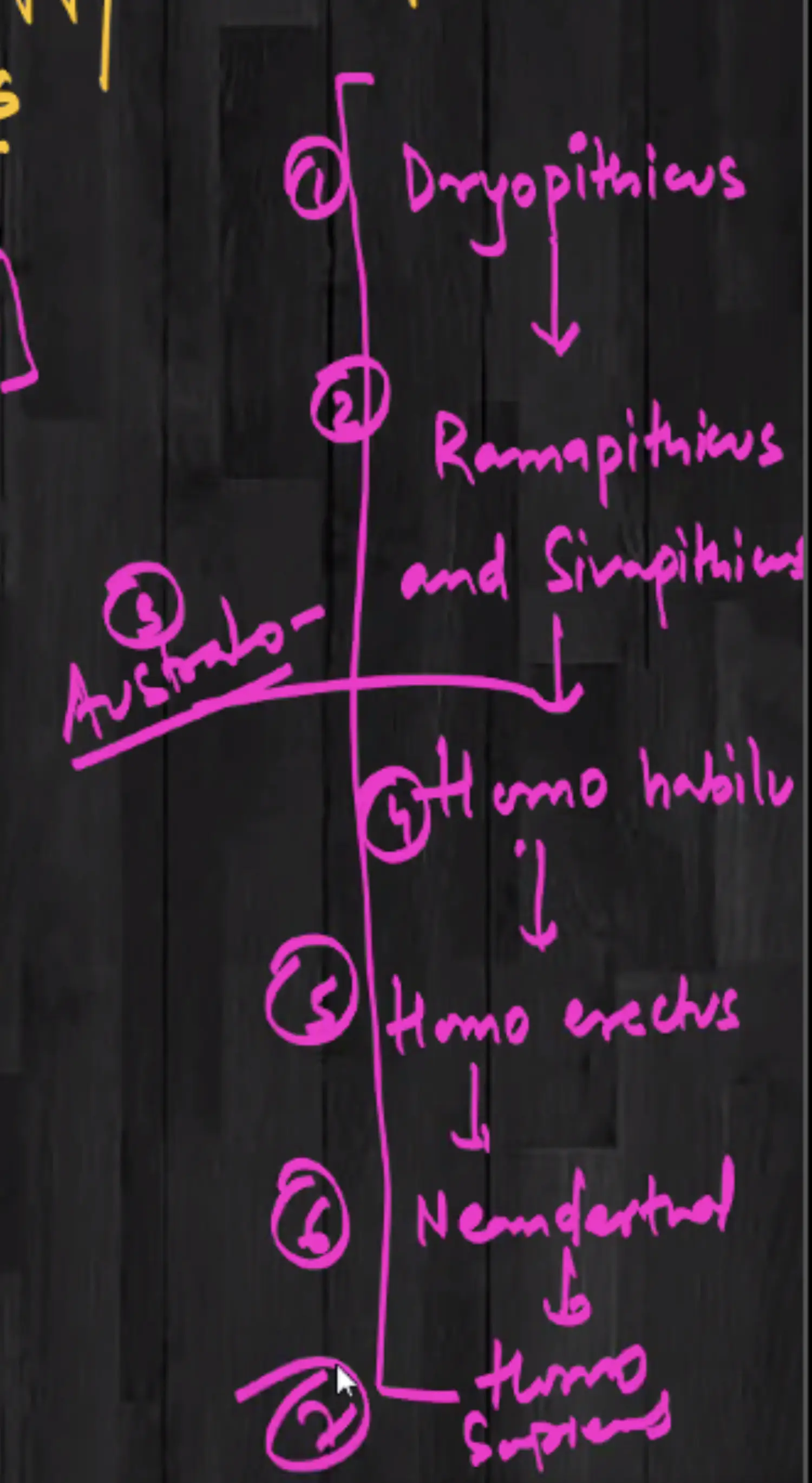
Introduction to Archaeological Anthropology
- It is an Offshoot of the Broad Field or Discipline of Archaeology which mainly deals with study of primitive and extinct cultures
- It is mainly targeting to Societies and Cultures with Some Written Records → Evidence for Existing Nearly 5000 Years Ago
- But Humans have existed way earlier than this 5000. Some Earliest Fossils of Humans are more than 30 Lac Years Old ( More than 3 Million Years Old)
- Hence, Anthropology Aims to study these human too, as Humans are central to anthropology in all space and time
- So, Taking help from Archaeology, Geology, Fine Arts, Classical History ; Archaeological Anthropology was started
- Archaeological Anthropologists work actively with paleontologists, Geologists, Historians, Chemists etc
- In Maximum Parts of the World, Including Australia, Melanesia, Polynesia, Africa & ecen the New World ( North and South America) → Here Knowledge of Writing is Very Recent but existence of humans is NOT Recent i.e Old
- Hence, to Study them we need archaeological anthropology to trace the emergence, development and spread of social customs, norms and behaviors
Important Terms of this Discipline
Chronometry
Any Method which gives data about age, sequence or co occurrence fossils
Examples:
C 14 Dating Method
Not Practical Approach beyond 50,000 Years Old
William Libby Discovered this Method
Stratigraphy
Palynology
Seriation
Thermoluminescence Dating Methods
K A Dating Methods ( Potassium Argon Dating Methods etc )
In these Chronometric Techniques, An Approx of 3 Million Year Old Fossil can be Studied
Ethnology - SCA
It is used for Socio Cultural Anthropology in America
Ethnography - SCA
Detailed Study of a Particular Culture, Society in Maximum Possible Dimensions
Ethnoarchaeology - AA
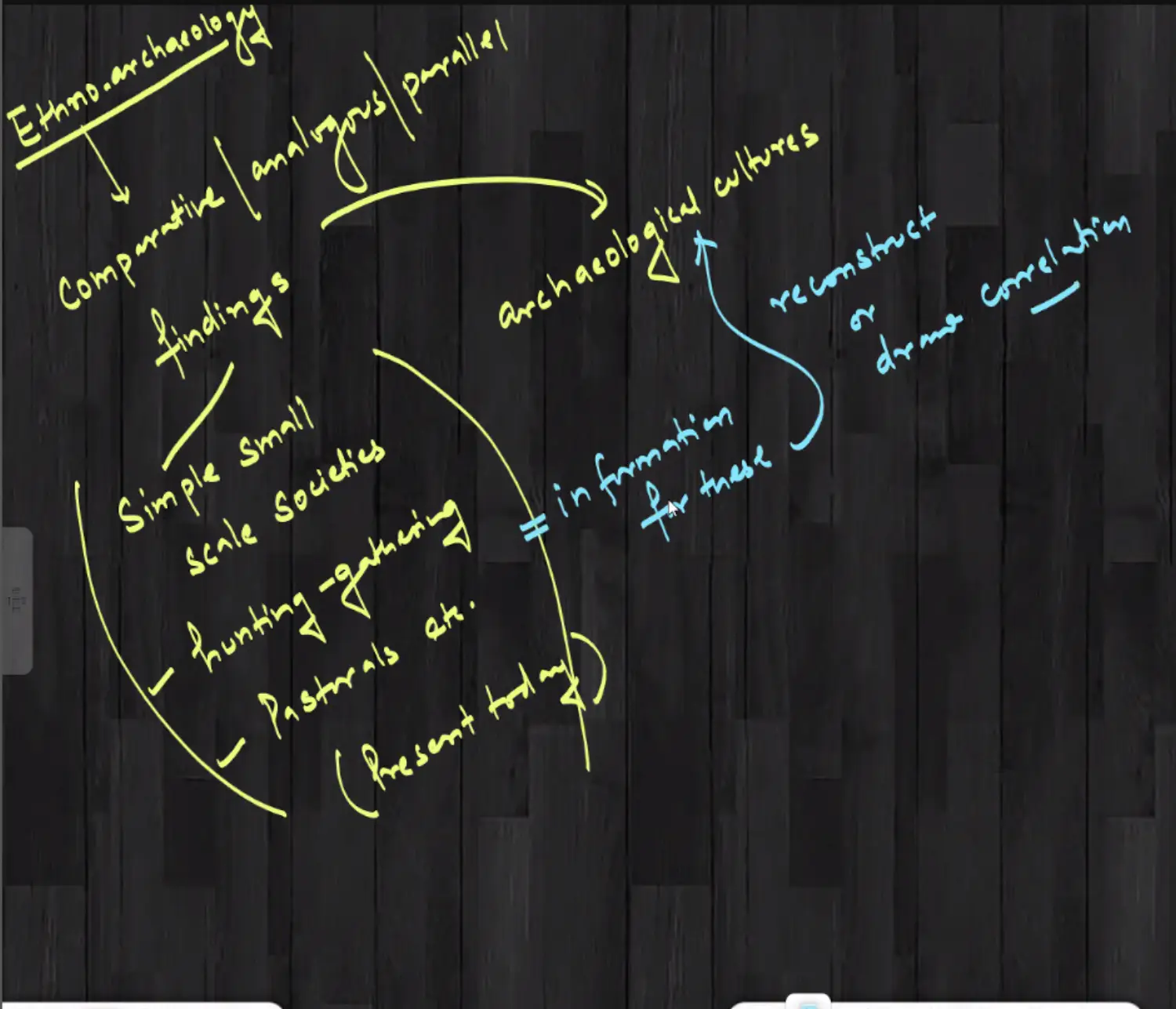
Ethno Archaeology Deals with the Use of Analogies or Parallels drawn from the Study of Present or Recent Simple Small Scale Societies ( Like Hunting Gathering & Pastorals) ; for reconstructing and interpreting the archaeological cultures
In Simple Words it is use of Ethnography in Archaeological Reconstruction.
In Recent Years Archaeologists have felt the need to undertake field works by themselves amongst the present day simple small scale societies and study them from archaeological point of view
Two Important Case Studies Are
- Bushmen of Africa - Studied by John Yellem
- Nunemitu of Eskimos of Alaska - Studied by Lewis Binford
Two Types of Ethnographic Analogies
General Comparative
It is basically comparative study of different cultures without any geographical limits
Direct Historical
It Involves some unbroken links between past and present of a same geographical area in specific region (with geographical restrictions)
Direct Historical Analogies involve unbroken links between past and present in specific regions
For Example Hunting Gathering Society of Chenchus are Ethnographically Studied to get an Idea about Past Cultures of Deccan Region of India
Unit 1.8 : Dating Methods
Principles of Prehistoric Archaeology (Chronology) Relative & Absolute Dating Methods
Introduction to Dating Methods
Tools, Techniques and Scientific Methods used in the field of evolutionary investigations to identify the age of the fossils or artifacts of Geological Deposits. And also the Evolutionary Sequence of Occurrence for different Fossils
Dating Methods helps researchers, tp reach upto better assessments and scientific conclusion based on evidence
There are Two Types of Dating Methods
Relative Dating
Gives an Idea about the age of an object or fossil in context of or in relation to some another one i.e with the help of this method archaeologists can arrange various fossils according to their age
This method does not give calendar or exact age of Fossils
Examples Are :
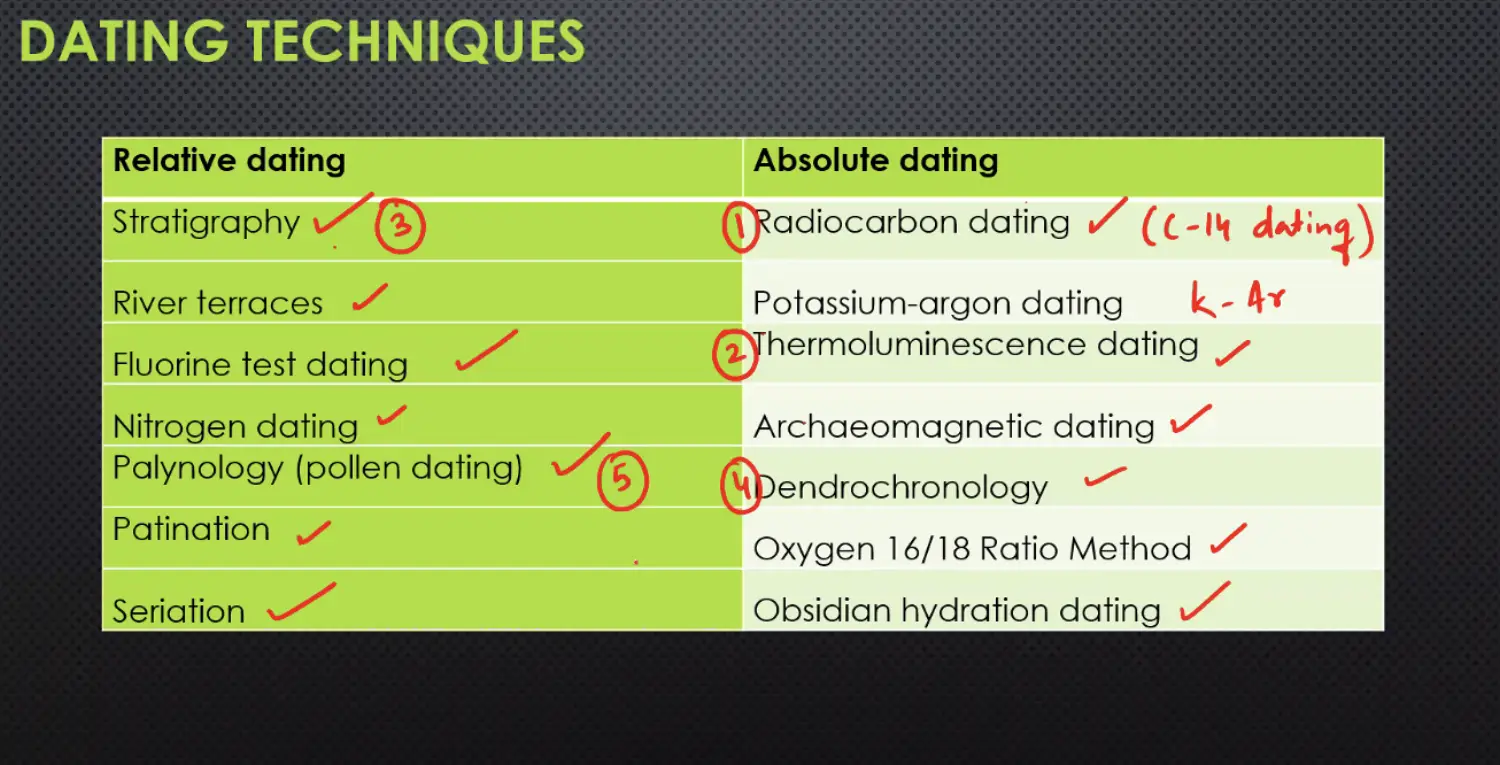
- Stratigraphy
- Seriation
- F(Fluorine) Analysis
- Palynology ( Pollen Analysis)
- Typological Dating
Absolute Dating / Also Termed as Chronometric Dating
To Identify the Actual or Calendrical Age of Certain Fossils. Here a particular object or fossil or artefact is studied in isolation as an Independent Existence
Examples Are :
- Carbon 14 Dating Methods
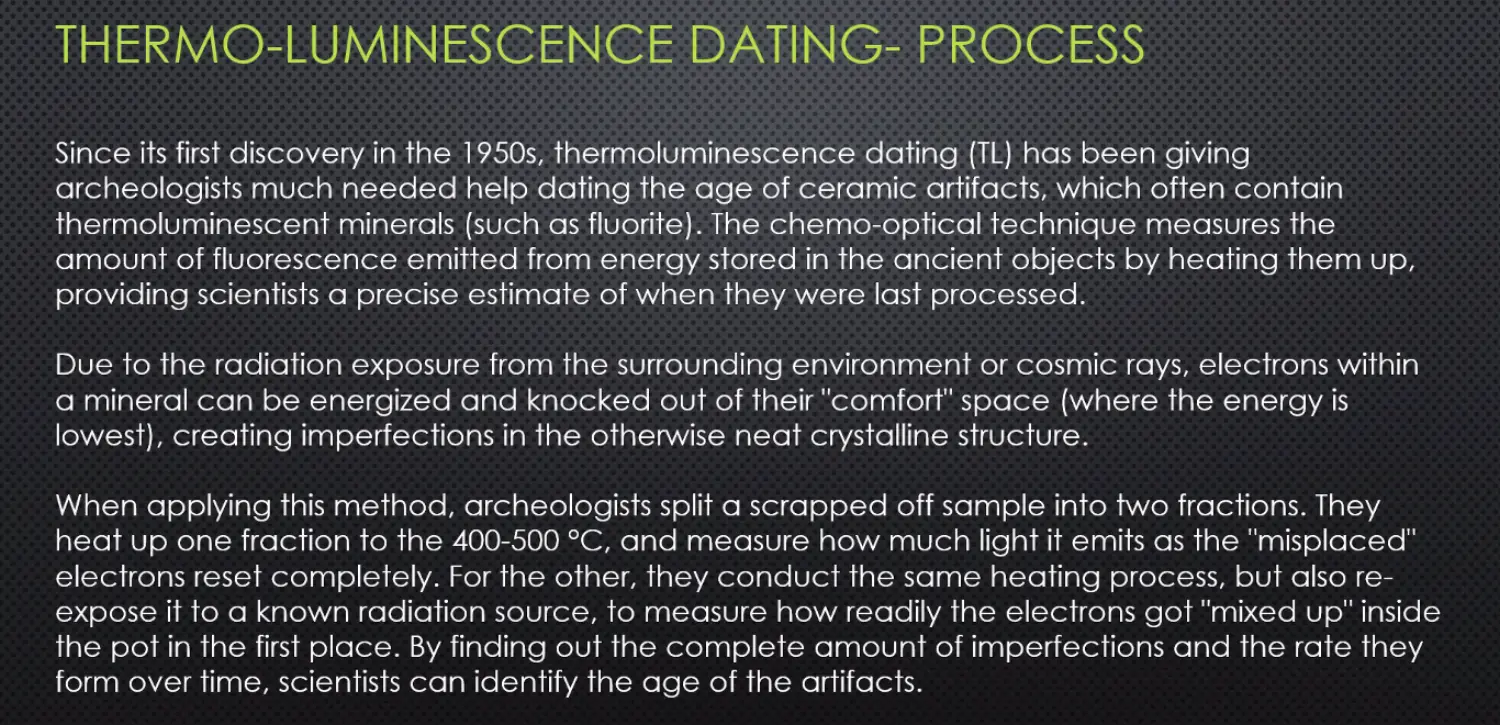
- Thermo Luminescence etc
Examples of Absolute and Relative Dating
Difference Between Absolute and Relative Dating
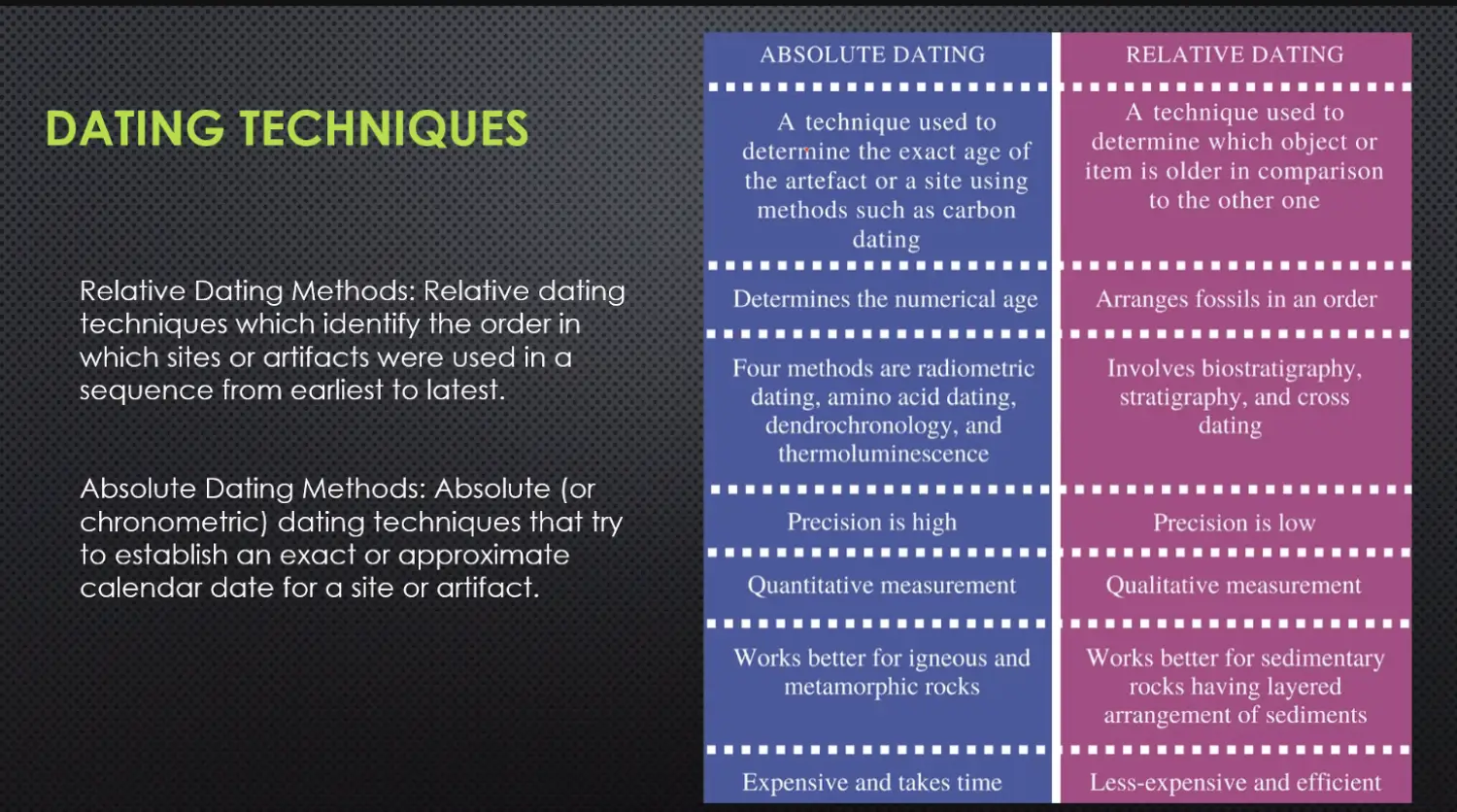
Absolute Dating is 100 times costlier than Relative Dating
Absolute Dating is Better for Igneous or Metamorphic Rocks due to Absence of Layering
Relative Dating Methods
- Stratigraphy
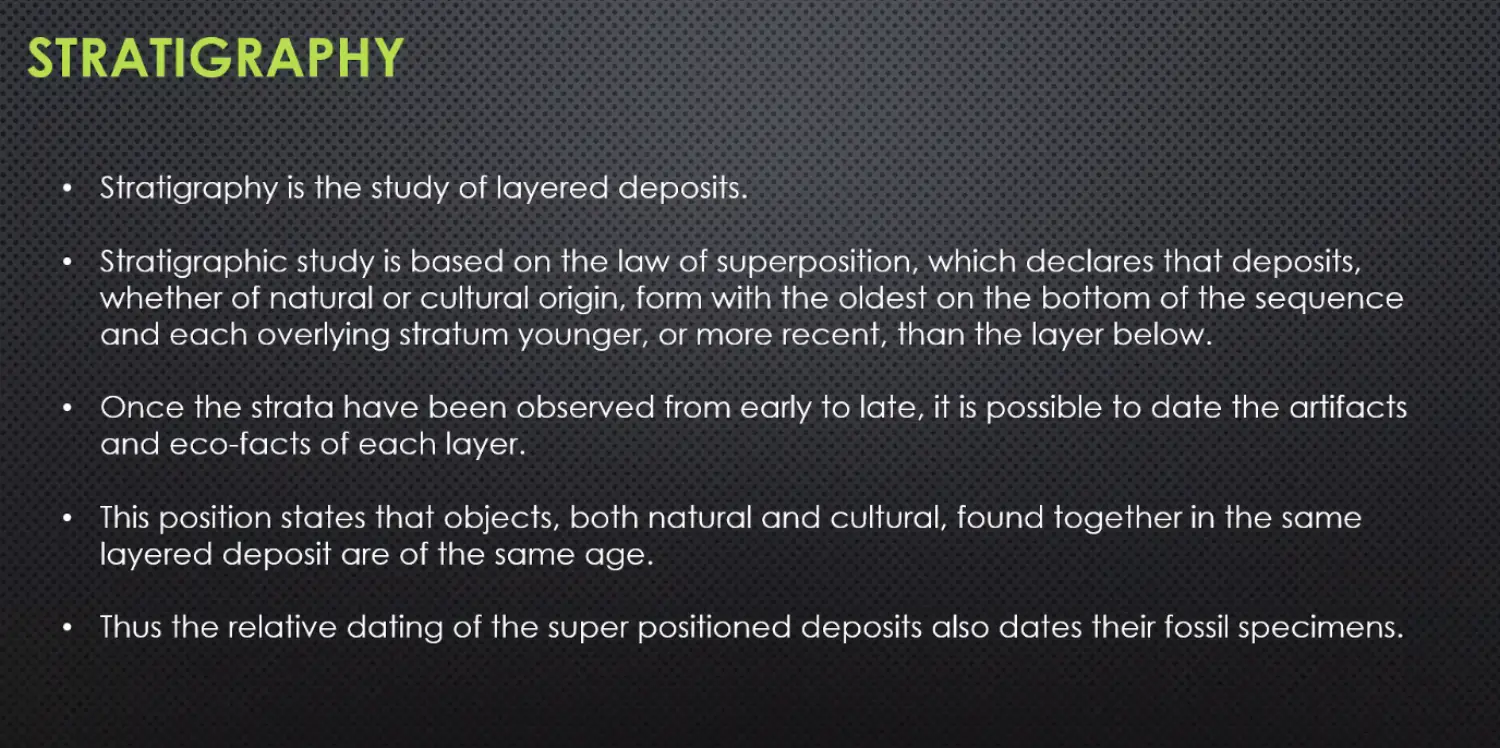
- Stratification means Division
- It Emerged from Geology. Hence sometimes it is also called as a Sub Discipline of Geology
- It Simply Means to Study Something Layer by Layer
- Hence, the Origin, Physical Features as well as special relationships of stratified rock structure
- Bottom Layer is the Oldest One and the Top Most Layer is the Youngest One
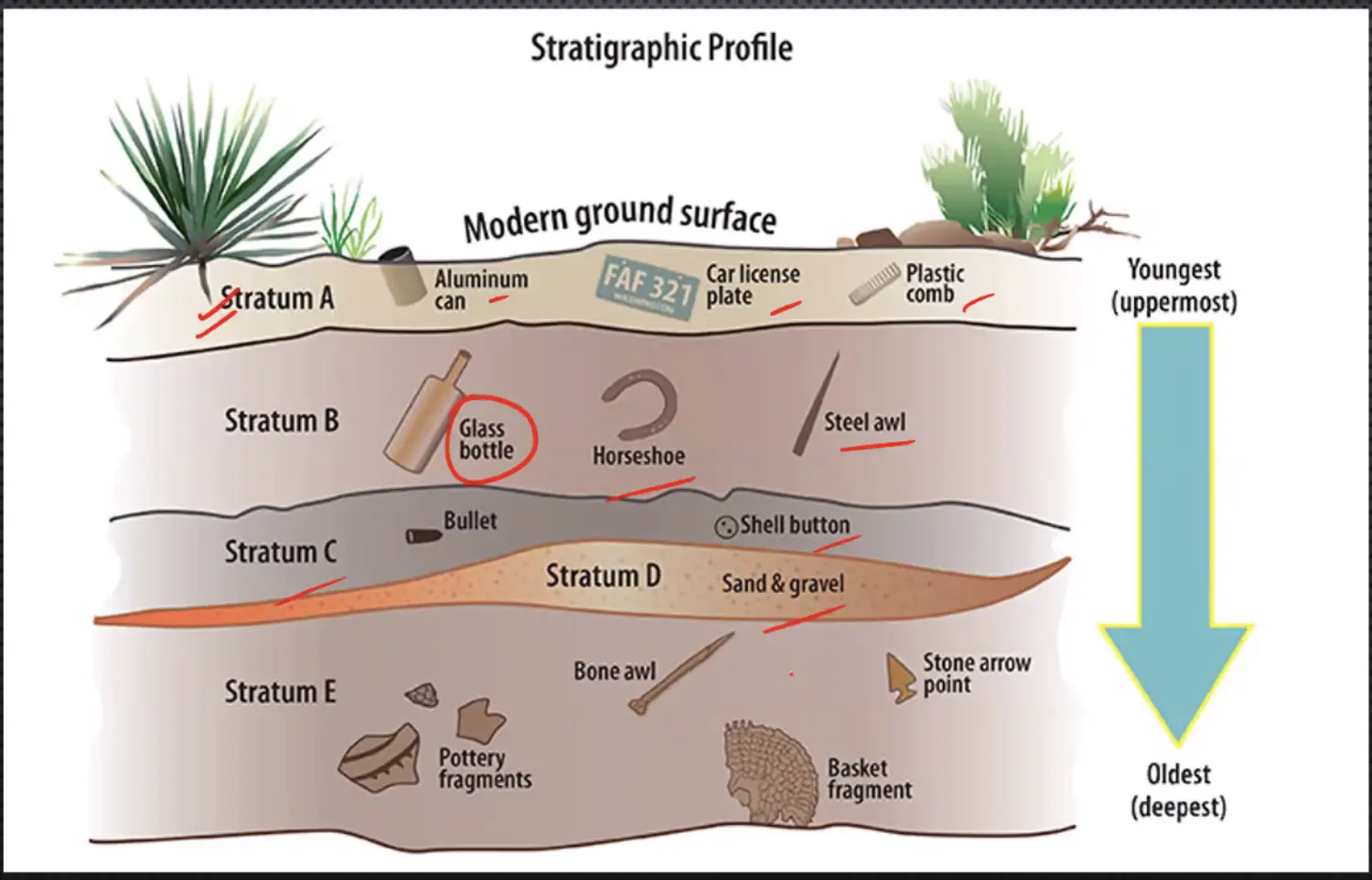
- Three Principles are used in Stratigraphy
Principles of Superposition
It means that if one series of rock lies above the another one, then the upper ones are newer or younger than the lower series
Principle of Original Horizontality
It says that layers of sediments are originally deposited horizontally under action of gravity. Later due to outside forces these deposits got deposited or tilted ( like plate tectonics)
Principle of Lateral Continuity
It states that layers of sediments also expands laterally in all the directions i.e there is a laterally continuous deposition
as a result of this the rocks which are otherwise similar, but are now separated by a land form like valley can be assumed to be originally continuos
- Fluorine Dating
- It is mainly used to find age of fossilised bones, teeth buried underground for a long period
- Fluorine Formation may vary from region to region & time to time ;
- Hence, it is not a very reliable method when fossils of different geographical regions are compared

- Palynology
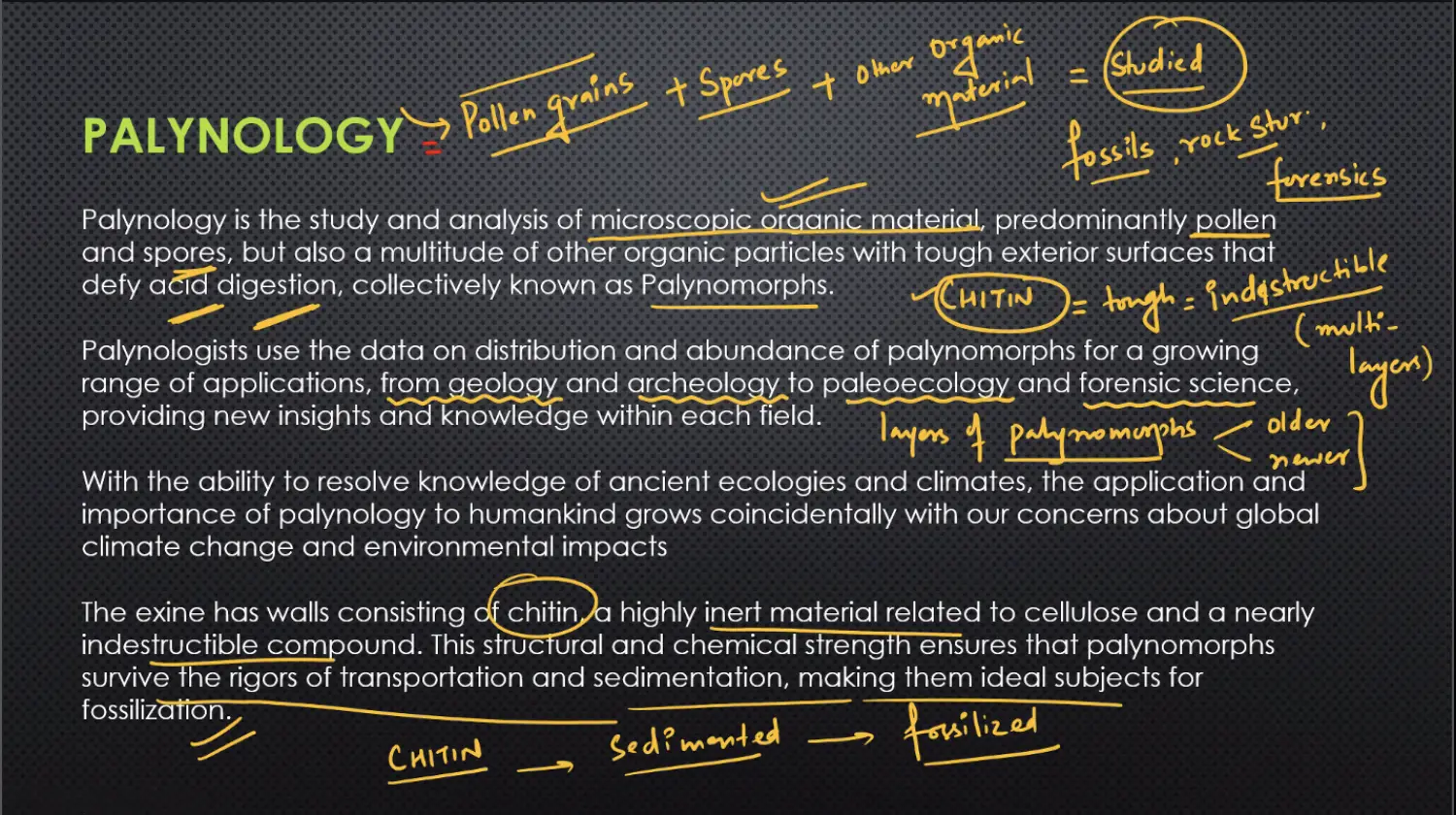
- It is mainly a term used for the study of Pollen Grains, but gradually it started incorporating Spores of Plants and Other Organic Material
- When this is Studied in relation to fossils or rock structure
- Now It has application in Forensics too
- Palynomorphs outer covering is made up of Chitin which is Tough, Almost Indestructible and is present in multiple layers
- Now a Method is used to arrange these layers in Palynomorphs as older or newer
- The Difference between these is found by means of relative aberration in the Older Layer
- Significance
- Chemicals, Microscope, No Laser Beam is Required → Hence it is Cheap and is Less Time Taking
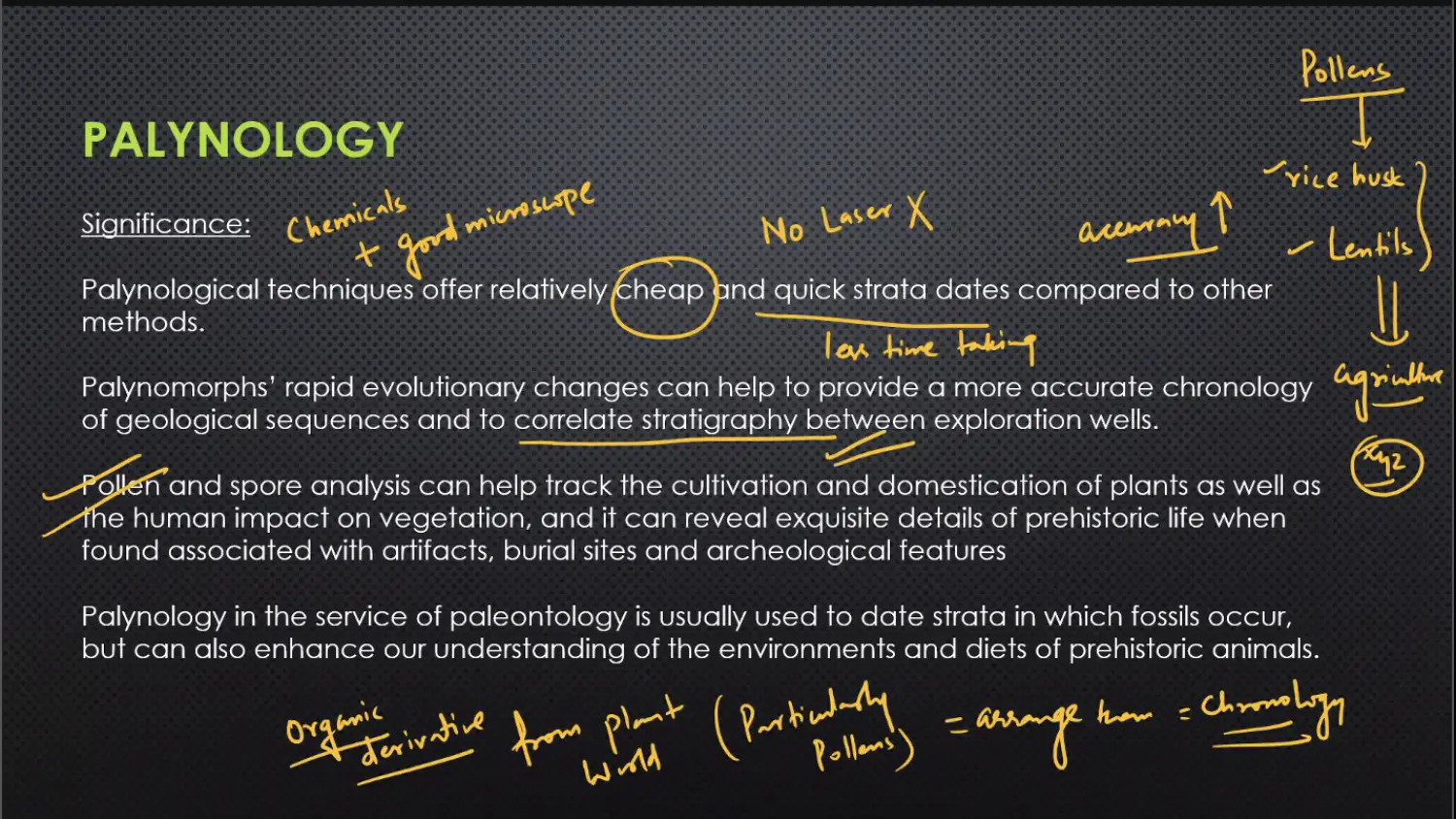
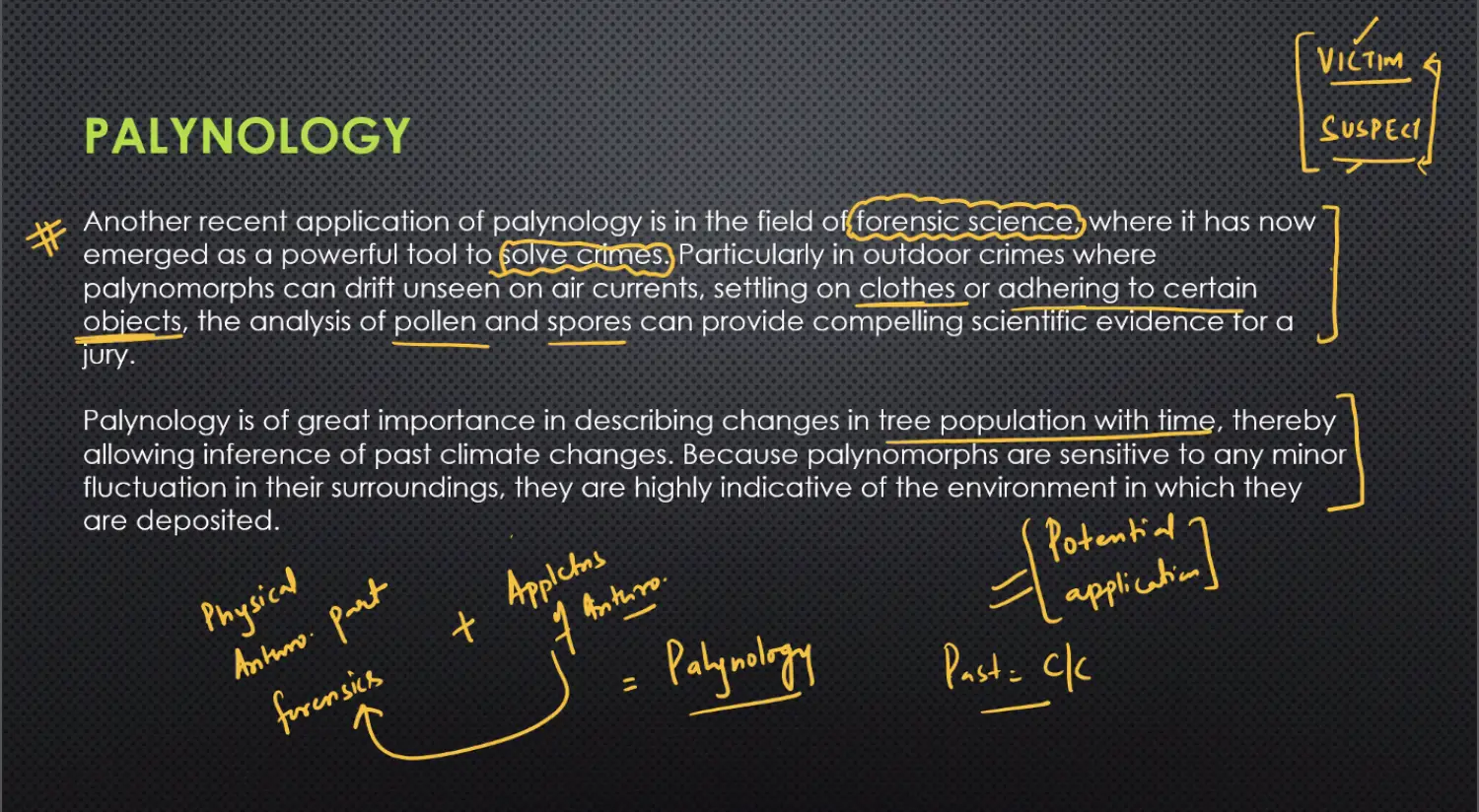
The Last Point of Study of Tree Population with time is a Potential Application
- Seriation
Introduction
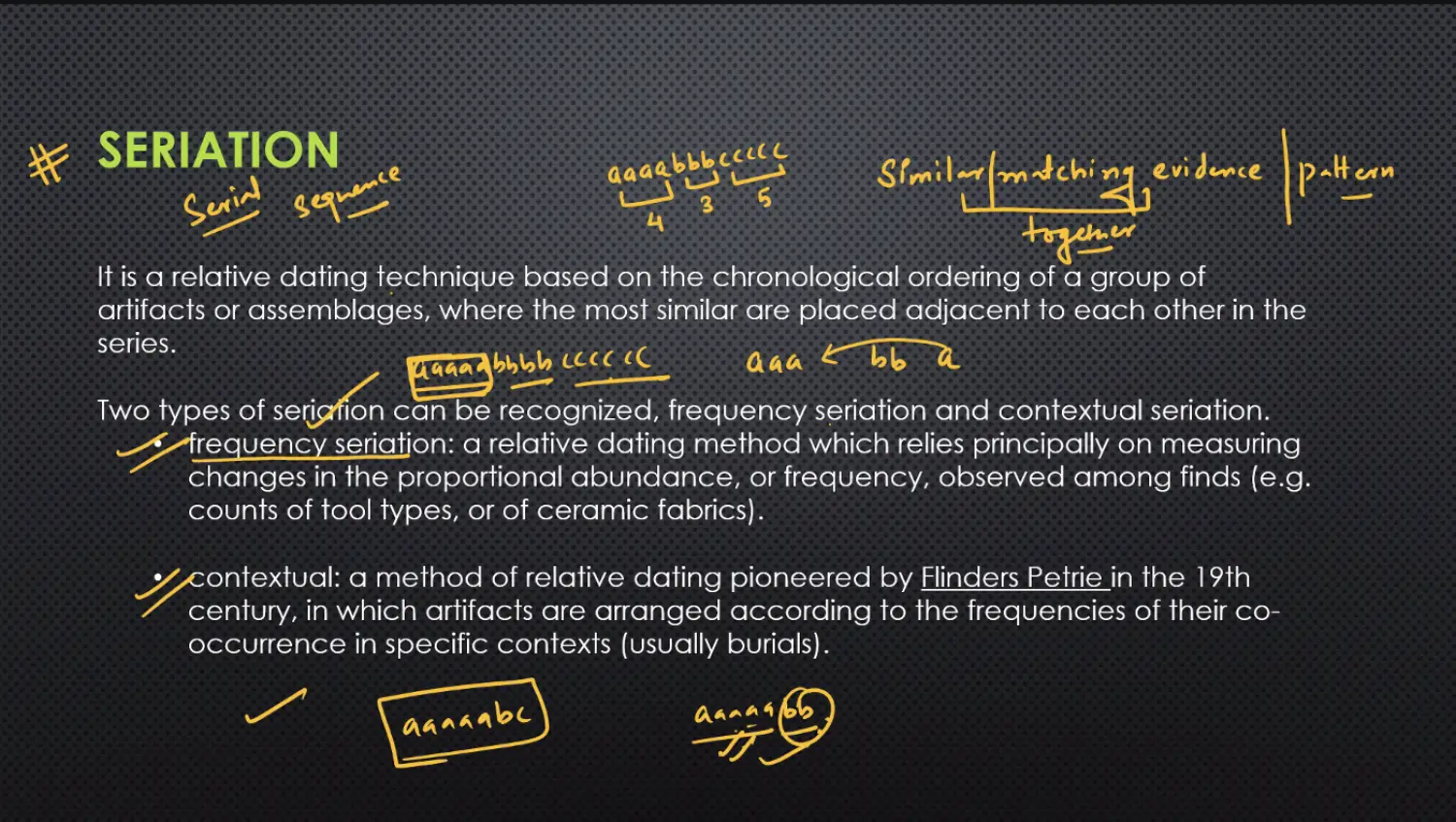
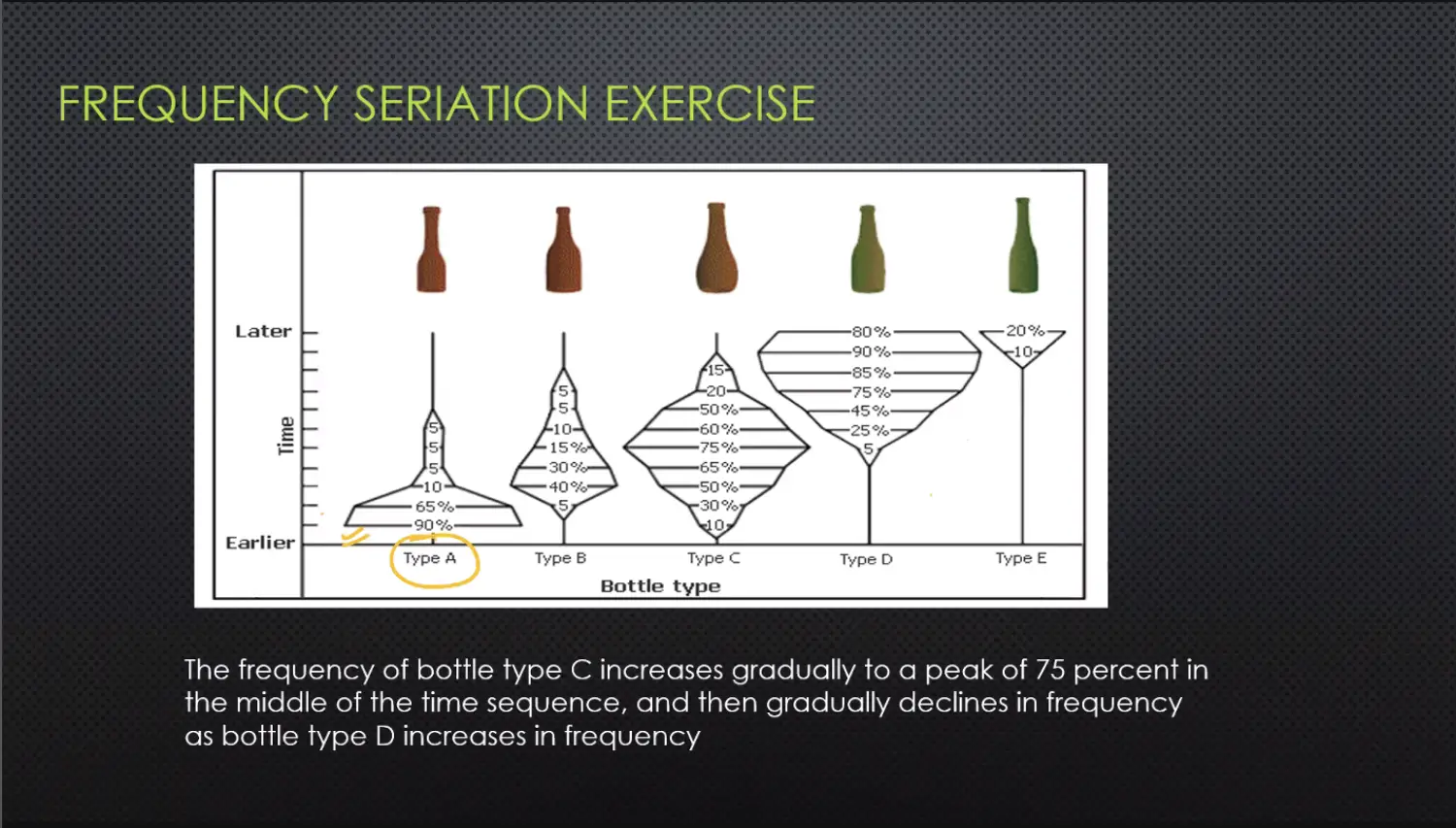
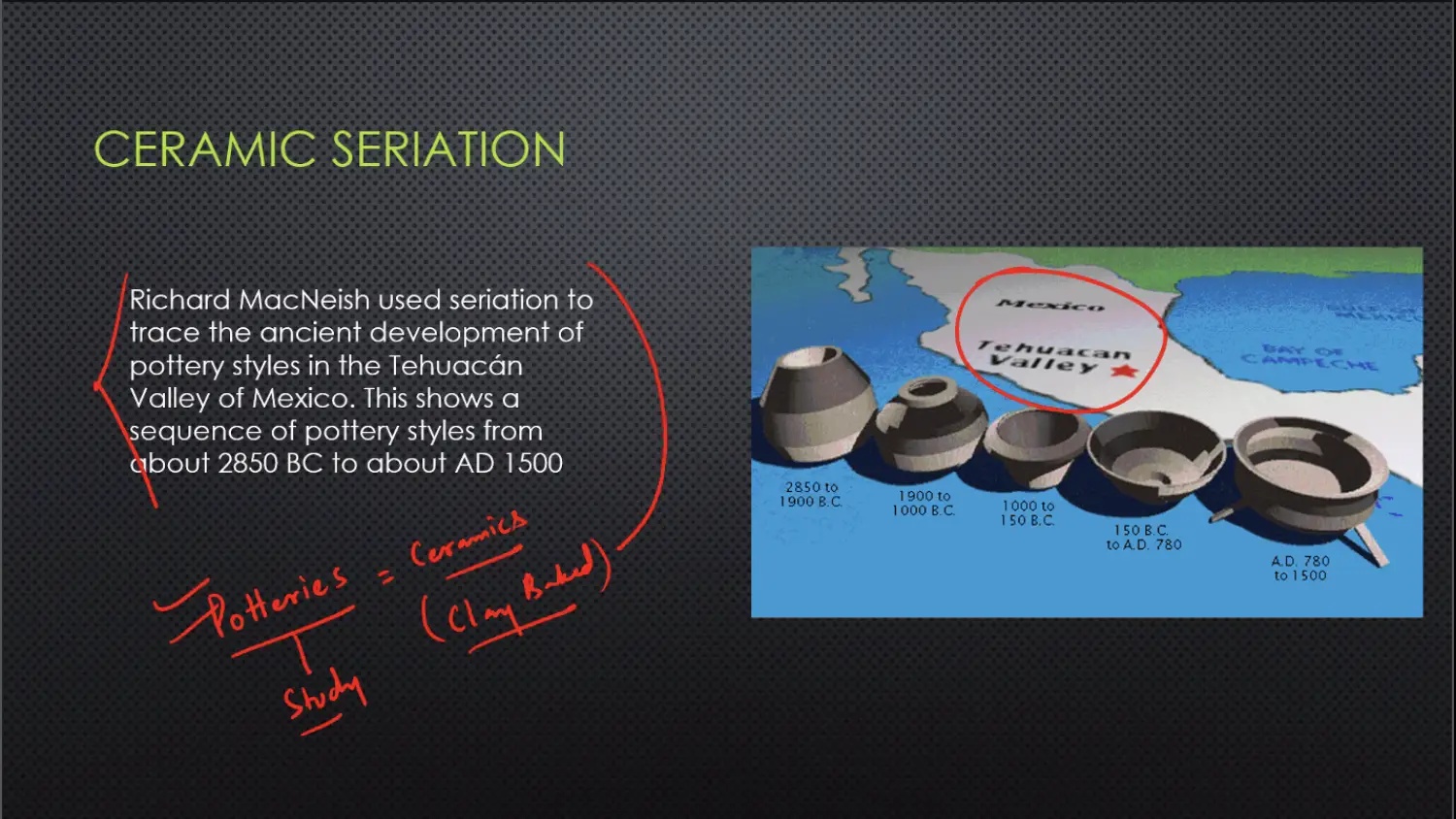
Example of Frequency Seriation → Ceramic Seriation
Tehuacan Valley of Mexico
Example of Contextual Seriation → Tomb Stone Seriation
In Contextual Seriation, it is understood that what kind of stone tool or technique was used at what point of time, either alone or with some other method
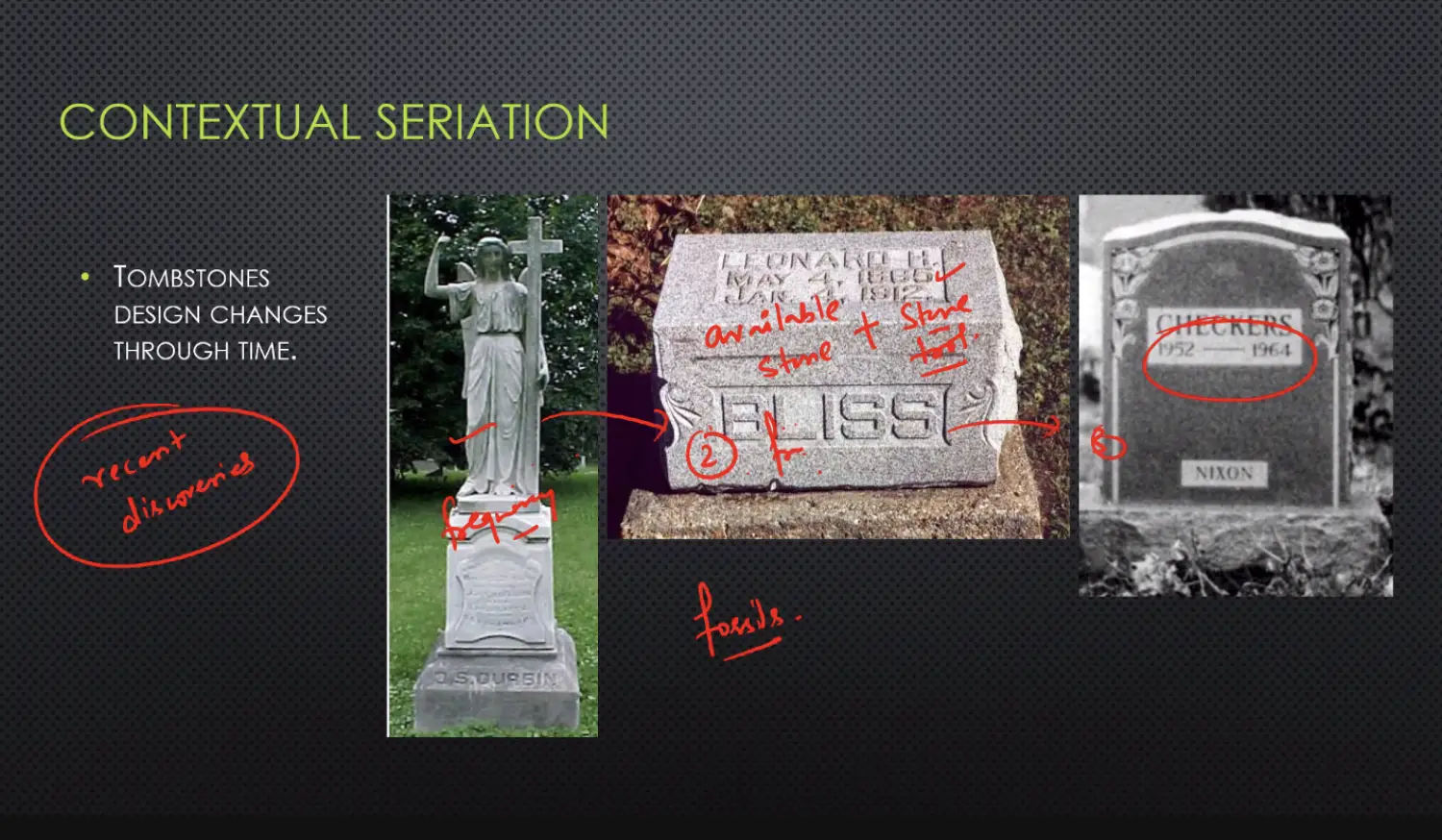
- Nitrogen Dating
Nitrogen Content Decreases with time in Human Body Fluorine Content Increases with time in Human Body
More the Nitrogen, Fossil is New Less the Nitrogen, Fossil is Old

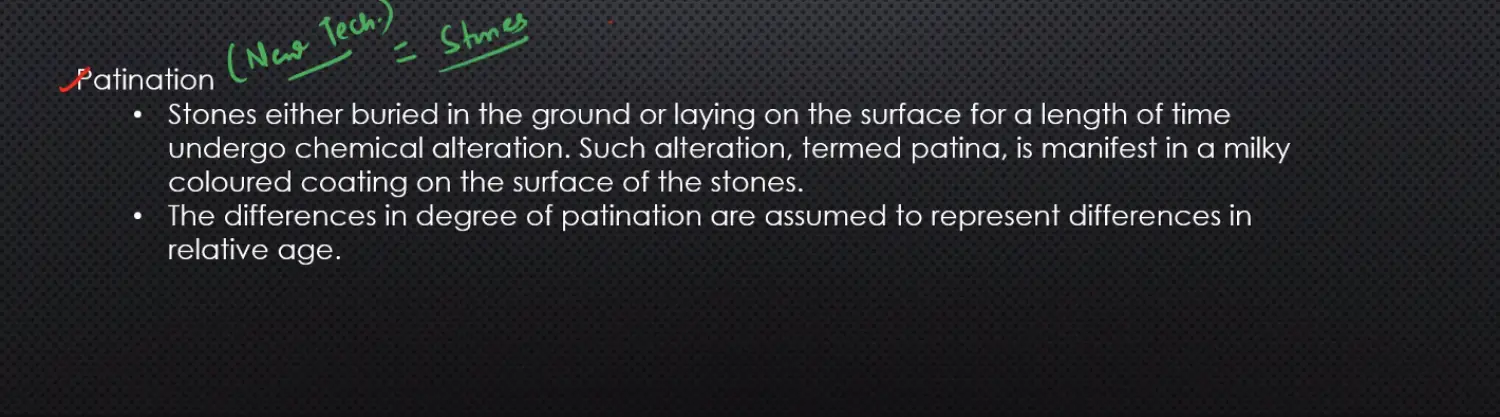
- Patination
It is based on Stone, Any Stone which is Based on Ground or is buried will undergo chemical changes and due to these changes, there will be some coating of milky chemicals i.e Patina
More the Deposition of Chemical i.e Patina → More the Patination → More the Age
Absolute Dating Methods
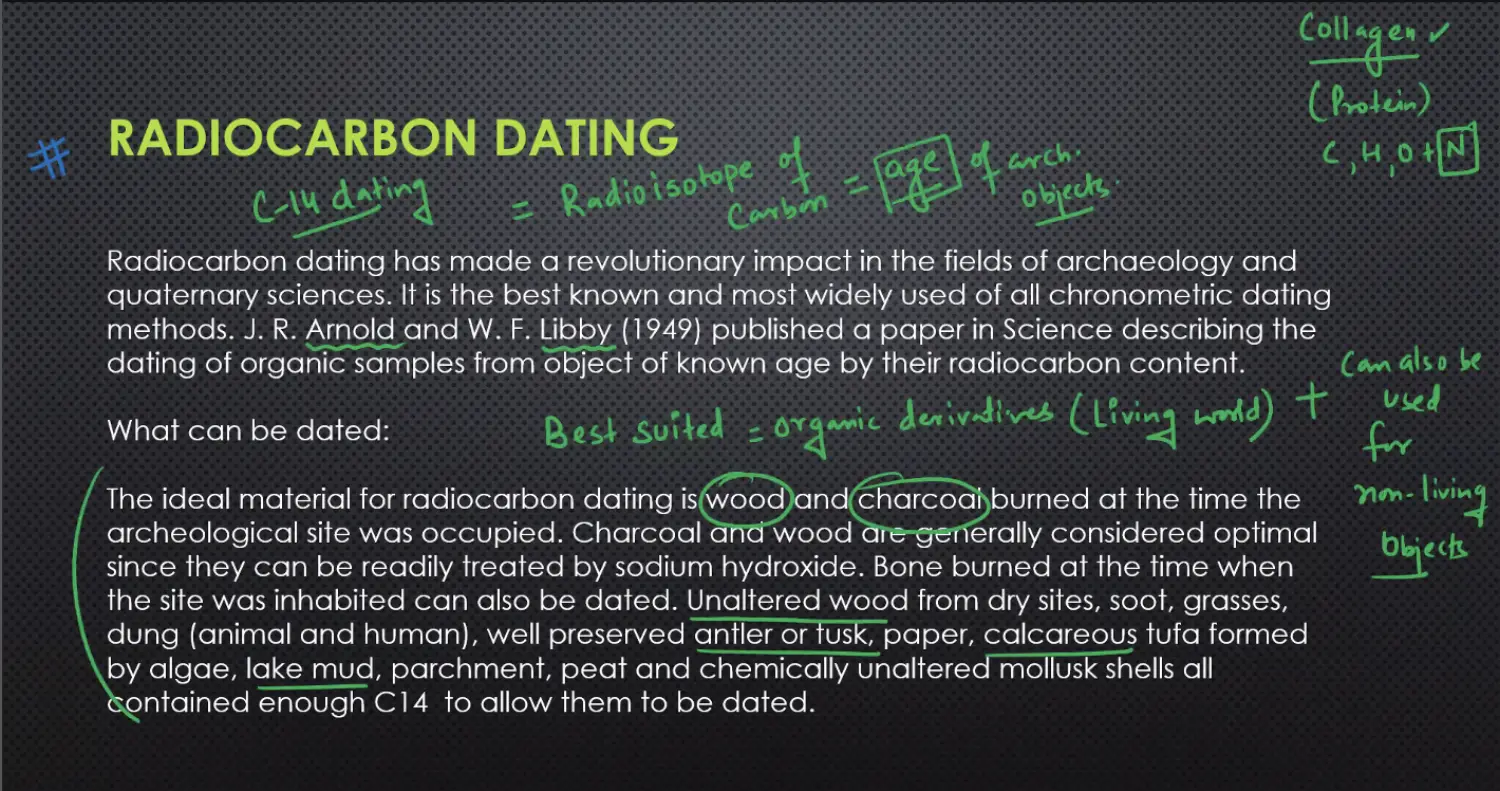
- Radiocarbon Dating
Introduction
- It is best suited for Organic Derivatives coming from Living World but can also be used for Non Living Objects
- It is one of the Most Commonly used Method of Absolute Dating
- Two Prominent Names Associated with its Discovery Are Arnold & Libby
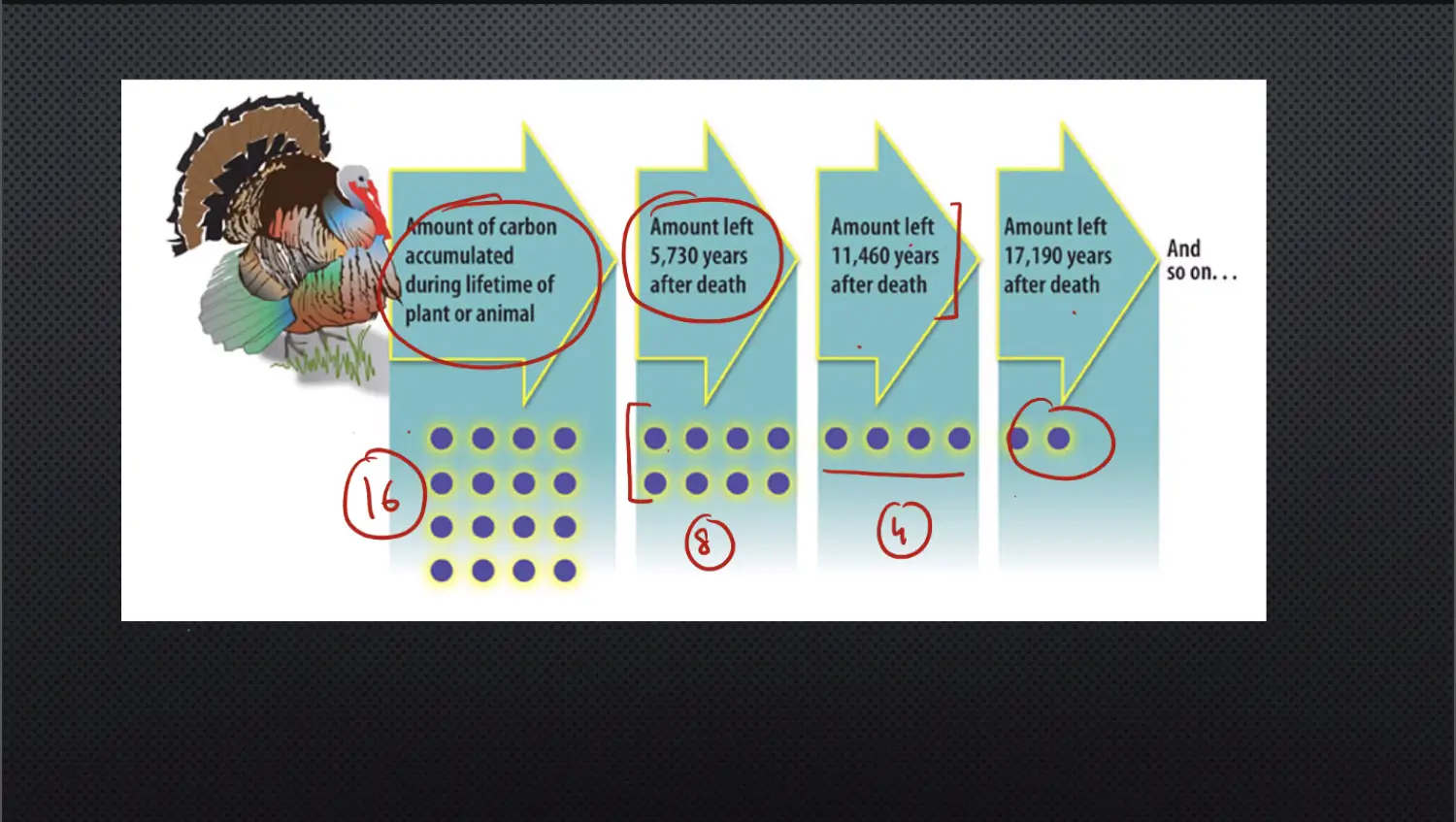
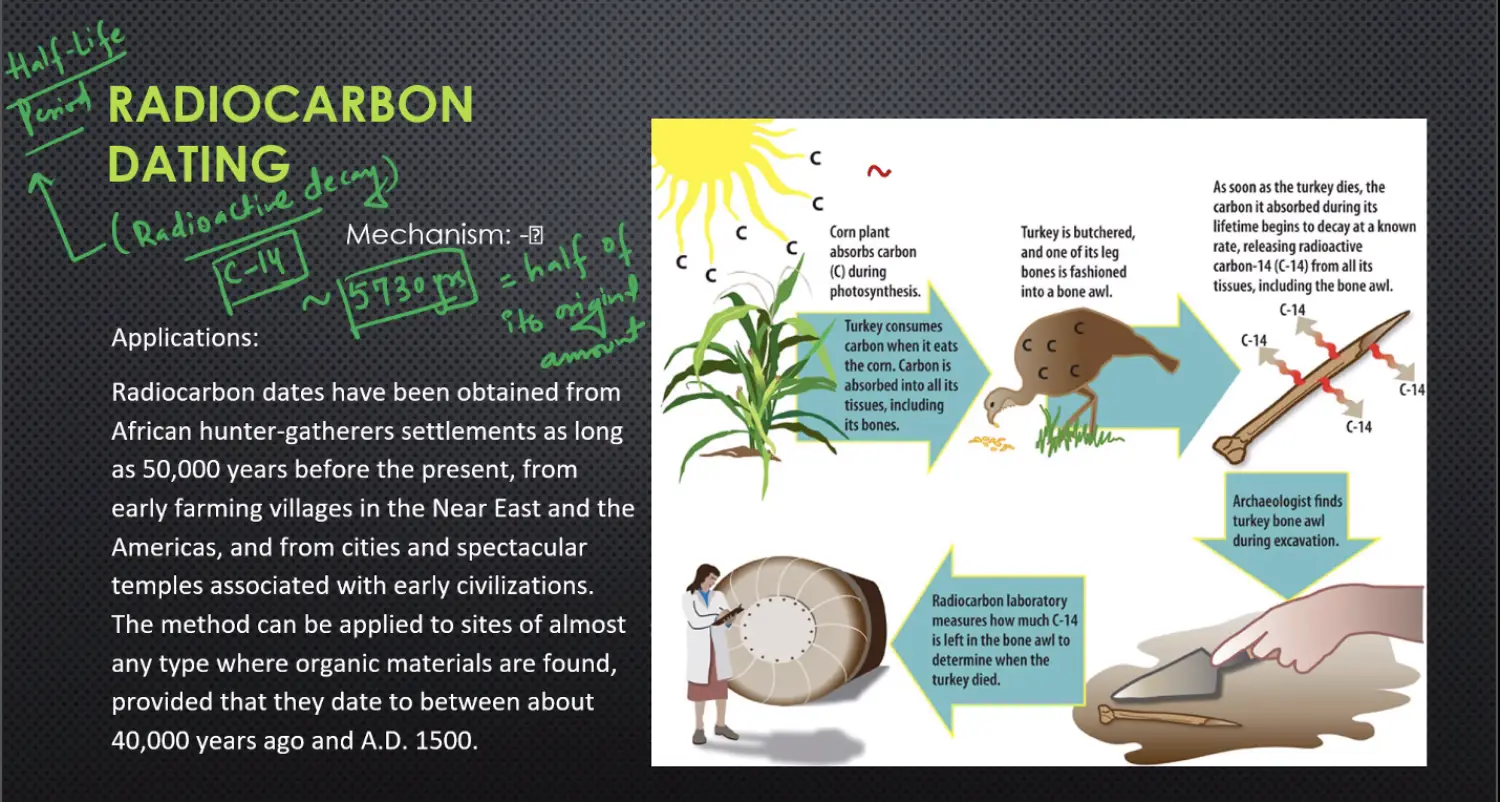
Half Life Period
Due to Radioactive Decay, C-14 content of an Organism Decreases
Application & Process - Method 1 → Normal Method
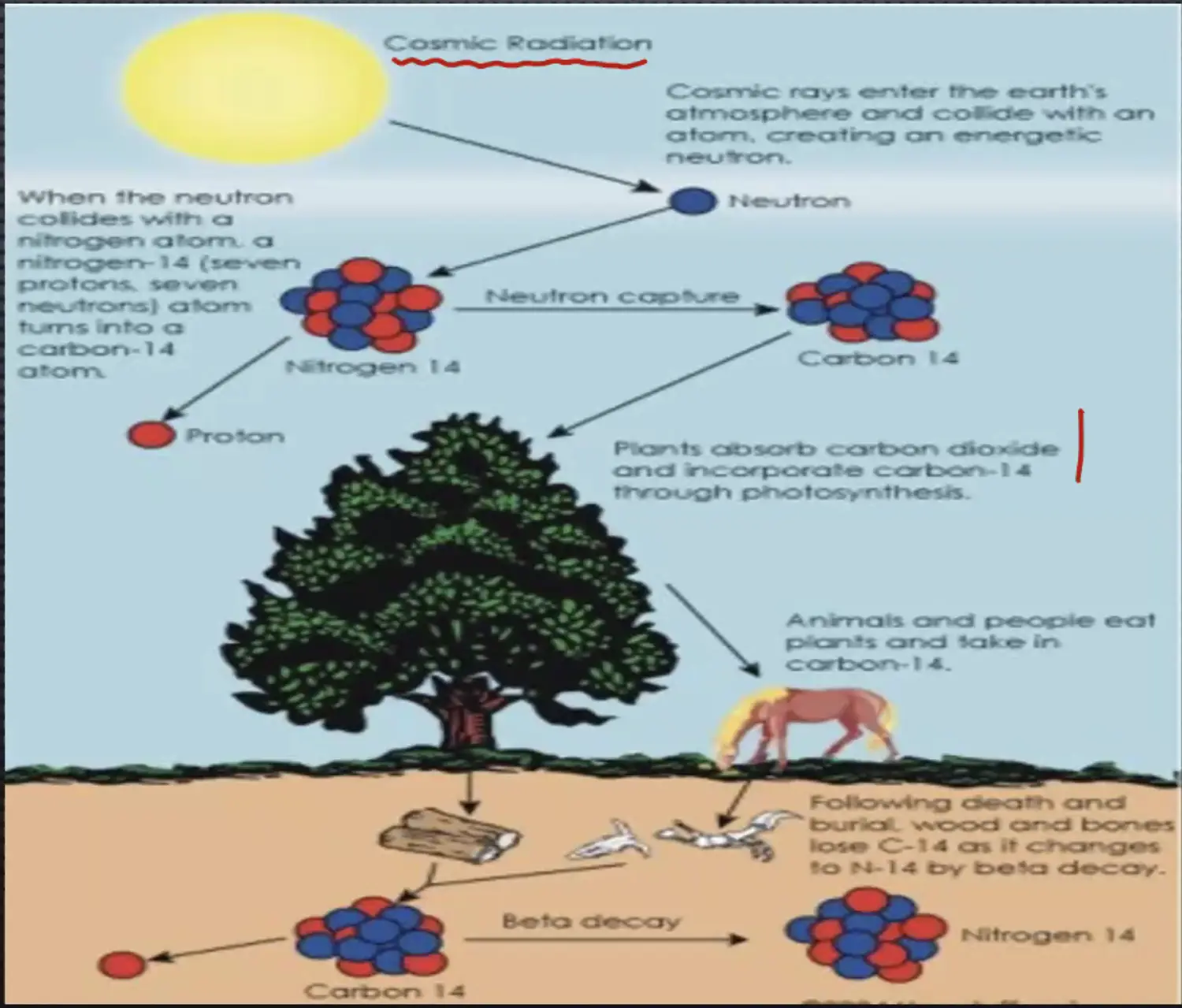
Application & Process - Method 2 → Nature Method
Limitation of C 14 Dating
- For Method 1 and Method 2
- Not Very Accurate as → It is applicable for only 60,000 to 70,000 Years of Age
- Generally the Age of Fossil Counted by Carbon Dating is Erroneous by +_ 300 Years because there is Not a Uniform Disintegration of Carbon 14
New Application & Process - Method 3 → Accelerator Mass Spectrometry (AMS)
AMS Does not Give Age but tells the Precise Amount of C 14 Left in the Organism
Range is even to small amount of 100 Micrograms to 300 Milligrams
Its an added Technique of C 14 Dating

- Potassium Argon Dating
Introduction
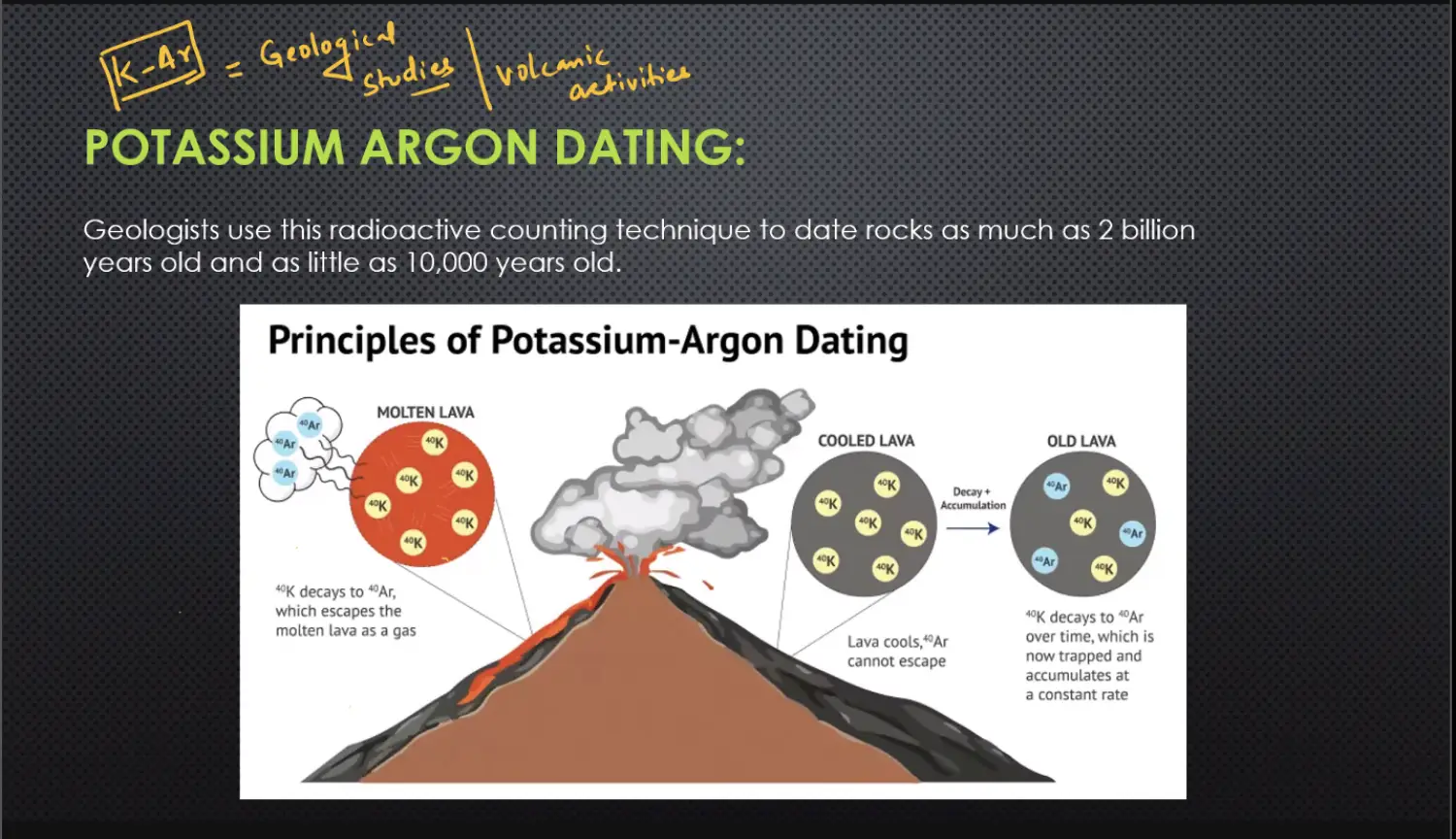
- We Study the Age of Non Living Matter, based on that we approximate the age of living matter
- Volcanic Eruption Released Potassium 40 which is stuck in Lava Erupted
- When this Potassium 40, converts into Argon 40 by various means like (Eruption or Cooling) it converts into Argon 40
- Mainly used for Rock Structure ranging from 10,000 to 2 Billion Years
Application of Potassium Argon Dating
Olduvai Gorge in Tanzania is a prominent location of upper paleolithic age was based on K Ar Dating, studied by Louis and Mary Leakey
Here they Found Skull Specimens of Australopithecus Boisei
Omo Valley - Southern Ethiopia → Lower Pleistocene Deposits have been seen
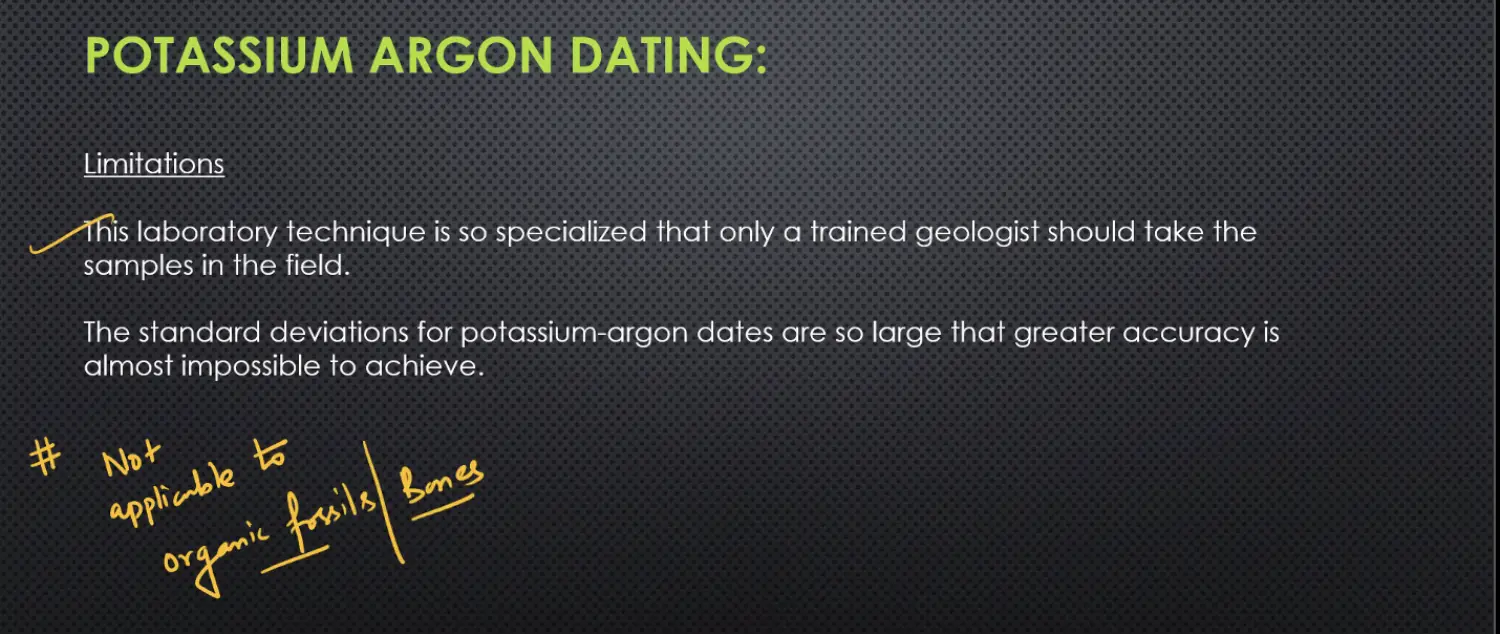
Limitation
Not Applicable to Organic Fossils, Bones or Skulls Directly
- Luminescence Dating
Introduction
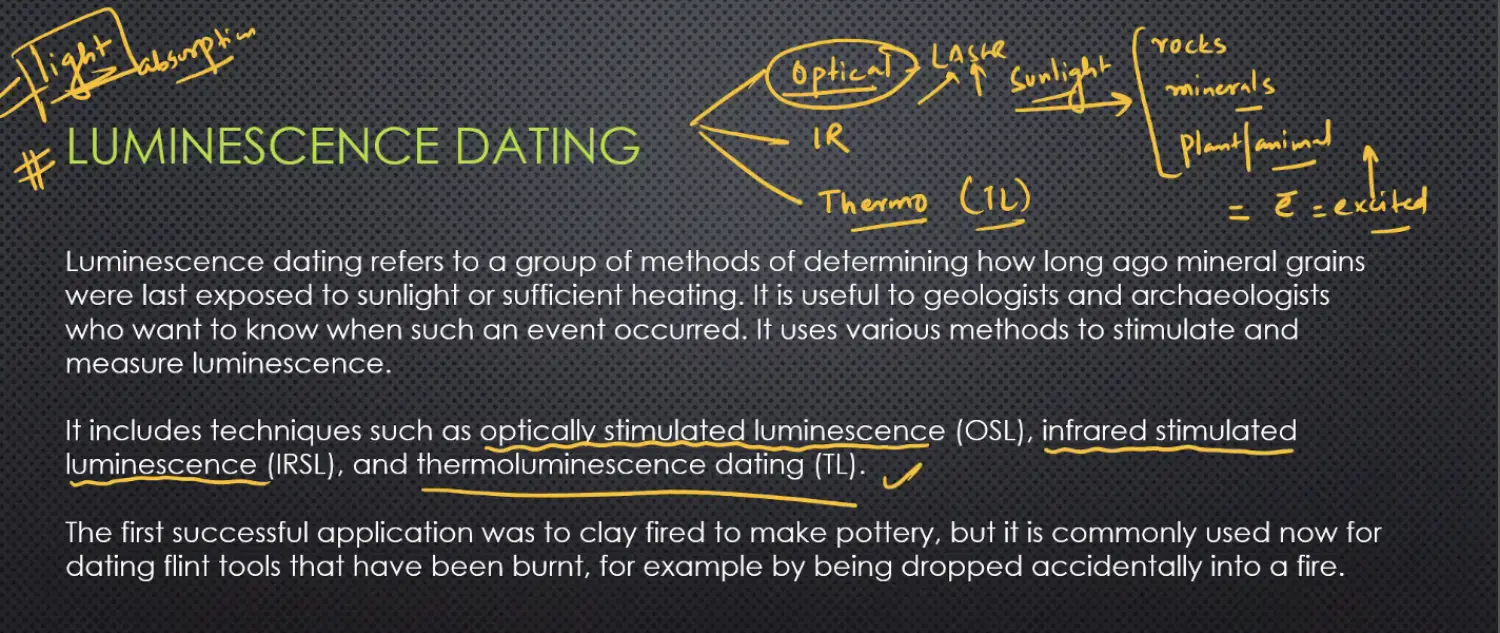
- Luminescence can be of different types Optical, IR, Thermo (TL)
- It is based on Light Absorption. At Some point of time, the Rocks, Minerals or Plant and Animals were exposed to sunlight. They Absorb a Part of it
Process
Examples
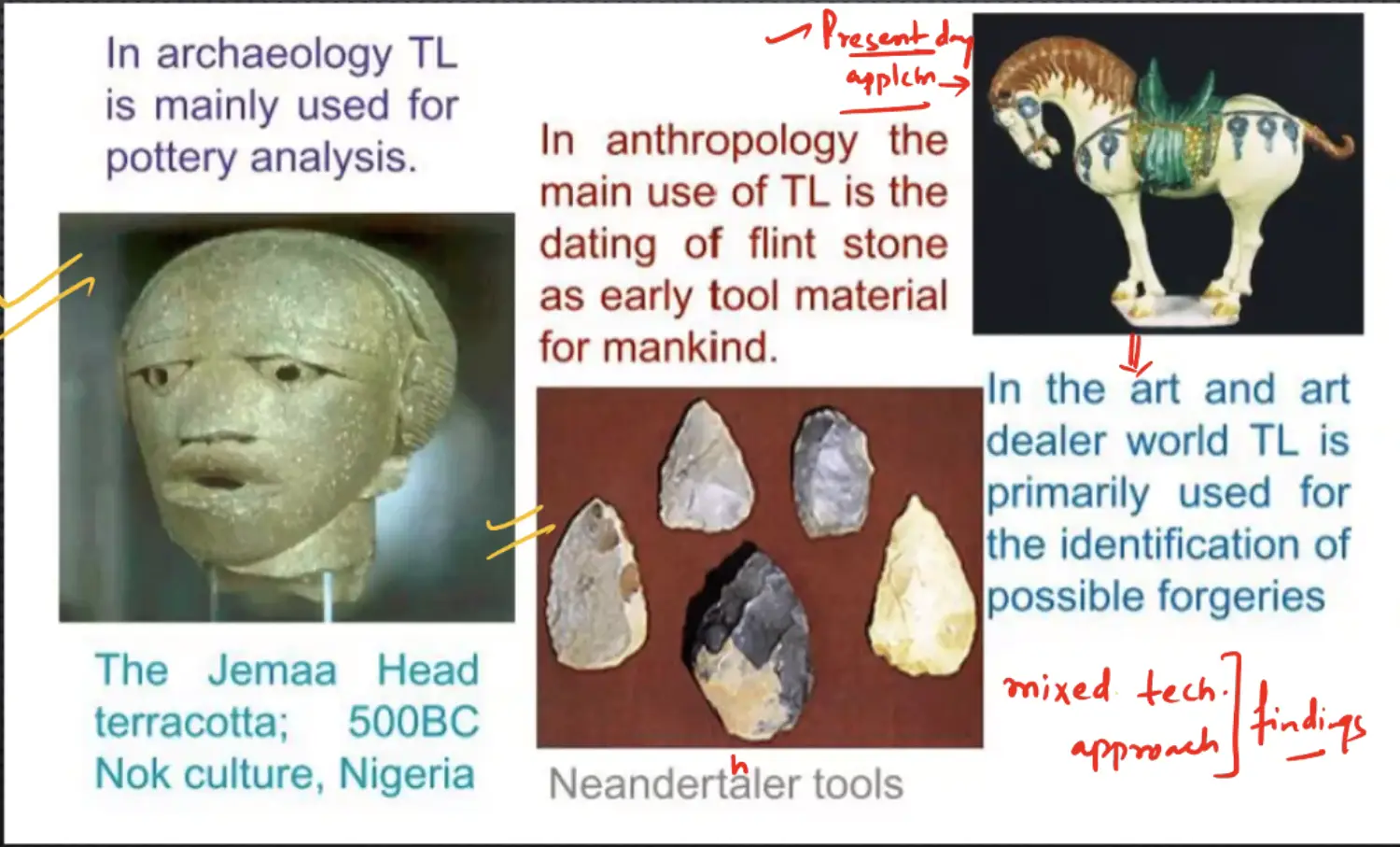
In Recent Days Thermoluminescence can be used in the world of art & craft to verify the originality of the product and to find out the forged copies
Limitation
- Dendrochronology *
Introduction
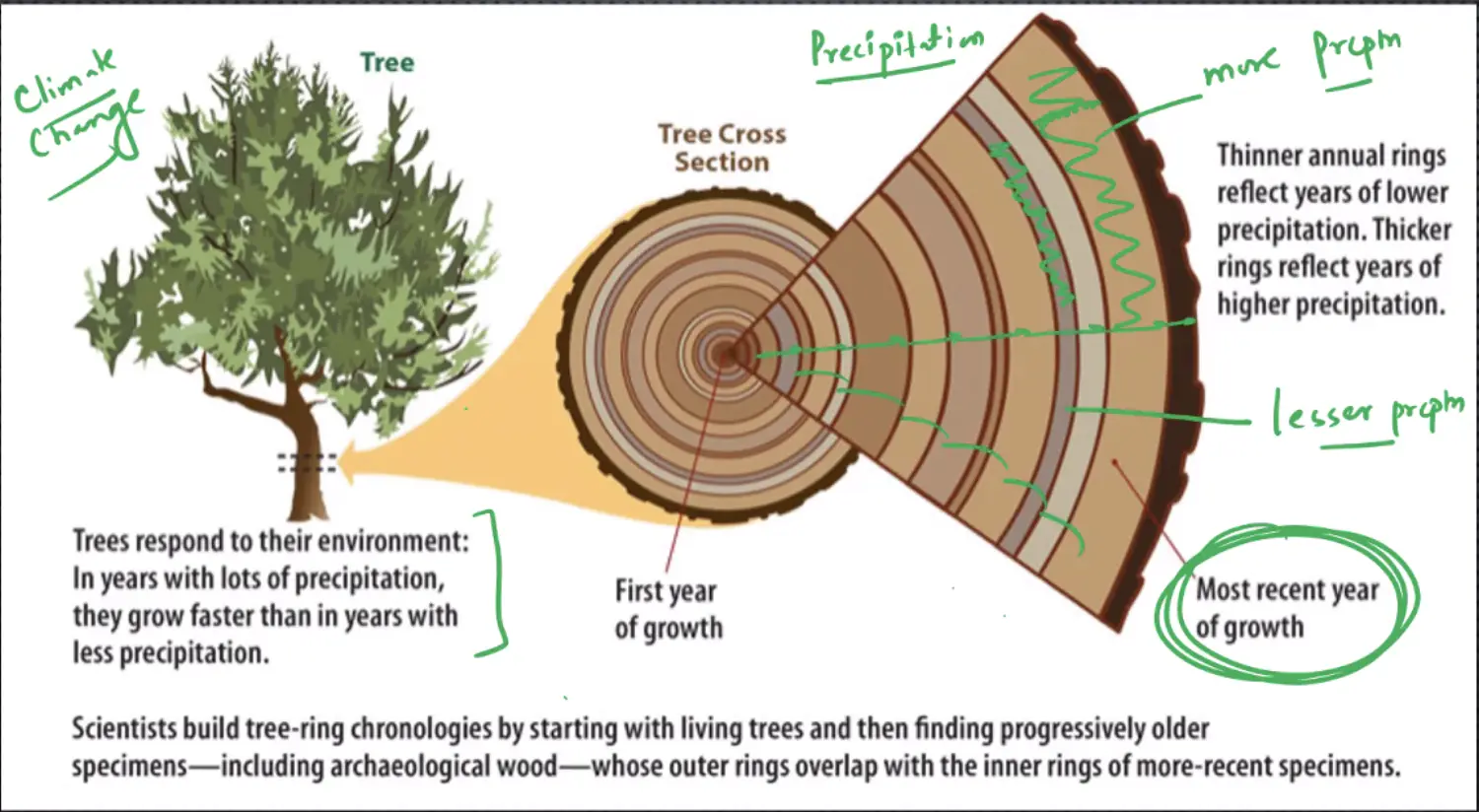
- Dendrochronology is Tree Ring Dating
- These Rings are Based on Precipitation
- Thicker the Layer more the Precipitation and Vice Versa
- Outermost Layer is the Most Recent Layer
- Innermost Layer is the Most Old One
- One Ring in Tree is completion of One Cycle of Season
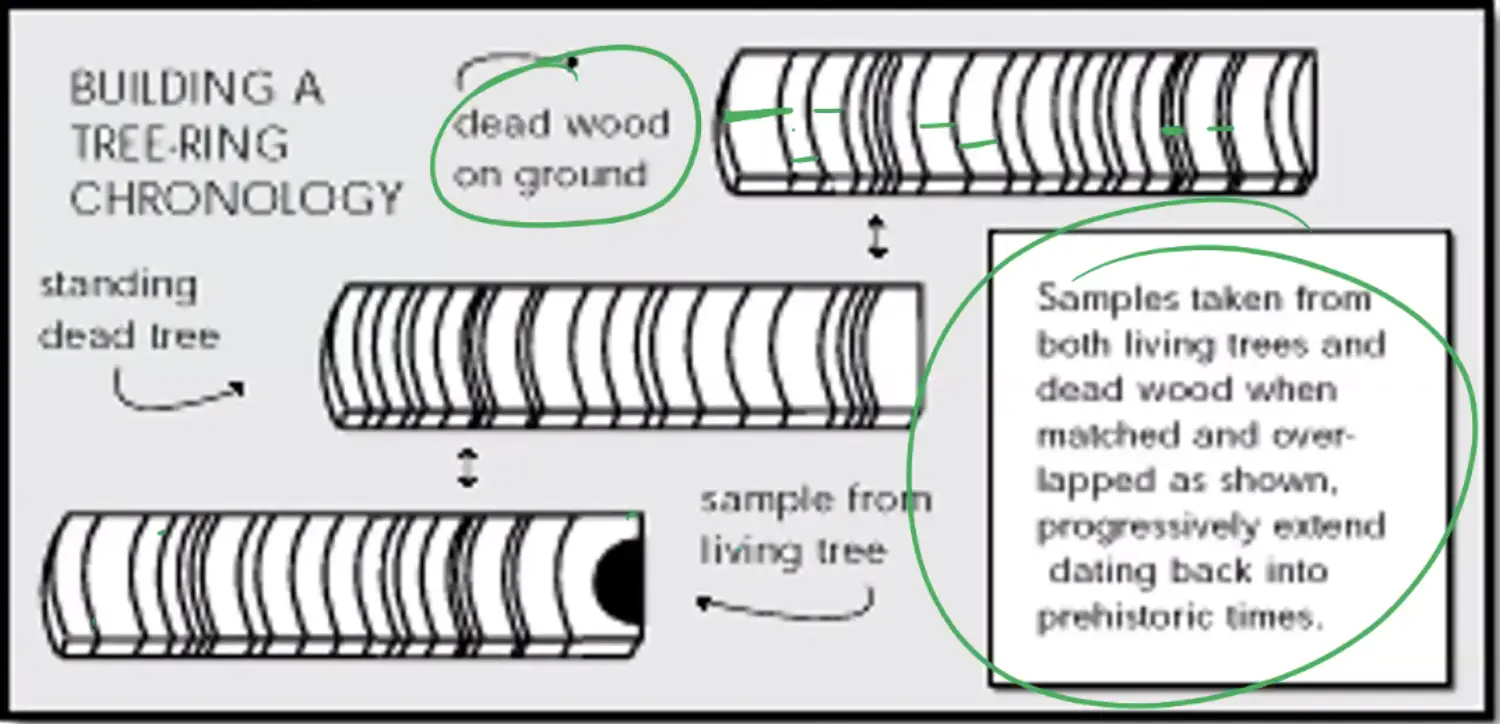
Technique and Process
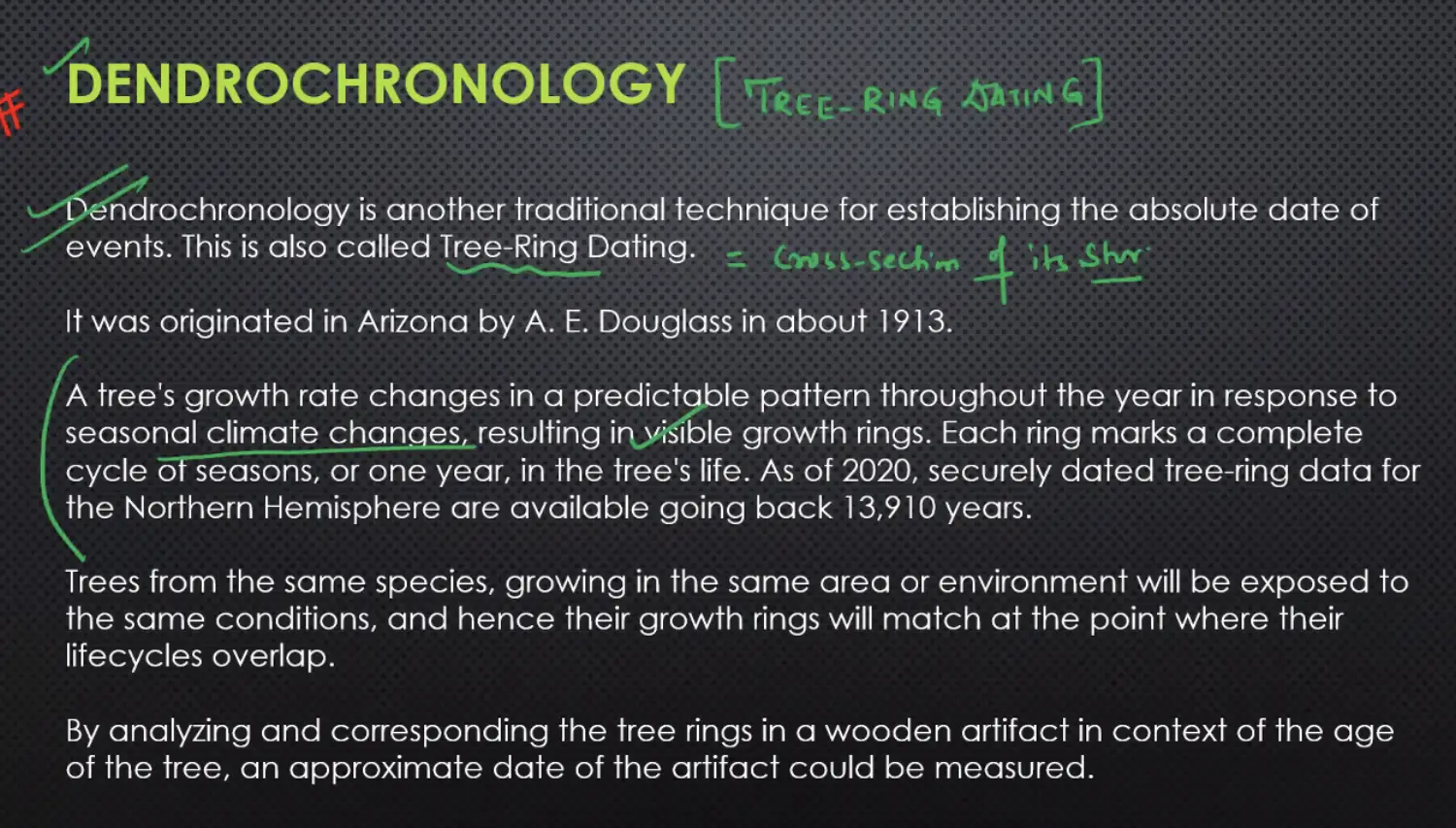
Make This Diagram in Exam 👇
Application
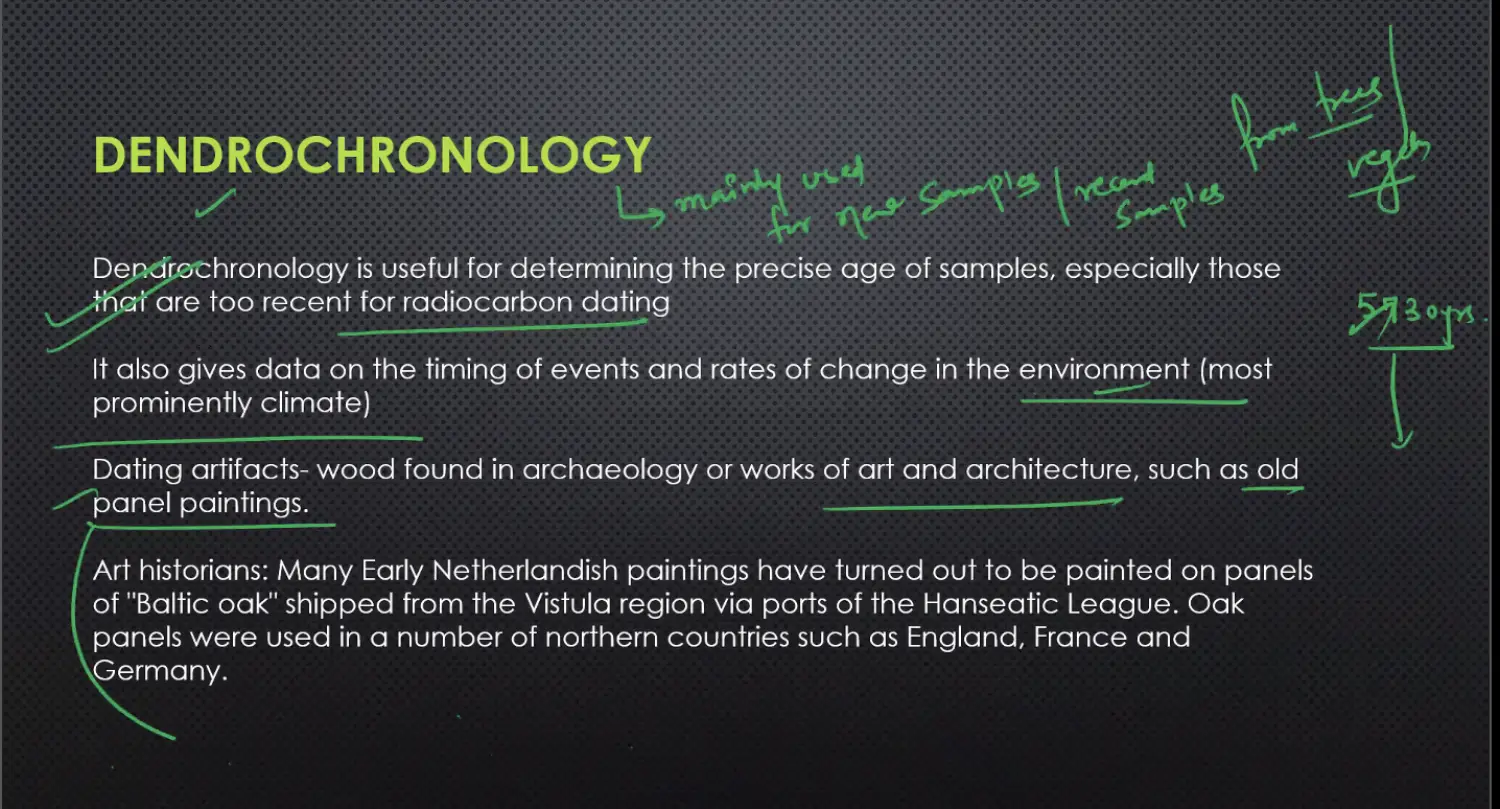
- It is mainly used for New or Recent Samples ; especially those which are too recent for Radiocarbon Dating
- It can help in understanding the Climate Change around the Date of Artefacts
- Study of Artefacts like of Danish Artefacts
Limitations
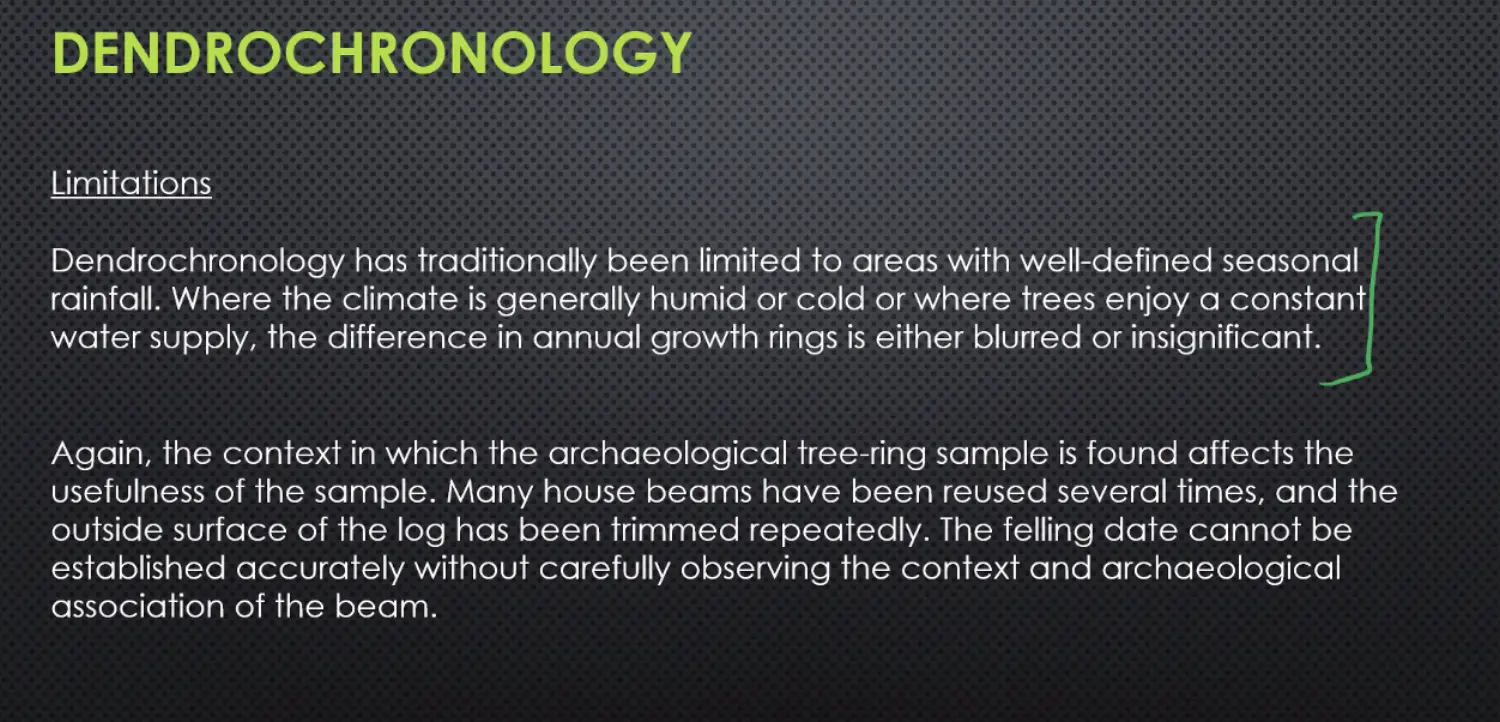
- But Places where we don't have Seasonal Changes like in Equatorial Region. Here Dendrochronology Fails.
- There is no evidence of Study by means of Dendrochronology older than 13,000 - 14,000
- Apart from Wooden Tools and Artefacts ; Nothing can be Studied
- Samples which have been Reused cannot be identified with accuracy via this method
Unit 1.8 & 1.1 : Pre History
Cultural Evolution - Broad Outline of Prehistoric Culture - India and World
Meaning of Prehistoric
It SImply Means Before Writing of History
Important Note for Terminology
These Ages are Different for Different Parts of the World
Imp Names in Indian Archaeology
- Robert Bruce Forte
- H D Sankalia
- H De Terra
- Paterson
- Mishra
Paleolithic Culture Old Stone Age 30 Lac Years to 10/12 K Years
Introduction
- Classification of Paleolithic Culture was Given by Lartet in 1870
- The Onset of Paleolithic Period has Traditionally Coincided with the first evidence of tool construction and is used by Humans at about 2.58 Million Year Ago
Stone tools used in Paleolithic Culture are
Stone Tool Culture of Paleolithic Culture used Multiple Techniques for its Creation
- Core Stone Tool
- Core of the Material is used as a basic raw material for finished tool
- Ex
- Hand Axes
- Choppers
- Cleavers
- Flake Stone Tool
- Ex
- Scrapers
- Pointers
- Borers
- Ex
- Blade Stone Tool
- Ex
- Sharpened at Both the Edges
- Ex
- Core Stone Tool
It can be divided into three Ages
Lower Paleolithic - 30 Lac to 3 Lac
World
Features of Tools
- Acheulean Tools - Acheulean Sites means places where evidences of Acheulean Stone Tools were found in the World → Use of those Stone Tools were reflection of Acheulean Culture & Tradition
Features of Location
Features of Culture
- Two Types of Division in Study of Lower Paleolithic
- Peninsular - Forested & Rocks - Central & Southern India
- Extra Peninsular - Himalayan & IG Plain & Brahma Plain - Glacial & Pluvial Deposit
- Some Evidences of Use of Fire by Homo Erectus
- Homo Erectus were very Efficient hunters (well explained by F Clark Howell)
- EA Hobble studied some evidences of Cannibalism in some parts of China
- New Water Resources & Dense Vegetation
- Less Evidences of Caves - Max Stay in Open Area
- Acheulean Sites / Tradition -> Manufac + use of ST by Acheulean Technology Acheulean Industry
- All Over India except Kerala, SPO TN & Sindh
- Son/Sohan Valley/Culture, Punjab - Max Part in Present Day Pak
- Madarasian Culture
- Narmada Culture
First Pal Tool discovered by Robert Bruce Foot in 1863 at Pallavaram, Near Madras This Study Laid the Foundation of Pre History Studies in India
Env & Climate were NOT uniform. Ex Kotwar Plateau (Pak) & Kashmir Valley. They were under the Influence of Great Ice Age
Area b/w Hoshangabd & Narsinghpur Dist in MP Western Ghat Part of Mah Mysore Coorg Region of Karnataka
- Sankhlia in 1964 Studied Narmada Culture
- Two Types of Division in Study of Lower Paleolithic
India
It is prominently studied under two aspects
Peninsular → Central + Southern
These are Mainly Found in Forested Area & Rocky Structure
Extra Peninsular → Himalayan and IG Plains + Extending into Brahmaputra Plains
Two Types of Deposits were found here
- Glacial Deposits - Glacial Deposits
- Pluvial Deposit - Rain Related Deposits
Soan Narmada & Madras Culture
| Themes | Soan | Narmada | Madras | | --- | --- | --- | --- | | Location | 1. Major Part in Son / Sohan Valley Region of Punjab in Pak 2. Potwar Plateau Region 3. Sohan Valley Region 4. Parts of Him & UK (Chauntara) 5. Extended till Brahmaputra Valley | 1. Adamgarh Hills Region 2. Parts of MP, Mah, Rajasthan 3. Pravara Valley 4. Ratnagiri, Mah | 1. Attirampakkam Near Chennai
Extended in TN, Ktk, AnP, Orissa, WB | | Tools Used | 1. Max Presence of Chopping Tools | 1. Max Occurence - Cleavers
Some Evidences of Hand Axis | 1. Dominated by Hand Axis | | Archaeologist Studied | De Terra & Patterson | First by De Terra and Peterson Later by Sankhlia | First by Robert Bruce Foot Later by De Terra, Peterson, Krishna Swami | | Location | 1. Boulder, Pebbles & Gravels dominated
Large Evidences of Glacial Deposits | 1. Complicated Strata of Terraces were found because of Rift Valley | 1. Here Use of Quartz for making stone tools
Evidences of Abbeville - Acheulean Technique was seen |
In Soan Valley Culture → In the Studies of De Terra and Peterson, The River Bed of Soan or Sohan Valley was divided into 5 different zones or Terraces i.e T1 to T5.
With T1 at the Highest Feet above the River Bed and Terrace 5 being the Lowest Terrace
These Terraces were found with different stone types, like Boulders at the Top & Fine Granules towards the Bottom
In Narmada Culture → due to the presence of Rift Valley with the Flow of Rivers it was difficult to divide the Strata in different terraces. Hence No Such Terrace Division was seen in Narmada Culture
In Madras Culture → The Terraces were simpler in division studied under three different parts T1, T2, T3. Soan river terraces were most extensively studied
Jab Kuch Yaad Na Aaye, Tab Ye Likhna !
Middle Paleolithic - 3 Lac to 30 K
- World
Location
Africa
- Klasies River Region of South Africa
Europe
- Krapina, Yugoslavia
Asia
- Shanidar Caves in Iraq
- Bhimbetka, India
- Mugharetes Skhul, Israel
Features of Locations
Excavations in Cave & Open Air Sites in Europe, Middle East & Africa
These Era of MPC was last phase of Glaciation or Great Ice Age. Hence called Warm Glaciation Phase
They Lived in Caves & Rock Shelters - They were Insulated with Animal Skin to avoid & protect thyself from Harsh Winters
Features of Tools
Small Hand Axes, Side Scrapers, Triangular Printed Tools
Flake Tool Tech, Eur = Mousterian Tool Culture
It is called so based on Le Moustier France
Most Prominent of Mousterian Tool Culture Levalloisian Tech
Details of Levalloisian Technique
- One Prominent Technique of Mousterian Tool Culture is Levalloisian Stone Tool Making Technique
- The Process is SC/F/Sharp
Preparation of Stone Core
Tortoise Shaped Core → Core Looks Like a Tortoise Shaped Core
Flaking
Sharpened - One or Both Sides
- Levalloisian Type Tools Found in Africa were found in Klasies River Region of South Africa. More Flake Tool Found. More Neanderthal Activity Seen
Broad Details of Tools of MP Tools
Some of the Tools in Middle Paleolithic Culture might have been hafted (handle lagana) for better grip & action
There was a Significant Degree of Variation in Stone Tools of Mousterian Technique.
There were Multiple Types of Tools used here even within france
Features of Cultures
Cannibalism
- In Mugharetes Skhul, in Israel - A Fatal Spear Wound in thigh Bones of Human was Found
- in Krapina in Yugoslavia (Present Day Balcan) - we found mutilated skulls and bones of men, women & Children
Fire
Multiple Evidences of Fire used for for Warming and Cooking of Meat
Bear Cult
Bear Cult in Western Eurasia
Worshipping of Cave Beer. Within the Cave They arranged Bones of Cave in Mul Patterns. Hinting About Some Rituals
Skilled Hunters
Neanderthals were Skilled Hunters whose evidence were found in Gibraltar Region.
They Gathered Shellfish, Seals & even Dolphins
Burials
- Burial of Dead with Rituals, Flowers, Stone Tools & Animal Bones. Ex : Shanidar Caves of Iraq
- Remains of Handicapped Man along with Multiple Pollens were found. Hinting that multiple flowers were used in last rites.
- Family Plot for Burial, Le Ferraise in France 5 Children & 2 Adults were apparently buried together
- India
- Features of Location
- Caves and Rock Shelters in Central India & Deccan
- Fossil Bones of Wild Ox, Hunting in Kalegaon Maharashtra
- Skull of Wild Elephant in Chandoli Maharashtra
- Crystalline Silica tools found in River Pebbles
- Middle Paleolithic Cul was found in Foothills, River Valley, Riverbeds, Riverbanks, Forested Area
- Features of Tools
- Sankhlia in Pravara Valley, Nevasa, Mah for the first time recorded & demonstrated flake tools of Middle Paleolithic Culture in India
- Called them Nevasian Culture
- Sankhlia also found the same kind of tool in Godavari Valley, North Karnataka
- Sankhlia Found Flake Tools in Narmada, Son, Krishna, River Valleys
- Further Studies Proved that this Study was spread in entire Mah except some coastal area, Seve Places in Ktk, AnP, Ker, Odisha, MPUP, Bihar, Pun, Raj, Guj, WB, No Evidences in North Eastern Region Except Assam
- Tools used were - Fale Tools, Hand Axes, Cleavers, Barers, Scrapers
- flake tools were prepared and used for scraping the wood, Skin of Animals & Flaking of Various Other things Hunting and Gathering was dominating at South CC as studied by Krishnaswami
- Features of Culture
Various Archaeologists Divided India into Different Zones based on Env Conditions, Tech of Tool Making, Sustiences Activities :
- Soan Culture Complex, Central C/C
- Narmada Valley of MP + Parts of Guj
- Luni Cul Comp, Rajasthan
- Nevasian Cul Compl, Mah + Ktk
- Southern C/C TN, AP, Odisha
- Eastern Southern Complex - UP, Bihar, Bengal
Archaeologists Studied
De Terra & Peterson studied the Soan Cul Com in 1935. They Founded Evidences of Middle Paleo in T4
Central C/C De Terra and Peterson Studies Narmada Valley
V N Mishra Excavated Several SItes at Bhimbetka
Balathal studied Looney Valley in Rajasthan
H D Sankalia Studies Nevasain Cul in Maharashtra
Krishnaswami Studied Southern C/C In Various Cultural Complexes of Middle Paleo Cul
flake tools were prepared and used for scraping the wood, Skin of Animals & Flaking of Various Other things Hunting and Gathering was dominating
- Features of Location
- World
Upper Paleolithic - 40 K to 10/12 K Years
- World
Locations
- Chauvet, France - Earliest Evidences of Cave Art in World (Nearly 40 K YO)
- Apollo 11, Namibia - Nealry 26 K YO
- Carpenters Gap, Australlia - Nearly 40 K to 30 K YO (not well defined timelines)
Features of Location
- Upper Paleolithic Culture was spread in maximum parts of Europe, Middle East, Africa & South Asia
- There were almost nil evidences of lower & middle paleolithic culture in australia but significant findings of upper paleolithic sites were seen in australia
- this timeline can be considered as the beginning of modern men
Features of Tools
- Hominis Started Modifying Rock Structures called Knapping
- First Evidences of Bow and Arrow
- Barbed Harpoons for Fishing
- Knapping means Rock Architecture, Modifications and Carvings
- Emergence of Activity Specific Tool
Features of Culture
- It is divided into 5 different industries
- Chatelperronian
- Aurignacian
- Gravettian
- Solutrean - These were very Skilled Tools
- Magdalenian
- Environment
- Initial Evidences of Agriculture
- This Period Witnessed Major Env Shifts
- It was the Last Phases of Glacial Periods and Witnessed Warming
- In the Northern Latitudes & Eurasian Region - Permafrost was still there & Hence, No Growth of Trees
- But there was Growth of Small Mosses, Small Steel Flowering Plants
- Vast Pastures in Middle Latitude - Hence More No of Herbivores - Hence More Number of Carnivores
- Hence Herbi + Carni = Huge Populations
- Burial
- Burial Rituals with Multiple Grave Goods buried with Dead People
- Earliest Evidences of use of Red Ochre from Australia. Evidences were found from Burial Grounds from Deads and Burial Grounds !
- Paintings
- Petroglyphs were found in Europe Asia and Africa
- Red Ochre Studies in Australia by Dead in Burial Grounds by Hovers
- Ornaments
- Making of Portable Arts & Ornaments Ex: Venus Figurines (Fertility Totems)
- Pendants made from Human Molars & Beads
- It is divided into 5 different industries
- India
- Locations
- Krishna Godavari River Valley Andhra pradesh
- Narmada and Banjer River Valley in MP
- Krishna Tungabhadra & Bheema River Valley in Karnataka
- Belan Valley, UP
- Along with these River Valleys there were cave sites also like
- Kurnool, Andhra Pradesh
- Bhimbetka, MP
- Features of Location
- Upper Paleolithic Culture was Restricted to Central India and Deccan
- Minimum Evidences from Western India
- Almost No Evidences from Himalayan Region, North East , IG Plains Kerala and TN
- Features of Tools - Missing
- Features of Culture
Zones
Upper Paleo in India can be divided into 5 Paleo Zones
- Southern - AnP
- Southern Central - KTK, SPO Mah
- Western Peninsula - Mah Guj
- Central Zone - MP
- NE Zone - UP Bihar
Environment
- Env - Not Uniform like Lower and Middle Paleolithic
- Northern Sites - Colder Climate
- Southern Sites - Pluvial Conditions
- Evidences of Wild Animals hunting like Antelopes, Gazelles, Wild Horses, Wild ELephant Msot Prom Evidences in Andhra in Kurnool and Jalgaon Region of Maharashtra
Archaeologists Studied
H D Sankhlia studied Patna near Jalgaon in Mah and found that UPC was found in 10,400 - 17, 500 Yrs Ago
De Terra & Peterson found evidences of UPC in Narmada Valley
V N Mishra - Narmada Valley. he found that the tools were made up of bones and stones
tools like Barrers, Scrapers & Evidences of Hand Axis were seen
Long Bones of Animals were used like in Chisels, Scrapers and Spatulas
in the Words of V N Mishra, Upper Paleo Cul was non uniform in climate but was uniform in it’s culture
M K Murthy studied, chittoor district of andhra pradesh
Paintings
Upper Paleolithic Culture in India was Involving Proliferation of Artistic Activities like rock carvings and paintings (like involving, man, animal, geometric symbols, etc)
Bisones and Antelopes were the most common figures in these paintings and hence upper palo in India as well as world laid the foundation of artistic activities which flourished in meso culture
- Locations
- World
Mesolithic Culture Old World Archaeological Age 15,000 Years to 5,000 Years
- World
It was seen in Europe and Some Parts of Middle East
It was because of End of the Climate and Pleistocene Period → i.e Ice Age Got Over
Many Animal and Plant Species became Extinct during this Age
It was a Period of Massive Readjustments
- This Led to Emergence of Millions of New Plants and Animals
- Also, Humans Started Adjusting to New Conditions
Due to this
- Large Scale Tundra Disappeared from Middle and Lower Middle Latitudes Disappeared
- Against that Forests Emerged. Also Hunting in the Forests Areas became a Challenge
- This led to Temporary Crisis for Hunting Gathering Communities
- With time this crisis got settled - by finding an alternative like domestication of plants and animals
- Hence Hominins of this time started settlement near the Shores of Rivers and Lakes
- Hence Hunting of Fishes and Molluscs led to use of More Barbed Tools
- Thus, New Skills and Tools were invented
In Europe there was extensive spread of Mesolithic Culture, Like
- Southern Part of Germany, Switzerland - (>2000 Sites)
- Czech Republic Poland, England - > 2000 Sites
- Netherland, Belgium
In Europe Max Locations used Microliths
Tiny Blades Types of Tools
With Geometric and Non Geometric Shapes, were crescent, triangular, Trapez - Maximum of them were with attached Shaft or Handle
Sometimes to give more strength to the tool, a rod like Structure was also inserted
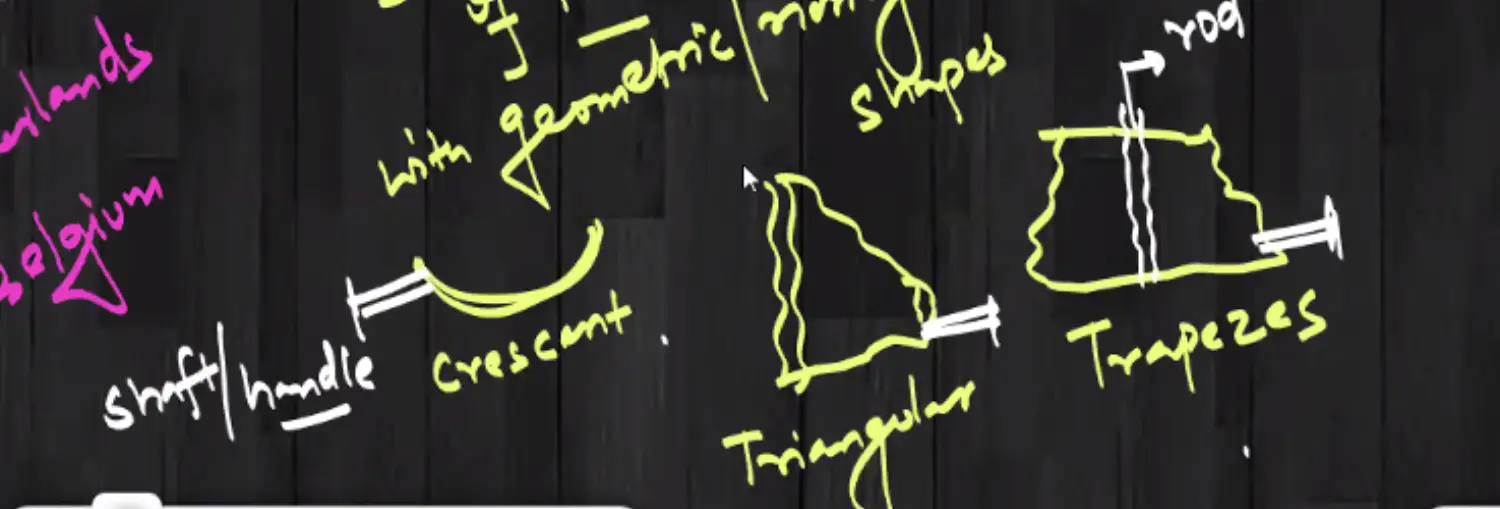
They used some non geometric shapes like
- Barbed Bones for Fishing
- They made tools out of Bones and Antlers
H D Sankhlia Studied Geometric Microliths in India
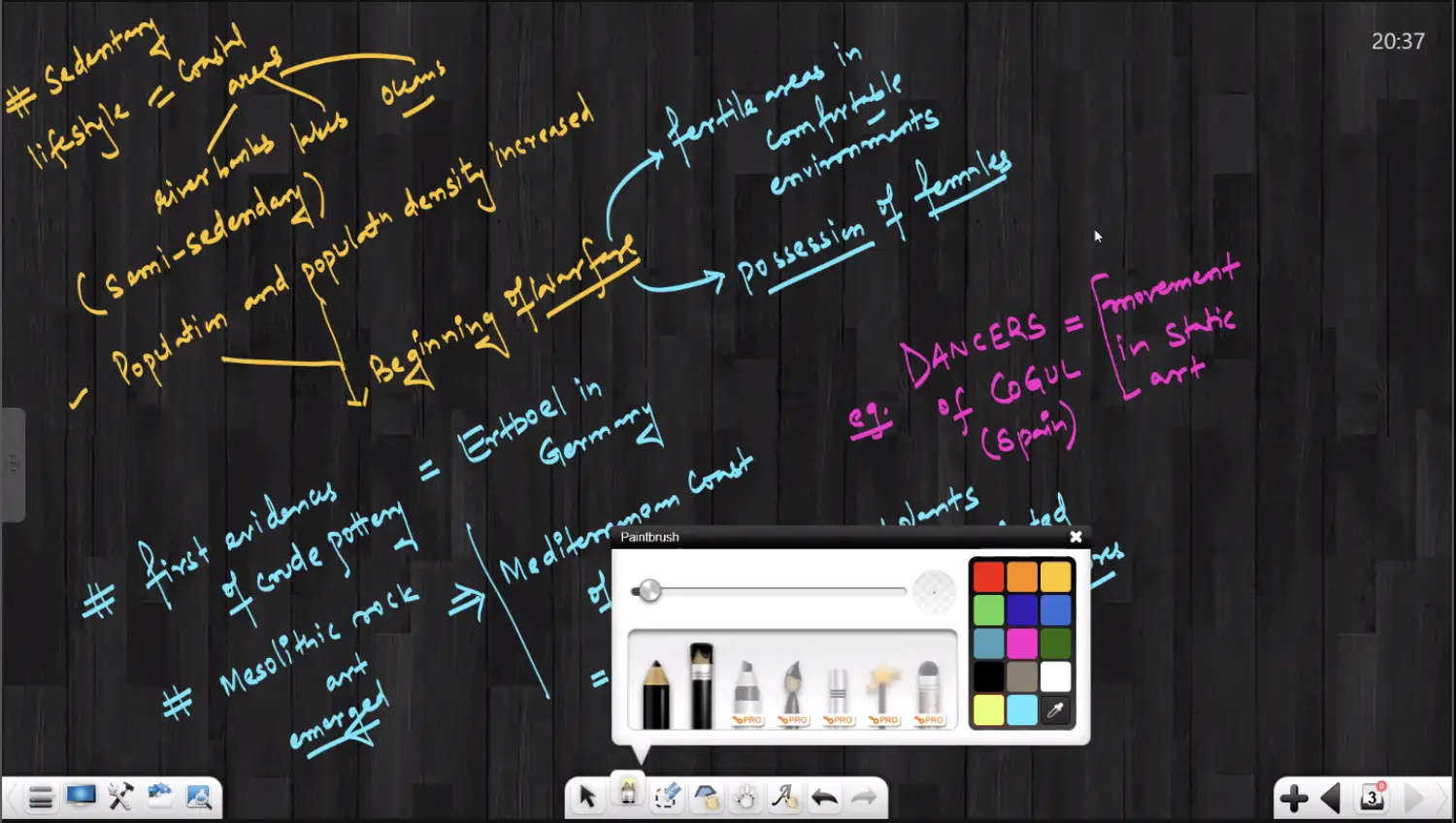
Due to Settled Lifes. Hence, Sedentary or Semi Sedentary Form of Lifestyles emerged particularly in Coastal Areas, Lakes & Oceans
Due to settling down Population and Population Density Increased
Now when Population Density Increased it led to Beginning of Warfare. Mainly because of two things
- Fertile Areas in Comfortable Environments
- Possession of Females
First Evidence of Crude Pottery is seen in Ertboel in Germany
Mesolithic Rock Cut Emerged → Mediterranean Coast of Spain - Humans and Animals & Plants Figures - Small Painted Farms and Figures
Example : Dancers of Cogul in Spain - Movement in Static Art
Here 9 Women were seen dancing around a male figure
2 Most Prominent Colors used in this Painting was Red & Black
Excavation of Some Megalithic Monuments in Britain, Iceland and Scandinavian Region revealed their burial rituals
Classical Example and Exception : In Strait of Sicily which was nearly 39 Feet Long and 5 Lac 30,000 Pounds in Weight. Its Purpose is still unknown
Moving from Paleolithic to Early Mesolithic → The Levant Region comprising of Israel, Palestine, Tukey, Syria, Jordan → Witnessed Emergence of Natufian Culture
In Some Area Natufian Culture Flourished in between 13,000 to 15,000 BC also
Main Support and Life Line of this Culture was Jordan River
In Archaeological History the Natufian Culture is considered between Sedentary to Semi/Non Sedentary Lifestyle
They were mainly hunting gathering people who remained restricted to places in period of sufficient resources
They were involved in Mainly Hunting of Gazelles
- India
It was first discovered in 1866-67 by Archibald Carlyle in caves or rock shelters of Vindhyas
It had more than 1000 microliths in the very first discovery
With a research of 70 to 80 years it was found that there were 100s of microlithic sites that we found in India predominantly Maharashtra, Gujarat, MP, UP, Bihar, West Bengal
But Also in Rajasthan, TN, Karnataka
With Later Research it evidences were found in
- Assam
- Indo Gangetic Plains of Pb
- Delta Regions of WB
there were very less microlithic sites. Some Arch said it can be avoided too
Location of Mesolithic Culture in India are
- Langhraj, Gujarat → Sankhlia
- Bangaltota, Karnataka → Sankhlia
- Bhimbetka, MP → Sankhlia
- Sanagankalu, Karnataka → Sankhlia
- Bagor, Rajasthan → V N Mishra
- Tilwara, Rajasthan → V N Mishra
- Teni, Tamilnadu → Ayyappam
- Birbhanpur, West Bengal → Lal
- Sarai Nahar Rai, UP →
Features of Above Locations
- These Location were Found in Areas of Scrubby Forest to Thick Forest which could support Small and Large Size Animals
- Some Scattered Location were also found in Grassland
- Also in Hilly Area
- Use of Both Geometric and Non Geometric Tools
- Raw Material in the use of Microliths were of Siliceous Rocks, Quartz, Quartzite
Evidences of Tethering or Glueing for making compound tools in Sanagankalu in Karnataka. These evidences are specific to India
In Bhimbetka a Special Structure was created outside the Cave Mouth to act as a windbreak
in Sarai Nahar Rai - Constructed Erected structure for residence
In Bagor a Natural Concrete from River Bed was used as floor of living space
In Adamgarh, Bhimbetka, MP - Here we found Large No of Animal Bones
In Mirzapur Region of UP Evidences of rock paintings over the Petroglyphs
In Max Sites of Mesolithic Period, Microliths as a tool was found designed specifically for a Specific Purpose
No Heavy Tools were Found
- World
Neolithic Evolution / Revolution - Pending from Class New Stone Age 20,000 Years - 5,000 Years
World
Introduction
Why is it called as Evolution or Revolution
Gordon Childe and Many Other Anthropologists said that changes taking place in this period are of far reaching importance
Significant Changes in Technology, Economy, Political & Social Life - Due to these reasons we called this as Revolution
But Literal Meaning of Neolithic is New Stone Age
In Some Parts of the world like in South West Asia it started 20,000 years ago and existed until 8000 year ago
But for Majority of the world including india it was for 12,000 to 7000 Years ago
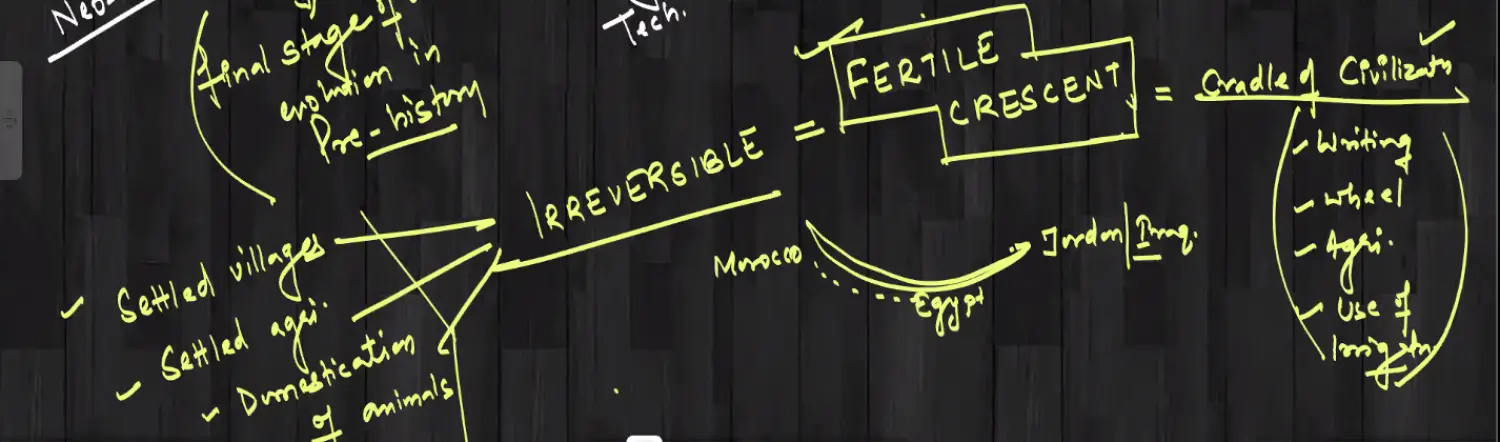
It can be called as Final Stage of Cultural Evolution in Pre History marked by Settled Villages, Agriculture &. Large Scale Domestication of Animals Started → These changes became irreversible changes
Fertile Crescent
is that part of middle east and near by Africa which was home to some of the earliest human civilisation and hence is also termed as cradle of civilisation - It was FOUND for the First Time
Three Prominent Changes of Neolithic Period according to Ethnohistorian / Ethno Archaeologist Bennet
- Increase in Population
- Shift in Climate
- Weakening of Social Control
Features of Neolithic Revolution
- Changed Climate leading to Dominance of Grasses in Middle Latitude. These Grasslands were ideal for growth of Wheat & Barley
- Settled Agri - Settled Villages - Sedentary Lifestyle - Increase in Fat Content of Body
- Densely Populated Settlements Emerged
- Property Ownership Emerged → Personal and Private Land Concept - Hierarchy in Society Emerged - Hereditary Transfer of Property Emerged - Political Administration Emerged
- Economic Structure Emerged - like Earliest Evidences of Trade or Exchange of Goods.
- There have been evidences of Division of Labour, led to substantial changes in technology and tools making
- Earliest Evidence of Woven Textile Clothing of Flax and Cotton
Features of Neolithic Tools
- Tools were much advance as they were made by chipping, finishing, polishing & grinding
- this led to creation of Fine, Sharp & Aesthetic Tools
- Clearing of forests for Settled Agriculture was not an easy task. for this efficient axes with smooth finishing and sharpening & a Good Grip is Required.
- To achieve this a Polished tool with Smooth End with Bundle was made
- Triangular Shaped Stone Tools with Broad and Sharp cutting edge
- Matching with Present Day Metallic Axes were used to clear the Forest
Features of Pottery Making
- Settled Agri - Prodn of Extra Food Grains
- Either used in Trade
- Either Stored - for Future Use → use of Ceramic and Fire Clay Potter Emerged
- With Pottery Potters while came into existence, Instances have been found in Mehrgarh in Balochistan Province of Pakistan
- Later Evidences were found in some parts of Europes too
- Settled Agri - Prodn of Extra Food Grains
Features of Dwelling Units
- Made of Stone and Mud Bricks i.e Sun Dried Bricks in Maximum Parts of the World
- In India Wattle and Daub Structure were seen
- Its a technique in which dried branches of Trees and Bushes were used to create a screen like a Wall and then Mud is plastered over it
- These kind of residences were found in various neolithic sites of India in Both Western and Eastern Margins
Features of Religion
- Some Instances of Spirit Worship were found in Middle East
- Complex Burial Rituals
Features of Neolithic Natufian
- Natufians Continued until this period also
- Constructed Permanent houses in fertile crescent region
- Catalhoyuk in Turkey is one of the most prominent neolithic sites
Features of Location
European Neolithic Sites were mainly concentrated near Danube River
India
- Introduction
Firstly Discovered in 1840’s by Captain Meadows Tyler in Lingsagaur in Ktk
Here a Polished Stone Axe as first Neolithic Tool was found
in 1870 another british researcher Fraser discovered first neolithic settlement of India in Bellary Ktk
Robert Bruce Foote discovered more than 200 Neolithic Sites in South India
Some Studies say that time of Neo Lithic Sites in india are 7000 BC - 3000 BC or some say 4000 BC - 1050 BC
- Prominent Sites in India are
- Burzahom - J&K
- Gufkral J&K
- Nagarjunakonda - Andhra
- Bairumpalli - TN
- Brahmagiri Hills - Ktk
- Chirand - Bihar
- Deojati - Assam
- Features of Location
- They Either Lived in Hilly Area or Hilly RIver Valleys
- Features of Tools
- Use of Microlithic Blades
- Polished Stones and Stone Hoes & Digging Sticks
- Along with Stone Bones were also used in Making of Tools and Weapons
- Use of Axe as a weapon along with tool usage started
- Features of Neolithic Indian Society as a Whole
- Houses were made up of Mud - Either Rectangular or Circular
- Initially Started with Hand Made Pottery, followed by usage of Potters Wheel, Later finding its pinnacle in Polished Pottery
- In Burzahom and Chirand, Maximum evidences of Polished tools have been found
- Earliest Evidences of Terracotta Figurines of Humped Bull from Mehrgarh in Pakistan
- In Belan Valley UP → Significant Number of Neolithic and Chalo Lithic Sites were Found
- Some Evidences of Rice Related Evidences have been seen in Belan Valley too
- Hut Kind of Residential Units were initially found in Brahmagiri Hills, Ktk
- Introduction
Chalcolithic Culture Eneolithic Age or Copper Age 5500 Years - 3600/4200 Years Ago
- Date Range is Also Called
- 5th Millennium BC → 5500 Years
- Later 3rd Millennium BC or Early 4th Millennium BC
- Word
- Chalcolithic → Chalco - Copper && Lithic - Stone
- The dates are highly variable in different parts of the world
- In India it is 2000 BC to 700 BC → In India it is very new
- It existed in India in both Pre Harappan and Harappan Periods
- this period was a transition zone between Stone to Metal usage
- There was a sharp Increase in Number as well as size of settlements
- Improvement in Architecture
- Wheel Made Pottery ( Diversification of Shapes, Size, Colour) → Associated with Decoration of Pottery & Vessels
- For the First time there was appearance of Beads and different materials - Aesthetics Emerged
- Terracotta Figurines were of Animals as well as Humans
- Use of Metal in Agriculture i.e Non Ferrous Metal → for Small Scale Use
- No Significant Social Change in Comparison to Neolithic and Mesolithic Cultures
- India
- Introduction
In India First Sites were found in Rajasthan with Malwa Plateau Region followed by Deccan
Later Formed Extensive Spread in India → They were contemporaries of Harappan → as compared to them they were a much simpler society in comparison to harappans
In India, some sites are as old as 3000 BC
Here they are found in River Valleys, Upper Reaches of Rivers, Plains, Arid + Semi Arid Area, Hill Tops, Hill Slopes
Rarely found in Foothills
Chalco Culture in India is divided into 6 Different Zones
- Ahar Culture Zone - Rajasthan
- Mala Culture Zone - Kayatha
- Mid Gangetic Culture Zone-
- Jorwe Culture Zone - Maharashtra
- Eastern Chalcolithic - Bihar, Orissa, Bengal
- Southern Chalcolithic
- Significantly Present in - Plateau Region of Balochistan + Indus Plains in Pakistan
- Features
- Ahar CZ
- Location - Ahar + Gilund
- Stone Axes - Blades
- Copper Tools were abundant
- Malwa CZ
- Location - Kayatha
- Western MP + Northern Maharashtra + Some Parts of Gujarat
- Some Spindle Whorls for weaving
- Evidences of 29 Copper Bangles
- 2 Unique Copper Axes
- Necklaces of Semi Precious Stone particularly Steatite with Beads
- Jorwe CZ
- Location - Jorwe, Daimabad, Nevasa, Inamgaon
- Copper Chisels were found
- Evidence of Rice
- Mother Goddess Figurines
- Ahar CZ
- Characteristics of Chalcolithic Culture in India
Existed in Diverse Climates - Arid & Semi Arid + Colder Climate + Hotter Climate + Forest Areas + Plains etc
Western India (including Balochistan & Sindh) → This Culture Flourished Before Rest of India
Western India Flourished Between
- 2700 - 1600
- More Urban in Nature
- Location of Pre Harappan
- Amri
- Kot Diji
- Kalibangan(Raj),
- Banwali(haryana
- Locations which emerged with Harappa
- Ahar in Rajasthan
- Nagada in Chambal Region
- Navdatoli in Narmada River Basin
- Nasik + Nevasa → Godavari Valley
- Post Harappan Chalcolithic Culture
- Chirand in Bihar
- Pandu Raja Dibi
- Hence we can conclude that, some chalcolithic cultures were before Indus Valley, with Indus Valley & After Indus Valley
Rest of India
- 2300 - 700
- Rural in Nature
- Cu & Cu+Tin(Sn)= Bronze
- Chalcolithic Settlements in South
- Introduction
- Existed Independent of Indus Valley Civilisation
- Last Phase of Neolithic Came in Contact with Early Stages of Chalcolithic
- Hence there was a Mixture of Neolithic, Chalcolithic leading to Neolithic Chalcolithic Cultural Mux
- HD Sankhlia termed → This Southern Chalcolithic Culture Transformed into Megalithic Culture using Iron → hence It was Beginning of Iron Age in India
- Settlement Size
- Mostly Settlements were small sized
- Ahar Golund in Raj were of Medium Size
- Daimabad in Jorwe Cul were Large Sized
- House Construction
- Use of Mud Bricks
- in Ahur Gilund Region of Raj
- There were Stone Built House
- There was Almost Zero Use of Burnt Bricks
- in Jorwe Sites, Mah
- The Chiefs / Heads → Houses were Big with Multiple Rooms
- Commons had Small Houses and Single Rooms
- Hence it is clear Evidence of Division in Society
- Use of Stone & Metals
- Majorly mixed use of Stone and Metal (Copper) - for tools and weapons
- in Copper Tools - Flat Rectangular Axes, Fish hooks, Bangles, Chisels.
- in Stone - Microliths, Stone Blades, Stone Axes
- They used mixed approach of Stone & Metals
- Pottery
- Wheel Based, Black and Red Ware
- Fooding Habits
- There as Significant Food Production
- Animal Herders - Cows, Sheep, Goat, Pigs, Buffalos etc
- Here animals were not used for Milk or Dairy but they were Slaughtered for Food
- In Ahar, Malwa, Jorwe - Cultivation of Cotton, Barley, Wheat, Lentils
- in Eastern Chalcolithic Culture Rice was Present
- in Southern Chalcolithic Culture Evidences of
- Ragi - Finger Millet
- Bajra - Pearl Millet
- Other Millet
- Religion & Society
- in Ahar Malwa Eastern Souther Sites - in All SItes Socioeconomic Inequalities were present in Chalcolithic Periods
- Mother Goddess and Sacred Bull were 2 Prominent Religious Cults
- Introduction
- Introduction
- Date Range is Also Called
Copper Bronze Age 2000 BC to 700 BC
- Intermediate Time Period Between Chalco Neolithic Period and Iron Ages is Copper Bronze Age or Bronze Age which is not a Dedicated Period
- It Existed Earlier with Copper Age and Later with Early Iron Age, There was a Shift from Copper to Bronze and can be studied in the Context of India with Indus Valley Civilisation or Harappan Culture
Iron Age & Megalithic Culture < 1500 BC
Introduction
- Mega is Big and Lithic is Stone - Here it is when People Started Making Huge Stone Monuments as Memorials for the Dead
- It is Parallel to Iron Ages
Timeline
- Broadly it is 1000 BC to 700 BC
- After Studying of Brahmagiri in Ktk it was found that Megalithic Culture was of 2000 BC to 700 AD
- with advanced Carbon 14 Dating Methods, Archaeologists have bracketed Megalithic Culture in India from 1000 BC to 1000 AD
Features of Megaliths
- Megaliths in the earliest stages were used in the funeral proceedings. Later they were erected as Memorial Stones
- It was more commonly they were erected on Foothills and Hillocks
- Its Sizes were Highly Variable
- Number of other items were used in Funeral Rituals
- R M Wheeler defined Megaliths as “those monuments which are built on rough & Large stone and are usually connected with Burials which fulfill funerary or religious functions”
Timeline of Discovery
- Branfill in 1818 discovered first megalith in India in Ktk & AP Region
- Babington in 1818 found Megalith throughout the Malabar Region of Kerala
Location
- They were Located Throughout India except some parts of Punjab Plains, Indo Gangetic Divide, Dessert Part of Rajasthan & Run Region of Gujarat
Division of Megaliths
For Better Understanding Megaliths were divided into 5 different Zones
- Past Period Megaliths
- South - South of Godavari
- Has Max No of Megaliths
- Mainly Made up of Granite & Gneiss
- Sometimes people used Pebbles, Sand Stones, Deccan Traps etc with Iron Reefs (Base)
- North - J&K, UK, Parts of UP, MP & Del
- West - Raj, Mah, Guj
- Central - MP, Vidarbha Region
- South - South of Godavari
- Living Megaliths
- East - Assam, Arunachal, WB, Bihar, Orissa, Meghalaya
- It is called Living Megaliths as Nagas, Khasis, Garos, Oraons, Mundas, Bondos, Gonds build megaliths even today
- Past Period Megaliths
Features & Characters
Use of Iron and even Cu for Axes, Chisels, Sickles, Knives etc
People Lived in Simple Houses made of Wattle & Daub Structure
There was floor plastering with Lime or Mud
They were Agriculturists & they Started Domestication of Animals for Milk and Dairy Products + use in Agri + hunting was also there
There were Spinners and Weavers
There was a Complex Social Organisation
Construction of Tombs in Different Dimensions and in a Planned Way Indicated the Social Distinctions or Stratification
dedicated and organised political system emerged
In Religion, Intermixing of Different Cults Occurred
- Fertility Cult
- Ancestral Cult
- Mother Goddess
- Trident Worship - Trishul Worship
Sangam Literature
- SL has some specific mentions of the soul reaching the upper world
- and various megalithic sites were found with certain goods in the graves like Paddy Husk or Garland of Beads showing respect to the Buried Individuals highlighting megalithic burial patterns
Types of Megaliths Based on Size Shape & Technique Used - No Details Needed only Remember Names
- Menhir (long stones)
- Alignments (rows of menhirs)
- Avenues
- Cists
- Cairn Circle
- Dolmens
- Umbrella Stones
- Rock Cut Caves
Iron Age
- World
Started around 1000 BC
Use of Iron for Clearing Forests
Led to Extension of Agriculture
Led to Permanent Settlements
with PS came Political Power
Main Ingredient of Tools and Weapons was Iron
Last Metal Age ( from Copper to Bronze to Iron)
Agricultural Tools + Weapons like
- Ploughshare
- Sickle
- Axe
- Arrow Head
- Blades
were made up of Iron
Significant Locations
- Mesopotamia - Iraq
- Levant - Jordan + Israel
- Anatolia - Turkey
- Mediterranean
- Egypt
- Parts of Europe
- Scandinavian
- Steppe
- Caucasus Mountain Region
- India
- Intro and Location
- Originated around 800 BC
- In Jodhpur & Sardar Shahr Region of Rajasthan
- Then Present Day Haryana
- After these two in Malwa Plateau Region & Northern Maharashtra
- Then, Parts of Karnataka and Coastal Andhra
- Chirand Region of Bihar
- Socio Cultural Feature of Iron Ages
- Irrigated Agriculture - Barley, Rice, Wheat
- Well Flourished Trade & Commerce
- Polished Grey Ware of Wehaled Pottery
- Complex Class Based Society
- Full time Religious Specialists
- Dead Bodies buried with Iron Implements
- Larger Sized Terracotta Figurine Emerged of Horses camels and humans
- Here Political Power transformed into emergence of Kingdoms as units of political control → Led to Warfare
- Significant Demographic Changes
- Significant Rise in Population
- Urbanisation
- Intro and Location
- World
Unit 1.1 : Proto History (Harappan Culture)
Introduction to IVC
- It is termed as Indus Valley Civilisation
- Earlier to Its discovery it was thought that there is no history of India before Aryan Invasion
- First Prominent Location Seen was Harappa and Mohenjo Daro
- Sir John Marshall was Supervising the Excavations
- Harappa
- Mr Daya Ram Sahni is credited with Discovery of Harappa
- On the Banks of River Ravi
- In the Pakistani Part of Punjab
- Mr R D Banerjee is credited with Discovery of Mohenjo Daro
- On the Banks of River Indus
- In the Sindh Province of Pakistan
- Timeline
- 2800 - 1000 BC - Over All Years
- 2500 - 1800 BC - Flourishing Age
- Based on this Indus Valley Civilisation is divided into three Phases
- Early Phase - 2800 BC to 2500 BC
- Beginning of Urbanisation
- Walled and Fortified Cities
- Use of Cattles as Religious Icons
- Political System Emerged - Formation of State
- Mature Phase - 2500 BC to 1800 BC
- Emergence of Cities
- Trade and Commerce
- Writing Started - Majorly Pictographic
- Later Phase - 1800 BC to 1000 BC
- Earlier Signs of Decline due to Various Reasons
- Early Phase - 2800 BC to 2500 BC
- Name is Indus Valley Civilisation but it is not restricted to Indus Valley
- North - Manda, Kashmir
- South - Daimabad, Maharashtra
- East - Makran Coast of Balochistan
- West - Alamgirpur, Meerut, UP
- For the first time Urban Civilization Emerged hence is called a Urban Population. Or else more than 90% civilisation was Rural
Features of Location
- Present Day It Included - Punjab, Sindh, Balochistan Region of Punjab
- Over All Area was more than 5 Lac Square Miles
- It was larger than Civilisations of Egypt & Mesopotamia
- Most Prominent Region was - Plains of Indus + Its Tributaries
- It was on the Ghaggar Hakra System ( Ancient Saraswati River)
- Coastal Areas of Gujarat (East of Indus System)
- Extending Until Makran Coast
- In Centre it was by Ganga Yamuna River System
Important Anthropological Sites & Features
- Harappa
- Six Granaries in a Row
- Separate Workmans Quarter
- Coffin Burials
- Bullock Cart ( Ekka)
- Sandstone Statues
- Symmetry of Construction
- Mohenjo Daro
- Sindh Province & Indus Bank
- Great Bath
- Mound of Dead
- Large Size Granary
- Bronze of Statue of a Dancing Girl
- Woven Clothes and Cotton
- Seal of Pashupati also called Proto Shiva
- Bones of Horses and Buffalo
- Assembly Hall, College & Residences of Elites = Citadel
- Chanhudaro
- Only harappan sites where No Citadel or Acropolis was seen
- Foot Prints of Dog Chasing a Cat were seen in Chanhudaro
- Evidences of Lipstick were found in Chanhudaro
- Inkpot was found here
- Lothal
- Evidences of Rice Husk were found here
- Joint Burial with Possible Evidences of Sati with a Debate of Couple Burial or Brother Sister Burial
- Kalibangan
- Furrowed Field were found in Kalibangan
- Dholavira
- Unique Water Management System
- Harappa
Features of Tools and Technology
- Significant use of Bronze
- Art & Craft Flourished at Indus Valley Civilisation
- They used Blades and Flakes
- They used Metallic and Lithic Tools
- Weapons, Weights, Measures
- Axes, Blades, Spears, Knives
Potteries
- Ochre Based and RBW Paintings
- Images of Flora and Fauna
- Clay Based Pottery
- Metallic Utensils were also found here
Agriculture
- They were very Fertile Land as was alluvial soil
- Prominent Crops were Barley, Wheat, Cotton, Rice
Manufacturing
- Weights & Measures
- Metallic Crafts
- Decorative Beads
- Cotton Woven Cloth
- Trade and Commerce within and Outside the Civilisation
Society
- Division of Society in Upper and Middle Class by Means of Upper and Lower Parts of Cities
- Instances of Division of Labour
- Instances of Joint Family - Big Rooms - Particularly for Residences of Commoners
Religion
Flora and Fauna
Seals with Neem, Peepal, Banyan Tree & Humped Bull
Figures of Gods and Goddesses like Proto Shiva
Goddesses Hint Fertility Cult
Evidences of Cremation and Burial
Fire Altars at Kalibangan
Spirit Worship
Phallus & Yoni Worship
No Evidences of Temples
They were Successful Because
According to V N Mishra - they were advanced because of their Creative Genius
Environmental and Climatic Conditions
Fertile Areas, Perennial Rivers, Sufficient Rainfall
Well Established Trade and Commerce due to its geographical location as it was a Gateway to
There was Division of Labour
Scripts
- On Seals, Pots, Walls
- More Pictographic and Not Yet Deciphered Fully
- Inscriptions seen were from Right to Left - Boustrophedon
Rough Representation of IVC City
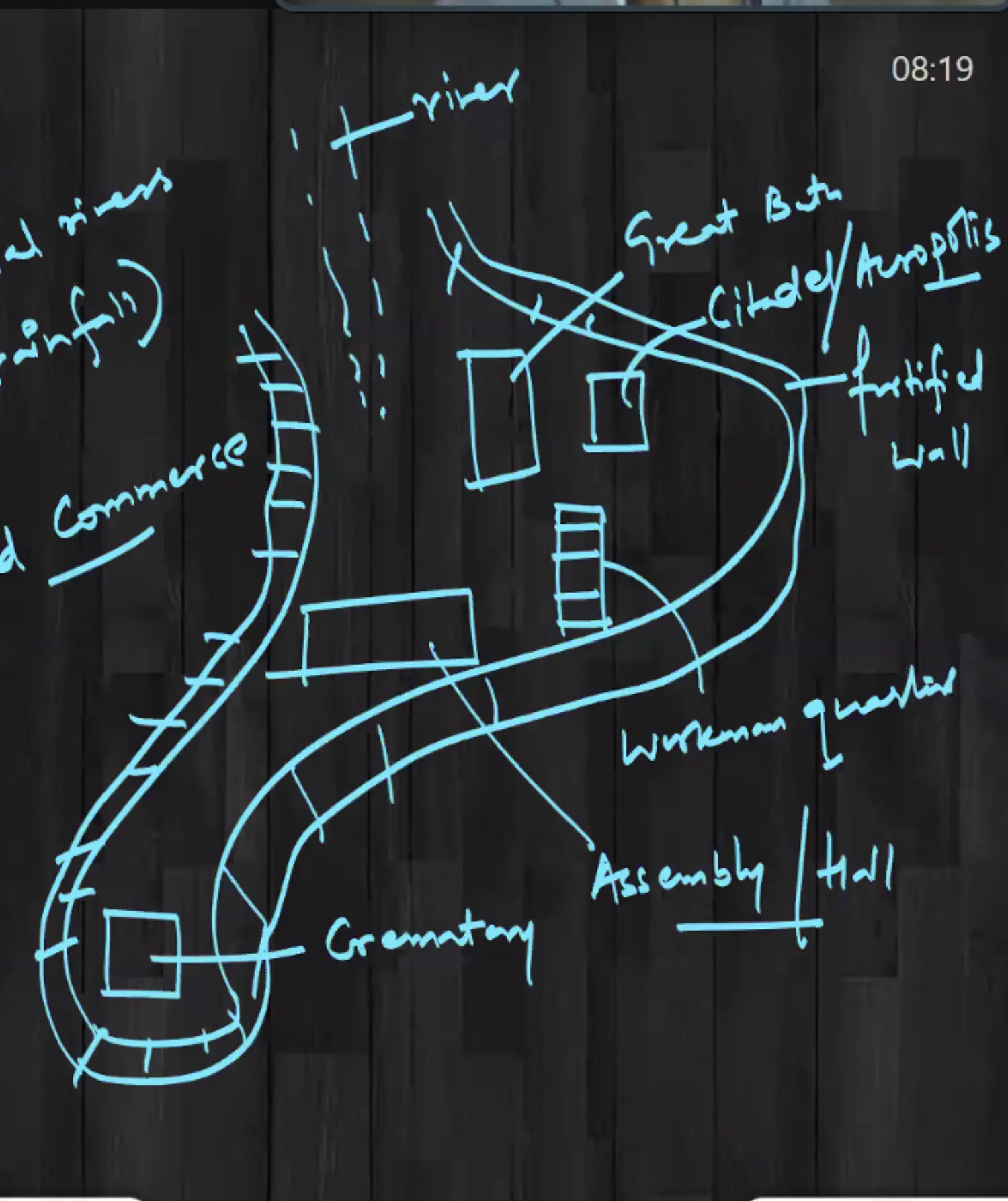
Urban Structures and Town Planning in IVC
Dwelling Units
Citadel / Acropolis
Occupied by Ruling Class as we found in Mohenjo Daro
Fortified
Assembly
Crematory
Closed Drainage System
Focus on Hygiene
Well Planned Streets
Arrangement of Houses in Grid Systems
No Where the Buildings were allowed to encroach into public roads
Instances of Lamp Posts at Regular Intervals
Wells with Potable Drinking Water Facility
Houses with Separate Washrooms and Kitchens
Use of Burnt Bricks in a shape and size of fixed proportion
Theories on Decline of IVC
River Course Change Theory or Hydrological Changes Theory
According to V N Mishra, He Studied the Paleo Channel of Ghagra River System and said that in the past it acted as a feeder channel to Indus.
with course of time it shifted towards the east ultimately joining the ganga system. this resulted in dryness of sutlej and hence the Indus.
This brought sharp decline in Agri Production and a crash in economy. It was not all of a sudden but rather a gradual phenomenon which ultimately led to decline of IVC
Foreign Invasion Theory
It Includes Aryan Invasion and European Invasion Theory supported by Pegot, Gordan, Wheeler
According to Foreign Invasion Theory Entry of Outsiders like Aryans and Europeans led to violent massacre which is evident at Mohenjodaro also highlighted in Rig Veda
At Various Instances, fortified wall of Urban Locations was reinforced hinting about some probable attack
Climate Change Theory ( Frequent Flooding, Droughts)
Marshal and Ostein were greatest advocates of this theory, considering significant climatic changes, like flooding droughts and other disasters leading to decline of IVC
Tectonic Phenomenon / Tectonic Depression
Supported by a Geologists Dales, He Argued that, River Indus was Flooded Suddenly because of Tectonic Phenomenon leading to land depression and tectonic upliftment of river basin
Physio Chemical Explosion
According to Russian Scholar Dmitriyev, He Explained that there were certain physico chemical explosions including black lightning and sudden rise in temperature upto 15000 degree celsius leading to destruction of civilization
Such Incidences are also mentioned in Mahabharat
Conclusion
None of the Theory can scientifically explain the decline of civilisation, rather it can be said that the decline of Indus Valley Civilisation can be an outcome of mixed reasons based on these theories
Add Somewhere - Spread of Diseases
Unit 1.1 : Contribution of Tribal Cultures to Indian Civilisation Vedic Culture
Introduction
- Tribal and Other Original Inhabitants were makers of Harappan Civilisation
- Various Ancient Texts, Archaeological Evidences & Historical Records highlight about tribal culture and their influences or contribution in development of vedic culture and civilisation at Large
Contribution of Tribal Culture in Languages
- Different words from Tribal Dialects and Languages were picked up by various modern day languages like
- baal for hair emerged from the word baala in tribal language
- bengal emerged from the word bonga in tribal language
- baan(arrow) emerged from the word baana in tribal language
Contribution of Tribal Culture in Ethnic Complexities
- When Aryans Invaded India, their ethnicity mixed up with the local tribal ethnicity giving rise to diversity which can be witnessed even today
- Assimilation of Priest Hood like the aboriginal Vishwamitra, Vashishta and Bhardwaj were assimilated in aryan fold who were originally black according to aryans.
- So Gradually Tribalisation of Aryans and Hinduisation of Tribes took place
Contribution of Tribal Culture in Economic Life
The Art of raising crops, use of stone and metallic tools and trade and commerce (like tribal barter system) emerged in tribal life and diffused to civilisations
Contribution of Tribal Culture in Social Cultural Elements (Including Religion)
- Worshipping of Flora & Fauna as deities and even the practise of fasting as a religious gesture is of Adivasi Origin
- Gotra System of Gonds, filtered into traditional hindu social organisation and it was later copied by Brahmins
- Also, the Institution of Cousin and Cross Cousin Marriages have its origin in Tribal Life which became a part of Larger Civilisation
Contribution of Tribal Culture in Political System
The Traditional Political Organisations of Ancient, like Sabhas, Samitis, Assemblies or Chiefdoms gave rise to modern political organisation like Gram Sabhas Gram Panchayats and even central political administration
Contribution of Tribal Culture in Art & Craft
Use of Herbs, Plant Products and Natural Derivatives in curing the illness, started in adivasis and later became a significant part of Traditional Medicine in India
Also various musical instruments and even certain rhymes are inspired by tribal folks
For Example: veena is derived from Savara Instrument used by Tribals
Conclusion
Contribution of Tribal Culture, Led to formation of a complete and composite Indian Civilisation
Tribalisation of Non Tribals and Hinduisation of Tribes is a continuous process which can be witnessed even today