Public Health (From Handout)
Bio-Tech
Skeletal System
Longest Bone in Human Body - Femur
Shortest Bone in Human Body - Stapes (Ear Bone)
Child Has → 300+ Bones
Human Has → 206 Bones
Total No of Vertebra → 33
No of Ribs → 12 on Each Side 24 in Total
Cranial Capacity → 1400 to 1500 cc (1 Cubic Centimetere = 1.5 Ltr Water)
No of Bones in Skull → 29 Bones
Allen & Bergman Rule →
Organisms Aapt to Environment in Colder Regions to reduce the Surface Area.
The Limbs and Extremities that is the Fingers become shorter in Length and the body becomes bulky or stalkier
Example: Eskimos & Innuits, Seal & Polar Bear → Genetic Adaptations
Organism Living in Hotter Region, Organisms need to Dissipate Heat, so they have longer limbs and extremities and Lean body.
Examples: Tribes of Africa
Gloggers Rule
In Hotter Region, the Melanin Content Increases to protect against UV Radiation.
In Colder Region the Melanin Content Reduces.
Nervous System
Direction
- Anterior - Front
- Posterior - Back
Central Nervous System - Brain + Spinal Cord
Brain - It has 3 parts
- Anterior - Forebrain
- Cerebrum
- It is the most developed part of brain
- It is centre of wisdom, memory, thinking, will power
- Thalamus
- It is centre of Pain, Cold & Heat
- Hypo Thalamus
- Controls Hormonal Secretion of Glands
- Centre of Love Hate Joy Fear Anger
- Cerebrum
- Mid Brain
- Essentially for Hearing & Vision
- Posterior - Hindbrain
- Cerebellum
- It is responsible for Co-Ordination of Muscular Movement
- Responsible for Precision Actions
- Helps in Maintaining Erect Posture and Walking Straight
- Pons
- Bridge between Brain and Spinal Cord
- Medula Oblongata
- Posterior Part of Brain
- Controls the Complex Activity like all involuntary activities like Heart Pumping, Coughing Sneezing, Vomiting, Salivation
- Cerebellum
- Note
- Our Brain has a Protective Covering known as Meninges, if there is inflammation to Meninges is called as Meningitis
- EEG - Electro Encephalon Gram is an Instrument which measures the Brain Activity
Spinal Cord
- It is the centre of reflex action
- It was first observed by Marshall Hall
- Anterior - Forebrain
Peripheral Nervous System
%20(1)/Screenshot_2023-03-07_at_1.06.36_PM.png)
Read from Handouts as Well !
Neurons are Specialised Cells for Conducting Information via electrical Impulses from one part of body to another. Heat, Cold, Taste, Sense is received by the Dendritic End of the Neuron that sets off a chemical reaction that creates Electrical Pulses.
These Pulses then travel to the Nervous or Neuron Network to reach the CNS. The CNS then sends back these pulses to control the surrounding muscles.
With age capacity to create new and successful synapse reduces.
Types of Tissues in Plants and Animals
Tissue: Tissue is a Group of Cell to perform a specific function
Types of Tissues in Humans
- Epithelial Tissue - Skin & On Surface of Organs
- Connective Tissue - Bone, Cartilage, Blood
- Muscle Tissue
- Nervous / Neuron Tissue / Network
Types of Tissues in Plants
Temporary Tissue → Also called as Meristematic
Apical - Tip of the Shoots / Apex of Shoots
Lateral - Helps in Gaining Girth or Width
Inter Calary - Bark or Outer Part of the Plant
Present Below Apical and when the Apical is eaten by Animals, Inter Calary helps in Growth of Plants.
Permanent Tissue
Simple Permanent →
Complex Permanent → Xylem & Phloem
Their role is to transport food (Phloem) & water (Xylem)
Xylem is Tube Like Structure which helps in transporting water from roots to other parts of water
Phloem transports food from leaves to different parts of the plant.
HW: Find the Coordination & Control Mechanism in Plants
It is in NCERT
Circulatory System (Blood & Circulation System)
Composition of Blood - Diagram
%20(1)/Screenshot_2023-03-08_at_1.08.33_PM.png)
%20(1)/Screenshot_2023-03-08_at_1.10.12_PM.png)
%20(1)/Screenshot_2023-03-08_at_1.10.04_PM.png)
Blood & its Details
- Basic Facts
- Blood is the Only Mobile Connective Tissue
- There is 5 to 6 Litres of Blood in Human Body
- Blood is Slightly Basic in Nature i.e its pH is 7.4
- Parts of Blood are
Plasma - 60%
After Anti Body is made in WBC. Anti Body is present in Plasma.
Plasma has proteins which contains Anti Bodies.
Removing Proteins from the Plasma we get Serum
Corpuscles - 40%
RBC’s → Erythrocytes
- It is Bi Concave in Shape
- Helps in carrying Oxygen. It carries a pigment containing Iron called as Haemoglobin
- Mature RBC cells do not have a Nucleus
- RBC’s are formed in Bone Marrow
- in Bone Marrow there is Blood Stem Cells which helps in formation of Blood
- Life of RBC is just for few months
- Problems with RBC
Anaemia
Def of Iron → Def of Haemoglobin → We Need 12 to 16 gms / dl of Haemoglobin in the Body → If this is reduced then oxygen is not supplied properly
Sickle Cell
RBC becomes shape of a Sickle Cell
Thalassaemia
insufficient qty of Hb. Here Bone Marrow is not able to make sufficient qty of RBC. Here Transfusion of Blood (i.e giving blood externally) is done as a cure. Stem cell therapy is a relatively newer
Leukemia
It is blood cancer. Here formation of RBC & WBC may be hampered
Haemophilia (also called as Royal Disease)
Here Blood is not able to clot. Here men are more affected than women.
WBC’s → Leucocytes
T Cells (Killer Cells) B Cells (Help in Making Anti Bodies) Eosinophils, Basophils, Neutrophils
Platelets → Thrombocytes
Plasma is necessary to help your body recover from injury, distribute nutrients, remove waste and prevent infection, while moving throughout your circulatory system
- Basic Facts
Blood Types & Groups
%20(1)/Screenshot_2023-03-08_at_1.35.45_PM.png)
What is this Positive & Negative - Concept of Rh Factors
It is also an antigen present of surface of RBC. it has rhesus factor because we got it from Rhesus Monkey
If Rh Protein is Present on RBC it is called as Rh Positive
If Rh Protein is Absent on RBC it is called as Rh Negative
Hence in 2 variations of 4 Types we in total 8 Types of Blood Groups
Rare Blood Group
Bombay Blood Group has a specific gene which doesn't allow the A & B Antigen to be formed
It was first found in Bombay in 1952, it is because of inbreeding amongst some groups, there is gene silencing of A & B Antigen
It is one of the rarest Blood Group, at present inly 179 people have this blood group
Concepts Related to Inheritance of Blood Group
Concept of Mendel Law, Genotype, Phenotype
Genotype - The Genes which an Individual has
Phenotype - Physical manifestation of the Gene
Example: Genotype - XX Phenotype - Female
Example: Genotype - XY Phenotype - Male
%20(1)/Screenshot_2023-03-08_at_2.21.35_PM.png)
If the Blood Group is B then the Geno Type is AA or AO
If the Blood Group is A then Geno Type is BB or BO
If the Blood Group is O then Geno Type is OO only
Alleles are the different forms of the same trait
in AO → A is a Allele & O is Allele
Example Height is one Characteristics but T is allele for Tall and t is allele for Short
Similarly → in Tt Gene → T is tall height Allele & t is small height Allele
Concept of Mendel Law by Gregor Mendel, 1865
He is known as Father of Genetics. He gave two Laws.
Law of Segregation
Alleles Segregate during Gamete Formation.
Alleles can be Dominant or Recessive
Dominant Alleles are Allele which Express themselves which are expresses even Singly in the Genes
Recessive Allele doesn’t express itself if it is present singly. here tt will express itself
Application of this Concept to Inheritance of Blood
in Blood Group → A & B are Dominant Alleles && O is recessive allele
AO & AA → A is Expressed as Phenotype
BB & BO → B is Expressed as Phenotype
OO → O is Expressed as Phenotype
Inheritance of Blood Group
| Parents | Possible Blood Group of Child | Impossible Blood Group of Child | | --- | --- | --- | | B x O | B, O | A, AB | | A x B | A, B, AB, O | None | | AB x A | A, B, AB | O | | AB x O | A, B | O, AB |
Blood Circulation System
%20(1)/Screenshot_2023-03-08_at_2.44.46_PM.png)
Blood Vessel is a Generic Term → They can be called as Arteries, Vein, Capillary
Arteries → Which Carries blood Away from Heart to Different Parts of Body. Hence, Carries Oxygen Rich blood. Blood Flows at Higher Pressure in Arteries. Arteries are more thicker than Veins.
Veins → They carry De Oxygenated Blood from different parts of Body towards heart. Here Pressure of the Blood in the Veins is Less. Veins are less thick as compared to Arteries
Capillary → It is thinnest blood vessel which is just one cell thick. It helps in Diffusion of Gases.
Impure Blood → Impure Blood is De Oxygenated Blood
Working of Heart→ When Left Ventricle Compresses Oxygenated Blood is pumped into the Arteries. It reaches the Capillaries where Oxygen from Blood Diffuses to that part of Body and Carbon Di Oxide diffuses into RBC.
Now, this De Oxygenated Blood moves in the Veins to reach heart. The Rt Ventricle pumps this De Oxygenated Blood into Lungs, where Oxygen Diffuses Into Blood and CO2 Diffuses out of Blood and this Oxygenated Blood reaches Left Autricle and then the Left Ventricle again compresses
Diseases Related to Circulatory System
Concept of Systolic & Diastolic
Blood Pressure is Measured using Sphygmanometere. it measures the pressure of Arteries only
Systolic → when it is in contraction state or pumping state
Diastolic → when it is in relaxation state
In a Normal Person Range is 120/80 → Systolic & Diastolic
Concept of High BP & Low BP
Hypertension → Range is > 140/90.
CAD → Coronary Artery Disease
Coronary Arteries are the Blood Vessels which Supply Blood to Heart Muscles, if this supply is blocked because of Deposition of Fat or Calcium. Then it can lead to Heart Attack
Stents are Metallic Tube Like Structures which are placed inside Blood Vessels so that the Blood flow is not restricted.
HW : Find the Circulatory System in Humans
Excretory System
Original Human Excretion System
%20(1)/Screenshot_2023-03-08_at_3.13.21_PM.png)
Working of Kidney by Means of Dialysis Machine
%20(1)/Screenshot_2023-03-08_at_3.12.29_PM.png)
%20(1)/Screenshot_2023-03-08_at_3.13.46_PM.png)
The Impure Blood going inside the Dialysis Machine is a Impure Blood that contains Excess Nitrogenous Compounds
Respiratory System
Read Basics from Handouts
Current Affairs of ACE 2 Receptors →
ACE 2 Receptors are proteins attached to membranes of cells. They are found in Lungs or Intestines and they act as Receptors for Covid Virus.
%20(1)/Screenshot_2023-03-08_at_3.24.19_PM.png)
Diseases wrt Respiratory System
Asthma
Formation of Net Like Structures in Lungs which reduces Diffusion Capacity of Lungs
Emphysema
it is a chronic disorder in which the Alveolar Walls are Damaged due to which the Respiratory Surface is decreased. This is mainly caused by Smoking.
Occupational Diseases →
People working in Stone Quaries experience Silicosis because of Deposition of very fine Silica.
A lung disease caused by breathing in particles of asbestos (a group of minerals that take the form of tiny fibers). Symptoms include coughing, trouble breathing, and chest pain caused by scarring and permanent damage to lung tissue.
Fibrosis → Creation of Fibres in Lungs
Bronchitis → Inflammation of Lungs
Tb → Tuberculosis
Digestive System
Diagram of Digestive System

Concept of Digestion
Enzymes are Proteins produced by Glands in our Body. Liver is the Largest Gland which produces Bile.
| | Enzyme | Food | | --- | --- | --- | | in Mouth | Amylase | Carbs | | Stomach | Pepsin | Protein | | | Renin | Casein (milk) | | Pancreas | Trypsin | Protein | | | Amylase | Carbs | | | Lipase | Fats | | | Insulin | Regulate Sugar Spike in Blood | | Small Intestine | Erepsin | Protein | | | Maltase | Carbs | | | Lactase | Carbs | | | Sucrase | Carbs | | | Lipase | Fats |
Complete Breakdown of Food Occurs Only in Small Intestine. Large Intestine is used only for the case of
Gall Bladder → Excess Bile is stored by Gall Bladder
Bile Juice → It makes the food Alkaline so that the Pancreatic Juices can work on them. It emulsifies fat or breakdown of fat. It accelerates the power movement in the intestine and it also helps in absorption of Vitamin K.
Diseases Related to Liver System
Find and Write in Notes of Marasmus and Kwashiorkor
Types of things in Food *
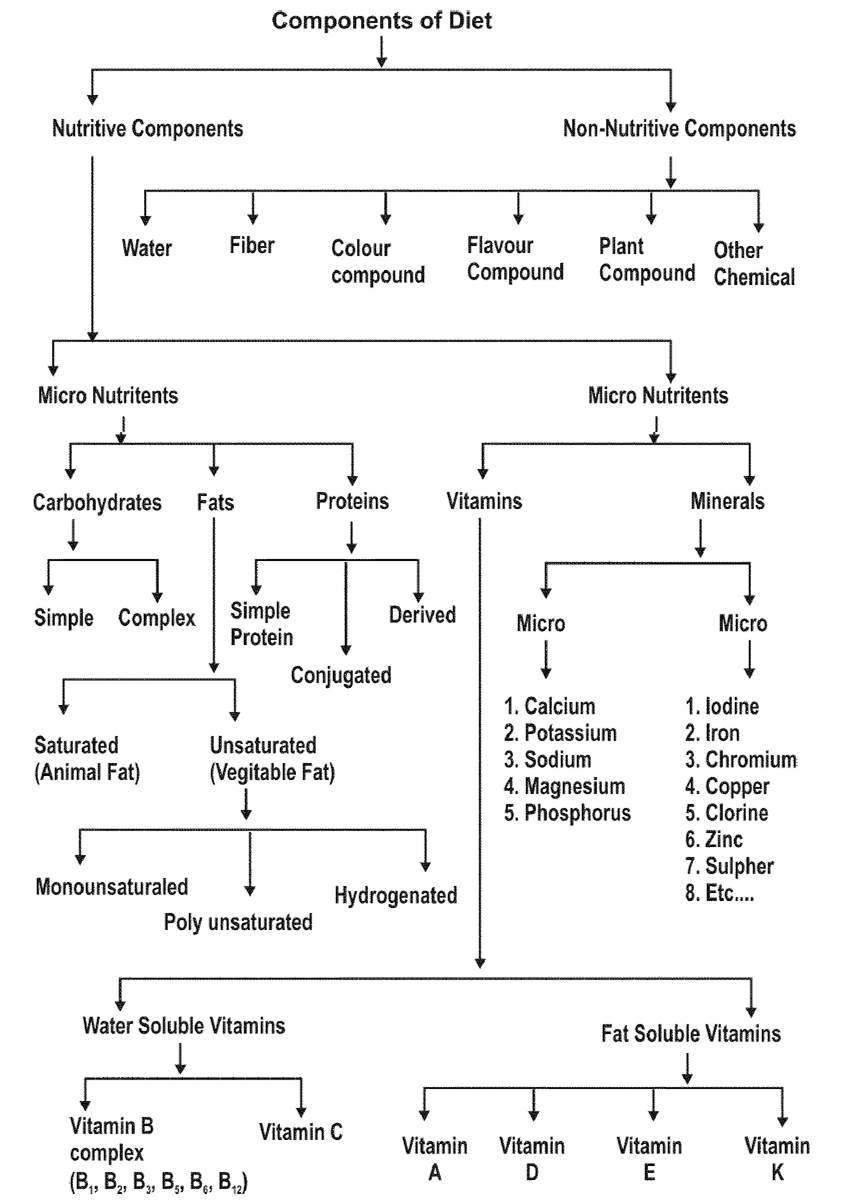
Types of Lipids & Fats
From Handout
Unsaturated is Healthy. Saturated is Bad.
Omega 3 & 6 is Unsaturated.
Trans Fat is the Most Unhealthiest Fat. Partial Hydrogenation produces Trans Fats.