Medieval India - Class 12: Themes in Indian History - Part 2
- Chapter 5 - Through the Eyes of Travellers
Perception of Society (10th to 17th Century)
Travelers' Accounts and Their Contributions to Historical Knowledge
1. Introduction to Travelers' Accounts:
- 1.1 Motivations for Travel:
- People traveled for work, to escape disasters, as traders, soldiers, priests, pilgrims, or adventurers.
- 1.2 Encountering New Worlds:
- Travelers often faced new landscapes, customs, languages, beliefs, and practices.
- 1.3 Adaptation and Observation:
- Some adapted to new environments, while others recorded remarkable differences in detailed accounts.
- 1.4 Lack of Women's Accounts:
- Despite known travels by women, their accounts are virtually non-existent in historical records.
2. Varieties in Travel Accounts:
- 2.1 Diverse Focus:
- Accounts varied from court affairs, and religious issues, to architectural features and monuments.
- 2.2 Example of Detailed Accounts:
- Abdur Razzaq Samarqandi provided an important description of Vijayanagara in the 15th century.
- 2.3 Local Travelers:
- In the Mughal Empire, administrators traveled within the empire, recording observations of customs and folklore.
3. Case Studies of Notable Travelers:
- 3.1 Al-Biruni (11th Century):
- Origin: Uzbekistan. Noted for detailed observations of Indian social life, philosophy, and culture.
- 3.2 Ibn Battuta (14th Century):
- Origin: Morocco. Traveled extensively in Africa, Asia, and Europe, recording diverse cultures and practices.
- 3.3 François Bernier (17th Century):
- Origin: France. His accounts provide a perspective on Mughal India, focusing on social conditions and political scenarios.
4. Significance of Travelers' Accounts:
- 4.1 Unique Perspectives:
- Provided insights into everyday activities often overlooked by indigenous writers.
- 4.2 Audience and Purpose:
- Travelers wrote for different audiences, from fellow countrymen to patrons or for personal records.
- 1.1 Motivations for Travel:
Al-Biruni and the Kitab-ul-Hind
1. Al-Biruni's Background:
- 1.1 Early Life and Education:
- Born in 973 in Khwarizm, present-day Uzbekistan, a renowned center of learning.
- Multilingual: knew Syriac, Arabic, Persian, Hebrew, and Sanskrit; familiar with Greek philosophical works through Arabic translations.
- 1.2 Move to Ghazni:
- Taken to Ghazni in 1017 by Sultan Mahmud during the invasion of Khwarizm.
- Initially a hostage, he grew fond of Ghazni, spending his life there till his death at 70.
2. Developing Interest in India:
- 2.1 Cultural Exchange:
- From the 8th century, Sanskrit works (astronomy, math, medicine) were translated into Arabic.
- Al-Biruni was intrigued by India during Punjab's inclusion in the Ghaznavid empire, leading to increased cultural interactions.
- 2.2 Learning and Travel:
- Spent years with Brahmana priests and scholars, learning Sanskrit and studying religious texts.
- Likely traveled extensively in Punjab and parts of northern India.
3. Al-Biruni’s Work - Kitab-ul-Hind:
- 3.1 Characteristics of the Text:
- Written in Arabic, simple and clear style.
- Comprehensive: 80 chapters covering religion, philosophy, festivals, astronomy, social life, customs, laws, etc.
- 3.2 Structural Approach:
- Each chapter: a question, a description based on Sanskritic traditions, and a comparison with other cultures.
- This structured approach is possibly influenced by his mathematical background.
- 3.3 Intended Audience and Critical Stance:
- Written for people on the subcontinent's frontiers.
- Aware of translations of Sanskrit, Pali, and Prakrit texts into Arabic but aimed to enhance the quality and presentation of information.
- 1.1 Early Life and Education:
IBN Battuta’s Rihla
1. Ibn Battuta's Background:
- 1.1 Early Life and Education:
- Born in Tangier, Morocco, into a family known for expertise in Islamic religious law (shari‘a).
- Received a literary and scholastic education at a young age.
- 1.2 Philosophy of Travel:
- Valued experiential knowledge from travels over traditional book learning.
- Passionate about exploring new worlds, cultures, and peoples.
2. Extensive Travels:
- 2.1 Before India:
- Pilgrimage to Mecca; travels in Syria, Iraq, Persia, Yemen, Oman, and East Africa.
- 2.2 Journey to India:
- Reached Sind in 1333, drawn to Delhi by Sultan Muhammad bin Tughlaq's patronage.
- Became the qazi (judge) of Delhi, faced imprisonment, was reinstated, and was sent to China as an envoy in 1342.
- 2.3 Beyond India:
- Traveled to Malabar, the Maldives (served as Qazi), Sri Lanka, Bengal, Assam, Sumatra, and China (up to Beijing).
- Returned home in 1347; his travels were often compared with Marco Polo's.
3. Challenges of Fourteenth-Century Travel:
- 3.1 Duration and Rigor:
- Long journeys: Multan to Delhi (40 days), Sind to Delhi (50 days), Daulatabad to Delhi (40 days), Gwalior to Delhi (10 days).
- 3.2 Dangers:
- Frequent attacks by robbers; preferred caravan travel for safety but still faced threats.
4. Ibn Battuta's Rihla:
- 4.1 Recording the Journey:
- Upon returning to Morocco, the local ruler ordered his travel stories be documented, leading to the creation of Rihla.
- 4.2 Content and Contribution:
Detailed observations of cultures, peoples, beliefs, and values; a critical resource on social and cultural life in the 14th century.
Map
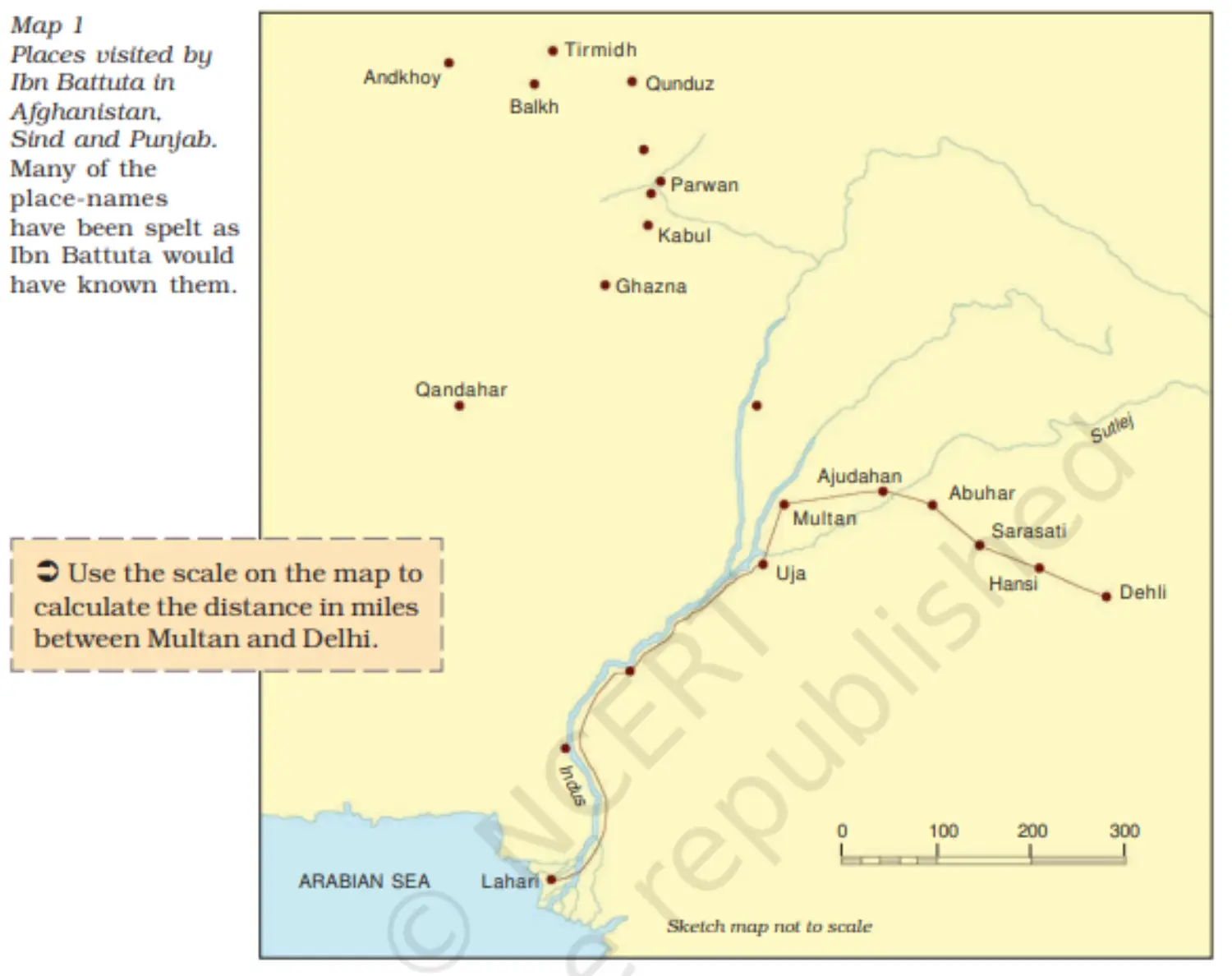
- 1.1 Early Life and Education:
François Bernier A Doctor with a Difference
1. Background:
- 1.1 European Travelers in India:
- Post-1500: Arrival of Portuguese, followed by Dutch, English, and French.
- Notable figures: Roberto Nobili, Duarte Barbosa, Jean-Baptiste Tavernier, and Manucci.
- 1.2 François Bernier:
- French doctor, political philosopher, and historian.
- In India from 1656 to 1668.
- Physician to Prince Dara Shukoh, later associated with Danishmand Khan.
2. Bernier's Observations and Writings:
- 2.1 Travels and Comparisons:
- Extensive travels in India, with observations often comparing India unfavorably with Europe.
- 2.2 Major Works:
- Writings dedicated to Louis XIV and letters to officials.
- Descriptions often portrayed India in a bleak light, though not always accurately.
- 2.3 Publication and Reception:
- Works published in France (1670-71), translated into multiple European languages.
- Reprinted multiple times due to popularity, unlike Arabic and Persian accounts, which remained in manuscript form.
3. Impact and Legacy:
- 3.1 Influence in Europe:
- Bernier's writings were widely read and influenced European perceptions of India.
- 3.2 Contrast with Other Accounts:
- Popularity contrasted with Arabic/Persian manuscripts, highlighting the growing influence of print and Europe's engagement with the "East."
- 1.1 European Travelers in India:
Making Sense of an Alien World: Al-Biruni and the Sanskritic Tradition
1. Al-Biruni's Approach to Understanding India:
- 1.1 Barriers to Understanding:
- Language differences: Sanskrit is vastly different from Arabic and Persian.
- Divergent religious beliefs and practices.
- Local population's self-absorption and insularity.
- 1.2 Reliance on Brahmanical Texts:
- Despite barriers, heavily depended on Brahmanical works for understanding Indian society.
- Sources included Vedas, Puranas, Bhagavad Gita, Patanjali's works, Manusmriti, etc.
2. Caste System Analysis:
- 2.1 Search for Parallels:
- Compare the Indian caste system with social categories in ancient Persia.
- Highlighted the universal nature of social divisions but noted the equality concept within Islam.
- 2.2 Critique of Pollution Concept:
- Criticized the notion of pollution inherent in the caste system.
- Argued the natural world's tendency towards purity, contrasting social pollution's contradiction with nature's laws.
3. Real-life Application of Caste System:
- 3.1 Flexibility in Practice:
- The system is less rigid in real life compared to normative Sanskrit texts' descriptions.
- 3.2 Economic Inclusion of Marginalized:
- "Antyaja" groups, though socially oppressed, are included within economic networks as essential labor providers.
4. Conclusion:
- 4.1 Al-Biruni's Legacy:
- Despite challenges and personal biases, provided a comprehensive, comparative perspective on Indian society.
- Utilized existing resources while critically engaging with social norms and practices.
- 1.1 Barriers to Understanding:
Ibn Battuta and the Excitement of the Unfamiliar
1. Introduction:
- 1.1 Global Communication Network:
- The 14th-century subcontinent is part of a global network from China to Europe.
- Ibn Battuta's extensive travels included diverse cultural encounters and roles.
2. Novelty of Indian Produce:
- 2.1 Fascination with the Unfamiliar:
- Emphasis on unfamiliar items like coconut and paan to captivate his audience.
3. Indian Cities through Ibn Battuta's Eyes:
- 3.1 Prosperity and Opportunities:
- Cities are depicted as bustling with activity and prosperity.
- Crowded streets and vibrant markets; examples include Delhi and Daulatabad.
- 3.2 Bazaars as Cultural Hubs:
- Economic centers also host various cultural activities.
- Presence of religious structures and spaces for artistic performances.
4. Economic Observations:
- 4.1 Source of Urban Wealth:
- Towns' wealth is partly due to surplus appropriation from villages.
- 4.2 Agricultural Productivity:
- Fertile lands allow for dual annual crops.
- 4.3 Trade and Commerce:
- Integration with inter-Asian trade networks.
- High demand for Indian textiles in West and Southeast Asia.
5. State Support for Commerce:
- 5.1 Merchant Encouragement:
- Trade routes equipped with inns and guest houses.
- 5.2 Efficient Postal System:
- An advanced system enabling swift information and goods exchange.
- Example: News reaching Sultan from Sind in just five days, compared to a fifty-day travel time.
6. Conclusion:
- 6.1 Ibn Battuta's Contributions:
- Detailed accounts provide valuable insights into 14th-century Indian socioeconomic conditions.
- Emphasis on the excitement of encountering the unfamiliar, enhancing understanding of historical interconnectivity.
- 1.1 Global Communication Network:
Bernier and the “Degenerate” East
1. Introduction:
- 1.1 Different Perspectives:
- Bernier focused on contrasting India with Europe, highlighting negative aspects.
- Aimed to influence European policy and thought by depicting a "degenerate" East.
2. Bernier's Observations:
- 2.1 Detailed Insights:
- Emphasized critical insights, comparisons with Europe, and a sense of European superiority.
- Presented India in binary opposition, often as inferior.
- 2.2 Land Ownership:
- Cited the lack of private land ownership in Mughal India as detrimental.
- Believed crown ownership discouraged long-term investment, leading to societal decline.
- 2.3 Social Structure:
- Described Indian society as polarized between extreme wealth and poverty, with no middle class.
- Depicted the Mughal Empire negatively, attributing issues to land ownership policies.
3. Impact and Influence:
- 3.1 Influencing Western Thought:
- Ideas shaped concepts like "oriental despotism" and "Asiatic mode of production."
- Influenced thinkers like Montesquieu and Karl Marx.
- 3.2 Critique:
- Contradictions with historical records regarding land ownership and societal structure.
- Oversimplified views of Indian rural society and urban centers.
4. Complex Social Reality:
- 4.1 Beyond Simplistic Depictions:
- Acknowledged the prosperity of Indian merchants and the influx of precious metals.
- Noted the existence of diverse, thriving towns contrary to his "camp towns" concept.
- 4.2 Merchant Communities:
- Recognized prosperous merchants, community structures, and various professional classes.
- Indicated an oversimplification in his critiques of Mughal society and economy.
5. Conclusion:
- 5.1 Bernier's Legacy:
- Despite biases, contributed detailed observations of Mughal India.
- His writings influenced Western perceptions of India and theoretical concepts in sociology and economics.
- 1.1 Different Perspectives:
Women Slaves, Sati and Labourers
1. Overview
- Male travelers documented the condition of women in the subcontinent, often perceiving social inequities as "natural."
- Their accounts provide insights but were influenced by their cultural backgrounds.
2. Slavery in the Subcontinent
- 2.1 Slave Trade:
- Slaves were common commodities, traded in markets, and given as gifts.
- Ibn Battuta purchased slaves as gifts for Sultan Muhammad bin Tughlaq.
- 2.2 Differentiation Among Slaves:
- Slaves had various roles; some female slaves were skilled in music and dance.
- They were used for domestic labor, surveillance, entertainment, and transportation (e.g., palanquins).
3. Women's Conditions and Roles
- 3.1 Practice of Sati:
- Highlighted by travelers like Bernier, some women embraced death in sati, while others were forced.
- 3.2 Economic Roles:
- Women's labor was vital in agriculture and non-agriculture sectors.
- Women in merchant families participated in trade and legal matters, indicating they weren't confined to private spaces.
4. Limitations and Future Explorations
- 4.1 Biases and Unseen Realities:
- Travelers' observations were contextually limited, missing many aspects of social life.
- 4.2 Unknown Experiences:
- Accounts of subcontinent natives traveling abroad remain largely unexplored.
- Future historical inquiries may reveal more about their experiences and cultural exchanges.
Additional Concepts
1. Observations of Travellers
- Various travelers documented unique aspects of the Indian subcontinent.
- Their observations included social practices, economic conditions, and cultural peculiarities.
2. Al-Biruni's Objectives and Contributions
- Aimed to provide comprehensive information about Hindu culture for those interested in religious discussions or social interactions.
- Expert in languages translated Sanskrit works into Arabic and Greek texts into Sanskrit.
- Critical yet curious about Indian traditions, questioning long-lasting wooden idols.
3. Hindu: Terminology and Identity
- The term “Hindu” originally referred to geographical region and people, not religion.
- It evolved from the Persian name for regions beyond the river Sindhu (Indus).
4. Ibn Battuta’s Travels and Observations
- Left home at 22, and journeyed for about 30 years.
- Documented social practices, architecture, and the postal system in India.
- Noticed the differentiation among slaves and their roles.
5. Women: Roles and Challenges
- Women's lives involved more than just the practice of sati; their economic contributions were significant.
- Slave women were utilized for various services, including espionage.
6. European Travellers: Perspectives and Comparisons
- European writings shaped the image of India globally.
- Bernier’s accounts highlighted the Mughal Empire's socio-economic conditions, warning Europe against similar governance.
7. Art, Craft, and Imperial Workshops
- The subcontinent was known for its diverse artisan work and imperial karkhanas.
- Skills included embroidery, painting, carpentry, and textile manufacturing.
8. Traveller Impressions and Interpretations
- Travellers’ accounts were subjective, and influenced by their cultural backgrounds.
- Abdur Razzaq found India peculiar yet admired its craftsmanship.
9. Economic Observations
- Bernier acknowledged fertile lands and diverse commerce, yet criticized governance for widespread poverty.
- Pelsaert noted extreme poverty and state exploitation.
10. Significant Travellers and Timelines
- 10th-11th centuries: Al-Biruni (973-1048)
- 13th century: Marco Polo (1254-1323)
- 14th century: Ibn Battuta (1304-1377)
- 15th century: Abd al-Razzaq (1413-1482), Afanasii Nikitin (1466-1472 in India)
- 16th century: Duarte Barbosa (1518), Seydi Ali Reis (1562), Antonio Monserrate (1536-1600)
- 17th century: Mahmud Wali Balkhi (1626-1631 in India), Peter Mundy (1600-1667), Jean-Baptiste Tavernier (1605-1689), François Bernier (1620-1688)
- Chapter 6 - Bhakti-Sufi Traditions
Changes in Religious Beliefs and Devotional texts (8th to 18th Century)
"Religious Texts and Structures in Early India"
1. Religious Structures and Texts in the First Millennium CE
- Landscape marked by religious edifices like stupas, monasteries, temples.
- Beliefs and practices inferred from structures and textual traditions, including the Puranas.
2. Emergence of New Textual Sources
- Poet-saints began oral compositions in regional languages, resonating with common people.
- These compositions, often musical, were compiled posthumously by disciples or devotees.
3. Fluidity of Religious Traditions
- Traditions were dynamic; followers often expanded on original teachings.
- Modifications or abandonments occurred to suit varying socio-political or cultural contexts.
4. Challenges for Historians
- Utilizing these sources is complex due to their fluid and evolving nature.
- Determining original messages or factual accuracies requires critical analysis.
5. Role of Hagiographies
- Biographies of saints, penned by followers, offer insights, albeit not always literally accurate.
- They reveal how devotees interpreted the lives of influential religious figures.
6. Diversity and Dynamism
- Sources from this period signify a time of religious vibrancy and diverse spiritual expressions.
A Mosaic of Religious Beliefs and Practices
"Diversity in Religious Beliefs and Practices in Early India"
1. Expansion of Deity Worship
- Increased visibility of diverse gods/goddesses in sculptures and texts.
- Extended worship of major deities: Vishnu, Shiva, and the goddess, each visualized in multiple forms.
1.1 Integration of Cults
- Dissemination of Brahmanical ideas through Puranic texts in simple Sanskrit, targeting wider audiences including women and Shudras.
- Brahmanas integrated beliefs and practices from various social groups, forming a dialogue between "great" Sanskritic Puranic and "little" traditions.
- Example: Puri's Jagannatha (Vishnu) is worshipped in a unique local form.
- Goddess cults: Local goddesses integrated into the Puranic hierarchy, identified with Lakshmi or Parvati.
1.2 Diversity and Conflict
- Tantric practices: Open to all genders and social statuses, influenced Shaivism and Buddhism.
- Evolution into Hinduism: Divergent practices and beliefs were eventually recognized as part of Hindu tradition.
- Shift in Deity Importance: Vedic deities like Agni, Indra, and Soma became marginal; Vishnu, Shiva, and the goddess gained prominence.
- Vedas are revered despite discrepancies with evolving practices.
- Conflicts:
- Vedic traditionalists opposed non-Vedic practices.
- Tantric practitioners often disregarded Vedic authority.
- Devotees' preference for Vishnu or Shiva caused tensions.
- Strained relations with other traditions like Buddhism and Jainism.
2. Tradition of Devotion (Bhakti)
- Bhakti has a history of nearly a thousand years, involving routine deity worship and ecstatic expressions.
- Devotional singing was integral, especially in Vaishnava and Shaiva sects.
Poems of Prayer Early Traditions of Bhakti
"Early Bhakti Traditions and Sociopolitical Interactions"
1. Bhakti Movement Emergence
- Poet-saints emerged as community leaders.
- Inclusion of women and "lower castes," previously excluded from spiritual liberation.
- Diverse forms of bhakti, accommodating various social backgrounds.
2. Bhakti Classification
- Saguna (with attributes): Worship of specific deities (Shiva, Vishnu, Devi) in anthropomorphic forms.
- Nirguna (without attributes): Worship of an abstract form of God.
2.1 Alvars and Nayanars
- Early bhakti movements were led by Alvars (Vishnu devotees) and Nayanars (Shiva devotees).
- Compositions in Tamil identified shrines for their deities; temples built at these sites became pilgrimage centers.
2.2 Caste System Challenge
- Bhaktas from diverse backgrounds, including "untouchables," suggesting opposition to caste hierarchy.
- Alvars and Nayanar compositions equated with Vedas, challenging Brahmanical authority.
2.3 Women in Bhakti
- Presence of women poets like Andal (Vishnu devotee) and Karaikkal Ammaiyar (Shiva devotee).
- Their existence and compositions challenged patriarchal norms.
2.4 State Relations
- Early Tamil chiefdoms evolved into states (Pallavas, Pandyas).
- Tamil bhakti poets often opposed Buddhism and Jainism, possibly due to competition for royal patronage.
- Chola rulers (9th-13th centuries) supported Brahmanical and bhakti traditions, constructing temples, and making grants.
- Magnificent temples and bronze sculptures of Shiva under Chola patronage.
- Nayanars and Alvars revered by Vellala peasants; rulers sought their support.
- Chola kings introduced Tamil Shaiva hymns in temples, and organized them into texts (Tevaram).
- Inscriptions suggest Chola ruler Parantaka I consecrated images of Appar, Sambandar, and Sundarar in a Shiva temple.
The Virashaiva Tradition in Karnataka
1. Virashaiva Movement's Emergence
- Founded in the 12th century by Brahmana Basavanna, a minister for the Kalachuri ruler.
- Followers are known as Virashaivas (heroes of Shiva) or Lingayats (wearers of the linga).
2. Lingayats' Beliefs and Practices
- Worship Shiva as a linga.
- Men wear a small linga in a silver case, strung over the left shoulder.
- Reverence for jangama (wandering monks).
- Belief in unification with Shiva after death, negates the cycle of rebirth.
- Unique funerary practice: burial instead of cremation.
3. Social Reform and Challenges
- Opposed caste system and Brahmanical notions of "pollution."
- Rejected the theory of rebirth.
- Advocated for practices not approved by the Dharmashastras: post-puberty marriage and widow remarriage.
- Gained followers from marginalized groups within the Brahmanical framework.
4. Documentation
- Knowledge about the Virashaiva tradition comes from vachanas (sayings) written in Kannada by women and men in the movement.
Religious Ferment in North India
1. Worship in North India
- Vishnu and Shiva were worshipped in temples, often with the support of rulers.
- No evidence of compositions like those of the Alvars and Nayanars until the 14th century.
2. Emergence of Rajput States
- Several Rajput states emerged in this period.
- Brahmanas held significant positions, performing both secular and ritual functions.
- Minimal challenges to the Brahmanical position.
3. Rise of Alternative Religious Leaders
- Naths, Jogis, and Siddhas gained prominence.
- Many originated from artisanal groups, like weavers.
- Craft production increased with new urban centers and long-distance trade (Central and West Asia).
- Questioned the authority of the Vedas.
- Used regional languages for communication, which evolved into modern languages over time.
- Despite popularity, lacked support from the ruling elites.
4. Political Shifts and Cultural Changes
- The arrival of the Turks led to the establishment of the Delhi Sultanate in the 13th century.
- Weakened many Rajput states and their associated Brahmanas.
- The arrival of the Sufis brought significant cultural and religious changes.
New Strands in the Fabric Islamic Traditions
1. Historical Connections
- The subcontinent had long-standing connections with lands beyond seas and mountains.
- Arab merchants frequented ports along the western coast in the 1st millennium CE.
- The 7th century marked the beginning of the region being part of the Islamic world.
2. Influence on Rulership
- 5.1 Faiths of rulers and subjects
- Arab general Muhammad Qasim conquered Sind in 711.
- The 13th century saw the establishment of the Delhi Sultanate.
- Muslim rulers were guided by the ulama according to the shari‘a.
- Hindus, Christians, and Jews were given "zimmi" status under Muslim rulership.
- Mughal rulers saw themselves as emperors of all peoples.
- 5.3 Names for Communities
- Terms like "musalman" or "Muslim" weren’t used widely.
- People identified based on regions (e.g., Turushka for Turkish rulers).
- The general term "mlechchha" is used for migrants not observing caste norms.
3. Popular Practices
- 5.2 The Popular Practice of Islam
- Five pillars of Islam: shahada, namaz/salat, zakat, sawm, hajj.
- Diverse practices: Sunni, Shi'a, local customs, etc.
- Khojahs disseminated Qur’an ideas through "ginans" in regional languages.
- Arab Muslim traders in Kerala adopted local language and customs.
- Mosque architecture blended universal features with local variations.
The Growth of Sufism
1. Introduction to Sufism
- Emerged as a reaction against the materialism of the Caliphate.
- Sufis emphasized salvation through devotion and love for God.
- They sought a personal interpretation of the Qur’an based on experience.
2. Organizational Structure
- 6.1 Khanqahs and silsilas
- By the 11th century, Sufism had literature on Quranic studies and practices.
- Sufis organized communities around hospices or khanqahs.
- Led by a shaikh, pir, or murshid who enrolled disciples and appointed successors.
- Sufi silsilas (chains) represented continuous spiritual linkages from the master to the Prophet.
- Rituals of initiation developed, involving an oath, wearing specific garments, and shaving hair.
- The tomb shrine or dargah of a deceased shaikh became a pilgrimage site, especially on the death anniversary or urs.
- Shaikhs, posthumously, were revered as walis and believed to be closer to God.
3. Variations in Sufi Practices
- 6.2 Outside the Khanqah
- Some mystics had a radical interpretation of Sufi ideals.
- They often ignored rituals and practiced extreme asceticism.
- Known by various names: Qalandars, Madaris, Malangs, Haidaris, etc.
- They were often called be-shari‘a for defying the shari‘a, in contrast to ba-shari‘a sufis who followed it.
The Chishtis in the Subcontinent
1. Introduction to Chishtis
- The most influential Sufi group that migrated to India in the 12th century.
- Adapted to the local environment and adopted Indian devotional traditions.
2. Life and Practices
- 7.1 Life in the Chishti Khanqah
- Khanqah: center of social life.
- Included small rooms, a large hall, and an open kitchen.
- Khanqahs attracted people from various walks of life.
- Practices assimilated local traditions.
- 7.2 Chishti devotionals: ziyarat and Qawwali
- Ziyarat: the pilgrimage to tombs of Sufi saints.
- Qawwali: use of music and dance for divine ecstasy.
- Sama‘: performance of mystical music, integral to Chishtis.
- 7.3 Languages and Communication
- Chishtis conversed in local languages, including Hindavi and Dakhani.
- Sufi poetry ranged from love stories to lullabies and wedding songs.
- The Sufis in Karnataka were influenced by bhakti traditions.
3. Sufis and the State
- 7.4 Sufis and the state
- Chishti tradition emphasized austerity and distance from worldly power.
- Sufis accepted donations but spent them on immediate requirements.
- Sultans set up charitable trusts and granted tax-free land for hospices.
- Sufis’ moral authority attracted people from all walks of life.
- Sufis provided legitimation for kings and had the ability to intercede with God.
- Kings desired association with Sufis and wanted tombs near Sufi shrines.
- Occasional conflicts occurred between Sultans and Sufis over rituals and titles.
New Devotional Paths Dialogue and Dissent in Northern India
1. Introduction
- Poet-saints engaged in dialogue with new social situations, ideas, and institutions.
2. Kabir's Teachings
- 8.1 Weaving a Divine Fabric: Kabir
- Lived during the fourteenth-fifteenth centuries.
- Verses ascribed to Kabir compiled in multiple traditions.
- Poems reflect a blend of Islamic, Vedantic, and yogic traditions.
- Challenged established religious practices, blending various religious ideas.
- Debates persisted about his religious identity: Hindu or Muslim.
3. Teachings of Baba Guru Nanak
- 8.2 Baba Guru Nanak and the Sacred Word
- Lived from 1469-1539 in Punjab.
- Advocated nirguna bhakti, rejected rituals of both Hinduism and Islam.
- Emphasized recitation of the Divine Name, composing hymns in Punjabi.
- Organized followers into a community and set up rules for congregational worship.
- Successors consolidated practices and distinguished themselves from Hindus and Muslims.
- Guru Granth Sahib compiled a scripture, containing hymns of various poets.
- Guru Gobind Singh founded Khalsa Panth and set its five symbols.
4. Mirabai's Devotion
- 8.3 Mirabai, the devotee princess
- Lived during the fifteenth-sixteenth centuries.
- Rajput princess who defied traditional roles saw Krishna as her lover.
- Faced adversity from her family, became a wandering saint.
- Possibly mentored by Raidas, a leather worker, indicating defiance of caste norms.
- Did not form a specific sect, but remains a source of inspiration, especially in Gujarat and Rajasthan.
Reconstructing Histories of Religious Traditions
1. Introduction
- Historians use diverse sources to study histories of religious traditions.
2. Significance of Different Sources
- Sculpture and architecture provide insights but require understanding of context.
- Textual traditions span various languages and styles, demanding diverse skills from historians.
3. Challenges and Dynamics
- The continuity of religious traditions aids historians in tracing changes over time.
- Historians must balance sensitivity and acknowledgment that religious traditions evolve.
Additional Concepts
1. Introduction
- Religious traditions have deep roots and have been influenced and evolved through various teachers, practices, and interactions.
2. Great and Little Traditions
- Introduced by sociologist Robert Redfield to describe the cultural practices of peasant societies.
- "Great" traditions are practices from dominant social categories; "Little" traditions are local practices.
- Both traditions changed through interaction.
3. Sufi Traditions
- Various sources are used to understand Sufi traditions: treatises, malfuzat (conversations), maktubat (letters), tazkiras (biographies).
- Sufis and their interactions with the state varied; some declined royal gifts, and others took on courtly roles.
- Sufi practices like qawwali emerged and became widespread.
4. Devotional Literature and Teachers
- Rich devotional literature emerged in various regions, e.g., vachanas by Basavanna, and compositions by Alvars.
- Poets like Kabir challenged existing norms and emphasized universal spirituality.
5. Major Religious Teachers
- Various teachers across different centuries and regions have contributed to religious traditions.
List of Major Teachers and Major Religious Teachers with Related Dates:
- c. 500-800 CE
- Appar, Sambandar, Sundaramurti (Tamil Nadu)
- c. 800-900
- Nammalvar, Manikkavachakar, Andal, Tondaradippodi (Tamil Nadu)
- c.1000-1100
- Al Hujwiri, Data Ganj Bakhsh (Punjab)
- Ramanujacharya (Tamil Nadu)
- c.1100-1200
- Basavanna (Karnataka)
- c.1200-1300
- Jnanadeva, Muktabai (Maharashtra)
- Khwaja Muinuddin Chishti (Rajasthan)
- Bahauddin Zakariyya, Fariduddin Ganj- i Shakar (Punjab)
- Qutbuddin Bakhtiyar Kaki (Delhi)
- c.1300-1400
- Lal Ded (Kashmir)
- Lal Shahbaz Qalandar (Sind)
- Nizamuddin Auliya (Delhi)
- Ramananda (Uttar Pradesh)
- Chokhamela (Maharashtra)
- Sharafuddin Yahya Maneri (Bihar)
- c.1400-1500
- Kabir, Raidas, Surdas (Uttar Pradesh)
- Baba Guru Nanak (Punjab)
- Vallabhacharya (Gujarat)
- Abdullah Shattari (Gwalior)
- Muhammad Shah Alam (Gujarat)
- Mir Sayyid Muhammad Gesu Daraz (Gulbarga)
- Shankaradeva (Assam)
- Tukaram (Maharashtra)
- c.1500-1600
- Sri Chaitanya (Bengal)
- Mirabai (Rajasthan)
- Shaikh Abdul Quddus Gangohi, Malik Muhammad Jaisi, Tulsidas (Uttar Pradesh)
- c.1600-1700
- Shaikh Ahmad Sirhindi (Haryana)
- Miyan Mir (Punjab)
- Chapter 7 - An Imperial Capital Vijayanagara
From 14th to 16th Century
"Vijayanagara Empire and City"
1. Introduction
- Vijayanagara: Name for both a city and an empire in South India.
2. Establishment and Expansion
- Founded in the 14th century.
- At its peak, it extended from the river Krishna in the north to the southern tip of the Indian peninsula.
3. Decline
- The city was sacked in 1565.
- Fell into ruin by the 17th-18th centuries.
4. Legacy and Rediscovery
- Locally remembered as "Hampi," a name derived from the local goddess Pampadevi.
- Oral traditions, archaeological finds, monuments, inscriptions, and records contributed to the rediscovery of the empire by scholars.
The Discovery of Hampi
1. Initial Discovery
- Who: Colonel Colin Mackenzie.
- When: 1800.
- Role: Engineer and antiquarian for the English East India Company.
- Achievement: Prepared the first survey map of Hampi.
2. Source of Information
- Based on memories of priests from:
- Virupaksha temple.
- Shrine of Pampadevi.
3. Photographic Documentation
- Start: 1856.
- Purpose: Allowed scholars to study the monuments.
4. Epigraphical Evidence
- The collection of inscriptions began in 1836.
- Found in temples at Hampi and other locations.
5. History Reconstruction
- Information collated from various sources:
- Inscriptions.
- Accounts of foreign travellers.
- Literature in Telugu, Kannada, Tamil, and Sanskrit.
Rayas, Nayakas and Sultans
1. Foundation of the Vijayanagara Empire
- Founders: Harihara and Bukka in 1336.
- Diversity: The empire encompassed different languages and religious traditions.
2. Geopolitical Context
- Northern Frontier Rivals: Sultans of the Deccan, Gajapati rulers of Orissa.
- Objective: Control of fertile river valleys and overseas trade resources.
- Interaction Outcome: Sharing of architectural ideas and techniques.
3. Legacy of Former Dynasties
- Cholas: Tamil Nadu. E.g., Brihadishvara temple at Thanjavur.
- Hoysalas: Karnataka. E.g., Chennakeshava temple at Belur.
- Vijayanagara's Contribution: Built upon these traditions, reaching architectural pinnacles.
4. Kings and Traders
- Horse Trade: Vital for warfare. Controlled by Arab traders and local "kudirai chettis."
- Portuguese Influence (from 1498): West Coast establishment with superior military technology.
- Vijayanagara's Markets: Spices, textiles, precious stones; trade symbolized status and wealth.
5. Evolution of the Empire
- Dynamics: Power struggles between ruling lineage and military commanders.
- Dynasties:
- Sangama (till 1485).
- Saluvas (till 1503).
- Tuluvas (Krishnadeva Raya belonged here).
- Krishnadeva Raya's Era: Expansion, consolidation, architectural contributions, and peace.
- Post Krishnadeva Raya: Internal strain, the rise of the Aravidu dynasty, shifting alliances with Sultanates.
6. The Battle of Rakshasi-Tangadi (1565)
- The Alliance of Sultanates (Bijapur, Ahmadnagar, Golconda) defeated Vijayanagara.
- Aftermath: Vijayanagara City was sacked and later abandoned.
7. Rayas and Nayakas
Nayakas: Mobile military chiefs controlling forts.
Amara-nayaka System: Political innovation, possibly inspired by the Delhi Sultanate's iqta system.
Duties: Tax collection, tribute to the king, maintaining military contingents.
Seventeenth Century: Many nayakas established independent kingdoms, leading to the empire's decline.
Map
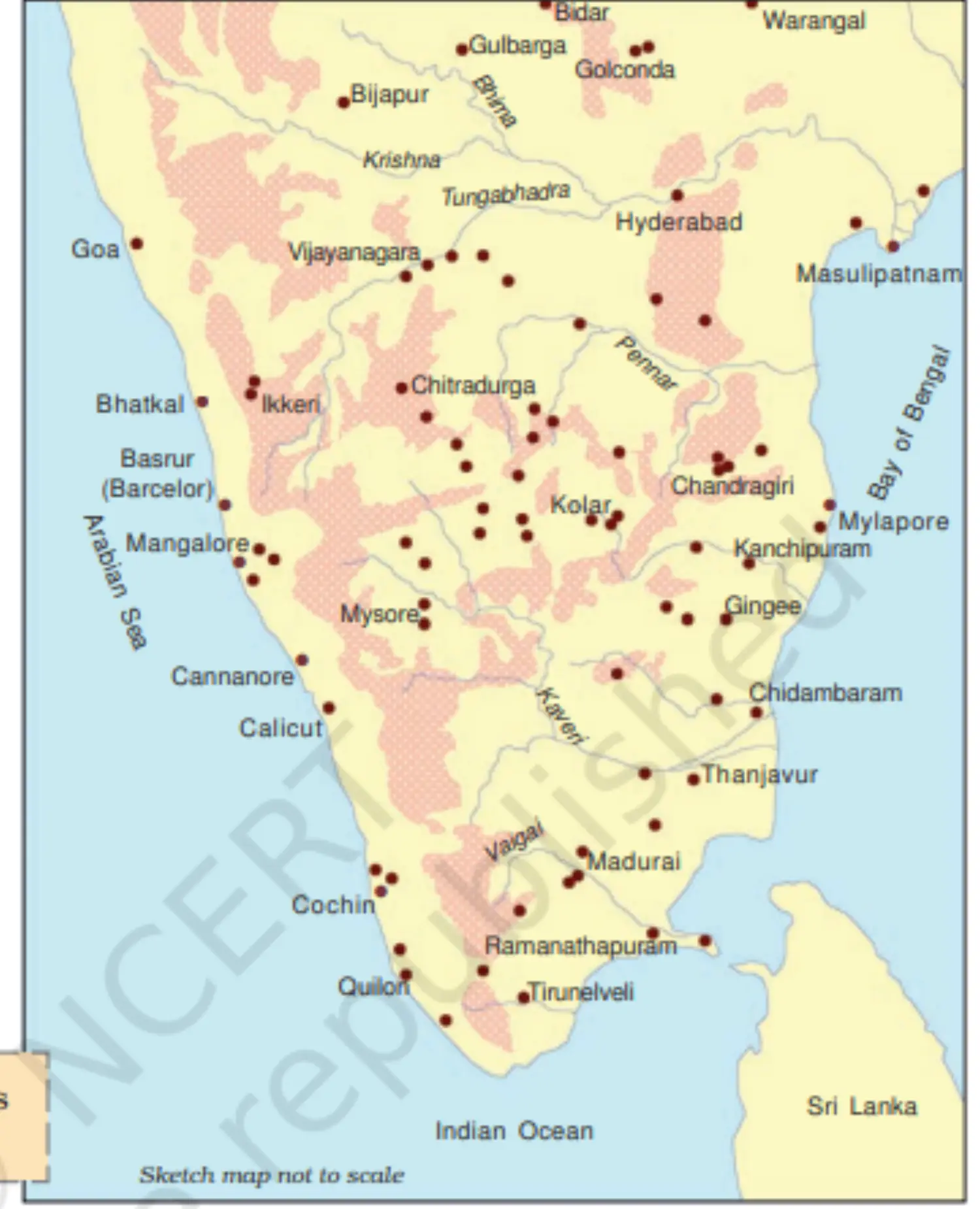
Vijayanagara The Capital and its Environs
1. City Features
- Distinctive: Physical layout and building style unique to Vijayanagara.
2. Water Resources
- Location: Natural basin formed by the Tungabhadra River.
- Landscape: Granite hills surround the city with streams flowing to the river.
- Water Storage: Embankments built to create reservoirs.
- Kamalapuram Tank: Major water tank of the city, also supplying the “royal centre”.
- Hiriya Canal: Separated the “sacred centre” from the “urban core”.
3. Fortifications and Roads
- Fort Walls: Seven lines of fortifications as observed by Abdur Razzaq.
- Construction: Wedge-shaped stone blocks without mortar, inner portion packed with earth and rubble.
- Agricultural Importance: Fortified areas included agricultural tracts to withstand sieges.
- City Entry: Well-guarded gates linked to major roads with distinctive Indo-Islamic architectural features.
- City Roads: Traced through gateways, winding through valleys and lined by bazaars.
4. The Urban Core
Residences: Limited archaeological evidence of houses of ordinary people.
- Rich Traders: Areas with Chinese porcelain discoveries.
- Muslim Quarters: Tombs, mosques resembling the temple mandapas.
Portuguese Observation: The houses of ordinary people were thatched but well-built.
Religious Diversity: Numerous shrines and temples indicate a variety of cults.
Water Sources: Wells, rainwater tanks, and temple tanks.
Map
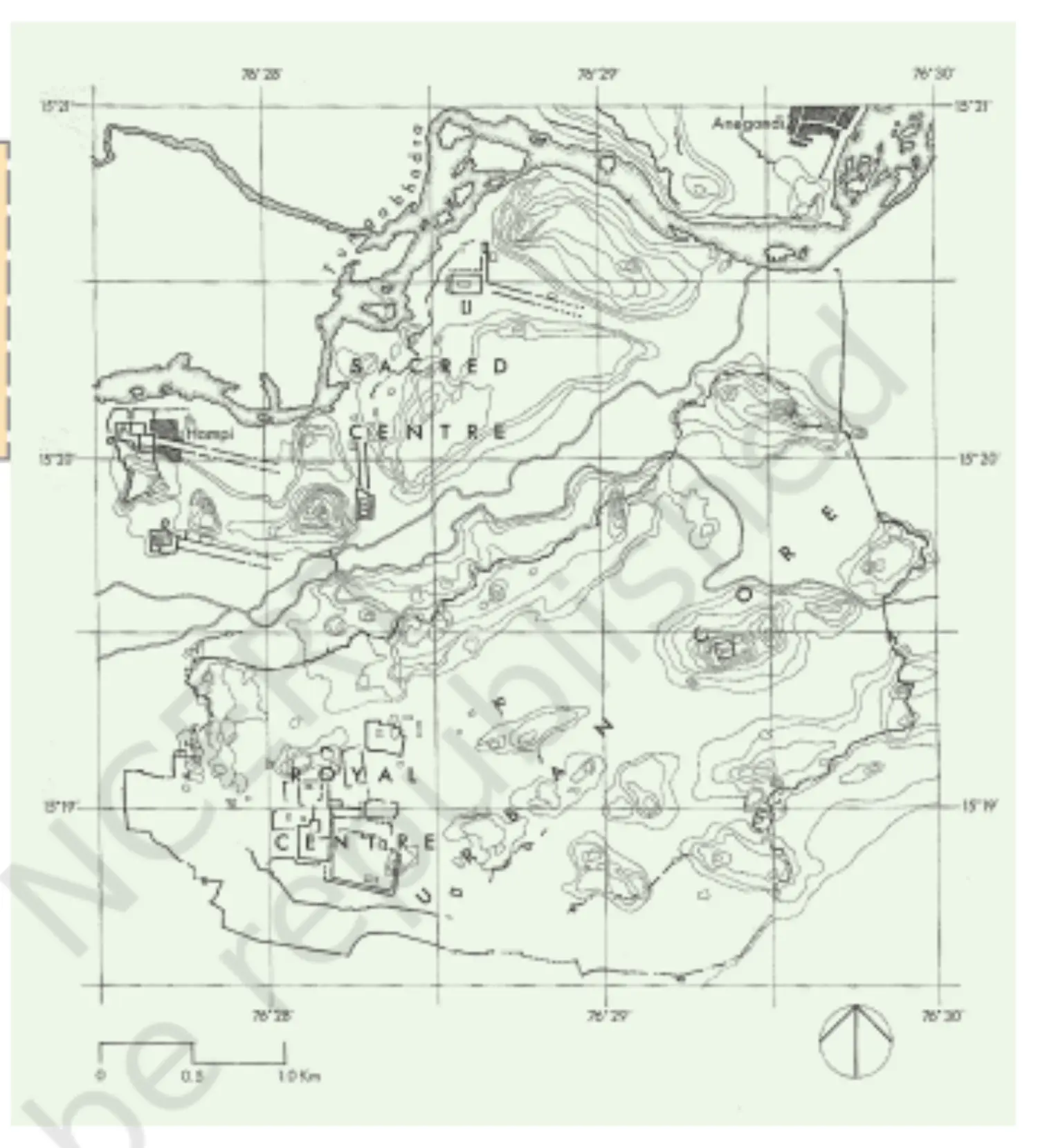
The Royal Centre
"The Royal Centre of Vijayanagara"
1. Overview
- Location: South-western part of the settlement.
- Composition: Over 60 temples and around 30 building complexes were identified as palaces.
- Significance: The patronage of temples was crucial for rulers to legitimize their authority.
- Construction: Temples were made of masonry, while secular buildings had perishable superstructures.
2. The Mahanavami Dibba
- Description: Massive platform (11,000 sq. ft base, 40 ft high) supporting a wooden structure.
- Relief Carvings: Base adorned with carvings.
- Rituals: Celebrations during the Mahanavami festival, showcasing the king's prestige and power.
- Ceremonies: Included worship, dances, processions, and presentations to the king.
- Doubts: Uncertain if the platform was the ritual center due to spatial constraints.
3. Notable Buildings in the Royal Centre
- Lotus Mahal: Named by British travelers; possibly a council chamber.
- Hazara Rama Temple: Exclusive for the king and family, with sculpted panels from the Ramayana.
4. Legacy
- Destruction: Many structures were destroyed when the city was sacked.
- Continuation: The tradition of building palatial structures was upheld by the Nayakas.
The Sacred Centre of Vijayanagara
1. Overview
- Location: Northern end of the city on the Tungabhadra's banks.
- Significance: The area is associated with several sacred traditions, including the Ramayana and Pampadevi.
2. Significance of Temples
- History: Temple building was an old tradition, backed by dynasties like Pallavas, Chalukyas, and Cholas.
- Role: Temples were religious, social, cultural, and economic centers.
- Rulers' Affiliation: Temples were a means of legitimizing authority; associating with the divine.
- Virupaksha & Pampadevi: The choice of the Vijayanagara site is possibly due to these shrines.
3. Temple Architecture Innovations
- Royal Portrait Sculpture: Displayed in temples.
- King's Visits: Treated as state occasions, accompanied by nayakas.
4. Distinctive Features
- Raya Gopurams: Royal gateways that signaled temple presence from a distance.
- Mandapas: Pavilions and long pillared corridors around temple shrines.
5. Temples of Note
- Virupaksha Temple: Built over centuries; expanded during the Vijayanagara Empire. Features halls for various religious purposes.
- Vitthala Temple: Dedicated to Vitthala, a form of Vishnu. Features chariot streets and a unique chariot shrine.
6. Nayakas and Temple Building
- Nayakas continued traditions of temple building and fortification.
- They built some of the most spectacular gopurams.
Plotting Palaces, Temples and Bazaars
1. Background Information
- Initial Surveys: Conducted by Mackenzie.
- Sources: Travellers’ accounts and inscriptions.
- Preservation: 20th-century efforts by the Archaeological Survey of India and Karnataka Department of Archaeology and Museums.
- Recognition: Hampi was identified as a site of national importance in 1976.
2. Documentation Project (1980s)
- Objective: Detailed documentation of Vijayanagara's material remains.
- Methods: Extensive and intensive surveys using various recording techniques.
- Collaboration: Scholars worldwide participated over nearly two decades.
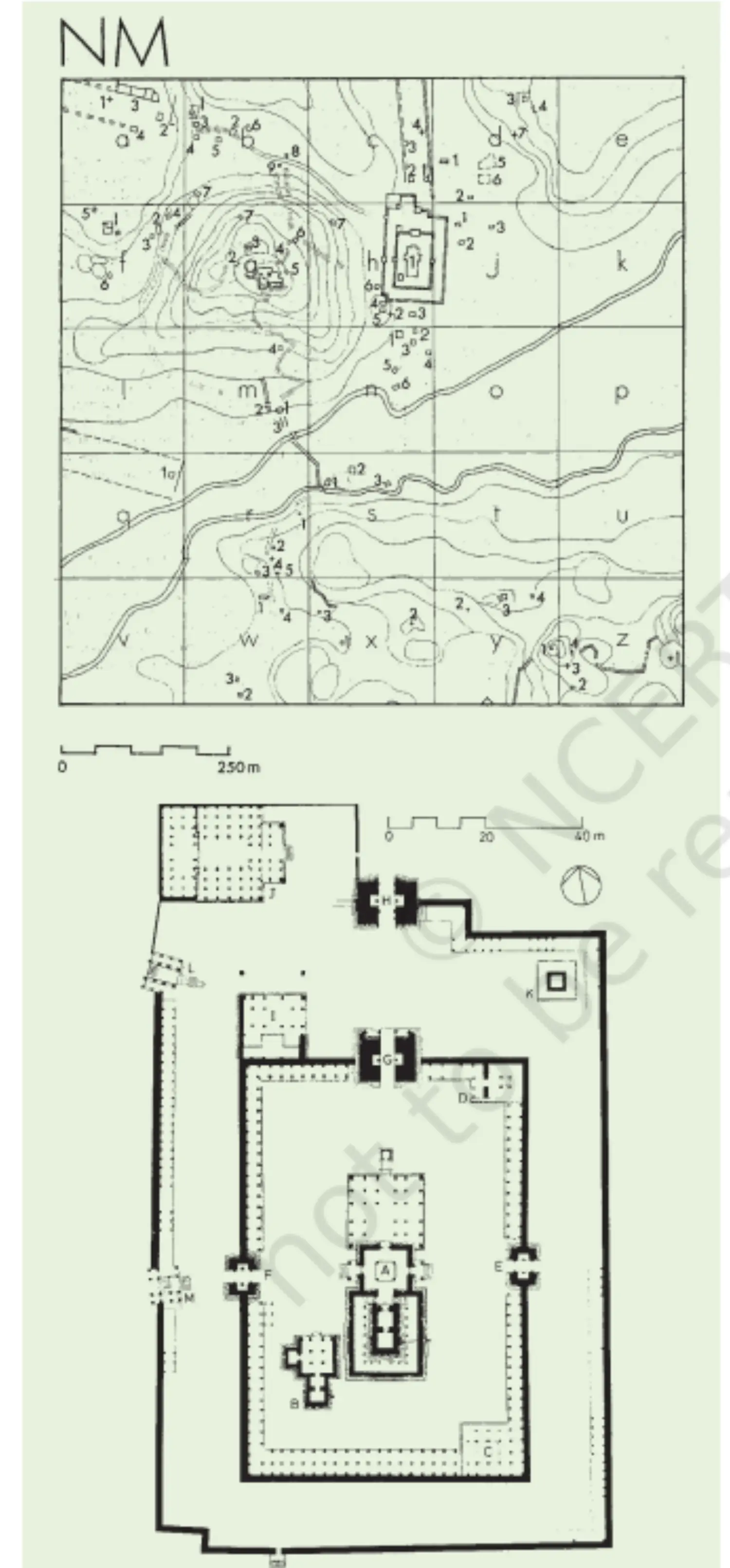
3. Mapping Process
- Division: The entire area is divided into 25 squares, each designated by an alphabet letter.
- Subdivision: Each primary square is subdivided further into smaller squares, and then further subdivided into even tinier units.
- Findings: Thousands of structures documented, from small shrines to grand temples. Traces of roads, paths, and bazaars were also uncovered.
4. Significance of Surveys
Bazaars: Located through remains of pillar bases and platforms, indicating once-thriving markets.
Limitations: Only stone structures survive; wooden elements have vanished.
Reconstructions: Despite the loss of wooden structures, travellers' descriptions help reconstruct the vibrant life of the times.
Map
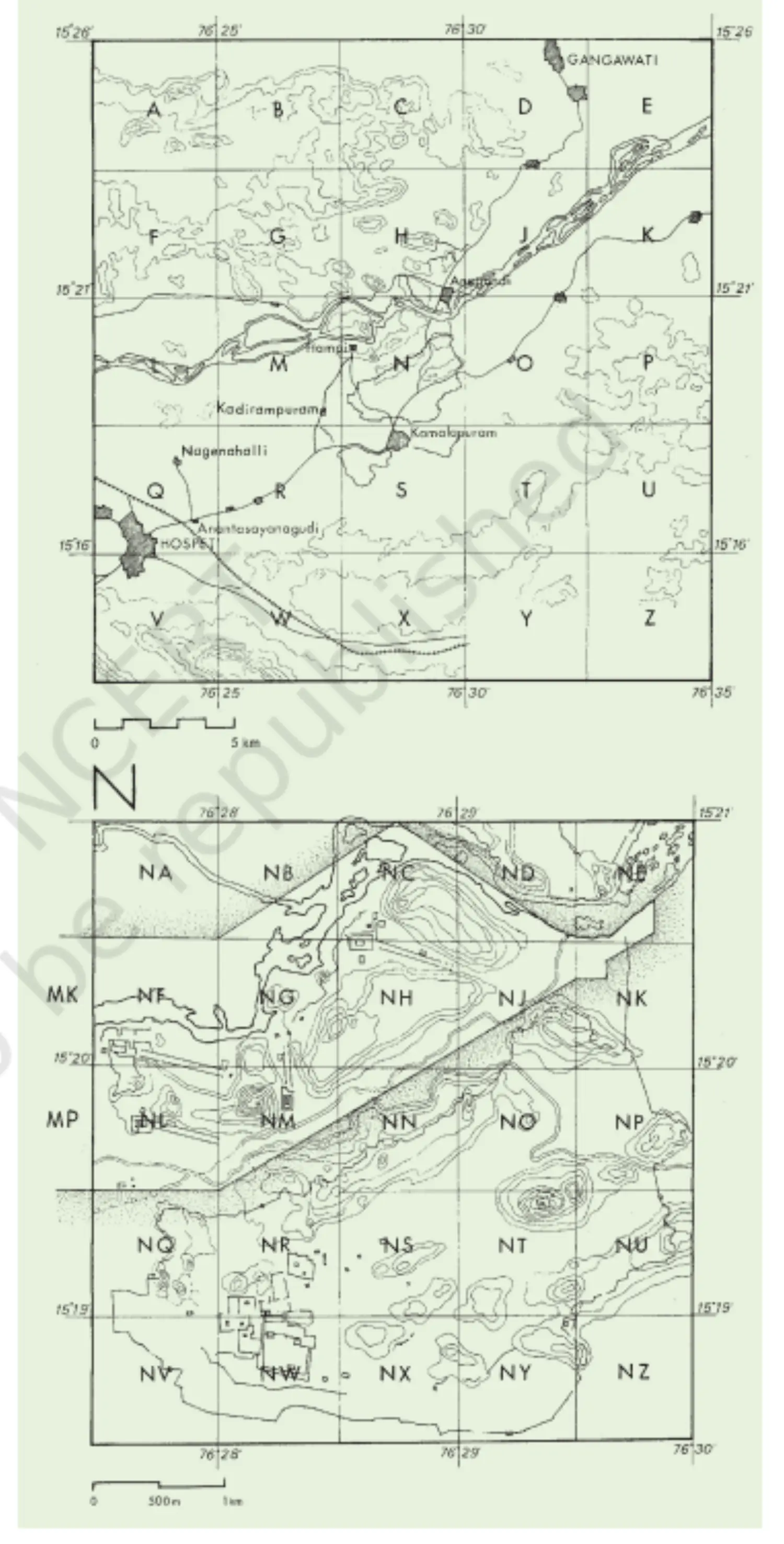
Questions in Search of Answers
1. Significance of Buildings
- Insights: Offer understanding of space organization, usage, construction materials, and techniques.
- Military Assessment: Fortifications reveal defense needs and military strategies.
- Cultural Spread: Comparisons with other structures show cultural influences and ideas.
2. Symbolism and Perception
- Cultural Context: Buildings contain symbols influenced by literature, inscriptions, and traditions.
- Public Interaction: Uncertainty about ordinary people's access and interpretation of the royal or sacred centers.
- Worker Perspectives: The thoughts of laborers contributing to construction remain largely unknown.
3. Behind the Construction
- Decision Making: Rulers decided on construction aspects such as size, material, and style.
- Specialized Knowledge: Questions arise about the planners and possessors of architectural expertise.
- Labor Force: The origins and backgrounds of masons, stonecutters, and sculptors are intriguing.
- Possible Sources: Were workers from neighboring regions, perhaps even war captives?
- Wages: Uncertain compensation structures for the workers.
- Logistics: Questions about supervision, transportation of materials, and their sources.
4. Pursuit of Answers
- Limitations: Merely observing the buildings or their remains doesn't answer all questions.
- Future Research: Utilizing diverse sources may provide more insights.
Additional Concepts
"Questions and Insights about Vijayanagara"
1. Buildings and Their Insights
- Purpose: Reflect on the organization of space, materials, and techniques.
- Fortifications: Indicate defense strategies and military requirements.
- Cultural Comparisons: Studying buildings in different locations reveals shared ideas and influences.
2. Symbols and Their Meanings
- Embedded Meanings: Buildings carry symbols influenced by literature, inscriptions, and traditions.
- Public Perspective: How ordinary people perceive and interact with these structures remains uncertain.
- Laborers' View: The sentiments of those who worked on the constructions are largely unknown.
3. Construction Dynamics
- Decision Makers: Rulers made major decisions regarding construction.
- Specialists: Questions arise about the identities and origins of architectural experts.
- Labor Force: Where did the workers come from and what was their compensation?
- Logistics: Concerns about supervision, transportation of materials, and sourcing.
4. Unknowns and Research
- Limitations: Observing structures doesn't reveal all answers.
- Further Studies: Diverse sources may provide deeper insights.
5. Mackenzie and His Contributions
- Colin Mackenzie (1754-1821): Renowned as an engineer, surveyor, and cartographer.
- Role: Appointed first Surveyor General of India in 1815.
- Objective: Understand India's past for better colonial governance.
- Vijayanagara: Studying it could provide information about prevailing institutions, laws, and customs.
6. Vijayanagara Marketplace
- Vibrancy: Described as "best-provided" with various commodities available in abundance.
- Goods: Included rubies, diamonds, emeralds, pearls, grains, fruits, and meats.
- Exotic Foods: Descriptions include "sparrows, rats, cats, and lizards."
7. Krishnadeva Raya's Image
- Statue: Located on the gopuram of the temple at Chidambaram.
- Physical Description (by Paes): Medium height, fair complexion, signs of smallpox on his face.
8. Discovery and Conservation Timeline
- 1800: Colin Mackenzie visits.
- 1856: First detailed photographs by Alexander Greenlaw.
- 1876: J.F. Fleet documents inscriptions.
- 1902: Conservation starts under John Marshall.
- 1986: Hampi was declared a World Heritage site by UNESCO.
Keywords Defined:
- Gajapati: Literally means "lord of elephants", a ruling lineage in Orissa during the 15th century.
- Ashvapati: Translates to "lord of horses" and refers to the Deccan Sultans.
- Narapati: Means "lord of men" and refers to the rayas.
- Elevation: A vertical view of an object or structure.
- Gopuram: A monumental tower, usually ornate, at the entrance of any temple, especially in Southern India.
Dates and Context:
- 1200-1300: Establishment of the Delhi Sultanate.
- 1300-1400: Establishment of the Vijayanagara Empire and Bahmani kingdom.
- 1400-1500: Establishment of the Gajapati kingdom of Orissa and emergence of Sultanates.
- 1500-1600: Portuguese conquest of Goa and collapse of the Bahmani kingdom.
- 1800: Colin Mackenzie visits Vijayanagara.
- 1856: Alexander Greenlaw photographs archaeological remains at Hampi.
- 1876: J.F. Fleet begins the documentation of inscriptions.
- 1902: Conservation starts under John Marshall.
- 1986: Hampi is declared a World Heritage site by UNESCO.
- Chapter 8 - Peasants, Zamindars, and the State
Agrarian Society and the Mughal Empire
During 16th and 17th Century
"Rural Society and Mughal Influence in the 16th and 17th Centuries"
1. Rural Population
- Demographics: 85% of India's population resided in villages during the 16th and 17th centuries.
2. Agricultural Production
- Involvement: Both peasants and landed elites were engaged in farming.
- Rights: Both groups claimed rights to a portion of the produce.
- Rural Dynamics: Relationships of cooperation, competition, and conflict formed the foundation of rural society.
3. External Influences on Rural Life
- Mughal State: A key external entity that largely depended on agricultural production for income.
- State Agents: Included revenue assessors, collectors, and record keepers.
- Objective: Control rural society to ensure consistent cultivation and tax collection.
4. Integration of Trade and Markets
- Crops for Sale: Many agricultural products were intended for trade.
- Market Influence: The introduction of trade, money, and markets integrated villages with urban areas.
Peasants and Agricultural Production
"Peasants and Agricultural Production in 17th Century India"
1. Village Life & Peasant Role
- Village: Fundamental unit of agrarian society.
- Peasant Activities: Seasonal tasks - tilling, sowing, harvesting, and agro-goods production.
2. Landscape & Agrarian Society
- Varied Topography: Dry lands, hilly regions, and forests.
- Agrarian Diversity: Different regions had varied cultivable capabilities.
3. Sources of Knowledge
- Major Source: Chronicles and documents from the Mughal court.
- Ain-i Akbari: Key text by Abu'l Fazl that recorded state arrangements for agriculture.
- Regional Sources: Revenue records from Gujarat, Maharashtra, and Rajasthan; East India Company records.
4. Peasants & Land Relations
- Terminology: Raiyat, muzarian, kisan, asami.
- Types of Peasants:
- Khud-kashta: Village residents.
- Pahi-kashta: Non-resident cultivators.
- Ownership: Lands bought and sold based on individual ownership principle.
5. Irrigation & Technology
- Importance: Addressed water needs beyond monsoons.
- State Role: Initiated irrigation projects like canals.
- Agricultural Tools: Wooden plough, drill, hoe, and narrow iron blade.
6. Crop Production & Variety
- Seasonal Cycles: Kharif (autumn) and rabi (spring).
- Crop Diversity: Numerous varieties; Bengal had 50 types of rice.
- Jins-i Kamil: High-revenue crops like cotton and sugarcane.
- New Crops: Maize, tomatoes, potatoes, chillies, pineapple, and papaya were introduced in the 17th century.
The Village Community
"The Village Community in Mughal Society"
1. Village Structure and Social Groups
- Individual Ownership: Peasants held their lands individually but were also part of a collective village community.
- Community Constituents:
- Cultivators: Varied based on caste and roles.
- Panchayat: Assembly of village elders.
- Headman (muqaddam/mandal): Supervised village affairs.
2. Caste in Rural Areas
- Heterogeneity: Cultivators varied widely due to caste distinctions.
- Lower Strata: Direct correlation between caste, poverty, and social status.
- Intermediate Levels: Some castes, like Ahirs and Gujars, rose in status due to their professions.
3. Village Governance
- Panchayat's Role: Upheld caste boundaries, levied fines, and decided on matters of community welfare.
- Headman's Role: Supervised village accounts and conducted oversight on villagers' conduct.
- Jati Panchayats: Represented specific castes within the village. Had significant influence and arbitrated disputes.
- Village Resistance: Panchayat could mediate conflicts. If unsatisfied, peasants might resort to drastic measures like deserting the village.
4. Village Artisans
- Artisan-Peasant Overlap: Many groups performed tasks of both artisans and peasants.
- Remuneration: Artisans were compensated through a share of the harvest, land allotments, or daily allowances.
- Jajmani System: Mutual exchange system between artisans and peasant households.
5. Village Perception
- "Little Republic" Myth: Contrary to some British perceptions, villages weren't egalitarian. They had clear power hierarchies, caste distinctions, and gender biases.
- Economic Dynamics: Cash nexus developed through village-town trade, and revenue was often assessed and collected in cash.
Women in Agrarian Society
1. Role in Agricultural Production
- Collaborative Efforts: Both men and women had distinct roles in the fields. Men handled tasks like tilling and ploughing while women managed sowing, weeding, threshing, and winnowing.
- Home and World: Due to the structure of medieval Indian agriculture, women's roles were not just limited to the household. They were actively involved in fieldwork and other outdoor activities.
- Cultural Biases: Despite their active role, certain biases persisted. For instance, menstruating women had restricted access to certain tasks and areas.
2. Women in Artisanal Work
- Craft Production: Women were instrumental in tasks such as spinning yarn, pottery, and embroidery.
- Commercialization Impact: The more a product was commercialized, the higher the demand for women's labor in its production.
3. Socio-Cultural Significance
- Child-bearing Role: Women were valued as child bearers in a labor-dependent society.
- High Mortality Impact: Frequent deaths due to malnutrition, childbirth, etc., led to bride-price customs and legitimization of remarriage among peasants.
4. Control and Patriarchy
- Male Dominance: Households were typically male-headed, leading to strict control over women.
- Infidelity and Punishments: Society had strict norms regarding women's fidelity, with severe consequences for suspected infidelity.
5. Petitions and Justice
- Seeking Redress: Women often sent petitions to the village panchayat against issues like husbands' infidelity or neglect.
- Anonymity in Records: Women's names were typically excluded from records, reflecting societal norms.
6. Property Rights and Landed Gentry
- Inheritance: Women, especially among the landed gentry, had the right to inherit property.
- Active Participation: Evidence shows women, even widows, actively participating in rural land markets.
- Women Zamindars: In places like eighteenth-century Bengal, women held significant zamindari positions.
Forests and Tribes
1. Beyond Settled Villages
- Forest Cover: Vast forests, including dense jungles and scrublands, covered a significant portion of India, possibly around 40%.
- Definition of Jangli: Forest dwellers were called 'jangli'. The term didn’t imply a lack of civilization but denoted their livelihood from the forest – gathering, hunting, and shifting agriculture.
- Seasonal Activities: Forest activities varied by season. For Bhils, spring was for gathering, summer for fishing, monsoon for cultivation, and autumn/winter for hunting.
- State's Perception: Forests were seen as hiding places for rebels. Babur mentioned how jungles made people rebellious and evade taxes.
2. Inroads into Forests
- State Needs: The state needed elephants for its army, often as part of the tax (peshkash) from forest communities.
- Hunting Symbolism: For the Mughal state, hunting symbolized its connection to all subjects. It was also a way for emperors to personally attend to grievances.
- Trade & Commerce: Forest products like honey, beeswax, and gum lac were in demand, with gum lac becoming a significant export. Barter systems were common in the trade.
- Tribal Transformation: Many tribal chiefs became zamindars or kings, establishing armies and integrating into the larger socio-political landscape.
- Wars & Conflicts: Tribal kingdoms in the northeast and other regions often engaged in wars. The Koch kings, for instance, expanded their territories through conquests in the 16th and 17th centuries.
- Cultural Influences: Sufi saints (pirs) played a role in introducing Islam to new agricultural communities in forested areas.
The Zamindars
1. Definition and Role
- Zamindars: Landed proprietors in Mughal India who did not directly engage in agricultural production but benefited from it.
- Privileges: Elevated status due to caste and services (khidmat) provided to the state.
2. Land Ownership
- Milkiyat Lands: Personal lands owned by zamindars. They had full rights to sell, bequeath, or mortgage them.
- Cultivated primarily for the private use of the zamindars, often utilizing hired or servile labor.
3. Power and Influence
- Revenue Collection: Often tasked with collecting revenue on behalf of the state, earning them financial compensation.
- Military Resources: Maintained fortresses (qilachas) and armed forces (cavalry, artillery, infantry).
- Zamindari Hierarchy: Visualizing rural society as a pyramid, zamindars were at the top. Combination of upper-caste (Brahmana-Rajput) dominance with some representation from intermediate castes and Muslim zamindaris.
4. Expansion and Consolidation
- Origin: Some emerged from conquests, but imperial confirmation was typically needed.
- Zamindari Consolidation: Involved land colonization, transfer of rights, orders from the state, and purchase. Even "lower" castes occasionally became zamindars.
- Territorial Control: Rajputs, Jats, and peasant-pastoralists like the Sadgops expanded their territories.
5. Economic Role
- Land Colonization: Played a role in settling cultivators and providing resources for cultivation.
- Monetisation: Buying and selling of zamindaris increased cash flow in the countryside.
- Market Establishment: Often set up markets (haats) where peasants sold their produce.
6. Relationship with Peasantry
- Reciprocity & Patronage: Despite its exploitative nature, some elements of mutual benefit and paternalism existed.
- Bhakti Saints' Perspective: Criticized many forms of oppression but didn't particularly portray zamindars as oppressors.
- Agrarian Uprisings: Zamindars often allied with peasants against the state in 17th-century agrarian revolts.
Land Revenue System
1. Importance of Land Revenue
- Mainstay of the Mughal Empire: Land revenue was the principal source of income for the Mughal state.
- Administrative Apparatus: Created to ensure control over agricultural production and collect revenue. This included the office of the diwan who supervised the fiscal system.
2. Assessment and Collection
- Two Stages: First was the assessment, and then the actual collection.
- Jama: The assessed amount.
- Hasil: The collected amount.
- Payment Modes: Akbar allowed cultivators to pay either in cash or in kind.
- State's Goal: Maximise its revenue claims, but the actual collection was sometimes affected by local conditions.
3. Land Measurement
Purpose: To get information about the extent of agricultural lands and their production.
Cultivated & Cultivable Lands: Both were measured in each province.
Ain's Compilation: During Akbar's rule, the Ain aggregated measurements of such lands.
Continuous Effort: Subsequent emperors, like Aurangzeb in 1665, directed officials to prepare annual records of cultivators in each village.
Challenges: Not all areas, especially forests, could be successfully measured.
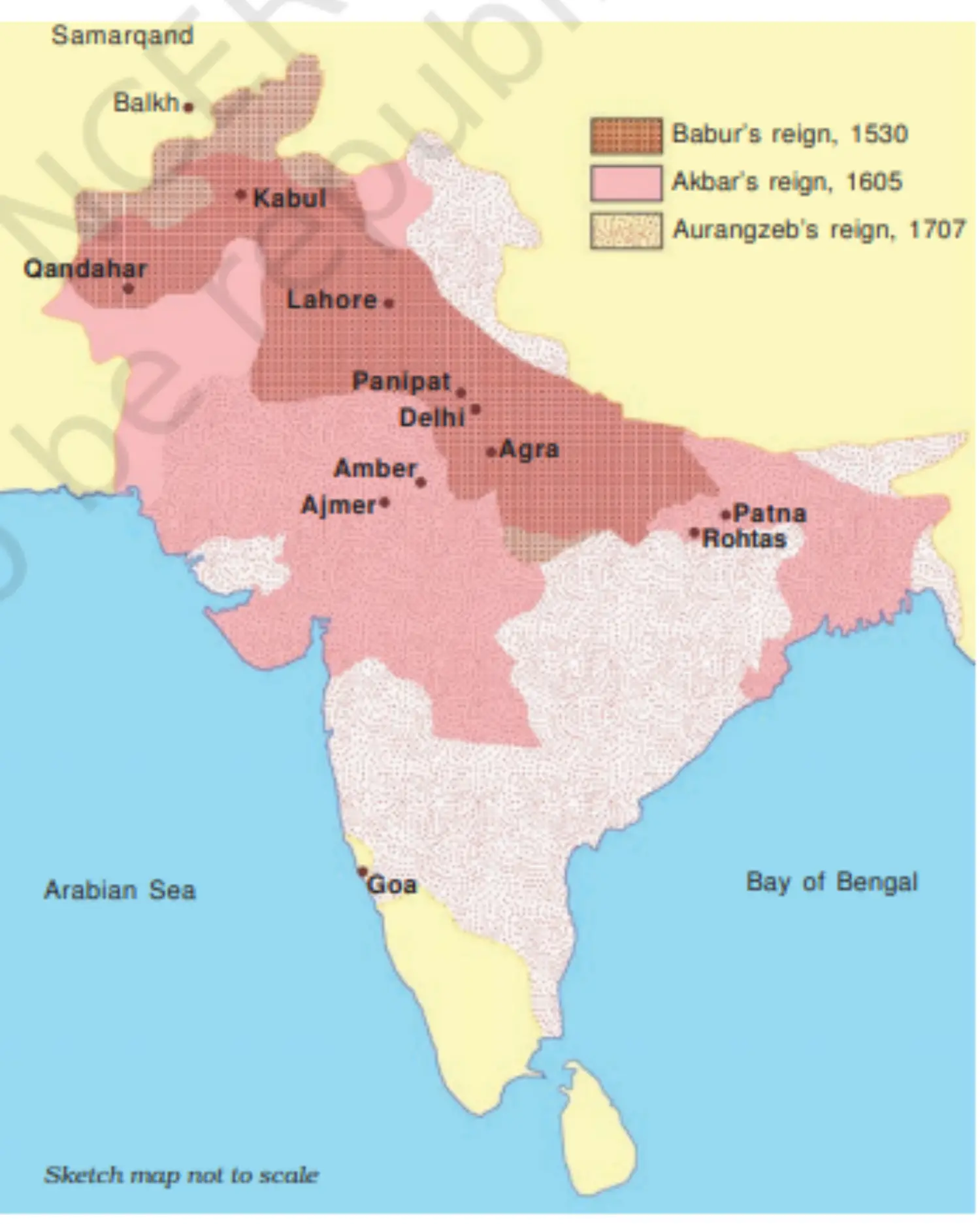
Map
The Flow of Silver
1. Asian Empires in the 16th and 17th Centuries
- Major Players: Mughal (India), Ming (China), Safavid (Iran), and Ottoman (Turkey).
- Achievement: Consolidated power and resources, leading to political stability.
2. Impact of Political Stability
- Trade Networks: Vibrant overland trade routes formed from China to the Mediterranean.
- European Connection: Voyages of discovery and the opening of the New World expanded Asia's trade, especially India's, with Europe.
3. Expansion of India's Overseas Trade
- Geographical Diversity: India’s trade spread across a wider geographical region.
- Commodity Composition: Diversification in the types of goods traded.
4. Influx of Silver into India
- Reason: Expanding trade required European countries to pay in silver for goods from India.
- Benefit for India: India lacked natural silver resources, so the incoming silver was crucial.
- Economic Stability: The 16th to 18th centuries saw a stable availability of metal currency, particularly the silver rupee, in India.
5. Expansion in Monetary Transactions
- Minting & Circulation: There was an unprecedented expansion in coin minting and money circulation.
- State Revenue: The Mughal state benefitted from the ability to collect taxes and revenue in cash.
6. Giovanni Careri's Testimony (c. 1690)
- Insight: Provided a detailed account of how silver traveled globally to reach India and highlighted the vast scale of cash and commodity transactions in 17th-century India.
The Ain-i Akbari of Abu’l Fazl Allami
1. Introduction to Ain-i Akbari
- Author: Abu’l Fazl Allami
- Completion: 1598, after five revisions.
- Purpose: Part of the larger project, the Akbar Nama, commissioned by Emperor Akbar.
2. Composition and Structure
- Three Books: The first two are historical narratives. The third, Ain-i Akbari, is a compendium of imperial regulations and a gazetteer.
- Contents: Details on the court, administration, army, revenue sources, geography, and cultural traditions.
3. Emphasis on Quantitative Information
- Jama vs. Hasil: Jama refers to the assessed amount, while Hasil is the collected amount.
- Land Measurements: Detailed statistics on the provinces, including geographic, topographic, and economic profiles.
- Details on Subas and Sarkars: Includes pargana/mahal, qila, arazi, naqdi, suyurghal, zamindars, and their troops.
4. Authenticity and Verification
- Revisions: The manuscript underwent five revisions for accuracy.
- Cross-checking: Oral testimonies were verified before inclusion.
5. Limitations of Ain-i Akbari
- Errors: Minor arithmetic and transcription errors exist.
- Skewed Data: Data was not uniformly collected from all provinces.
- Fiscal Data Richness: Detailed financial data, but limited information on prices and wages outside Agra.
6. Historical Significance
- Departure from Tradition: Unlike typical chronicles focused on political events, Ain-i Akbari detailed the empire's structure and its people.
- Benchmark: Provides vital insights into India in the 17th century.
- Value for Historians: Helps in reconstructing the socio-economic fabric of Mughal India.
Additional Concepts
Mughal Empire's Various Aspects
1. Agrarian Mobility
- Babur's Observation: Villages and towns in Hindustan could be quickly depopulated and repopulated.
- Reasons: No need for digging water courses due to rain-grown crops; abundant population and resources like khas-grass and wood.
2. Irrigation Techniques
- Babur's Description: Absence of running water in most of Hindustan.
- Methods: Buckets or wheels are used for irrigating young trees.
- Variations: Lahore and Dipalpur used a wheel system; Agra and nearby regions used buckets.
3. Tobacco's Introduction
- Origin: First arrived in the Deccan.
- Spread: Reached northern India in the early 17th century.
- Concerns: Jahangir banned it due to addiction fears, but by the end of the 17th century, it became widespread.
4. Demographic Growth
- Outcome: Flexible agricultural production led to slow population growth.
- Statistics: Increase of about 50 million people between 1600 and 1800.
5. Corrupt Mandals
- Misuse: Mandals often manipulated village accounts with patwaris and under-assessed their own land revenue, burdening smaller cultivators.
6. Village Economy
- Money Exchange: Jean-Baptiste Tavernier observed that even small villages had a money-changer or Shroff, acting as a banker.
7. Ain-i Akbari's Compilation
- Abu’l Fazl's Efforts: Collected records, narratives, and accounts. Consulted various officials, and sagacious men, and used royal records.
- Translation: Translated by scholars like Henry Blochmann and H.S. Jarrett.
8. Important Mughal Dates
- 1526: Babur defeats Ibrahim Lodi at Panipat.
- 1530-40: First phase of Humayun’s reign.
- 1540-55: Humayun's exile due to defeat by Sher Shah.
- 1555-56: Humayun regains territories.
- 1556-1605: Reign of Akbar.
- 1605-27: Reign of Jahangir.
- 1628-58: Reign of Shah Jahan.
- 1658-1707: Reign of Aurangzeb.
- 1739: Nadir Shah invades India.
- 1761: Ahmad Shah Abdali defeats the Marathas.
- 1765: Diwani of Bengal transferred to the East India Company.
- 1857: The last Mughal ruler, Bahadur Shah II, was deposed.
9. Key Definitions
- Pargana: An administrative subdivision of a Mughal province.
- Peshkash: A form of tribute collected by the Mughal state.
- Jama: Assessed the amount of land revenue.
- Mansabdari System: A military-cum-bureaucratic apparatus responsible for the civil and military affairs of the state.