Class 10: Science: textbook for class X, 2006
Chapter 1 - Chemical Reactions and Equations
- Introduction
- Evidence of Chemical Reactions
- Nature Change: Substances change their identity and properties.
- Examples in Daily Life:
- Milk souring at room temperature in summer.
- Iron objects rusting in a humid atmosphere.
- Grapes fermenting to produce wine.
- Food cooking and changing in taste, texture, and color.
- Food digestion in the body.
- Respiration process in living organisms.
- Identification of Chemical Reactions
- Observable Indicators:
- Change in state (solid, liquid, gas).
- Change in color.
- Evolution of a gas.
- Change in temperature.
- Observable Indicators:
- Chemical Reaction Characteristics
- Chemical Change: A transformation that alters the chemical composition of a substance.
- Example: Magnesium ribbon burning in air to form magnesium oxide.
- Determining Chemical Reactions
- Observations: Look for physical changes, like state or color change, gas production, or temperature shift.
- Inference: These changes suggest a chemical reaction has occurred.
- Evidence of Chemical Reactions
- Chemical Equations
- Understanding Chemical Equations
- Definition: A chemical equation is a symbolic representation of a chemical reaction.
- Components of a Chemical Equation
- Reactants: Substances that undergo the chemical change.
- Products: New substances formed as a result of the reaction.
- Format of a Word-Equation
- Structure: Reactants on the left-hand side (LHS) + Arrow (→) + Products on the right-hand side (RHS).
- Example: Magnesium + Oxygen → Magnesium oxide.
- Representation
- Symbols and Formulas: Used to represent the elements and compounds.
- Arrow Indication: Points from reactants to products, showing the direction of the reaction.
- Benefits of Chemical Equations
- Conciseness: Provides a shorter and clearer way of describing chemical reactions.
- Clarity: Clearly distinguishes between the starting materials and the outcomes.
- Writing a Chemical Equation
- Shorter Representation of Chemical Reactions
- Chemical formulae are used in place of words for conciseness.
- Chemical Equations
- Definition: A representation of a chemical reaction using chemical formulae.
- Example: The reaction of magnesium with oxygen can be written as:
- Mg + O2 → MgO2
- Balancing Chemical Equations
- Skeletal Equation: An unbalanced equation that does not have equal numbers of each atom on both sides.
- Balanced Equation: The number of atoms for each element is the same on both sides of the equation, indicating mass conservation.
- Steps to Balance Equations
- Count Atoms: Compare the number of atoms of each element on the left-hand side (LHS) and right-hand side (RHS).
- Adjust Coefficients: Change coefficients to balance the atoms on both sides.
- Verify Balance: Ensure the mass is the same on both sides by counting the atoms again.
- Shorter Representation of Chemical Reactions
- Balanced Chemical Equations
- Law of Conservation of Mass
- Mass remains constant; the mass of the reactants equals the mass of the products.
- Balanced Equation Criteria
- The number of atoms of each element must remain the same before and after the reaction.
- Balancing a Chemical Equation: Steps
- Step I: Enclose each chemical formula in boxes and do not alter the formulae while balancing.
- Step II: Count the number of atoms of each element in the unbalanced equation.
- Step III: Start balancing with the compound that has the maximum number of atoms.
- Step IV: Balance elements one by one using coefficients.
- Step V: For elements not yet balanced, adjust their coefficients accordingly.
- Step VI: Verify by counting atoms on both sides to ensure they are equal.
- Step VII: Include physical states and conditions (e.g., temperature, pressure) if necessary.
- Indicating Physical States and Reaction Conditions
- Use
(s)for solids,(l)for liquids,(g)for gases, and(aq)for aqueous solutions. - Reaction conditions like temperature and pressure can be indicated above or below the reaction arrow.
- Use
- Example of a Balanced Chemical Equation
- 3Fe(s) + 4H2O(g) → Fe3O4(s) + 4H2(g)
- Additional Information in Equations
- Symbols and physical states provide a more comprehensive understanding of the reaction conditions.
- Law of Conservation of Mass
- Understanding Chemical Equations
- Types of Chemical Reactions
- Fundamentals of Chemical Reactions
- Atoms of one element do not transform into another during a chemical reaction.
- Atoms are neither created nor destroyed (consistent with the law of conservation of mass).
- Mechanism of Reactions
- Chemical reactions involve breaking and forming of bonds between atoms.
- New substances are produced as a result of these bond changes.
- Continued Learning
- Details on types of bonds between atoms are covered in subsequent chapters (Chapters 3 and 4).
- Combination Reaction
Combination Reaction
- Definition: A reaction where two or more substances (elements or compounds) combine to form a single product.
- Example: Calcium oxide reacts with water to form slaked lime.
- CaO(s)+H2O(l)→Ca(OH)2(aq)+HeatCaO(s)+H2O(l)→Ca(OH)2(aq)+Heat
Examples of Combination Reactions
Combustion of coal: C(s)+O2(g)→CO2(g)
C(s)+O2(g)→CO2(g)
Formation of water: 2H2(g)+O2(g)→2H2O(l)
2H2(g)+O2(g)→2H2O(l)
Exothermic Reactions
- Definition: Reactions where heat is evolved, making the reaction mixture warm.
- Characteristics: Release energy, often in the form of heat or light.
Examples of Exothermic Reactions
Burning of natural gas: CH4(g)+2O2(g)→CO2(g)+2H2O(g)
CH4(g)+2O2(g)→CO2(g)+2H2O(g)
Respiration (also an exothermic process): Breakdown of glucose in cells to release energy.
- C6H12O6(aq)+6O2(aq)→6CO2(aq)+6H2O(l)+energyC6H12O6(aq)+6O2(aq)→6CO2(aq)+6H2O(l)+energy
Decomposition of organic matter into compost.
Identifying Reaction Types
- Activity involving the formation of a single product with heat release is an example of an exothermic combination reaction.
- Decomposition Reaction
Decomposition Reaction
Definition: A single reactant breaks down into two or more simpler products.
General Equation: ABEnergyA+B
AB→EnergyA+B
Types of Decomposition Reactions
- Thermal Decomposition
Example: CaCO3(s)HeatCaO(s)+CO2(g)
CaCO3(�)→HeatCaO(s)+CO2(�)
Called lime or quick lime; used in cement manufacturing.
- Decomposition by Electricity
- Electrolysis reactions where compounds break down upon passing an electric current.
- Photodecomposition
Example: 2AgCl(s)Sunlight2Ag(s)+Cl2(g)
2AgCl(s)→Sunlight2Ag(s)+Cl2(�)
Silver chloride decomposes into silver and chlorine under sunlight; used in photography.
- Thermal Decomposition
Characteristics of Decomposition Reactions
- May release gases and involve color changes.
- Require an external source of energy, such as heat, light, or electricity.
Endothermic Reactions
- Reactions that absorb energy from their surroundings.
- Energy is required to break the bonds of the reactants.
Examples and Applications
- Ferrous sulphate decomposes into ferric oxide, sulphur dioxide, and sulphur trioxide.
- Lead nitrate decomposes into lead oxide, nitrogen dioxide, and oxygen.
- Silver bromide decomposes into silver and bromine under sunlight.
- Displacement Reaction
Displacement Reaction
- Definition: A more reactive element displaces a less reactive element from its compound.
- Characteristic Change: The color change in the reaction signifies the occurrence of a displacement reaction.
Examples of Displacement Reactions
Iron displacing copper: Fe(s)+CuSO4(aq)→FeSO4(aq)+Cu(s)
Fe(s)+CuSO4(aq)→FeSO4(aq)+Cu(s)
Zinc displacing copper: Zn(s)+CuSO4(aq)→ZnSO4(aq)+Cu(s)
Zn(s)+CuSO4(aq)→ZnSO4(aq)+Cu(s)
Lead displacing copper: Pb(s)+CuCl2(aq)→PbCl2(aq)+Cu(s)
Pb(s)+CuCl2(aq)→PbCl2(aq)+Cu(s)
Reactivity Series
- Elements like zinc and lead are higher in the reactivity series compared to copper, hence they can displace copper from its salts.
Observations in Displacement Reactions
- The brownish color on iron indicates the deposition of copper.
- The fading blue color of copper sulphate solution indicates the formation of iron sulphate.
- Double Displacement Reaction
Double Displacement Reaction
- Definition: A type of reaction where two compounds exchange ions to form two new compounds.
- Precipitate Formation: A characteristic of many double displacement reactions is the formation of an insoluble substance known as a precipitate.
Example of Double Displacement Reaction
Reaction between sodium sulfate and barium chloride: Na2SO4(aq)+BaCl2(aq)→BaSO4(s)+2NaCl(aq)
Na2SO4(aq)+BaCl2(aq)→BaSO4(s)+2NaCl(aq)
Formation of a white precipitate of barium sulfate (BaSO4) and sodium chloride in solution.
BaSO4
Ion Exchange
The driving force of the reaction is the exchange of ions (SO42− and Ba2+) between reactants.
SO42−
Ba2+
Characteristics of Double Displacement Reactions
- Often occur in aqueous solutions where ions can move and react.
- Can result in the formation of a precipitate, a gas, or a molecular compound like water.
Precipitation Reactions
- A type of double displacement reaction that results in the formation of an insoluble product.
- Oxidation and Reduction
Oxidation
Definition: Gain of oxygen or loss of hydrogen by a substance during a reaction.
Example: Copper becomes copper(II) oxide when heated in the presence of oxygen. 2Cu+O2heat2CuO
2Cu+O2→heat2CuO
Reduction
Definition: Loss of oxygen or gain of hydrogen by a substance during a reaction.
Example: Copper(II) oxide turns back to copper when reacted with hydrogen. CuO+H2heatCu+H2O
CuO+H2→heatCu+H2O
Redox Reactions
- Definition: Reactions where oxidation and reduction occur simultaneously.
- Characteristic: One reactant is oxidized (loses electrons or gains oxygen) while the other is reduced (gains electrons or loses oxygen).
Examples of Redox Reactions
Reduction of zinc oxide with carbon: ZnO+C→Zn+CO
ZnO+C→Zn+CO
Reduction of manganese dioxide with hydrochloric acid: MnO2+4HCl→MnCl2+2H2O+Cl2
MnO2+4HCl→MnCl2+2H2O+Cl2
Understanding Oxidation and Reduction
- Oxidation is often exothermic; substances like metals can react with oxygen to form metal oxides.
- Reduction often involves the removal of oxygen or the addition of hydrogen.
Key Points
- Oxygen addition = Oxidation
- Hydrogen addition = Reduction
- Oxygen loss = Reduction
- Hydrogen loss = Oxidation
- Fundamentals of Chemical Reactions
- Have you ever observed the effects of Oxidation Reactions in Everyday Life?
- Corrosion
- Corrosion Basics
- Definition: Deterioration of metals due to chemical reactions with their environment.
- Common Metals: Iron, copper, silver, and others.
- Examples of Corrosion
- Iron: Rusting, forming reddish-brown iron oxide.
- Copper: Developing a green coating called patina.
- Silver: Tarnishing, leading to a black coating.
- Impacts of Corrosion
- Structural Damage: Affects the integrity of buildings, bridges, vehicles, and metal structures.
- Economic Costs: Significant expenditure on repair and replacement of corroded items.
- Prevention and Control
- Protective Coatings: Paint, galvanizing, or plating metals can prevent direct exposure to corrosive elements.
- Regular Maintenance: Inspection and maintenance can help to detect and prevent serious corrosion.
- Understanding Corrosion
- Caused by environmental factors like moisture and acids.
- Involves oxidation reactions where the metal is oxidized.
- Key Points
- Corrosion is an oxidation process.
- It can lead to significant material and financial loss.
- Prevention strategies are crucial for managing corrosion.
- Corrosion Basics
- Rancidity
- Understanding Rancidity
- Definition: The process where fats and oils get oxidized, leading to a change in flavor and odor.
- Result: Foods turn rancid, affecting taste and smell negatively.
- Causes of Rancidity
- Oxidation: Primary cause, as fats and oils react with oxygen.
- Prolonged Exposure: Leaving fat/oil-containing foods out for extended periods accelerates the process.
- Prevention of Rancidity
- Antioxidants: Adding substances that inhibit oxidation to extend shelf life.
- Airtight Containers: Reduces the exposure of food to oxygen, slowing down the rancidification.
- Inert Gases: Flushing with gases like nitrogen, as done by chips manufacturers, to prevent oxidation.
- Key Points
- Rancidity compromises food quality.
- Preventive measures are important to maintain the edibility of food products.
- Understanding the process helps in choosing proper storage and additives for food preservation.
- Understanding Rancidity
- Corrosion
- Additional Concepts
- Chemical Equations
- Complete Equation: Shows reactants, products, and their states (solids s, liquid l, gas g, aqueous aq).
- Balancing: Ensures atom conservation—the same number of each atom on both sides.
- Types of Reactions
- Combination Reaction: Two or more reactants form one product.
- Decomposition Reaction: A single reactant breaks into two or more products.
- Exothermic Reaction: Releases heat, e.g., combustion, and respiration.
- Endothermic Reaction: Absorbs energy, e.g., photosynthesis.
- Displacement Reaction: One element replaces another in a compound.
- Double Displacement Reaction: Exchange of ions between two compounds, often forming a precipitate.
- Special Cases
- Precipitation Reaction: Forms an insoluble salt.
- Oxidation: Gain of oxygen or loss of hydrogen.
- Reduction: Loss of oxygen or gain of hydrogen.
- Redox Reactions: Involve both oxidation and reduction.
- Applications
- Whitewashing: Ca(OH)2 reacts with CO2 to form CaCO3, giving walls a shiny finish.
- Formation of Marble: Marble also consists of CaCO3.
- Chemical Equations
- Introduction
Chapter 2 - Acids, Bases and Salts
- Introduction
- Characteristics of Acids and Bases
- Acids: Sour taste; turn blue litmus red.
- Bases: Bitter taste; turn red litmus blue.
- Neutralization
- Concept: Acids and bases can cancel each other's effects.
- Application: Baking soda can be used as a remedy for acidity.
- Indicators
- Natural Indicators: Litmus, turmeric.
- Synthetic Indicators: Methyl orange, phenolphthalein.
- Indicator Reactions: Soap (base) turns turmeric-stained cloth reddish-brown; water reverses it.
- Daily Life Applications
- Understanding the properties of acids and bases can guide in everyday choices, like selecting a remedy for acidity.
- Characteristics of Acids and Bases
- Understanding the Chemical Properties of Acids and Bases
- Acids and Bases in the Laboratory
- Further Exploration
- Perform additional activities to explore the chemical properties of acids and bases.
- Identifying Olfactory Indicators
- Conduct experiments to see which substances can serve as olfactory indicators by noting the odor changes in acidic or basic media.
- Indicators
- Color Change Indicators: Substances like litmus that show color change in acidic or basic environments.
- Olfactory Indicators: Substances like vanilla, onion, and clove that change smell in different pH levels.
- Further Exploration
- How do Acids and Bases React with Metals?
- General Reaction
- Acid-Metal Reaction: When an acid reacts with a metal, hydrogen gas is released, and a salt is formed.
- Summary Equation: Acid + Metal → Salt + Hydrogen gas.
- Specific Example
- Reaction with Sodium Hydroxide:
- 2NaOH_{(aq)} + Zn_{(s)} \rightarrow Na_2ZnO_2_{(s)} + H_2_{(g)} (Sodium zincate is formed).
- Observation: Hydrogen gas is produced in this reaction as well.
- Reaction with Sodium Hydroxide:
- Limitations
- Not all metals will react with bases to produce hydrogen gas. The reactivity of metals varies.
- General Reaction
- How do Metal Carbonates and Metal Hydrogen carbonate React with Acids?
- General Reaction of Metal Carbonates with Acids
- Metal carbonate reacts with an acid to produce salt, carbon dioxide, and water.
- Example Equation: Metal Carbonate+Acid→Salt+CO2+H2O.
- General Reaction of Metal Hydrogencarbonates with Acids
- Metal hydrogen carbonate reacts with an acid to produce salt, carbon dioxide, and water.
- Example Equation: Metal Hydrogencarbonate+Acid→Salt+CO2+H2O.
- Specific Examples
- Test tube A: Sodium carbonate with hydrochloric acid.
- Test tube B: Sodium hydrogen carbonate with hydrochloric acid.
- Precipitation Reaction with Lime Water
- Passing CO2 through lime water (Ca(OH)2) forms a white precipitate of CaCO3.
- Upon passing excess CO2, the precipitate dissolves forming soluble calcium hydrogen carbonate.
- Forms of Calcium Carbonate
- Limestone, chalk, and marble are all forms of calcium carbonate.
- Summary of Reactions
- Both metal carbonates and hydrogen carbonates decompose in the presence of acid to give the same products: salt, carbon dioxide, and water.
- General Reaction of Metal Carbonates with Acids
- How do Acids and Bases React with each other?
- Neutralization Reaction Overview
- Occurs when an acid and a base react with each other.
- The acid's effect is nullified by the base and vice versa.
- General Neutralization Reaction
- The reaction between an acid and a base produces salt and water.
- General Equation: Base+Acid→Salt+H2O.
- Example of a Neutralization Reaction
- Sodium hydroxide reacts with hydrochloric acid to form sodium chloride (table salt) and water.
- Example Equation: NaOH (aq)+HCl (aq)→NaCl (aq)+H2O(l).
- Properties of Neutralization Reactions
- The product salt may be soluble or insoluble in water depending on the acid and base involved.
- Applications
- Neutralization reactions are widely used in titrations to determine acid or base concentrations.
- They are also used in everyday life for treating acidity and in various industrial processes.
- Neutralization Reaction Overview
- Reaction of Metallic Oxides with Acids
- Basic Concept of Metal Oxides and Acids
- Metal oxides react with acids to form salt and water.
- This reaction is indicative of the basic nature of metal oxides.
- General Reaction
- General form: Metal oxide+Acid→Salt+H2O.
- Example Reaction
- Copper(II) oxide reacts with hydrochloric acid to form copper(II) chloride and water.
- This results in a blue-green solution due to the formation of copper(II) chloride.
- Characteristics of Metal Oxides
- Metal oxides are considered basic because they react with acids to neutralize them and produce salt and water.
- Balancing the Reaction
- It's important to balance the chemical equation to adhere to the law of conservation of mass
- Basic Concept of Metal Oxides and Acids
- Reaction of a Non-metallic Oxide with Base
- Fundamental Understanding
- Non-metallic oxides react with bases to form salts and water, indicative of their acidic nature.
- Typical Reaction
- General form: Non-metallic oxide+Base→Salt+H2O.
- Specific Example
- Carbon dioxide, a non-metallic oxide, reacts with calcium hydroxide (lime water) to produce calcium carbonate and water.
- Acidic Character of Non-metallic Oxides
- The reaction of non-metallic oxides with bases mirrors that of acids with bases, confirming the acidic properties of non-metallic oxides.
- Fundamental Understanding
- Acids and Bases in the Laboratory
- What do all Acids and Bases have in Common?
- Similar Properties of Acids
- All acids release hydrogen ions (H+) in solution, which accounts for their acidic properties.
- Conductivity Test
- When acids are dissolved in water, they conduct electricity due to the presence of ions.
- Glucose and alcohol do not conduct electricity, indicating that not all hydrogen-containing compounds are acidic.
- Ion Presence in Acids
- Acids produce hydrogen ions (H+) as cations and various anions (Cl−, NO3−, SO42−, CH3COO−) in solution.
- Testing with Alkalis (Bases)
- Alkalis like sodium hydroxide (NaOH) and calcium hydroxide (Ca(OH)2) also conduct electricity, suggesting they produce ions in solution.
- Conclusion
- The common feature in all acids is the production of H+ ions, while bases generate hydroxide ions (OH−) in aqueous solutions, leading to their respective acidic and basic properties.
- What Happens to an Acid or a Base in a Water Solution?
- Ion Production in Water
- Acids produce hydrogen ions (H+) in the presence of water, which combine with water to form hydronium ions (H3O+).
- Bases release hydroxide ions (OH−) when dissolved in water.
- Behavior of Acids and Bases
- The reaction of HCl with water is represented as HCl+H2O→H3O++Cl−.
- Hydrogen ions combine with water to form H3O+, not existing freely as H+.
- Alkalis and Solubility
- Soluble bases are termed alkalis, like NaOH and KOH, which dissociate in water to give Na+, K+, and OH− ions.−
- Neutralisation Reaction
- Neutralization can be viewed as the reaction of H+ ions with OH− ions to form water: H+(aq)+OH−(aq)→H2O(l).
- Safety Precautions
- Mixing acids/bases with water is exothermic; add acid to water, not vice versa, to prevent splashing and burns.
- Dilution
- Dilution is the process of adding water to an acid or base, resulting in a decreased concentration of H3O+/OH− ions.
- Ion Production in Water
- Similar Properties of Acids
- How Strong are Acids or Bases Solution?
- Universal Indicator
- A combination of indicators shows different colors at different concentrations of H+ ions.
- pH Scale
- "pH" stands for ‘potenz’ in German, indicating power or concentration.
- The pH scale ranges from 0 (very acidic) to 14 (very alkaline).
- A pH of 7 is neutral, less than 7 is acidic, and greater than 7 is basic.
- Hydronium Ion Concentration
- A lower pH value indicates a higher concentration of hydronium ions (H3O+).
- Strength of Acids and Bases
- Strong acids/bases produce more H+/OH− ions in solution.
- Weak acids/bases produce fewer H+/OH− ions.
- Example: Hydrochloric acid is a strong acid, while acetic acid is a weak acid.
- Importance of pH in Everyday Life
- Are plants and animals pH-sensitive?
- pH Range for Life
- Most living organisms require a pH range of 7.0 to 7.8.
- Sensitivity to pH Change
- Organisms are sensitive to even slight changes in pH.
- Acid Rain
- Rain with a pH less than 5.6 is termed acid rain.
- Acid rain can lower the pH of river water, affecting aquatic life.
- pH Range for Life
- What is the pH of the soil in your backyard?
- Importance of Soil pH
- Different plants have specific pH needs for optimal growth.
- Testing Soil pH
- Collect soil samples from different areas.
- Test the pH of each sample to determine suitability for various plants.
- Observation of Plant Growth
- Note which plants thrive in the collected soil samples.
- Correlate plant health and growth with the soil pH.
- Importance of Soil pH
- pH in our digestive system
- Role of Hydrochloric Acid
- The stomach produces hydrochloric acid to aid digestion.
- Hydrochloric acid helps break down food without damaging the stomach lining.
- Indigestion and Excess Acid
- Overproduction of acid in the stomach can lead to pain and irritation.
- This condition is known as indigestion or hyperacidity.
- Antacids
- Bases, known as antacids, are used to neutralize excess stomach acid.
- Common antacids include Magnesium hydroxide (Milk of magnesia).
- Role of Hydrochloric Acid
- pH change as the cause of tooth decay
- Tooth Decay and pH
- Tooth decay begins when mouth pH drops below 5.5.
- Enamel Corrosion
- Enamel, composed of calcium hydroxyapatite, is corroded in acidic conditions (pH < 5.5).
- Bacterial Action
- Mouth bacteria produce acid from sugar and food remnants.
- This acid production contributes to the lowering of mouth pH.
- Preventive Measures
- Cleaning the mouth after eating helps remove food particles.
- Toothpaste, being basic, can neutralize the acid and help prevent decay.
- Tooth Decay and pH
- Self-defense by animals and plants through chemical warfare
- Chemical Defense Mechanisms
- Animals and plants have evolved to use chemicals as a means of self-defense.
- Examples of Chemical Defenses
- Honey-bee Sting:
- Leaves an acid that causes pain.
- Relief can be found by applying a mild base such as baking soda.
- Nettle Leaves:
- Inject methanoic acid through stinging hairs, leading to a burning sensation.
- Honey-bee Sting:
- Chemical Defense Mechanisms
- Are plants and animals pH-sensitive?
- Universal Indicator
- More about Salts
- Formation of Salts
- Salts are formed through various chemical reactions such as neutralization, displacement, and the reaction of acids with metal carbonates.
- Preparation of Salts
- Different methods are used depending on the salt desired, including:
- Evaporation
- Crystallization
- Precipitation
- Different methods are used depending on the salt desired, including:
- Properties of Salts
- Salts can be:
- Colorful or colorless
- Soluble or insoluble in water
- Crystalline or amorphous
- Salts can be:
- Uses of Salts
- Used in:
- Food preservation
- Seasoning
- Industrial processes (e.g., tanning, dyeing)
- Agricultural (fertilizers)
- Medical (electrolytes, antacids)
- Used in:
Family of Salts
- Chemical Formulae of Salts
- Potassium sulphate: K2SO
- Sodium sulfate: Na2SO4
- Calcium sulphate: CaSO4
- Magnesium sulfate: MgSO4
- Copper sulphate: CuSO4
- Sodium chloride: NaC
- Sodium nitrate: NaNO
- Sodium carbonate: Na2CO
- Ammonium chloride: NH4Cl
- Origins of Salts (Acids and Bases)
- Identify acids and bases that combine to form the given salts.
- Example: Sodium chloride can be formed from hydrochloric acid (HCl) and sodium hydroxide (NaOH).
- Salt Families
- Salts are categorized into families based on shared cations or anions.
- Sodium salts family: Includes NaCl, Na2SO4, NaNO3, Na2CO3.
- Sulfate salts family: Includes K2SO4, Na2SO4, CaSO4, MgSO4, CuSO4.
- Chloride salts family: Includes NaCl, NH4Cl, and KCl.
- Chemical Formulae of Salts
pH of Salts
Salts and pH Values
- Neutral Salts:
- Formed by a strong acid and a strong base.
- pH value: 7 (Neutral)
- Acidic Salts:
- Formed by a strong acid and a weak base.
- pH value: Less than 7 (Acidic)
- Basic Salts:
- Formed by a strong base and a weak acid.
- pH value: More than 7 (Basic)
- Neutral Salts:
Chemicals from Common Salt
- Introduction to Sodium Chloride
- Common table salt is sodium chloride (NaCl).
- It's produced by the neutralization reaction of hydrochloric acid and sodium hydroxide.
- Sodium chloride is a neutral salt.
- Sources of Sodium Chloride
- Seawater is a major source, with salt extracted from evaporated seawater.
- Rock salt is another source, formed from the evaporation of ancient seas.
- Rock salt is mined similarly to coal and may appear brown due to impurities.
- Historical Significance
- Sodium chloride was a symbol of resistance during India's struggle for independence, exemplified by Mahatma Gandhi’s Dandi March.
- Common salt — A raw material for chemicals
- Versatility of Sodium Chloride
- Sodium chloride (NaCl) is not just for culinary use; it's a key raw material in the chemical industry.
- Products Derived from Sodium Chloride
- Sodium Hydroxide (NaOH): Also known as lye or caustic soda, used in soap making, paper manufacturing, and water treatment.
- Baking Soda (NaHCO₃): Used in baking as a leavening agent, in cooking, for cleaning, and as an antacid.
- Washing Soda (Na₂CO₃): Employed in cleaning agents, water softening, and in the manufacture of glass and detergents.
- Bleaching Powder (Ca(OCl)₂): Utilized for bleaching, disinfecting, and in water treatment processes.
- Process of Derivation
- Through chemical processes like the Solvay process, electrolysis, and others, common salt is transformed into these valuable compounds.
- Versatility of Sodium Chloride
- Sodium hydroxide
- Chlor-Alkali Process
- A chemical process that decomposes brine into valuable chemicals.
- Electrolysis of Brine
- Passing electricity through brine results in:
- Sodium Hydroxide (NaOH): An alkali used in various industries.
- Chlorine Gas (Cl₂): Utilized in disinfectants and plastics.
- Hydrogen Gas (H₂): Used as a fuel and in chemical synthesis.
- Passing electricity through brine results in:
- Product Formation
- At the Anode: Chlorine gas is released.
- At the Cathode: Hydrogen gas is released.
- In Solution: Sodium hydroxide is formed.
- Utilization of Products
- All by-products of the chlor-alkali process have significant industrial uses.
- Chlor-Alkali Process
- Bleaching powder
Production of Bleaching Powder
Created by reacting chlorine gas with dry slaked lime.
Chemical reaction: Ca(OH)2+Cl2→CaOCl2+H2O.
Ca(OH)2+Cl2→CaOCl2+H2O
Composition and Representation
Often denoted as CaOCl2 despite a more complex actual composition.
CaOCl2
Uses of Bleaching Powder
- Textile Industry: Bleaching cotton and linen.
- Paper Manufacturing: Bleaching wood pulp.
- Laundry: Bleaching washed clothes.
- Chemical Industry: Serving as an oxidizing agent.
- Water Treatment: Disinfecting drinking water.
- Baking soda
- Chemical Name and Formula
- Sodium hydrogen carbonate: NaHCO3.
- Production
- Created from sodium chloride, water, carbon dioxide, and ammonia.
- Chemical reaction: NaCl+H2O+CO2+NH3→NH4Cl+NaHCO3.
- Properties
- Mild, non-corrosive basic salt.
- pH indicates its basic nature.
- Cooking Uses
- Added for faster cooking.
- Makes crispy pakoras.
- Decomposes upon heating to produce Na2CO3, H2O, and CO2 which helps food to rise.
- Household Uses
- Used as a leavening agent in baking.
- Can neutralize acids, hence used for mild cleaning and antacid purposes.
- Uses of Baking Soda
- Baking Powder Production
- A mixture of sodium hydrogen carbonate (baking soda) and a mild edible acid (e.g., tartaric acid).
- Reaction when heated or mixed with water: NaHCO3+H+→CO2+H2O+Sodium salt of acid.
- Produces CO2 that makes baked goods rise and become soft and spongy.
- Medical Use
- As an antacid for neutralizing stomach acid.
- Provides relief from excess stomach acidity.
- Fire Extinguishing
- Component in soda-acid fire extinguishers.
- Baking Powder Production
- Chemical Name and Formula
- Washing Soda
- Chemical Structure and Formation
- Chemical name: Sodium carbonate decahydrate (Na2CO3⋅10H2O).
- Formed from the recrystallization of heated baking soda (sodium hydrogen carbonate).
- Significance of 10H2O10H2O
- The 10H2O represents the water of crystallization.
- It does not mean the substance is wet; these are water molecules integrated into the crystal structure.
- Industrial Relevance
- Both sodium carbonate and sodium hydrogen carbonate are valuable in various industrial applications.
- Uses of washing soda
- Applications in Industry
- Utilized in the production of glass, soap, and paper.
- Employed to manufacture other sodium-based compounds, such as borax.
- Domestic Uses
- Acts as a cleaning agent for various household applications.
- Effective in softening water by removing its permanent hardness.
- Applications in Industry
- Chemical Structure and Formation
- Introduction to Sodium Chloride
Are the Crystals of Salts Really Dry?
- Water of Crystallisation
- Defined as the fixed number of water molecules present in one formula unit of a salt.
- Copper Sulphate
- Hydrated copper sulphate (CuSO4·5H2O) has five water molecules.
- Upon heating, it loses water, turns white, and can regain its blue color upon adding water.
- Gypsum
- Contains two molecules of water of crystallization (CaSO4·2H2O).
- Plaster of Paris
- Heating gypsum at 373 K produces Plaster of Paris (CaSO4·0.5H2O).
- When mixed with water, it reverts to gypsum, forming a hard solid mass.
- Used in medical applications, toys, decorations, and smoothing surfaces.
- Conceptual Understanding
- A 'half' water molecule in the formula represents shared water between two formula units.
- Water of Crystallisation
- Formation of Salts
- Additional Concepts
- Indicators
- Substances that change color to indicate the presence of an acid or base.
- Natural Indicators
- Derived from plants (e.g., litmus from lichen, red cabbage, turmeric).
- Litmus Solution
- Purple in neutral solutions, changes to red in acidic and blue in basic conditions.
- Alkalis
- Bases soluble in water, soapy to touch, bitter, and corrosive.
- Extraterrestrial Acidity
- Venus's atmosphere contains sulphuric acid clouds, questioning the possibility of life.
- Neutralisation in Nature
- Nettle plant stings due to methanoic acid; dock plant leaves can neutralize the sting.
- Chemical Reactions
- Acids react with metals to produce hydrogen gas and salts.
- Bases react with metals to produce hydrogen gas and metal oxides.
- pH Scale
- Measures hydrogen ion concentration; ranges from 0 (acidic) to 14 (basic).
- Conductivity
- Acids and bases conduct electricity in water due to ion formation.
- Optimal pH for Life
- Metabolic activities in living beings require maintaining an optimal pH range.
- Safety in Dilution
- Diluting concentrated acids or bases in water releases heat; safety precautions are necessary.
- Neutralization
- Acids and bases neutralize each other, forming salts and water.
- Water of Crystallisation
- A specific number of water molecules is associated with a salt's crystalline form.
- Applications of Salts
- Salts are used in daily life and various industries for multiple purposes.
- Indicators
- Introduction
Chapter 3 - Metals and Non-Metals
Introduction
- Elements Overview
- Elements are classified as metals or non-metals based on distinctive properties.
- Uses in Daily Life
- Metals and non-metals play various roles in everyday applications.
- Classification Criteria
- Consider properties like malleability, conductivity, and appearance to categorize elements.
- Property-Use Relationship
- The inherent properties of elements dictate their practical uses.
- Detailed Exploration
- Examining specific properties provides insight into the practical applications of each element.
- Elements Overview
Physical Properties
- Metals
- Metallic Lustre
- Metals have a shiny appearance when in pure form.
- Hardness
- Metals are generally hard, but the degree of hardness varies among them.
- Malleability
- Ability to be hammered into thin sheets.
- Gold and silver are highly malleable.
- Ductility
- Capability of being drawn into wires.
- Gold is extremely ductile; a single gram can yield a 2 km wire.
- Conductivity
- Metals are excellent conductors of heat and electricity.
- Silver and copper are the best heat conductors.
- Lead and mercury are poorer conductors.
- Use in Cookware
- Metals' malleability, ductility, and heat conductivity make them ideal for cookware.
- Electrical Conductivity
- Metals are good electrical conductors, which is why they are used in wiring.
- Insulation Coating
- Wires are coated with PVC or rubber to prevent electric shocks.
- Sonority
- Metals produce sound when struck, making them useful for bells and gongs.
- Metallic Lustre
- Non-Metals
- State of Matter
- Non-metals can be solids, gases, or liquids (bromine).
- Variability in Properties
- Non-metals have properties that are not always consistent.
- Exceptions in Physical Properties
- Mercury: A metal that is liquid at room temperature.
- Gallium and Caesium: Metals with low melting points, can melt in your hand.
- Iodine: A non-metal that is lustrous.
- Carbon Allotropes: Diamond (hard and high melting point) and graphite (conductive).
- Softness and Density
- Alkali metals are soft and have low densities.
- Chemical vs. Physical Classification
- Elements are more distinctly classified as metals or non-metals based on chemical properties.
- Oxides
- Non-metals typically form acidic oxides, while metals form basic oxides.
- State of Matter
- Metals
Chemical Properties of Metals
- Reactivity with Oxygen
- Metals react with oxygen to form metal oxides, which are typically basic.
- Reactivity with Water
- Some metals react with water to produce metal hydroxides and hydrogen gas.
- Reactivity with Acids
- Metals react with acids to release hydrogen gas and form salts.
- Displacement Reactions
- A more reactive metal can displace a less reactive metal from its compound.
- What happens when Metals are burnt in the Air?
General Reaction
Metals react with oxygen to form metal oxides.
Example: Metal+Oxygen→Metal oxide
Metal+Oxygen→Metal oxide
Specific Reactions
- Copper burns to form copper(II) oxide: 2Cu+O2→2Cu
- Aluminium reacts to form aluminium oxide: 4Al+3O2→2Al2O3
Properties of Metal Oxides
- Metal oxides are generally basic but can also be amphoteric (react with both acids and bases).
Amphoteric Oxides
- Example: Aluminium oxide is amphoteric.
- Reactions with acids/bases:
- With acid: Al2O3+6HCl→2AlCl3+3H2O
- With base: Al2O3+2NaOH→2NaAlO2+H2O
Reactivity with Water
- Some metal oxides dissolve in water to form alkalis (e.g., NaOH, KOH).
Variation in Reactivity
- Different metals react with oxygen at different rates.
- Highly reactive metals like potassium and sodium are stored in kerosene to prevent reaction with oxygen.
Oxide Layers
- Metals like magnesium, aluminium, zinc, and lead form a protective oxide layer that prevents further oxidation.
Temperature Sensitivity
- Some metals like iron do not burn in air but may react at high temperatures.
- Precious metals like silver and gold do not react with oxygen even at high temperatures.
- What happens when Metals react with Water?
- General Reaction
- Metals react with water to produce metal oxide and hydrogen gas.
- Soluble metal oxides in water form metal hydroxides.
- Reactions with Water
- Violent Reactions:
- Potassium: 2K(s)+2H2O(l)→2KOH(aq)+H2(g) + heat
- Sodium: 2Na(s)+2H2O(l)→2NaOH(aq)+H2(g) + heat
- Less Violent Reaction:
- Calcium: Ca(s)+2H2O(l)→Ca(OH)2(aq)+H2(g)
- Violent Reactions:
- Reactions with Hot Water
- Magnesium forms magnesium hydroxide and hydrogen: Mg+H2O(l)→Mg(OH)2+H2(g)
- Reactions with Steam
- Aluminium: 2Al(s)+3H2O(g)→Al2O3(s)+3H2(g)
- Iron: 3Fe(s)+4H2O(g)→Fe3O4(s)+4H2(g)
- Non-Reactive Metals
- Lead, copper, silver, and gold do not react with water.
- General Reaction
- What happens when Metals react with Acids?
- General Reaction
- Metals react with dilute acids to produce a salt and hydrogen gas.
- Reaction formula: Metal + Dilute Acid → Salt + Hydrogen
- Reactivity with Hydrochloric Acid
- Magnesium: Reacts vigorously with dilute HCl.
- Aluminium: Reacts less vigorously than Mg with dilute HCl.
- Zinc: Shows a slower reaction with dilute HCl compared to Mg and Al.
- Iron: Reacts with dilute HCl more slowly than Mg, Al, and Zn.
- Exception with Nitric Acid
- Nitric acid is a strong oxidizing agent and does not release hydrogen gas with metals.
- Exceptionally, very dilute nitric acid can release hydrogen gas when reacting with Mg and Mn.
- Reactivity Series
- The reactivity series from these reactions: Mg > Al > Zn > Fe.
- Copper does not react with dilute hydrochloric acid.
- General Reaction
- How do Metals react with Solutions of other Metal Salts?
- Displacement Principle
- A more reactive metal can displace a less reactive metal from its compound.
- This principle helps to arrange metals in an order of reactivity.
- General Reaction
- Reaction formula: Metal A + Salt Solution of B → Salt Solution of A + Metal B
- Example: If Metal A displaces Metal B from its solution, Metal A is more reactive.
- Observing Reactivity
- Perform experiments to observe which metals can displace others.
- The outcomes of these experiments help to deduce the reactivity series of metals.
- Practical Applications
- Displacement reactions are used to extract metals from their ores.
- They are also used in electroplating and corrosion protection.
- Displacement Principle
- The Reactivity Series
- Definition
- The reactivity series is a ranking of metals based on their reactivity levels.
- Development
- Formulated from the results of displacement experiments.
- Order of Reactivity
- Metals are listed from most reactive to least reactive.
- Utility
- Helps predict the outcomes of displacement reactions.
- Useful in metal extraction and recycling processes.
- Examples
- At the top are highly reactive metals like potassium and sodium.
- Metals like gold and silver, which are less reactive, are found at the bottom.
Table
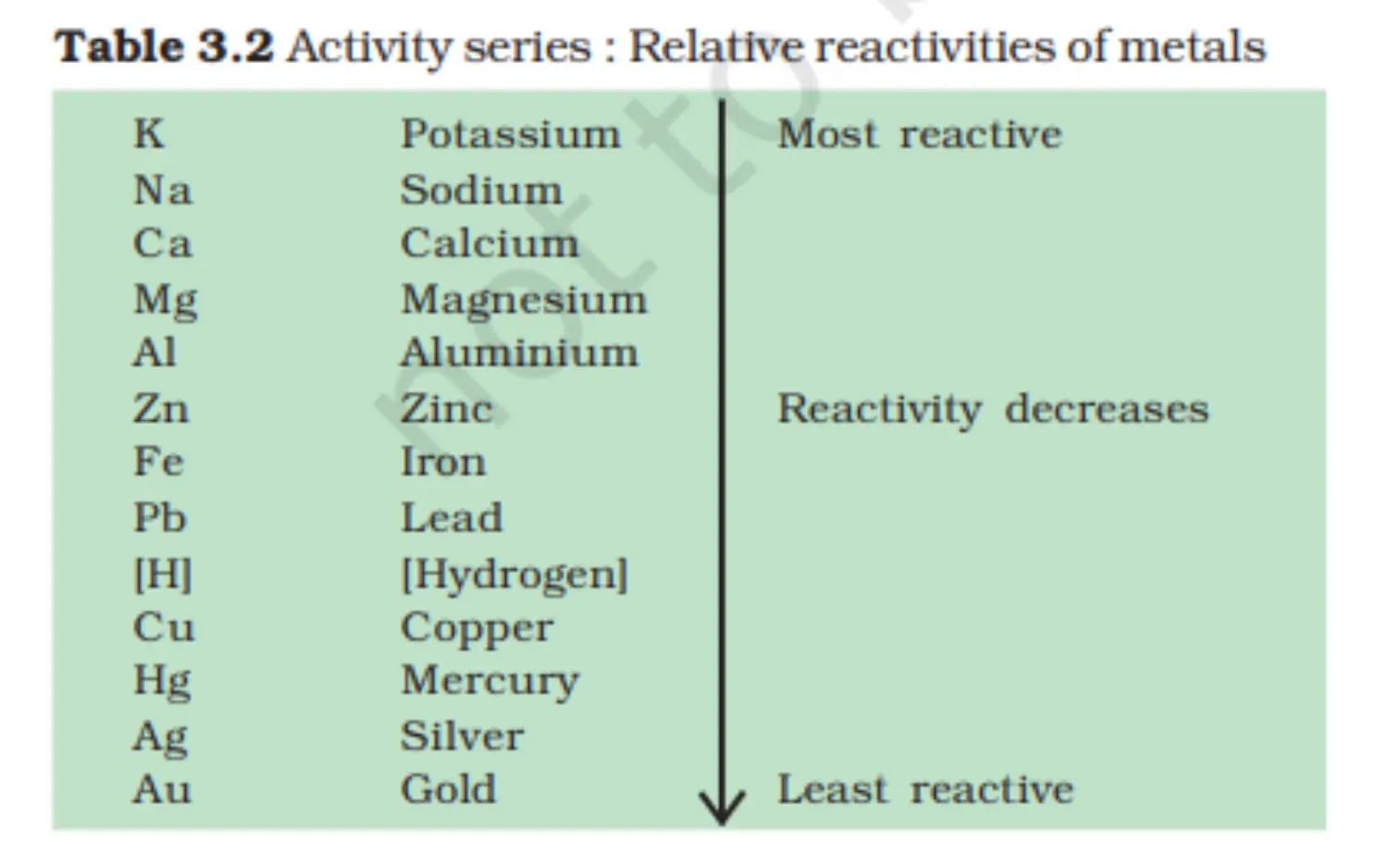
- Definition
- Reactivity with Oxygen
How do Metals and Non-metals React?
- Reactivity Basis
- Elements react to achieve a stable electronic configuration, similar to noble gases.
- Electronic Configuration
- Metals tend to lose electrons, forming cations (positively charged ions).
- Non-metals tend to gain electrons, forming anions (negatively charged ions).
- Ionic Formation
- Sodium (Na) loses an electron to become Na+, a cation.
- Chlorine (Cl) gains an electron to become Cl−, an anion.
- Ionic Compounds
- Formed by the transfer of electrons from metals to non-metals.
- Characterized by strong electrostatic forces of attraction between ions.
- Example: Sodium Chloride (NaCl)
- Does not exist as molecules but as aggregates of ions.
- Example: Magnesium Chloride (MgCl22)
- Magnesium becomes Mg2+, and each chlorine becomes Cl−.
- The cation is Mg2+ and the anions are Cl−.
- Properties of Ionic Compounds
- Physical Nature
- Ionic compounds are hard, brittle solids.
- The strong attraction between ions gives them a hard nature but makes them brittle.
- Melting and Boiling Points
- High melting and boiling points due to strong ionic bonds.
- Requires a lot of energy to break these bonds.
- Solubility
- Generally soluble in water but insoluble in non-polar solvents like kerosene, petrol, etc.
- Conduction of Electricity
- Conducts electricity in a molten or solution state due to the movement of ions.
- Does not conduct electricity in a solid state because ions are fixed in a rigid structure.
- Physical Nature
- Reactivity Basis
Occurrence of Metals
- Sources of Metals
- Primarily obtained from the earth's crust.
- Seawater contains soluble salts like sodium chloride and magnesium chloride.
- Minerals and Ores
- Minerals: Naturally occurring elements or compounds in the earth's crust.
- Ores: Minerals that contain a high percentage of a metal that can be extracted profitably.
Extraction of Metals
- Free State and Compound State Metals
- Free State Metals: Least reactive metals like gold, silver, platinum, and sometimes copper, found in nature in their pure form.
- Combined State Metals: More reactive metals are found as compounds (e.g., oxides, sulfides, carbonates).
- Activity Series and Metal Reactivity
- Low Reactivity Metals: Found in the free state (e.g., gold, silver).
- Medium Reactivity Metals: Found as oxides, sulfides, or carbonates (e.g., zinc, iron, lead).
- High Reactivity Metals: Never found in the free state due to their high reactivity (e.g., potassium, sodium).
- Extraction Process
- Involves several steps to extract a pure metal from its ore, each requiring specific techniques based on the metal’s reactivity.
Flowchart
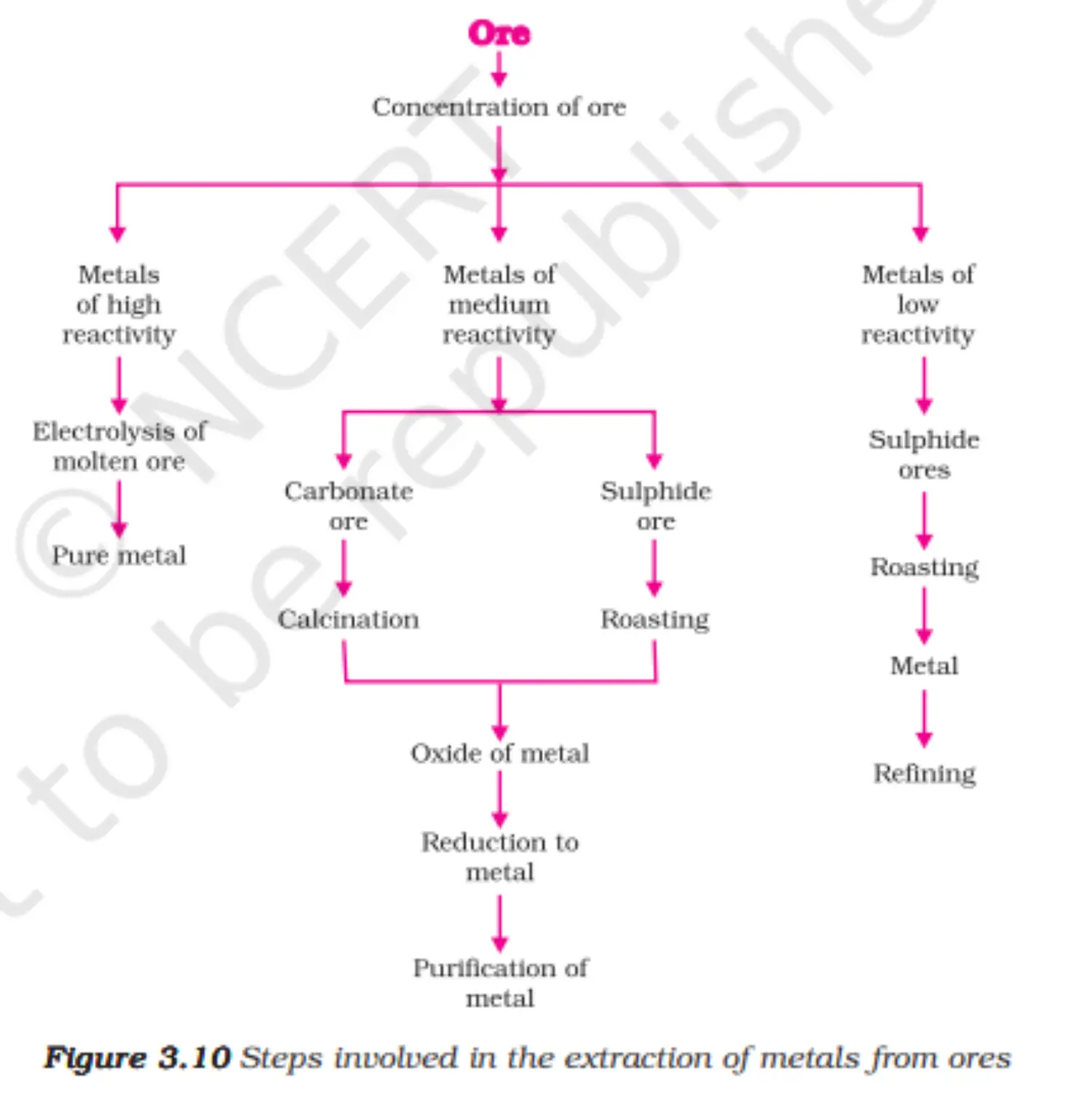
- Free State and Compound State Metals
Enrichment of Ores
- Ore Contamination
- Ores are extracted with impurities like soil and sand, known as gangue.
- Removal of Gangue
- Essential to purify ores by removing gangue before metal extraction.
- Utilizes various physical or chemical separation techniques.
- Separation Techniques
- Chosen based on the difference in physical or chemical properties between the ore and gangue.
- Ore Contamination
Extracting Metals Low in the Activity Series
- Unreactive Metals
- Metals low in the activity series do not react vigorously with other substances.
- Extraction by Heating
- These metals can often be extracted by simple heating (roasting and smelting).
- Example: Mercury from cinnabar (HgS) and copper from copper sulfide (Cu2S).
- Conversion Processes
- Ore is first converted to metal oxide through heating.
- Metal oxide is then reduced to pure metal.
- Examples
- Mercury Extraction:
- Cinnabar heated in air becomes mercuric oxide (HgO).
- Further heating reduces HgO to liquid mercury (Hg).
- Copper Extraction:
- Copper sulfide heated in air to form copper(I) oxide (Cu2O).
- Cu2O, with more Cu2S, heated to yield pure copper (Cu).
- Mercury Extraction:
- Unreactive Metals
Extracting Metals in the Middle of the Activity Series
- Moderate Reactivity Metals
- Metals like iron, zinc, lead, and copper.
- Conversion to Oxides
- Sulfide ores: Converted to oxides by roasting (heating with excess air).
- Carbonate ores: Converted to oxides by calcination (heating in limited air).
- Reduction to Metals
- Metal oxides are reduced to metals using reducing agents like carbon (coke).
- Displacement reactions with more reactive metals (e.g., sodium, calcium, aluminum) can also be used.
- Examples of Reduction
- Zinc Oxide to Zinc:
- ZnO+C→Zn+CO (using carbon).
- Manganese Dioxide to Manganese:
- 3MnO2+4Al→3Mn+2Al2O3 (using aluminum, a highly exothermic reaction).
- Zinc Oxide to Zinc:
- Thermit Reaction
- A highly exothermic reaction used to repair railway tracks or cracked machinery.
- Example: Fe2O3+2Al→2Fe+Al2O3.
- Moderate Reactivity Metals
Extracting Metals towards the Top of the Activity Series
- High Reactivity Metals
- Metals such as sodium, magnesium, calcium, and aluminum.
- Ineffective Carbon Reduction
- These metals cannot be reduced by carbon due to their stronger affinity for oxygen.
- Electrolytic Reduction
- Obtained through the electrolysis of their molten chlorides.
- Electrolysis involves depositing metal at the cathode and liberating chlorine at the anode.
- Electrode Reactions
- Cathode (negative electrode)
- Anode (positive electrode)
- Example of Aluminum
- Obtained by the electrolytic reduction of aluminum oxide (in molten state).
- High Reactivity Metals
Refining of Metals
- Purpose of Refining
- To remove impurities and obtain pure metals.
- Electrolytic Refining
- Widely used for metals like copper, zinc, tin, nickel, silver, and gold.
- Refining Process
- Anode:
- Made of impure metal.
- Cathode:
- A thin strip of pure metal.
- Electrolyte:
- A solution of the metal salt.
- Anode:
- Electrolysis Mechanism
- The impure metal dissolves from the anode into the electrolyte.
- Pure metal is deposited on the cathode.
- Impurities
- Soluble impurities enter the solution.
- Insoluble impurities form 'anode mud' at the anode's bottom.
- Purpose of Refining
- Sources of Metals
Corrosion
- Definition of Corrosion
- The process where metals deteriorate due to the reaction with chemicals in their environment.
- Examples of Corrosion
- Silver
- Tarnishes to black (silver sulfide) when exposed to sulfur in the air.
- Copper
- Develops a green coat (basic copper carbonate) from reacting with moist carbon dioxide.
- Iron
- Acquires rust (a brown flaky substance) when exposed to moist air over time.
- Silver
- Conditions for Rusting of Iron
- The presence of both oxygen and water accelerates rusting.
- Iron does not rust in dry air or in water devoid of oxygen.
- Prevention of Corrosion
- Basic Prevention Methods
- Painting, Oiling, and Greasing
- Create a barrier to moisture and air.
- Galvanizing
- Coating iron with zinc to prevent rust.
- Chrome Plating and Anodising
- Adding a protective layer to prevent corrosion.
- Making Alloys
- Mixing metals to enhance properties and prevent rust.
- Painting, Oiling, and Greasing
- Galvanisation Details
- Process
- A thin zinc layer is applied to steel or iron.
- Protection Mechanism
- Zinc acts as a sacrificial anode, protecting iron even if the coating is damaged.
- Process
- Alloying
- Purpose
- To improve metal properties by mixing with other elements.
- Examples
- Carbon with iron to make steel.
- Nickel and chromium with iron to create stainless steel.
- Properties of Alloys
- Generally have lower electrical conductivity and melting points than pure metals.
- Purpose
- Special Alloys and Uses
- Brass (Copper + Zinc)
- Not used in electrical circuits due to lower conductivity.
- Bronze (Copper + Tin)
- Also, lower in electrical conductivity.
- Solder (Lead + Tin)
- Low melting point, used for welding electrical wires.
- Brass (Copper + Zinc)
- Basic Prevention Methods
- Definition of Corrosion
Additional Concepts
- Anodising of Aluminium
- The process forms a protective oxide layer on the aluminium.
- Increases resistance to corrosion.
- Can be dyed for aesthetic finishes.
- Aqua Regia
- A mixture of HCl and HNO3 in a 3:1 ratio.
- Can dissolve gold and platinum, highly corrosive.
- Gold Alloying
- Pure gold (24 carats) is too soft for jewellery.
- Alloyed with copper or silver to harden it.
- 22-carat gold is commonly used in Indian jewellery.
- Ancient Indian Metallurgy
- The iron pillar in Delhi is an example of advanced ancient techniques.
- Known for rust-resistant properties.
- Metals: Properties and Reactivity
- Lustrous, malleable, ductile, good conductors.
- Form basic oxides, with some being amphoteric.
- The reactivity series determines reactions with water and acids.
- Non-metals: Properties and Reactions
- Opposite properties to metals.
- Form acidic or neutral oxides.
- Cannot displace hydrogen from acids but forms hydrides.
- Metallurgy
- The process of extracting and refining metals.
- Alloys
- Homogeneous mixtures of metals or a metal with a non-metal.
- Used to improve the properties of pure metals.
- Corrosion
- Deterioration of metals when exposed to the environment.
- Prevention includes painting, galvanising, and alloying.
- Anodising of Aluminium
Chapter 4 - Carbon and its Compounds
Introduction
- Introduction to Carbon
- Carbon is a fundamental element found in nature.
- Despite its low abundance in the Earth's crust (0.02%) and atmosphere (0.03% as CO2), it is vital for life and numerous substances.
- Ubiquity of Carbon Compounds
- Common items like food, clothing, and medicines contain carbon compounds.
- Carbon is the backbone of all living structures.
- Carbon Testing
- Burning carbon compounds typically releases CO2.
- The presence of carbon can be tested by burning and checking for CO2 release.
- Significance of Carbon
- Its ability to form a vast number of compounds is unparalleled.
- The diversity of carbon-based life forms and manufactured goods is due to carbon's unique properties.
- Introduction to Carbon
Bonding in Carbon - The Covalent Bond
- Nature of Carbon Compounds
- Carbon compounds usually have low melting and boiling points.
- They are poor conductors of electricity, indicating the absence of free ions.
- Carbon's Electron Configuration
- Carbon has 4 valence electrons and requires 4 more to achieve a noble gas configuration.
- It cannot easily gain or lose 4 electrons due to energy constraints and charge management.
- Formation of Covalent Bonds
- Carbon achieves noble gas configuration by sharing its valence electrons with other atoms.
- This sharing leads to the formation of covalent bonds, creating stable molecules.
- Types of Covalent Bonds
- Single covalent bonds: Shared pair of electrons between two atoms (e.g., H2).
- Double covalent bonds: Two shared pairs of electrons (e.g., O2).
- Triple covalent bonds: Three shared pairs of electrons (e.g., N2).
- Examples of Covalent Molecules
- Hydrogen (H2): Single bond formation for a stable molecule.
- Oxygen (O2): Double bond ensuring full valence shells for both atoms.
- Nitrogen (N2): Triple bond with six shared electrons for stability.
- Methane (CH4): Carbon forms four single covalent bonds with hydrogen.
- Properties of Covalently Bonded Molecules
- Strong intramolecular bonds but weak intermolecular forces.
- Result in low melting and boiling points compared to ionic compounds.
- Generally poor conductors of electricity due to lack of ions.
- Nature of Carbon Compounds
Versatile Nature of Carbon
- Unprecedented Diversity
- Carbon compounds greatly outnumber those of any other element.
- Millions of known carbon compounds exist, displaying vast diversity.
- Catenation
- Definition: Carbon's ability to bond with other carbon atoms.
- Resulting Structures:
- Chains: Linear or branched.
- Rings: Cyclic structures.
- Bond Types:
- Single bonds: Saturated compounds.
- Double or triple bonds: Unsaturated compounds.
- Stability: Carbon-carbon bonds are strong and stable.
- Bonding with Other Elements
- Carbon bonds with O, H, N, S, Cl, and many others.
- Results in compounds with varied properties.
- Strength of Carbon Bonds
- Carbon's small size leads to strong bonds due to effective nuclear control over shared electrons.
- Larger atoms form weaker bonds compared to carbon.
Saturated and Unsaturated Carbon Compounds
- Saturated Carbon Compounds
- Definition: Compounds with single bonds between carbon atoms.
- Examples:
- Methane (CH4)
- Ethane (C2H6)
- Characteristics:
- Formed by satisfying carbon valencies with single bonds.
- Typically less reactive.
- Can be depicted with all valencies satisfied by hydrogen.
- Unsaturated Carbon Compounds
- Definition: Compounds with double or triple bonds between carbon atoms.
- Examples:
- Ethene (C2H4) with a double bond.
- Ethyne (C2H2) with a triple bond.
- Characteristics:
- Have at least one double or triple bond.
- More reactive than saturated compounds.
- Depicted with carbon-carbon multiple bonds.
- Saturated Carbon Compounds
Chains, Branches, and Rings
- Carbon Chain Compounds
- Linear Chains: Compounds with a straight line of carbon atoms like methane (CH4), ethane (C2H6), and propane (C3H8).
- Longer Chains: Carbon chains can extend to contain many carbon atoms forming longer compounds.
- Branching in Compounds
- Butane Example: With four carbon atoms, butane can have straight or branched structures.
- Structural Isomers: Compounds with the same molecular formula but different structures, such as the isomers of butane (C4H10).
- Cyclic Compounds
- Rings of Carbon: Carbon atoms can also be arranged in ring structures, such as in cyclohexane (C6H12).
- Benzene: A well-known ring compound with a formula of C6H6.
- Types of Hydrocarbons
- Saturated Hydrocarbons: Alkanes with only single bonds (e.g., methane, ethane).
- Unsaturated Hydrocarbons:
- Alkenes with one or more double bonds.
- Alkynes with one or more triple bonds.
Table
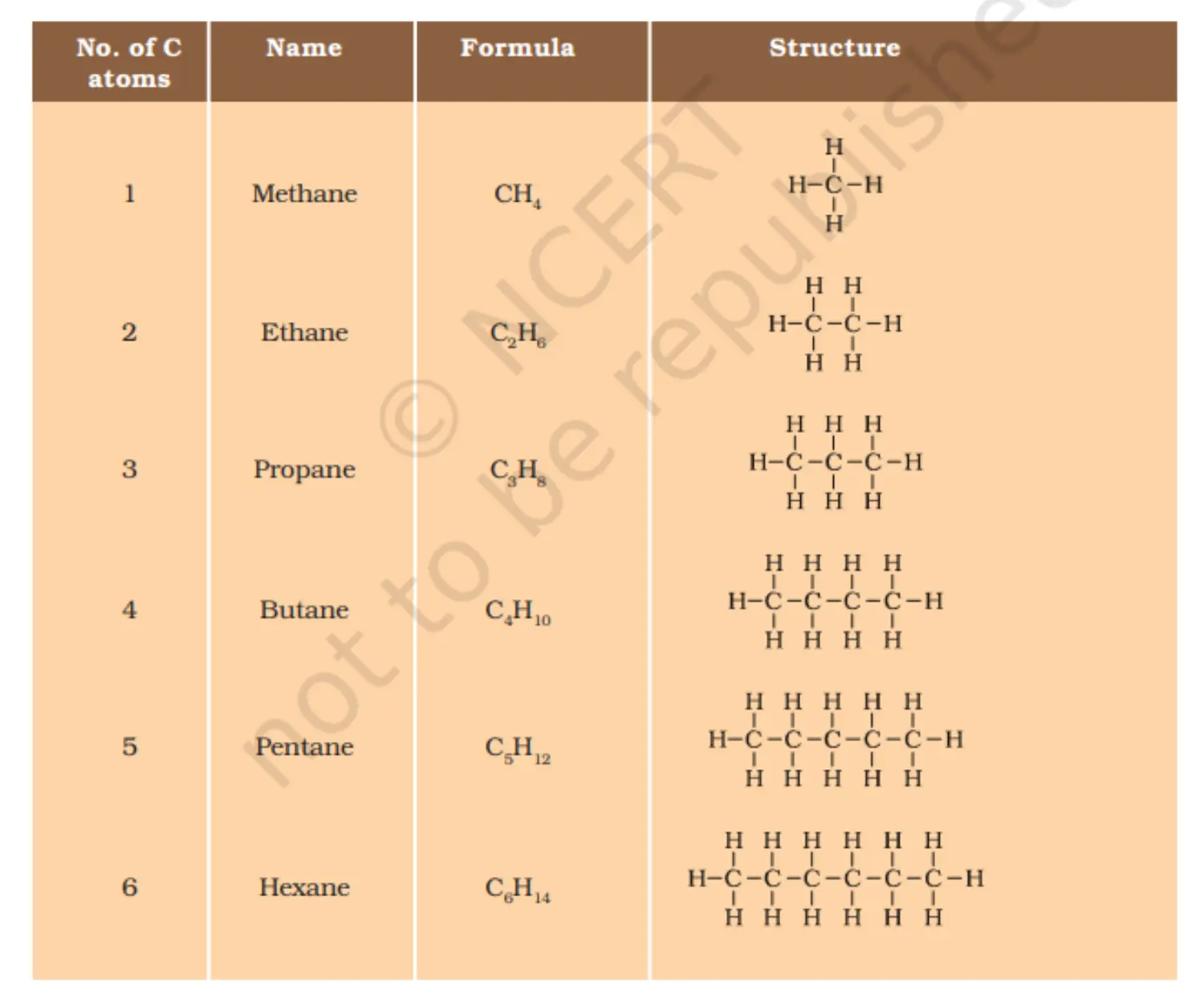
- Carbon Chain Compounds
Will you be my Friend?
- Carbon's Friendliness
- Carbon forms covalent bonds with various elements, not just hydrogen.
- Compound Diversity
- Replacement of hydrogen in hydrocarbons with other elements like oxygen, nitrogen, sulfur, or halogens.
- Functional Groups
- Definition: Atoms or groups of atoms that confer specific chemical properties to the compounds.
- Role of Functional Groups: They define the chemical character of the molecule, regardless of the carbon chain length.
- Attachment of Functional Groups
- Functional groups are connected to the carbon chain by replacing one or more hydrogen atoms.
- Importance of Heteroatoms
- Elements like O, N, S, or halogens in functional groups are called heteroatoms.
- Carbon's Friendliness
Homologous Series
- Definition of Homologous Series
- A series of compounds where each member differs from the next by a consistent unit (often a −CH2− group).
- Characteristics of Homologous Series
- Functional Group: The same functional group across the series determines chemical properties.
- Molecular Mass: Successive members have an incremental increase in molecular mass.
- Examples and Formulas
- Alkanes: Follow the general formula CnH2n+2 (e.g., methane CH4, ethane C2H6).
- Alkenes: Have the general formula CnH2n (e.g., ethene C2H4, propene C3H6).
- Alkynes: Characterized by the general formula CnH2n−2.
- Physical Properties
- Show a gradation in properties like melting point, boiling point, and solubility with increasing molecular mass.
- Chemical Properties
- Remain consistent throughout the series due to the functional group.
- Definition of Homologous Series
Nomenclature of Carbon Compounds
- Basic Chain Naming
- Identify the length of the carbon chain; use root words like meth-, eth-, prop-, etc.
- Inclusion of Functional Groups
- Prefix/Suffix: Functional groups may modify the name as a prefix (before the root) or as a suffix (after the root).
- Suffix Rules:
- If the functional group starts with a vowel and is used as a suffix, remove the ‘e’ from the root name (e.g., "propane" becomes "propane").
- Add the suffix appropriate to the functional group (e.g., "propane" + "ol" for an alcohol group becomes "propanol").
- Unsaturated Hydrocarbons
- Alkenes: Double bonds; replace ‘ane’ with ‘ene’ (e.g., "propane" with a double bond becomes "propene").
- Alkynes: Triple bonds; replace ‘ane’ with ‘yne’ (e.g., "propane" with a triple bond becomes "propyne").
- Chain Complexity
- For branched chains, indicate the position of the branches or functional groups with numbers (e.g., 2-methylpropane).
- Functional Group Priority
- Some functional groups have priority in naming and will influence the position numbering in the carbon chain.
Table
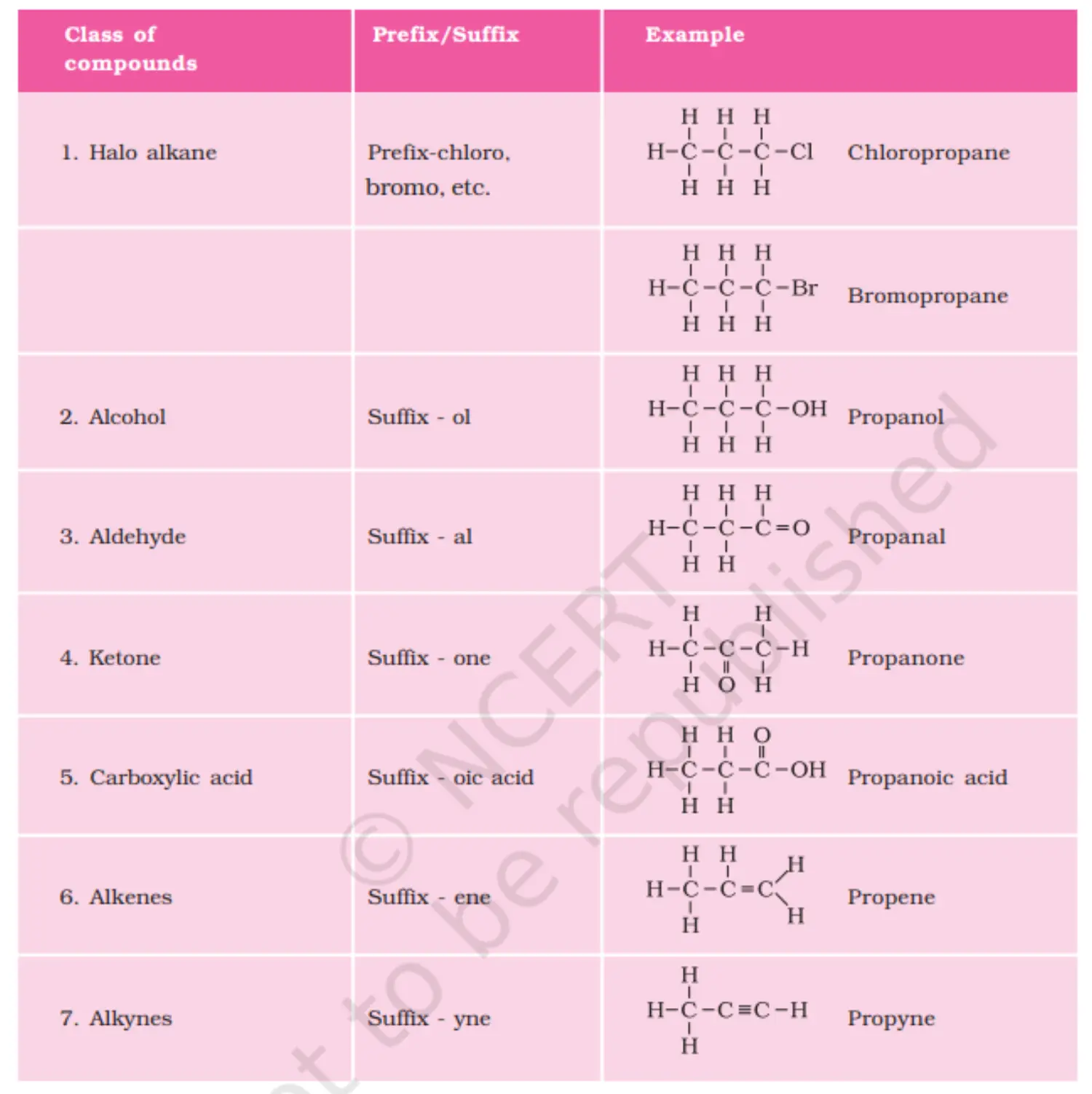
- Basic Chain Naming
- Unprecedented Diversity
Chemical Properties of Carbon Compound
- Combustion
- Complete Combustion: Carbon compounds burn in the presence of oxygen to give carbon dioxide, water, and heat.
- Incomplete Combustion: Limited oxygen supply leads to carbon monoxide or soot (carbon particles).
- Heat Generation: Combustion of fuels generates heat used in various applications.
- Oxidation
- Controlled Oxidation: Involves adding oxygen or removing hydrogen.
- Products: Alcohols can be oxidized to carboxylic acids.
- Addition Reaction
- Unsaturated Compounds: Double or triple bonds can add hydrogen (hydrogenation) or halogens.
- Catalysts: These reactions may require catalysts like nickel or palladium.
- Substitution Reaction
- Saturated Hydrocarbons: Can undergo substitution reactions, such as halogenation.
- Polymerization
- Monomers to Polymers: Small molecules (monomers) combine to form long chains (polymers).
- Combustion
- Basic Combustion Reactions
- Pure carbon burns in oxygen to form carbon dioxide (CO2), releasing heat and light.
- Carbon compounds combust to release CO2, water (H2O), heat, and light.
- Balancing Combustion Equations
- The combustion of methane (CH4) and ethanol (CH3CH2OH) should be balanced to reflect the conservation of mass.
- Flame Characteristics
- Saturated Hydrocarbons: Burn with a clean flame.
- Unsaturated Hydrocarbons: Tend to give a yellow flame with soot due to incomplete combustion.
- Incomplete Combustion
- Inadequate oxygen supply can lead to incomplete combustion, resulting in sooty flames and wasted fuel.
- Environmental Impact
- Combustion of fuels like coal and petroleum can produce oxides of sulfur and nitrogen, contributing to pollution.
- Basic Combustion Reactions
- Oxidation
- Oxidation Basics
- Oxidation in carbon compounds involves the addition of oxygen or the removal of hydrogen.
- Complete combustion is a form of oxidation where carbon compounds form carbon dioxide and water.
- Conversion Reactions
- Alcohols can be oxidized to carboxylic acids.
- Oxidizing agents like alkaline potassium permanganate (KMnO4) or acidified potassium dichromate (K2Cr2O7) are used to facilitate this transformation.
- Oxidizing Agents
- Substances that add oxygen to others are called oxidizing agents.
- These agents can convert alcohols to carboxylic acids by adding oxygen to the alcohol molecules.
- Oxidation Basics
- Addition Reaction
- Unsaturated Hydrocarbons
- Have double or triple bonds and can add hydrogen in the presence of catalysts.
- This addition converts them into saturated hydrocarbons.
- Role of Catalysts
- Catalysts like palladium or nickel speed up the reaction without being consumed.
- They are essential for the hydrogenation process.
- Hydrogenation Process
- Used to convert vegetable oils (unsaturated) into saturated fats.
- Involves the addition of hydrogen to unsaturated carbon chains.
- Health Implications
- Saturated fats, often found in animal fats, are considered less healthy.
- Unsaturated fats, typically in vegetable oils, are recommended for healthier diets.
- Unsaturated Hydrocarbons
- Substitution Reaction
- Characteristics of Saturated Hydrocarbons
- Generally inert and unreactive with most reagents.
- Can undergo substitution reactions under certain conditions.
- Substitution Reaction
- Involves the replacement of a hydrogen atom by another atom or group, like chlorine.
- Occurs in the presence of sunlight, which acts as an energy source for the reaction.
- Mechanism of Reaction
- Chlorine, when exposed to sunlight, can add to hydrocarbons, replacing hydrogen atoms successively.
- This results in the formation of different products, depending on the number of substitutions.
- Example
- Methane reacting with chlorine gas in the presence of sunlight produces chloromethane and hydrochloric acid.
- Characteristics of Saturated Hydrocarbons
- Combustion
Some Important Carbon Compounds - Ethanol and Ethanoic Acids
- Ethanol (C2H5OH)
- Commonly known as alcohol, used in beverages, as a solvent, and in sanitizers.
- Produced by the fermentation of sugars.
- Properties of Ethanol
- Physical: Colorless liquid, distinctive smell, and taste.
- Chemical: Burns in air to produce carbon dioxide and water; reacts with sodium to produce hydrogen.
- Uses of Ethanol
- In alcoholic beverages due to its psychoactive effects.
- As a solvent in the pharmaceutical and cosmetics industry.
- As a fuel and in the production of biofuels.
- Ethanoic Acid (CH3COOH)
- Also known as acetic acid, the main component of vinegar.
- Produced both synthetically and by bacterial fermentation.
- Properties of Ethanoic Acid
- Physical: Colorless liquid with a sour taste and strong vinegar-like smell.
- Chemical: Reacts with alcohols to form esters and with bases to form acetates.
- Uses of Ethanoic Acid
- As a preservative and flavoring agent in the food industry.
- In the manufacture of synthetic textiles and polymers.
- As a reagent in chemical syntheses.
- Properties of Ethanol
- Physical Properties of Ethanol
- State: Liquid at room temperature.
- Solubility: Miscible with water in all proportions.
- Use in Alcoholic Drinks: Active ingredient in alcoholic beverages.
- Use in Medicine: Used as a solvent in tinctures, cough syrups, and tonics.
- Health Impact
- Drunkenness: Caused by the consumption of dilute ethanol.
- Toxicity: Pure ethanol (absolute alcohol) is lethal in small quantities.
- Long-Term Effects: Chronic alcohol consumption leads to serious health issues.
- Chemical Reactions of Ethanol
- With Sodium: Produces hydrogen gas and sodium ethoxide.
- Reaction: 2Na+2CH3CH2OH→2CH3CH2O−Na++H2
- Dehydration to Ethene:
- Conditions: Heated with excess concentrated sulfuric acid at 443 K.
- Reaction: CH3CH2OH→CH2=CH2+H2O
- Agent: Concentrated H2SO4 acts as a dehydrating agent.
- With Sodium: Produces hydrogen gas and sodium ethoxide.
- Physical Properties of Ethanol
- Properties of Ethanoic Acid
- Common Names and Uses
- Also Known As Acetic acid.
- Vinegar: 5-8% solution of acetic acid in water.
- Preservative: Used in pickles.
- Physical Properties
- Melting Point: Freezes at 290 K, hence called glacial acetic acid.
- Acidity
- Type of Acid: Carboxylic acid, which is a weak acid compared to mineral acids like HCl.
- Chemical Reactions of Ethanoic Acid
- Esterification:
- Formation of esters from acids and alcohols.
- Reaction: CH3COOH+CH3CH2OH→CH3COOCH2CH3+H2O
- Uses of Esters: Perfumes and flavoring agents.
- Saponification: Ester reacts with NaOH to revert to alcohol and soap (sodium carboxylate).
- Reaction with Base:
- Forms salt (sodium ethanoate) and water.
- Reaction: NaOH+CH3COOH→CH3COONa+H2O
- Esterification:
- How does ethanoic acid react with carbonates and hydrogen carbonates?
- Reactions with Carbonates General Reaction: Ethanoic acid reacts with carbonates to produce salt, carbon dioxide, and water.
- Example:2CH3COOH+Na2CO3→2CH3COONa+H2O+CO2Salt Formed: Sodium acetate.
- Reactions with HydrogencarbonatesGeneral Reaction: Similar to carbonates, ethanoic acid reacts with hydrogencarbonates to yield salt, carbon dioxide, and water.
- Example: CH3COOH+NaHCO3→CH3COONa+H2O+CO2
- Common Names and Uses
- Ethanol (C2H5OH)
Soaps and Detergents
- Understanding Soap
- Nature of Soap: Soap molecules are sodium or potassium salts of long-chain carboxylic acids.
- Function: They clean by forming structures called micelles, which emulsify oils and dirt, making them soluble in water.
- Soap Micelles
- Structure: Soap molecules arrange themselves in a spherical structure with the ionic end facing the water and the hydrocarbon tail facing the oil or dirt.
- Cleaning Mechanism: The micelles trap oil or dirt within their structure, allowing it to be washed away with water.
- Soap vs. Hard Water
- Problem with Hard Water: Soap reacts with calcium and magnesium in hard water, forming an insoluble substance (scum) and reducing effectiveness.
- Consequence: More soap is required in hard water to achieve cleaning.
- Detergents
- Composition: Detergents are sodium salts of sulphonic acids or ammonium salts and do not form scum with hard water.
- Advantages: Effective in hard water and does not leave insoluble residues.
- Uses: Commonly used in shampoos and cleaning products for clothes.
- Understanding Soap
Additional Concepts
- Allotropes of Carbon
- Diamond: Carbon atoms bonded to four others, forming a three-dimensional structure.
- Graphite: Carbon atoms bonded to three others in a plane, with hexagonal arrays layered on each other.
- Fullerenes: A class of carbon allotropes, including C-60 with a football-like structure.
- Organic Compounds
- Tetravalency and Catenation: Characteristics of carbon leading to a vast number of compounds.
- Historical Aspect: Once believed to require a 'vital force' for formation, disproven by Friedrich Wöhler.
- Combustion and Flames
- Gaseous Substances: Produce flames when they burn.
- Charcoal: Glows red and emits heat without a flame due to lack of gaseous substances.
- Formation of Coal and Petroleum
- Coal: Formed from plant remains under geological pressures and processes.
- Petroleum: Originates from tiny sea plants and animals, transformed under high pressure into oil and gas.
- Effects of Alcohols
- Ethanol: In small amounts can cause relaxation, but in large amounts leads to depression of the central nervous system.
- Methanol: Even in small quantities can cause death, affects the liver, and causes blindness.
- Alcohol as Fuel
- Biofuel: Ethanol from sugarcane is used as an additive in petrol due to its cleaner combustion.
- Micelles and Cleaning Action
- Soap Structure: Contains hydrophilic and hydrophobic ends.
- Cleaning Mechanism: Soap micelles trap oily dirt and keep it suspended, allowing it to be rinsed away.
- Allotropes of Carbon
Chapter 5 - Life Processes
Introduction
- Identification of Life
- Observing movement in animals, such as running or breathing, indicates life.
- Sleep or inactivity does not negate the presence of life.
- Plants and Life
- Greenery is often associated with life, but not all plants have green leaves.
- Growth over time is a sign of life in plants.
- Movement as a Characteristic
- Visible movement is not a reliable indicator since not all living things show obvious movement.
- Molecular movements, although invisible, are crucial for life.
- Viruses and Life
- Viruses lack molecular movement outside of a host cell, leading to debate over their status as living entities.
- Molecular Movements and Life
- Molecular movement is essential for maintaining life's organized structure.
- The environment can disrupt the order, necessitating constant repair and maintenance.
- Maintenance Processes
- Living organisms engage in continuous maintenance of their structures at a molecular level.
- Identification of Life
What are Life Processes?
- Definition of Life Processes
- Life processes refer to the maintenance functions that continue in living organisms at all times, even during rest or sleep.
- Energy for Maintenance
- Energy is essential for life processes and is obtained from food, which is taken from outside the organism.
- Nutrition
- Nutrition involves the intake of food to provide energy for growth and maintenance.
- Variety in Nutritional Needs
- Different organisms require various complex carbon-based molecules, leading to diverse nutritional processes.
- Respiration
- This is the acquisition of oxygen from outside the body to break down food sources at the cellular level.
- Specialisation in Multi-cellular Organisms
- Specialised tissues develop for intake of food and oxygen due to increased body size and complexity.
- Transportation System
- A system to carry food and oxygen to different parts of the body, and waste away from cells, becomes necessary.
- Excretion
- The removal of waste by-products from the body to avoid harm.
- Integration of Life Processes
- These processes are interconnected and collectively essential for maintaining life in an organism.
- Definition of Life Processes
Nutrition
- Essence of Nutrition
- Nutrition is the process of taking in food to obtain energy and materials for growth, development, and maintenance of the body.
- Energy Requirements
- Energy from food is utilized not only for activities like walking and cycling but also for maintaining bodily functions at rest.
- Growth and Development
- Food provides the necessary raw materials for cellular growth, development, and synthesis of vital substances like proteins.
- How do living things get their Food?
- Diversity in Nutritional Needs
- Organisms have varied nutritional requirements to fulfill their energy and material needs.
- Autotrophs: The Self-Feeders
- Definition:
- Autotrophs are organisms that synthesize their own food from inorganic substances.
- Examples:
- Green plants and certain bacteria.
- Process:
- Utilize carbon dioxide and water to produce food through processes like photosynthesis.
- Definition:
- Heterotrophs: The Other-Feeders
- Definition:
- Heterotrophs depend on complex organic substances for nutrition.
- Enzymatic Breakdown:
- Require enzymes to digest complex molecules into simpler ones for absorption.
- Dependency:
- Heterotrophs, including animals and fungi, rely directly or indirectly on autotrophs for sustenance.
- Definition:
- Diversity in Nutritional Needs
- Autotrophic Nutrition
- Fundamentals of Photosynthesis
- Autotrophs, such as plants, synthesize their own food through photosynthesis using:
- Carbon dioxide (CO2)
- Water (H2O)
- Sunlight
- Chlorophyll
- Autotrophs, such as plants, synthesize their own food through photosynthesis using:
- Process of Photosynthesis
- Energy Conversion:
- Light energy absorbed by chlorophyll is converted into chemical energy.
- Water Splitting:
- Water molecules are split into hydrogen and oxygen.
- Carbon Reduction:
- CO2 is reduced to form carbohydrates.
- Energy Conversion:
- Chlorophyll and Chloroplasts
- Chlorophyll:
- Essential for capturing light energy.
- Chloroplasts:
- Organelles in plant cells that contain chlorophyll.
- Chlorophyll:
- Gaseous Exchange and Stomata
- Stomata:
- Tiny pores on leaves for CO2 intake.
- Guard Cells:
- Regulate the opening and closing of stomatal pores.
- Stomata:
- Raw Materials for Photosynthesis
- Water:
- Absorbed from the soil by roots.
- Minerals:
- Nitrogen, phosphorus, iron, magnesium, etc., are taken from the soil.
- Nitrogen Uptake:
- In the form of inorganic nitrates/nitrites or organic compounds.
- Water:
- Fundamentals of Photosynthesis
- Heterotrophic Nutrition
- Adaptation to Environment
- Organisms have nutrition forms suited to their environment and food availability.
- Types of Heterotrophic Nutrition
- Saprobiotic Nutrition:
- Organisms like fungi (bread moulds, yeast, mushrooms) decompose and absorb nutrients from dead organic matter.
- Holozoic Nutrition:
- Involves ingestion of solid food and its internal breakdown, as seen in animals.
- Parasitic Nutrition:
- Organisms (cuscuta, ticks, lice, leeches, tapeworms) feed on hosts without killing them, obtaining nourishment directly from the hosts' bodies.
- Saprobiotic Nutrition:
- Nutrition Strategies
- External Digestion:
- Some organisms secrete digestive enzymes and absorb digested nutrients from the environment.
- Internal Digestion:
- Others consume and digest food within their bodies through specialized systems.
- External Digestion:
- Dependency on Other Organisms
- Many heterotrophs depend directly or indirectly on autotrophs for their nutritional needs.
- Adaptation to Environment
- How do Organisms obtain their Nutrition?
- Nutrition in Simple Organisms
- Single-celled organisms absorb nutrients across their entire surface due to their simple structure.
- Specialised Nutritional Methods
- As organisms increase in complexity, they develop specialised regions for nutrition.
- Nutrition in Amoeba
- Utilises pseudopodia to engulf food forming a food vacuole.
- Inside the vacuole, enzymatic breakdown of food occurs.
- Absorbed nutrients diffuse into the cytoplasm.
- Undigested residue is expelled out of the cell.
- Nutrition in Paramecium
- Has a more defined cellular structure.
- Cilia around the cell help sweep food towards the cell mouth.
- Maintains a specific spot for food intake.
- Nutrition in Simple Organisms
- Nutrition in Human Beings
The Alimentary Canal
- A long tube from the mouth to the anus, specialized in different regions for various functions.
Ingestion and Digestion
- Mouth: Food is crushed by teeth, mixed with saliva containing the enzyme salivary amylase which begins the breakdown of starch.
- Oesophagus: Food is pushed down by peristaltic movements towards the stomach.
Digestion in Stomach
- Stomach: Secretes gastric juices including hydrochloric acid, pepsin, and mucus.
- Acid: Creates an acidic environment for enzyme activity and protects against microbes.
- Mucus: Protects stomach lining from acid.
Regulation of Exit
- Sphincter Muscle: Controls the release of food into the small intestine.
Digestion in Small Intestine
- Site of Complete Digestion: Digestion of carbohydrates, proteins, and fats is completed here.
- Liver: Produces bile which neutralizes stomach acid and emulsifies fats.
- Pancreas: Secretes pancreatic juice with enzymes for protein and fat digestion.
Absorption
- Small Intestine: Lined with villi that absorb digested nutrients into the bloodstream.
- Villi: Increase surface area for absorption, rich in blood vessels.
Elimination
- Large Intestine: Absorbs water, forms feces.
- Anus: Regulated by anal sphincter, expels waste.
Diagram
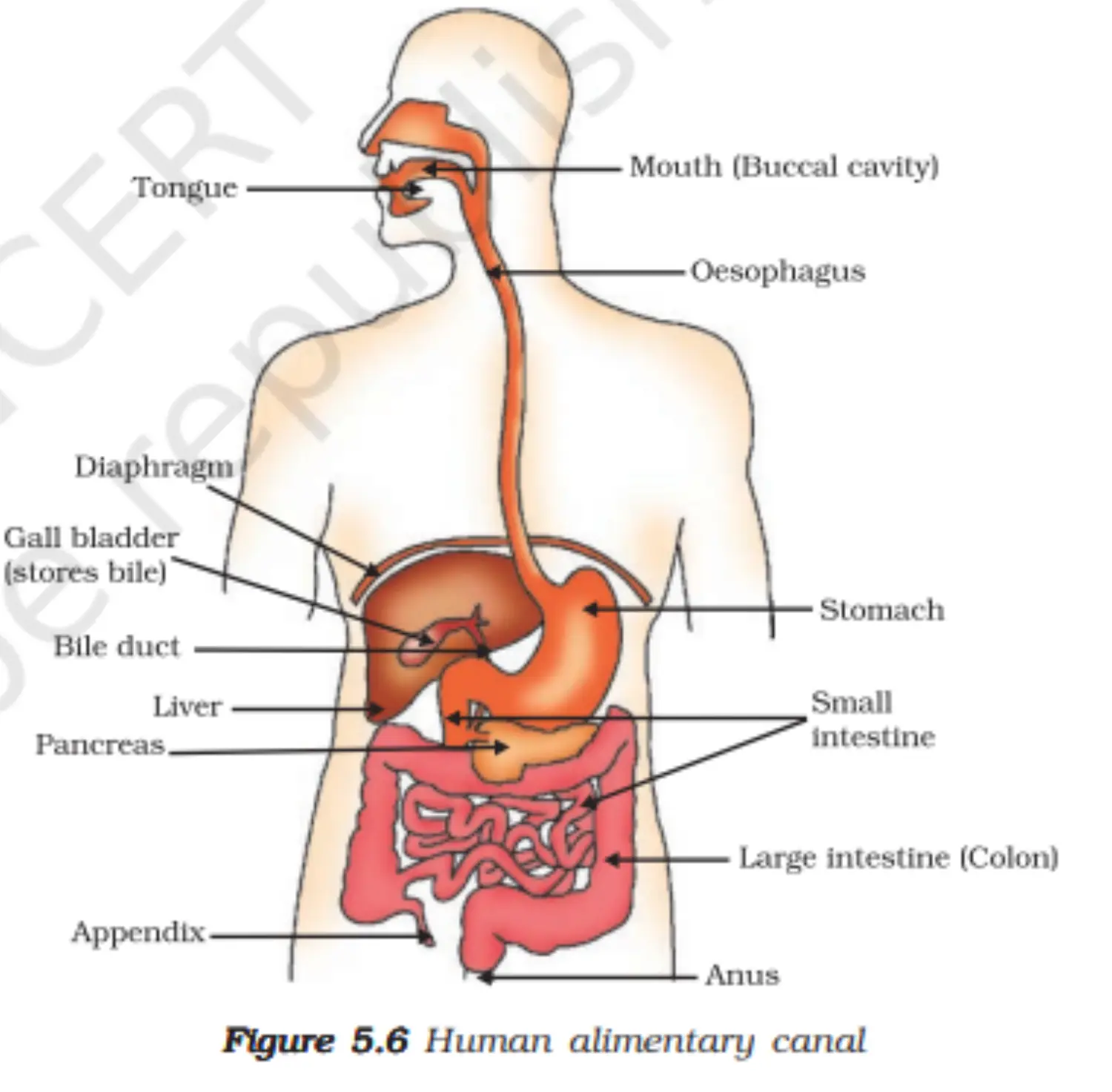
- Essence of Nutrition
Respiration
Basics of Respiration
- Involves energy release from food substances within cells.
- Glucose breakdown is the first step, converting into pyruvate.
Types of Respiration
- Aerobic Respiration:
- Occurs in mitochondria with oxygen, producing CO2, water, and energy.
- Anaerobic Respiration:
- Occurs without oxygen, producing ethanol, CO2 in yeast (fermentation), or lactic acid in muscles.
- Aerobic Respiration:
Energy Utilization
- Energy released forms ATP, the energy currency for cells.
- ATP fuels cellular activities and drives endothermic reactions.
Gas Exchange in Plants
- Occurs through stomata by diffusion, influenced by environmental conditions.
Respiratory Organs in Animals
- Adapted for oxygen uptake and CO2 release.
- Aquatic animals have gills, terrestrial animals have lungs or other structures.
Human Respiratory System
- Air Intake: Through nostrils, filtered by hairs and mucus.
- Air Passage: Through throat, where rings of cartilage prevent collapse.
- Lungs and Alveoli: Site of gas exchange; alveoli have extensive blood vessels.
Breathing Mechanism
- Ribs lift and diaphragm flattens to increase chest cavity volume and draw in air.
- Oxygen is absorbed, and carbon dioxide is released in the lungs.
Oxygen Transport
- Respiratory pigment haemoglobin in red blood cells transports oxygen.
- Carbon dioxide, more soluble in water, is transported mostly in dissolved form in blood.
Flowchart
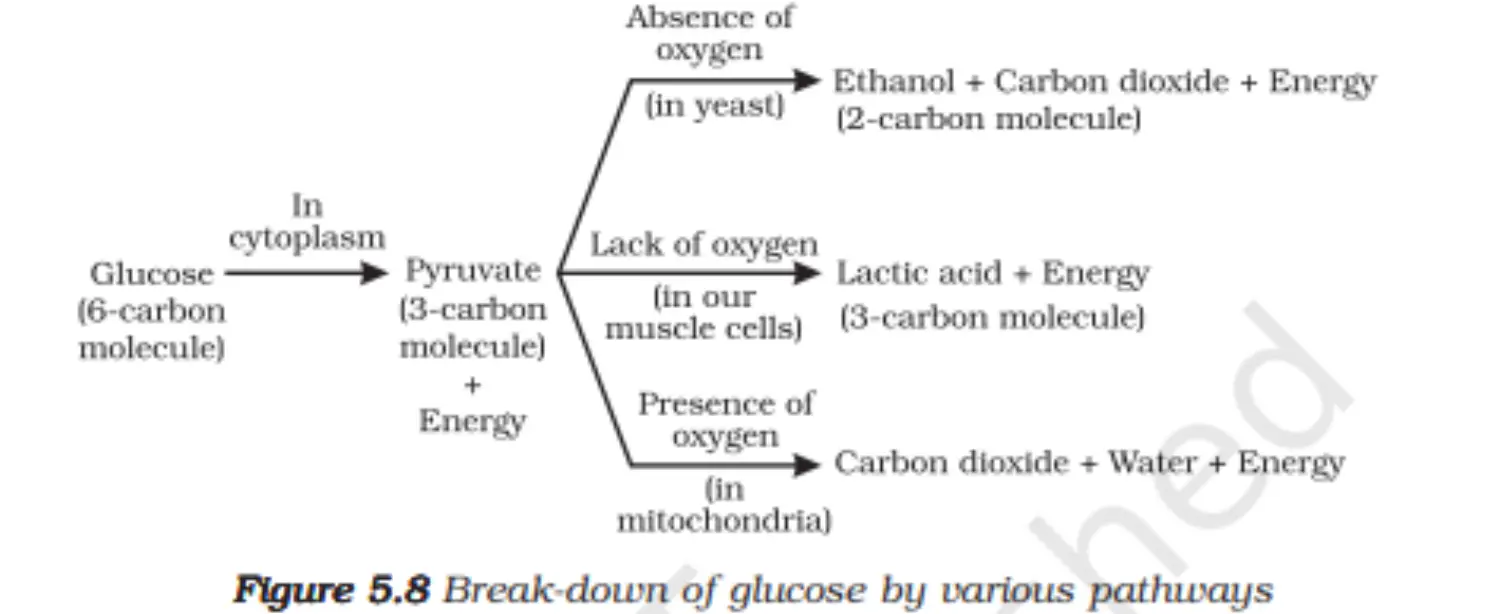
Diagram
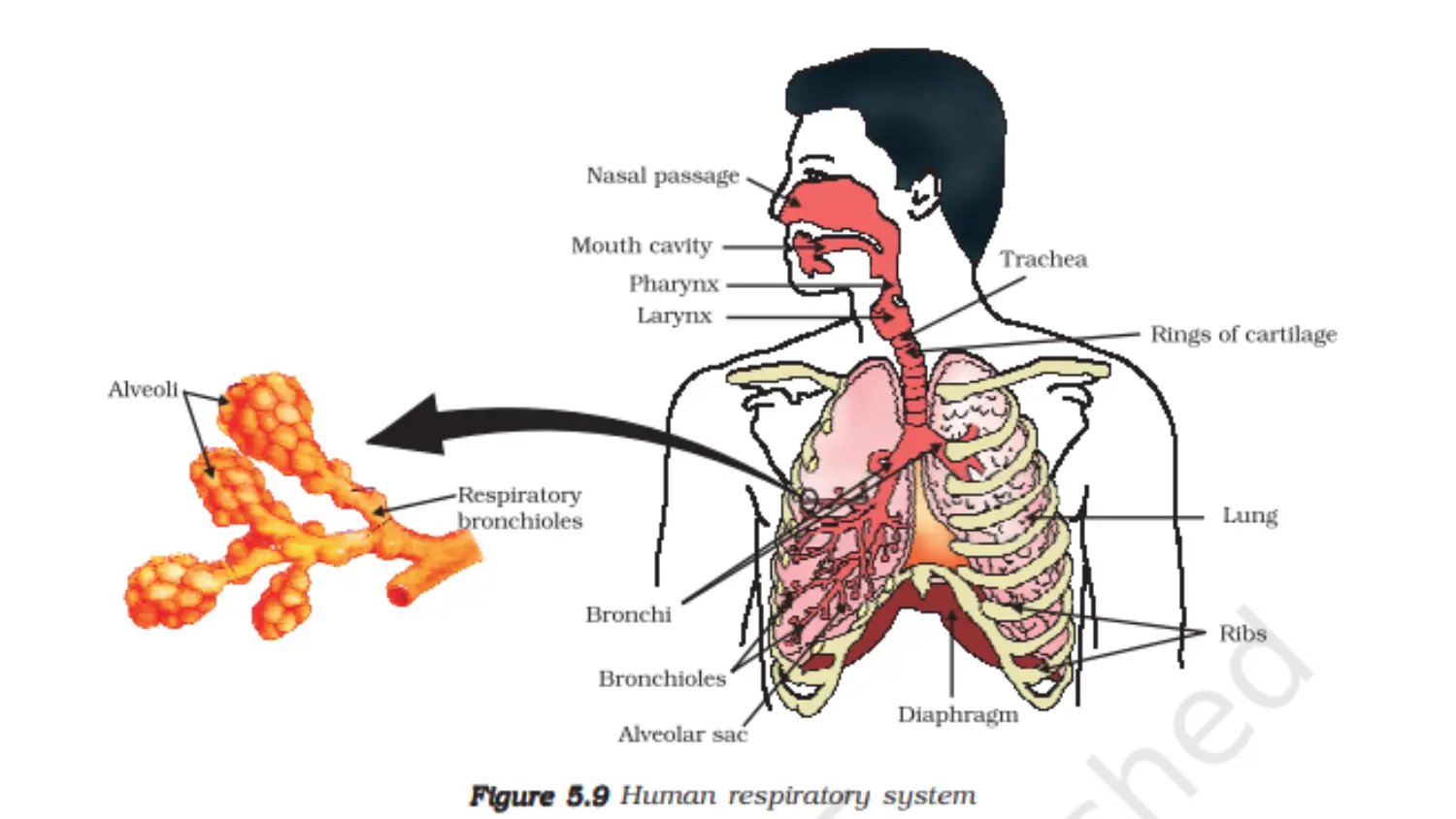
Transportation
- Transportation in Human Beings
- Role of Blood
- Transports essential substances like food, oxygen, and wastes.
- Blood is a fluid connective tissue.
- Components of Blood
- Plasma: The fluid medium carrying food, CO2, and waste in dissolved form.
- Red Blood Cells (RBCs): Specialize in oxygen transport.
- Other Substances: Blood also carries salts and various nutrients.
- Circulatory System Components
- Heart: The pumping organ that moves blood through the body.
- Blood Vessels: A network of tubes (arteries, veins, capillaries) that deliver blood to tissues.
- Repair System: Mechanisms to fix damage within the network.
Our pump — the heart
- Heart Structure
- Muscular organ, size of a fist.
- Has separate chambers to prevent mixing of oxygen-rich and carbon-dioxide-rich blood.
- Chambers of the Heart
- Left Atrium: Receives oxygen-rich blood from the lungs.
- Left Ventricle: Pumps oxygen-rich blood to the body.
- Right Atrium: Receives deoxygenated blood from the body.
- Right Ventricle: Sends deoxygenated blood to the lungs for oxygenation.
- Heart Functioning
- Chambers contract and relax in a sequence to pump blood.
- Ventricles have thicker walls to pump blood to various organs.
- Valves prevent backflow of blood during contraction.
Diagram
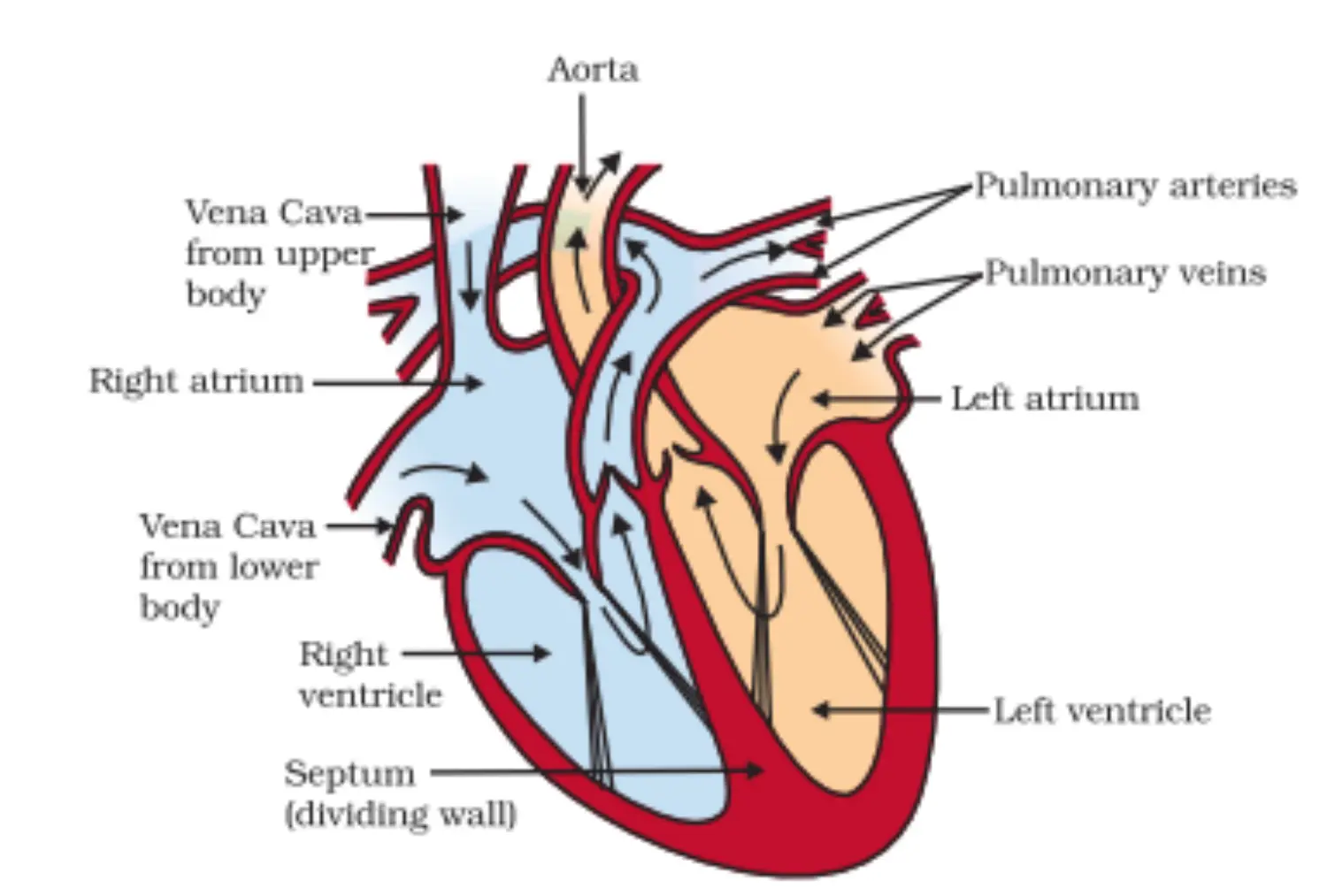
- Heart Structure
Oxygen enters the blood in the lungs
- Heart Separation
- Keeps oxygen-rich (oxygenated) and oxygen-poor (deoxygenated) blood from mixing.
- Enhances efficiency of oxygen supply to the body.
- Energy and Temperature Regulation
- High energy animals (birds, mammals) use energy to maintain body temperature and have 4-chambered hearts.
- Cold-blooded animals (amphibians, reptiles) depend on environmental temperature and may have 3-chambered hearts, allowing some blood mixing.
- Different Heart Structures
- Fish: 2-chambered heart with single circulation (blood passes through the heart once per cycle).
- Other vertebrates: 4-chambered heart with double circulation (blood passes through the heart twice per cycle).
Diagram
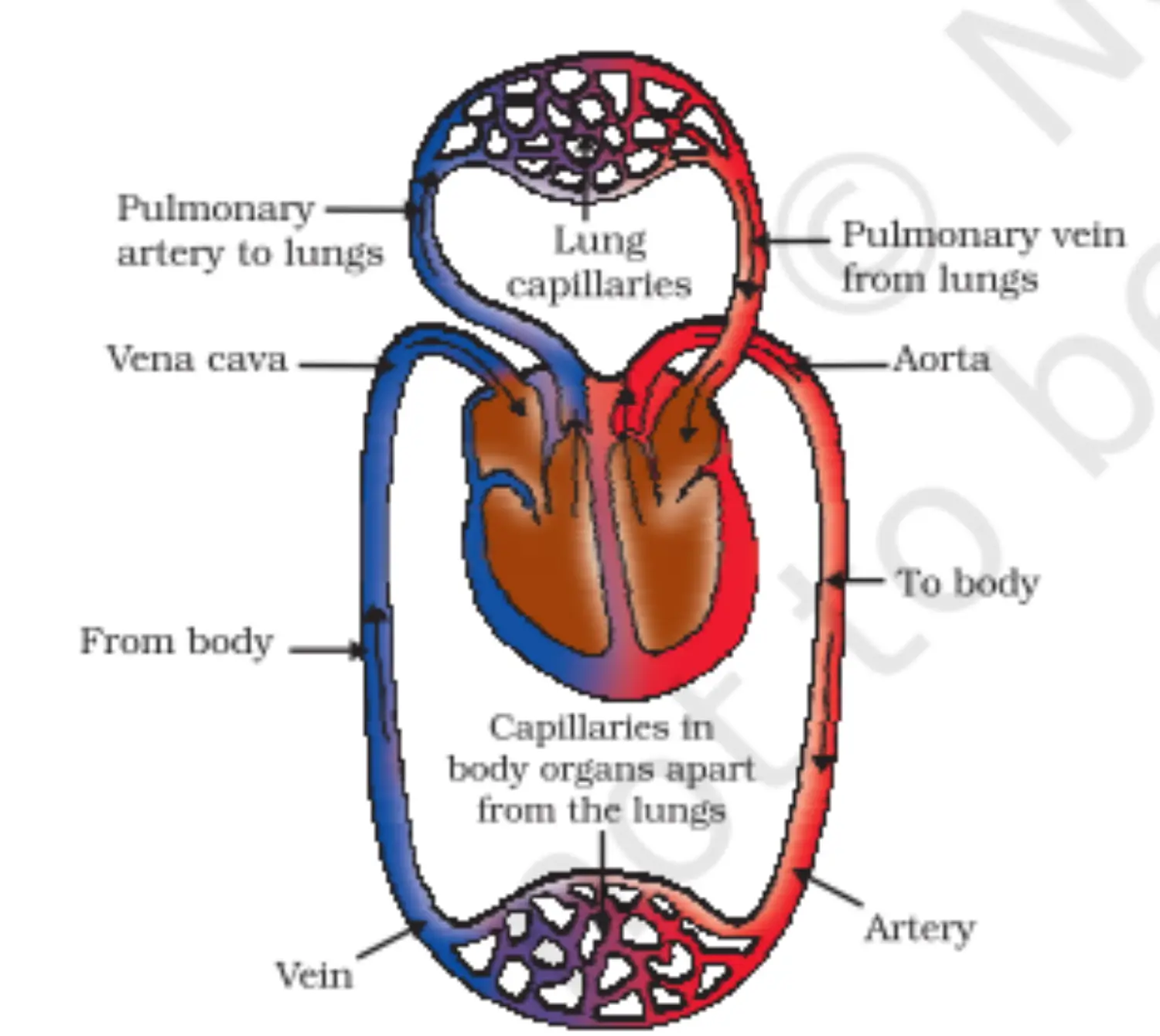
- Heart Separation
The tubes – blood vessels
- Arteries
- Function: Carry blood away from the heart.
- Structure: Thick, elastic walls to handle high pressure.
- Veins
- Function: Return blood to the heart.
- Structure: Thinner walls than arteries, contain valves to prevent backflow.
- Capillaries
- Role: Connect arteries and veins, facilitate exchange with cells.
- Structure: Walls one-cell thick for easy material exchange.
- Arteries
Maintenance by platelets
Platelets
- Role: Circulate in the blood and respond to vascular injury.
- Function: Plug leaks in the blood vessels by clotting blood.
- Importance: Prevents blood loss and maintains blood pressure for system efficiency.
Lymph
- Lymph
- Definition: A fluid that is part of the body's transport system.
- Origin: Arises from blood plasma through capillary walls into tissue spaces.
- Composition: Similar to blood plasma but with less protein and no color.
- Functions of Lymph
- Transports absorbed fats from the intestine.
- Returns excess interstitial fluid to the bloodstream.
- Lymphatic System
- Lymph Capillaries: Begin in tissue spaces and absorb lymph.
- Lymph Vessels: Formed from lymph capillaries, transport lymph.
- Integration with Veins: Large lymph vessels empty into veins, returning lymph to the bloodstream.
- Lymph
- Role of Blood
- Transportation in Plants
- Introduction
- Plants synthesize energy through photosynthesis in leaves.
- Nutrients and minerals are absorbed from the soil via roots.
- Need for Transportation
- Short Distances: Diffusion is sufficient for transport within small plants.
- Long Distances: Large plants, such as tall trees, require a dedicated transport system.
- Transport Systems in Plants
- Xylem: Conducts water and minerals from roots to leaves.
- Phloem: Distributes the products of photosynthesis from leaves to other plant parts.
- Efficiency and Energy
- Plants have low energy needs and support slower transport systems.
- The transport operates over potentially vast distances in large plants.
- Transport of Water
- Xylem Tissue
- Vessels and tracheids form a continuous system for water transport.
- Root Absorption
- Active uptake of ions at the roots.
- Water moves into the root to balance ion concentration.
- Water Movement
- Root pressure aids in pushing water upwards.
- Pressure alone is insufficient for high elevation transport.
- Transpiration
- Loss of water as vapor from leaves creates a suction force.
- Transpiration pull is essential for upward water movement during the day.
- Functions of Transpiration
- Assists in nutrient uptake.
- Regulates temperature.
- Drives water transport when stomata are open.
- Root Pressure vs. Transpiration Pull
- Root pressure functions more at night.
- Transpiration pull is the dominant force during the day.
- Xylem Tissue
- Transport of food and other substances
- Phloem Tissue
- Responsible for translocation of photosynthesis products.
- Also transports amino acids and other substances.
- Direction of Movement
- Movement occurs in both upward and downward directions.
- Utilizes sieve tubes and companion cells for transport.
- Translocation Process
- Involves active transport using ATP.
- Sucrose and other materials are moved into the phloem.
- Osmotic Pressure
- Increased by loading of materials, drawing water into phloem.
- Drives the flow of substances to areas of lower pressure.
- Energy Utilization
- ATP is used to transport materials into phloem tissue.
- Distribution According to Needs
- Phloem moves substances to where they are needed most.
- Example: In spring, sugars move to buds for growth.
- Phloem Tissue
- Introduction
- Transportation in Human Beings
Excretion
- Definition of Excretion
- The biological process of removing metabolic wastes.
- Types of Wastes
- Mainly nitrogenous products from metabolic activities.
- Excretion in Various Organisms
- Unicellular Organisms: Use simple diffusion for waste removal.
- Multi-cellular Organisms: Have specialized organs for excretion.
- Purpose of Excretion
- To eliminate harmful substances that can be detrimental to health.
- Excretion in Human Beings
- Components of the Excretory System
- Kidneys: A pair, filtering blood to create urine.
- Ureters: Tubes carrying urine from kidneys to the bladder.
- Urinary Bladder: Stores urine until expulsion.
- Urethra: The duct through which urine is discharged.
- Urine Production
- Purpose: To eliminate waste from the blood.
- Process: Blood is filtered in the kidneys' capillaries, entering Bowman’s capsule.
- Nephrons: The Functional Units
- Filtration Units: Numerous in each kidney.
- Reabsorption: Selective uptake of glucose, amino acids, salts, and water.
- Urine Transport and Storage
- Ureters: Conduct urine to the bladder.
- Bladder: Expands as it fills, controlled release via urethra.
- Control of Urination
- Muscular Bladder: Under nervous system control for urination regulation.
- Components of the Excretory System
- Excretion in Plants
- Excretion Mechanisms in Plants
- Gaseous Wastes: Oxygen from photosynthesis and CO2 from respiration are released through stomata.
- Excess Water: Eliminated via transpiration.
- Utilization of Plant Structures
- Dead Cells: Accumulate non-gaseous wastes.
- Leaf Fall: Discards waste materials stored in leaves.
- Resins and Gums: Store wastes in old xylem.
- Waste Management Strategies
- Cellular Vacuoles: Contain waste by-products.
- Soil Excretion: Release certain waste substances into the surrounding soil.
- Excretion Mechanisms in Plants
- Definition of Excretion
Additional Concepts
- Dental Health
- Dental Caries: Caused by bacteria on sugars producing acids, leading to enamel and dentine decay.
- Plaque Formation: Bacterial cells and food particles create plaque, hindering saliva's neutralizing effect.
- Prevention: Brushing teeth post-eating to remove plaque and prevent acid production.
- Cellular Energy
- ATP: Adenosine Triphosphate, the energy currency of cells, made from ADP and inorganic phosphate.
- Energy Release: Breaking ATP releases energy (30.5 kJ/mol) for various cellular processes.
- Tobacco Hazards
- Health Risks: Smoking and tobacco products can cause various cancers and respiratory issues.
- Ciliary Damage: Smoking destroys lung cilia, increasing the risk of infections and lung cancer.
- Respiration and Gas Exchange
- Alveolar Efficiency: Large surface area (~80 m^2) facilitates efficient gas exchange.
- Oxygen Transport: Critical role of hemoglobin in oxygen transport, as diffusion alone is inefficient.
- Blood Pressure
- Systolic/Diastolic Pressure: Normal levels are 120/80 mm Hg.
- Hypertension: High blood pressure can lead to serious cardiovascular issues.
- Artificial Kidney (Hemodialysis)
- Kidney Failure Treatment: Dialysis helps remove waste from blood, mimicking kidney function.
- Reabsorption: Unlike natural kidneys, hemodialysis does not reabsorb filtered substances.
- Organ Donation
- Transplantation: Donated organs can save lives; includes kidneys, heart, liver, etc.
- Donation Process: Can occur post-mortem or from a living donor (e.g., kidney).
- Dental Health
Chapter 6 - Control and Coordination
Introduction
- Movement and Growth
- Movement as an indicator of life, distinct from growth (e.g., seed germination vs. animal movement).
- Growth-induced movement is seen in plants, whereas animals exhibit independent movement.
- Response to Environment
- Movement often as a response to environmental changes (e.g., cat chasing a mouse).
- Organisms use environmental changes to their advantage (e.g., plants growing towards light).
- Controlled Responses
- Responses to stimuli are controlled and appropriate (e.g., whispering vs. shouting in class).
- Protection mechanisms triggered by stimuli (e.g., blinking in bright light).
- Coordination Systems
- Necessity for systems that provide control and coordination.
- Use of specialized tissues for coordinated responses to environmental stimuli.
- Movement and Growth
Animals - Nervous System
- Purpose of the Nervous and Muscular Tissues
- Control and coordination within the body
- Response to urgent and dangerous situations (e.g., touching a hot object)
- Detection of Environmental Information
- Specialized nerve cell tips, called receptors, detect environmental stimuli.
- These receptors are located in sense organs such as:
- Inner ear
- Nose
- Tongue
- Types of receptors:
- Gustatory receptors for taste
- Olfactory receptors for smell
- Transmission of Nervous Impulses
- Information is acquired by the dendritic tips of nerve cells.
- A chemical reaction at the dendrite converts the information into an electrical impulse.
- The impulse travels in the following path within the neuron:
- From dendrite
- To the cell body
- Along the axon
- At the axon's end, the electrical impulse triggers the release of neurotransmitters.
- Synapse and Signal Transmission
- Neurotransmitters cross the synaptic gap to the next neuron.
- This process creates a new electrical impulse in the receiving neuron's dendrite.
- Synapses also allow impulses to pass from neurons to muscle cells or glands.
- Structure of Neuron (Fig. 6.1 (a))
- (i) Information Acquisition: Dendritic tips of nerve cells
- (ii) Electrical Impulse Travel Path: Dendrite → Cell body → Axon
- (iii) Conversion to Chemical Signal: Axon terminal (end of the axon)
- Impact of Olfactory Impairment on Taste
- Taste perception can be different if the nose is blocked.
- Possible reasons:
- Taste and smell are closely linked; blocking the nose reduces the sense of smell.
- Reduced olfaction affects the ability to perceive the full range of flavors.
- Similar situations occur during a cold, where the sense of smell (and thus taste) is often impaired.
What happens in Reflex Actions?
- Understanding Reflex Actions
- Reflex actions are automatic and rapid responses to environmental stimuli.
- They occur without conscious thought or deliberate control.
- The Need for Reflex Actions
- In urgent situations (like touching a flame), thinking before acting can be too slow.
- Reflex actions bypass the complex thought processes for a quicker response.
- Mechanism of Reflex Actions
- Involves a direct pathway called the reflex arc.
- The reflex arc is a simpler connection between sensory nerves and motor nerves.
- It enables a fast response by bypassing the brain's complex processing.
- Components of a Reflex Arc (Refer to Fig. 6.2)
- Sensory nerve: Detects the stimulus.
- Motor nerve: Executes the response.
- Spinal cord: Site where reflex arcs are formed and where sensory and motor nerves connect.
- Role of the Spinal Cord
- Acts as a relay point for reflex arcs.
- Connects nerves from the body to the brain.
- Allows reflex actions without direct involvement of the brain.
- Reflex Actions vs. Brain Processing
- Reflex actions are faster than conscious responses.
- Evolved as an efficient response mechanism, even in animals with less complex neuronal networks.
- Example of a Reflex Action: Response to Bright Light
- Bright light triggers sensory nerves in the eyes.
- Signals are sent via a reflex arc to the muscles controlling the iris.
- The muscles contract or relax to adjust the size of the pupils, reducing the amount of light entering the eyes.
- This reflex helps protect the eyes from damage due to excessive light.
Diagram
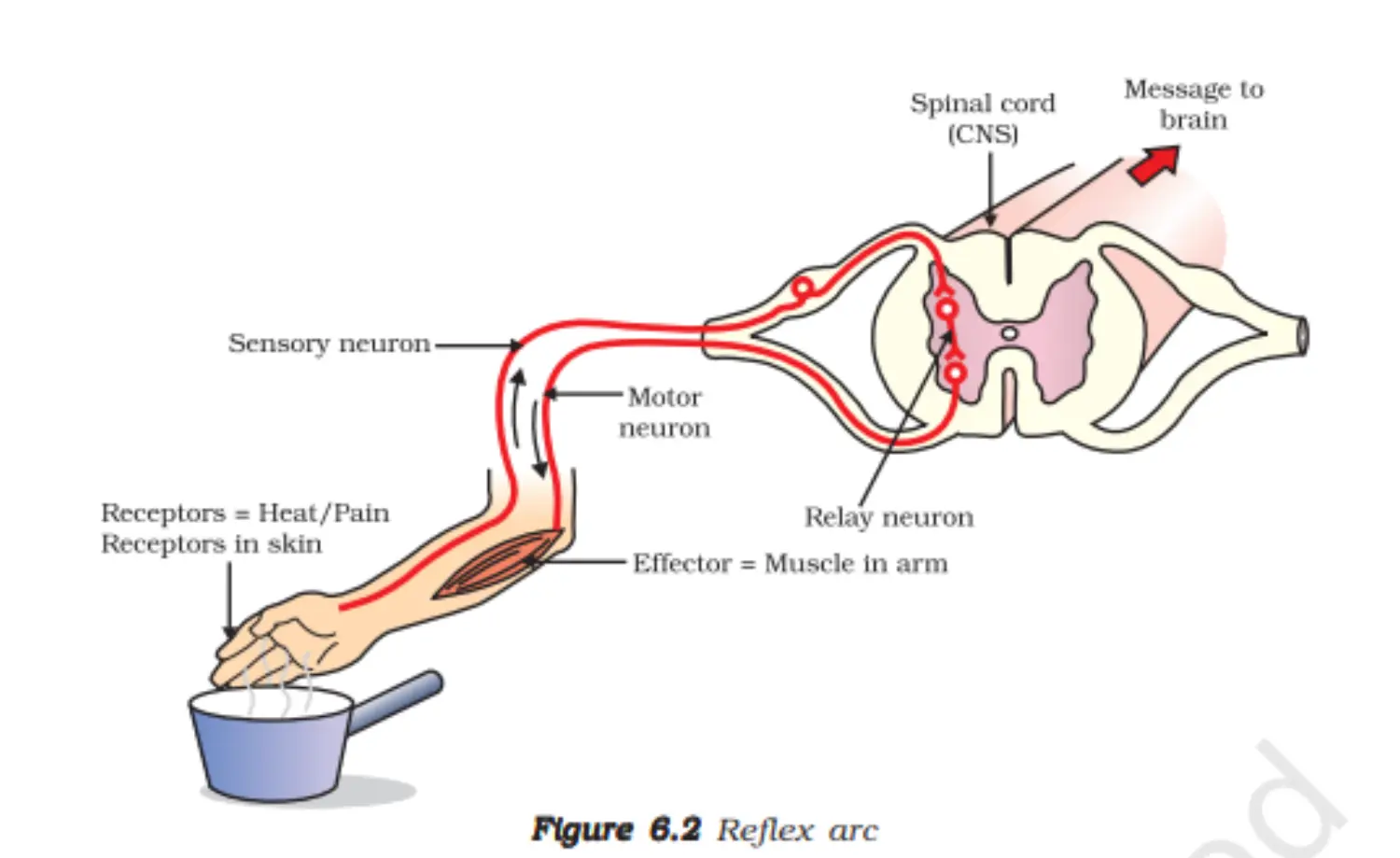
- Understanding Reflex Actions
Human Brain
- Central Nervous System (CNS)
- Comprises the brain and the spinal cord.
- Integrates information from all parts of the body.
- Responsible for coordinating thought processes and voluntary actions.
- Spinal Cord Functions Beyond Reflex Actions
- Supplies information for complex thought processes.
- Involved in voluntary actions like writing, talking, and moving objects.
- Brain's Role in Voluntary Actions
- Sends messages to muscles to perform deliberate actions.
- Works with the spinal cord to facilitate communication with the body.
- Peripheral Nervous System
- Consists of cranial nerves (from the brain) and spinal nerves (from the spinal cord).
- Connects the CNS to limbs and organs, facilitating motor and sensory functions.
- Major Parts of the Brain
- Fore-brain: Main thinking part; processes sensory information.
- Contains specialized areas for senses (hearing, smell, sight).
- Has association areas to interpret sensory info and make decisions.
- Controls voluntary muscles through motor areas.
- Mid-brain: Controls some involuntary actions.
- Hind-brain: Includes the cerebellum and medulla.
- Cerebellum: Responsible for precision in voluntary actions, posture, and balance.
- Medulla: Controls involuntary actions like blood pressure and salivation.
- Fore-brain: Main thinking part; processes sensory information.
- Involuntary Actions and Reflexes
- Some involuntary actions like heartbeats, digestion, and salivation occur without conscious thought.
- These are controlled by the mid-brain and hind-brain, especially the medulla.
- Importance of the Cerebellum
- Maintains body balance and posture.
- Coordinates the timing and force of muscle movements for smooth, coordinated actions.
Diagram
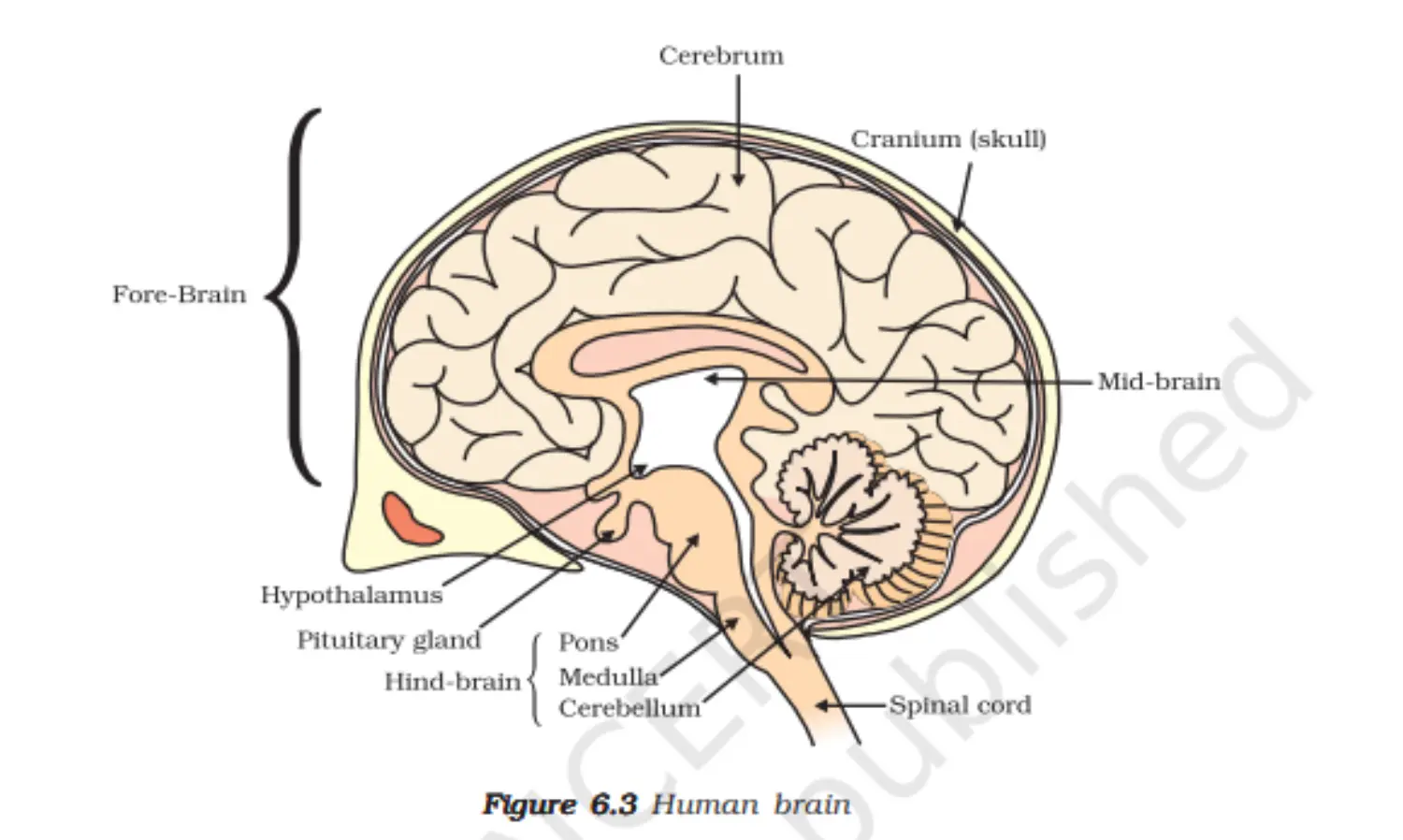
- Central Nervous System (CNS)
How are these Tissues protected?
- Protection of the Brain
- Housed within a hard, bony structure known as the skull.
- Encased in a fluid-filled balloon-like structure for shock absorption.
- Protection of the Spinal Cord
- Enclosed within the vertebral column or backbone.
- The vertebral column is composed of individual vertebrae that are rigid and provide structural support.
- Additional Protective Measures
- The brain and spinal cord are enveloped in three layers of protective tissues called meninges.
- Cerebrospinal fluid (CSF) circulates within the meninges, adding further cushioning against impacts.
- Functional Design
- The skeletal protections are part of the body's central framework.
- This design ensures the delicate tissues of the CNS are well-shielded from everyday jolts and potential injuries
- Protection of the Brain
How does the Nervous Tissue cause Action?
- Role of Nervous Tissue
- Collects and sends information throughout the body.
- Processes information and makes decisions.
- Transmits decisions to muscles for action.
- Muscle Movement Initiation
- Muscle action is triggered by nerve impulses reaching the muscle fibers.
- Muscle Cell Movement
- Muscle cells change shape by shortening or contracting.
- This movement is known as muscle contraction.
- Mechanism of Muscle Contraction
- Special proteins in muscle cells respond to nervous impulses.
- These proteins change shape and rearrange to shorten the muscle cell.
- Types of Muscle Tissue
- Voluntary muscles: Controlled consciously (e.g., moving an arm).
- Involuntary muscles: Operate without conscious control (e.g., heart muscle).
- Chemistry of Muscle Contraction
- Involves a complex interaction of proteins like actin and myosin within the muscle cells.
- The interaction is powered by ATP, the energy currency of the cell.
- Differences Between Muscle Types
- Voluntary muscles are usually attached to the skeleton and are used for movement.
- Involuntary muscles are found in organs and are responsible for automatic functions.
- Role of Nervous Tissue
- Purpose of the Nervous and Muscular Tissues
Coordination in Plants
- Lack of Nervous System in Plants
- Plants do not have a nervous system or muscles for coordination.
- Plant Responses to Stimuli
- Plants can still respond to environmental stimuli despite the lack of a nervous system.
- Types of Plant Movements
- Movement Independent of Growth
- Rapid and reversible actions, such as the Mimosa plant's leaves folding when touched.
- Movement Dependent on Growth
- Directional growth movement, such as a seedling's root growing downward and stem growing upward.
- These movements are irreversible and driven by growth processes.
- Movement Independent of Growth
- Mechanisms of Movement in Plants
- Growth-Independent Movement
- Involves changes in cell pressure and cell structure without growth.
- Growth-Dependent Movement
- Involves growth hormones that affect the rate and direction of growth.
- Growth-Independent Movement
- Examples and Observations
- The rapid folding of the Mimosa plant's leaves is an example of growth-independent movement.
- The directional growth of a seedling is an example of growth-dependent movement.
- Immediate Response to Stimulus
- Movement in Plants Without Growth
- Certain plants can move their leaves in response to stimuli without growth, such as the sensitive plant.
- Detection and Response to Touch
- Plants detect touch without nervous or muscle tissue.
- Information about the touch is communicated across plant cells.
- Communication of Stimuli in Plants
- Plants use electrical-chemical signals to convey information from cell to cell.
- There is no specialized tissue for conduction like in animals.
- Cellular Mechanism of Movement
- Plant cells respond by changing the amount of water inside, causing swelling or shrinking.
- This change in water content alters the cell's shape, resulting in movement.
- Difference from Animal Response
- Instead of using specialized proteins like in animal muscles, plant cells adjust their water content for movement.
- Movement in Plants Without Growth
- Movement Due to Growth
- Tropic Movements in Plants
- Plants respond to stimuli with directional growth called tropisms.
- Tropisms can be toward (positive) or away from (negative) a stimulus.
- Types of Tropisms
- Phototropism: Movement in response to light.
- Shoots exhibit positive phototropism (towards light).
- Roots exhibit negative phototropism (away from light).
- Geotropism: Movement in response to gravity.
- Roots show positive geotropism (downwards).
- Shoots show negative geotropism (upwards).
- Hydrotropism: Movement towards moisture.
- Chemotropism: Movement in response to chemicals.
- Example: Growth of pollen tubes towards ovules.
- Phototropism: Movement in response to light.
- Communication for Tropic Movements
- Plants use hormones to communicate and coordinate growth direction.
- Chemical signals in plants regulate the speed and direction of growth.
- Plant Hormones
- Auxin: Stimulates elongation of cells, particularly on the shady side, causing the plant to bend toward light.
- Gibberellins: Promote stem growth.
- Cytokinins: Promote cell division, prevalent in fruits and seeds.
- Abscisic Acid: Inhibits growth and causes wilting of leaves.
- Chemical vs. Electrical Impulses
- Chemical signals are slower but can reach all cells, unlike electrical impulses which are limited to nerve connections.
- Hormonal communication is essential for both immediate and sustained responses to stimuli.
- Controlled Growth in Plants
- Plant growth is precisely regulated to ensure proper development and response to the environment.
- Limitations and Advantages of Chemical Signaling
- Chemical signaling is not as rapid as electrical signaling but ensures sustained communication to all cells.
- Tropic Movements in Plants
- Lack of Nervous System in Plants
Hormones in Animals
- Role of Hormones
- Hormones serve as chemical messengers in the body, transmitting information to various tissues.
- Response to Stress
- Adrenaline:
- Secreted by adrenal glands in response to stress.
- Prepares the body for fight or flight response.
- Increases heart rate, redirects blood to muscles, and enhances breathing rate.
- Adrenaline:
- Endocrine System
- Works alongside the nervous system for control and coordination.
- Secretes hormones directly into the blood to act on target organs.
- Regulation of Body Functions
- Hormones control various body functions like metabolism, growth, and blood sugar levels.
- Examples of Hormones and Their Functions
- Thyroxin:
- Produced by the thyroid gland.
- Regulates metabolism and is dependent on dietary iodine.
- Deficiency can lead to goitre (swollen neck).
- Growth Hormone:
- Secreted by the pituitary gland.
- Controls body growth and development.
- Deficiency can result in dwarfism.
- Testosterone and Estrogen:
- Responsible for secondary sexual characteristics at puberty.
- Insulin:
- Produced by the pancreas.
- Regulates blood sugar levels.
- Insufficient production can lead to diabetes.
- Thyroxin:
- Feedback Mechanisms in Hormonal Regulation
- Hormone secretion is regulated by feedback to maintain balance.
- Example: Insulin release increases when blood sugar levels rise and decreases as levels fall.
Diagram
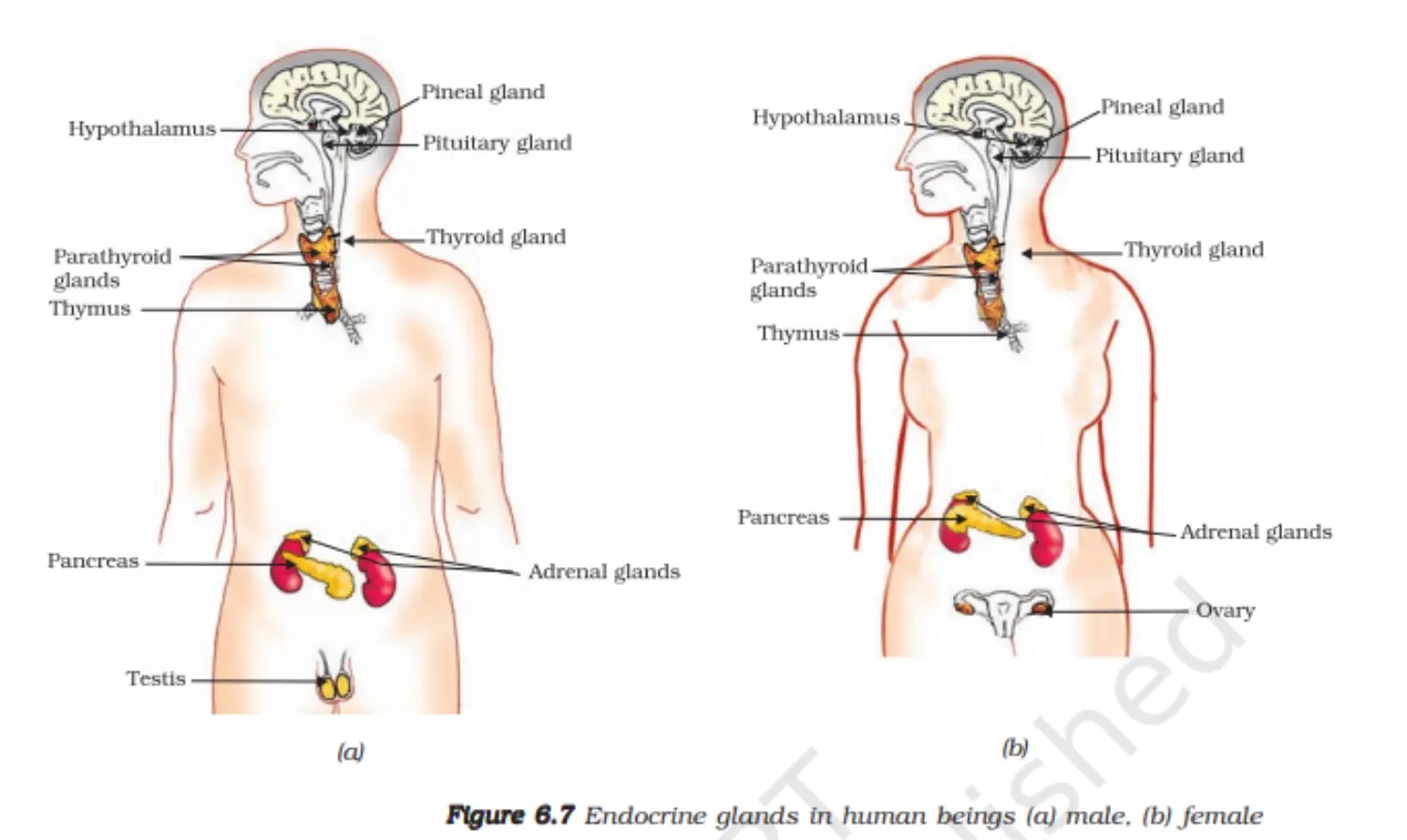
Table
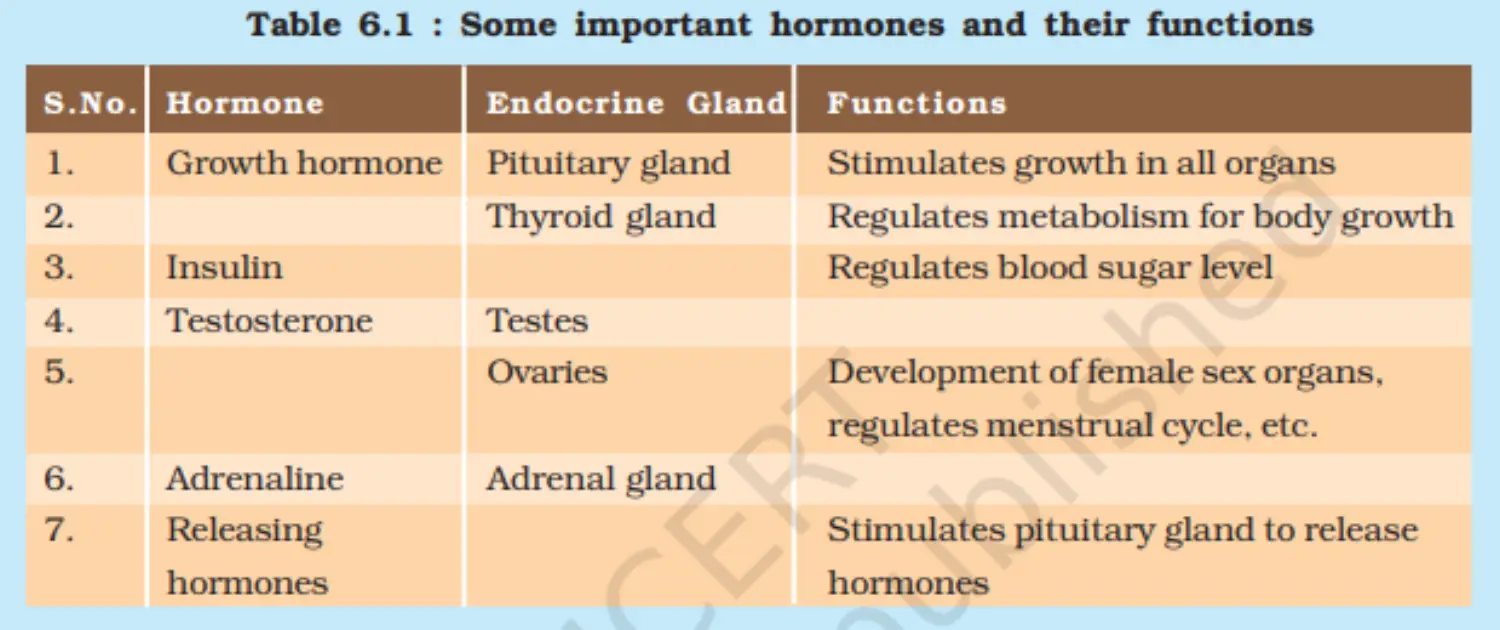
- Role of Hormones
Additional Concepts
- Hypothalamus Function
- The hypothalamus is a crucial brain region for hormonal regulation.
- It monitors levels of hormones in the blood.
- Hormone Release Mechanism
- When a hormone level is low, the hypothalamus secretes releasing factors.
- These factors stimulate glands, such as the pituitary, to release more hormones.
- Growth Hormone Regulation
- The hypothalamus releases growth hormone-releasing factor (GHRF).
- GHRF prompts the pituitary gland to release growth hormone (GH).
- Control and Coordination in the Body
- Achieved through the nervous system and hormonal systems.
- The nervous system uses electrical signals, while hormones use chemical signals.
- Types of Nervous Responses
- Reflex actions: Automatic and quick.
- Voluntary actions: Conscious and deliberate.
- Involuntary actions: Automatic but not as quick as reflexes.
- Chemical Coordination
- Present in both plants and animals.
- Hormones travel to target areas to perform specific functions.
- Feedback Mechanisms
- Hormonal actions are regulated by feedback to maintain homeostasis.
- Hypothalamus Function
Chapter 7 - How do Organisms Reproduce?
- Introduction
- Fundamental Question
- Why do organisms reproduce?
- Reproduction is not necessary for an individual's survival.
- Energy Consideration
- Reproduction requires significant energy expenditure.
- Energy is diverted from individual survival to create new organisms.
- Recognition of Species
- Large numbers of similar organisms signal a species' existence.
- Species members typically resemble each other, aiding in identification.
- Reproduction and Species Continuity
- Reproduction ensures the continuity of a species.
- Without reproduction, a species may not be noticeable or may even go extinct.
- Classroom Discussion
- Encouraged to understand the biological significance and the evolutionary perspective on reproduction.
- Fundamental Question
- Do Organisms Create Exact Copies of Themselves?
- Similarity in Organisms
- Organisms exhibit similarity in body designs due to similar blueprints.
- The blueprint for these designs is encoded in the DNA.
- DNA and Protein Synthesis
- Chromosomes contain DNA, which is the information source for protein synthesis.
- Changes in DNA lead to different proteins, affecting body design.
- DNA Replication
- A key aspect of reproduction is copying DNA.
- This process involves complex biochemical reactions.
- Cell Division
- DNA replication is followed by the formation of cellular apparatus.
- The cell divides, creating two cells, usually similar to the parent cell.
- Variations in Reproduction
- Copying DNA is not error-proof, leading to variations.
- Some variations may be harmful, while others may be neutral or beneficial.
- Evolutionary Significance
- Variations introduced during reproduction can lead to evolution.
- This creates diversity within species over generations.
- The Importance of Variation
- Role of Reproduction:
- Organisms reproduce to maintain their species and fill ecological niches.
- Consistency of DNA Copying:
- Accurate DNA replication is crucial for preserving body design and ecological roles.
- Environmental Changes:
- Ecosystems can change due to various factors like climate shifts or natural disasters.
- Survival through Variation:
- Variations in a population can lead to the survival of a species under changing conditions.
- Adaptation Example:
- A population with heat-resistant bacteria may thrive in warming temperatures, while others perish.
- Evolutionary Advantage:
- Variation enables species to adapt over time and is essential for long-term survival.
- Role of Reproduction:
- Similarity in Organisms
- Modes of Reproduction used by Single Organisms
- Understanding Reproduction:
- Reproduction varies among organisms and is influenced by their body design.
- Yeast Reproduction:
- Investigate how yeast reproduces (typically through asexual budding).
- Mould Reproduction:
- Examine the reproductive method of moulds (often through spore formation).
- Comparison:
- Contrast the reproductive processes in yeast and mould to understand different strategies.
- Influence of Body Design:
- Recognize that the method of reproduction is dictated by the organism's structure.
- Fission
- Basic Concept of Fission:
- Fission is a form of cell division that results in the creation of new individual organisms from a single parent.
- Bacteria and Protozoa:
- These organisms often undergo binary fission where the cell divides into two equal halves.
- Amoeba:
- Amoeba's cell division can occur in any plane, resulting in two cells from the parent cell.
- Organised Fission:
- Organisms with more body organization, like Leishmania, undergo binary fission in a specific orientation related to certain body structures.
- Multiple Fission:
- Organisms like Plasmodium (malarial parasite) undergo multiple fission, forming several daughter cells at the same time.
- Yeast Reproduction:
- Yeast cells reproduce asexually by budding, where small buds grow and eventually separate from the parent cell.
- Basic Concept of Fission:
- Fragmentation
- Definition of Fragmentation:
- Fragmentation is a form of asexual reproduction where an organism breaks into fragments, and each fragment develops into a mature, fully grown individual.
- Simple Organisms:
- In simple multi-cellular organisms like Spirogyra, fragmentation is a common reproductive method.
- Process of Fragmentation:
- Upon reaching maturity, the organism breaks up into pieces or fragments.
- Each fragment then grows into a new individual.
- Complex Multi-cellular Organisms:
- In more complex organisms, reproduction cannot occur via simple cell division due to the specialised structure of tissues and organs.
- Specialised Reproductive Cells:
- Complex organisms have specific cell types dedicated to reproduction.
- These reproductive cells can proliferate and differentiate into other cell types to form a new organism.
- Definition of Fragmentation:
- Regeneration
- Understanding Regeneration:
- Regeneration is a biological process that allows an organism to replace or restore lost or damaged body parts.
- Capability of Regeneration:
- Organisms like Hydra and Planaria demonstrate remarkable regenerative abilities, where each piece of their body can grow into a new individual.
- Mechanism of Regeneration:
- Specialised cells in these organisms proliferate to form a mass of cells.
- Cells from this mass then differentiate into various cell types and tissues.
- Development Process:
- The differentiation and changes follow an organized sequence, known as development, leading to a fully formed organism.
- Regeneration vs. Reproduction:
- Regeneration is different from reproduction; it is usually a response to injury, not a normal method of reproducing.
- Understanding Regeneration:
- Budding
- Budding as a Reproductive Strategy:
- Organisms like Hydra use a process called budding to reproduce.
- Budding involves the formation of a new organism from a growth or bud due to cell division at one site on the parent body.
- Process of Budding:
- A bud forms from repeated cell division at a specific site on the parent organism.
- This bud grows and develops into a new individual.
- Once the bud reaches maturity, it detaches from the parent and lives independently.
- Budding as a Reproductive Strategy:
- Vegetative Propagation
- Definition of Vegetative Propagation:
- A type of asexual reproduction in plants where new individuals are produced from the roots, stems, or leaves.
- Does not involve seeds.
- Methods of Vegetative Propagation:
- Layering: Involves rooting a new plant while still attached to the parent plant.
- Grafting: Attaching a cut piece of one plant to another plant.
- Advantages:
- Plants mature faster than those grown from seeds.
- Used for plants that do not produce viable seeds.
- Offspring are genetically identical to the parent, ensuring desirable traits are retained.
- Examples:
- Sugarcane, roses, and grapes are often grown using vegetative propagation.
- Bryophyllum exhibits vegetative propagation through buds on leaf margins.
- Definition of Vegetative Propagation:
- Spore Formation
- Definition of Spore Formation:
- A type of asexual reproduction where reproductive cells (spores) can develop into new individuals.
- Common in fungi, like Rhizopus.
- Structure Involved:
- Sporangia: The spherical structures on the hyphae of fungi.
- Sporangia produce and contain spores.
- Spore Characteristics:
- Encased in thick walls for protection.
- Can remain dormant until conditions are favorable.
- Reproductive Process:
- Spores are released from sporangia.
- Upon landing on a moist surface, they germinate and grow into new organisms.
- Significance:
- This is a form of asexual reproduction.
- Allows single individuals to create new generations independently.
- Definition of Spore Formation:
- Understanding Reproduction:
- Sexual Reproduction
- Definition of Sexual Reproduction:
- A biological process that requires two parents, male and female, for the creation of a new generation.
- Requirement of Sexes:
- Involves the combination of genetic material from both a male and a female.
- Significance of Sexual Reproduction:
- Enhances genetic diversity within a species.
- Leads to variations which are important for evolution.
- Limitations of Asexual Reproduction:
- Less genetic variation, which can be a disadvantage in changing environments.
- Offspring are genetic clones of the parent, leading to vulnerability to diseases.
- Why the Sexual Mode of Reproduction?
- Purpose of Sexual Reproduction:
- To increase variation within a species, aiding survival and adaptation.
- Accuracy of DNA Copying:
- DNA replication is precise but not perfect, leading to variations.
- Importance of Variation:
- Helps protect species in a population through diversity.
- Speeding Up Variation:
- Sexual reproduction accelerates variation by combining DNA from two individuals.
- Challenge of DNA Doubling:
- Offspring receiving double DNA amount could disrupt cellular control.
- Solution - Meiosis:
- Specialized cells undergo meiosis to halve the chromosome number, maintaining DNA balance.
- Germ-cell Specialization:
- In complex organisms, germ-cells (gametes) specialize:
- Male gamete: Motile and smaller.
- Female gamete: Larger with energy stores.
- In complex organisms, germ-cells (gametes) specialize:
- Gamete Combination:
- Combination of germ-cells during fertilization re-establishes chromosome count in offspring.
- Result of Gamete Specialization:
- Leads to specialized reproductive organs and potential physical differences between sexes.
- Purpose of Sexual Reproduction:
- Sexual Reproduction in Flowering Plants
- Parts of a Flower:
- Sepals and Petals: Protective and attractive functions for the reproductive parts.
- Stamens: Male reproductive part, produces pollen grains.
- Pistil: Female reproductive part, consists of ovary, style, and stigma.
- Types of Flowers:
- Unisexual: Contains either stamens or pistil (e.g., papaya, watermelon).
- Bisexual: Contains both stamens and pistil (e.g., Hibiscus, mustard).
- Pistil Structure:
- Ovary: Swollen bottom part containing ovules with egg cells.
- Style: Elongated middle part.
- Stigma: Terminal part, may be sticky for pollen attachment.
- Pollination:
- Self-Pollination: Pollen transfer within the same flower.
- Cross-Pollination: Pollen transfer between different flowers, facilitated by wind, water, or animals.
- Fertilization Process:
- Pollen reaches the stigma, grows a tube through the style to the ovary, and fertilizes the egg cell.
- Seed Formation:
- Zygote divides to form an embryo within the ovule.
- Ovule develops into a seed with a tough coat.
- Fruit Development:
- Ovary ripens into a fruit, protecting the seed.
- Germination:
- Seed contains an embryo that develops into a seedling under the right conditions.
- Parts of a Flower:
- Reproduction in Human Beings
- Sexual Maturation:
- Common Changes: Increase in height, appearance of body hair, oily skin, and pimples.
- Gender-Specific Changes: Girls develop breasts and start menstruating; boys experience voice changes and facial hair growth.
- Puberty:
- The transition period called puberty is when the body undergoes sexual maturation.
- Different rates of maturation among individuals, with varied patterns of growth.
- Reproductive Tissue Maturation:
- As body growth slows, reproductive tissues mature.
- This is preparation for the creation of germ-cells for sexual reproduction.
- Signals of Sexual Maturity:
- Physical changes signal the body’s readiness for reproduction.
- The Sexual Act:
- Requires special organs for the transfer of germ-cells between individuals.
- In humans, it involves internal fertilization through mating.
- Female Reproductive Maturation:
- Development of the reproductive system and breasts for potential pregnancy and breastfeeding.
- Male Reproductive System
- Testes:
- Location: In the scrotum, outside the abdominal cavity.
- Function: Produce sperm and testosterone.
- Temperature: Lower than the body's normal temperature for optimal sperm formation.
- Testosterone:
- Role: Hormone regulating sperm formation and responsible for puberty changes in boys.
- Sperm Delivery:
- Path: Formed in testes → vas deferens → urethra.
- Vas Deferens: Tube that carries sperms from testes.
- Urethra: Common passage for sperm and urine.
- Glands:
- Prostate and Seminal Vesicles: Add secretions to the sperms.
- Purpose of Secretions: Provide nutrients and ease the transport of sperms.
- Sperm Structure:
- Components: Genetic material and a tail.
- Tail Function: Helps in mobility towards the female germ-cell.
- Testes:
- Female Reproductive System
- Ovaries:
- Function: Produce eggs (female germ-cells) and hormones.
- Egg Maturation: Begins at puberty, with one egg maturing each month.
- Egg Transport:
- Path: Ovary → Oviduct (Fallopian tube) → Uterus.
- Oviduct: Thin tube through which the egg travels to the uterus.
- Uterus:
- Structure: Elastic, bag-like organ where the embryo implants and grows.
- Cervix: Opening that leads to the vagina.
- Fertilization:
- Sperms: Enter through the vagina during intercourse and may meet the egg in the oviduct.
- Zygote: Fertilized egg that divides to form an embryo.
- Embryo Development:
- Implantation: In the uterine lining, which thickens to nourish the growing embryo.
- Placenta: Special tissue for nutrient and waste exchange between mother and embryo.
- Pregnancy Duration:
- Approximately nine months.
- Birth:
- Triggered by rhythmic contractions of the uterus muscles.
- Ovaries:
- What happens when the Egg is not Fertilized?
- Unfertilized Egg:
- Lifespan of approximately one day.
- Released monthly by the ovary.
- Uterine Preparation:
- Monthly thickening of the uterine lining in anticipation of a fertilized egg.
- Spongy lining facilitates embryo nourishment.
- Menstruation:
- Occurs if fertilization does not happen.
- Involves shedding of the uterine lining.
- Manifests as blood and mucous discharge.
- Typically lasts between two to eight days.
- Known as the menstrual cycle, recurring roughly every month.
- Unfertilized Egg:
- Reproductive Health
- Sexual Maturation:
- Sexual maturation is a gradual process.
- It happens alongside general body growth.
- Does not imply readiness for sexual activity or parenting.
- Decision Making and Pressures:
- Influence from peers, family, and society can affect decisions.
- Pressures include engaging in sexual activities, marriage, and childbearing.
- Sexually Transmitted Diseases (STDs):
- Intimate nature of sexual act allows for transmission of STDs.
- Includes bacterial infections (gonorrhoea, syphilis) and viral infections (warts, HIV-AIDS).
- Condom use can reduce the risk of transmission.
- Contraception and Pregnancy:
- Pregnancy demands physical and mental readiness.
- Contraceptive methods vary:
- Mechanical barriers (condoms).
- Hormonal pills (may have side-effects).
- Intrauterine devices (loops, copper-T).
- Surgical methods (vasectomy, tubectomy).
- Surgical Methods:
- Create blocks in vas deferens or fallopian tubes.
- Safe long-term but can have short-term risks.
- Can be used for abortion, but sex-selective abortion is illegal and unethical.
- Population and Reproductive Health:
- Birth and death rates affect population size.
- Expanding population can impact the standard of living.
- Inequality is often a significant factor in living standards.
- Sexual Maturation:
- Sexual Maturation:
- Definition of Sexual Reproduction:
- Additional Concepts
- Tissue Culture:
- 1.1. Process:
- Tissue or cells from a plant's growth tip are cultured.
- Cells form a callus in an artificial medium.
- Callus induces growth and differentiation with hormones.
- 1.2. Applications:
- Produces many plants from one parent.
- Ensures disease-free plant growth.
- Common in ornamental plant production.
- 1.1. Process:
- Reproduction Overview:
- 2.1. Necessity:
- Reproduction is not vital for an individual organism’s survival, but for species continuity.
- 2.2. Cellular Mechanism:
- Involves DNA replication and cellular apparatus formation.
- 2.1. Necessity:
- Asexual Reproduction:
- 3.1. Modes:
- Fission in bacteria/protozoa.
- Regeneration in organisms like hydra.
- Vegetative propagation in plants.
- 3.2. Characteristics:
- Involves a single parent.
- New generation created without sexual means.
- 3.1. Modes:
- Sexual Reproduction:
- 4.1. Involvement:
- Requires two individuals.
- 4.2. Genetic Variation:
- DNA replication errors introduce variations beneficial for species survival.
- 4.1. Involvement:
- Reproduction in Plants:
- 5.1. Pollination:
- Transfer of pollen from anther to stigma.
- 5.2. Fertilisation:
- Follows pollination, leading to zygote formation.
- 5.1. Pollination:
- Human Reproduction:
- 6.1. Sexual Maturation:
- Puberty brings physical changes signaling sexual maturity.
- 6.2. Male System:
- Comprises testes, vas deferens, seminal vesicles, prostate, urethra, and penis.
- 6.3. Female System:
- Includes ovaries, fallopian tubes, uterus, and vagina.
- 6.4. Fertilisation:
- Sperm introduced into the vagina, fertilisation in fallopian tubes.
- 6.1. Sexual Maturation:
- Contraception:
- 7.1. Methods:
- Condoms, oral pills, copper-T, surgical methods.
- 7.2. Purpose:
- Prevents unwanted pregnancies and manages reproductive health.
- 7.1. Methods:
- Tissue Culture:
- Introduction
Chapter 8 - Heredity
- Introduction
- Concept of Variation:
- 1.1. Introduction to Variations:
- New individuals show similarities with subtle differences.
- 1.2. Asexual Reproduction:
- Produces variations but to a limited extent.
- 1.1. Introduction to Variations:
- Sexual Reproduction:
- 2.1. Maximizing Variations:
- Sexual reproduction leads to a greater degree of variation.
- 2.2. Observation:
- In plants like sugarcane, variations are minimal.
- In animals and humans, variations are more pronounced.
- 2.1. Maximizing Variations:
- Mechanism of Inheritance:
- 3.1. Study Focus:
- Understanding how variations are created and inherited.
- 3.1. Study Focus:
- Concept of Variation:
- Accumulation of Variation During Reproduction
- Inheritance and Variation:
- 1.1. Basic Body Design:
- Inherited from the previous generation with subtle changes.
- 1.2. Reproduction and Variation:
- Each new generation introduces inherited and new variations.
- 1.1. Basic Body Design:
- Asexual vs. Sexual Reproduction:
- 2.1. Asexual Reproduction:
- Leads to minor differences due to DNA copying inaccuracies.
- 2.2. Sexual Reproduction:
- Results in greater diversity due to combination of different genes.
- 2.1. Asexual Reproduction:
- Survival and Selection:
- 3.1. Environmental Impact:
- Variations confer different survival advantages.
- 3.2. Evolutionary Significance:
- Selection of variants by the environment influences evolution.
- 3.1. Environmental Impact:
- Inheritance and Variation:
- Heredity
- Definition of Heredity:
- 1.1. Basic Concept:
- Heredity is the process by which traits are passed from parents to offspring.
- 1.2. Outcome:
- Results in offspring with similar characteristics to their parents.
- 1.1. Basic Concept:
- Rules Governing Heredity:
- 2.1. Predictable Patterns:
- The rules of heredity help predict how traits are transmitted.
- 2.2. Genetic Laws:
- Underlying genetic principles guide the inheritance of traits.
- 2.1. Predictable Patterns:
- Inherited Traits
- Understanding Inherited Traits:
- 1.1. Basic Features:
- Children possess the fundamental characteristics of humans.
- 1.2. Unique Appearances:
- Offspring look similar to but not identical to parents.
- 1.3. Population Diversity:
- Human populations display a wide range of variations and differences.
- 1.1. Basic Features:
- Concept of Inheritance:
- 2.1. Transmission of Traits:
- Traits are passed from parents to offspring, influencing their physical appearance and behavior.
- 2.2. Genetic Variation:
- Differences arise due to the unique combination of genes inherited from both parents
- 2.1. Transmission of Traits:
- Understanding Inherited Traits:
- Rules for the Inheritance of Traits – Mendel’s Contributions
- Mendel's Experiments:
- 1.1. Pea Plant Characteristics:
- Mendel used pea plants with contrasting traits (e.g., tall/short, round/wrinkled seeds).
- 1.2. Parental Traits and F1 Generation:
- Crossing tall and short plants resulted in all tall F1 progeny, exhibiting only one parental trait.
- 1.1. Pea Plant Characteristics:
- Inheritance Patterns:
- 2.1. F1 Generation Analysis:
- Self-pollination of F1 tall plants produced both tall and short F2 progeny.
- 2.2. Dominant and Recessive Traits:
- Tallness (T) is dominant; shortness (t) is recessive. Tt plants are tall, but carry the recessive trait.
- 2.1. F1 Generation Analysis:
- Mendel's Principles:
- 3.1. Law of Segregation:
- Two alleles for each trait separate during gamete formation.
- 3.2. Law of Independent Assortment:
- Traits are passed on independently of other traits (e.g., plant height and seed shape).
- 3.1. Law of Segregation:
- Mendel's Experiments:
- How do these Traits get Expressed?
- Gene Function:
- 1.1. DNA and Proteins:
- DNA contains genes, which are instructions for making proteins.
- 1.2. Traits and Proteins:
- Traits, like tallness in plants, are influenced by proteins, which are products of genes.
- 1.1. DNA and Proteins:
- Expression of Traits:
- 2.1. Enzymes and Hormones:
- Plant height is affected by enzymes that influence hormone levels.
- 2.2. Gene Efficiency:
- A gene alteration can change enzyme efficiency, impacting the trait (e.g., plant height).
- 2.1. Enzymes and Hormones:
- Mendelian Inheritance:
- 3.1. Equal Contribution:
- Each parent contributes one set of genes to the offspring.
- 3.2. Two Gene Sets:
- Organisms have two sets of genes, one from each parent.
- 3.1. Equal Contribution:
- Formation of Germ Cells:
- 4.1. Chromosomes:
- Genes are on chromosomes, which come in pairs with one set from each parent.
- 4.2. Germ Cell Development:
- Germ cells contain one set of chromosomes, ensuring genetic diversity.
- 4.1. Chromosomes:
- Chromosome Behavior:
- 5.1. Independent Assortment:
- Chromosomes segregate independently, allowing for Mendel's law of independent assortment.
- 5.2. Stability of Species DNA:
- Combining germ cells restores normal chromosome numbers, preserving DNA stability.
- 5.1. Independent Assortment:
- Asexual Reproduction:
- 6.1. Similar Inheritance:
- Even asexually reproducing organisms exhibit inheritance patterns like sexually reproducing ones.
- 6.1. Similar Inheritance:
- Gene Function:
- Sex Determination
- Variability in Sex Determination:
- 1.1. Environmental Influence:
- In some reptiles, the temperature of egg incubation affects the sex of the offspring.
- 1.2. Changeable Sex:
- Certain animals, like snails, can change sex, showing that sex is not fixed genetically in all species.
- 1.1. Environmental Influence:
- Genetic Determination in Humans:
- 2.1. Genetic Influence:
- In humans, sex is genetically determined.
- 2.2. Chromosome Pairs:
- Humans have 22 pairs of matched chromosomes and one pair of sex chromosomes.
- 2.1. Genetic Influence:
- Sex Chromosomes:
- 3.1. Women's Chromosomes:
- Women have two X chromosomes (XX).
- 3.2. Men's Chromosomes:
- Men have one X and one Y chromosome (XY).
- 3.1. Women's Chromosomes:
- Inheritance of Sex Chromosomes:
- 4.1. Maternal Contribution:
- All children receive an X chromosome from their mother.
- 4.2. Paternal Contribution:
- The sex chromosome children receive from their father determines their sex (X for girls, Y for boys).
- 4.1. Maternal Contribution:
- Outcome of Inheritance:
- 5.1. Probability of Sex:
- There is a 50% chance for each parent to have a boy or a girl.
- 5.1. Probability of Sex:
- Variability in Sex Determination:
- Definition of Heredity:
- Additional Concepts
- Inheritance of Variations:
- 1.1. Origin of Variations:
- Variations arise during reproduction and may be inherited.
- 1.2. Survival Impact:
- Some inherited variations may enhance survival.
- 1.1. Origin of Variations:
- Genetic Copies and Expression:
- 2.1. Two Gene Copies:
- Individuals possess two gene copies for each trait.
- 2.2. Dominant and Recessive Traits:
- The expressed trait is dominant, and the unexpressed is recessive.
- 2.1. Two Gene Copies:
- Combination of Traits:
- 3.1. Independent Inheritance:
- Traits are inherited independently, creating new trait combinations in offspring.
- 3.1. Independent Inheritance:
- Sex Determination:
- 4.1. Species Variation:
- Different species use various methods for sex determination.
- 4.2. Human Sex Determination:
- In humans, sex is determined by the paternal chromosome, X for females and Y for males.
- 4.1. Species Variation:
- Mendel's Contribution:
- 5.1. Systematic Study:
- Mendel systematically studied trait inheritance in peas, using mathematical analysis.
- 5.2. Laws of Inheritance:
- His experiments led to the formulation of the fundamental laws of inheritance.
- 5.1. Systematic Study:
- Inheritance of Variations:
- Introduction
Chapter 9 - Light - Reflection and Refraction
- Introduction
- Visibility of Objects:
- 1.1. Role of Light:
- Objects become visible when they reflect light.
- 1.2. Light Sources:
- Daylight and artificial light enable us to see.
- 1.1. Role of Light:
- Transmission of Light:
- 2.1. Transparent Media:
- Light passes through transparent materials, allowing visibility.
- 2.1. Transparent Media:
- Optical Phenomena:
- 3.1. Variety of Effects:
- Includes mirror images, star twinkling, rainbows, etc.
- 3.2. Light Behavior:
- Light bends when passing through different media.
- 3.1. Variety of Effects:
- Light Propagation:
- 4.1. Straight-Line Travel:
- Light travels in straight lines, evidenced by sharp shadows.
- 4.2. Ray Representation:
- Light's path is often represented as a ray.
- 4.1. Straight-Line Travel:
- Reflection and Refraction:
- 5.1. Study of Phenomena:
- Exploration of light reflection and refraction.
- 5.2. Spherical Mirrors:
- Reflection by spherical mirrors.
- 5.3. Refractive Index:
- Refraction depends on the medium's refractive index.
- 5.1. Study of Phenomena:
- Applications:
- 6.1. Practical Uses:
- Understanding these concepts is crucial for real-life applications.
- 6.1. Practical Uses:
- Visibility of Objects:
- Reflection of Light
- Fundamentals of Reflection:
- 1.1. Polished Surfaces:
- Reflect most of the light falling on them, e.g., mirrors.
- 1.2. Laws of Reflection:
- The angle of incidence equals the angle of reflection.
- Incident ray, the normal at the point of incidence, and the reflected ray are in the same plane.
- 1.1. Polished Surfaces:
- Plane Mirrors:
- 2.1. Image Properties:
- Virtual and erect images.
- Same size as the object.
- Equidistant from the mirror as the object is in front.
- Laterally inverted.
- 2.1. Image Properties:
- Curved Mirrors:
- 3.1. Curved Surfaces:
- Reflecting surfaces that are part of a sphere.
- 3.2. Spherical Mirrors:
- Can be concave or convex.
- Used in various applications due to their focused reflection.
- 3.1. Curved Surfaces:
- Fundamentals of Reflection:
- Spherical Mirrors
- Types of Spherical Mirrors:
- 1.1 Concave Mirrors:
- Curved inwards, resembling the inside of a spoon.
- Reflect light to a focal point in front of the mirror.
- 1.2 Convex Mirrors:
- Curved outwards, resembling the back of a spoon.
- Diverge light, making them useful for wider views.
- 1.1 Concave Mirrors:
- Terminology:
- 2.1 Pole (P):
- The center point on the reflecting surface of the mirror.
- 2.2 Centre of Curvature (C):
- The center of the sphere whose part creates the mirror.
- In front of concave and behind convex mirrors.
- 2.3 Radius of Curvature (R):
- The radius of the sphere to which the mirror belongs.
- Equal to the distance from the center of curvature to the pole.
- 2.4 Principal Axis:
- The line passing through the pole and the center of curvature.
- Normal to the mirror at the pole.
- 2.5 Focus (F):
- The point where rays parallel to the principal axis converge (concave) or appear to diverge from (convex).
- 2.6 Focal Length (f):
- The distance between the pole and the focus.
- For small apertures, R=2f (the focus is midway between the pole and the center of curvature).
- 2.1 Pole (P):
- Aperture:
- 3.1 Definition:
- The diameter of the reflecting surface.
- Limited discussion to mirrors with apertures much smaller than the radius of curvature.
- 3.1 Definition:
Image Formation by Spherical Mirrors
- Image Formation:
- 1.1 Concave Mirrors:
- Nature, position, and size of images vary with the object's position relative to points P (Pole), F (Focus), and C (Centre of Curvature).
- 1.1.1 Real Images:
- Formed when the object is placed beyond the focus (F).
- Can be projected on a screen.
- 1.1.2 Virtual Images:
- Formed when the object is placed between the pole (P) and focus (F).
- Cannot be projected on a screen.
- 1.1.3 Image Size:
- Magnified: When the object is placed close to the focus.
- Diminished: When the object is placed far from the mirror.
- Same Size: When the object is placed at the centre of curvature (C).
- 1.1 Concave Mirrors:
- Locating Images:
- By constructing ray diagrams or using mirror formula, we can determine the nature and position of the image.
- The method of locating images varies with the object's distance from the mirror.
Table
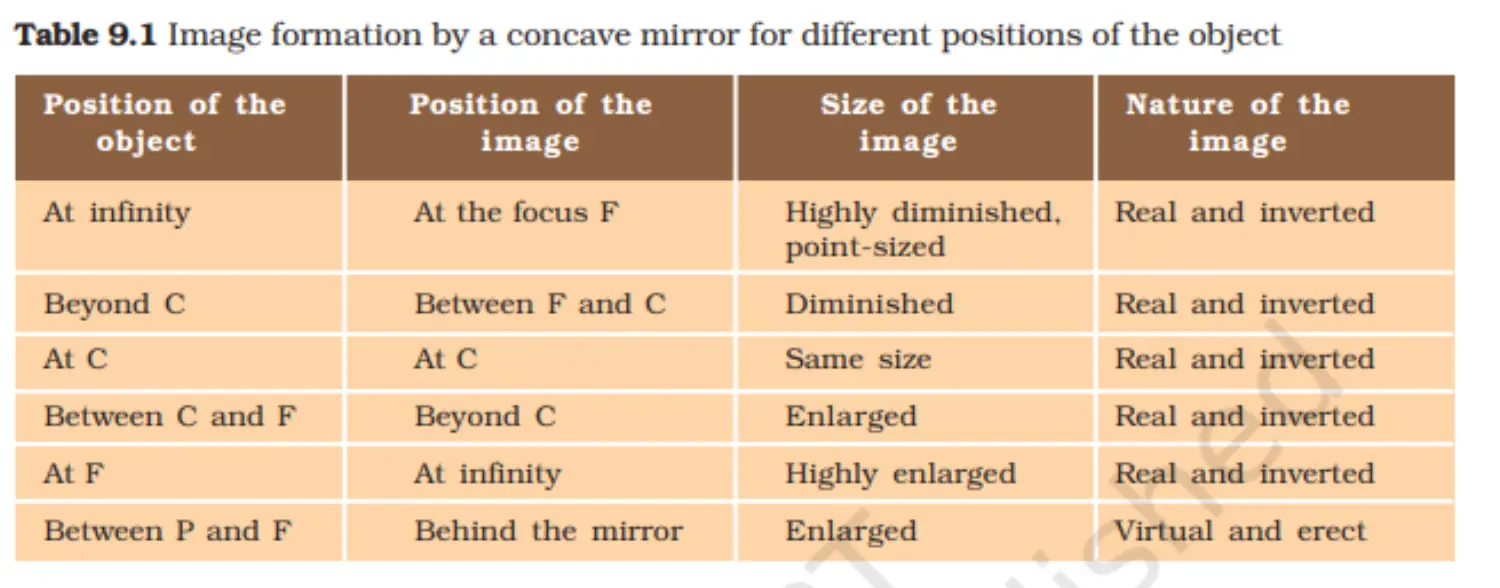
- Image Formation:
Representation of Images Formed by Spherical Mirrors Using Ray Diagrams
- Ray Diagram Basics:
- 1.1 Purpose: To locate the image formed by spherical mirrors.
- 1.2 Approach: Use two selected rays for clarity, though many rays reflect from an object point.
- Key Rays for Ray Diagrams:
- 2.1 Ray Parallel to Principal Axis:
- Concave Mirror: Reflects through the principal focus.
- Convex Mirror: Appears to diverge from the principal focus.
- 2.2 Ray Through Principal Focus:
- Concave Mirror: Reflects parallel to the principal axis.
- Convex Mirror: Directed towards the principal focus, reflects parallel to the principal axis.
- 2.3 Ray Through Centre of Curvature:
- Reflects back along the same path for both concave and convex mirrors.
- 2.4 Ray Oblique to Principal Axis:
- Reflects obliquely, adhering to the laws of reflection at the pole.
- 2.1 Ray Parallel to Principal Axis:
- Laws of Reflection:
- At the point of incidence, the angle of incidence equals the angle of reflection.
- The incident ray, the reflected ray, and the normal at the point of incidence all lie in the same plane.
Image formation by Concave Mirror
- Ray Diagrams for Concave Mirrors:
- 1.1 Principle: Ray diagrams demonstrate how images are formed by concave mirrors for different object positions.
- 1.2 Features: Depending on the object's position, the image can be real or virtual, and can vary in size and orientation.
Diagram
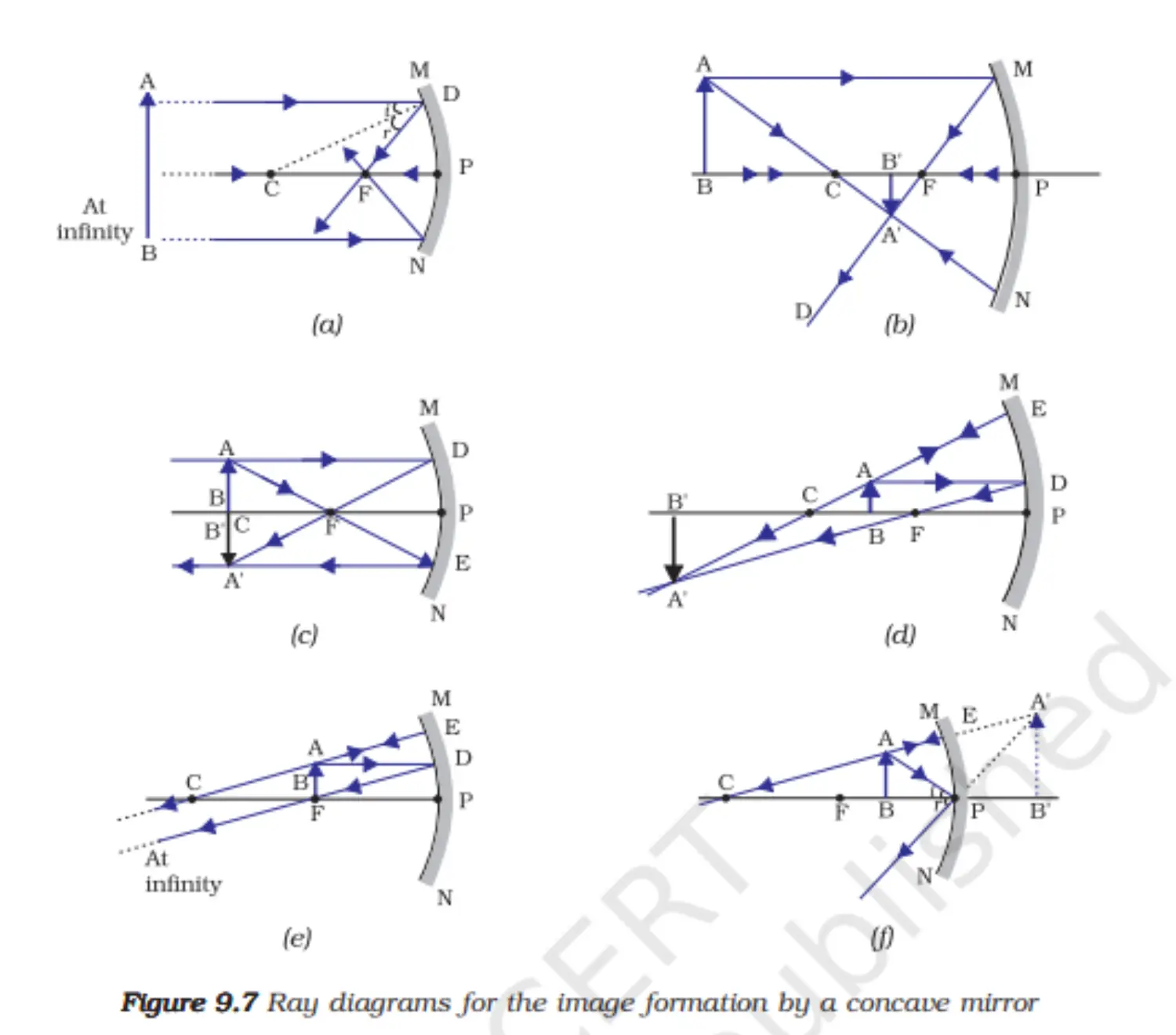
Uses of concave mirrors
- Uses of Concave Mirrors:
- 2.1 In Everyday Devices:
- 2.1.1 Torches & Headlights: For creating focused, parallel beams of light.
- 2.1.2 Shaving Mirrors: To see an enlarged image of the face.
- 2.2 In Professional Equipment:
- 2.2.1 Dentistry: For enlarged images of patients' teeth.
- 2.2.2 Solar Furnaces: To concentrate sunlight for heating.
- 2.1 In Everyday Devices:
- Uses of Concave Mirrors:
- Ray Diagrams for Concave Mirrors:
Image formation by a Convex Mirror
- Convex Mirrors and Image Formation:
- 1.1 Object at Infinity:
- When the object is at infinity, a convex mirror forms a diminished image at its focal point.
- 1.2 Object at Finite Distance:
- For an object placed at a finite distance, the convex mirror forms an erect and diminished image behind the mirror.
- 1.1 Object at Infinity:
- Uses of convex mirrors
- Uses of Convex Mirrors:
- 2.1 Rear-View Mirrors in Vehicles:
- Provide an erect and diminished image.
- Offer a wider field of view for safe driving.
- 2.1 Rear-View Mirrors in Vehicles:
- Uses of Convex Mirrors:
- Convex Mirrors and Image Formation:
Sign Convention for Reflection by Spherical Mirrors
- New Cartesian Sign Convention Basics:
- 1.1 Origin and Axis:
- The pole (P) of the mirror is the origin.
- The principal axis is the x-axis of the coordinate system.
- 1.2 Object Placement:
- Always placed to the left of the mirror, where light approaches from.
- 1.1 Origin and Axis:
- Distance Measurement Rules:
- 2.1 Parallel to Principal Axis:
- Measured from the pole.
- 2.2 Right of Origin (Positive Direction):
- Distances along +x-axis are positive.
- 2.3 Left of Origin (Negative Direction):
- Distances along –x-axis are negative.
- 2.4 Perpendicular and Above Principal Axis:
- Distances along +y-axis are positive.
- 2.5 Perpendicular and Below Principal Axis:
- Distances along –y-axis are negative.
- 2.1 Parallel to Principal Axis:
- Usage in Optics:
- 3.1 Application:
- These conventions are used for deriving the mirror formula and solving numerical problems.
- 3.1 Application:
Diagram
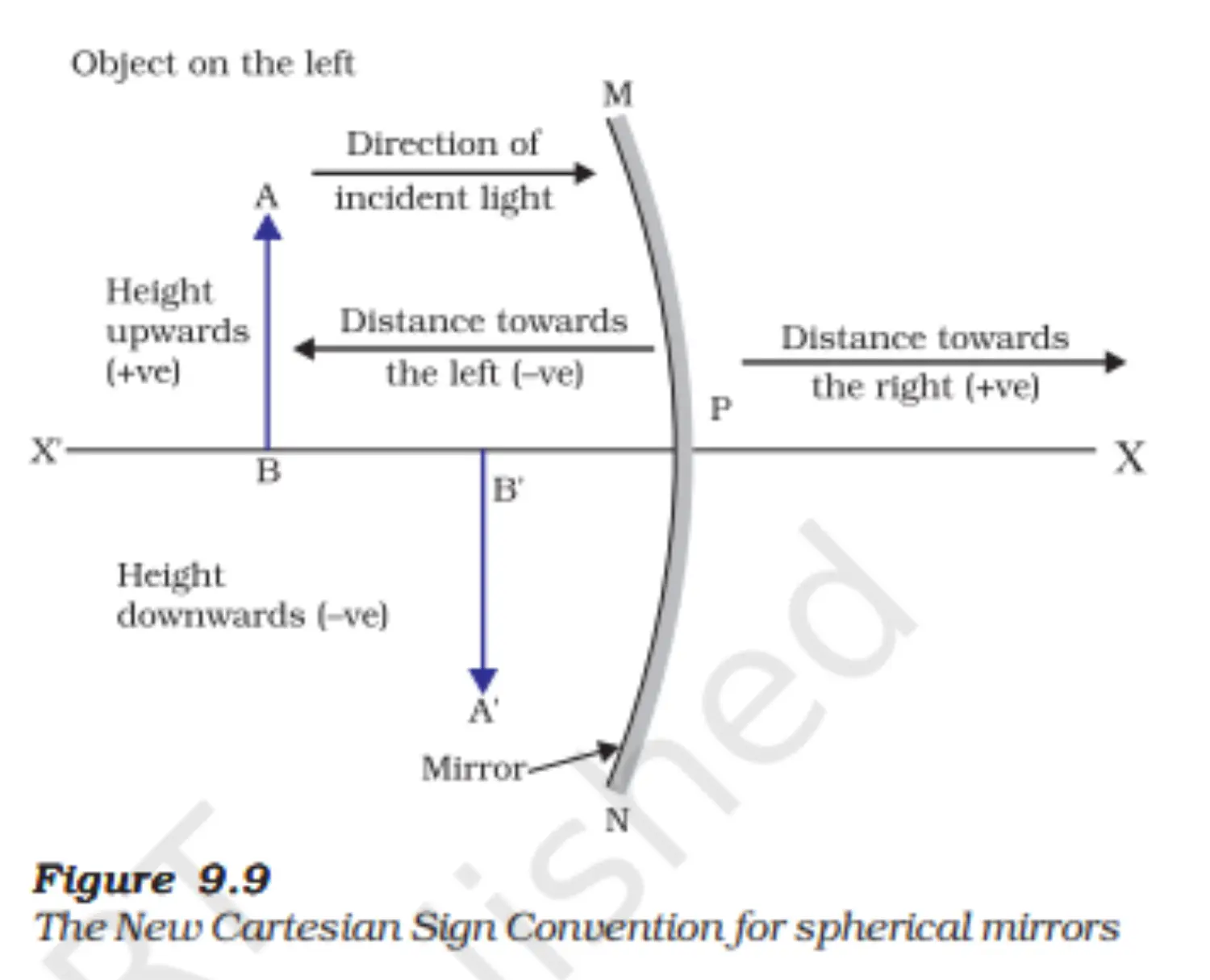
- New Cartesian Sign Convention Basics:
Mirror Formula and Magnification
Key Terms:
- 1.1 Object Distance (u): Distance from object to mirror's pole.
- 1.2 Image Distance (v): Distance from image to mirror's pole.
- 1.3 Focal Length (f): Distance from principal focus to mirror's pole.
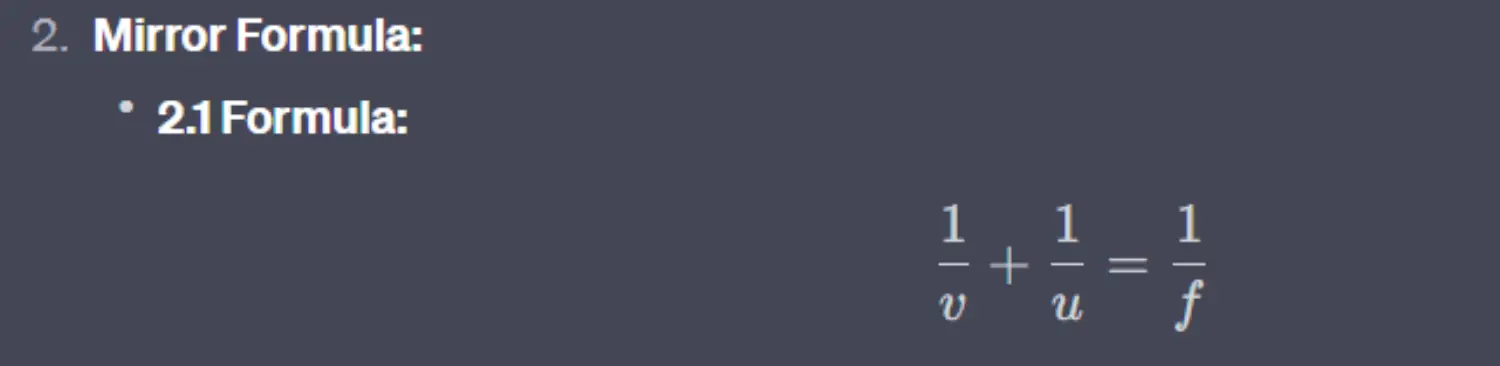
Using the Formula:
3.1 Problem-Solving:
- Apply the formula to find unknown distances when two are known.
3.2 Sign Importance:
- Correct sign usage ensures accurate results.
Magnification
- Understanding Magnification:
- 1.1 Definition: Magnification indicates the degree of enlargement or reduction of an image compared to the object's size.
- 1.2 Representation: Denoted by m.
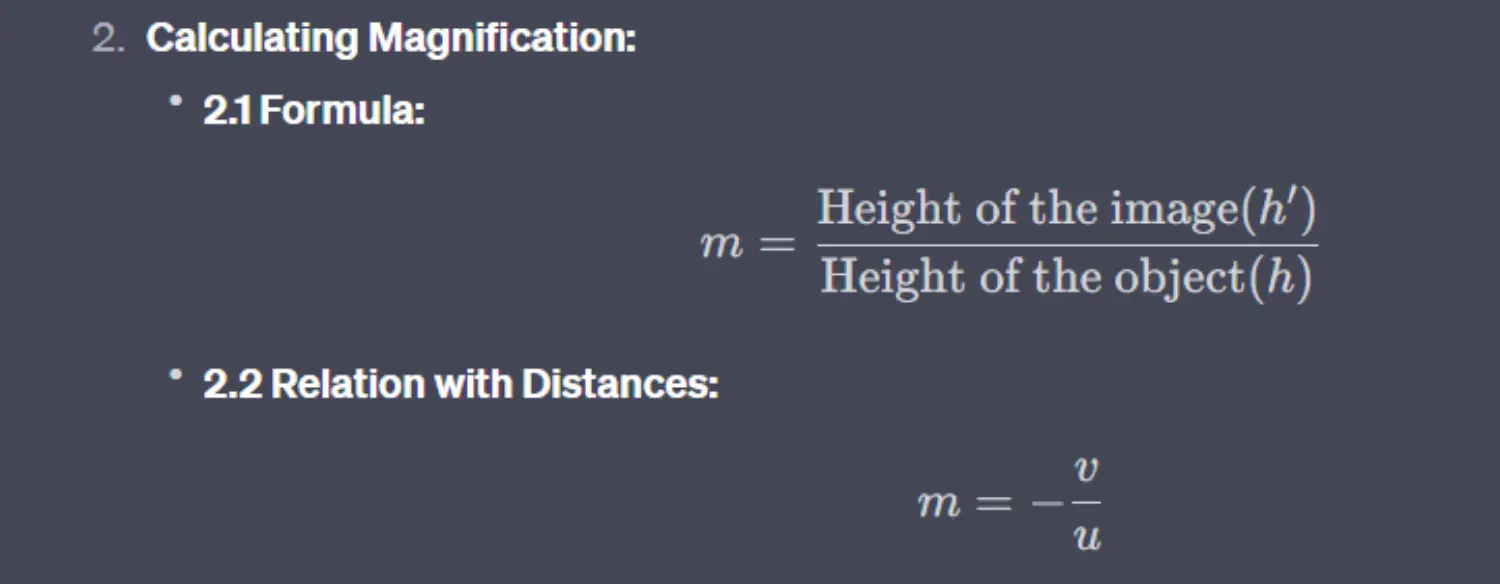
- Interpreting Magnification:
- 3.1 Sign of ℎ′h′: Positive for virtual images, negative for real images.
- 3.2 Sign of m: Indicates the nature of the image:
- Positive m: Virtual image
- Negative m: Real image
- Sign Convention:
- 4.1 Height of Object: Always positive, as objects are typically above the principal axis.
- 4.2 Applying Convention: Ensures correct determination of image nature and size.
- Understanding Magnification:
- Ray Diagram Basics:
- Types of Spherical Mirrors:
- Refraction of Light
- Basics of Refraction:
- 1.1 Definition: Change in direction of light when it passes from one medium to another.
- 1.2 Occurrence: Happens when light travels obliquely across the interface of two media.
- Everyday Observations:
- 2.1 Raised Bottom: Objects under water appear raised due to refraction.
- 2.2 Displaced Pencil: A pencil partly immersed in water appears bent or displaced.
- 2.3 Enlarged Lemon: Objects in water can appear larger than their actual size.
- Experiments with Refraction:
- 3.1 Displacement Varies: Different liquids cause varying degrees of apparent displacement.
- 3.2 Medium's Effect: The extent of refraction depends on the medium's properties.
- Understanding Refraction:
- 4.1 Direction Change: Light changes direction due to refraction, not always maintaining a straight path.
- 4.2 Medium Pair Effect: The effect of refraction varies with different pairs of media.
Refraction through a Rectangular Glass Slab
- Refraction Basics:
- 1.1 Change of Direction: Light changes direction at the interface of two media.
- 1.2 Entry from Air to Glass: Bends towards the normal due to higher density.
- Interactions at Surfaces:
- 2.1 At Point O: Entry from rarer to denser medium (air to glass).
- 2.2 At Point O': Exit from denser to rarer medium (glass to air).
- Angles of Incidence and Refraction:
- 3.1 Comparison: Angle of incidence is different from angle of refraction.
- 3.2 Normal Lines: Perpendiculars NN' and MM' are drawn at points O and O' respectively.
- Behaviour of Refracted Rays:
- 4.1 Incident Ray EO: On surface AB; bends towards the normal.
- 4.2 Emergent Ray O'H: Parallel to incident ray due to opposite but equal bending at both surfaces.
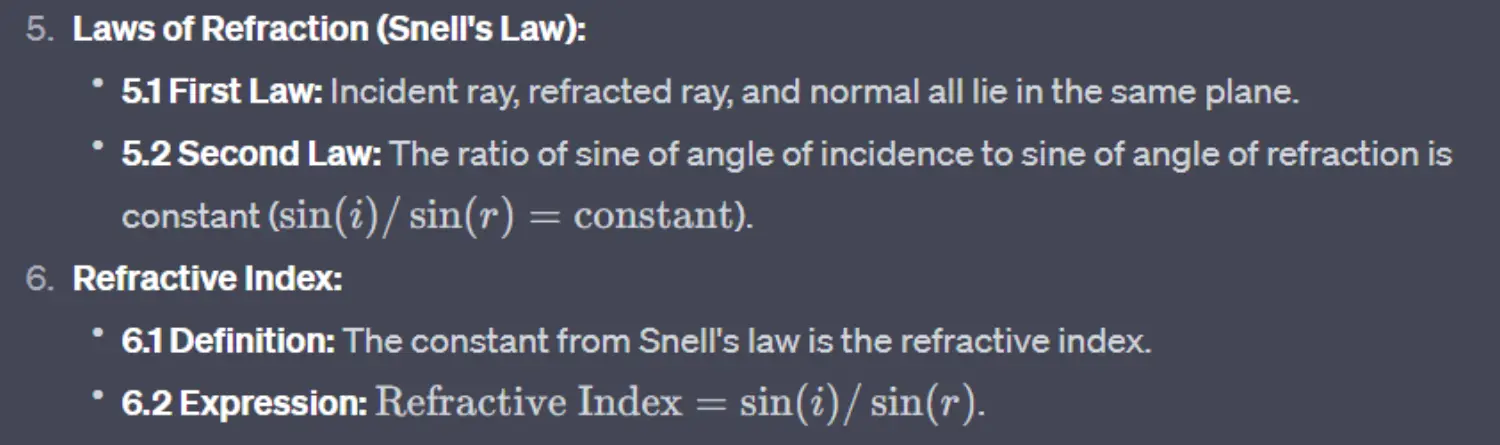
- Refraction Basics:
The Refractive Index
- Understanding Refractive Index:
- 1.1 Definition: Measure of how much light bends when it enters a medium.
- 1.2 Expression: Represented by n, given by n=sin(r)sin(i).
- Speed of Light in Media:
- 2.1 Speed Variation: Speed of light differs in various media (fastest in vacuum, slower in glass or water).
- 2.2 Speed in Vacuum: 3×10⁸ meters per second.
- Refractive Index Calculation:
- 3.1 Refractive Index 21n21: For light going from medium 1 to medium 2, n21=v2v1.
- 3.2 Refractive Index 12n12: For light going from medium 2 to medium 1, n12=v1v2.
- Absolute Refractive Index:
- 4.1 Reference to Vacuum/Air: When medium 1 is air or vacuum, n2 is the absolute refractive index.
- 4.2 Calculation: nm=vc, where c is the speed of light in air or vacuum and v is the speed in the medium.
- Optical Density vs Mass Density:
- 5.1 Optical Density: Refers to refractive index, not related to mass density.
- 5.2 Example: Kerosene is optically denser than water due to higher refractive index, despite lower mass density.
- Tabulated Refractive Indexes:
- 6.1 For Water: nw=1.33, indicating light speed in water is 1.33 times slower than in air.
- 6.2 For Crown Glass: ng=1.52, meaning light travels slower in crown glass compared to air.
Table
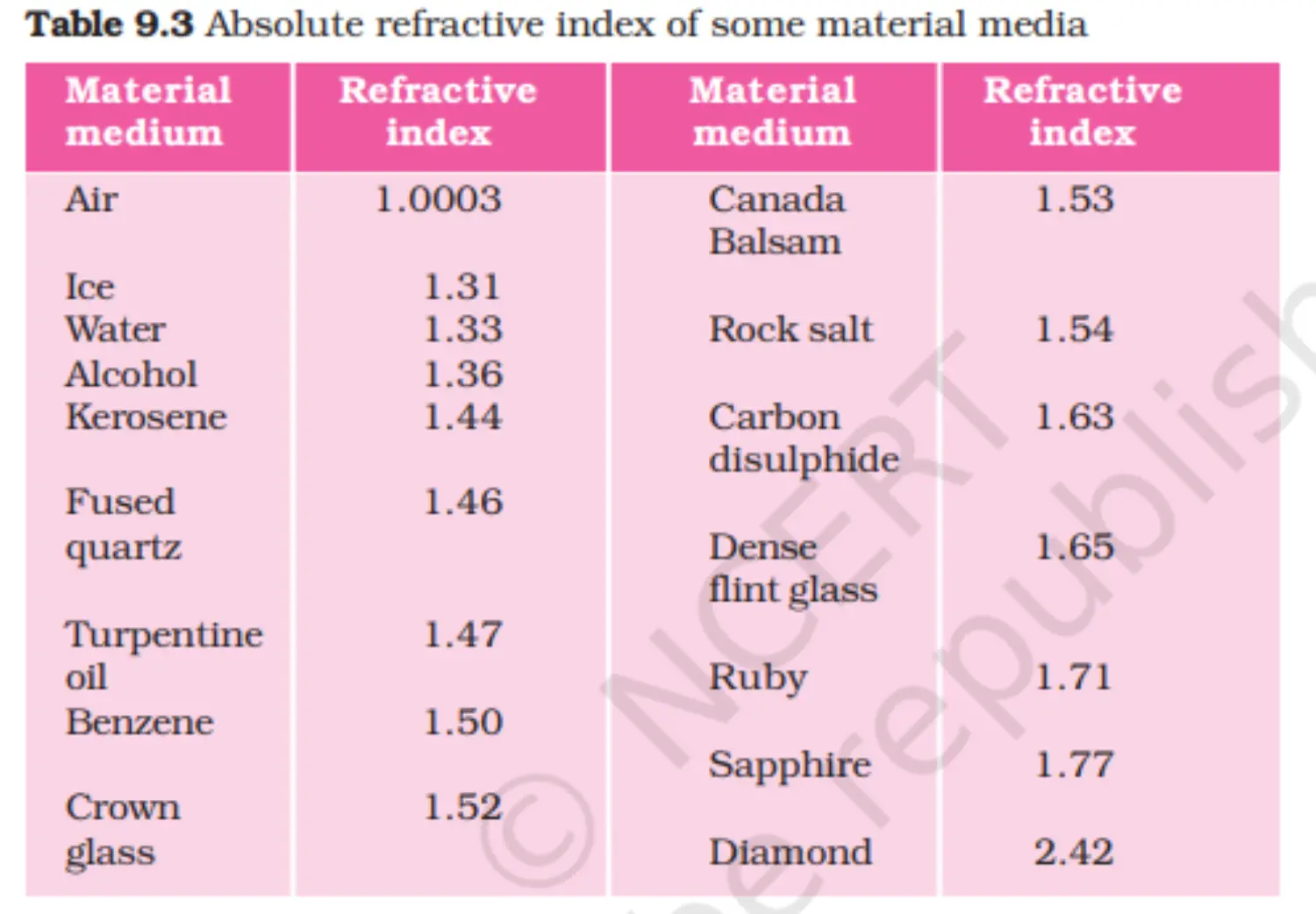
- Understanding Refractive Index:
Refraction by Spherical Lenses
- Basics of Lenses:
- 1.1 Definition: A lens is a transparent material with two surfaces that are spherical or one spherical and one plane.
- 1.2 Types of Lenses:
- 1.2.1 Convex Lens: Bulges outward, thicker in the middle, converges light rays, known as a converging lens.
- 1.2.2 Concave Lens: Curved inwards, thicker at the edges, diverges light rays, known as a diverging lens.
- Anatomy of Lenses:
- 2.1 Centres of Curvature (C1, C2): The centers of the spheres to which the spherical surfaces of the lens belong.
- 2.2 Principal Axis: An imaginary line joining the two centers of curvature.
- 2.3 Optical Centre (O): The point through which light rays pass without deviation.
- 2.4 Aperture: The effective diameter of the lens.
- Principal Focus and Focal Length:
- 3.1 Principal Focus (F1, F2): For a convex lens, it's the point where parallel rays converge; for a concave lens, it's where rays appear to diverge.
- 3.2 Focal Length (f): Distance between the optical center and the principal focus.
- Determining Focal Length:
- 4.1 Convex Lens: The distance from the lens to the point where it focuses sunlight, creating a bright spot on paper, is its focal length.
- Basics of Lenses:
Image Formation by Lenses
- Image Formation by Convex Lenses:
- 1.1 Nature of Image: The nature (real or virtual) of the image depends on the object's position relative to the lens.
- 1.2 Position and Size: The image's position and size change based on where the object is placed in relation to the lens's focal point.
- Image Formation by Concave Lenses:
- 2.1 Consistent Outcome: No matter where the object is placed, a concave lens always produces a virtual, erect, and diminished image.
- General Observations:
- 3.1 Convex Lens Behavior:
- Objects beyond 2F produce smaller, inverted, real images between F and 2F.
- Objects at 2F produce real, inverted images of the same size at 2F on the other side.
- Objects between F and 2F produce larger, inverted, real images beyond 2F.
- Objects at F produce no image because light rays are parallel after refraction.
- Objects between the lens and F produce magnified, upright, virtual images on the same side as the object.
- 3.1 Convex Lens Behavior:
Table
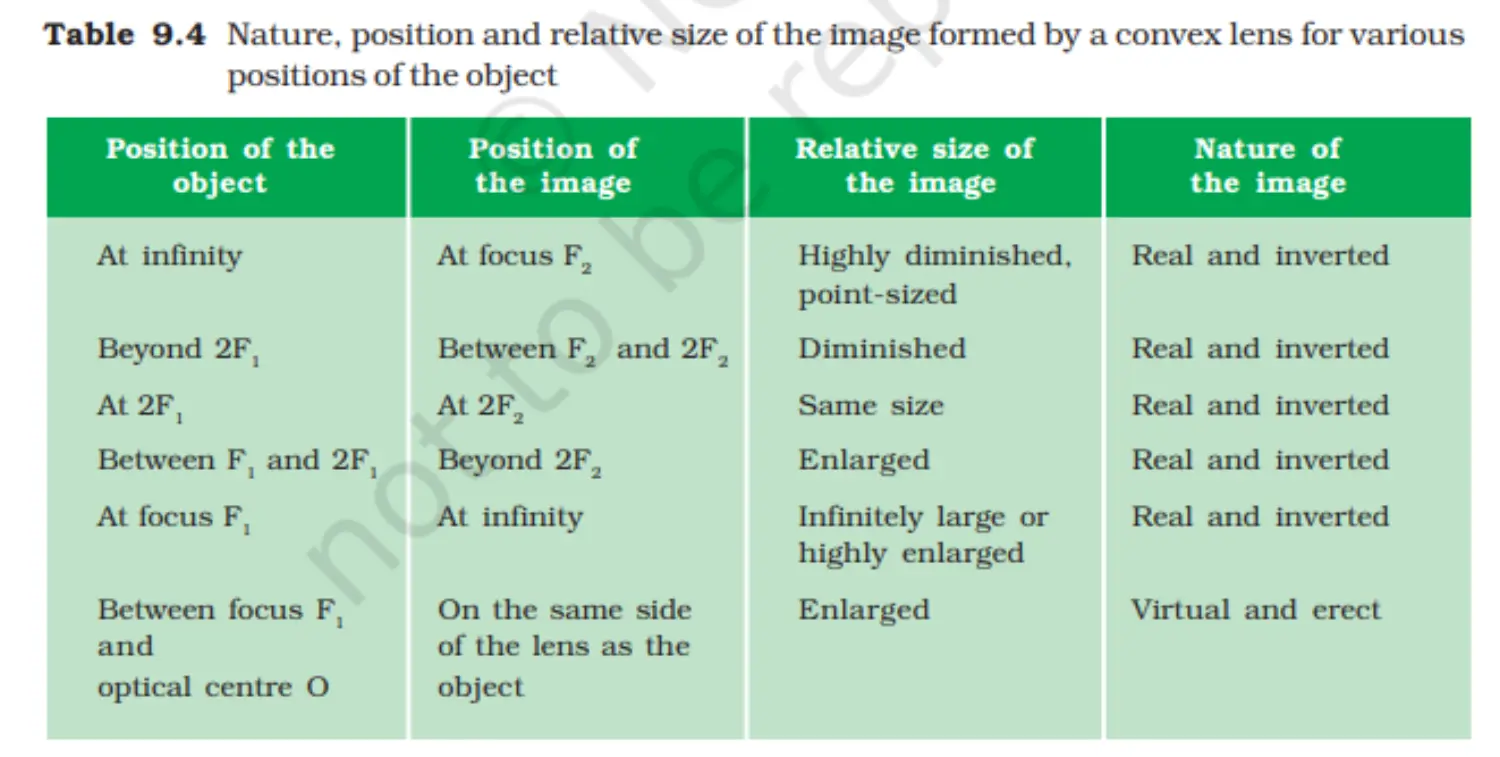
Table
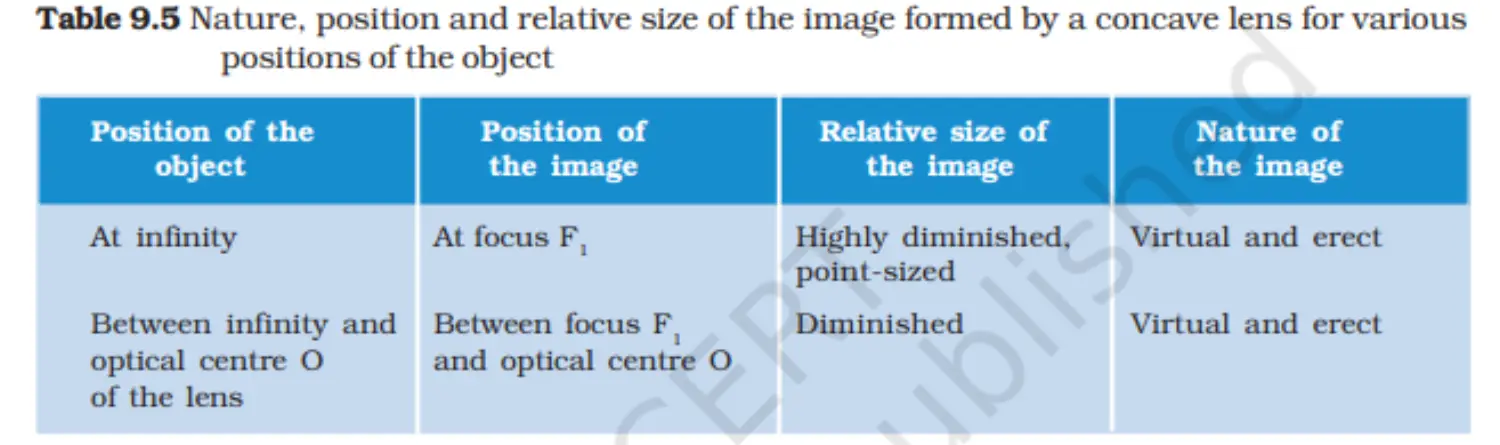
- Image Formation by Convex Lenses:
Image Formation in Lenses Using Ray Diagrams
- Ray Diagrams for Lenses:
- 1.1 Purpose: Ray diagrams help visualize the nature, position, and size of images formed by lenses.
- 1.2 Principle: Just like spherical mirrors, we use two specific rays to construct the diagram.
- Rays Used in Diagrams:
- 2.1 Parallel Ray (Convex Lens): A ray parallel to the principal axis passes through the principal focus on the other side after refraction.
- 2.2 Parallel Ray (Concave Lens): A parallel ray appears to diverge from the principal focus on the same side.
- 2.3 Focus to Parallel (Convex Lens): A ray through the principal focus becomes parallel to the principal axis after refraction.
- 2.4 Focus to Parallel (Concave Lens): A ray towards the principal focus emerges parallel after refraction.
- 2.5 Optical Centre Ray: A ray through the optical centre passes without deviation.
- Image Formation Specifics:
- 3.1 Convex Lens Images: Ray diagrams for different object positions are shown in the referenced figures.
- 3.2 Concave Lens Images: Ray diagrams for different object positions with a concave lens are detailed in the referenced figures.
- Ray Diagrams for Lenses:
Sign Convention for Spherical Lenses
- Basics of Sign Convention:
- 1.1. Purpose: Essential for accurate optical calculations involving lenses.
- 1.2. Similarity to Mirrors: Follows the same principles as the convention for spherical mirrors.
- Rules for Sign Convention:
- 2.1. Measurement Reference: All distances are measured from the lens's optical centre.
- 2.2. Focal Length:
- 2.2.1. Convex Lens: Focal length is positive.
- 2.2.2. Concave Lens: Focal length is negative.
- 2.3. Distance Values:
- 2.3.1. Object Distance (u): Sign determined by position relative to the optical centre.
- 2.3.2. Image Distance (v): Sign determined by image formation relative to the optical centre.
- 2.4. Height Values:
- 2.4.1. Object Height (h): Positive if object is above the principal axis.
- 2.4.2. Image Height (h′): Sign varies depending on the nature of the image (positive for virtual, negative for real).
- Application:
- 3.1. Consistency: It's crucial to consistently apply these sign conventions in all lens-related calculations to ensure accuracy.
- Basics of Sign Convention:
Lens Formula and Magnification
- Lens Formula:
- 1.1. Definition: Relates object distance (u), image distance (v), and focal length (f).
- 1.2. Formula: v1−u1=f1
- 1.3. Applicability: Valid for all spherical lenses.
- Magnification:
- 2.1. Definition: Ratio of the height of the image (h′) to the height of the object (h).
- 2.2. Formula for Magnification (m): m=hh′=uv
- 2.3. Interpretation:
- 2.3.1. Positive Magnification: Indicates a virtual image.
- 2.3.2. Negative Magnification: Indicates a real image.
- Using the Formula:
- 3.1. Sign Convention: Must use the appropriate sign convention for u, v, and f.
- 3.2. Problem-Solving: Essential for solving lens-related numerical problems.
- Magnification
- Magnification (m):
- 1.1 Definition: Ratio of image height (h′) to object height (h).
- 1.2 Formula: m=hh′
- Relation to Distance:
- 2.1 Distance Relationship: Magnification is also the ratio of image distance (v) to object distance (u).
- 2.2 Formula: m=uv
- Interpreting Magnification:
- 3.1 Positive Value: Indicates a virtual image.
- 3.2 Negative Value: Indicates a real and inverted image.
- Usage in Optics:
- 4.1 Problem Solving: Essential for calculating the properties of the image formed by a lens.
- 4.2 Sign Convention: Apply the sign convention accurately for h′, v, and u.
- Magnification (m):
- Lens Formula:
Power of a Lens
- Power of a Lens:
- 1.1 Definition: Power of a lens (P) is the reciprocal of its focal length (f).
- 1.2 Formula: P=f1
- 1.3 Unit: The SI unit of power is dioptre, denoted as D.
- Convex Lens:
- 2.1 Positive Power: A convex lens has positive power.
- 2.2 Short Focal Length: It converges light rays significantly, indicating higher power.
- Concave Lens:
- 3.1 Negative Power: A concave lens has negative power.
- 3.2 Divergence of Light: A shorter focal length means higher divergence and more negative power.
- Interpreting Prescriptions:
- 4.1 Example (+2.0 D): A +2.0 D power suggests a convex lens with a focal length of 0.50 m.
- 4.2 Example (–2.5 D): A –2.5 D power indicates a concave lens with a focal length of –0.40 m.
- Power of a Lens:
- Basics of Refraction:
- Additional Concepts
- Nature of Light:
- 1.1 Straight-line Path: Light typically travels in straight lines.
- 1.2 Diffraction: When an object is very small, light bends around it, known as diffraction.
- Dual Nature of Light:
- 2.1 Wave-Particle Duality: Light behaves both as a wave and a particle.
- Optical Density:
- 3.1 Definition: Not related to mass density, but refers to the refractive index.
- 3.2 Optically Denser Medium: Higher refractive index than another medium.
- 3.3 Light Speed: Faster in optically rarer mediums.
- Refraction:
- 4.1 Direction Change: Light bends towards the normal when entering a denser medium and away when entering a rarer medium.
- Combination of Lenses:
- 5.1 Power Summation: Net power is the algebraic sum of individual powers.
- 5.2 Practical Use: Simplifies the calculation for opticians.
- General Concepts:
- 6.1 Real and Virtual Images: Formed by mirrors and lenses.
- 6.2 Laws: Reflection and refraction are governed by specific laws.
- 6.3 Sign Conventions: Cartesian Sign Conventions are used for mirrors and lenses.
- Formulas:
- 7.1 Mirror Formula: v1+u1=f1
- 7.2 Focal Length: Equal to half the radius of curvature for mirrors.
- 7.3 Magnification: Ratio of image height to object height.
- 7.4 Lens Formula: v1−u1=f1
- 7.5 Power of a Lens: Reciprocal of focal length, measured in dioptres (D).
- Nature of Light:
- Introduction
Chapter 10 - The Human Eye and the Colorful World
- Introduction
- Human Eye and Lenses:
- 1.1 Eye as an Optical Instrument: Uses light to see objects; contains a natural lens.
- 1.2 Lens Function: Focuses light to form clear images on the retina.
- Defects of Vision and Correction:
- 2.1 Spectacles: Correct vision defects by adjusting the focus of light onto the retina.
- 2.2 Types of Defects: Myopia (nearsightedness), hyperopia (farsightedness), etc.
- Optical Phenomena in Nature:
- 3.1 Rainbow Formation: Caused by refraction, reflection, and dispersion of light in water droplets.
- 3.2 Splitting of White Light: Dispersion into its constituent colors when passing through a prism.
- 3.3 Blue Sky: Rayleigh scattering of sunlight by the atmosphere, more effective at shorter wavelengths.
- Application of Refraction:
- 4.1 Natural Events: Explains phenomena like mirages and twinkling of stars.
- 4.2 Technological Uses: Design of cameras, microscopes, and telescopes.
- Human Eye and Lenses:
- The Human Eye
- Importance of the Human Eye:
- 1.1 Primary Sense Organ: Essential for vision and perceiving colors.
- 1.2 Uniqueness: The only organ capable of discerning colors.
- Anatomy of the Eye:
- 2.1 Eye Structure: Spherical shape, approximately 2.3 cm in diameter.
- 2.2 Cornea: Transparent front membrane, primary light refractor.
- 2.3 Lens: Adjusts focus, fine-tuning image formation.
- 2.4 Iris: Muscle controlling pupil size, thus light intake.
- 2.5 Retina: Light-sensitive screen with cells that signal the brain.
- Functioning of the Eye:
- 3.1 Light Entry: Through cornea, controlled by pupil.
- 3.2 Image Formation: Inverted real image on retina.
- 3.3 Signal Transmission: Electrical signals from retina to brain via optic nerves.
- 3.4 Perception: Brain interprets signals to form visual perception.
Diagram
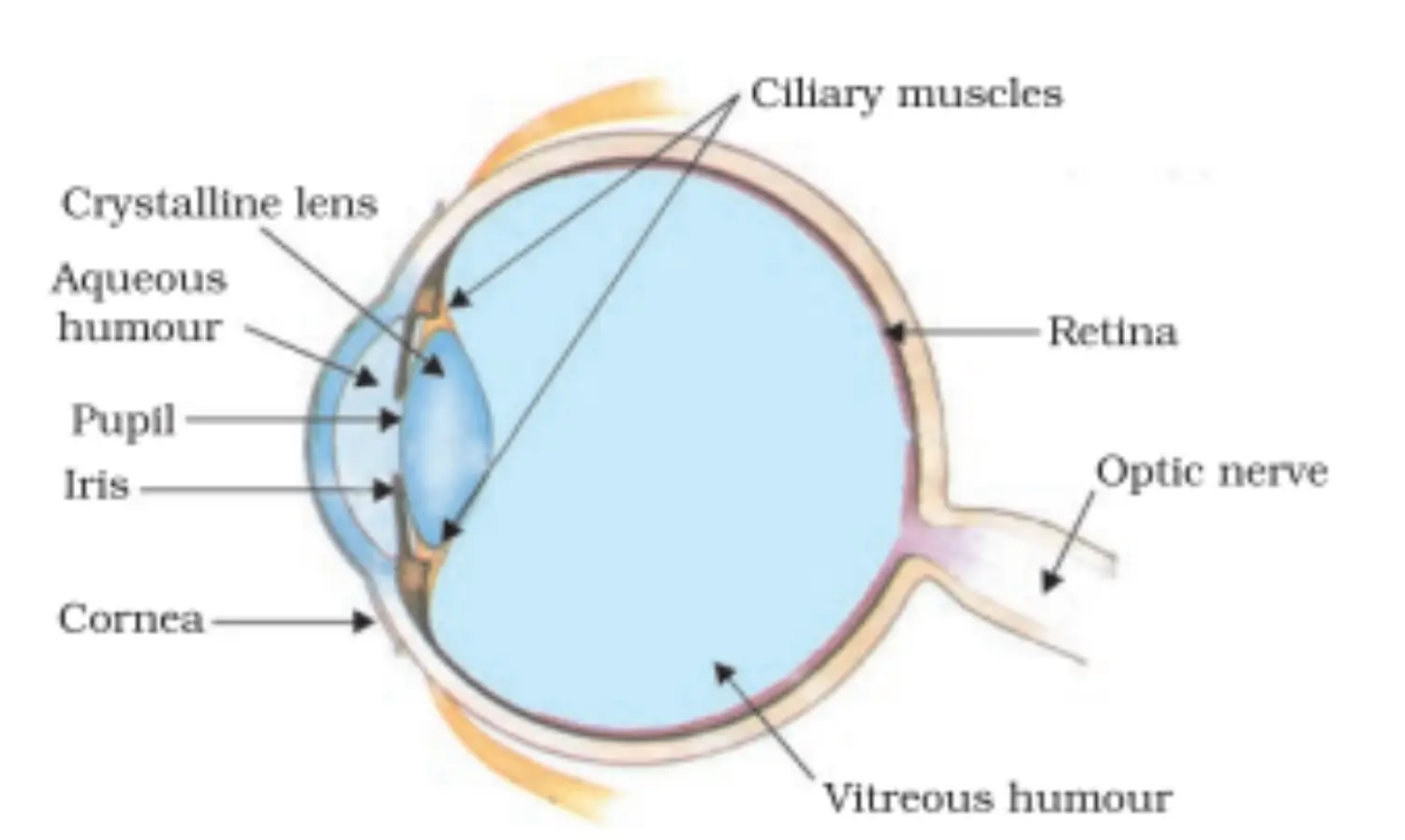
Power of Accommodation
- Eye Lens Composition:
- 1.1 Material: Fibrous, jelly-like substance.
- 1.2 Modifiable Curvature: Controlled by ciliary muscles.
- Focal Length Adjustment:
- 2.1 For Distant Objects: Muscles relax, lens thins, focal length increases.
- 2.2 For Close Objects: Muscles contract, lens thickens, focal length decreases.
- Accommodation:
- 3.1 Definition: The eye lens's ability to adjust its focal length.
- 3.2 Limits: Focal length can't decrease below a minimum limit.
- Vision Distances:
- 4.1 Near Point: Closest distance for clear vision without strain, typically 25 cm.
- 4.2 Far Point: Farthest point for clear vision, normally infinity.
- Age-Related Changes:
- 5.1 Cataract: Clouding of the crystalline lens, leading to vision loss.
- 5.2 Treatment: Vision can often be restored with cataract surgery.
- Eye Lens Composition:
- Importance of the Human Eye:
- Defects of Vision and their Correction
- Loss of Accommodation:
- 1.1 Cause: Eye's gradual inability to adjust focus.
- 1.2 Result: Blurred and uncomfortable vision.
- Common Refractive Defects:
- 2.1 Myopia (Nearsightedness):
- 2.1.1 Definition: Clear vision of close objects, distant objects are blurred.
- 2.1.2 Correction: Use of concave lenses.
- 2.2 Hypermetropia (Farsightedness):
- 2.2.1 Definition: Clear vision of distant objects, difficulty seeing close objects.
- 2.2.2 Correction: Use of convex lenses.
- 2.3 Presbyopia:
- 2.3.1 Definition: Impaired vision due to aging; difficulty focusing on close objects.
- 2.3.2 Correction: Use of bifocals or reading glasses.
- 2.1 Myopia (Nearsightedness):
- Correction with Lenses:
- 3.1 Purpose: To correct the refractive errors by altering light path into the eye.
- 3.2 Lenses: Suitable spherical lenses can remedy these defects.
- Myopia
- Definition of Myopia:
- 1.1 Clarity: Clear vision for nearby objects, distant objects appear blurred.
- 1.2 Far Point: Closer than infinity, typically a few meters away.
- Causes of Myopia:
- 2.1 Eye Lens Curvature: Excessive curvature leads to a shorter focal length.
- 2.2 Eyeball Length: An elongated eyeball causes images to form in front of the retina.
- Correction of Myopia:
- 3.1 Use of Lenses: Concave lenses are used to correct myopia.
- 3.2 Function: The lens diverges light rays, extending the image formation to the retina.
- Adjustment with Concave Lenses:
- 4.1 Selection: The power of the lens is chosen based on the severity of myopia.
- 4.2 Result: The image is repositioned onto the retina, restoring clear vision.
- Definition of Myopia:
- Hypermetropia
- Definition of Hypermetropia:
- 1.1 Clarity: Clear vision for distant objects, nearby objects appear blurred.
- 1.2 Near Point: Further away than the normal near point (25 cm).
- Causes of Hypermetropia:
- 2.1 Eye Lens Focal Length: Too long, causing poor focus for close objects.
- 2.2 Eyeball Size: A smaller-than-normal eyeball.
- Correction of Hypermetropia:
- 3.1 Use of Lenses: Convex lenses are used to correct hypermetropia.
- 3.2 Function: The lens converges light rays, moving the focus forward to the retina.
- Adjustment with Convex Lenses:
- 4.1 Selection: The power of the lens is tailored to the individual's condition.
- 4.2 Result: The image is adjusted to form on the retina, enabling clear near vision.
- Definition of Hypermetropia:
- Presbyopia
- Understanding Presbyopia:
- 1.1 Definition: A vision condition linked to aging.
- 1.2 Symptom: Difficulty in seeing close objects distinctly.
- Causes of Presbyopia:
- 2.1 Muscle Weakening: Diminished ciliary muscle function.
- 2.2 Lens Rigidity: Reduced flexibility of the eye lens.
- Correction of Presbyopia:
- 3.1 Glasses: Bifocal lenses with both concave (upper) and convex (lower) parts.
- 3.2 Contact Lenses/Surgery: Alternative options for correction.
- Bifocal Lenses:
- 4.1 Design: Upper part for distance, lower for close-up work.
- 4.2 Purpose: Accommodate both myopic and hypermetropic conditions.
- Understanding Presbyopia:
- Loss of Accommodation:
- Refraction of Light through a Prism
- Basics of a Prism:
- 1.1 Structure: Triangular base, three rectangular lateral surfaces.
- 1.2 Angle of Prism: Angle between two lateral faces.
- Refraction Process:
- 2.1 Incidence: Light enters from air to glass, bends towards the normal.
- 2.2 Emergence: Light exits from glass to air, bends away from the normal.
- Angle of Deviation:
- 3.1 Definition: Angle between the direction of the incident ray and the emergent ray.
- 3.2 Observation: Emergent ray deviates from the incident ray's path.
- Comparative Study:
- 4.1 Glass Slab vs. Prism: Both bend light, but prism causes deviation in the emergent ray.
- 4.2 Measuring Deviation: Mark and measure ∠D in experimental setups.
- Basics of a Prism:
- Dispersion of White Light by a Glass Prism
- Phenomenon of Dispersion:
- 1.1 Definition: The splitting of white light into its component colors.
- 1.2 Result: Formation of a spectrum of colors.
- Colors of the Spectrum:
- 2.1 Sequence: Violet, Indigo, Blue, Green, Yellow, Orange, Red (VIBGYOR).
- 2.2 Observation: Each color emerges at a different angle due to varying degrees of bending.
- Prism's Role:
- 3.1 Function: A prism disperses the white light into its constituent colors.
- 3.2 Mechanism: Different wavelengths of light refract at different angles within the prism.
- Newton's Experiment:
- 4.1 Initial Discovery: White light composed of seven colors.
- 4.2 Further Investigation: Second prism recombined the colors into white light, confirming the composition of sunlight.
- Rainbows:
- 5.1 Natural Occurrence: Formed by dispersion of sunlight by water droplets in the atmosphere.
- 5.2 Formation Process: Refraction, dispersion, internal reflection, and again refraction as light exits the droplets.
- Phenomenon of Dispersion:
- Atmospheric Refraction
- Atmospheric Refraction Concept:
- 1.1 Definition: The bending of light as it passes through layers of the Earth's atmosphere.
- 1.2 Causes: Variations in air density due to temperature differences.
- Observations of Atmospheric Refraction:
- 2.1 Local Effects: Flickering of objects seen over hot surfaces due to turbulent air.
- 2.2 Astronomical Effects: Twinkling of stars caused by light passing through various layers of the atmosphere.
- Density and Refractive Index:
- 3.1 Relationship: Lighter (hotter) air has a lower refractive index than denser (cooler) air.
- 3.2 Consequence: The path of light is constantly shifting, causing apparent position fluctuations.
- Twinkling of Stars:
- 4.1 Phenomenon Explanation: Caused by atmospheric refraction due to temperature and density variations in the atmosphere.
- 4.2 Visual Impact: Stars appear to twinkle or change position due to the refraction of their light.
- Twinkling of Stars
- Twinkling of Stars:
- 1.1 Cause: Atmospheric refraction of starlight.
- 1.2 Refraction Process: Continuous change as starlight passes through the Earth's atmosphere with varying refractive index.
- 1.3 Apparent Position: Star appears higher than its actual position when near the horizon.
- 1.4 Fluctuations: Apparent position and brightness fluctuate due to atmospheric conditions.
- Stability of Planets' Appearance:
- 2.1 Extended Sources: Planets are closer to Earth and appear as extended sources, not point-sized like stars.
- 2.2 Twinkling Effect: Variations in light from planets' various points average out, reducing twinkling.
- Twinkling of Stars:
- Advance sunrise and delayed sunset
- Phenomenon Overview:
- 1.1 Atmospheric Refraction: The bending of sunlight through the Earth's atmosphere.
- 1.2 Visual Effects: Causes the Sun to be visible before it actually rises and after it sets.
- Timing Details:
- 2.1 Advance Sunrise: Approximately 2 minutes before the Sun actually crosses the horizon.
- 2.2 Delayed Sunset: Visible for about 2 minutes after it has truly set.
- Apparent Solar Shape:
- 3.1 Flattened Sun's Disc: At sunrise and sunset, the Sun appears flattened due to atmospheric refraction.
- Phenomenon Overview:
- Atmospheric Refraction Concept:
- Scattering of Light
- Basic Concept:
- 1.1 Scattering: Interaction of light with particles that results in redirection of light.
- 1.2 Visibility of Light Path: Light paths are visible in colloidal solutions due to larger particle sizes.
- Natural Phenomena:
- 2.1 Sky's Color: Blue due to scattering of shorter wavelengths by atmospheric particles.
- 2.2 Ocean Color: Deep sea appears blue for similar reasons as the sky.
- 2.3 Sunrise and Sunset: Reddening occurs as the longer wavelengths scatter less and travel further.
- Scattering in Solutions:
- 3.1 True Solutions: Light path is invisible.
- 3.2 Colloidal Solutions: Larger particles make the light path visible.
- Tyndall Effect
- Definition:
- 1.1 Tyndall Effect: Scattering of light by particles in a colloid or fine suspension.
- Occurrence:
- 2.1 Natural Settings: Visible when sunlight enters a smoke-filled room or passes through the forest mist.
- 2.2 Conditions: Occurs due to the interaction of light with small particles in the atmosphere like dust, smoke, or water droplets.
- Visibility of Light Path:
- 3.1 Beam Path: The path of a light beam becomes visible due to scattering by these fine particles.
- Color Dependence:
- 4.1 Particle Size: The color of the scattered light depends on the size of the particles.
- 4.2 Blue Light: Very fine particles predominantly scatter blue light.
- 4.3 Longer Wavelengths: Larger particles scatter light of longer wavelengths.
- 4.4 White Light: Sufficiently large particles can scatter light that appears white.
- Definition:
- Why is the color of the clear Sky Blue?
- Atmospheric Composition:
- 1.1 Molecules: Air contains molecules and fine particles smaller than the wavelength of visible light.
- Scattering of Light:
- 2.1 Shorter Wavelengths: These particles scatter shorter wavelengths (blue light) more than longer wavelengths (red light).
- 2.2 Wavelength Comparison: Red light's wavelength is roughly 1.8 times greater than blue light.
- Visual Perception:
- 3.1 Blue Sky: The scattered blue light is what makes the sky appear blue to us.
- 3.2 No Atmosphere, Dark Sky: Without an atmosphere, the sky would look dark due to the absence of scattering.
- Altitude Effects:
- 4.1 High Altitude Observation: At high altitudes where the atmosphere is thinner, the sky appears darker as there is less scattering.
- Practical Application:
- 5.1 'Danger' Signals: Red lights are used for danger signals because red is the least scattered color, making it visible over long distances through fog or smoke.
- Atmospheric Composition:
- Basic Concept:
- Additional Concepts
- Eye Function and Accommodation:
- 1.1 Accommodation: Ability to adjust focal length to focus on near and distant objects.
- 1.2 Near Point: The least distance for clear vision without strain, typically 25 cm for young adults.
- Refractive Defects and Corrections:
- 2.1 Myopia: Near-sightedness corrected with concave lenses.
- 2.2 Hypermetropia: Far-sightedness corrected with convex lenses.
- 2.3 Presbyopia: Age-related loss of accommodation.
- Eye Donation:
- 3.1 Eligibility for Donation: Most people, including those with glasses or cataract surgery.
- 3.2 Procedure Post-Death: Eyes removed within 4-6 hours, simple and respectful process.
- 3.3 Restrictions: Infections like AIDS, Hepatitis B or C, and certain other diseases preclude donation.
- Utilization of Donated Eyes:
- 4.1 Eye Banks: Evaluate and distribute for transplantation or research.
- 4.2 Impact: One donor can help restore the sight of up to four individuals.
- Optical Phenomena:
- 5.1 Dispersion: Splitting of white light into its component colors.
- 5.2 Scattering: Causes the blue color of the sky and is influenced by particle size.
- Eye Function and Accommodation:
- Introduction
Chapter 11 - Electricity
Introduction
- Electricity Basics:
- 1.1 Definition: Electricity is a form of energy that is controllable and convenient for various uses.
- 1.2 Constituents: It is constituted by the flow of electric charge, primarily electrons.
- Electric Circuit:
- 2.1 Flow of Current: Electricity flows in a closed path known as an electric circuit.
- 2.2 Components: Includes sources of electricity (batteries, generators), conductors (wires), and consumers (bulbs, motors).
- Regulation of Current:
- 3.1 Factors Influencing Current:
- 3.1.1 Voltage: The electric potential difference between two points.
- 3.1.2 Resistance: Opposition to the flow of current, measured in ohms (Ω).
- 3.1.3 Conductance: Ease with which current flows, the inverse of resistance.
- 3.1 Factors Influencing Current:
- Heating Effect of Current:
- 4.1 Applications: Used in devices like electric heaters, toasters, and incandescent bulbs.
- 4.2 Principle: Current passing through a resistor generates heat, described by Joule's Law.
- Electricity Basics:
Electric Current and Circuit
- Understanding Electric Current:
- 1.1 Definition: Electric current is the flow of electric charge through a conductor.
- 1.2 Analogies: Comparable to water current in rivers or air current in the atmosphere.
- Conductors and Flow of Charges:
- 2.1 Conductor Role: Metals and other materials allow charges to flow, constituting a current.
- 2.2 Direction: Conventionally, the current is the flow of positive charges, opposite to electron flow.
- Electric Circuit:
- 3.1 Circuit Essentials: A complete path for current flow, including a power source, load, and conductive path.
- 3.2 Switch Function: A switch controls the flow of current by opening or closing the circuit.
- Measuring Electric Current:
- 4.1 Current (I): The rate of charge flow, measured in amperes (A).
- 4.2 Formula: I=tQ, where I is current, Q is charge in coulombs (C), and t is time in seconds.
- 4.3 Ammeter Use: Device used to measure current, always connected in series.
- Units of Current:
- 5.1 Ampere: The SI unit, defined as one coulomb of charge per second.
- 5.2 Smaller Units: Milliampere (mA) and microampere (µA) for lesser currents.
- Circuit Diagram Representation:
- 6.1 Symbols: Standard symbols represent different components.
- 6.2 Flow Direction: From positive to negative terminal through the circuit elements.
- Understanding Electric Current:
Electric Potential and Potential Difference
- Basic Concept of Potential Difference:
- 1.1 Analogy: Like water needing a slope to flow, charges need a potential difference to move.
- 1.2 Flow of Charge: Charges move in a wire when there's a potential difference along it.
- Role of a Battery:
- 2.1 Battery Function: Generates a potential difference, even without current flow.
- 2.2 Chemical Energy: A battery uses chemical energy to maintain potential difference and current.
- Defining Potential Difference:
- 3.1 Work and Charge: The potential difference is the work done to move a unit charge between two points.
- 3.2 Formula: V=QW, where V is the potential difference, W works in joules, and Q is charge in coulombs.
- Units of Potential Difference:
- 4.1 Volt: The SI unit of potential difference, named after Alessandro Volta.
- 4.2 Expression: 1 volt = 1 joule per coulomb (1V=1J/C).
- Measuring Potential Difference:
- 5.1 Voltmeter: Instrument used to measure the potential difference.
- 5.2 Connection: Always connected in parallel with the circuit element.
- Basic Concept of Potential Difference:
Circuit Diagram
- Concept of a Circuit Diagram:
- 1.1 Simplification: A circuit diagram simplifies the representation of an electric circuit.
- 1.2 Components: Includes a cell or battery, plug key, electrical components, and wires.
- Purpose of Circuit Diagrams:
- 2.1 Convenience: Provides a convenient way to visualize and understand complex circuits.
- 2.2 Standardization: Uses universally accepted symbols for components.
- Symbols in Circuit Diagrams:
- 3.1 Representation: Each electrical component has a unique symbol.
- 3.2 Common Symbols: Symbols for cell, battery, resistor, switch, etc.
Diagram
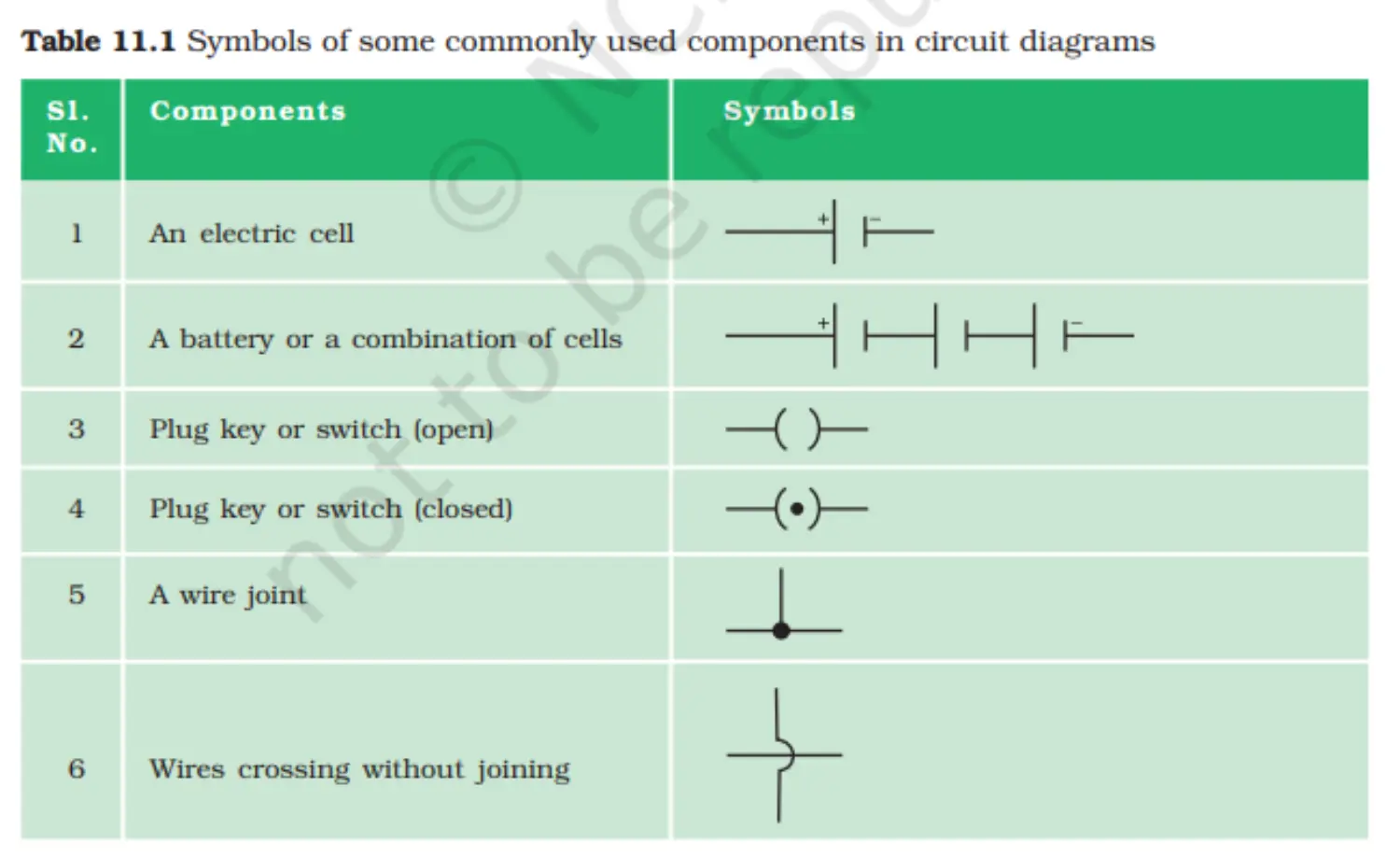
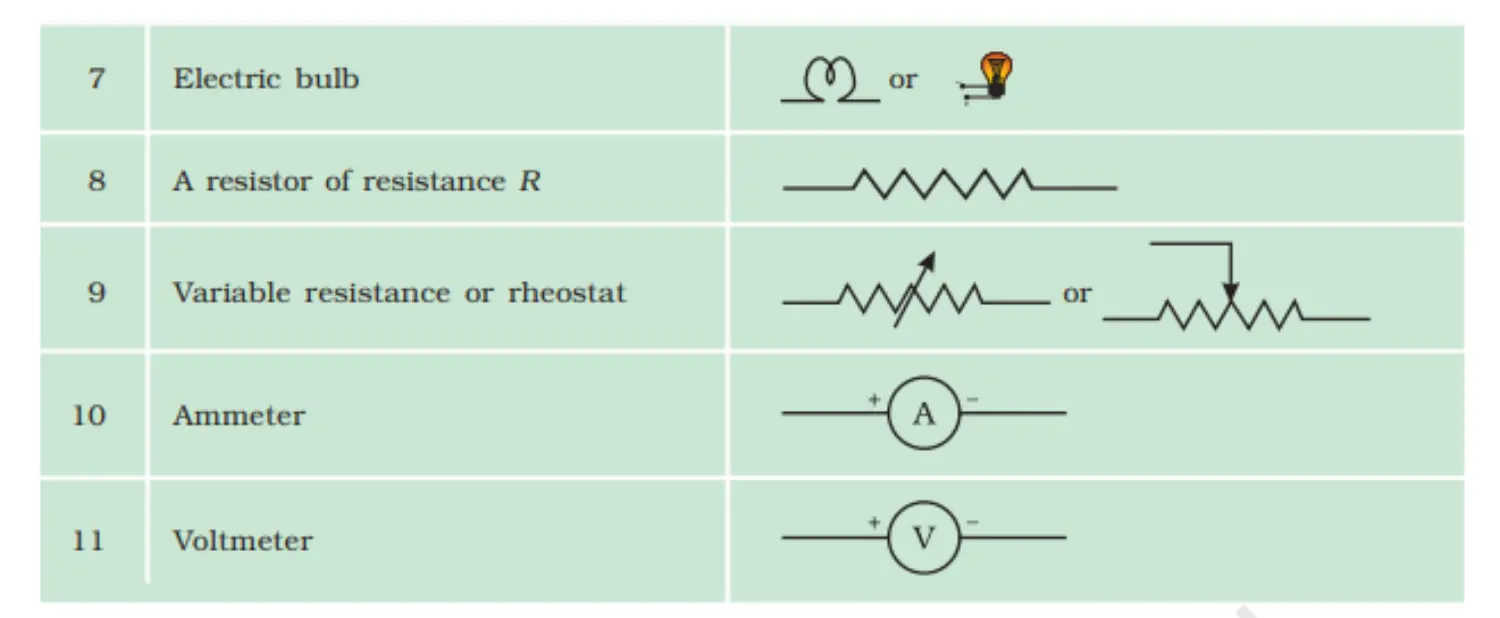
- Concept of a Circuit Diagram:
Ohm’s Law
- Ohm’s Law Basics:
- 1.1 Discovery: Formulated by Georg Simon Ohm in 1827.
- 1.2 Principle: The potential difference (V) across a conductor is directly proportional to the current (I) through it, maintaining a constant temperature.
- Mathematical Relationship:
- 2.1 Formula: V=IR, where R is the resistance in ohms (Ω).
- 2.2 Resistance: A measure of the opposition to the flow of electric current.
- Implications of Ohm’s Law:
- 3.1 Constant Ratio: The ratio IV is constant, and this constant is the resistance R of the conductor.
- 3.2 Resistance Units: 1Ω=1 ampere1 volt.
- Conductors and Insulators:
- 4.1 Conductors: Materials that offer low resistance and allow easy flow of electric current.
- 4.2 Resistors: Components that provide specific resistance to electric current.
- 4.3 Insulators: Materials that offer high resistance and do not allow electric current to flow easily.
- Practical Applications:
- 5.1 Rheostat: A device used to adjust the resistance in a circuit without changing the voltage source.
- 5.2 Variable Resistance: Allows for the regulation of current in an electric circuit.
- Ohm’s Law Basics:
Factors on which the Resistance of a Conductor depends
- Observations on Resistance:
- 1.1 Length of Wire: Doubling the length of the wire doubles the resistance, halving the current.
- 1.2 Thickness of Wire: A thicker wire decreases resistance, increasing the current.
- 1.3 Material: Different materials affect the current due to varying resistances.
- Resistance Dependence:
- 2.1 Proportional to Length (l): R∝l
- 2.2 Inversely Proportional to Area (A): R∝A1
- Resistivity (ρ):
- 3.1 Definition: Resistivity is the material's inherent resistance to current flow.
- 3.2 Formula: R=ρAl
- 3.3 SI Unit: The SI unit for resistivity is ohm-meter (Ω⋅m).
- Material Properties:
- 4.1 Metals and Alloys: Have low resistivity, good for conduction.
- 4.2 Insulators: Have high resistivity, and prevent current flow.
- Temperature Effect:
- 5.1 Variation with Temperature: Both resistance and resistivity change with temperature.
- Applications:
- 6.1 Alloys: Used in electrical heating devices due to higher resistivity and stability at high temperatures.
- 6.2 Specific Metals Use:
- 6.2.1 Tungsten: For electric bulb filaments.
- 6.2.2 Copper and Aluminium: For electrical transmission lines due to their lower resistivity.
Table
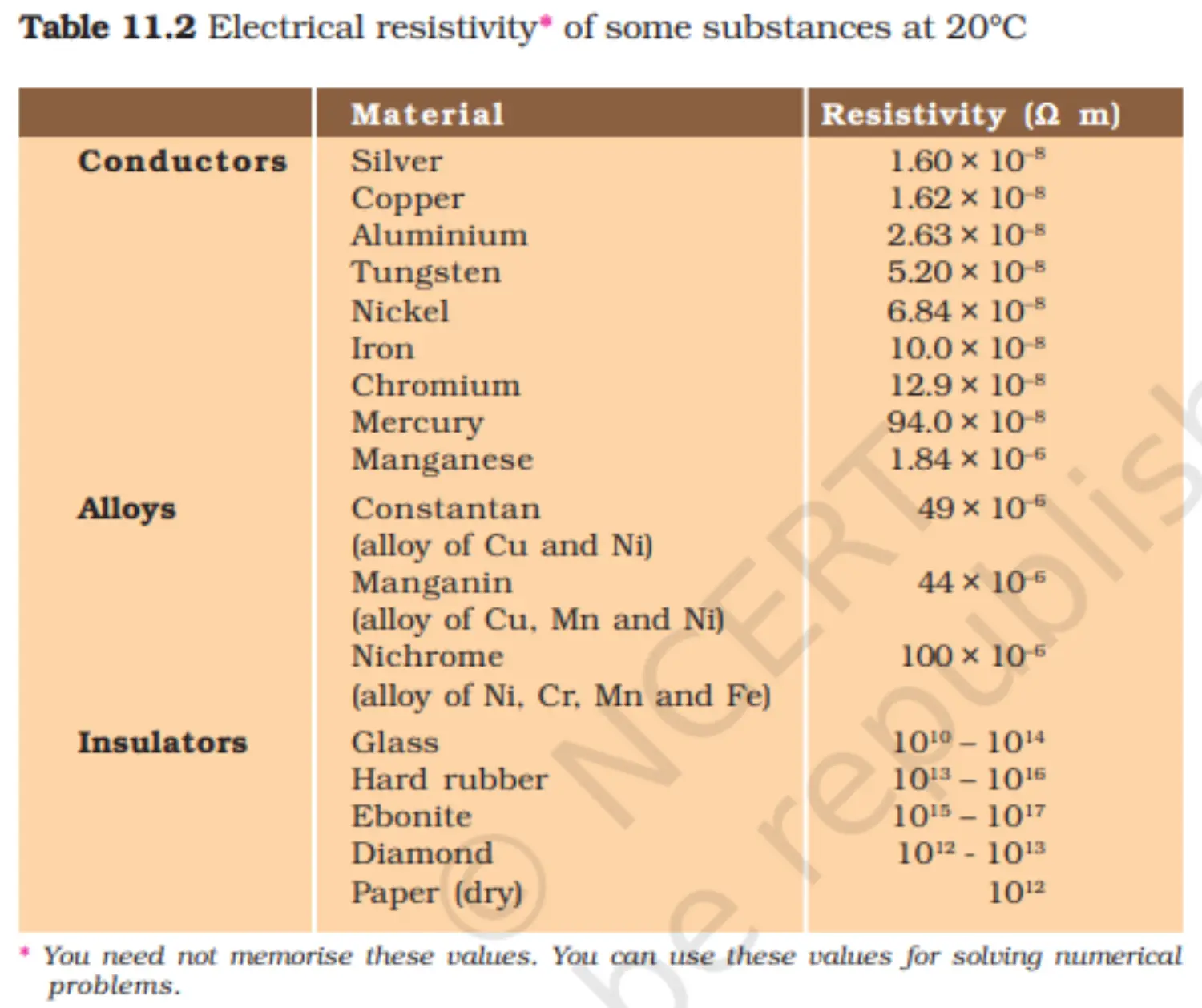
- Observations on Resistance:
Resistance of a System of Resistors
- Combination of Resistors:
- 1.1 Series Connection:
- Resistors are connected end-to-end.
- The current flowing through each resistor is the same.
- Total resistance (Rtotal) is the sum of individual resistances: Rtotal=R1+R2+R3+…
- 1.2 Parallel Connection:
- Resistors are connected across the same two points, forming a junction.
- The voltage across each resistor is the same.
- Total resistance is found using the reciprocal sum of individual resistances: Rtotal1=R11+R21+R31+…
- 1.1 Series Connection:
- Ohm's Law in Combinations:
- 2.1 Series Resistors:
- Ohm's law applies across the entire series combination.
- The voltage drop across each resistor is proportional to its resistance.
- 2.2 Parallel Resistors:
- Ohm's law applies to each resistor individually.
- The current through each resistor is inversely proportional to its resistance.
- 2.1 Series Resistors:
- Practical Implications:
- 3.1 Current Distribution:
- In series, the current is constant throughout.
- In parallel, it is divided according to resistance values.
- 3.2 Voltage Distribution:
- In series, it is divided across resistors.
- In parallel, it remains constant across all resistors.
- 3.1 Current Distribution:
- Resistor in Series
- Current in Series:
- 1.1 Consistency:
- The current (I) remains constant across all resistors in series.
- 1.2 Ammeter Reading:
- Position in the circuit does not affect the ammeter reading.
- 1.1 Consistency:
- Potential Difference in Series:
- 2.1 Summation of Voltage:
- Total voltage (V) across series resistors equals the sum of individual voltages: V=V1+V2+V3
- 2.1 Summation of Voltage:
- Equivalent Resistance in Series:
- 3.1 Calculation:
- Equivalent resistance (Rs) is the sum of all resistances: Rs=R1+R2+R3
- 3.2 Comparison:
- Rs is always greater than any individual resistance in the series.
- 3.1 Calculation:
- Application of Ohm’s Law:
- 4.1 Across Entire Circuit:
- Using Ohm's law for the whole circuit: V=IR
- 4.2 Across Each Resistor:
- Ohm's law applied individually: V1=IR1, V2=IR2, V3=IR3
- 4.1 Across Entire Circuit:
- Series Circuit Characteristics:
- 5.1 Unchanged Current Flow:
- The same current flows through each part of the circuit.
- 5.2 Increased Total Resistance:
- Total resistance is the aggregate of all resistances.
- 5.1 Unchanged Current Flow:
- Current in Series:
- Resistor in Parallel
- Current in Parallel:
- 1.1 Total Current:
- The total current (I) is the sum of the currents through each parallel branch: I=I1+I2+I3.
- 1.1 Total Current:
- Equivalent Resistance in Parallel:
- 2.1 Calculation:
- The reciprocal of the equivalent resistance (Rp) is equal to the sum of the reciprocals of individual resistances: Rp1=R11+R21+R31.
- 2.1 Calculation:
- Application of Ohm’s Law:
- 3.1 To Parallel Combination:
- Ohm’s law applied to parallel combination: I=RpV.
- 3.2 To Each Resistor:
- Ohm’s law applied to individual resistors: I1=R1V, I2=R2V, I3=R3V.
- 3.1 To Parallel Combination:
- Advantages of Parallel Circuit:
- 4.1 Current Division:
- Allows different currents through various components suitable for their operation.
- 4.2 Individual Operation:
- One component failure does not affect the others.
- 4.1 Current Division:
- Practical Implications:
- 5.1 Series vs. Parallel:
- Devices with different current needs are impractical in series but work well in parallel.
- 5.2 Circuit Continuity:
- Parallel circuits maintain continuity even if one component fails.
- 5.1 Series vs. Parallel:
- Current in Parallel:
- Combination of Resistors:
Heating Effect of Electric Current
- Source of Electric Energy:
- 1.1 Battery/Cell Function:
- Generates potential difference, driving electron flow and current.
- 1.1 Battery/Cell Function:
- Energy Expenditure:
- 2.1 Useful Work:
- Part of the energy does work (e.g., rotating fan blades).
- 2.2 Heat Production:
- The remaining energy raises the temperature of the gadget.
- 2.1 Useful Work:
- Heating Effect in Resistive Circuits:
- 3.1 Purely Resistive Circuit:
- Energy from the source dissipates as heat, known as the heating effect.
- 3.1 Purely Resistive Circuit:
- Utilization of Heating Effect:
- 4.1 Appliances:
- Employed in electric heaters, irons, etc.
- 4.1 Appliances:
- Calculation of Heat Produced:
- 5.1 Formula:
- H=VIt where V is the potential difference, I is current, and t is time.
- 5.2 Joule’s Law of Heating:
- H=I2Rt, showing heat is proportional to the square of the current, resistance, and time.
- 5.1 Formula:
- Practical Applications:
- 6.1 Electric Appliances:
- Heat production is calculated using I=V/R when connected to a known voltage.
- 6.1 Electric Appliances:
- Practical Applications of Heating Effect of Electric Current
- Overview of Heating in Conductors:
- 1.1 Inevitable Outcome: Heat generation is a natural result of electric current flow.
- 1.2 Undesirable Effects: Unwanted heat can increase component temperatures and change properties.
- Useful Applications:
- 2.1 Domestic Appliances:
- Includes electric irons, toasters, ovens, kettles, and heaters.
- 2.2 Lighting Devices:
- Electric bulbs utilize heating for light emission, using tungsten filaments for durability.
- 2.1 Domestic Appliances:
- Electric Bulbs:
- 3.1 Filament Requirements:
- High melting point and thermal isolation.
- 3.2 Composition and Atmosphere:
- Tungsten filaments are surrounded by inert gases like nitrogen and argon to extend life.
- 3.1 Filament Requirements:
- Electric Fuses:
- 4.1 Safety Mechanism:
- Fuses protect against excessive current by melting and interrupting the circuit.
- 4.2 Construction and Rating:
- Composed of metals/alloys with specific melting points; rated in amperes (e.g., 1A, 2A, etc.).
- 4.1 Safety Mechanism:
- Fuse Selection Example:
- 5.1 Electric Iron Case Study:
- For a 1 kW iron at 220 V, a 5 A fuse is appropriate to handle the current of 4.54 A.
- 5.1 Electric Iron Case Study:
- Overview of Heating in Conductors:
- Source of Electric Energy:
Electric Power
Power Definition:
- 1.1 Work Rate: Power is the rate at which work is done or energy is consumed.
Electric Power Equations:
- 2.1 Basic Formula: P=VI
- 2.2 Derived Formulas:
- P=I2R (Using V=IR)
- P=RV2 (Using I=RV)
Units of Power:
3.1 Watt: The SI unit of power, where 1 W=1 V×1 A.
1 W=1 V×1 A
3.2 Kilowatt: A larger unit, 1 kW=1000 W.
1 kW=1000 W
Energy Consumption:
- 4.1 Watt Hour: Energy used by a 1-watt device for an hour.
- 4.2 Kilowatt Hour: The commercial unit of energy, also called a ‘unit’.
Conversion to Joules:
5.1 Energy Conversion: 1 kW h=3.6×10⁶ J.
1 kW h=3.6×10⁶ J
Additional Concepts
- Electric Current:
- 1.1 Nature of Current: Electric current is a flow of electrons through a conductor.
- 1.2 Current Direction: By convention, the current direction is opposite to electron flow.
- 1.3 Current Unit: Measured in amperes (A).
- Potential Difference:
- 2.1 Creation: Generated by a cell or battery.
- 2.2 Measurement Unit: Volts (V).
- Resistance:
- 3.1 Function: Resists electron flow and controls current magnitude.
- 3.2 Resistance Unit: Ohms (Ω).
- Ohm's Law:
- 4.1 Formula: Voltage (V) across a resistor is directly proportional to the current (I), with constant temperature.
- 4.2 Expression: V = IR .
- Factors Affecting Resistance:
- 5.1 Length: Directly proportional.
- 5.2 Cross-Sectional Area: Inversely proportional.
- 5.3 Material: Depends on the conductor material.
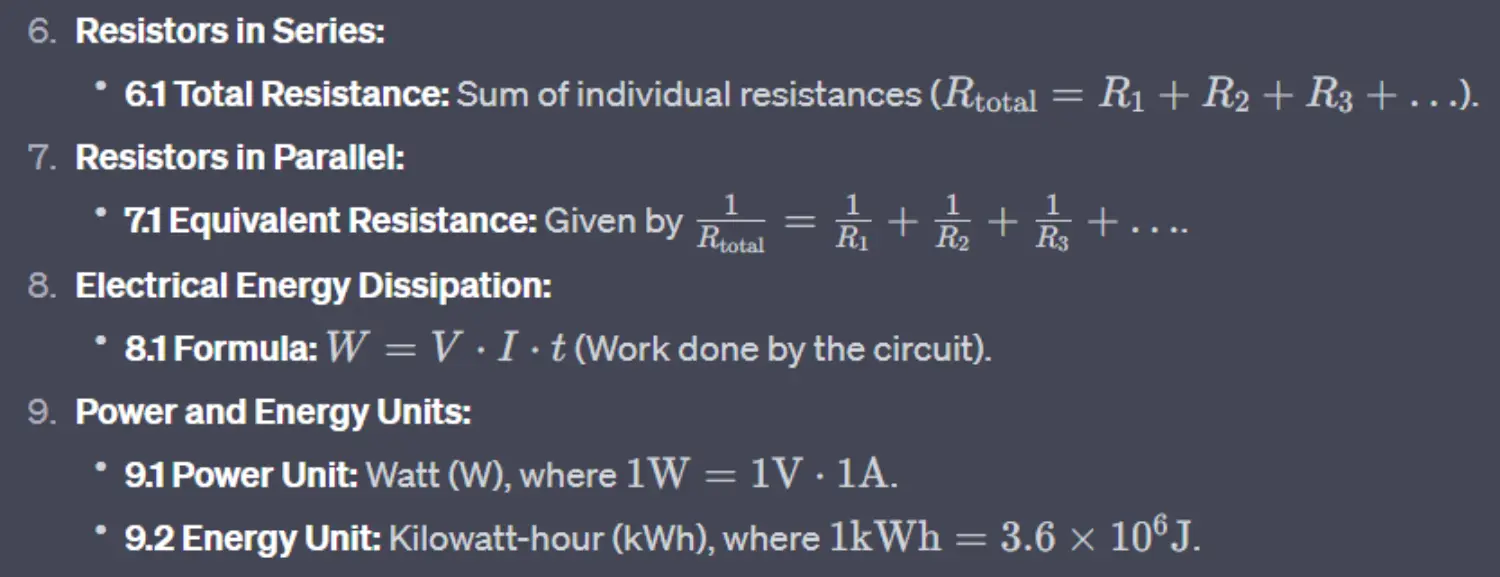
- Electric Current:
Chapter 12 - Magnetic Effects of Electric Current
Introduction
- Magnetic Effect of Electric Current:
- 1.1 Basic Phenomenon: A current-carrying wire exhibits magnetic properties.
- 1.2 Experiment Observation: Deflection in a magnetic needle indicates the magnetic effect of the electric current.
- Electricity and Magnetism Relationship:
- 2.1 Interconnection: Electricity can produce magnetism.
- 2.2 Reverse Effect: Moving magnets can produce an electric effect.
- Study Focus:
- 3.1 Magnetic Fields: Exploration of the area around a magnet where magnetic forces are exerted.
- 3.2 Electromagnetic Effects: Understanding how electric currents affect magnetic fields and vice versa.
- 3.3 Electromagnets: Delving into magnets created by electric currents.
- Magnetic Effect of Electric Current:
Magnetic Field and Field Lines
- Magnetic Poles:
- 1.1 North Pole: The end of a compass needle or bar magnet that seeks the Earth's North.
- 1.2 South Pole: The end that seeks the Earth's South.
- Magnetic Field:
- 2.1 Definition: The area around a magnet where magnetic forces are detectable.
- 2.2 Field Demonstration: Iron filings can reveal the magnetic field pattern due to the force exerted by the magnet.
- Magnetic Field Lines:
- 3.1 Representation: Iron filings align along the magnetic field lines.
- 3.2 Direction: By convention, field lines emerge from the North Pole and merge at the South Pole.
- 3.3 Closed Loops: Inside the magnet, field lines go from the South Pole to the North Pole, forming closed curves.
- Field Strength:
- 4.1 Indicators of Strength: Closeness of field lines indicates the strength of the magnetic field.
- 4.2 Non-Intersection: Field lines never cross each other, ensuring a single direction for the magnetic force.
- Magnetic Poles:
Magnetic Field due to a Current-carrying conductor
- Magnetic Field Creation:
- 1.1 Electric Current's Role: An electric current flowing through a conductor produces a magnetic field around it.
- Determining Field Direction:
- 2.1 Right-Hand Thumb Rule: The thumb points in the direction of current, and curled fingers show the field direction around the conductor.
- 2.2 Visualization Techniques: Using magnetic compasses or iron filings to view the pattern of the magnetic field.
- Field Characteristics:
- 3.1 Shape of the Field: Circular lines around the conductor.
- 3.2 Effect of Current Direction: Reversing the current will flip the direction of the magnetic field.
- Practical Implications:
- 4.1 Electromagnets: Utilizing the magnetic field produced by electric current for various applications.
Diagram
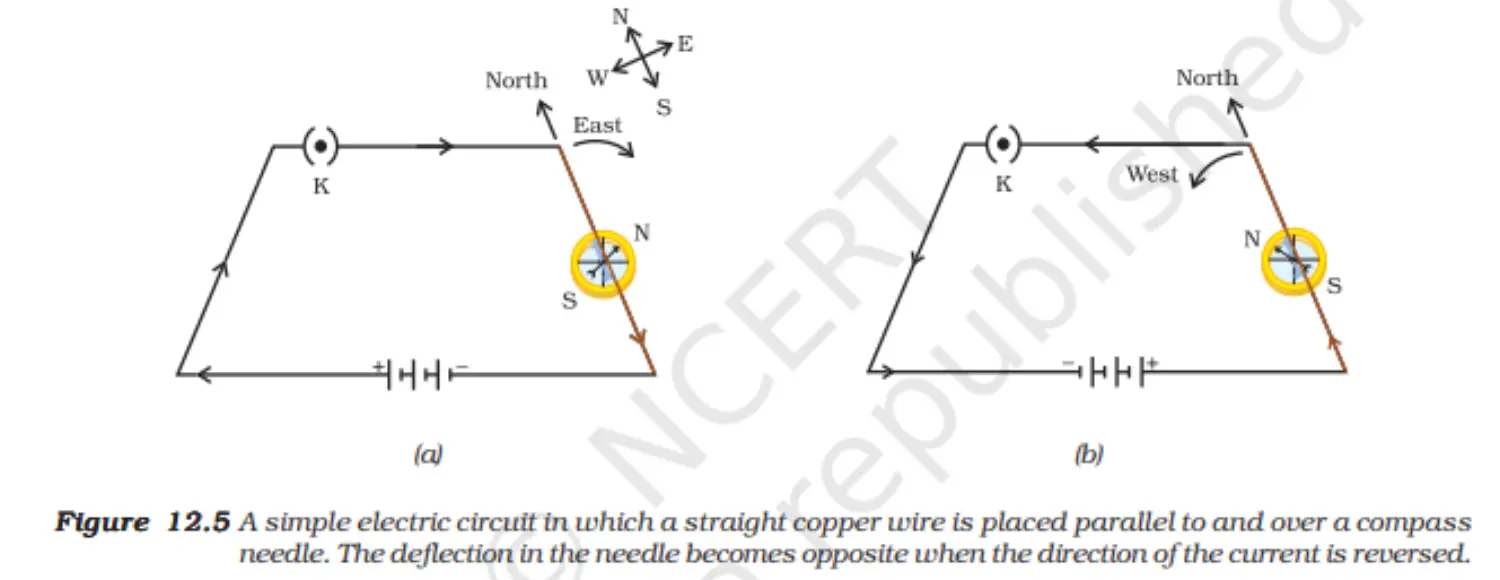
Magnetic Field due to a Current through a Straight Conductor
- Magnetic Field Patterns:
- 1.1 Straight Conductor Influence: The conductor shape affects the magnetic field pattern.
- 1.2 Visualization with Compass: Use a compass to observe the magnetic field direction and pattern.
- Current's Effect on Magnetic Field:
- 2.1 Deflection Changes: The compass needle deflection changes with the current intensity.
- 2.2 Increased Current: A higher current results in a stronger magnetic field (greater needle deflection).
- Distance's Effect on Magnetic Field:
- 3.1 Decreasing Field with Distance: The magnetic field weakens as the distance from the conductor increases.
- 3.2 Field Representation: Magnetic field lines are concentric circles that expand with distance.
- Magnetic Field Patterns:
Right-Hand Thumb Rule
- Right-Hand Thumb Rule Basics:
- 1.1 Definition: A method to determine the magnetic field direction around a current-carrying conductor.
- 1.2 Usage: Position your right hand with the thumb pointing along the current's direction, and curled fingers show the magnetic field's loops.
- Visualizing Magnetic Field:
- 2.1 Thumb Representation: Thumb points in the current's flow direction (from positive to negative).
- 2.2 Fingers Representation: Fingers curl in the direction of the magnetic field lines encircling the conductor.
Diagram
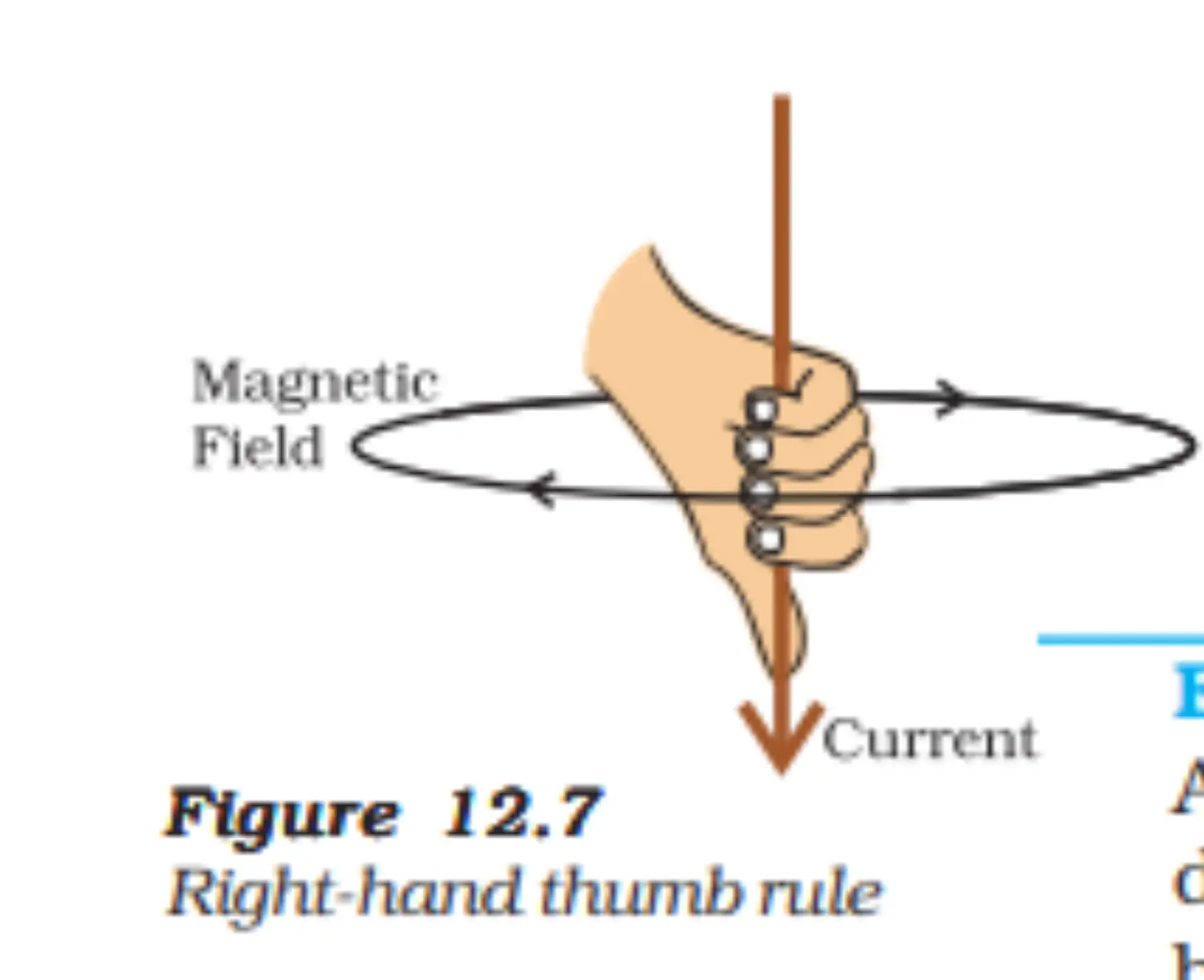
- Right-Hand Thumb Rule Basics:
Magnetic Field due to a Current through a Circular Loop
- Magnetic Field in a Circular Loop:
- 1.1 Formation: Created when a straight current-carrying wire is bent into a loop.
- 1.2 Field Lines: Concentric circles around the loop, appearing as straight lines at the center.
- Behavior of Field Lines:
- 2.1 Distance Effect: As we move away from the loop, the concentric circles become larger.
- 2.2 Center Effect: At the center of the loop, the field lines from each point of the wire appear straight.
- Influence of Current and Turns:
3.1 Current Dependency: The magnetic field strength is directly proportional to the current through the wire.
3.2 Multiple Turns: If the loop has n turns, the magnetic field is n times stronger than that of a single loop.
�
�
- Magnetic Field in a Circular Loop:
Magnetic Field due to a Current in a Solenoid
- Solenoid Description:
- 1.1 Definition: A solenoid is a cylindrical coil of wire acting as a magnet when carrying electric current.
- 1.2 Construction: Made from insulated copper wire wound into a series of tight circular turns.
- Magnetic Field Pattern:
- 2.1 Similarity to Bar Magnet: The field pattern of a solenoid resembles that of a bar magnet.
- 2.2 Pole Behavior: One end acts as the north pole and the other as the south pole.
- Characteristics Inside the Solenoid:
- 3.1 Uniform Field: Inside the solenoid, the magnetic field lines are parallel and uniform.
- 3.2 Strength: The magnetic field is strong and consistent throughout the interior.
- Electromagnet Formation:
- 4.1 Magnetization: Inserting a soft iron core inside a solenoid and passing current can create an electromagnet.
- 4.2 Electromagnet Use: Electromagnets are widely used in various applications due to their temporary and adjustable magnetic properties.
- Solenoid Description:
- Magnetic Field Creation:
Force on a Current-carrying conductor in a Magnetic Field
- Fundamental Concept:
- 1.1 Ampere's Insight: A magnetic field exerts a force on a nearby current-carrying conductor.
- 1.2 Reciprocal Action: A current-carrying conductor also experiences a force within a magnetic field.
- Experimental Observations:
- 2.1 Force Direction: The direction of force changes with the direction of the current and the magnetic field.
- 2.2 Maximum Force: The force is greatest when the current direction is perpendicular to the magnetic field.
- Fleming's Left-Hand Rule:
- 3.1 Orientation: The thumb, forefinger, and middle finger of the left hand are held perpendicular to each other.
- 3.2 Directions:
- Thumb: Points in the direction of the force.
- Forefinger: Points in the direction of the magnetic field.
- Middle Finger: Points in the direction of the current.
- Practical Applications:
- 4.1 Devices: This principle is utilized in electric motors, generators, loudspeakers, and measuring instruments.
Diagram
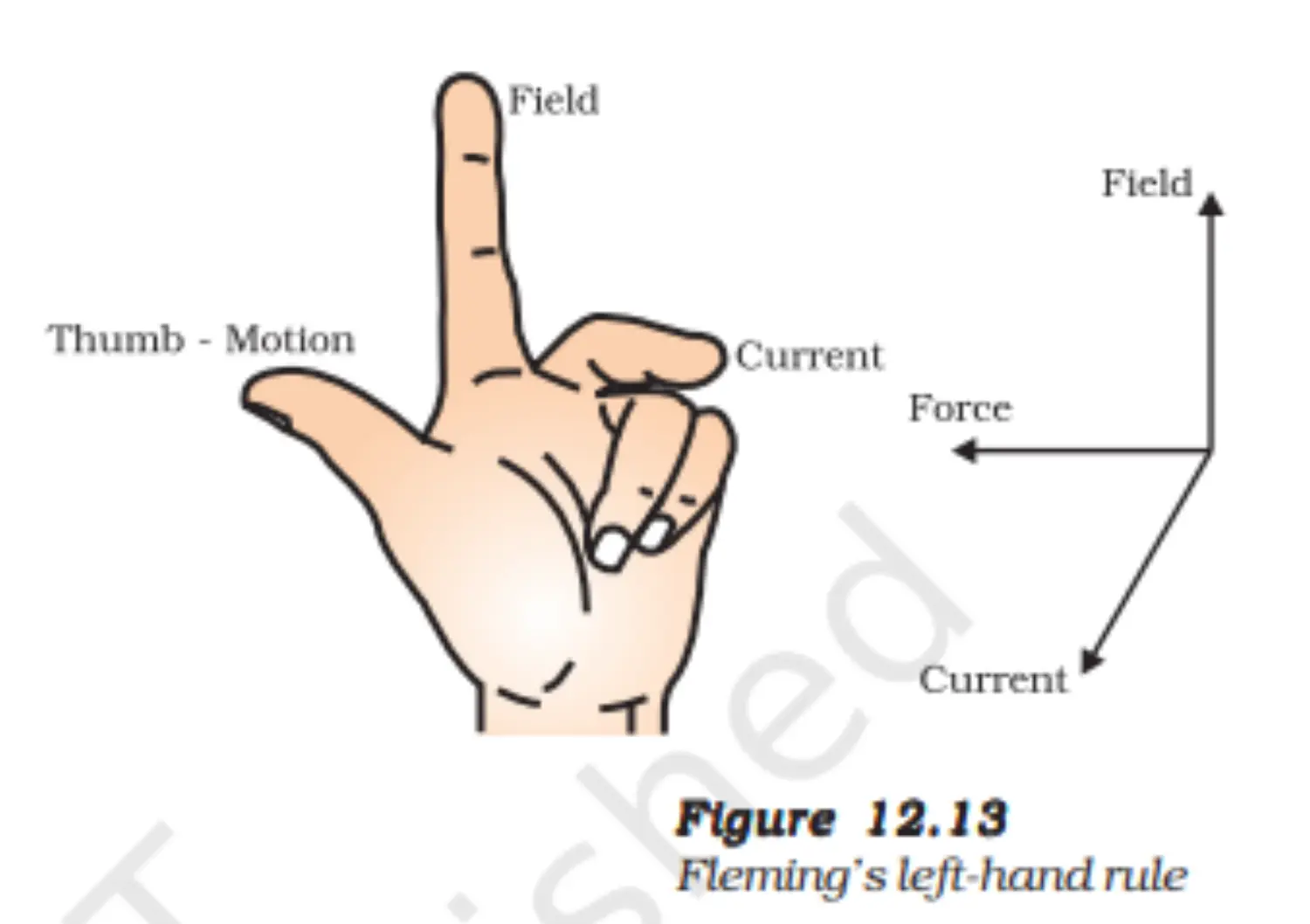
- Fundamental Concept:
Domestic Electric Circuits
- Main Supply:
- 1.1 Live Wire: Usually red, positive wire with a potential difference of 220 V in relation to the neutral wire.
- 1.2 Neutral Wire: Typically black, negative or neutral wire.
- 1.3 Earth Wire: Green insulation, connected to the earth for safety.
- Household Wiring:
- 2.1 Electricity Meter: The entry point of mains into the house, via a main fuse.
- 2.2 Main Switch: Controls connection to internal house circuits.
- 2.3 Circuit Ratings: Separate circuits for high (15 A) and low (5 A) power appliances.
- Safety Features:
- 3.1 Earth Connection: Reduces risk of electric shock by keeping the appliance at earth potential.
- 3.2 Fuses: Protect against overloading and short-circuiting by breaking the circuit if current is too high.
- Circuit Design:
- 4.1 Parallel Connections: Appliances are connected in parallel to ensure equal potential difference.
- 4.2 Individual Switches: Each appliance can be controlled independently.
- Hazards and Protections:
- 5.1 Short-Circuiting: Occurs when live and neutral wires contact directly, can be prevented with fuses.
- 5.2 Overloading: Can result from damaged insulation, appliance faults, or too many appliances on one socket.
Diagram
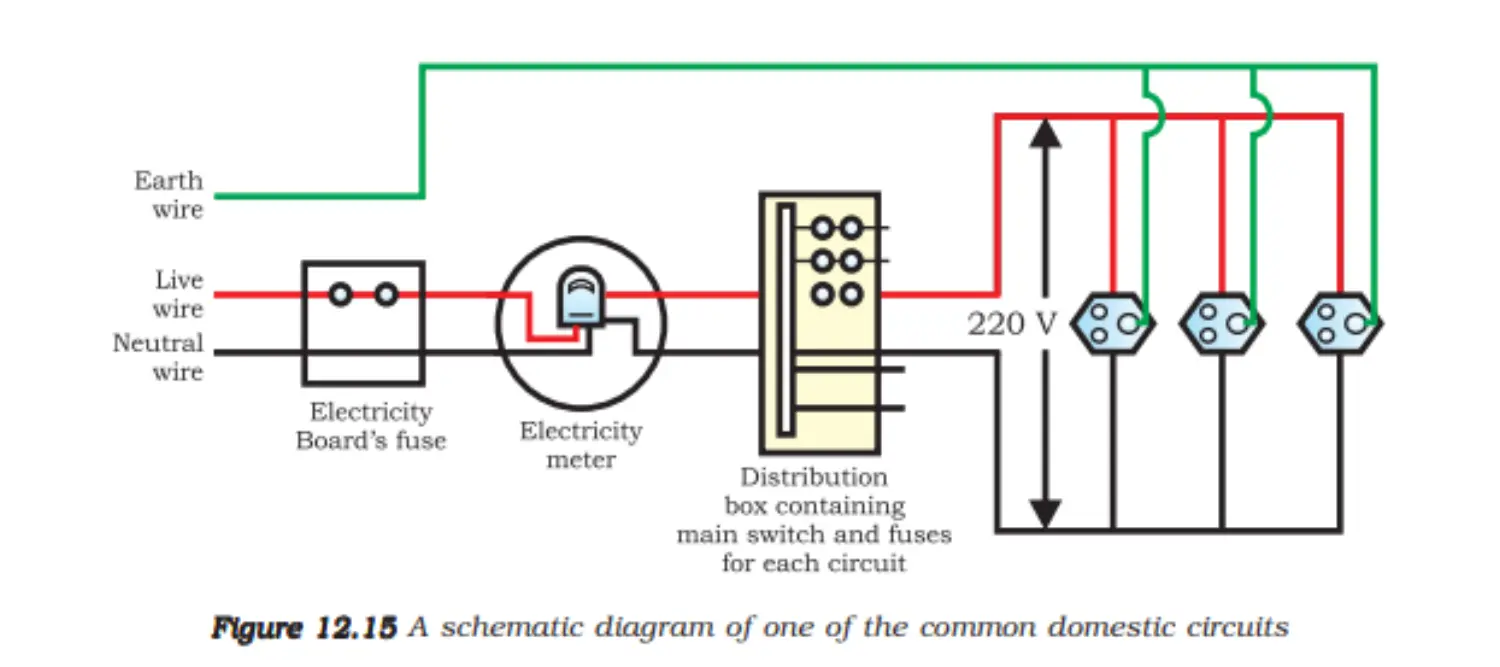
- Main Supply:
Additional Concepts
- Hans Christian Oersted:
- 1.1 Discovery: Deflection of a compass needle by electric current.
- 1.2 Contribution: Established the relationship between electricity and magnetism.
- Magnetic Field Visualization:
- 2.1 Field Lines: Represented as concentric circles around a current-carrying wire.
- 2.2 Right-Hand Rule: Determines the direction of the magnetic field.
- Magnetism in Medicine:
- 3.1 Bio-Magnetic Fields: Weak magnetic fields produced by ion currents in the body.
- 3.2 MRI: Uses magnetic fields for imaging and medical diagnosis.
- Magnetic Field Properties:
- 4.1 Compass Needle: North pole points north, south pole points south.
- 4.2 Field Strength: Indicated by the density of field lines.
- 4.3 Direction: Direction a north pole would move at a point.
- Conductors and Magnetic Fields:
- 5.1 Conductor Shape: The shape of the conductor affects the magnetic field pattern.
- 5.2 Solenoid Field: Similar to the magnetic field of a bar magnet.
- Electromagnets:
- 6.1 Composition: Soft iron core with insulated copper wire coil.
- 6.2 Functionality: Acts like a bar magnet when current flows through the coil.
- Forces on Current-Carrying Conductors:
- 7.1 Fleming's Left-Hand Rule: Determines the force direction on a conductor in a magnetic field.
- Domestic Electric Power:
- 8.1 Supply: AC power at 220 V and 50 Hz.
- 8.2 Wiring: Live wire (red), neutral wire (black), earth wire (green).
- 8.3 Safety: Earth wire and fuses for protection against shock and circuit damage.
- Hans Christian Oersted:
Chapter 13 - Our Environment
Introduction
- Concept of Environment:
- 1.1 Definition: Encompasses all living and non-living things interacting with each other.
- 1.2 Perception: Recognized as changing and degrading over time.
- Human Interaction:
- 2.1 Work Environment: Importance of a healthy setting for productivity and well-being.
- 2.2 Impact on Nature: Human activities and their significant impact on natural surroundings.
- Environmental Discourse:
- 3.1 Public Awareness: Increased through media like television and newspapers.
- 3.2 Global Summits: Platforms for discussion among nations on environmental conservation and policies.
- Components of the Environment:
- 4.1 Biotic Elements: All the living components including humans, animals, and plants.
- 4.2 Abiotic Elements: Non-living components like water, air, soil, and minerals.
- Environmental Issues:
- 5.1 Climate Change: A critical issue often discussed in global contexts.
- 5.2 Pollution: Affects air, water, and soil quality, impacting all forms of life.
- Sustainable Practices:
- 6.1 Conservation: Efforts to preserve natural resources.
- 6.2 Sustainable Development: Balancing environmental protection with economic progress.
- Concept of Environment:
Eco Systems - What are its Components?
- Introduction to Ecosystems:
- 1.1 Definition: An ecosystem is an interactive system comprising both organisms (biotic components) and their physical environment (abiotic components).
- 1.2 Examples: Gardens, forests, ponds, lakes (natural ecosystems), and crop-fields (human-made ecosystems).
- Biotic Components:
- 2.1 Producers: Organisms like green plants and certain bacteria that synthesize organic compounds (e.g., sugars, starch) through photosynthesis using sunlight and chlorophyll.
- 2.2 Consumers:
- 2.2.1 Herbivores: Animals that eat plants directly.
- 2.2.2 Carnivores: Animals that eat other animals.
- 2.2.3 Omnivores: Animals that eat both plants and animals.
- 2.2.4 Parasites: Organisms that live on or in a host organism and derive nutrients at the host's expense.
- Abiotic Components:
- 3.1 Physical Factors: Temperature, rainfall, wind, soil, minerals, and other non-living elements that affect living organisms.
- Role of Decomposers:
- 4.1 Definition: Microorganisms like bacteria and fungi that decompose dead organisms and waste products.
- 4.2 Function: Convert complex organic substances into simple inorganic substances that enrich the soil.
- 4.3 Importance: Essential for natural replenishment of the soil; without them, waste accumulation would disrupt the ecosystem balance.
- Balance in Nature:
- 5.1 Interactions: Continuous interactions among biotic and abiotic components maintain ecological balance.
- 5.2 Sustainability: Decomposers ensure the sustainability of the ecosystem by recycling nutrients.
- Food Chain and Webs
- Food Chains:
- 1.1 Definition: A series of organisms each dependent on the next as a source of food.
- 1.2 Trophic Levels:
- 1.2.1 First Trophic Level: Autotrophs or producers (e.g., green plants).
- 1.2.2 Second Trophic Level: Herbivores or primary consumers.
- 1.2.3 Third Trophic Level: Small carnivores or secondary consumers.
- 1.2.4 Fourth Trophic Level: Larger carnivores or tertiary consumers.
- Energy Flow:
- 2.1 Autotrophs' Role: Capture solar energy and convert it into chemical energy.
- 2.2 Energy Loss: Energy decreases with each trophic level; on average, only 10% is transferred to the next level.
- Food Webs:
- 3.1 Complexity: Food webs consist of multiple overlapping food chains.
- 3.2 Branching Lines: Represent multiple prey-predator relationships.
- Characteristics of Energy Flow:
- 4.1 Unidirectional: Energy moves in one direction—from the sun to producers to consumers.
- 4.2 Diminishing Availability: Energy available decreases with each trophic level due to energy loss.
- Biological Magnification:
- 5.1 Accumulation of Chemicals: Harmful chemicals enter the food chain and get concentrated at each trophic level.
- 5.2 Impact on Humans: Humans, being at the top of the food chain, accumulate the highest concentration of these chemicals.
Flowchart
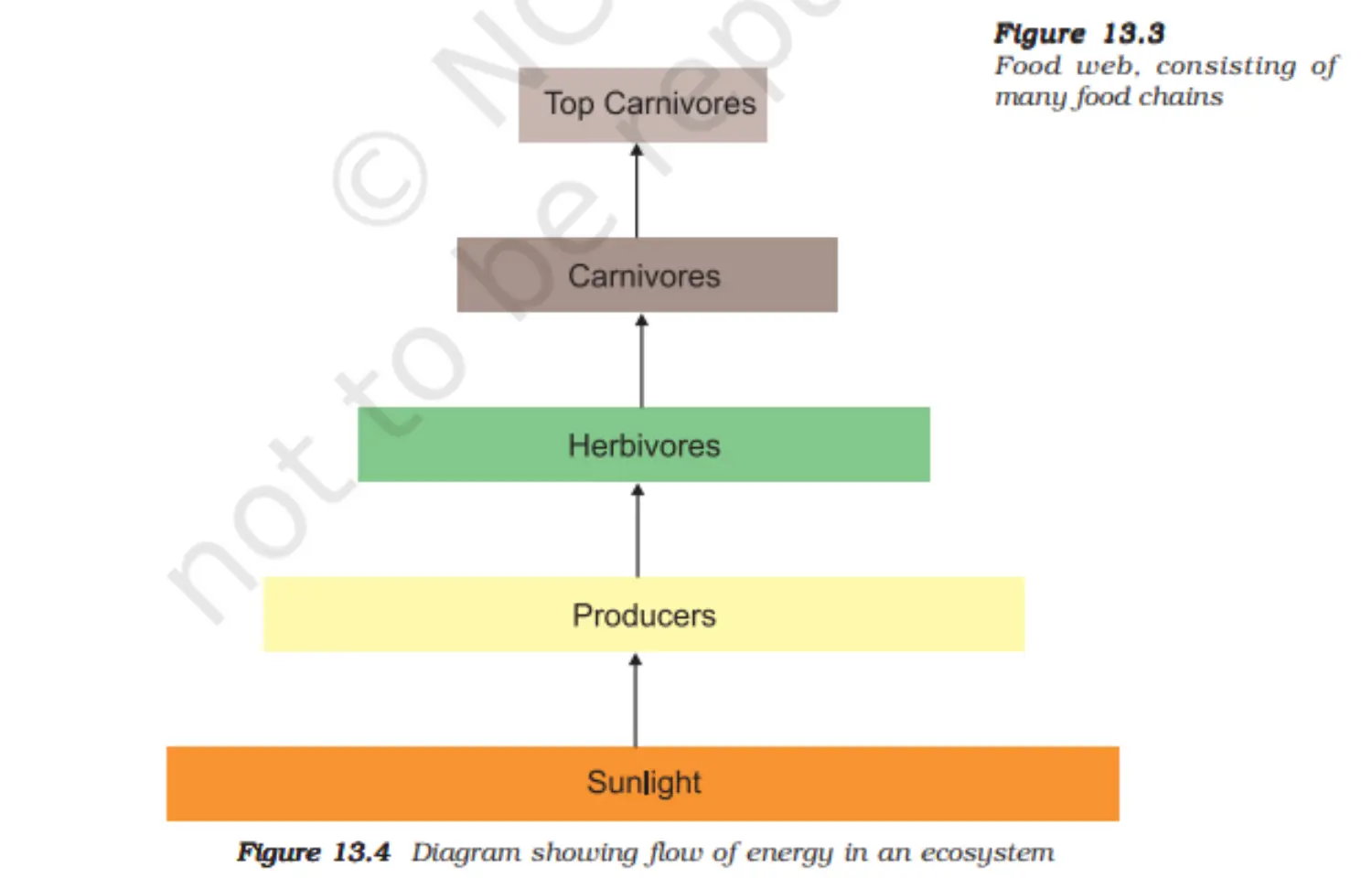
- Food Chains:
- Introduction to Ecosystems:
How do our activities affect the Environment?
- Introduction:
- 1.1 Interconnectivity: Humans are part of the environment; our actions impact it and changes in the environment affect us.
- Environmental Problems:
- 2.1 Ozone Layer Depletion:
- 2.1.1 Causes: Release of CFCs and other ozone-depleting substances.
- 2.1.2 Effects: Increased UV radiation reaching Earth, leading to health and ecological issues.
- 2.2 Waste Disposal:
- 2.2.1 Challenges: Increasing amounts of domestic, industrial, and electronic waste.
- 2.2.2 Consequences: Pollution, land degradation, and harm to aquatic and terrestrial life.
- 2.1 Ozone Layer Depletion:
- Mitigation and Management:
- 3.1 Sustainable Practices: Adoption of recycling, use of eco-friendly materials, and proper waste management.
- 3.2 Policy and Regulation: Implementation of environmental protection laws and international treaties.
- Ozone Layer and How it is Getting Depleted
- Ozone Basics:
- 1.1 Composition: Ozone (O3) consists of three oxygen atoms, different from the oxygen (O2) we breathe.
- 1.2 Vital Role: Ozone exists in the stratosphere and protects life by blocking harmful ultraviolet (UV) radiation from the Sun.
- Formation of Ozone:
- 2.1 Process:
- UV radiation splits molecular oxygen (O2) into free oxygen (O) atoms.
- Free oxygen atoms combine with O2 to form ozone (O3).
- 2.1 Process:
- Depletion of Ozone:
- 3.1 Discovery: A significant decline in ozone levels was detected in the 1980s.
- 3.2 Causes: Usage of chlorofluorocarbons (CFCs) in refrigerants and fire extinguishers has been a major cause.
- 3.3 Consequences: Depletion leads to increased UV radiation reaching the Earth, causing health hazards like skin cancer.
- Global Action:
- 4.1 UNEP Agreement (1987): Aimed to freeze CFC production at 1986 levels.
- 4.2 Regulation: It is now a global mandate for manufacturers to produce CFC-free refrigerators.
- Ozone Basics:
- Managing the Garbage we Produce
- Waste Generation:
- 1.1 Daily Waste: We produce various waste materials in our daily lives.
- 1.2 Disposal Queries: Questions arise about the fate of these wastes once discarded.
- Biodegradation:
- 2.1 Enzyme Action: Specific enzymes break down food but not non-biological materials like coal.
- 2.2 Biodegradable Materials: Substances that can be decomposed by biological processes.
- 2.3 Non-biodegradable Materials: Substances that do not break down easily and persist in the environment.
- Environmental Impact:
- 3.1 Accumulation: Non-biodegradable waste accumulates in cities and tourist spots.
- 3.2 Lifestyle Changes: Increased waste from improved lifestyles and disposable products.
- 3.3 Packaging Issues: Shift to non-biodegradable packaging increases environmental strain.
- Ecosystem Harm:
- Non-biodegradable waste can be inert or actively harmful to the ecosystem.
- Waste Generation:
- Introduction:
Additional Concepts
- Evolution of Disposable Cups:
- 1.1 History: Tea was once served in trains in reusable plastic glasses.
- 1.2 Hygiene Focus: Introduction of disposable cups for hygiene improvements.
- Kulhads (Clay Cups):
- 2.1 Initial Solution: Kulhads proposed as an eco-friendly alternative.
- 2.2 Environmental Cost: Concerns about the loss of fertile top-soil from large-scale kulhad production.
- Paper Cups:
- 3.1 Current Trend: Shift to disposable paper cups in trains.
- 3.2 Advantages Over Plastic:
- 3.2.1 Biodegradability: Paper cups are more biodegradable than plastic.
- 3.2.2 Energy and Resource Usage: Paper cups may consume less energy and resources in production and disposal.
- Environmental Considerations:
- 4.1 Ecosystem Interdependence: All parts of an ecosystem rely on each other.
- 4.2 Energy Flow Limitations: Energy loss at each trophic level constrains the number of levels in a food chain.
- 4.3 Human Impact: Our activities, including waste generation, affect the environment.
- 4.4 Chemicals and Ozone: Chemicals like CFCs threaten the protective ozone layer.
- 4.5 Waste Disposal: Challenges in managing biodegradable and non-biodegradable waste.
- Evolution of Disposable Cups: