Ancient India - Class 12: Themes in Indian History - Part 1
- Chapter 1 - Bricks, Beads and Bones
The Harappan Civilization
1. Harappan Civilization: Overview 1.1. Distinctive Artefacts:
- Harappan seals are the most iconic artefacts, made of steatite with animal motifs and undeciphered script. 1.2. Sources of Information:
- Knowledge about the Harappan civilization is primarily derived from archaeological evidence like houses, pots, ornaments, tools, and seals.
2. Archaeological Evidence: 2.1. Nature of Materials:
- Varied artefacts left behind by the Harappans provide insights into their lifestyle and social practices. 2.2. Interpretation Challenges:
- The script found on many artefacts remains undeciphered, posing challenges in understanding certain aspects of the civilization.
3. Changing Interpretations: 3.1. Dynamic Field of Study:
Interpretations of archaeological evidence can evolve based on new findings, advanced research methods, or fresh theoretical approaches. 3.2. Limitations:
Despite advancements, certain elements of the Harappan civilization remain unknown and might continue to be unresolved due to gaps in the archaeological record.
Map
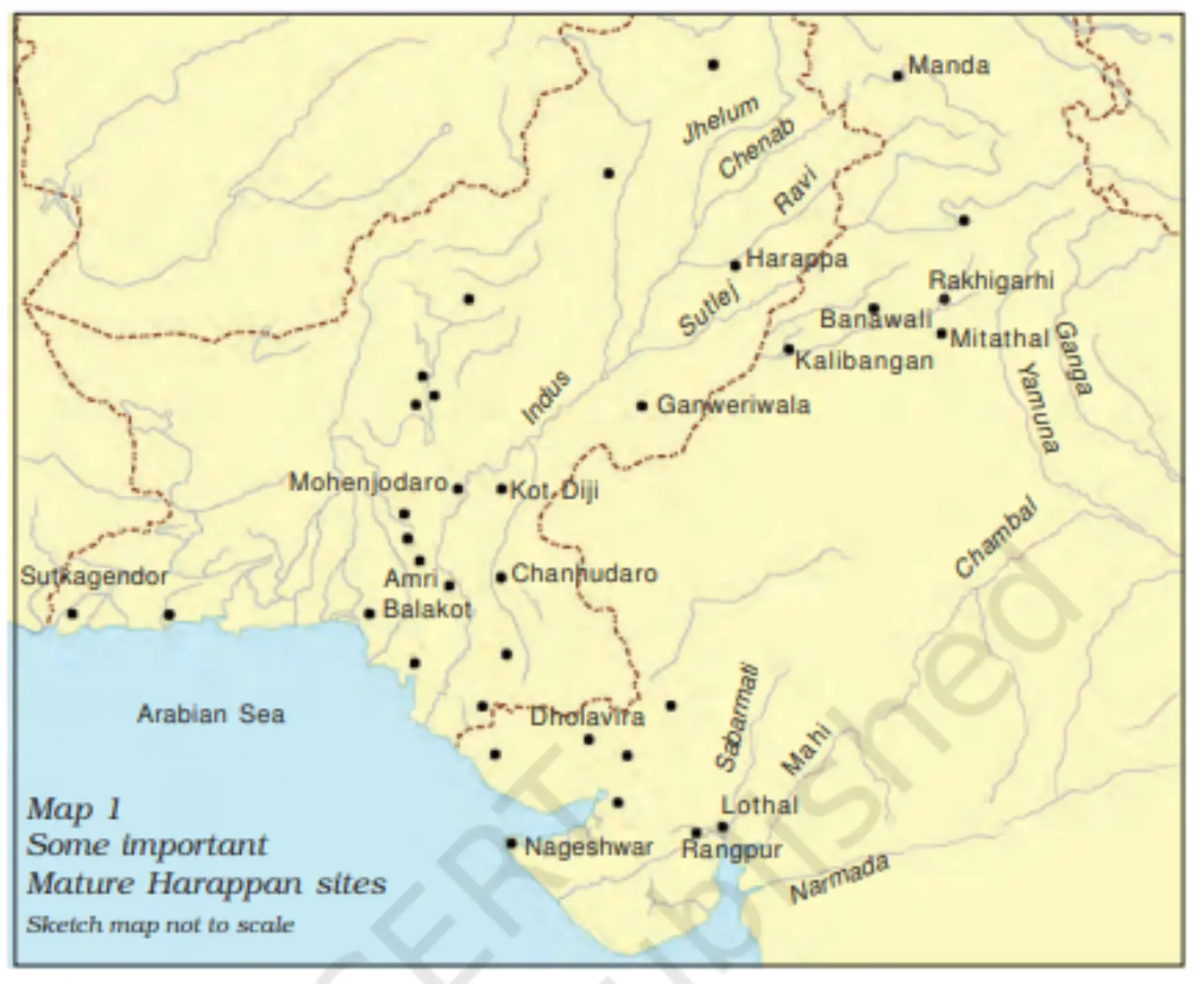
Beginning
1. Pre-Harappan Phase: 1.1. Archaeological Cultures:
- Before the Mature Harappan period, the region was inhabited by several cultures.
- These cultures are identified through distinctive pottery, signs of agriculture and pastoralism, and various crafts. 1.2. Settlement Characteristics:
- Settlements were predominantly small.
- Large buildings were almost non-existent during this phase.
2. Transition to Harappan Civilization: 2.1. Evident Break:
- There seems to have been a significant transition from the Early Harappan phase to the Harappan civilization.
- This transition is indicated by large-scale burning observed at some sites. 2.2. Abandonment of Settlements:
- Some settlements were completely abandoned during this period, marking a clear demarcation in the civilization's progression.
Subsistence Strategies
1. Harappan Subsistence: 1.1. Development and Continuity:
- Mature Harappan culture evolved from Early Harappan cultures, maintaining some common elements, especially in subsistence strategies. 1.2. Diet Composition:
- Harappans consumed a diverse array of plant and animal products, including fish.
- Diet reconstructions are based on charred grains, seeds, and animal bones, analyzed by archaeo-botanists and zooarchaeologists.
2. Agricultural Practices: 2.1. Crops Cultivated:
- Common grains: wheat, barley, lentil, chickpea, sesame.
- Millets are prevalent in Gujarat; rice finds are scarce. 2.2. Animal Husbandry:
- Domesticated animals: cattle, sheep, goat, buffalo, pig.
- Wild species: boar, deer, gharial, fish, fowl.
3. Farming Techniques: 3.1. Ploughing and Sowing:
- Evidence suggests oxen were used for ploughing; terracotta plough models discovered. The ploughed field at Kalibangan indicates potential mixed cropping. 3.2. Harvesting Tools:
- Unclear if Harappans used stone blades in wooden handles or metal tools.
4. Irrigation Methods: 4.1. Geographical Context:
Most sites in semi-arid regions, likely require irrigation. 4.2. Irrigation Evidence:
Canals evidenced at Shortughai; absence in Punjab or Sind possibly due to silting.
Water wells and reservoirs (e.g., Dholavira) might indicate water storage for irrigation.
Map
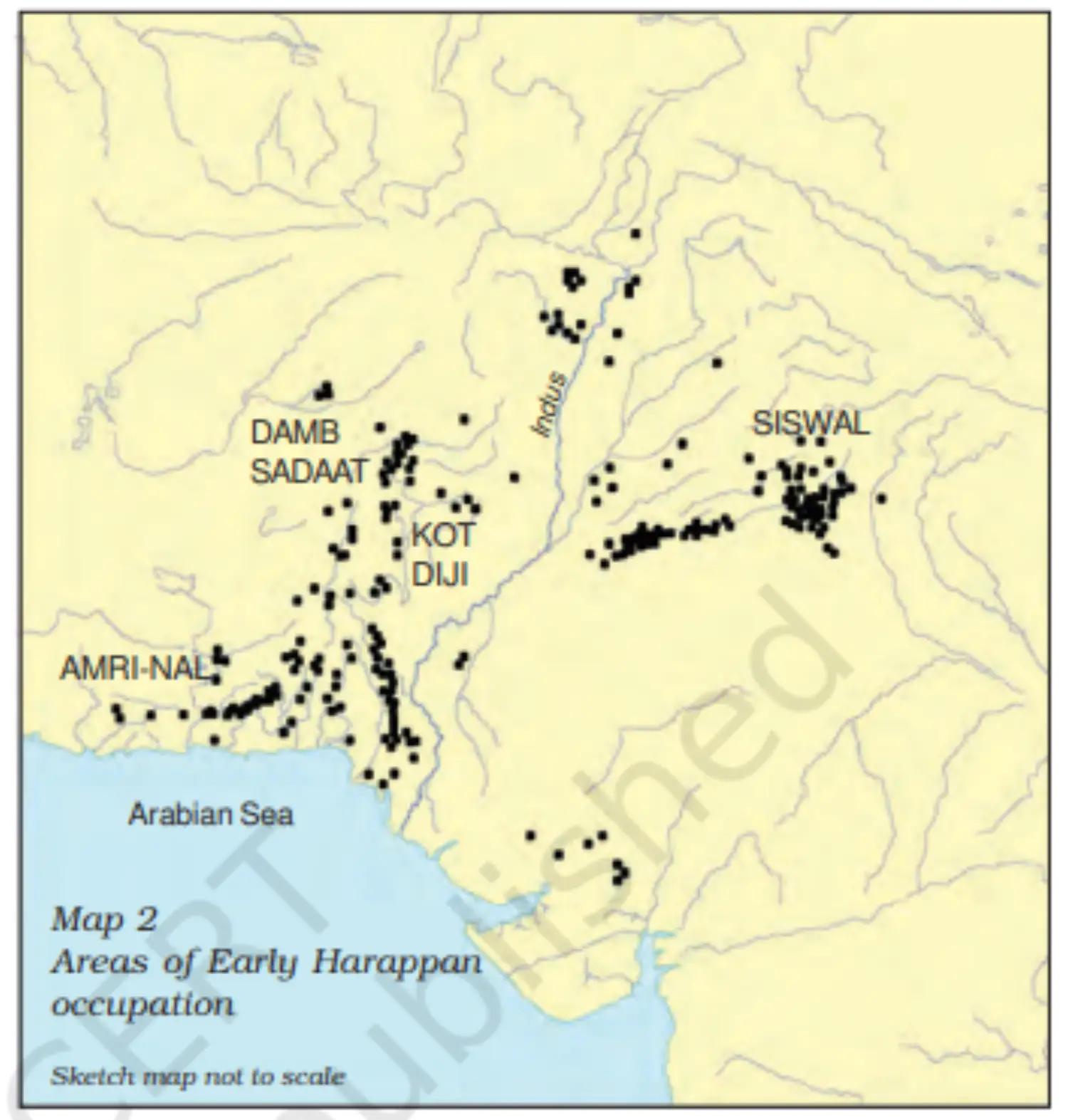
Mohenjodaro A Planned Urban Culture
1. Mohenjodaro: An Urban Achievement 1.1. Unique Urbanization:
- Harappan civilization known for urban centers, with Mohenjodaro being a prominent one.
- Divided into two main areas: the Citadel (higher) and the Lower Town (larger). 1.2. Construction Insights:
- Buildings on raised, mud-brick platforms, particularly in the Citadel.
- Large-scale labor mobilization for construction, indicating advanced planning.
2. City Planning: 2.1. Standardization and Layout:
- Uniform brick size across Harappan sites.
- City layout suggests pre-planning before construction. 2.2. Drainage System:
- Advanced and well-planned.
- Roads and streets in a grid-like pattern, with systematic drainage.
3. Residential Structures: 3.1. House Design:
- Centered around a courtyard for domestic activities.
- Design indicates a preference for privacy. 3.2. Amenities:
- Every house featured a bathroom with a connected drain system.
- Presence of wells in many houses, accessible from the outside.
4. The Citadel: 4.1. Public Structures:
- Area contains structures likely used for public purposes, including a warehouse and the Great Bath. 4.2. The Great Bath:
- Large, watertight, rectangular structure surrounded by a corridor, with rooms and a well.
- Believed to be used for special ritual baths due to its unique features and location.
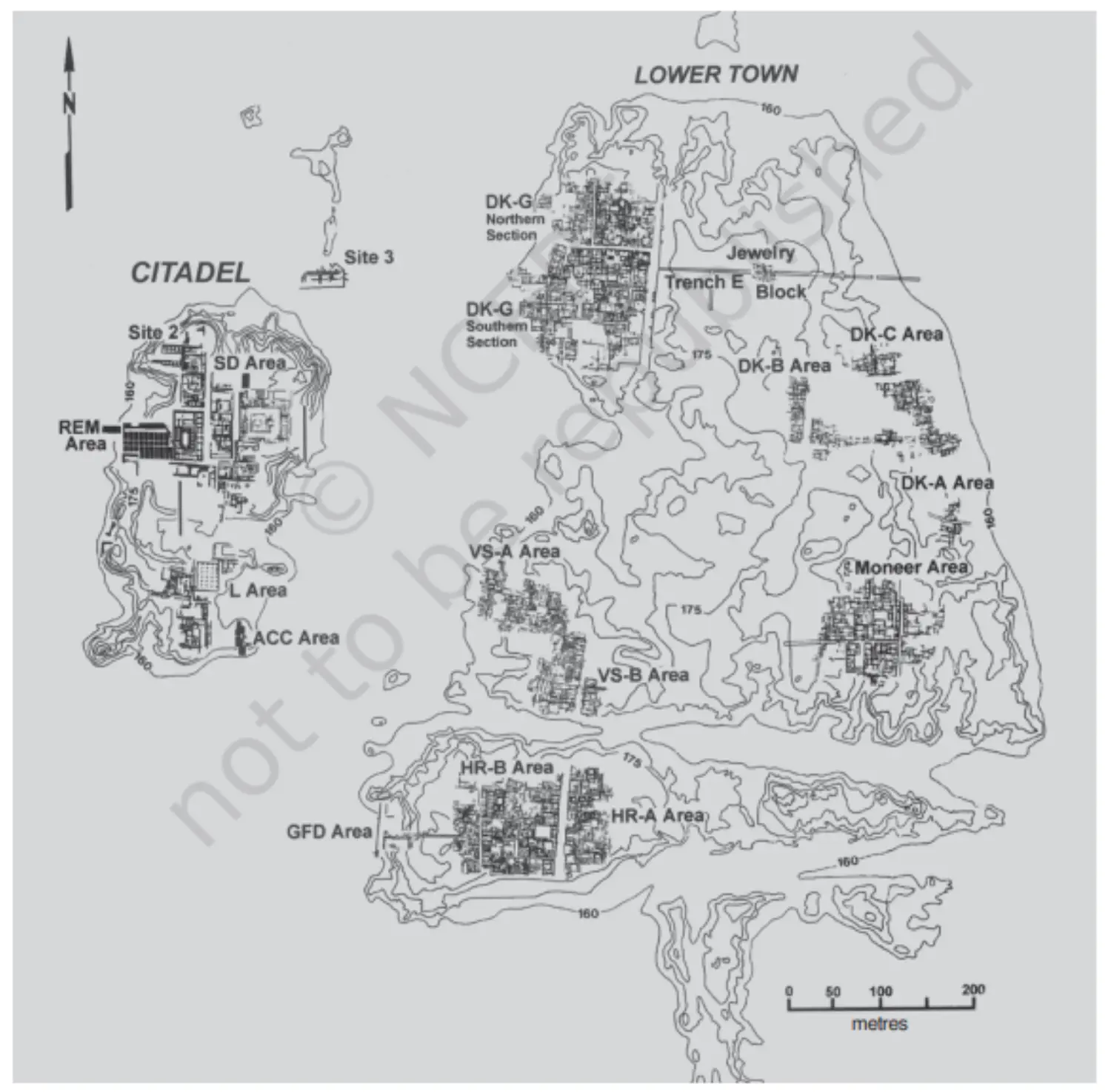
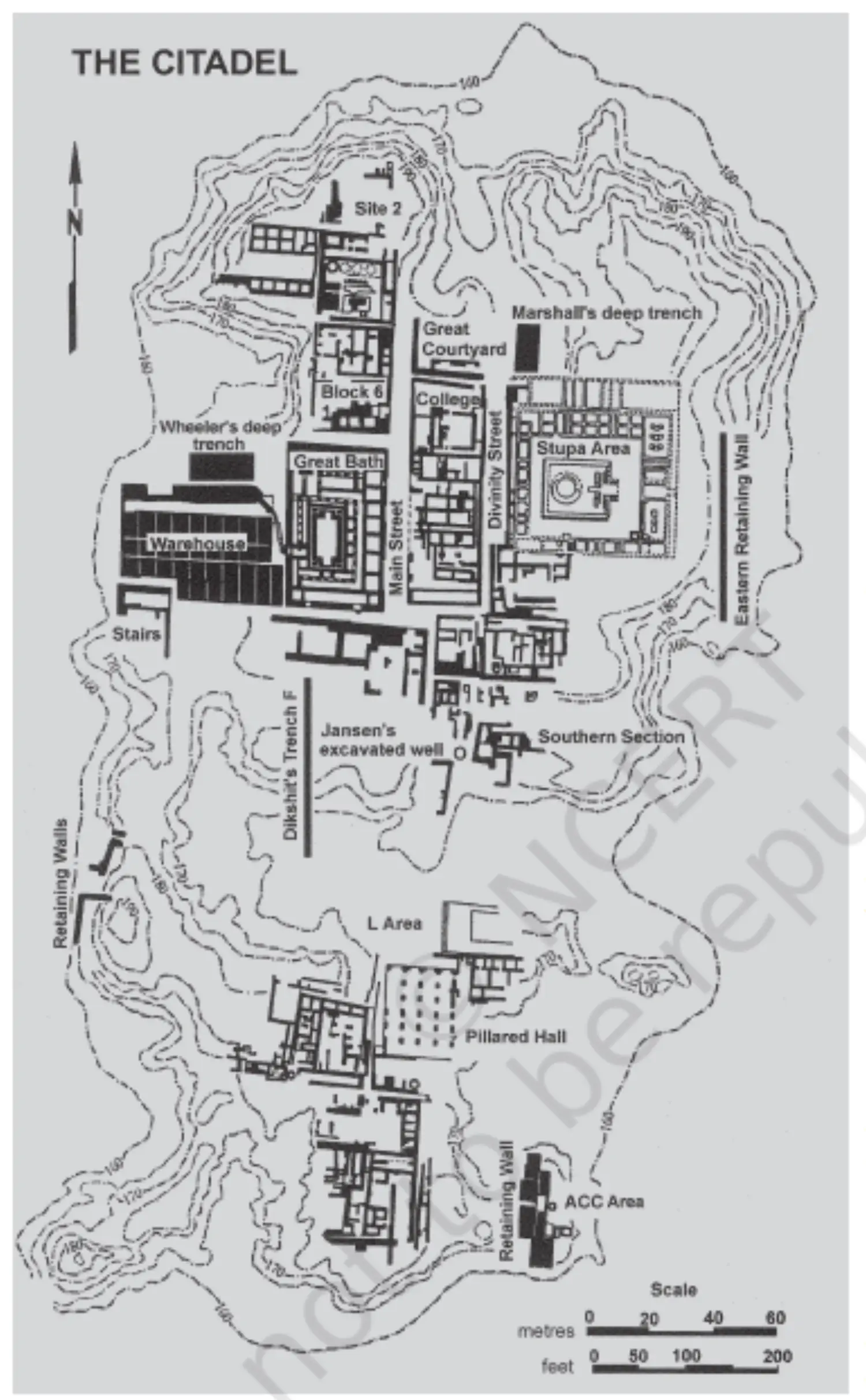
Tracking Social Differences
4. Social Stratification in Harappan Society: 4.1. Understanding through Burials:
- Archaeologists explore social differences through burial styles and grave goods.
- Unlike the extravagant royal burials in Egypt, Harappan burials were more modest, with the dead generally laid in pits, occasionally lined with bricks.
- Grave goods included everyday items like pottery and ornaments, possibly for use in the afterlife.
- Wealthy items were relatively rare in burials, suggesting a limited practice of burying the dead with precious goods.
4.2. Artifacts as Social Indicators:
- Artifacts are classified into utilitarian (everyday use) and luxuries (rare or made from precious materials).
- Common items: querns, pottery, needles, flesh-rubbers, etc.
- Luxuries: objects made from rare materials or through complex processes, like faience pots.
- Complications in classification arise when everyday items are made from luxurious materials (e.g., spindle whorls from faience).
4.3. Distribution of Luxury Goods:
- Concentration of luxury items in larger settlements (e.g., Mohenjodaro, Harappa), with sparse findings in smaller ones.
- Indicative of social and economic disparities based on settlement size and possibly hierarchy. The rarity of gold and its presence in hoards suggests its high value and selective distribution/ownership.
Craft Production
5. Craft Production in Harappan Civilization: 5.1. Specialized Craft Centers:
- Chanhudaro: a small settlement focused on various crafts (bead-making, shell-cutting, metal-working, seal-making, weight-making).
- Craft materials included stones (carnelian, jasper, crystal, quartz, steatite), metals (copper, bronze, gold), and others (shell, faience, terracotta).
- Beads: diverse in material, shape, and design; intricate production methods.
- Steatite: soft stone, easy to work with, allowing for diverse shapes.
- Carnelian: red color achieved through specific firing techniques.
- Specialized tools: drills found at Chanhudaro, Lothal, and Dholavira.
5.2. Coastal Production Centers:
- Nageshwar and Balakot: known for making shell objects, which were distributed to other settlements.
- Finished products from specialized centers likely distributed to larger urban areas like Mohenjodaro and Harappa.
5.3. Identifying Craft Production Sites:
- Indicators: presence of raw materials (stone nodules, shells, copper ore), tools, unfinished objects, rejects, and waste material.
- Waste: a significant indicator of craft activity; discarded material from the production process.
- Craft production is not limited to specialized centers; also prevalent in larger cities (Mohenjodaro, Harappa).
Strategies for Producing Materials
6. Procurement of Materials and Trade: 6.1. Transportation and Procurement Strategies:
- Materials for crafts: mix of local (like clay) and external sources (stone, timber, metal).
- Transport: likely via bullock carts (evidenced by terracotta models) and riverine/coastal routes.
- Settling near resources: settlements like Nageshwar and Balakot near shell sources; Shortughai near lapis lazuli; Lothal near carnelian, steatite, and metal sources.
- Expeditions for materials: possibly to areas like Khetri (for copper) and south India (for gold), establishing local contacts.
- External contacts: Harappan objects found in distant areas indicate far-reaching trade/communication.
6.2. International Trade and Contacts:
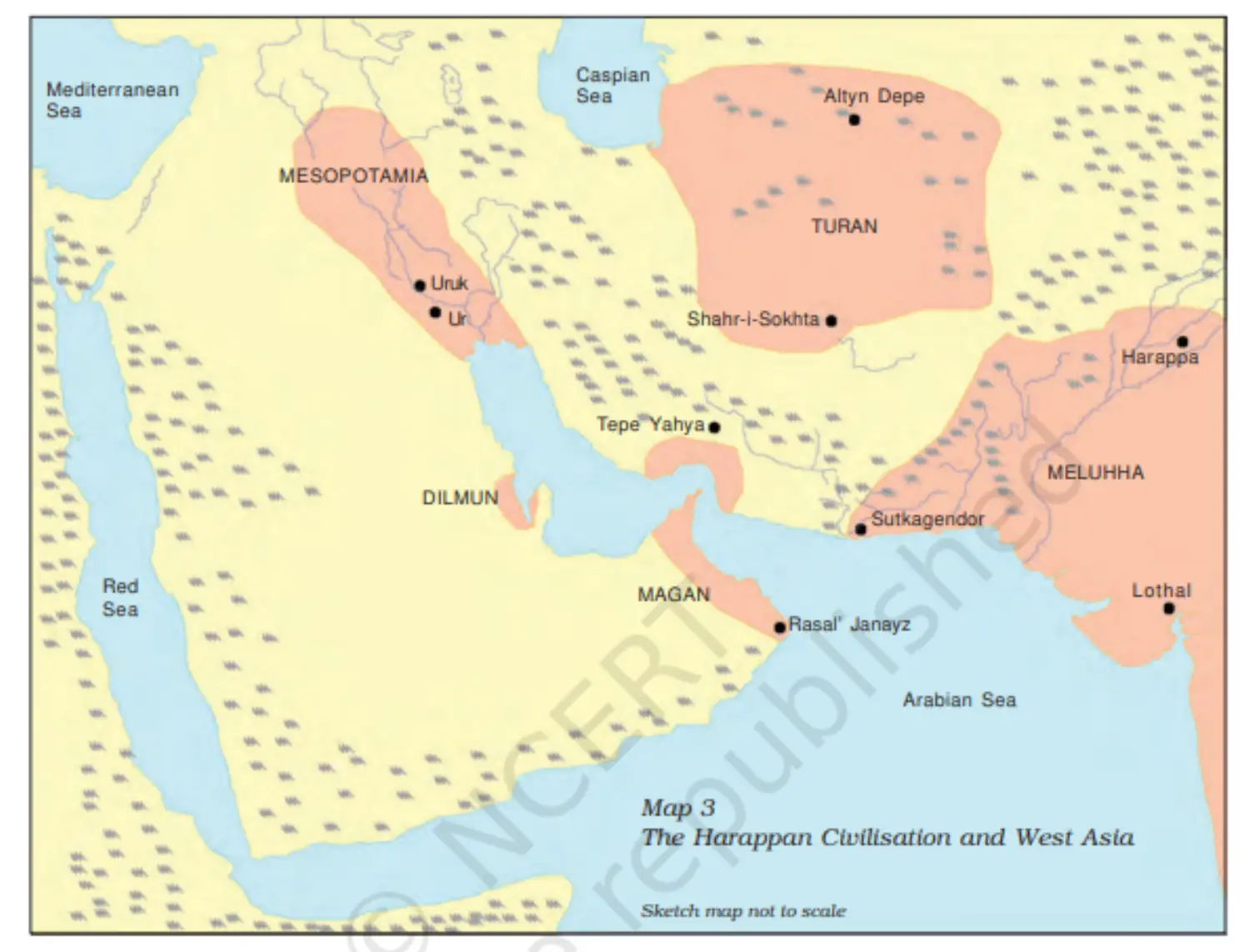
Copper possibly imported from Oman (evidenced by nickel traces in Omani copper and Harappan artifacts).
Harappan jars found in Oman, possibly used for trade exchanges.
Mesopotamian texts: mention trade with regions like Dilmun (Bahrain), Magan (Oman?), and Meluhha (Harappan region?), trading carnelian, lapis lazuli, copper, gold, and wood.
Possible sea communication: depictions of ships on seals; Mesopotamian references to Meluhha as seafarers.
Cultural exchanges: Mesopotamian myth mentions the haja-bird, possibly the peacock, suggesting cultural or natural exchanges.
Map
Seals, Scripts and Weights
7.1. Seals and Sealings:
- Purpose: Facilitated long-distance communication and trade.
- Usage: Bags of goods sealed with clay impressions of seals to indicate the sender's identity and ensure security (intact seal meant no tampering).
7.2. Harappan Script:
- Characteristics: Found on seals, typically alongside animal motifs; motifs likely conveyed meaning to the illiterate.
- Content: Likely contained owner's name and title; remains undeciphered.
- Nature: Not alphabetical; contains between 375 and 400 signs, too many for an alphabet.
- Writing direction: Right to left, inferred from spacing on seals.
- Surfaces with writing: Diverse, including seals, tools, jewelry, tablets, and signboards, suggesting possible widespread literacy.
7.3. Weights System:
- Material and shape: Made of chert, generally cubical, unmarked.
- Measurement system: Binary for lower denominations (1, 2, 4, 8, 16, etc.), decimal for higher ones.
- Usage: Smaller weights for jewelry and beads; the presence of metal scale pans indicates weighing processes.
Ancient Authority
- Observations: Notable uniformity in Harappan artifacts (pottery, seals, weights, bricks) across diverse geographic regions; strategic settlement locations; organized labor for construction projects.
- Key Question: Who organized and controlled these societal activities?
8.1. Speculations on Leadership:
- Palaces and Kings:
- Archaeological Ambiguity: No clear evidence of a central power source or depictions of rulers; a large building in Mohenjodaro speculated as a "palace" but lacks grandeur or treasures; a stone statue termed "priest-king" due to parallels with Mesopotamian priest-kings, yet no substantial evidence to confirm political or religious authority.
- Theories on Governance:
- Egalitarian Society: Some scholars propose a society without rulers, where everyone has equal status.
- Multiple Rulers: Theory suggesting separate rulers for each major city (e.g., Mohenjodaro, Harappa).
- Single State Rule: Supported by artifact uniformity, planned settlements, standardized brick sizes, and strategic placement near raw materials; currently the most plausible theory due to the complexity of decision-making and implementation observed.
The End of Civilisation
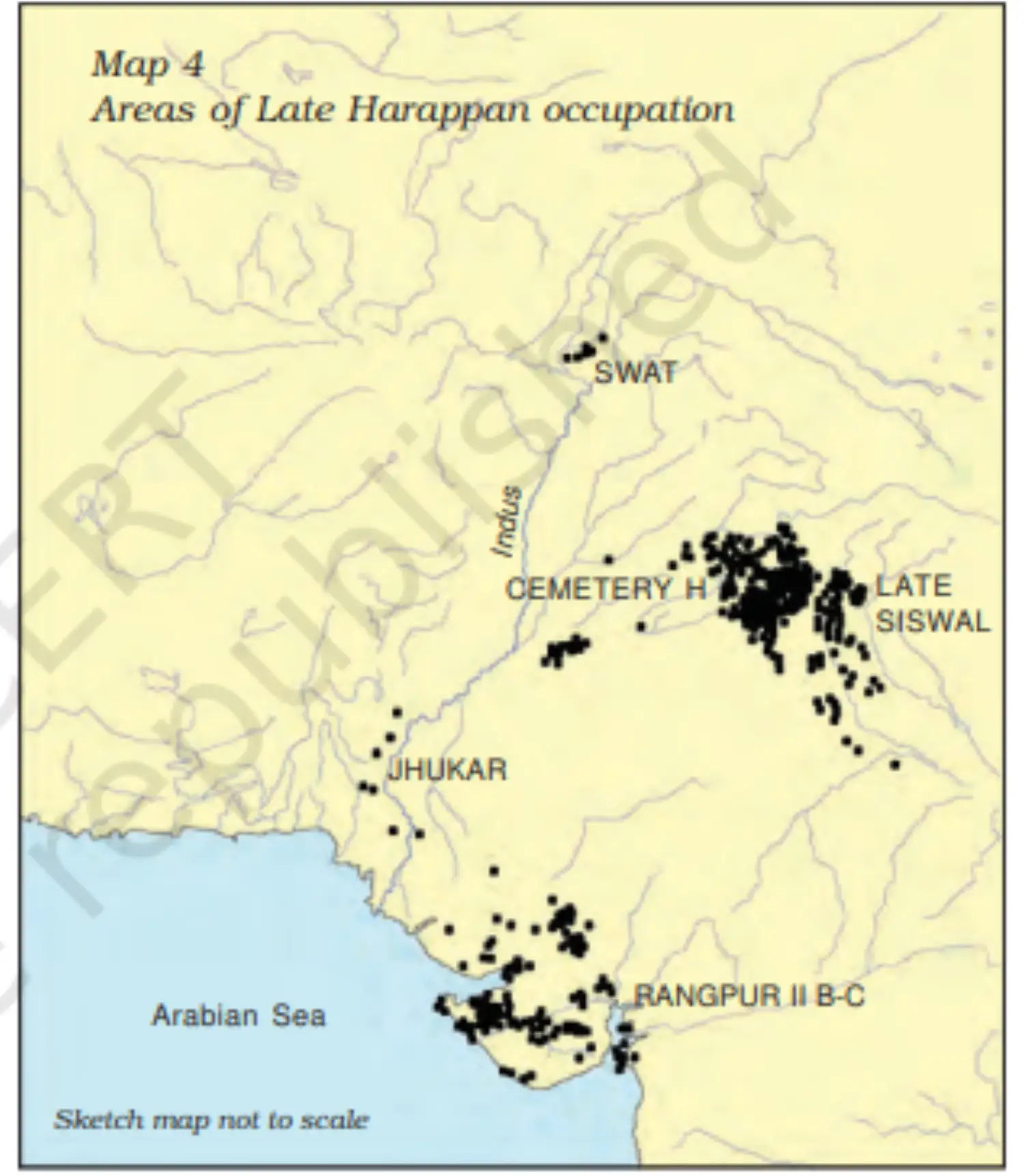
- Observations: By around 1800 BCE, the abandonment of many Mature Harappan sites, especially in regions like Cholistan, coupled with population expansion into areas in Gujarat, Haryana, and western Uttar Pradesh.
- Changes in Remaining Harappan Sites Post-1900 BCE:
- Disappearance of characteristic Harappan artifacts (weights, seals, special beads).
- Decline of writing, long-distance trade, and craft specialization.
- Simplification in material culture, with fewer materials used for fewer purposes.
- Deterioration in house construction techniques; no more large public structures.
- Transition to a more rural lifestyle, indicated by artifacts and settlements in "Late Harappan" or "successor cultures."
- Theories on the Harappan Decline:
Proposed Causes: Climatic changes, deforestation, excessive floods, river shifts/drying, landscape overuse. However, these don't fully explain the collapse of the entire civilization.
Probable Central Cause: The disintegration of a unifying element, likely the Harappan state itself.
Evidence: Loss of seals, script, distinctive beads, and pottery; the shift from standardized to local weight systems; city decline and abandonment.
Aftermath: A millennium-long gap before the emergence of new cities in different regions of the subcontinent.
Map
Discovering the Harappan Civilisation
- Background:
- Post-civilization, Harappan cities were forgotten until rediscovery through various means (floods, erosion, plowing, digging).
- 10.1 Cunningham's Confusion:
- Alexander Cunningham, the first Director-General of the ASI, primarily focused on Early Historical periods, guided by texts and inscriptions.
- He overlooked Harappan artifacts due to their disconnect with known historical frameworks and his focus on sites mentioned by Chinese pilgrims.
- 10.2 A New Old Civilisation:
- Recognition of the Harappan civilization's significance began in the early 20th century with discoveries by Daya Ram Sahni (Harappa) and Rakhal Das Banerji (Mohenjodaro).
- John Marshall's 1924 announcement highlighted the civilization's contemporaneity with Mesopotamia, based on similar seals found at both sites.
- Marshall, the first professional archaeologist in India, introduced systematic excavation but ignored stratigraphic distinctions, causing a loss of contextual information.
- 10.3 New Techniques and Questions:
- R.E.M. Wheeler, succeeding Marshall, emphasized stratigraphy over uniform horizontal excavation units, bringing precision to archaeology.
- Post-partition, Indian archaeologists focused on discovering Harappan sites within India (Kutch, Punjab, Haryana), leading to discoveries like Kalibangan, Lothal, Rakhi Garhi, and Dholavira.
- Current Focus:
- Establishing cultural sequences, understanding site locations, and analyzing artifact functions.
- Since the 1980s, increased international collaboration, using advanced techniques for comprehensive evidence analysis, promising future insights.
- Background:
Problems of Piecing Together the Past
- Understanding through Material Evidence:
- Material evidence, not Harappan script, is crucial for understanding the civilization.
- Surviving materials: stone, burnt clay, metal; organic materials often decomposed.
- 11.1 Classifying Finds:
- Recovering and Classifying:
- Artifacts are classified by material (stone, clay, metal) or function (tool, ornament, ritual object).
- Understanding Function:
- Function inferred from resemblance to present-day objects or context of discovery.
- Indirect evidence is sometimes used, e.g., for clothing from sculptures.
- Recovering and Classifying:
- 11.2 Problems of Interpretation:
- Religious Practices:
- Early interpretations based on unusual objects or structures, assumed religious significance (e.g., terracotta figurines, Great Bath).
- Seals depicting ritual scenes or mythical creatures are interpreted as religious symbols.
- Assumptions are often made based on parallels with later traditions (e.g., "proto-Shiva").
- Speculative Reconstructions:
- Many reconstructions, especially religious ones, remain speculative.
- Differences between Harappan depictions and later religious texts (e.g., Rigveda).
- Religious Practices:
- Achievements and Questions:
- A clearer understanding of the Harappan economy, social differences, and civilization functioning.
- Unanswered questions: nature of Great Bath, extent of literacy, social differentiation in cemeteries, gender roles and representations.
- Future work is needed, especially in exploring gender issues in the Harappan context.
- Understanding through Material Evidence:
Additional Concepts
1. Terminology and Timeframes:
- Indus Valley Civilization (IVC) or Harappan Culture:
- Dating: c. 2600 to 1900 BCE.
- Identified by unique objects: seals, beads, weights, stone blades, baked bricks.
- Spread across Afghanistan, Jammu, Baluchistan (Pakistan), and Gujarat.
- Early (pre-Harappan) and Late (post-Harappan) cultures were also identified.
- Abbreviations:
- BP: Before Present.
- BCE: Before Common Era.
- CE: Common Era.
- c.: Circa (approximately).
- Site Distribution (Sind and Cholistan):
- Total sites: Sind (106), Cholistan (239).
- Early Harappan sites: Sind (52), Cholistan (37).
- Mature Harappan sites: Sind (65), and Cholistan (136), with many on new sites.
2. Artefacts and Excavations:
- Food Processing:
- Tools: Saddle querns for grinding cereals, herbs, and spices.
- Materials: stone, metal, terracotta.
- Harappa's Plight:
- Significant damage by brick robbers for railway construction.
- Contrast with the better-preserved Mohenjodaro.
- Citadels and Urban Planning:
- The high western part, and lower eastern section in settlements.
- Variations: Fortified settlements, walled sections (Dholavira, Lothal).
- Drainage Systems:
- Advanced, with street drains, sumps, and cleaning arrangements.
- Found in both larger cities and smaller settlements.
3. Interpretations and Controversies:
- Evidence of “Invasion”:
- Debated findings: Skeletal remains at Mohenjodaro.
- Contrasting interpretations: Massacre vs. irregular burials.
- Archaeological Layers and Stratigraphy:
- Sites are formed through the accumulation of materials, and structures.
- The study of layers (stratigraphy) reveals cultural periods.
- Early Archaeologists:
- Driven by adventure, and exploration (e.g., R.E.M. Wheeler at Harappa).
- Religious Artefacts:
- Interpretations of seals, and stones (e.g., “proto-Shiva”, lingas).
4. Timelines:
- Major Periods in Early Indian Archaeology:
- From 2 million BP (Lower Palaeolithic) to 400 CE (Early Historic).
- Developments in Harappan Archaeology:
- Key excavations and explorations from 1875 to 1990s.
- Indus Valley Civilization (IVC) or Harappan Culture:
- Chapter 2 - Kings, Farmers, and Towns
Early States and Economics (600 BCE - 600 CE)
1. Post-Harappan Developments (1500 years span):
- Geographical Spread:
- Agricultural settlements: North India, Deccan Plateau, and parts of Karnataka.
- Pastoral populations: Deccan, further south.
- Cultural Practices:
- Megaliths: Elaborate stone structures from the first millennium BCE in central and south India.
- Function: New modes of disposing of the dead.
- Characteristics: The dead are often buried with a range of iron tools and weapons.
- Megaliths: Elaborate stone structures from the first millennium BCE in central and south India.
- Rigveda Composition:
- Timeframe: Post-Harappan period.
- Location: Along the Indus and its tributaries.
2. Significant Changes from c. 6th Century BCE:
- Political Transformations:
- Emergence of early states, empires, and kingdoms.
- Agricultural Organization:
- Changes in the systems of agricultural production.
- Urbanization:
- New towns sprouting up across the subcontinent.
3. Historical Sources and Interpretations:
- Types of Sources:
- Inscriptions, texts, coins, visual materials.
- Challenges:
- Complexity in understanding developments.
- Incomplete stories from existing sources.
- Geographical Spread:
Prinsep and Piyadassi
1. Milestones in Indian Epigraphy:
- 1830s Developments:
- Key Figure: James Prinsep, an officer in the mint of the East India Company.
- Achievements: Deciphered two ancient scripts:
- Brahmi
- Kharosthi
- Usage: Scripts found in the earliest inscriptions and coins.
- Significant Discoveries:
- Piyadassi: A name found in most inscriptions, means "pleasant to behold."
- Asoka: Name found in a few inscriptions, identified as a famous ruler from Buddhist texts.
2. Impact on Historical Studies:
- Political History:
- Early Research Focus: Reconstructing lineages of major dynasties.
- Methods: Using inscriptions and texts in various languages.
- Result: Establishment of broad contours of political history by the early 20th century.
- Early Research Focus: Reconstructing lineages of major dynasties.
- Shift in Scholarly Focus:
- New Investigations: Connections between political changes and economic/social developments.
- Findings: Existence of links, but often complex and indirect.
- 1830s Developments:
The Earliest States
1. Emergence of Early States:
- Time Period: Sixth century BCE, a pivotal era in Indian history.
- Characteristics:
- Emergence of early states and cities.
- Increased use of iron.
- Development of coinage.
- Rise of diverse philosophical thoughts, notably Buddhism and Jainism.
2. Mahajanapadas:
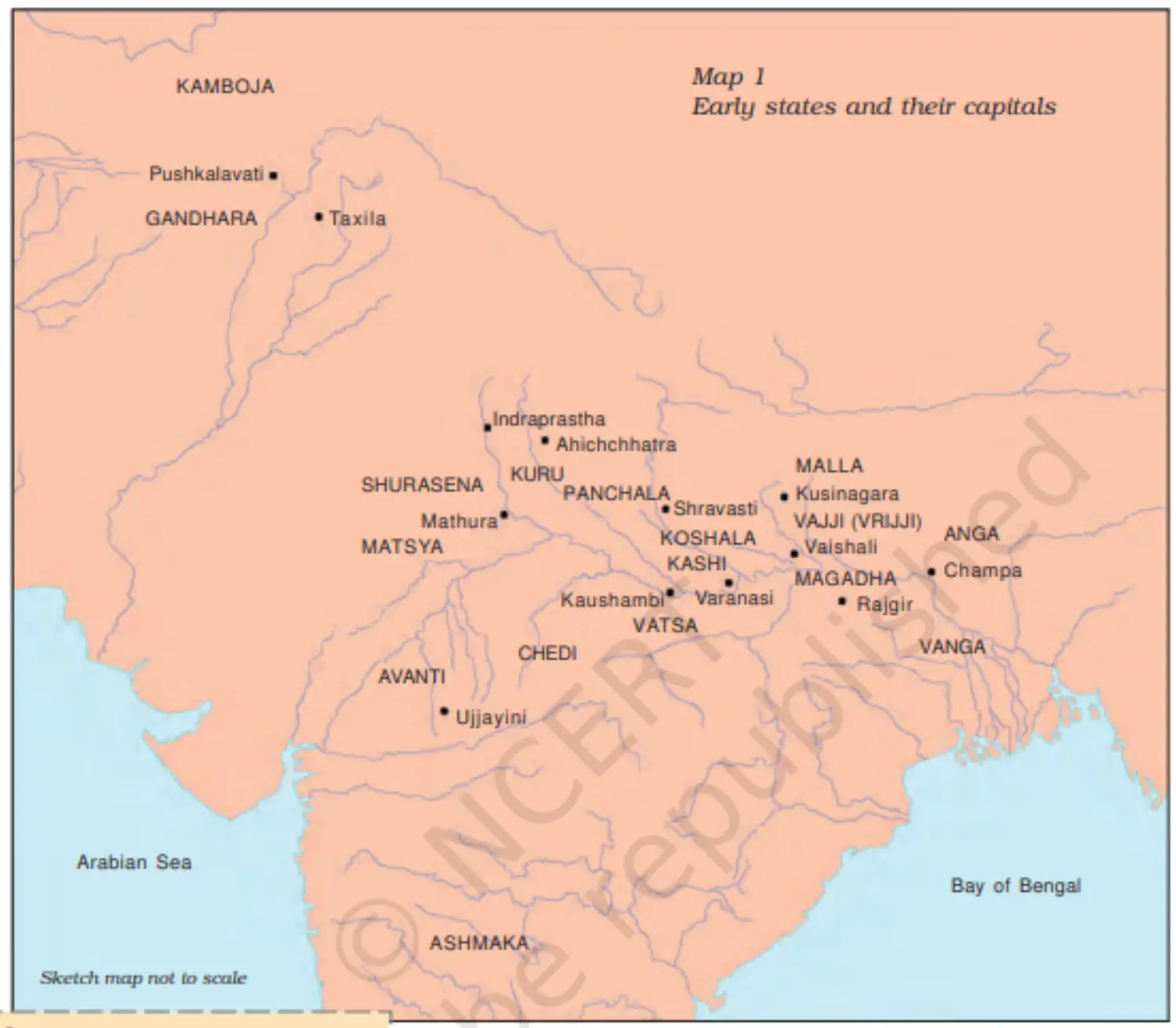
- Definition: Sixteen large states mentioned in early Buddhist and Jaina texts.
- Prominent Mahajanapadas: Vajji, Magadha, Koshala, Kuru, Panchala, Gandhara, Avanti.
- Government Forms:
- Monarchies: Ruled by kings.
- Ganas or Sanghas: Oligarchies (ruled by a select group of individuals, termed rajas).
3. Economic and Political Structures:
- Capital Cities: Each Mahajanapada had one, often fortified.
- Resource Management: For maintaining cities, armies, and bureaucracies.
- Imposition of taxes and tributes on cultivators, traders, and artisans.
- Raiding neighboring states for wealth.
- Military: Gradual shift from militia to standing armies.
4. Magadha's Ascendancy:
Timeframe: Between the sixth and fourth centuries BCE.
Geographical Advantage: Fertile lands, proximity to iron mines, availability of elephants, navigable rivers.
Notable Rulers: Bimbisara, Ajatasattu, Mahapadma Nanda.
Capitals:
- Rajagaha (initial): Fortified settlement among hills.
- Pataliputra (later): Strategic location along the Ganga.
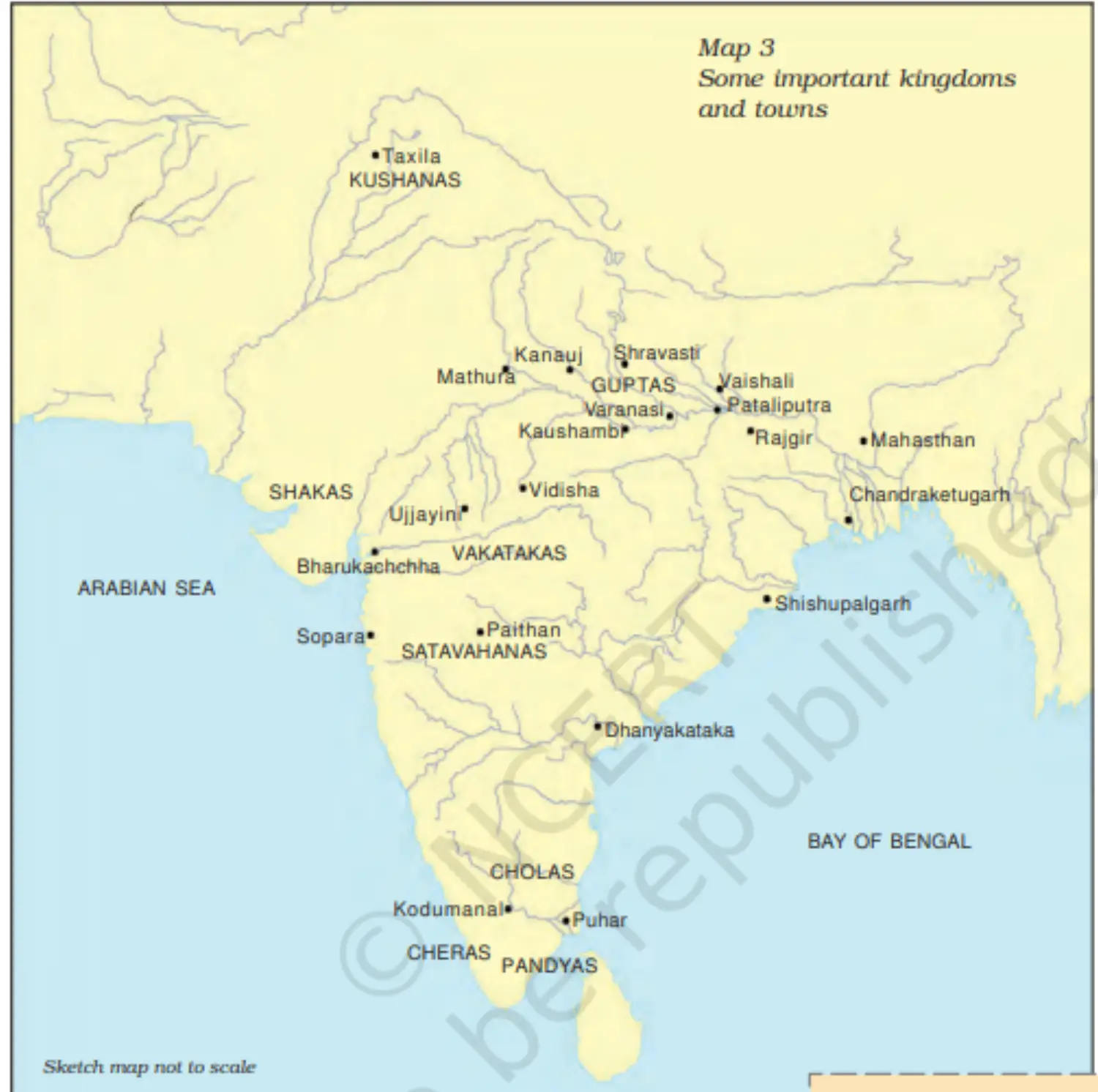
Map
An Early Empire
1. Mauryan Empire:
- Foundation: Founded by Chandragupta Maurya around 321 BCE, reaching its zenith under Asoka.
- Territory: Extended to Afghanistan and Baluchistan in the northwest and conquered Kalinga in the east.
2. Sources for Mauryan History:
- Archaeological: Sculptures, artifacts.
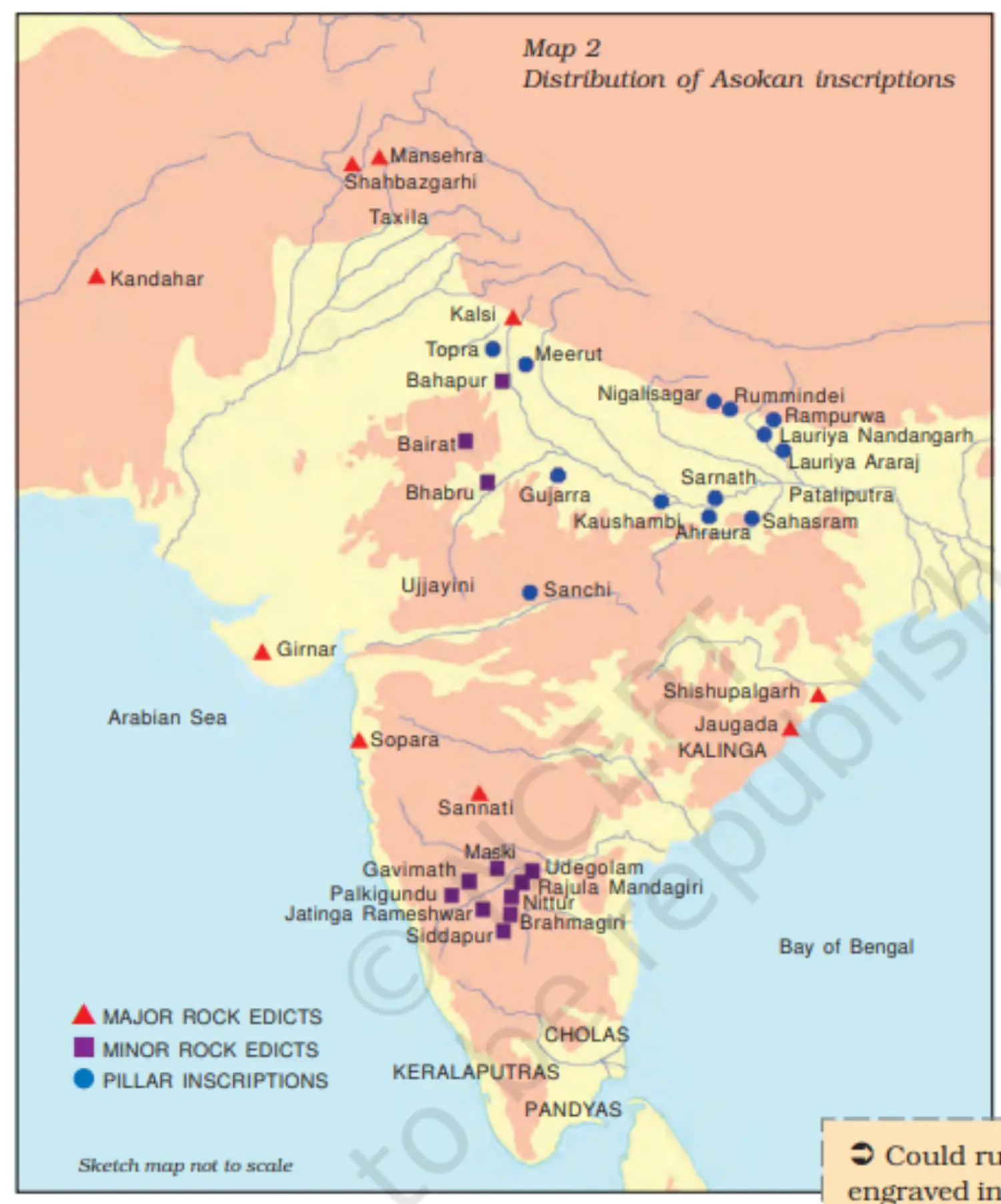
- Textual: Accounts of Megasthenes, Arthashastra, Buddhist, Jaina, and Puranic literature, and Asoka's inscriptions.
- Asoka's Inscriptions: Proclamations of dhamma, promoting moral and social norms.
3. Administration:
- Political Centres: Pataliputra (capital), Taxila, Ujjayini, Tosali, and Suvarnagiri (provincial centers).
- Uniformity in Administration: Unlikely due to regional diversity.
- Control: Strongest around the capital and provincial centers.
- Communication: Vital for maintaining the empire, facilitated through land and riverine routes.
- Military Structure: Organized into committees overseeing various aspects (navy, provisions, infantry, cavalry, chariots, elephants).
4. Propagation of Dhamma:
- Purpose: Unifying the empire, and ensuring the well-being of people.
- Dhamma Mahamattas: Special officers appointed to spread dhamma.
5. Significance of the Mauryan Empire:
Historical Context: Seen as a major landmark during the colonial period.
Cultural Contribution: Rich stone sculptures, and unique inscriptions.
Asoka's Legacy: Revered for his moral governance, used as a national symbol in modern times.
Empire's Duration and Extent: Lasted about 150 years, did not encompass the entire subcontinent, and had non-uniform control.
Post-Mauryan Developments: Emergence of new chiefdoms and kingdoms by the second century BCE.
Map
New Notions of Kingship
1. Emergence of New Kingdoms:
- Location: Deccan and southern India (Tamilakam - ancient Tamil country).
- Kingdoms/Chiefdoms: Cholas, Cheras, Pandyas, Satavahanas, Shakas.
- Revenue Sources: Long-distance trade.
- Social Status Claims: New rulers claimed high status through various strategies once in power.
2. Concept of Divine Kingship:
- Kushanas: Ruled from Central Asia to northwest India (1st century BCE-1st century CE).
- Status Projection: Identified with deities; colossal statues in shrines; title "devaputra" (son of god).
- Influence: Possibly inspired by Chinese rulers' concept of divine origin.
3. Gupta Empire and Notions of Kingship:
- Time Period: Emergence by the 4th century.
- Samantas System: Local chiefs or lords providing military support and homage to kings; potential to become kings themselves.
- Historical Sources: Literature, coins, inscriptions, prashastis (laudatory inscriptions).
- Noteworthy Inscription: Prayaga Prashasti by Harishena for Samudragupta.
4. Historical Interpretation:
- Prashastis: Valued for poetic content; factual accuracy can be contentious.
- Literature vs History: Historical compositions are treasured as literary works, not always literal historical accounts.
A Changing Countryside
1. Popular Perceptions of Kings:
- Sources: Jatakas, Panchatantra (oral tales, later written down).
- Subjects' Views: Often negative due to high taxes, and insecurity (e.g., Gandatindu Jataka).
- Escape: Fleeing to forests to avoid oppression.
2. Agricultural Advancements:
- Plough Agriculture: Adoption in fertile valleys from c. 6th century BCE; iron-tipped ploughshare for alluvial soils; transplantation in Ganga valley.
- Limitations: Restricted use in semi-arid or hilly regions.
- Irrigation: Wells, tanks, canals; community and individual (often royal) initiatives.
3. Rural Social Structure:
- Differences: Landless laborers, small peasants, large landholders (gahapati in Pali texts); the emergence of powerful village headmen.
- Tamil Society: Vellalar (landowners), uzhavar (ploughmen), adimai (slaves).
- Access Inequality: Based on land, labor, and technology.
4. Land Grants and Inscriptions:
- Documentation: Stone inscriptions, copper plates (mostly grants to religious institutions, Brahmanas).
- Language: Sanskrit, sometimes combined with local languages (from the 7th century).
- Notable Example: Prabhavati Gupta's grant despite legal restrictions on women owning land.
- Rural Population: Varied; obligations to new landlords.
5. Debates on Land Grants' Impact:
- Agricultural Expansion: Viewed as a strategy to promote agriculture.
- Political Decline Indicator: Seen as a sign of weakening royal power, and control over samantas.
- Supermen Projection: Kings' attempts to maintain an image of power.
6. Groups Beyond State Control:
- Semi-independent Communities: Pastoralists, fisherfolk, hunter-gatherers, semi-sedentary artisans, and shifting cultivators.
- Record-keeping: Generally, these groups didn't maintain detailed records.
Towns and Trades
1. Emergence of New Cities:
- Origins: Began c. 6th century BCE, many as capitals of mahajanapadas.
- Locations: Along communication routes, riverine routes (Pataliputra), land routes (Ujjayini), and coastal areas (Puhar).
- Characteristics: Centers of commerce, culture, and political activity (e.g., Mathura).
2. Urban Populations:
- Inhabitants: Kings, elites, craftspersons, and various professionals.
- Artifacts: Luxury goods (Northern Black Polished Ware), tools, ornaments, weapons, and diverse materials.
- Votive Inscriptions: Mention donors, occupations, and guilds (shrines).
3. Trade Dynamics:
- Routes: Land, river, overland to Central Asia, overseas via the Arabian Sea and Bay of Bengal.
- Traders: Peddlers, caravan merchants, seafarers.
- Merchandise: Variety of goods including salt, grains, metals, spices (high demand for pepper in the Roman Empire), and textiles.
- Prominent Traders: Wealthy merchants known as masattuvan in Tamil, setthis, and satthavahas in Prakrit.
4. Coinage and Economic Indicators:
Early Coinage: Punch-marked coins (silver, copper) from c. 6th century BCE; issued by kings, possibly merchants and townspeople.
Indo-Greeks: First to issue coins with names and images of rulers.
Kushanas: Issued large hoards of gold coins, matching contemporary Roman and Parthian standards.
Roman Coins: Found in south India, indicating extensive trade networks beyond political boundaries.
Tribal Republics: Issued their own coins (e.g., Yaudheyas).
Gupta Era: Notable for pure gold coins, facilitating long-distance transactions.
Post-6th Century CE: Decline in gold coins; possible indicators of economic shifts or changes in hoarding behavior.
Map
Back to Basics- How are Inscriptions Deciphered
1. Decipherment of Ancient Scripts:
- Brahmi Script:
- Origins: Basis for modern Indian scripts, used in Asokan inscriptions.
- Decipherment Process: European scholars and Indian pandits compared Brahmi with contemporary scripts (e.g., Bengali, Devanagari).
- Misconceptions: Early inscriptions were initially thought to be in Sanskrit; but actually in Prakrit.
- Breakthrough: James Prinsep deciphered Asokan Brahmi in 1838.
- Kharosthi Script:
- Usage: Found in northwest inscriptions.
- Decipherment Aid: Coins of Indo-Greek kings with names in Greek and Kharosthi.
- Process: Comparison of scripts (e.g., symbol for "a" in names like Apollodotus).
2. Analyzing Historical Evidence from Inscriptions:
- Asokan Inscriptions:
- Ruler's Identification: The name "Asoka" is not directly mentioned; titles like "devanampiya" and "piyadassi" are used.
- Verification: Cross-referencing content, style, language, and paleography across different inscriptions.
- Claims Assessment: Historians evaluate the truthfulness of claims (e.g., Asoka's statement on the absence of prior reporting arrangements).
- Interpretational Challenges:
- Text Clarification: Words within brackets are added by epigraphists for clarity.
- Linguistic and Cultural Variations: Consideration of literacy rates, language understanding across regions, and compliance with royal orders.
- Contextual Complexities: Asokan inscription is interpreted as reflecting his post-war anguish not found in the conquered region (present-day Orissa); reasons unclear.
- Brahmi Script:
The Limitations of Inscriptional Evidence
1. Limitations of Epigraphical Evidence:
- Technical Challenges:
- Faint Engravings: Some inscriptions have letters that are barely visible, leading to uncertain reconstructions.
- Damage and Loss: Inscriptions can be damaged or have missing letters, hindering complete interpretation.
- Linguistic Ambiguities:
- Contextual Meanings: Words in inscriptions may carry meanings specific to certain times or places, complicating interpretation.
- Scholarly Debates: Continuous discussions and debates occur over alternative ways of reading and interpreting inscriptions.
- Volume and Scope:
- Undiscovered/Undeciphered Inscriptions: Many inscriptions likely haven't survived or haven't been found, deciphered, and studied.
- Focused Content: Inscriptions often record grand events or achievements, overlooking routine or everyday activities.
- Commissioners' Biases: Content reflects the perspective of the patron, usually someone of importance or power, leading to a potentially biased view of history.
2. Evolving Historical Inquiry:
- Changing Focus Over Time:
- Early Emphasis: The late 19th and early 20th centuries focused on kings and their histories.
- Mid-20th Century: Shift towards understanding economic change and the emergence of different social groups.
- Recent Trends: Increased attention to marginalized groups, leading to new investigations and analytical strategies.
- Need for Comprehensive Analysis:
- Beyond Epigraphy: Inscriptions alone cannot provide a complete understanding of political and economic history.
- Continual Reassessment: Historians consistently revisit both old and new evidence, questioning and reinterpreting findings in light of current understanding.
- Technical Challenges:
Additional Concepts
1. Understanding Inscriptions and Epigraphy:
- Definition:
- Epigraphy: The study of inscriptions, or texts inscribed on hard surfaces like stone, metal, or pottery.
- Characteristics of Inscriptions:
- Often record achievements, activities, or ideas of those who commissioned them, such as kings' exploits or donations to religious institutions.
- Regarded as permanent records; some are dated, and others are dated based on paleography.
- Languages and Scripts:
- Early inscriptions were in Prakrit, with others in Pali, Tamil, and Sanskrit.
- Most Asokan inscriptions were in Prakrit, with scripts including Brahmi and Kharosthi; Aramaic and Greek were used in the northwest.
2. Historical Texts and Accounts:
- Examples:
- Megasthenes' account highlights the administrative organization, including overseeing rivers, land measurement, and tax collection.
- The Arthashastra provides details on administrative and military organization, including elephant capture.
- The Silappadikaram, a Tamil epic, describes the Pandya chief Senguttuvan's visit to the forest.
- Prayaga Prashasti praises Samudragupta's qualities and achievements.
- The Manusmrti, a legal text, advises on setting boundaries and resolving disputes.
3. Sociopolitical Structures and Historical Developments:
- Chiefdoms:
- Chiefs were powerful, with support from kinfolk, and often performed rituals, led warfare, and arbitrated disputes.
- Gahapati:
- A household head, controlling resources and people within the household; also used to denote status among the urban elite.
- Agrahara:
- Land granted to a Brahmana, often exempt from taxes and with rights to collect dues from locals.
4. Cities and Urbanization:
- Example of Pataliputra:
- Started as Pataligrama, became the capital of the Mauryan Empire, and was one of Asia's largest cities; later found in ruins.
5. Trade and Economy:
- Malabar Coast Trade:
- Active trade, with exports like pepper and imports like coins and precious stones.
- Numismatics:
- The study of coins examines aspects like scripts, images, and metallurgical composition.
6. Important Dates and Epigraphical Advances:
- Timelines 1 & 2:
- Provide chronological frameworks for political, economic, and epigraphical developments.
[Copy the above content to Notion, maintaining the bold headings and nested list structure for clarity and ease of revision.]
Keywords:
- Epigraphy: The study of inscriptions.
- Paleography: The study of ancient writing systems and the dating of manuscripts.
- Prakrit: A general term for languages used by ordinary people in ancient India, different from the scholarly language of Sanskrit.
- Janapada: A term meaning the land where a tribe or people settle; used in both Prakrit and Sanskrit.
- Oligarchy: A form of government where power is held by a small group of people.
- Gahapati: The owner or head of a household, exercising control over the household and its resources.
- Agrahara: Land granted to a Brahmana, exempt from certain taxes and charges.
- Numismatics: The study of coins.
- Periplus: A Greek term meaning "sailing around"; used for ancient navigation texts.
- Definition:
- Chapter 3 - Kinship, Caste, and Class
Early Societies (600 BCE - 600 CE)
1. Social Changes in Historical Context (c. 600 BCE - 600 CE):
- Economic and Political Influences:
- Extension of agriculture affected forest dwellers.
- The emergence of craft specialists as distinct social groups.
- Unequal wealth distribution heightened social disparities.
2. Understanding Social Histories Through Texts:
- Role of Textual Traditions:
- Texts provide norms for social behavior and insights into various social practices and situations.
- Inscriptions offer glimpses of social actors.
- Considerations for Textual Analysis:
- Authorship, intended audience, language, and circulation method are crucial for understanding the perspective and context.
- Texts help reconstruct attitudes and practices shaping social histories.
3. The Mahabharata as a Social Text:
- Overview:
- A vast epic with over 100,000 verses, composed over approximately 1,000 years (from c. 500 BCE).
- Contains a variety of social categories and norms, and depicts a wide range of social situations.
- Central Theme:
- Focuses on the conflict between two sets of cousins and includes sections dictating behavioral norms for different social groups.
- Conformity and Deviation:
- Characters occasionally conform to or deviate from established social norms, which is significant for understanding the social dynamics of the time.
- Economic and Political Influences:
The Critical Edition of the Mahabharata
- Project Initiation and Leadership:
- Began in 1919, led by V.S. Sukthankar.
- Involved a team of dozens of scholars.
- Process:
- Collection of Sanskrit manuscripts from across India, written in various scripts.
- Comparison of verses from each manuscript to identify common elements.
- Publication of common verses in a critical edition spanning over 13,000 pages.
- Completion took 47 years.
- Findings:
- Discovery of common elements in versions from different regions.
- Identification of significant regional variations in the text's transmission.
- Documentation of variations in footnotes and appendices, comprising more than half of the publication.
2. Reflections on Social Histories:
- Variations as Social Indicators:
- The text's variations reflect the dialogues between dominant traditions and local ideas/practices.
- These dialogues involved both conflict and consensus.
- Sources and Interpretations:
- Initial historical interpretations relied heavily on Sanskrit texts by and for Brahmanas.
- Later studies incorporated Pali, Prakrit, and Tamil works, revealing both acceptance and questioning of Sanskrit text ideas.
3. Reconstructing Social Histories:
- Historians' Approach:
- Early historians took texts at face value, assuming direct practice of textual norms.
- Subsequent scholars recognized the complexity of social practice, including questioning and rejection of normative ideas.
- Project Initiation and Leadership:
Kinship and Marriage - Rules and Varied Practices
1. Kinship and Marriage:
- 2.1 Understanding Families:
- Families vary in size, relationships, and activities.
- Larger networks of relatives or "kinfolk."
- Kinship definitions vary across societies.
- Historians find more information about elite families than ordinary ones.
- Analysis of attitudes towards family and kinship essential for insight into historical social behaviors.
- 2.2 Patriliny in the Mahabharata:
- Mahabharata reflects kinship changes; the feud between Kauravas and Pandavas highlights issues of land, power, and patrilineal succession.
- Patriliny: sons inherit resources from fathers.
- Common in ruling dynasties from c. sixth century BCE, with variations.
- Also evident in mantras in texts like the Rigveda, likely shared by wealthy/high-status men.
- 2.3 Marriage Rules:
- Importance of sons for patrilineage; different view of daughters.
- Exogamy: marrying outside kin, regulating the lives of high-status women.
- Kanyadana: the gift of a daughter in marriage as a religious duty.
- Post-c. 500 BCE: Brahmanas lay down detailed social behavior codes, compiled in Dharmasutras and Dharmashastras (e.g., Manusmriti).
- Eight forms of marriage are recognized, four "good" and four condemned.
- 2.4 Gotra System:
- From c. 1000 BCE, classification by gotras (especially among Brahmanas).
- Women were expected to adopt their husbands’ gotra upon marriage; the same gotra members couldn't marry.
- Evidence of non-adherence: Satavahana rulers' wives retained their father’s gotras, some from the same gotra (endogamy).
- 2.5 Matronymics and the Role of Mothers:
Satavahana rulers used metronymic but generally followed patrilineal succession.
The importance of mothers is suggested, but conclusions must be drawn cautiously.
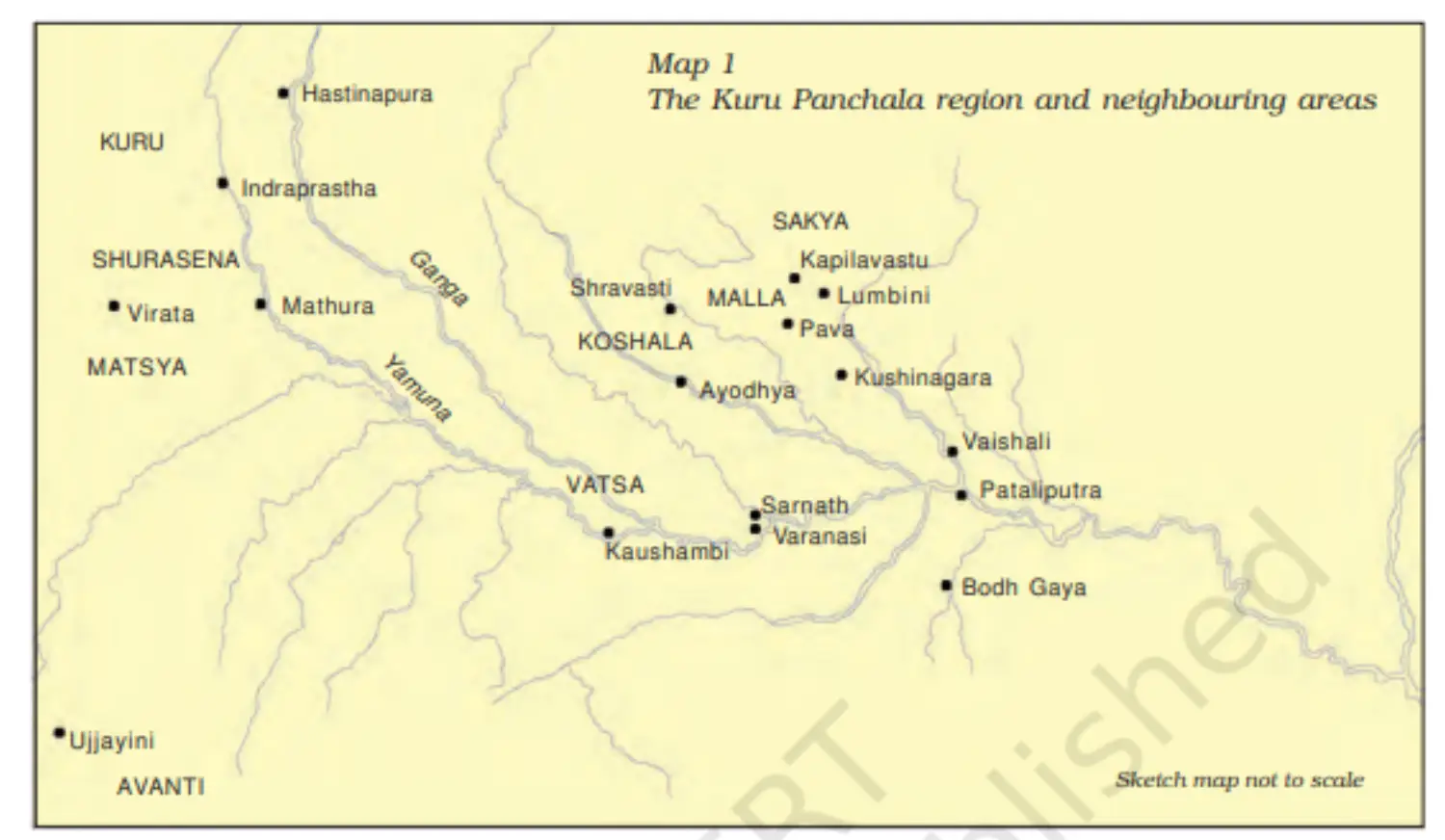
Map
- 2.1 Understanding Families:
Social Differences: Within and Beyond Framework of Caste
- 3.1 Caste System and Occupations:
- Caste: hierarchical social categories; positions determined by birth.
- Dharmasutras and Dharmashastras: prescribed ideal occupations for four varnas.
- Enforcement strategies: divine origin, royal enforcement, birth-based status.
- Realities often differed from prescriptions, as indicated in Mahabharata stories.
- 3.2 Non-Kshatriya Kings:
- Shastras designated kingship for Kshatriyas, but many rulers were from other varnas or outside the caste system.
- Examples: Mauryas (debated origin), Shungas and Kanvas (Brahmanas), and Shakas (mlechchhas from Central Asia).
- Integration into caste framework complex; Satavahanas (claimed Brahmana status, practiced endogamy, allied with mlechchhas).
- 3.3 Jatis and Social Mobility:
- Jatis: another term for social categories, more flexible than varna, often based on occupation.
- Shrenis or guilds: groups with a common professional identity, sometimes transcending a single occupation.
- Example: Mandasor inscription of silk weavers' guild; shared profession, collective decisions, social mobility.
- 3.4 Beyond the Four Varnas - Integration:
- Many communities not influenced by Brahmanical ideas; are often labelled as uncivilised or animal-like in Sanskrit texts.
- Challenges in accommodating diverse lifestyles (e.g., forest-dwellers, nomadic pastoralists).
- Non-Sanskritic speakers are often labeled mlechchhas; complex interactions are depicted in Mahabharata stories.
- 3.5 Beyond the Four Varnas - Subordination and Conflict:
- Development of "untouchability": based on notions of purity and pollution.
- Chandalas: lowest category, handling tasks considered "polluting"; severe social restrictions and stigmatization.
- Accounts from Fa Xian and Xuan Zang: untouchables' lives, forced segregation.
- Non-Brahmanical texts: exploring if chandalas accepted their imposed status; occasional hints of different social realities.
- 3.1 Caste System and Occupations:
Beyond Birth Resources and Status
- 4.1 Gendered Access to Property:
- Social positions are often influenced by access to resources (e.g., land, wealth).
- Mahabharata episode: Yudhisthira stakes and loses all, including wife Draupadi, highlighting issues of ownership.
- Manusmriti: paternal estate divided among sons; women excluded but could retain stridhana (marriage gifts).
- Generally, men controlled major resources; social gender differences were accentuated due to unequal resource access.
- 4.2 Varna and Access to Property:
- Brahmanical texts: wealth access was also regulated by varna; Shudras were relegated to servitude, and upper varnas had diverse economic opportunities.
- Reality: Kings and priests were often wealthy, but social critiques existed (e.g., early Buddhism rejected birth-based status).
- 4.3 Alternative Social Scenario: Sharing Wealth:
- Contrary scenarios: generosity valued, hoarding wealth scorned.
- Ancient Tamilakam: chiefs respected for sharing resources, and patronizing arts; Sangam literature reflects social-economic nuances.
- 4.1 Gendered Access to Property:
Explaining Social Differences: A Social Contract
- 5.1 Buddhist Perspective on Social Inequalities:
- Buddhism offered alternative views on social inequalities and necessary institutions for managing social conflict.
- Myth from Sutta Pitaka: Originally, humans had simple forms, lived peacefully, and took only needed sustenance from nature.
- 5.2 Deterioration and the Emergence of Kingship:
- Human behavior declined due to greed and deceit, disrupting the idyllic state.
- Solution: Select an individual ("mahasammata" or "the great elect") to maintain order, rightfully express indignation, and banish deserving individuals. This individual was essentially the first king.
- Kingship, thus, was a human choice, a social contract, with taxes as compensation for the king's services.
- 5.3 Human Agency in Social Systems:
- This narrative underscores human agency in creating and institutionalizing social and economic relations.
- Implies potential for change: Systems created by humans can be altered by them in the future.
- 5.1 Buddhist Perspective on Social Inequalities:
Handling Texts: Historians and the Mahabharata
- 6.1 Language and Content:
- Text in Sanskrit, simpler than that of Vedas, is likely widely understood.
- Contents are classified into narratives (stories) and didactic (prescriptions about social norms) sections.
- Described as "itihasa" (history) in Sanskrit tradition; actual historicity is uncertain.
- 6.2 Author(s) and Dates:
- Original story possibly composed by sutas (charioteer-bards), circulated orally.
- From the 5th century BCE, Brahmanas started writing it down.
- Composition phases:
- c. 200 BCE - 200 CE: Growth of Vishnu worship; Krishna's prominence.
- c. 200 - 400 CE: Addition of didactic sections like Manusmriti; expansion to 100,000 verses.
- Traditionally attributed to sage Vyasa.
- 6.3 The Search for Convergence:
- Archaeological excavations at Hastinapura: Possible correlations with the epic.
- Houses from c. 12th-7th centuries BCE: Mud and mud bricks; reed walls with mud plaster.
- c. 6th-3rd centuries BCE: Mud-brick and burnt brick houses; advanced drainage systems.
- Uncertainty over whether city description in the epic reflects actual urban centers post-6th century BCE or poetic imagination.
- 6.4 Controversies and Interpretations:
- Draupadi’s polyandrous marriage: Central to the narrative; multiple explanations provided.
- Indicative of the prevalence of polyandry among ruling elites at some time.
- Gradual disfavor among Brahmanas, who reworked the text over centuries.
- Existence in the Himalayan region; potential link to wartime women shortage.
- Creative literature’s narrative requirements may not always reflect social realities.
- 6.1 Language and Content:
A Dynamic text
- 7.1 Continuous Growth:
- Mahabharata evolved over centuries; versions in various languages.
- Growth through dialogue among communities, writers, and regional stories.
- Central stories are often retold, and depicted in arts and performances.
- 7.2 Creative Retellings:
- Contemporary adaptations draw on the main narrative, introducing new perspectives.
- Example: Mahashweta Devi's story, "Kunti O Nishadi."
- 7.3 Devi's Transformation:
- Focuses on an episode where the Pandavas escape a fire, sacrificing a Nishada woman and her sons.
- The story is set post-war; Kunti reflects on her past in the forest.
- Encounter with a nishadi who challenges Kunti's morality.
- The nishadi reveals she is related to those sacrificed, highlighting Kunti's oversight of their lives.
- Kunti's confrontation with forgotten casualties; ends with symbolic justice as Kunti remains in approaching flames.
- 7.1 Continuous Growth:
Additional Concepts
1. Key Terms and Concepts:
- 1.1 Family and Kin:
- Kula: Families.
- Jnati: A larger network of kinfolk.
- Vamsha: Lineage.
- Patriliny: Descent through the father's line.
- Matriliny: Descent through the mother's line.
- 1.2 Social Practices:
- Endogamy: Marriage within a certain group.
- Exogamy: Marriage outside the group.
- Polygyny: A man having several wives.
- Polyandry: A woman having several husbands.
- 1.3 Forms of Marriage (Manusmriti):
- The first, Fourth, Fifth, and Sixth forms are described, differing by who decides the marriage terms: bride, groom, parents, or mutual desire.
2. Key Historical Insights:
- 2.1 Satavahana Dynasty:
- Inscriptions reveal names of kings, often ending with "puta" (meaning son).
- Usage of matronymics (naming based on mother's name) evident.
- 2.2 Social Norms and Conflicts:
- Stories from Mahabharata, Rigveda, and Buddhist texts reflect societal structures, norms, conflicts, and perspectives on caste and gender.
- 2.3 Wealth Acquisition:
- Different means for men and women to acquire wealth, as per Manusmriti.
- 2.4 Varied Social Roles:
- Merchants (vaniks) could be from different varnas, challenging strict occupational categorizations.
- Stories from texts suggest non-Brahmanical communities and individuals often resisted or renegotiated societal norms.
3. Art and Literature:
- 3.1 Depictions:
- Various sculptures and paintings depict scenes from epics like Mahabharata.
- 3.2 Textual Traditions:
- Significant texts over centuries include Ashtadhyayi, Dharmasutras, Tripitaka, Ramayana, Mahabharata, Manusmriti, Puranas, etc.
- 3.3 Mahabharata Studies:
- Twentieth-century efforts include the Critical Edition and English translations.
4. Stories and Parables:
- Narratives from various texts (Mahabharata, Jataka tales, etc.) are used to convey moral, ethical, and spiritual lessons, and reflect societal attitudes.
5. Important Dates:
1. Timeline of Textual Traditions and Historical Developments:
- 1.1 c. 500 BCE:
- Ashtadhyayi by Panini, a foundational work on Sanskrit grammar.
- 1.2 c. 500-200 BCE:
- Composition of Major Dharmasutras in Sanskrit, outlining moral laws and duties.
- 1.3 c. 500-100 BCE:
- Compilation of Early Buddhist texts, including the Tripitaka in Pali, encompassing the Buddha's teachings.
- 1.4 c. 500 BCE-400 CE:
- Composition period of the epic texts Ramayana and Mahabharata in Sanskrit.
- 1.5 c. 200 BCE-200 CE:
- Composition and compilation of Manusmriti in Sanskrit, a significant Dharma text, and Tamil Sangam literature, a collection of classical Tamil poetry and prose.
- 1.6 c. 100 CE:
- Compilation of Charaka and Sushruta Samhitas, foundational texts on Ayurvedic medicine, in Sanskrit.
- 1.7 c. 200 CE onwards:
- Compilation of the Puranas begins in Sanskrit, a genre of ancient Indian literature encompassing mythological stories, traditions, and legends.
- 1.8 c. 300 CE:
- Composition of Natyashastra by Bharata, an ancient Sanskrit treatise on the performing arts, encompassing theatre, dance, and music.
- 1.9 c. 300-600 CE:
- Compilation of Other Dharmashastras in Sanskrit, texts that expound on dharma (moral and ethical conduct).
- 1.10 c. 400-500 CE:
- Emergence of Sanskrit plays including works by Kalidasa, a celebrated classical Sanskrit writer, and scientific works on astronomy and mathematics by Aryabhata and Varahamihira. Also, the period saw the compilation of Jaina works in Prakrit.
2. Twentieth Century: Key Developments in Mahabharata Studies:
- 2.1 1919-1966:
- Preparation and publication of the Critical Edition of the Mahabharata, a project to establish a single, unified text from numerous manuscripts.
- 2.2 1973:
- J.A.B. van Buitenen begins the English translation of the Critical Edition of the Mahabharata, a task left incomplete due to his death in 1978.
- 1.1 Family and Kin:
- Chapter 4 - Thinkers, Beliefs and Buildings
Cultural Developments (600 BCE - 600 CE)
Philosophers, Traditions, and Historical Sources
1. Introduction:
- This chapter explores a millennium of philosophical thought, examining how philosophers attempted to understand their world.
- Ideas from this period were preserved in oral and written texts, architecture, and sculpture, reflecting the significant impact these philosophies had on society.
- The focus is on Buddhism, but it's crucial to recognize that it was one of many coexisting traditions, often in dialogue and debate with one another.
2. Contextual Framework:
- 2.1 Timeframe:
- The journey spans a thousand years, highlighting the evolution and endurance of philosophical ideas and their manifestations.
- 2.2 Interconnected Traditions:
- Buddhism didn't develop in isolation. It was part of a vibrant philosophical milieu, engaging with multiple other traditions.
3. Historical Sources:
- 3.1 Textual Records:
- Sources for historical reconstruction include Buddhist, Jaina, and Brahmanical texts, each offering perspectives on the ideas and beliefs of the time.
- 3.2 Material Remains:
- Beyond texts, historians also study monuments and inscriptions to understand the period.
- Among these, the stupa at Sanchi stands out for its excellent preservation and is a significant focus of this chapter.
4. Importance of Philosophical Traditions:
- These traditions were influential in shaping societal values, beliefs, and cultural practices, leaving a legacy that endured through oral and written literature, and monumental architecture.
A Glimpse of Sanchi
The Stupa at Sanchi and Early Buddhist Tradition
1. Nineteenth-Century Interest in Sanchi Stupa:
- 1.1 European Fascination:
- The stupa at Sanchi attracted significant attention from Europeans in the 19th century.
- The French wanted to relocate the best-preserved eastern gateway to a museum in France, a sentiment shared for a time by the English.
- 1.2 Preservation Efforts:
- Ultimately, both the French and English settled for plaster-cast copies, leaving the original stupa intact.
- Significant financial contributions for the site's preservation came from the rulers of Bhopal, Shahjehan Begum, and her successor, Sultan Jehan Begum.
- 1.3 Contributions by Bhopal Rulers:
- These rulers funded the museum at the site, the guesthouse (which served as John Marshall's residence and workspace), and the publication of volumes on Sanchi.
- John Marshall dedicated his works on Sanchi to Sultan Jehan in recognition of her support.
2. Sanchi's Significance in Buddhist History:
- 2.1 Historical Importance:
- Sanchi's survival is credited to wise decisions and good fortune, avoiding the fate of being carried off to European museums.
- Recognized as one of the most important Buddhist centers, its discovery has greatly enriched our understanding of early Buddhism.
- 2.2 Present-Day Status:
- Today, the stupa is a testament to successful restoration and preservation efforts by the Archaeological Survey of India.
3. Questions Surrounding the Stupa:
- 3.1 Construction and Purpose:
- Several intriguing questions persist about the stupa, such as its original purpose, the reasons for its specific architectural features (like the stone railing), and the identities of its patrons.
- 3.2 Discovery and Historical Context:
- The "discovery" of the stupa and its historical context remain topics of scholarly interest.
- 3.3 Combining Historical Sources:
- Unraveling Sanchi's mysteries requires a multifaceted approach, combining information from texts, sculptures, architecture, and inscriptions.
4. Exploration of Early Buddhist Tradition:
- To fully appreciate Sanchi's significance, an exploration into the background of the early Buddhist tradition is essential.
- 1.1 European Fascination:
The Backgrounds: Sacrifices and Debates
Turning Points in Thought and Tradition
1. Historical Turning Point (mid-first millennium BCE):
- 1.1 Emergence of Thinkers:
- This period witnessed the rise of influential thinkers worldwide, including Zarathustra, Kong Zi, Socrates, Plato, Aristotle, Mahavira, and Gautama Buddha.
- 1.2 Focus of Thought:
- These thinkers explored existential mysteries and the human-cosmic relationship.
- Contextual backdrop: development of new kingdoms, cities, and socio-economic changes, especially in the Ganga Valley.
2. Existing Traditions and New Philosophical Movements:
- 2.1 Vedic Tradition:
- Early Vedic tradition from the Rigveda (compiled c.1500-1000 BCE) included hymns for various deities and sacrificial rituals.
- Initially collective, sacrifices became more domestic or elaborate (rajasuya, ashvamedha) over time, often led by Brahmana priests.
- 2.2 Philosophical Curiosity:
- The Upanishads (from c. sixth century BCE) reflect growing curiosity about life, death, rebirth, and karma.
- Debates emerged about the ultimate reality, and questions were raised about the sacrificial tradition's significance.
- 2.3 Intellectual Debates:
- Numerous sects or schools of thought participated in vigorous debates, as depicted in Buddhist texts.
- Philosophers, including those outside the Vedic tradition, traveled and engaged in discussions, often leading to shifts in followership.
3. Challenges to Established Norms:
- 3.1 Questioning Authority:
- Figures like Mahavira and Buddha challenged the Vedas' authority.
- 3.2 Emphasis on Individual Agency:
- Contrary to Brahmanical norms tied to caste or gender, new philosophies emphasized personal effort toward liberation.
- 1.1 Emergence of Thinkers:
Beyond Worldly Pleasures: The Message of Mahavira
Jainism - Philosophy, Expansion, and Cultural Influence
1. Foundations of Jainism:
- 1.1 Pre-existing Philosophy:
- Jainism's basic tenets were present in north India before the emergence of Vardhamana Mahavira in the 6th century BCE.
- 1.2 Tirthankaras:
- Mahavira was the last in a line of 24 Tirthankaras, spiritual teachers guiding souls across existence's river.
2. Core Principles of Jainism:
- 2.1 Animism:
- The fundamental belief that the world is animated; even inanimate objects like stones and water possess life.
- 2.2 Ahimsa (Non-violence):
- Central to Jain philosophy, extending to all living beings. Its influence permeated broader Indian thought.
- 2.3 Karma and Asceticism:
- The cycle of birth and rebirth is influenced by karma. Liberation requires asceticism, penance, and renunciation of the worldly life.
- 2.4 Monastic Vows:
- Jaina monks and nuns adhered to five vows: non-violence, truth, non-stealing, chastity, and non-possession.
3. Spread and Cultural Influence of Jainism:
- 3.1 Geographic Expansion:
- Jainism gradually expanded across India.
- 3.2 Literary Contributions:
- Jaina scholars enriched literature, writing in Prakrit, Sanskrit, and Tamil. Texts were preserved in temple libraries.
- 3.3 Artistic Expressions:
- Early stone sculptures related to religious traditions, especially those of Jaina Tirthankaras, were found across the subcontinent.
- 1.1 Pre-existing Philosophy:
The Buddha and the Quest of Enlightenment
Buddhism - The Buddha's Life and Teachings
1. Introduction:
- 1.1 Global Influence:
- Buddhism, founded by the Buddha, spread throughout the Indian subcontinent and beyond, influencing East Asia and Southeast Asia.
2. Sources of Knowledge:
- 2.1 Buddhist Texts:
- The Buddha's teachings were compiled from texts edited, translated, and analyzed over the centuries.
- 2.2 Hagiographies:
- Details of the Buddha's life were reconstructed from hagiographies written at least a century after his lifetime.
3. The Buddha's Early Life:
- 3.1 Birth and Upbringing:
- Born Siddhartha, he was the son of a chief of the Sakya clan and had a protected upbringing.
- 3.2 Encounter with Suffering:
- His first exposure to life's harsh realities — old age, sickness, and death — deeply distressed him and triggered his spiritual quest.
4. The Quest for Enlightenment:
- 4.1 Renunciation:
- Siddhartha renounced palace life to seek truth, initially exploring severe asceticism.
- 4.2 Enlightenment:
- After rejecting extreme practices and meditating intensely, Siddhartha attained enlightenment, becoming the Buddha, or "Enlightened One."
5. The Buddha's Teachings:
- 5.1 Dhamma (Righteous Living):
- The Buddha spent the rest of his life teaching Dhamma, the path of righteous living.
- 1.1 Global Influence:
The Teachings of the Buddha
Buddhism - Core Teachings of the Buddha
1. Source of Teachings:
- 1.1 Sutta Pitaka:
- The Buddha's teachings are mainly found in the Sutta Pitaka, part of the Buddhist scriptures.
2. Nature of Teachings:
- 2.1 Reason and Persuasion:
- The Buddha used reason and persuasion, not supernatural powers, to impart wisdom.
- 2.2 Language:
- Teachings were conveyed in the common language for easy understanding.
3. Core Philosophical Concepts:
- 3.1 Transience (Anicca):
- The world is constantly changing and nothing is permanent.
- 3.2 Sorrow (Dukkha):
- Suffering is inherent to human existence.
- 3.3 Soullessness (Anatta):
- There is no eternal, unchanging soul.
- 3.4 Path of Moderation:
- Liberation is found through a middle way between severe penance and self-indulgence.
4. Social and Ethical Teachings:
- 4.1 Human-Centric World:
- Social structures are human creations, not divinely ordained.
- 4.2 Ethical Governance:
- Advised rulers and gahapatis to act ethically and humanely.
5. Path to Liberation:
- 5.1 Individual Agency:
- Emphasized personal effort and righteous action to overcome suffering and achieve liberation.
- 5.2 Nibbana:
- The ultimate goal is Nibbana, the end of the ego and desire, thereby ending the cycle of suffering.
- 5.3 Self-Reliance:
- Encouraged followers to seek enlightenment through self-reliance: "Be lamps unto yourselves"
- 1.1 Sutta Pitaka:
Followers of the Buddha
Buddhism - The Sangha and the Followers of the Buddha
1. Formation of the Sangha:
- 1.1 Founding:
- The Buddha established a sangha, a community of monks, who became teachers of dhamma.
- 1.2 Lifestyle:
- Monks, known as bhikkhus, lived simply, relying on alms for sustenance.
2. Inclusion in the Sangha:
- 2.1 Expansion to Women:
- Initially male-only, the sangha later included women, with the Buddha's foster mother, Mahapajapati Gotami, being the first female monk, or bhikkhuni.
- 2.2 Emergence of Theris:
- Many women became respected teachers, known as theirs, after achieving liberation.
3. Diversity of Followers:
- 3.1 Social Spectrum:
- Followers included individuals from all social strata—kings, gahapatis, workers, slaves, and craftspeople.
- 3.2 Equality in the Sangha:
- Once admitted, all members were considered equal, shedding their previous social identities.
4. Governance of the Sangha:
- 4.1 Consensus-Based Decisions:
- The sangha operated on principles similar to ganas and sanghas, prioritizing consensus and resorting to voting if necessary.
5. Appeal of Buddhism:
- 5.1 Rapid Growth:
- Buddhism expanded quickly during and after the Buddha's life, resonating with those disenchanted with prevailing religious practices and societal upheavals.
- 5.2 Emphasis on Ethics:
- Conduct and values were prioritized over birth-based superiority.
- 5.3 Core Values:
- The teachings highlighted metta (fellow feeling) and karuna (compassion), attracting a diverse follower base.
- 1.1 Founding:
Stupas
Buddhism - Sacred Spaces and the Emergence of Stupas
1. Emergence from Dialogues:
- 1.1 Interactions with Other Traditions:
- Buddhist practices and ideas evolved through dialogues with other traditions, including those of Brahmanas, Jainas, and others.
2. Sacred Places:
- 2.1 Identification of Sacred Sites:
- Sites often marked by unique natural features or with small shrines (chaityas) were considered sacred.
- 2.2 Places Linked to Buddha's Life:
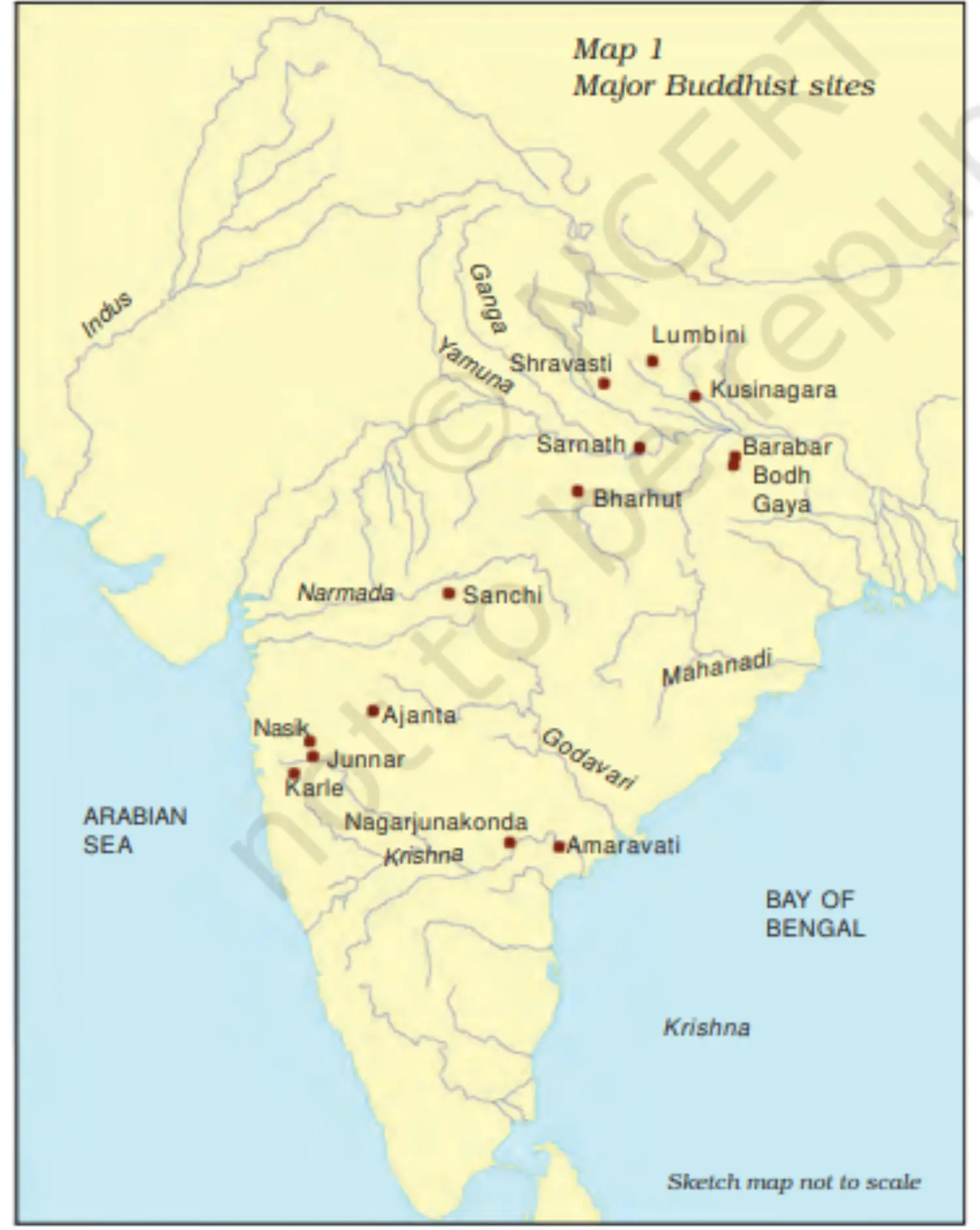
- Locations like Lumbini (birth), Bodh Gaya (enlightenment), Sarnath (first sermon), and Kusinagara (nibbana) became revered.
3. Stupas - Origins and Significance:
- 3.1 Reasons for Construction:
- Stupas, mounds containing Buddha's relics, were constructed as sacred emblems of Buddha and Buddhism.
- 3.2 Association with Asoka:
- As per the Ashokavadana, Asoka distributed Buddha's relics and ordered stupas built over them, marking the spread of Buddhism.
4. Construction and Financing of Stupas:
- 4.1 Donations and Contributions:
- Inscriptions reveal donations for stupas by various groups, including kings, guilds, individuals, and monastic members.
5. Structure and Architecture of Stupas:
- 5.1 Basic Design:
- Originating as simple semi-circular mounds (anda), stupas evolved into complex structures.
- 5.2 Elements of a Stupa:
- Featured the anda, harmika (balcony-like structure), yashti (mast), and chhatri (umbrella), with a railing marking the sacred area.
- 5.3 Evolution of Design:
- Early stupas were plain, with decorative railings and gateways; later versions featured elaborate carvings and sculptures.
6. Worship and Stupas:
- 6.1 Rituals:
Devotees entered stupas from the east and circumambulated clockwise, emulating the sun's path.
Map
- 1.1 Interactions with Other Traditions:
Discovering Stupas: The Fate of Amravati and Sanchi
Discovery and Preservation of Stupas - Amaravati and Sanchi
1. Histories of Stupas:
- 1.1 Construction Histories:
- Individual stupas have unique histories, including how they were built and discovered.
- 1.2 Discovery Histories:
- The discovery of stupas has its own narrative, often intertwined with local and colonial histories.
2. Amaravati Stupa:
- 2.1 Initial Discovery:
- Uncovered by a local raja in 1796, who intended to use the stones for building a temple.
- 2.2 Colin Mackenzie's Exploration:
- Visited Amaravati later, and documented sculptures, but reports remained unpublished.
- 2.3 Walter Elliot's Collection:
- Elliot collected several sculptures in 1854, taking them to Madras; and recognized the stupa's historical significance.
- 2.4 Dispersal of Sculptures:
- Slabs from Amaravati were distributed globally and even used as garden decorations by British officials.
- 2.5 H.H. Cole's Advocacy:
- Cole opposed the removal of original artworks from their discovery sites, advocating for in situ preservation.
3. Sanchi Stupa:
- 3.1 Condition at Discovery:
- Found in 1818, mostly intact with three standing gateways and one fallen.
- 3.2 Preservation Debate:
- Proposals were made to relocate the gateway to Paris or London, but various factors led to its in situ preservation.
- 3.3 Contrast with Amaravati:
- Sanchi remained preserved in its original location, unlike Amaravati, which was left as an insignificant mound.
4. Reflection on Preservation Practices:
- 4.1 Evolution of Attitudes:
- The different fates of Amaravati and Sanchi highlight changing attitudes towards archaeological discoveries and the importance of preserving artifacts in their original context.
- 1.1 Construction Histories:
Sculpture
Understanding Ancient Sculptures and Symbolism
1. The Value of Sculptures:
- 1.1 Removal from Stupas:
- Sculptures were often taken from their original locations due to their perceived beauty and value.
2. Interpretation of Sculptures:
- 2.1 Stories in Stone:
- Sculptures often depict narratives, like the Vessantara Jataka, requiring comparison with textual evidence for interpretation.
- 2.2 Symbols of Worship:
- Early Buddhist sculptures used symbols (empty seats, stupa, wheel) instead of human figures to represent events from the Buddha's life.
3. Influence of Popular Traditions:
- 3.1 Integration of Cultural Motifs:
- Elements not directly linked to Buddhism, like the shalabhanjika motif, were incorporated due to their auspicious nature.
- 3.2 Animal Depictions:
- Animals, real and mythical, were common, symbolizing various qualities or simply adding liveliness to the narratives.
4. Varied Interpretations:
- 4.1 Multiple Meanings:
- Some sculptures could be interpreted in multiple ways, like the figure potentially representing both Maya and Gajalakshmi.
- 4.2 Influence of Non-Textual Traditions:
- Motifs like serpents, derived from popular traditions not recorded in texts, indicate the diverse influences on Buddhist art.
5. Challenges in Art History:
- 5.1 Limitations of Early Interpretations:
- Early art historians, like James Fergusson, made assumptions based on sculptures alone, lacking access to relevant Buddhist texts.
- 1.1 Removal from Stupas:
New Religious Traditions
Evolution of Religious Traditions and Temple Architecture
1. Shifts in Buddhist Ideology:
- 1.1 Emergence of Mahayana Buddhism:
- Focused on the concept of a savior and Bodhisattas, compassionate beings aiding others' salvation.
- Introduced image worship of the Buddha and Bodhisattvas.
- Termed previous Buddhist practices as "Hinayana" (lesser vehicle).
2. Rise of Puranic Hinduism:
- 2.1 Development of Vaishnavism and Shaivism:
- Emphasized bhakti (devotion) and the worship of chosen deities (Vishnu and Shiva).
- Vaishnavism celebrated avatars, incarnations of Vishnu, to restore cosmic order.
- 2.2 Symbolism in Sculptures:
- Deities are depicted with specific symbols, ornaments, and postures, conveying complex religious ideas.
- 2.3 Role of Puranas:
- Compiled by Brahmanas, these texts narrated stories of gods and goddesses, facilitating the understanding of sculptures.
3. Evolution of Temples:
- 3.1 Early Structures:
- Initiated with a simple garbhagriha (sanctum) for the deity and evolved to include shikhara (towers) and elaborate halls and gateways.
- 3.2 Cave Temples:
- The tradition of carving temples from rocks, culminated with the Kailashnatha temple at Ellora.
4. Cultural Interactions and Spread:
- 4.1 Deity Worship Across Regions:
- Worship of specific deities, like Vasudeva-Krishna, spread from one region to another, indicating cultural interactions.
- 1.1 Emergence of Mahayana Buddhism:
Can We “see” Everything?
Interpretation and Understanding of Ancient Art
1. Limitations in Interpreting Historical Art:
- 1.1 Perception of Ancient Art:
- Early European scholars struggled to understand the symbolism in Indian sculptures, often comparing them unfavorably to Greek art.
- Certain Buddha and Bodhisattva images, influenced by Greek art, were valued more due to their familiarity with these scholars.
- 1.2 Challenges in Art Interpretation:
- Using textual references to interpret art has limitations, exemplified by the diverse interpretations of the Mahabalipuram sculpture.
- Debate persists on whether it depicts the descent of the Ganga or Arjuna's penance from the Mahabharata.
2. Unrecorded Religious Practices:
- 2.1 Transience of Rituals:
- Not all religious practices were immortalized in art; many daily rituals and beliefs went unrecorded but were integral to cultural heritage.
- 2.2 Recognition of Unseen Traditions:
- The absence of physical records doesn't diminish the value or richness of these traditions; known artifacts represent only a fraction of historical cultural richness.
- 1.1 Perception of Ancient Art:
Additional Concepts
Ancient Artifacts, Teachings, and Archaeological Discoveries
1. Historical Artifacts and Their Interpretations:
- 1.1 Sanchi Stupas:
- Discovered in the 19th century, Sanchi hosts ancient Buddhist monuments.
- Major Cunningham played a significant role in their study.
- 1.2 Ancient Texts and Teachings:
- Religious texts, like the Rigveda and Upanishads, offer insights into ancient beliefs.
- Buddhist teachings were compiled posthumously into the Tipitaka.
- Jaina texts and the Therigatha provide perspectives on non-Buddhist traditions.
- 1.3 Artistic Representations:
- Sculptures, like the tirthankara from Mathura, represent religious figures.
- Buddhist practices depicted in art include the worship of the Bodhi tree and stupa.
- Ajanta paintings illustrate Jataka stories and social scenes.
2. Archaeological Discoveries and Preservation:
- 2.1 Discovery Timeline:
- 19th century: Major explorations and establishment of museums.
- 20th century: Publications on Sanchi and conservation efforts.
- Sanchi was declared a World Heritage Site in 1989.
- 2.2 Preservation Efforts:
- Various acts and appointments aimed at preserving ancient monuments.
- The Conservation Manual by John Marshall highlights preservation methods.
3. Important Dates and Context:
- c. 1500-1000 BCE: Early Vedic traditions.
- c. 1000-500 BCE: Later Vedic traditions.
- c. sixth century BCE: Early Upanishads; Emergence of Jainism and Buddhism.
- c. third century BCE: Construction of the first stupas.
- c. second century BCE onwards: Development of Mahayana Buddhism, Vaishnavism, Shaivism, and goddess cults.
- c. third century CE: Construction of the earliest temples.
2. Landmarks in Archaeological Discoveries and Preservation:
- 2.1 Nineteenth Century:
- 1814: Founding of the Indian Museum, Calcutta.
- 1834: Ram Raja's publication on Hindu architecture; Cunningham's exploration of Sarnath.
- 1835-1842: James Fergusson's surveys of archaeological sites.
- 1851: Establishment of the Government Museum, Madras.
- 1854: Cunningham's publication on Sanchi.
- 1878: Rajendra Lala Mitra's work on Buddha Gaya.
- 1880: H.H. Cole's curator appointment.
- 1888: Enactment of the Treasure Trove Act.
- 2.2 Twentieth Century:
- 1914: Publication of "The Monuments of Sanchi."
- 1923: John Marshall's "Conservation Manual."
- 1955: Foundation of the National Museum, New Delhi.
- 1989: Sanchi recognized as a World Heritage Site.
Keywords:
- Stupa: A dome-shaped structure erected as a Buddhist shrine.
- Tipitaka: The Buddhist scriptures, consist of three "baskets" or sections: the Vinaya Pitaka (rules for monastic discipline), Sutta Pitaka (discourses), and Abhidhamma Pitaka (philosophical and doctrinal analysis).
- Therigatha: A Buddhist scripture, part of the Sutta Pitaka, consisting of verses attributed to the first Buddhist women.
- Tirthankara: In Jainism, a spiritual teacher who has attained enlightenment.
- 1.1 Sanchi Stupas: