Internal Security
Basic Terms - Online
Extremism
is a very broad term that covers- terrorism, Naxalism, insurgency, militancy, etc
- Linkages between development and spread of Naxalism
- Development has a meaning of positive connotation. Today we experience expanded meaning of development from Roti Kapda Makaan to social infrastructure, internet, clean and safe drinking, etc
- Extremism - is a negative term
- The solution to the issue of extremism
- The first school of thought
- Wherever there has been under-development, then there breeds extremism
- Where the standard of living is high, extremism is contained
- There can be development-induced displacement
- So, we need more development in these regions.
- Another school of thought
- To curb extremism, we need strong law and order.
- The first school of thought
- Linkages between development and spread of Naxalism
Terrorism
the idea is to create terror in the minds of people. Generally, it's not targeted against a community. They just want to grab the eyeballs of the people
It is an act of violence. The people who kill are not the actual target
It does not distinguish between security personnel and civilians
Insurgency
It is an act of internal armed rebellion. The idea is to throw the established state and install their own government
Their target is not civilians but security personnel
Militancy
in the context of Kashmir we use the term. Rebels are sourced from outside.
Left-Wing Extremism - Refer Offline Notes
- Introduction to Left Wing Extremism
The concept emerged in French Revolution
Industrial Revolution - in the 19 century, a section of society wanted to remove capitalism
Karl Marx wrote Fallacies of capitalism.
- He wrote very extensively about communism
- He said that there are 2 classes in society- have and have nots. There should be a revolution that should form a classless society
- Communist society is the ideal society
- He inspired the Russian Revolution.
- Charu Mazumdar- CPI Marxist
Mao Zedong - revolution through the barrel of a gun. This led to the Chinese revolution
- He wanted an armed revolution inspired by the left-wing.
- This philosophy of Mao is called Maoism.
Point of View
There should be no revolution but by democratic ways
Origin of Naxalism
- The word Naxal is derived from the word Naxalbari
- The peasants were exploited by the zamindars and moneylenders
- Some peasants were beaten by the goons of zamindars
- Naxalbari became the flashpoint of violence
- It was named as Naxalbari revolution. It was started in May 1967
- It primarily started as an agrarian movement
- In 2009, the area impacted by Naxalism is known as Red Corridor
- One minister that area stretches from Tirupati to Pashupati
- There have been many attacks - Dantewada (Chinatanal Massacre)
- The term Naxalism/ Maoism/ Left Wing Extremism is used interchangeably
- They want to overthrow the state and want to establish a new social order
- Other local leaders- Kanu Sanyal and Jangal Santhal
- Breeding grounds of Left Wing Extremism
- Under-development
- Tribals
- Resources
- Refer Naxalbari movement from the handout.
- Causes for Rise of Naxalism
- Land related factors/ issues- development induced displacement
- Forced evictions, tribal forest dwellers, Forest Conservation Act, 1980 and Forest Right Act, 2006
- Non-implementation/poor implementation of constitutional and legal measures- Schedule V → which says that Governor would establish Tribal Advisory Council.
- It is under Article 244
- The transfer of land from tribals to non-tribals should be transparent
- Issues in PESA, 1996 and FRA 2006
- One of the major reasons is the vacuum in governance. These areas have not been developed by the government- exploitation at the hands of SFD, police
- Denial of social justice
- External factors like Nepal and China- they provide the funding- vested interests- illegal mining activities by the Mafia
- Now, the issue is not only of law and order but a very deep issue.
- Phases of Naxal Violence
- Phase I (1967-71)
- It started as an agrarian crisis. It was prominent in rural areas
- Urban Naxalism- by its nature Naxalism is not an urban problem. It started in Kolkata
- Steady growth- we also witness the growth of CPI (M-L)
- Charu Mazumdar died which led to the formation of smaller splinter groups
- This was the end of the era
- Phase II (1980- 2004)
- This was a phase of consolidation of Naxalism in India
- Peoples War Group - AP
- Maoist Communism Center- Bihar
- Phase III Post 2004
- PWC+MCC and other smaller groups merged together to form CPI (Maoist)
- Phase I (1967-71)
- Strategy / State’s approach to combat Naxalism
- Law and Order
- Umbrella scheme- modernization of police forces.
- Reduction of trust deficit
- Special anti-Naxal forces- CRPF (CoBRA), Andhra Pradesh (Greyhounds), Chattisgarh (Black Panther)
- Integrated Command for Central Command and Police Forces. Eg- CG, JK, and ODDrone technology
- Surrender cum rehabilitation policy
- SAMADHAN doctrine of MHA
- Salwa Judum- The civilians started using their own vigilante to fight Naxalism.
- Developmental measures
- Nai Roshni scheme
- Eklavya schools- residential schools so that the students are not required to travel, hence saving lives
- Choo Lo Aasman by the Chattisgarh government- to provide education, coaching
- Legal steps- FRA 2006- to give guarantee over forest produce to the tribals
- Relief and rehabilitation policy of 2007
- The backward region grant fronts are now replaced by the Aspirational Districts Program of Niti Aayog
- Integrated Action Plan- DM, SP, District Forest Officer- to bring convergence in the developmental efforts. The gap will be fulfilled with special assistance
- Rural Road Programme I and II
- MGNREGA
- Law and Order
- Critique of the State approach
- The states treat Naxalism as a problem of the center- states have shown a casual approach
- Lack of coordination between states- eg Andhra Pradesh has put in more efforts
- Lack of coordination between police and civil administration
- The strategy of clear-hold- develop
- Overdependence on the center
- The backwardness of these areas- development has not taken place at the expected pace.
- Andhra Pradesh model of Combating Naxalism
- Adopting 3-dimensional strategy- social, economic, and political measures
- The government abolished the patwari system
- Focused on providing basic services
- So this increased alienation of people with the government.
- Way forward
- Implementation of PESA, FRA
- Capacity building of local police forces
- Training and re-orientation of CAPF personnel
- Curbing the funding of Naxalite- the taxes which they impose on people should be stopped, cannabis cultivation.
- Introduction to Left Wing Extremism
North Eastern Insurgency - Notes Online
Insurgency in NE India
Naga Insurgency
Introduction
It is said to be the doyen of insurgency
It was formed as a state in 1963 from Assam
Naga wanted to establish their own state after independence
Since 1946, the government tried to talk with A.Z. Phizo was head of Naga National Council (formal Naga Club)
A Z Phizo was father of Insurgency in North East
Naga Club Participated in Second Round Table Conference
Nagas are collection of Tribes
On 14 August 1947, the Nagas declared themselves independent. In 1951 a plebiscite was conducted in which almost 99% of Naga people voted for Naga Independence.
Nagas Boycotted 1951/52 Election in India
They formed their own Army & Parallel Govt was formed by them
in 1958 - AFSPA was Implemented
Article 371 A- separate provisions for Nagaland provided in
1975 - Shillong Accord between
NSCN - Nationalist Socialist Council of Nagaland
- NSCN (K) - NSCN Khaplang → Never Ready to come to table
- NSCN (I-M) - NSCN Isak Muivah → had better communication with the government
Demands
Naga wants a Naga Constitution
They want a Naga Flag
Inclusion of some areas/dist of Assam, Manipur, Myanmar
In 2015 Indian government signed a Naga Peace Accord was signed
However, not much success was achieved because RN Ravi (Former RAW & IB Chief) who was appointed as governor of Nagaland to make arrangements for the peace talks in 2019 crossed the deadline (October 2019)
Issues
- Absolute Pathetic Connectivity
- Forcing Administrators to give tenders to their people
- Insurgents have become organised criminals
- They have parallel army
- It is having ripple effects on other states of North East
Solutions
- Economic growth, infrastructure, employment, etc
Mizo Insurgency
- In the 1960s, it emerged, there was a major famine called Mautam Famine
- In this background, Mizo National Front was formed to provide relief - Started with Relief & Rehabilitation Work
- Mizo National Group was formed lead by Lal Denga
- 1986 - Mizo Accord was signed between India and Mizo National Front
- Lal Denga became first CM Of Mizoram
- In 1987, Mizoram was given full statehood
- Lal Denga the leader of MNG became the CM of Mizoram
Manipur Insurgency
- A large number of ethnic groups in Manipur, who have made their own Insurgent Groups and they are fighting amongst themselves. There are more than 40 groups
- Biggest Reason for Insurgency here - Naga Insurgency
- Meities - prominent tribe, dominant tribe, they adopted vaishnavism
- Hill (Kukis & Naga) & Valley (Meities) Tribes are in fight with each other
- Not much of a asking for sovereignty problem
- High Handedness of AFSPA and Security Forces
Tripura Insurgency
- It was a tribal state but as a result of the influx of illegal migrants, the demography changed. It slowly changed into a bengali speaking state
- A situation of identity crisis became prominent for the natives and tribals of tripura
- Insurgent Groups formed are
- ATTF - All Tripura Tiger Force
- TNV - Tripura National Volunteers
- In 2015, Tripura became the first state where AFSPA was revoked
Assam Insurgency
Two prominent insurgencies
- ULFA 1979 (United Liberation Front of Asom)
- In the 1960s - All Assam Student Unions started the anti-alien movement primarily against migrants and native identity crisis
- ULFA wanted a sovereign state & rights of native people
- They say that there is a difference between Assam and the rest of India's history- the Ahom Kingdom (Ahom Dynasty)
- In 1985 - Assam Accord was signed
- Add the Role of AASU
- Bodo Insurgency
- All Bodo Student Union was formed - wanted more opportunities for Bodos. Ultimately, they started asking for the creation of Bodoland (carved out from Assam) within India
- They were facing an identity crisis
- The National Democratic Front of Bodoland (NDFB) was formed
- Bodo Liberation Tiger was also formed
- Currently, under Schedule VI of the constitution, Bodoland Autonomous Territory was formed which is governed by Bodoland Autonomous Territorial Council.
- ULFA 1979 (United Liberation Front of Asom)
Meghalaya - Offline Notes
Arunachal Pradesh - Offline
All States have spillover effect of violence in whole of North East
Causes for North Eastern Insurgency
- General Causes
Historical Factors
Britishers followed the policy of non-interference in India
Geographical Factors
Terrain and topography (hilly) - Hence Easy Guerilla Warfare
Physical Connectivity is also less from India and within North East - Connected through Chicken Neck Corridor or Siliguri Corridor or only 25 KM Long
Porous Borders
training camps of insurgent groups are in bordering countries. It leads to issues of coordination between the countries.
External Factors
the role of China as an External State Actor
Demographic Factor
- Illegal migration
- Culture of violence
Economic Factors
lack of physical infrastructure, severe unemployment
Psychological Factor
Isolated - Physical as well as psychological
Elected CM of North East stopped at Delhi Airport
Political Factors
c Schedule VI is limited
creation of ad-hoc states (states were created as and when there was demand)
Administrative Causes
Corruption, funds are going to insurgent groups etc
Money Laundering
Introduction to Money Laundering and Hawala
Introduction
- The money which is not unaccounted for. The money on which tax is evaded
- Black money- money that is not accounted for
2 sources for Generating Black Money
Criminal Activities (dirty money)
The dirty money needs to be converted into clean money
Legally earned but not declared to the government
Definition
As per Interpol, any act or attempted act to conceal or disguise the identity of illegally obtained proceeds, so that appeared to have originated from legitimate sources is called money laundering
Twin objectives of money laundering
- It is to conceal the source of the money
- To ensure that money gets converted into a form so that it can be enjoyed by the person who has earned it
Hawala Transactions
- It is a parallel remittance system
- Money is moved from one place to another without the formal banking system
- The system is based on trust
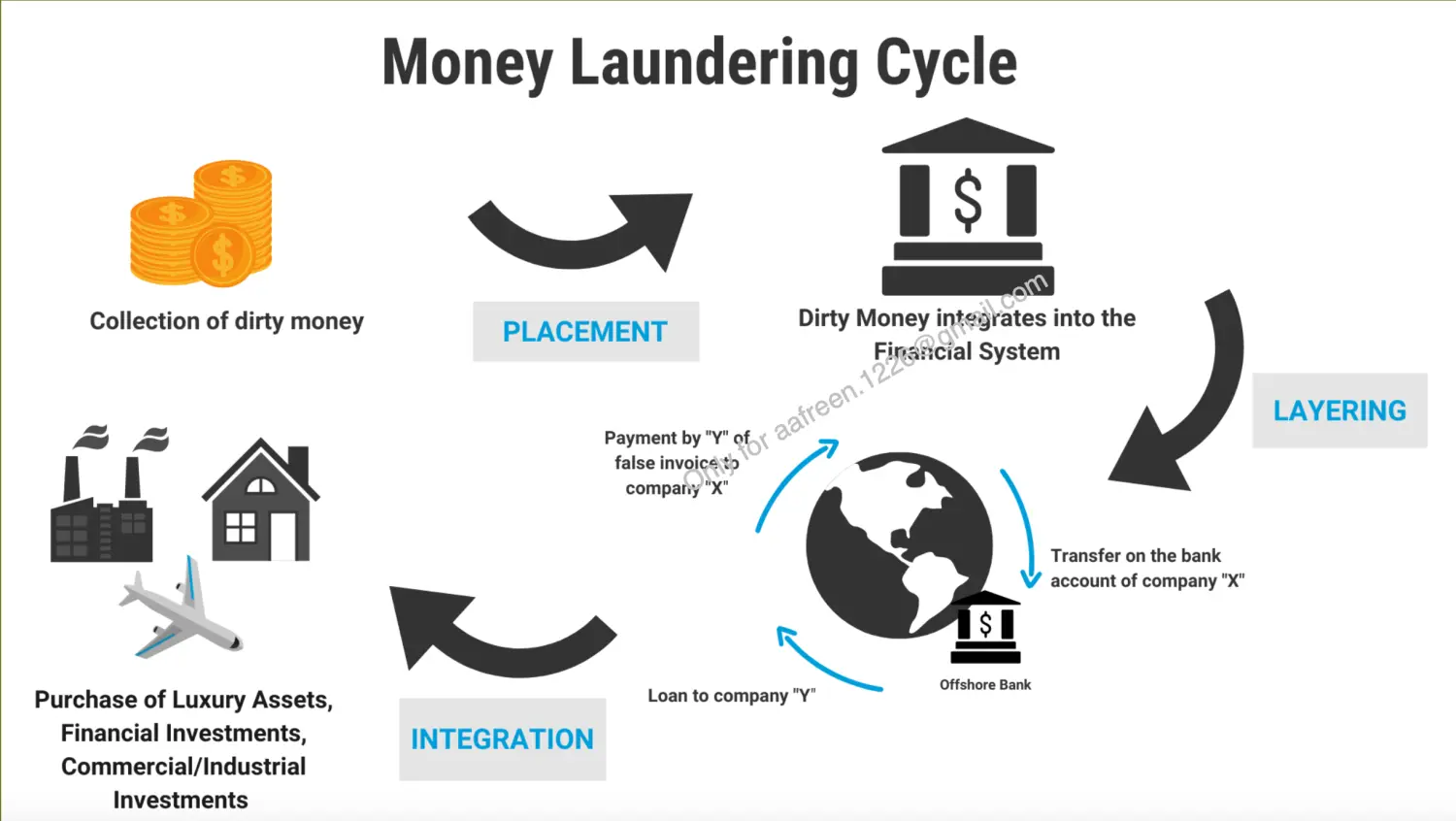
Process/Steps of Money Laundering
- Placement Riskiest stage as a large amount of money is brought into the formal financial system through smurfing or structuring deposits, currency exchange, real estate assets, luxury items
- Layering Taking money through multiple layers and hence become impossible to detect from where money has come for; For example Hawala Transactions
- Integration Creation of shell companies for integration through countries like the Maldives, etc where corporate secrecy laws are strict; For example Panama Papers, etc
Definition of Money Laundering
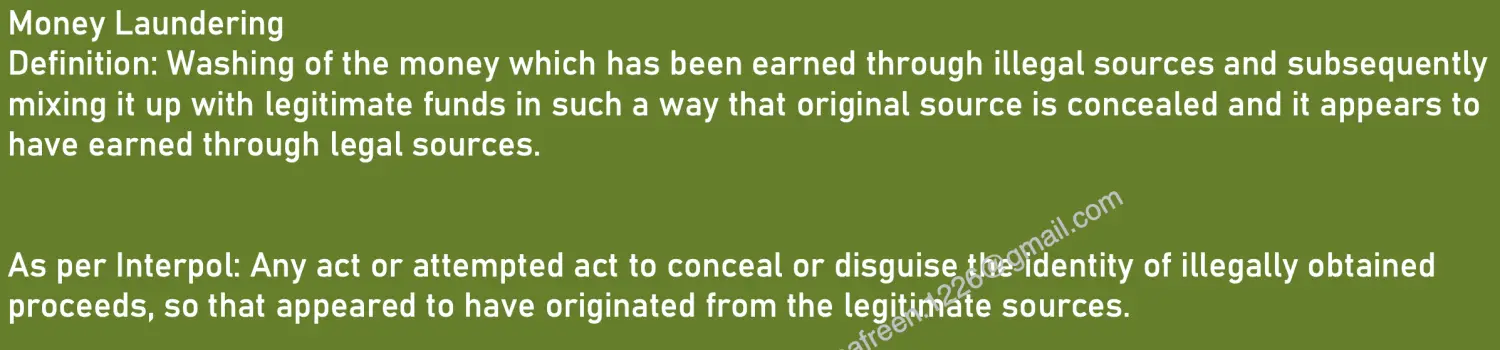
Washing of the money that has been earned through illegal sources and subsequently mixing it up with legitimate funds in such a way that original source is concealed and it appears to have earned through legal sources.
As per Interpol: Any act or attempted act to conceal or disguise the identity of illegally obtained proceeds, so that appeared to have originated from legitimate sources.
Objectives of Money Laundering

- To enjoy money and to save from tax authorities
- To hide the criminal activities
Impact of Money Laundering
Economic Impact
- Increases Inflation
- Loss of tax revenue and fixing the policy rates
- It can severely dent the reputation of the financial institutions of the country
- Exposes the financial system and can have volatility in exchange rates
- It can deter foreign investment and destroy level playing field
Social Impacts of Money Laundering
It can raise inequality in the society
Degradation of moral values and fabric of the society
It legitimises criminal activity in society such as drug trafficking, etc
It doesn’t matter if the cat is black or white unless it catches the mics
Political Impact
- It promotes corruption
- leads to the criminalisation of politics
- It increases the role of money power in elections
- Promotes the activity of terrorism
- lead to instability in politics through defection
Steps were taken to counter Money Laundering
- India
IT Act → Income Tax, 1961
NDPS Act → Narcotics Drugs and Psychotropic Substances Control Act, 1985
Predicate Offence - Crime Done via the Laundering Money
To Prove the wrong work done by money laundering
Benami Transactions Act, 1988
Foreign Exchange Management Act, 2000
Prevention of Money Laundering Act, 2002 *
Defined Money Laundering
All the banks in India to have Compliance Officer, Detailed Record of all transactions and customers
Many banks have compliance officers to ensure that anti-money laundering regulations are observed.
Mandatory KYC Norms for customers
Penalties for institutions who don't observe money laundering prevention actions
Creation of Financial Intelligence Unit (FIU)
- Global
Setting up of Financial Action Task Force (FATF)
Taking actions against erring countries, providing technical support
Pakistan is in grey list of FATF
India Earlier Observer, now full fledged member
Started by G7 Members
learn from each other experiences, sharing best practises
United Nations global program for combating money laundering
United nations convention on Transnational organized crime
BASEL statement of principles by
International convention for the suppression of the financing of terrorism
- India
Challenges in fighting Money Laundering:
- Growth of technology such as cryptocurrencies
- Lack of awareness about the problems money laundering possess to the country
- Non-Fulfilment of KYC Norms, Lack of Compliance of Banks
- Lack of comprehensive approach - Anti Money Laundering Legislation in 2002 (so late)
- Indian Conviction Rate one of the lowest. Not able to prove the conviction
Way Forward
- Awareness Creation
- Sensitisation of public and government officials
- The signing of bilateral agreements to improve knowledge sharing with multiple countries
- Strengthening up of International Organisations
- India should strive to implement FATF recommendations on a priority basis
Organised Crime
Introduction
- It is any criminal activity performed in a very well planned and professional manner with the objective to earning money or monetary benefit
- For Example : Drug trafficking, human trafficking, trade-in illicit items, contract killing, abductions, gun running, smuggling, money laundering etc
- It is performed by an entity/organisation in a corporate manner - performs crime as business
- Examples :
- D Company - Dawood Ibrahim Company
- CRIPS - African American Company
Definition of Organised Crime (as per MCOCA)
MCOCA - Maharashtra Control of Organised Crime Act
KCOCA - Kerala Control of Organised Crime Act
Gujarat Rule
It is pursuance of criminal activity as a business
As Per Law : It is any continuing unlawful activity by an individual singly or jointly, either as a member of organized crime or on behalf of such group by use of violence or the threat of violence or intimidation or coercion or other unlawful means with the objective of gaining monetary benefits or gaining undue economic or other undue advantage for himself or any person is termed as organised
Examples of Organised Crimes
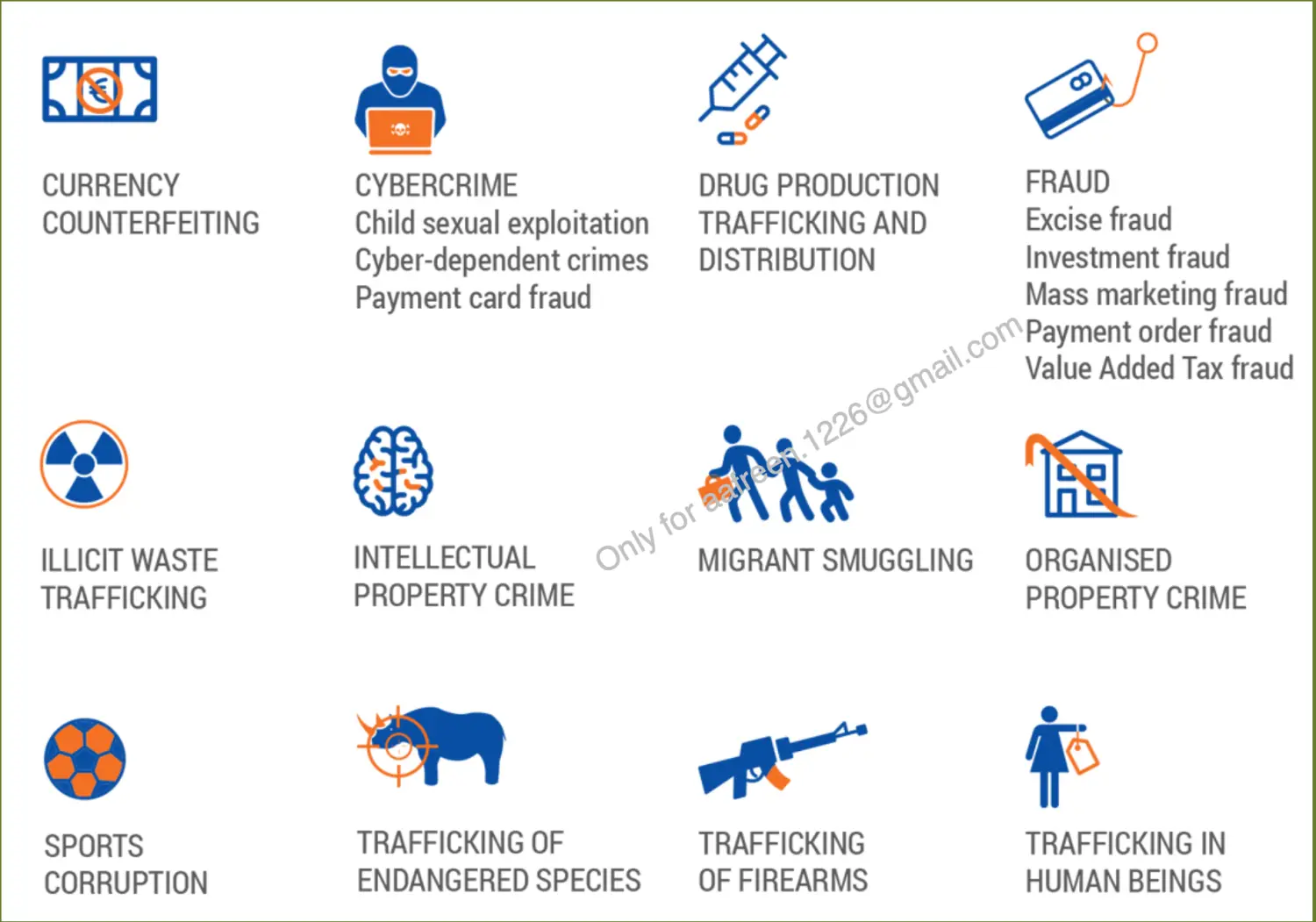
Scale of Organised Crime
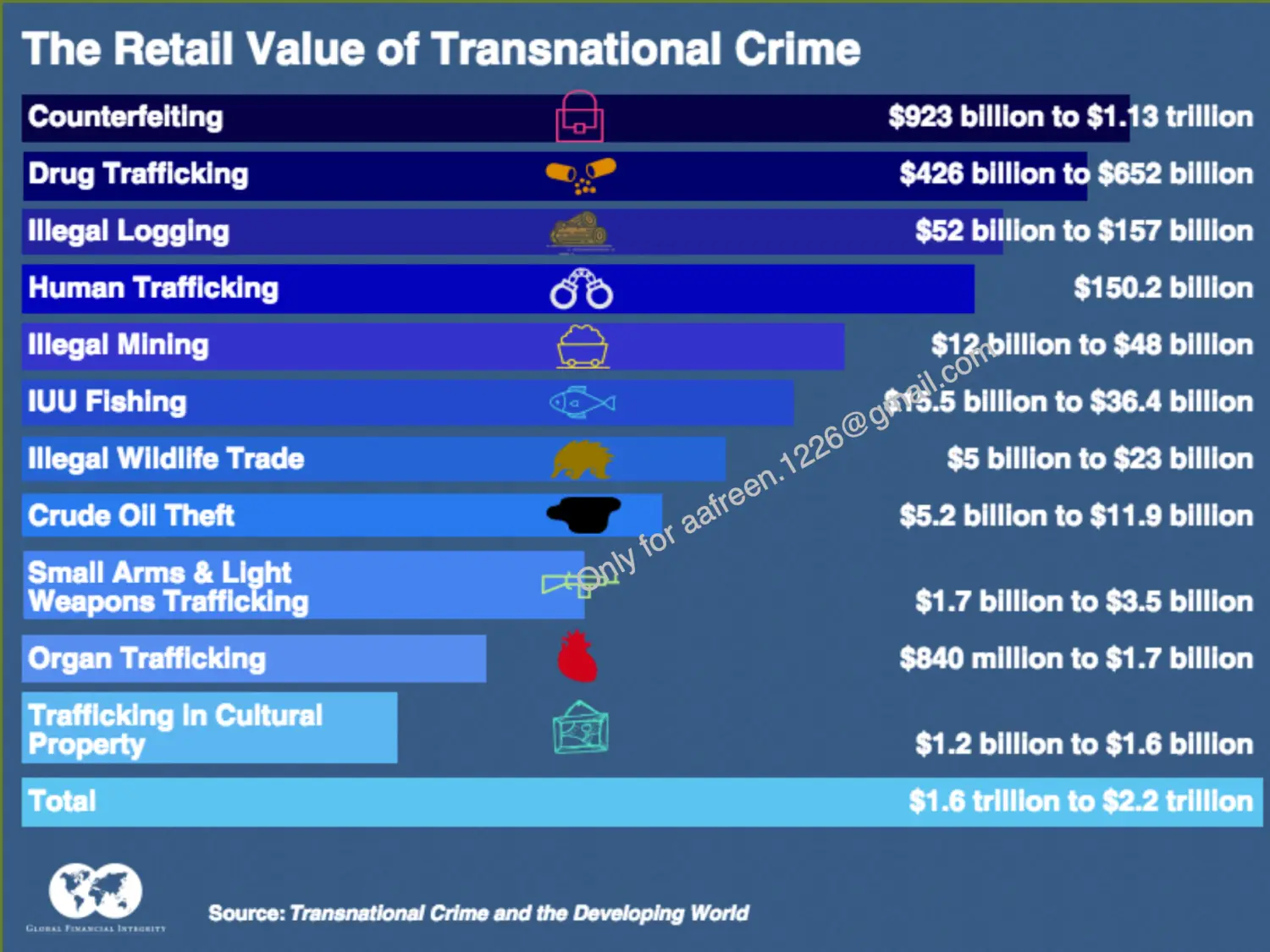
Scale of Organized Crime in Various Nations
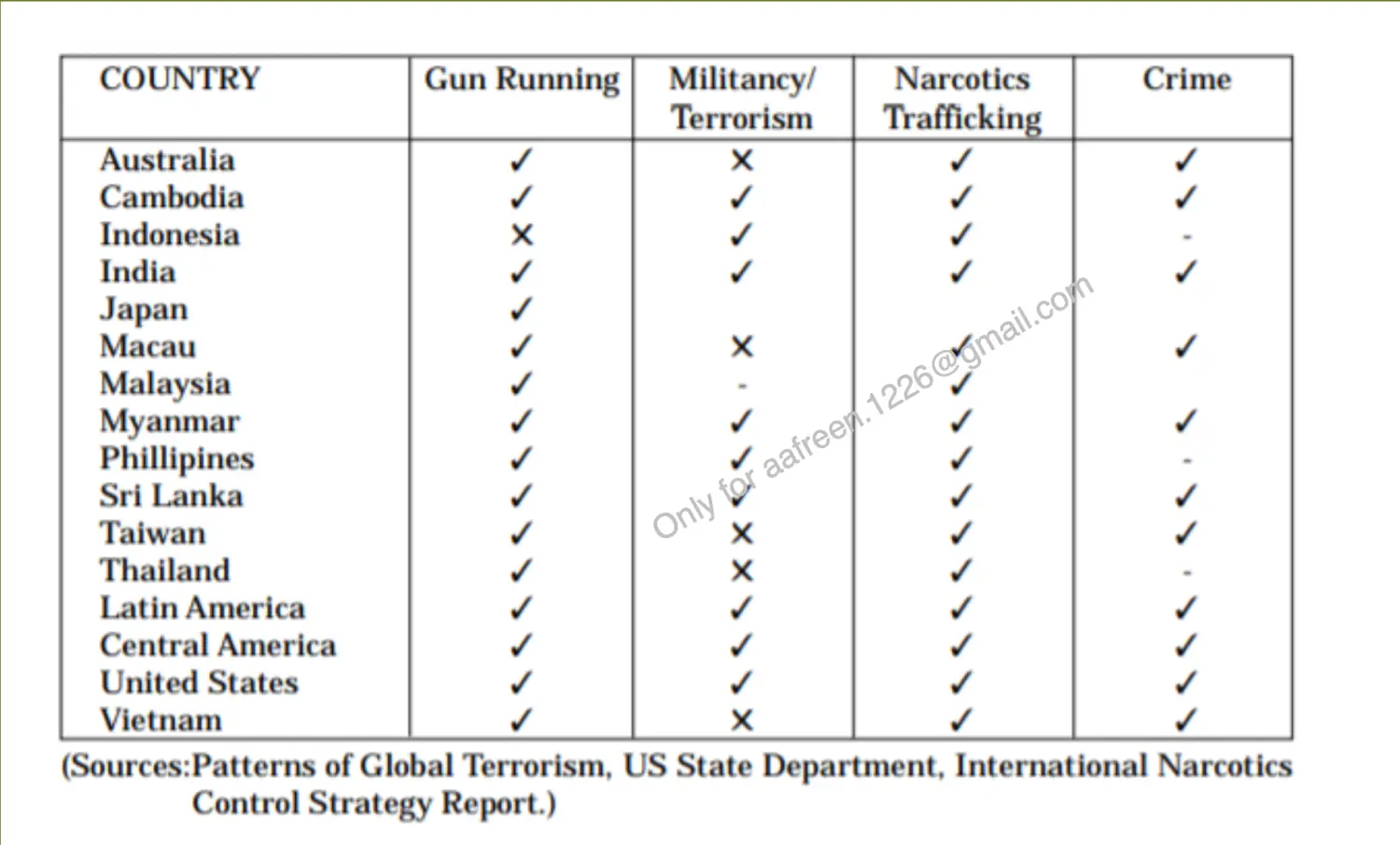
Characteristics of Organised Criminal Groups (OCGs)
- Hierarchical in nature
- Use of Violence
- Division of work
- Strict membership criteria
- Continuity - exist beyond the lifetime of members
Structure of Organised Crimes
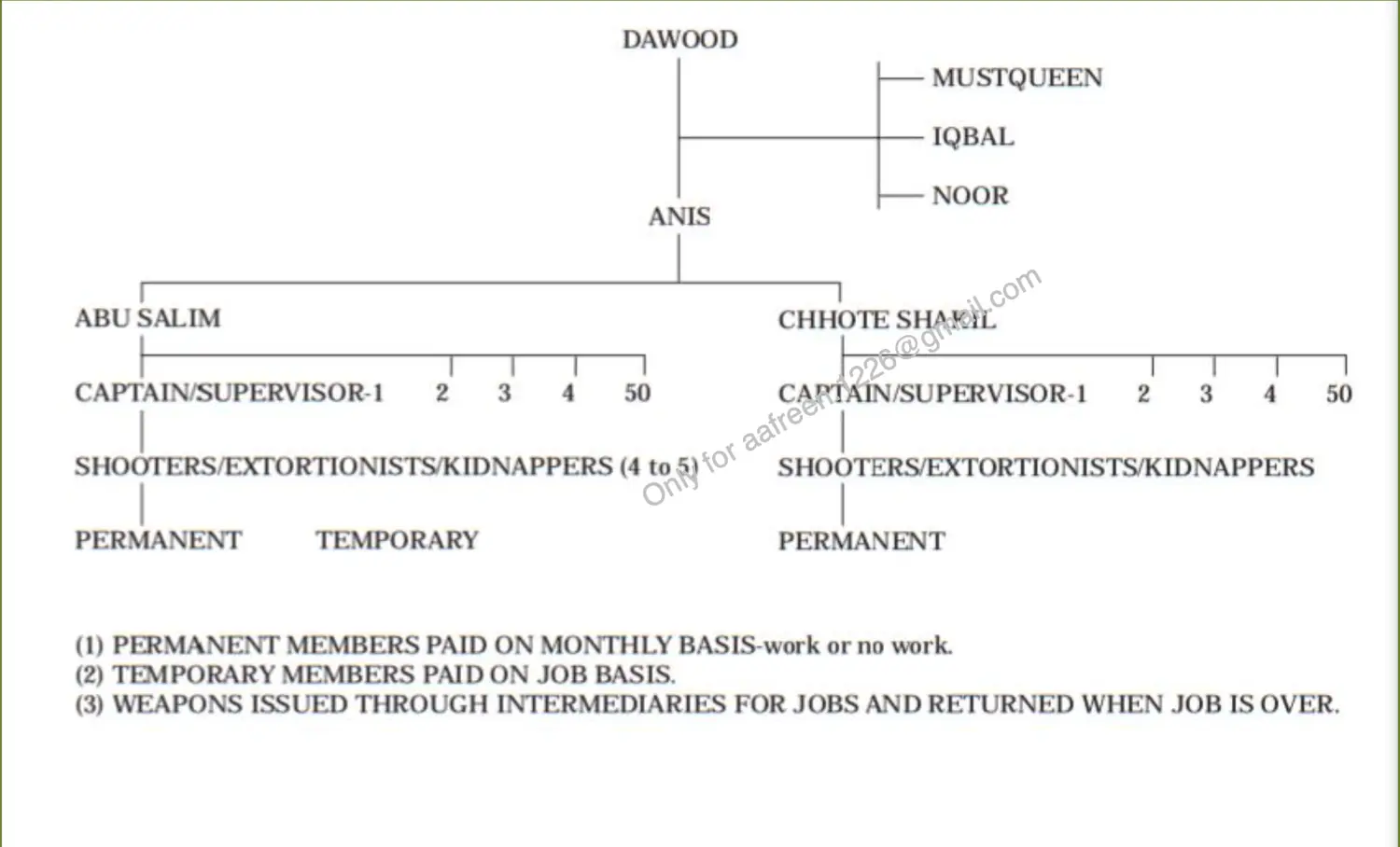
Characteristics of OCGS
- Use of Criminal and Violent Means
- They both have division of labor or division of work on specialisation
- there is a strict membership criteria. once you become a member, there is no way out
- There is an element of continuity in these groups
Threats from OCG
Organized crime groups affect the development at the national level by interfering in and influencing the working of the government and private businesses
Organized crime groups influence the government and the private sector through bribery
Drugs increase the chances of an unstable society and insurgency
They are now acting as a Force Multiplier
Linkages to terrorist groups are threatening the national security
Destroy the demographic dividend
Organised Criminal Groups (OCGs) and Terror Groups (TGs)
Similarities
- Both are criminal in the eyes of the laws
- The both use violent means
Differences
| Themes | Terror Groups | Organised Criminal Groups | | --- | --- | --- | | Objective | Political | Monetary | | Extent of Violence | Extreme Violent Means | Less Violent Means | | Relationship with the State | Antagonistic with the State, To Create Chaos, Against State | indifferent attitude/parallel system towards the state | | Media Attention | Seeking Media Attention | Avoid Media Attention |
Linkages between OCG & TG - 3C’s
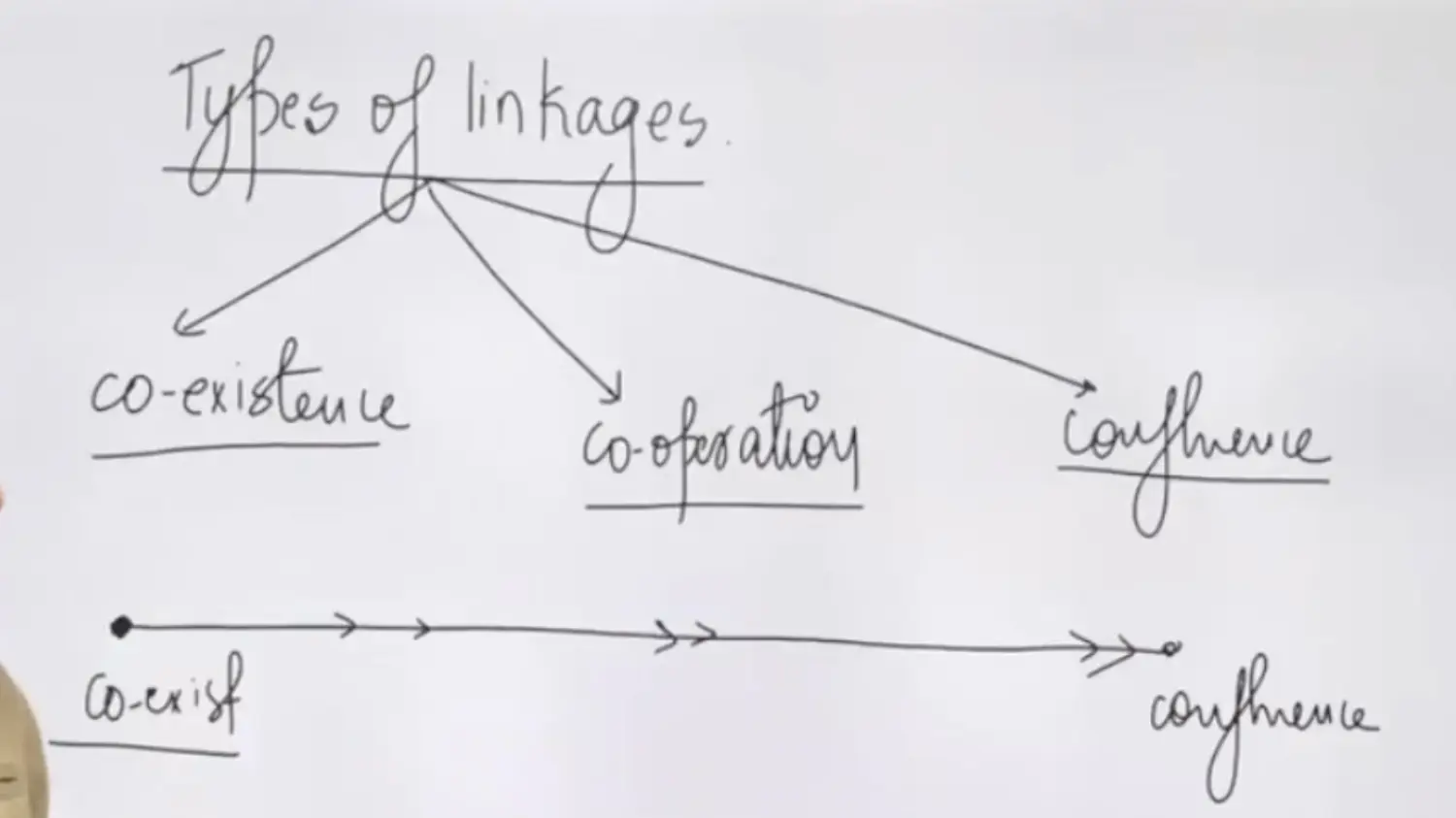
Co-Existence
They coexist without any significant inter-linkage with each other
Co-Operation
Can develop a symbiotic relationship between each other
OCGs Help Terror Group:
In terms of Logistics Support, Arms & Ammunitions, funding, Trafficking Routes
Example : Madrid Attack 2004 by Al Qaeda. They got help from Eastern European Organised Criminal Group
Example : Mumbai Blast in 1993 by Lashkar E Taiba, helped by D Company
Terror Groups help OCGs:
- Arms training, protection, funding
Confluence
It performs functions meant for each other
For Example : Taliban in the drug trade and ISIS in the oil trade
Linkages between OCG & TG
- Organized crime groups have helped terrorist organizations by providing finances, recruiting new members and through arms and ammunition trafficking via their well-established channels
- There is evidence of organized crime influencing governments, such as that of Pakistan, to help the terrorist groups survive
- Led to communal tensions, violence and international conflicts due to the religious bent of some of these organizations, etc
Reasons for growing proximity between OCG & TG
Forces of Globalization
Spread of Technology
The global war on Terror by US
Mutual benefits
Taliban Involved in Opium Trade
ISIS Involved in Black Marketing of Oil
Examples of linkages Between OCG’s & TG’s in India
Naxal Affected Area
Naxal groups are involved in threatening public officials so that these public official would award contracts to different criminal groups
Illegal mining of organized criminal groups under the protection of Naxalites
Naxal Group provide patronage to Naxal Groups
Cannabis cultivation in Naxal Affected Areas
Naxals impose an extortion fee called a levy. They themselves have started being involved in
Naxals involved in illegal logging and lumbering activities
North-East India - Insurgency Ridden Areas
Narcotrafficking, Trafficking in human beings and wildlife
Terror groups are involved in extortion, bribe giving, and abduction
Terror groups help the Organised groups to move to and fro between India and Myanmar
Report by MHA and Standing Committee on Security Situation in North East
No of Insurgents after surrendering are now involved in Organised crimes
Kashmir
External state sponsorship of militancy and hence the dependence on organized crime for funds in minimal - like by ISI of Pakistan
Terror or militant groups transport fake Indian currency notes from Pakistan to India
Drug trafficking across the border and the issue of stone-pelting by OCG for TG & Militants
OGW’s - Over the Ground Workers help the terror groups covertly but overtly they are helping militancy
Example : Jamat Ud Dawa
Challenges that exist with respect to Organised Criminal Groups
Inadequate Legal Framework
Provisions of IPC are inadequate in dealing with OCG
IPC doesn't define Organized Criminal Activities
Only handful states in India have enacted laws to specifically tackle organised crimes
MCOCA of Mah & Kerala = IPC 34 of Group Activity
Becomes difficult to establish criminal liability
Centre should enact a model legislation for states
Weak Enforcement Agencies
High time to end the fragmented approach for organised crimes
lack of cooperation between countries - extradition laws & treaties
Ex : Abu Salem in Portugal, Dawood in Dubai
Difficulty in Obtaining Proof
Leaders aren't caught but the foot soldiers are
Nexus between organized criminals, politicians, etc
Some Organised Criminals are politicians and campaign funders themselves
Growth in technology is needed
The outlook to deal with organized crime and organized criminal groups should be national and not regional. it is because many organized groups are transnational in nature.
Cyber Security
Introduction to Cyber Security (In lieu of IT Act)
As per the IT Act, 2000: Cyber security is defined as the protection of information/data computer systems, devices, networks, and the information and data stored in these devices from unauthorized access, use, destruction, disruption, or modification
Importance of Cyber Security for India
Economic Importance
- we are becoming a digital economy
For Example : we are becoming the leaders of the Fintech revolution in the world
Governance
- we have taken many governance-related projects in India under the e-governance initiative
- For example, Aadhaar Database, the Smart Cities program, initiatives under the national e-Governance program, etc.
Security
- Collection of intelligence through the internet
Demography
- Third largest internet users in the world
- Third largest smartphone users in the world
Cyber Threats that India as a nation is exposed to
Cyber Crimes
- It refers to a crime committed with the help of cyber security or in cyberspace
- Examples
- Phishing Scams
- Cyber Stalking
- has been defined in section 354D of IPC
- It also includes crimes like hacking, identity theft, child pornography
- Bulli Bai App
- Sending Message to Girl if she doesn't respond
- Identity Theft
- Child Pronography
Cyber Terrorism
Section 66F of IT Act, 2000 defines cyber-terrorism.
When cyberspace is used to commit activities that have the potential to disrupt the sovereignty and integrity of India or the security of that state or with the intention of creating terror in minds of people
It will be termed as an act of cyber terrorism
For Example : the Muzaffarnagar riots, 2013 due to doctored videos shared through the internet
Cyberspace has been used by many terror groups to raise funds, recruit, plan, and coordinate terror attacks, spreading propaganda
Example : Attack on Power Grid in Mumbai
Cyber Warfare
- Warfare in cyberspace is Cyber Warfare. Air Land Sea was conventional. then space, now cyber.
- The cyberwar initiated by one nation on the other where the attempt is to cause damage to the critical infrastructure of the other nation
- For Example : The Stuxnet virus was infested(by USA and Israel) in the Iranian nuclear program to disrupt it
- For Example : Jawaharlal Nehru Port Trust's website was infected with a virus (by china)
- For Example : In 2013, there was an attack on the DRDO website originated from Alegria
- For Example : China has raised an army of Cyber Warriors
- For Example : The exodus of North-East Indians from Bangalore in 2012 on the basis of morphed videos that are alleged to have originated from Pakistan
The Cyber Security Architecture in India
- Institutional Measures
CERT-In to provide a response for cyber threats that take place
CERT - Computer Emergency Response Team
Sectoral CERTs
For Example :
For the financial sector → Financial CERT
For power sector → power CERT.
NCIIPC: To provide protection to the critical information infrastructure of the country
NCIIPC : National Critical Information Infrastructure Protection Centre
Critical information infrastructure is that information infrastructure upon which the well-being of India's critical infrastructure is dependent
NC4 : The National Cyber crime Coordination center is the apex authority under the leadership of the National Security Provider
Special Cybercrime Cells are set up by various state police departments.
Cyber Swachata Kendra: Malware analysis and botnet cleaning center
- Legal and Policy Measures
National Cyber Security Policy of 2013
The policy lays down the priority areas for the various law and order agencies and various enforcement agencies
But how ? not clear !
Greater role of private sector
within five years three lakh persons have to be trained
IT Act of 2000 and the Subsequent Amendments
Refer Value Added Material for Cyber Security only of Vision IAS
Introduction
- Amendments were introduced to the IT Act in 2008
- Section 66F which talks about cyber terrorism was included in 2008
- Identity Theft was also included in 2008 in section 66D
- Draft Data Protection Bill on the basis of the recommendation provided by the committee that is BN Sri Krishna Committee
Limitations of the IT Act, 2000
The vagueness of Section 69 of the Act relates to the liability of intermediaries
There are inadequate checks and balances over the enforcement of various provisions under the act
For Example: Section 66A of the IT Act - have been termed unconstitutional by supreme court
Shreya Singhal v/s UoI - Violated Art 19(1)(a)
Some provisions in the IT Act allow the state to decrypt and monitor the information of citizen can be considered as a violation of the privacy of the citizens
- Challenges pertaining to ensuring cyber security in India
- General Points
- Lack of awareness among citizens about cyber security measures
- More than 80% of Indian CEOs do not consider cyber security as crucial to their companies' growth as a result many of them fail to pay attention, time to cyber security.
- Shortage of trained workforce and trained professionals.
- Shortage of funds allocated by various governments and departments towards cyber security.
- Lack of coordination between various agencies.
- over-dependence on imported telecom equipment.
- More than 70% o the telecom equipment in India is imported.
- Absence of comprehensive Data Protection aw.
- Budapest Convention
- Proposed in 2001 by western countries and came into effect in 2004.
- It serves as a guideline for any country developing comprehensive national legislation against Cybercrime and as a framework for international cooperation between state parties to this treaty.
- India has not signed the convention.
- Also lays down specific standards that are to be enforced for cybersecurity around the world.
- Technology and resources sharing to curb cybersecurity threat
- Reasons why India has not joined Budapest Convention
- This convention is not universal and applicable only for member countries
- India was not involved in consultation during the framing stage
- Highly biased towards the western world
- Seen as a mode to sell expensive technologies by west
- Sovereignty issues
- Arguments in favor of India joining the Convention
- India can influence the future of the treaty by becoming its member
- Access to the latest and cheap technology as India will be designated as a priority country.
- Formulate comprehensive data protection act, so now apprehensions left regarding concern over data sovereignty
- General Points
- Institutional Measures
Challenges pertaining to ensuring cyber security in India
Lack of awareness among citizens about cyber security measures
More than 80% of Indian CEOs do not consider cyber security as crucial to their companies' growth as a result many of them fail to pay attention, time to cyber security
Shortage of trained workforce and trained professionals
Shortage of funds allocated by various governments and departments towards cyber security.
Lack of coordination between various agencies
Over-dependence on imported telecom equipments
More than 70% of the telecom equipment in India is imported. There is always risk of foreign malice from these equipments
Absence of comprehensive Data Protection Law
Budapest Convention on Cyber Security
Introduction
- Proposed in 2001 by western countries and came into effect in 2004
- It serves as a guideline for any country developing comprehensive national legislation against Cybercrime and as a framework for international cooperation between state parties to this treaty
- India has not signed the convention
- Also lays down specific standards that are to be enforced for cybersecurity around the world
- Technology and resources sharing to curb cybersecurity threat
Reasons why India has not Joined:
- This convention is not universal and applicable only for member countries
- India was not involved in consultation during the framing stage
- Highly biased towards the western world
- Seen as a mode to sell expensive technologies by west
- Sovereignty issues
Arguments in favor of India joining the Convention
- India can influence the future of the treaty by becoming its member
- Access to the latest and cheap technology as India will be designated as a priority country
- Formulate comprehensive data protection act, so now apprehensions left regarding concern over data sovereignty
Recommendations of Gulshan Rai Committee and Inderjeet Rao Committee
- Creation of Cybercrimes cell in each state and district
- Appropriate certification for the adoption of best practices
- More research and development is required
- Also, train manpower to enhance the capacity
- Internet servers should be hosted within the country
- Regular and consistent changes should be brought in the IT Act and other legislation to tackle cyber threat
- A separate agency should be created to deal with the data breaches
- Stringent penalty provisions should be placed to deter individuals and agencies from misusing private data
Social Media (Completely from Handout)
Role of Social media in India's internal security
Social Media in recent times has become synonymous with Social Networking sites such as FaceBook or MicroBlogging sites such as Twitter. However, very broadly social media can be defined as any web or mobile-based platform that enables an individual or agency to communicate interactively and enables the exchange of user-generated content
From the perspective of the governments, the following represent some of the reasons for using social media:
- seeking feedback and input from the citizens
- Enhanced outreach
- Real-time engagements
- Managing perception
Challenges created due to Social Media
- Fake news and hate messages
- National security concerns
- Pornography and Obscenity
- Identity theft
- Cyber Bullying and Harassment
- Snooping and misuse of online data
It is difficult to overcome these challenges as
- Huge and expanding number of users
- Ineffectiveness of censorship on content and its impact on freedom of citizens.
- Difficulty in prosecution and tracking of crime due to jurisdiction problems and anonymity offered by the internet • Lack of Geographical Boundaries makes social media regulation an arduous task.
- Lack of digital literacy amongst people.
- AI is still in the early stages of development and cannot be used to regulate the sector.
Way forward
- Responsible use of social media must be taught by increasing digital literacy.
- Joint steps by government and social media platforms must be taken like the recent steps by Facebook to spread awareness w.r.t responsible use of social media.
- Strengthening of Cyber security organizations and IT cells of law enforcement agencies.
- International consensus w.r.t easier Extradition and prosecution of Cybercriminals.
- Data protection and privacy must be enhanced.
Challenges in regulation
- Freedom of speech issues
- Lack of technical know-how
- Liability of intermediaries
- Jurisdictional challenges
- Social media is just a medium
- May result in over-regulation
Recommendations
- Institutionalize the blueprint for a National Social Media Policy
- Implement and institutionalize the Framework of Guidelines on social media engagement
- Create awareness of the challenges posed by social media
- Create organizational ecosystems, circumvent hierarchies, encourage outreach
- Empower agencies, build talent, and use specialists
- Replicate “Social Media Labs” across the country
- Demarcate budgets, standardize tools and platforms
- Expand and define the scope of public-private partnerships
Media
Role of Media in creating challenges to Internal Security Issues
Sensationalization of national security issues → Leads to Hasty Decision Making
Coverage of Anti-Terror operations in sensational manner
For Example → 26/11 attacks
Irresponsible coverage of communal conflicts
Reporting of sub-judice issues
media trials → hyper investigative, over enthusiastic
Paid News
Irresponsible coverage of victims of terror attacks
Positive Role Played by the media
Busting fake lies from TG and Countries
Eg : Kargil War (Proved that Pakistan National Army was involved in Kargil War)
Building a rapport in international communities
8 Aug, 1999 → Patrol Plane of Pak Navy lost its way into Indian Air Space. It was a genuine mistake of pak, but India shot it down.
Pak challenged this action of India in ICJ
In dousing communal fire by improving trust deficit
some have helped in creating bonhomie between communities
Busting propaganda and lies spread by extremists
Self Regulating Mechanisms by Media itself
Press Council of India
National Broadcaster Authority
Bureau of Editors
Best practices of media regulation around the world
- In the United Kingdom, the BBC has exemplary guidelines for terror, war, and emergency
- The United States America's "Patriot Act" Instituted after the 9/11 attacks give overriding powers to the government over media agencies
- Canada has laid down a code of ethics for radio and television channels
Various security agencies and their mandate - (Behind Handout of Social Media)
The Forces
Mandate
Art 355 - Resp of Union to protect state against external aggression and internal disturbance
All are under MoHA
- Enforcement Agencies
- Central Armed Police Force (CAPF)
Basic Details
Border Guarding Forces - ITBP, SSB, BSF
Indo Tibetan Border Police
ITBP was created as a force for guarding force with Tibet
Border Security Force
BSF for Pakistan (started with), Bangladesh and Myanmar
Sashastra Seema Bal
SSB guards border with Nepal and Bhutan
Non-Border Guarding Forces - CRPF, CISF, NSGs
Central India Security Force
provides security to India's public sector undertakings along with Airport, Delhi Metro, monuments
National Security Guard
For counter-terrorist organisations, etc
Issues related to CAPF in India
- Human resource Issues - A severe shortage of workforce and the staff if overworked; poor training facilities, mental stress and lack motivation and frequent promotions
- Operational Issues - Over dependence of states on central armed police forces for law and order situation; poor accommodation
- Leadership by IPS officers rather than the CAPF officers themselves, etc
- Discussion on recommendations to address the issues from the PPT
- State Police Forces
- Committees - Malimath Committee, Julio Ribero Committee, Soli Sorabjee Committee, NPC-Iⅈ Prakash Singh Versus Union of India, 2006, 2nd ARC, etc
- Defence Forces
- Intelligence Agencies of India
- Agencies
- Intelligence Bureau (IB) and its related functions from the PPT
- Research and Analysis Wing (R&AW) created in 1968 comes under PM Office
- National Technical Research Organisation (NTRO) set up in 2004
- Issues associated with the functioning of intelligence agencies in India
- Amount of infighting and lack of co-ordination
- Lack of clarity and overlapping functions which lack accountability
- Lack of oversight mechanism and legislative oversight
- Not being able to attract talent for technical intelligence collection
- Discussion of reforms needed in intelligence agencies from PPT along with NIA and CBI
- Agencies
- Investigation Agencies
- CBI
- NIA
- Enforcement Agencies
Issues related to CAPF
- Human Resource
- Severe Shortage of workforce up to 20%
- More than 40 thousand people resigned between 2010-12
- They are understaffed and overworked
- UN recommended should be considered
- The recruitment process is unscientific & outdated
- Mental Stress Involved - Large No of Suicides, Instances of Violence within the forces
- Poor Training Facilities
- Motivation is not constant
- Recruitment at multiple entries points and reduces exposure of senior leadership to the ground realities & Poor self-image and societal perceptions
- Lack of avenues for promotions
- Operational Issues
- Over dependence of state on CAPF for Law & Order Situation
- Law and Order and investigation are not separate
- law and order is a state subject and significant variation between states
- Leadership is of IPS - Paradropping Leaders doesn't work
- Poor Living Condition, Poor Accommodation, Shortage of Weaponry (max deaths due to malaria and not insurgency)
- Hardly any time for rejuvenation, training and rest
- Also lack of grievance redressal mechanism for citizens in case of violation of right and interference on a day-to-day basis by politicians, etc
- Infrastructural Issues
- shortage of weaponry and latest technology types of equipment
- Structural issues
- It is top and bottom-heavy; governed by a colonial act of 1861, etc
- Human Resource
Issues related to Intelligence Agencies
Infighting and lack of coordination - turf war between various agencies
Lack of role clarity - overlapping function
Lack of an oversight mechanism - Lack of Accountability
No Legislative/Legal Accountability, they only have accountability to executive
They have been many time accused of narrow political interest
There is shortage of workforce → they have not been able to attract talent for technical intelligence collection
Issues related with State Police Forces in India
Important Committees
- Malimath Committee
- Julio Ribeiro Committee
- National Police Commission 1
- National Police Commission 2
- Soli Sorabjee Committee
- Prakash Singh v/s Union of India
Human Resource
- Shortage of workforce up to 20% and UN recommended 222 police personnel per million. Whereas Indian Ratio is 185 per million
- the recruitment process is unscientific and outdated - marred with corruption
- Lower Levels Entry only based on Physical Criteria
- Same Examination for other services as needed for IPS
- Recruitment at multiple entries points
- Reduces exposure of senior leadership to the ground realities
- Poor self-image and societal perceptions
Operational Issues
- law and order & investigation are not separate
- law and order is a state subject and as a result there is significant variation between states in police functioning
- Lack of grievance redressal mechanism for citizens in case of violation of right
- Excessive interference on a day-to-day basis & for transfers by politicians
Infrastructural Issues
- shortage of weaponry and latest technology types of equipment
- According to BPRD (Bureau of Police Research & Development) - Some States have shortage upto 75%
- Shortage of Latest Tech Equipments - Night Vision Camera
Structural Issues
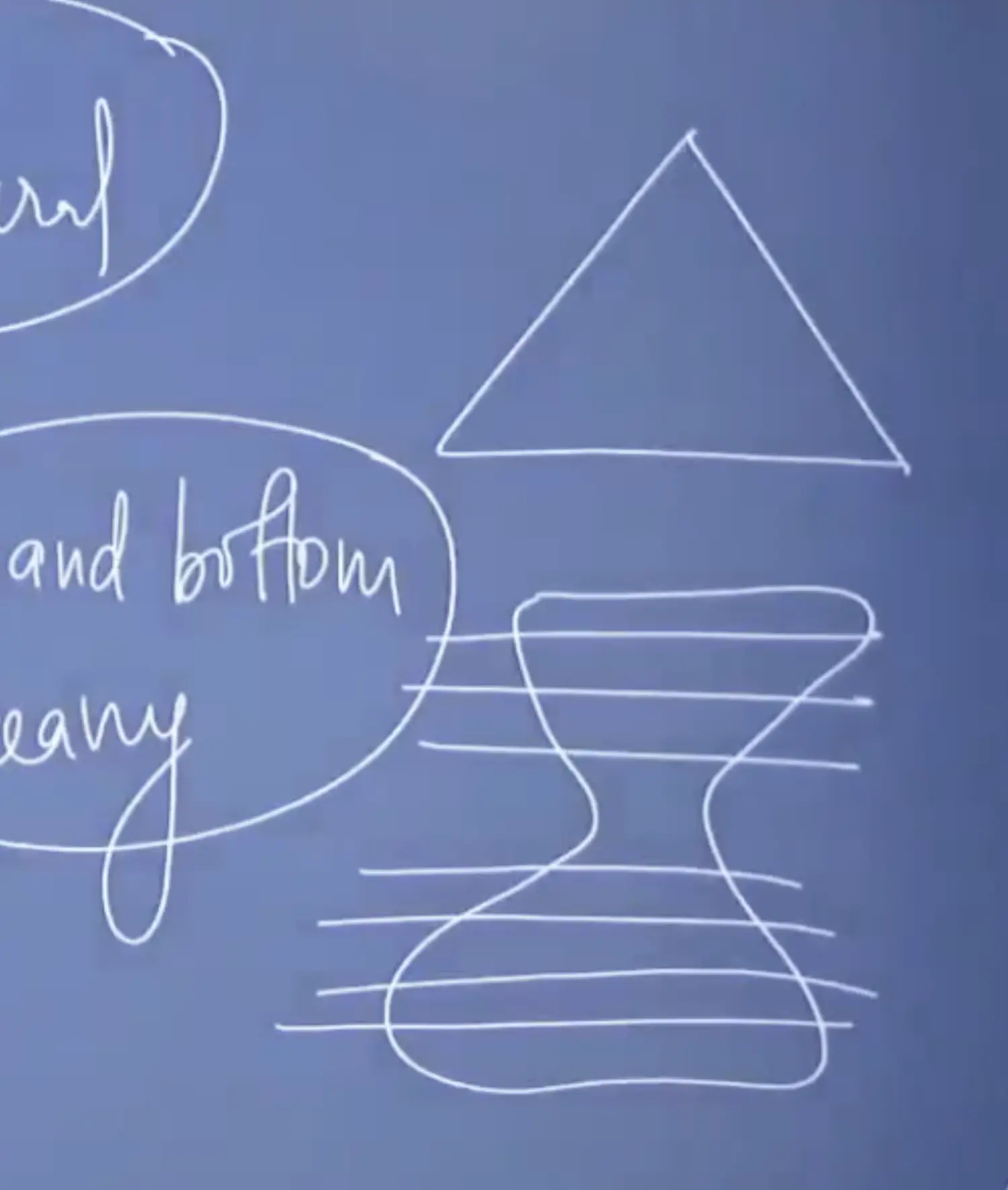
Uppar Wala - Reference ; Neeche Wala - Indian Police
It is top and bottom-heavy
governed by a colonial act of 1861 → police should not be seen as something to be feared of.
Case Study : In New Zealand, Police generally is unarmed but after christ church attack, for sometime they had to carry guns, for this short duration with guns they also wore roses so as to distract common masses from the gun.
Thus, Psyche & Trust of People on Police is a must and such steps should be taken
Border Management & Border Security
Introduction
Border Security is a narrow term that refers to the protection of a country's territory from unwanted and hostile elements and secure borders
It is concerned about infiltrations, trafficking,narco trafficking etc
Border Management is the effective management of border areas so that emphasis is given to both border security as well as economic development of border areas
Challenges of Border Management in India
- Geographical Challenges
- Artificial or man-made borders with neighbouring countries → guarding becomes a challenge
- Difficult terrain and topography in the border areas make it difficult to guard border areas which lead to poor infrastructure
- It also leads to economic backwardness of the border areas
- Diplomatic Challenges
We have unsettled boundary disputes with most of our neighbouring countries
We have a multiplicity of forces in the border areas and coordination issues - Assam Rifles, Indian Army, SSB, ITBP → Becomes Difficult to have a standard common operating procedures
India has open or porous borders with neighbouring countries - Bhutan and Nepal
Border guarding forces are diverted towards law and order problems in hinterland of country → Leads to staff shortage
Lack of concern towards the problems of the local population as a result they tend to be swayed away with economic opportunities by extremists
Vicinity of some of the disturbed regions such as Afghanistan and Myanmar
India is in the vicinity of the golden crescent (Iraq, Afghanistan, Pakistan) and golden triangle
Golden Crescent and Triangle Famous for Drug Trade Route
- Geographical Challenges
Linkages between poor border management and internal security threats
- Militancy in Kashmir and Insurgency in North East
- Insurgents groups make movement across the border
- Major Reason of insurgency in North East → Illegal Immigration in North East
- narco-trafficking crimes across borders
- Organised criminals find refuge in border countries
- Naxal training in Nepal
- Challenges between countries
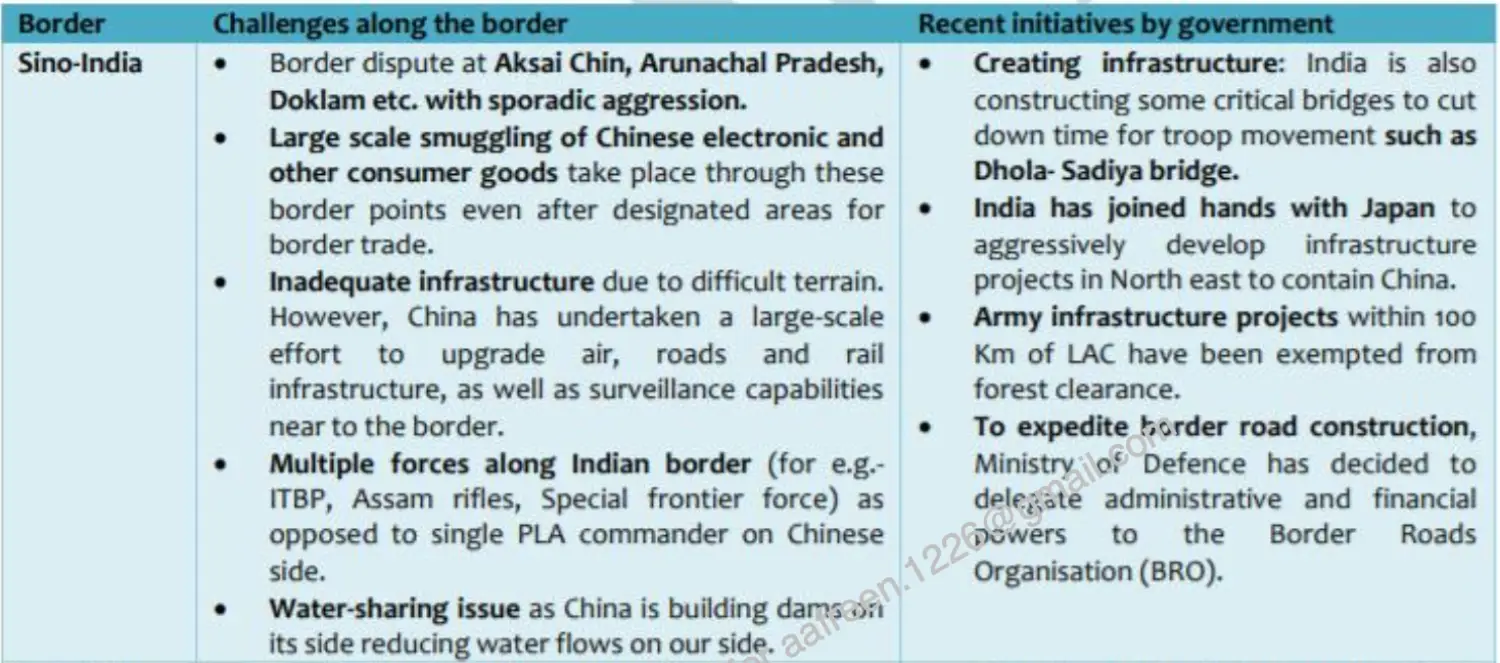
Sino India (Indo Chinese Border)
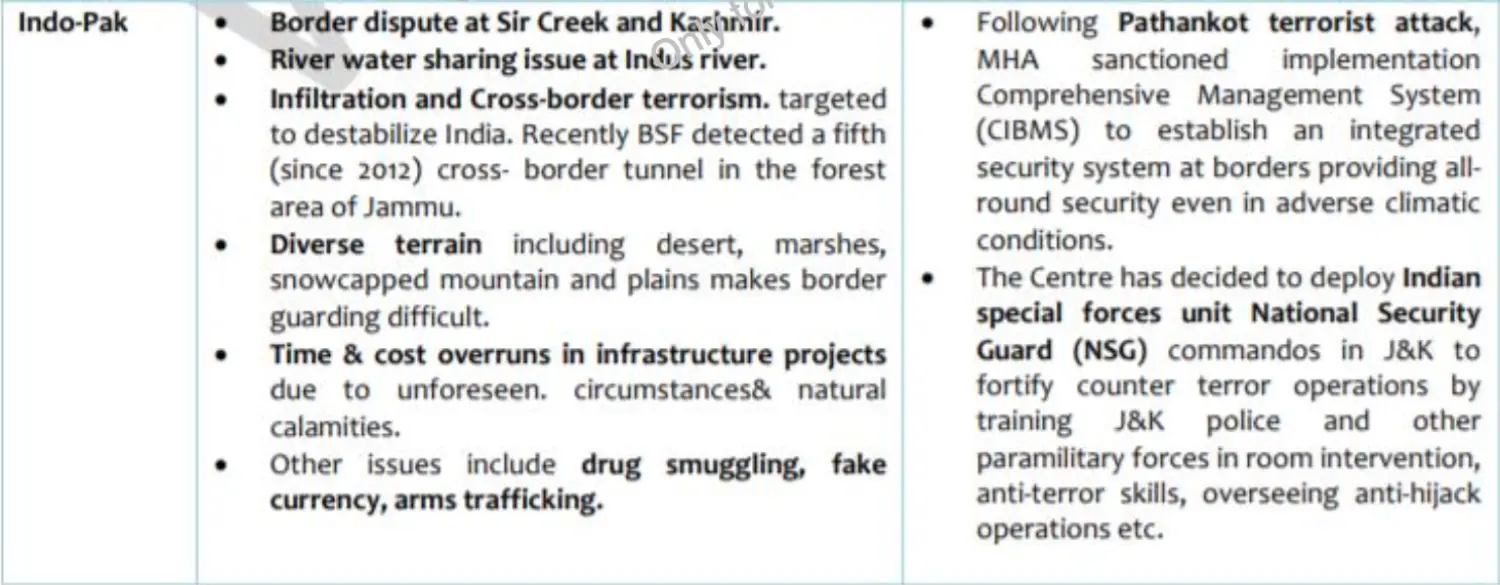
Indo Pak
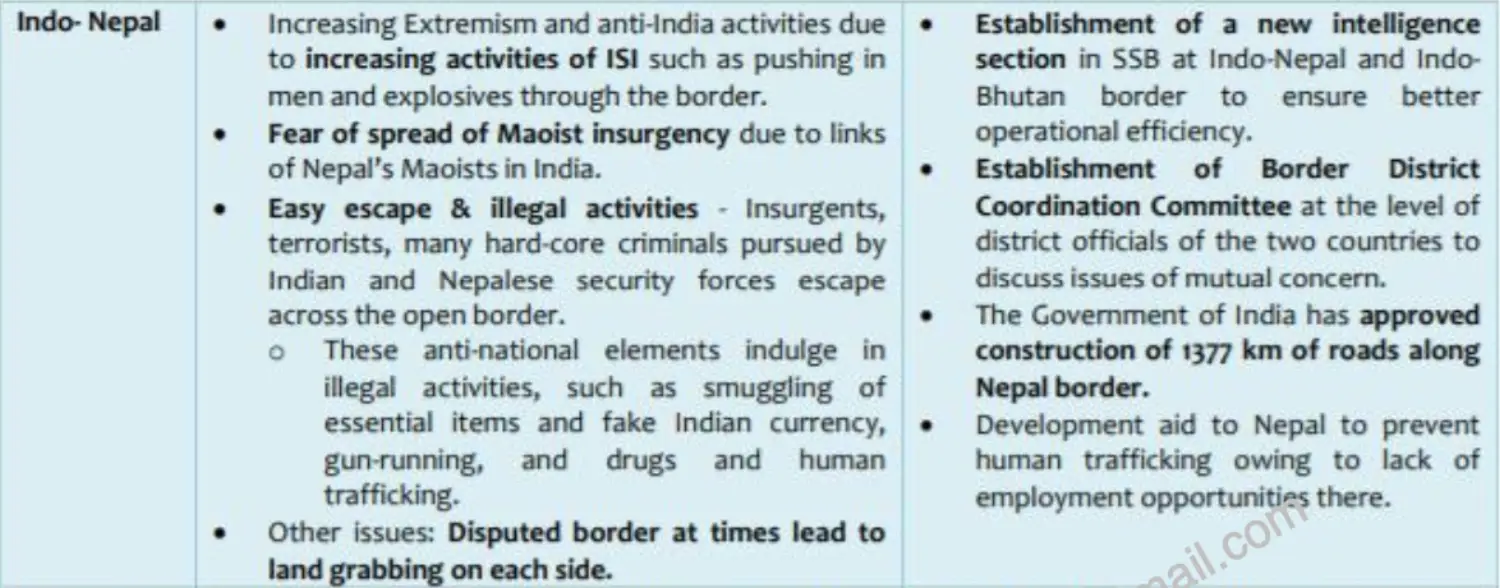
Indo Nepal
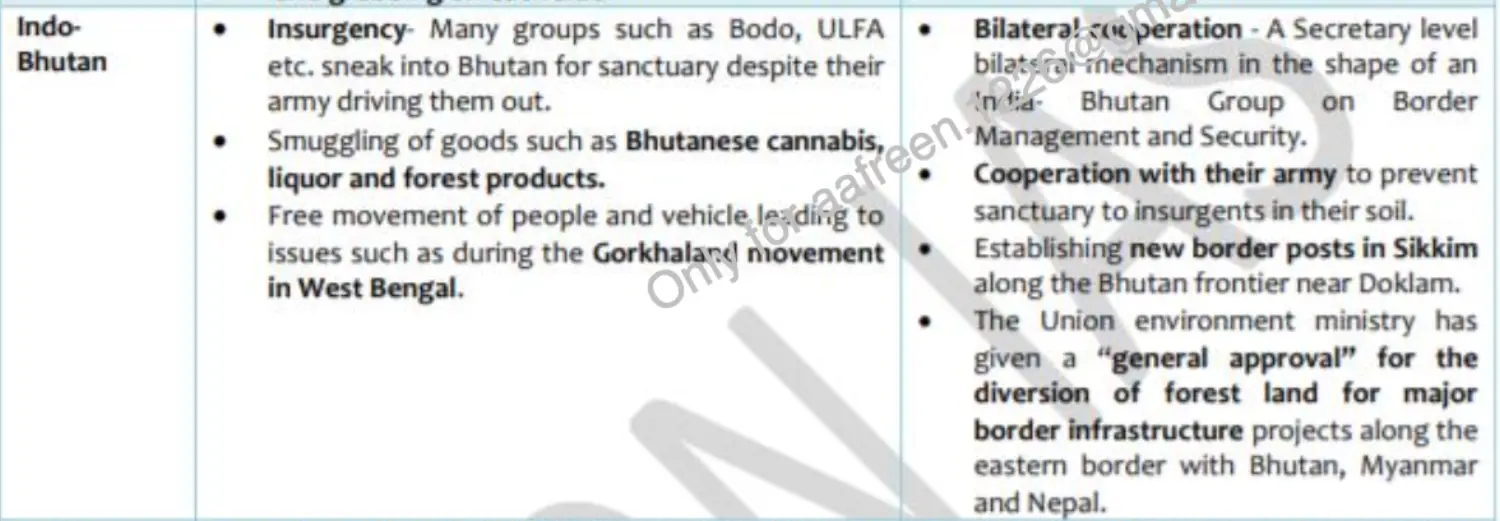
Indo Bhutan
Indo Myanmar
FMR - Free Movement Regime * (Important)
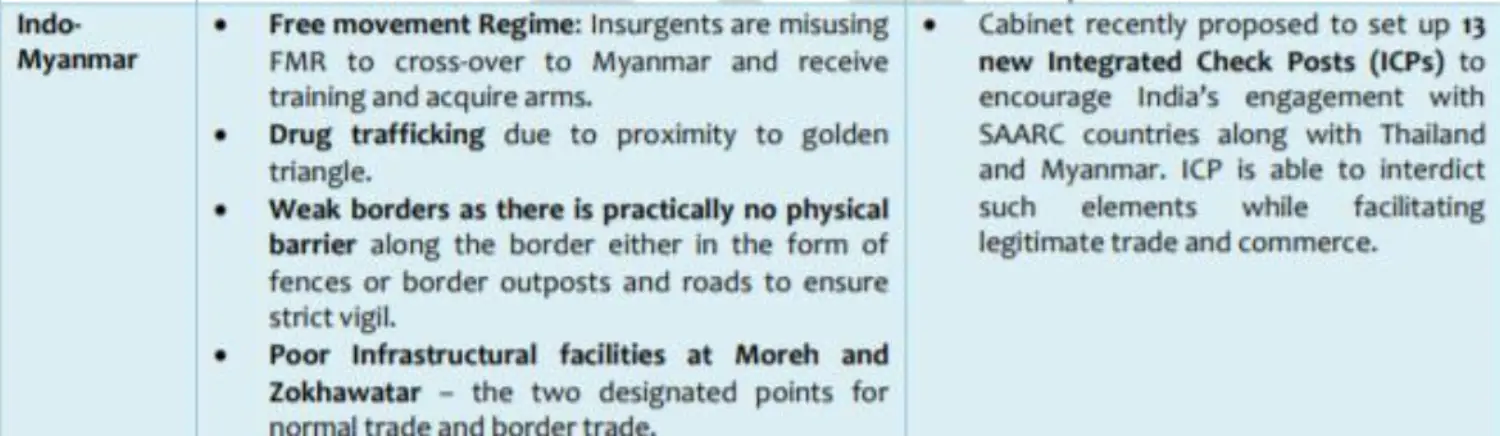
Indo Bangladesh
Limitation in developing border infrastructure
- Poor implementation and lack of monitoring
- Multiple authorities managing borders
- Lack of adequate allocation of funds, etc
- Challenges along the border and steps that are taken:
- Sino-India; Indo-Pakistan, Indo-Nepal; Indo-Bhutan, Indo-Myanmar to be done from PPT
Role of technology for Border Management
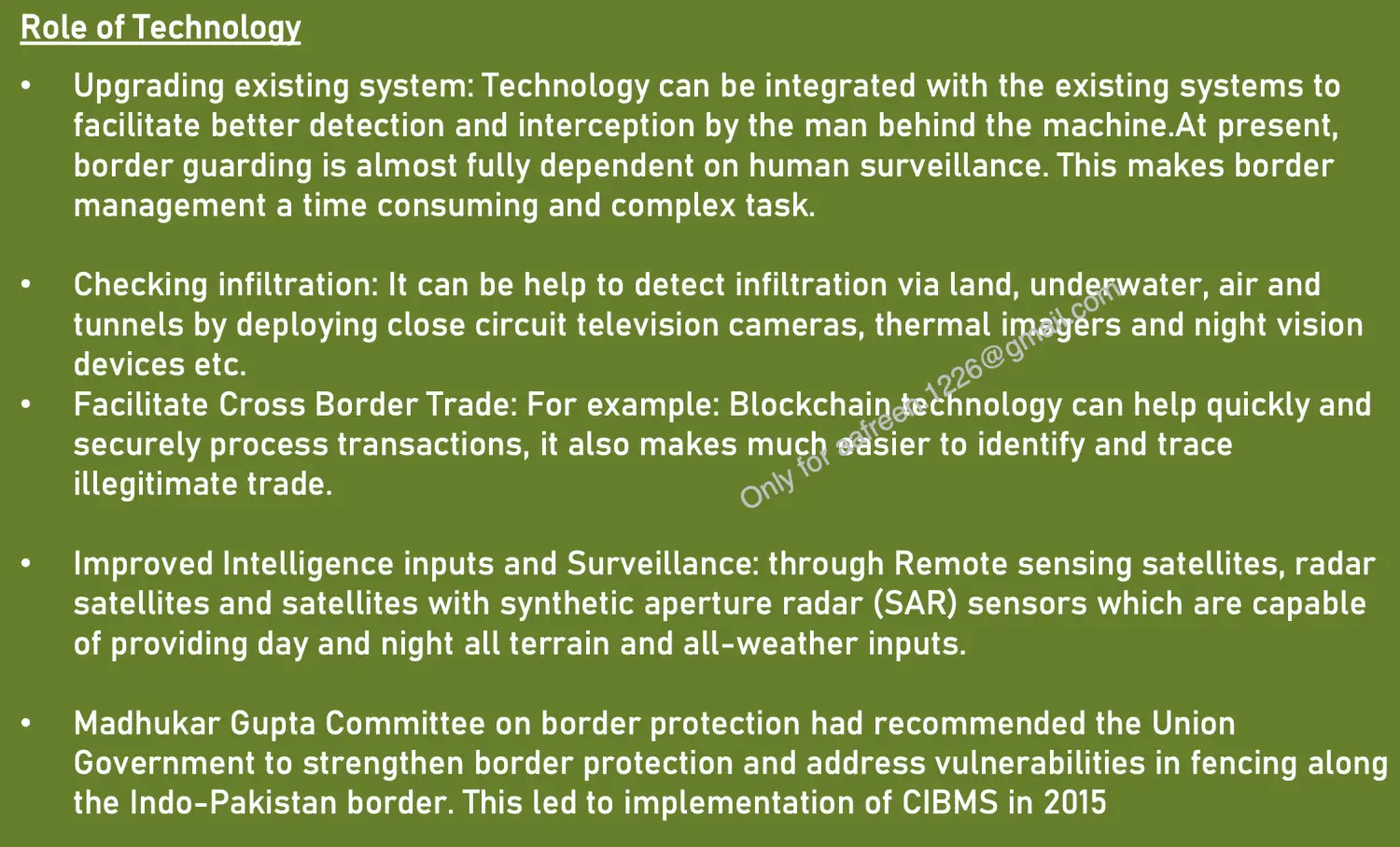
Upgrading the existing system and Checking infiltration
Facilitate Cross Border Trade
Improved intelligence inputs and surveillance
Madhukar Gupta Committee on Border protection recommended strengthening border protection
This also led to Comprehensive Integrated Border Management System (CIBMS) in 2015
CIBMS is a state of the art technology to prevent illegal activities in the border areas of India and immigration and infiltration
Surveillance Devices deployed → to an analysis centre → Command Centre → Security Forces
Challenges associated with the deployment of technology in the border areas
- Technology is cost-intensive
- Requires trained manpower
- Poor Physical Infrastructure
- Compatibility of technology with the conditions in the border areas
Role of External State Actors in creating challenges to India's Internal Security
- Bangladesh
Illegal immigration from Bangladesh
Insurgency in North East ; For Example : ULFA
Human trafficking (Flesh Trade)
Increasing proximity of China with Bangladesh
China developing port in Bangladesh and has given Line of Credit
Issue of Cattle smuggling across India Bangladesh Border
Increasing fundamentalism in bangladesh society → radicalisation and polarisation → Can have effect in Indian communal harmony and bonhomme
- Myanmar
- Myanmar is also part of the Golden triangle - Drug & Narco Trafficking → India acts as a transit hub and consumer → Indian society is consuming this drug too
- Rohingya Refugee Crisis → can snowball into something big in India → creating communal tension in India
- Insurgency in NE where Myanmar acts as a safe haven - Training Outfits in India
- Military rule in Myanmar and diplomacy acts as a challenge
- It acts as a major route for arms trafficking
- Pakistan
- Cross border terrorism, Militancy in Kashmir → Proxy War Post 1971
- Smuggling of fake currency notes - threat to economy
- Drug trafficking in Punjab and Rajasthan
- All weather friendship as Chinese Troops in PoK
- Always top the voice → Stall all the International Alliances and Support to Taliban
- Nepal
- Fake Indian Currency notes in India
- Support to Indian Left-Wing Extremists
- Safe haven for Organised criminals
- Militancy in Punjab spill through nepal
- Role of China in Nepal - Teaching Mandarin in Nepal Schools
- The growing radicalisation of youths in Indo-Nepal border
- Afghanistan
- Presence of Taliban and Narco-trafficking
- Presence of external forces in the region
- China
- The String of Pearls (China is trying to encircle India)
- Dumping of cheap Chinese goods
- Cyber Warfare - china raised cyber warriors army
- ideological support to Maoism
- All-weather friendship and Relationship with Pakistan
- Covert support to the insurgency in North East
- water wars
- Sri Lanka
- The proximity of China
- Making Hambantota Port as Military Port which was given for civilian port
- Fisherman killing
- Katchatheevu Island in Sri Lanka
- Civil war and Tamilian Crisis in Sri Lanka → It has the potential to disturb domestic politics
- Bangladesh
Terrorism - From Handout
Definition
as per the FBI, 8th report of 2nd ARC, features of Terrorism from the PPT
Causes of Terrorism
- Social and political injustice
- Strategic reasons
- Religious causes
- Socio-economic
- Globalisation and increasing inequality
Reasons for the spread of Terrorism
- Indoctrination
- Technology
- The porosity of border with neighbouring
- Developmental deficit
Types of Terrorism
- Ethno-nationalist terrorism
- Religious terrorism
- Ideology oriented terrorism - left and right-wing
- State-sponsored terrorism
- Narco-terrorism
Effects of terrorism
- Significant effects on the Economic aspects of the country
- Societal effects -
- destroy demographic dividend
- disturbs communal harmony
- destroy social capital
- Psychological effects as it creates trauma
- Effects on human rights and rule of law
Issues in the present set-up
- Lack of co-ordination
- Training and capacities
- Human resource
- Financial resources and technical resources crunch
- The political will to carry out reforms, etc
India's resolution in UN against international terrorism: (7:40 PM)
- Comprehensive Convention on International Terrorism (CCIT)
- CCIT seeks to have a universal definition of terrorism; ban all terror groups and prosecute them, etc
- Hurdles to CCIT
- by US block
- by Organisation of Islamic Countries (OIC)
- by Latin Countries
Lone Wolf Terror Attacks
- Causes - Alienation of communities; Mental and psychological terror attacks; lax gun control, etc
- Challenges - difficult to apprehend; use of social media; possibilities of the global network, etc