Disaster Management
PYQP
https://byjus.com/free-ias-prep/disaster-management-questions-upsc-mains-gs-3/
Syllabus of Disaster Management → Disaster and Disaster Management
- Basic Concepts
- Hazard
- Disaster
- Risk Reduction
- Vulnerability
- Disaster Management Cycle
- Disaster Management in India and international initiatives
- Disasters in India
- Basic Concepts
Questions asked in the Previous Years
There was a total of 20 questions in these 9 years.
The topic is not confined to Paper 3 but also coincides with Paper 1 under the Geography Part "Important Geophysical phenomena such as earthquakes, Tsunami, Volcanic activity, cyclones, etc., geographical features and their location- changes in critical geographical features (including water-bodies and ice-caps) and in flora and fauna and the effects of such changes."
The Pattern of the Questions is mainly Based on
- General concepts.
- Initiatives that are taken by the government and so on
Types of Disasters asked in the previous years
- Landslides( Total Four Questions with Two questions in 2021 in the Same Paper)
- Drought
- Earthquakes (Total Two Questions)
- Disaster in the context of Mountain or Hill Ecosystem (Appeared Twice in 9 years)
- Urban Floods (two questions in the same year in Paper 1 and Paper 3 2016 and one more question in 2020)
- Cloud Bursts
- Tsunami
- Floods
- Mountain Ecosystem
Note : Anthropogenic Sources
Observations from the previous years' questions
- Topics Get Repeated
- At Least One Question in Paper 1 and Paper 3
- The Nature of questions is both static and current affairs
Important Questions
Difference Between Landslides in Himalayas and Western Ghats
Sources
- CBSE XIth Standard Book
- Vision IAS Disaster Management Material
- NDMA Guidelines
- Current Affairs
- Class Notes
Unit 1: Basic Concepts Related to Disasters
Hazard and Disaster
Hazard
Hazard is a dangerous condition or event that has the potential for causing injury to life or damage to property or the environment
Has the Potential, May Cause Damage
Disaster
Disaster is the disruption in the functioning of the community or a society causing widespread economic, social, or environmental losses which exceed the ability of the affected society to cope using its own resources.
Difference Between Hazard and Disaster
| Hazard | Disaster | | --- | --- | | Potential To Loss | Event of Loss | | No Loss as Such | Very High Amount of Loss | | Money Needed for Prevention | External Support Needed for Recovering | | No Vulnerability | High Vulnerability | | | |
Vulnerability
Definition
The characteristics of an area that makes it more likely to be damaged by the impact of the hazard.
Types of Vulnerability
Physical Vulnerability
The physical condition causes physical vulnerability such as the physical condition of the people, nature, and their proximity to vulnerable regions such as Mountain slopes
Economic Vulnerability
It depends on economic conditions such as Migrant laborers
Social Vulnerability
It depends on the social status of the people, for example, elderly, women, children, disabled
Causes of Vulnerability
- Poverty
- Limited access to resources
- Lack of infrastructure
- Lack of education
- Lack of training
- Unplanned urbanization
- Environmental degradation
Indicators of Vulnerability
- Physical Conditions
- By assessing the physical conditions, we can get the idea of vulnerability
- Geographical aspects
- Topography
- Urban settlements
- Demography
- Health status of a particular place - Hygienes, Services ?
- Economic Conditions
- Levels of Income
- Production
- Social Conditions: Belief Structure, Traditions, Culture
- Specific System of Patriarchy not giving equal chances for safety measures for women and children
- Organizational Structures: NGOs, Government Organization
- Physical Conditions
Capacity
Introduction
- Means, resources, and strengths that enable a community to prevent, mitigate, prepare for withstanding or quickly recover from a hazard.
- They reduce Vulnerability
- Vulnerability is Inversely Proportional to Capacity - Higher the Capacity Lower the Vulnerability
Capacity Development
It involves Training, Skill Development, Education, Research, Awareness Generation
Types of Capacity
Physical capacity
Both the capacity of the individual and entire geographical region to withstand those vulnerabilities
Economic capacity
Economic Status to reduce vulnerability → Income Generation
Social capacity
Reducing gender discrimination, gender parity, empowering each section of the society especially women and children
Risk
- Vulnerability is Characteristics & Risk is Measure of Loss
- Characteristics that are more prone to damage
- Risk is the Probability of expected loss
- Lesser the risk, the higher the chances of success
- Risk is the probability of harmful consequences or the measure of expected losses resulting from interactions between Hazards and Vulnerable conditions
- Risk=(Hazard x Vulnerability)/ Capacity
- Disaster Management is about reducing the risk
- Disasters Cannot be Prevented Entirely
Unit 2: Disaster Management
Introduction and Definition
It includes sum total of all Activities, Programs, and Measures that can be taken up before, during, and after a Disaster
Mind Map
Example
- Most Disaster Prone Country in the World is East Japan
- But they are examples of preventive disaster management
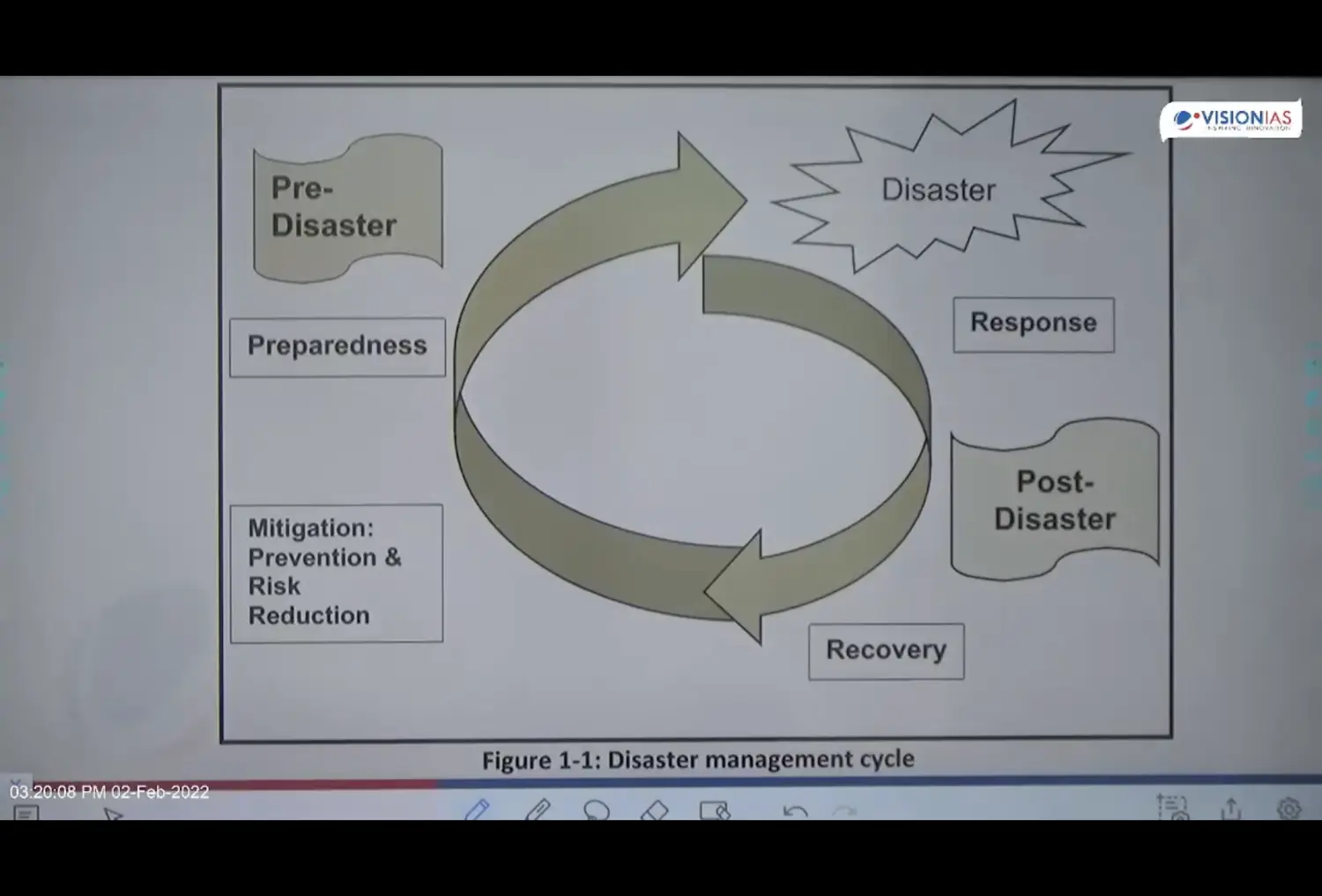
Disaster Management Cycle
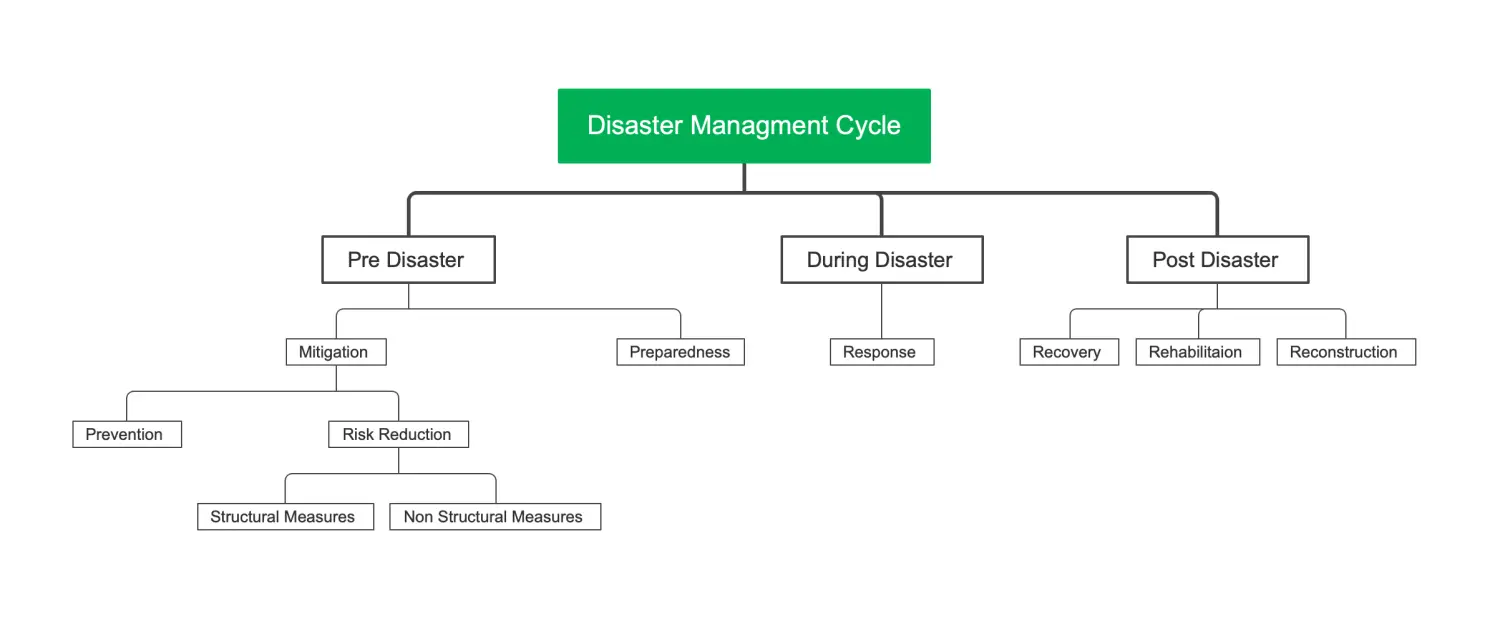
Pre-Disaster Management - Mitigation Centric Approach
These are the activities taken to reduce the losses to be caused by potential hazards.
Steps Are:
Mitigation
It involves the steps required to reduce the impact of a disaster or the size of disasters
Prevention
Those events which can be prevented
For Example: Drought can be prevented through water management measures
Risk Reduction
It involves reducing vulnerability and enhancing capacity that can be done either using structural measures or non-structural measures.
(i) Structural Measures Examples: Construction of physical barriers, infrastructures, etc
(ii) Non-Structural Measures Examples: involve policy formulation, awareness, education, research and development.
Preparedness
It involves training, development of warning systems, construction of shelter homes, conduction of mock drills, etc.
This entire stage of pre-disaster management is called mitigation centric approach
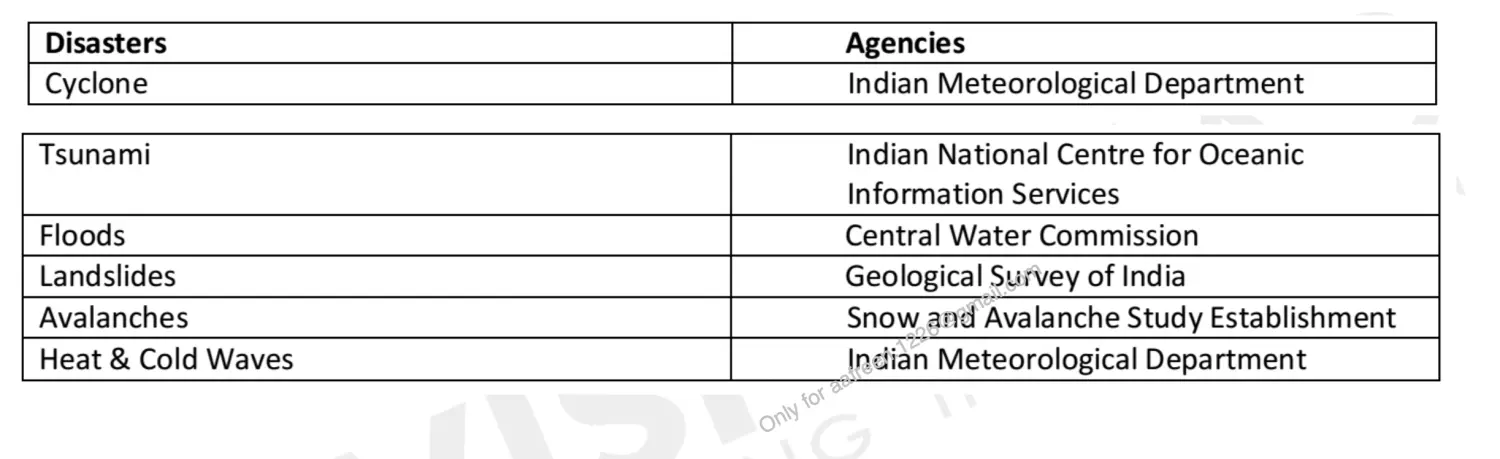
Warnings By
During Disaster
The Response involves immediate action in case of disasters such as assembling at shelter homes, forecasting, warning, immediate relief, etc
Post Disaster
Recovery
Rescue the people, debris clearance, etc so that minimum damage is caused to life and property
Communication Between Various Agencies
Rehabilitation
It involves temporary shifting of people to safe locations or shelter homes, collection and distribution of relief material, restoration of communication and basic infrastructure, coordination of different agencies
Reconstruction
- Permanently constructing something back
- Build, Back, Better should be the Mantra
- It involves damage assessment, building safer and sustainable infrastructure, taking feedback from the previous stages, and accommodating future improvements
Unit 3: Initiatives for Disaster Management
Before 2005
India followed a Reactive Approach for any Disaster
1994 - Yokohama Conference at the international level (The first major initiative was at )
This conference emphasised the preparation and mitigation of disasters
1999 - Orissa Super Cyclone a Government appointed a High Powered Committee on Disaster Management after the Disaster
HPC Recommended Specific & Legal Framework for Disasters
2001 - Bhuj Earthquake and Government appointed a Disaster Management Division under Home Ministry
2004 December - Tsunami which was one the worst disaster India faced in the recent past
2005 - National Disaster Management Act
National Disaster Management Act, 2005
Introduction to NDMA
- The act provides for an institutional mechanism and framework for preventing and mitigating disasters in India
- It was a landmark initiative by the government from a reactive to practice approach to deal with disasters
Legal Framework Mind Map
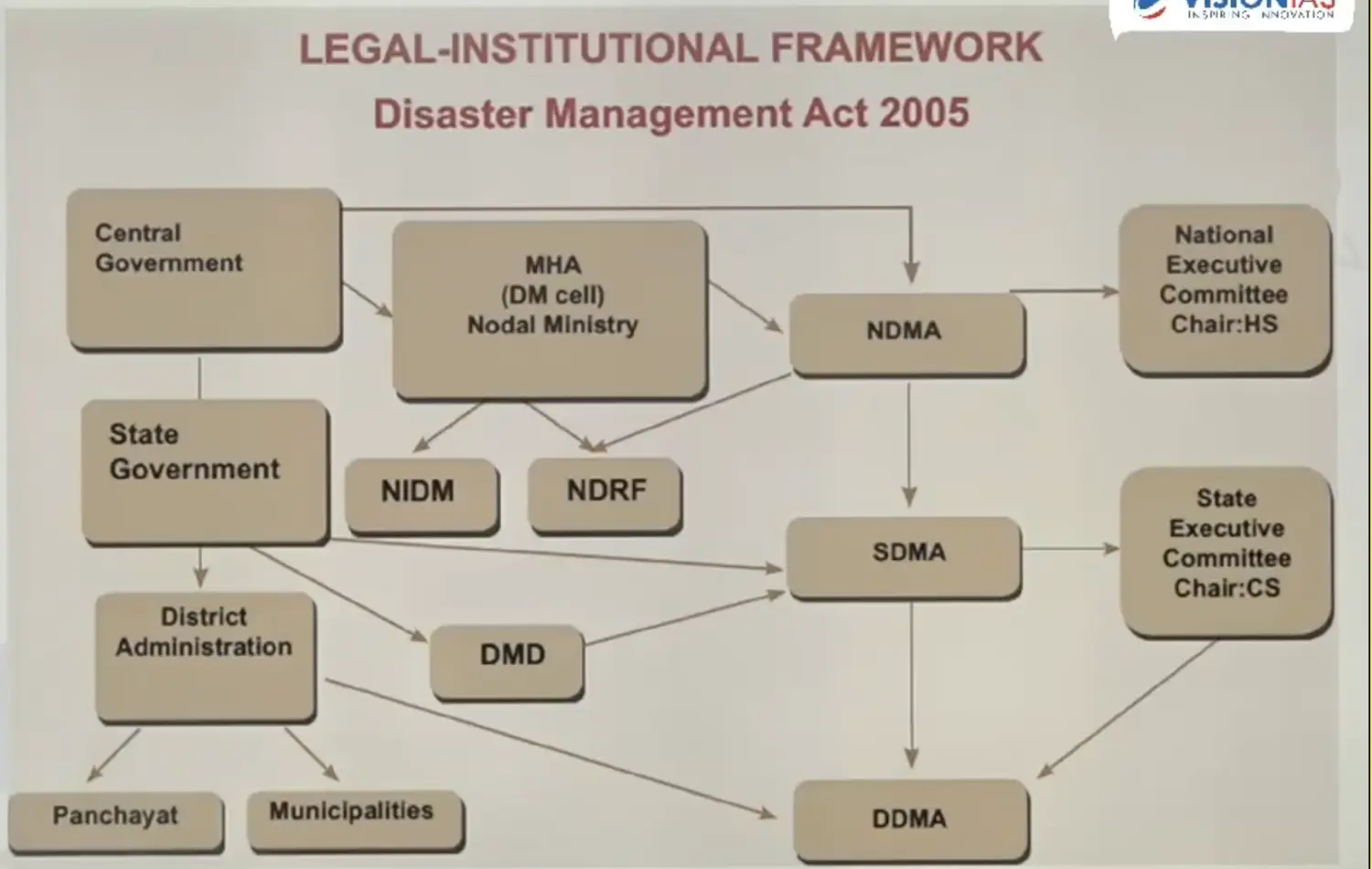
National State and District Level Details
| Themes | Authorities (Legislative) | Executive Committees | Institute | Force | Funding Mechanism | | --- | --- | --- | --- | --- | --- | | National Level | NDMA Headed by PM | National Executive Committee | NIDM - National Institute of Disaster Management | NDRF - National Disaster Response Force | 1. National Disaster Response Fund 2. National Disaster Mitigation Fund | | State Level | SDMA Headed by CM | State Executive Committee | NA | NA | 1. State Disaster Response Fund 2. State Disaster Mitigation Fund | | District Level | DDMA | DDMA Headed by DM Himself | NA | NA | NA |
Details of Bodies Under NDMA Framework
- Nodal Ministry is the Ministry of Home Affairs
- National Disaster Management Authority (NDMA)
- It is the apex body for Disaster Management in India headed by the Prime Minister
- Policy, Plan and Guideline formulation and implementation at the national level → 3 Things
- Policy - Less Elaborate Basic Guiding Principle
- Plan → Detailed
- Guidelines → Disaster Specific
- National Executive Committee
- it is headed by Home Secretary along with other secretaries from other departments
- They assist NDMA in their functioning and helps in coordinating
- We have also two bodies but which is NOT under DM Act, 2005
- Cabinet Committee on Security - Headed by PM and other ministers as members)
- NDMA Advisory Committee - 15 members committee from various different fields
- State Disaster Management Authority (SDMA)
- It is headed by Chief Secretary and co-originates the SDMA in its functioning
- Every UT also has its own SDMA as it requires a quick response
- District Disaster Management Authority (DDMA)
- Planning and coordinating at the local level
- It takes all the measures so that the district is disaster prone
- National Institute of Disaster Management (NIDM)
- It is in New Delhi and is for training
- National Disaster Response Force (NDRF)
- Takes care of response activities during disasters
- Before 2005, there was no specific force
- They are trained specifically for handling disasters
Funding Mechanism under DM Act, 2005
National Disaster Response Fund and State Disaster Response Fund
It is to fund the response and rescue activity during the disasters
Before 2005 there was National Calamity Contingency Fund (NCCF) - National Calamity Contingency Duty was levied on petrol, crude oil, automobiles, etc
The duty is still continued to fund the National Disaster Response Fund
Similar provisions for raising money at State Disaster Response Fund
SDRF is used first in case of any disaster especially at the local level and in case of notified disaster and goes beyond SDRF
then NDRF releases funds for the same
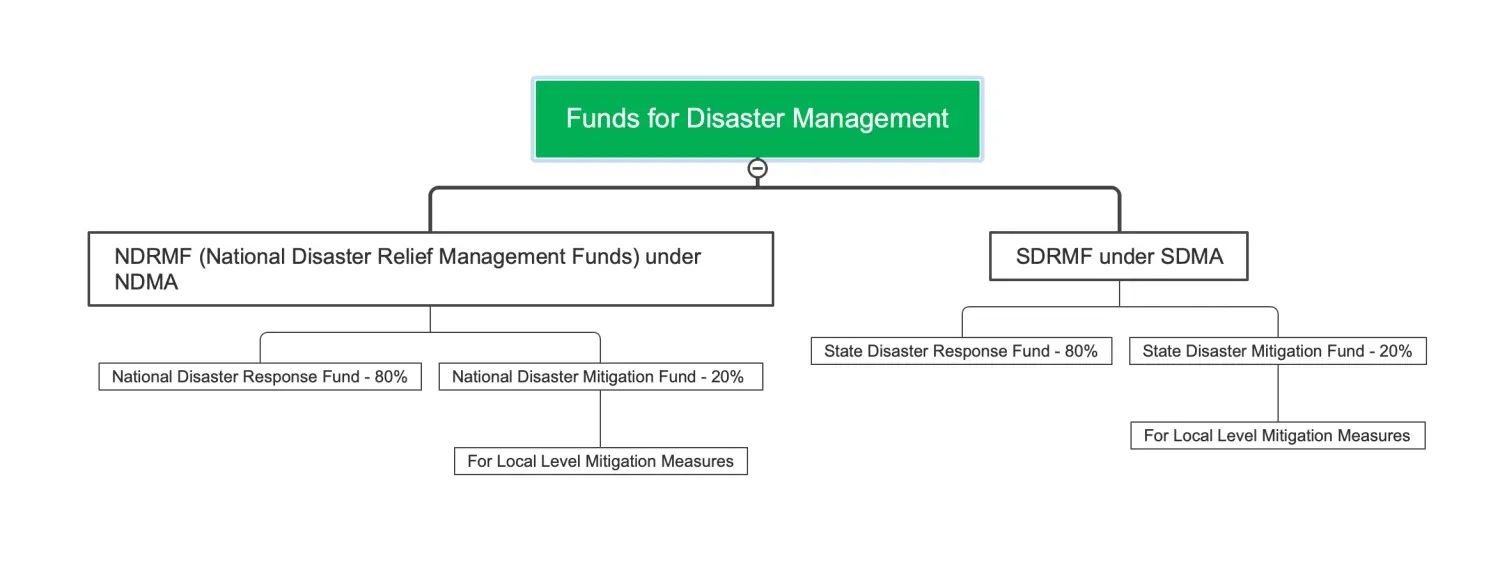
National Disaster Mitigation Fund and State Disaster Mitigation Fund
- Mitigation is the steps taken before the disaster is struck
- Recommendation of the 15th Finance Commission
Establishment on only one overall fund for the national level (NDRMF) and one for state-level (SDRMF)
For SDRMF
- 75 by Centre 25 by State - For Normal States
- 90 by Centre 25 by State - For North East States
Creation of National Disaster Risk Management Fund:
PM Cares - Donation by people, not under RTI, No Audit for it
Sources
- Apart from NCCD, also
- there is need for budgetary allocations - both at state and national level
Criticisms of NDMA, 2005
- Working Conditions:
- CAG reports highlight that NDMA projects have been pending or restructured
- Poor Working conditions
- Not much control over SDMA and DDMA by NDMA
- Vacancy and posts are not filled in NDMA including NDM Advisory Committee
- They Follow Top-Down Approach i.e control from the central level. But for controlling disasters it should be from Bottom to the Top
- 2nd ARC Recommendations on NDMA
- The state should play the primary role and the centre should play a supportive role
- Disasters should be categorised into national, state and local levels. This hasn’t been done yet
- Severe punishment in case of any misuse of funds
National Policy on Disaster Management, 2009 (Latest Policy as of now)
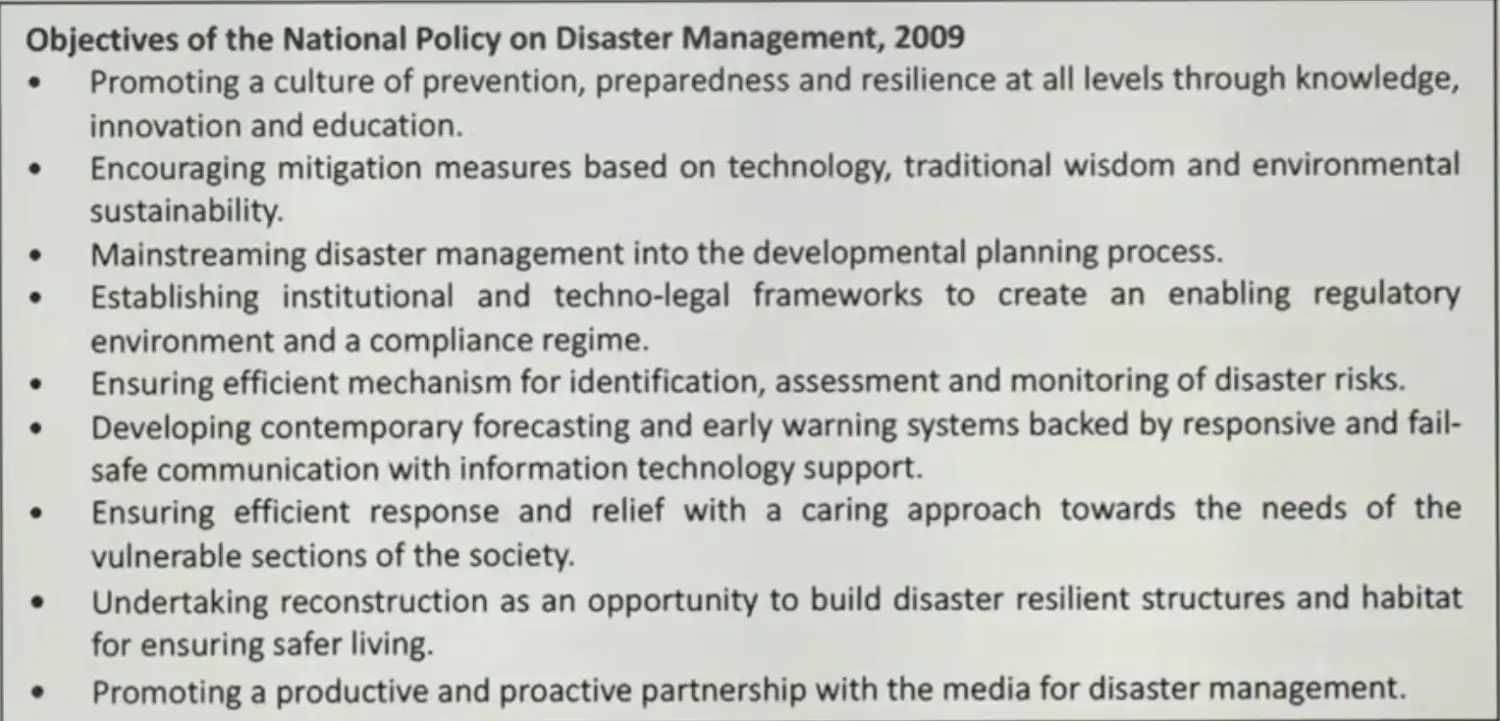
National Disaster Management Plan, 2016 (Updated in 2019)
National Disaster Management Plan, 2016 → Original Version
Introduction
- In 2016, the plan was made in order to fulfil Sendai Framework
- It provides for a direction and framework for disasters
Contents of NDMP
Provides for a comprehensive definition of disasters in India
Identifies 5 Thematic Areas of Work - Based on 4 Priorities of Sendai Framework
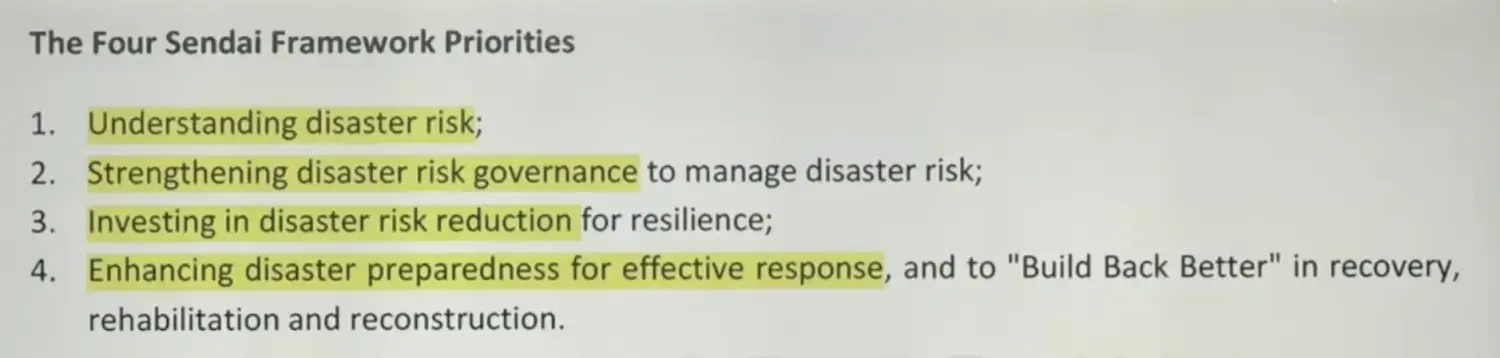
It also provides for a Time Framework in 5, 10 and 15 years from 2016 to 2030
It also provides the checklist
prescribes the roles and responsibilities at local, state and national levels like
Talks about Responsible Role of Media (Ethical Guidelines for them)
National Disaster Management Plan, 2019 → Updated Version
- Rationale:
- to bring coherence between Sendai Framework (2015-2030)
- SDGs (2015 - 2030)
- Paris Agreement (Signed in 2015, First Promise Ends in 2030)
- 6th Thematic Area Added - Climate Change Risk Management (along with previous 5)
- A new chapter has been added for Mainstreaming and Social Inclusion
- Time Frameworks:
- Short Term - 2022
- Medium-Term -2027
- Long Term - 2030
- Rationale:
Criticisms of National Disaster Management Plan
- The plans are very generic in nature, where as plans should be specific
- No specific targets or goals
- There is no monitoring and evaluation mechanism
- No mention of funding mechanism
- Private Organisations and Corporates have not been taken into consideration
International Initiatives
Yokohama Conference (1994)
- First world conference on disaster reduction
- They accepted that there is an Natural Disasters in the World
- They accepted that poor people are more impacted due to more vulnerability and less capacity
- Developing and less developed countries are more impacted, even though developed countries are responsible for emission
- Countries agreed to cooperate with each other to strengthen prevention, mitigation and preparedness
Hyogo Conference (2005)
- It was After 2004 Tsunami
- Second world conference on Disaster Risk Reduction
- It came out with Hyogo Framework of Dealing with Disasters
- It also came with putting in place an International Early Warning Programme
- It targeted at reducing loss and impact
Sendai Conference (2015)
It was the third conference on Disaster Risk Reduction
It said that state has the primary responsibility to deal with disasters but that should be shared with local government and private sectors
It aimed at reducing the risk and size of the disaster
It talks of building resilience
It gave for Sendai Framework
4 Priorities Areas - Remember All
7 Targets - Remeber Reduce 4 Increase 3
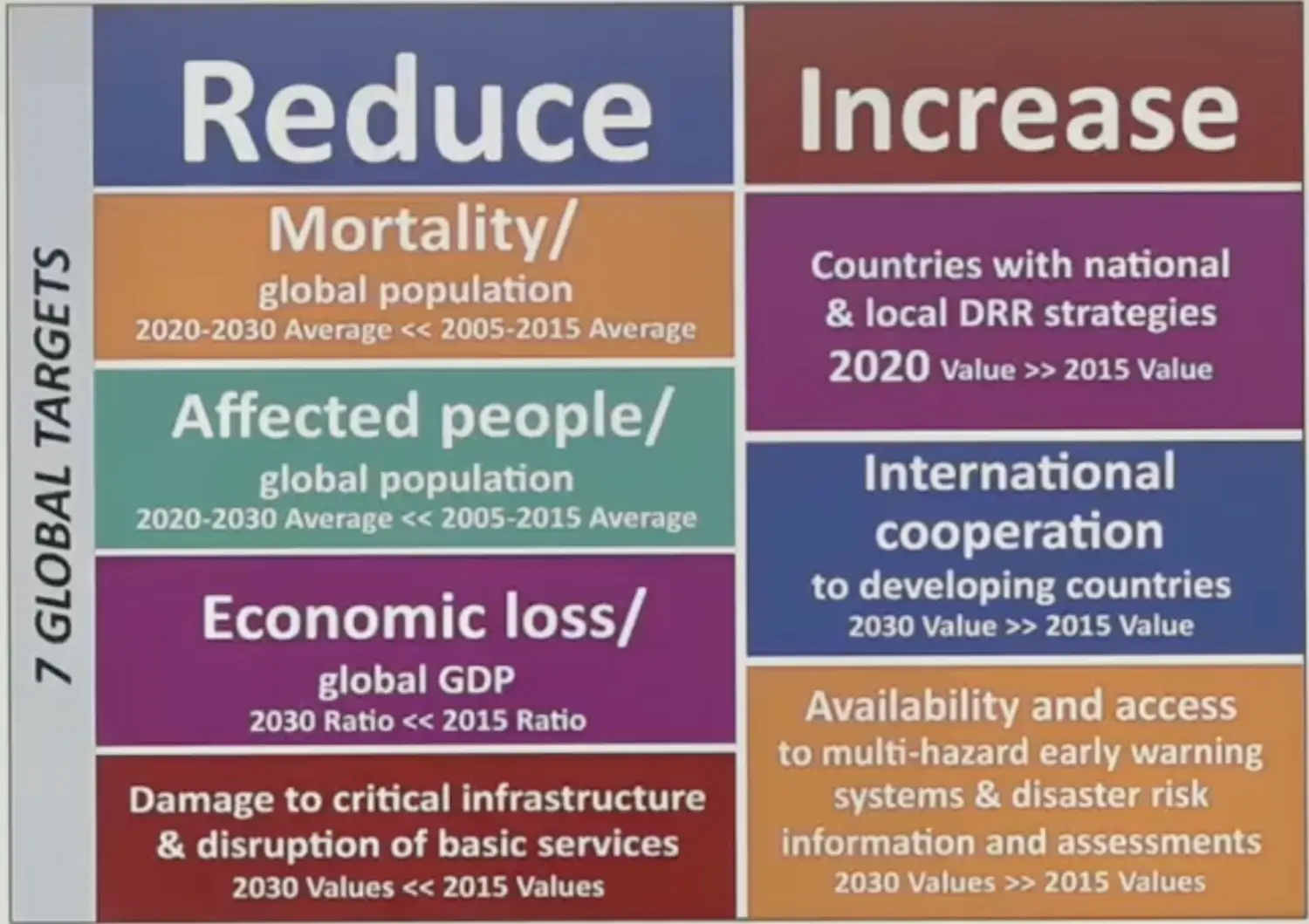
Difference Between Hyogo and Sendai Conference
| Hyogo | Sendai | | --- | --- | | Aims to Reduce Loss Includes All Activities which escapes from Loss, Includes Moving out People as well Loss - Escapist Approach | Aims to Reduce Risk Risk - Stand there and Fight | | Aims to Reduce Impact of Disaster | Aims to Reduce Size of Disaster | | What to Do | How to Do | | Talks About Loss | Talks About Building Resilience |
Unit 4: Major Disasters in India
- Classification of Disasters
- Geophysical Disasters:
- Due to geophysical phenomena/processes
- Example: earthquakes, volcanic eruptions, mass movements, etc
- Hydrological Disasters:
- caused by deviations from the normal water level of different water bodies
- Example: coastal erosions, landslides, etc
- Meteorological Disasters:
- These are short-lived processes in the atmosphere extending a few minutes to days
- Example: Cyclones; Heatwave, Cold waves
- Climatological Disasters:
- These are long-lived macro-scale processes of the atmosphere
- Example: Drought, Glacial Lake Outburst Flood, Forest Fire
- Biological Disasters:
- These are Disasters from Organic Origin or Biological Vectors
- Example: Insects epidemics
- Prime Example: Covid-19
- Geophysical Disasters:
- Structure for Answers
- Definition
- Causes
- Natural
- Anthropogenic
- Areas - Map
- Measures by NDMA
- Response Measures
Traditional Disasters
Earthquake
Causes
It can be caused by multiple natural and anthropogenic factors
Natural
Tectonic Plates, Subsidence of Land, Landslide, Movement of Earth Plates, Meteorite Impact
Anthropogenic
Mining, Blasting Activities, Reservoir Induced Movements
Definition
Sudden vibration felt on the surface of the earth due to the release of energy causing transient disturbance of equilibrium in rocks
Regions Impacted
🌋 Zone 5 - Highest ImpactZone 1 - Lowest Impact
Zone 5 - Entire North East; Nepal border of Bihar, Nanda Devi in Uttrakhand, Dharamshala in Himachal Pradesh, Kashmir Valley, Western Gujrat (Bhuj), Andaman and Nicobar Islands
Gujarat has a : Allah Bund Fault
Zone 4
- Rest of the Himalayas beyond Zone 5
- the western part of Maharashtra (Latur EQ 1994)
- Northern Plains and Ganga Delta
Zone 3 Mainly along the valleys of rivers such as Narmada, etc
Zone 2 Plateau regions of India such as Karnataka, MP, Chattisgarh, Odisha, Tamil Nadu
Examples of Major Earthquake
Map
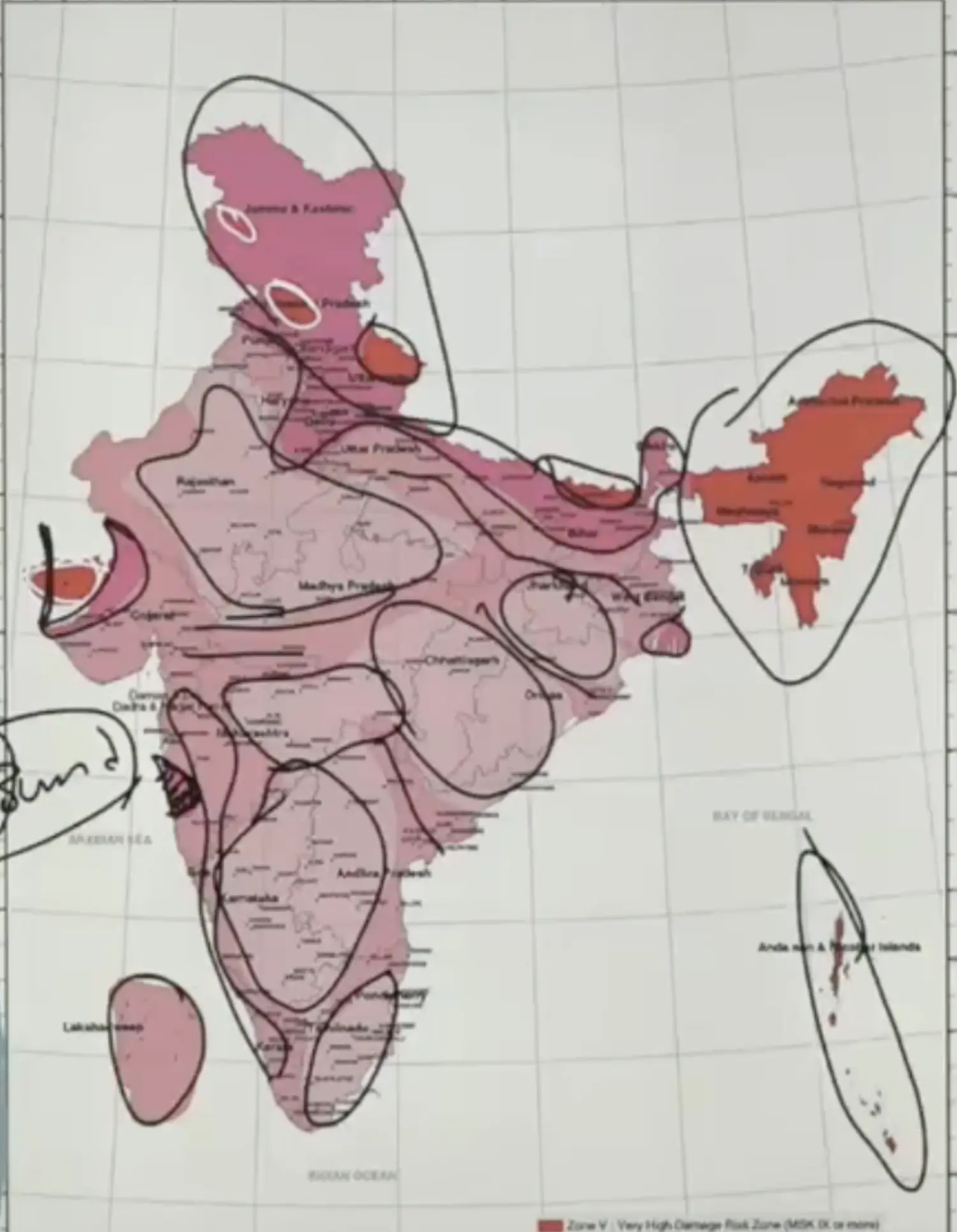
Examples of Past
- 2015, Nepal Earthquake; 7.8 Magnitude
- 2011, Sikkim-Nepal Earthquake; 6.9 Magnitude
- 2006, Kashmir Earthquake; 7.6 Magnitude
- 2004, Earthquake in Indonesia; 9.1 Magnitude, etc
- 2001, Bhuj Earthquake; 7.7 Magnitude
- 1994, Latur Earthquake; 6.2 magnitude
- 1991, Uttarkashi Earthquake; 6.1 Magnitude
Measures as Suggested by NDMA
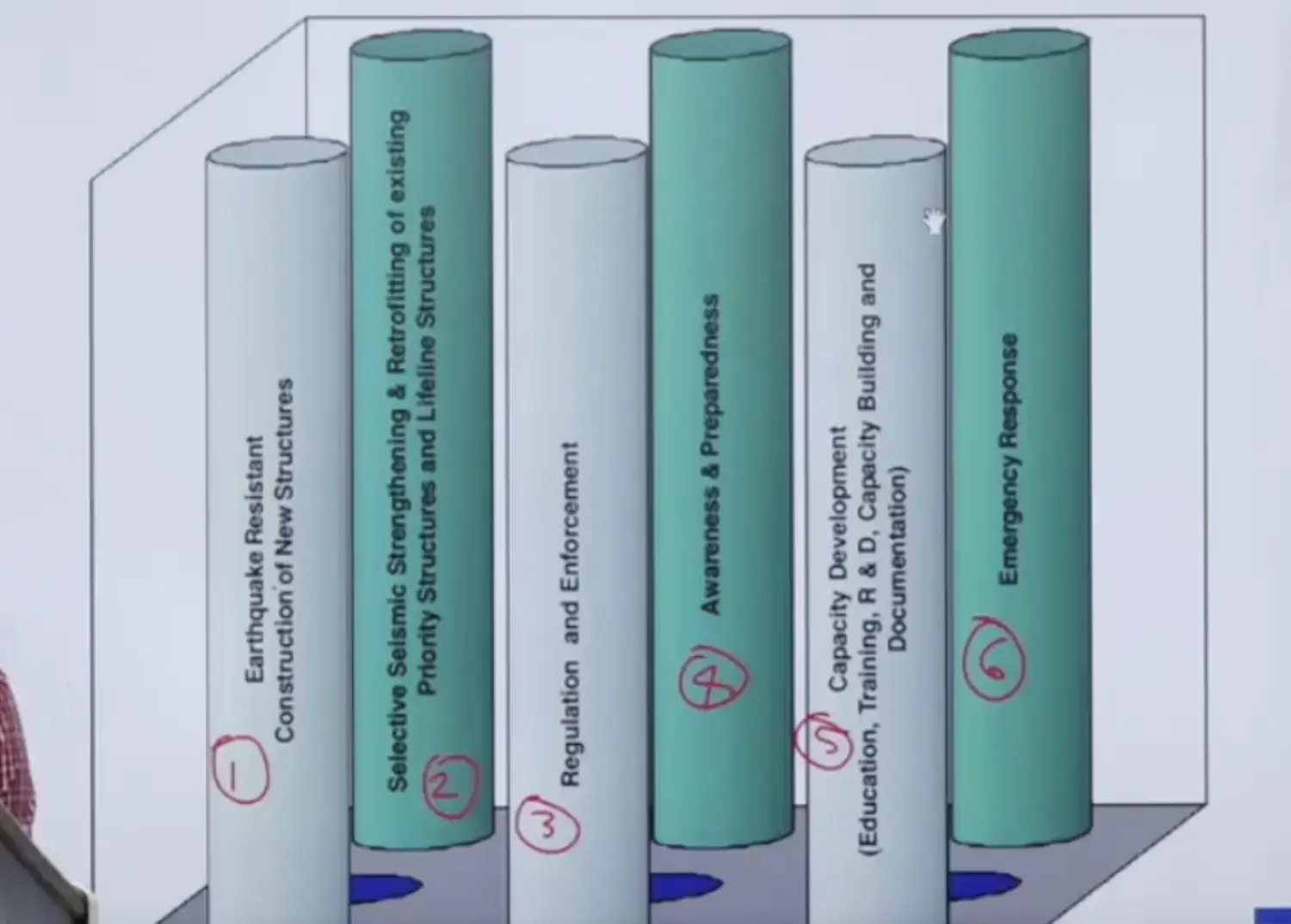
The six pillars for earthquake management in India:
- Earthquake resistant construction of new structures
- Selective seismic strengthening and retrofitting of existing priority structures and lifeline structures
- Regulation and enforcement (comes under respo of state govt)
- Awareness and preparedness
- Capacity Development (education, training, documentation, etc)
- Emergency response, etc
Floods
Causes - Natural and Anthropogenic
Natural Causes
- Cloudburst or Glacial Lake Outburst (Example Chorabari Glacial Lake Outburst in Kedarnath)
- High Tides
- Cyclones & Tsunamis
- Siltation, Change in river course (Shifting River - Kosi River)
- Pollution like deposition of Sewage
Anthropogenic Causes
- Mismanagement of Dams & reservoirs - timing of releasing water
- disturbing natural drainage system like construction of roads and infra in hilly areas
- occupation of floodplain - UP, Bihar, Uttarakhand
- deforestation, soil erosion, siltation, dam construction
🌊 100 Saal main ek baar bhi flood ho gaya hai toh woh Floodplain khelayega
Flood Prone Areas of India
- Punjab Haryana Indus Plains
- Ganga Plain
- Brahmaputra Plains
- Eastern Coast - Mahanadi Godavari Krishna Delta
- 12% of Indian Land is Flood Prone
NDMA Measures - Structural and Non-Structural
- Structural Measures
construction of reservoirs and dams
Damodar Valley Corporation made Dams on the River Godavari
levee construction/floodwall

desilting or dredging
Afforestation in the catchment area reduces the surface flow
drainage improvement
diversion of floodwater
Independent Suggestion : Interlinking of Rivers
- Non-Structural Measures
Flood Plain Zoning
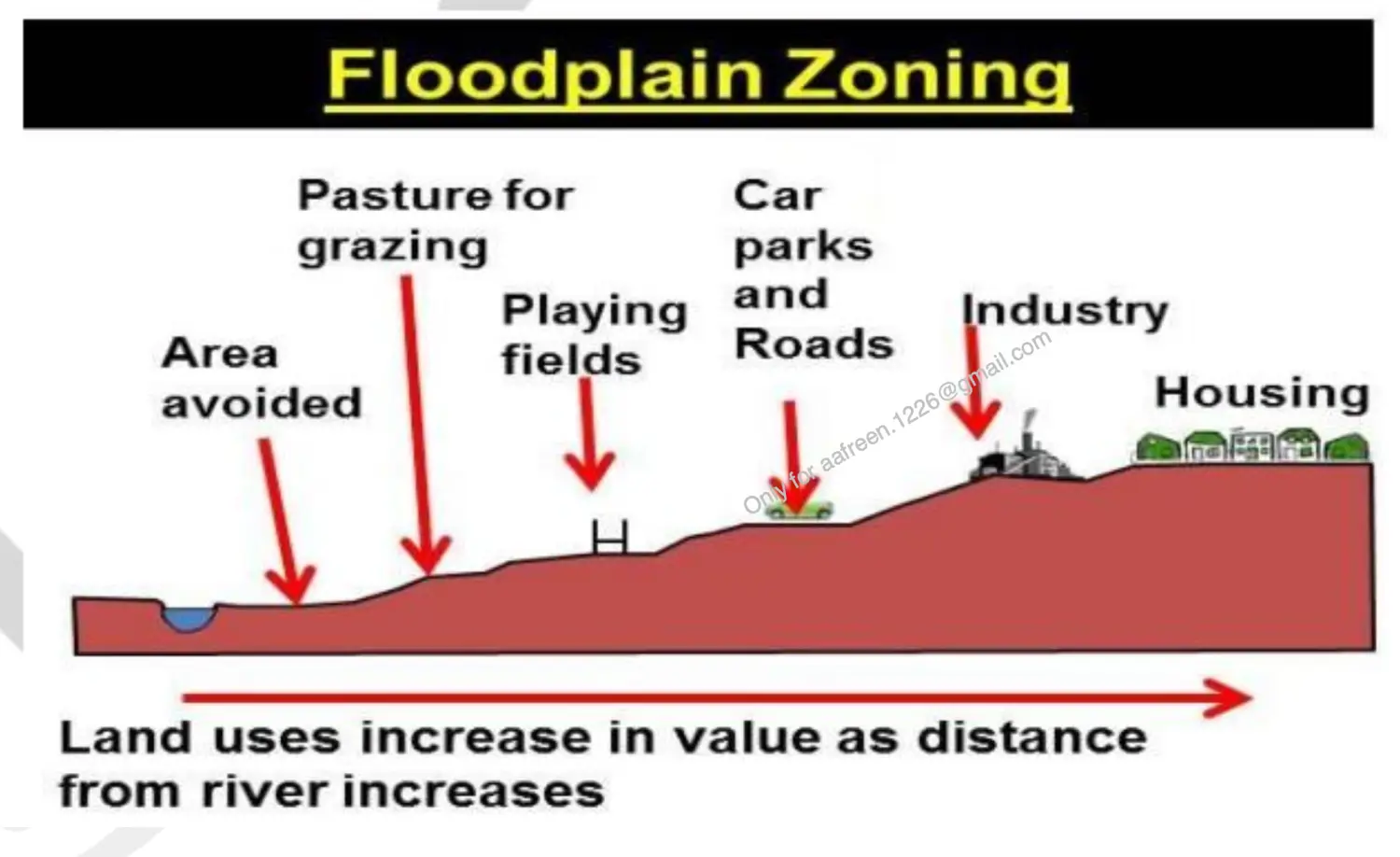
It involves the regulation of and zonation of different areas based on the probability of flooding
Flood Proofing
Involves combination of structural and nonstructural measures such as rising the buildings, double-storeyed constructions, etc
Flood forecasting and early warning system
Emergency response and training
Integrated watershed development - Integral Part of PM Krishi Sinchai Yojana
- Structural Measures
Urban Floods
Difference Between the Two
Where as normal floods happen due to Natural and Anthropogenic Causes, Urban Floods are majorly due to Anthropogenic Causes.
Causes
- Disturbance of natural drainage system
- occupation of lakes and wetlands
- Increased concrete surface
- Deforestation and lack of trees and vegetation
- Urban Heat Islands Effect - Increase in Temp, Increase Rate of Evaporation
Management (as suggested by NDMA)
- Urban drainage management which involves design flow with control especially in concrete areas
- Stormwater drainage system
- Creation of Rain Gardens
- Rainwater harvesting system
- Creation of urban flooding cells under Ministry of Urban Development
Response
- Emergency operation centres
- flood shelters
- emergency logistics and sanitation management
- Vulnerability and risk assessment which involves categorisation of regions as per vulnerability
Cloudburst
As per IMD (Indian Meteorological Department) : Very high precipitation of more than 10 cm per hour concentrated in a small region in a short duration of time is called a cloudburst
Causes - Natural - Rapid convention, Creation of Large Vertical Cumulonimbus Clouds, Funnelling Effect in the Hilly areas
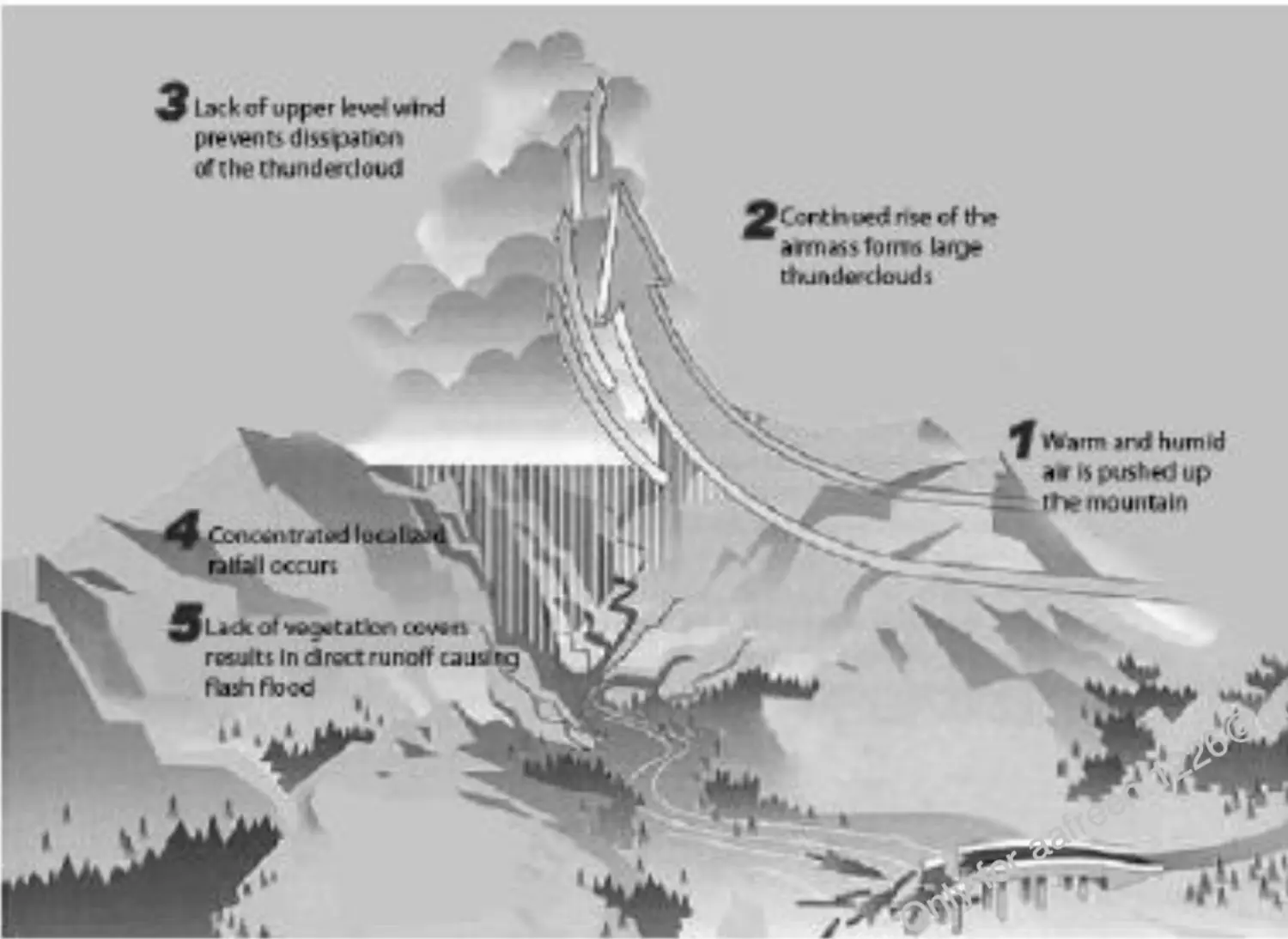
Regions
- Himalayan Regions
- Rajasthan and Gujarat
- Monsoon Coast i.e western Coast
- some part of the eastern coast
Management
- Can't Prevent and Very Difficult to Predict
- Similar to flood management
Drought
What is Drought ?
A serious shortfall in the availability of water mainly but not exclusively due to deficiency of rainfall. Shortfall can also arise due to severe demand of the water.
Hence, Drought can occur due to Increased Demand or Reduced Supply
Causes - Natural and Anthropogenic
- Natural - Supply Factor
- Due to Deficiency in monsoon
- Shifting of rivers
- El-Nino creates dry condition
- Negative Indian Ocean Dipole
- Madden Julian Oscillation (Subsiding)
- Anthropogenic Factors
- Supply Side
- Excessive grazing
- Excessive extraction of groundwater
- Pollution
- Occupation of lake and wetlands
- Demand Side
- urbanisation
- population
- water-intensive agriculture/crops like Sugarcane
- Supply Side
- Natural - Supply Factor
How drought is different from other disasters
- It is a very slow disaster - slow on its onset and hence called a creeping disaster. It gives adequate warning
- It covers a much larger area
- Also, once its set it will be there for a longer duration
- It is more of a rural phenomenon and can be prevented
Types of Drought
- Meteorological drought - Shortfall of Precipitation
- Agricultural drought
- Hydrological drought
Regions impacted by Drought in India
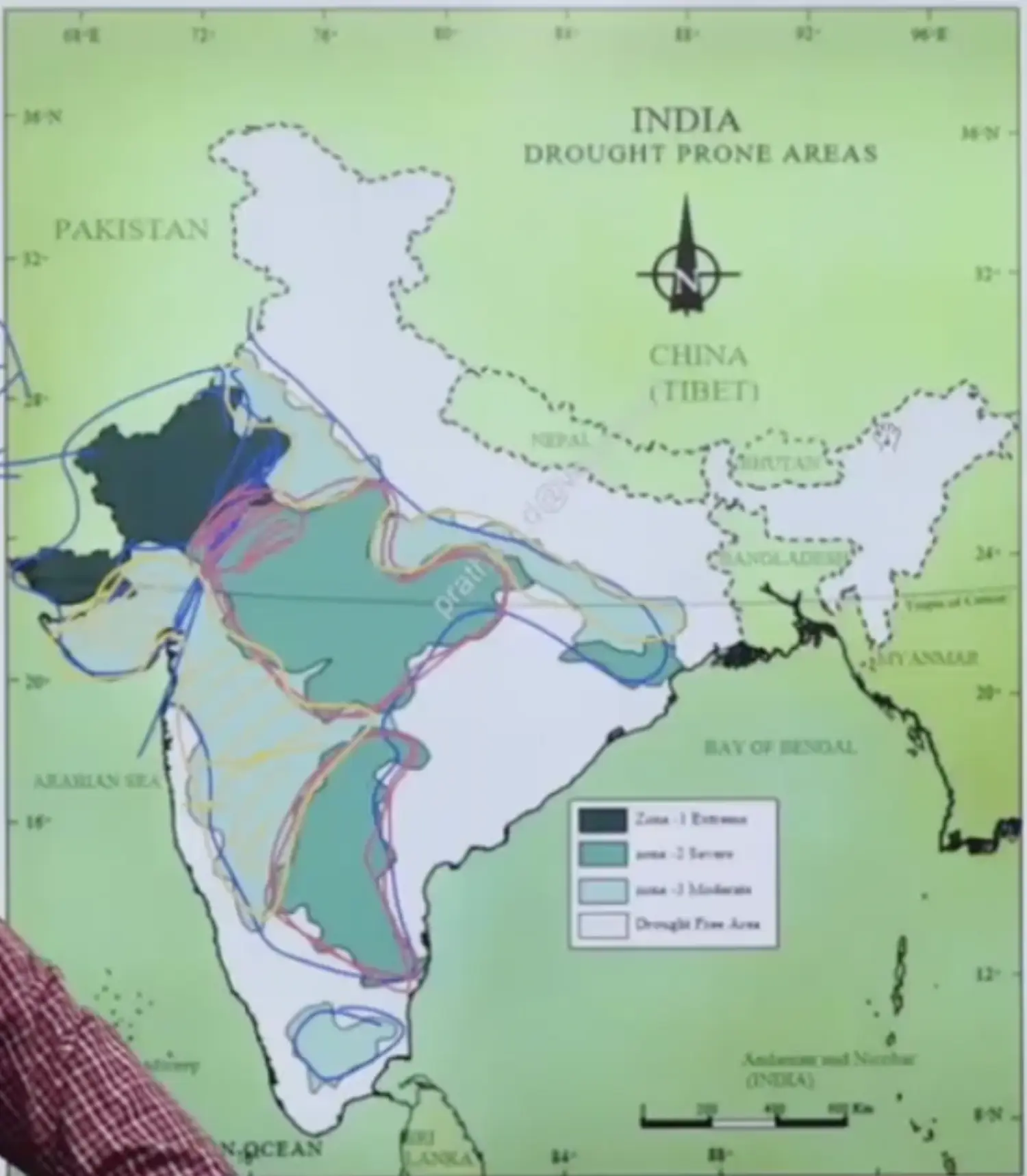
- Extreme Drought Prone - Western Rajasthan and Northern Gujarat
- Severe Drought Prone - Rainshadow region of the Western Ghats and Eastern Part of Rajasthan
- Moderate Drought Prone - Southern Gujarat, Western Maharashtra, etc
Measures Required
- Water harvesting and conservation
- Suitable farming Methods for arid areas
- Drip and sprinkler irrigation
- Mapping of groundwater potential like Aquifer
- Drought Monitoring and Planning
- Cloud Seeding
Landslide
Definition
Landslide is a type of mass movement involving a large scale movement of the mass of rock, debris or earth down its slope under the direct influence of gravity
Causes - Natural and Anthropogenic
- Natural
- heavy rainfall
- earthquake
- steep topography
- nature of rocks
- Floods
- Cloudburst
- volcanic eruption
- Anthropogenic
- deforestation and overgrazing
- soil erosion
- roads and other infrastructure projects like creation of roads
- mining activities
- disturbance of natural drainage
- shifting cultivation
- Natural
Regions : Himalayan Region & Western Ghats
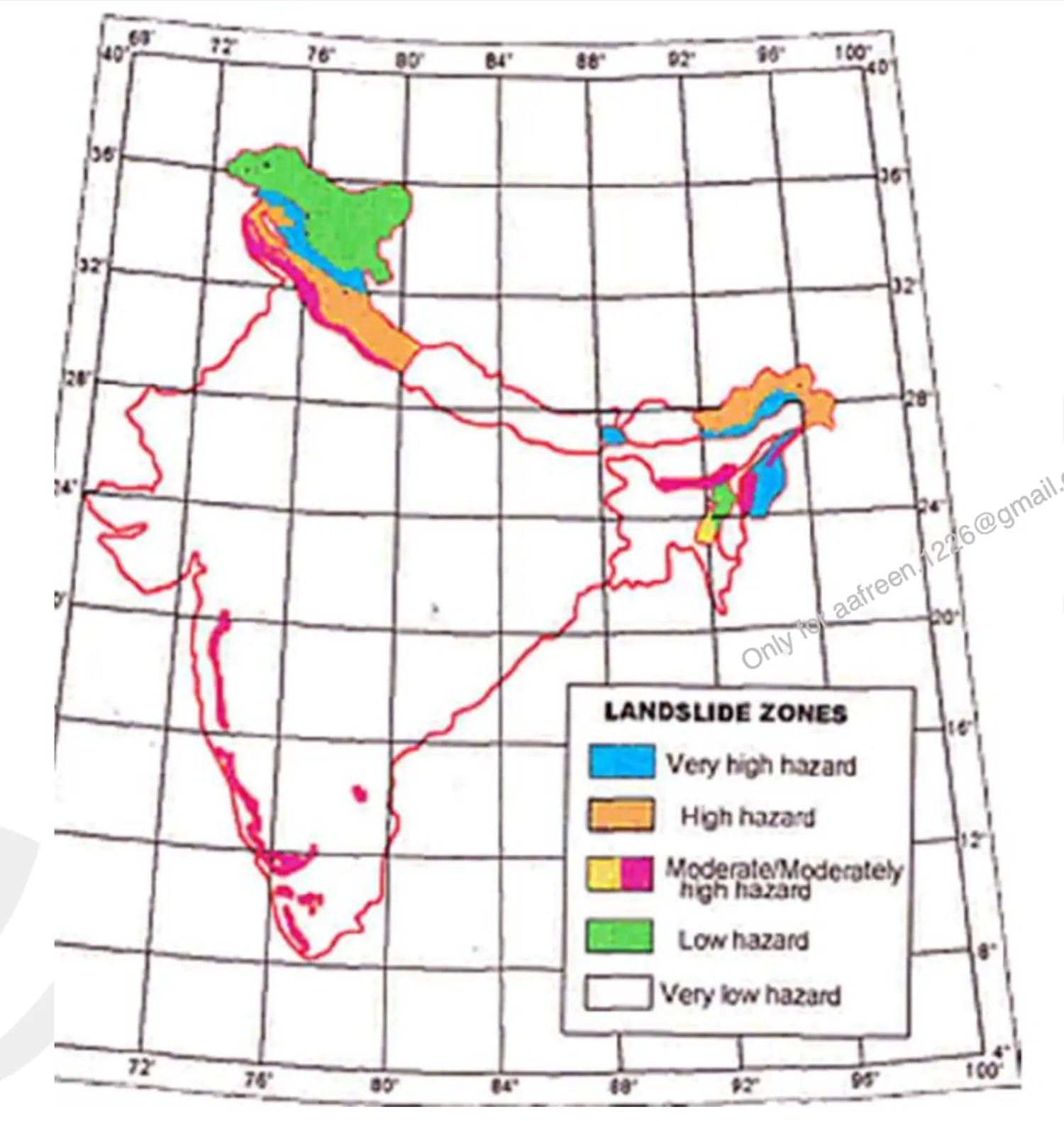
Landslide Management by NDMA
Landslides Hazard Zonation
Preparation and validation of landslide zoning map with high resolution at requisite scale.
Landslide monitoring and early warning
It involves a real-time monitoring system for landslide prediction and the development of an early warning system.
Culture of awareness generation and preparedness among residents and tourists.
Stabilisation and mitigation of landslides
through retention walls, correction of the natural drainage system, afforestation, reforestation etc
Tropical Cyclones
Definition
It is a tropical weather system in which wind speeds equal or exceed the gale force (64 km/hr).
Reason
Development of low pressure of area.
Regions
Eastern Coast of India-TN, AP, Odisha, WB, Gujarat and Maharashtra
Causes
Development of low-pressure area
Management
- India has one of the best Cyclone Warning System in the World
- The nodal agency for the warning is - Indian Meteorological Department
- Tracking is done through the INSAT satellite system and accurate landfall prediction before 3 hours prior to people
Mitigation Measures
- Hazard Mapping to assess the areas vulnerable to cyclones and estimate the severity and damage intensity
- Land use control especially in flood-prone areas
- Engineered structures - to withstand wind force and flood damage
- resistant buildings
- Improving green cover and coastal plantations through green belt as the wide buffer zone
- All other measures as for flood management
Note : Management Measures are Important.
Tsunami
Can be read from Handout, Not So Important
Disasters in News
Forest Fires
Vulnerable areas
Nilgiri, Uttarakhand, Western ghats.
Causes
- Natural Causes - lightning, rolling of stones, dry and hot winds, volcanic eruptions, Swaying of bamboo
- Anthropogenic Causes
Intentional Causes
Shifting cultivation, Regeneration fire and Poachers of animals
Unintentional Causes
By tribals and tourists, Camping Fire Leftover, Mining or Blasting
Types of Forest Fire
- Crown Fire : Eg in Coniferous forest
- Surface Fire : along the surface on dried litter and leaves.
- Bush Fire : Specific Type in Australia
Regions in India impacted by a forest fire
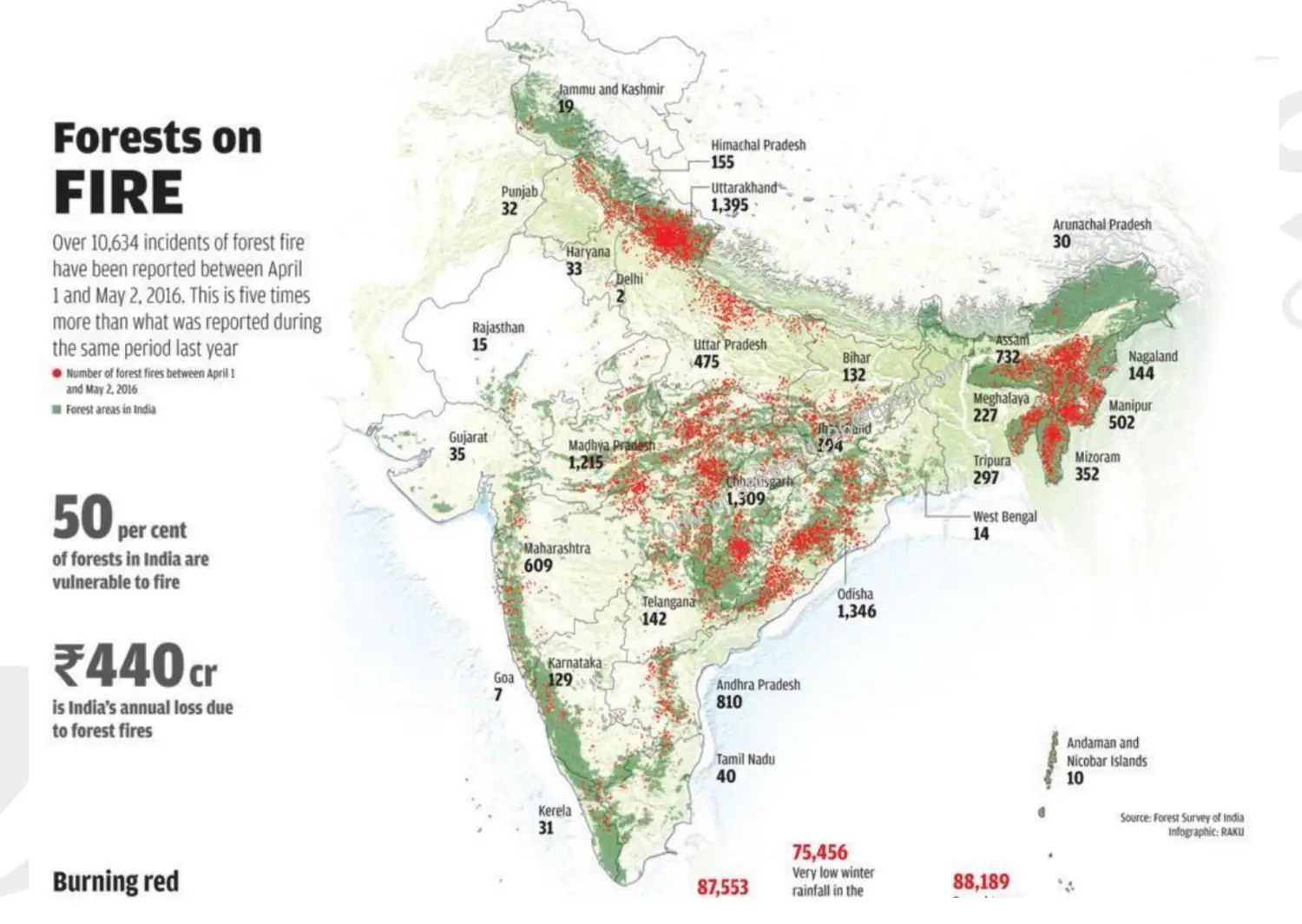
- Uttarakhand
- Himachal Pradesh (Deodar Replaced by Chirpine Trees) Chirpine in demand due to its Softwood
- Northeast due to shifting cultivation
- Central India - Nagarhole and Bandipur
Management Measures Required
- Vegetation Management - through methods such as controlled burning
- Preparation of fire lines
- Clearing litters and vegetation along the zones of interaction between forest and settlements
- Fire fighting drills
- Public education
- Satellite-based fire detection
- Fire danger rating system like ranking of Dryness, Moisture Content in Atmosphere etc
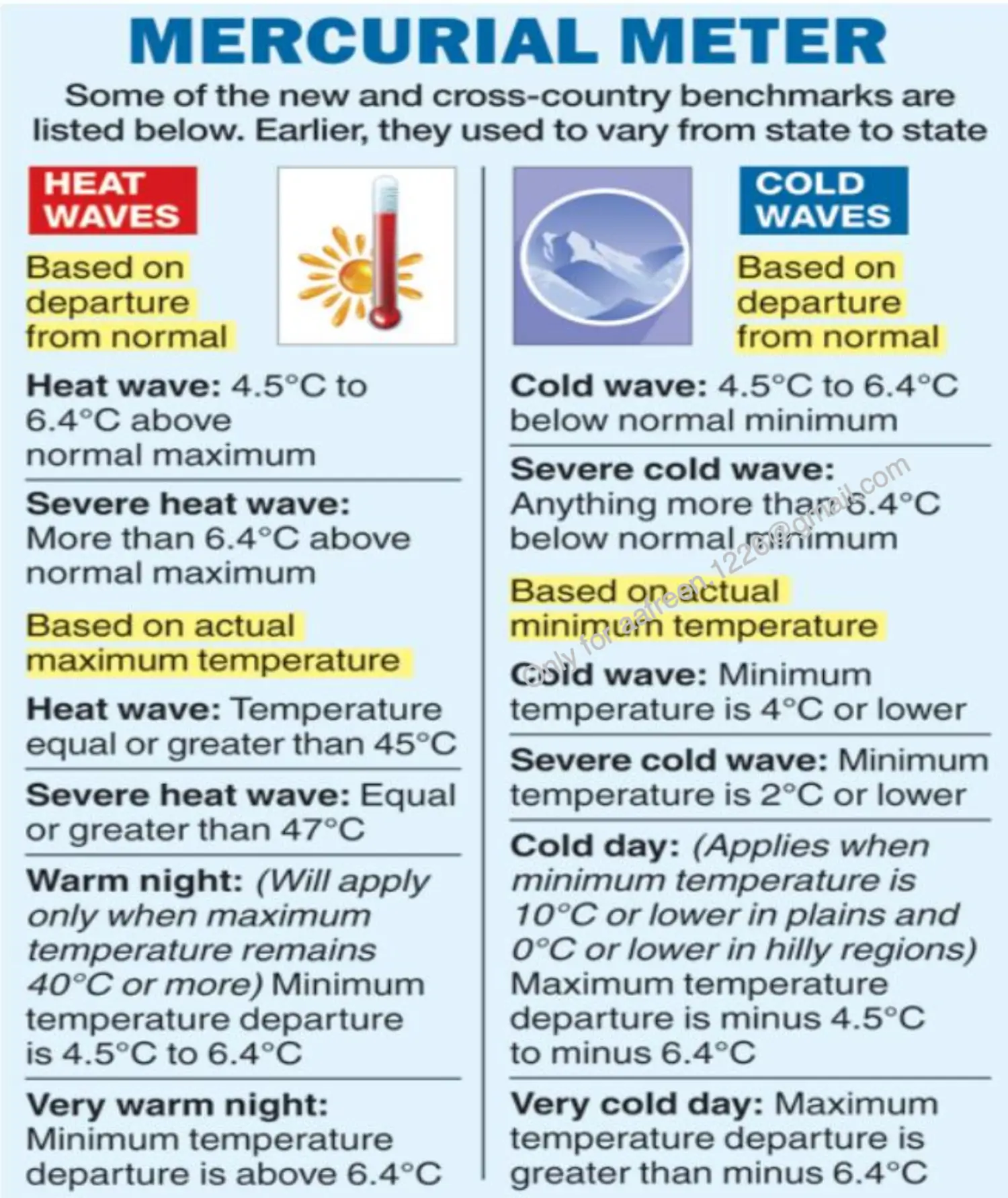
Heatwave and Coldwave
Content provided in the Material
Heat Dome
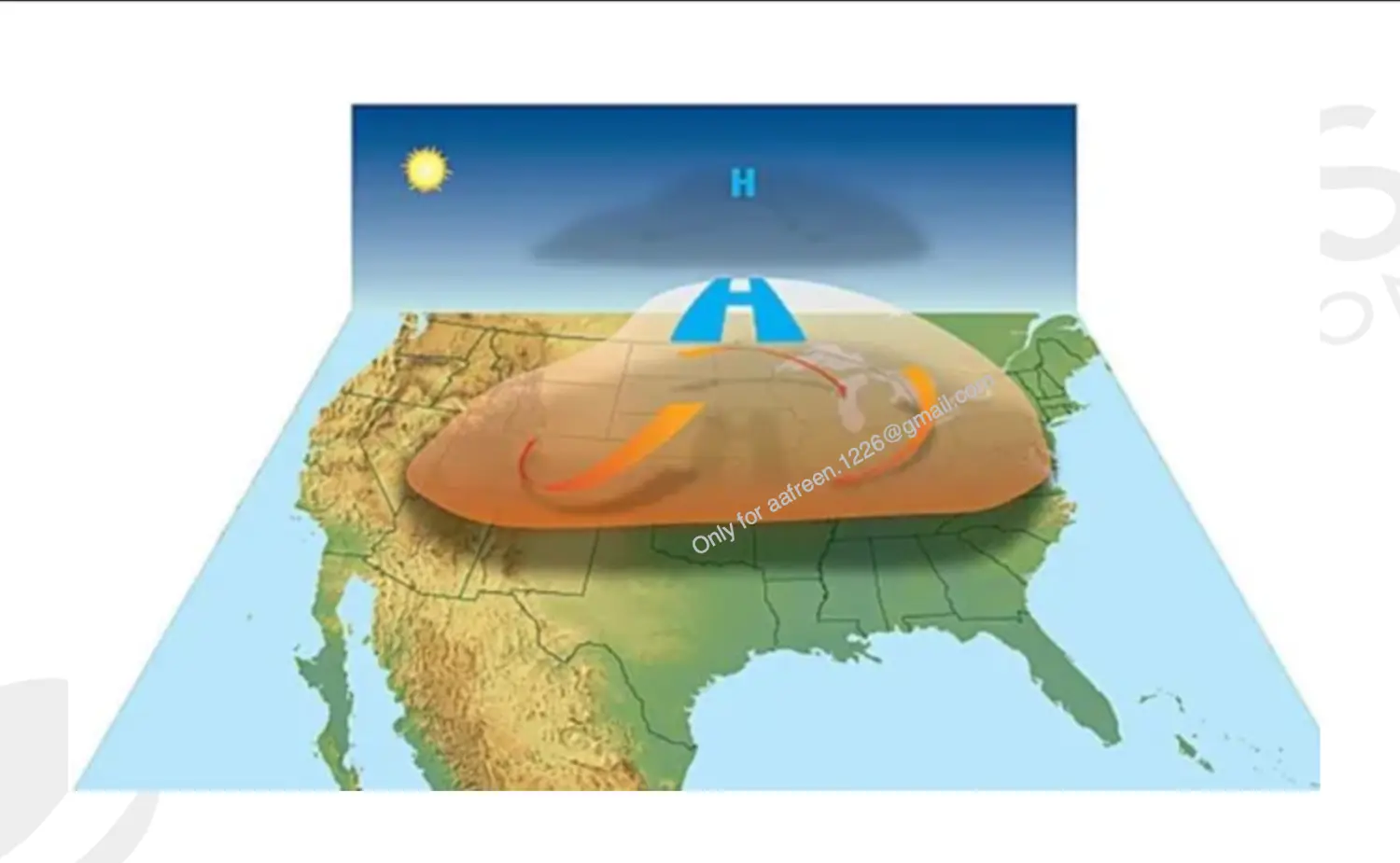
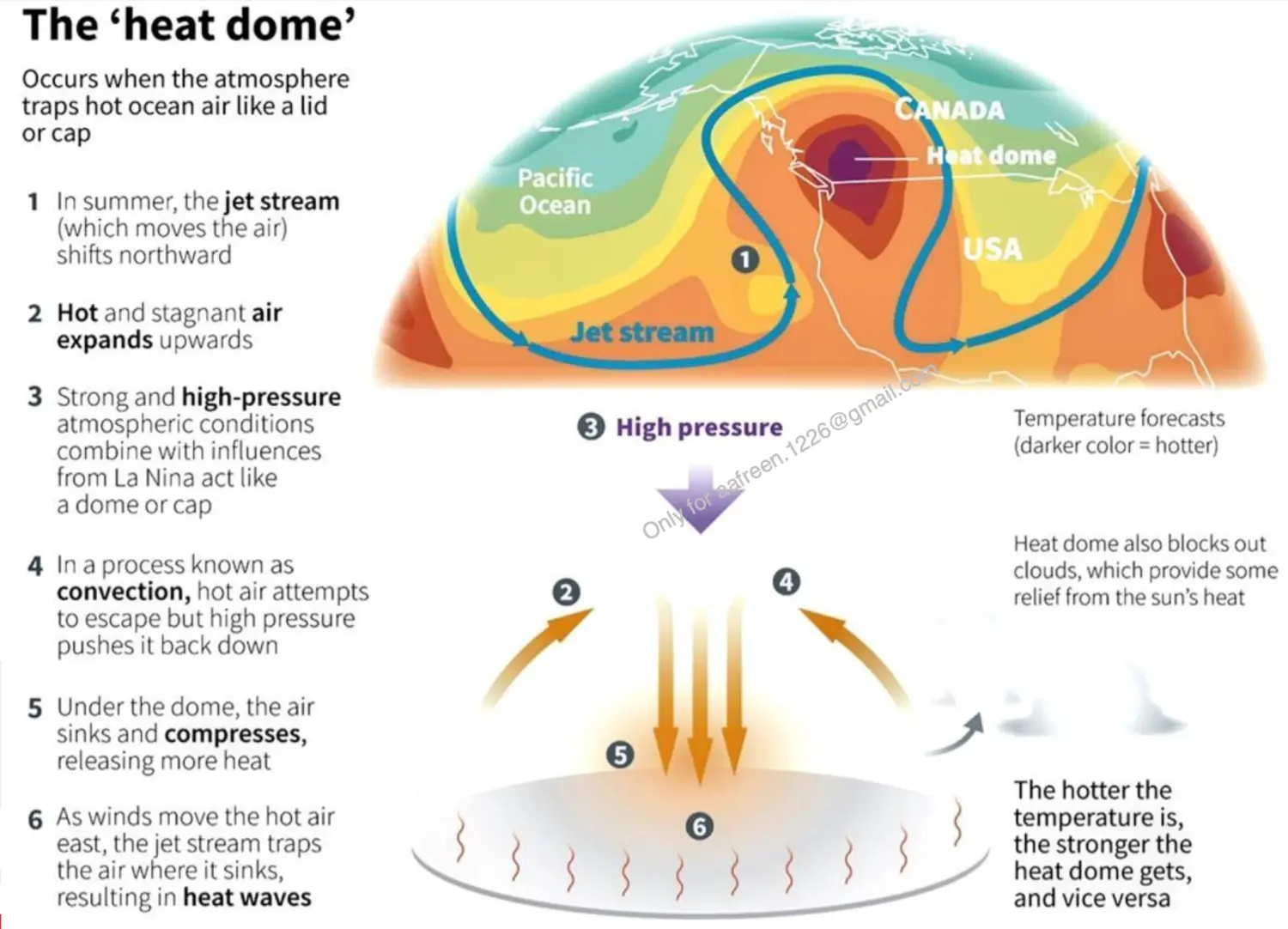
- It is a combination of multiple factors
- It is basically a phenomenon where northwestern Canada and the USA suffered very high temperatures for a few days.
- It was caused due to meandering of jet streams that traps the warm air.
- Global warming has reduced the pressure differences resulting in such conditions.
Biological Disasters
- Biological Disasters is a multi-sectoral and multi-agency problem.
- Guidelines by NDMA
Legislative Framework
A proper legal framework of policy, programmes, plans and SOP should be there to better implement the measures to deal with biological disasters
Capacity Development
for prevention such as vulnerability and risk analysis of various epidemics through disease surveillance programmes.
Development of facilities covering water supply, vector control etc.
Capacity development of the human resource like Medico and Non Medico Fraternity. Doctors, Administrators, Community and Society Should be aware
Development of Critical Infrastructure such as laboratory network, ambulance network, emergency communication network, diagnostic centres
Establishment of Command Control and Coordination Function
Pharmaceutical and Non Pharmaceutical Interventions such as monitoring status of cases, vaccination, social distancing, isolation, quarantine measures etc
Mechanism for Public Health Response
Biological Containment of Microbial Agents
Area of Research, Containment etc
Prelims Questions on Biological Disasters
- Nodal Ministry for Biological Disasters is for Ministry of Health and Family Welfare
- Health is a State Subject
- Lockdown by Centre was put under Disaster Management
- National Institute of Communicable Diseases
- Classification of Disasters