Science Updates
Concept of Forces
| Force | Particle | Characteristics | Role | | --- | --- | --- | --- | | Gravitational Force | Graviton | Not Yet Discovered | | | Electromagnetic Force | Photons | Repulsive or Attractive | | | Strong Nuclear | Bosons | Always Attractive | Dominates in Small Range, For Binding of Nucleus, Specifically Gluons is a type of Boson | | Weak Nuclear Force | Muons | Manifests in the form of Radiation, Hence Weak Nuclear Force is Responsible for Radiation and Radioactivity | |
Neutrino & Neutrino Detector
Neutrino have Negligible Mass and No Charge. It is difficult to detect because, It can [ass easily through Gravitational and Magnetic Fields. Hence they are unaffected for millions and billion of Years. Hence, thier study can give us real insight into the formation of Universe.
Photons are affected by Many Fields
But Neutrinos do interact with Water. How ?
Neutrinons Repsond to Weak Nuclear Force, When they Interact with Water, they Release Muons which emits small flashes of light and hence Neutrinos are detected
Super K experimentally confirmed the First Neutrino
Until Now, the Largest Neutrino Detector was in Antarctica i.e Ice Cube
Now it will be TRIDENT / Hai Ling / Ocean Ball in Pacific Ocean
Indian Neutrino Detector is coming up in Theni in Tamil Nadu
CAR T Cell Therapy
- Nex CAR 19
- Indigenous
- Only 600 Patients per Year Technology
Parker Probe
- Again became the Fastest Man Made Object in Space
- Aditya L1 is at L1
- JWST is Located at L2
- SoHo is Located at L1
Nasa to Launch Psyche Mission on a Asteroid
Asteroid - Between Mars & Jupiter
16 Pscyhe - Composition is allmost Metallic
It is believed that it might be core of some planet or proto planet
OSIRIS Rex for Bennu
Mission of Returning Some Particles of Asteroid → OSIRIS Rex → from Bennu Asteroid
This has brought the Largest Material from an Asteroid. Bennu Asteroid is important because Bennus Orbit intersects with Earths Orbit
DART Mission (Redirection)
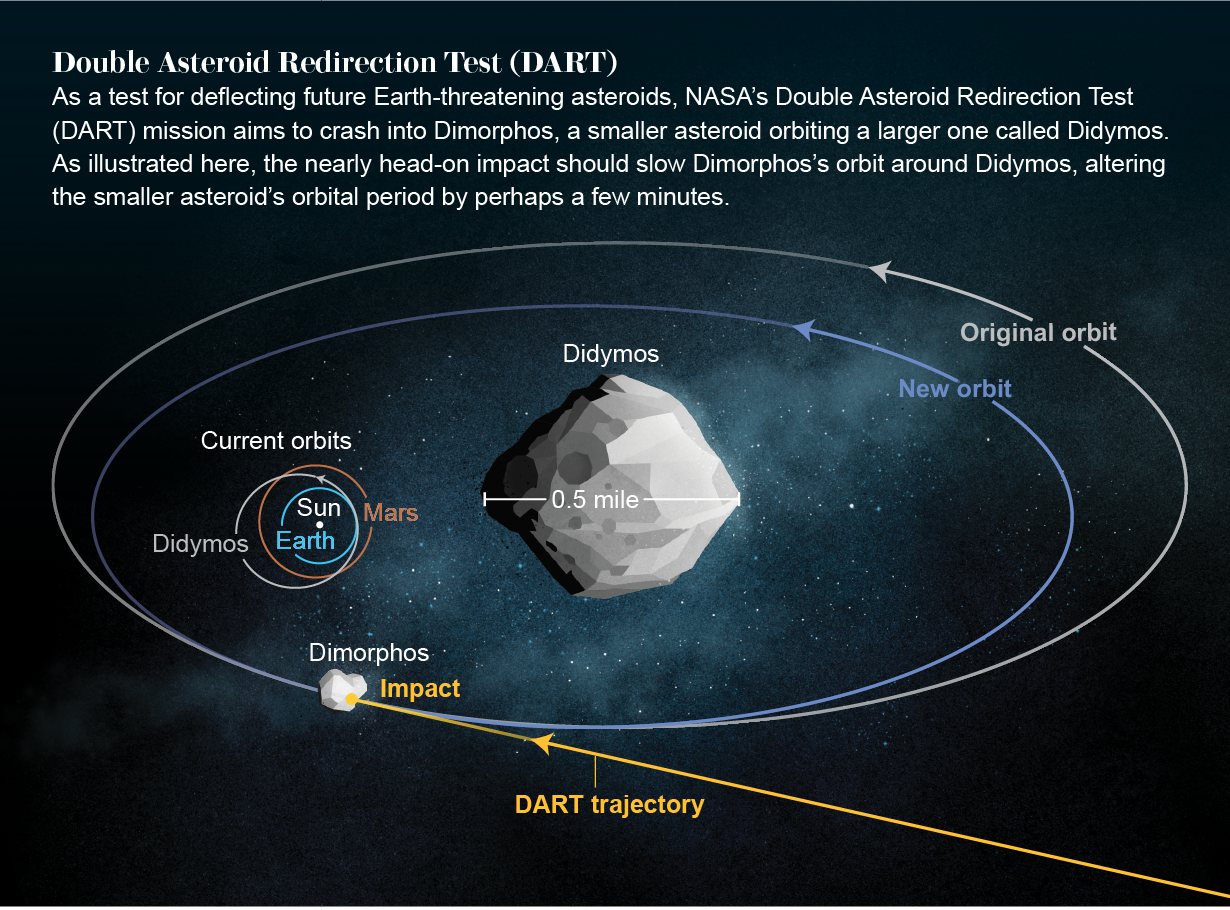
DART Mission - Double Asteroid Redirection Test
Double Asteroid → Binary System
Here the Two Bodies Are
Centre → Didymos
Around It → Dimorphos
OLICIA Cube → To Click the Pic of The Collision Between DART & and Dimorphos
Satellites Life is → Life of 3 to 4 to 5 Years in the Orbit. Most Orbits Decay
Deep Space Fiber Optics: Understanding Communication Technologies
- Current State of Technology:
- Optical mediums are not typically used for open-air communications.
- Li-Fi technology is restricted to confined spaces and isn't suitable for long-range open-air communication.
- Challenges of Open Air Transmission:
- Optical waves face attenuation, scattering, and other issues when transmitted through air.
- Space communication commonly relies on microwaves due to their ability to penetrate the ionosphere and withstand atmospheric disturbances.
- Speed and Efficiency:
- Presently, data transmission from Mars provides about 5 Mbps speed, taking approximately 7.5 hours to download one set of recordings.
- Optical air transmission is effective between spatial objects but problematic when interacting with Earth's atmosphere.
- Innovations in Laser Technology:
- Efforts are being made to use near-infrared lasers, which scatter less and can provide up to 100 Mbps by compensating for atmospheric disturbances.
- Lasers are preferred over white light due to their minimal scattering and higher precision.
- Challenges Ahead:
- Developing lightweight, energy-efficient lasers that can transfer significant amounts of data.
- Addressing the issues of data rates and transmission quality between Earth and other celestial bodies.
- Currently, near-red frequency lasers are used, avoiding frequencies beyond the visible spectrum due to potential harm to human life.
- Conclusion:
- While there are significant challenges in developing effective deep space optical communication, advancements in laser technology and a better understanding of atmospheric compensation offer promising avenues for higher speed, more reliable space data transmission.
- Current State of Technology:
Nano PTA: An Overview of Applications and Challenges
- Introduction to Nano PTA:
- Nano PTA refers to the use of nanotechnology to simulate enzymes that can break down harmful chemicals, similar to certain enzymes found in humans.
- Bio Enzyme Challenges:
- While bio-enzymes can treat environmental hazards like oil spills, their commercial production is challenging due to scaling issues.
- They require strict temperature conditions (below 0°C or above 40°C) and have high transportation costs.
- Bio-enzymes are not stable for more than 2-3 hours, limiting their practicality.
- Advantages of Nano PTA:
- Nano PTA offers a solution by simulating these enzymes using nano-molecules, providing stability for up to 75 days.
- Though more costly to produce, the increased stability and effectiveness justify the investment.
- Applications:
- Domestic and Industrial: Nano PTA is not universally applicable but is particularly effective in treating phenols and dyes in specific sectors.
- Medical: In medical applications, these nano-enzymes can break down substances like dopamine and adrenaline, aiding in the early detection and treatment of conditions like Parkinson's and Alzheimer's.
- Types of Nano PTA:
- Nano Lipids: These are lipid-based nanoparticles used in various applications, possibly including the delivery of these enzyme-like substances.
- Nano Enzymes: Directly related to Nano PTA, these are nanoparticles designed to mimic the action of natural enzymes.
- Conclusion:
- Nano PTA represents a significant advancement in environmental and medical applications by overcoming the limitations of natural bio-enzymes. Despite the challenges in production and cost, its stability, efficiency, and potential for precision in applications like medical treatment make it a promising field of study and development.
- Introduction to Nano PTA:
WHO Recommendation of R21 Matrix M: A Step Forward in Malaria Prevention
- Background on Malaria Vaccines:
- The first vaccine for malaria, Mosquirix, had limited success with an efficacy of about 30%.
- The need for a more effective vaccine led to the development of R21 Matrix M.
- R21 Matrix M: A New Hope:
- R21 Matrix M is in the final stages of trials and has shown promising results with an efficacy rate of around 75%.
- This represents a significant improvement over previous vaccines, offering the potential to drastically reduce malaria incidence.
- Indigenous Development:
- A notable aspect of R21 Matrix M is its development partnership with the Serum Institute of India, making it indigenous to India.
- This collaboration highlights the growing expertise and capability in vaccine development within the country.
- Adjuvant Technology:
- R21 Matrix M is an adjuvant vaccine, which means it uses a substance that enhances the body's immune response to the vaccine.
- The specifics of the adjuvant in R21 Matrix M involve a combination of components designed to boost efficacy and immune response.
- WHO's Role and Recommendations:
- The World Health Organization (WHO) plays a crucial role in evaluating and recommending vaccines for widespread use.
- As R21 Matrix M progresses through its final trials, WHO's recommendation will be critical for its acceptance and deployment on a global scale.
- Conclusion:
- The development of R21 Matrix M represents a significant advancement in the fight against malaria. Its higher efficacy and the involvement of indigenous institutions like the Serum Institute of India not only promise better protection against malaria but also demonstrate the potential for future vaccine developments and collaborations. With WHO's endorsement, R21 Matrix M could become a key tool in eradicating malaria globally.
- Background on Malaria Vaccines:
CERN Experiment Reveals Antimatters Response to Gravity
Dark Matter
Like Normal Matter it behaves and has tendency to Bind - it is called Dark because we cannot see it, anything in space it can only be seen if its interacts with electromagentic spectrum
Anti Matter - Every Matter has a Anti Matter which is excalty similar like that of the sub atom but its charge is only opposite
whenever matter is created Anti Matter is Created, when matter interacts with anti matter, it becomes zero it is anhilated
At the time of Big Bang, equal matter and anti matter was made
as of now we see 10 matter is there and then 3 Am is there, they should ideally be equal in universe, but the anti matter is less, it is one of the msyteries that the sceintiest are trying to solve
to destroy they have to cmbine
Innovative PANi
Capacitor - Charges Immideiatley and Discharges Rapdily
PANi- Poly Aniline and Vanadium Pentoxide nano structures
in battery there is chemical raction to produce energy where as in capacitors there is pure electrostatic potential
Mains 2023 Question
Ai 2023 Question
Generate Points X Ray and Machine Systems
Other Analysis outside of Focus As Well - Accurate Diagnosis and Prognosis
under Duress can someone really give an Informed Consent
You have to THINK & Write
Re Indentification and Linked Analysis
Standard Points - Dat Security, Processinf and Transmission of Data
What is a Bio Fuel
Introduction
Category of Alternate Fuels → Bio Fuels → Some Kind of Bio-Mass is converted into Energy
It happens Naturally → Coal → Very Long Time and Pressure
Alternate is Technology that we use to Create Bio Fuel
Types of Bio Fuels
- Solid
- Liquid
- Bio Ethanol
- Bio Diesel
- Gas
- Bio Gas
Classification of Bio Mass
Three Broad Categories Are
- Carbohydrates / Sugarcane → Sugarcane Juice → Bio Ethanol
- Lipids / Fats → Coconut Oil → Bio Diesel
- Cellulose → Bio Ethanol
Normal Use of Bio Mass
Most Common Form We Derive Energy from is Bio Mass → Wood Jalana
Biomass + O2 → Combustion → CO2+Energy+Many More Components
This is the Process of Oxidation
Bio Ethanol
Lets Assume there is No Oxygen
In that Case there is certain bacteria, which carries out Oxidation
Biomass → Anaerobic Conditions → CO2 + H2S (hydrogen sulphide) + CH4 (methane)
here the Methane will give me energy, this would normally happen under Anaerobic Conditions
Here CO2 H2S and CH4 is called as Bio Gas
Difference Between Bio Gs & Natural Gas
Natural Gas is CNG → Source of CNG is Oil Fields ke Upar ka Portion
Natural Gas is 95% Methane
Where as in Bio Gas is 50 to 60% Methane → Using Bio Gas Directly there is CO2 → Carbon Foot Print will be High
Also, the H2S will lead to Acid Rain and Corrosive Rain
Hence Direct Application of Bio Gas is Limited
Where as Natural Gas or CNG is a very clean fuel
| Field | CNG / Natural Gas | Bio Gas | | --- | --- | --- | | Source | Oil Fields | Bio Mass | | Process | Natural Geological Process
The Whole Process is Thermogenics | Artificial Process (Anaerobic) (Methanogenesis)
The Whole Process is Biogenics | | Composition | 90% Methane | This is only 50% Methane with combination of H2S and CO2 | | Efficiency | Higher Efficiency | Lesser Efficiency |
Methanogenesis - by Methanogens - Set of Bacteria which can carry out Anaerobic Respiration
Methanogen → Stagnant Water, Rice / Paddy Cultivation, Guts of Cattles
Compressed Bio Gas → Pollutants like H2S and CO2 is removed → CBG is a cleaner fuel
CBG and CNG allmost are similar → But here still CNG will be having better and higher efficiency as compared to CNG
Why Do We Compress → For Higher Energy Density → For Better Storage Capacity & Transportation !
Bio Mass (Sugar / Carbs) → Fermentation → Alcohol (Ethanol or Ethyl Alcohol → Bio Ethanol
Normally we do not target it as replacement of petrol and it is blended with Petrol → this will not work with Diesel Engines
Terms like E5, E20, E100 → 100 Parts Ethanol like in Brazil
E5 - 5 Parts Ethanol and 95 Parts Petrol
Bio Mass (Lipids)
Through a process called as Trans Esterification
Bio Mass → Trans Esterification → Bio Diesel
Bio Diesel → B5, B20, B100
B5 - 5 Parts Bio Diesle
Here, Micro Organism is not used, this is largely a Industrial Process
Microbial Fuel Cells
Electrogens → Bio Mass + H2O → Electrogens → CO2 + (H+) + (e-)
Process is Anaerobic
Electricity is Flow of Electrons
Generations of Bio Fuels
Sources are called as Feedstocks
First Generation Bio Fuels
Introduction
- Feedstock is Food Crops here example corn, sugar cane
- Process is MEthanogenesi and fermentation → Bio Ethanol and Bio Diesel
- COst it Low, Technology is Simple and Readily Available
Challenges
- Competition with Food Crops
- This leads to Hike in Food Prices
- Land Use Change
Second Generation Bio Fuels
Introduction
Feedstock is Agricultural and Forest Waste → Example Rice Husk → The Challenge is here cuz it is largely cellulose. Waste as in Humans cannot use it, hence Cellulose
Breaking Down of Cellulose → Costly and Technologically Demanding
Cellulose are broken down by Hydrolysis
Advantages
Do not compete with Food Crop.
Land Use Is not changed, as there is sufficient supply of Rice Husk
Challenges
Technology & Cost
Second Kind of Feedstock here is → Specifically Grown Plant called → Jatropa
Here Creating Energy is Easy
Third Generation Bio Fuels
Introduction
- Feedstock is Largely Alage (Algal Farms) → Give Lipids &
- Land Use Efficiency is High
- Agricultural Land is not required to be diverted
- Not in competition with Food Crops
- Scaling up of it is Easier
- No Carbon Foot Print
Challenges
- Cost is Higher
- Tech is available only in North America
Fourth Generation Bio Fuels
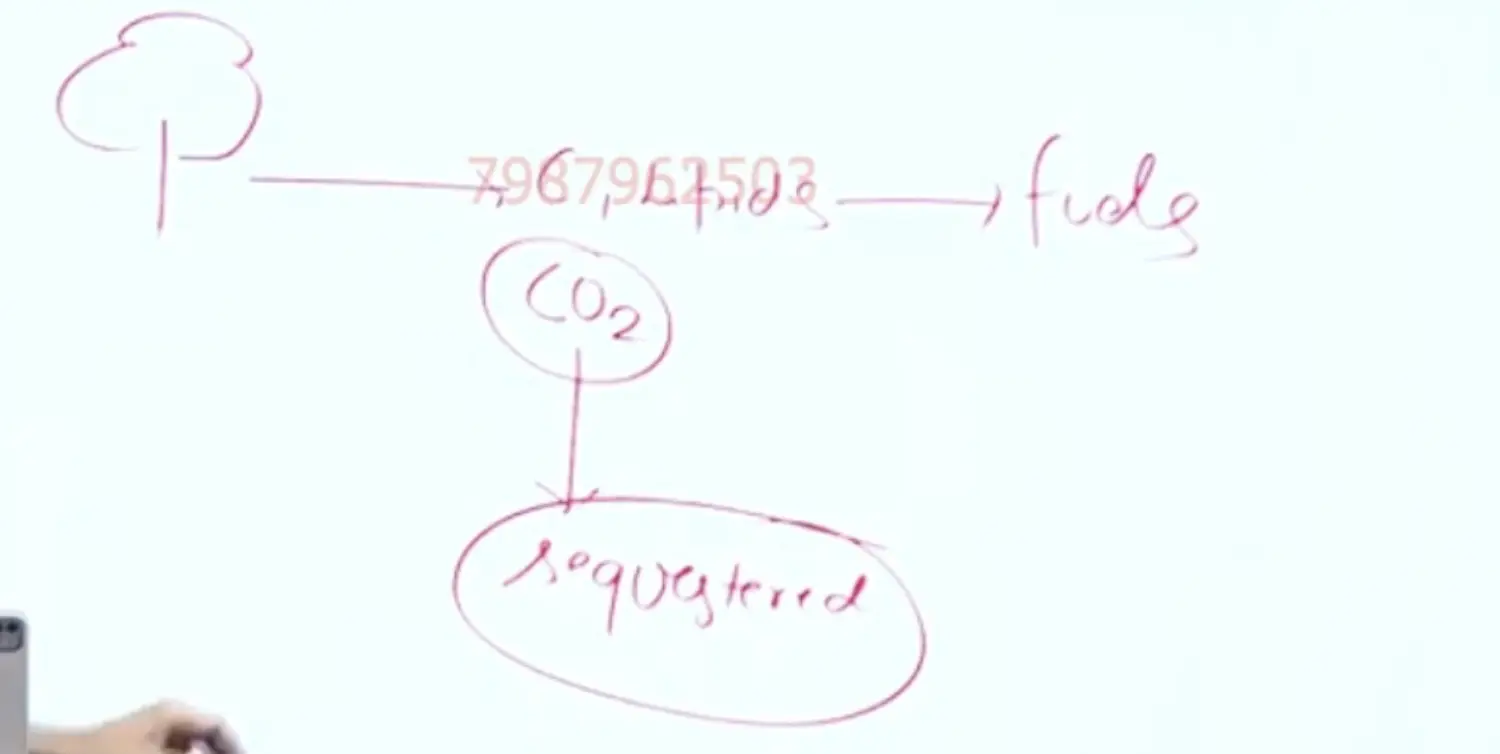
We specifically make plants which sequester 30% more carbon
Now we decrease the percentage of Lignin and Cellulolse
Goall of Gen 4 Bio Fuels
- Hence Now Carbon Asborption is Higher
- Bio Mass Formation is Higher
- Less Cellulolse
Process → We have to produce Fuel & Sequster at the Same Time
Challenges
- Costly Tech and Extra Cost of Sequestration
Advantages
- Good Energy
Note : Pending Second Gen Bio Fuel → equation for hydrolysis to convert cellulolse into energy
Bio Fuels and Electric Vehicle
In Terms of Carbon Foot Print which one is better is the source of electricity is green
Most of the Bio Fuels is Carbon Neutral → There is NO Net Addition of CO2 in the Atmosphere
EV’s are considered clean because they do not add anything to the Atmosphere
in Natural Gas and Bio Gas → Bio Gas is More Clean. In case of Natural Gas, atleast the CO2 or Ch4 was inside earth, whcih we have extracted and taken out and now with its usage we are adding extra co2 to the atmosphere which is not the case in Bio Gas
In Case of Cars, We talk about Tail Pipe Emissions
Limit for Green Hydrogen is 2 Kg CO2 for Per Kg of Hydrogen. The whole process has to be certified