ADITYA L1 Mission
Introduction:
- Name Origin: Aditya, meaning Sun in Sanskrit, signifies the mission's focus on studying the Sun.
- Launch Vehicle: PSLV-XL.
- Type: It is India's first space-based solar mission and the second observatory mission but the first dedicated solar mission.
Mission Details:
- Payloads:
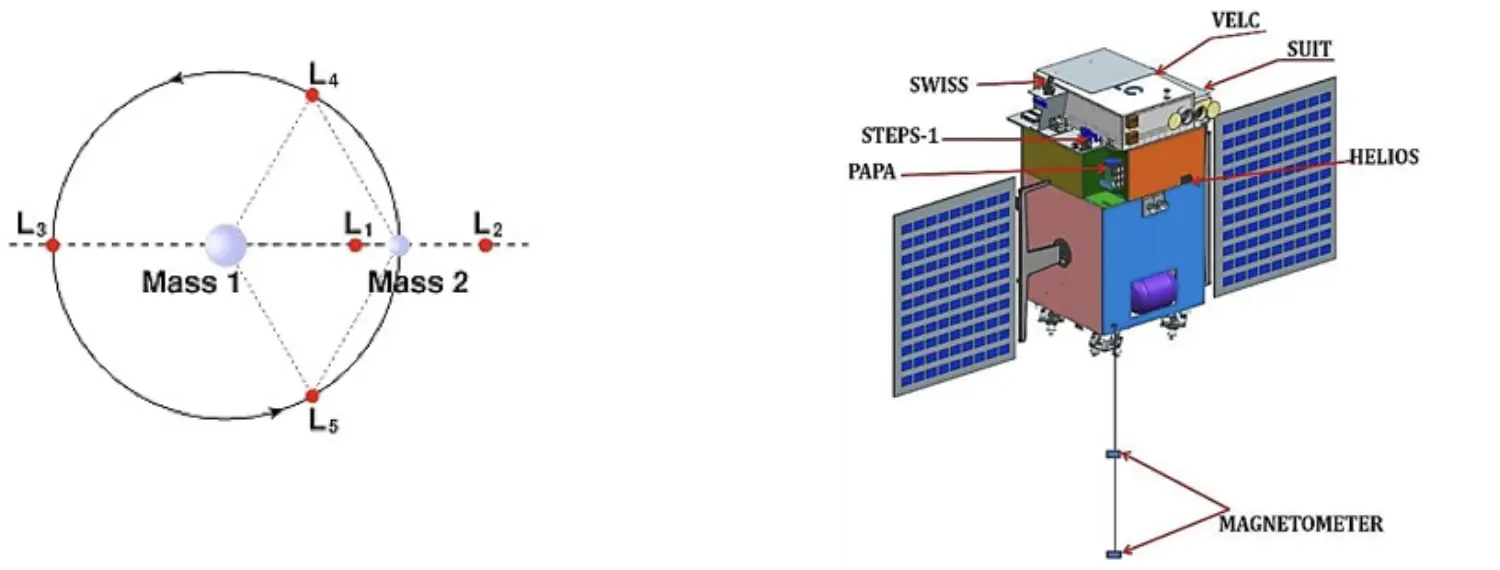
- VELC (Visible Light Emission Coronagraph)
- SUIT (Solar Ultraviolet Imaging Telescope)
- SoLEXS (Solar Low Energy X-ray Spectrometer)
- ASPEX (Aditya Solar wind Particle Experiment)
- HEL1OS (High Energy L1 Orbiting X-ray Spectrometer)
- PAPA (Plasma Analyser Package for Aditya)
- Advanced Tri-axial High Resolution Digital Magnetometers
- Orbit: Placed in Lagrange L1 orbit.
- Payloads:
Mission Objectives:
- To study the Sun's corona, photosphere, chromosphere, solar emissions, solar winds, and flares.
- To investigate Coronal Mass Ejections (CMEs).
- To carry out round-the-clock imaging of the Sun.
Location & Advantage:
- Positioned at the L1 point of the Earth-Sun system, providing an uninterrupted view of the Sun.
- The L1 point is advantageous as orbit corrections and fuel requirements needed to maintain desired orbits are minimum.
Lagrange Point
Comparative Solar Missions:
- Parker Solar Probe (NASA):
- Aims to trace how energy and heat move through the Sun’s corona.
- Studies the source of the solar wind’s acceleration.
- Helios 2 Solar Probe:
- A joint venture between NASA and the space agency of erstwhile West Germany.
- Went within 43 million km of the Sun’s surface in 1976.
- Solar and Heliospheric Observatory (SOHO) (ESA & NASA):
- Placed near the L1 point.
- Studies the Sun and its deep core.
- Parker Solar Probe (NASA):
Additional Notes:
Comparative Missions & Definitions:
- Fastest Man-Made Object: Parker Solar Probe.
- James Webb Space Telescope (JWST): Positioned at Lagrange L2 point and operates in Infrared.
Details of the Sun:
- Biggest Solar Storm: Occurred in 1856.
- Sun Spots: Temporary spots on the Sun's photosphere that are darker than the surrounding areas.