By Jatin Gupta Sir
Pillar 2 - Application - By JG Sir & VK Sir
Aptitude & Foundational Values in Civil Services
Sources
- Reading Newspaper → Real Life Example from Newspaper
- Awards
- Govt of India Awards
- Padma Awardees Etc
- PM Award Excellence in Pub Ad
- Govt of India Awards
- Second ARC : 10th Report on Personal Administration
- Value Added Material by Vision IAS
- Lexicon - for Basic Terms
- Previous Year Questions Since 2013
Values
Introduction
Values are intrinsic beliefs
of an individual that
guide and motivate one’s behavior
It could be Truthfulness, Respect for Others, Courage, Loyalty, Sincerity, Helpfulness
It can come from many varied sources like teachers, scriptures,
Examples
Conflicting Values 1

Conflicting Values 2
TT Old Lady No Ticket, Or Fine Her or De Board Her
Conflicting Values 3
Boss Says lathi charge, Mob MAY turn violent, Mob haven’t yet
Ethical Dilemma
Its a tough situation to chose one value over another where neither of one is outrightly wrong than another
Foundational Values for Civil Services
- These are those values or principles that form the very basis of an Organization
- In other words, they formed the core identity of any organization
- These values are given the highest priority in the functioning of an organization
Sample Foundational Values of Some Organisation
- Tata - Employ Centric Policies
- Maruti - Focuses on Safety & Security of Employees
- Vision IAS - Innovation
- Apples - Quality
Home Work : Foundational Values of Bug Business Houses
Importance/Significance of the Foundational Values of the Civil Services
What is the Importance of Foundational Values to be studies and understood for Civil Servants ?
Civil Servants possess wide discretionary powers and by following the foundational values they can maximise public goods
To Minimise Exploitation of Power for Personal Gains for CS
Often Civil Servants end up in ethical dilemmas, in such situations foundational values can help them make decisions
These foundational Values help in establishing trust between the citizens and the civil servants
Foundational Values help in ensuring consistency in decision making
It helps in ensuring the maximum utilisation of limited resources for the well-being of society
Sources of the Foundational values
- Constitution : It is the most important source for civil servants and citizens. It could be Preamble, Fundamental Rights, DPSPs.
- Laws : Made by the Legislature
- Scriptures : Spiritual and Religious Texts
- Leaders :
- Steadfast Adherence of Gandhi Ji towards Non Violence in withdrawal of NCM after Chauri Chaura
- History : Historical Events and Precedents
- Ashoka
- Resignation of Ambedkar for not being able to Pass Hindu Code Bill
- Memoirs : Memoirs of the Retired Civil Servants
- Kiran Bedi - Chalan of PM Convoy
- Shastri - Resigned after Train Accident
- T N Seshan
- P S R Subramanyam
- Reports & Rules
- Nolan Committee Report
- UN Code of Conduct for the Public Officials 1996
- All India Civil Services Conduct Rules, 1964
- Central Civil Services Conduct Rules, 1968
Values are not always universal and are varying in nature depending on space and time
Example of the American soldiers wearing underwear made with American Flag
The symbolic value of patriotism is not prevalent in America
They are not Edged in Time & Place

Example of PDA in India && PDA in Metro && PDA in France
Example of Choice of Vaccine in India and Vaccine in USA
Hence it is important to understand, that Foundational Value of Civil Services is different from values of other Organisations
Sympathy/Empathy/Compassion
They are generally used in similar context, but they are different. In increasing order of the complexity
Example
Old Lady in Cold Winters of Delhi
Sympathy
- It refers to a situation where an individual recognises the pain or agony of other individuals
- But it stops there, there is no action
Empathy
- Its a Step Ahead of Sympathy, What would I feel like if i were in her situation
- Here you involved your thoughts, mind and cognitive senses
- Empathy on the other hand is putting one’s self in the position of someone who is in pain and relating to the same.
Compassion
Compassion is feeling the Pain of an Individual && taking actions to relieve someone from the pain and suffering one is experiencing
How to Reach Compassion
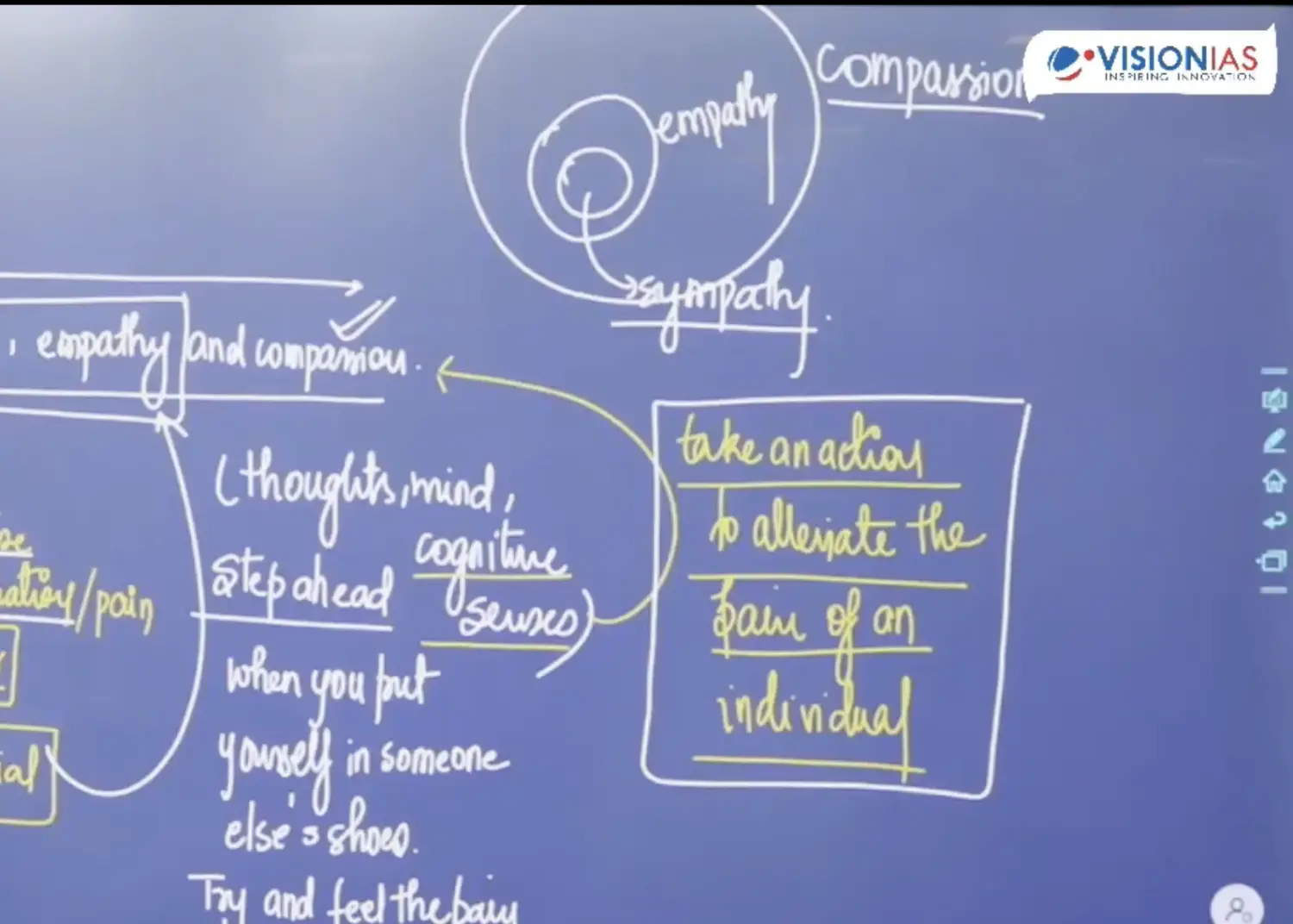
Compassion is a Four-Step Process
- Being aware of someone’s feelings
- Being emotionally moved by someone’s suffering
- developing a desire to resolve the suffering
- Taking necessary steps to resolve the suffering
Example
- Avanish Sharan admitted his child to the government school of his district and ate mid day meals
- Swati Bhadoria admitted her child to Anganwadi Centre
- DM Gopalganj went to eat Mid Day Meal cooked by a Dalit
Home Work for Abdal
Find examples from the lives of Civil Servants, Public Servants, those who showed compassion
Find examples in your life where you exemplified compassion
The Importance of Compassion in Civil Services
All the other values are meaningless without compassion
Application of Laws with Feelings and Emotions is a Must
The end goal of civil service is to serve the people and that cannot be achieved without compassion
It helps in winning the trust of the people and bridging the trust deficit that exists between citizens and civil servants
It helps in ensuring Citizen Centric Administration
We are often victims of various stereotypes in society which can be addressed by empathy and compassion
Example : Police Stereotype that fault is of Small Cloth and She went out at midnight
Compassion is often referred to as the mother of all the values in civil services
Methods to Inculcate Compassion in Civil Services/Civil Servants
- Organising regular field visits
- Organization of the “Janta Darbar”
- Role Play Activities
- Bharat Darshan during IAS Training
- Organising sensitivity training for the civil servants
Home Work for Abdal
Find other examples that how to Inculcate Compassion
Objectivity
Meaning of Objectivity
- Being objective means taking decisions or actions on the basis of analysis and critical thinking. It also means not being influenced by one’s personal feelings and opinions
- One can also say that objectivity is a lack of biases, prejudices, and stereotypes in taking decisions
- Decisions are taken in a rational manner
- Takes decisions on the basis of the facts, evidence, figures, and analysis of these facts and figures
- Subjectivity is opposite of the objectivity. Subjectivity means the decisions made on the basis of the biases you suffer
Importance of the Objectivity for Civil Services
To give a fair chance and to ensure the principle of equality
It promotes merit
It also gives a sense of fairness to the citizens
Protect the trust of the citizens in Civil Services or the entire democratic system
It prevents corruption
Whom to Award Tenders To ?
It can prevent biases from creeping into decision-making
It reduces errors in decision-making.
Methods to Inculcate Objectivity in Civil Services
- By deploying technology such as data analytic tools
- By providing a decision-making framework to the civil servants
- By SWOT Analysis - Strength Weakness & Opportunity & Threats
- By Pros and Cons Listing
- By increasing the open debates, deliberation, and discussions
- By promoting critical analysis
- By Promoting Social Audits
- By soliciting citizens' feedback through surveys, consultations, Citizen's report cards
Absence of Objectivity Leads to
Sadhu Dream of Buried Gold, ASI Starts Digging
Courage and Fearlessness
- Meaning
Courage is the ability to make decisions, take actions, and stick to one’s values and principles even when there is a possibility of unfavourable outcomes.
Example :
Sam Manik Shaw opposed the order of then PM Indira Gandhi of attacking East Pakistan and Sam Manik Shaw Resigned
By the Time we mobilise troops in East Pakistan, there will be Monsoon by then
It means to speak truth to power and not to fear the outcome
- Home Work : Examples of Courage by Civil Services and Public Life
Ashok Khemka
T N Sheshan
Head of Election Comission of India
Vikram Batra
Satyendra Dubey
Killed by Mafia
S C Manjunath
Mahatama Gandhi
Going to Dandi and Making Salt
Mangal Pandey
Justice H R Khanna - KSN Bharti Case
BSF Jawan : Talking About Bad Quality of Food
- Importance of Courage and Fearlessness in Civil Services
- Helps in decision making however tough the situations/Circumstances are
- It helps in standing against the irregular activities in the government
- Helps the civil servants in taking quick decisions as they do not have the benefit of hindsight
- It helps the civil servants to stick to their core values and principles
- How to inculcate Courage and Fearlessness in Civil Services
- Rewarding and recognising the act of courage by Civil Servants
- A code of Ethics should be introduced for the Civil Services
- Enacting a strong Whistleblower mechanism within the Civil Services. Proper Functioning of Such Grievance Redressal Mechanisms is also Important
- Making the process of appointments/promotion/transfers Apolitical in nature
- Creating an internal grievance redressal mechanism
- Meaning
Tolerance
Meaning
Respecting Views/Opinions of Others
Acknowledgment of Differences
Defintion
Tolerance is giving respect to the views/opinions of others even though they may be in conflict with one's own views
Importance of the value of tolerance in the context of Indian Civil Services
To protect the multi-religious, multi-ethnic Indian society with varying practices, traditions and beliefs.
There is intra-religious diversity as well
For example: In some cultures, Ravana is worshipped
Helps in giving a voice to the opinion of minorities, marginalised and backward communities
Helps Protect the Minority from Majoritarian Dominance
Helps in upholding the fundamental right of the freedom of speech and expression under Article 19
A long-lasting solution to a problem can only be achieved through discussion, deliberation and a consensus-building approach. This is possible by means of values of Intolerance
Is Indian society Intolerant in nature?
There have been instances in the past where cases of intolerances have emerged.
however, if we look at the differences in cultures, religions, languages, India has still existed and has maintained its unity. Thus broadly we have to argue that India is a tolerant society.
Thus the very existence of India as the most diverse country of the world, is the testament to the fact that India is tolerant
However, one can mention:
Threats to tolerance in Indian Society
Political parties try to use religion, caste, beliefs in order to get petty political gains.
Attempts are made by political parties to polarise Indian Masses
Social media is used to circulate fake news, instances trying to divide the people, create outrage & disturb communal harmony
For example, the Muzaffarnagar Riots
Threat to tolerance from Traditional Media sometimes deliberately manufactures hate, outrage, etc.
It tries to inflammate Feelings unnecessarily by fabricated News
Developing tolerance among civil servants
Exposure to different cultures, traditions, etc through Bharat Darshan, field visits, books, etc
Encouraging a culture of debate & discussions in a respectful and structured manner
Celebration of different festivals, organising cultural events,
Example : India Day at LBSNAA Example : According to R C Guha, India is a Salad Bowl Example : 26 January Tableau
Organising sports and related events / activities
Example : Cricket Binds India Example : To Encourage Spirit of Esprit De Corps
Dedication to Public Service
Dedication
- To Put Ones Mind, Body and Soul to a specific thing or activity
- It should not be external, it should be internal
- Putting Ones Soul into an Act
- Dedication is the quality of being able to give or apply one's time, attention or self entirely to a particular activity, cause or an objective
- It is a commitment with passion and personal urge to do something without any external force or power to enforce that urge
- Hence, Dedication should come from within a person. This helps in being consistent to dedication
Dedication to public service
Dedication to public service refers to committing oneself to the cause of the public and perseverance to serve the public interest despite obstacles and challenges
Significance/Importance of dedication in public service
The very purpose of civil services is to improve the lives of the people to contribute to society which would get defeated in case there is no dedication to public service
To deal with adverse situations like when there is a lack of resources when the work environment is not conducive
For Example : Armstrong Pame, an IAS officer, earned the nickname “Miracle Man” for creating a 100-kilometre road connecting Manipur to Nagaland and Assam in a remote part of the hills state of Manipur without any government assistance
To always put the public interest over one's own interest. Civil servants enjoy huge discretionary powers which can be used for personal gains. Thus the value of dedication is a must in civil services
Without this value, a Civil service will eventually run out of motivation. This helps to work without the opium of External Motivation
A Civil Servant has a lot of Discretion, with dedication its misuse can be prevented
A civil servant encounters several social obstructions in the implementation of a programme
In such a situation, without dedication to public service, one may never be able to achieve the desired objectives
For Example : Vaccine hesitancy was observed during the Covid vaccination drive. The public servants had to personally reach out to people to clear their doubts
For Example : DM Gopalganj
A job of a civil servant is a 24*7 job and the will to continue for long hours can come only when one is dedicated to the public service
For Example : SDM from Tonk in Rajasthan, on time
For Example : Officers Working during Covid and Responding
For Example : IFS Paris and India PMO Time Mismatch
Way to Inculcate Dedication to public service in the civil servants
- Reward and Recognition to the best performing officers so that it will encourage even other officers to work hard
- Conduct regular training sessions to sensitise civil servants towards the challenges faced by the citizens
- Volunteer Sundays can be used to address some specific issues of the masses
- Teaching civil servants through inspiring stories and examples
- Teaching through Religious Scriptures
- Performance linked appraisals like given in private sectors
- Setting objective targets like KRA(Key result areas)/KRI(Key Result Indicators)
- Feedback about Performance of Civil Servants
Impartiality and Non-Partisanship
Impartiality
- It refers to the act of not supporting one person or a group over the other. In simple words, it means not taking any sides
- Essentially it means taking decisions on the basis of merit without any personal biases and prejudices
Non-Partisanship
- It refers to not allowing personal political ideology to come in the way of taking decisions
- A civil servant is expected to remain politically neutral and implement the policies irrespective of who is in power
Special Note
Even though impartiality and non-partisanship are used interchangeably with each other, non-partisanship has a special meaning that connotes apolitical / Political Neutrality behaviour by a civil servant
Because Civil Servants are responsible for Implementation of Policy Implementation and this has to been done by the policy formulators (political representatives who are chosen by the will of people)
Note :
You can have your own political ideology because you are also a citizen of India but that you cannot allow that ideology to interfere in you Work
Importance and significance of impartiality and non-partisanship
- It helps in maintaining the trust of people in democracy.
- Civil servants have wide discretionary powers and they should be used only in the public interest
- It helps in upholding the value of civil services neutrality.
- Only when a civil servant is non-partisan can he/she show courage to suggest alternative policies to the ministers
- Transformations in society can not be introduced with a biased mind
- India is a diverse society with varying interests. Therefore, civil servants are expected to be neutral while implementing the policies
Inculcation of the values of impartiality and non-partisanship
Creation of Civil Services Board to decide appointments and transfers so as to make them politically neutral
Example : CSR Subramaniam v/s Union of India SC Suggested Creation of Civil Services Board
An objective criteria should be created while deciding promotions in the services like KRA & KRI
Defining the minimum duration of posting and a fixed tenure for important appointments and posts
This allows them to take bold decision
Mandatory cooling-off period for civil servants resigning from the job
Example : To Prevent Joining a Political Party Immediately after resigning
A strong emphasis should be created on inculcating values of neutrality among the civil servants by training them under retired and senior civil servants of repute
In Simple Words, Assign a Mentor to Civil Servants
Example : Lectures in LBSNAA
Honesty & Integrity
Meaning
Often honesty and integrity are considered synonymous with each other but there is a basic difference between the two values.
Honesty refers to the quality of being truthful and sincere in one's conduct It is an external concept and does not guarantee the highest standards of behaviour
Not having any rouge intentions. Having Values of Truthfulness
Integrity comes from the Word Integer meaning Wholesome
On the other hand, Integrity is the mother of all values.
It refers to steadfast adherence to the highest standards of behaviour and consistency in one's actions, thoughts and behaviour irrespective of time, place and circumstances.
Relations between Honesty and Integrity
a person of integrity is always honest
a honest person may or may not be a person of integrity
Integrity is the quality of being honest even when no one is watching
consistency in ones actions, thoughts and behaviours
Honesty is a sub value of integrity
Integrity is a 3 step process that involves the following:
- Choosing the right course of conduct
- Acting consistently with the choice even when it is inconvenient or unprofitable to do so
- Openly declaring one's stance on issues
Honesty as a subset of integrity
Integrity implies a number of values including reliability, consistency in one's principles and values and honesty.
Therefore, one can say honesty is a necessary though not a sufficient criterion for integrity.
For Examples: Committed a Murder / Committed Steal
- Honesty : You Accept You Did it
- Integrity : You don’t even think about doing this
To be a person of integrity, one has to be honest, but merely being honest does not make an individual a person of integrity.
For Examples: Accepting that one has taken a bribe will come under honesty whereas an integral person will not even think of taking a bribe.
Your brother has committed a murder, someone might start justifying the act that certain circumstances led to the act however, an integral person will consider it wrong irrespective of the circumstances.
When you hold yourself to the same standards as you hold the others to, then you are an integral person.
For Examples:
- Lal Bahadur Shashtri did not use the ink of his government office to write his personal letters
- Kiran Bedi Gave ticket to PM Convoy Car in Khan Market Delhi. This showed indifference to any person in power or not in it
- Kalam’s Refusal of NASA’s Offer
- Dhoni calling back Ian Bell after being given out
- Sachin Tendulkar Moving Out of Stadium when he was out himself
- Traffic Light at Mid Night
- Honesty : Stops when a Camera or Police is there
- Integrity : Stops no matter theres camera or anyone else or not
- Self Example
- Mother Said No Sweets, Papa Said Eat, I will bring New Box, Saying No
Homework: Need to find examples of each value discussed from your own life or from people who are involved in public life.
Significance of Integrity for Civil Servants
- Civil servants enjoy wide discretionary powers and in the absence of integrity, they may end up using the same for their personal benefits
- It helps in building the trust of the citizens in the functioning of the system
- Without integrity, corruption thrives in society and other values also get compromised in adverse and challenging situations
- Civil servants are role models for society and therefore it is expected that they will show staunch adherence to various values and principles
- For efficient and effective utilisation of limited resources, it is important that civil servants show integrity
Ways to Inculcate integrity - General
- Assigning mentors to young civil servants at early stages of their career so that they know how to react in adverse situations.
- Appropriate punishment and reward mechanism for civil servants embroiled in corruption and showing exemplary behaviour.
- Enactment and adherence to a strict code of conduct.
- Creating a code of ethics that should guide the behaviour of civil servants in situations where the law is silent.
- Reforms should be introduced in the recruitment process so that candidates are checked with respect to their moral standing and values.
- Inclusion of value-based training and curriculum in the training methodology of young officers
Nolan Committee's Recommended Values (United Kingdom)
This committee gave the Seven Principles of Public Life
👨🏫 SAHILOO - Self, Acc, Honesty, Integrity, Leadership, Openness, ObjectivitySelflessness
Holders of public office should take decisions solely in terms of the public interest. They should not do so in order to gain financial or other material benefits for themselves, their family, or their friends.
Integrity
Nolan committee has defined integrity in a very narrow sense.
The committee says that holders of public office should not place themselves under any financial or other obligation to outside individuals or organisations that might influence them in the performance of their official duties.
Objectivity
In carrying out public business, including making public appointments, awarding contracts, or recommending individuals for rewards and benefits, holders of public office should make choices on merit.
Accountability
Holders of public office are accountable for their decisions and actions to the public and must submit themselves to whatever scrutiny is appropriate to their office.
Accountability is not just about being answerable for one's actions but includes the component of scrutiny or punishment in case of any violations.
Responsibility is completing the Work. Accountability includes accepting future questions, if arbitrary actions is done punishment should be allowed
Ex : Social Audit, Lok Pal,
Openness
Holders of public office should be as open as possible about all the decisions and actions that they take. They should give reasons for their decisions and restrict information only when the wider public interest clearly demands.
This can be improved in the case of India where secrecy is preferred over open dissemination of information.
Example : Sealed Envelope Culture
Honesty
Holders of public office have a duty to declare any private interests relating to their public duties and to take steps to resolve any conflicts arising in a way that protects the public interest.
Example : Declaring Conflict of Interests, Recusing Yourself Example : When Public & Self Interests are at Logger Heads
Leadership
Holders of public office should promote and support these principles by leadership and example.
Homework:
- Try to find examples for each of the values stated above
- Write These in You Own Words
Ethics in Public Administration
Introduction
- Governance
- Governance as a Process refers to
- It refers to the decision-making process in running a nation.
- It can relate to
- internal security
- welfare measures
- foreign relations
- Ethical Governance
- It is the governance that is carried out with ethical concerns in the mind.
- It is a step ahead of the concept of “good governance” elaborated upon by the World Bank
- Ethical governance seeks to realise certain universal desirable values, and not merely values of administrative efficiency.
- It includes both efficiencies of administration and universal human values.
- Key elements of ethical governance are based on some basic values such as
- Probity (the quality of being incorruptible)
- integrity
- compassion
- responsibility
- social justice
- rule of law etc
- Importance of ethical governance - Real Life & Current Affairs to be added for Each Point
To Accommodate the Increased expectations of citizenry due to the forces of globalisation.
India v/s Scandinavian Nature of Delivery of Governance
To ensure effective utilisation of resources.
To bridge the trust deficit that exists between the government and the citizens.
To protect the interests of the weak and the marginalised.
To ensure a citizen-centric model of governance.
To overcome issues such as corruption, nepotism, favouritism, etc
- Example : Jet Airways, Axis Bank Case
Ethical Issues and Dilemma
Ethical Issues in the Indian administration - Real Life & Current Affairs to be added for Each Point
Excessive political interference
Bribe taking
Complacency in civil services
Career Based Civil Services
Excessive use of discretionary powers for personal gains
Secrecy is the norm and transparency is an exception
Nepotism and favoritism
Delay in the decision-making process
Example of March Rush
Psychology of Govt Services - Psychology of Evasion
Lack of empathy and compassion in public dealing
Example of Use of Physical Force(Slap) during Corona Epidemic
Lack of Due Care and Negligent Attitude towards Implementation Rule
- Collapse of Building
- Instance of Fire in Market
Excessive Political Interference in Functioning of Bureaucracy
Ethical Dilemma
It is a situation of conflict among two or more values where a decision is to be made.
An ethical dilemma usually gets created where all the available options are in conflict with each other.
For Example:
During Covid 19, a migrant worker walks on foot to reach his hometown where a strict lockdown has been put in place by the administrative authorities.
Various Ethical Dilemmas faced by public servants in India
Where One Value is Compromised at the cost of another
It is fight between tow good Values
Efficiency v/s Accountability
Conflict between Personal values v/s Directive of a Senior
Lathi Charge on Angry Mob
Professional Ethics v/s following an unjustified order by a supervisor
Compassion & empathy v/s Objectivity
Compassion & empathy v/s Principle of Legality
No Ration w/o Aadhar Card
Truthfulness v/s Secrecy
Privacy v/s National Security
On Suspicion Tapping of Phone
Code of Conduct v/s Accepting an Award
Urgency v/s Legality
Urgency v/s Accountability
Environmental Sustainability v/s Livelihood of People
IFoS v/s Villagers of Forests
Homework : From Previous Year Questions of case studies of UPSC
- Governance
Probity in Governance
Meaning of Probity
- It is the quality of having strong moral values and principles such as honesty and integrity in governance processes.
- Probity as a term is used in the context of institutions in the same way integrity is used in the context of individuals.
- Probity in governance automatically means the absence of corruption from public life.
- The other requirement of ensuring probity in governance is effective implementation of rules and regulations and adherence to such principles that ensure public interest & priority
- Probity in Governance
- Absence of Complacency
- Rule of Law
- Decisions will be on Public Interests
Importance of Probity in Governance
Effective utilisation of resources
Helps in building public trust in institutions
Opposite Example : CBI being a Cage Parrot according to SC
Helps in fulfilling the expectations of society
It helps in ensuring accountability of the institutions to the citizens
Example : UPSC
It prevents misuse of the wide discretionary powers provided to public institutions in India
Setting an example of right conduct for citizens as well as for public servants
To attract the best talent to administration
For Example : CAG played a very major role in unearthing scams like- Coal Scam, CWG Scam, 2G spectrum Scam, etc.
Measures to ensure Probity in Governance
RTI and Suo-Motu disclosure in information
Citizen Charter - Detail from Governance
For Example : of Punjab
Social audit, which ensures vertical accountability
For Example : of MGNREGA
Code of conduct and code of ethics
Deployment of technology to reduce human interface.
For Example : Online registration at RTO & Passport offices - Reduced the Corruption, Entire System has been moved online
2nd ARC’s Integrity Pacts
For Example : It is a vigilance tool signed by government with various vigilante people
Strengthening of Lokpal & Lokayukta
Citizens Report Card
Deployment of Technology
For Example : Biometric & GPS Tracking - PDS
Bucketing of Issues
- Legal Measures
- Institutional Measures
- Internal Measures
Code of Conduct & Code of Ethics
Meaning of Code of Conduct
- Code of Conduct refers to a specific set of guidelines provided to members of an organization with the objective of providing the do’s and the don’ts
- For Example : Code of conduct for central civil services prescribes that civil servants should not accept gifts from outsiders above a certain value and should report the same to the concerned authorities
Meaning of Code of Ethics
- Code of Ethics refers to a general set of values and principles that should be adhered to by members of an organization
- They do not have any legal backing but rather a moral force
- For Example : Civil servants are expected to uphold the principle of transparency in governance even though it does not have any legal sanction
Differences between code of ethics and code of conduct
- Code of ethics is generic in nature, as compared to code of conduct which is specific.
- Code of conduct is legally enforceable whereas code of ethics does not have any legal backing.
- Code of conduct is explicit in nature whereas code of ethics is implicit in nature.
- Code of conduct focuses on the compliance of rules and regulations whereas the code of ethics focuses on values and principles
| Code of Conduct | Code of Ethics | | --- | --- | | Specific | General | | Legally Enforceable | No Legal Backing | | Explicit in Nature | Implicit in Nature | | Focus on Compliance of Rules & Regulations | Focus on Values and Principles |
Significance/Importance/Need of Code of Ethics and Code of Conduct
IT can help in resolving ethical dilemmas
For Example : Politician calls you up to provide preference to a candidate for a govt job
They prevent unethical behavior on the part of civil servants
Civil servants are entrusted with the resources of the community. Following Code of Conduct and Code of Ethics, it can help in maintaining public trust and preventing misuse and inefficient utilisation of resources
Adherence to the code of conduct and code of ethics would result in a better work culture in public organisation
Adherence to the code of conduct and code of ethics can help in ensuring the sustainability of government institutions
It can help in ensuring uniformity in the actions of civil servants
Can help in reducing Stress on Civil Servants
To Resolve Ethical Dilemmas
Decision Making in Adverse Situations
Limitations of Code of Conduct and Code of Ethics
- Code of Conduct
- They may not be able to in all situations
- In most cases, they are not legally enforceable and their enforcement is dependent on departmental discretion
- Often Mechanism to Enforce Accountability in Implementation of Code of Conduct are missing
- Code of Ethics
- There is no possibility of even departmental discretion
- They are at times too ambitious to achieve
- They are generally vague in nature
- Adherence to the Code of Ethics boils down to an individual civil servant
- There is no incentive for following the code of ethics
- They can be very difficult to adhere to in the prevailing circumstances where excessive political interference is there in routine administrative matters
- Both Together
- The dwindling of moral values has happened to such an extent in pub services already that Code of Conduct and Code of Ethics have a negligible impact on probity in governance
- Code of Conduct
Steps to Improve th effectivity of Code of Conduct & Code of Ethics
- The enforcement of the code of ethics and code of conduct should not be left upon the discretion of an individual
- Code of ethics and code of conduct should be supported by commensurate service delivery standards, strong accountability, and transparency mechanisms
- The code of conduct should be made legally binding and the code should lay down the course of action in case of violation
- There is a need to learn from the private organization as many of them have effectively implemented the code of ethics creating an environment where employees identify themselves with the organization and its objectives
- The 2nd ARC has recommended that the code of ethics and code of conduct should only be drawn up after consulting with multiple stakeholders
- To make the code of conduct and the code of ethics effective, public service values should be inculcated in young civil servants at the early stages of their careers
- Creating Incentive Mechanism for Adherence to Code of Ethics like in Private Sector
Aptitude of Civil Services
Framework Mind Map


Meaning
It is the innate ability of the person to acquire a skill after training and practice
Aptitude refers to natural ability or innate potential to learn or acquire a skill. In other words, aptitude is a natural talent or inborn ability that makes it easier for a person to learn or to do certain tasks
For Example: Having an aptitude for music is the basic requirement for becoming a musician
Learning or acquiring certain skills comes more easily and naturally to some people whereas others require great effort and practice
Aptitude as a concept focuses on the future potential of an individual to acquire certain specific skills
Varies from Person to Person
- Scientist - to have aptitude for solving scientific questions
- Cricketer - to have aptitude for sports and its pointers
Importance of Aptitude for Civil Services
- With the increasing complexity of governance, a civil servant needs to possess the requisite aptitude to be able to perform his duties effectively and efficiently.
- Only when aptitude is coupled with interest/desire to be trained and acquire capability, a person becomes skilled
A civil servant must possess the following aptitudes
- Intellectual Aptitude
A person should possess the intellectual capability to think logically and rationally and must also possess the desired knowledge level
Whether one has the aptitude to be able to identify the right solutions
- Emotional Aptitude
Emotional Aptitude is very important as the civil servant has to undergo an emotional roller coaster ride during his tenure
For Example : During the Covid pandemic, many civil servants were not able to provide the desired facilities to the people due to a lack of resources, adequate knowledge, etc.
However, a civil servant must be able to handle his emotions well.
It is also about analysing one's emotions and knowing oneself fully
To handle disappointment or dejection during course of work
To handle and control anger
How to be Not Very Happy & Not Very Sad
To Connect Better with Society & Empathise with them
- Moral Aptitude
Moral aptitude that a civil servant possesses plays a very important role in determining the future potential as an administrator
Moral aptitude includes the ability of a person to develop and imbibe values such as empathy, compassion, etc
Example : Hitler had good knowledge but not a Good Moral Aptitude
Example : Osama Bin Laden
Kinds of aptitude desirable in a civil servant
- Critical Thinking
- Ability to be a good listener
- Ability to create collaborative networks and ability to work and lead in teams
- Should possess an ability to negotiate in difficult circumstances
- Ability to become a good leader
- Ability to develop communication and interpersonal skills
- Ability to manage limited resources in an efficient manner
- Ability to think on one's feet
🔥 Try to Catch a Person Young for Civil ServicesAptitude + Desire to Learn + Training → Acquire Capability + Practise → Skill & Being of a Civil Servant
Corruption
Meaning
- As per World Bank, corruption refers to the abuse of public funds and/or public office for private gains
- The private/personal gains can be monetary or non-monetary in nature. It does not have to necessarily involve money
For Example: When an officer takes money from a particular vendor to award a contract for procurement by the government to that particular vendor, it would be considered as a case of corruption
Categorisation of Corruption
Corruption is
a Process of Keeping the Mechanism Greased
Mind Map

On the basis of value/amount involved in corruption
Petty Corruptions - Generally Coercive
is done by the lower-level officials of the government. It includes the day to day corruption in government offices.
The big-ticket Corruptions - Generally Collusive
like CWG scam, Bofors scam where huge sums of money are involved.
Coercive vs Collusive corruption
- Coercive corruption
- It is very close to petty corruption
- It is faced by citizens on a day to day basis
- It is a bottom-up corruption
- Collusive corruption
- Here multiple stakeholders collide with each other for monetary gain at the expense of the state exchequer.
- It is top-down corruption
- Collusive corruption is a by-product of the growth of the private sector as one private player wants to grow at the expense of others. This type of corruption has been observed in many countries
- However, it is the presence of coercive corruption in India, that directly impacts the citizenry on a day to day basis
- Collusive corruption is more harmful as
- The amount of money and resources involved in collusive corruption is huge
- It is more harmful in the longer run
- Public representatives and officials are involved in such corruptions and therefore diminish the trust of people in a democracy and its basic principles
- Because it affects the public spending on various welfare programmes
- Coercive corruption is more harmful as
- It erodes the faith in governance processes and government
- The lowest strata of the society get affected directly
- Coercive corruption makes corruption a way of life
- Coercive corruption is extremely difficult to control
- It demotivated the citizen to approach the government in case of any problems
- Coercive corruption
Rank of India in Corruption
- India Ranks
- Corruption Perception Index by Transparency International. India has been rated as the most corrupt bureaucracy
Causes of corruption in India
Framework Mind Map
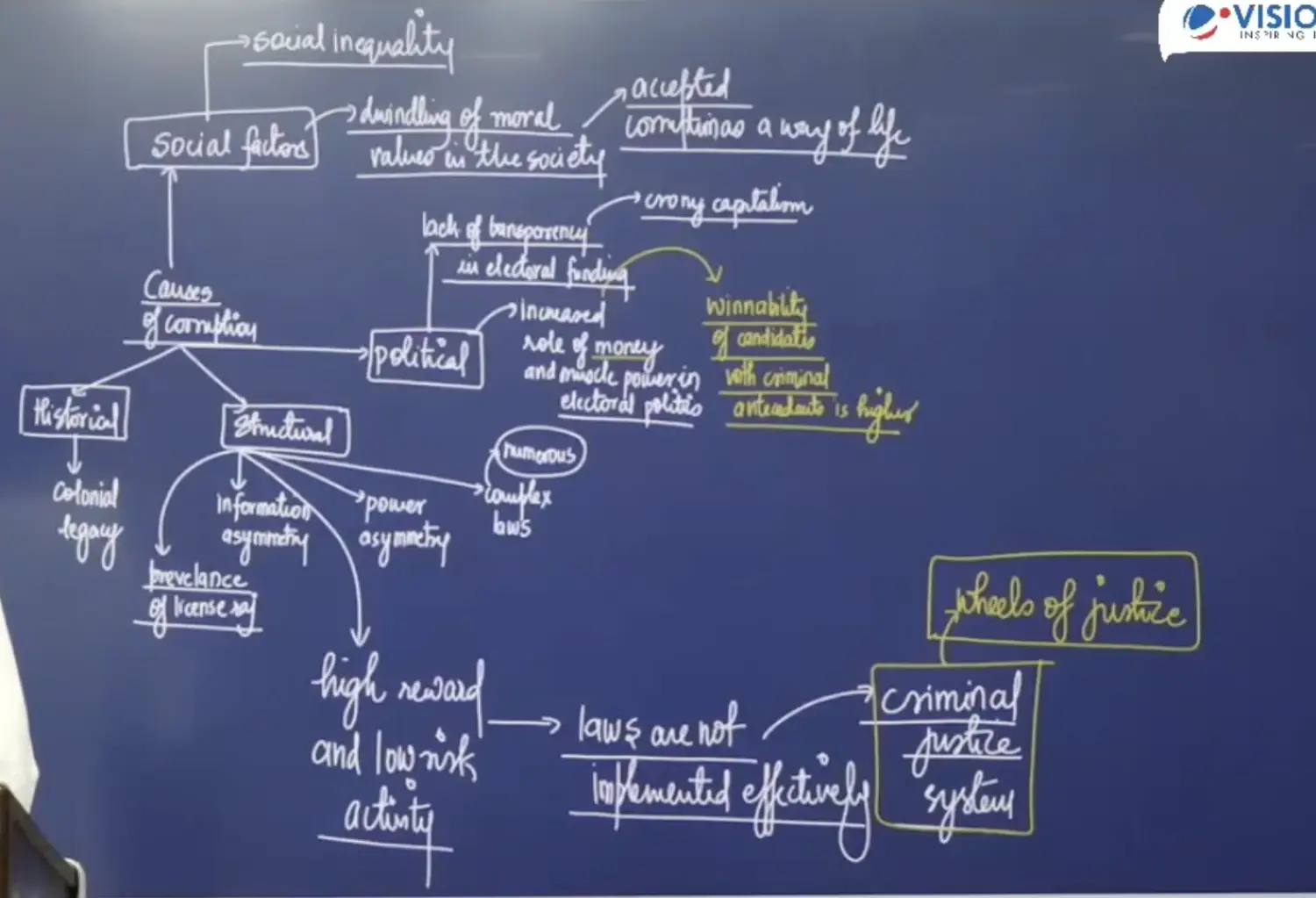
Historical Reasons
- India has a colonial legacy. Since the British were draining India economically
- Indians were told that it was fine to steal from the British
- also, the British administration in India was extremely corrupt where personal corruption by officials was rampant
- Hence, the culture of bribes became common and was carried forward
- It was a matter of pride to steal from British. For Example: Kakori Kaand
Structural Reasons
Information Asymmetry
exists in India between the officials and the citizenry which is used to scare, threaten and extract money from the people
Arises due to not knowing our Rights and Laws
Power Asymmetry
also exists where the officials have wide discretionary powers
Nature of Laws
which are overlapping and become increasingly complex.
Numerous and Complex Laws
Prevalence of License Raj
In certain industries, there is still a prevalence of license raj which promotes the rent-seeking attitude in bureaucracy
Example: Giving Money to be SHO of Karol Bagh would want to be seek the money back with profit
In India, corruption is seen as low risk and high reward activity
The laws are not implemented effectively. The criminal justice system is weak and inefficient
Political Reasons
The increased role of money and muscle power in electoral politics
The criminalisation of Politics. For example, the Winnability of candidates with a criminal record is higher as compared to candidates with a clean record
Lack of transparency in electoral funding as a result of which crony capitalism is promoted
Example: If Business House has given you donation, it will want to have some returns on it
Social Reasons
Overall dwindling of moral values in society. There is acceptance of corruption as a way of life.
Social inequality that exists in Indian society is cited as justification for corruption
Two Wrongs Don’t Make One Right
Impacts of corruption
- Economic impact of corruption
- Corruption leads to inflation in the economy
- It affects the spending on social welfare schemes and programmes.
- Tax collection also suffers in the economy.
- It discourages the ease of doing business and therefore dissuades the investors in the economy.
- It leads to time and cost overruns in various projects that have economic implications associated with it
- Societal impact of corruption
Corruption develops the “attitude of indifference” → "chalta hai" attitude
They started accepting it as a way of life
It reduces or impacts the social capital in society.
Social capital is the relationship and trust between the members of society among themselves and between members and the institutions
It demotivates individuals from carrying on with an ethical conduct. It has a ripple effect on other people of society
- Political impact of corruption
It affects the faith and trust in democratic institutions
Corruption in society promotes the entry of criminals into politics
Rakshak Bhakshak Syndrome is developed where
the protector of the law becomes the violator of the law
- Economic impact of corruption
Ways to Curb Corruption → Can be used in Probity in Governance
- Societal Measures
- Need to emphasise value education
- Try to address inequalities
- Awareness campaigns highlighting the ill effects of corruption and pushing for an attitudinal level among the people
- Legal Measures
Strict laws need to be passed.
Focus on enforcement of the laws with reform of the criminal justice system
Example: Fast track courts should be made for cases under the Prevention of Corruption Act, 1988
Simplification of rules and procedures by repealing irrelevant and archaic laws
Introduce a single-window clearance system so that people can get all the related work done in one place
People shouldn't have to run Pillar to Post
Exemplary punishments so that a civil servant thinks twice before indulging in any act of corruption
Introducing transparency in governance especially decision making
Accountability measures with the experiment of social audits in the various government initiatives
Need to inculcate moral values in civil services at an early age via training modules
Enactment of strong whistleblower law. Protection to Whistleblower. Whistleblower
- Technological Measures
Introduction of e-Governance tools to provide services to the people. Reduces Human Interface and Interaction
Example: GPS Tracking of PDS in CG
Government must take feedback from the citizens on policies and citizens
- Political Measures
- RTI Act must be further strengthened.
- Dinesh Goswami Committee on electoral reforms has recommended that there should be state funding for elections in India
- Public Electoral Funding in India should be introduced
- Representation of People Act, disqualification from election when charges are framed/FIR is registered rather than waiting for conviction
- Reform in Anti Defection Law
- Societal Measures
Work Culture
Meaning
The work culture of an organisation refers to the collective values, beliefs and principles of an organisation and its employees
The work culture of an organisation decides the way in which employees of an organisation interact with each other as well as their interaction with the clients
An organisation is said to possess a strong work culture when the employees follow and adhere to the rules and regulations and the values and principles of the organisation
Work culture not only determines attitude within the organisation but an organisation's attitude towards other stakeholders as well
For Example: Google promotes the work culture of innovation, risk-taking and providing the best customer experience
For Example: On the other hand, BSNL is a slow-moving organisation with undue emphasis on procedures, rules and protocols
Therefore, one can say that the work culture of an organisation reflects the philosophy and the character of an organisation
Examples of Good Work Culture around the World
For Example: Balance of Work Life in Europe
For Example: Strict Laws for punishing Boss or the Employer after reaching them out after working hours by means of Mail, Message or Call
Factors that determine the work culture of an organisation:
Factors that determine the work culture of an organisation
History of an organisation : Under what circumstances was the organisation made.
For Example: the TATA's have a work culture of employee-centric system which got inculcated at its inception.
The aims or objectives of an organisation also determine the work culture of an organisation.
For Example: if an organisation is solely focused upon profit-making, then it will be reflected in the work culture of the organisation.
The senior leadership and the management also play a crucial role in determining the work culture
For Example: Values of Ratan Tata is seen in the work culture of Tata
National culture determines the work culture as well
For Example: Difference between Work Culture of India and Europe
The output and the results shown by an organisation can also play a very crucial role in determining the work culture of an organisation.
Characteristics/traits of a good/healthy work culture
Appreciation for the best performers where the best in the organisation are made to feel that they are indispensable
Adequate work-life balance should be present
Organisations should have employee-friendly & employee-centric policies
A work culture that promotes mutual respect for fellow workers and encourages discussions and deliberations instead of contempt for each other
There should be a collaborative environment
Employees must be encouraged(not forced) to be cheerful, polite and punctual at work
A work culture that promotes inclusiveness. People from all walks of levels should be given inclusion
An organisation that promotes democratic decision making
Employees should be judged only on the basis of their work and there should be no bias shown by the management
Benefits / Advantages of a Good/Ethical Work Culture
Promotes trust for employees in the organisation
Repercussions of non-ethical work culture can lead to the demise of organisations
For Example : Kingfisher
It promotes healthy competition between the employees as a result employees do not look at each other with jealousy, contempt
Good work culture ensures and promotes discipline within the organization
It creates a conducive working relationship between the leadership and the employees
It reduces attrition and helps in attracting the best talent
Example: Apple Attrition Rate is very Low
Employee satisfaction is very high in organisations that have a healthy and ethical good work culture
Promotes risk-taking behaviours and allows the employee of the organisation innovative thinking
Example: Google
Promotes customer-centric behaviour and encourages customer-centric behaviour. It thus promotes customer satisfaction
Drives the financial performance of the organisation, makes the organisation effective and efficient
Good work culture is focused on promoting the well-being of employees, It helps in employee development
Example: TATA
Importance of Ethical Work Culture (EWC)
Good ethics are synonymous with good business, only those organisations that show ethical traits are able to achieve success for longer periods
Example: TATA
Find an Example of Govt Department
EWC promotes employee satisfaction because it ensures consistency in actions and thoughts
EWC Promotes trust in the workplace
EWC It promotes transparency and accountability in the organisation
EWC ensures legal compliance and lowers the regulatory risk
Counter Example : Unethical work culture can often lead to creating risk for the business itself
For Example: Demise and Fall of Kingfisher Airlines
Traits of healthy work culture in bureaucracy or civil services
It should reflect the administrative hierarchy and there should be a clear-cut division of functions, work & responsibility
There should exist a system of rules and regulations to be followed within the organisation
Bureaucracy should try to be rule-bound, It should follow rules and regulations
A healthy work culture should focus upon process simplification
It should promote Citizen-Centric Administration
Bureaucracy should promote responsiveness through modern means as well.
For Example: Responses of the Ministry of External affairs on Twitter/Social media so as to help the people stuck in certain circumstances.
It should always try to promote the adoption of technology to keep pace with the development of the 21st century.
For Example: Ministry of Corporate Affairs
Bureaucracy should try and promote transparency in its functioning
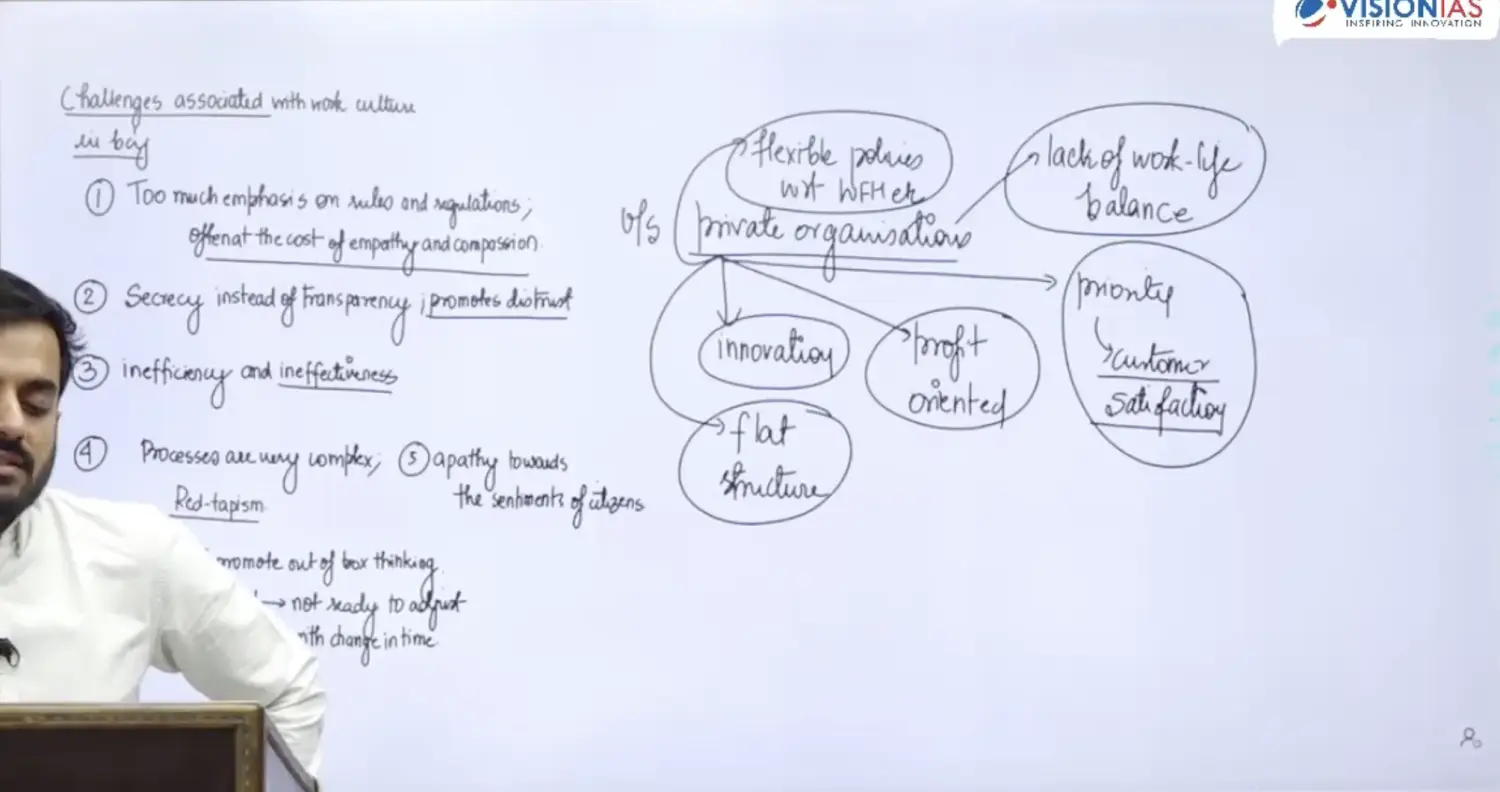
Challenges associated with the work culture in bureaucracy or civil services
- Too Much emphasis on rules and regulation in bureaucracy often at the expense of compassion and empathy
- The civil services are Secretive in nature, It creates distrust
- Inefficiency and Ineffectiveness especially at Lower Levels of Bureaucracy
- Processes are very complex and strenuous because if which citizens have to face Red-Tapism
- Apathy towards the sentiments of the citizens
- It does not promote out-of-the-box thinking
- Too rigid in their approach where they are not ready to adjust with the change with time
- Excessive Political Interference in day to day administration, hinders administrative funtioning
Challenges associated with the work culture private organisations
- Profit oriented, innovative
- They aren't rigid, they adopt according to time or else they would run out of relevance of market
- They observe Flat structure, No Levels of Hierarchy
- Flexible policies with respect to work from Home
- Priority usually is customer satisfaction
- Lack of work-life balance
Summarised Comparison between the Two
How to establish/create a good work culture in organisations
It is Required to promote transparency in govt
Transparency should not be force fed, it should be more Suo Motu
Promote and award the best performers in civil services
Exemplary punishment for habitual offenders
Promoting bonhomie by conducting team-building exercises so as to promote the spirit of the team in bureaucracy
Constantly undergoing training programs
Encourage discussions, debate & even dissents in a safe space
Reforms in the evaluation system/appraisal of the organisation are also very crucial in order to promote
Exposure visits to other countries and other geographies
We should have a mentorship program for the new recruits to civil services
This mentorship program should be conducted under senior or retired civil servants of repute & inspiration
Important Example : Karmayogi Platform by LBSNAA
- A Platform with Modules to Track Progress
- Modules on Ethics
Corporate Governance
Who are the Stakeholders in an organisation ?
- Board of directors
- auditors
- Employees
- Management
- Shareholders & investors
- Customers
- Society
Meaning
Corporate governance is defined as set of systems, principles, and processes which ensure that a company is governed in the best interest of all the stakeholders
For Example: Tata Son would be paying salary upto 60 Years if some Tata Employee Dies this is to contrary to the Myopic View of Corporates who tend to focus only on profits
Importance of Corporate Governance
It Promotes sustainability and is able to run in the longer run
It ensures lawful and ethical conduct of the company, hence the lawful and legal conduct violation is reduced
It ensures the empowerment of minority shareholders as well, thus promoting inclusiveness
It helps in establishing a greater brand value for the organisation
Example: Google
Ensure Compliance of rules and regulations by the Board of Directors
It ensures that private organisation do not work blindly with the motive of being “for-profit” only
Need for Corporate Governance Norms in India
The effect of LPG reforms(1991/1992) has led to the increased role of the private sector in the Indian economy.
Due to Withdrawal of State from Economy, 70 to 80 percent production in India is by Private Players
The increased role of retail investors in various publicly listed companies in India
A majority of big businesses in India are family-owned
It is to protect and ensure that the companies operate for the benefit of all the stakeholders and not just particular families
Example : Ambani’s after going public
To improve the confidence of institutional investors, especially foreign institutional investors to attract investment into Indian businesses (FDI)
India has a history of several high-profile scams related to the functioning of companies; in order to avoid such scams in the future, it becomes important to have Corporate Governance scams in the future
For Example: Harshad Mehta Scam, Satyam Scam, UTI Scam
For Example: Leadership of NSE was taking help from Himalayas, thus compromising on important data
HomeWork : Find out Statistics of Retail Investors in India
Principles of Corporate Governance
- Equity
- There should be diverse representation in the organization from all sections of the society.
- It should promote inclusivity such as women directors/SCs/STs/OBCs. Representation of Various Sections
- Example : Recently Passed Companies Act says that at least 33% companies should have women directors
- Ethics
- An organisation should follow ethics in the decision-making process with values such as → fairness, transparency, accountability, participative decision-making
- Timely disclosures to all stakeholders about important decisions
- Should Promote Duty-Based ethics: Board of Directors, management should know their role clearly
- The organization should promote effective functioning and participation of an Independent Board of Directors (According to Companies Act) → They are the Conscience of Board of Directors because they have no vested interest
- Protection of interests of minority shareholders
- A strong and independent audit process is the very essential principle and requirement of Corporate governance → To Maintain Clean Books
- A separate CEO and Chairman
- Robust Grievance redressal mechanism
- The company should involve itself in Corporate Social Responsibility work.
- Equity
Challenges / Impediments to Corporate Governance
Often auditors are compromised due to the lure of money
the audit committee is often compromised
Questionable independence of independent directors
often the autonomy of independent directors come into question → Either not appointed and if appointed not allowed to function
Lack of adherence to transparency norms and disclosure requirements
Insider trading when material information related to a company that is not public in nature who may then use it to their advantage
Insider Trading → Material Info related to a company that is ot in public nature is know to some persons who may then use it to their advantage
Example : Rajat Gupta Case in USA
Lack of adherence to regulatory framework and norms
Bad debts/NPAs are increasing → Connivance of various banking authorities is a major impediments
Bad Debt Track Records are still being given loan
Corporate Social Responsibility (CSR)
Introduction
Add Kotak Committee from Value Added Material
- CSR is referred to as a Corporate initiative to assess and take responsibility for the effect of companies work on the environment and impact on social welfare.
- In India, the concept of CSR is governed by section 135 of the Companies Act, 2013.
- In fact India is the first country in the world to provide mandatory CSR spending by companies of a certain size and scale along with a framework to identify potential CSR activities
- The CSR provisions under the Act are mandatory for companies with
- an annual turnover of 1000 crores or
- more or a net worth of rupees 500 crores and more or
- a net profit of rupees 5 crores or more
- The act makes it mandatory for such companies to spend 2% of percent of their average annual profit of the last 3 years on CSR activities
Should CSR be Forcefully or be completely on prerogative of the company is separate debate in which we don’t have to get into
Advantages in indulging in the CSR Activities
It helps in building a brand as a responsible entity in the eyes of the customers and the shareholders
It helps in creating a healthy work environment in the organisation as the employees feel that they are able to contribute positively to society
It is of mutual benefits to the society and to the corporate entity, as the society is able to gain through better development opportunities.
the entity benefits in the form of better availability of workforce as well as an enlarged market for its products
CSR activities can initiate a chain reaction. Therefore, leading to several other organisations as well initiating similar steps, Thus creating a culture of philanthropy in society
It promotes inclusive growth in society and helps in filling the gaps not addressed by the government
CSR activities have made the corporate sector an important partner in India's developmental story
For Example: The e-Chaupal Initiative of ITC → for Technical Help for Farmers
For Example: From 2013 to 2018 → Increase in CSR Activity from 33 Billion Rupees to 250 Billion Rupees
Problems associated with CSR activities in India
Organisations are more concerned about their branding vis-a-vis promoting social interest
Mandatory CSR has dissuaded several investors from investing in Indian companies
Geographical inequality occurs due to money being spent in the vicinity of big corporates
As per a report published by Oxfam more than 85% of CSR spending is restricted to three sectors that are Education, Health, and Livelihood
Subjects / Fields / areas in which CSR is spent is Lopsided
A significant portion of the CSR scheme is being spent on Government Schemes, thus promoting Crony Capitalism in India
Several corporates have set up their own NGOs or foundations where most CSR money is routed towards their own employees
It often acts as Extended Arm for the Company
Often Companies indulge in CSR to avoid tax liabilities and avail tax exemptions
Way Ahead of CSR - From Value Added Material of Vision IAS
- Ethics Index like Stock Exchange Index
Public Service Delivery
Introduction
Public Service Delivery is the most critical aspect of Governance as success of every policy and program of the government is dependent on its effective delivery
Public service refers to a service which is provided by the government to its people
This can happen through two modes
Directly through the government machinery
Indirectly through various partners and agencies who work along with the government
Agencies - Private Agencies → for Profit or NGO’s
Some of the key public services delivered by the government include- Healthcare, education, waste management, sanitation, law enforcement and infrastructural development.
Various challenges in ensuring effective public service delivery are:
Red Tapism
Government machinery is often obsessed with regulations, paperwork and tedious procedure. Thereby hindering the implementation of various programmes initiated by the government
Excessive Interference & Attitude of the bureaucracy
Often officials tend to have an obstructionist attitude where they show considerable apathy towards the problems of the citizens.
This leads to bureaucracy becoming a hindrance in effective public service delivery.
Various Leakages and Corruption
Delivery of services by the government is marred with leakages and corruption, therefore reducing the trust of citizens in the public service delivery mechanism
Government schemes are often initiated in a top-down manner where the focus is on spending allocated funds rather than achieving the desired outcomes
Example: Meghalaya’s Insurgency in 1980’s ; Cattle was being given to families of agriculture in other parts of country by planning commission of India
Like for : Other Works, Milk Produce can be consumed and May be a Source for Extra Income
In Meghalaya, Garo Khasi Jayantiya, Khasi don’t consume milk, Because Govt was unaware of the ground realities
Because the policy was made on the whims and fancies of a babu in Meghalaya
Lack of public participation
Citizens are often unaware and ignorant about their rights and obligations, therefore, restricting their participation in the implementation of schemes and programmes
As a result, citizens are not able to demand rightful services from the government
Quality of service delivery provided by the government
Often it has been found that services provided by the government machinery is not up to the mark, therefore, creating circumstances under which citizens prefer accessing services from private agencies which is significantly costly as compared to the public sector
Sample Sector - Health Sector - Public Service Delivery
Public Service Delivery in the Health Sector - taken as a sample to make the approach clear to students
Think about more examples from various sectors
Challenges to Public Delivery in Health Sector
Excessive pressure on the resources in public institutions
Despite the presence of the best doctors in the public sector, government hospitals suffer on account of poor management and support staff
Housekeeping and Sanitation are often neglected in government hospitals
Equipment is either defective or absent in several good hospitals
Example : Evasive Ventilator is there but no anaesthesia
There are ownership and accountability issues as well
Examples to ensure effective public service delivery in the health sector
No of Dialysis Care << Demand of Dialysis Patients in Andhra Pradesh
Setup, Own, People Will be Installed → Govt will pay Braun
Braun will now transfer this project to Government Once it become functioning and working as a pilot model
The state government of Andhra Pradesh entered into a PPP arrangement (BOOT Model - Build, Own, Operate and Transfer Model) with a company called Braun for dialysis care
Principles to Ensure quality public service delivery
Government schemes and programmes should be demand-driven rather than allocation based
The government should try and ensure awareness amongst the citizens about their rights and obligations so as to empower the citizens to ask questions to those in power
Establishing effective accountability mechanisms such as Citizen's Charter, Public service delivery acts
Introduction of e-technology in public service delivery
For Example: Delhi Govt “Sarkar Aapke Dwaar”
Increasing the participation of private sector organisations through various innovative models.
For Example: BOOT model discussed above
Government should try and ensure continuity in governance and administration
For Example: civil services should be given a minimum tenure in a particular location
Strengthening the feedback mechanism
For Example: the citizen report card initiative of the Bangalore Municipal Corporation
Examples of Initiatives taken to improve public service delivery in India
Sevottam Model
Prepared by the Department of Administrative Reforms and Public Grievances (DARPG)
It is considered as a gold standard in the citizen charter
Prime Minister's Award for excellence in Public Administration
It has created an incentive for various government functionaries to outperform themselves
Introduction of technology to ensure SMART delivery of services
S - Simple M - Measurable A - Accountable R - Responsive T - Transparency
Common Service Centres(CSC) Mobile Payment of Subsidies
Conduct Regular Field Visits
Requirement of mid-career training for civil servants so as to upgrade their skill sets to suit the needs of the time
PM Modi in his speech in the graduation day of LBSNAA talked about Data Governance & Certificate Courses
Utilisation of Public Funds
Explained with the help of Handout No 1 in Red Pen Printed in folder
Importance of Effective Utilisation of Funds ?
- It is important that the money the government earns is spent for the benefit of the people and is only spent under the authority of law.
- The government is only the custodian of public funds and not the owner and therefore it has a responsibility to ensure judicious and effective utilisation of public funds
- It is one of the key tenets to ensure social and economic justice and meet developmental goals
- It is their moral and legal responsibility to spend the money judicially
How do we ensure that Public Funds are used Optimally ?
Public funds are optimally utilised if:
- the spending is in accordance with the law
- conforms to conventionally accepted standards
- deemed well worth the money spent on something
- conforms to accountability and financial control valuing the most effective use of resources and operational inputs.
Causes of ineffective utilisation of public funds in India
Political Reasons
Irrational Freebies Distribution: and signing off loans for electoral popularity
Example: The Govt was providing electricity for free of cost in India in Punjab and Haryana
This led to Two things :
- DISCOMS ran into massive losses in Punjab and Haryana because of T&D Losses & Theft of Electricity
- To Counter this Debt, Govt will Pay Money or Banks will accumulate NPA’s
- Because Electricity was for free, people dug up bore and started wasting water
- Due to deep water scavenging, heavy minerals like copper and arsenic came up due to capillary action. this led to health hazards
- When Water Level Went Down, People Further Dug up depleting water level
- The Further Capillary Coming of Heavy Metals led to Infertility & Loosing of Nutrients from Soil
- In Longer Run, the Sugarcane & Rice used more water leading to failure of crops and filed irrigation system (Agro Eco Conditions were Ignored)
Politicised Protests: including bandhs increase the incurred costs due to delay in the public works undertaken
These also leads to widespread destruction of property
Administrative Reasons
Policy Paralysis
Delays, inaction and inability to take policy decisions by the government cause inefficiency in public fund utilisation
Loss Due to Delayed Decision Making
For Example: Procurement of Defence Equipments from Outside India generally takes 4 to 5 Years, this leading to Increase in Cost because of delays in decision making
Loss Due to Delayed Implementation
For Example: GST implementation took several years owing to which India lost huge revenues
According to Scholars, India was loosing 2% of GDP Every Year
Red Tapism
Due to over-regulation the implementation of schemes and projects gets affected thereby impacting the effective public fund utilisation
Lack of Public Participation
With a high level of illiteracy and ignorance prevalent among the masses, many citizens especially the poor can not demand their rightful financial liabilities from the government.
Lack of Autonomy of Public Watchdogs
CVC, Lokpal, Lokayukta
For Example: Central Vigilance Commission lacks powers to take decisions itself as it is treated as an advisory body only and it has no power to register criminal cases against government officials
Economic Reasons
Expenditure Rush
Expenditure rush during the month of March, which leads to inefficient fund expenditure
Example:
We Don’t Need → 1000 Crores have been Spent
We Need → What is New No of School? Increase in Gross Enrolment Ratio?
Social Reasons
- Social apathy towards corruption so much so that people are calling corruption to be the Grease of Indian Economy
- Inequality
- Lack of institutional and social accounting
Implications of ineffective utilisation of funds
Social
- Violation of the rights and entitlements of the masses.
- Leads to social problems like inequality, illiteracy, poor health and sanitation
Political
- Unequal development in the country and inequality within different states
- Increased corruption - Regionalism, Naxalism, Separatism etc
Economic
- Non Utilisation of India’s Demographic Dividend
- We Could have a Double Digit Growth but we are limited up and until 7%, conditioned has worsened after corona
Ethical
Breach of “Doctrine of Public Trust”
Principles underpin trust in Public Finances
- Transparency: Accurate records that show where money is raised and spent
- Accountability: decision-makers should be subject to strict rules and review of performance and outcomes
- Objectivity: Policies should be based on accurate information and rigorous analysis
- Integrity: the most cardinal virtue that holders of public office must adhere to
- Fairness: ensures non-partiality
Ethics in International Relations
Explained with the help of Handout No 2 in Red Pen Printed in folder
Definition
Application of principles of morality and ethics in solving the various ethical dilemmas that a country faces in the conduct of its international relations with various countries
For Example: India is currently facing an ethical dilemma with respect to the Russia-Ukraine war and how to balance its national interests
Some Sources of International Ethics
- UN Declaration of Human rights
- Geneva Convention for Humanitarian Treatment in War
- The Paris Climate Deal under UNFCCC
- WTO and its TRIPS Agreement etc
Importance of ethics in international relations
It helps in avoiding the "ego clash" and "ideological clash" between two or more nations
For Example: USSR & USA Russia could have worked with Ethics
For Example: WW2 would have been avoided
Ethics aim at a peaceful world and respect for all and equality
They help in the resolution of international conflicts such as terrorism, territorial disputes, and refugee crisis
For Example: If US wouldn't have harboured ISIS
They help in international environmental efforts to fight against ozone depletion, global warming, etc
Collective security efforts such as economic sanctions and military sanctions against an aggressor state
For Example: No One Spoke against Russias Invasion of Ukraine
Contrasting Examples from Handout - Berlin Crisis & America First
3 major approaches to resolving ethical dilemmas in International Relations(IR)
Every Method has its own Pros and Cons
Realism
According to this approach, morality is not an important consideration in a nation's action
It assumes IR is guided by national self-interest
For Example: Indian can justify Abstaining on the Idea of Russia’s Invasion of Ukraine
Idealism
- The goals and means of foreign policy should be based on morality
- It should be based on ideals such as peace, human rights, and global justice
- Pandit Nehru adopted this approach
Principled Realism
Based upon a combination of the first 2 approaches
Foreign policy involves the pursuit of interests based on power as well as fundamental moral values
For Example: The approach adopted by India during the current Ukraine crisis. We Abstained against them, but we criticised Russia Invasion of Ukraine
Incorporating morality while making decisions serving national interests
End based approach/consequentialism
- Action should be judged by its outcomes
- It is based on the consequences/end based
For Example: Reliance of US on Nuclear During Civil War
For Example: Debate on Indian Nuclear Weaponry and Civil Nuclear Programs was debated.
Rule-based approach/ deontological approach
Morality is fulfilled when action is aspired by fundamental moral obligation
For Example: From Handout
Tri-Dimensional Ethics / Principle Realism Approach
This approach seeks to overcome end based and rule-based decision making by integrating both the approaches
This is difficult to maintain, marrying both of them may lead to problems too
For Example: From Handout
Elements of Ethics in IR
- Human rights at the heart of foreign policy
- Commitment to multilateralism, prosperity and environmentalism
- Global Justice and Responsibility to protect
- Principle of Sacrifice
Ethical challenges/issues in IR
Neocolonialism in the name of international ais rather than aiming at uplifting poverty.
For Example: China invested heavily in Africa with ulterior motives.
Issues of human rights violations are being ignored by countries at their convenience.
For Example: the Rohingya crisis and other atrocities in Myanmar were ignored by countries and in Sri Lanka
Lack of Responsibilities by the developed countries regarding Global Commons
International Diplomacy is guided by narrow national interests rather than common global agendas.
For Example: Terrorism is still not defined internationally.
For Example: China opposed naming Maulana Masood Azhar as terrorist
Dilemma in IR - Add from Value Added Material
Ethical Belief vs National Interest
For Example: India's concerns vis a vis Myanmar
Commercial interest vs Bilateral Obligation
For Example: Investing in profitable petroleum extraction of Myanmar or in loss-making but strategically important Sri Lankan Port