Chapter 05 - Money Market / Capital Market
Prelims Syllabus
Introduction
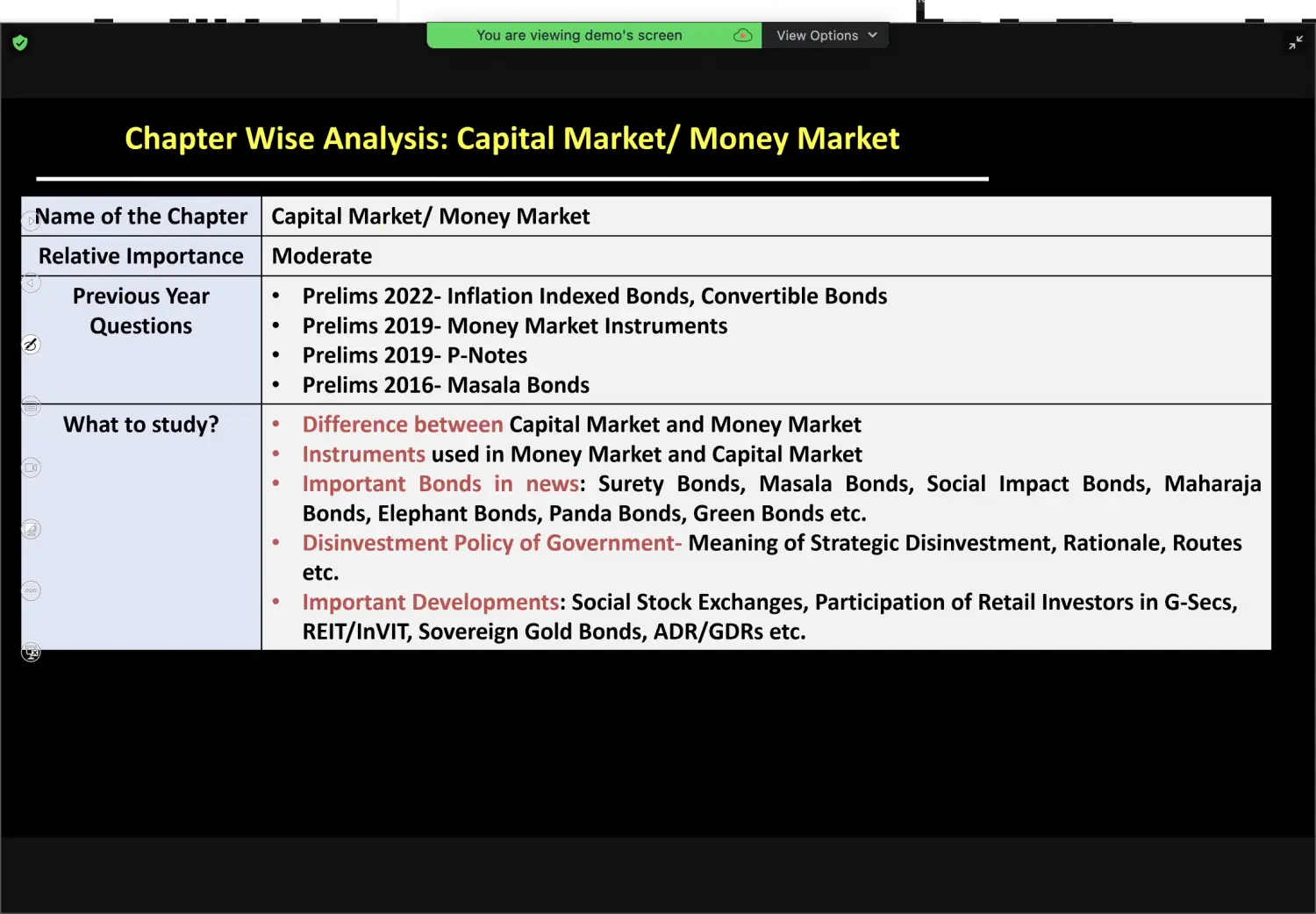
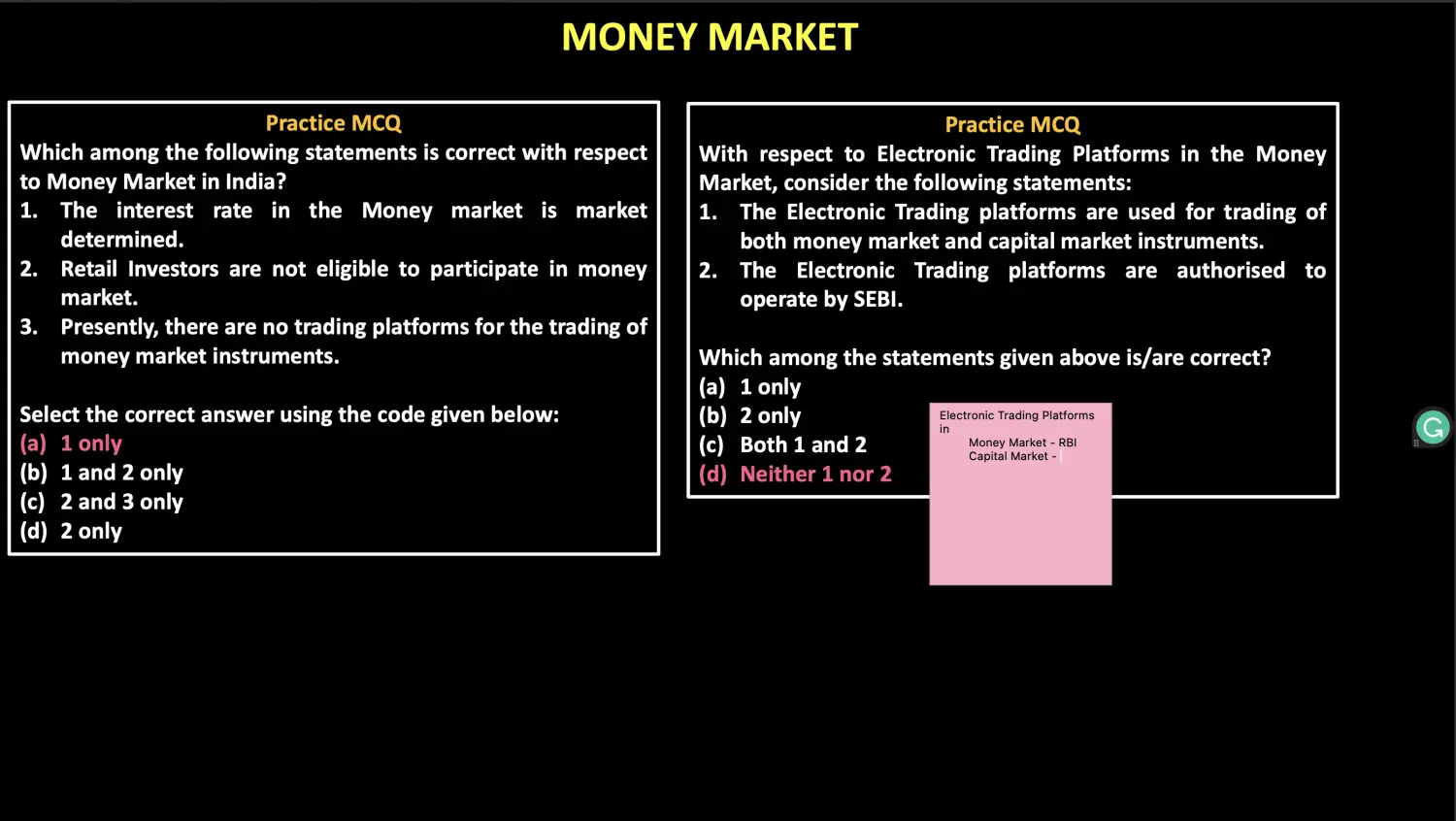
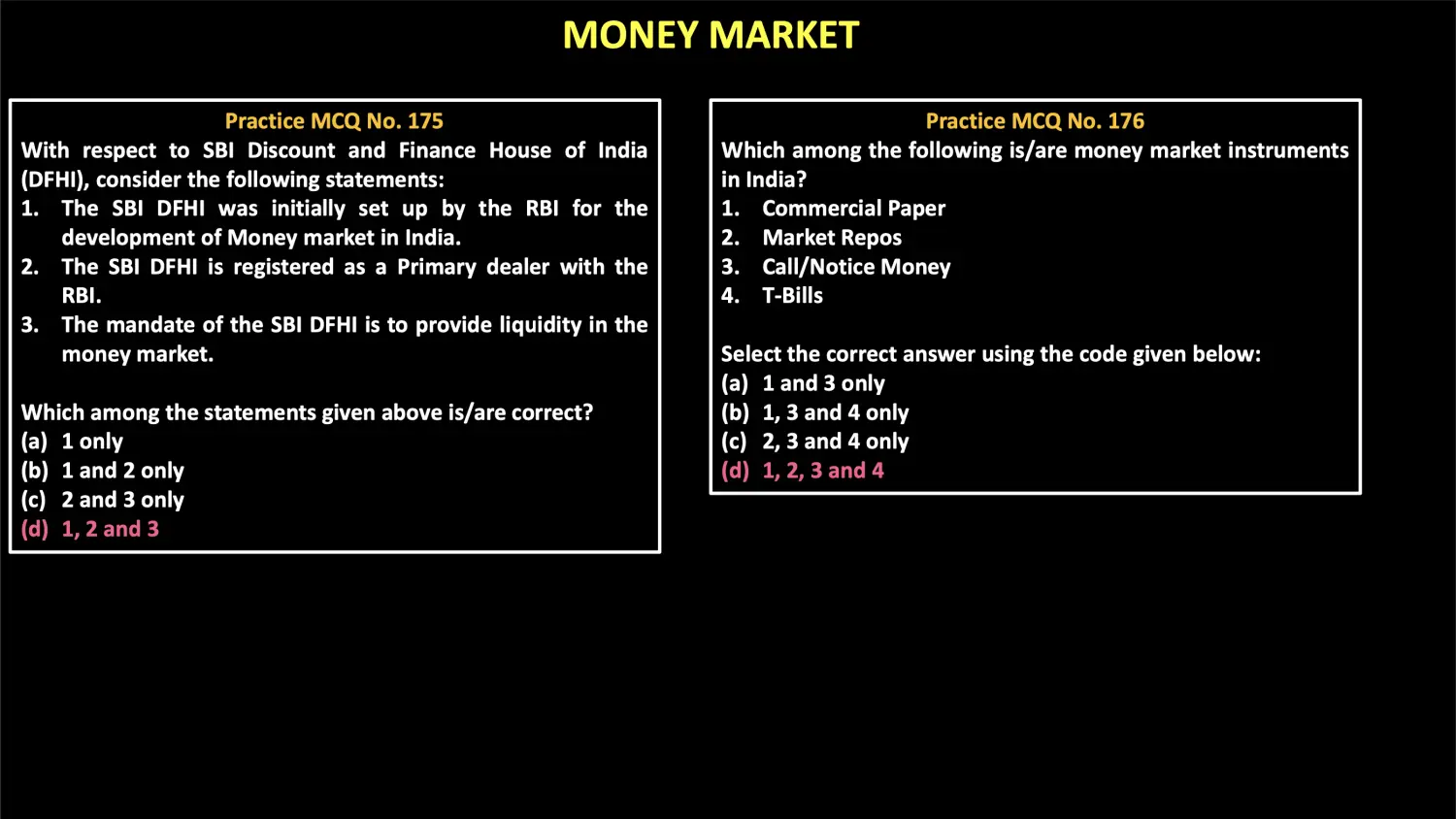
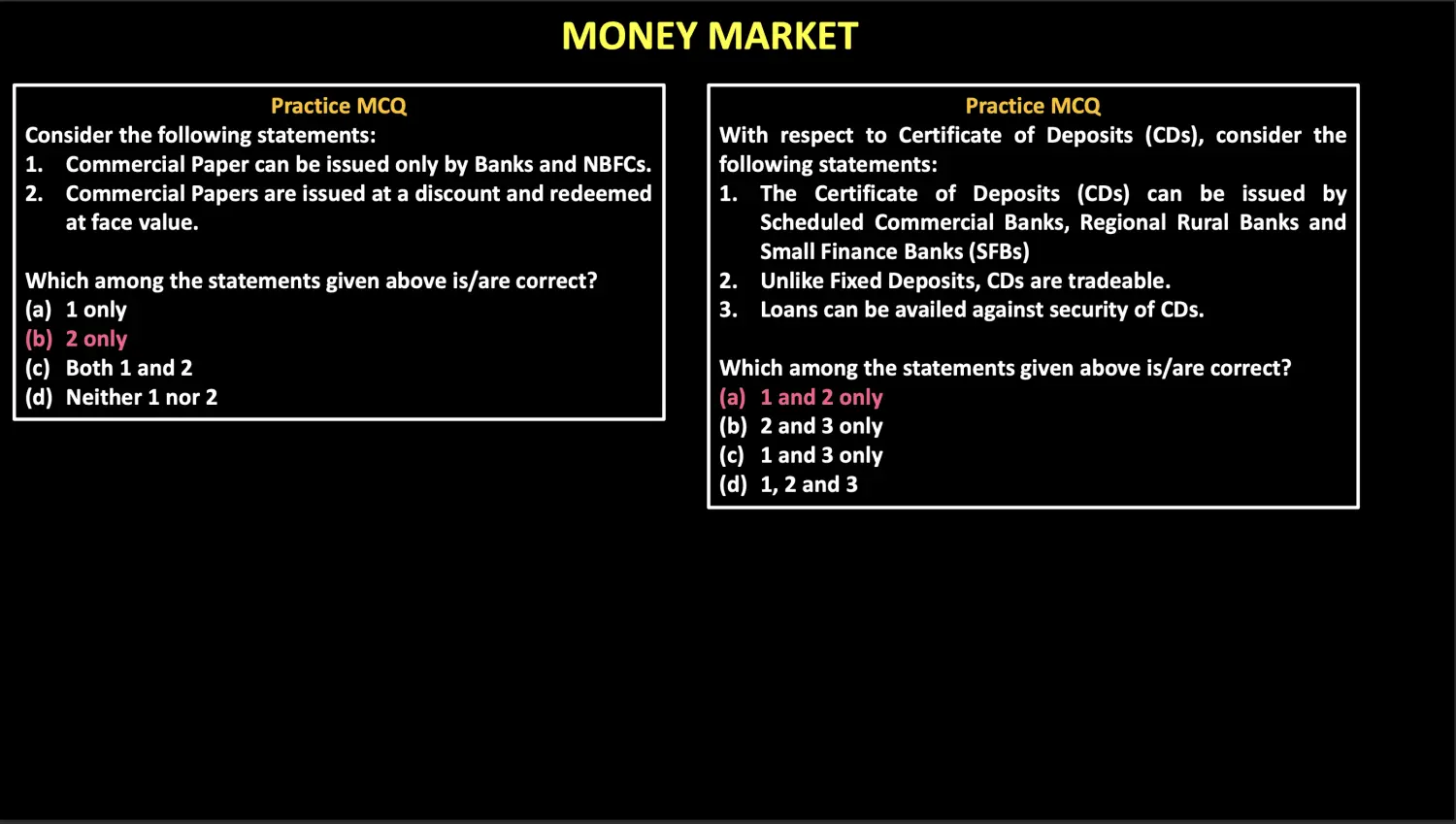
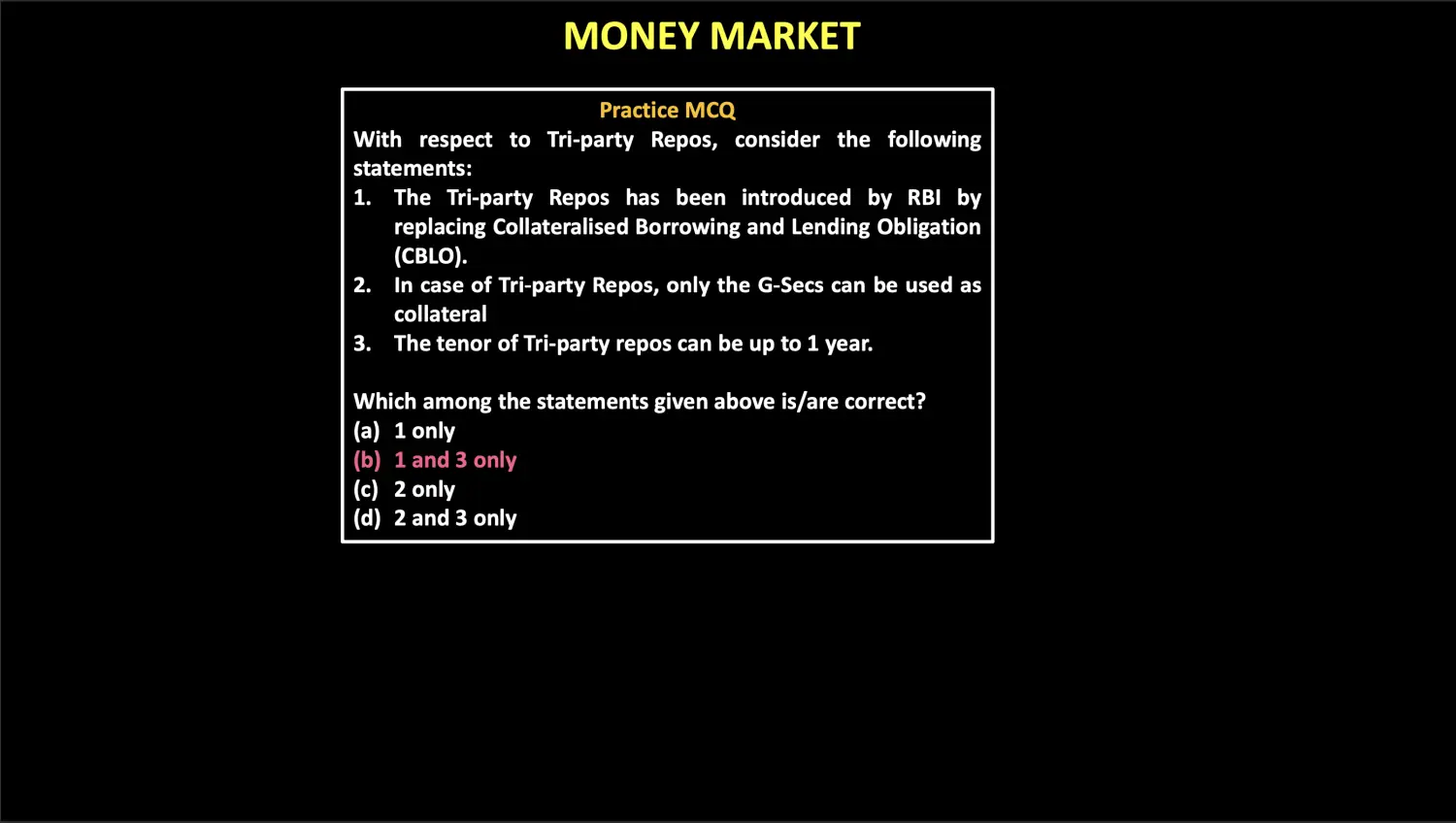
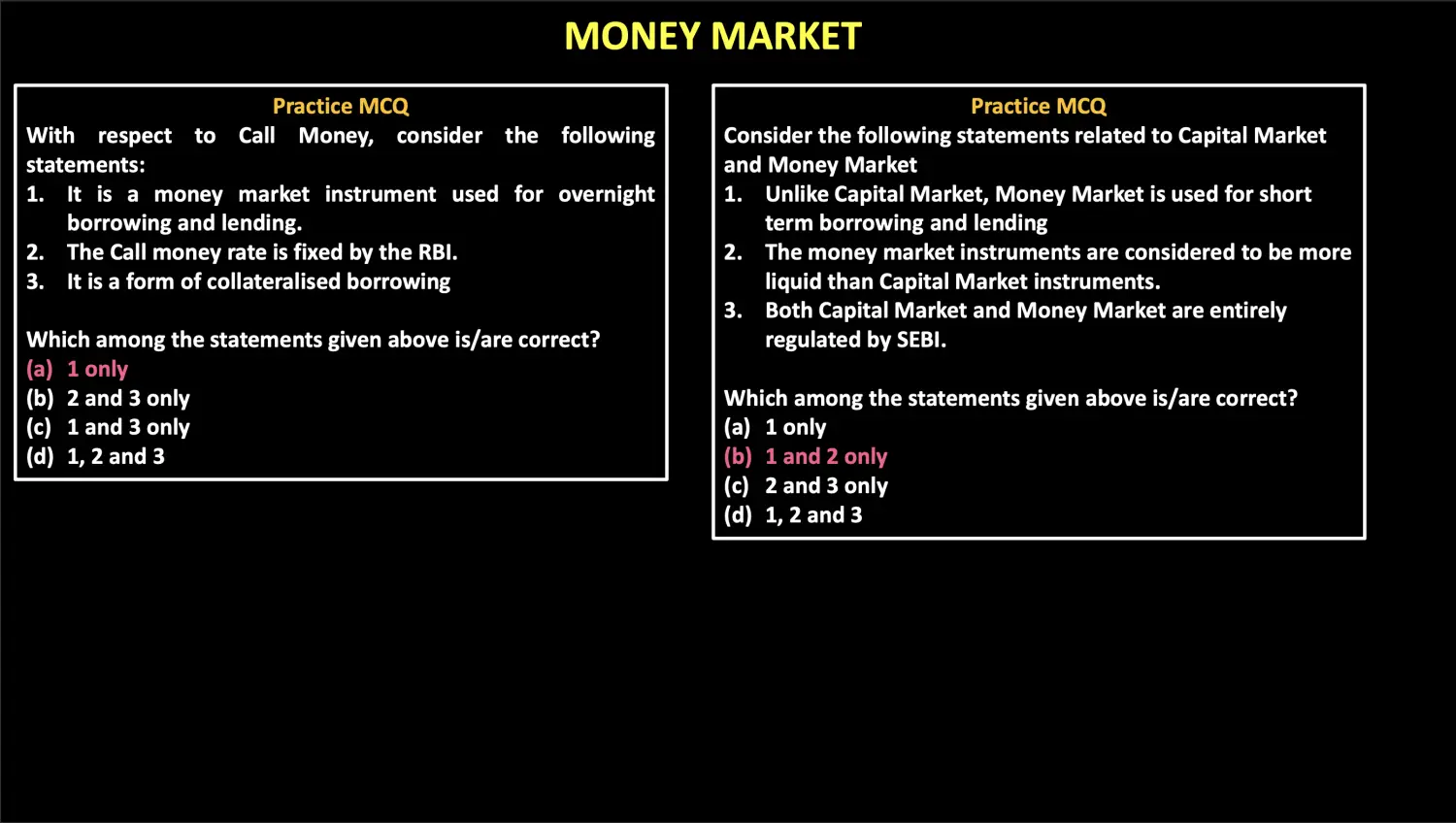
Money Market Questions
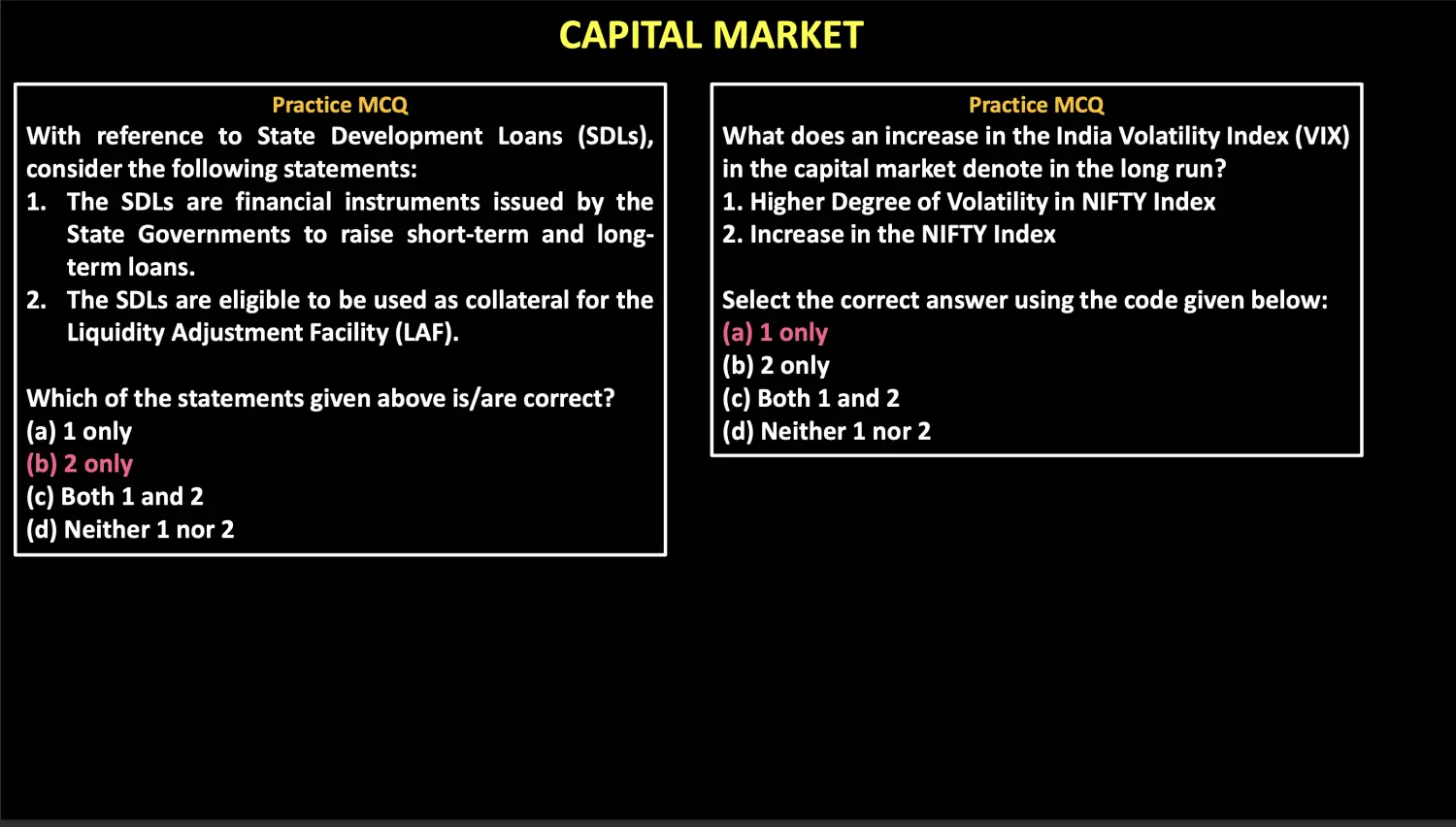
Capital Market Questions
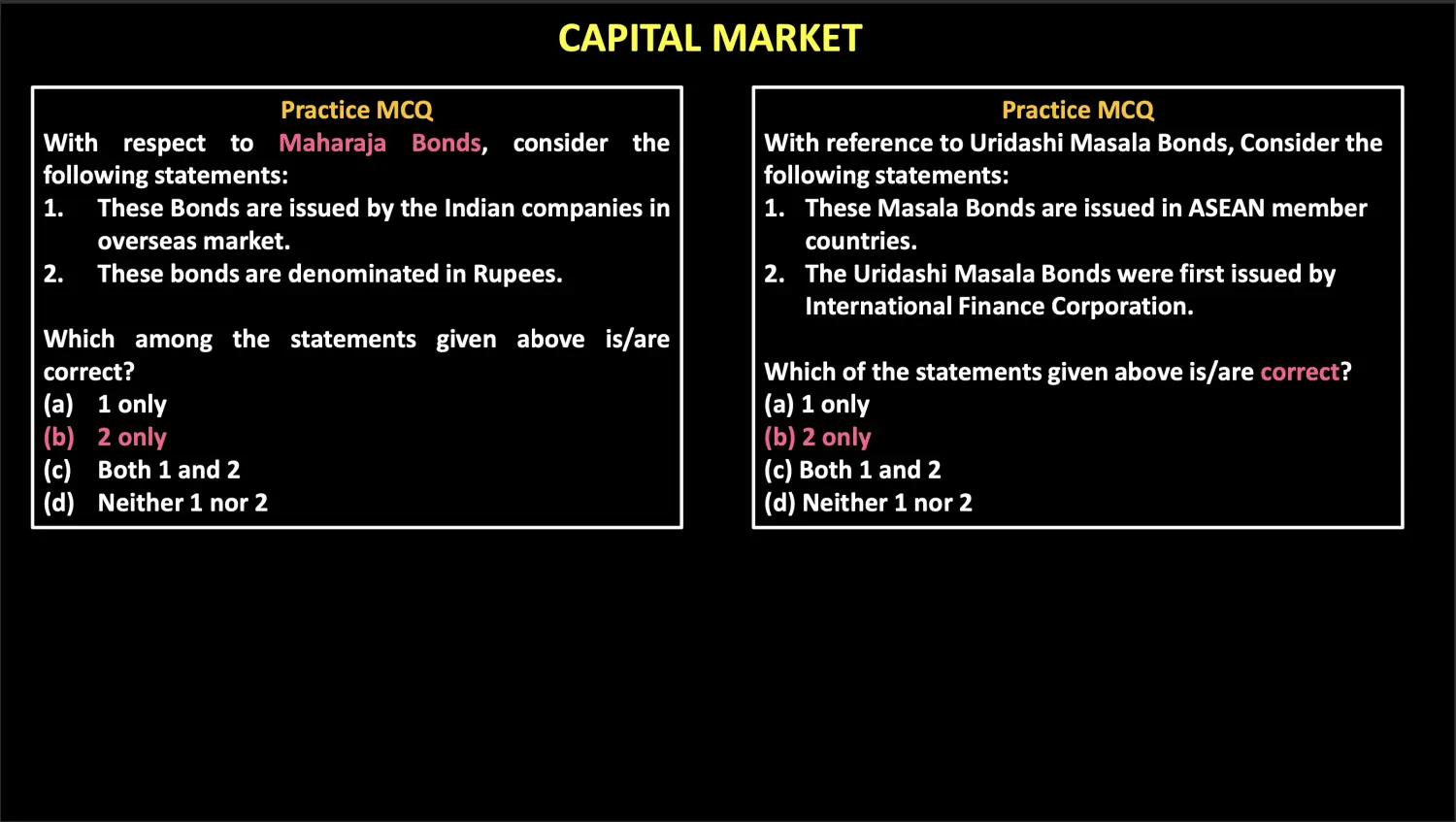
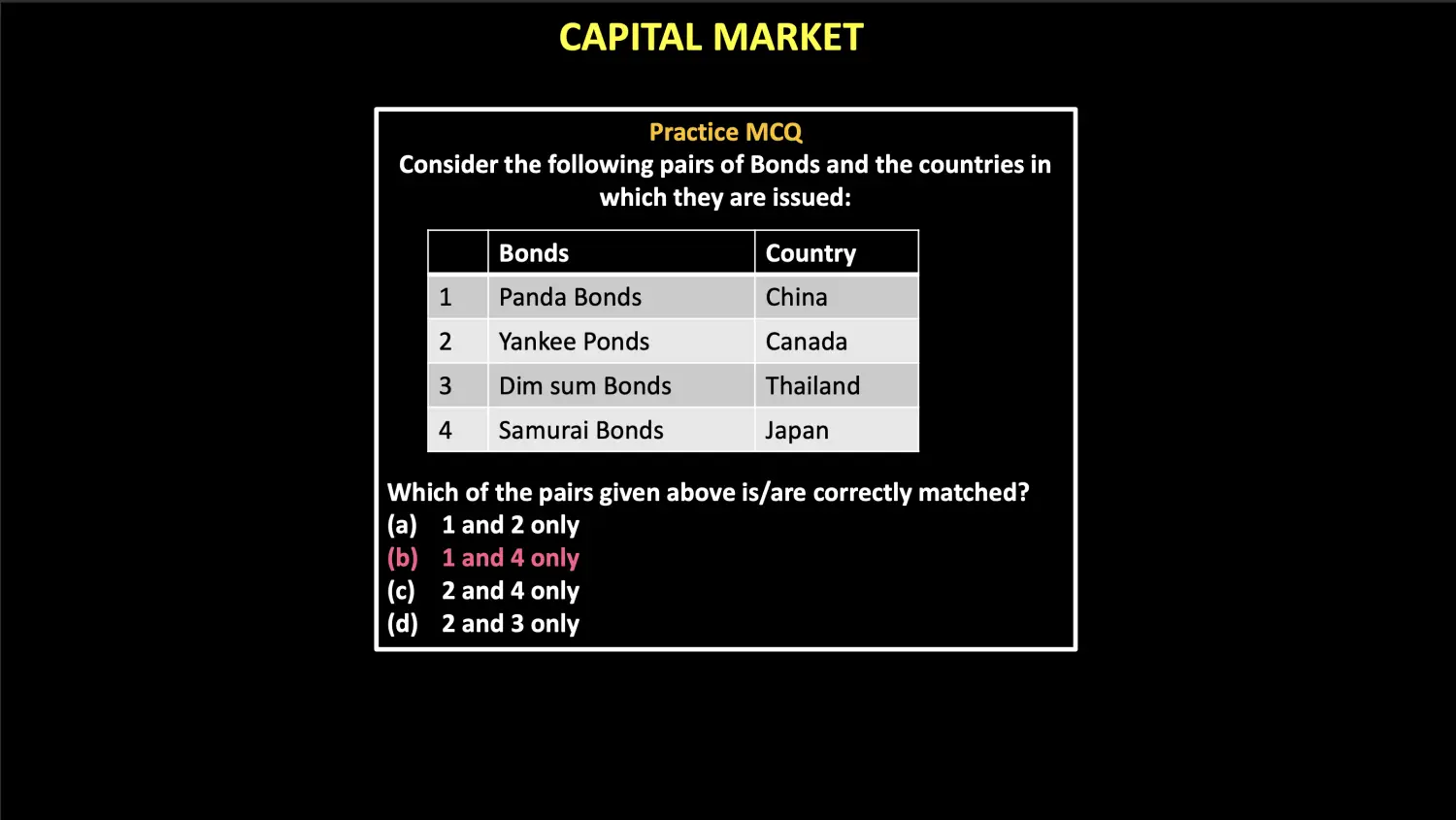
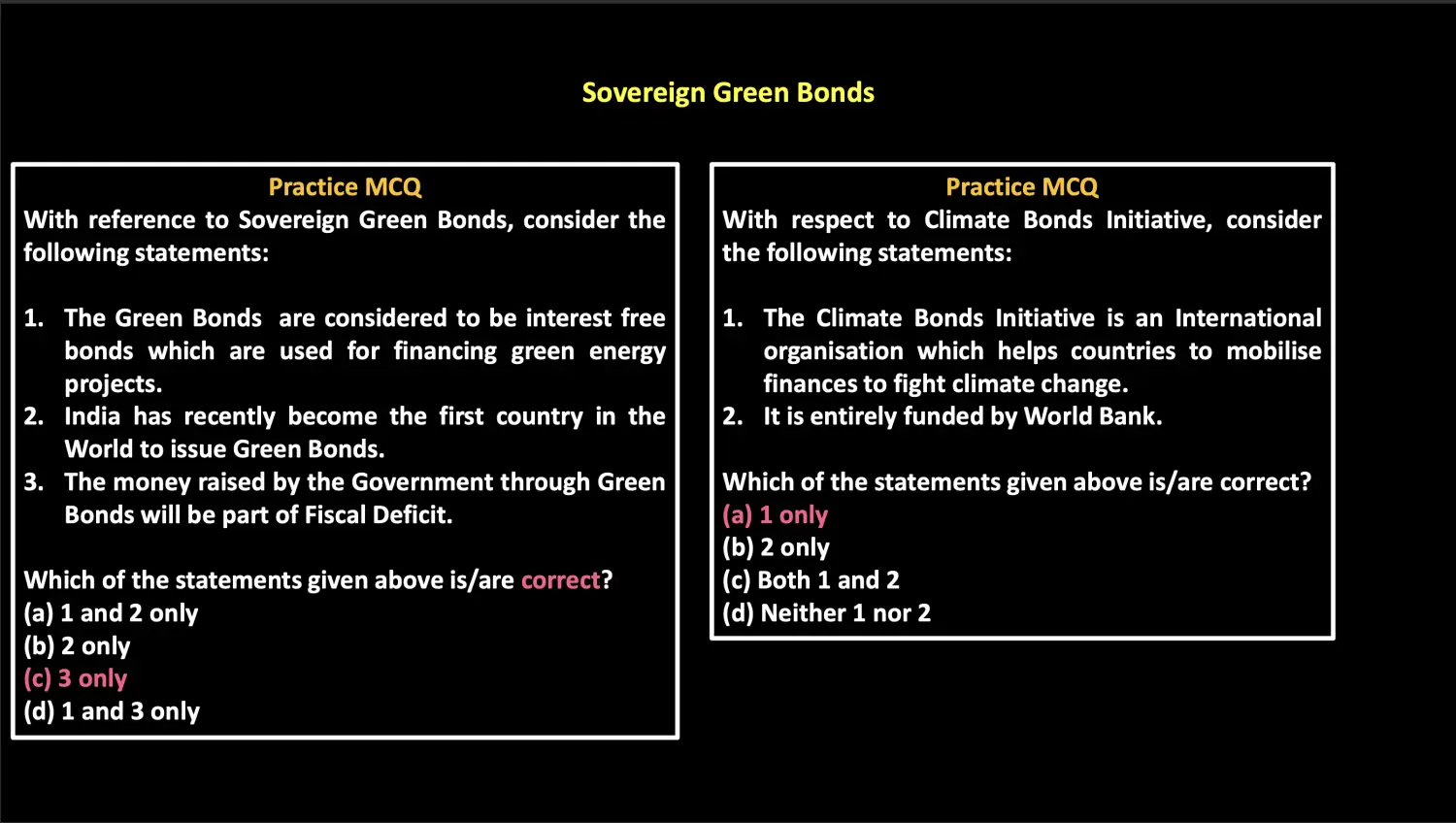
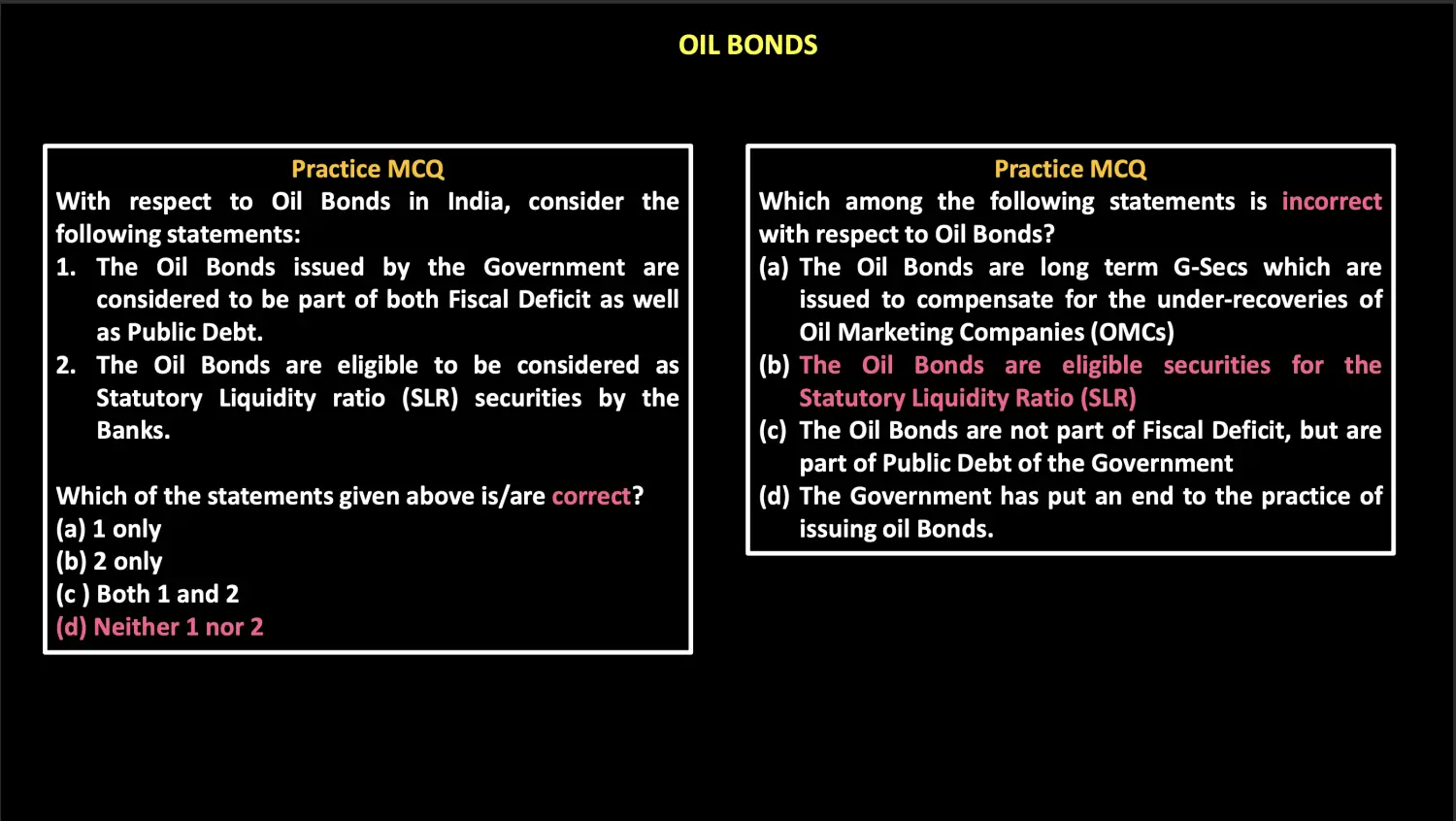
Current Affairs of that Day
Public Debt & Fiscal Deficit
Public Debt - Stock
Fiscal Deficit - Flow
GSP - Generalised System of Preferences
US Imports at Zero Percent Custom Duties on Few Goods
MFN - Most Favoured Nation
National Treatment Clause
What is a Financial Market in a Country
There are only two types of entities in a Country
Entity which has surplus money
- Banks
- NBFC
- Pension Fund
- Mutual Fund Companies
- Foreign Investor
- Retail Investor
Entity which needs money
- Govt
- Companies
- Start Ups
- Banks
- NBFC
There are Two Types of Financial Market
- Money Market - Capital Raised for a time < 1 Year → Retail Investors Less
- Commercial Paper < 1 Year MP
- Bills of Exchange
- Bank Rate
- Certificate of Deposits
- Call Notice or Term Money
- Tri Party Repos or Market Repos
- Money Market Mutual Funds
- T Bills
- CMB
- Capital Market - Capital Raised for a time > 1 Year → Retail Inv High
- Share
- Corporate Bond
- Debenture
- ETF - Exchange Traded Funds
- REIT - Real Estate Investment Trust
- Futures and Options
- SDL
- Dated Security of Central Gov
There are different Instrument which give money, which can be either short term or long term based on which it can be money or capital market
- Money Market - Capital Raised for a time < 1 Year → Retail Investors Less
Difference Between Capital and Money Market
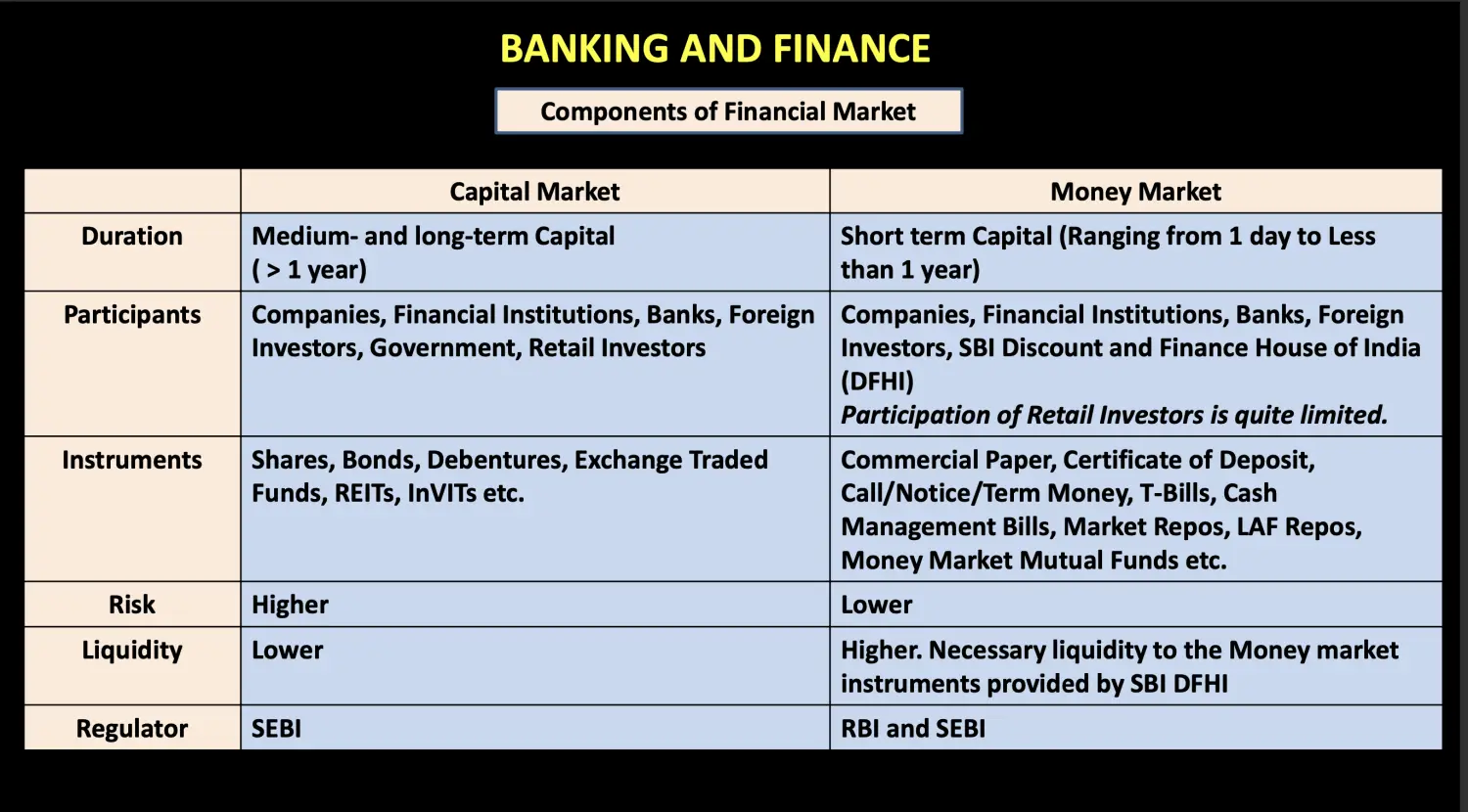
DFHI - Discount and Finance House of India
99.99% of Money Market is Regulated by RBI
RBI has Laid Down Guidelines for all the Instruments
SEBI has laid down Guidelines for only one Instrument i.e Money Market Mutual Funds
Types of Money Markets in India
Introduction
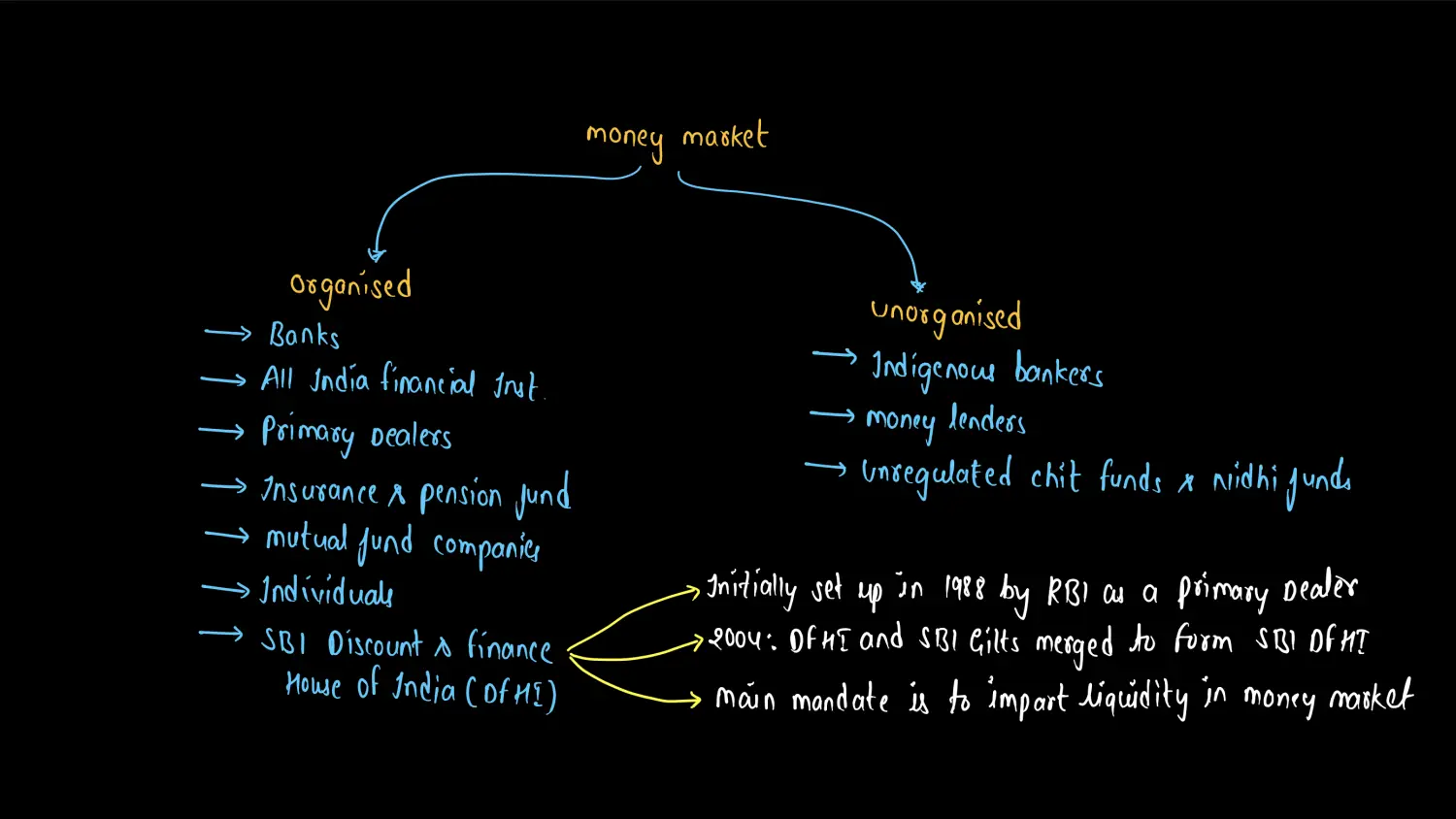
Organised Money Market
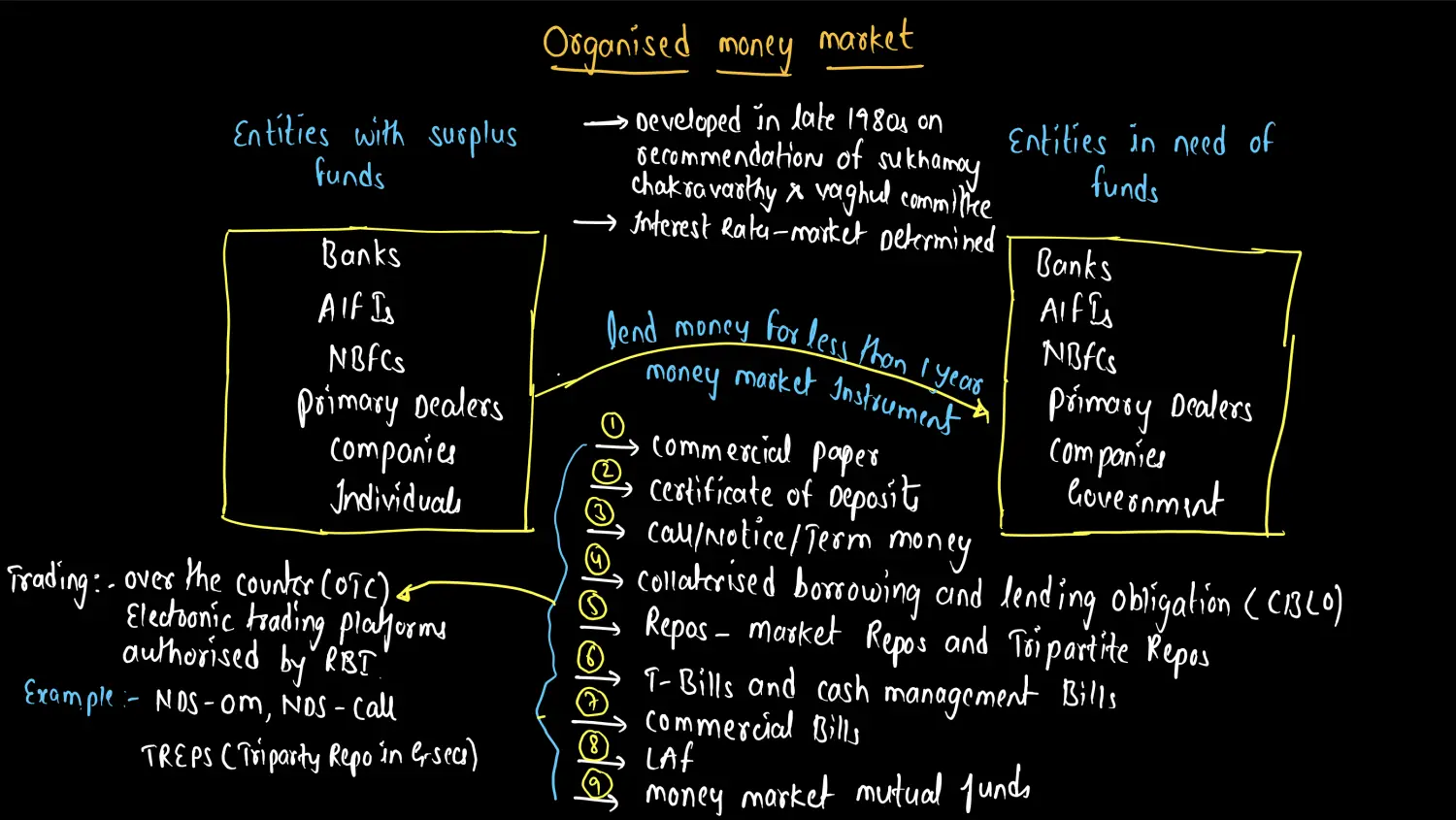
NDS OM - Negotiated Dealing System Ordered Matching
NDS - CALL - Negotiated Dealing System Call
TREPS - Tri Party Repo System
Unorganised Money Market
Not to be Studied
Types of Instruments in Organised Money Market
Summary
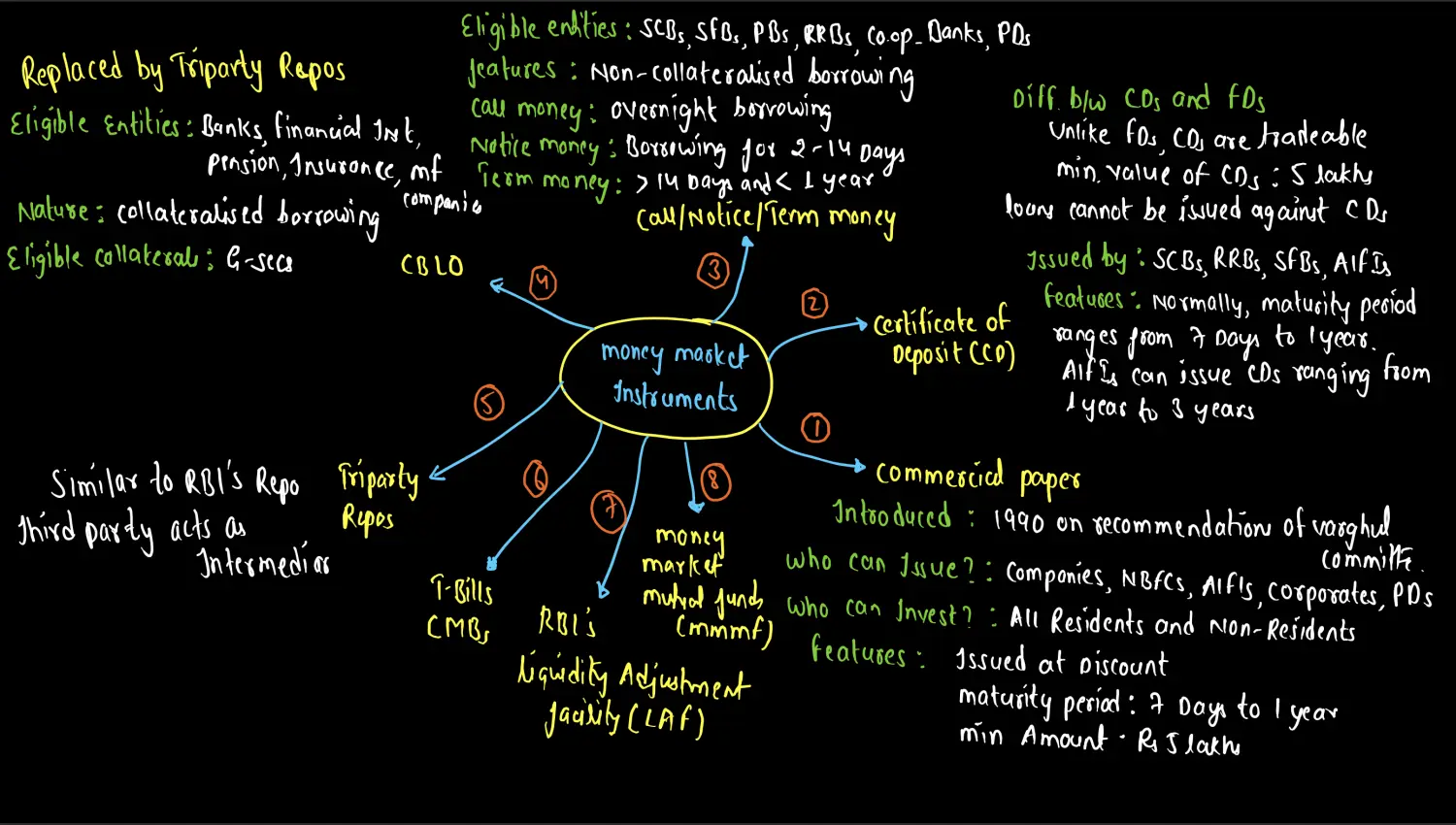
Commercial Paper
- Similar to Bond
- MP < 1 Year
- Issued at Discount and Redeemed by Face Value
- Issued by Banks, NBFC and Companies
- Always Unsecured
Certificate of Deposit
| FD Fixed Deposit | CF Certificate of Deposit | | --- | --- | | Value Lower or Higher | Min Value is Rs 5 Lac | | MP Vary from time to time | Min Time is 1 Year | | Can be used as a Collateral | Cannot be used as a Collateral | | Non Tradeable | Tradable |
Call Notice & Notice Money & Term Money
Doubt in Collateralised Borrowing
- 1 Day Lending - Call Money
- 1 to 14 Days - Notice Money
14 < 1 Year - Term Money
CBLO
- Collateralised Borrowing and Lending Obligation
- Bank to Bank by Means of Collateral
- CBLO has been replaced by another tool called Tri Party Repos
Tri Party Repos / Also Called Market Repos
Tri Party Repos
- RBI is Never a Intermediary No Matter What
- CCI and TREX are Examples of Intermediary
- It is like P2P just that G Secs are Sold and Bought Here
- It is always for a period less than 1 Year
- Eligible Participants here can be Borrowers or Lenders
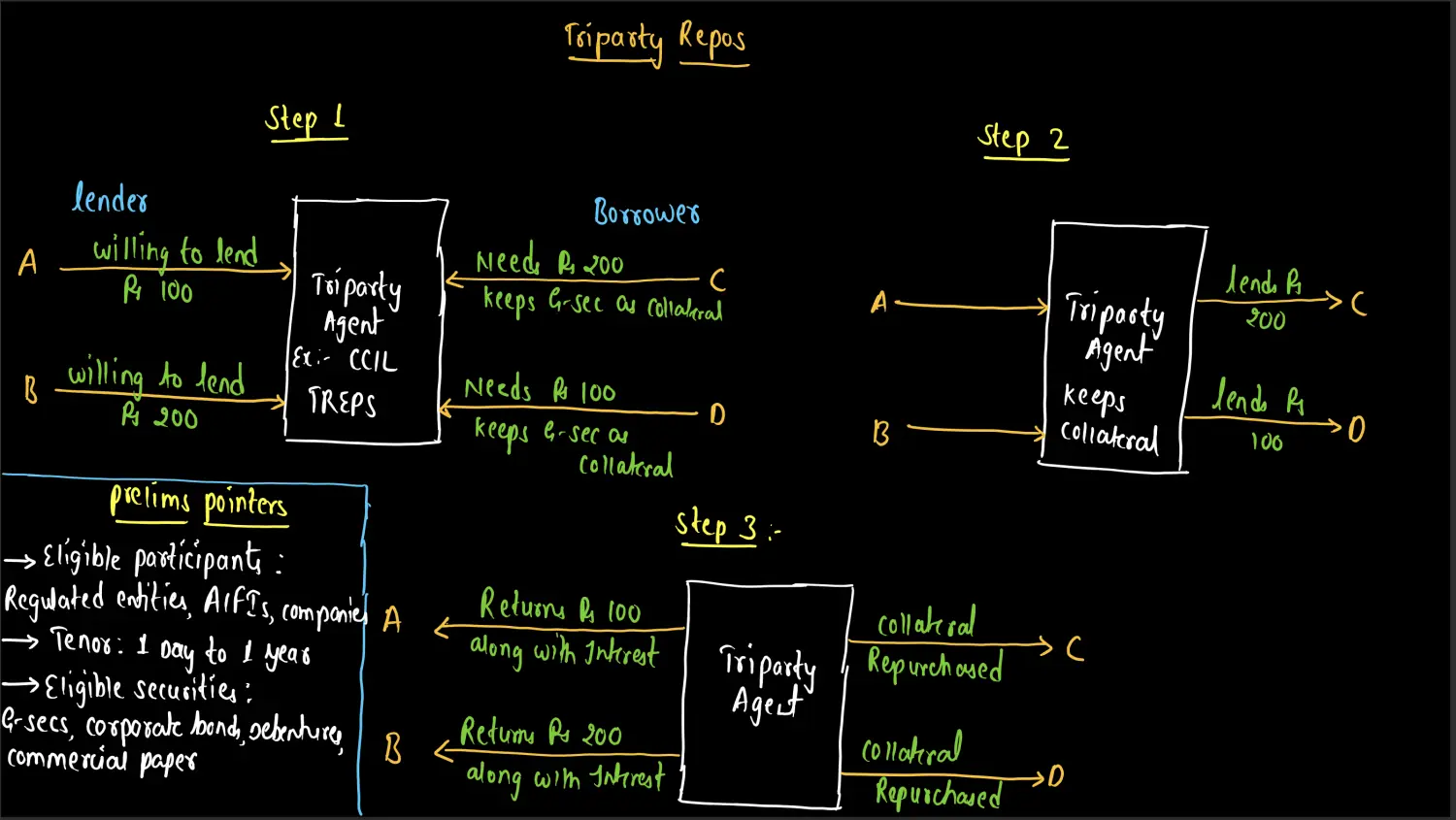
Difference Between Tri Party Repo and RBI Repo
| Tri Party Repo | RBI Repo | | --- | --- | | Three Parties | Two Parties | | RBI Not Involved | RBI Involved | | G Sec, Bond & Commercial Paper can be used as Collateral | Here only G Sec can be involved as a Collateral |
Money Market Mutual Funds
- Mutual Funds Companies Mobilise Money from Various INvestors and Invest them in
Shares - Equity Mutual Fund - Can be Long or Short Term
Bond - Debt Mutual Funds - Can be Long or Short Term
Money Market - Money Market Mutual Fund - Always Short Term
They In Turn Invest in Money Market Instruments like the ones discussed above
- Mutual Funds Companies Mobilise Money from Various INvestors and Invest them in
Types of Capital Markets in India
India's Ranking
- In Terms of Market Capitalisation - 5th Largest
- In Terms of PPP - 3rd Position
- In Terms of Nominal GDP - 5th Position
Introduction
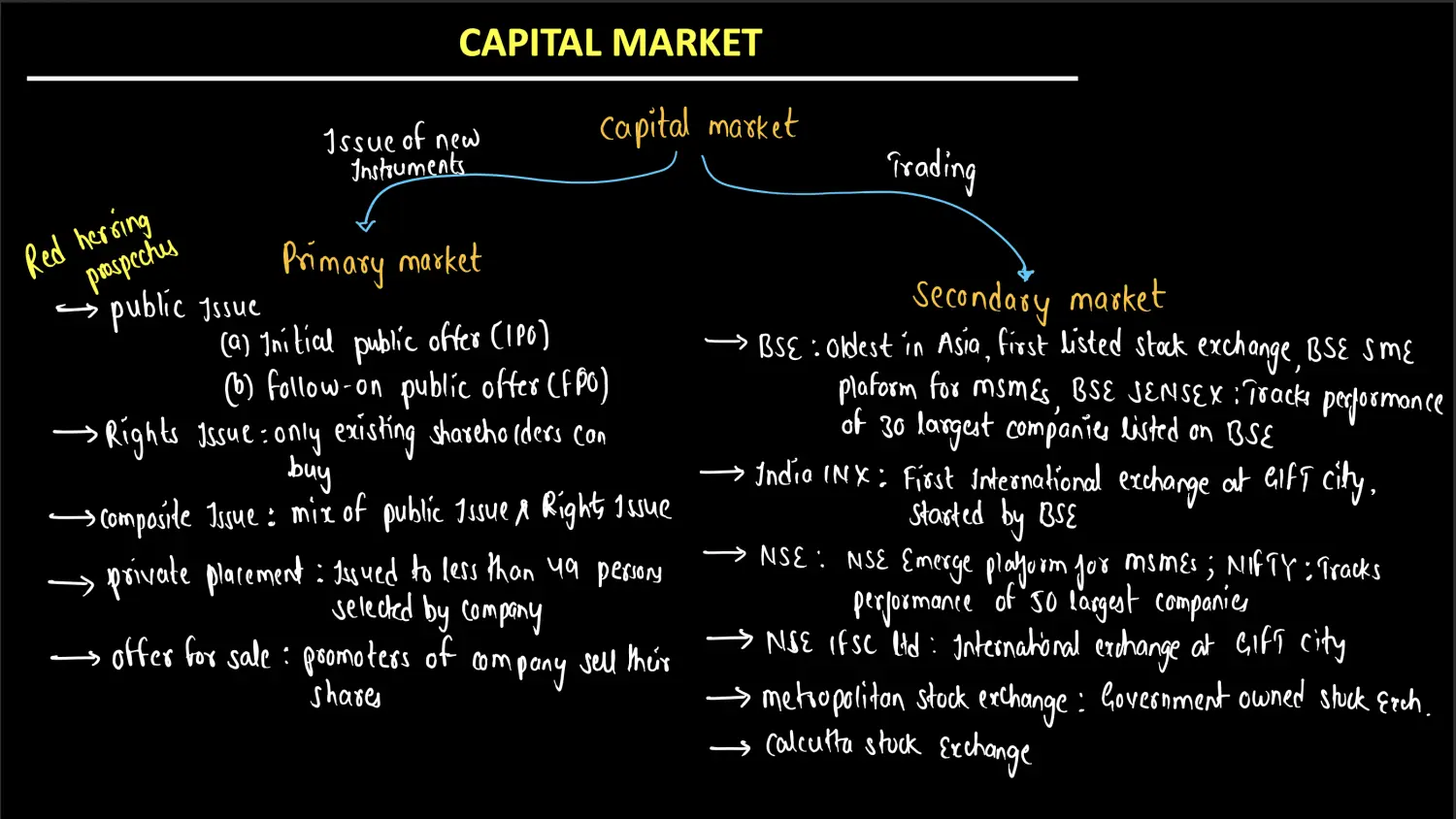
Primary Market - Issue of New Financial Instrument
Process of Issue of Shares by a Particular Company
When a Company Issues Share. It can be
Initial Public Offering → first time in the Market is called IPO → Can Never be Rights Issue
Follow on Public Offer → for the subsequent times, issuances of shares
Offer for Sale → Another way of Selling Shares
Here Owners of Company are offering to Sell their Shares → Always in Primary Market
Unlike IPO or Follow on Public Offer, Here New Shares are NOT Created and Only the Transfer of Ownership from Owner to Other Share Buyers
Ways in Which Shares can be Issued
Rights Issue → When Only the Existing Shareholders can buy Shares
Private Placement → Company Decides for itself that who can buy the share
Secondary Market - Trading of Already Issued Financial Instrument
How Many Stock Exchanges do we have in India
- We have 5 to 6 Stock Exchanges
Does the Price of a Share differ from One Stock Exchange to Another
Yes They Do. But they Dont Vary with Large Gaps
According to SEBI - List of All India Stock Exchanges Are :
- BSE - Bombay Stock Exchange
Intro to BSE
It is located in the Dalal Street
NY Stock Exchange is located in Wolf Street
There are Two Types of Companies in BSE
- Listed Companies
- They Have Issued Shares
- Their Shares are Traded
- Examples - LIC, Nykaa, PayTM, Zomato
- Unlisted Companies
- Not Yet Issued Shares
- Listed Companies
BSE is India's First Listed Stock Exchange - It has its shares Listed in BSE and NSE
Who Owns BSE → It is similar to a company. Hence different people have come together and set up BSE
There is No Single Institution who owns BSE, There are Banks, FI’s and Retail Investors
There is no one entity which has > 50% Ownership
But amongst all the owners → LIC has the Highest Ownership of BSE i.e 9 to 10
BSE Sensex
- It Deals with the Share Price of Top 30 Companies
- Top 30 is decided by Market Cap by BOD
- Sensex is a Kind of Barometer
- NSE
- Intro to NSE
- NSE Nifty
- It Deals with the Share Price of Top 50 Companies
- Some Companies of Sensex, would be a part of NIFTY. Hence Changes in Sensex or NIFTY will show effects on
- Indian INX
- NSE IFSC Ltd
- Metropolitan Stock Exchange
- Only Govt Owned Stock Exchange
- Calcutta Stock Exchange
- BSE - Bombay Stock Exchange
Terms Related to Capital Market in India
Market Capitalisation
Listed Company has issued share
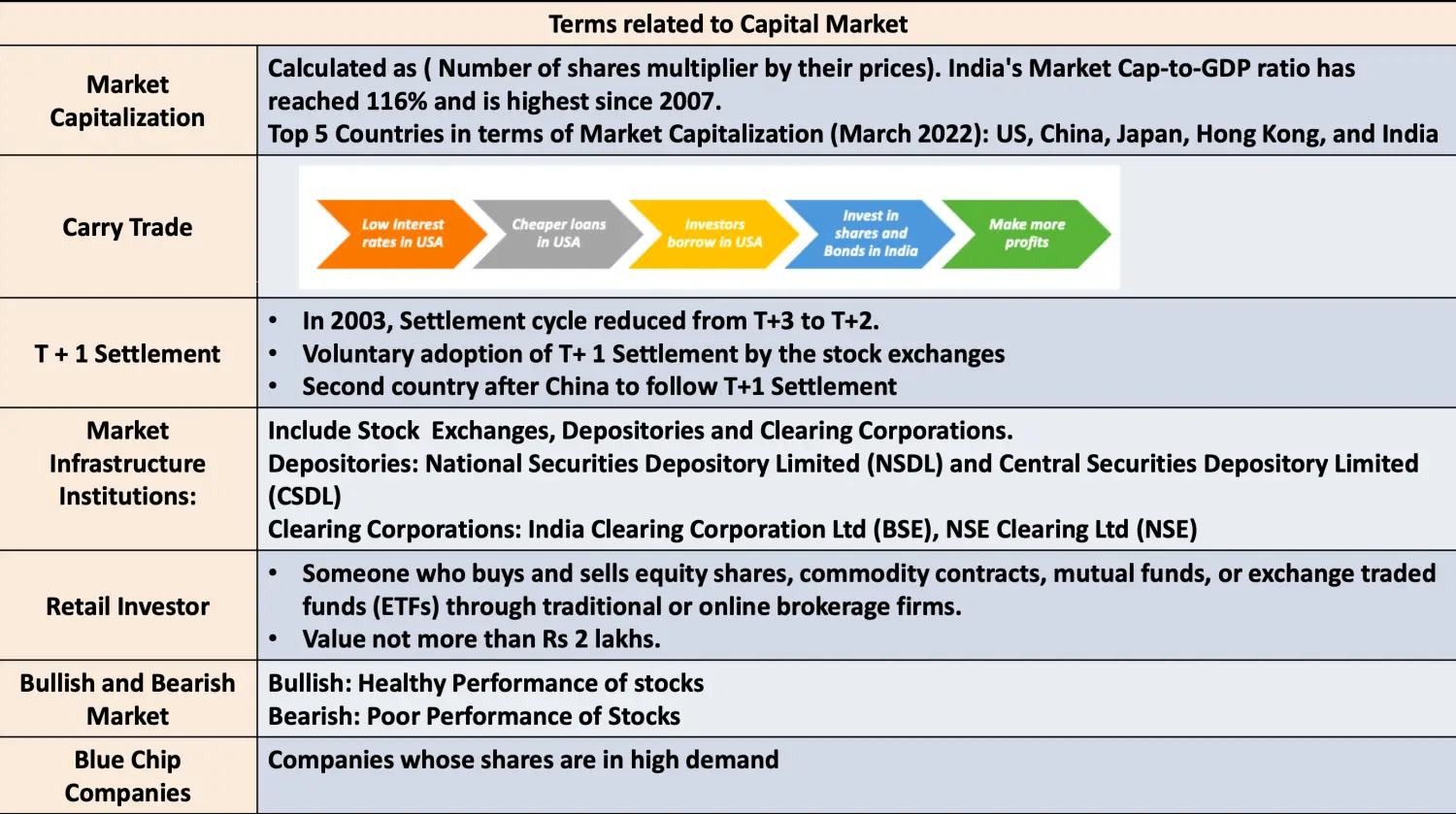
Market Capitalisation of = No of Shares * Price of Share
Market Cap of Indian Economy = Sum Total of all the Companies
Reason
More no of shares have been issued as large number of companies were listed on stock exchange
there was overall increase in the share prices of the companies as a whole
It was a special case that at one side was going down (-7.2%) but at the same time Sensex and Nifty were Increasing
Why this Anomaly took place ? → Demand Increased !! But why demand Increased → During Covid time, Middle Class People got money but at the same time they couldn't spend or invest → Hence they Invested
Carry Trade
- When Interest Rate in their country decreases they invest in other countries and when the Interest Increase in their company they invest in their country
- This Strategy is called Carry Trade
- Sometime the Carry Trade is not good for India → when Investors will borrow from India and Invest in USA
- Basically investors take advantage of difference of rate of interest between two countries
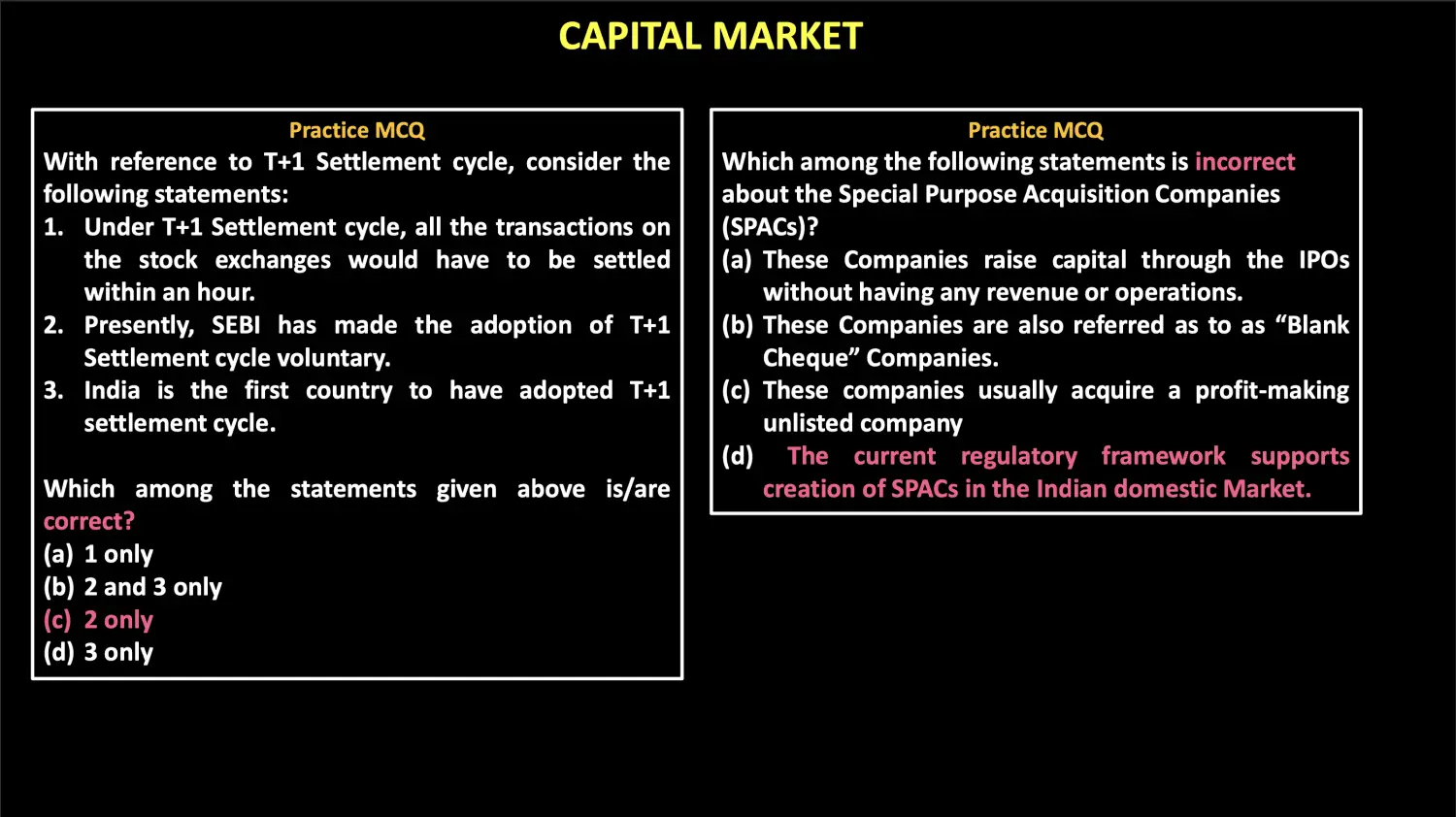
T + 1 Settlement
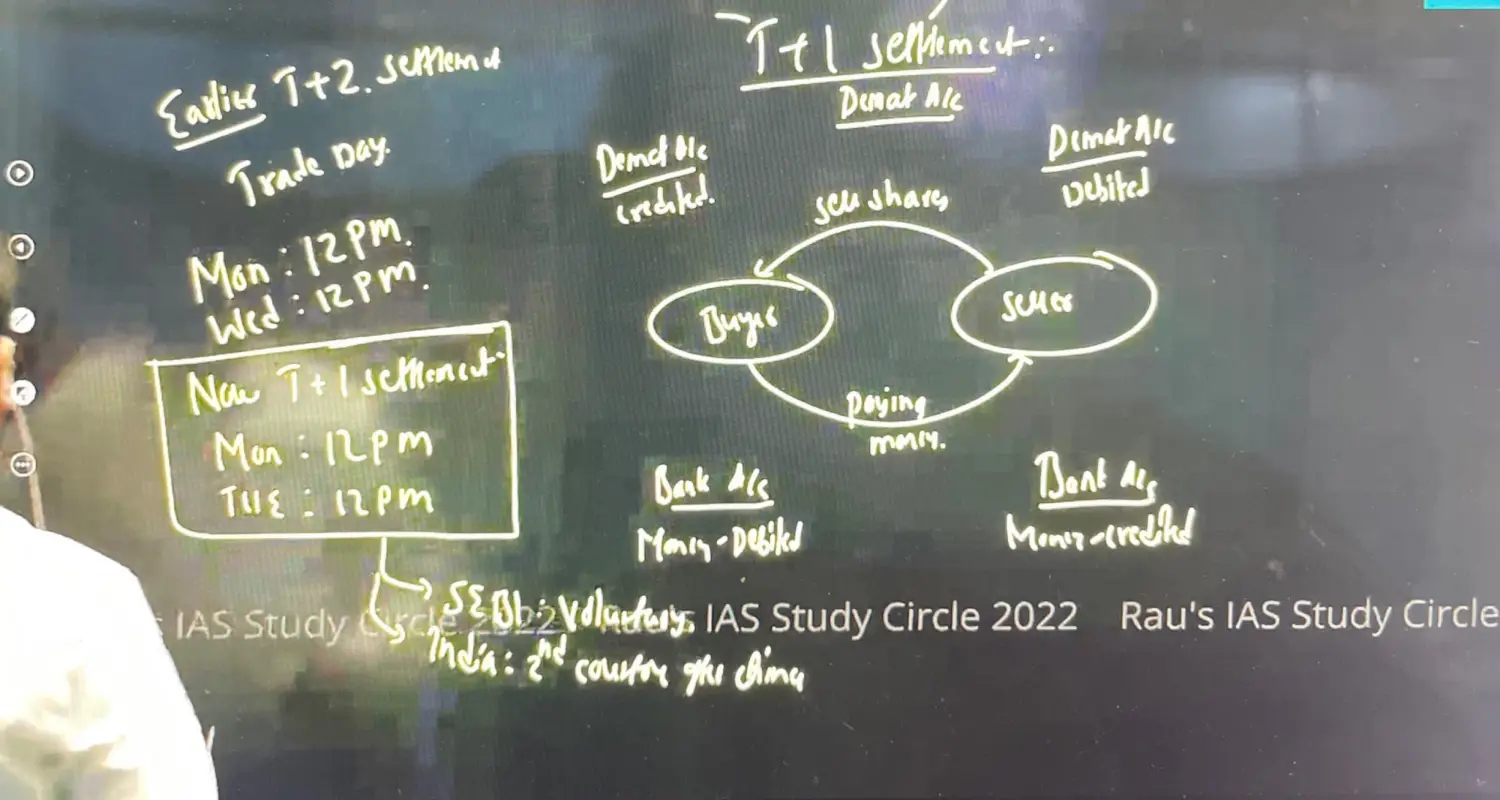
Settlement of Transaction Means →
T Means Trade → T+2 → Within 48 Hours
T+1 Means → Within 24 Hours of Transaction Maximum → SEBI has made it voluntary
BSE & NSE Have Started Implementing it
Market Infra Institutions
- Like NBFI → In Capital Market. We have MII has
- Demat Account is where you can store your financial instruments
- It is stored in depositories
- There are Two Depositories in India
- NSDL - National Securities Depository Limited
- CSDL - Central Securities Depository Limited
- They are Regulated by SEBI
- But the Demat Account is opened with Depositories by means of Intermediaries like
- Bank → ICICI, SBI
- Fin Tech → Groww & Zerodha
Clearing Corporation
- It is used for Settlement of Transactions
- Example Are :
- India Clearing Corporation Ltd (BSE)
- NSE Clearing Ltd (NSE)
Retail Investor
- In General Someone who invests money in small amounts
- According to SEBI, A Retail Investor is someone who makes a transaction of less than Rs 2 Lac in one Single Transaction
- Not on the Basis of Total Transaction
- Importance ? → When a Company Issues Shares, it ca reserve certain percentage of shares for retail investors
- Opposite of Retail Investor is Institutional Investor
Bullish and Bearish Market
- Bull Market → Capital Market is Doing Good → Market is Going Up
- Bearish Market → Capital Market is Not Doing Good → Market is Going Down
Blue Chip Companies
- Any Companies whose shares are in Great Demand are called Blue Cheap Companies
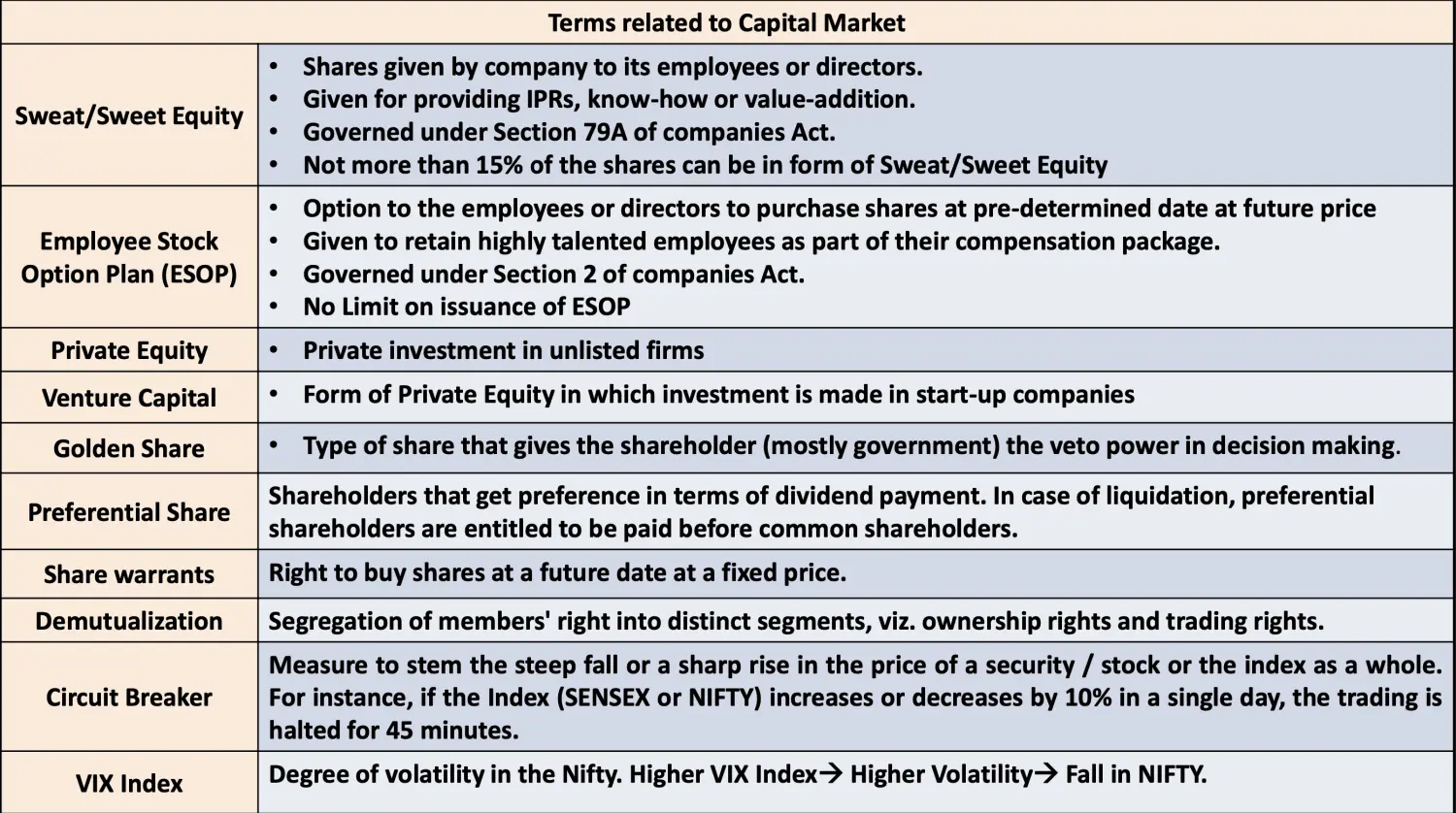
ESOP & Sweat/Sweet Equity
- ESOP - Employee Stock Option Plan
- If cost of each share is equal to Rs 12
- Given at Discount to Rs 10
- Number of Shares Rs 10
- Total 100
- Companie will say that once you get the ESOP you can't sell the share for next 2 to 3 years
- Risk Sharing
- If cost of each share is equal to Rs 12
- Sweat/Sweet - is Share without Employees Paying Money for exceptional hard work or to reward hard work. It brings loyalty and hard work of employees
- In Case of Sweat Equity Share is free of cost, Whereas ESOP is a Part of their Package
- ESOP - Employee Stock Option Plan
Private Equity
- It is always in a Unlisted Indian Company
- Venture Capital is a Part of Private Equity
Golden Share
- A Person who has this share, can veto (reject) the decisions of a company
- There are Two Ways to See it
- When the Shareholder is having > 51% Ownership
- As a Shareholder, I may have < 51%, but can still veto
- It is not a prominent thing in India
- Brazilian Govt has a Golden Share in a Pvt Company which is Strategic called Manyata Aircraft
- In India Privatisation of PSU is ok, but in Indian Strategic Companies. Indian Govt should have a Golden Share in the Company
Preferential Share
from the Image
Share Warrant
- It is an agreement between an investor at a future rate at a predetermined price
- For this Agreement, I have to pay some amount
- Generally Its more used by FDI by Institutional Buyers
De Mutualisation
- Ownership & Management of Stock Exchanges should be completely separated
- To Avoid Conflict of Interest
- Management of Stock Exchange - by BOD
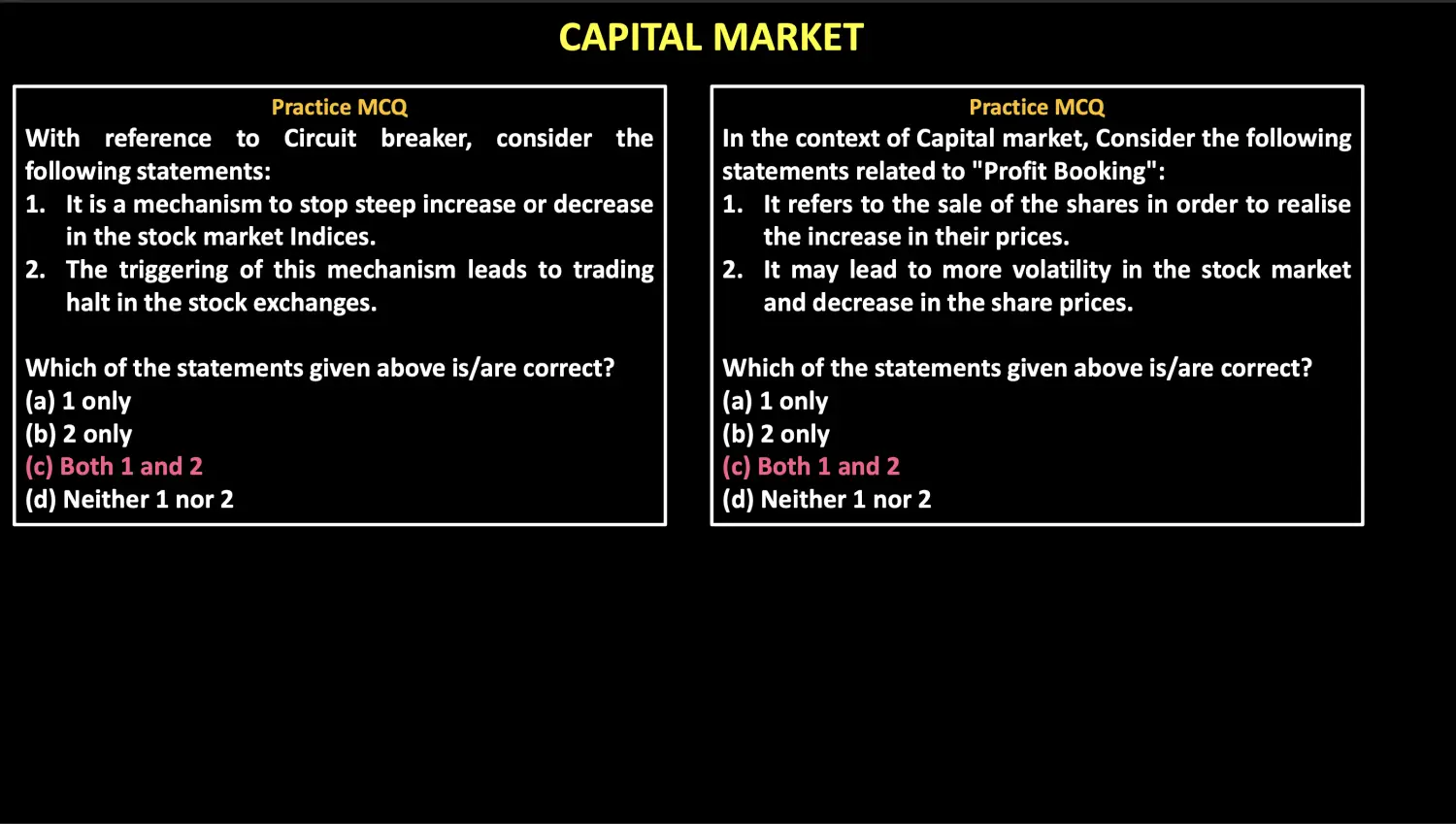
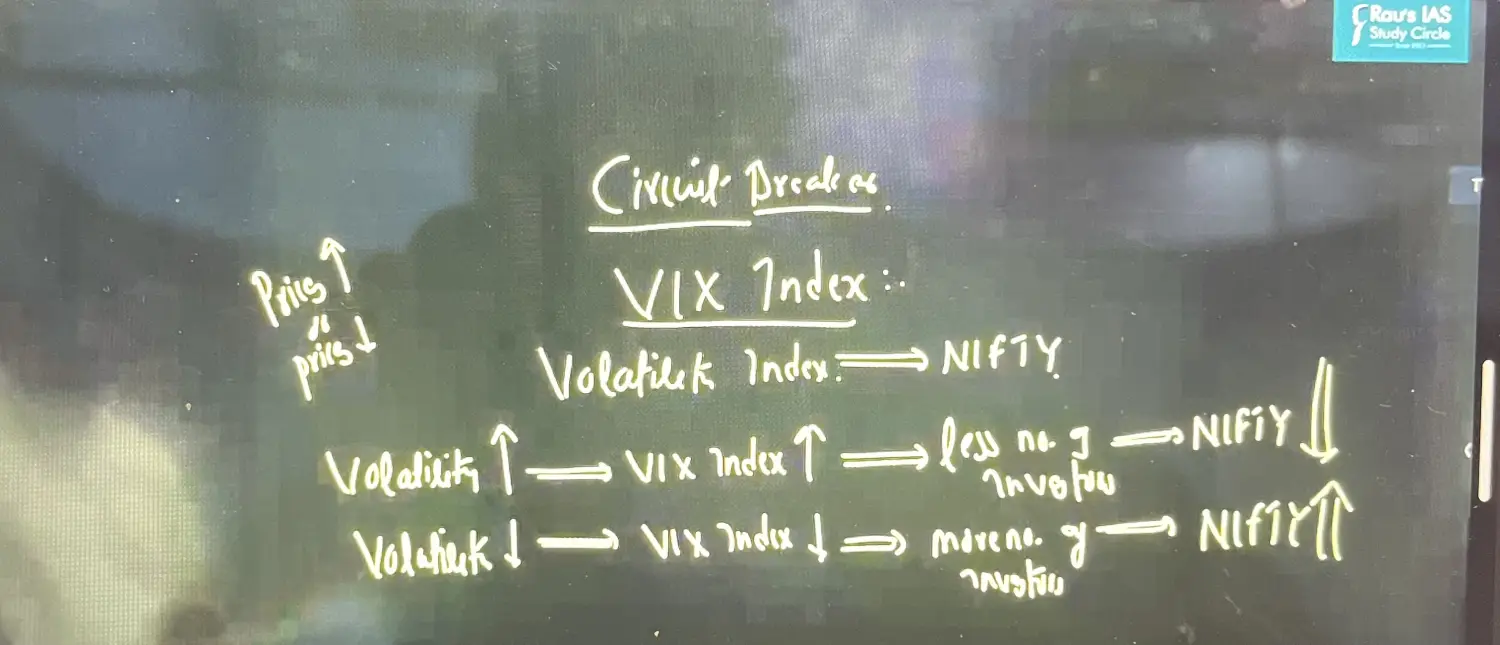
Circuit Breaker
from the Image
VIX Index
Measures the Extent of Volatility in NIFTY
VIX is Inversely Proportional to NIFTY Index
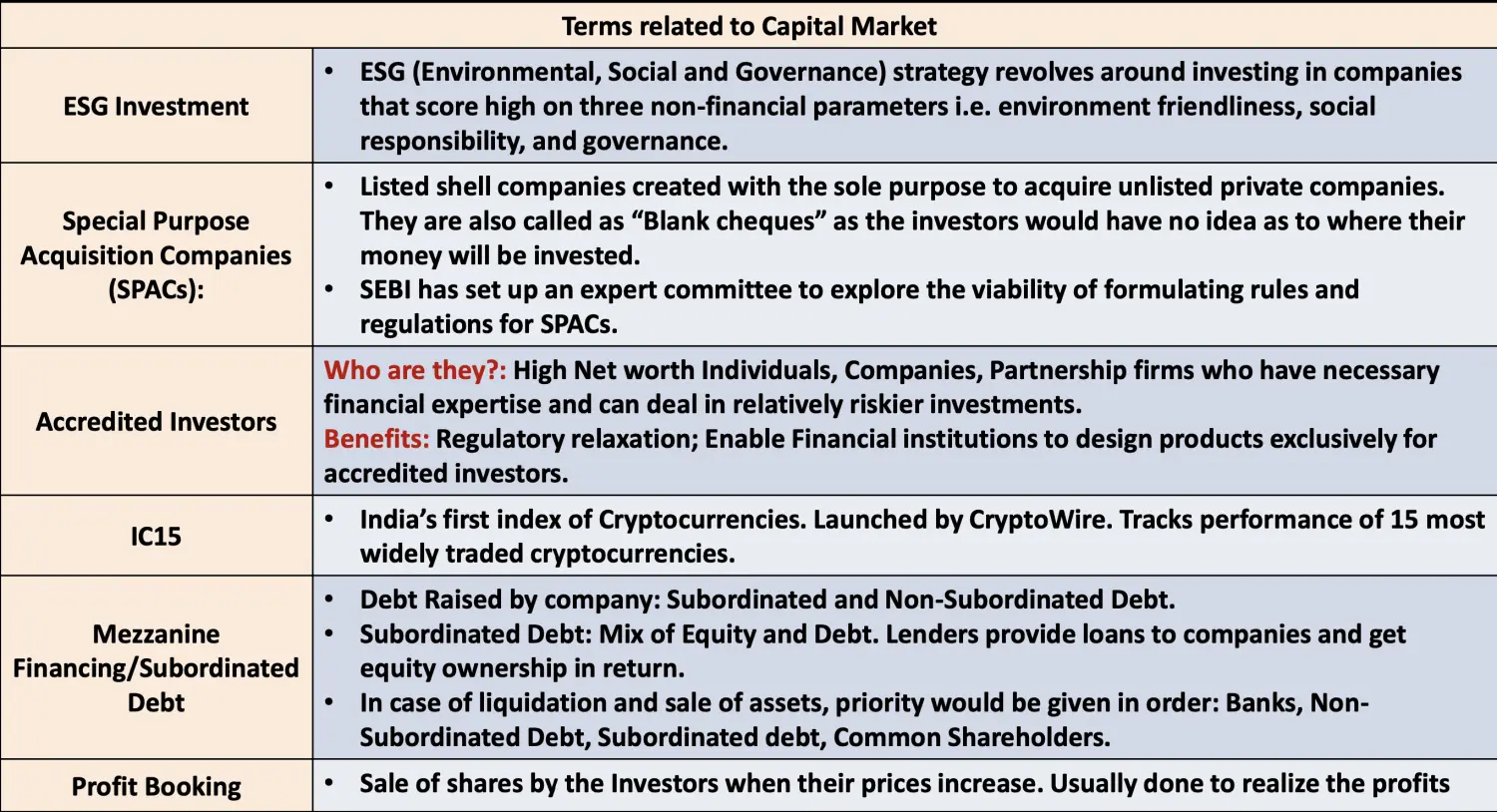
ESG Investment
from Image
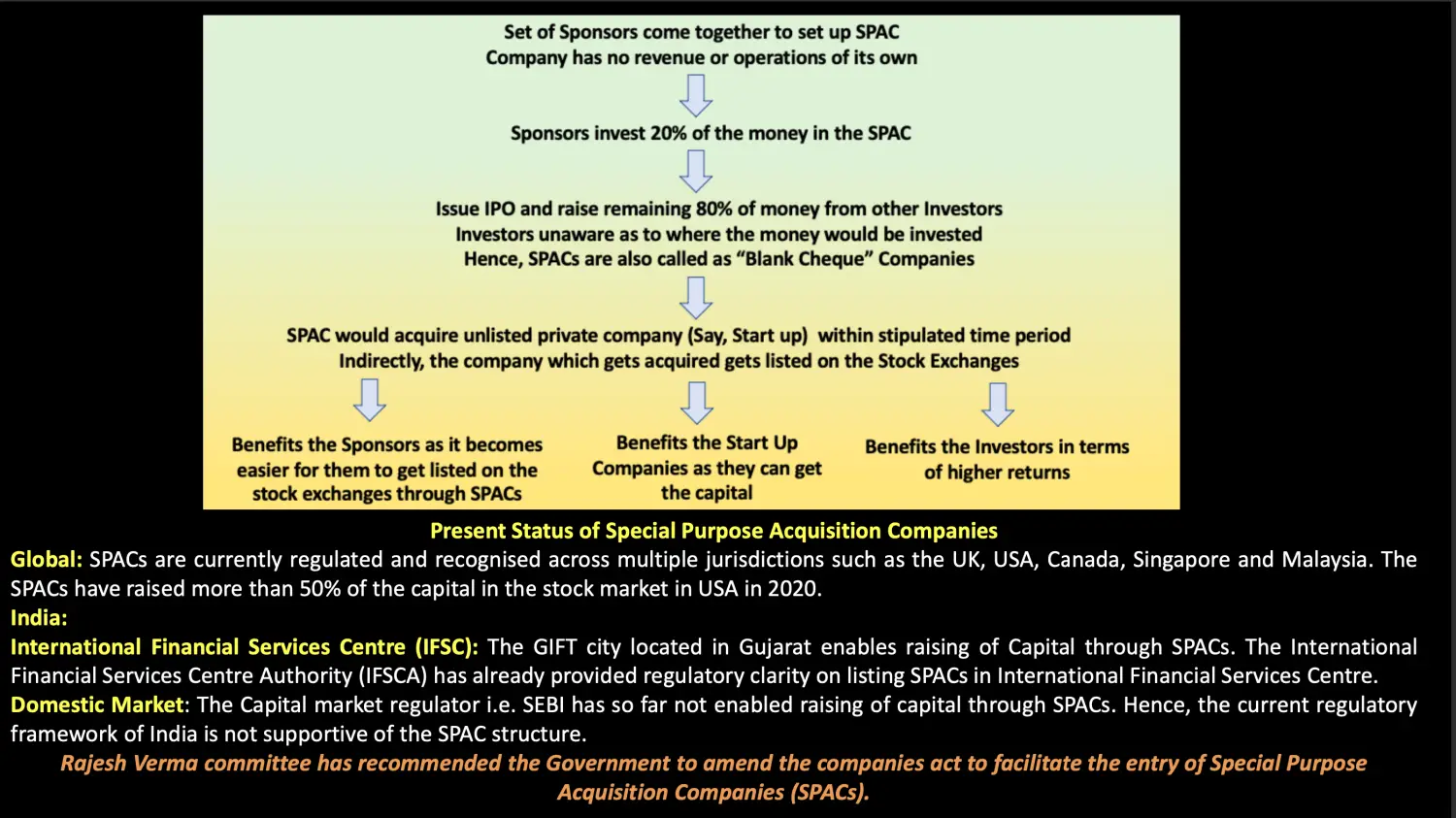
SPAC - Special Purpose Acquisition Company
- In Domestic Market SPAC can also be used for diversion of Black Money
- International Financial Service Authority has enabled SPAC in GIFT City of Gujarat
Accredited Investors
- Certain Category of Investors are Prohibited from INvesting in certain Riskier Instruments like Currency Derivatives and Hedge Funds
- Normal Investors are not allowed investing in Accredited Investors
- But Accredited Investors are Allowed - Rest from Image
IC15
- India's First Index of Crypto Assets
Mezzanine Financing or Subordinated Debt
Mezzanine is a Intermediate Floor
Profit Booking
If All the People sell their shares then the Supply in the Market Will Increase and Its Value Will Decrease. Hence Share Prices will decrease
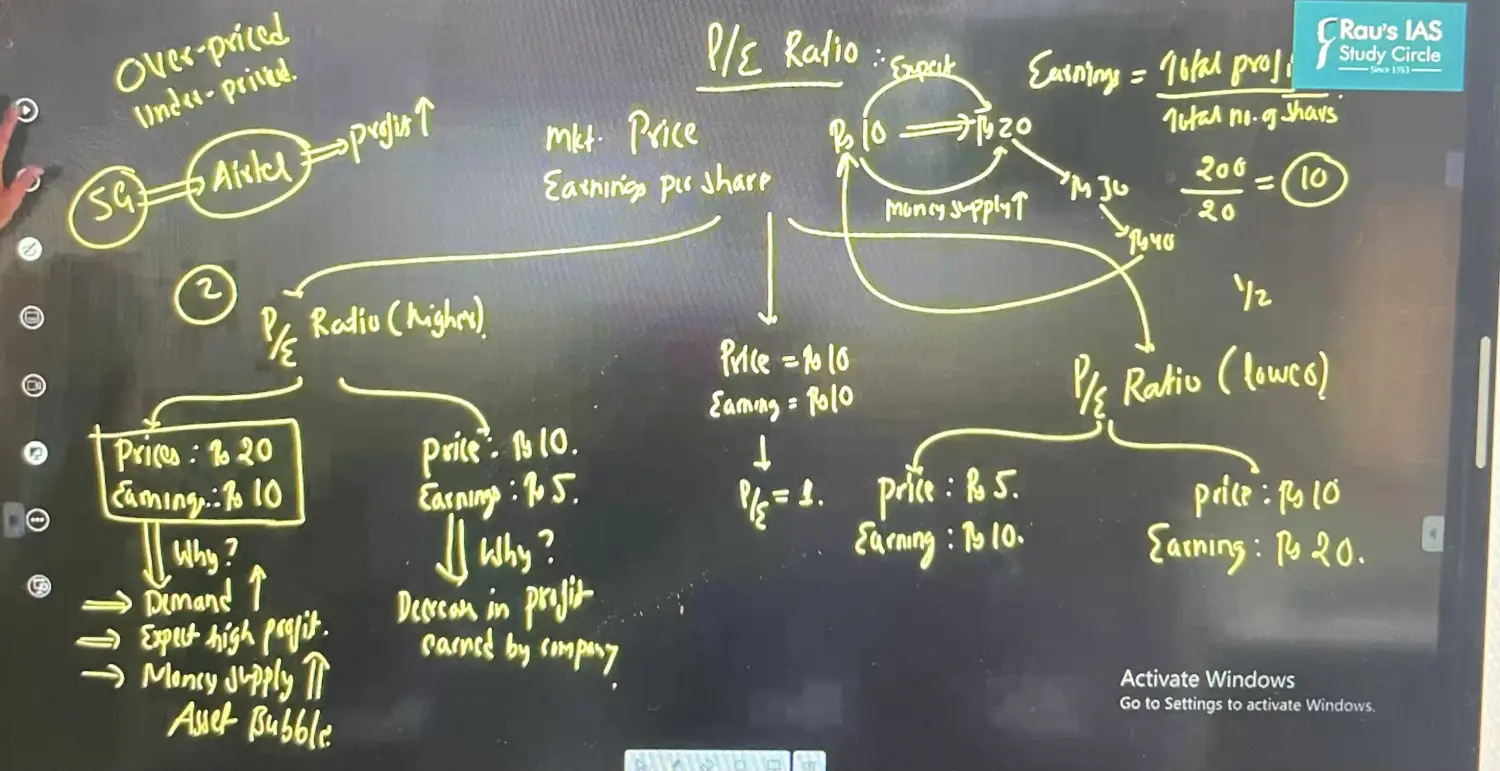
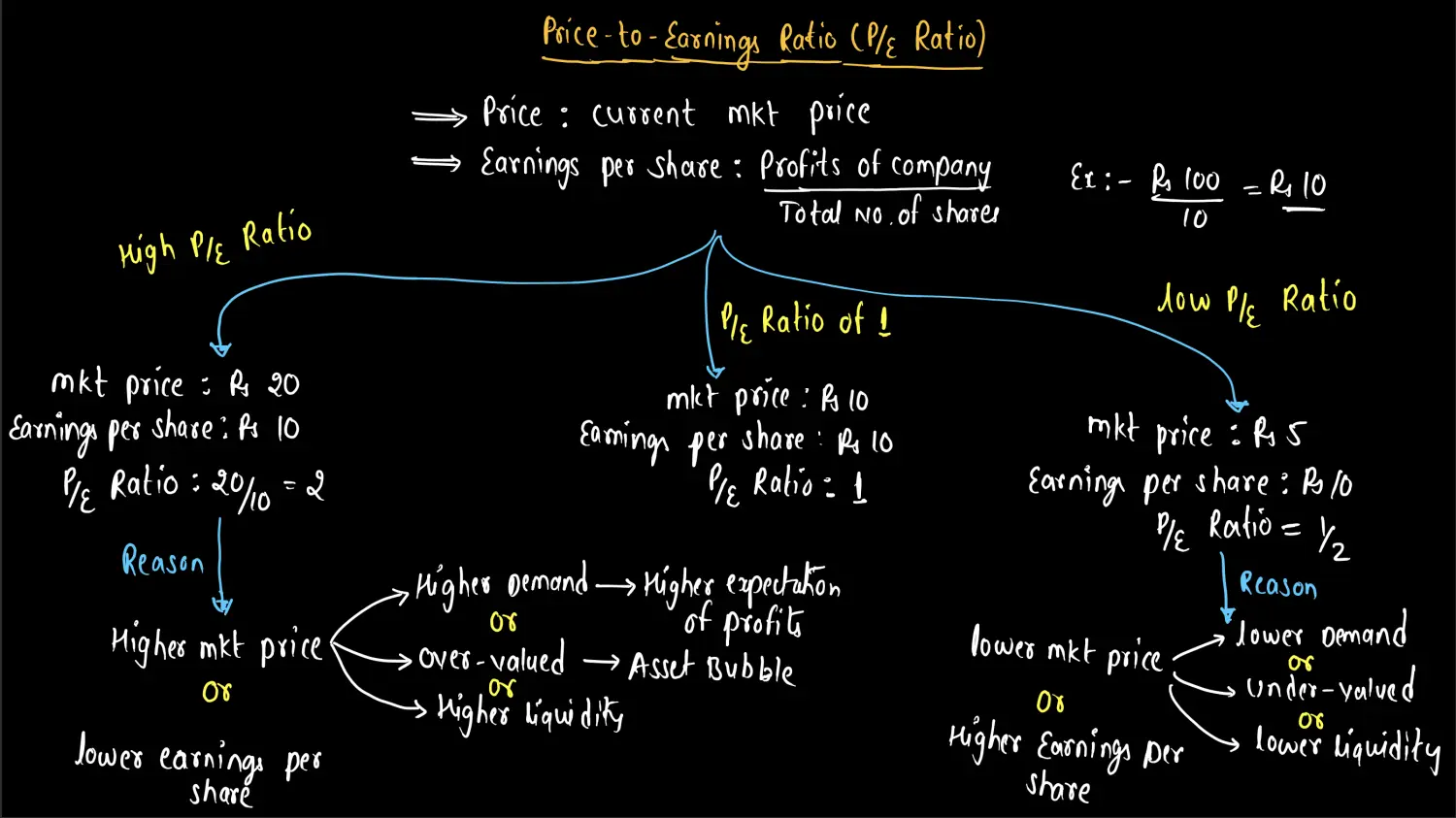
P/E Ratio
- P - Current Market Price of Share && E - Earning Per Share
- P/E Higher When - Price is higher and Earning is Less
- P/E is 1 - Price and Earning is Same
- Price Increases Because
- High Demand - Due to High Profit Expectation
- Money Supply in Economy is Higher - High Liquidity
- Asset Bubble - Sudden Crash of Share Price after Increase in Share Price - Share when thought to be overpriced
Types of Bonds
- How Indian Companies Borrow from India & Beyond
- Option for a Indian Company to Raise Money Within India
- Loans
- Shares
- Bonds
- Debentures
- Commercial Papers
- Capital Raised by Indian Company from Outside India Overseas
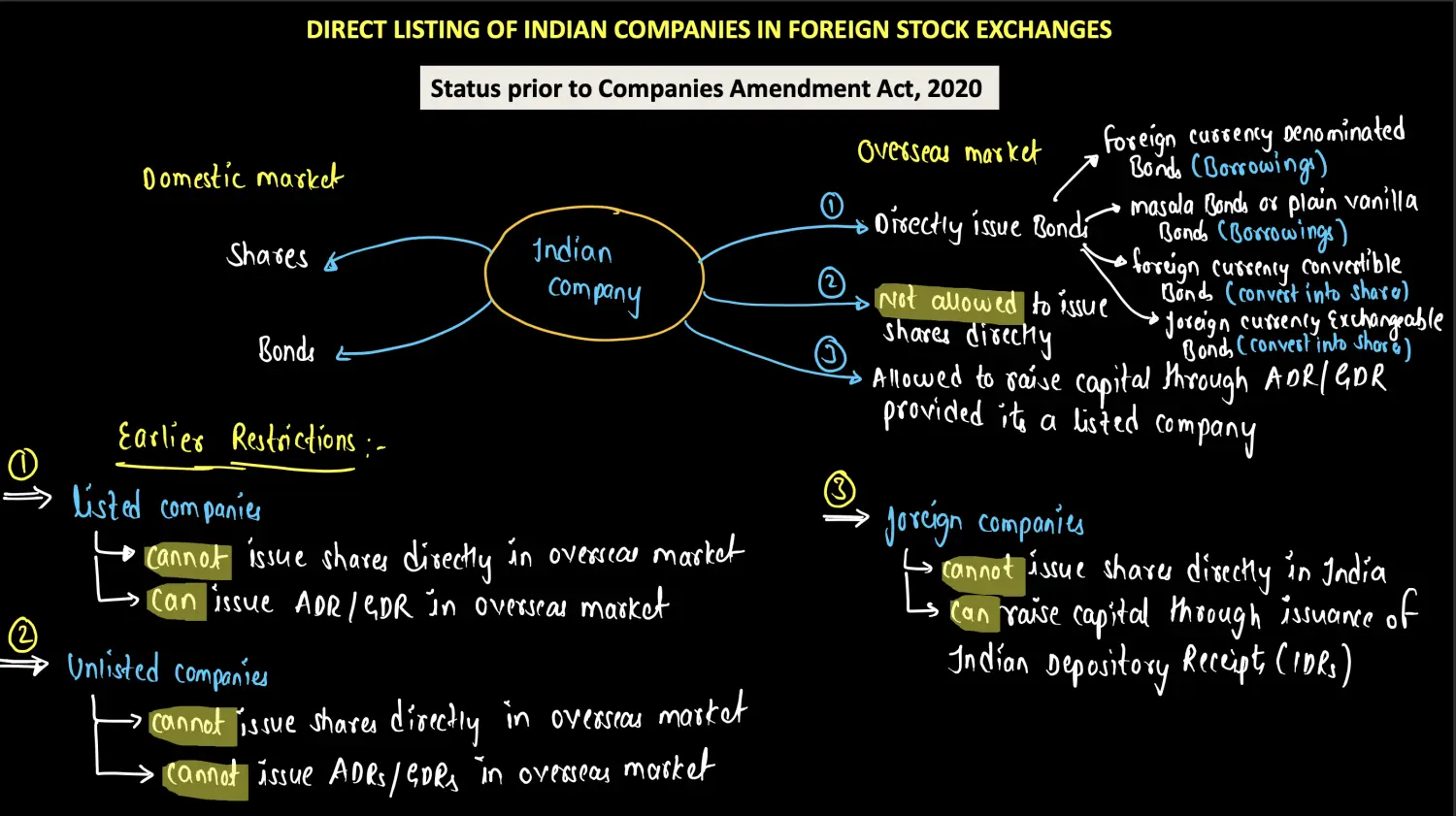
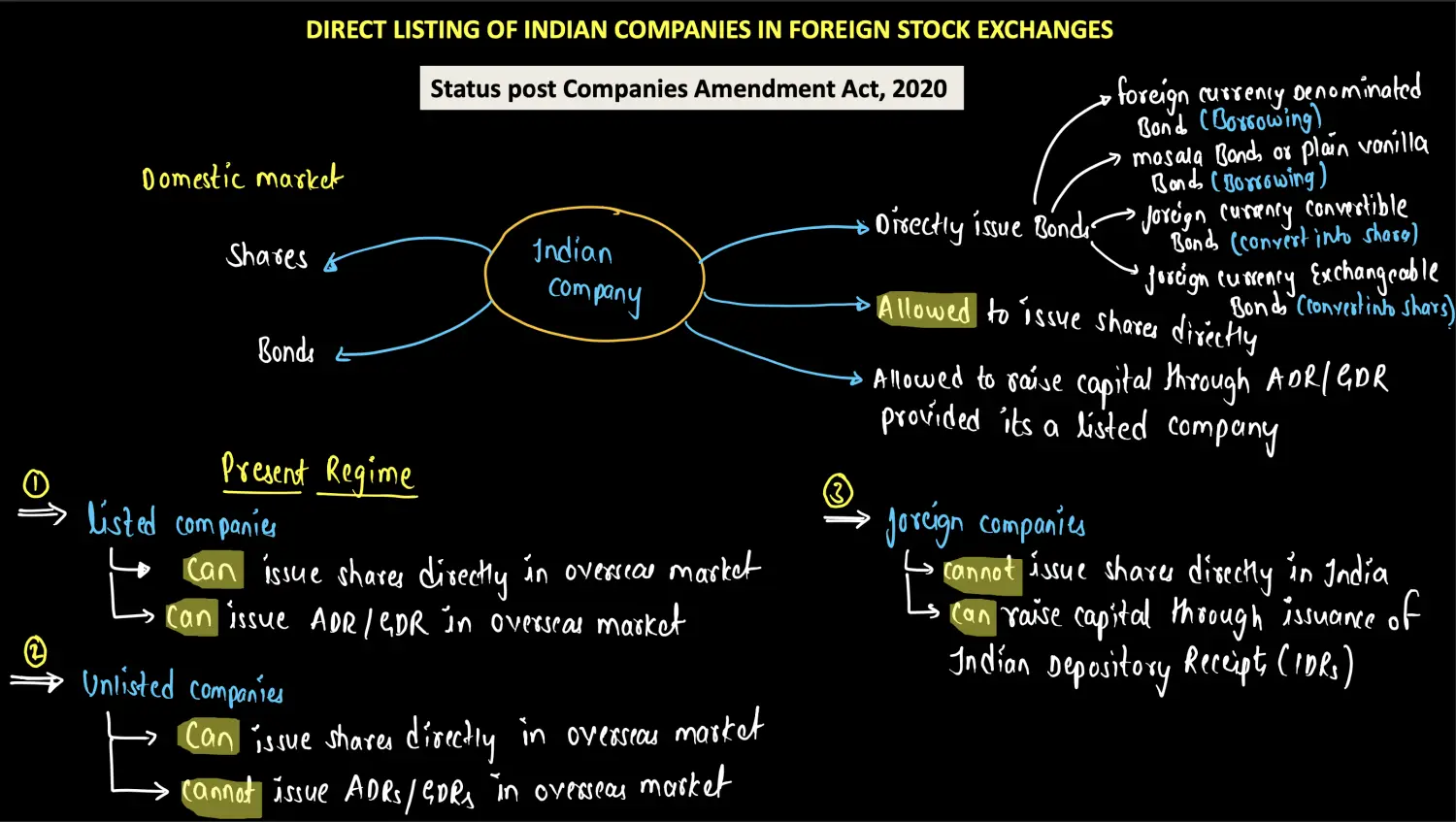
Indian Company Issuing Shares in Other Countries
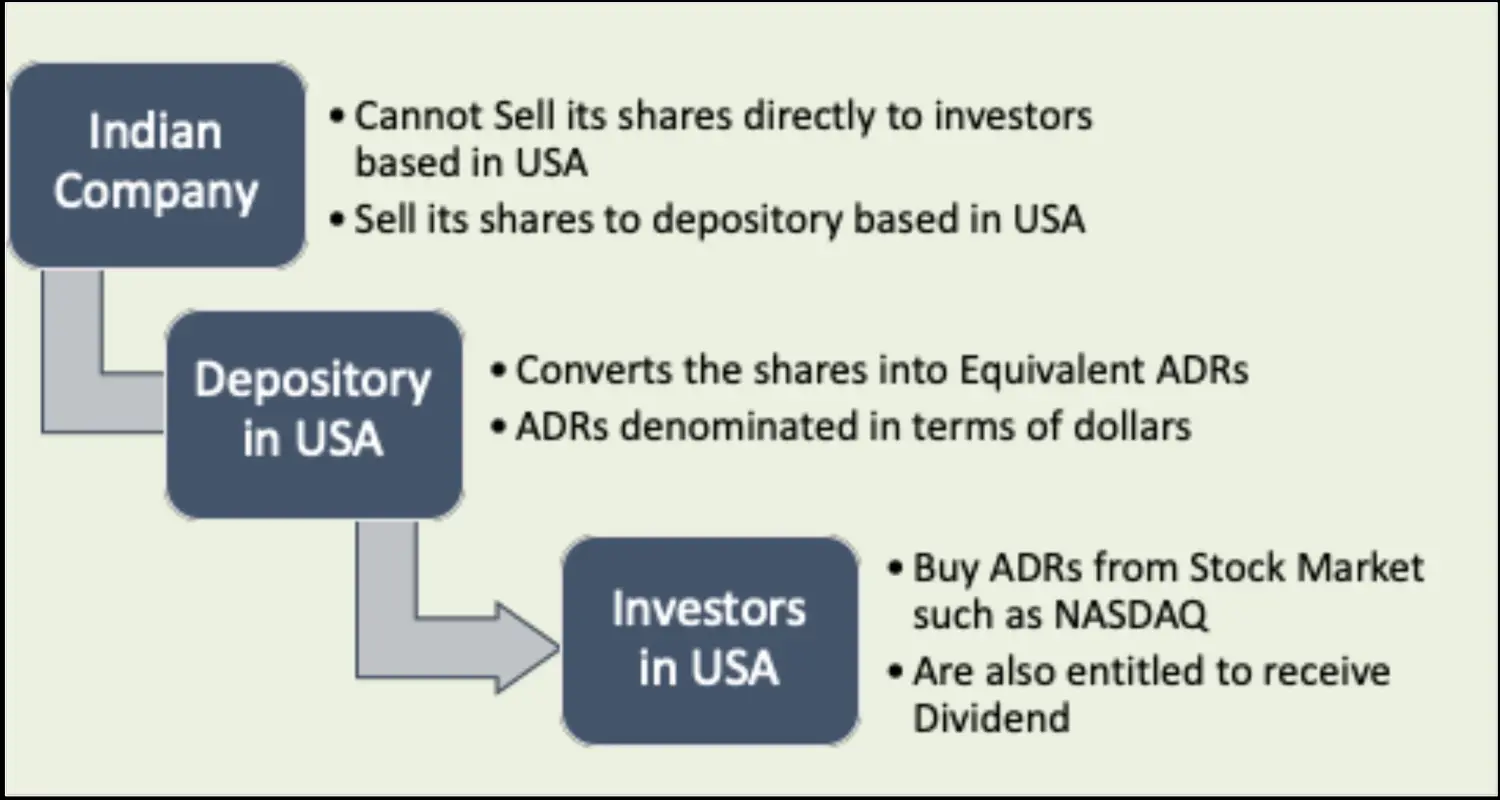
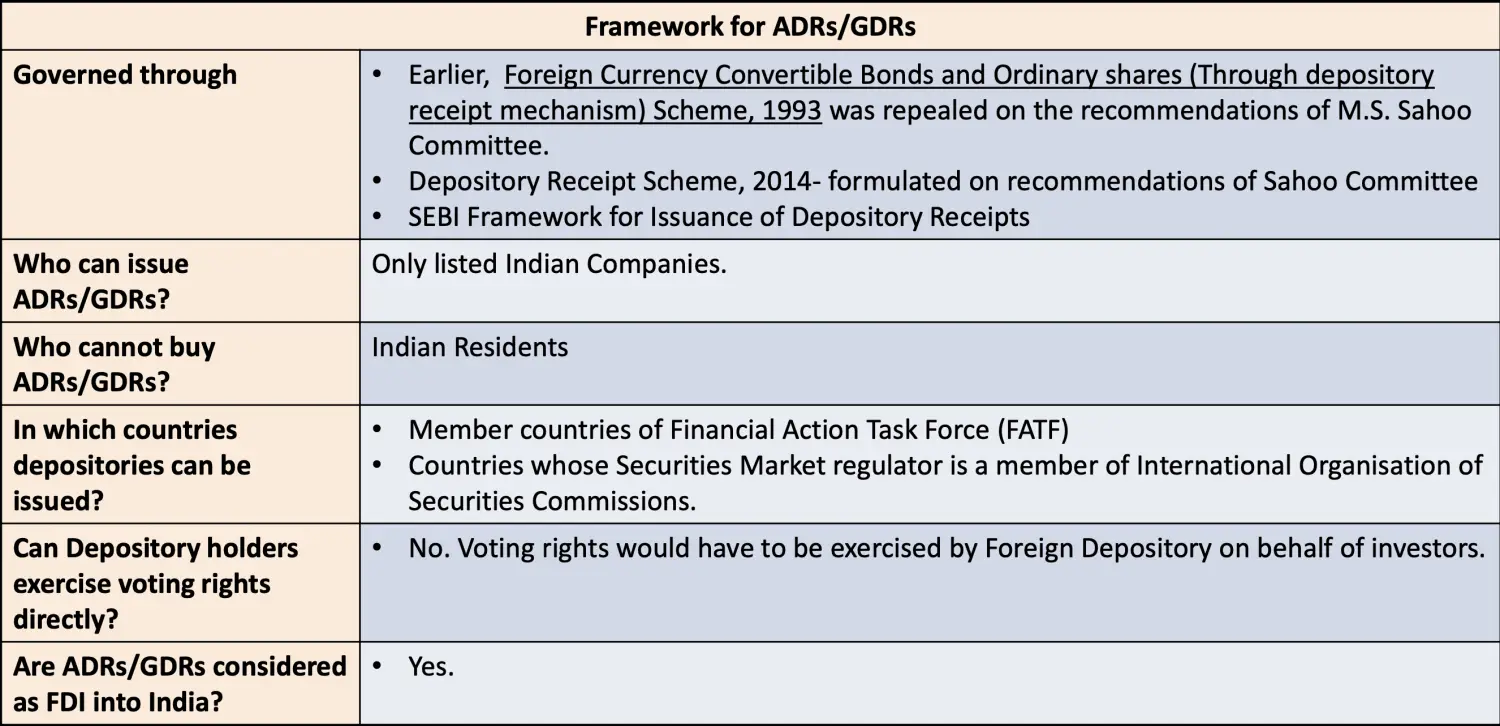
Prior to 2022 Indian Companies were not Allowed to Issue Shares in Foreign Market Before 2022
FPI - Investor Based in USA, Comes to Domestic Market, Invests in Infosys Shares
ADR - Investor Based in USA, Buys within USA, the Shares of Infosys
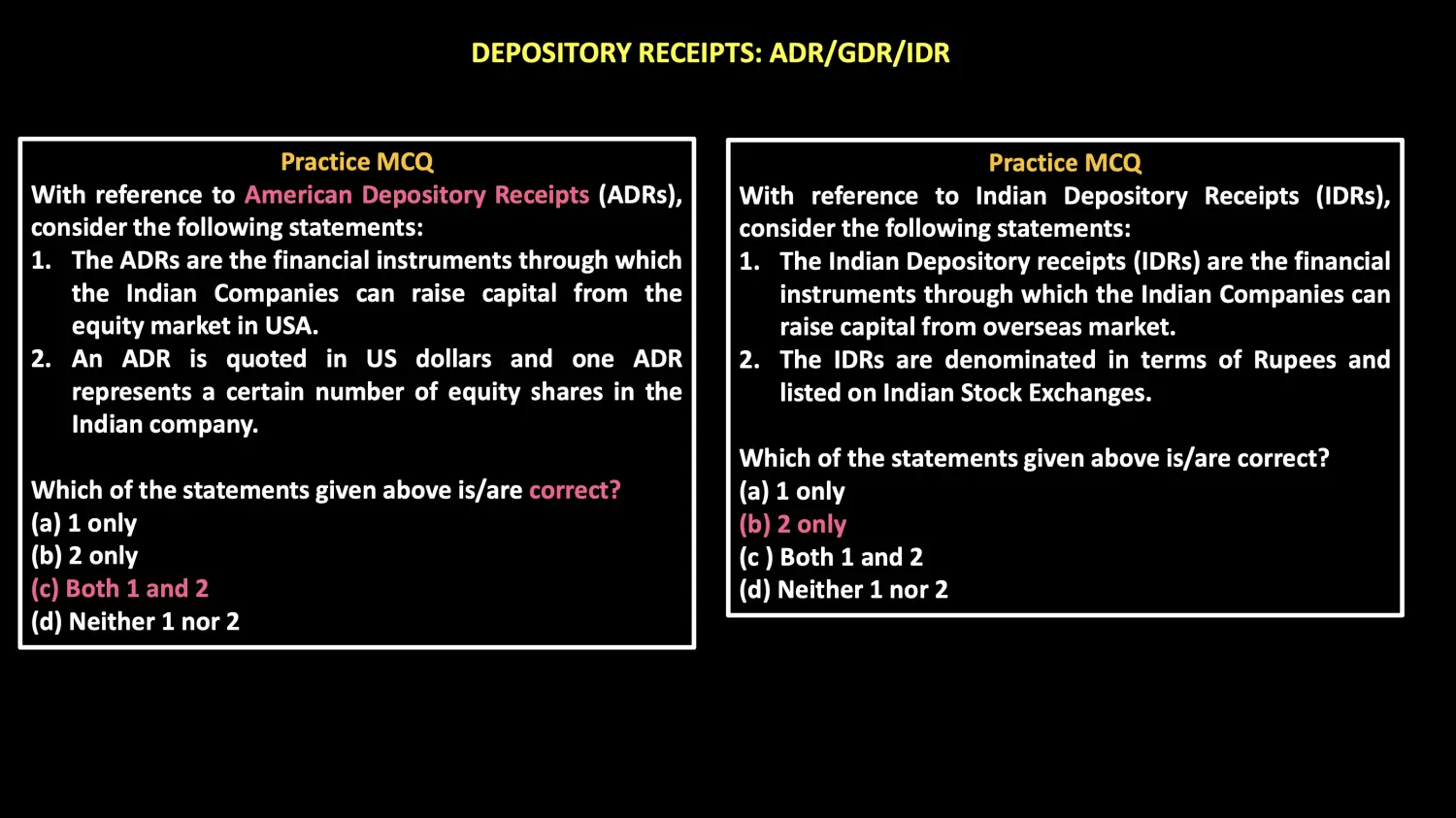
ADR - American Depository Receipt - For America - Denominated in USD
GDR - Shares Issued by Indian Company Anywhere Across the Globe - Denominated in Respective Countries Receipt
GDR - Global Depository Receipt - For Other Companies
IDR - Foreign Companies Issuing Shares in India and Indians are Buying it
No of IDR’s in India are - Sole IDR will cease to Exist
By Means of Bonds
Not in FDI → Only Bond
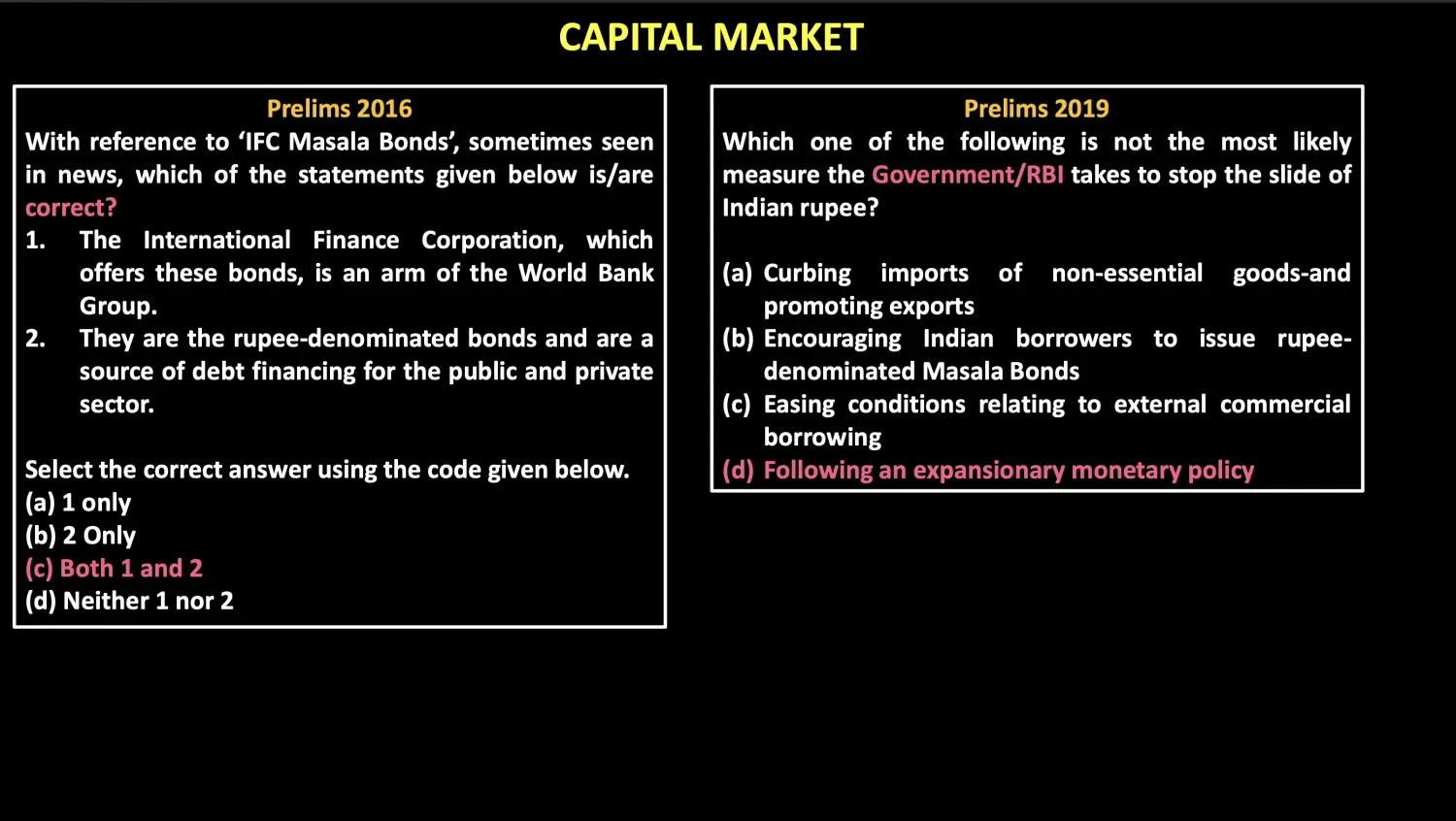
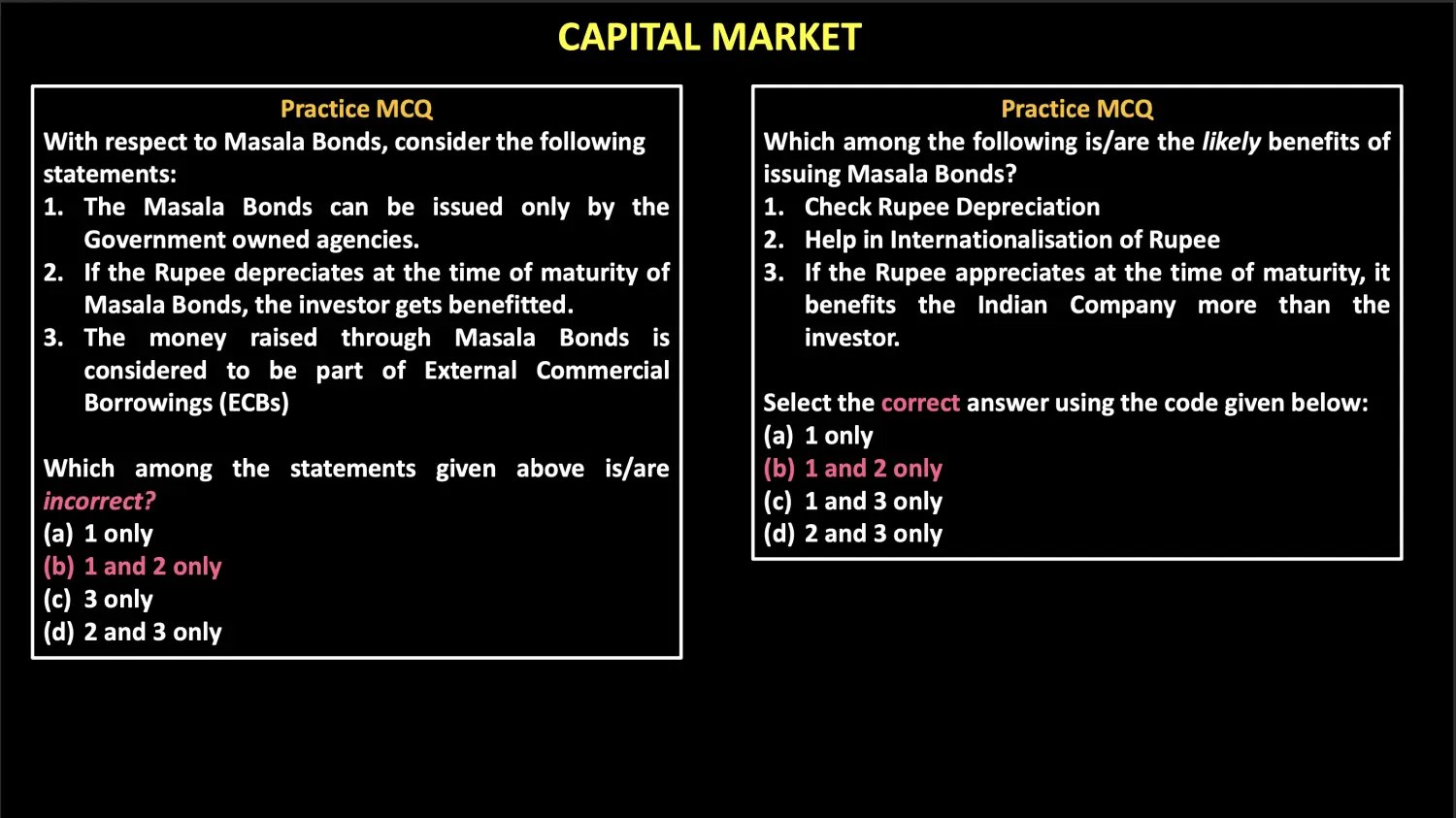
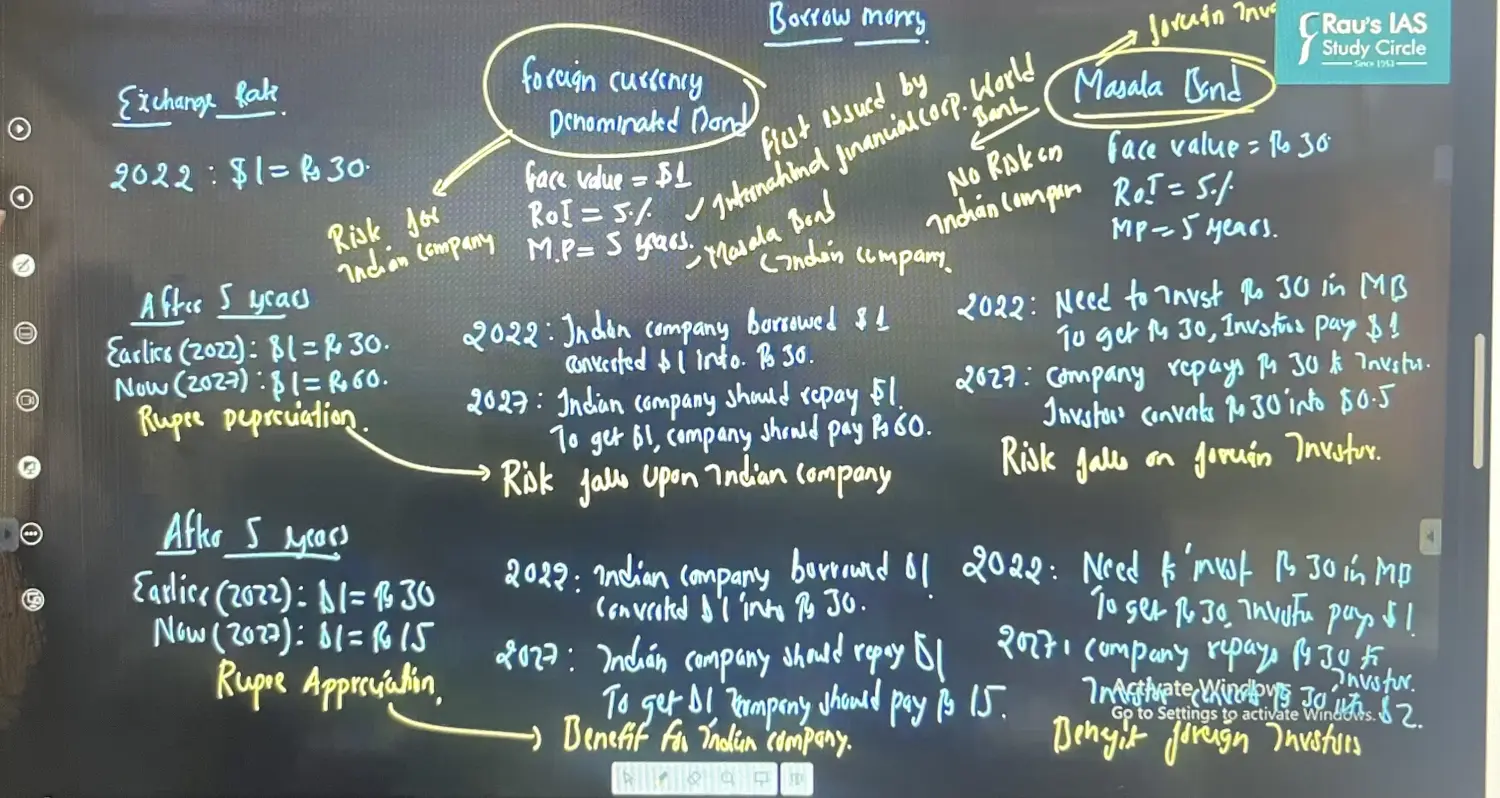
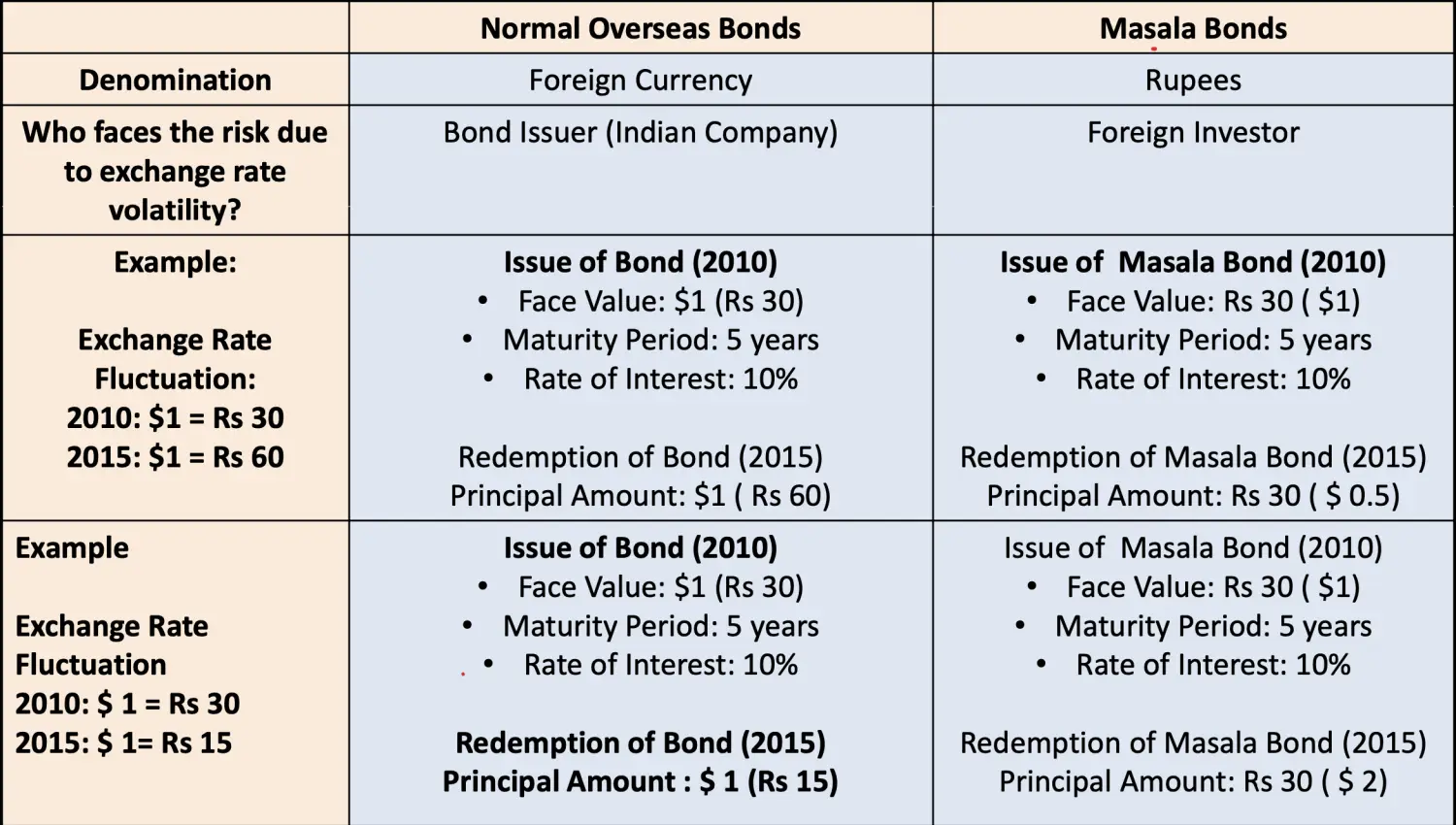
Masala Bond - ( A Type of Plain Vanilla Bond) Borrow & Repay in Rupees Look from Perspective of Foreign Investor NOT FDI
Borrowing and Repayment will be in Rupees
It is NOT Included in FDI
Remember Indian Company Always Pays in Terms of Rupees
First Issued by International Financial Corporation which is a Part of World Bank
Subsequent to IFC, Masala Bonds have been issued by a large number of Financial Companies
Benefits
- Lower Risk - Borrow and Pay in Rupee
- Conversion Cost Saved
- Internationalisation of Rupee - It Increases Demand for Rupee - Helps in Reducing Monopoly of Dollar
- Helps in Checking Rupee Depreciation - as it increases more demand for Rupee
Class Table
Revision Table Check
RBI Guidelines on Masala Bonds
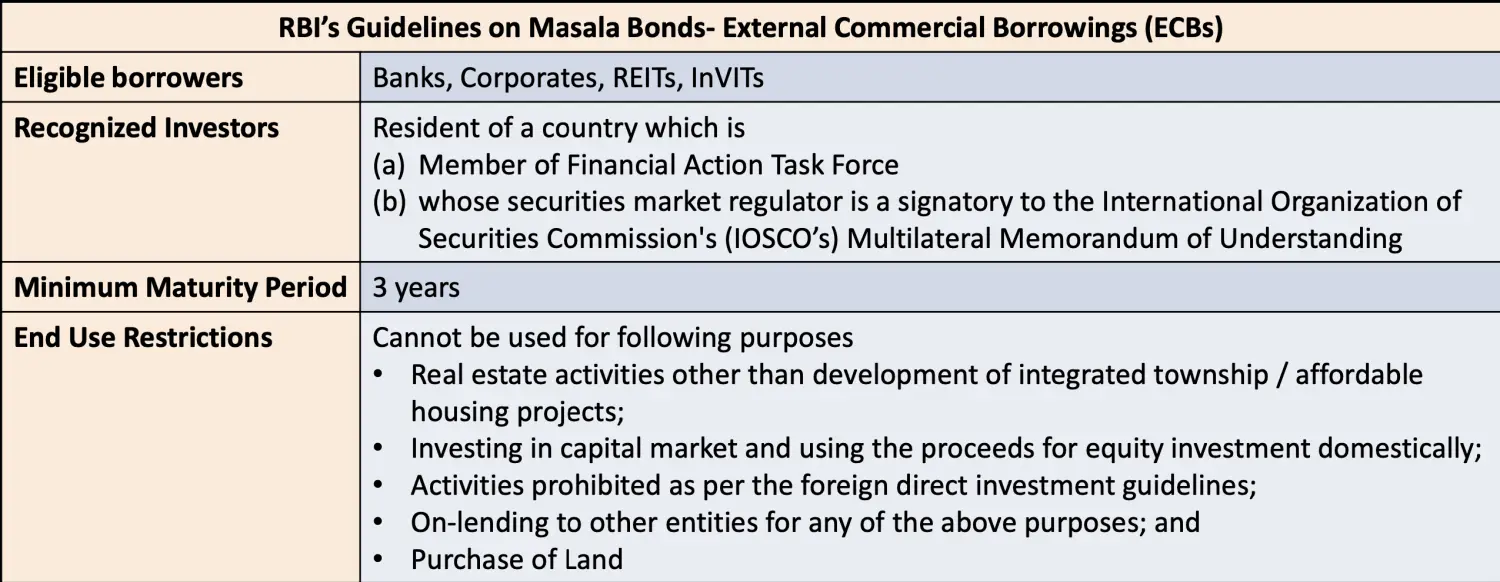
FATF - Financial Action Task Force
They are not part of FDI as Bond is NOT Converted into Share
Note : Debt Investment is NOT a Part of FDI
Foreign Currency Denominated Bond Borrow & Repay in Dollar Look from Perspective of Indian Company NOT FDI
- Borrowing and Repayment will be in Dollar Only
in FDI → Bond & Share → Hybrid Instruments
Difference Between FCCB & FCEB
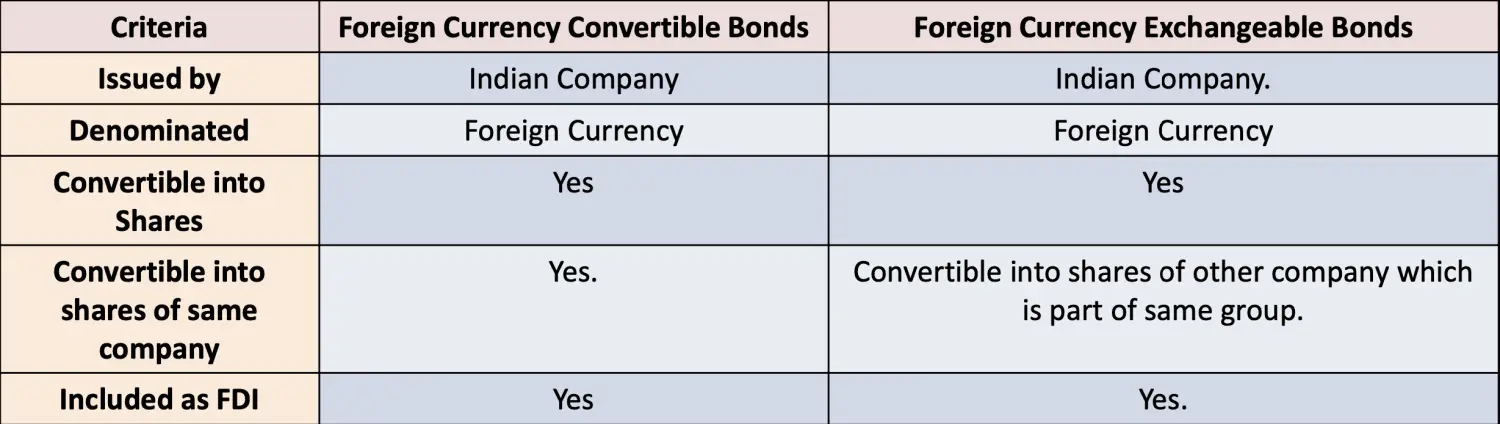
Foreign Currency Convertible Bonds
Face Value is in Dollar
Here Convertible Means Bonds to Share → when the bond matures.
At the end of maturity period, the bond is converted into shares by amount of Face Value
Here you don't get the principal amount back
Foreign Currency Exchangeable Bonds
- Upon Maturity the Principle Amount Gets Converted into shares of associated company
- Associated Company - Tata Son being a parent company, its associated company will be TCS and Tata Motors etc
- Associated Company - means Subsidiary Company
- The Issuer Company Decides in which associate company it will convert
Summary of Different Types of Bonds
Foreign Company or Investor Means Foreign for that country !
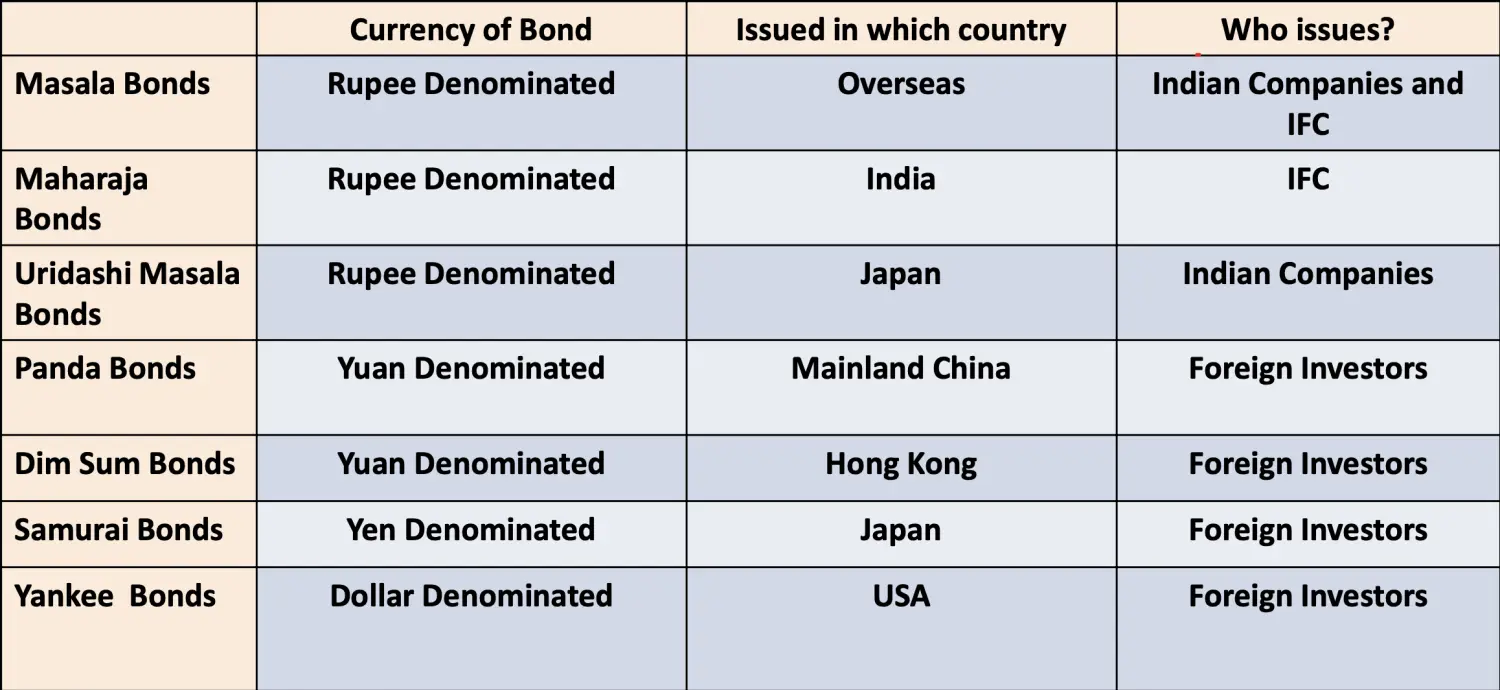
By Means of Trade Credit
- Buyers Credit → Company Arranges Loan and Gives Money to Seller
- Seller's Credit → Seller Says Baad Main Paisa De Dena
- FDI Into India are
- FCCB
- FCEB
- ADR/GDR
- Option for a Indian Company to Raise Money Within India
- Other Types of Bonds
Plain Vanilla Bond
- Any Bond which is issued by Indian Company in Overseas Market, denominated in Rupees is called Plain Vanilla Bond
Social Impact Bond
Money Spent by Government is not Creating Impact. Hence Social Impact Bond is Created
Here Bond is an Agreement between Govt and Private Sector and this Sector enters into agreement with NGO to meet Specific Targets and Requirements
Examples
Utkrisht Bond launched by USAID being the Donor Agency to Reduce IMR and MMR
Benefits
- Faster Implementation of Scheme
- Reduced Burden of Government
- a Bottom Up Approach
- Encourages Role of Cooperation between Private Sector and Social Infra
- Help of Specialised Assistance from Pvt
- NGO’s doing good work will be rewarded
- More Accountability and More Specialization
Summary
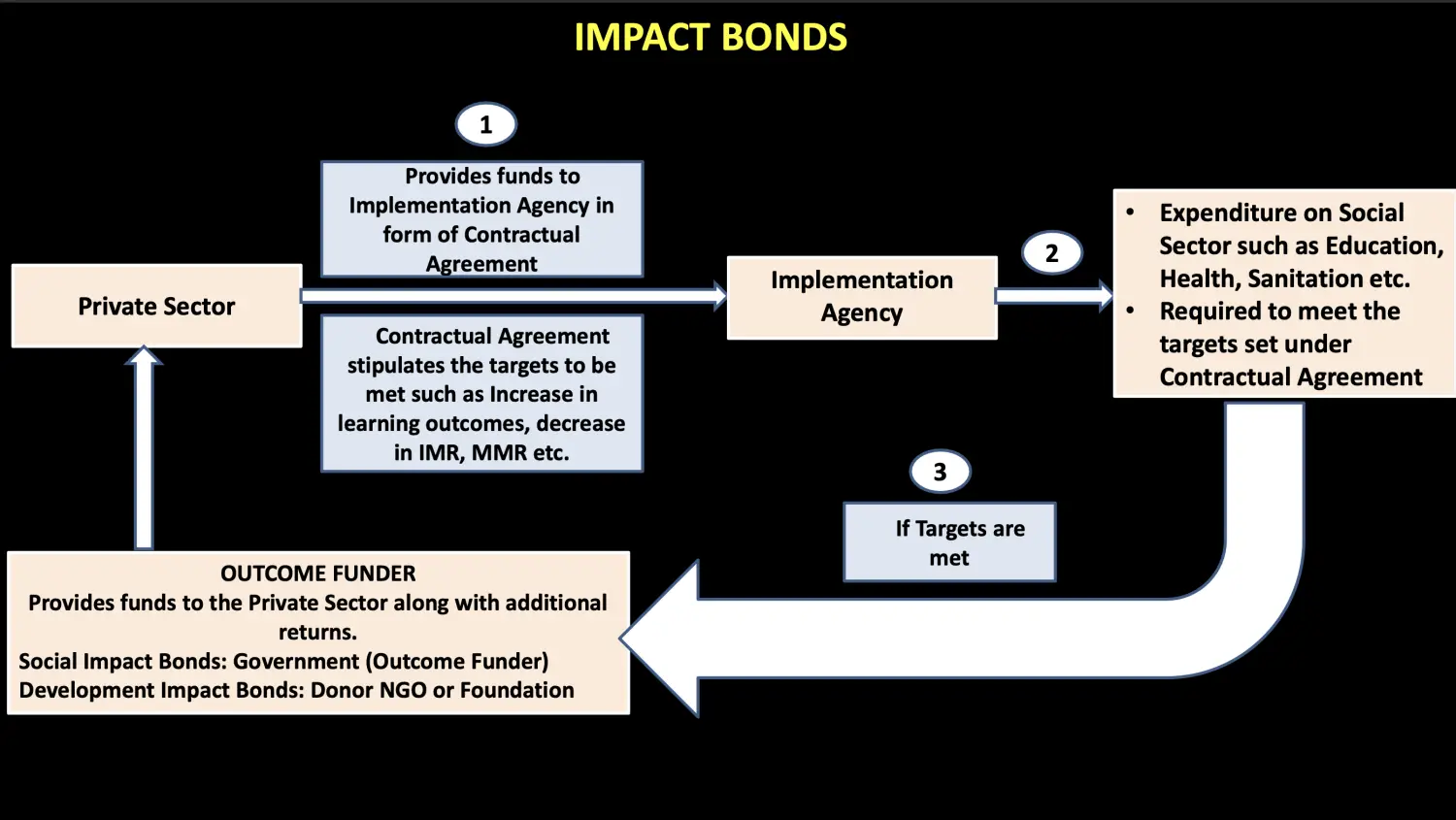
Sovereign Green Bond
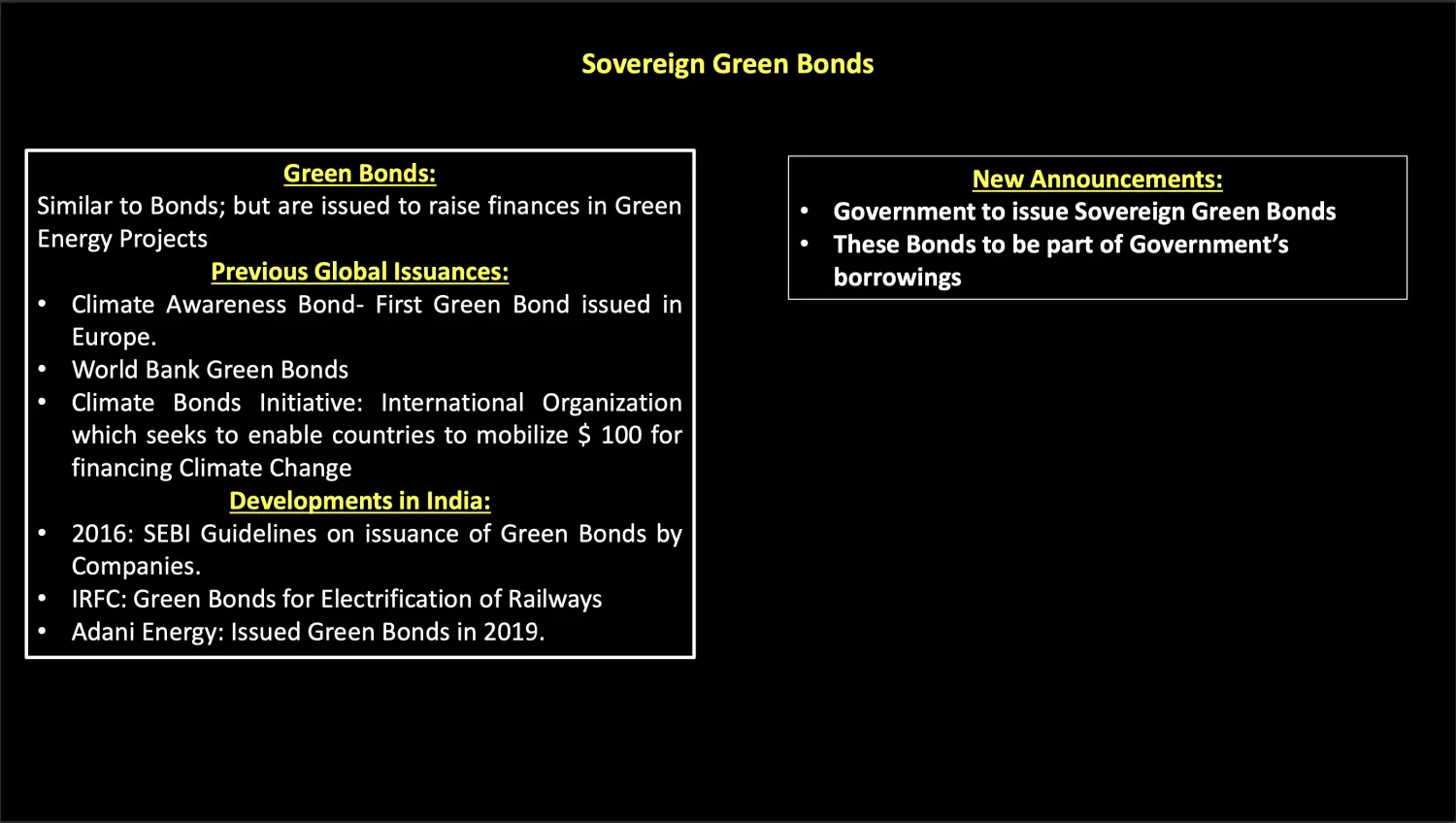
Elephant Bond
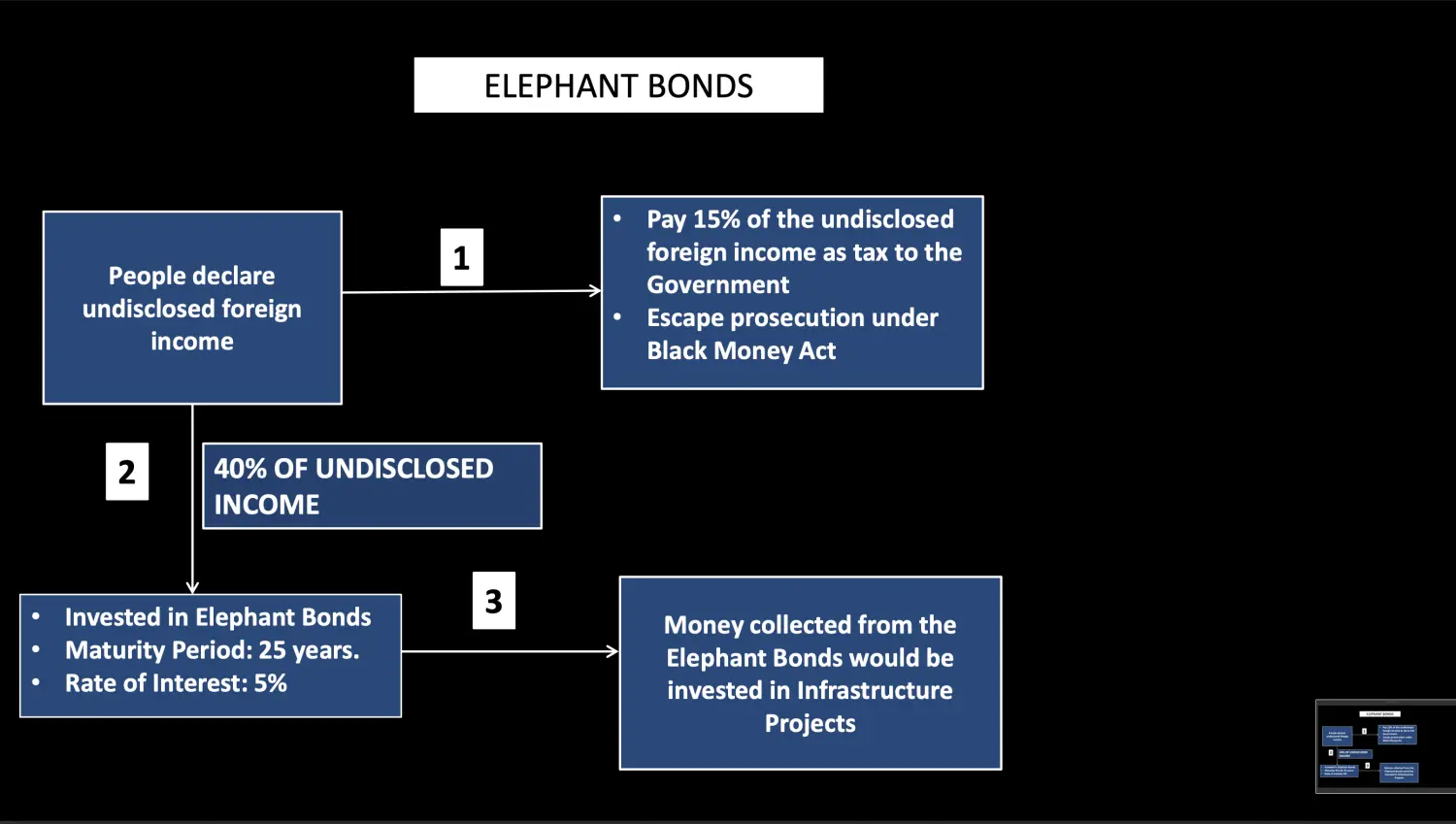
Sovereign Gold Bond
Summary
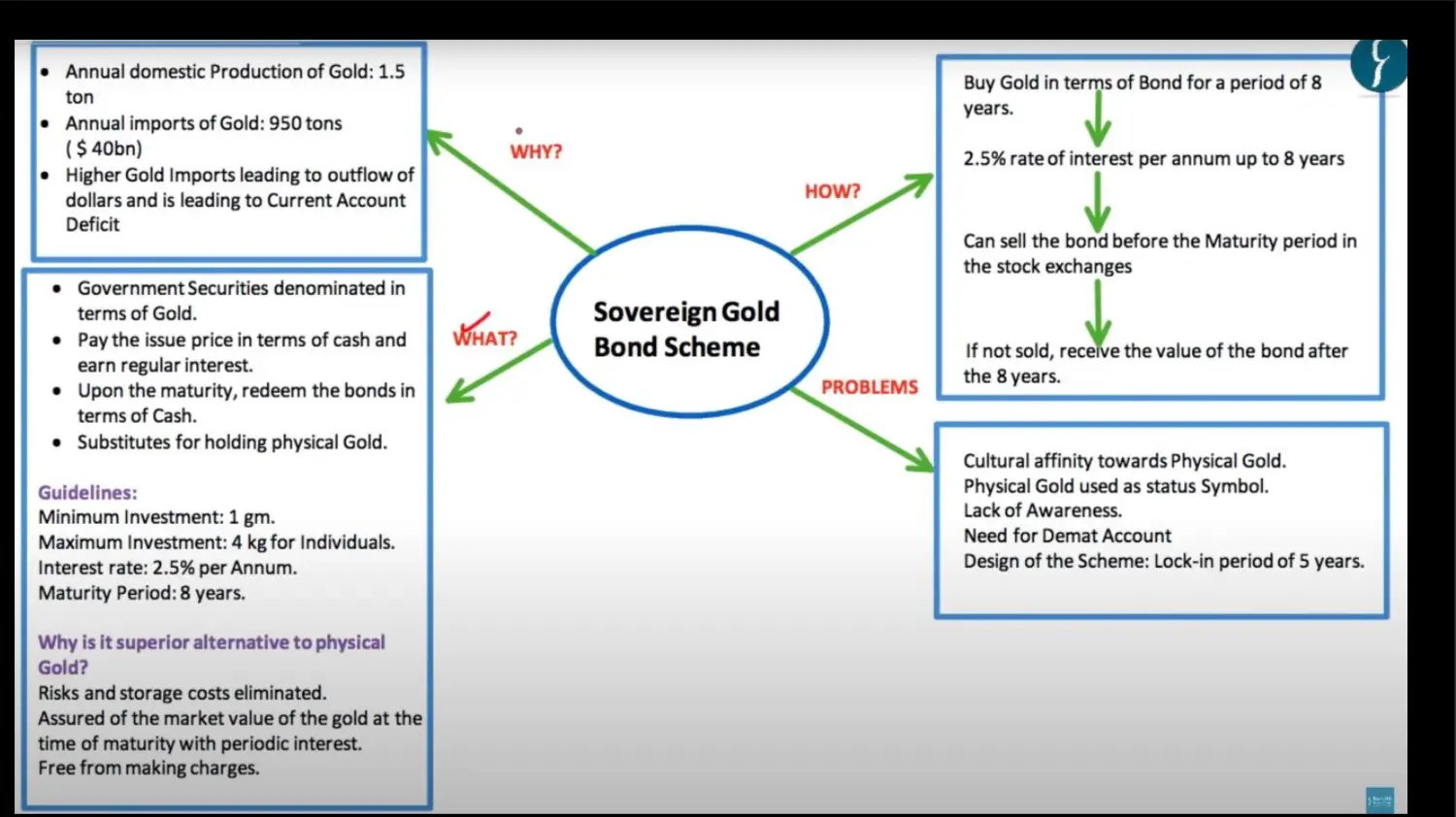
Present State
- Domestic Production : 1 Tonne
- Annual Import : 980 Tonnes $40 Billion
Reasons for Higher Import
- Cultural Reasons
- an investment bet - indians consider it as secure investment option
- can be used in emergency purpose - can be liquidated easily
Implications of this Import
- Higher Dollar Outflow
- Affects Overall Investment in Economy
Solution
- Sovereign Gold Bond is a Special G Sec issued by Govt
- It is always denominated in Gold meaning
- Face Value is 1 gm
- ROI 2.5%
- MP 8 Years
- Upon Maturity you will get money based on the present rate of gold
- Here there is NO gold secured at side for this bond
- Its based on common acceptance
- Benefits
- No Security Risk
- No Storage Risk
- RoI
- can use it as collateral to take loans from Bank
- can be traded on stock exchanges
- Issues with Sovereign Gold Bonds
- It is still not physical gold
- cultural sentiments
- Needing of demat account
- Lack of Awareness
- Sell Bonds in Gold Stores
- They are available by notifications from RBI by means of Retail Direct Scheme
- Other than that if u need to buy this it can be bought from Stock Market
Problems with Physical Gold
- Stealing, Degradation
- Making Charges
Oil Bond
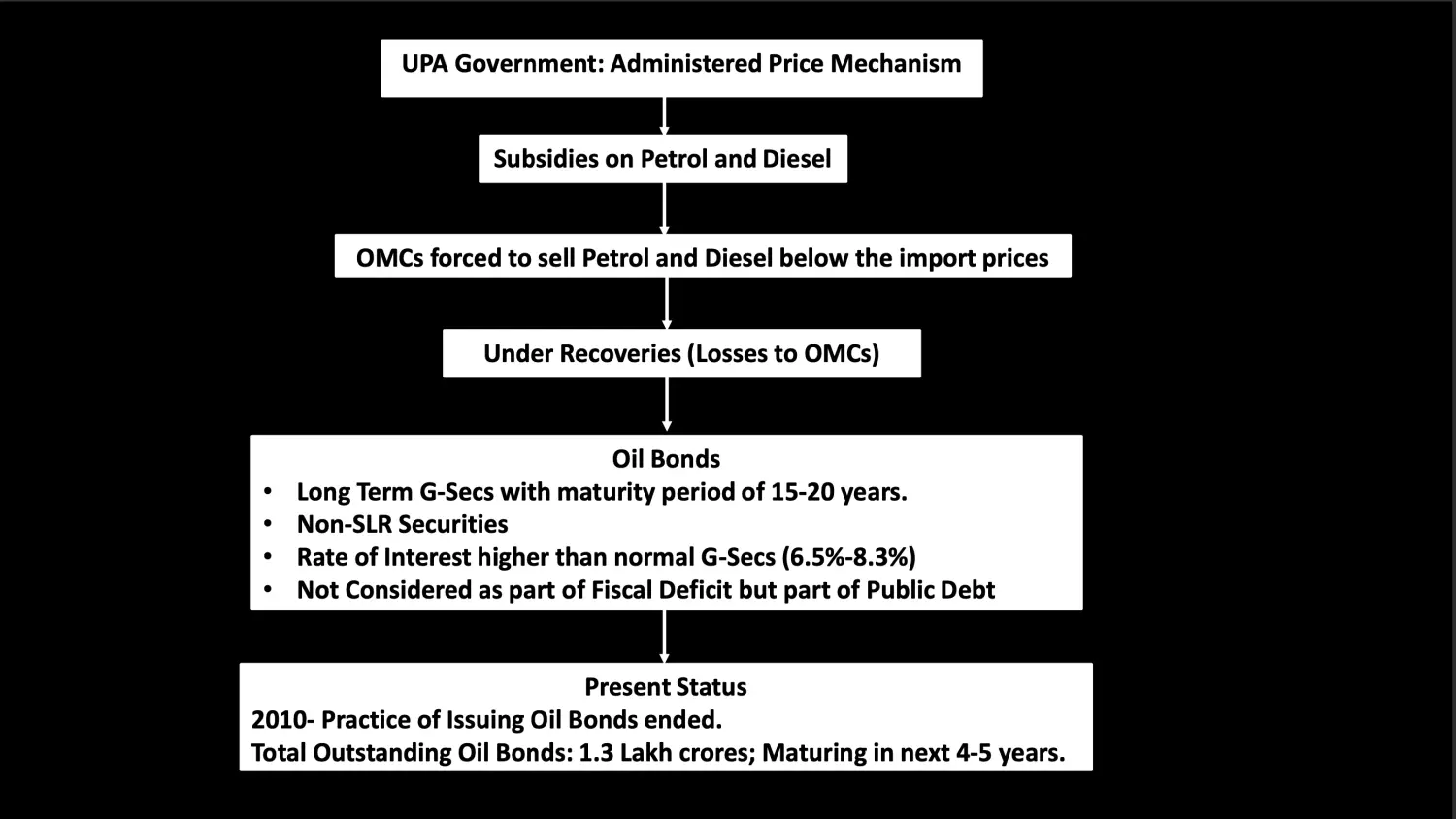
- Prior 2010
- Prior 2010 - Administered Pricing Mechanism - It used to give subsidies under Petrol and Diesel
- Subsidy to Oil Market - Load on Fiscal Deficit
- Fiscal Deficit Limit under FRBM Act - 3% of GDP
- UPA Govt Issued Oil Bond to Oil Market Companies
- Face Value - Under Recovery Amount = Subsidy
- ROI - Some Int
- MP - 15/20 Years
- Govt Said that Oil Bonds will not be included in fiscal deficit of government
- But it will be included in Public Debt
- Difference Between Fiscal Deficit and Public Debt
- Fiscal Deficit - Flow → for a Year
- Public Debt - Total Outstanding Loans - Stock → Total Cumulative
- These Oil Bonds can be Sold to Banks and they pay face value amount to oil company → this is done for immediate money
- Oil Bonds are NON SLR Securities
- Post 2010
- Administered Price Mechanism Stopped
- No Oil Bond Issued by Govt Since then
- At about Rs 1.2 Lac Crore has to be given
- Features
- Not Included in Govt Fiscal Deficit but it is counted in Public Debt
- It is Non SLR Security
- Prior 2010
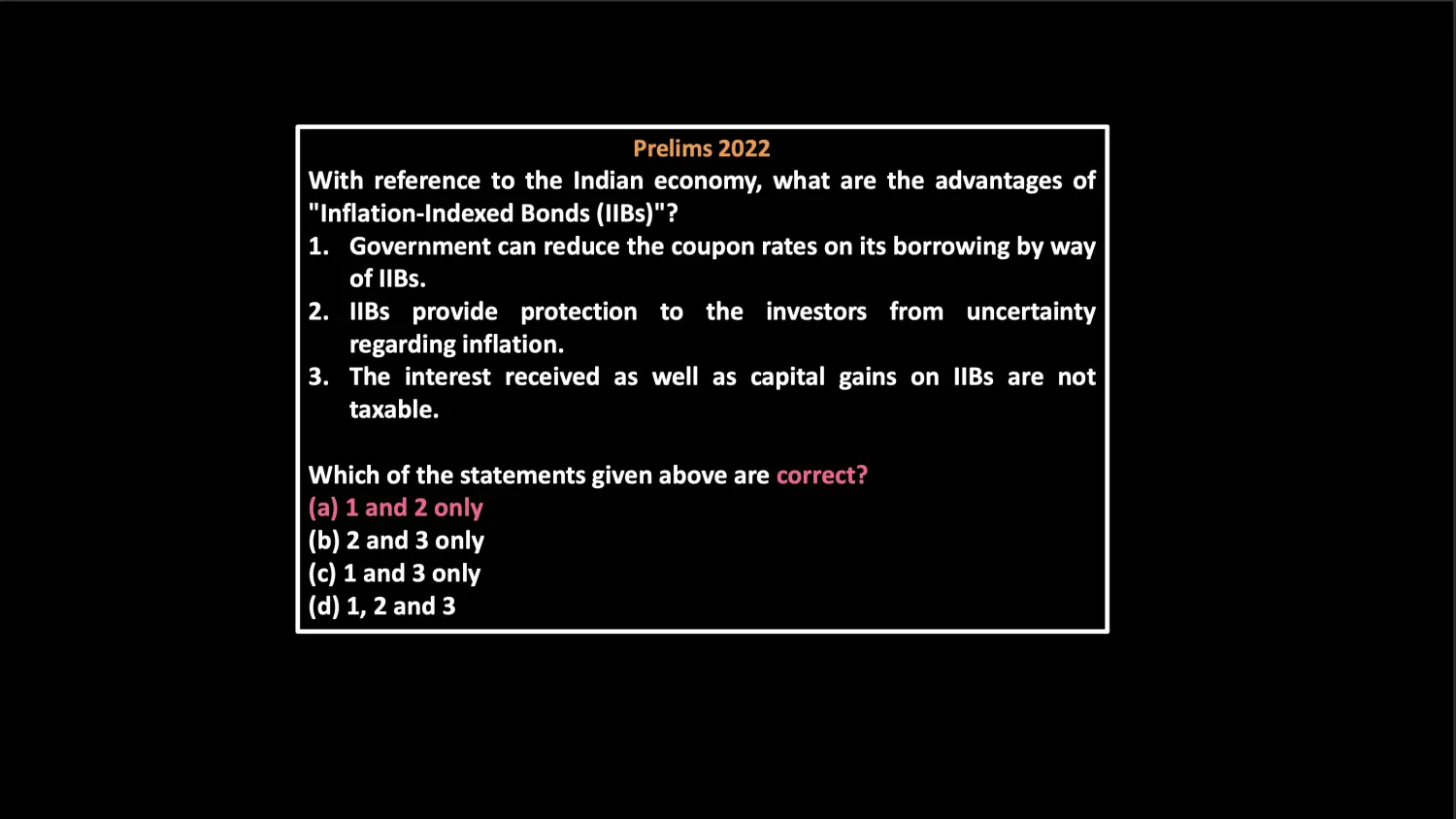
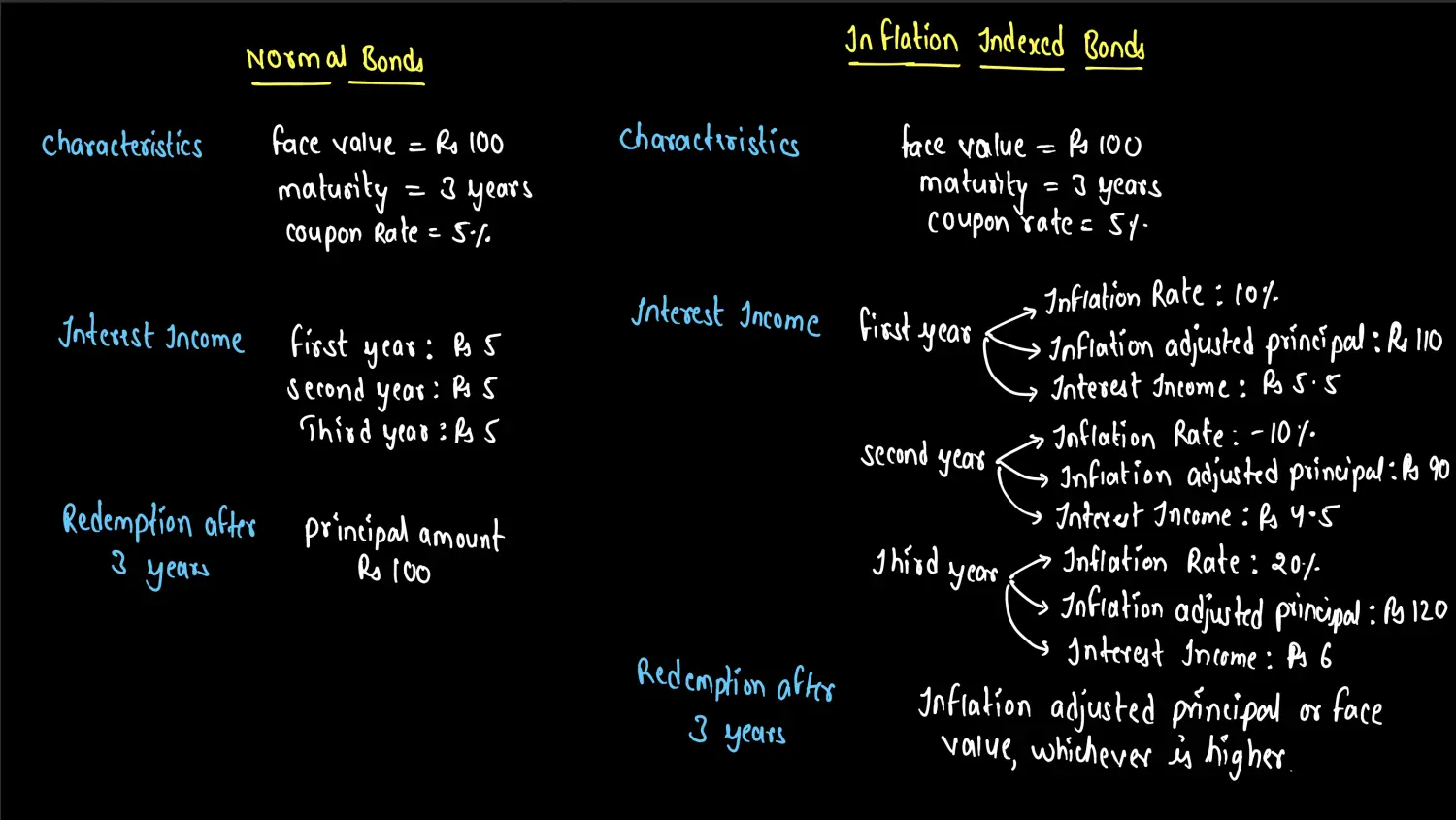
Inflation Index Bond
Not in News Since 2013 - but asked in 2022
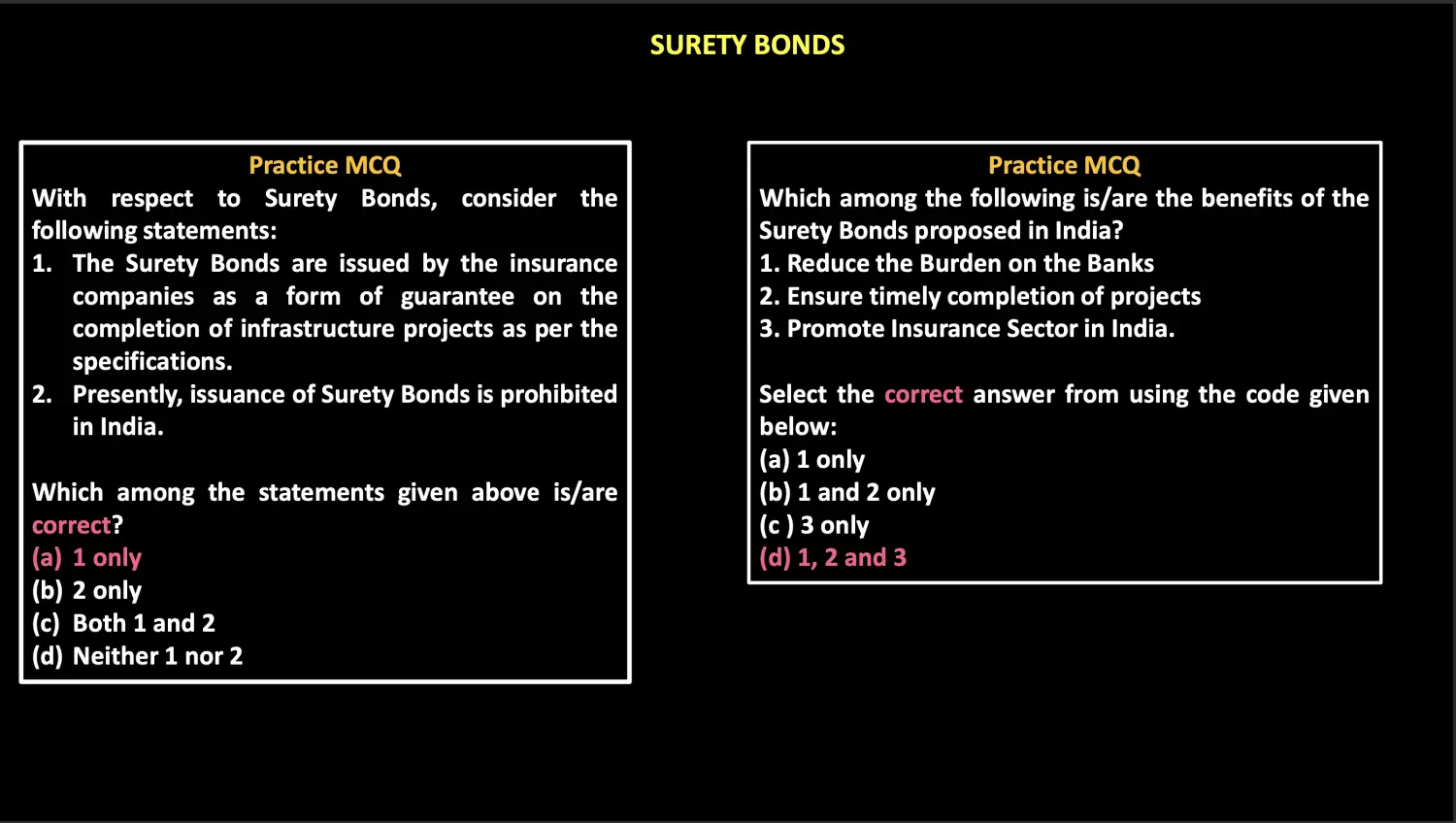
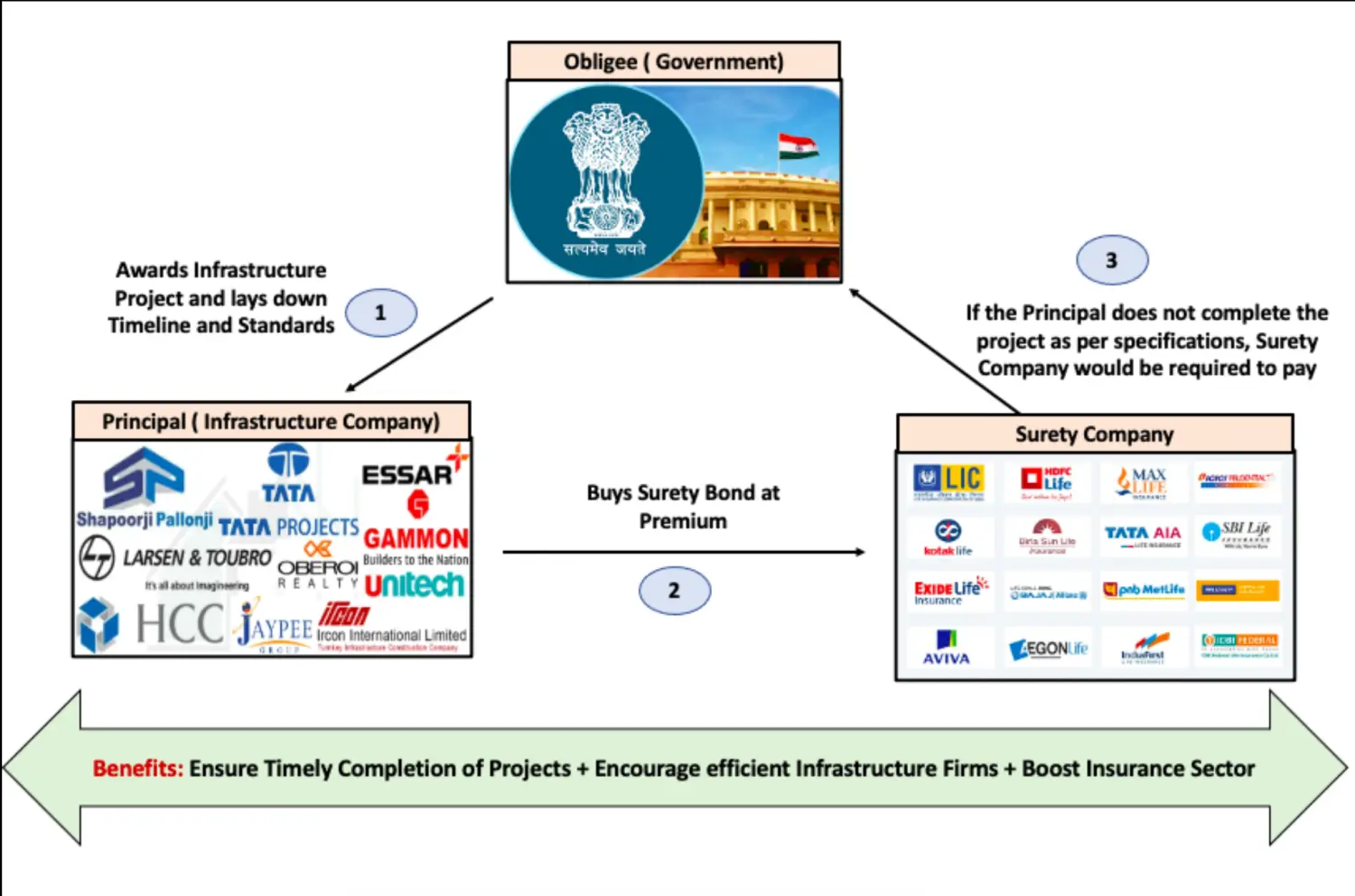
Surety Bond
Prior to Surety Bond
- Govt Awards Project
- Govt Gives Timeline & Specification
- Earlier Pvt Sector had to give Guarantee of Completion
- Pvt Sector would take Bank Guarantee of 100 crore by paying a premium of 1 crore ; just like a insurance
- If Pvt Sector is not able to complete the project, the bank would have to pay the govt Rs 100 Crore
- Bank Factor
- Problem - Rs 100 Crore by Banks to be Paid ka Issue
- Benefit - Rs 1 Crore Benefit Anyways
With Surety Bonds
- Here Pvt Sector Companies Buys Surety Bond from a Insurance Company at a Premium of 1 Crore for a Face Value of Rs 100 Crore
- If pvt sector does not complete project, risk falls on Insurance Company
- if pvt sector completes the project, insurance companies earns a profit of Rs 1 crore
Usage
- Can be used in Road, Railway, Airport Creation
- To Reduce Pressure on Bonds
Mind Map
- How Indian Companies Borrow from India & Beyond
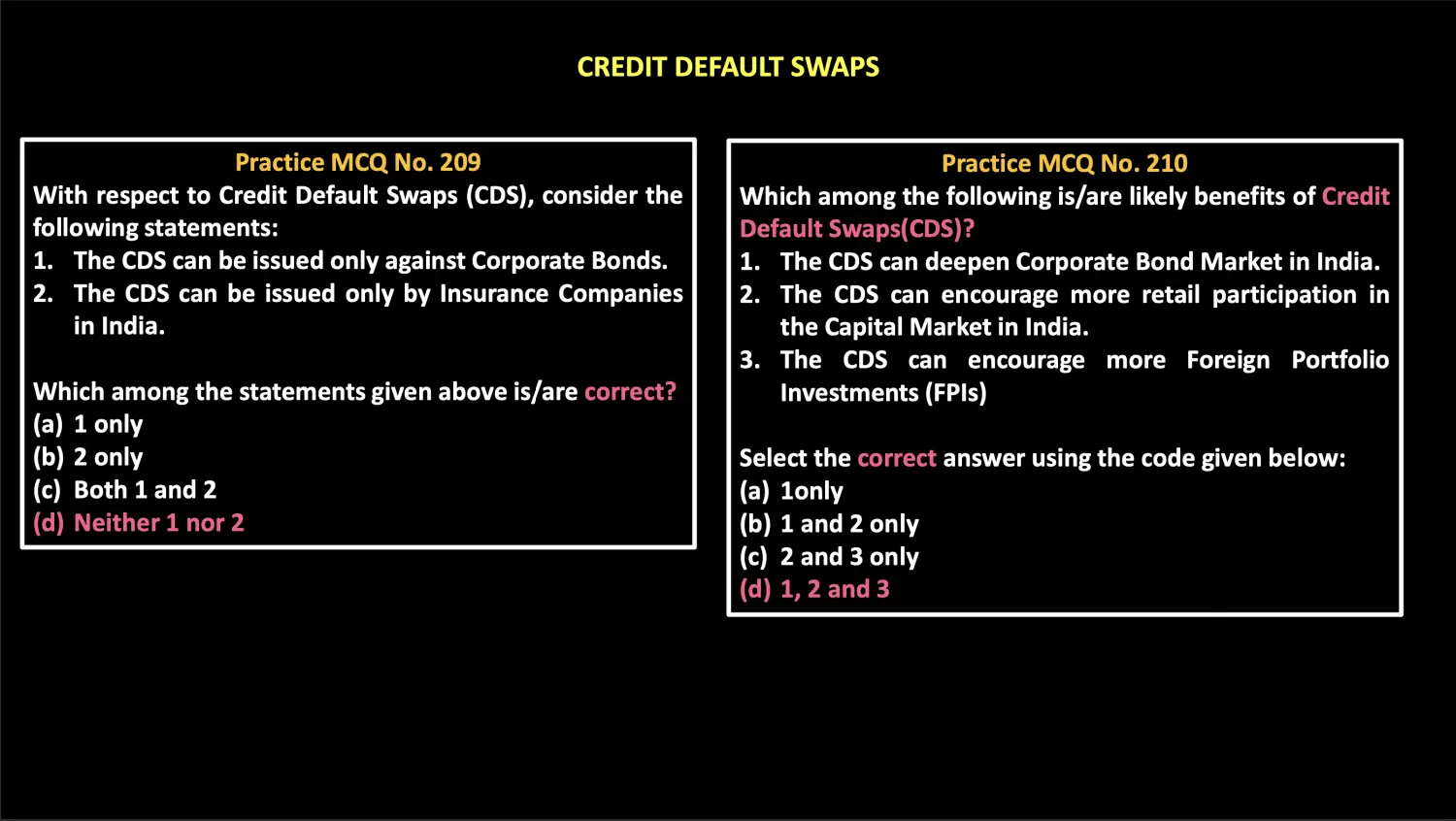
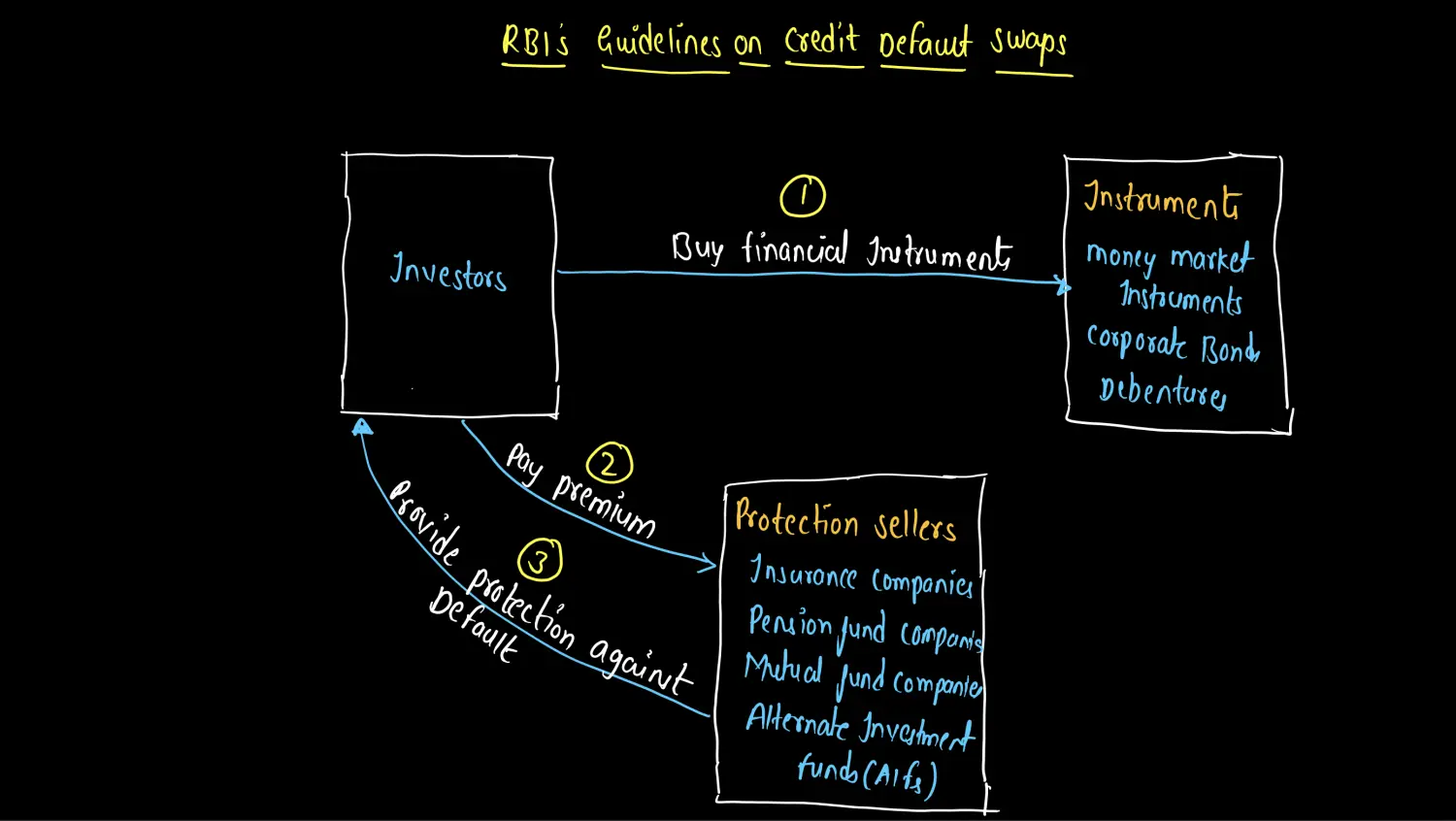
Credit Default Swap
Investors Take Insurance from a Company, like anyone else does
Benefits
- Guarantee of Principal Amount
- Risk of Investing in Financial Instrument Reduces
Why is it called Credit Default Swap
Because Credit Default Risk is Swapped Between Investors Institution is swapped with the Insurance Company
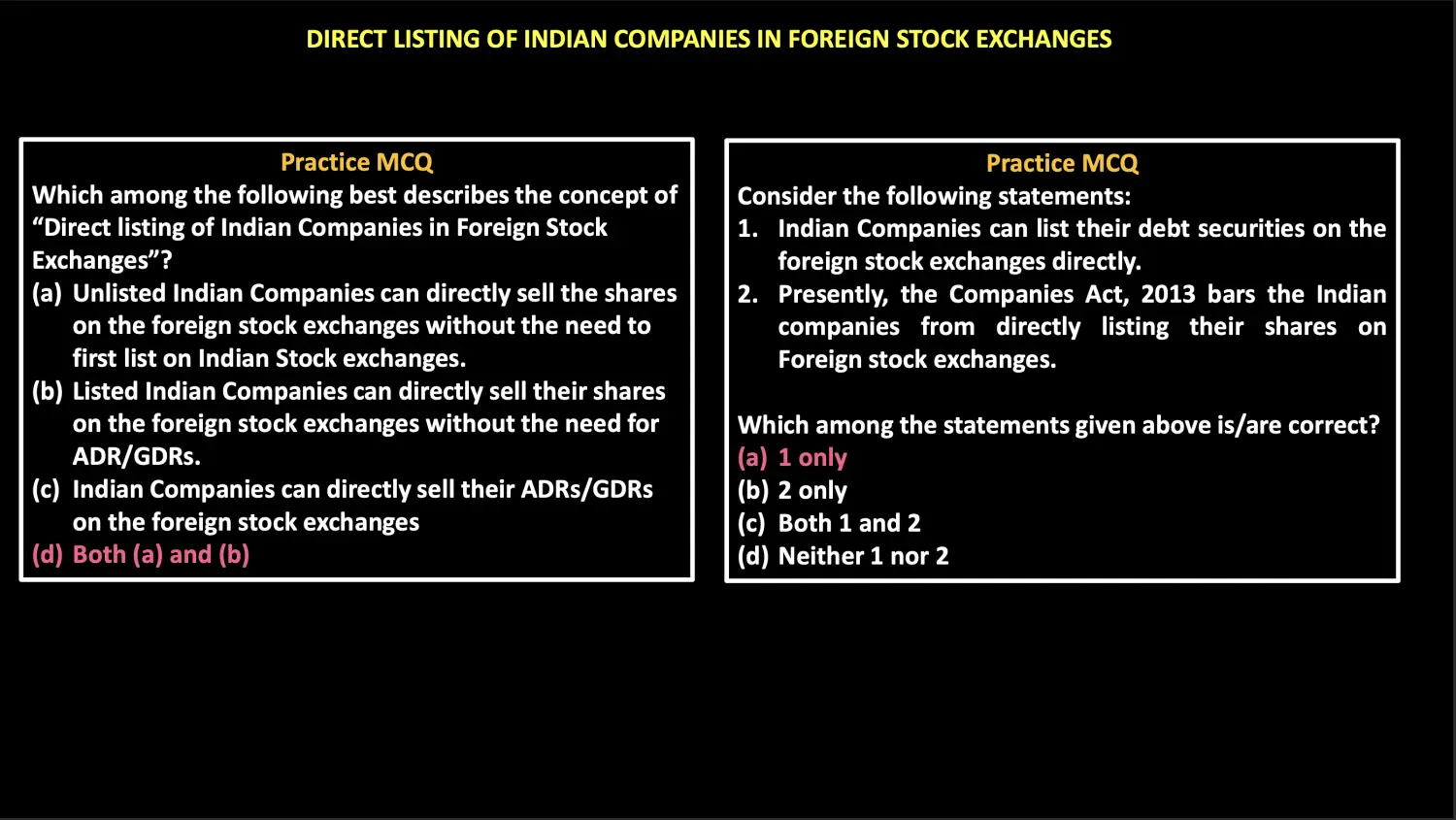
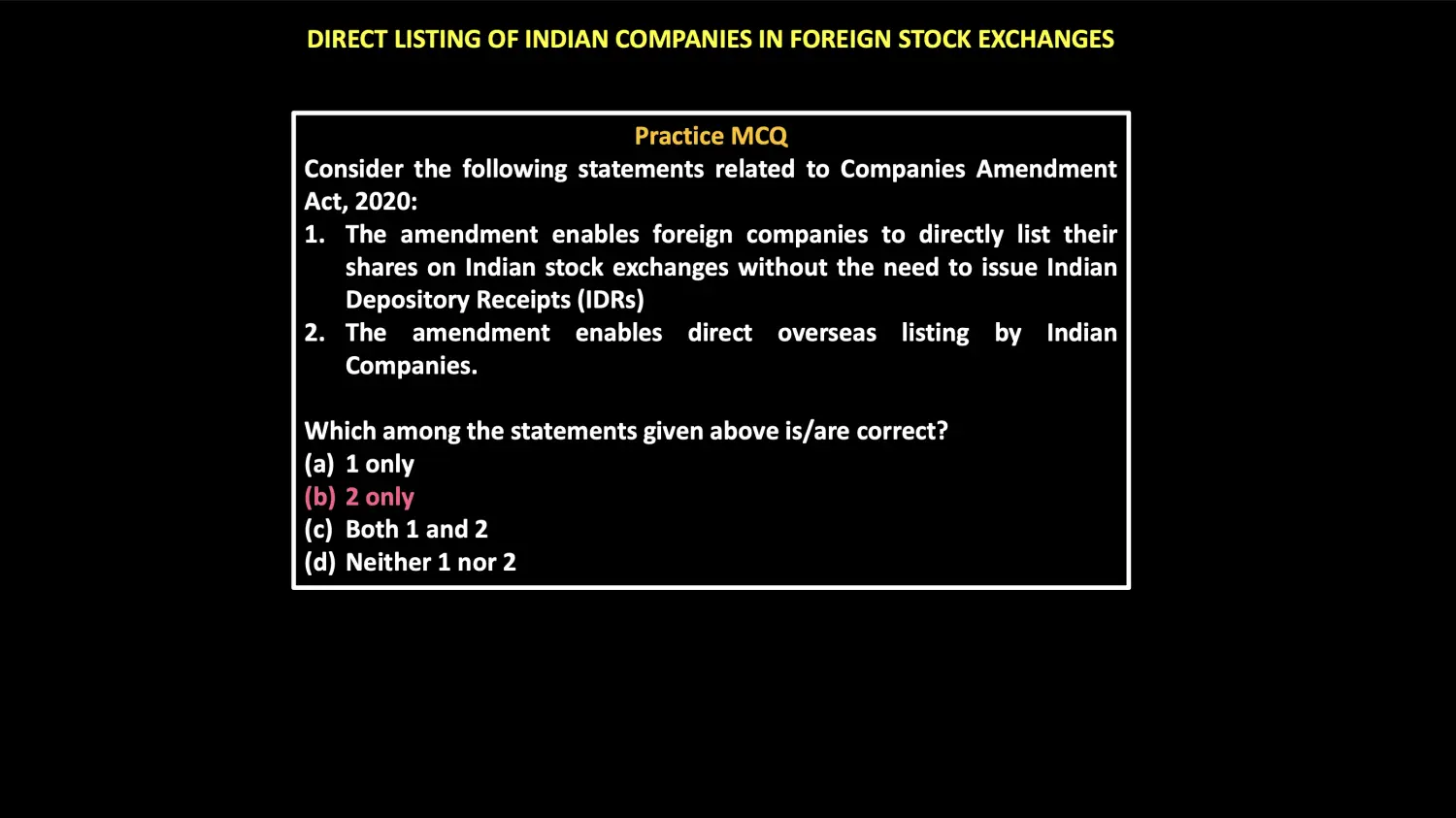
Direct Listing of Indian Companies in Foreign Stock Exchange
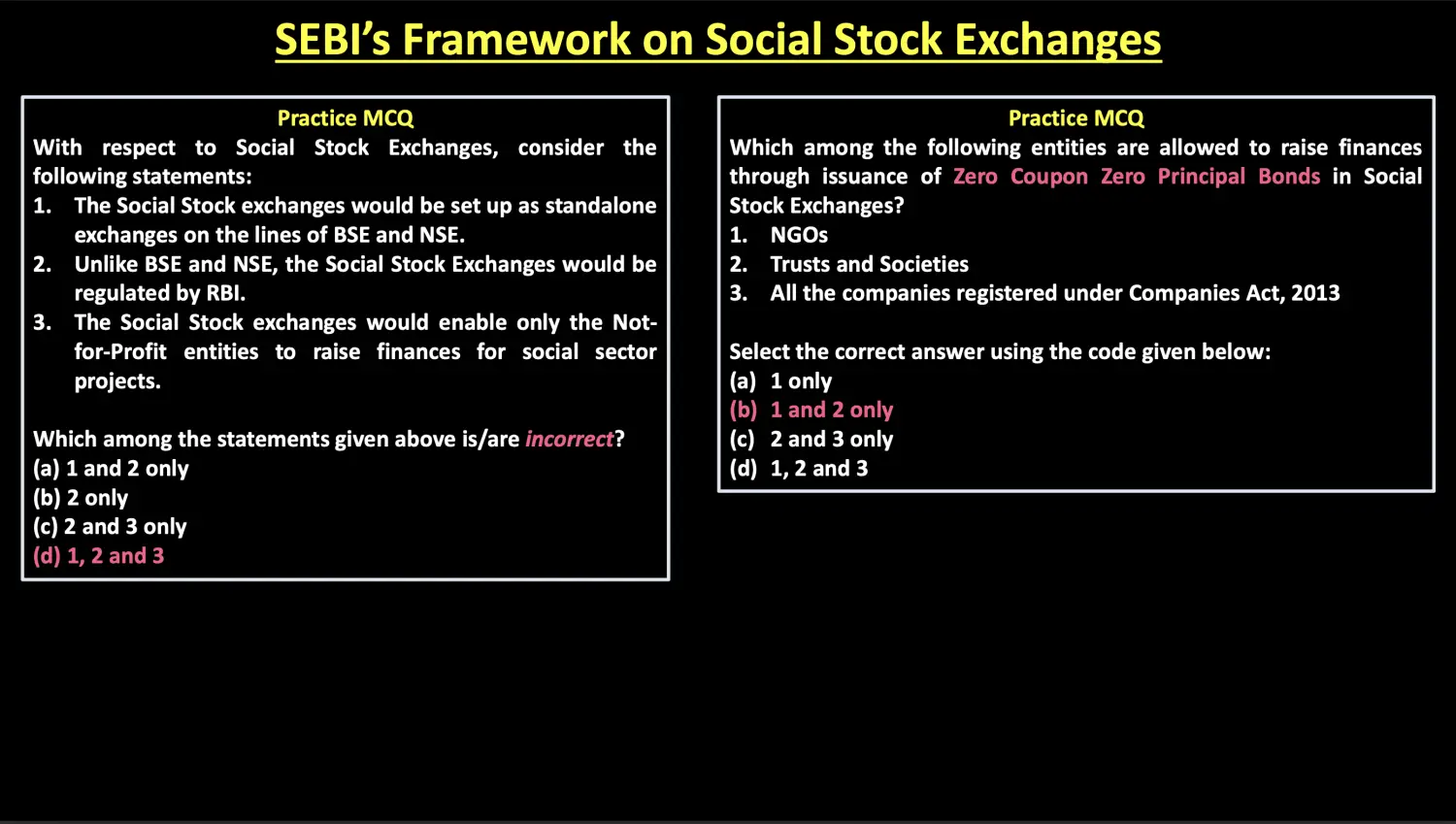
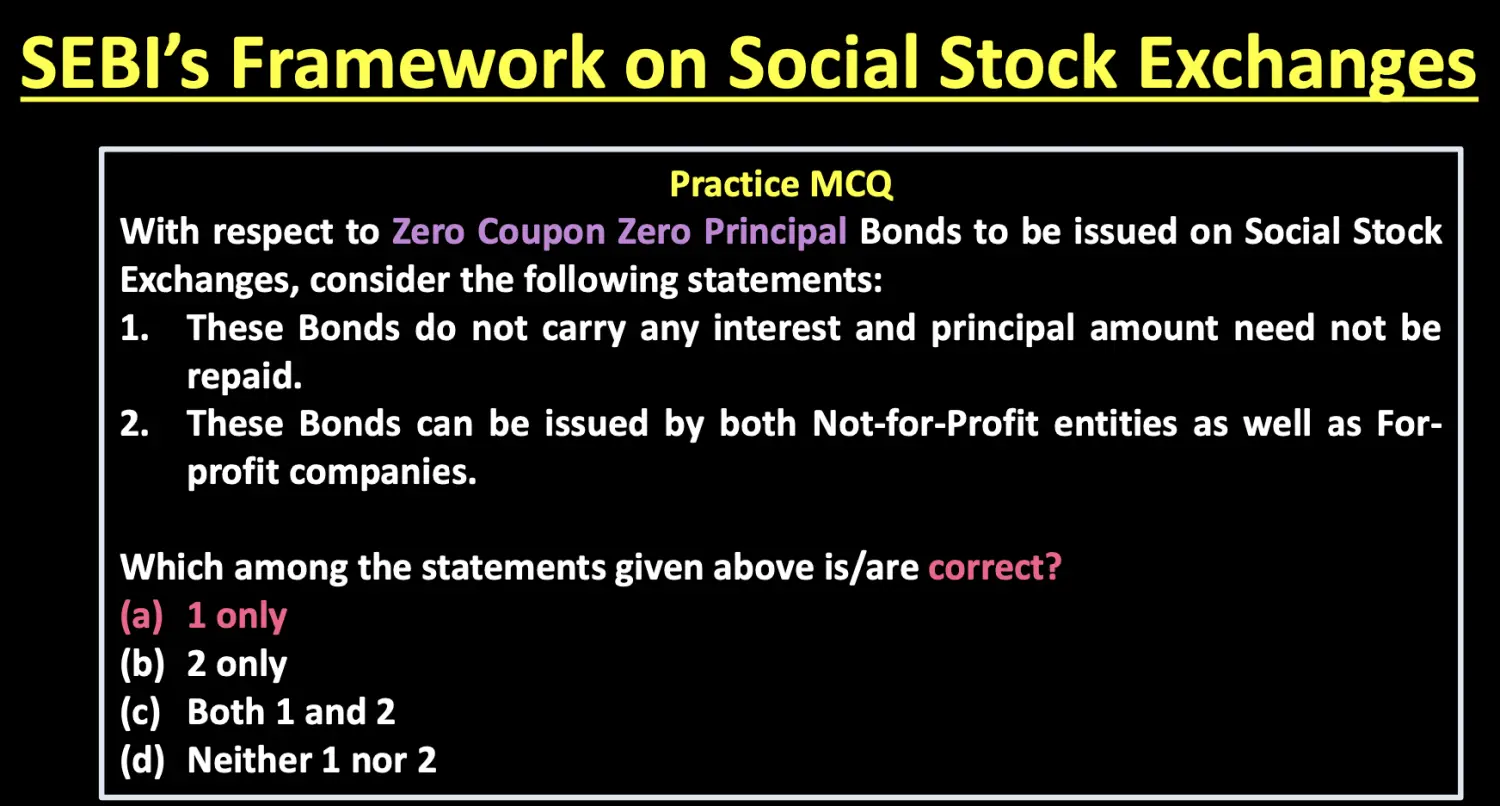
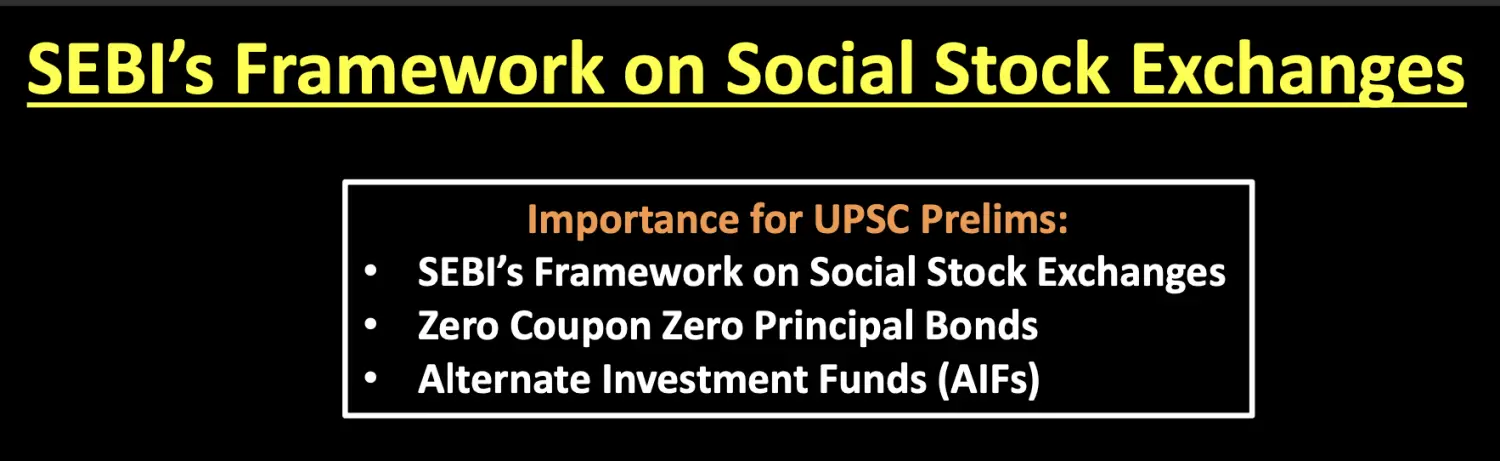
SEBI’s Framework on Social Stock Exchange
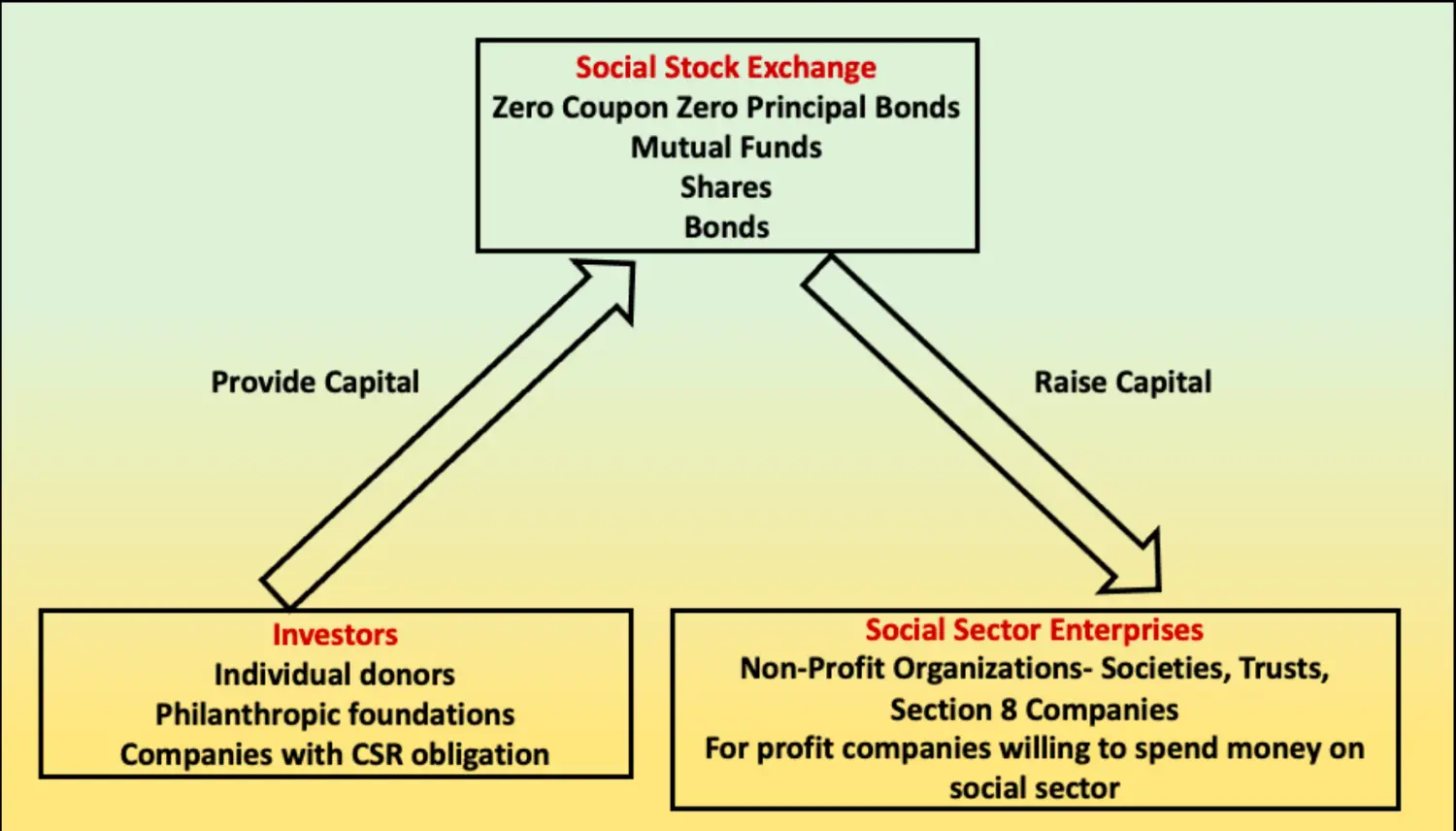
Mind Map
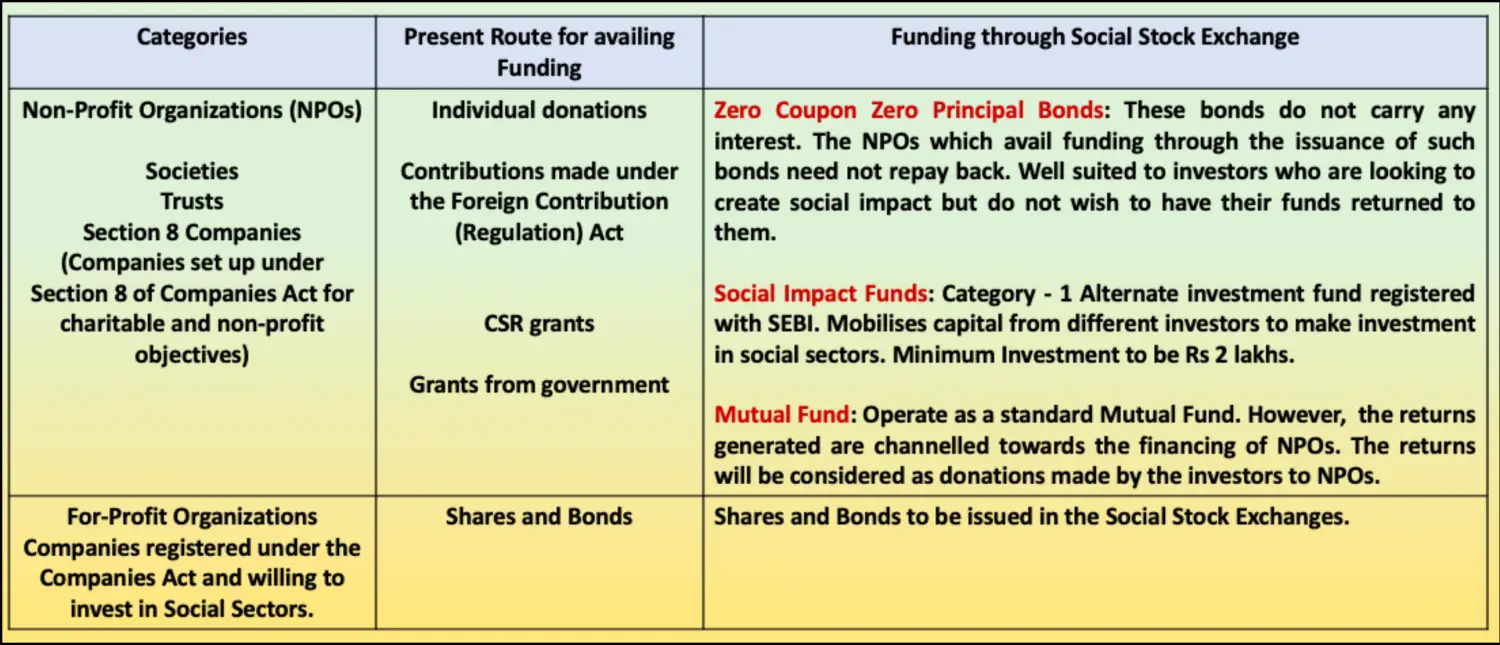
Details
- NGO’s can be registered as
- Trust
- Societies
- Companies - Section 8 Companies → Not for Profit Companies - Set Up for a Social Cause
- Presently, How do they Get money
- Donation
- CSR
- From International Donor Agencies
- Grants by Govt
- Foreign Contribution - FCRA Act - Foreign Contribution Regulation Act
- Social Stock Exchange Created by Recommendations of Ishaat Hussain Committee
- Current Situation
- Not Standalone Stock Exchange
- But as a part of already existing exchanges like NSE & BSE
- What Financial Instrument can be Extended by NGO’s
Zero Coupon Zero Principal - Just Like a Donation
Zero Coupon - No Return
Zero Principal - No Money Return
Mutual Fund - ROI can be kept with NGO & Principal can be given back to the Investor
Social Venture Fund has been renamed as Social Impact Fund which is a type of AIF
Social Impact Fund is NOT Social Impact Bond
- NGO’s can be registered as
Problems with it
Donation can be claimed as Tax Exemption for Tax Benefit
Zero Coupon Zero Principle Bond - No Tax Exemption or Benefit
At Corporate Level, CSR obligation NOT counted in Zero Coupon Zero Principle Bond / Mutual Fund / Social Impact Bond
India International Bullion Exchange (IIBX)
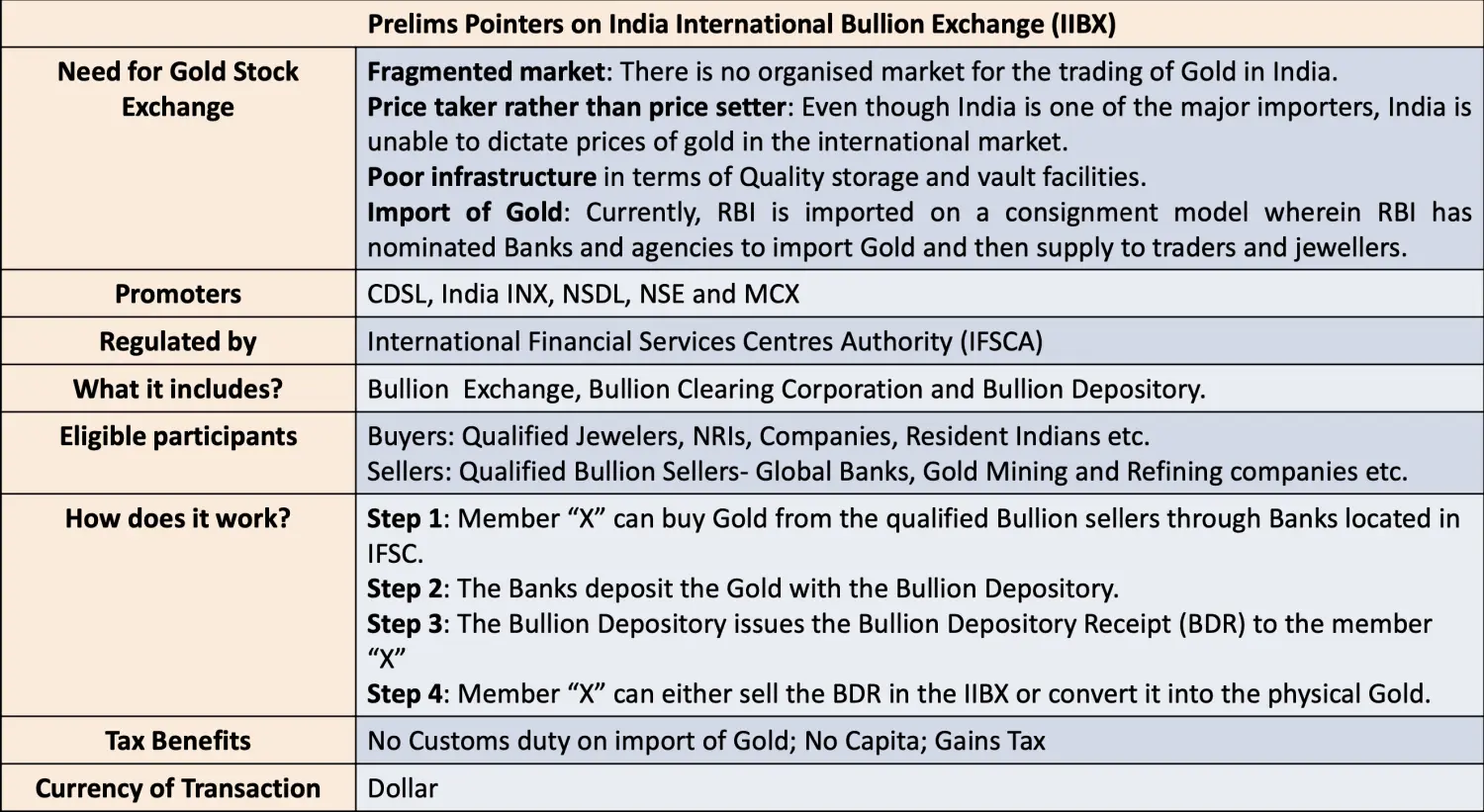
Meaning of Bullion : Gold or Silver in Coin or Bar
Need : India is one the Largest Importer of Gold, we import 980 Tons of Gold on Annual Basis costing us 40 Billion Dollars
Bulk Buyer has higher Negotiating Power, He can act as a Price Setter
In Spite we import huge amount of gold outside India, we aren't able to be Price Setter, rather we are Price Keeper
This Problem Occurs because we import in Bricks and not in a Particular Market
List of Gold Companies : Kalyan, Tanishq, Malabar
Issues Are
No Aggregation of Demand
Lack of Organised Market for Gold Trading for Flow of Information
Inter Company Communication between Two Parties of Gold Company is NOT Present
Participants :
- Bullion Buyers - Jewellers, Individual
- Bullion Sellers - Gold Mining Companies, Global Banks
- Bullion Exchange
- Bullion Repository
- Bullion Clearing Exchange
Process :
Bullion Buyers come together and Aggregate the Demand and they go to bank
Bank buys from Dollar, the Gold
Bank Stores it in Bullion Depository
Bullion Depository issues Bullion Depository Receipt
- Benefit - Safe & Secure
- Benefit - Easy Liquidation
- Benefit - Selling & Buying of Bullion Depository Receipt
Selling and Buying of these Bullion Depository Receipt is done on Bullion Stock Exchange
Bullion Stock Exchange is Located in IFSC in GIFT
All Entities in IFSC is Regulated by IFSCA (Independent Authority)
IFSCA - International Financial Service Authority
All Transaction in Terms of Dollars
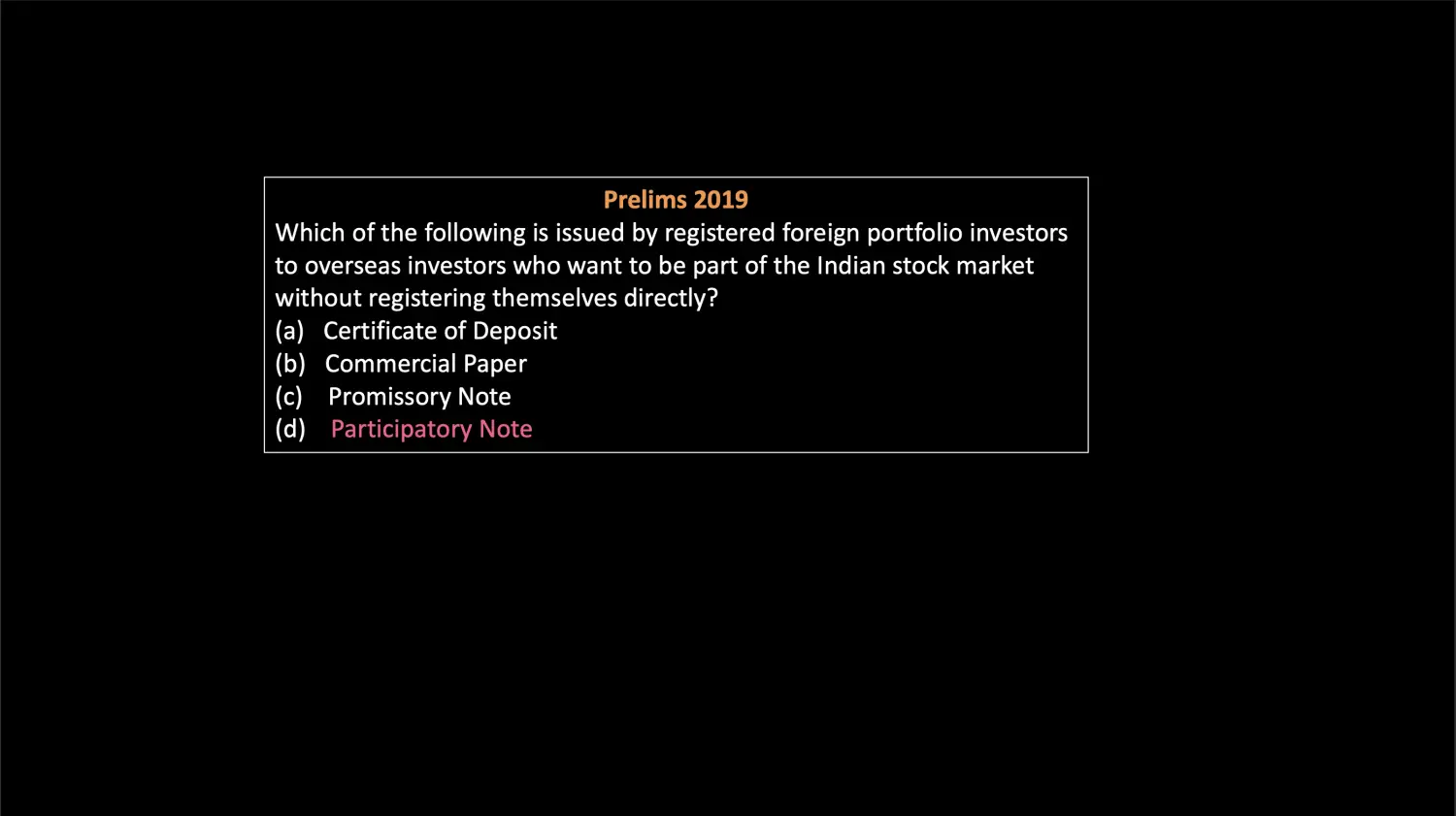
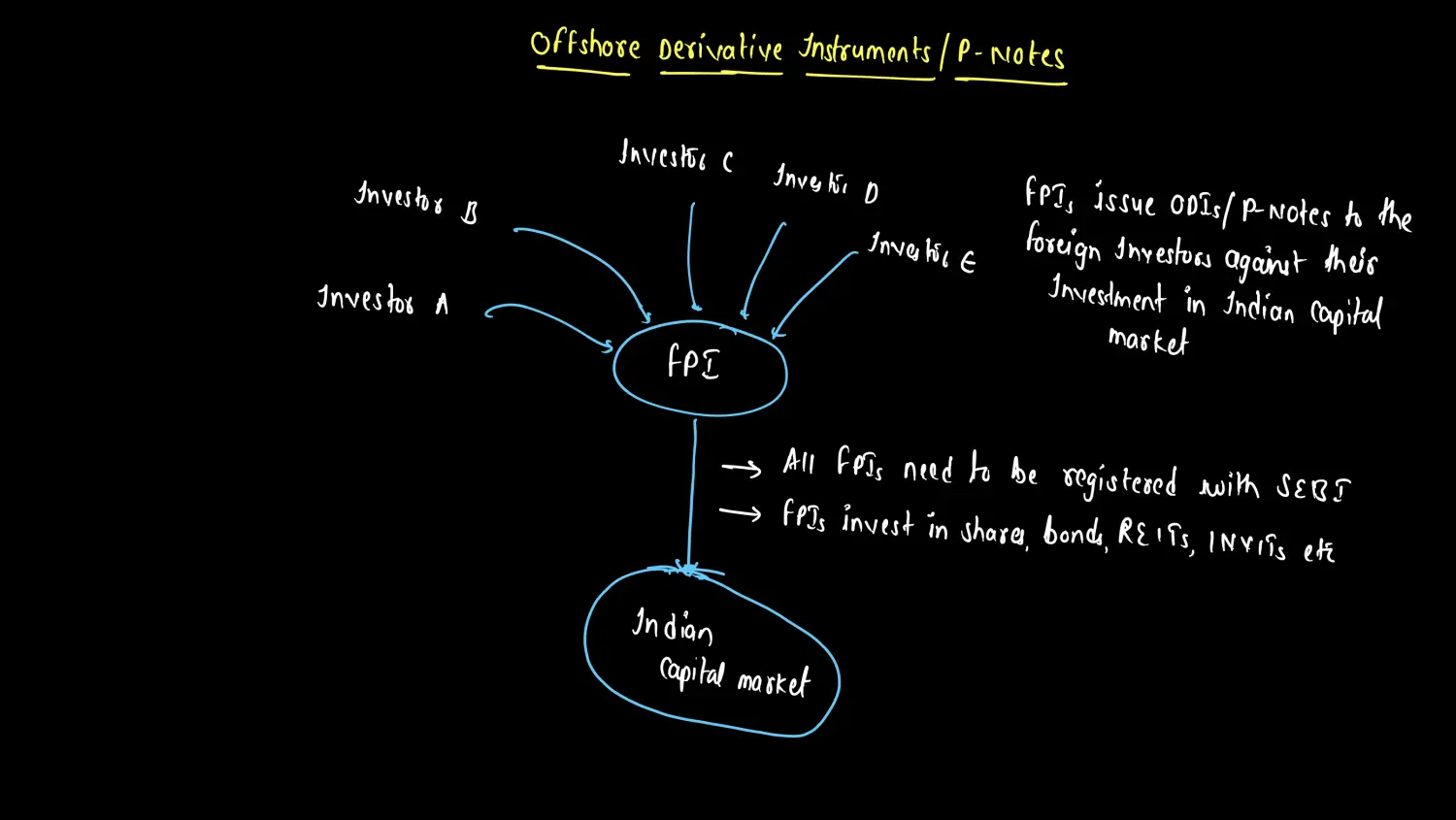
Offshore Derivative Instruments or P Notes
Arvind Mayaram Committee recommended that Foreign Investment (FI) should be categorised as
- FDI
- Unlisted Company → Under Unlisted Companies
- Listed Company → FI Buys 10% or More Shares, It is treated as FDI
- FPI
- Listed Company → Foreign Investor buys Less than 10% of Shares of Indian Company
- Foreign INvestment in Bonds, Debentures or REIT’s, InVITS, G Secs
- FDI
What are Offshore Derivative Instruments
- in FPI - a Foreign Investor buys various Instruments from Foreign Market
- For this it has to register to SEBI
- for the USA Retail Foreign Investor - he has to face a lot of Red Tapism for getting registered with SEBI to be registered as FPI
- Or he goes to a FPI (For Ex Mutual Fund Company), on behalf this Individual this MF company of US which is registered in US as FPI will Invest in India
- This MF Company will issue P Note (Participatory Notes) as a Receipt
- P Note is a Acknowledgement given by a FPI to a Retail Foreign INvestor in Foreign, that his money has been invested in India
Why is It called Offshore Derivative
Off Shore :
- as it is based in Other Country
Derivative :
- Because Investor is not directly investing
- the P Note Derives its values from the value of share of Indian Company
Concerns with FPI
- Investment of Black Money by Means of P Note Investment through a FPI
- No Transparency so as to from where this FPI has gotten money from
- It can act as a Source for Money Laundering
Hence, SEBI has come up with Guidelines to disclose the Identity of the Retail Foreign Investors
At the same time, it has not taken strict action like stopping it completely as Jo Paisa Bahar Jaa Raha Wapas Aa raha hai
Cant Stop Par Regulate Strong
Also Hamesha Nahin Lieninet Reh Sakte Nahin toh paisa bahar jaata hi rahega
Difference Between Promissory Notes and Participatory Notes
Promissory Note is a Currency Note
National Monetization Pipeline
Introduction
Example of Haveli and Heritage Hotel
Govt Brownfield Assets - They are Inefficiently Utilised
Example of Brownfield Assets
Road, Railways, Port, Airport, Stadium, Telecom Towers
LANDS & BUILDINGS ARE NOT Part of National Monetisation Pipeline
Railway Infra - Tracks are Under Utilised
National Infra Pipeline
To Create World Class Infrastructure. For this we need Rs 111 Lac Crore to Build this Infra
For this 111 Lakh Crore, a Good Source is NMP which is around Rs 5 Lac Crore
NMP
Aims at Leasing NOT Selling
Govt Gets Upfront Money by Leasing
using this Money Govt can create New Infra
Focuses only on Monetisation of Core Assets only
- Core - Railway Rail Road etc
- Non Core - NOT Include LAND & BUILDING
(Monetisation of Land will be done by National Land Monetisation)
NMP is nothing but a Fancy Name of PPP ( Public Private Partnership )
It is NOT Privatisation as nothing is Sold but is Leased
India is not the First Country to Come up with NMP. For Ex
- Australia - Asset Recycling Initiative
- Indonesia - Limited Concession Scheme
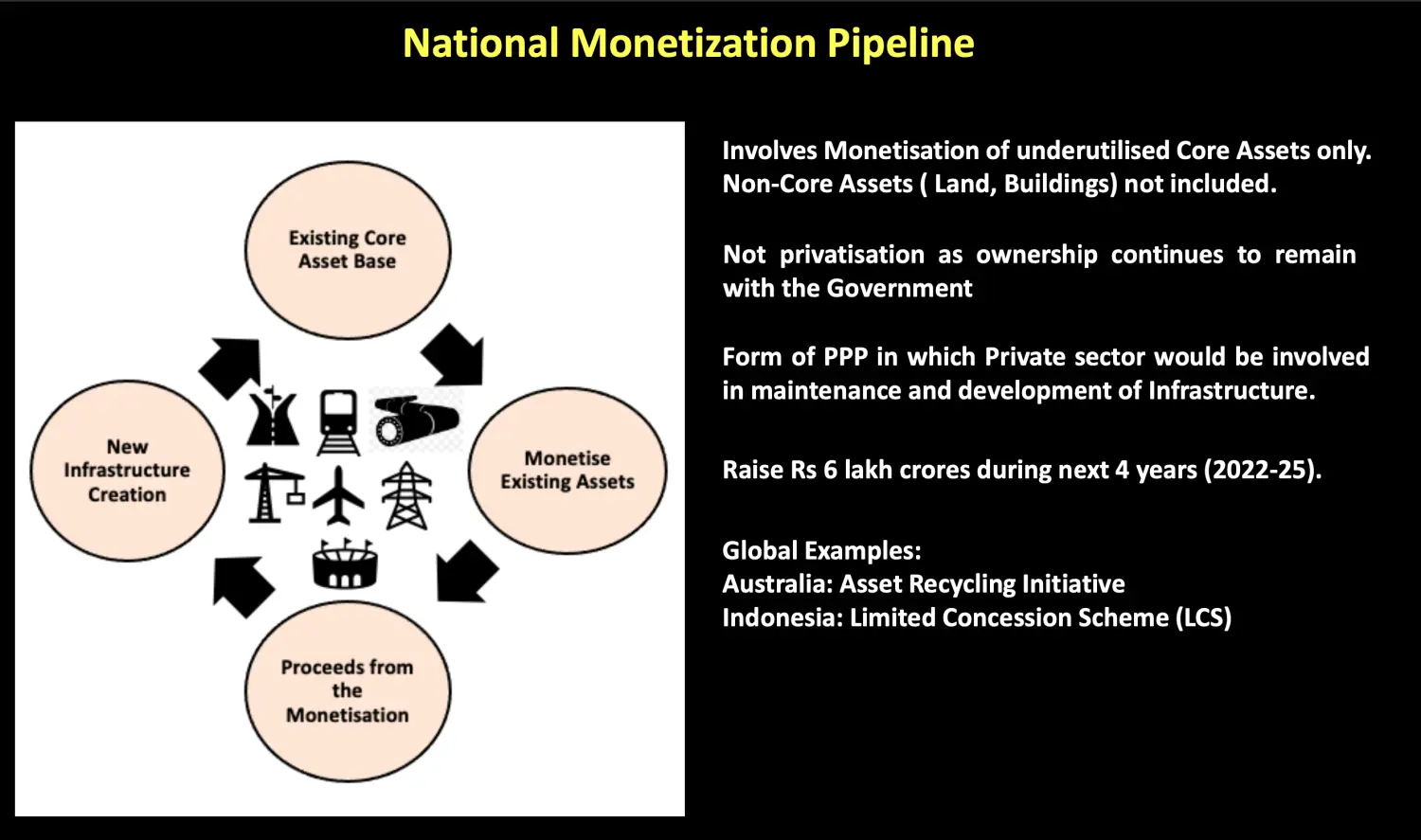
Benefits of NMP are
- Increase Economic Efficiency Usage of Assets
- Govt can create new Infra w/o borrowing
Assets Recognised in NMP
List of Companies
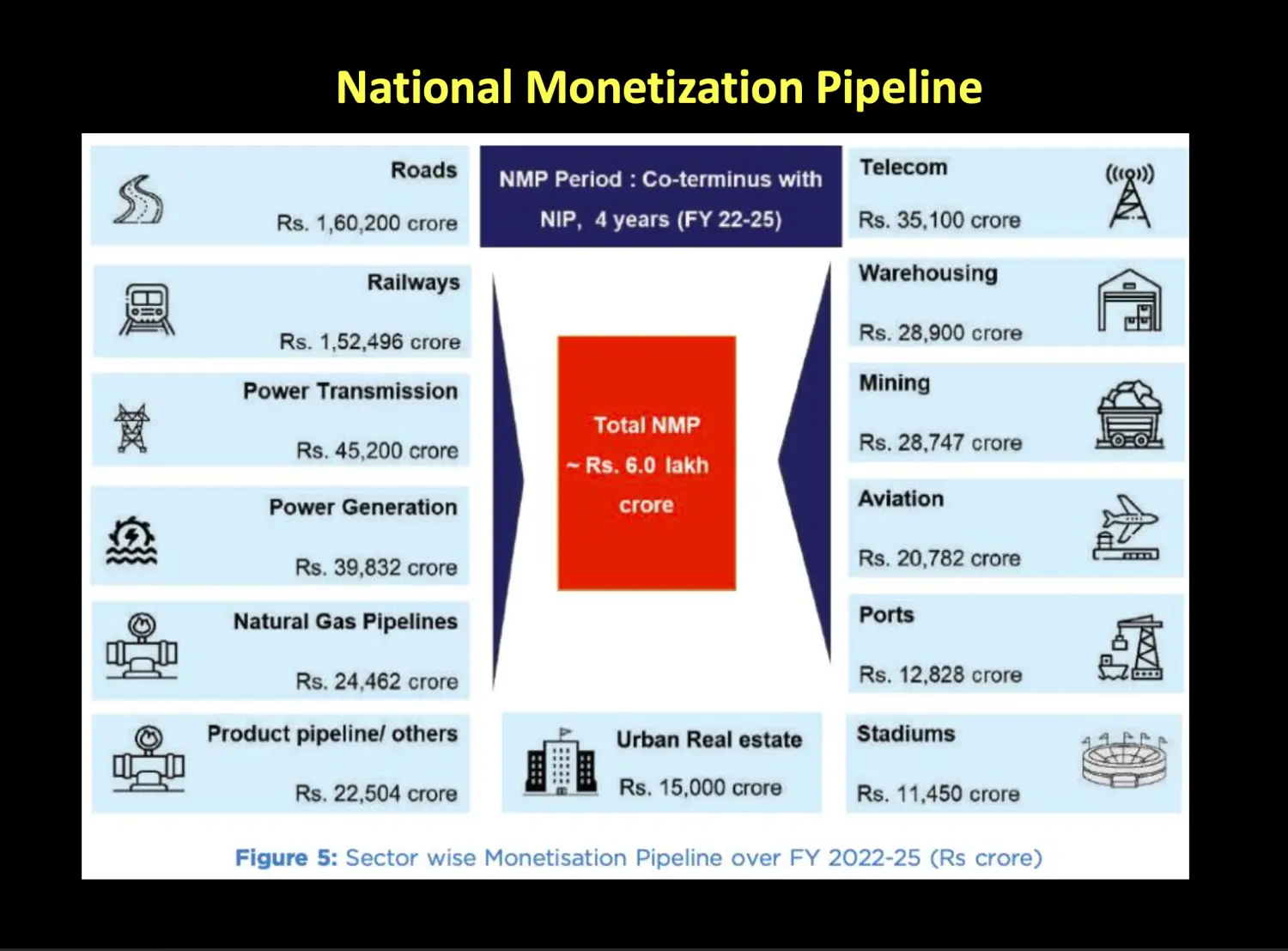
Most Contribution by Means of Road - By Means of Toll by Pvt Sector Company
Concession and Contract is Same

Methods of Monetisation
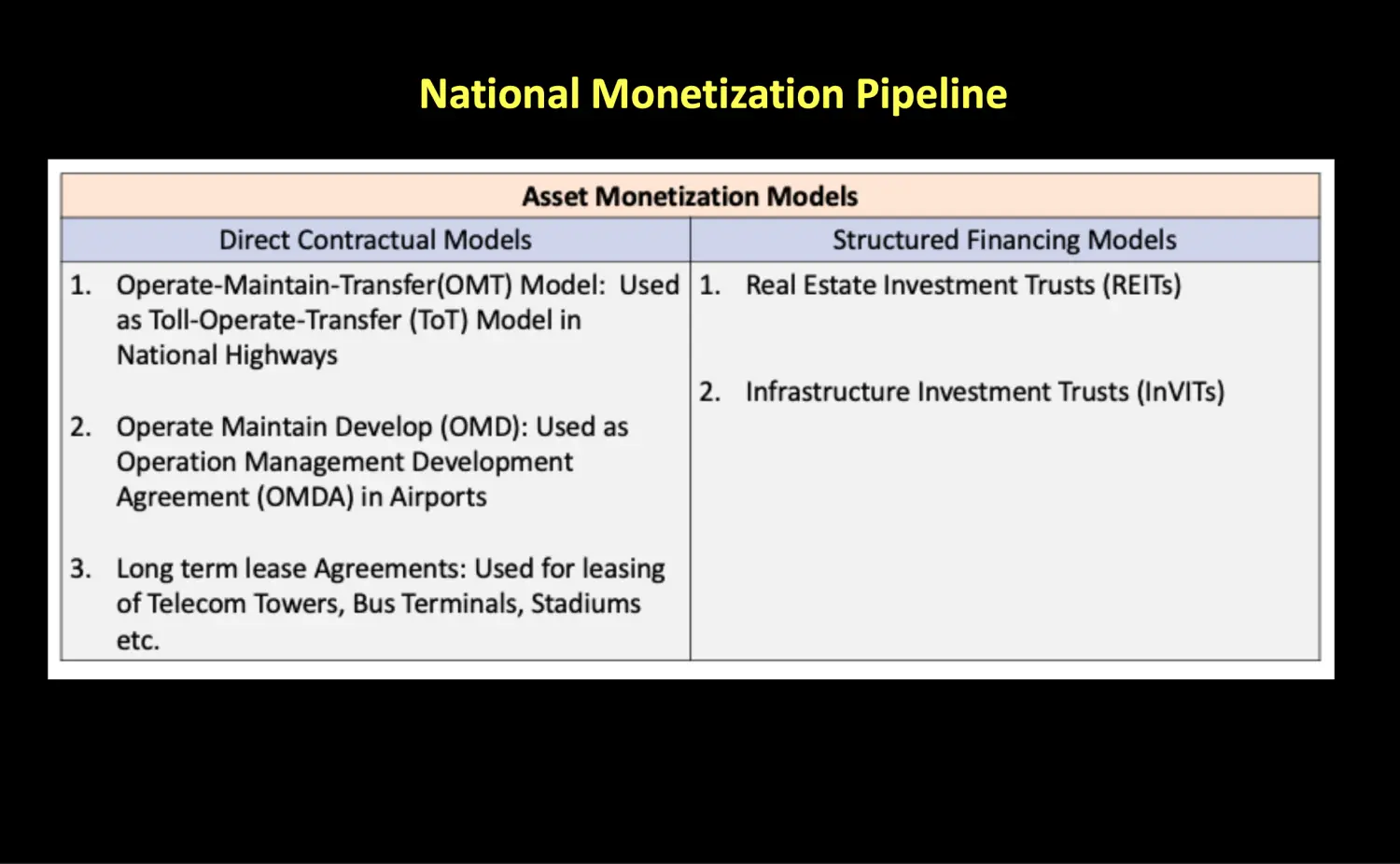
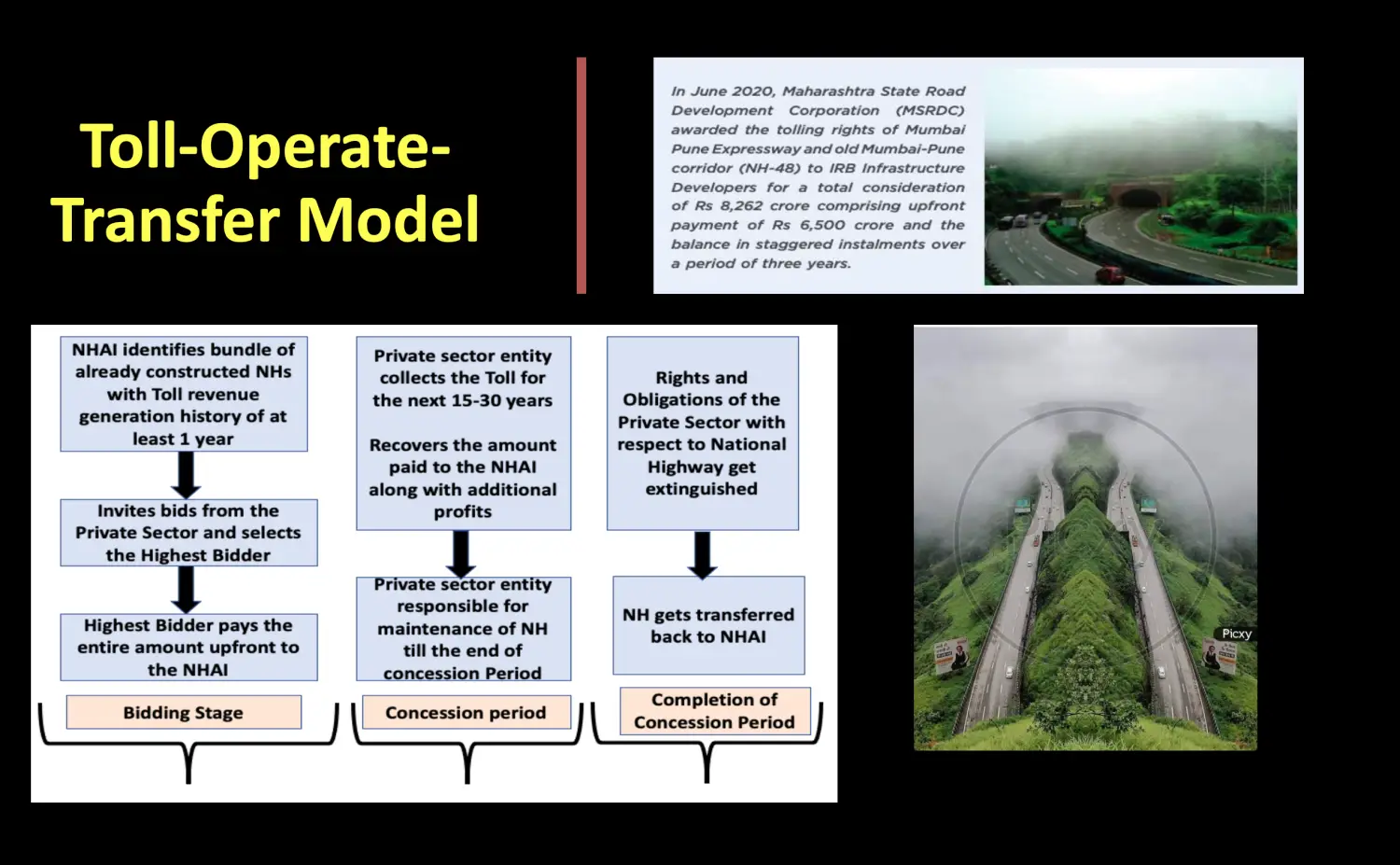
OMT Model - Toll Operate Transfer
Pvt Sector Company will collect money from toll, in the start of Lease, Pvt Company will give money to Govt and will maintain the Road as well
Hence, It is a win win for both Pvt & Pub. But it is a Dual Burden on People
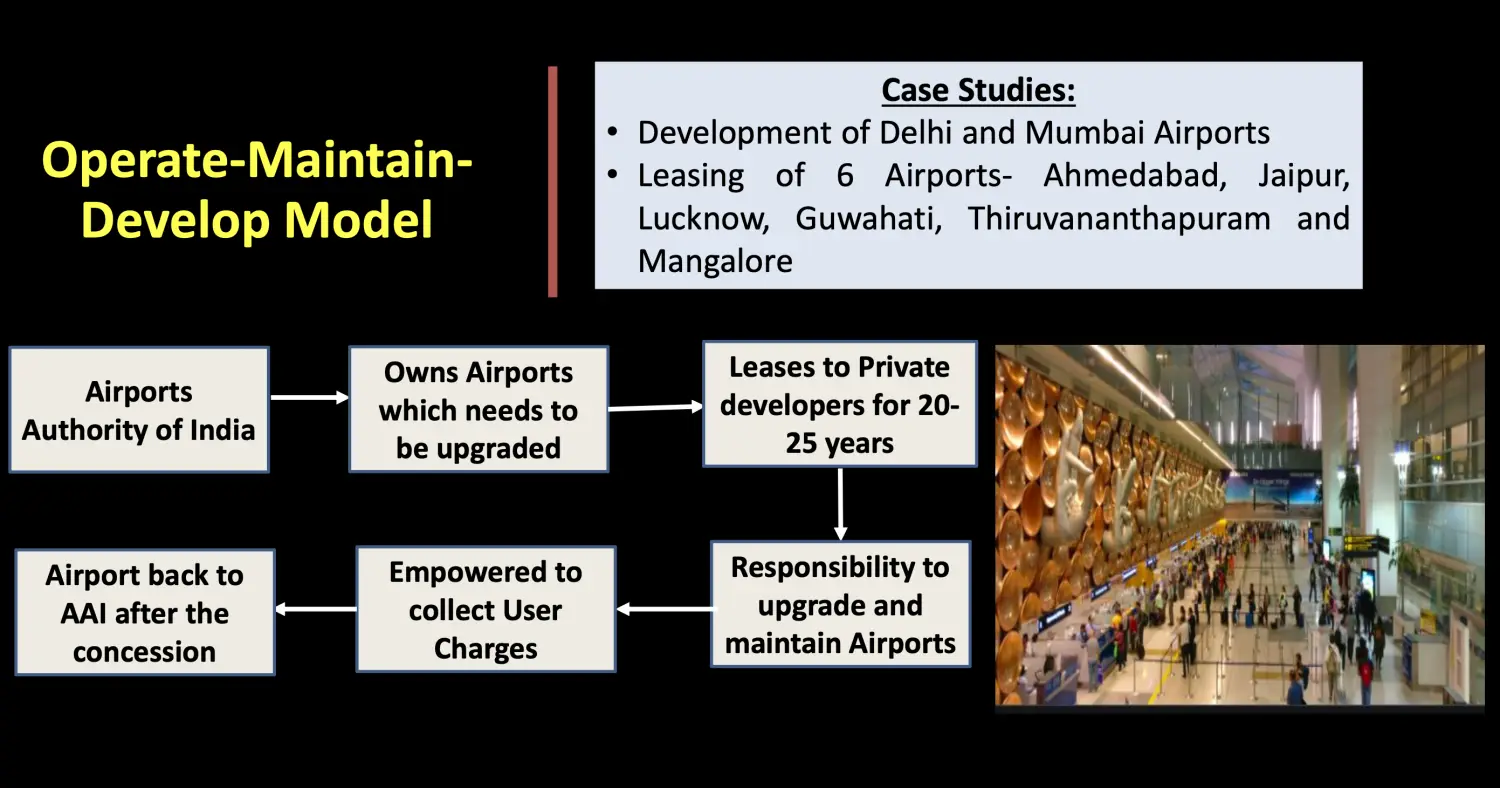
OMD Model - Operation Maintain Develop Model
Used for Modernisation of Airports in India
Pvt Sector will Maintain and Lease the Airport - Pvt Sector earns money by User Development Fee
Example : T3 Terminal has been developed by GMR Company
Asset Monetization REITs & InVITs
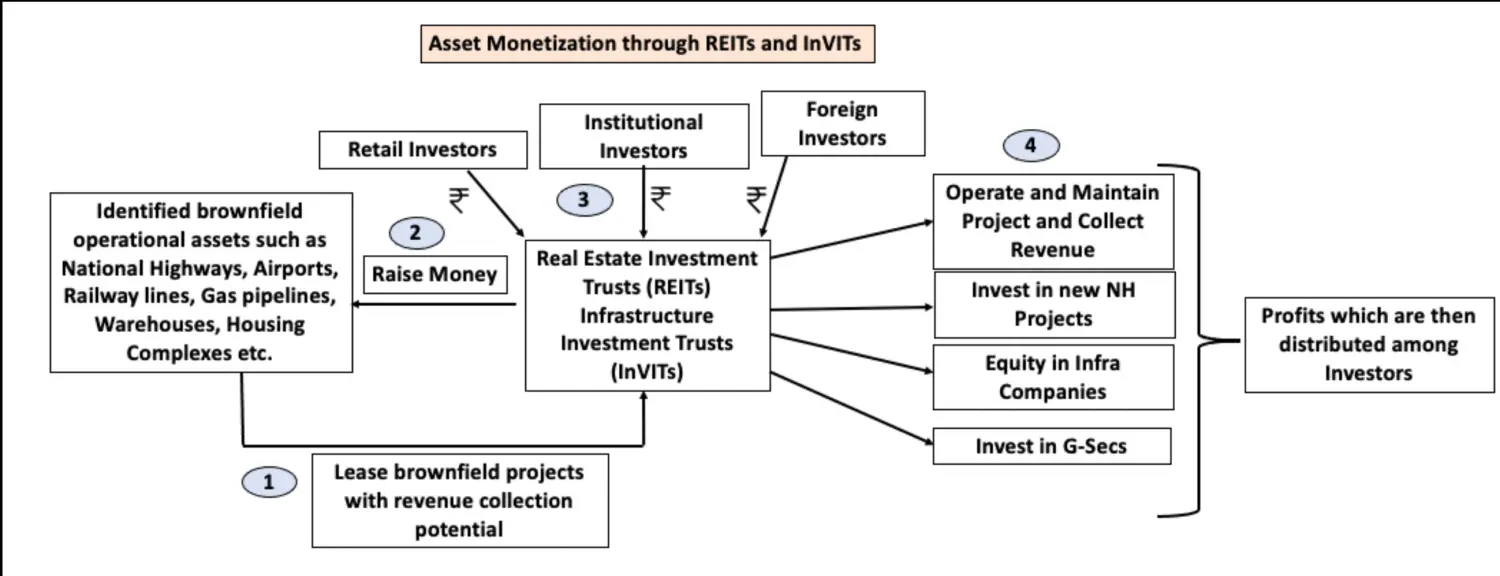
Process of InVIT
- InVIT - Infrastructure Investment Trust (InvITs)
- NHAI will transfer this National Highway to a trust
- NHAI has built a National highway - This Highway can collect Toll
- NHAI owns this Trust
- In Return NHAI Trust will give money to NHAI
- NHAI Trust kahan se paisa laaega
- NHAI Trust will issue INVIT, like a Share, People will but it like
- Retail
- Foreign
- Institution
- Bank
- If total invit is 100 Crore
- If I Buy 1 Part of Invit - I own 1 Percent of Highway
- NHAI Trust can do 4 things with the money
REIT’s
Everything is same like InVIT
in InVIT - I am talking about Infrastructure
In REIT - Real Estate
EGL in BLR is the First Company to Come up with REIT
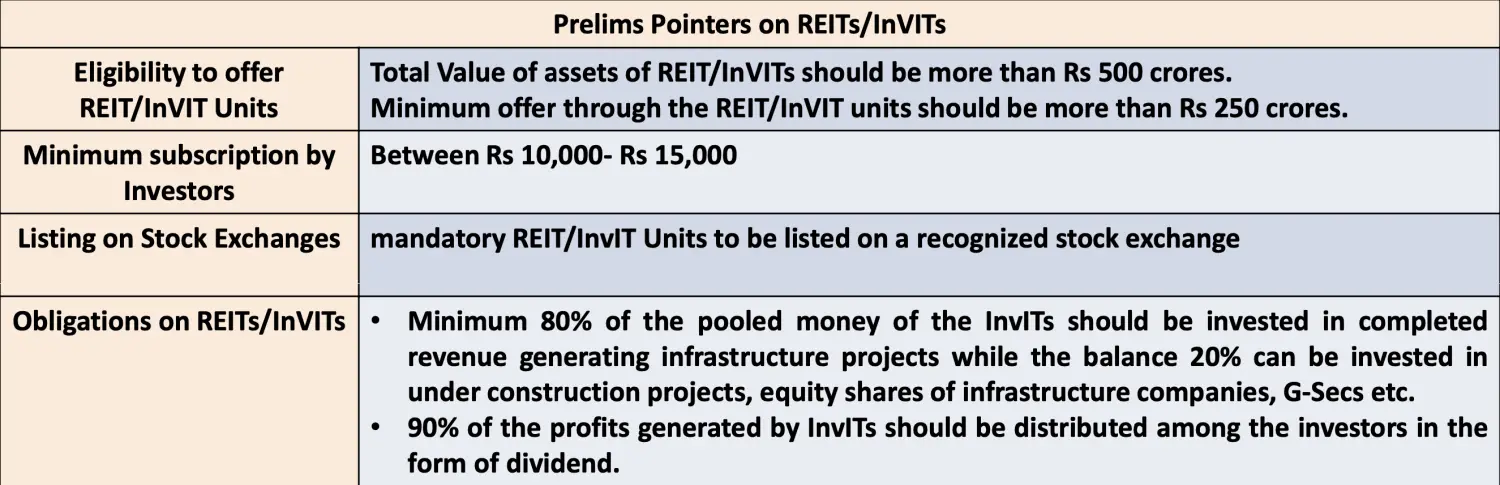
Prelims Pointer & Guidelines on REIT & InVIT
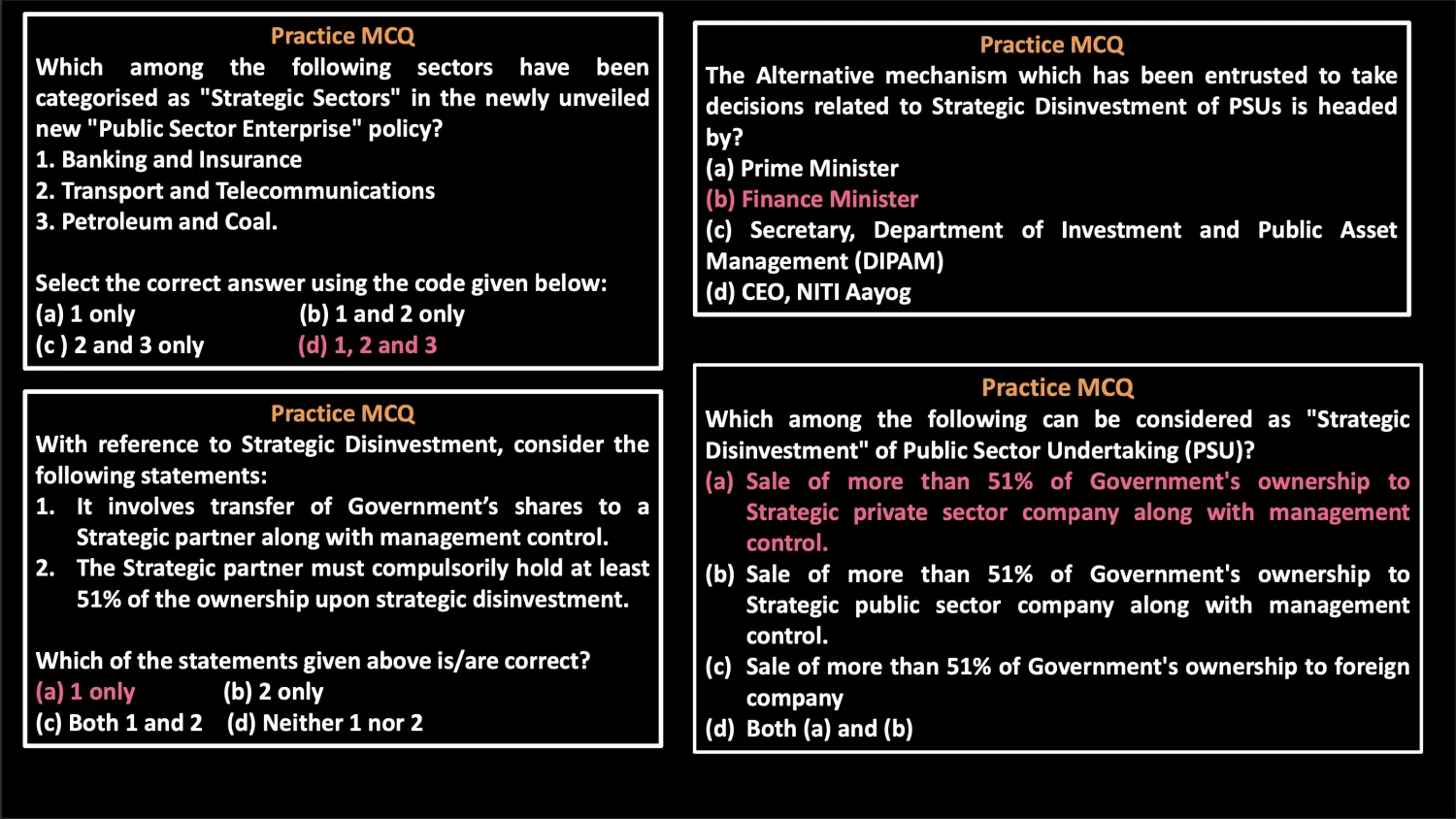
Disinvestment - Related to PSU
Introduction
If in any company which has more than 51% of ownership by Govt. It is called PSU
Examples of PSU are: SAIL, BHEL, NTPC, ONGC, CIL, IOC, GAIL, SBI, PSB, LIC, BSNL, MTNL
Buy 5 Shops - Investment
Sell 2 Shops - Disinvestment
from 1947 (Independence) - 1991 (LPG)
- Here we were a Mixed Economy - Public & Pvt
- But More Importance was given to Public Sector due to Socialist Nature of Constitution
- Not Enough Role or Importance was Given to Pvt Sector because
- Most Sectors were close to Pvt Sector
- If some sectors are allowed, license was needed for everything
- We went for Public Sector, due to poor & literacy rate of India at that time
in 1991 - LPG Reforms were Introduced
in 1991 - we didn't had forex for our imports, we needed loan
IMF said, loan only if there's LPG
LPG - Full Form
Liberalisation - Many Sectors were Opened to Pvt, Other than 5 to 6 sectors all were done away with the requirement of Licensing
Privatisation - Sell Loss Making PSU to Pvt
Globalisation - Attracting FDI & Focus on Export
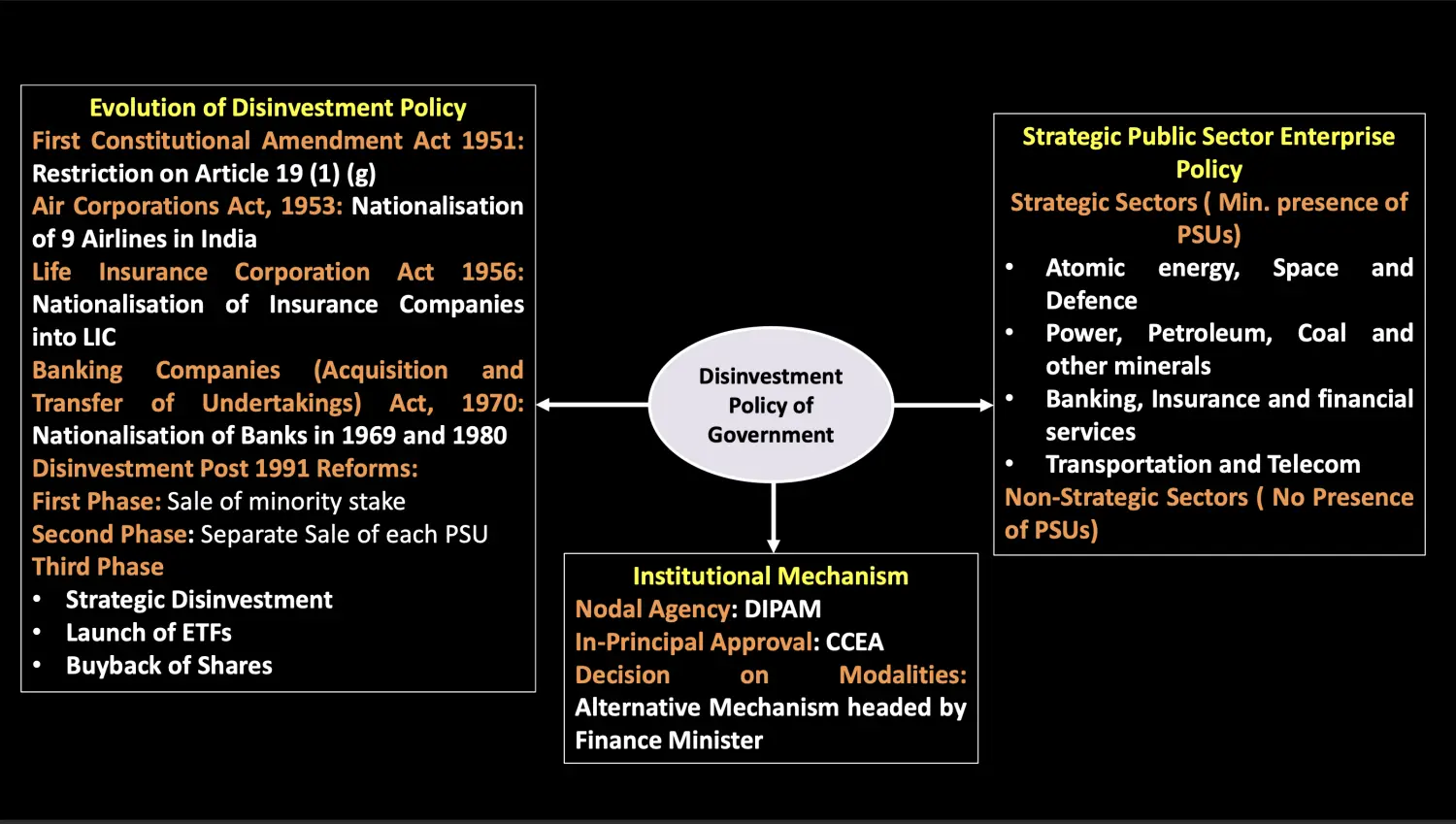
Evolution of Disinvestment in India
- 1 CAA, 1951 : Amended Act 19(g) → To Practise, Profession, Trade, or Business
- Air India Act, 1953 : Nationalisation of 9 Airlines
- LIC Act, 1956 : Nationalisation of Insurance Companies
- Nationalisation of Banks, 1969 - 14 Banks Nationalised
- Nationalisation of Banks, 1980 - 6 Banks Nationalised
- LPG Reforms, 1991
- Govt Policy of Disinvestment Started
Govt Policy of Disinvestment Evolved (No Fixed Timeline)
- Phase 1 - Minority Sale of PSU
- Phase 2 - Entire Sale of PSU
- Phase 3 - Current Phase
- Strategic Disinvestment
- Exchange Traded Fund
- Buy Back of Shares
Nodal Agency for Disinvestment is:
Nodal Agency : DIPAM

Final Call: Cabinet Committee on Economic Affairs
Moralities of Disinvestment: Alternative Mechanism Headed by Finance Ministers
Identification of Strategic or Public Sector Enterprise
- Strategic Sectors -
- Some Merged
- Some Partially Disinvestment
- Unstrategic Sectors - All will be Disinvested
- Strategic Sectors -
What to Study
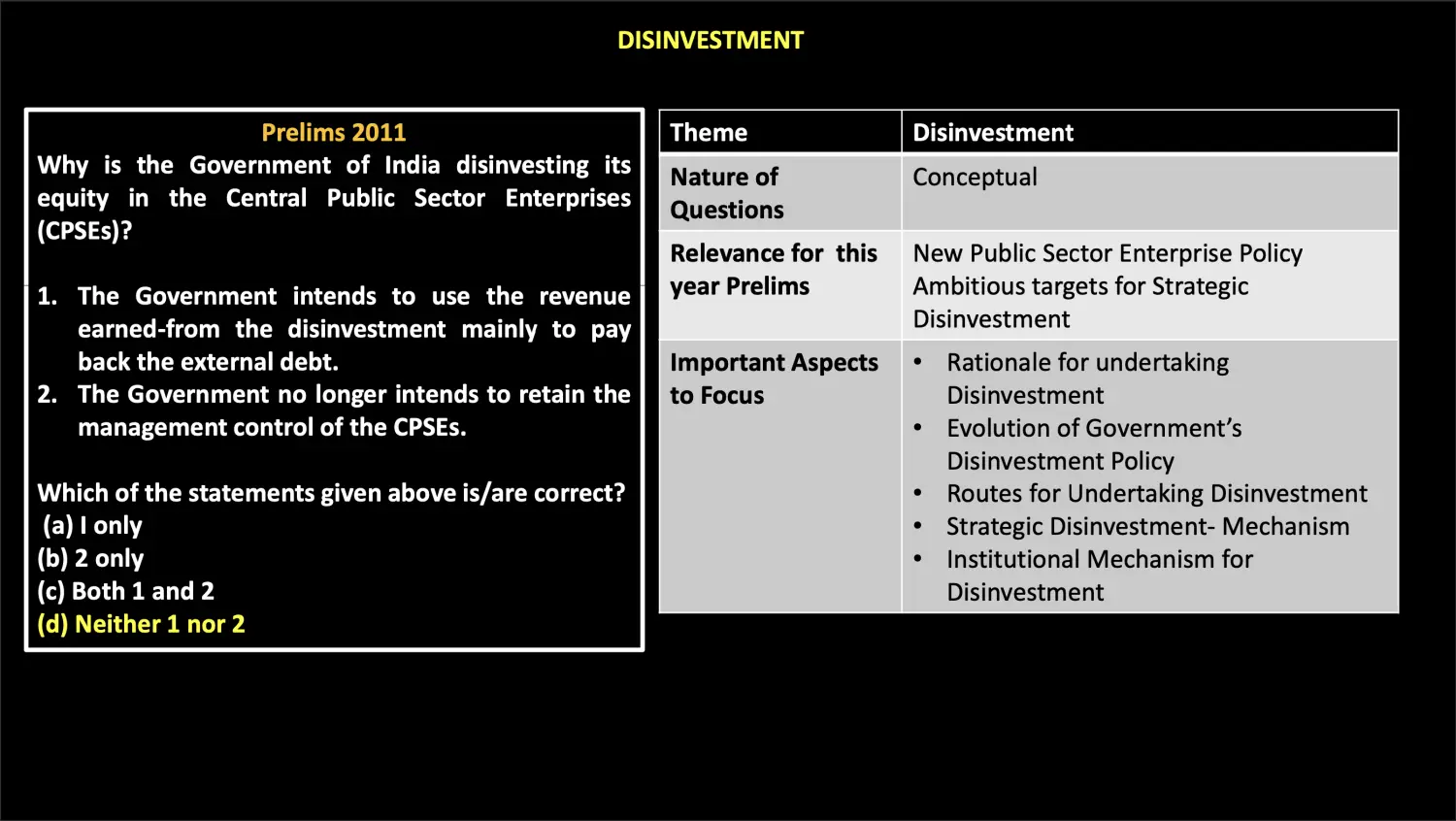
Reason for Disinvestment
Mind Map
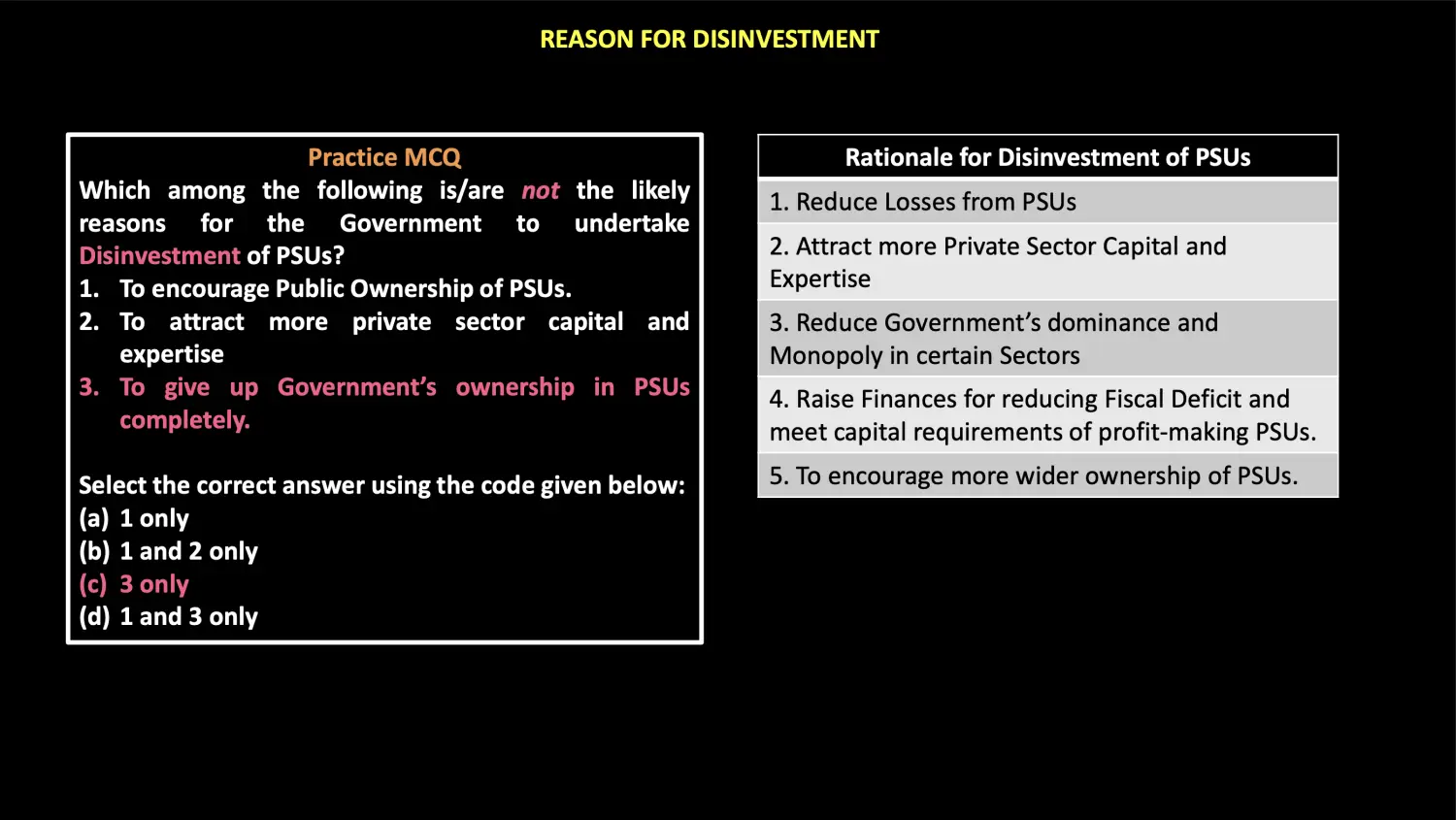
Reasons for Disinvestment
- Good Source of Money
- Better Horizons for Soft & Hard Infrastructural Development
- Reduced Burden of Govt
- Strategic & Skilled Hiring
- Efficiency of Working Mechanism
- Pension Load on Govt Reduces
- Fiscal Deficit would reduce
- To Promote Wider Ownership of PSU’s
Govt has no Business, Doing Business
Example of Air India is a classical example of Disinvestment
It owed around 66,000 Crores to Banks & FInancial Institutions
Everyday Govt had to spend Rs 20 Crore Per Day to keep it running
Air India was sold to Tata Sons at 18,000 Crore, Govt is still left with 40,000 Crores
But, Govt Saves 20 Crore Per Day on a Loss Making Asset
Disinvestment Policy
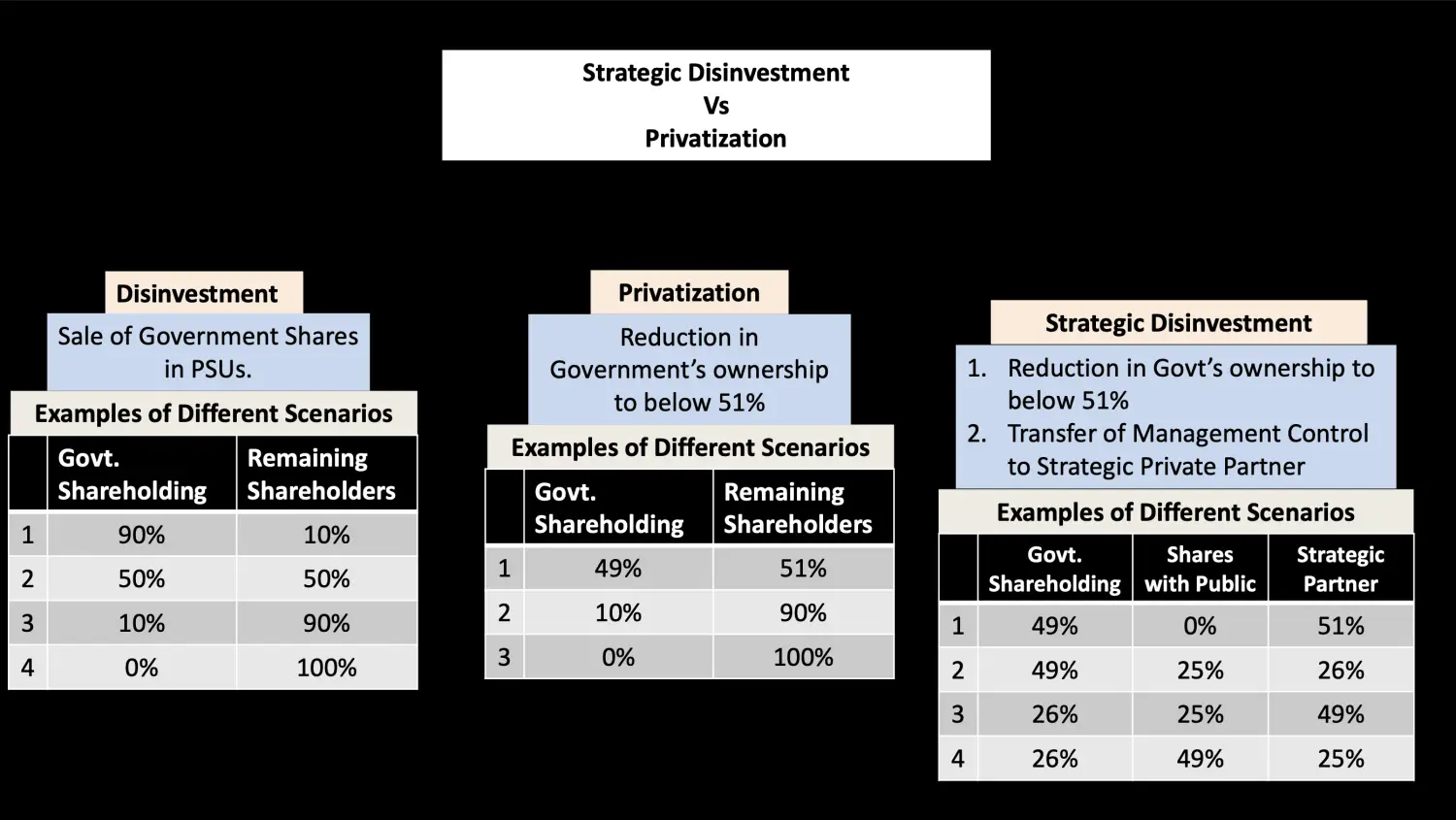
Strategic Disinvestment v/s Privatization
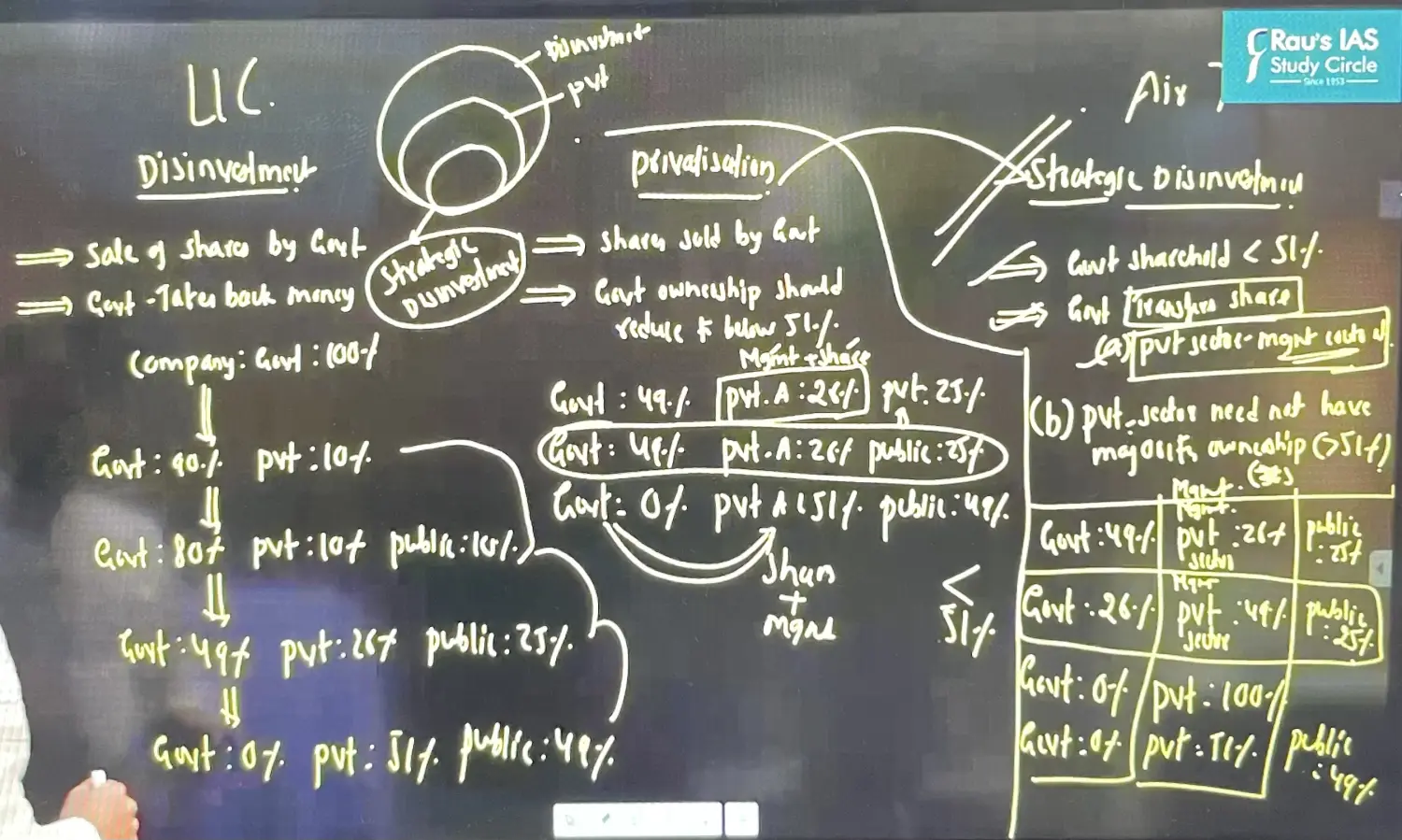
Disinvestment: Govt is Selling its Share && Govt Gets Back its Money
Privatisation: Means Govt has Ownership below 51%
(Think from Perspective of Govt)
Strategic Disinvestment:
- Govt Share less than 51% &&
- Govt Shares its Block of Shares to the Strategic Partner &&
- Transfer of Management Control
NOTE 1
A Strategic Partner can have less than 51% ownership but at the same time can have explicit management control
NOTE 2
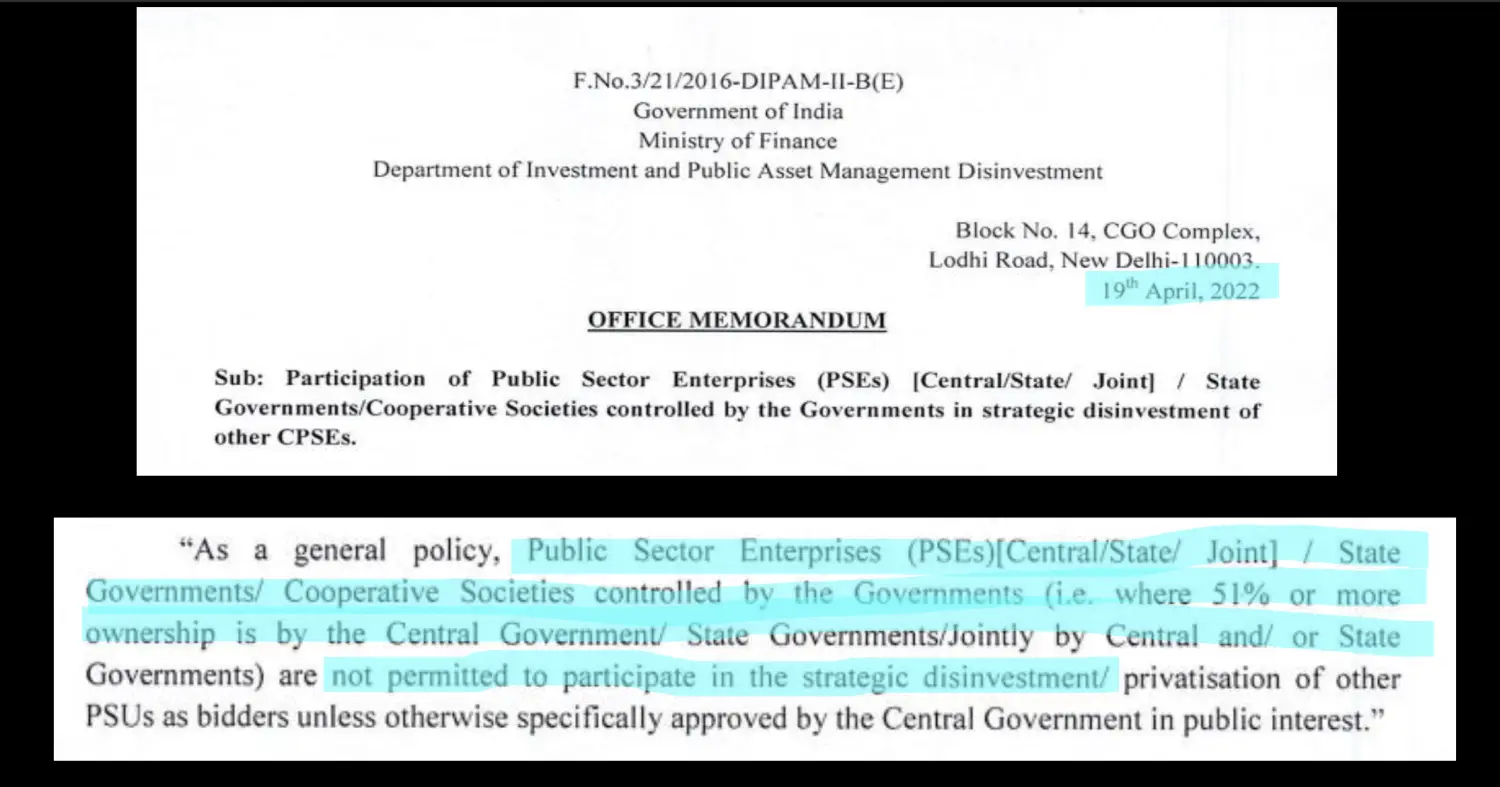
According to Earlier Definition : This Strategic Partner can can be a PSU or Pvt Sector
But According to Notification of 19 April 2022 ; PSU will NOT be permitted to participate in Strategic Disinvestment or Privatisation
Note
- All Strategic Disinvestment is Privatisation
- All Privatisation is Disinvestment
Mind Map
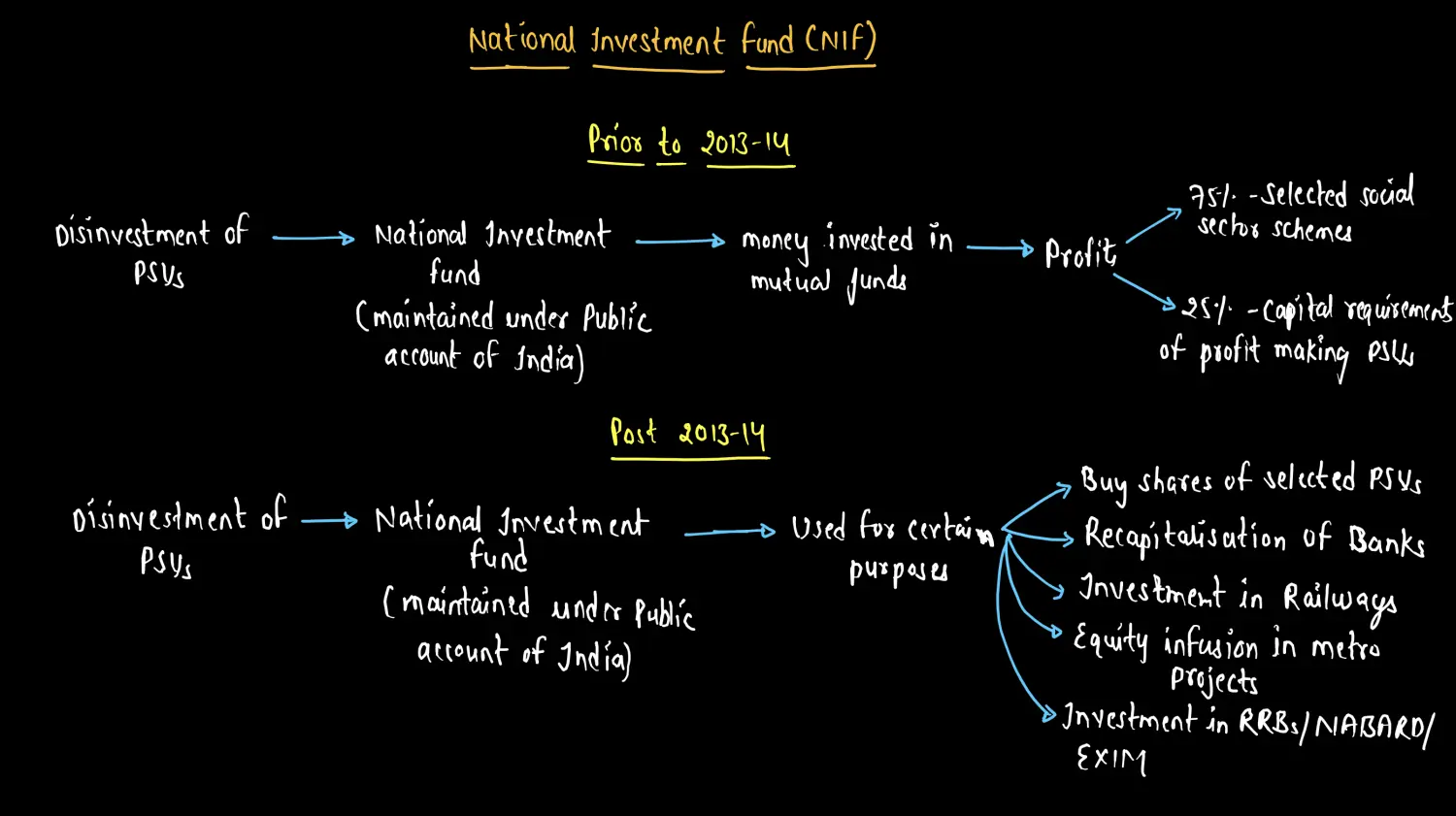
NIF - National Investment Fund
Art 226 - Provides for Public Account of India. It has Two Types of Money
- People Put Money by Means of Trust - No Parliamentary Approval Needed
- Post Office Deposit
- PPF - Public Provident Fund
- NSSF - National Small Saving Fund
- Cess Collected by Govt → Stored in CFI ( Consolidated Fund of India) → Separate Fund Under Public Accounts of India → Parliamentary Approval is Needed
- People Put Money by Means of Trust - No Parliamentary Approval Needed
NIF - National Investment Fund → Parliamentary Approval is Needed
ETF - Exchange Traded Fund
Detail and Mind Map
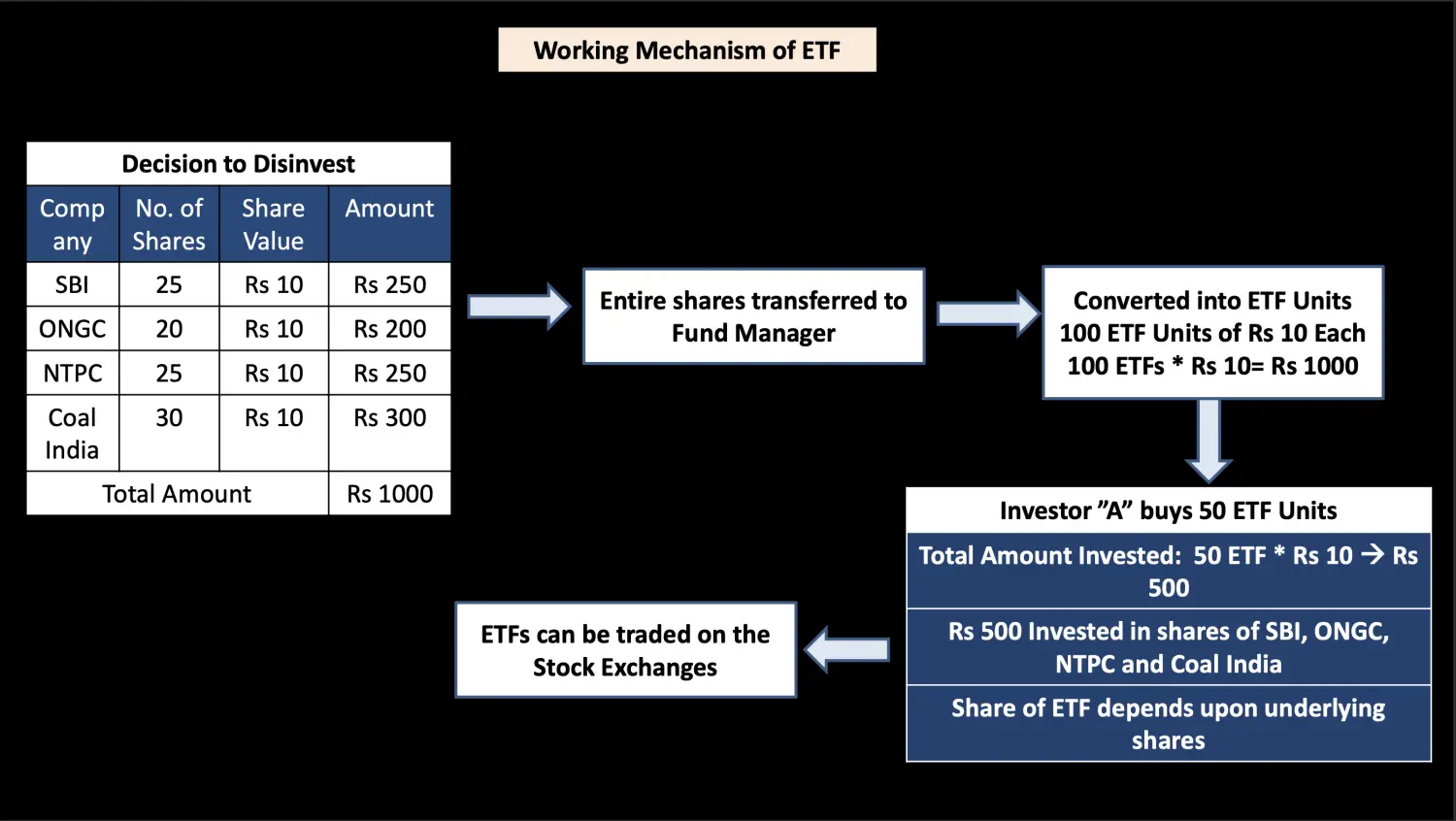
- Example of Fund Manager - Nippon India, ICICI Prudential
- Air India Disinvestment was decided in 2001 and happened in 2021
- Benefits
- Lower Risk due to a Bigger Basket of Diversified Investment
- Risk is scattered across Multiple PSU
There are Two Types of ETF
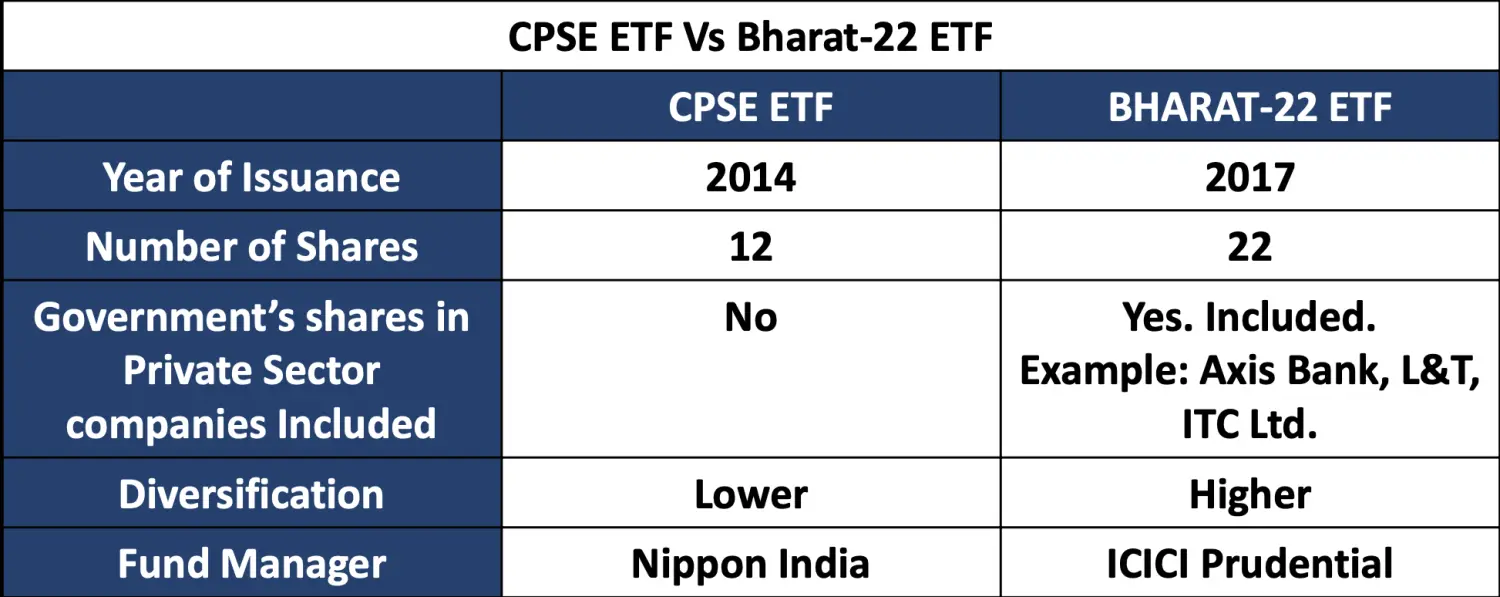
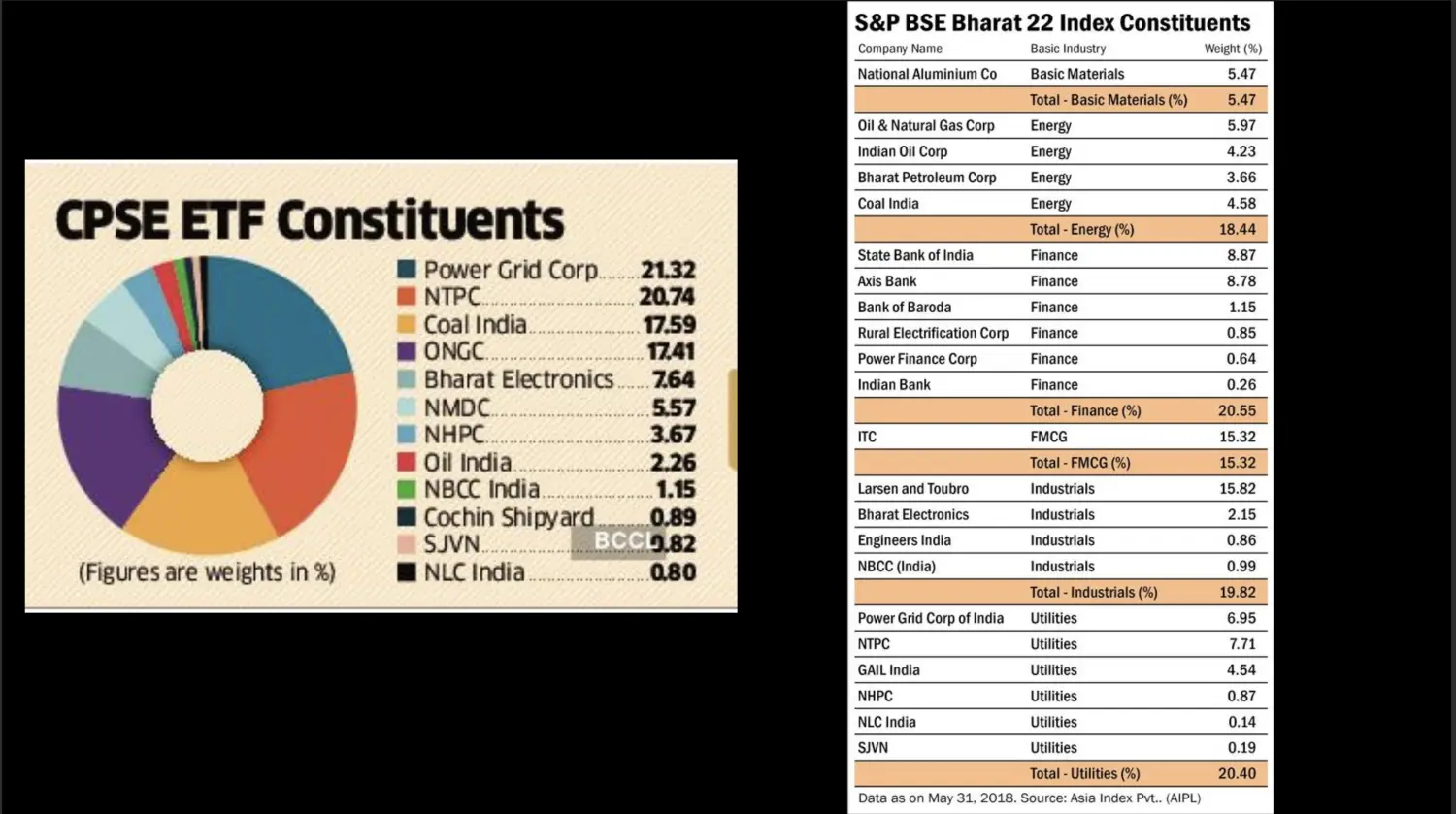
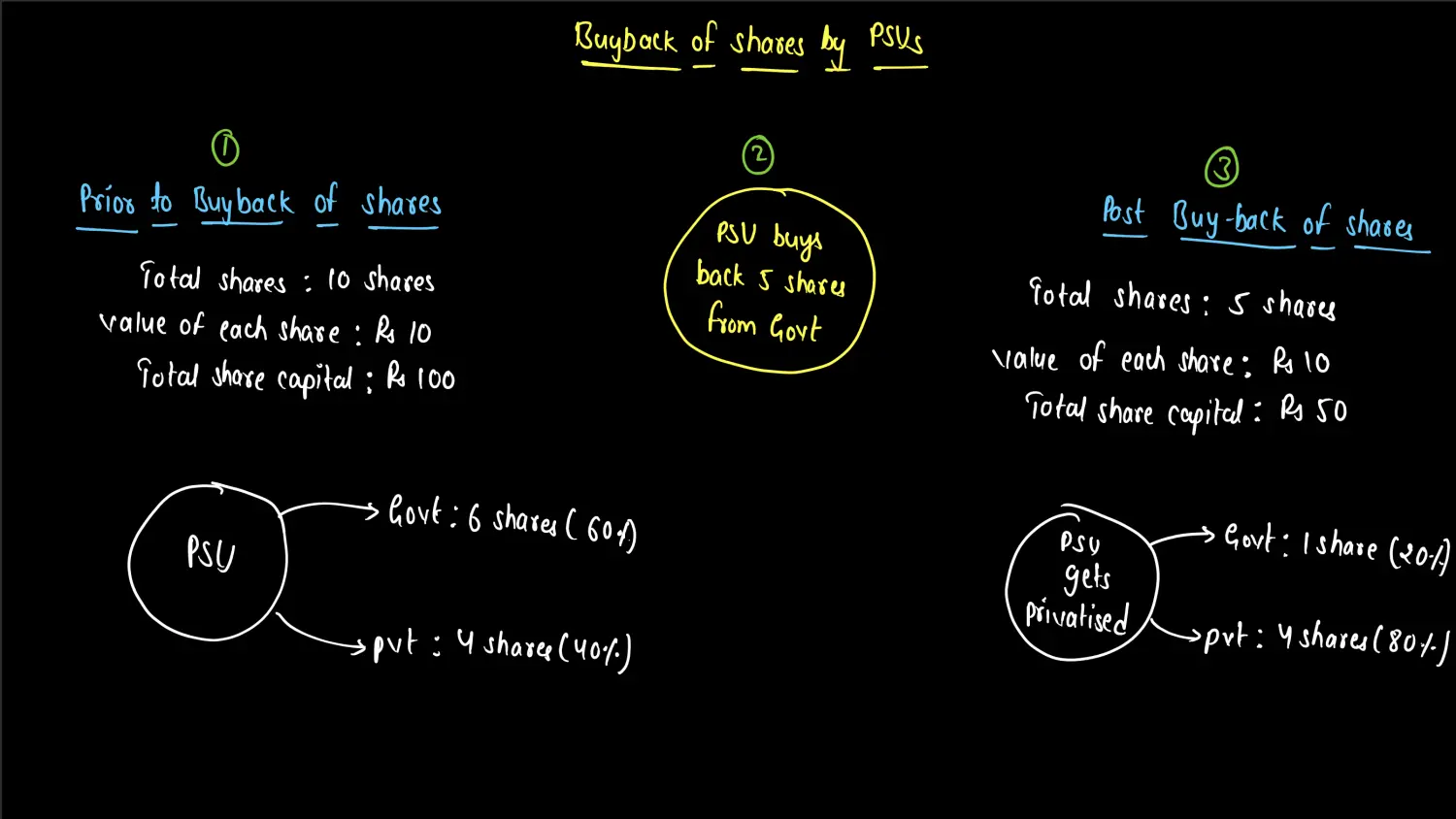
Buy Back of Shares by PSU from Govt
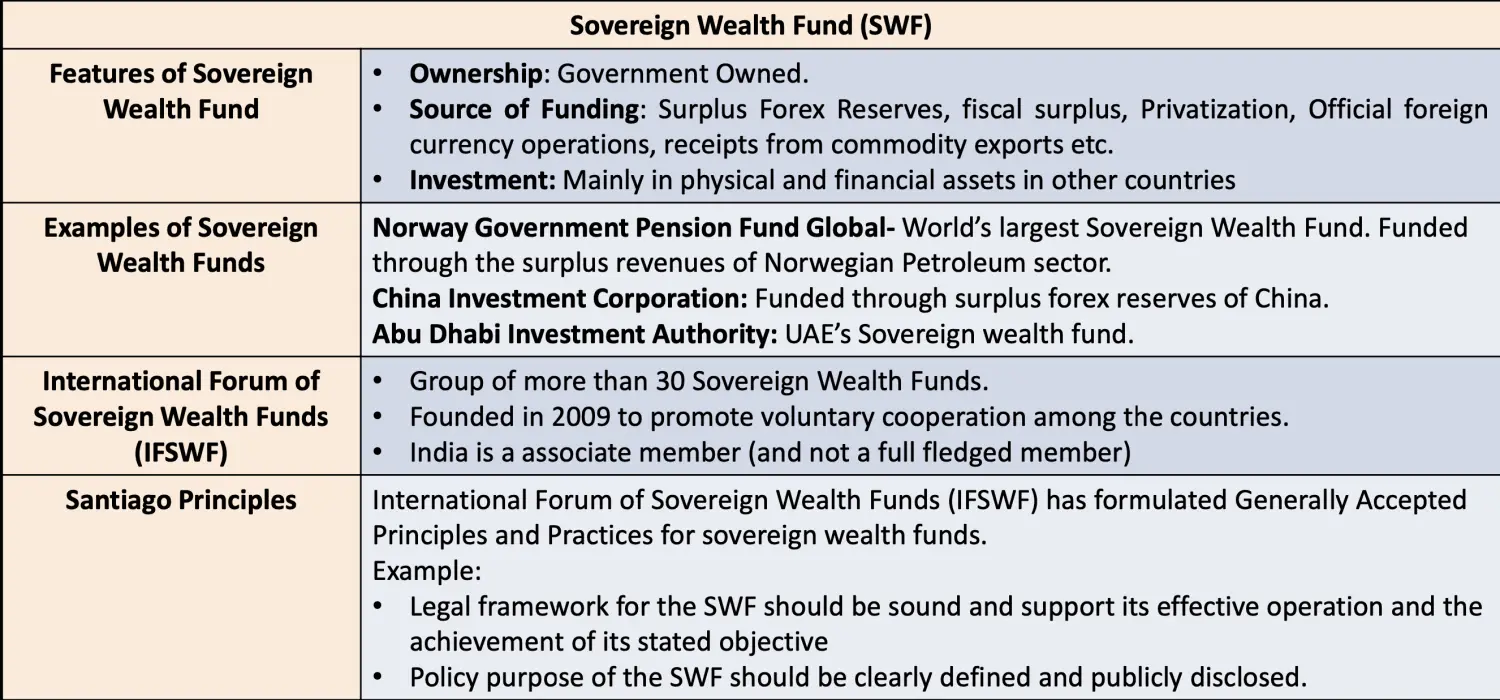
SWF - Sovereign Wealth Fund
SWF In General
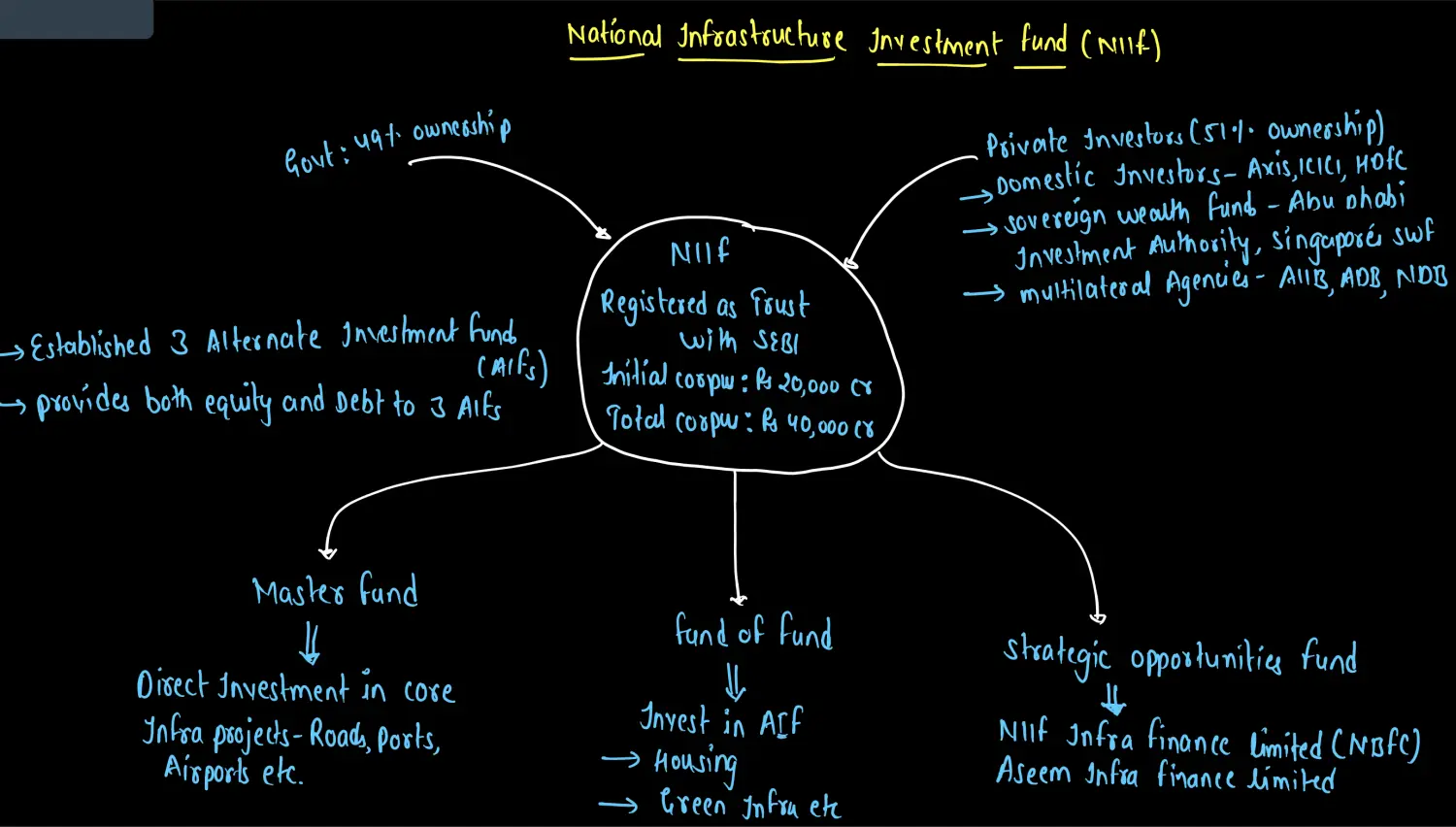
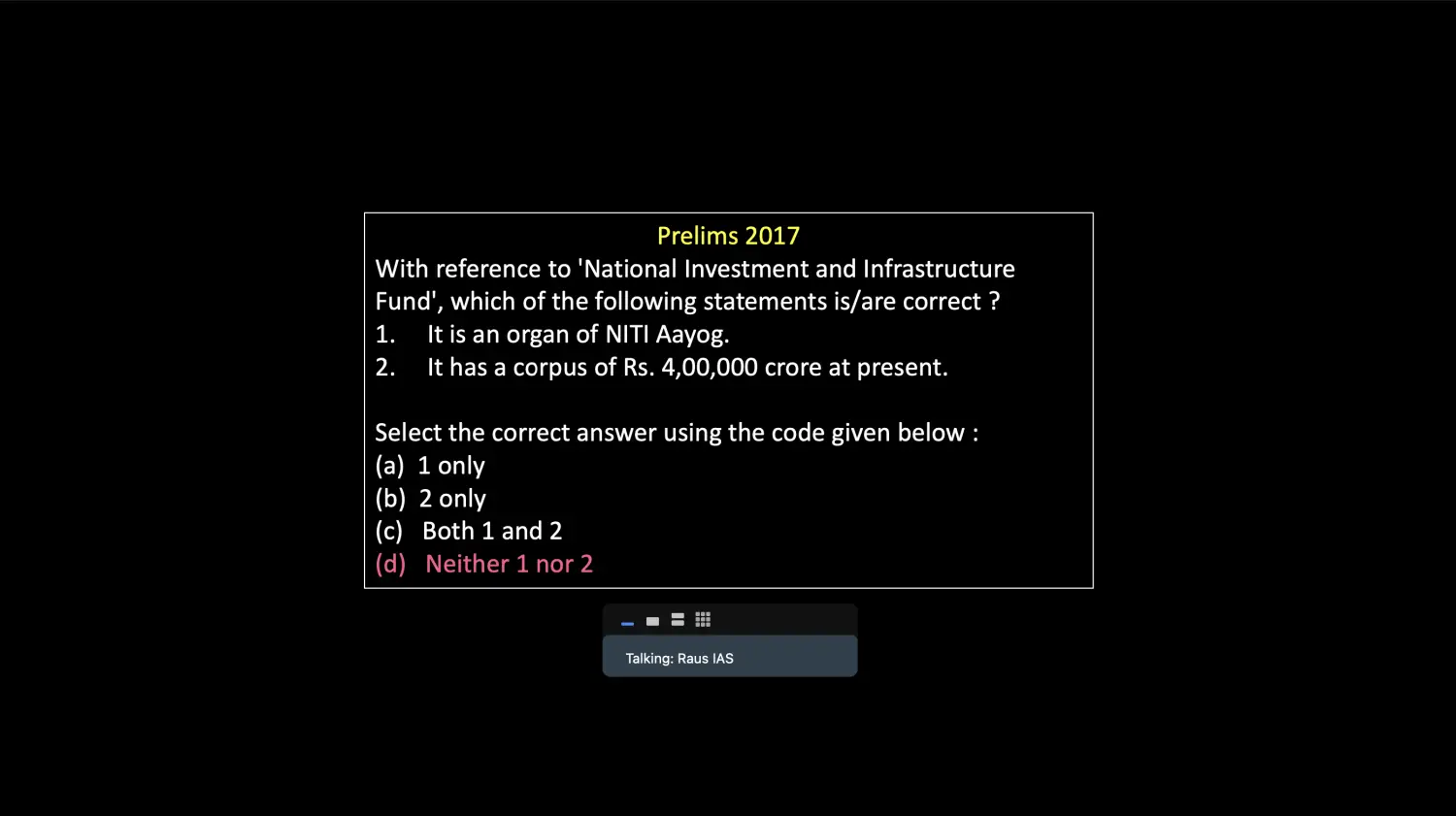
Intro to Indian SWF - NIIF
- Official Foreign Currency Operation → Sucking out of Dollars from Economy to Check Local Currency Fluctuation
- Indian SWF - NIIF → National Investment and Infrastructure Fund & Its Functioning
- Here Govt 49%
- Here Pvt Sector 51%
- Domestic : ICICI HDFC SBI
- Foreign : Banks, SWF of Other Countries, Singapore SWF
- Multilateral Agencies : WB, ADB, AIIB, NDB
- Initial Corpus was Rs 20,000 Crore
- It focuses more on Domestic Market
- It Established 3 Alternate Investment Funds
NIIF Mind Map & Details