Part 3 - Socio-Cultural Anthropology
Paper 1 - Unit 9.5 - Racial Anthropology
Race → Introduction & Classification
Introduction
Race is a grouping of humans based on shared physical(morphological or bodily features) or social(socio cultural) qualities, into different categories which are viewed as different by the society.
For the first time the term race was used to refer speakers of same languages, which later transformed into a biological concept i.e Populations having matching bodily features (Phenotypic Features)
Present day scholars regard the term race as a social construct or an identity, assigned by the rules of the society.
Hootan defined race as a great division of humans, the members of which although individually varying, yet characterised as a group, by certain common Bodily & Metrical Features (measurements) which have been derived from a common descent
Classification of Races by Earnest Hootan
Hootan Classified Races into two categories
Primary Races
Formed by Differentiation caused by geographical & reproductive isolation, mutations, environmental factors, natural selection etc
Secondary Races
Hootan considered secondary races as formed by blending of two or more primary races when some characters are picked up by Genes and some are lost.
This is Further Aggravated by Mutations and Environmental Factors
Thus it can be said that “Race is a Dynamic Group, Instead of a Static One”
Factors Responsible for the formation of Races
- Mutation
- Natural Selection
- Geographical Isolation
- Reproductive Isolation
- Selective Breeding, Inbreeding & Population Mixture
- Genetic Drift (Sewall-Wright Effect)
Different Criteria for Racial Classification
1 Colour of Skin - Cuvier
- Most Striking Superficial Characteristics of human division. Three Colours were almost universally accepted
- Cuvier Divided, Human Groups into 3 different races based on skin colour.
- The Types of which are - LSM
- White Complexion Leucoderms Caucasoids
- Yellowish Complexion Scanthoderms Mongoloids
- Black Complexion Melanoderms Negroids
- Its a very defective method of judging human variations because there can be many overlapping shades amongst the populations
- due to
- genetic mutations
- hereditary factors
- environmental factors
2 Colour and Texture of Hair - Hoodan
Hair may be straight, curly, wavy, frizzy or wooly.
- Hoodan Classified Hair Texture into 3 Prominent Categories
- The Types of which are
- Ulotrichus Frizzy or Wooly Hair Ex : Bushmen Nigros, Melanasain, Andaman Islanders etc
- Sinotrichus Wavy Hair Ex : Caucasians etc
- Leotrichus More or Less Straight Hair Ex : Yellowish Skinned Asians, Mongoloids, Eskimos etc
3 Colour and Shapes of Eyes - Dr Beddoe
Dr Beddoe was the first one to consider colour & shape of eyes as a criteria for racial classification with Hair & Skin Colour
The Greatest Majority of Population of eye colour has shades of black and brown. Beddoe considered black and brown variation as the most common eye colour
There can be some regional variation like Nordics in Northern Europe having blue coloration of eyes
another variation can be shape of eye, based on opening
In General, there are wide open eyes in maximum populations of the world, but in yellowish skinned asians, people living in sub polar areas, There is narrow opening of the eye.
Due to Epicanthic Eye fold, typically referred as mongoloid eye
4 Blood Groups - Landstenier
ABO Blood Group System in Humans by Landsteiner
where A & B are dominant Blood Groups & O is the recessive one, in its expression.
All the types of blood groups are scattered in all population in the world, with some regional variations
ABO Blood Group System - Link to Core Physical Anthro
5 Height / Stature - Topinard
Topinard Gave Classification of people based on height or stature as
- Tall Stature > 170 cm
- Above Average > 165-170 cm
- Average > 160-150 cm
- Below Average < 160 cm
- Short Stature < 156 cm
The Sample Size, was only for Adult Males & was criticised for being very restrictive in sample size
6 Somatotypes - Heath & Carter
Link to Core Physical Anthro Prominent Method is Heath & Carter
- Ectomorph
- Mesomorph
- Endomorph
Other than these biological criteria, many anthropologists ethnographers used
- Nasal Index
- Cephalic Index
- Size & Shape of Jaws
as a criteria to classify the races
These Classification were criticised by various ethnographers & anthropologist for
- Being Restrictive in sample size
- Based on geography, gender & age of Individuals
Weiner’s 3 Race Classification of Population based in Physical Features
1 Caucasoids (12)
Mediterranean
India, Spain, Portugal, Italy France, Northern Africa, Iran, Afghanistan, India
and some scattered populations in middle east.
Nordics
Scandinavian Countries including Northern France, Northern Germany, Belgium etc
Dinarics
Australia, New Zealand Region & Scattered Population South Asia
Armenoids
Part of Ukraine, Iran, Iraq, Turkey, Syria
Lapps / Lappi
Sub Arctic Region, Northern Norway, Greenland, North Canada, Alaska
Dravidians
Deccan Plateau India, Some Population in Bangladesh Sri Lanka
Pre Dravidians (Veddoid)
Found in Sri Lanka, Andaman Islands & Near By Indian Islands of Indonesia
Other than these prominent sub races of caucasians
Extra Don’t Try to Mug Up
- Eastern Baltics
- Ainus of Japan
- Keltics - People of Scotland and Whales etc
can also be categorised
Historically, the term has been used to describe populations in these mentioned parts of the world based primarily on skin tone. Now the term is used in broader context as a term representing a general physical type, scattered in different parts of the world including Europe, North Africa, Horn of Africa, Middle East, Parts of Central Asia and South Asia
2 Negroids (2)
Summary
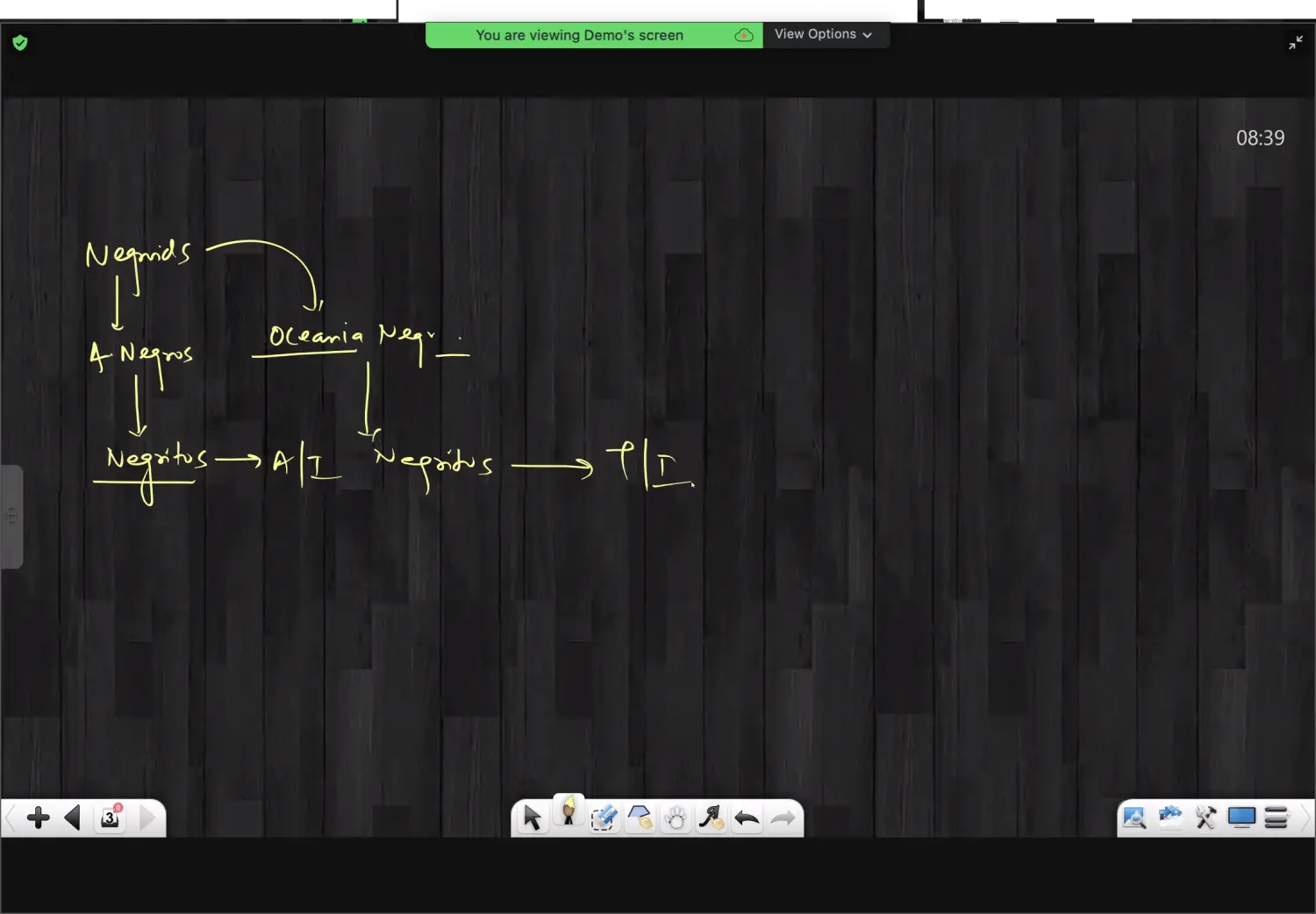
Primarily 2 Different Sub Races of Negroids exists :
African Negros
Mainly Scattered in African Continent Asia & Certain Scattered Islands in Indian Ocean.
There can be True Nigro found in African Continent, South of Sahara Desert till the geographical extent of Kalahari Desert.
Sub Races within African Negros can be
Bantu’s
Bushman
Negritos - Andaman Islander (G/A, Jarawa, Sentinele etc)
Oceania Negros
Found Mainly in
- Polynesian Islands of Pacific Ocean like
- Papua New Guinea
- Melanesia
- Trobriand Islanders
- There can be elements of Oceania Negros also
- Polynesian Islands of Pacific Ocean like
3 Mongoloids (4)
- Typically Characterised by
- Short Stature
- Yellowish Skin Coloration
- Epicanthic Eye Fold
- Can be Classified into 4 Different Sub Races
Classical or Central Mongoloids
Parts of Central Asia - China, Mongolia, Tibet, Korea, Some Himalayan Belts in India
Indo Malay Mongoloids
Indonesia, Malaysia, South East Asian Countries, Philippines, Burma, North East India & Some Parts of Tibet
Arctic Mongoloids
Northern Fringes of North America (Alaska & Canada), Greenland
Eskimos in these areas
Yakuts of Northern Fringes of North America
Amerindians (American Indians)
Paleo Amerindians - Countries like Brazil, Chili
Some Ab Origins of United States & Central America
- Typically Characterised by
Racism → Introduction & Classification
Rise & Persistence of Scientific Races
Summary - Stephen Gould & George Morton
Scientific Racism by Samuel George Morton
Stephen Gould studied Mortons Scientific Racism & maintained that he was biased
Within Blacks and Whites For Ex : He Compared Cranial Capacity of White Mails with Black Females. This is a Natural Difference
Within White English Men For Ex : North American have better thinking capacity, as compared to Other American(Inca American - Souther Part of Mexico to Colombia)
The Debate & Proposition
Most Anthropologists consider Race as a Social Construct and Concept, & Not a Biological One
Race in its application, that is Racism stigmatises certain individuals or populations as inferior and different.
It reinforces the privileges of others, with a flawed notion of superior race → Ethnocentric Sentiments related to ones own Race
There is no Evidence related to biologically distinct human beings or a sub species or a race of humans, which can be considered as superior or inferior
Further, the most common classification criteria i.e skin colour is incredibly varied based on various factors and also determined by multiple genes.
in 19th century Samuel Morton, attempted to prove that certain races are superior to others by measuring the brain size or cranial capacity or skull representing different groups like Blacks, Whites, American Indians, etc. Based on his study he concluded that whites are superior with more cranial capacity and intelligent as compared to others.
Mortons Study was challenged by Stephen Gould, a Harvard Scholar in his book ”The Miss Measure of Man”
Gould studied the same sample of skull used by Morton & he concluded that Morton was trying to confirm himself & fellow Americans bout the things they already knew or were accepted to them i.e whites are supreme race
Gould Rejected the Mortons Sample Size on the grounds that :
Reason 1 sample of black skulls was having more females and sample of white skulls was having more males.
Reason 2 Also while studying the American Indians and Latin & Southern Americans small sized INCA Skulls were more included that the lage sized Iroquois
When Gould measured the skulls he found that the average size of black male skulls was larger than that of average size of white male skulls
With Advancement in technology and genomic research its very much accepted that, brain size or cranial capacity is having no scientific basis for intelligence of an individual.
So the Ethnocentric View of Samuel Morton regarding superiority of white races was rejected by Stephen Gould and many further researchers
Present Day anthropologist, no longer take the idea of Race seriously
Race as a Biological Concept
There are still many researchers and people who believe that they can scientifically prove superiority of certain races over others
Much of these arguments, favour Eugenics → To Ensure Maximisation of Favourable Traits or Characters which are considered as supreme or desirable to promoting and legalising maximum generations/offsprings of individuals holding these characters
In Simple Words, Eugenics is an attempt to distinguish between people possessing good and bad genes and to foster social political or religious legislations that would encourage those with good genes, to have more kids than those with the bad genes
Concept of Eugenics was propagated by American geneticist Francis Galton. Eugenics was increasingly as unscientific and racially bias in 21st century
Some recent attempts are there to revive the eugenics by providing some scientific basis behind racial superiority, like
- Bell Curve Theory of Richard Herrnstein and Murray
- Writings of American Psychologist Rushton
Modern Day Anthropologists consider even, ethnicity being associated with concept of race and discipline of Anthropology, considers ethnicity connected with only historical and political set of identities, rather than any natural or superior/inferior distinction.
Later Franz Boas (1912), through studies of Cephalic Index of Immigrants in USA, rejected the concept of race as a Static Identity, in his essay “Cranial Plasticity in Immigrant Americans”
So race as a concept is considered invalid in modern day anthropology.
Is Race still a valid concept ?
Three Arguments Against it.
Race as a Biological Concept was supported with the arguments, with the basis with more occurrence of certain genes are holding those genes because of better adaptability and utilisation those characters.
Biologist define Race as a Sub Species/Populations differing geographically, morphologically or genetically.
There are certain valid arguments AGAINST race as a Biological Concept.
- It is Arbitrary and no scientific criteria is there, to justify that how many differences are required to specify a race.
Also one on eye colour, another on blood group and one on stature.
Modern Anthropologists do not accept this argument. 2. No Single Race has exclusive possession of any particular variant of any gene or genes 3. Vast Majority of Genetic Variation exists within the so called Racial Group
Lowenstein View
Lowenstein demonstrated through sceintific findings that nearly 7 to 10 percent of human genetic variations, exists amongst the racial group.
Roughly this much part of genome can be differentiated based on racial characters.
Franz Boas’s Study
Debunking the Myth of Race, Franz Boas conducted a Scientific Study on more than 18,000 immigrant families in US. in this study the cephalic index and associated changes in two different generations demonstrated, that the adults and children had variations, may be at small scale but is significant enough that could be expressed mathematically
European and African Parent of these children were having different Cephalic Index and the next generation born in us to these parents had different cephalic index.
Hence, Race as a concept is not stable and rather dynamic which can be changed based on various factors
Conclusion
Anthropologist consider Race as a Concept More of a Socio Cultural Nature, Human Groups or Populations enjoying historical privileges or dominance.
Thus, Continuously trying insert false notions of biological differences, into the cultural nature of race.
In Various ways, propagators of race as a biological concept, to retain there supremacy. They will try to support the unscientific arguments for justification of racial superiority.
and Hence it can be said that race as a concept is not accepted by Modern Anthropology.
UNESCO’s Declaration on Races
- Racism Causes Bloodshed and Differences in Society & Countries
- All Human Beings Belong to One Race - Homo Sapiens
- All Morphological & Anatomical Features are result of genetics and environment
- Race cannot be grouped based on nationality, religion, culture, languages etc
- Race doesn't play a role in classification of races. All Human beings are Equal and they deserve equal treatment
- UNESCO stressed upon the race crossing of population that is inter-breeding between two different human races, so that intermixing of different traits Acquired through Genetics & Heredity Acquired through Geography & environmental Factors
- Result of Race Crossing is formation of Mixed or Secondary Races with characters of both the parent races
- Hence, Race Crossing Proves that Race is a myth by helping in formation of new races. Leading to cultural exchange and intermixing.
Hereditary & Environmental Factors defining Racial Traits
Probable Question
What is the role of environment and hereditary (genetic) factors in formation of Races ?
Hereditary Factors
Summary
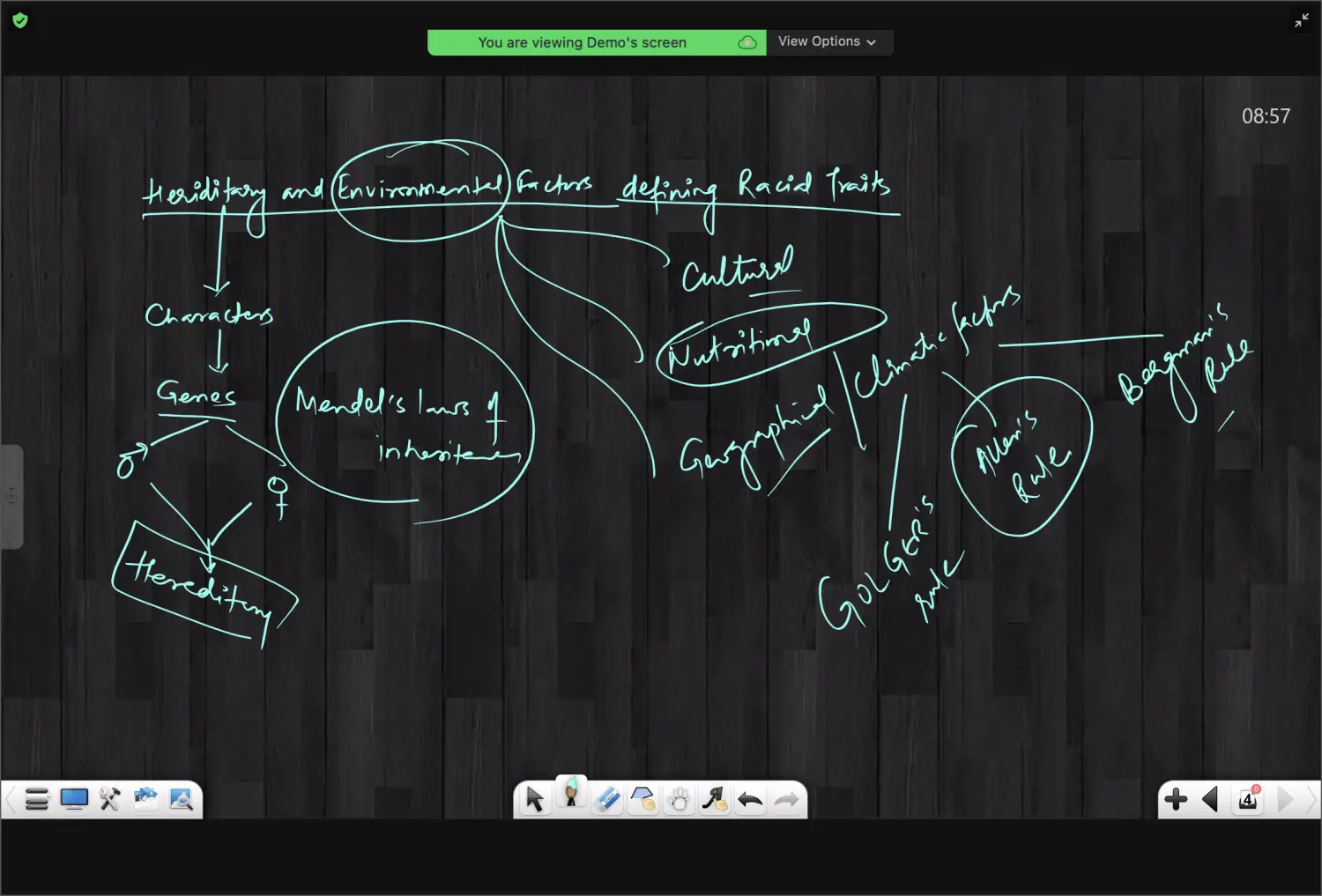
All Species Specific Characteristics are inherited, through hereditary or genetic mechanisms. The characters sustained by heredity determine the Race as,
All Characters in Living Beings are controlled by Genes coming from the Parents.
The Scientific basis behind hereditary inheritance was given by Austrian Geneticist Gregor Mendel, in the Mendel’s Laws of Inheritance
Environmental Factors
- Running Notes
- Cultural Factors
- Inbreeding - Preferential Marriages
- Nutritional Factors
- Malnourishment
- Geographical Factors (Climatic Factors)
Gloger’s Rule
Summary
Height Near Equator will be more and colour is dark
Pigmented Population near Equator
Allens Rule
Summary
Extremities will be higher in hotter areas, for minimum heat retention and maximum heat dispersion
Bergman’s Rule
- Cultural Factors
Another Crucial Factor along with hereditary factors influencing the characters and formation of races is environment.
Environmental Factors comprises of :
Cultural Factors
Certain Cultural Factors have a direct influence on the Gene Pool of population and hence eventually on the races.
Examples are
- Cultural Practises of Endogamy
- Inbreeding
- Preferential Mating
- Cultural Taboos
can lead to
- Accumulation
- Extinction
of Specific Characters, which can be more prominent in certain races or populations.
Nutritional Factors
Nutrition is a Prime Factor Determining Growth and Development of Human Body.
Sometimes Geographical factors are not in favour of availability of nutritious food items, like olives or food etc.
Also, Socio Cultural Elements like favour or disfavour in consumption of certain nutritious food.
Like Taboos related to consumption of milk, like Khasi Tribes in Meghalaya and some north eastern tribes
Geographical or Climatic Factors
Climatic Factors can be explained based on three different principles
Gloger’s Rule
At Equator, there is a trend of witnessing heavily pigmented population with long stature
Opposite to that, Fair population with short stature can be found towards the poles.
Allen Rule
Population Settled near the Equator, tend to have more protruding body parts and longer limbs than the individuals residing away from equator.
Bergman Rule
Individual with comparatively lesser body size tend to be rounded in shape, found at the equatorial region while bulkier individuals are generally found away form the equator
For Ex :
- Negroids Near Equator
- Mongoloids Near Pole
- Caucasoids in Between
Criticism of these Rules
However these 3 rules are subject to criticism, because of occurrence of regional variation in different populations
- Running Notes
Conclusion for Hereditary & Environment Factors
It can be concluded that, environment is capable of producing the genetic effects which can be selected by nature and thus would become hereditary
Hence, Heredity provides equipment & environment to decide its way of use.
So, both heredity and environment mutually reinforce, the existence of variations and characters in human populations. Significantly contributing in formation of races
Paper 1 - Unit 7.0 - Linguistic Anthropology
Culture, Language and Communication
What is Language as a concept ?
Language is a conventionally spoken or written symbol, utilising which human beings communicate with each other as members of society or social group or participants in a culture.
What is the Anthropological Context of Languages
It is a separate domain of Linguistic Anthropology. Languages are not only means of communication for exchange of idea or thoughts, but also forges cultural ties, economic relationships, friendships etc.
What is the difference between speech and Language ?
The difference between speech and language as highlighted by Saussure.
Speech is biological process of production of sounds from a voice box or larynx.
Certain Animals or Birds Like parrot or a one year old infant can have speech matching with adult humans, however there knowledge of language is not comprehensible (Acceptable in Social Context)
Is Language Necessarily a Verbal Mode of Communication ?
Language is not necessarily, a verbal communication. It can be non verbal through gestures and sign languages
What is the definition of Language according to Henry Sweet
In the words of Henry Sweet, Language is the Expression of Ideas by means of Speech Sounds combined into different words.
The Words will combine into sentence and sentences express the speakers thought process.
What is the scope of Linguistic Anthropology
Understanding Language as a socio cultural phenomenon is a concern of linguistic anthropology.
In fact Languages represent the culture
Languages are influences by the cultural elements and also influence the Socio Cultural Elements (Sapir-Whorf Hypothesis → Linguistic Determinism)
Languages are representatives of culture and one of the most significant identity of people.
Nature of Languages
Nature of Language is studied with Three Different Perspective
Structural Perspective
Considers Languages, as a system of structurally related elements, for transmitting towards a meaning.
Within Structural Elements there can be phonological units, grammatical units, grammatical operations and even the lexical elements of the language.
This Perspective is pure Linguistic Treatment or Analysis of a Language, that constitutes understanding of various structural aspects of a language.
It is the most basic requirement to understand a language.
Functional / Communicative Perspective
This view considers language, as a vehicle of expression with functional words, phrases and sentences to reach upto a functional meaning (Semantics)
So, this perspective has more emphasis on semantic and communicative dimensions of language.
It considers as a mean of communication.
Interactional Perspective
This Perspective observes the languages, as means of establishing and maintaining interpersonal relationships to perform social transactions between different individuals and groups.
In interactional view, the object of learning is to basically understand how people initiate and maintain conversation with each other.
Conclusion
So the Nature of the Languages is to
- understand a language from its most basic elements
- to frame the grammar and dictionary of language
- to Utilise the Language fro communication
- for interpersonal relations
Origin of Languages
Summary
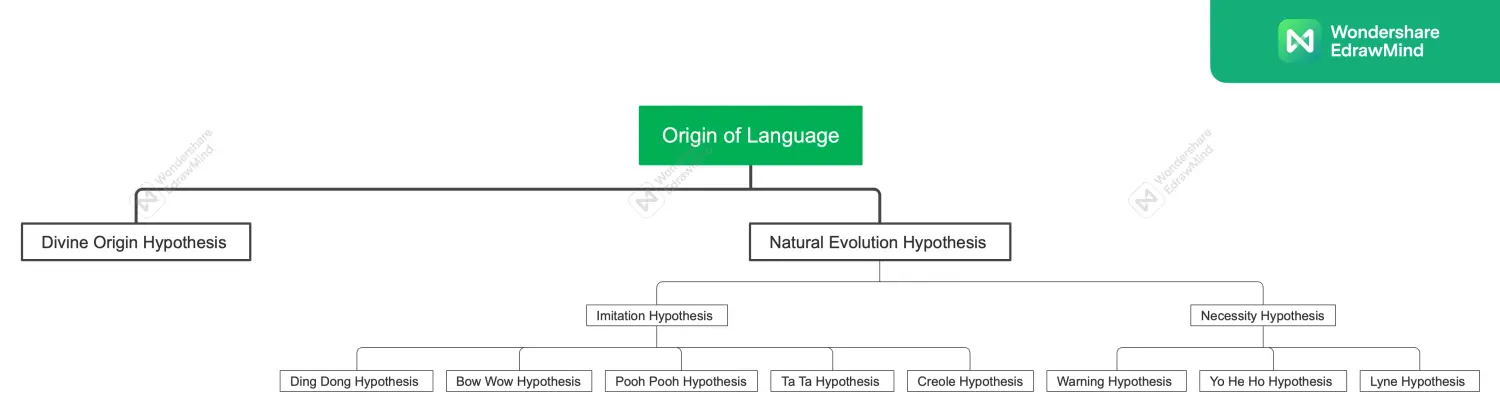
Divine Origin Hypothesis
Various Societies and Culture believe that Language is a gift of god to human. One Familiar one is found in Genesis 2.20 in sacred text of Bible, suggesting that Adam gave the names to all living creatures, i.e Languages are as ancient as existence of humans
It cannot be proved scientifically, but it is definitely true that languages and human societies are inseparable
Wherever Humans Exist, Languages Exist
Natural Evolution Hypothesis
Human Acquired a Sophisticated Brain which made Language Invention and Learning Possible during course of evolution
Either through copying the Natural Sounds, or by developing as per the Necessity.
Imitation Hypothesis
Ding Dong Hypothesis
Says that Language begin, when humans started naming the objects or actions or phenomenon, based on a recognisable sound associated with real life
This Hypothesis holds that the first human words were a type of verbal icon, to assign having a meaning matching with some natural or real object of sounds
Like use of
- boom for explosion
- crash for thunderstorms.
- chirping for continuous small grade sounds of birds
Conclusion
The Problem with this Hypothesis is that, through Imitation of Natural Sounds, a limited part of vocabulary can be generated
Also naming noiseless things and events cannot be justified, like sun, moon, emotions and love
Bow Wow Hypothesis
Introduction
The Vocabulary developed based on the imitations of animal noises like
roaring, barking, meowing, hiss, quack quack
Criticism
Criticism can be matching with ding dong hypothesis, as very limited part of vocabulary of any language can be developed.
Another Criticism use of different words in different languages for the same animal sound.
Like quack quack has different meaning in different languages
Pooh Pooh Hypothesis
Introduction
This Hypothesis holds that initial words came from involuntary explanation of hunger, dislike, pain & pleasure eventually leading to expression of more developed ideas and emotions.
In this case, the initial words would have been, involuntary sounds like
- hahaha
- nonono
- wow
- wah wah
- ouch
Criticism
this hypothesis is the most famous but most ridiculed
Ta Ta Hypothesis / Gestural Hypothesis
Introduction
Charles Darwin hypothesised that Speech and Language may have developed based on certain gestures like in Pantomime.
That is the Organs of Speech, started picking up the gestures of hands and body
It is quite possible that human languages which are more of verbal nature in present times, originated from some gestural languages as a part of communication which is still present in some primates.
These Gestures can be having different meanings in different locations and languages i.e they can vary from culture to culture.
For Example Nodding is
Yes - in most Languages
No - Turkish
Criticism
This kind of Language is baed on geographical and environmental interpretation of gestures, hence it lacks standardisation
Creole Hypothesis
Introduction
Creole is a fully functional language of its own, having a complete grammar and full expressive power, according to this hypothesis. Creole Languages and dictionary develop, due to mixing up of different linguistics elements.
Criticism
This was criticised for explaining the after effects after the origin of languages.
Origin of Languages and it’s dictionary was missed
Necessity Hypothesis
This hypothesis is dependent upon the notion that languages begin, as a response to some acute necessity i.e the initial words originated from situations from day to day life and activities of different people
Warning Hypothesis - Situational
Languages may have evolved from warning signals, like those used by animals. Perhaps languages started with some words as a warning to others.
Like
- Turnaround
- Stop
- Run
- Look Out etc
It was meant to the used to alert the group members, the earliest words and symbols could have been related to hunting instructions or to avoid an attack on wild animals wtc
Yo Le Ho Hypothesis - Human Cooperation Efforts
Languages developed on the basis of human cooperative efforts like some chantings to stimulate a collective efforts repeating war like phases to inflame the fighting skills
collective efforts like moving large stone in front of cave, required some energy ridden words for a better physical force
Lying Hypothesis - Given by Sturtevant
Sturtevant argued that all the real emotions and intentions get involuntarily expressed by the gesture or the looks or the sounds, voluntary communication and words must have been invented for the purpose of lying, deceiving or cheating
so words and voluntary communication was to justify the selfish needs and hence origin of languages occured
Verbal and Non Verbal Communication
Verbal Communication
Verbal communication is the study of languages which involves understanding, producing and receiving of sounds. It requires approval and appraisal at different levels like,
- language with sounds (Phonology)
- meaningful communication of words
- formation of functional sentences to make some sense out of sentences
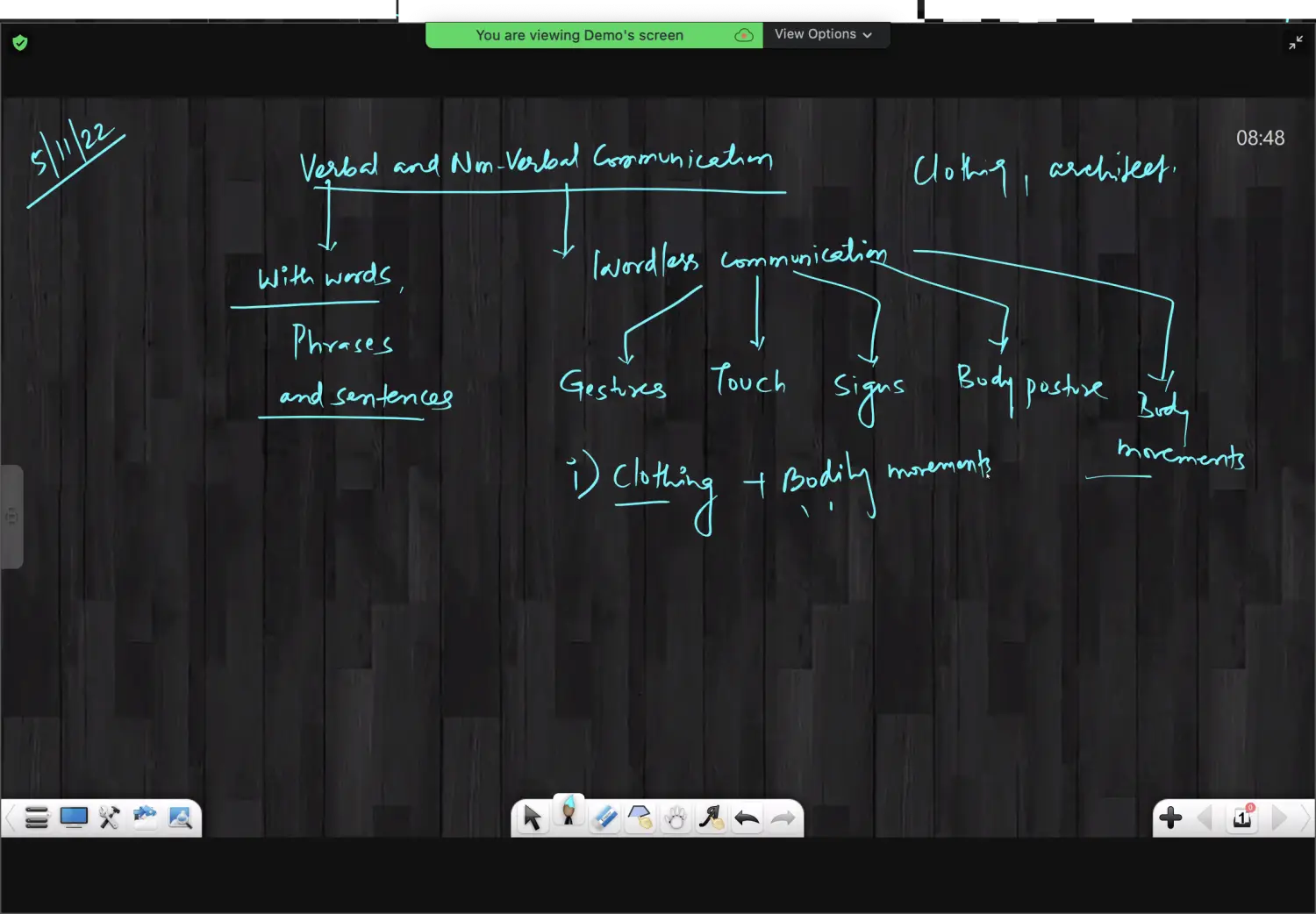
In Short, Verbal Communication is communication with use of words, phrases and sentences.
Non Verbal Communication
Summary
Introduction
Non Verbal Communication is generally a process of sending and receiving the messages without using words phrases and sentences.
It can be communicated through gesture or through touch by body language or posture, by facial expressions, by eye contact.
It can also be communicated through, object communication such as clothing, architecture, infographics, etc.
In daily life communication is generally involving, a blend of both verbal and non verbal communication.
Use of Sign Language, by Deaf & Dumb Individuals is one of the most sceintific explanation of non verbal communication
Three Categories of Non Verbal Communication
Clothing & Bodily Characters (involving minor movements)
Various Elements like body physique, height, body odour & clothing → Non Verbal Messages, during social interactions.
For Instance, it was found in many studies, that taller people are having more impressive personality and better perceiving capabilities of communications
Physical Environment
NVC taking place in physical environment can be based on colours, architecture, music, noise and various, gestural connotations in different time and space.
Same object or way of communication, can have different meanings and interpretations based on
1 Physical Space (Proxemics)
It is the study of how people use and perceive the physical space around them.
The Space between sender and receiver influences the message and interpretation.
The Perception and use of space, can vary in different cultures. Also, NVC related to an individual can have different interpretations and usage based on
Public Space & Personal Space etc
Proxemics was explained in Linguistics Anthropology by Edward Hall
2 Time (Chronemics)
Chronemics is the Study of use of time in NVC that is the timing and frequency of an action as well as the Tempo and Rhythm of communication within an interaction.
Chronemics is a way to perceive time and reactions based on that time for non verbal communication.
Bodily Movements & Body Positions
1 Kinesis
The Term was used and propagated by Ray Birdwhistell. In broader sense it is the interpretation of body language, like facial expressions, the gesture or any sort of bodily movement. Contributing to Non Verbal Communication
Various movements of body having some meaning can be a part of Kinesics and there should be a well defined grammar, to study the meanings of these movements to interpret the underlying motive.
Sub Domains of Kinesics
Other Forms of Bodily Movements like Posture, Gesture, Haptics & Eye Gaze can be broadly considered as sub domains of Kinesics only
2 Eye Gaze
Eye Gaze is the Study of
Eye Movement
Eye Contact
Expression through Eyes
as a part of NVC
3 Haptics
It is the use and study of touch in NVC, like communication through
handshake
holding hands
slapping
pat on shoulder etc
4 Posture
It is used to determine the participants degree of attention or involvement in the communication
Various Postural ways can be direction of body lean, armed position etc can be used in NVC
5 Gesture
Its a Non Vocal Body Movement, for expression of some meaning which can be articulated through hands or wrists or face or eyes
Conclusion of NVC
Along with verbal communication, Non Verbal Communication is a significant method, to express the ideas in public or private spheres and is one of the significant interests of linguistic anthropologist.
Also, this domain involves use of principles of psychology in understanding anthropological events.
Sapir-Whorf Hypothesis / Linguistic Relativity Hypothesis
Background
By Edward Sapir and Benjamin Wharf
They gave these hypothesis separately
Introduction
Culture and Language influence each other, there is a general agreement that cultural influence on language is more and opposite influence is not that much well marked.
Sapir-Whorf hypothesis studies the influence of languages on culture. Edward Sapir and Benjamin Whorf proposed this hypothesis independently but the basic theme is same.
It is based on the close relationship and continuous interaction between our thoughts and languages leading to an intrinsic relationship, between the fundamental features of culture and structure of languages
This hypothesis proposes that, the relationship is so close, that the pattern of language, influences the way we think about reality → also termed as Linguistic Relativism
Sapir and Whorf Suggested that Language is a force in its own, influencing the individuals and society at large through Two Different Versions of Sapir-Whorf Hypothesis (SWH)
Strong Version (Linguistic Determinism)
All human thoughts and actions are bound by the language i.e language determines the thoughts ideas and cultures.
It is the less accepted version of SWH.
Weak Version
It states that, language only somewhat shapes the thinking and behaviour
Linguistic Elements are only influencing the cultural elements and are not determining those.
Whorf’s Analysis of Hopi Indian Languages and English
While comparing english language with Hopi Language, Whorf found out, that english language categorises and conveys the discreetness (objectivity) with regard to time and space but Hopi Languages do not
English has a discreet and objective idea of past, present and future. Here, things are co related with definite time where as Hopi, Expresses things, with more of an Idea related to some ongoing event, without time being highlighted in specific or fixed segments.
Whorf believed that these language differences, lead the Hopi and English speakers to see the world differently.
Language Influences the Socio Cultural realities of population.
Critique of SWH
No Scientific Basis
Limited Research and Limited Quality Arguments to Justify
No Practical Example
Many Linguists and Socio Cultural Anthropologist criticised Linguistic Determinism as there is no Practical Example to Prove that
They argued that language can be the significant factor influencing culture but cannot be the only factor.
Lenneberg’s Criticism
Lenneberg criticised the hypothesis with an argument that Wharf & Sapir never showed a connection between Linguistic, Mental or Psychological Phenomenon → This can influence the ideas, beliefs and culture at large
Conclusion
Sapir-Whorf Hypothesis, may not be completely accurate in practise but also cannot be rejected at Large.
Language is an important factor, shaping the thoughts and cultural elements.
Over all the hypothesis helped in understanding language as a social phenomena impacting humans and society at large
Language use in Social Context
Introduction
- It involves the study of effect of any and all a knowledge pics of society, including the cultural norms, expectations and contacts on the way language is used.
- It also studies how language differs, between different groups separated by certain social variables like gender, ethnic, city, religion, status, age, profession etc
- Use of Language in Social Context, varies from place to place and from time to time.
- Some fundamental concepts of socio linguistics related to use of languages in social context can be based upon
1 Speech Community
Speech Community is a discrete group of people using language in a unique and mutually accepted way amongst themselves like distinct words used by high school students with abusive or slang language
2 Social Network
a social network can be another way of describing a particular speech community in terms of relations between different members in a community.
A Network can be loose or tight, depending upon how members interact with each other.
3 Age and Gender Differences
Age Difference can be another aspect to study the differences in use of language in social context
Young Populations dress up differently, also use different versions of language not generally found in old age populations.
4 Gender Difference
Gender Differences and use of language, studied by Zimmerman and West, found some fundamental minimal differences,
Women tend to make more fundamental responses as compared to men like hmm, ya, no
Men tend to be more verbally aggressive, frequently using, abusive, yelling and threatening words.
5 Class Difference
Bessel Benstein - a British Socio Linguist claimed that, members of middle class have different ways of organising their speech which is fundamentally different form the ways adopted by working class
For Example :
- social cohesion and bond is strong in working class → emphasis on “WE”
- as compared to middle class with → Emphasis on “I”
6 Pidgin & Creole - Can be 10 Marker Short Note
PIDGIN is the term associated with outcome of mixing up of words and languages. A Pidgin arises when speakers of two different languages encounter one another and have a need for limited communication.
The Pidgin incorporates words from both source languages and has a simple or unspecified grammatical structure, just enough to allow communication for some limited purpose.
For Ex : a rickshaw puller, communicating with a foreigner for drop point and charges.
In Contrasts, a CREOLE is a fully functional version of a language of its own, having an elaborative grammar which is different from the grammar of source languages.
A Creole Language Develops spontaneously amongst children living in multilingual community. For example, some languages developed in various areas where European colonial powers established commercial enterprises based in imported labours, generally slaves. These Labourers at one place often came from several different societies and in the beginning would speak with there masters using pidgin.
Gradually some of these pidgins will develop into a creole, particularly when next generation will learn the parents and masters language.
Hence, with passage of time, a new grammar will evolve.
Pidgin and Creole can be most significant methods for use of languages in multi cultural & multi ethnic societies
7 Prestige
Paper 1 - Unit 2.1 - The Nature of Culture
- Introduction to Culture
- Culture is not a sophisticated entity in totality.
- In Anthropology, Every Society Irrespective of Time and Space, has a uUnique culture. Anthropology looks at culture free from the bias of good or bad, civilised or uncivilised society
- Whether it can be
Simple & Complex
Rural & Urban
Tribal & Regular Society
- Any & Every type of society has its own culture → This Culture is the Identity of the Society
- Culture as a concept in anthropology is universal and unique
- Cultures as Identity of Population
- Lossar Festival - Tibetan New Year
- Tibetans
- Ladakhis
- Buddhist Population of Sikkim & Arunachal Region
- Sattariya Dance - Dance Form
- West Bengal
- Parts of Assam
- Extended to Parts of Bangladesh & Orissa
- Lossar Festival - Tibetan New Year
- Elements of Culture are
Symbols
Rituals
Festivals
Languages
Dances
Material Things
Cultures use material things as an element as part of society
Technological Advancements
Ideals
Behaviour
Mental or Psychological Framework
Culture according to E B Tylor
- In the Words of E B Tylor (in the book Primitive Culture) defined the term culture as a complex hole which includes the beliefs, art, rituals, customs, morals, law, knowledge etc and any sort of potential or capabilities or acquired habit or behaviour, adopted by humans as a part of society.
Culture according to Malinowski
Culture is an Instrumental Reality and Apparatus for the Satisfaction of Biological and derived needs.
Culture according to Bodley
- What People Think → idea, Belief, Mental Framework, Cognitive Ability
- What People Do → Belief Leads to Inculcation
- What People Produce → Production of things → Material Objects
- Technological Advancement
Primary Characteristics of Culture
DIG S LIC (DIG ne Staff se Kaha LIC Leni Hai)
1 Learned
- It is Acquired after Birth
- It is not Biological but Social
- You Can Learn a Culture as a Member of Society
- Ranging from Infancy until the time spent, learning improves
2 Inculcated
Inculcation is passing of culture from generation tot generation not by genes but by social history
It is unique to humans, but not entirely
Chimpanzee
Every chimpanzee learns very primitive speech
Tiger
Every Cub Learns Hunting
Humans, behaviour is affected not only by parents, but by individuals of society
3 Commonly Shared (Social)
- Culture is a Group Phenomenon
- Anything that is Broadly Accepted or rejected by Society is culture
Social Nature of Culture
- Culture is always Social in Nature
- It Involves social interactions
- Individual Habits are not culture
- Hence, Culture is Commonly Shared
- In the Words of E B Tylor (in the book Primitive Culture) defined the term culture as a complex hole which includes the beliefs, art, rituals, customs, morals, law, knowledge etc and any sort of potential or capabilities or acquired habit or behaviour, adopted by humans as a part of society.
- Acquired → Not Biological & By Birth
- Culture is not Biologically Determined but Socially Inculcated
- Culture is not Inherent but Learned
- Culture is a kind of Social Learning
4 Symbolic
- Symbols can be Material and Non Material in Nature
- Examples of Symbols are
- Totem
- Myths
- Fairs Festivals
- Rituals
- Symbol is a gesture in conformity of acceptance or denial in society
- Certain Symbols can be unique to a particular culture
- Kalaripattu
- Lossar Festival
- Talanoa Dialouge of Polynesia
- Everything an individual is doing throughout life based upon is shaped by and is organised through cultural symbolism
5 Dynamic
- It changes and adapts with time
- Generally Culture is a Stable Entity
- But at the Same time it is dynamic, only those elements of culture are retained which are useful in contemporary times
- Example
Change of Ideology with change in time takes place which shapes the culture of society
Joint Family Structure moving toward unwillingness to live in a JF and leaning towards Extended or Nuclear Family
After Second World War, Birth Rate Increased in many parts of the World, as people realised the value of human resource
Village as a Structure exist, but amenities of cities have entered
- CCTV in Villages
- WiFi Clusters of Villages
- Change in Pace of Dynamic Pace of Society
- Scandinavian Country Sweden gave RTI in 1700 where as in India gave in 2005
- Population of Canada is equal to Population of Delhi which affects the rate of dynamism in India
- Elements of Culture found useful to population will be retained for longer periods and non useful ones will be not
6 Integrative → Can be a 10 Marker Question
Factors of Integrative Nature
Mutual Co Relation and Adjustments between these Elements of Culture
- Social
- Political
- Economic
- Religious
- Family
- Kinship
Example : Kapauku’s of Papua New Guinea
- Studied by Leopold Pospisil
- The Integration of Economic, Social, Ideological, Familial and other facets of culture in Kapauku Papuans (a Hilly Tribe of Western Papua New Guinea) is a classical example of Integrated System of Culture
- The Kapauku Economy Relied Mainly on the Agriculture and Plant cultivation, along with that Fishing, Horticulture, Hunting and domestication of animals is also involved
- Domestication of Animals → breeding and rearing of pigs is the most important and central activity to Kapauko System
- Although, Agriculture fulfils maximum food demands
- It is through pig breeding that man
- achieves political power
- social status
- legal authority etc
- Amongst the Kapauko Papuans, Pig Breeding is an Complex and Integrative facet of their culture, raising more number of pigs, require extra horticulture activity for production of sweet potatoes
- Males are mainly involved in outdoor hunting, clashes and wars with other groups and in safeguarding the populations
- so women are left behind for horticulture activity and breeding of pigs
- To raise and handle more no of Pigs, more and more no of women are required. so multiple wives to an individual and hence practise of polygamy is seen
- For Each Wife Man must Pay a Bride Price which is generally very high and keeps on increasing.
- So the Kapauku, Cultural System is an Integrative culture with co related different aspects
7 Gratifying
- Culture Fulfils
- Biological Needs - Procreation
- Social Needs - Respect and Cognition
- Family Need
- For all these needs culture has a social code of conduct and procedures
- Culture Fulfils
Secondary Characteristics of Culture
1 Overtness and Covertness in Culture - Studied By Outsider
- Overtness → superficial things which can be observed easily by an outsider
- Covertness → in depth study needed for understanding the concept of that culture
2 Explicit and Implicit Elements of Culture - Studied By Insider - Kluckhohn
Explicit → Experienced by Member in Routine
Implicit → Even Members of Society aren't witnessing it in routine
Not so frequent experience
3 Ethos and Eidus of Culture - Studied By Kroeber
Ruth Benedict → Pattern of Culture can also be discussed
Ethos → those aspects of culture which define the beliefs psychologically (Brain/Mental)
Eidus → Overall reflection of Culture
Its a broader term
4 Organic and Super Organic Elements
Organic - Culture is Organic in Nature, due to thinking capacity of brains, culture is developed
Culture is organic that is it is embedded in the biological nature of human brain i.e thinking emotions ideals behaviours are regulated by brain
Super Organic - after development of that cultural element, it becomes grater than the individual
Once originated culture will acquire the super organic character i.e a quality that will make culture exists on a level which is above the individual who created it
Cultural Process
Running Notes
- Example :
Joint/Extended Families → Nuclear Families (Husband/Wife/Kids) → Same Sex Family (Gays/Lesbians) → Single Parent Family
A cultural process can be continuous in one or same direction
Significant Objective of Marriage : Procreation but people are choosing to have co habitation but not pro create
Case Study : in a town in Norway after 28 Years a Child was Born that too with a South Asian Couple
Case Study : Declining Sex Rate of Iceland,
Introduction
- A Cultural Process is a gradual, continuous and specific change or action by which the elements of culture are formed or are modified
- A Cultural Process may promote better adjustments of human population to new conditions or events.
- It defines the course of dynamic developments of culture
- Cultural Process may impact Specific Elements of Culture or Whole Culture
- Set of Changes, May trigger a Chain Reaction, like one node impacting another, second one impacting another and so on
- For Example changes in the Marriages and Family Structure Define a Cultural Process.
5 Prominent Aspects of Cultural Process
1 Cultural Evolution
Process of Socio Cultural Change from
- Homogenity to Heterogeneity
- Simple to Complex
- from Indefinite to Definite
When Society changes its form from Simple Small Scale Agrarian Society to Complex Urban Society
These Aspects of Cultural Process were Explained by Evolutionist and Neo Evolutionist
2 Cultural Diffusion
Where the Cultural Elements, Complexes, are getting diffused or passed from one society to another through movement of people, traders, missionaries, war etc
3 Enculturation
It is the Process by which a growing chil learns, understands and imbibes cultural elements of his or her society i.e from one generation to next generation
4 Acculturation
It was first introduced by Kroeber in Anthro wrt to the changes in specific elements of culture triggered by its contact with other cultures
Example : Indo Islamic Architecture with advent of Turks, Arabs and Mughals into India
It cant come in existence, until the contact between two cultures is relatively continuous
5 Trans-Culturation
In Simple Words - Its Mutual Impact
It comes into existence when two societies and cultures experience change in their cultural matrix due to influence of each other i.e exchange of cultural items, value system, rituals etc
Example
- Celebration of Western Festival in India (Halloween) and Indian Festivals in West (Diwali)
Ethnocentrism and Cultural Relativism
Introduction to Ethnocentrism
The term “Ethnocentrism” was coined by sociologist “Williamn Sumner” in his book “Folkways”
Since beginning of the discipline, anthropologists have been trying to find out different people, there culture and way of existence. In these findings, various anthropologists found their own society, culture & way of life as the best of all the possible ways of human existence.
These sentiments can be reflected, in findings of many anthropological studies, when they translate the virtues of their own societies as true human beings. In contrast, they use some demeaning & derogatory term for other societies and culture,
like barbaric, dogs, monkeys, weird looking etc
These considerations are typical characteristics of ethnocentrism i.e any adequately functioning culture regards its own ways of life, in positive terms and quite often as the only proper way to live. This view is Ethnocentrism.
Prominent Sociologist Williamn Sumner, Coined and defined this term as “a tendency to assume that ones own way of life and culture, is superior to all others,
i.e the feeling of WE,US,I are dominating over THEY → Simply the In group Sentiments and group solidarity is highly placed over other groups i.e the superiority complex over the others
Sumner continued that, ethnocentrism is universal and present in every society, whether in
past or in present,
small or large,
simple or complex
rural or urban
at a smaller or larger scale
Types of Ethnocentrism
Positive (+ve)
When Preference is given to ones own way of life. This is the most commonly found form of ethnocentrism, providing a group identity to people or the nationalistic sentiment of taking pride in ones culture and traditions
Negative (-ve)
Ethnocentrism becomes negative when a particular sentiment of ones own group, takes the centre stage for everything and all others are scaled or rated based on that
Extreme Negative (- - ve)
When a dominating, more powerful group, not only impose its culture and rules on other groups, but also depreciate the other culture and its elements
Franz Boas’s view on Ethnocentrism
for the first time in anthropology Franz Boas rejected the, three stage classification of human civilisation i.e Savagery to Barbaric to Civilised. this rejection was further supported by his students like (Ruth Benedict, Margaret Mead and Herskovitz)
Boas introduced the concept of cultural relativism, even the functionalism of Malinowski was known to be ethnocentric in nature
Ethnocentrism in Primitive and Modern Societies
Ethnocentrism in primitive and modern societies as explained by Sumner has different ways of expression.
Ethnocentrism will be less wider and assumes more peaceful forms of expression in advance complex societies i.e they are more open in accepting elements of other cultures because of a long history of traders, missionaries, colonisers and impacts of globalisation.
Sumner says that in general,
- ethnocentrism in modern nations, with complex societies is more on the sentiments of Patriotism
- where as in primitive small scale simple societies, the ethnocentric sentiments are more towards, defending the very nature of the group
Elements of Cultural Shock, will be lesser in advanced complex societies and will be significant in simple small scale societies.
Cultural Relativism
Franz Boas and many of his students rejected the ethnocentric, classification of cultural elements, through the stages of savagery, barbaric & civilised.
He rejected the notion of superiority of western culture and all the Boasians insisted that a society, its customs or ideas, should be described objectively, in its own context and history.
Cultural Relativism promotes the idea that, every society and culture is unique in itself and hence should be studied, in terms of its own value system independent of others.
The belief system of different societies can be compared to find out the similarities and differences, but not in terms of superiority/inferiority or advanced/backward systems
Any character or trait in a culture, is neither good or bad in itself and even for others and hence should be studies as a unique aspect of some culture.
Ruth Benedict in the Book Patterns of Culture Accepted and Expanded the Concept of Cultural Relativism and considered it as a pre requisite of any anthropological research.
Even Famous Sociologist Max Webber through Construction of Ideal Types, rejected the prejudice or pre conceived notions in the minds of researchers, based on ethnocentric sentiments
So concept of Cultural Relativism is based on Tolerance, accepting the human plurality regarding rights of all humans.
Boasians maintained that even if some cultural practise of a group, is harmful to their health, survival or environment, it should be explained to them, in their own cultural pre text and not in comparison to others
Conclusion : In the words of Michael Brown, Cultural Relativism is less a comprehensive theory and more of a thumb ruler, keeping the anthropologist alert while studying the perspectives of other cultures
Culture and Civilisation
Civilisation and Culture vis-a-vis Civilisation
In the Words of Green, culture becomes civilisation when it contains a written format of language, metallurgy, technology, complex economic and political systems etc
Gillin and Gillin considered civilisation as a more complex and evolved form of a culture, in broader sense civilisation is advanced form of a culture
Culture is primarily the non material aspects, whereas civilisation is mainly material in nature.
💡 Civilisation represents a particular type of culture, cultural elements can be regarded as the genotype of an individuals whereas civilisation is the outward manifestation or phenotype based on that genotypeCivilisation & Indigenous Groups
Ab Origins are mainly with non permanent settlements and primitive form of Agriculture and Foragery (hunting-gathering)
Whereas, people live in Permanent Settlements and commercial and mechanised agriculture under a civilisation
Ab Origins rural forest based existence
Civilisations have cities extended
Well defined grammar and written scripts with maximum Civilisation
generally absent with Ab Origins
Large Complex Political and Economic Structure in Civilisation
Simple Scale Political and Economic Structure in Ab Origins
Similarities → Mac Iver & Page
Gave Co-Relation between Culture & Civilisation that is Similarities and differences. Both Culture and Civilisations are interdependent and continuously connected to each other
Civilisation represents material Culture and Culture implies non-material Civilisation
The Ship Analogy
Giving the analogy of a ship, MacIver and Page explained the interdependence of culture & civilisation. Civilisation is a Ship which can sail to various ports with its mechanical structure and its technology but culture is the direction to that ship related to the destination port.
In Short Culture, Commands Civilisation & Civilisation Represents a Culture
Differences → Culture & Civilisation
| Civilisation | Culture | | --- | --- | | Material Aspects | Non-Material | | External/Outward | Internal/Inward | | Material things, Technology, cities | Spirituality & Development of Language, Ideals and beliefs | | Civilisation Involves the efforts of the masses | Cultural Advancement is a function of Creative Minority, Artist, Philosophers, Poets etc | | civilisation is not a rule | Cultural Changes are universal in nature due to various factors | | Civilisation can be borrowed without any change or loss of originality | Culture is not usually transmitted in its original character |
Conclusion
So Culture and Civilisation are two essential elements of a broader single unit i.e society and human populations
Cultural Advancements in a particular society or populations carry it towards the civilisation
- Introduction to Culture
Paper 1 - Unit 2.2 - The Nature of Society
Society - Definition and Explanations
Society → is derived from the Latin Word Socius (Latin), meaning Companionship/Friendship
Companionship means → The Ability of Sociability
George Simmel → The elements of sociability is the true essence of society, indicating that man always lives in the company of other people
Aristotle → Defined Man as a Social Animal
Karl Marx → Explained the Existence of Society in Economic Terms that man was always aware with the fact that, man in association can always produce more than man in isolation.
MacIver & Page → They considered society as a system of usages and procedures, authority & mutual aid between different people.
There is a certain social divisions based on different criteria which regulate human behaviour and liberties
Morris Ginsberg → Society as an institution is a collection of individuals united by certain relations
Components of Social Setup
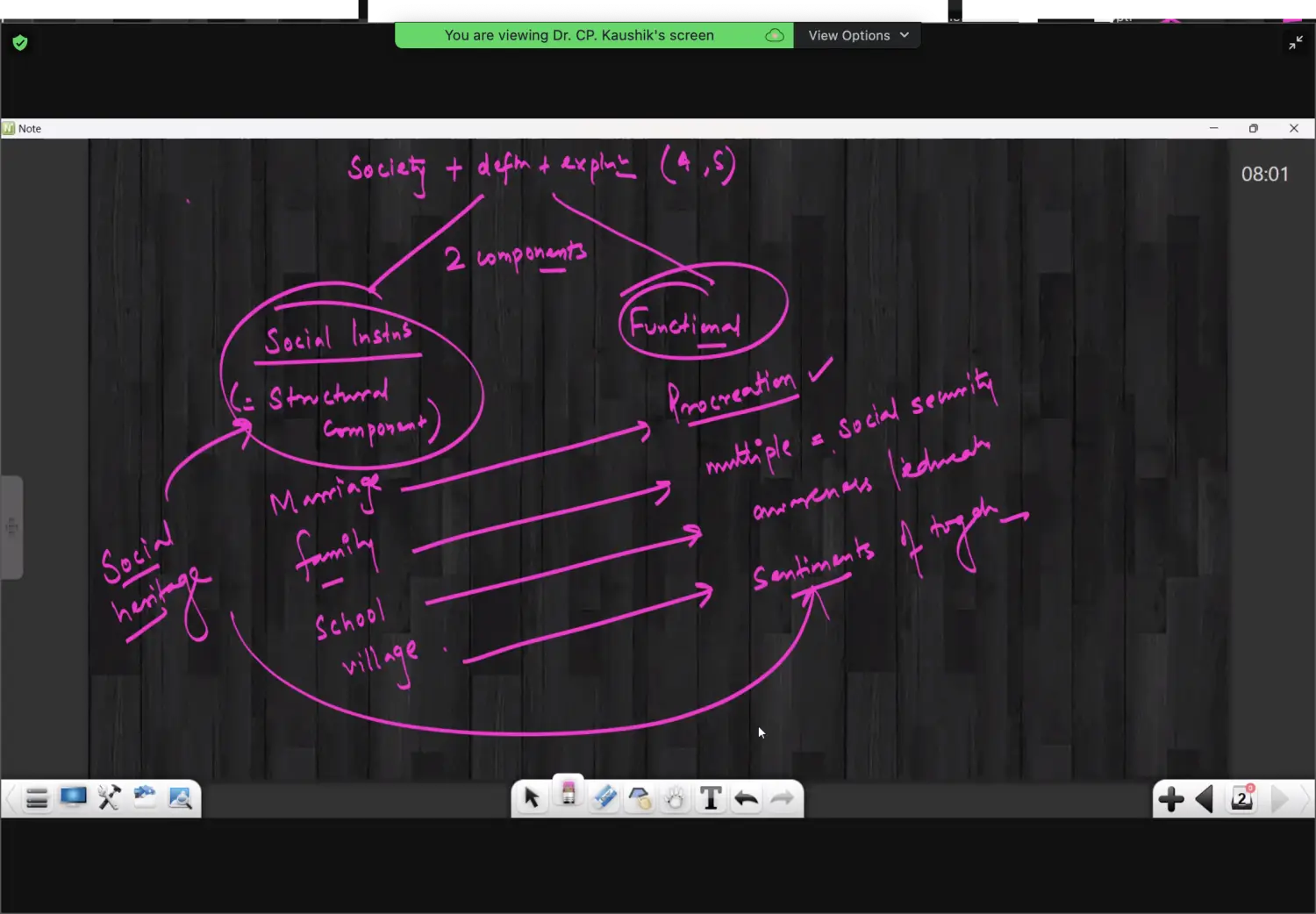
In all these interpretation and explanations of society , majorly two components can be understood
Structural Components
Majorly the Social Institutions like Marriage, Family, School, Village etc
Functional Components
Are the outcomes of the interactions of social institutions or members of society
Like Pre Creation out of marriages, sense of security and various other functions from family
Awareness and Education from Schools
Cohesiveness & Togetherness from Villages
Theories - Origin of Society
Introduction
Various theories have been proposed to explain the origin of society
Divine Origin Theory considered society as a creation of God
Force Theory Highlighted the Involvement of certain superior or supernatural forces
Evolutionary Theories were later given by Classical Evolutionists ; considering the origin of society as a gradual evolution from Savagery to Barbaric to Civilised
These arguments were outrightly rejected by sociologists and anthropologists
Patriarchal & Matriarchal Theory
These arguments consider, origin of society either through
Male Lines of Descent - Patriarchal Origin of Society
Henry Maine was one the strongest supporter of this theory with an argument that : male took responsibility to protect the females and kids from natural or wildlife threats.
These responsibilities, gave authorities to the male, particularly the eldest male member, to decide the aspects of existence of family and society, which gradually led to emergence of society as a institution
Female Lines of Descent - Matriarchal Origin of Society
Matriarchal Theory suggests that, due to dominance of → Polyandrous and Transient Marriages in primitive times (more than Polygyny, Monogamous or Settled Marriages)
The Maternal Lines of descent emerged, because motherhood was the fact of that time which was permanent and paternity was only an option.
Hence, the Importance of female lineage outweighed the Male lineage
Social Contract Theory
Introduction
It was proposed and supported by philosophers like Hobbes, Locke, Rousseau.
Basic theme of the Theory is that Humans Deliberately Created Society, so that the Natural Disasters, can be handled through collective efforts, attacks of wildlife can be avoided and food production can be enhanced.
Individuals Precedence over Society
This theory argues that, individuals preceded society, which was later criticised by many sociologist and anthropologist.
which argued that males and females through procreation, can begin the most initial stages of society
Hobbs’s View
According to Hobbs man in the state of nature was in perpetual conflict with his neighbours, on account of the essentially selfish nature.
He said man was solitary, poor, nasty, cheat, brutal etc & hence every man was enemy of every other man, so to protect his existence, to protect his existence and evil consequences man organised himself in the society.
Locke’s View
Locke Believed that State of Nature was of Peace, Good Will and Mutual Assistance, with Self Sufficiency of Food.
The only limitation was the absence of Recognised System of Law and Justice, so human entered into a contract by which a group was given some authority to administer Law and Justice. Thus in this need of humans, community and society emerged.
Rousseau’s View
Rousseau in his argument held that, naturally humans were
- Equal
- Satisfied
- Self Sufficient
- With Sentiments of Containment
- Living Happily & with Simplicity
but increase in population, started the struggle for food and resources and necessitated the establishment of civil society to avoid conflicts. This led to emergence of a full fledged society.
Conclusion
Social Contract Theory seems to assume that man as an individual, is prior to society. This assumption can be erroneous, because sociality is inborn in humans. As soon as an individual, sees the light of the birth, sociality and society becomes a reality.
In simple words, human beings are humans inside a society. Social Contract as an argument can be limited to only some of the societies.
Society Culture and Individuals
Introduction
In the words of Nadel, Culture is a way of life of people, whereas society itself is made up of people in an organised way when members interact with each other through various social relations
Since the time of Franz Boas, culture became an important tool for understanding and describing the outside societies. Anthropological studies wrt cultural relativism, allows a comparative study of culture w/o considering evolutionary hierarchies.
In Simple Words, every culture has its own existence and value system making it unique and different from others.
Society can be seen as a collection of individual members, fulfilling their interests under the formal rules of society.
It is to ensure the survival of group and society. Members of the society learn to postpone certain immediate personal needs and satisfactions, till the time they are being fulfilled through proper channel, within the norms of society, in an authorised way.
For Example, matter of sexual behaviour & expression is shaped by society and culture. Sexual Gratification is an Individual Need but fulfilment through legitimate ways leading to procreation is a societal need.
Bu this individual need can be disruptive, when it is
- Illegitimate
- Forced
- Rape
In the words of Sociologist R K Merton, there will always be some element of deviance, in every society, which can disrupt a balanced social order.
In Simple Words, culture is produced in a given society, within framework setup by Socio Economic, Political Structure, as society is made up of individuals having their own special needs and interests
Conclusion
During the course of life society and culture, must strike a Balance, between needs, desires, interests of individuals and of society as a whole.
When societal needs are always preferred over an individual, people may experiences excessive stress which may in turn lead to disruption of social order, gradually leading to cultural breakdown.
Social Institutions
Definition of Social Institution - Starting Dictation Pending
Majumdar, Social Institution is an collective mode of response or behaviour, which is in existence from generations, prescribing a well defined way of doing things binding the members together, through various symbols and rituals.
Mac Iver & Page defined an Institution as an established form, processes and procedures which typically forms a group identity.
Emile Durkheim, Sociology is the study of social institutions & social institutions are related to the members of the society
Social Institutions are the building blocks of society like the protein present in human body, providing a framework.
Characteristic of Social Institution
Social Institutions are Social in Nature, and not Individualistic
Social Institutions are Universal
Social Institutions are Independent as well as Interdependent
Social Institutions are Dynamic in Nature,
They are relatively permanent undergoing gradual changes
Sometimes fast sometimes slow, but there is always a change
Social Institutions have fixed norms to be followed by the members.
Social Institutions fulfils needs of individuals through prescribed norms
Institutions are synthesised in symbols, which can be material or non material in nature
Types of Institutions
Primary Institutions
These are the most basic units in any society, which are present, in one or another form, in all the societies whether
- Primitive or Advanced
- Rural or Urban
- Simple or Complex
Institutions like marriage and family, religion, state, economy, education and awareness etc form the primary institutions
Secondary Institutions
These are outcomes of new social order, which are gradually formed with changes taking place in primary institutions.
For Example, Changes in
- Marriage → Divorce
- Family Structure → Nuclear or Extended Families
Like banking sector stock market came out from economy
Temple, Church, Mosque etc came out from Religion
Comparison
| Theme | Primary | Secondary | | --- | --- | --- | | Defintion | in all types of societies these institutions are always present in one or other form | These are outcomes of new social order, which are gradually formed with changes taking place in primary institutions | | Examples | 1. Family 2. Education & Awareness 3. Religion 4. State | 1. Divorce in Marriage. 2. Nuclear Family in Family 3. Superstition in Religion |
Erwin Gauffman’s concept of Total Institution
- This concept was explained by Erwin Gauffman in his Essay : Essays on the Social Situation of Mental Patients & other Inmates
- A Total Institution is defined as a place of work or stay, may be residence or any other location where a large number of similarly situated people are present generally cut off from the wider society & community for a considerable period of time
- For Examples
- Jail Inmates / Prisoners
- Army or Defence Establishments
- Old Age Homes
- Patients undergoing treatment for certain disorder for longer time like in Sever TB or Leprosy
- These people form an enclosed, social group and these institutions act as centres for development of new social relations or a sort of obligation of re socialisation for those members of the society.
- Types of Social Institutions
- Institutions Established to take care of incapable & harmless poor people, including orphanages, old age homes & nursing homes.
- Institutions established for diseased people suffering from leprosy, mental illness, severe Tb.
- Institutions to protect community from criminals, terrorists or anti social elements like
- Jail & Juvenial Detention Centres
- these kind also include Rehabilitation camps for drug addicts
- or even the resettlement camps (refugee camps) for people of war crimes
- Institutions established for some specific task, like boarding schools, naval ships.
- Institutions designed as retreats from the world, serving for religious preachings like monasteries, convents, ashrams, madrassas etc.
Status and Role by Ralph Linton in “Study of Man”
Concept of Status and Role occupies central space in analysis of social structure. This concept is central to day to day life of humans, way before sociologists and anthropologists studied this.
Status is defined position in a social structure, distinguished & related to other positions, each status, is linked to a social role, based on a set pattern of behaviour expected from the person enjoying the status. (by Hobbs and Black)
The term status is not necessarily related to honour, prestige or hierarchy, it is just a positional aspect for a role.
Linton Maintained that Status is bundle of rights and duties and a person has to perform his duties, as an obligation towards the Status → This Obligation to fulfil the duty is role
A person can have multiple status at any point of life. A person can be a father, brother, politician, doctor and husband at a single point of time → This is Status Set for an Individual.
There are two different types of Status for an Individual
Ascribed Status → Given to an Individual by birth by society based on sex, race, caste, ethnicity, religion, etc
Like Varna System after it became Rigid
Achieved Status → Individuals acquired this status in a lifetime as a outcome of knowledge, skill, occupation, perseverance, etc
Like Choosing a Profession or Becoming a Parent
Conclusion : Both Ascribed and Achieved Status exists in maximum societies.
However, change in status is allowed in varying degrees in different societies. Also, various roles associated with the status are symbols of social recognition and hence an easy change is not generally allowed, particularly for the ascribed status.
Both Achieved and Ascribed Status regulate the social behaviour of Individuals in a social setup.
Social Stratification
Introduction
Social Stratification refers to division of societies in different stratum of groups placed one above the other, in hierarchy. It is different from inequality and focuses pre dominantly on social inequality.
Social Stratification can be based on various parameters, like
- Ethnicity
- Religion
- Caste
- Gender
- Power
- Authority
Example 1 - By Karl Marx
Marx divided the Capitalist society in two antagonistic groups, which emerged after industrial revolution.
Bourgeoisie
Here, Bourgeoisie were owners of resources, hence were called as means of production
Proletariats
Here, Proletariats were the labour or the working class
Example 2 - Indian Caste System
Another classical example of social stratification is traditional hindu caste system, based on ancient varna system, where different social groups are divided into 4 major section, based on activities associated with that group. The division is
- Brahmins
- Kshatriyas
- Vaishya
- Shudras
Explanation of the Indian Caste System by Louis Dumont
Louis Dumont explained this concept with Purity and Pollution i.e
as we move up from Shudras to Brahmins the level of Purity Increases
as we move down from Brahmins to Shudras the level of Pollution Increases
In all the societies, from the ancient to modern time, some sort of stratification was always there with varying degrees.
Various theories to explain Social Stratification
👨🏫 In Exam, Use Theory 2 & 3 → Use As 1 (More Socio) Use Theory 1 & 4 → Separately (More Anthro)
Proposition
- Functionalist Theory of Social Stratification Spencer / Davis & Moore
Summary

Background
- Propounded by : Herbert Spencer and August Comte
- Better Explained by : Davis & Moore
Introduction
According to Functionalist, social stratification is unavoidable and functional to society. society as a functional unit works in a balance based on division of labour created by social stratification.
Functionalists like Herbert Spencer and August Comte, were of the view that a particular profession is rewarded and respected more because of more money, time and effort invested
Division of Labour created by this Stratification is Functional to the Society, increasing the efficiency of production and the competitive spirit. All these contribute towards the betterment of society.
Davis and Moore, were the strongest supporters and promoters of functionalist view of stratification.
They argued that greater is the functional importance of a social role, greater must be the reward (Economic Reward or Social Status)
Example 1 -
For Example, A Fire Fighters Job is more important than the clerk of a grocery store. Hence the clerk should be rewarded and incentivised more as compared to the clerk.
If this incentivisation and better social recognition will not be there, why would someone be willing to rush into the burning buildings.
Example 2 -
Giving Example of Doctor and Nurse ; Davis & Moore argued that the Monetary Incentives, Prestige and Recognition in the society should always be better for a doctor than the nurse as the effort, time & money invested while studying medicine is way more than in Nursing.
Criticism
Melvin Tumin was the foremost critique of functionalists in his thesis “Some Principles of Social Stratification : A Critical Analysis”.
He questioned that If incentivising more and giving better social status is associated with the importance of the Job.
Then why a Basketball Player is earning more money and fame as compared to a Scientist
Tumin Argued that Economic Resources with some limited people is aggravating social stratification
and due to that underprivileged youth have less chances of achieving a better social status
Conclusion
The Functionalist aspect of stratification were an earlier attempt to explain the existing divisions of society.
It was not accepted by Sociologist and Anthropologists in the same form but contributed significantly towards socio cultural anthropology
Conflict
- Theory of Social Stratification Karl Marx Conflict View Perspective View
Theory of Social Stratification by Marx
Marxian Theory of social stratification is a radical reaction, against the functionalist theory of Social Stratification.
According to Functionalist, Stratification is Functional in the Society and is inevitable, because it increases the efficiency of production in the society, based on division of labour.
According to Marx, Stratification is a divisive force dividing the society in antagonistic groups, which will be in conflict with one another at some point of time. This is the reason marxian view is called the Conflict View of Stratification
According to Marx, Class is a Social Group where, members share the similar relationship with means of productions. It is like the capitalists or bourgeois share the same relation i.e ownership of means of production on the other hand the working class and labourers (proletariat), belong to same social group.
In words of Marx, these social groups are created, based on disparity in income. Marx Maintained that after primitive communism, every society witnessed some or the other type of social stratification. Like,
- Masters & Slaves in Ancient Society
- Feudal Lords & Landless Labourers in Agricultural Society
- Bourgeoises and Proletariat in modern capitalist society
Modern Capitalist Society → Social Stratification is marked based on the exploitation of labourers & exploitation will be continued, till the time of consciousness being achieved by
Labour Class (Pauperisation) → Leading to a Bloody Revolution that will overthrow the Capitalists and after that all the resources will be collectively owned forming an egalitarian society without any class based social stratification
- Idea of Social Stratification Max Weber Conflict View Addition of Two More Divisions
Introduction
Like Marx, Weber also considered stratification in economic terms, he agreed with Marx that class is a social groups whose members share similar relationship with the means of production.
This leads to disparity of income and hence social stratification.
Weber maintained that other than power, status and power also served as basis of stratification.
Criticism of Marx - Oversimplification
Criticising Marx, weber said that stratification of capitalists society just into 2 classes of Bourgeois and Proletariat was an oversimplification.
He proposed 4 different Stratum in Capitalist Societies
- Propertied Upper Class
- Propertyless Educated Middle Class
- Petty Bourgeois
- Labour Class
Status - Basis of Stratification
According to Weber, Status is another basis of Social Stratification which is based on unequal distribution of prestige in the Society i.e a persons status will determine the Hierarchy.
He gave the example of traditional hindu society where caste based social stratification is not determined by economic ownership. Here even if a brahmin or kshatriya is poor as compared to shudra, he would enjoy a higher social status in hierarchy.
Weber considered this form of Stratification as the most matured form of division based on status.
Power - Basis of Stratification
Other than class and status ; power is also a basis of social stratification, giving a person higher position in social hierarchy.
Weber cited the example of Military Elites in America that they enjoyed a higher position in society, irrespective of their class, status or economic resources
- Feminist Perspective Patricia Hill Collins / Ann Oakley Conflict View Gender Perspective of Stratification - From Class Notes
Names
- Herbert Spencer
- Talcott Parson
- Patricia Hil Collin
- Ann Oakley
- Raja Ram Mohan Roy
- Jyotiba Phule
- Savitribhai Phule
- Veena Majumdar
- Leela Dubey
- Gita Sen
- Brinda Karat
Paper 2 - Unit 3.1 - Structure & Nature of Traditional Indian Social System
Varna System
Initially Varna System was not Caste System
Varna in Vedas
- Do not consider Varna By Birth
- Do not consider Varna Based on Families
- It is not a method of stratification here
- Not on hierarchy
- Not a System in
Varna as Personality Types
4 Personality Types are
Actually it is referred as 4 different personality types in humans
- Brahmins - Preaching & Learning
- Kshatriyas - Rule Govern Fight
- Vaishyas - Land Management, Trade & Commerce
- Shudra - Food Production & Labour
Quotes of Bhagavad Geeta
Chaturvarnam Mahashrishtiya Gunakarma Vibhagasha (four Varnas are divine creation on the basis of inherit qualities) – Bhagwat Geeta
Chaturvarnam - Four Varnas
Mayashrishtiya -
Gunakarma - Based on Gun
Vibhagasha - Division
Characteristics of Personality Types
- Natural Traits
- Psycho-Biological Equipment of Individual
Various Theories on Varna System
- Triguna Theory of Varna System
- Introduction
- Tri Guna - Three Characters / Three Traits
- Varna System is based on certain inherent & inbuilt traits && qualities of humans
- They are found in varied proportion. Each Individual proportion over all character moves towards Varna.
- The Three Traits are
- Satvik
- State of Sattva
- Good Behaviour Good Ideology Good Wisdom Helpful to Others
- PT w/o bad habits
- Rajsik
- State of High Living of Luxury
- Presence of Pride Glory Valour Warriorship Leadership Skills Govern
- Tamsik
- It is being in the state of Tamas
- Use hands more and mind less
- Meaning working as labour
- Satvik
- Introduction
- Composite Theory of Varna System
Introduction and Back Ground
- Irt is given by P V Kane - Pandu Vaman Kane
- He is Bharat Ratna & A Sanskrit Schola
Composite Theory
- Factors in Emergence of Varna System
Mixing of Cultures & Civilisation
Ex : Meeting of Aryans and Non Aryans
Continuous Contact Between Different Cultures
Ex : Aryans Influencing Non Aryans
Functional Specialisation
Ex : Demand of Division of Labour
Theoretical Proposition
Non Aryans → Shudras
When Aryans met Non Aryans, the biggest difference between them was that of Skin Colour.
Non Aryans were termed as Dasas / Dasyus
Due to difference in colours, aryans started considering themselves
This Ideology Emerged with Closure of Samhita Period
These Dark Complexion Individual later became Shudras
The Shudras were further divided into different lower caste people like Chandalas and Paulkasas
Aryans → B K V
The spirit of exclusiveness and pride of superiority entered into the groups of Aryans too and birth of three other Varnas took place – B, K, V
- Factors in Emergence of Varna System
- Triguna Theory of Varna System
Characteristics of Varna System System
- Stratification
4 Layers of Traditional Hindu Society B K V S
B K - Upper Strata
V S - Lower Strata
- Universal Appearance & Existence (India)
Evidence of Varna in All Over India from Extrema North to South and West to East
Very Minimal Occurrence and Evidences in Tribal Belts
- Mobility
- Initially Allowed, Later Restricted and Limited
- From S to V
- From V to K
- But not from V to B
- Each Step up would take a Birth
No of Births & Upanayan Sanskara
Ekaja - For Shudras - Only One Birth - Biological
The Once Born Castes
Dwija - For B K V - Two Births
The Twice Born Castes
- One Birth - Biological
- Second - Spiritual by Upanayan Sanskara (Sacred Thread Ceremony for Boys)
Examples
- Ekaja - Aryans
- Dwija - Non Aryans
Anuloma and Pratiloma Marriages
Hyper Gamy
Higher Varna Boy Marrying a Lower Varna Girl
Hypo Gamy
Lower Varna BoyB Marrying a Higher Varna Girl
Ashram System
Meaning
A Dwelling Place - Would Go Here When they would denounce world
This Place is for Saints, Aesthetics and Monks
This is a Stage in the Life Cycle of Any Individual
According to Traditional Hindu Society
- There are 4 Different Ashrams for an Individual
- Brahmcharya
- Grihastha
- Vanaprastha
- Sanyas
- It is based upon what conduct an Individual should have, governed by
- Geography - Desa / Desh
- Time - Kala / Kaal
- Immediate Surrounding - Shram
- Psycho Biological or Inherent Traits - Guna
- Every Stage of Human Life Cycle i.e the Ashram has
- certain specific conduct associated with it
- Some Duties and Functions associated with it
- certain restrictions on the conduct etc
- There are 4 Different Ashrams for an Individual
The 4 Ashrams are - This has been only explained in the Context of Boys
- Brahmacharya Ashram
- Connected with Upanayan Sanskara
- After this he will be following Brahmacharaya Ashram
- This is a Learning Phase
- It was only associated with 3 Varnas
- The Age of Accepting Thread
- Brahmin - 8 Years
- Kshatriyas - 10 Years
- Varna - 12 Years
- Shudra - NOT for Shudras
- Characterised by
- Complete Celibacy
- Discipline of Ashram
- Grihast Ashram
- After Learning Phase
- Characterised by
- Marriage within the Same Varna
- Later got Transformed into the Same Caste
- When Men Enters into Grihast Stage
- Rearing of Kids
- Taking Care of old Parents
- Repaying of Debts (RINA)
- Hence, Responsible for fulfilment of basic needs of family
- Vanaprastha
- Worldly Affairs Renounced Move Towards - Spiritual Journey
- In a Forest or Secluded Area - Ascetic Area
- Wear Simple Cloth - Just to Hide Nakedness should be the only purpose of wearing this cloth
- Person should be away from sexual pleasures
- Sanyas
- All the Three Stages were to help to reach the Fourth and Final Stage
- The Stage of Moksh
- Brahmacharya Ashram
Concept of Purusharth
The Concept of Ashram is very much close to concept of Ashrams
Experts are of the opinion that both Purusharth and Ashram are destined towards achievement of Salvation or Moksha
These are Efforts and Deliberate Actions by an Individual to achieve a Target or Goal
All the Stages are ways to reach Moksha
There are 4 different purusharth that are recognised
Dharm
A Direction / Code to Achieve a Goal
Definition K N Kapadia →
Artha
Economic Resources + Material Aspects + Non Material Aspects like (Sexual Pleasures)
Artha is Achieved through Dharm
Definition K N Kapadia →
Kama
Kama is Outcome of Artha. All Kind of Senses and their fulfilment
Basically to fulfil the desires and basic impulses of humans like Good Food and Sexual Gratification
Definition K N Kapadia →
The Dharm, Arth, Kam are called the Trivarga
Moksha
Basically its the End of Life
Definition K N Kapadia →
According to P N Prabhu Purusharth is “from Handout”
Concept of Rina
- Religious Texts or the Dharmashastras say that Every Hindu has a Rin towards
- God - that god gave me a chance to become a human
- Parents
- Teachers / Gurus
- Saints
- Fellow Humans
- Hence every Hindu has to oblige towards various. kinds of Debts
- From time to time in lifecycle these Rina must be re paid by means of some deeds and rituals
- There are 4 Kinds of Rinas
Dev Rin - Rin of God
This is mainly performed through Yagy and Yajnas by means of rituals and sacrifice’s
Pitr Rin - Rin towards Parents
The Dharmashastras give 3 ways to repay Pitr Rin
By Having Children after Marriage so that you can maintain the race and family
When you are a parent, you should treat your kid nicely
You should give love to kid and be empathetic towards them and you should teach them the dharma
When Your Parents are old and sick, you should take care of them
You should take care of your grandparents as well
Rishi Rin - Towards Teachers and Saints
Respecting your teachers and saints
Manush Rina - Towards Fellow Humans
Debt in the forms of
- Respecting Them
- Helping Them
- Feed & Greet the Guest
- To Maintain Social Order
- Religious Texts or the Dharmashastras say that Every Hindu has a Rin towards
Concept of Karma and Re-Birth
All from Handout
Paper 2 - Unit 3.2 - Caste System in India
Definition and Origin of Caste System
- Caste is derived from the Portuguese Word Casta Meaning Lineage or Race
- S V Ketkar defined Caste as a Social Group having two fold characteristics of
- Ascribing Membership by birth, thus no entry to outsiders
- Endogamy - Marriage within the caste
- Bougle (Indologist) described
Caste to a Idea of Social hierarchy and in this social hierarchy
In this hierarchy one particular group is generally repulsive to other group
There is a Hereditary Specialisation Associated with a Particular Caste
Like: Gold Smith, Carpenters & Worshipping etc
G S Ghurye - Govind Sadashiv Ghurye - Definition and Characteristics
- Caste System is a Collective Representation of multiple aspects. It cannot be explained by means 1 or 2 Features
- Ghurye Gave 6 Different Characteristics of Caste System
Segmental Division of Society in a Hierarchy
B K V S
Endogamy
Intra Caste or Within Caste Marriages
Restriction on Feeding
Commensality / Common Dine In are avoided / not appreciated particularly when distance between Varnas is more than one
Restriction of Social Intercopurse
Not allowing lower caste people to drink or take water from common well
Shadow of Lower Caste People was not acceptable on upper caste people
Restriction on Choice of Occupation
Caste Specific Occupations were promoted
Civil and Religiou Disabilities
No Attendance in Social Gathering
No Entry into Temple
No Use of Religious Hymns or Chantings
Theories Explaining Origin of Caste
- Divine Origin Theory
- Body of Brahma
- Mouth - Brahmins
- Hands - Kshatriya
- Thighs / Belly / Trunk - Vaishya
- Feet - Shudra
- This Theory Supports
- Doctrine of Karma - Based on Previous Incarnation or Birth
- Doctrine of Dharma - Based on Present Birth and Actions & Adherence to Dharma
- It was Rejected by Many
- M N S - Considered it to be a Oversimplification
Brahmanical Theory by Abbe Dubois
Brahmins are responsible for caste system as they imposed social restrictions on non brahmins, especially on shudras
To
- Maintain Supremacy
- Preserve Purity
They Gave Higher Status to themselves
Supported by
G S Ghurye supported the Argument of Abe Dubis believing that Brahmins played a vital role in origin of caste system
Negated By
Hutton (Indologist) Rejected this Theory on the ground that such a deep rooted social institution cannot be imposed without political powers or administrative measures which were the authority of kshatriyas
Hence it is not easy to accept this that Brahmins convinced Non Brahmins of their Inferiority
- Racial Theory by Herbert Risley
- Introduction
- in the Book : “The People of India”
- It Emerged due to Two Reasons
Caste System originated from the Racial Difference between Aryans and Non Aryans
Aryans from Iran Region were of Fairer Complexion and Non Aryans were of Darker Skin Tone
This Skin Color Difference was the prime factor leading to Feeling of Racial Superiority
Caste Endogamy in Occupation and Marriage
When they Started Mating
- Male Aryans - Female Non Aryans → Allowed and Encouraged
- Male Non Aryan - Female Aryans → Not Allowed
Type of Society of Both
- Aryans - Patrilineal
- Non Aryans - Matrilineal
We can say that, aryans married the daughters of non aryans but didn't give them their daughter
- Some Aryans called the Non Aryans as Chandals who were considered to be the Lowest Class of people
- Risley’s → Processes or Events in formation of Caste
Changes in Traditional Occupation
Changes in Customs
Change with Old Traditions
Migration
Migrated Ind weren’t considered pure
Religious Enthusiasts
If someone is involved in religious activity he should be in that activity only
Enrolling in the ranks of Hinduism
G S Ghurye’s Theory
was supporter of Brahminical Origins and Racial Differences & Aspects
These Racial Difference Started with Advent of Aryans and Hence emerged in the Indo Gangetic Plains
Aryans considered themselves supreme and all the non Aryans were considered as shudras
as interbreeding between these populations tarted new groups emerged
These Factors Led to Development of Castes in India
As new and new differences emerged, new and new castes and sub castes emerged
There was a Social & Religious Disability on Shudras
His Theory is one of the most accepted theory for origin of caste system
- Nesfield’s Occupation Theory
- No Racial Affinity & No Racial Factor
- Caste System is Functional Classification for Occupation
- When done for Longer Periods formed the Occupational Guilds
- It maintained the Rituals, Sacrifices, Hymns, Yajnas - were considered very significant by the then society - that's why brahmins were given high regard
- Two Artisan
- One Working on Metal - He Gained Higher Status in Society
- One Working on Basket - He Gained Lower Status in Society
- Broken Man Theory by B R Ambedkar
- Shudras were Originally King, but later they became Slaves
- Shudras Belonged to Aryan Community of Solar or Suns Race
- When kings they were recognised as Kshatriyas. This was the Story during Indo Aryans Society started emerging
- There were only at that time 3 Castes - B K V
- Ambedkar Said that These Shudra Kings were in Continuos Tussle with Brahmins
- In this Tussles, Brahmins faced many tyranny of war and undignified dignities. Due to these, the later brahmins refused to give sacred thread to Shudras
- Meaning there was No Upanayan Sanskar
- Hence from here Social Degradation of Shudras Started and Hence a Fourth Varna was added
Later Sociologist & Anthropologists gave → 8 Fold Characteristics of Caste System
Views of G S Ghurye & M N Shrinivas in a Must
- Ascriptiveness - By Birth
- Endogamy
- Hierarchy
- Commensality - Restriction on Feeding
- Purity and Pollution
- Occupation based Socio Economic Interdependence
- Civil and Religious Disabilities
- Restrictions on Social Intercourse
Concept of Jati and Sub Caste
Given by MNS in 1950
He said that the Real Unit of Caste System is Not the 4 Varnas but the Sub Caste or the Jati.
It is a small endogamous groups , having a
- Traditional Occupation
- Cultural + Ritual Autonomy
- Localised Area of Limited Geography
At About there are 2500 Jatis in India
Maximum of them are Small but some are large in number and extensions
For Example:
- Reddys in South India
- Ahir or Yadavs in North India
They are Larger in Population and have huge extension of Geographical Presence
MNS Said that in a Region or a Group. There are dominant sub castes / jatis
- Jats in Haryana
- Jatas & Rajput in Rajasthan
- Yadavs in UP
- Reddys and Kammas in Andhra Pradesh
- Gowdas in Karnataka
Paper 2 - Unit 5.3 - Indigenous and Exogenous processes of Socio-Cultural Change in Indian Society
- Jajmani System
Introduction
- It is the Interdependence of Various Castes
- Generally the Upper / Dominant Castes take various kinds of services from lower caste people for generations
- It's kind of a Give and Take Arrangement
- Terminology
- Service Taker / Upper Class - Jajman
- Service Provider / Lower Caste - Kamins
- In Return, Jajman Provides some goods to the Kamins, Generally it is seen that it is not a Monetary Transaction
- but this is not a rule, S C Dubey while studying this system in Telangana, found out that, even cash was involved in this system
- William Wiser was the First Anthropologists, in his book “The Hindu Jajmani System”, about the Jajmani System in India.
- He called Jajmani System as one of the most prominent antiquities in traditional indian social system
- It promotes to maintaining a balance in the society
- Jajmani System maintain a Kind of Re Distributive Mechanism in the Society
- Before LPG Reforms there were many instances of Jajmani System
Two Reasons for Jajmani System
Due to Increased Population → Redistribution of Land → Decreased land holding size
This is making maximum population either landless or Very Small Land Holding
Hence they have no option but to render services and get something in return
Land Revenue & Taxes after Alauddin Khilji - No Land but Taxes are High. Hence Land Holding was not Sustainable
Hence these reasons made the Jajmani System, Functional in the Society
Case Study by D N Majumdar
- In a Village of Lucknow District
- Thakur & Rajputs are the Dominant Caste of the Region
- During Nainsanskarana (Mundan) Ceremony ; Hair Cut Ceremony
- It is Classical Example of Jajmani System
- The
- Brahmin - Recite
- Gold Smith - Ornaments
- Iron Smith - Ornament and Toys
- Carpenter - Provides Furniture for Ceremony
- Scavenging - Cleaning Activity
Benefits of Jajmani making it Functional
- Security of Employment & Type of Employment
- Social Cohesion
- One Family Getting Services from Multiple Families
- One Family Giving Services to many families
- Village as a Independent Unit becomes functional
- H Gould - Sort of Arrangement Giving Sense of Security & Employment
Is Jajmani System Exploitative
Oscar Lewis is a Marxist, He said that Jajmani System is one of the Biggest form of Exploitation in Indian Society
Dependency of Kamins on Jajman’s is way more than that of Jajman’s on Kamins
D N Majumdar Et Al Also said that Kamins are being Exploitative
Thomas Beidelman held the same way
Contrary Views
Gould criticised their view, saying that this maintains decorum in nature
He argued that Kamins are not forced to work and also they can work for multiple families
Due to LPG & Govt Measures, the forceful and no option nature of Kamins to work for Jajmans eventually receded away
- Concept of Dominant Caste
- Concept was given by M N Srinivas based in his essay “Social System in Mysore Village”
- There was already a concept available called : African Clans and Lineages
- Hence this African Study guided MNS to coin the concept of Dominant Caste
- MNS said that it is nor a rule but more of a study of exceptions
- Characteristics of Dominant Caste DC
They Have Land ownership
Population - No is High
They are more Politically Represented
Not always upper castes, but fairly high position in caste hierarchy
Generally SC & ST are NOT dominant caste
Hence, Economically Prosperous
- Because of these Characteristics of Dominant Castes, people look up to them
- Criticism
- Fairly Large Population - In Many Areas SC ST has high population but they aren’t dominant caste
- Even within a DC, every one doesn't dominate but a hand few
- It is not necessary that power is derived from people of dominant caste, but rather a saint or politician becoming economically, socially & politically powerful may in turn lead his caste towards the path of dominancy
- D N Majumdar Said that, Rituals of DC people, like tilak and vibhuti used by lower caste also doesn’t give them the status of dominance
- Examples
- Reddys and Kammas in Andhra
- Rajput, Jats in North
- Yadavs & Ahirs in UP
- Patidars in Gujarat
- Caste Continuity & Change
According to Brahmanical View Point, Traditional Viewpoint Caste is a Closed System
The Status is Ascribed
Caste Mobility is not allowed
Class Identity can overshadow Caste Identity by means of
- Educational Strength
- Economic Prosperities
- Political Powers
Example: According to Historian K M Panikkar, Nandas were the only true Kshatriyas, after that people usurped the status of Kshatriyas
He cited the Examples of Mauryans, who were Shudras, who later became Kshatriyas
Example: Many Researcher consider Shiva Ji to be a Shudra who later became a Kshatriya
Hence Social Mobility is seen by means of for example Hiranyagarbha Rituals - (Check and Verify Once)
Types of Caste Mobility
Horizontal
Vertical
Lower Caste Become Upper Caste
Upper Caste Become Lower Caste
Noniyas of Eastern UP and Bihar
They served as helpers of Brahmins, after 1 or 2 generation they became above than brahmins
Reasons for Caste Mobility
- Breakdown of Jajmani System
- Prominence of Class Based Organisation more than Caste Based Identity
- Industrialisation, Westernisation, Modernisation
- DICCI - Dalit Indian Chamber of COmmerce and Industry
- Stand Up India - Promotion of SC ST & Women Community
Criticism on Caste Mobility
- Social Structure is changed but Social Status is not changed
- In Urban Society at least, source of prestige is based on economic strength
Weber Views on Caste
- According to Max Weber Commensality has vanished
- But Connubium of Caste Based Marriages is still a primary question
Factors Leading to Change in Caste System
- Constitutional Provisions
- Legal Provisions
- Reservation & Protective Discrimination
- Impact of Modernisation, Globalisation, Westernisation, Urbanisation
- Traditional Occupation Hierarchy is broken down
Future of Caste System
- Due to Politicisation of Reservation
Conclusion
Kingsley Davis Fore Sees possibilities of transformation from caste based indian society to class based indian society
Caste as a Social Structure is one of the Significant Identity of Indian Society
Sanskritisation, Modernisation & Westernisation
Introduction
They are Agents of Socio Cultural Change, Changes could be that of
Changes occur in :
- Class Structure
- Caste Structure
- Rituals
- Political Organisation
- Economic Relationships
- Marriage, Family & Kinship etc
- Position of women
- Education & Awareness
Sanskritisation
Introduction
by M N Srinivas in his book “Social Change in Modern India”
Defintion
when any low caste group or tribal group started copying the socio cultural elements of upper castes or dominant caste or twice born caste
Socio cultural elements constitute
- Lifestyle
- Ritual
- Ceremonies
- Dressing
- Food Habits
The copying that occurs here, the dominant caste is regional and local
Terminology
- The Dominant Caste → Reference Group / Model
- The Copying Caste → Mimic Group
Other thinkers said that it is not a new phenomenon, it has been happening since long
This Copying of Culture is also called : Elite Emulation by sociologist O M Lynch
These Elites could be Social Elite, Political Elite & Economically Dominant Elite Groups which are Emulated
Sanskritisation was called as Elite Emulation by
Characteristics / Impacts of Sanskritisation
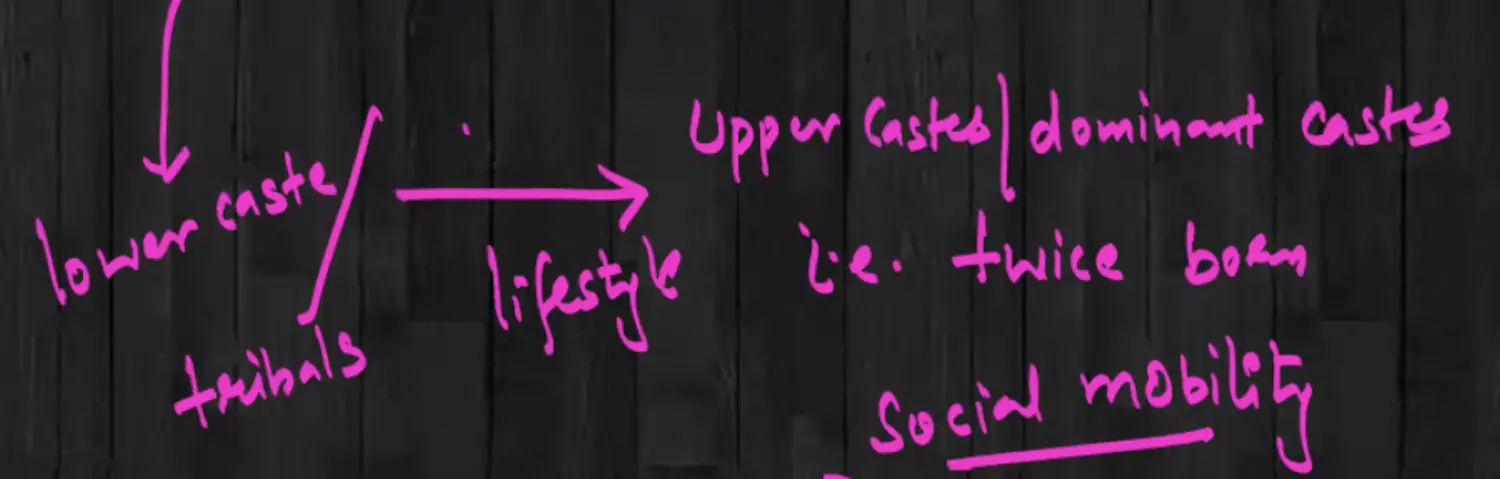
- Mode of Social Mobility. Hence Improves
- Social Status
- Political Representation & Status
- but NOT Economic Status
- It is a Positional Change. This positional change can and cannot lead to Structural Change
- Hence, Leads to Socio Cultural Change
- Mode of Social Mobility. Hence Improves
Case Study : Sanskritisation of Tribals
If a tribal group undergoes Sanskritisation i.e for instance starts employing caste statuses in its society
- Changes that will occur is
The Society will see a division in society in its cultural autonomy hitherto Egalitarian Society
From Polygamy to Monogamy
Earlier no restriction on fooding & drinking habits, now there would be some restrictions
Rigid Commensality will change
Earlier Women Folklore’s say in society, will be lost or eroded in movement towards Patriarchy
This newfound patriarchal elements in society will lead to Sexual Morality for Women thus leading to curbing of Sexual Independence
The Tribal Practise of Bride Price may change into Dowry
- Changes that will occur is
Impact of Globalisation on Sanskritisation
- With Globalisation, Communication, Transportation & Technological advancements have drastically improved and so it the rate of Sanskritisation
- Also Now, Sanskritic Rituals are not just restricted to local or regional levels rather Groups settled at distant places are also being emulated
Models / Case Studies of Sanskritisation
Brahminic Model
When Brahmins, Priest or Ritually Dominant caste or community is copied
- Koris of UP & Bihar
- Koris of Eastern UP and Bihar copied Brahmans of that area
- Koris were serving the Brahmans for Multiple Centuries and due to this association
- they copied the customs, rituals & lifestyles of Brahmins & then gradually got status of Brahmans
- Later, they considered there Brahmanism more pure than the earlier ones
- Lingayats of Karnataka
- Earlier Lingayats of Karnataka were from different castes
- when they embraced Shaivism, they were later accepted as Brahmins
- Smiths of South India
- They call themselves as Vishwa Brahmins
- Koris of UP & Bihar
Kashtriya Model
- Khatris in Punjab (Join Punjab)
- they were earlier shudras
- at that time they patronised brahmins of that area
- Patronised Meaning : accepted the rituals and paid for services to brahmans
- Later Brahmins Conceded the Brahmans are Kshatriyas
- Noniyas of Eastern UP
- They became Kshatriyas Later
- Shivaji Maharaja & Marathas
- Many Historians and Sociologists consider Shiva Ji Maharaja as Shudras in Past
- He adopted power, went through religious rites and got the status of Kshatriyas
- Khatris in Punjab (Join Punjab)
Vaish Model
- Kunbis’ & Patidar’s of Gujarat
- Kunbis were Low Caste Population
- Patidars were more rewarded (business class)
- Kunbis adopted the Surnames and Sub Castes of Patidars
- Later Patidars & Kunbis became one group and started following the Vaishya Lifestyle of Commercial exploitation of Resources
- Labourers from Marwar of Rajasthan
- Moved toward Eastern India, mainly towards Bengal & these marwari population gradually indulged themselves in trade activities
- Started Following a Vaish Lifestyle
- Kunbis’ & Patidar’s of Gujarat
Criticism of Sanskritisation
- Prof Yogendra Singh
- This process totally ignores Non Sanskritic Rituals, Traditions & Life Styles are Ignored
- With the copying of Sanskritic Rituals there will be retention of earlier Non Sanskritic Rituals
- Mackem Marriot (Indologist)
- He says that it is not necessary that Sanskritic Rituals will completely replace the earlier rituals
- Rather Sanskritic Rituals Complement the Non Sanskritic Rituals
- D N Majumdar
- Mohana Village - No Urge / Inclination to Sanskritisation or Copying
- Even After Copying no social acceptance as upper caste
- Prof Yogendra Singh
Conclusion
As an agent of Socio Cultural Change, Process of Sanskritisation is a significant one. MNS was of the view point that Sanskritisation is not necessarily a short term imitation or acceptance. It can be taking multiple decades or even generation before sanskritic acceptance
Westernisation
Introduction
Concept was extended to Sociology and Anthropology by MNS
Westernisation is those Socio Cultural Changes, which are taking place in India since last 250 Years
Roughly 200 Years of British Rule & 50 Years After Independence
Changes Occur in & Influence is seen on
- Social Institution - Marriage, Family and Kinship
- Technology
- Ideology
- Education
- Lifestyle
- Values and Beliefs
Examples of Westernisation
- Ban of Sati
- Eating on Dining
- Wearing of Jeans
- Kurta to Shirt
The Analogy
- Like Sanskritisation is mixing up of Indian Tradition with Indian Tradition
- Similarly Westernisation is mixing up of Indian Tradition with Western Tradition
Varied Facets and Features of Westernisation
Regional Variation of Westernisation
Bengal / Goa - was impacted the most (Initial European Cantonment )
HP / Rajasthan - Not so much westernisation
Caste Based Variation of Westernisation at a Specific Location
In a specific location, Brahmins adopted some element of western culture and rejected some elements
Adopted → Dressing, Car, TV, Tele
Not Adopted → No Consumption of Beef & Liquor, No Hunting
Interdependence of Westernisation & Sanskritisation
- Westernisation can increase the pace of Sanskritisation
- they both can occur simultaneously
Non Material Changes due to Westernisation
- Ideals of Liberty, Freedom, Equality, democracy etc
Conclusion
Sanskritisation and Westernisation are significant agents of Social Change. Changes in the Cultural Elements but not necessarily the Structural Elements
Prof Yogendra Singh, considered these concepts being narrow and not fully explaining the socio cultural changes
Modernisation
- It is movement of Orthodox & Traditional Society towards modern advance and more open society
- Significant changes occur in Social Cultural Economic & Political Regimes
- Examples
- Monarchy → Democracy
- Patriarchy / Matriarchy → No Gender Discrimination
- Rational Thinking & Scientific Approach
- Modernised Ideals, Beliefs and Thinking
- Prof Yog Singh in his book “Modernisation of Indian Tradition” says that
Rational Attitude towards issues and unbiased evaluation & interpretation of things is Modernisation
Mixing up of Great & Little Tradition is Modernisation
Concept of Great and Little Tradition by → Robert Red Field
Modernisation v/s Westernisation
Westernisation is a Prominent Force behind Modernisation
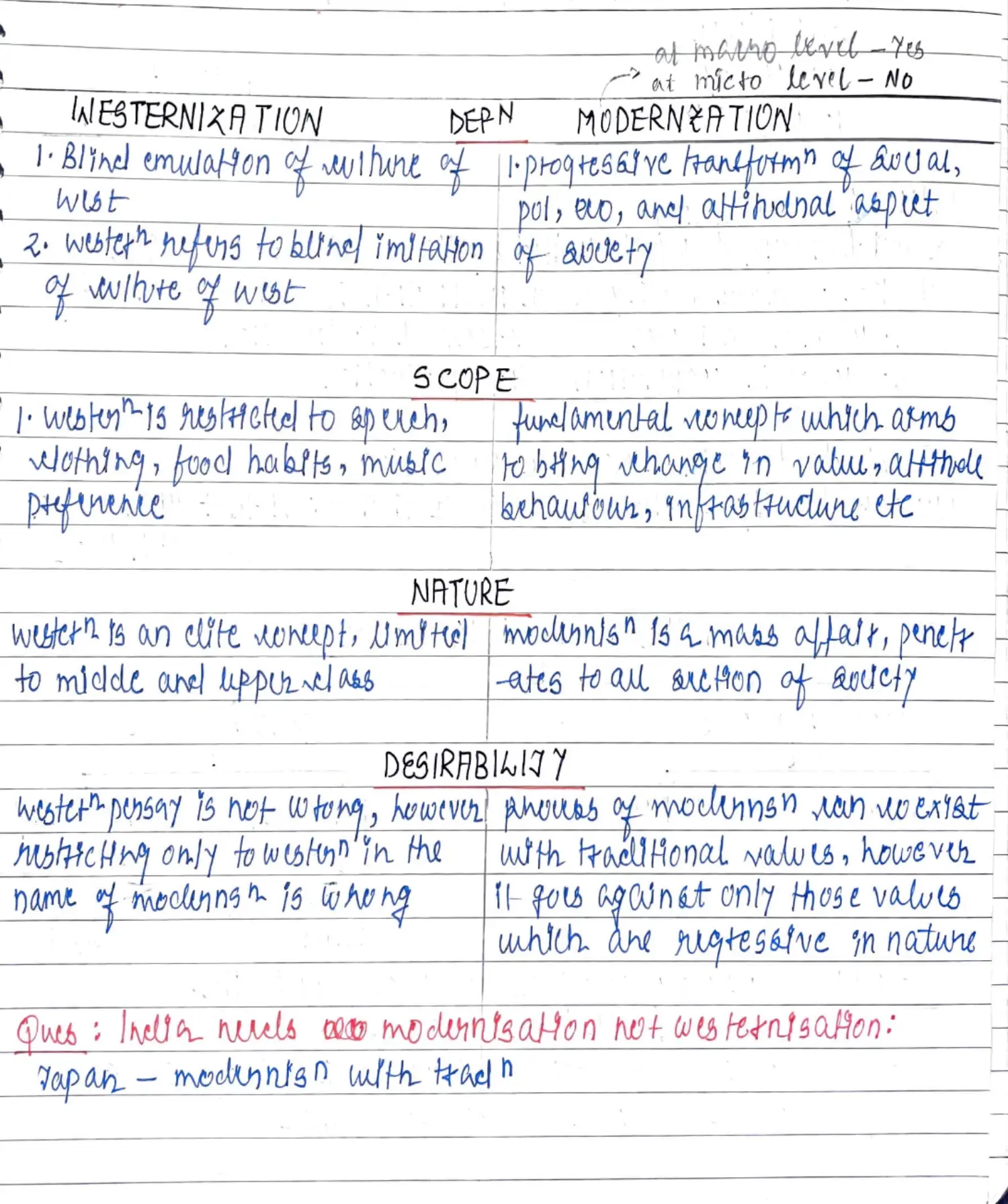
Great & Little Traditions
- Introduction
- Term was first used by Robert Redfield
- He was studying a Mexican Society of Yucatan Strait
- He used the knowledge of Mexican Society in Indian Society
- He was opinion that Mexican & Indian Society are very similar
- His books name was “Litte Community”
- The Concept
- Civilisation is something followed by Maximum Population
- Civilisation is formed by two types of traditions
- Great Traditions → Reflective Few + More Dominant
- Reflective Few
- Followed by Less No of People
- Generally by Intelligentsia & Elite
- Originates from Urban Cluster
- More Dominance
- They have NP Media etc
- They are Influential
- They have Lit, Music
- Inference
- High Dominance Less Following
- Reflective Few
- Little Traditions → Unreflective Many + Less Dominant
- Unreflective Many
- Followed by Less no of People
- They care commune Class
- Originates from Fields and Villages
- Less Dominance
- Folk Theatre
- Fair and Festivals
- Have no Influence
- Inference
- Less Dominance High Following
- Unreflective Many
- Extensions of Application
By Prof Yogendra Singh
Extension of this Concept to Indian Socity by Prof Yogendra Singh
By Oscar Levis
These Little Traditions are not limited to interactions between villagers as a universe but it is also their beliefs and interactions with Nature
- Great Traditions → Reflective Few + More Dominant
- Introduction
Universalisation & Parochialisation
Studies by McKim Marriott on a Study in Indian in a Mathura Village of Kishangarh
Universalisation
When Great Traditions are Influenced by Little Traditions
this is upward movement of little tradition
Parochialisation
When Little Traditions are Influenced by Great Traditions
This is a Downward Movement of Little Traditions
The Peasantry class takes something from the Intelligentsia
Case Study of Mathura
Calm Little Traditions of Lighting of Diya, became a grand festival of Diwali after Universalisation
Grand Festival of Navratri filtered into the Rural Folk Lore as Nauratha
When Villagers made Ideal of Nauratha against Goddess Durga
This Great Tradition filtering into Little Tradition is Parochialisation
Contribution of PYS - Prof Yogendra Singh
- Great & Little Tradition
- Given by Robert Redfield
- Examples Extended by PYS
- Universalisation & Parochialisation
- Given by McKim Marriott
- Examples Extended by PYS
- Great & Little Tradition
Tribe Caste Continuum
Emerged from the need to study the relations between Tribes and Caste, that whether they are correlated or different
H S Risley
was one of the first person who said that Tribes have many systems of a caste society
Max Weber
stated that when a Tribe gains a territorial significance, they adopt a caste based system of society
G S Ghurre
said that tribes are geographically isolated and socially backward hindu.
M K Bose
said that there are multiple similarity between tribes and caste
In both Tribes and Caste - Clan based marriages is seen
Incest Taboo is followed
F G Bailey
in his book “Tribe Caste and Nation” gave the concept of Tribe Caste Continuum
Existence of Tribes and Caste, like in a separation of poles, is a theoretical non pragmatic concept
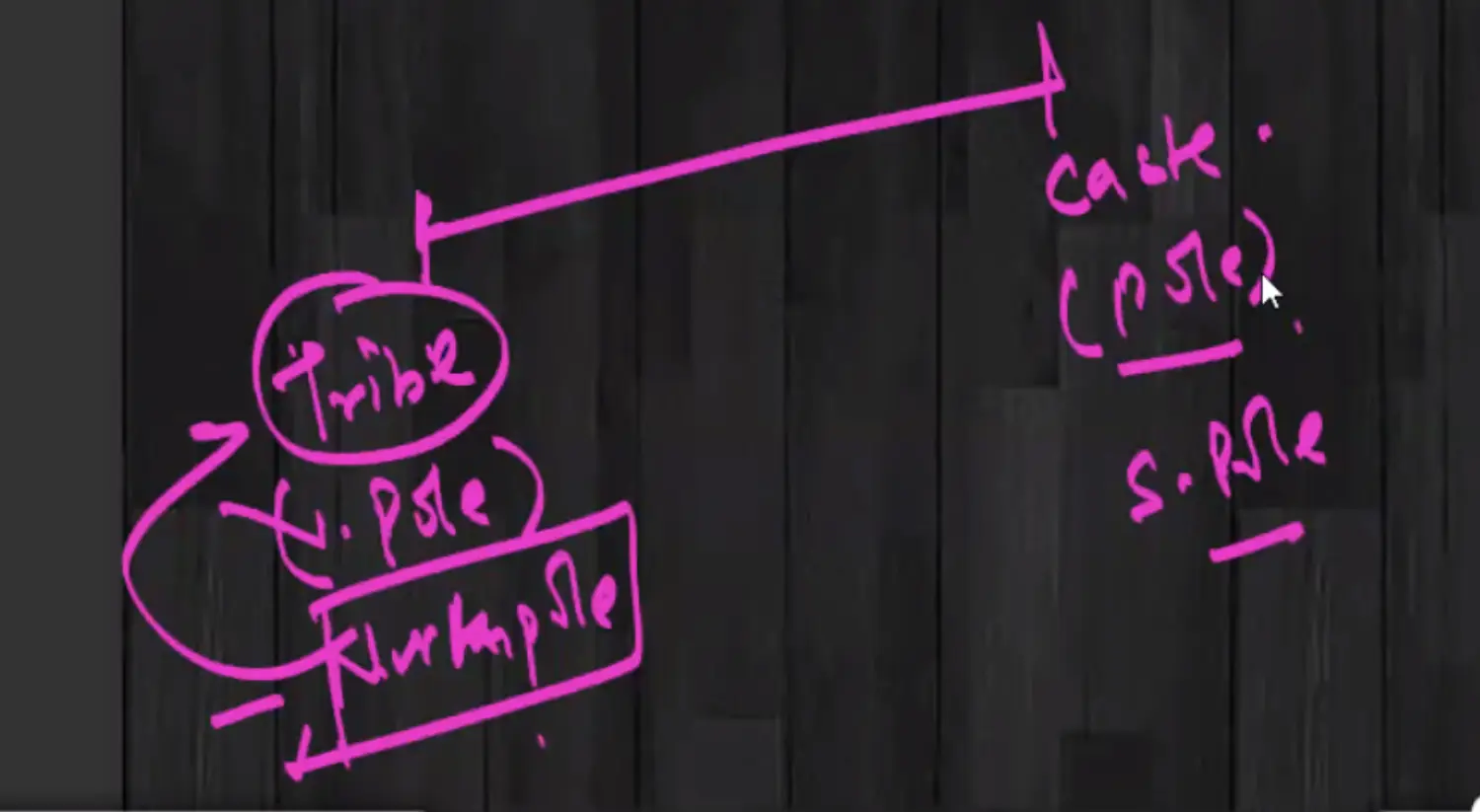
Maximum times they are in between, the two
There will Neither be a Pure Tribe Nor a Pure Caste
Examples
- Hierarchy Like Caste will be found in Tribe
- Egalitarianism Like Tribe will be found in Caste
Surjeet Sinha
He said there is a Tribal End & There is a Caste End
Great Tradition Perspective
- Tribal End : Tribals are Isolated to Great Traditions
- Isolated in Ecology, Demography, Social Relations
- Tribal End is Disconnected from Great Traditions of Indian Civilisation
- Hence, they are Incapable of Parochialisation
- Caste End : Typically Connected to Great Traditions
- They have Interdependence to Great Traditions
- Tribal End : Tribals are Isolated to Great Traditions
Little Traditions Perspective
- Tribal End forms its own Little Traditions
- Bheels, Gonds & Bhumij of Munda Ethnic Group from Parts of WB, Orissa & Jharkhand
- They were earlier egalitarian societies but they later started imitating rajputs and hence on the same lines created
- Clan System
- Rules of Marriages
- Appointed Brahmin Priests
- After this Process they recognised some parts of their tribe as Lower Castes
- Caste End in its normal existence has Little Traditions
- Tribal End forms its own Little Traditions
Conclusion
The long time debate of differentiation between tribes and caste was tilted towards an Interdependence and mutual influence on each other, particularly after the studies of Bailey and Surjeet Sinha.
It is now more or less accepted, that if not by Great Traditions ; Tribe and Caste are connected through Little Traditions. Hence, No Tribal Group can be found without features of caste system and vice versa
- Jajmani System
Paper 2 - Unit 3.3 - Sacred Complex & Nature Man Spirit Complex
Sacred Complex
Thinker & Place
| Thinker | Place | | --- | --- | | L P Vidyarthi | Bodh Gaya, UP | | Makhan Jha | 1. SC of Janakpur, Nepal 2. SC of Kashi, UP 3. SC of Kathmandu, Nepal | | B N Saraswathi | 1. Holy Circuit of NIMSAR, Goa 2. SC of Kashi, UP |
by L P Vidyarthi
Sacred Religious Affinity
- Tangible - Temple, Idol
- Non Tangible - Meditation, Prayers, Chanting
Components of Sacred Complex → Reflects the Collective Value of Society → Reflects the Civilisation
Sacred Centre - Geographical Location
Sacred Performance - Activities Involved (Rituals, Rites, Offerings, Prayers, Chantings, Yajnas, Yagya)
Combination of all these things
Sacred Specialist
Priests, Monks, Sacred Singers
Maintain a Distinct Lifestyle
Looks, Attire, Residence Area
Importance of Sacred Complex
- They are Vehicles of Civilisation
- Reflect the Value System of an Individual
- Centre for Integration of Society between Different Strata of Society
- There will be mixing of Great & Little Traditions by means of Universalisation & Parochialisation
Hypothesis by Vidyarthi on Sacred Complex
Continuity + Combination + Change = Gradual Transformations
Sacred Complex is a Broad Term, which can be further subdivided into sub-units
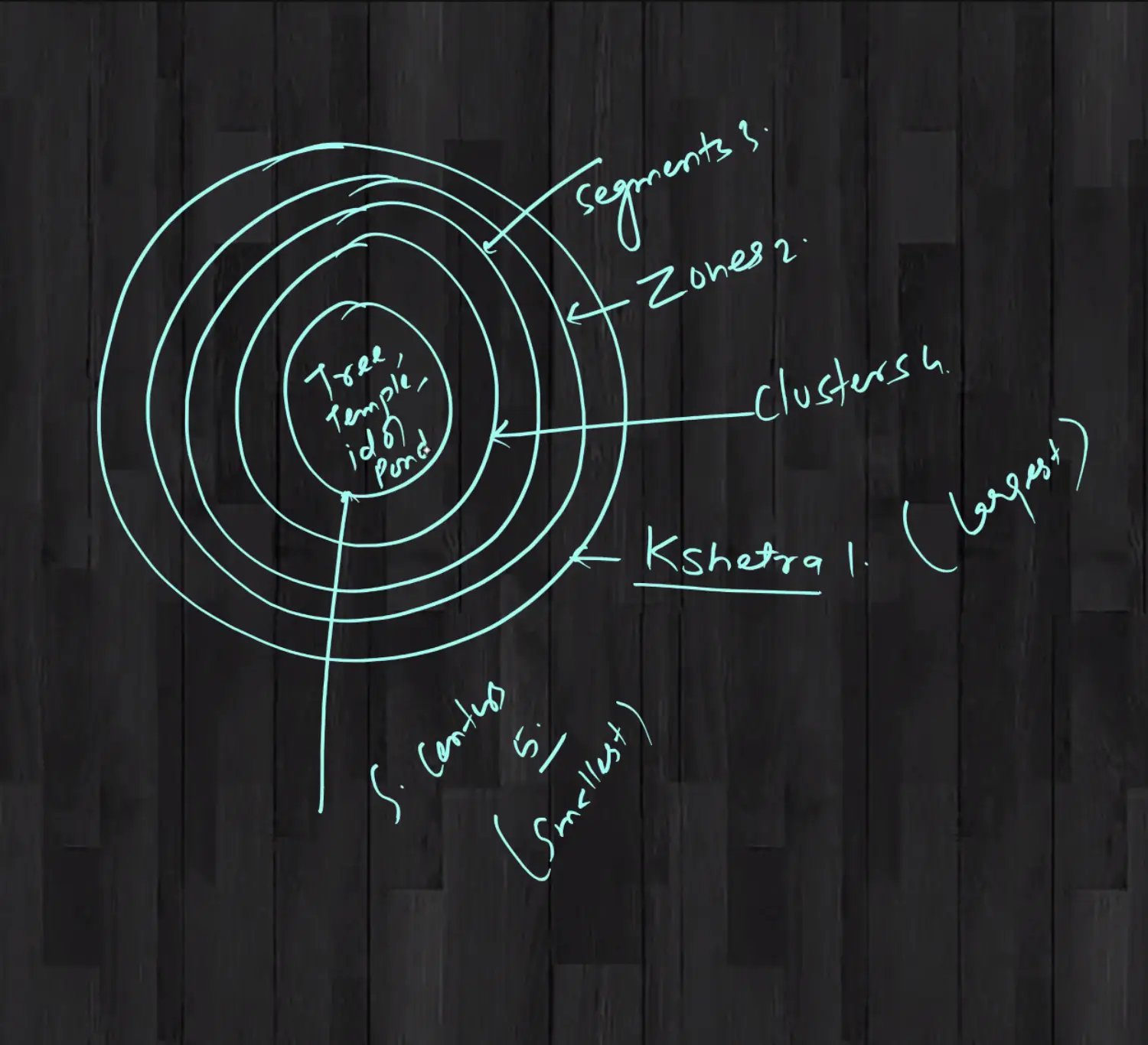
- The largest Unit in a Sacred Complex will be a Kshetra
- Kshetra will have different Zones
- Zones will have Segments
- Segments will have Clusters
- Clusters will have sacred Centres
- An Example of Centres can be
- Tree, Temple, Idol, Pond
Observations by L P Vidyarthi in a Sacred Complex
- Some Religious Texts will be promoted & Some Religious Texts will be demeaned
by Makhan Jha
- He Studied the Sacred Complex of Janakpur, Nepal
- Vidyarthi + Trans Boundary Acculturation
by BN Saraswathi
- Difference between Sacred Specialists
- NIMSAR, Goa - Non-Brahmins
- Kashi - Brahmins
- Hence,
- Sacred Performances are not restricted to upper-caste people
- Sacred Complex is not a Brahminical Monopoly
- Acts & Represents of Civilisation
- Difference between Sacred Specialists
Conclusion
B N S argued that the Sacred complex may appear as predominantly a brahmin complex, but it is much bigger organisations & traditions, involving non-brahmins equally.
Hence, Sacred Complex Represents Indian Civilisation
Nature Man Spirit Complex
Back Ground
- NMSC by LPV in his book “The Maler: NMS Complex in a hill tribe of Bihar”; 1963
- Maler Tribe is of Raj Mahal Hill
The Concept
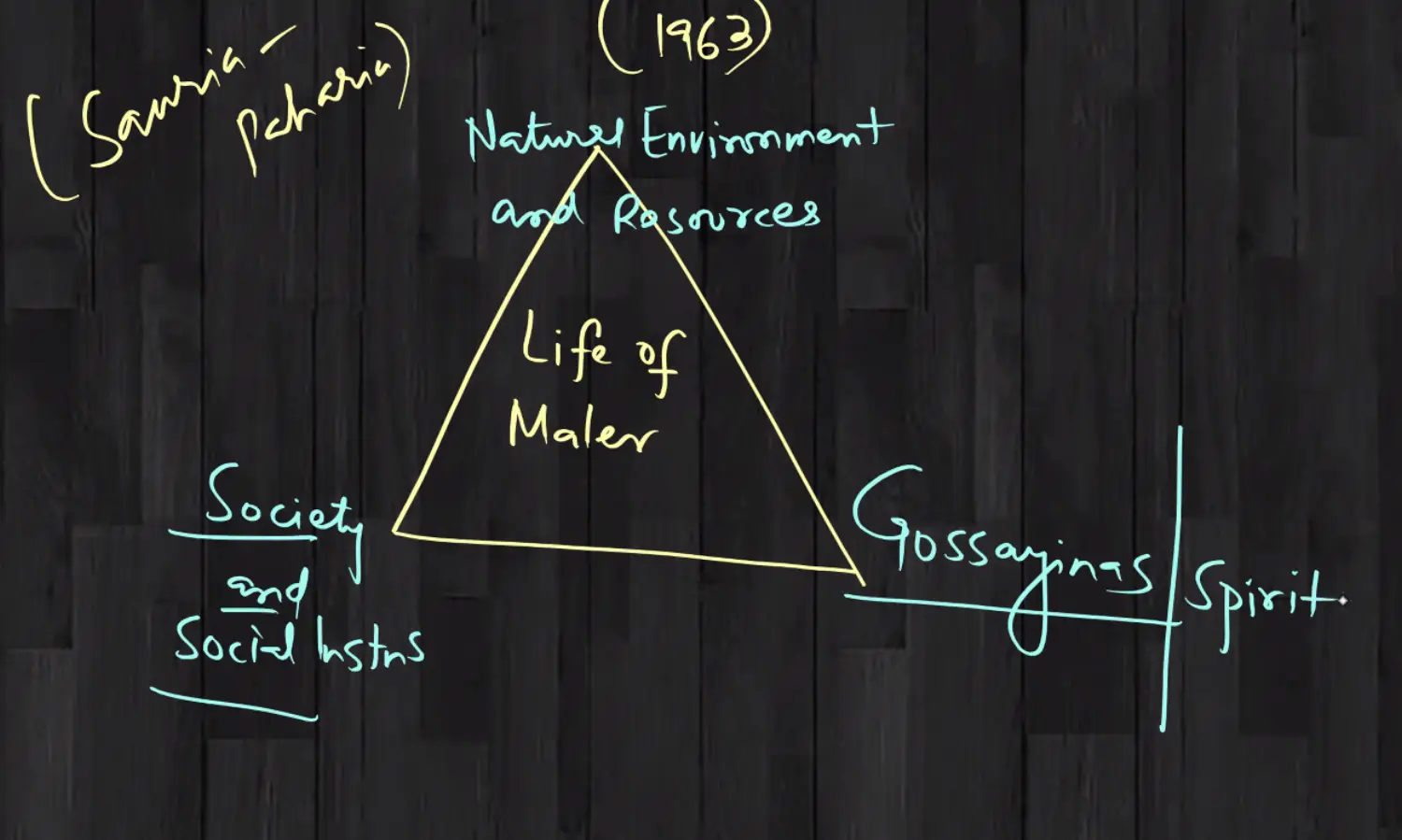
Nature → Natural Environment & Resources
Live in Hilly Area & Forest
Shifting Cultivation (Khallu) → of Maize Crop
Forest, Khallu & Hills are protectors of Malers and have high regard for Natural Resources because they have
Seen other tribes of nearby plains facing drought and food shortage
A Good Maler is someone, who practises agriculture of Maize by Khallu
Mahua is a Natural Plant used for Intoxication found in their Natural Environment
Man → Society & Social Institutions
- Everything of Social Behaviour including Sexual Behaviour is governed by the resources of the Surrounding
- Example
- Less Water Availability - No Bathing
- Their primary food base is Crops but sometimes when the crop is not good in a year they may shift to fruits or non-vegetarian food (buffalo/cow) etc
- No More number of Kids - In Years of Less Produce
- Mahua is used by these people from Nature and acts as a form of entertainment for them
- They have an attitude of animosity towards other tribes in the plains
Spirit → Gossaiyans
A Belief that these Gossaiyans can be either
- Happy - Benevolent - Soft on Tribe
- Produce will be Good
- Water Body will not Dry
- Fewer Deaths
- Not Happy - Malevolent - Hard on Tribe
- There will be Abortions
- Calamities
- Produce will not be good
from the Maler’s itself
- Happy - Benevolent - Soft on Tribe
Important Points
Life of Maler = Complex Interplay between these three
These Three are Intertwined, Interdependent, Interconnected
Due to British Exploitation in the past, these tribes have grown reluctant towards outsiders and especially the Government
NMS Complex Studies by Others
Nature Man Spirit Complex was extended to other Tribal Groups also and was studied by different scholars
All these studies established that NMS Complex was an important and useful tool in studying these populations
| People | Tribs | | --- | --- | | Sandhwar | Korwars of CG JH Region | | R K Sinha | Pando of CG JH Region | | Sahay | Great Nicobari of A&N Island |
Conclusion
NMS by LPV later became one of the prominent method used by Anthropologists for Formulation and Implementation of Developmental Programs and Policies for Tribals and Forests Dwellers
Paper 2 - Unit 3.4 - Impact of Buddhism, Jainism, Islam & Christianity on Indian Society
From Handwritten Handouts of Sir
Impact of Buddhism
Introduction
Buddhism emerged as a challenge to Brahminical Supremacy, Caste Based on Inequalities.
Also due to its emphasis on Ahimsa (Non-Violence), Peasantry, Lower Caste People, Shudra, Untouchables and even Vaishyas became disciples of Buddha.
Buddhism allowed the entry of women into the Sangh.
It gained popularity due to Magadhi & Pali
The Craze of Buddhism gradually declines in India but mainly became popular outside of India.
Impact on Social Life
- Impact on People from Outside
- There was a mixing up of Social Life
- Prevented People from Outside India from Identity Crisis
- Impact on Lower Caste People
- Buddhism Rejected Caste Hierarchy
- This Impacted and Accommodated Lower Caste Populations
- Caste Based Inequality was a Bit Diluted, but it was for a short duration
- Impact on Vaishyas
- After Continuous request and argument Vaishya's weren't able to get a higher status
- but buddhism gave the status hitherto not present
Impact on Economic Life
- Impact of Cattle Economy
- Buddhism prohibited animal sacrifice
- This in turn led to Cattle Buffer being re distributed in the lower economic strata of society
- which in turn contributed to their economic & societal respect
- Impact on Foreign Trade
- due to accommodative nature of buddhism, foreign population was easily induced into buddhism preventing them from Identity Crisis
- This led to Import and Export of Products
- Which in Turn Led to Flourishment of Trade and Commerce
- Which in Turn Led to Urbanisation
Impact on Political Life
- Impact on Other Countries
Guiding Principles of Buddhism were → Peace at any cost & Compromise with Invaders and Enemies
This Led to International Percolation of Buddhism
- Impact on Representation of People
Other Class and Caste were given representation hitherto not represented
- Impact on Women Representation
Buddhism allowed Women in Decision Making & in Sangha
- Impact on Process of Justice
More Democratic Principles were employed in the process of Dispute Resolution in Society
Voice of the Mass was being heard for the first time
Impact on Religious Life
Impact on Idol Worship
According to Jadunath Sarkar, in 72 AD with King Kanishka & Emergence of Mahayana Buddhism, Idol Worship began in India for the First Time
Impact on Monastic Code
Though one of the reason attributed to downfall of buddhism is its processed and organisation being similar to hinduism
Buddhism is appreciated for creation of a Separate Fraternity of Monks thus leading to creation of Monastic Code
It had 3 main components
Chaitya - Place of Worship
Vihara - Place of Residence
Stupa - Place of Monks Cremations Ash Symbols
Impact on Language of Religion
Earlier dominance of Sanskrit restricted the percolation of religious knowledge in masses
But Preaching of Buddha in Pali and Magadhi appealed to masses
Impact of Art & Architecture
Chaitya Vihara Stupa Pillars
Conclusion
Various Historians, Philosophers & Later Sociologists and Anthropologists were of the opinion that buddhism was an offshoot of Hinduism & these two cannot be demarcated very effectively.
Religious Philosopher and Historian Ram Swaroop argued that these two are Intertwined and Coiled. When Decoiled they will loose basic theme of belief
He maintained that Buddhism forms various ethos based on Hinduism and Hinduism is also affected by buddhism.
This is the reason why Impact of Buddhism and its intensity was not prolonged
Impact of Jainism
Impact of Islam
P K Kar suggested about mixing up of religious preachings of Hinduism and Islam, through Hindu and Sufi Saints
Denounced caste based divisions and focused on devotional worship
Impact of Christianity
Paper 1 - Unit 2.3 - Marriage
Definition & Universality of Marriage
Points to Note
- These Definitions are not 100 percent accurate
- All Definitions have some criticism
Definitions
- Seligman
Defintion
Marriage is a Union between a Male and a Female, such that the Children which are born to this women are considered to be legitimate
Criticism
This Definition Doesn’t Consider
- Polygamous Marriages
- Polygyny & Polyandry
- Ex : Toda
- Adopted Children
- Ex : Modern Society
- Nuers of Africa Pritchard
- If husband dies
- women marries another women
- for kids help of friend or a women
- Polygamous Marriages
- GP Murdock
Defintion
Marriage is a universal institution involving three things
- Resident Co Habitation
- Economic Co-operation
- Nuclear Families
Criticism
- Nayyars of Kerala
- Nuclear Family not a Norm Now
- Kathleen Gough
Defintion
Marriage is a Established Relationship between a women and one or more person and in such arrangement the child born to this women enjoys full birth status rights like any other member of the society
Criticism
- Polygyny → 1 Male Multiple Female → was not explained by this Definition
- Azande of Sudan - Homosexual Not Covered
- Westermarck
Defintion
Marriage is a ritually recognised institution between a man and a women living together and recognising each others mutual sexual rights
Criticism
- Rituals → Contractual Marriages without any ceremonies
- Nayars of Kerala → Couple is not Staying together
- Mutual Sexual Rights → Extra Marital Sexual Rights are not a Taboo
Universality of Institution of Marriage
Marriage as a Universal Institution can be found in maximum parts of society in maximum parts of the world
Conclusion
Marriage as a Socio Cultural Institution is almost universally found in different forms but there can be exceptions in occurrence, patterns, preference of mates in marriage
So a Universal Definition of Marriage is not easy to formulate but certain basic features of martial ties can be
Sexual Gratification & Pro Creation
Economic Interdependence
Rearing of Kids
Emotional Interdependence etc
Types of Marriage
Mind Map
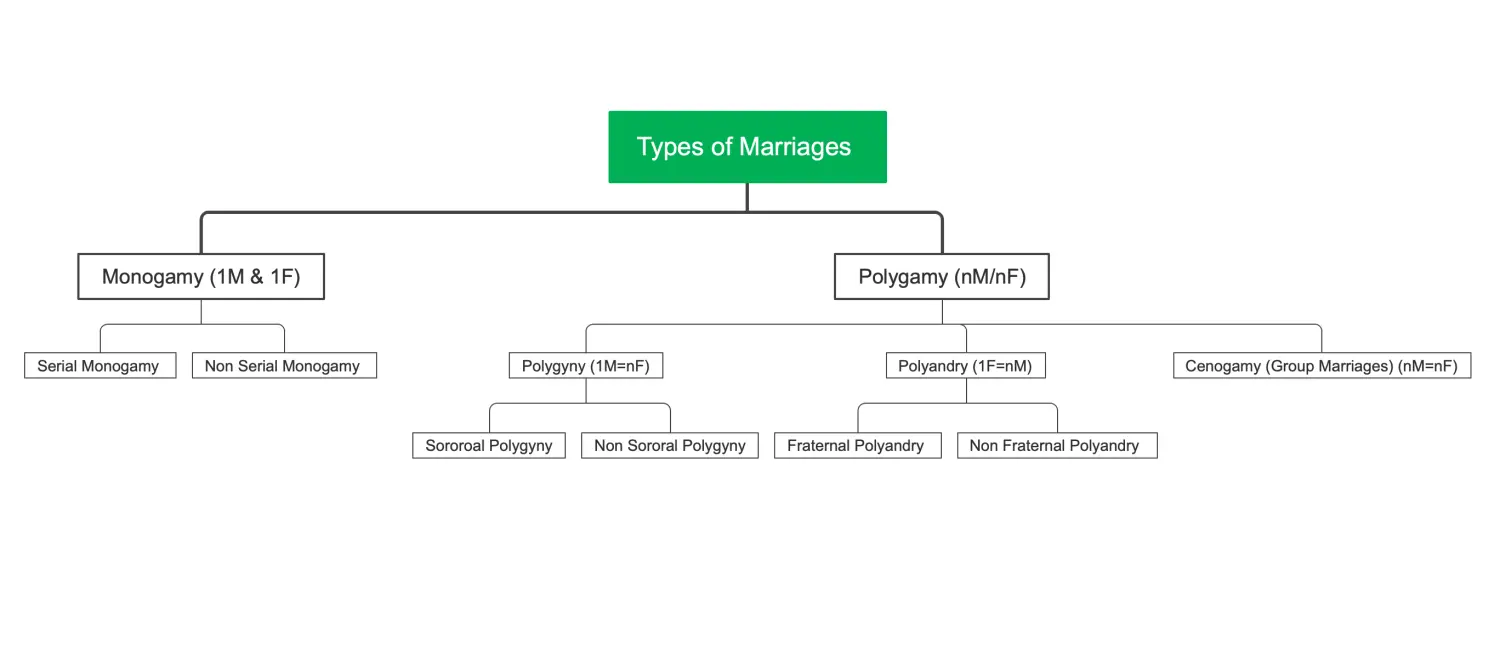
Monogamy
- Monogamy
Single Male is Marrying a Single Female
They Settle down to form a Family & Have children
Evolutionist View on Polygamous Marriages
When Society moves from Polygamous to monogamous Marriages
Society Moves from Savagery / Barbaric Society → Civilisations
They Considered this state of Society to be a Advanced Stage of Societal Development
Polygamous or Monogamous have nothing to do with Civilisation
It is now accepted that any civilisation, any society or culture can have poly or monogamous marriages irrespective of
- simplicity or complexity
- primitiveness or Advanced
- Eastern or Western or Southern Societies
Factors on which a Marriages Type Depends
Economic Factors
Kapauku of PNG & Pig Economy
More Wife More Kids More Money Needed
Bride Price concept restrict polygamous marriages
Dowry System restrict polygamous marriages
Demographic Factor
Natures Balance is that of Every Individual will have one Partner
Society which have skewed sex ratio and has less women, discourages polygamy
Preferential Marriages like a Individual wanting to marry Parallel and Cross Cousins restricts Polygamy
Two Types of Monogamy
Serial Monogamy
Definition
One Spouse at a Time but Multiple Marriages are allowed
Example
Western Society
Indian Urban Centre
Non-Serial Monogamy
If a Man gets Married to Women, even after death or divorce, no second marriage is allowed
Examples
- Hawaiian Island
- Tribes of Polynesia
- North Eastern Tribal Pockets
- Monogamy
Polygamy
- Polygamy
- Multiple Partners at a time
- Fairly Scattered in different parts of India and World
- Types of Polygamy
Polygyny
Definition
One Man Multiple Women
Examples of Polygyny
- Nagas
- Gonds
- Baigas
- Irulas / Iruler
Types of Polygyny
Sororal Polygyny
One Man Marrying one or more Female who are sisters
Non Sororal Polygyny
One Man Marrying one or more females who are not related
Why Polygyny
Imbalanced Sex Ratio
where females are more due to factors like War & Hunting etc
Agriculture & Pastoral Economic Systems
More Wives → More Work
Easy Handling of Domesticated Animals
Water Wives of Maharashtra
Domestic & Household Duties
Including Rearing of Kids or Child Rearing
Post Partum Sex Taboo
Post Partum - After Delivery when mother is nursing the Newly Born, at this point of time, sexual relations are not allowed
This Time Could be 6,9 Months or 1/2 Years
Patriarchy
No of Wives were considered as
more prestige to males
more Social Recognition
Why Because to have More no of Wives, More Bride Price and Maintenance was needed
Aspiration for More Children
Aspiration for a Male Child
Hence he was considered Economically Sound
Ex :
Kapauku PNG
Kanuri of Nigeria
Polyandry
Defintion
One Female Multiple Male
Example
- Todas & Kotas of Nilgiri
- Sinhalese of Ceylon
- Some Nepalese Tibetan’s
- Botas of Ladakh and Tibet
- Khasas of Uttarakhand and Nepal Himalayas
Types of Polyandry
Fraternal Polyandry
One Females Marries Two Brothers
Examples
Tibetans
Todas
Khasas
Non Fraternal Polyandry
- One Female Marries Two People who are not Related
- Examples
- Hilly Tribes of North America
- Hilly Tribes of Peruvian Andes
Why Polyandry
- Imbalanced Sex Ration
- Shortage of Females
- Where Female Foeticide and Female Infanticide is more Prevalent
- Example
- Todas
- Marquesan Polynesians
- Matrilineal Lineage of Society
- Khasis of Meghalaya
- Limited Resources Like Land
Ex 3 Brothers Marrying the Same Wife
Hence Land & Property will not be Further Fragmented
Examples
Goldstein’s study of Tibetans in North Westerns Part of Nepal
Khasas of UP
Kinnaur Region of Himachal
A Special Polyandry is practised by Todas of Nilgiri
a Toda Women when married to a male, is automatically married to all her husbands brothers
Bow & Arrow Ceremony for Parental Rigths
- Imbalanced Sex Ration
Cenogamy
Definiton
Multiple Males & Multiple Females
Sociologists call this Sexual Communism
Its a Kind of Marriage leading to a Extended Family without Kids
But it has faith within group
If any new male or female has to be added to the group, consensus of every individual is needed
They have no concern or issues with the Parental Rights
Example
- New Guinea
- Central Africa
- Ancient Hawaiians
Why Cenogamy
- This was to avoid internal dispute between the group
- Its a Sign of Hawaiian Society
- Polygamy
Laws of Marriage
Endogamy & Exogamy
Endogamy
Endogamy
Marriage within Ones own Group like
Levis defined Endogamy as a Rule that requires a person to marry within a Social Group of which he or she is a member
Types of Endogamy
- Tribes Endogamy
- Religion Endogamy
- Caste Endogamy
- Sub Caste Endogamy
- Varna Endogamy
- etc
Why Endogamy
- To Maintain Cultural Similarity
- To Maintain & want to be recognised with same social status and identity
- To Keep Wealth & Property within the Same Group, Especially when the Group has lesser populations
- Ethnocentric Sentiments
- To Maintain Unity & Solidarity in the Group
- To Maintain Racial Purity
Exogamy
Exogamy
When People marry outside ones own group
Examples
Gotra Exogamy in India
Village Exogamy
- North & North West India
- Haryana & Punjab
Village / Group of Village Exogamy
Ex : Khap Exogamy
Pravara Exogamy
Siblings meaning descendants of a common saint
Sapinda Exogamy
Why Exogamy
To Avoid Inbreeding
To Avoid Increase in
- Genetic Disorders
- Hereditary Disorders
It is Good for Health & Heredity
- Less Frequency of Genetic Disorders
to Avoid Incest
Developed as an Extension of Incest Taboo
To Avoid Attack on Each Other Groups
Ex : Bimbisara & Ajatshatru Marriages
Ex : CGM Marrying a Greek Princess
Levis Strauss Structuralism Alliance Theory
French Anthropologist Levi Strauss Extended the Concept of Exogamy through Alliance Theory in Structuralism
Marriage as an agent of Alliance
Bringing More Families Together
Hypergamy & Hypogamy
Hypergamy - Anuloma
Hypogamy - Pratiloma
Refer Varna System
Incest Taboo
Defintion
Taboo - Not Accepted, Stigma, Prohibited
Incest - Sexual Relations with Very Close or Close Relatives like
- Father with Daughter
- Mother with Son
- Brother with Son
Incest Taboo
When Norms Don’t Allow Sexual Relationship between Close or Very Close Relatives
Difference in Range of “Closeness”
Geographically
North India
Cousin Marriages Not Accepted
South India
Cousin Marriages is Prevalent
Boy Can Marry Sisters Daughter
Girl Can Marry Mothers Daughter
Religiously
Cousin Marriages Not Allowed in Hinduism but Allowed in Islam
Universal Taboo
Irrespective of Time, Location & Beliefs F&D, M&S, B&S is not allowed
Examples
Yanomami’s of in Brazil & Venezuela
Boys → marry their cross cousins by simply calling them wives
Girls → She will accept her cross cousin by simply calling him Husband
Nagas
Garos
Gonds
Oraons
But these marriages will be considered as part of Incestuous in North and North Western Part of Country
Theories on Incest Taboo
Not a Part of Syllabus Just to Quote in Exams
- Sigmund Freud’s Psychoanalytical Theory
- Cooperation & Alliance Theory by EB Tylor & Levi Strauss
- Inbreeding Theory
Supported by Many Sociologist and Anthropologists
One of the Oldest Explanations for Incest Taboo is based on Inbreeding Theory
If Focuses on the Potentially Damaging Consequences of Inbreeding or Marrying within the Family
People within the same family are likely to carry the same harmful genes which are lesser represented in exogamous marriages
Recent Evidences suggest that Inbreeding also tends to Increase the likelihood of diseases that affect people later in life
Such as Heart Diseases, Diabetes etc
So to avoid such things & to establish better relationships with other groups Incestuous Relations became a Taboo
Regulations of the Marriage System
The Above Laws of Marriage can be Sub Divided into 3 different categories
Questions can be asked in the form of
- Rules Regarding Marriages
- Marriage Regulations
- Choice of Spouses
Summary
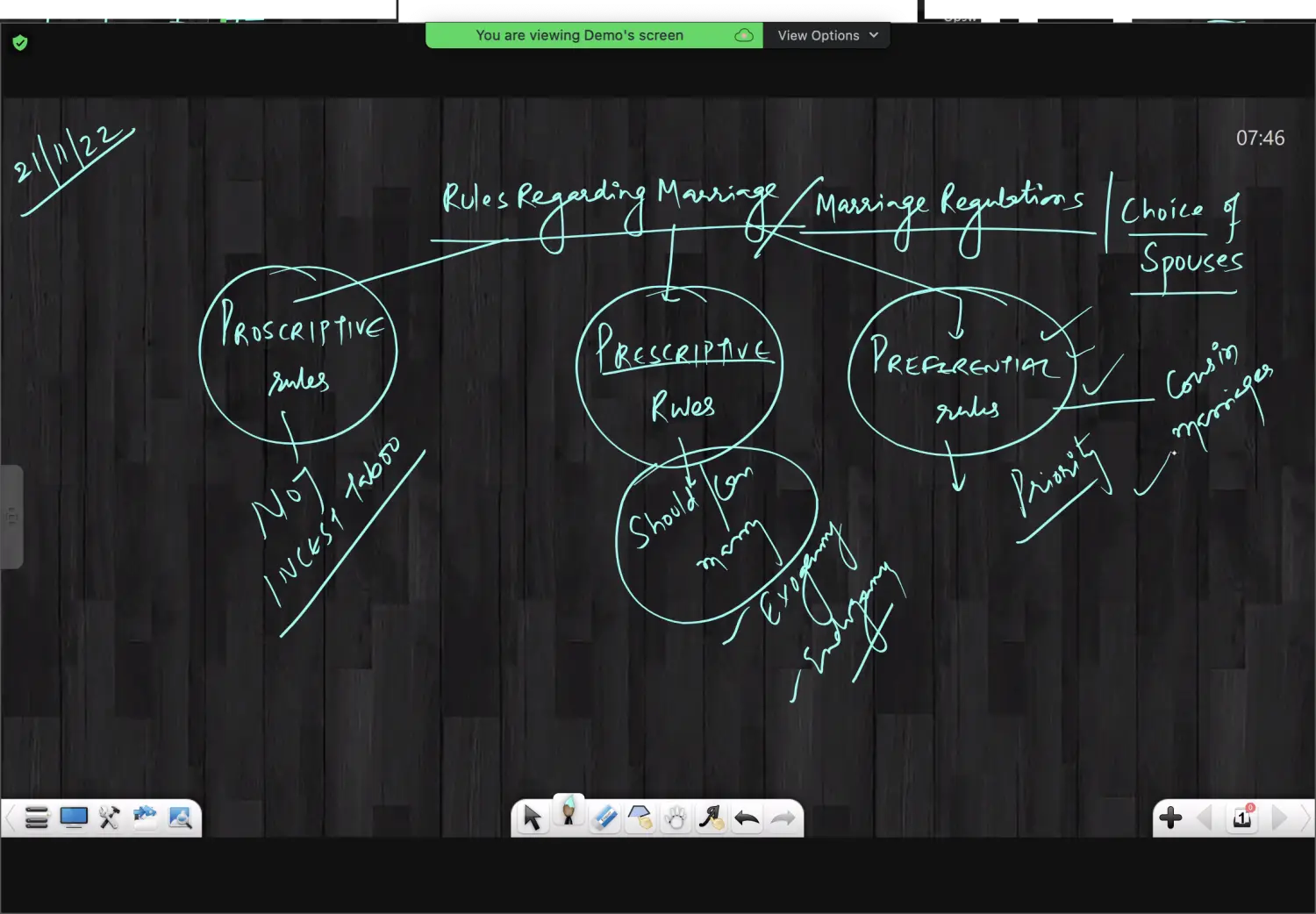
Proscriptive Regulations - You Should Not Marry These
Defintion
These rules direct the Individuals in a Group about whom one should NOT Marry like Incest Taboo in Maximum Societies
Examples
Apart from Incest Taboo, You Should Go for Something Else
Exception to Incest Taboo
Princess Cleopetra of Egypt due to
Religious Rituals && Property Retention
She married her brother & after her brother died, she married her another brother
Refer about Alliance Theory & Concept of Wife Givers and Wife Takers
Prescriptive Regulations - You Can Marry These Group
Defintion
Which are directing the Individuals in the Group like preference of Endogamous & Exogamous Marriages
Examples
Endogamy - Can Marry within this
Caste & Sub Caste Endogamy
Exogamy - Can Marry outside this
Gotra Exogamy
Preferential Regulations - These are in Preference / Priority
Defintion
Under these set of rules a person is expected to prefer certain specific categories of relatives or kins over others as a choice for Marriage
Types of Preferential Rules
Cousin Marriages
Cross Cousin Marriages
Meaning
Father Sisters Kids
Mothers Brothers Kids
Examples
Cross Cousin Marriages is the Most Common form of Preferential Regulations
- North Eastern Tribes Like Garo, Khasi, Nagas, Karbi's,
- Baigas
- Arunta Tribe of Australia
- Srilankai
Types of Cross Cousin Marriages
Symmetrical
Fa Si Kids && Mo Br Kids are in Equal Priority
Ex : Assam & Deccan & South India
Non Symmetrical
Out of Fa Si Kids && Mo Br Kids, If one is preferred
Generally Mothers Brothers Kids are Preferred
Reasons - In Favour
- Wealth is Regulated
- There are well known faces
- There is No Element of Surprise
- Choice of Parents will live near to family
Reasons - Against
Challenges of Inbreeding
Parallel Cousin Marriages
Meaning
Fathers Brothers Kids
Mothers Sisters Kids
Examples
Less Prevalent than Cross Cousin Marriages Particularly in Tribal Society
Semitic Arabs - Imp Ex
Semitic - Eastern Coast of Mediterranean is called Levant having a type of Language called Semitic
This Semitic has two types
Semitic Arabs
Semitic Hebrons
RIANGS of Tripura - Imp Ex
Bedouins of Arabs
Muslims Groups in India
Types
Example of Symmetrical and Asymmetrical Instances can be given
Reasons - Favour
Keep the Man Power Intact within the Group
Ex : Marrying Fathers Brother Daughter - Man Power Remains Intact
Ex : Marrying Mother Brother Daughter - Family is Divided
Reasons - Against
Challenges of Inbreeding
Levirate Marriages
Meaning
When a Widow Marries a Deceased Husbands Brother, It is called Levirate Marriages
Examples
- Natives of Australia
- Kukis of Arunachal and Nagaland
- Muslims in South Asia
- INCAS in Central America
- Also found in Maximum Tribal Societies of North Eastern and Eastern India
Type of Levirates
Junior Levirate
Marrying Younger Brother of Husband
Marrying Senior Brother of
Senior Levirate
Sororate Marriages
Meaning
When a Widower is Marrying his deceased wife’s sister
Examples
- Non Tribal Societies of Northern Plains
- Himalayan Region
Types of Sororate
- Junior Sororate - With Younger Sister of Wife
- Senior Sororate - With Elders Sister of Wife
Functions of Marriages
Biological Function
Sexual Gratification
Examples
- Monogamous Marriages allow Sexual Relationship with One Partner
- Polygamous Marriages allow Sexual Relationship with Multiple Partner
Procreation
Socialisation
Meaning
Marriage as an Institution or family at Large are responsible for Primary and Secondary Socialisation (Explained by Sociologists G H Meat)
Types of Socialisation
Primary Socialisation
Socially Accepted Behaviour & Norms in the Environment of Family
Secondary Socialisation
Socially Accepted Behaviour & Norms followed by Individuals with Society as Environment (Generally Outside the Family)
Social, Political & Economic Ties
between different groups by the concept of Wife Takers and Givers according to Alliance Theory by LS
Economic Functions between
- Husband Wife
- Husband - nWives
- Wife - nHusbands
Ways of Acquiring Mates in Tribes
Introduction
Tribal Populations use different Criteria for Marriage within or Outside of their Group. In Tribal Societies Marriage is more of a social or civil contract involving less of religious rituals and rites
Methods
- Probationary Marriages
Example
- Kukis of Arunachal & Nagaland
Meaning
In this type of Marriage, a Tribal Boy Lives in the house of his potential mate for weeks or months with her parents
Thereafter if they like and Finalise Each Other, they may enter into the Wedlock
If marriage is not Solemnised, the boy will have to pay compensation to girls family. So before marriage, the boy is like a Probationer in would be father in Laws house
Anyone Boy or Girl can say No
- Marriage by Capture
Example
- Juangs, Birhors & Kharias of CNP
Meaning
This is one of the Most Popular Method Amongst Indian Tribes, this capture can be ceremonial or forceful.
Sometimes to avoid Marriage Payments and restriction from the parents, this physical capture is pre arranged and often takes place in festivals, markets etc
Marriage is performed after the capture with a simple yet forceful “Smear Vermillion” (Mang Main Sindoor Bharna)
Types
- Ceremonial
- Forceful
- Marriage by Trial
Example
Bhils of Madhya Pradesh
Meaning
In these types of marriages the courage and bravery of young man is appreciated and recognised by means of some typical task. If the boy comes out successful in that, he is free to marry the girl
- Marriage by Purchase
Examples
Khonds, Ho, Mundas
Meaning
Any form of Marriage Payment is a Part of this
The Man Pays the Bride Price to the Girls Parents as his wife, this bride price can be in the form of
- cash or kind
- Grains or Cattle
The Grooms father will pay the Bride Price to the Brides Father in a Traditional Ceremony
- Marriage by Exchange
Examples
Khonds, Juangs, Santhals, Bhoomiyan / Bhoomiya of Chota Nagpur Plateau
Meaning
in this form of marriage, if a sun and daughter or marriageable age are available in two families or groups they may exchange the daughters
No Marriage Payment is Involved in this type of Arrangement
- Marriage by Services
Example
Baigas and Gonds
Meaning
Some Tribals have evolved the solution of Hire bride Price to the Girls Parents particularly grooms family which are economically weaker
A Boy can avoid the Bride Price by Serving the Would be Father in Law as a Worker or Servant doing
Agricultural Activities
Fishing
Taking Care of Animals
- Marriage by Elopement
Example
Santhals, Bhoomiya, Khonds, Juangs in Eastern Tribal Belt of India
Meaning
a boy and a girl stay in a dormitory after eloping together and after sometime they can inform the parents and the marriage is accepted
marriage payment can be easily avoided by this
- Marriage by Intrusion
Example
- Ho Tribes & Birhors of CNP
- Juangs and Khonds Also
Meaning
This is a sort of reverse mechanism of marriage by capture where in a girl is desiring to marry a particular tribal male and goes to his house stay without their will
She forcibly thrusts herself on them, despite of non acceptance
Here she is subjected to humiliation, refusal of food & often physical torcher but inspite of all these, if she sticks to the marriage, she is accepted as wife by the boy
- Divorce
Example
All Tribal Societies
Meaning
Dissolution of Marriage in Tribals is based in certain set of rules which cannot be abrupt or random
G P Murdock has mentioned a number of recognised grounds for divorce in tribal societies like
- Adultery
- Grave Diseases
- Impotency
- Sexual Unwillingness
- Heavy Drinking
- Mistreatment
- Quarrelsome Behaviour
If both the families agree, marriage is dissolved and divorce is approved. Both Boy & Girl are free to have new mates
- Inheritance of Widows
Example
Sema Nagas
Meaning
From the View of Tradition in Tribal Societies or personal choices, unmarried boys do not usually prefer to marry a widow.
On routine widows are preferred to be married with widowers, no bride price is to be paid for widow remarriage
as a customary practise, the Sema Nagas as a matter of Obligation marries his fathers widow, other than his own mother, this type of marriage is preferred to inherit property of father along with responsibilities which the father was fulfilling when he was alive
Marriage Payments - Add from Handout
Changing forms of Family → Changing forms of Marriage
Paper 1 - Unit 2.4 - Family
Nuclear Families
2 Adult Members of Opposite Sex with their Unmarried Kids
Definition
G P Murdock*
He Studied Family in his book Social Structure and was of view that family is as a social institution is all most universal
Within these occurrences “Nuclear Family” will be the most common one
In the Words of G P Murdock, Family is a Social Group characterised by
- Common Residence or Habitation
- Economic Interdependence and Cooperation
- Reproduction
It includes, Adult Members of both the Sexes, at least two of whom maintain a socially recognised or approved social relationship and the group has one or more kids which can be biological or adopted
Burgess and Loke
Machaiver
Kathleen Gough*
Diana Gittins
Characteristics of Family
Economic Cooperation
Division of Labour
Modern Families Boundary of Division is Labour is diminishing
Marital Ties
Same Sex
Other Sex
Nomenclature Associated with the Family
Common Habitation
Universality of Family
Proposition
- In Any Kind of Society
- In Any Geography
- There will be one or more type of Family
Counter Argument for Co Habitation
Nairs of Kerala (by Kathleen Gough)
Talli Rights before Puberty
Visiting Husbands / Sandbhanams, Females can have to 12 Visiting Husbands
No Life Long Union, No Cohabitation, No Economic Interdependence, No Moral Duty
Conclusion
Diana Gittins was a Feminist Scholars. She Said that Family may not be a universal institution but
- Relationship is Universal
- Sexuality is Universal
- Intimacy is Universal
- Emotional Bonds are Universal
Types of Families
Mind Map
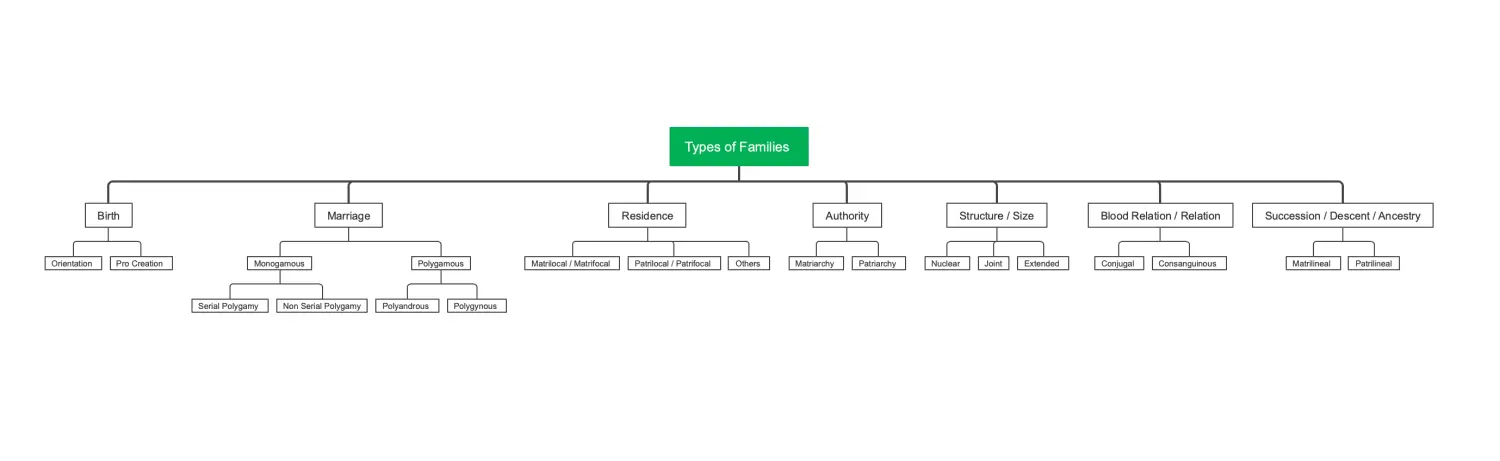
Based on Birth
Orientaton
In which you are born
Procreation
Family Which you will have after your marriage
Based on Structure or Size
- Nuclear Family
Husband + Wife + Unmarried Children
Ex : US Society, Urban India
Difference between Nuclear Family of West & India
US is actually Nuclear where as Indian Nuclear Family is Nuclear and Separate only in terms of Geography
Indian Nuclear Family is characterised Emotional Connect and Regular Visits
US Decision Making is Independent of any influence from family
Even in a Nuclear Family, the decision making, is generally done by elders in family mainly male
After LPG, Indian Nuclear Family is moving towards Nuclear Family of US
- Joint Family
- Multiple Family, Common Residence, Common Sources
- This is a Aspect of Traditional Hindu Society, later transcended to Indian Society as a whole
- Main Characteristics is Common Kitchen and Common Place of Worship
- Extended Family
- Nuclear Family
Household & Domestic Group
Household
Household is Parallel to Family
Its a Sort of Common Residence. It is that social group which has multiple individuals, generally two or more
It is two or more people connected by
Blood or Marital Status
When Households are based on Blood Relations or Martial Ties, these are more or less permanent.
There can be some temporary household for the members but or more or less they will be permanent for larger part of life
- Friendship
- Live in Relationship
- Hostel / Flat Sharing
- but now, there can be Single Person residence can be there as well
There can be two type of Household
Nuclear Household
Nuclear Households are typically associated with all types of societies and cultures but generally not an exclusive way of survival except some western societies. Also, an extended household will have some sort of Nuclear Householdness within that.
Extended
Special Case
Sociologist I P Desai & Anthropologist Irawati Karve : Within a Large Joint Family at a common residence, there can be examples of different and separate kitchens due to various
Domestic Group
Domestic Group is a Resource Owning Group, they handle these resources by sharing common labour
According to Mayor Fortes, a Prominent Sociologists gave a developmental cycle of Domestic Groups based on the Changing Dynamics.
He gave three different phases of developmental cycle
Phase of Expansion
Starts with Start of Marriage and further expands by birth of First Child and continuos to expand till the birth of last child.
Domestic Group is Expanding & Resource is Shared
Unless Husband is Fertile and Mother hasn’t reached Menopause
Phase of Dispersion
It Starts when one of the member of the family and household is out of the activities of domestic group for educational purpose, employment or setting up a new nuclear household after marriage
It can continue till the marriage of youngest child
Ownership of Resources moves towards Division of Resources
Phase of Replacement
It starts with ageing of parents and continues till till their death when parents become old and are left with No Stamina to perform physical activity they rely on their children to perform their function.
In this process parents no longer take part in economic event and hence their authority declines gradually.
Children Replace their parents as owners of economic resource in the domestic group and then again the domestic group undergoes the phase of expansion.
Old Parents, will expect that along taking care of them, their economic labour will also be taken care
Function of Family
- General Sense of Functions of Family
- Education, Values, Socialisation = Culture
- Procreation, Reproduction
- Sexual Gratification
- Economic Sustenance = Social Stability
- Adult Personality Stabilisation by Talcott Parsons
- Sense of Security & Survival
- G P Murdock in his essay “The Universal Functions of Family” gave a fourfold classification of family
Sexual Gratification
- Family is a Legitimate way of Sexual Access. In a “Free Play” there will be a disorder in society
- By this arrangement this function of family, ensures social stability
Procreation and Reproduction
Education, Values, Socialisation
By Talcott Parson
Primary Socialisation - Values Given by Family
Secondary Socialisation - Value Given by Friends, School and Society
Ideals of Secondary Socialisation are impacted by Primary Socialisation
Secondary Socialisation is also Influenced and governed by family as a Primary Socialising Unit and as a Adult Personality Stabilising Unit
Also, Through Marriage and Emotional Support
Economic Sustenance = Social Stability
- General Sense of Functions of Family
Changing Functions of Family
- Factors that Lead to Change in Family
- Urbanisation
From Joint, Extended Family moving towards Nuclear Family
that can lead to
Changes in Economic Functions, Family is now not a specific economic unit
Changes in Division of Labour
Rise in Involvement of Females in Decision Making
Rationalisation of thoughts - Increase in Marriages outside caste, religion, ethnicity
Dilution of Traditional Patriarchal System
- Industrialisation
- Rationalisation of thoughts
- Status in Modern Industrial Societies is more of achieved nature rather than ascribed ones
- Modernisation
- Rationalisation of thoughts
- Feminism
- Rationalisation of thoughts
- Urbanisation
- Talcott Parsons View
Macroscopic Function - Function is Generally being lost by Family
Instead of being a unit of production
SHG’s, Factories, Industries, Cooperatives etc
Adult Personality Stabilisation
Not only done by Family
Microscopic Function - Function Retained by Family
- Primary Socialisation is done by Family
- Emergence of Two Views
- Function of Family are Changing
- Function of Family have not gone obsolete, rather the function is changing and number of functions are increasing
- Factors that Lead to Change in Family
Feminist Perspective
Christine Delphy and Diana Leonard
It affected the discipline first, earlier sociologist weren't even agreeing and understanding that there is unpaid labour
They are prominent feminist sociologist
Christine Delphy and Diana Leonard and many others, highlighted the economic, social, political and sexual exploitation of females within the family, village, clan or larger society
Like Marxists, talked about the exploitation of working class in capitalist society
Feminists Started Talking about Exploitation of Females in all the Spheres, including family
David Cooper
Ideological Conditioning Explained by David Cooper was based on the argument that the ideology and conditioning imparted by family is exploitive in nature. The Efforts of females is almost submissive and is NOT getting accounted for.
Changes in Family Structure due to Feminism
all these perspectives developed in sociology, socio cultural anthropology and economics. They not only influenced the basic structure and functioning of familial system but also led to changes in social groups at large
- Increased Equality and Say in Decision Making due to dilution of patriarchy
- Reduced occurrence of repeated pregnancies or deliveries ; leading to improved health standards of females, thus restricting family size
- Increased Awareness or Literacy Increased Participation in Economic Activities Increased Family Incomes
- Reduction in Emotional Connect in Mother & Children according to study by Mackintosh on American Societies
- Increased Awareness and contribution in family income, increased the status of women in a family. Hence, there are incidence of reduced domestic violence
- Overall Improvement in Health Standards, Educational Standards, Political Representation and presence at higher domains of Economic System etc are all reflected due to changes starting at grassroots family level.
Paper 1 - Unit 2.5 - Kinship
PYQP Topics
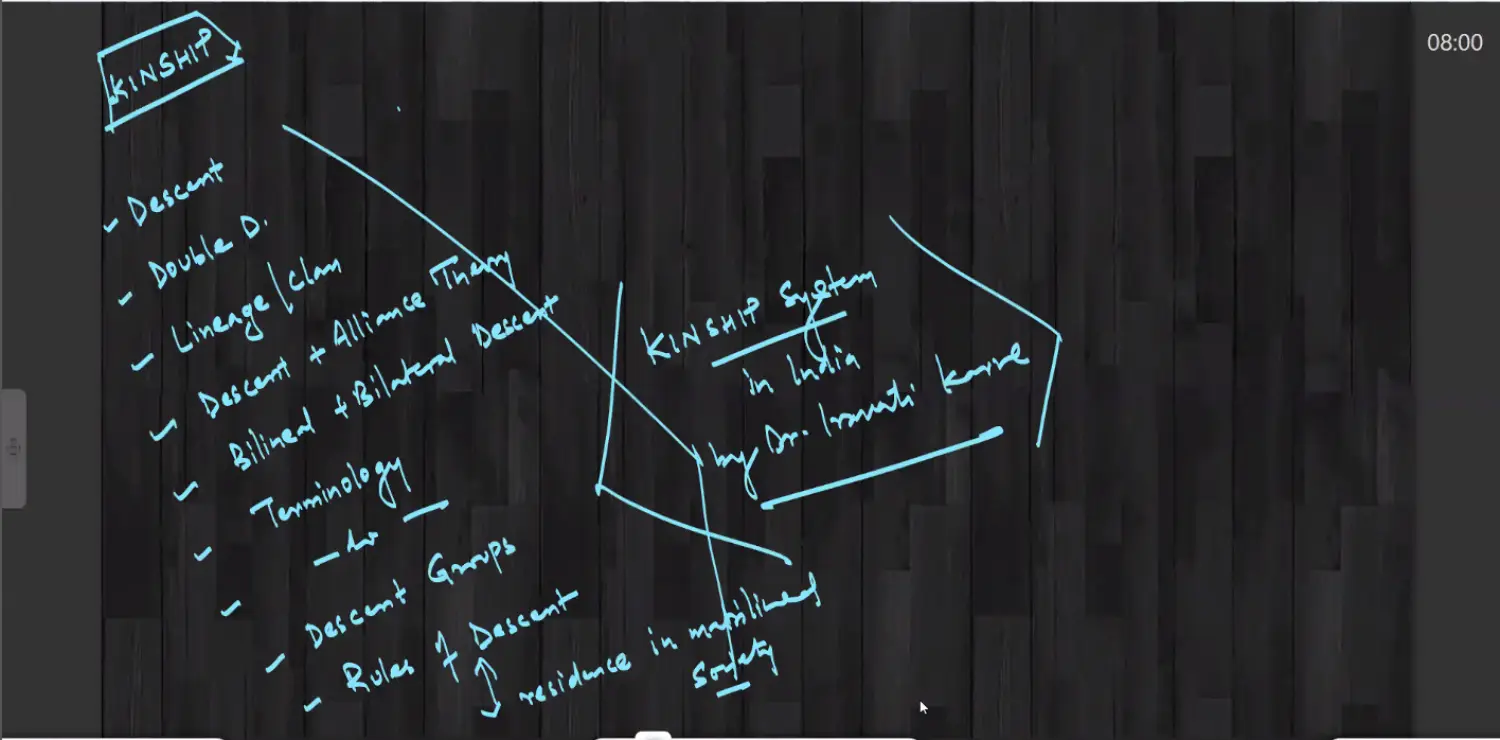
What do we study in Kinship ?
- How the Relations are made ?
- Which Relations are more important ?
- What are the terms used for various relationships ?
What is the Difference between Kinship and Genealogy ?
Genealogy is a type of Lineage and Family Tree which can be part of Genealogical Studies
Kinship doesn't start from our forefathers but from the person in present. Hence we can say that it is more focused on the present relationships
British Social Anthropologist Robin Fox tried to differentiate between Genealogical and Kinship Studies
He was Studying Tory Islanders, North West of Ireland. Here he came up with the approach that the study of lineage should not be limited to either Genealogical or Kinship Studies
He Stressed upon the interconnectivity of Genealogical and Kinship Studies
What are terms used in the study of Kinship ?
- Centre point of study is called an “Ego”
- It is based on primarily based on two things
- Family of Orientation - Relations Individual has
- Family that you take birth in
- Family of Pro Creation - Relations Individual acquire
- Family that you make
- Family of Orientation - Relations Individual has
What are the various Definitions of Kinship ?
Radcliffe Brown
Kinships Terms and Ties are signpost of Interpersonal Conduct
C L Strauss
Macklinen
What are the types of Kinship ?
Blood Relations (Family Orientation) - Consanguineous Relations
Detail
Those who share the Common Blood and Common Ancestors
- Grandparents
- Parents - Father Mother
- Kids
- Siblings
Criticism of Definition of Consanguineous Marriages
Talking from Biological Perspective, Common Blood is not a very defined term
Rather to be scientifically correct we could say Consanguineous marriages have common / matching Genotype
Adopted Child is
A Socially Consanguineous Realtions
But not a Biologically Consanguineous One
Ego
Ego is an individual for whom the Kinship relationship are being studies
Marital Ties (Procreation) - Affinal Relations
Those who come in relation due to Marriage
- Father & Mother in Law
- Other In Laws
What are the symbols used in Kinship Diagram ?
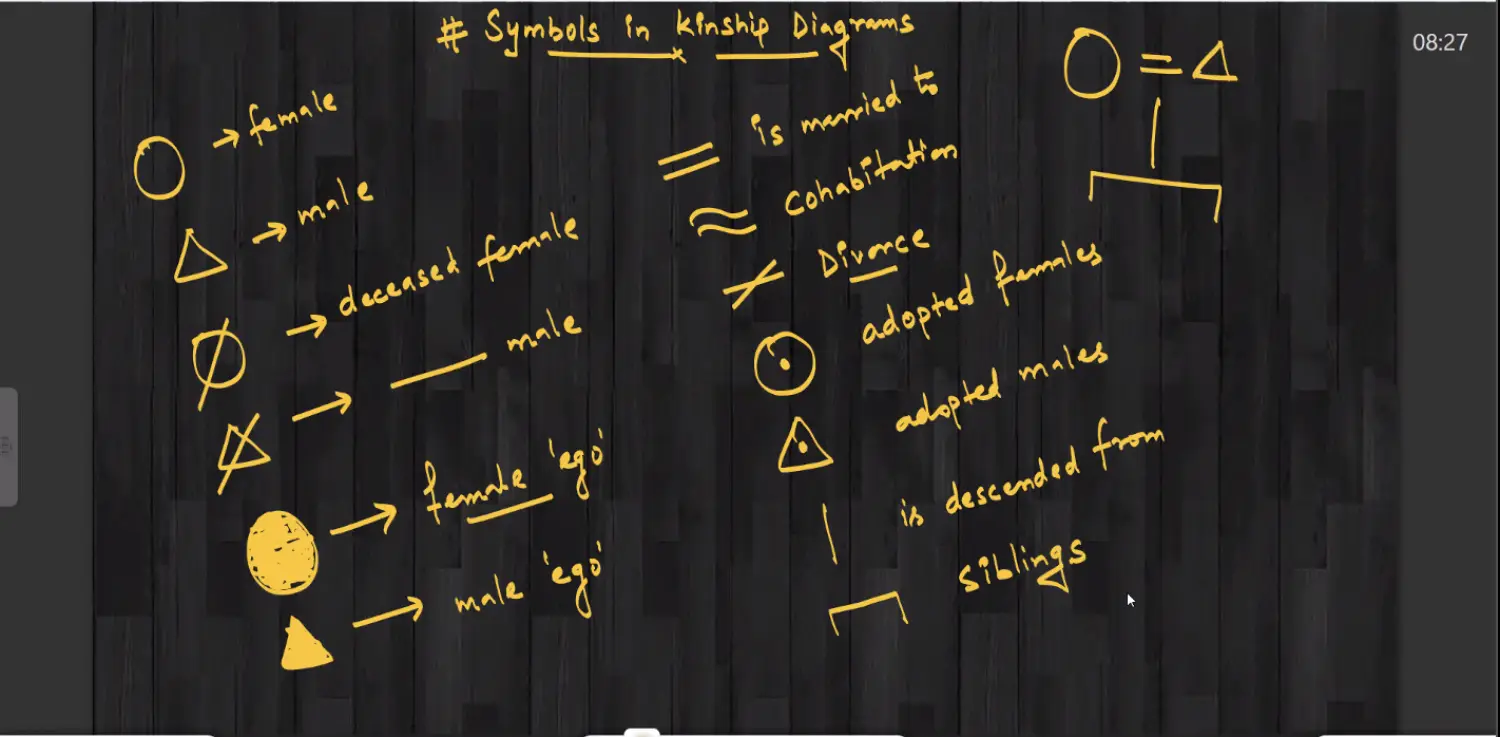
What are Principles of Descents ?
What is Descent
Kinship Ties acquired through Parentage
Line of Descent is a series of relations, where one is born from the previous one
These can be either Patrilineal or Matrilineal Societies
Principles of Descent 1
Distribution of Descent System is Different in Different Societies and is mainly governed by Production and Consumption patterns prevalent over there
Mainly, Hunting Gathering or Savagery is associated with Patrilineal Descent System
Horticulture Societies have evolved to be a Matrilineal System
Principle of Descent 2
Descent acts as means for an individual to
- Assert the Rights
- To fulfil duties
- Certain Privileges associated with Descent
- Generally, a Status attached with a Descent
What are the Types of Descents ?
Mind Map
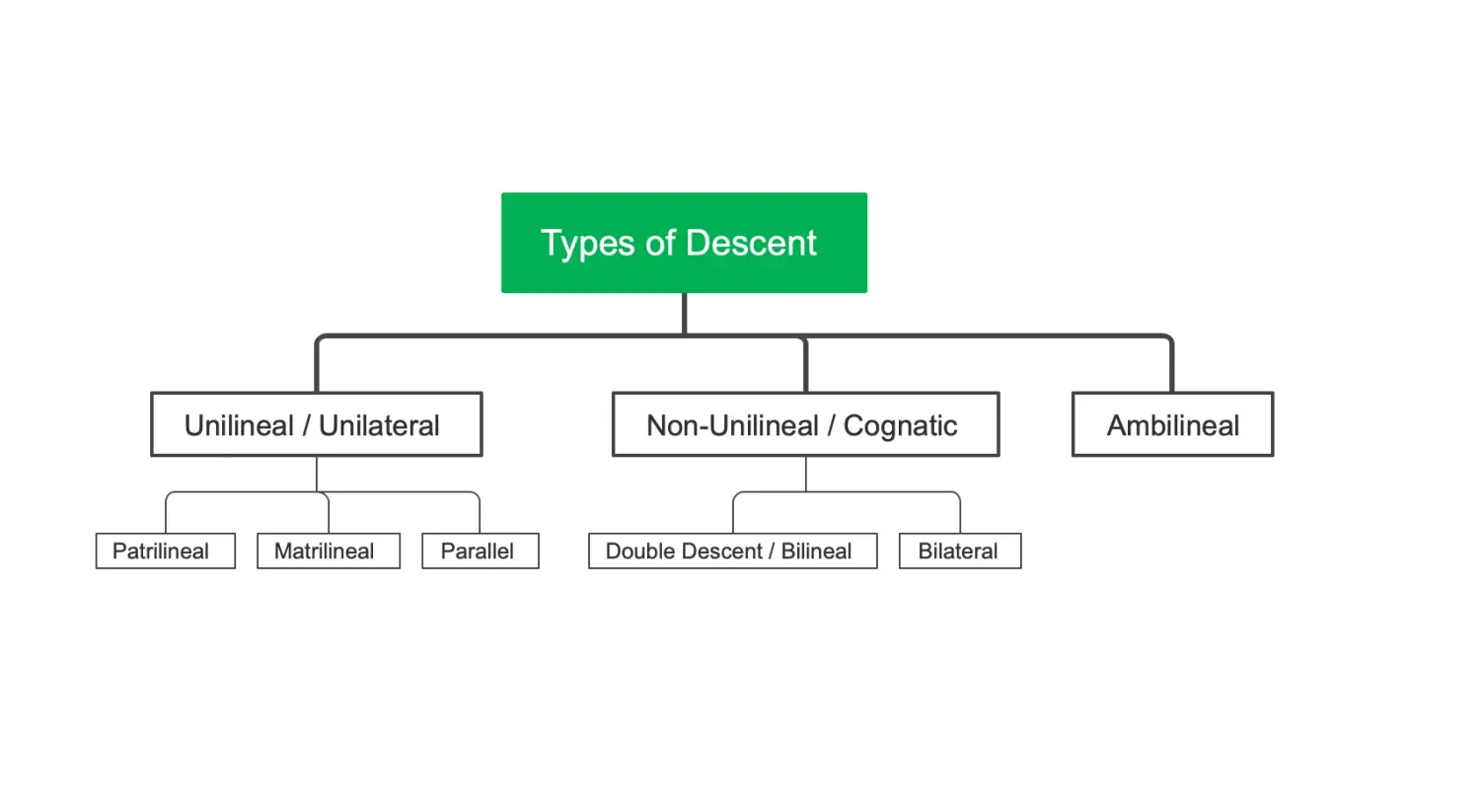
Unilineal Descent : Patrilineal OR Matrilineal Descent
- It is also called Unilateral Descent
- It is more common in Non Western Societies
- This Type of descent gives Membership Acquired by Birth
- Studying a Descent Group or an Individual based on One Line (NOT Both)
This one Line can be, either
- Male Line - Patrilineal Descent
- Male Socially and Culturally Significant
- Males have decision making power
- Females Line - Matrilineal Descent
Females are Socially and Culturally Significant
Both Males and Females have decision Making power
The Male is NOT Father or Husband of Ego
But More Say and Power is of Females
- Male Line - Patrilineal Descent
Two Types of Descent Groups are formed due to these descents
In Any of Patrilineal or Matrilineal type of Unilineal Descent, Two Measure Types of Descent Groups are formed → Lineage and Clan
Lineage
Lineage within a Unilineal Descent Group are all descendants of a common ancestor or founder who lived four to six generations back. The Kinship Ties amongst the members can be exactly stated based on genealogical studies
Clan
A clan is an extended form of unilineal kinship group having multiple lineages whose members claim a common descent from some remote ancestor usually some legendary, charismatic and mythological figure
For Example Individuals in Bheel Clan consider themselves as descendants of Goddess Parvati
Types of Unilineal Descent are
Patrilineal Descent - More Common
Male Lines
GGF → GF → F → Son+Daughter
Example:
- Munda Ethnic Group
- Santhals
- Non Tribal in Max Parts of India
- Hans of China
- Yoruba’s of Nigeria
Matrilineal Descent
Mothers Lines, Women have the considerable power but not exclusive authority, generally brothers share the authority
Not Husband or Father
Mainly Started with Horticulture Societies
Examples
- Mosuo of China
- Many North Eastern Tribes Especially Khasis of Meghalaya
- Trobriand Islanders
- Nayars of Kerala
Parallel Descent
- Very Rare form of Descent in which males reckon their descent from Male Lines and Females reckon their descent from Female Line
- “Sahas of Colombia” studied by Jana Safer are the only known example of parallel descent
Bilineal Descent : Patrilineal AND Matrilineal Descent
- Introduction
- It is also called Cognatic Descent
- Non Unilineal is based on descent from both the Lines, it is less Prevalent and is not well defined based on the membership that is whether patrilineal or matrilineal
- There are Two Types of Non Unilineal Descent
- Bilineal / Double Descent
- Example
- Yako’s of Nigeria
- Toda’s - By Means of Buffalo Economy
- Buffalo - From Matrilineal
- Grass Pasture & Land - From Patrilineal
- Jo / Ju / Hoansi of Kalahari
- G P Murdock Views
- Other Anthropologist Says that this is very less Prevalent
- Whereas G P Murdock said roughly 1/3rd of Society follow this
- This was an opinion contrary to max anthropologist & G P Murdock said that these can be understood through in depth understanding through various culture
- Example
- Bilateral
This Descent is Horizontal
Here Father and Mother Equally Important and Unimportant for a person
There relations are only visible for some point of time for a year
Due to these Ceremonies, Marriages, Functions, they celebrate the common ancestors
Example: Chipewyan of Subarctic Canada
Kindred - That Particular Group or Relative who are called for some specific purpose
Here There is only one Generation under Study
When Bilateral Descent is being followed Societies are not observing vertical or lineal descent groups.
Here the Reckoning of Kinship is Horizontal like Kindred including Bilateral set of Relatives
Kindred is a kind of Social Security in Adverse Situations
Here focus is more of Achieved Status
- Bilineal / Double Descent
- Introduction
Ambilineal Descent
- It is based on Choice that you want to take surname and inheritance from
- Fathers Father
- Fathers Mother
- Mothers Mother
- Mothers Father
- Here it is a choice of being in a particular descent
- Example : Samoan Islanders
- It is based on Choice that you want to take surname and inheritance from
What are the Forms of Descent Groups
Relation
Moieties have Phrateries, Phratries have Clans, Clans have Lineage
Relation between Moiety & Phratry
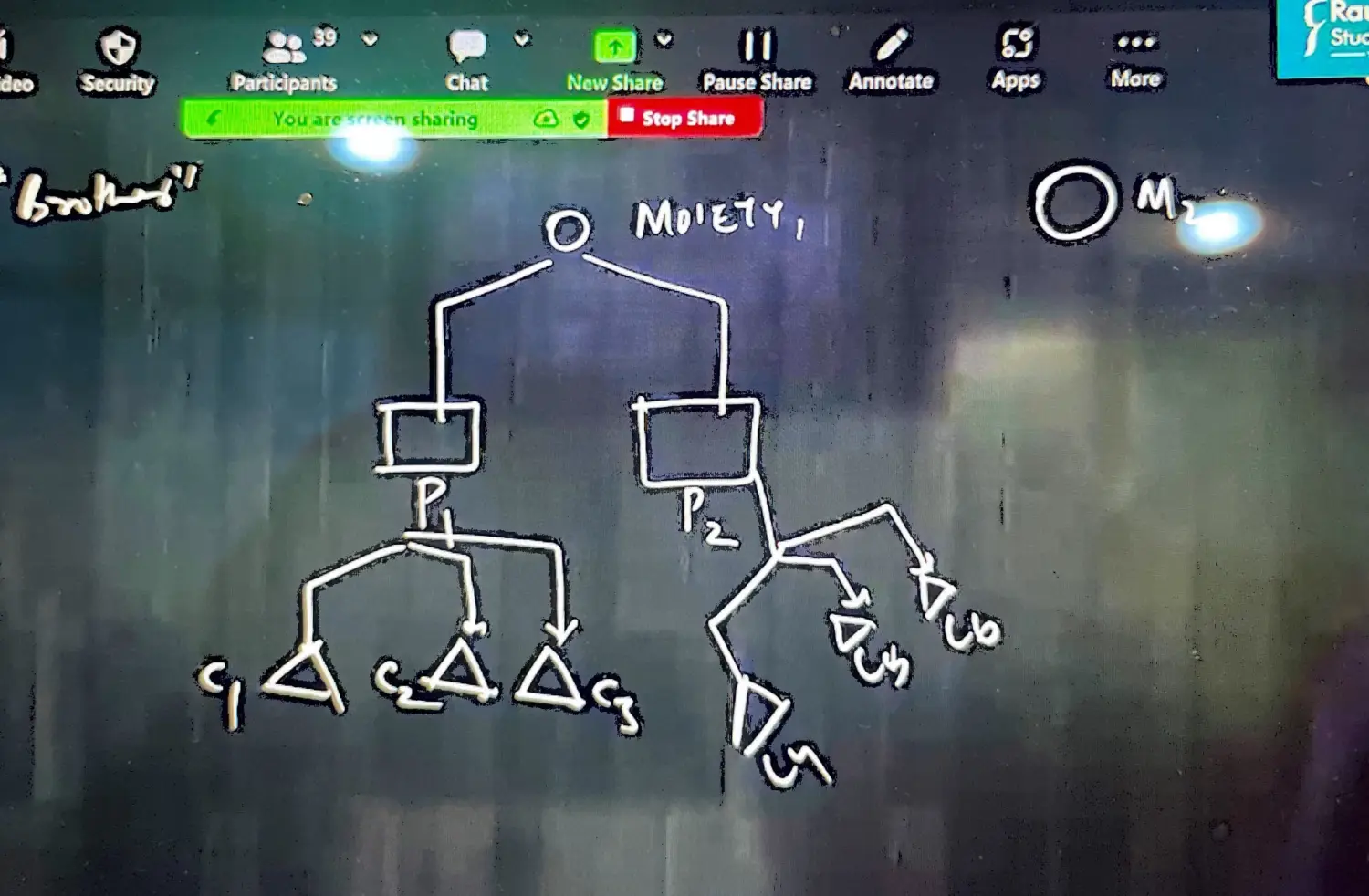
In Order
- Moiety - More Heterogeneous Term with Homogenous Phratry
- Its a French Term Meaning One Half. Hence, Moiety means having broadly two descent groups
- Moieties are two broad groups within One
- Example : Two Different Moiety of
- Todas - Teivali & Tarthars
- Teivali’s are Fully Matrilineal like Traditional Todas
- Tarthars have matrilineality based on situation
- Ahl e Bait - Hasani & Husaini - Self Example
- Monsangs of Manipur
- Todas - Teivali & Tarthars
- Here one Moiety is Toda
- But they cant tell that how they reached upto these division
- People of India Project - More than 60 Moieties are there in India Most of them are from North East
- Phratry - More Heterogeneous Phratries with More Homogenous Clans
Phratry Means Brotherhood. They are Examples of Near by Groups having Brotherhood
Phratry is a Unilineal Descent Group having multiple clans in it
Members belonging to different clan within the same fratery are having more closeness as compared to members of different clans under another fratery within the same Moiety
Classical Example of Phratery in India
- Muria Gonds of Central India - When Some Phrateries Dies, they don’t cry, as they consider they have gone to their phrateries
These Phratries are called as Vansh
5 different examples of Vansh are
- Naag Vansh (Snake)
- Kachim Vansh (Tortoise)
- Bagh Vansh (Tiger)
- Bod Vansh or Bod Mink (Fish)
If a person is belonging to any of these frateries, they cannot hurt, hunt, kill or consume these Phrateries
Examples India
- Ao-Nagas of Nagaland
- Rahas of Assam
Examples World
Hopi Indians - This is ONE Phratry within their Moiety
They have Phratry within them
Crow Indians
Cree Indians
Types
- Matri Phrateries
- Patri Phrateris
People of India Project Studies Around 150 Phrateries in India
- Clans
- Clan is typically consisting of multiple lineages that is an extended unilineal descent group whose members claim common descent from some distant ancestors who can be a legendary, mythological figure or a charismatic leader.
- All Clans will be having Similarity within Common Larger Groups
- They have some sort of common geographical nature in larger area
- They have common heritage, way of survivals, rituals
- Some will have Clan Endogamy or Exogamous Clans
- Cohesion - They Merge At
- Religious Cohesion - They may have different sources
- Political Cohesion - Yaad Rakhne ke Liye, Caste Based Voting
- Examples World
- Winnebago Red Indians is an Indian have 12 Clans
- Teivali has 12 Clans
- Tarthars has 6 Clans
- Examples India
- Lineage
Introduction
A Unilineal Kinship Descended from a Common Ancestor / Founder who lived 4 to 6 Generation ago where relationship amongst others can be described in genealogical terms
There can be different minor lineages within a larger population which may combine to form a major lineage
There can be different segments of a broader lineage
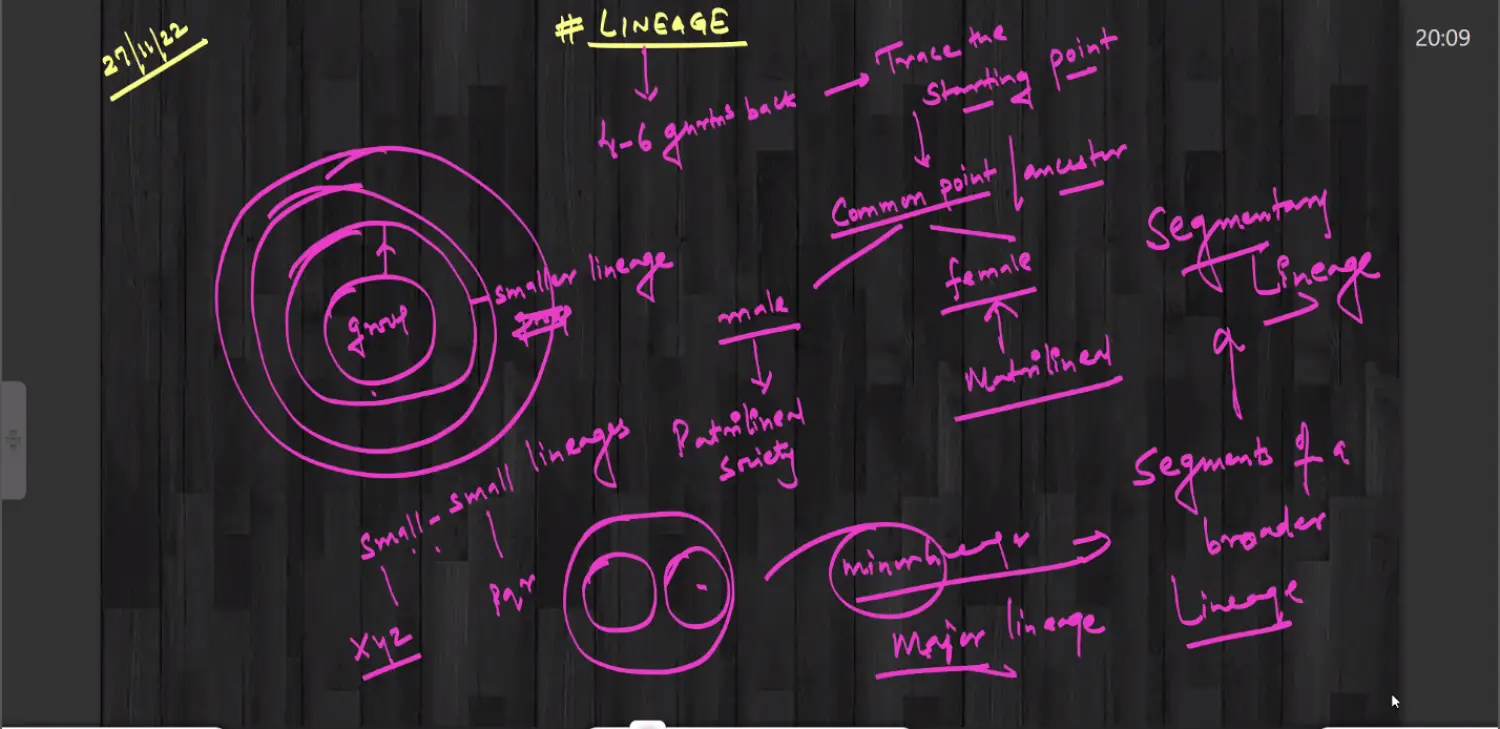
Concept of Purity and Pollution in Lineage
If Exogamy is followed in Lineage, It can add up polluting characteristics, which will disturb the birth and death cycle
If Sanctity and Purity is maintained through exogamy, ideal birth and death cycle will continue.
Various Features on Lineage
According to Mayor Fortis Lineage as a Miniature Society
According to Evans Pritchard Lineage is a Egalitarian System Securing Survival of Individual and Groups. This can be
- Patrilineage
- Nuers of Sudan
- Witoto Red Indian of America
- Matrilineage
- Khasi
- Garo
- Kuki
- Nairs of Kerala
- Patrilineage
As a Psychological & Social Unity
Members are united through a common mental framework that we belong to a particular lineage
As a Medium of Security
- Social Security
- Economic Security
As a Unit of Co Operation
Members work & fight together
They face the adversities together
Segmentary Lineage
Introduction
When Larger Unit of Lineage can be further sub divided into smaller Lineages, it is called Segmentation of Lineage
Schema
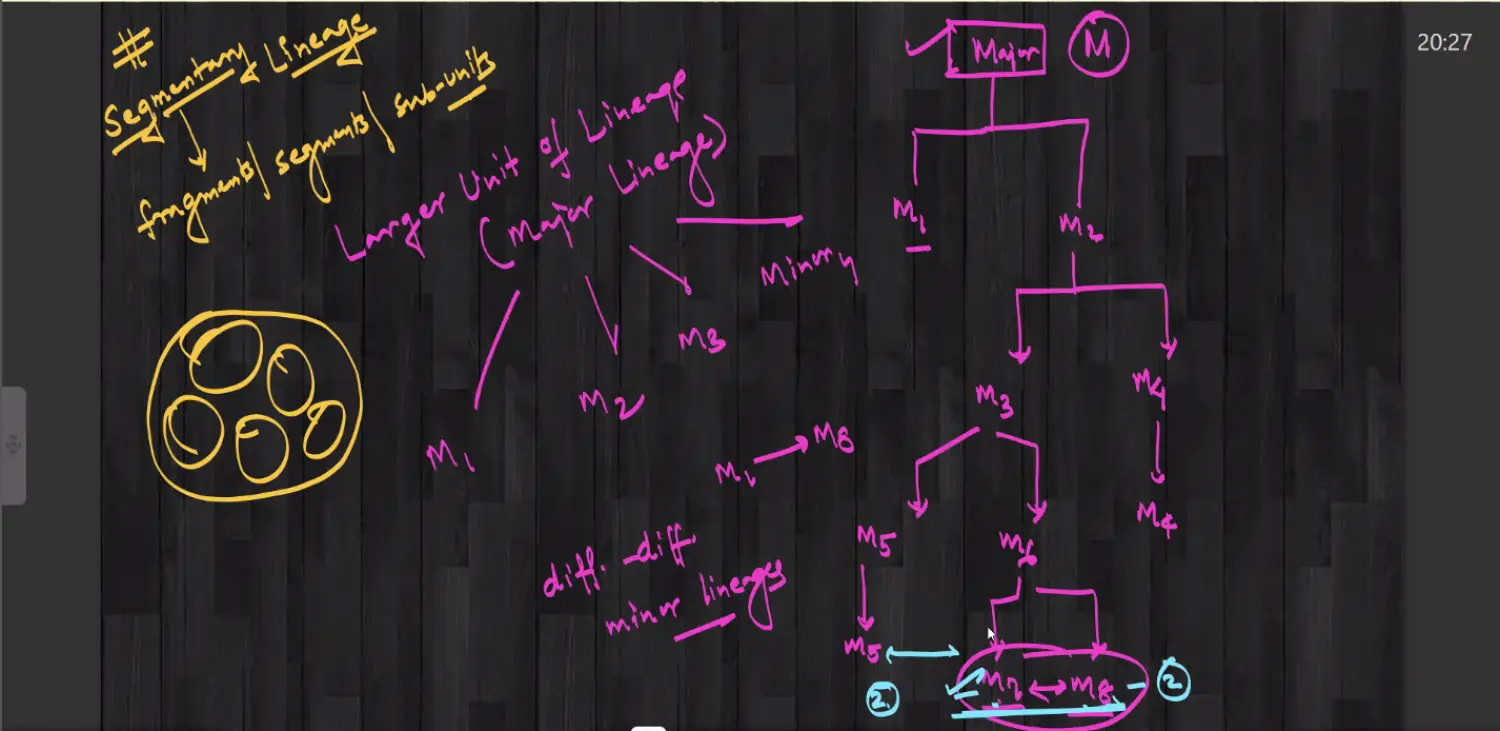
Concept of Segmentary Lineage
Segmental Lineage Organisation is based on the principle that genealogically closer groups can come together when they have to fight / oppose a more distant group or lineage
Features of Segmentary Lineage
Security System for its members
Acts as a Defence Force, against another groups
They share a collective responsibility of resources
For Example : Grasslands and Water Reservoirs in Nuers of Africa
Conclusion
Segmentary Lineage in Nuers of Sudan studies by Evans Pritchard is one of the most classical example of a decentralised and egalitarain segmental lineage system
Descent, Filiation & Complementary Filiation
Concept of Filiation
Introduction
Filiation is a Connection or Bond between Successive Generations.
For Example, Parents connected with Kids
Grandparents connected with Kids
Schema of Filiation Studies
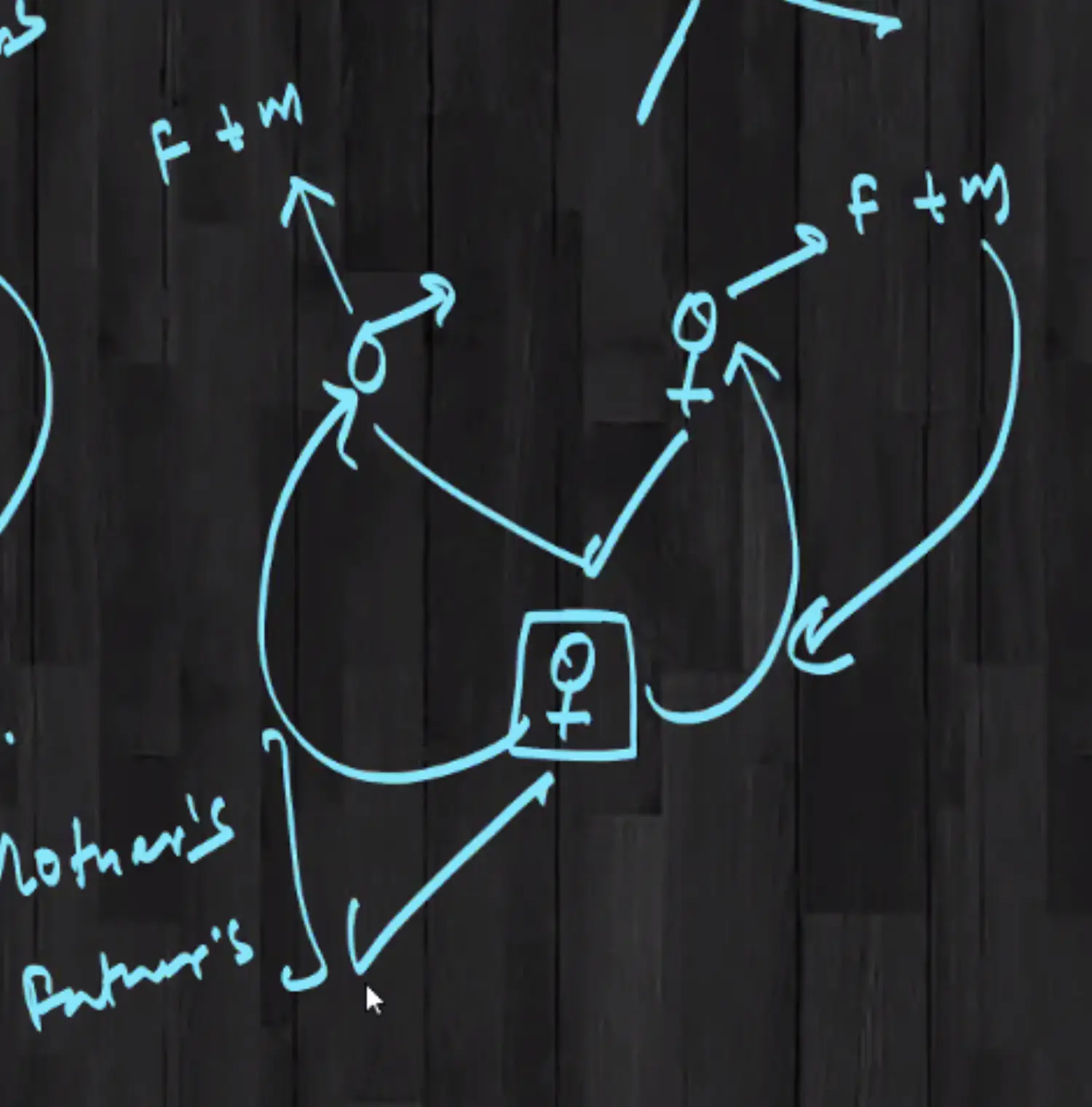
Important Point
In Filiation Studies, No Matter if its a Patrilineal or Matrilineal Society, there is no differentiation between Patrilineal and Matrilineal sources
A Grandkids, connection with here Dada Dadi and Nana Nani will be considered to be same w/o any system for MatriLineal or Patrilineal Connection
Concept of Filial Bond
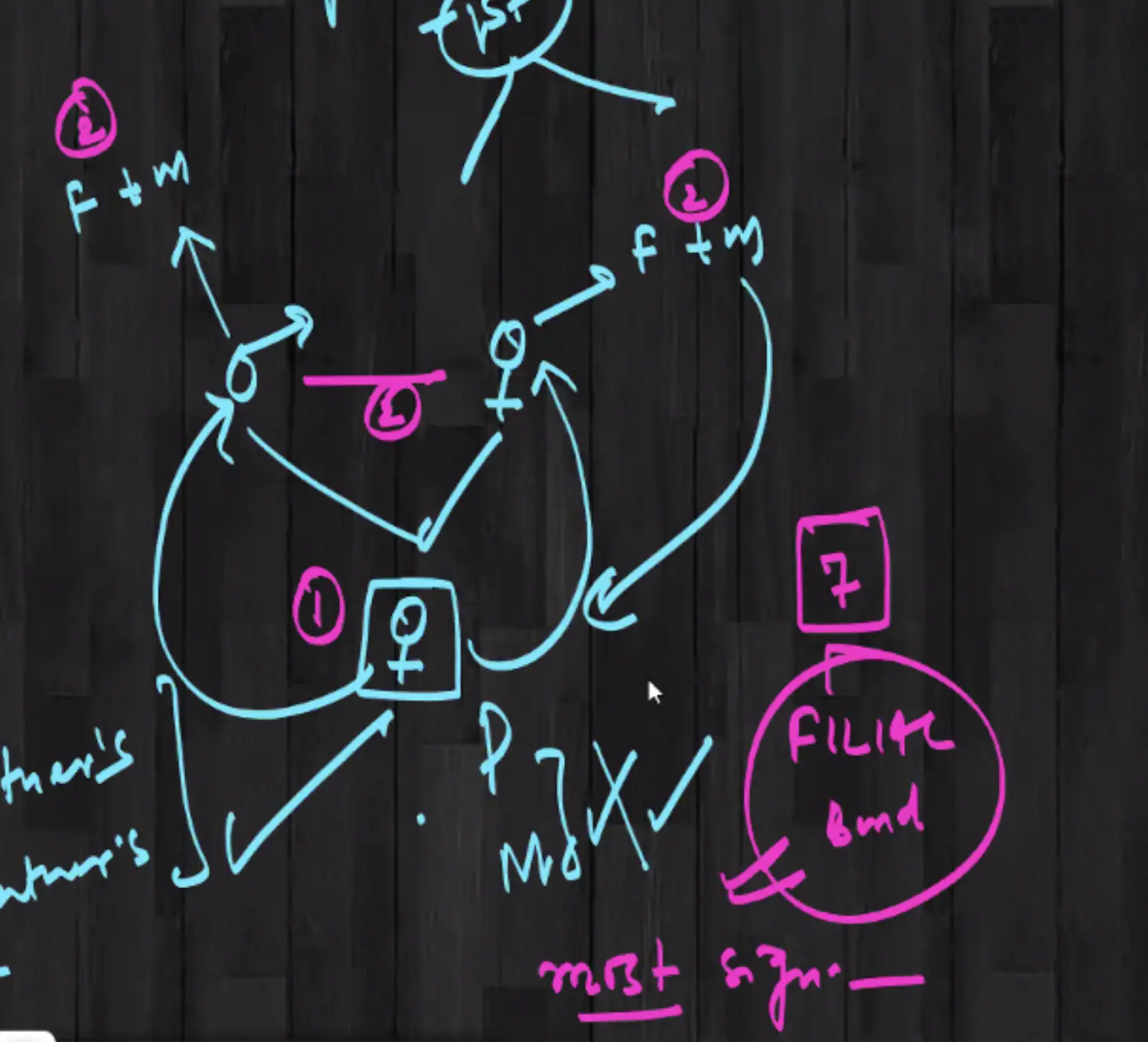
Who are Filial Bonds
For a Person Including Him(1) + His Siblings (x)+ His Parents (2)+ His Dada Dadi (2)+ His Nana Nani (2) → They are Filial Bonds
Concept of Complimentary Filiation
Schema
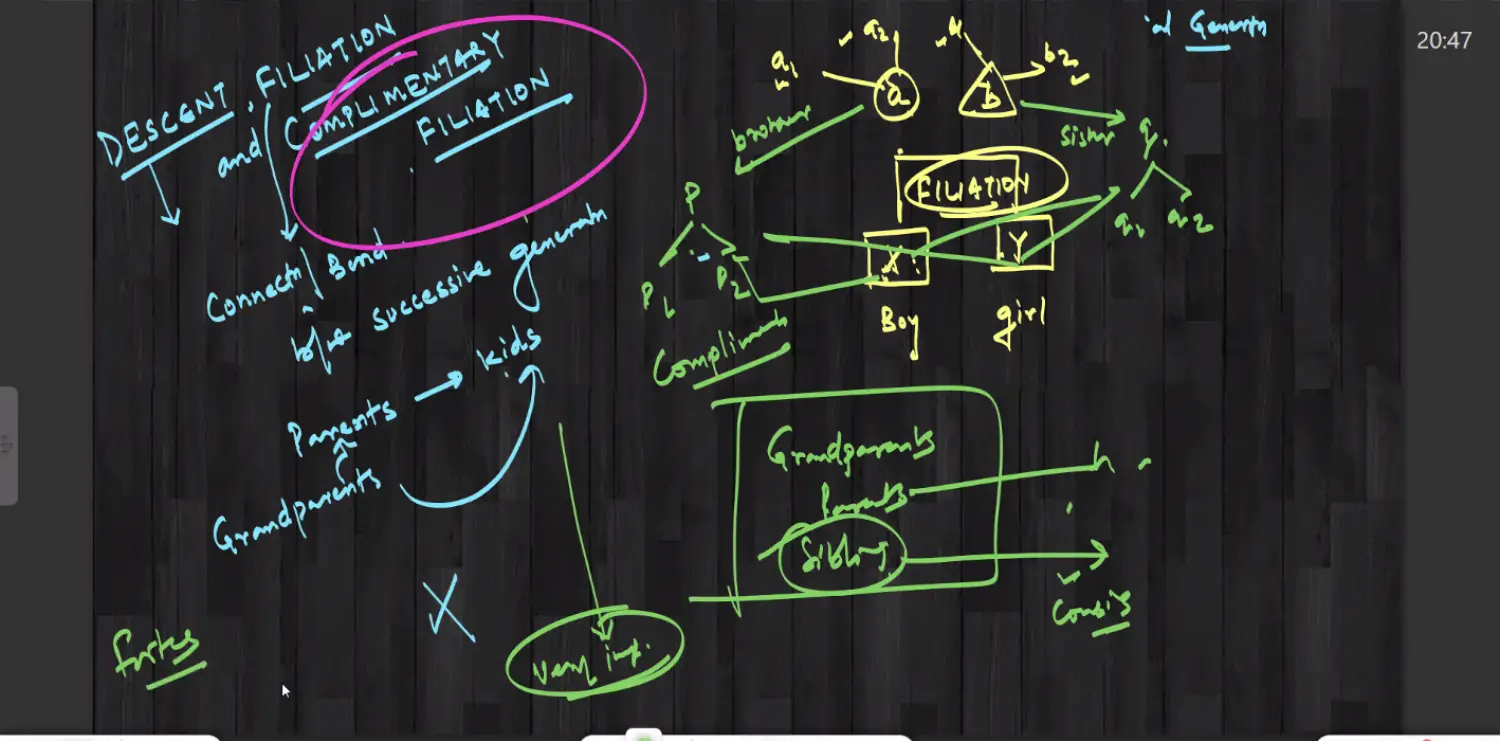
Explanation
Other than Siblings, Parents, Grandparents (Maternal+Paternal → 4)
Other than them, all will be considered as Complimentary Filiation
All Green Colours are Complimentary Filiation where as Yellow Bonds are Filial Bonds
Example
Tallensi of Ghana
Political Connection → by means of Filiation
Emotional & Personal Connection → by means of Complementary Filiation
Descent Theorist of Africa
All the Anthropologist who studied Complimentary Filiation Studies led by Mayor Fortes are called as Descent Theorists of Africa
Patri Filiation and Matri Filiation
Note
- In Matrilineal - Fathers Line is Ignored
- In Patrilineal - Mothers Line is Ignored
Dictation
Patri Filiation can be considered as an extension of patrilineal society only in the context of transfer of responsibilities, authorities, status etc
as an Extension of Matrilineal Society, but there is a difference at the level of comparison of Patri Filiation and Matri Filiation
The Filial Bond is Same within both the Lines and is of Equal Importance
Kinship Terminologies as a Basis of Classification
This can be a 20 Marker Question
Introduction
L H Morgan was one of the first Anthropologist to recognise various kinship terms as basis of classification.
It means that you can give various societies as being similar or different as the terms used for Terms of Terminology
Schema
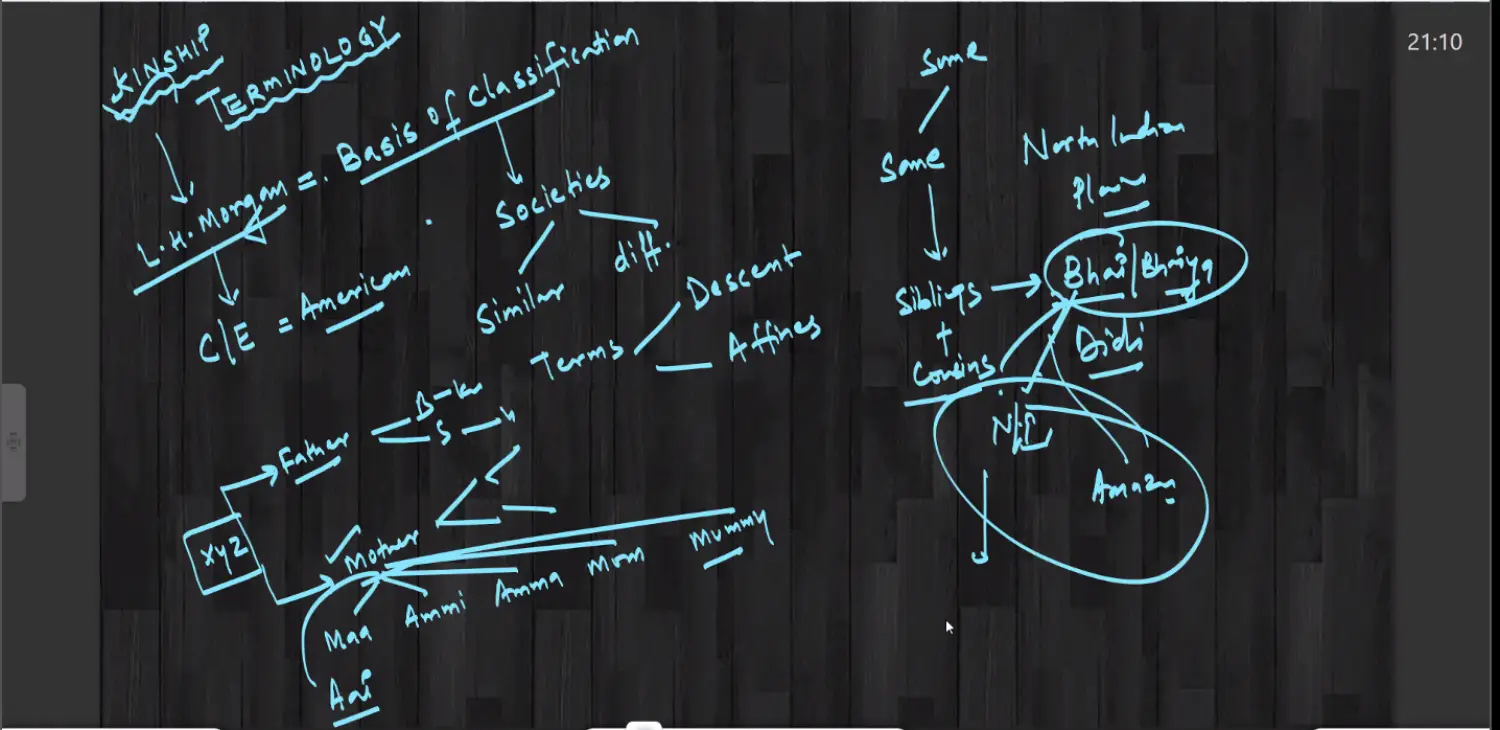
Morgans Method of Kinship Terminology Classification
Introduction
Classification based on Kinship Terminology gives an Idea about Similarities and Differences about Managing Kinship Ties and those societies and these societies following same pattern of terminology can be put together.
L H Morgan said that there are two different ways to establish this terminology
Classificatory System
- One Term for Multiple Relations
- One Term for More than One Type of Kin
- Either for Same Sex, Same Age Group, Same Generation
Descriptive System
Every Kins Relationship is Designated by a Different Term
Like Father Brother will be having different term
Like Mothers Sister will will be having different term
Like Mother Brother will be having different term
Morgans view of Evolution on Kinship Terminologies
Criticism of Morgans View
WHR Rivers View
Rivers considered Kinship Terms arising from some marriage principles, some forms of marriage practises.
even if these principles and practises are vanished kinship terms stayed
Hence these terms can be now used to study about those marriage principles and practises.
G P Murdock Classification of Kinship
Introduction
He used three types of Criteria to classify major systems of Kinship Terminologies.
He gave the most elaborative scheme of Kinship Terminologies
Concept of Classification
He gave 3 Types of Determinants, based on which there are 5 or 6 major types of Kinship Terminology Systems
Some Consider Omaha & Crow as separate → 6 Types
Some Consider Omaha Crow as same → 5 Types
Three Types of Determinants are
Mind Map
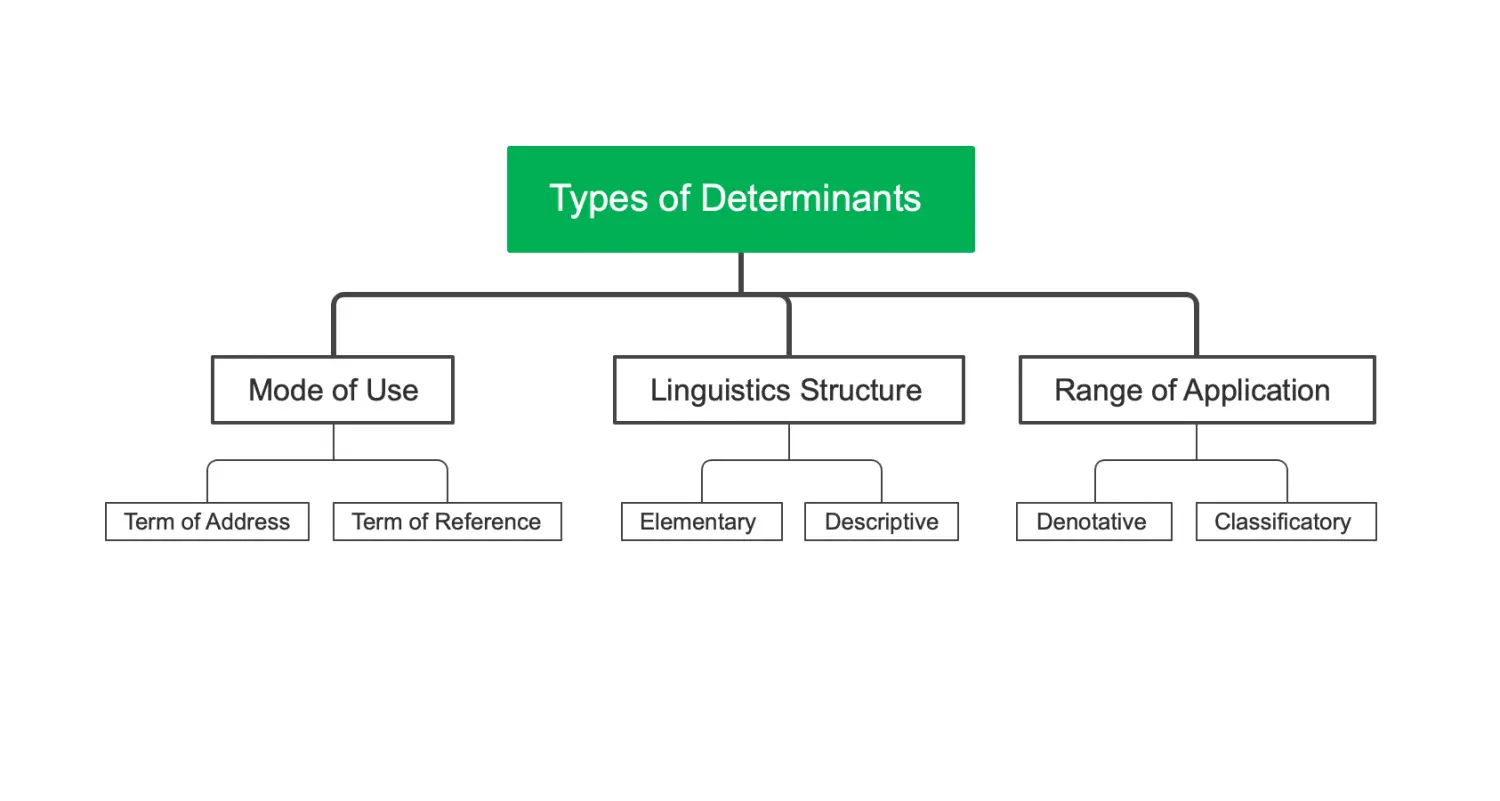
- Mode of Use
- Term of Address - Directly Addressing the Person → You, I, Us
- Term of Reference → Third Party → He, She, They & Them
Linguistic Structure
Elementary Structure
Which cannot be broken down Further
Example
- Father
- Daughter
Descriptive / Derivative Structure
Which Needs to be Derived or Further Described
Example
- Grandfather - Paternal / Maternal
- Step Daughter
Range of Applications
Denotative Term
Can be used for Relatives of Same Category
Examples
Brother
Sister
Classificatory Term
Can be used for Relatives of Two or More Categories
Examples
Uncle
Grandfather
Six Major Systems (Global Classification)
It can be
Omaha and Crow
Omaha and Crow Terminologies are almost mirror images of each other found in different parts of the world.
The only difference is that Omaha terminology is mainly used in patrilineal descent
Crow Terminology is mainly associated with Groups of Patrilineal Descent
Thats why sometimes they are mentioned together as Omaha Crow Terminologies
- Omaha System
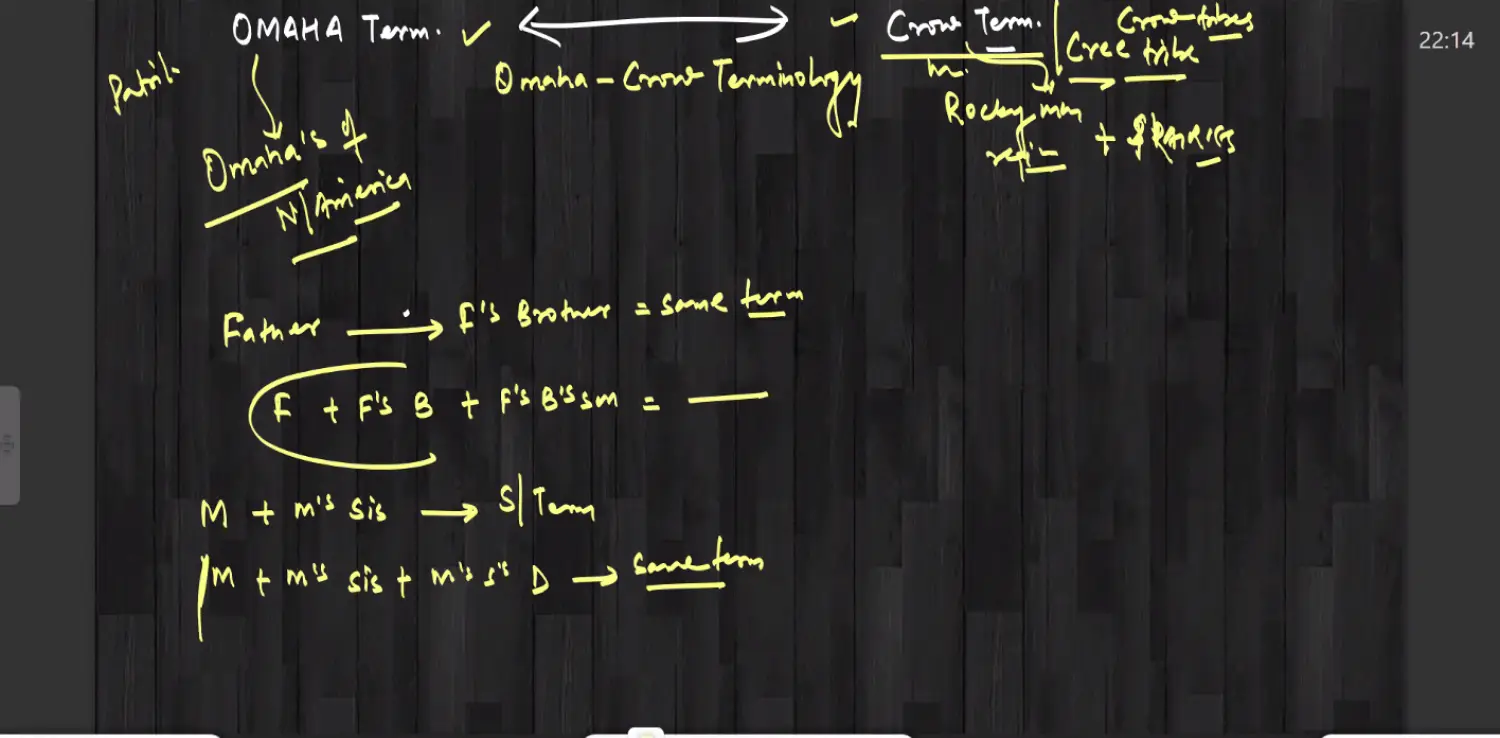
- Name Based on Omahas of North America
- Examples
Omahas of North America
Sumi Nagas of Nagaland
They use the Term INGU for both Mothers Brother and Mothers Brother Son
- Crow System
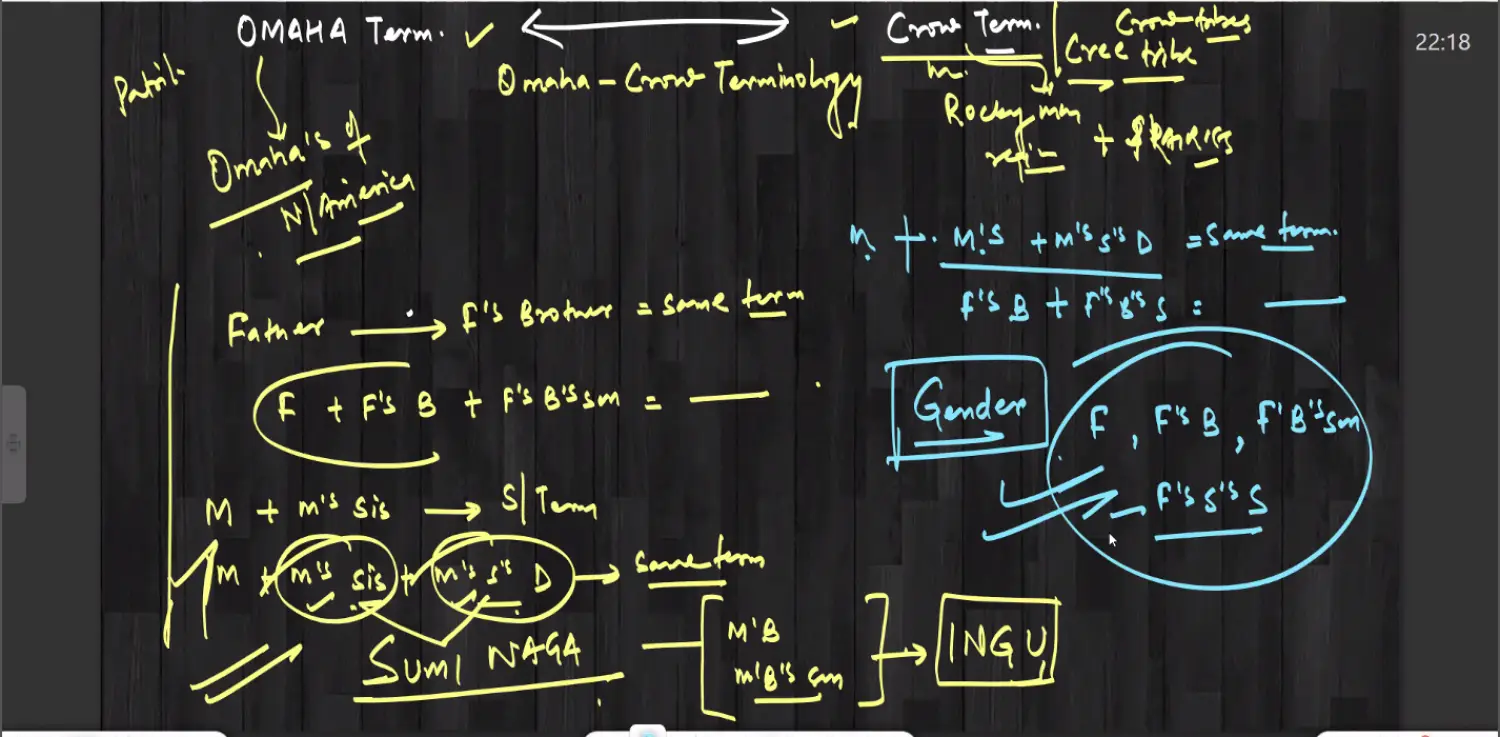
- Name Based on Crow & Cree Indians near Rocky Mountains and Prairies
- Blue One is Description of Crow System
- In Omaha Crow Terminology usually a Same term is used to Address all the male members on father side or all the female members towards mothers side
- For Examples
- Father
- Fathers Brother
- Fathers Brothers Son
- Fathers Sister Son
- All these Male Members will be addressed with the same term
- Examples
- Ab Origins of Australia
- Amazonian Tribes
- Hawaiian System
Fathers Brother = Mothers Brother
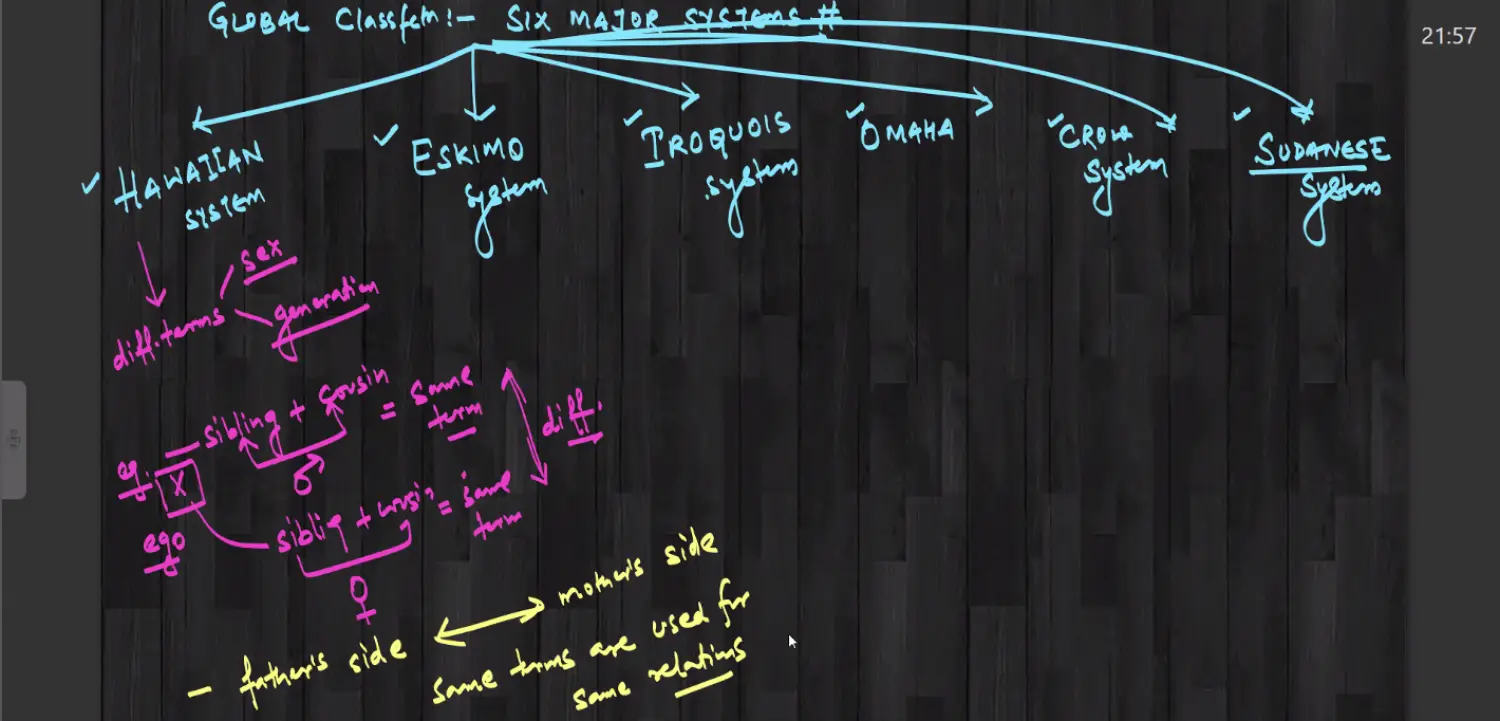
Examples :
- Hawaiian Polynesians
- North India
- Bhai / Bhaiyya - Brother for Real or Cousin or Sibling Tribe
- Didi - Sister
- Zeme Tribe of Assam and Manipur
- Asi - All Brothers, Sisters & Cousins of Ego will be called Asi
- Now it is considered as Hawaiian Type as earlier there was different term for these which is now merged into one
Eskimo System
Involves use of both Classificatory and Descriptive Terms
It is found in less numbers in the world
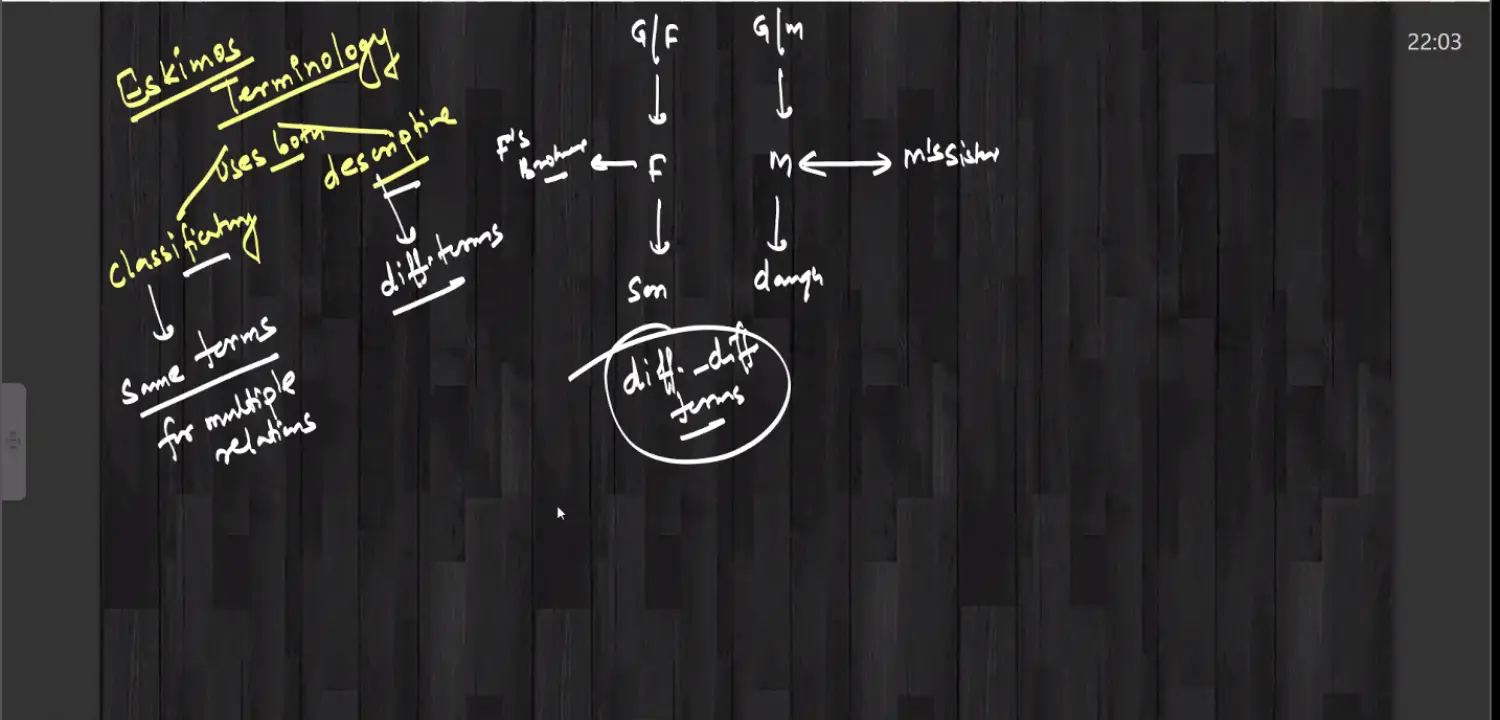
Example
- Inuits
- Eskimos of Sub Arctic Region
- Iroquois System
Can be considered as an extension of Omaha Crow Terminology with certain additions and modifications
Examples
- Ao Nagas of Nagaland
- All the Boys - Oti
- All the Girls - Oya
- Various Chinese Tribes or Rural Chines Populations use this system
- Sudanese System
It is the most descriptive system, there are different terms for different relations and positions
Examples
- Trobriand Islanders
- Norther Plains in India for Parental Generations
Conclusion & Criticism
G P Murdock gave one of the most elaborative classification for Kinship Terms which is used in different disciplines
Various Anthropologists criticised Murdock for focusing mainly on simple small scale societies but even after criticism Murdock’s classification is one of the most elaborative system for kinship terminology
Descent and Alliance Theory
Descent Theorist
- Theorists are
- Proponents of Descent
- Led By
- R Brown - Andaman Islanders
- Jack Goody
- Meyer Fortes - Tallensi of Ghana
- Further Supported by
- WHR Rivers - Todas
- Led By
- Proponents of Alliance
- Levi Strauss
- Proponents of Descent
- Concept
Descent + Transfer of Everything + Elements of Consanguinity
Lineage is like a Corporate House where people hold resources and collectively maintain the resources
As a Member of Lineage, they are followers of Incest Taboo
Here Marriage is an outside Phenomenon
As such it is not required for Kinship
It came out of as a result for Incest being Taboo
They called Marriage to be Ephemeral, meaning it was for short lived period of time, and it was secondary
But Alliance theorist emerged in response to descent theorist
- Theorists are
Alliance Theorist
Theorists are
Levi Strauss
Book: “Elementary Structure of Kinship”
Dumont
Needham
Leach
Concept
It emerged as a response to Descent Theorist
They said that proposition of descent theorist is confined to african societies
They Proposed that Australoasians, South East Asia, Latin Americans is not at all Ephemeral and stays for Longer Periods of Life Cycle
We Can Give Example of Indian Society for Non Ephemeral Permanent Marriages of Alliance Theory
These Theorists Gave Examples of Kachin Province of Burma
- Polygamous Marriages are Prevalent
- Brides (Dulhan) Family is of Higher Status than the Grooms (Dulha)Family
- In Kachins of Burma, Marriage can be in one form only
- Its unidirectional but permanent
This Marriage Arrangement in Kachins will lead to a formation of Lineage
Alliance Theorist Argue that Marriage is a Structural Principle
Hence, Based on Marriage a Lineage will be formed, thus alliance theorists proved that marriage is a structural reality
They Negated the Descent theorists that Lineage was Primary and Not Marriage
Strauss Alliance Theory
- He propounded this theory in his book “elementary Structure of Kinship”
- Levi Strauss termed incest taboo as cornerstone of society
- Is based on Incest Taboo such that if society is a fact then Incest Taboo is a pre social fact
- When a Person understood that he cannot marry his sisters
- Sister exchange took place, by means of marriage which in turn led to evolving of society
- Sister exchange is a kind of positive rule of marriage
Conclusion
There is a Difference in the Approach of Descent and Alliance Theorists in a way that
Descent Theorists Accepted Primary → Descent and Lineage as Primary Secondary → Marriage as Secondary or Ephemeral
Alliance Theorist Accepted Primary → Marriage as Central Point revolving around incest taboo which can be supported by Lineage Systems
Hence, Alliance Theorists Did Not reject lineage as factor of Kinship or Soci
Two Models of Structure of Kinship based on Alliance Theory
Closed System (Elementary)
Introduction
Levis Strauss Argued that Cross Cousin Marriages which are prevalent in Maximum Parts of the World are to create a Balance between Daughter Providers and Receivers
Cross Cousin Marriage was considered as one of the most elementary form of closed system marriages
This Closed System Marriage was divided into two types
Symmetric (Restricted)
Kind of Bi-Lateral Cross Cousin Marriages
Asymmetric (Generalised)
Examples : Kachins of Burma have 5 different members of the groups
Open System (Complex)
Strauss used the term Alliance with Other Groups, Alliance based on Marriage will also lead to social cohesion
This cohesion is used to minimise animosity & Increase Solidarity
Kinship System in India by Dr Irawati Karve
She talked about the Kinship System in India in her Book: Kinship Organisation in India
She divided India into 4 Different Cultural Zones based on Kinship Ties
Northern Zones
Central Zones
Central India Maximum Parts + Some Parts of Western India + Some Parts of Eastern India
Southern Zone
Eastern Zone ( Actual North East India)
Some Parts of Eastern India + North Eastern India Maximum Parts
This Division was based on Three Concepts / Basis
Linguistic Regions
There can be Linguistic Divisions and they can deviate
She gave Example of Maharashtra → Marathi or Gujarati are Sanskritic Language but in Maharashtra Kinship Ties are More Matching with Southern India
Caste
She Said → Caste is Hereditary, Its Endogamous, Caste is Restricted to a Linguistic Region
She was of the Opinion that a Particular Caste is Found in a Particular Language Belt
There are Lot of Deviations Seen from this Aspect
Family Organisation
Joint Family is one of the Significant Institution to Understand Cultural Phenomenon of India
Example: Agrarian Background of India Led to Creation of Join Family Structure in India
JF in India is not Just a Kinship Ties, but is a Kind of Social and Economic Security
Kinship Systems in Various Parts of India
Kinship Systems in North India
Sacred Value of Blood and Marital Ties
Rule of Four Gotras is employed in rules of Marriage
Gotras of Father Mother, Grandmother (Paternal and Maternal) is used
Example : Brahmins, Kshatriyas + Other Upper Caste
Example of Prominent Languages: Hindi, Punjabi, Sindhi, Bihari, Bengali, Nepali, Small Pockets of Assamese
Well Defined Clan Exogamy. Village Exogamy is also practised in many parts of Northern India
Strict Focus on Caste Endogamy
Strong Taboo related to Marital Ties in Primary Relations
Kinship System in Central India
- Examples of Place: Raj, Some Parts of Guj, MP, CG, MP, Orissa, Some Parts of Maharashtra
- Examples of Languages: Gujarati, Marathi, Rajasthani, Bengali, Oriya etc are some prominent languages of this region
- Maximum of These Languages are Sanskritic in Origin. But there are some pockets of Dravidian Languages as well.
- With this Spoken Language, there are many tribal languages and Dialects Prevalent
- Here, Cross Cousin Marriages are Allowed
- Clan Exogamy is Practised in Many Caste
- Village Exogamy is Also practised here in some parts like North India
Kinship System in South India
Examples of Place: Karnataka, Andhra Pradesh (including Telangana), Kerala, Tamil Nadu, Maharashtra, Orissa and Jharkhand
It is the most “complicated pattern of kinship in India”
Patrilineal, Matrilineal, Patrilocal, Matrilocal
Cross Cousin Marriage is almost a NORM
- Father Sister Daughter
- Mother's Brother Daughter
When there is a Age Gap between Brother and Sister
Elder Sister Daughter can be considered for marriage for Brother
This Preferential Marriages are to maintain unity & Solidarity of the Clan
Upholding the Principle of Return or Exchange of Daughters
To Maintain and Keep the Property Holdings in the Family Itself
Here Village Exogamy is Not a Norm in South
Kinship System in Eastern India
Mainly Talks about North Eastern part of the country
Examples of Languages: Korku, Saka, Khema, Saaki, Assamese, Annamese
DON’T ADD : Nagas and Mezos (It was not studied by Irawati Karve)
Examples of Local Dialects: Mundari, Monkhmer (Khasi Hills Region), Chain → Austro Asiatic Group of Languages
Some Parts of Eastern India like Ho, Santhals
They have Preferential Marriages under Cross Cousin Marriages
They have Totemistic Religions and Clans in all of North Eastern India
They Have common Graveyards
They have common properties but husband and wife can stay in Separately in a nearby house
They have balanced system of joint family characterized by Matrilineality. Property goes to the Youngest Daughter
Themes for Comparison - Make a Table
Village, Clan, Preferential Marriages, System of Marriages, Languages etc
Paper 1 - Unit 5.0 - Religion
Introduction
Anthropologist Since Beginning of Discipline have been talking about Religion
Some Theories consider religion as either
- Magic
- Agent to fill gap between Science and Humans
- Some consider it a form of life
For Example, Maurice Goudier (Marxist Structuralist), propounded that religion was a predominant force in version of ancient societies which acted as a mode of production
Maurice Goudier view of Religion
Marxist Structuralist Maurice Godier, Believed that societies where religion was predominant was regarded as a mode of production. It was a Important Structural Element of the Society. He gave the classical example of
Inca Civilisation
Ancient Peru
Traditional Hindu Society (When Outside Elements have not infiltrated the society)
Religion as Mode of Social Control Mechanism
Whether its a Older or Present Society, Whether Simple Small Scale Whether Complex Industrial Every Society will have Religion with some or the other affect on the people of that society
Subject Matter of Religion in Anthropology
Study of Theology, Philosophy, Mythology also leads to Study of Religion
But Anthropological View of Religion studies, that why Religion is Important to Society ? why is it more important to some and less to others How it shapes society How it is shaped by Society How it is regulating action of people
Hence Anthropology Studies Religion in Context of Society
Subject Matter of Religion in Anthropology, is quite different from the Subject Matter of Religion in Theology, Philosophy of Mythology.
In Anthropology, we are not trying to explain what religion is or what are its characteristics, but the focus agenda is why is religion important in some societies and less in others How is it impacting day to day life of people How it acts as an agent of Social Control
E B Tylor view of Religion
- He was supporter of Naturism form of Religion
- Naturism is when they consider Elements of Nature as Elements of Religion like Rain, Sun, Forest, Ocean etc
- Which Later Transformed into Animatism or Animism
- Animatism comes from the world Anima meaning Soul. Thus, Animatism means Soul Worshipping
- Deducing from these Arguments, Tylor said that Religion is a belief in Spiritual things, it's a belief in Non Living Things present in our Ancestors
Durkheim's View of Religion
- Durkheim said that Religion is a Unified Whole of Beliefs & Practises
- Thus Collective Beliefs and Practises can be termed as a Religion
- Actual Definition by Durkheim: Durkheim Considered Religion as a Unified System of Belief and Practises relative to sacred things that is to allow or forbid certain acts by followers And these practices adhere the members together
Marx’s View of Religion
Religion is Opium TO Masses
Clifford Geertz View of Religion
Definition Framework - MUG THIS UP / ROTE LEARN THIS
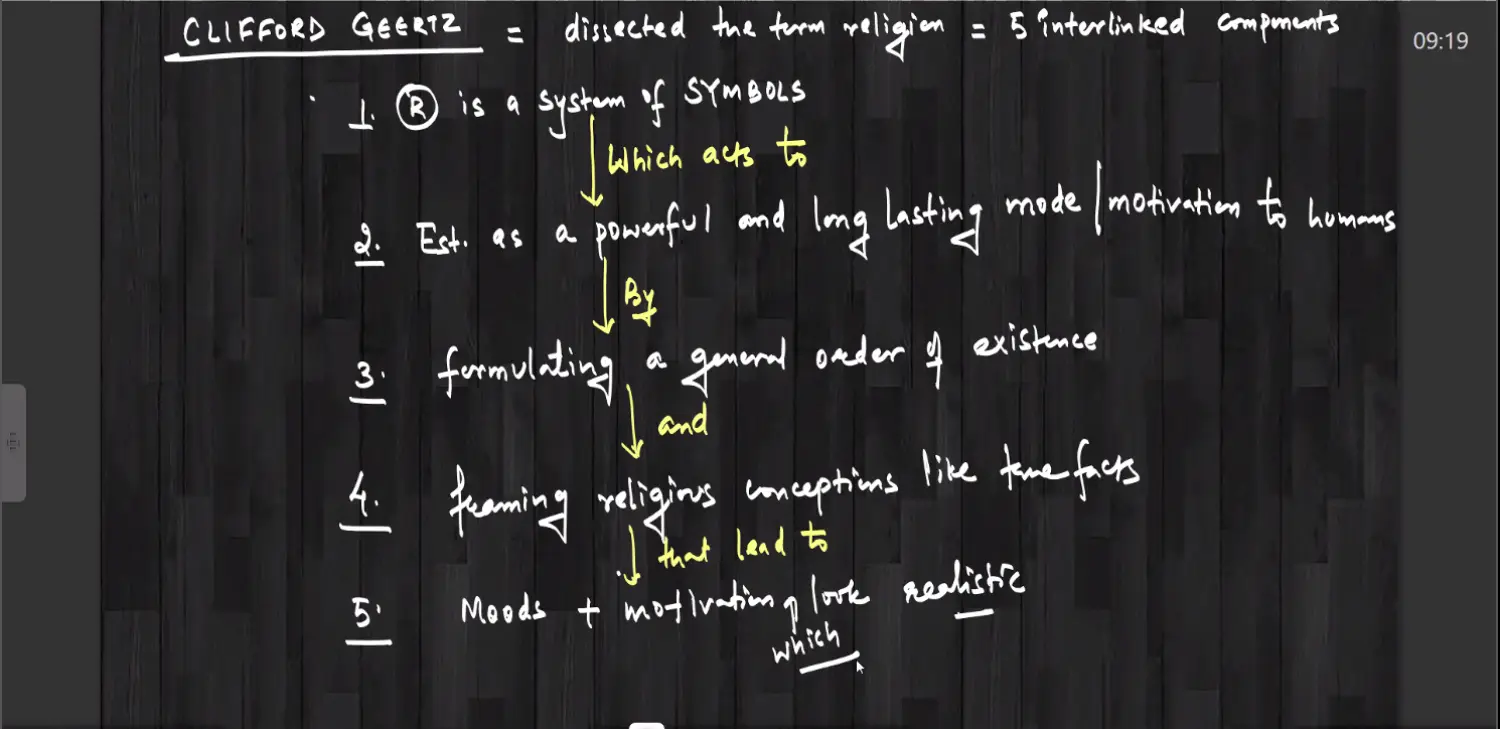
Definition
He Dissected the Term Religion under 5 interlinked components
- R is a system of symbols
- R is established as a long lasting mode or motivation to humans
- R formulating a general order of existences
- R frames religious conception like true facts
- Moods and Motivation look realistics
Animism and Animatism
Animism and Animatism is derived from the common term Anima
Animism
Animism is one of the most primitive form of religion where natural objects are considered to be inhabited by spirits like creatures objects, places and perhaps even words
Animism is one of the most primitive form of religion which is considering natural objects being inhabited by spirits like creatures, objects, places, trees and even the words
Also the Spirits can interact with people as per their wish and will
Polytheism form of religion was contemporary to animism beliefs
E B Tylor's and Herbert Spencer were supporters of Animism
Animatism
It is also a primitive form of religion considering the power of spirits and souls scattered in both living and nonliving things i.e the power of spirit is impersonal and everywhere
R R Marett (British Anthropologist) proposed the Idea of Animatism and some anthropologist were of the opinion that animatism emerged even before animism
Naturism
Concept Proposed by the Sociologist Max Muller, with the basic idea that man has always worshipped forces of nature, which could have been started as early as the emergence of modern man
Naturism doesn't talk about Spirits
For Example
Worshipping of Sun, Winds, Rain. Considering them being governed by certain Super Natural Powers present in the Nature
Schools of Thoughts on Emergence of Religion
Framework Mind Map
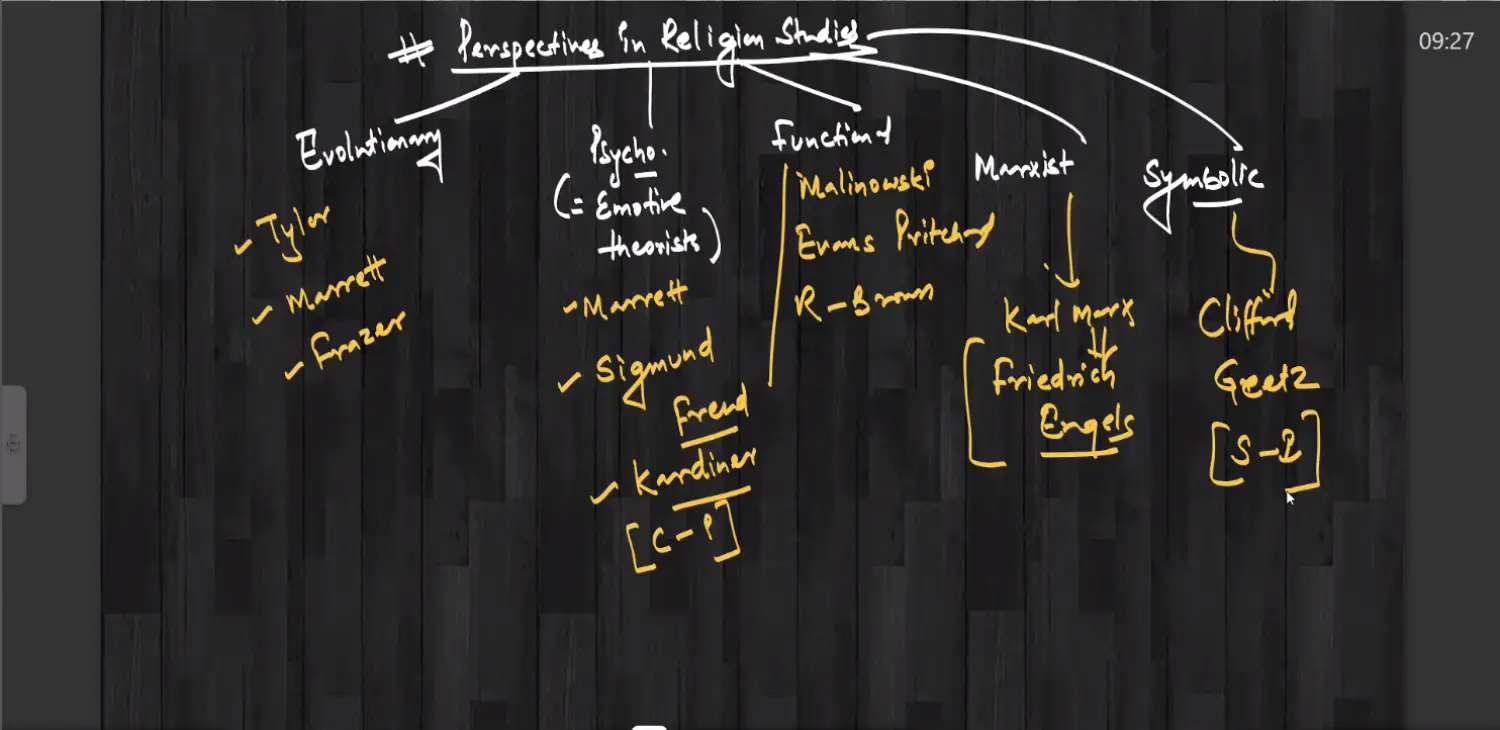
Evolutionary Perspective
James Frazer
Religious beliefs in words of James Frazer, moved from Magic to Religion to Science
Tylor and Marret
Tylor was of the view that first what started was Animism
Supernatural Powers are called
- Mana - Pacific
- Mulungu - Africa
- Orena - North America
Criticism by Kroeber
Psychological Perspective
Also called Emotive Theorists
RR Marett View on Emergence of Religion
Religion started religion to answer the things which is unanswered
What people thought in a collective behavior became religion
Emotive Factor Responsible for Emergence of Religion by Various Scholars
- Unspecified Emotions
- Fear
- Anxiety & Uncertainty
These things were later explained by Malinowski
Sigmund Freud View on Emergence of Religion
Oedipus Complex - Greek Prince Killed his Father to Marry here
Religion can be an outcome of conflicts of ideas of subconscious
Subconscious - Conflict - Emergence of Religion
Neo Freudian - Kardiner
Religious Institutions of Tribals led to Projection of Basic Personality
Functional Perspective
Introduction
Like other Social System Religion also has function to society. Religion emerged in society
- to explain certain situations
- especially to explain their suffering
- for maintenance of social order
- as a tool for cohesion
Protestant Ethics and Spirit of Capitalism ( Max Weber)
Religion in the view of functionalists, is an explanation to human sufferings which acts as a source of social cohesion, social welfare, social control and also impacts the economic life.
also impacts the economic life → Max Weber in his theory of Protestant Ethics and Spirit of Capitalism, supported this Idea that the seeds of civilisation were present in different parts of the world from china to India to Egypt to Europe and America, but capitalism flourished only in europe because of the religious belief of protestantism, which is asking protestants to work more and more to produce more
Examples Are :
Malinowski - Trobriand Islanders
Burning of the Dead by means of religious beliefs for the soul to come out of Body
R Brown - Andaman Islander
They consider Forest has Soul. Hecne, they protect the forest, which in turn gives them resources
Evans Pritchard - Nuer Tribes of Africa
Marxists Perspective
- Proposed by Karl Marx & Friedrich Engels (French)
- Religion in the Words of Marx is an Expression of Real Distress and a protection against that distress
- Religion is a Sign of Oppressed Creature
- Religion is the Heart of Heartless
- Religion is the Spirit of Spiritless
- Which is Opium to the Masses
Symbolic Perspective
- Proposed by Clifford Geertz
- He gave a “Three Point Critical Threshold Theory”
- Threshold of Reason
- Threshold of Suffering
- Threshold of Evil
- Geertz was of the opinion that religion is a connection of symbols, events, objects and acts etc
Theory of Religion by Durkheim
Introduction
- Syllabus : Totemism : The Elementary Form of Religious Life
- He Studied the Arunta Tribes of Australia
- Totemism was given by Durkheim as the most basic form of Religion.
- He Rejected Animism first and then later rejected Naturism (accepted some elements, rejected some elements)
- for Durkheim, Religion is a Collective whole of Beliefs and Practises
- Maintained that Notion of God is Not Necessary for a Religion
- Totem as a Symbol
- Example of Central Indian Tribes
- Bakra Vansh
- Khonds
- Elementary Form of Society is not complex, it is as simple as the society
Sacred Mundane Profane
Recognition to a particular value divides the society into two parts
- Sacred
- Profane
Stenner gave the concept of Mundane
M K Bose & Ghurre criticised the Structure of Totem, for some it's different and some different
Myths
Introduction
Perception and Belief - Maximum Times it is Religious Beliefs
It is some kind of narrative for which we don’t know the origin generally
Sometimes it is based on Stories
Its Literal Meaning is Fiction
It’s a Historical Event may be which is connected to a
- SuperNatural Thing
- Religious Leader
- Event - Ex: Disaster
It can be connected with God Also
Myths are Perceptions and Beliefs
Myths are Relevant as per the Interest of people, more of a Pragmatic Interest
Mythology Generates from Myth
It is followed but NOT Questioned
Myths are NOT False Perceptions
Myths are MERELY Perceptions
Definition by Malinowski
Myths are Relevant as per Interest of People
Definition of C L Strauss
- He was a Structuralist
- Myth is a Cultural Artefact meaning it is an outcome of some particular culture
- In his Study : Structural Analysis of Men
- It is a Kind of Structural Reality, which is imposed on people and this imposition has some context
- If this context is not present people will not accept it
- Do Not Read A Myth Superficially, Try to Find out the Deeper Understanding of the Myth
Definition by Franz Boas
Functions of a Myth in a Society
It Explain some Elements of the society
which in practicality is not easily explainable
Myths Explains - Rituals and Religious Practises
It can explain certain facts at Some point of time
Example A Society not Following Exogamy. It is following Endogamy.
There may be no scientific backing to it but there may be a Myth that if they follow exogamy there purity will be lost
Certain Elements of Folklore can be explained by means of Myth
Example why Cloth and Food is the way it is
Folklore can give rise to New Myths
Example Usage of Extract from Seed of Some Plant in a Dye
Example is when Malinowski was studying Trobriand Islanders, Like this Plant is Giving Healthy Food for All Most throughout the Year
If this plant is given to the cattle, it was a belief that cattle will give good quality milk
Rituals
Introduction
- Ceremonies / Religious Practises / Acts of Worshipping → Followed by People on the Direction of Priesthood
- To Follow their Traditional Practises
- Example : Weapon Worshipping
Edmund Leach’s Definition of Rituals
Rituals are culturally defined behaviour which acts a medium to connect people which in turn acts as a medium of social communication
Gilbert Levis’s Definition of Rituals
It is a Standardised Behaviour with Meanings and defined Means & Ends
It can be Rational or Non Rational
Features & Functions of Rituals
It is not Individual it is having a public content
It is sometimes symbolic in nature
Example: Lossar Festival of Tibetan New Year, but it is not merely a Symbol
Rituals are followed from time to time at Specific Times of Life Cycle
Example : Upanayan Sanskar (Twice Born Caste)
Example : Visiting Sabrimala, Tirupati & Mecca
Sometimes Rituals are Parallel to Certain Natural Events Also
Example: Rituals Related to Solar & Lunar Eclipse
Example: Rituals in western ghats for onset of Monsoon
Functionality of Rituals - Durkheim
- When a totem is considered to be sacred, it is worshipped and not eaten
- It forms a Ritual which promotes Social Consciousness, In Group Feelings and Solidarity in the Society
Functionality of Rituals - Radcliffe Brown
They Maintain Social Structure as they Re Enforce Sentiments of People
Even Taboos in societies, The Prohibition of Taboo and Acceptance of this Prohibition is
Brow was of the Opinion that Taboos which are Prohibitory in Nature can also have rituals associated with them
Like Some Ritual denouncing consumption of Certain food products
He Gave the Example of Andaman Islanders extended the ritual value to some of the food items and the members are not allowed to harm or consume those
In this way a rare species is getting protected and such precious food items are safeguarded for emergency use
Types of Rituals
- Positive & Negative Rituals
- Positive Ritual
- Related to Re Inventing Something
- Example: Dussehra
- Negative Rituals
- Prohibition Taboo
- Positive Ritual
- Imitative Rituals
- Just to show loyalty to Group
- You Imitate the Ritual
- Sacrificial Rituals
New Year Celebration is 1 January
New Year Celebration can be 21 March, 22 June, 21 September
When you begin an attack
When done with harvesting season
During Marriage
Sacrifice of Cattle is Seen
- Positive & Negative Rituals
- Rites De Passage / Rites of Passage
Introduction
Arnold Van Gannepp - Liminality - Victor Turner - Symbolic & Interpretative
When we shift from one stage to another stage, there are certain ceremonies and rituals to be followed
If a person is moving from Pre to Liminal to Post Liminal
He has to change his Life Style
Examples are
- Mundan
- Name Giving / Name Rites on Rituals
- Upanayan Sanskar
- Kangas in NDembu
- Marriage and Funeral Rites - Almost Universal
- Rites of Intensification
- Also called Life Crisis Rights
- Crisis can be on
- Life - Hindu Cremation Ceremony
- Disaster
- Food Unavailability
Relation Between Myth and Rituals
Rituals Emerged from Myths Most Accepted Proposition
- Multiple Religious Practises in all the Religion
- Example : Easter Celebrations, Dussehra, Some Jews Festival
- Myths do not have a stand individually unless they are supported by Rituals
- View of E B Tylor on their inter connectivity
- E B Tylor Said that Myths are connected to Rituals in a way like Science & Technology
- Like Without Backup of Science, Technology cannot be developed
- Technology expresses science behind it
- Myth is a Kind of Proto Science
- Ritual is the Technological Based on Science
- Like Technology is Application of Science, in the same way Ritual is Application of Myth
Myths Emerged from Rituals
- According to James Frazer and Robertson gave the Principal of Primacy of Rituals
- It says that Rituals are Basis and Primary. Myths emerge time to time from these Rituals
- As Religious Evolution takes place, the Rituals, Give Rise to Notion which in turn give rise to myth
- Primacy of Rituals as per Robertson and Frazer is talking about Sequential Steps of Religious Evolution from one form to another to another and during this course various notions are developed which emerged in the form of myth
Rituals and Myths are Interlinked
Malinowski said it is always not necessary that myths will give rise to rituals or vice versa
It Really depends on the situation, Situation that there are many cultural practises or rituals that are related to various myths
Within One Practise or Ritual, there can be a Myth behind it and this ritual in turn may give rise to a new myth
Fetishism
It emerged from the term Feticos, meaning outcomes of a skill (Skilfully Made Object)
It is a kind of Earliest Form of Religion
August Comte in his book Evolution of Religion says that Fetishism was religion even before Polytheism
Hence, the Sequence is Fetishism → Polytheism → Monotheism
This Feticos can be
- Man Made : Like a Sword
- Natural : Plant / Human / Animal
- Human Body : Cloth, Nail, Hair, Bone etc
- Most Common Feticos Object from Human Body is : Blood
Voodoos of Carribean Islands → They had a Belief that when there was a cut or injury and blood loss occurred, people would die → They thought that Blood was a Supernatural Power
Later Voodoos Considered → Nail , Claws & Fur as Fetish Object
Bondo Tribe of Odisha considers Sword as Fetish Object
Indian Form of Fetishism is may be worshipping or insulting the Fetish Object
Magic Religion and Science
Introduction
- There is a Constant Flux between Religion, Magic and Science
- in Pre Renaissance Period → Magic and Religion was Co Existent with Science.
- in Renaissance / Enlightenment period, with rationalisation of thought, people questioned everything, they didn’t accept things which could not be proved. This led to Secularisation of thought, first in Europe and then in other parts of the world
- Renaissance led to clear cut division of function between State and Religion, thus religion should be restricted to private sphere as it is a individual thing
- Hence, we can conclude that before renaissance magic religion and science existed equally, where as post renaissance the sphere of magic, religion and science were clearly
Views of Various Thinkers
Acc to Albert Einstein
Science without Religion is Lame Religion without Science is Blind
Acc to James Frazer
There is a Liner Evolutionary Framework, in between Magic to Religion to Science
Acc to E B Tylor
Religion is a Belief in Spiritual Realm of Real World. Since Beginning people use religion to answer the unanswered
In Primitive Societies, People follow Animism. Thus the Scope of Science is Very Less
But in Advanced & Civilised Societies, where monotheism emerged. Here Religion and Science can co exist together
Acc to Durkheim
Durkheim was of the opinion that
Magic did not give birth to religion
Rather, Religion gave birth to Magic and Later Science
He further extended by saying that Magic and Religion oppose Each Other.
Magic Can Have but Maximum Times Cannot Have a Social Character
It is more of a Individual Expression
But Religion is essentially social which is functional to society
which can be accepted to rejected by society at large
Religion and Science will stay together because
Religion is Raw Science
Science is Mature Religion
Durkheim was of this Opinion that Religion is a form of Raw Science and Scientific thought develop with a mature religion
Acc to Malinowski
in His Essay : “Magic, Science & Religion”
He opined that no matter what form of society exists, there is always a scientific element present in the society.
These Scientific Elements can emerge in the form of magic and in the form of religion
He gave Example of Trobriand Islanders
There Art & Craft, Instruments, Agricultural Practises etc cannot exists and function until they have better understanding of natural phenomenon
He Said Magic in itself is science and they both have a definite aim
Both are based on Human Instincts and Needs
When Crops Failed, Cattle Died and Health Challenged occurred, people when couldn’t explain this moved to define these through magic, which later became Religion.
Both the Magic and Religion were based on some or the other Scientific Principles
For Example : Growing of a Specific Crop in a Specific period of time is Scientific
Magic was considered as an Superstitious activity or Belief by Malinowski to control the Nature
When Natural or Human Efforts were In Sufficient
Acc to Raymond Firth
R Firth said that Magic has Three different Elements in it,
- Practitioner
- Aim : Practical Aim
- Technique : Magical Formula
Similarities Between Magic & Sciences
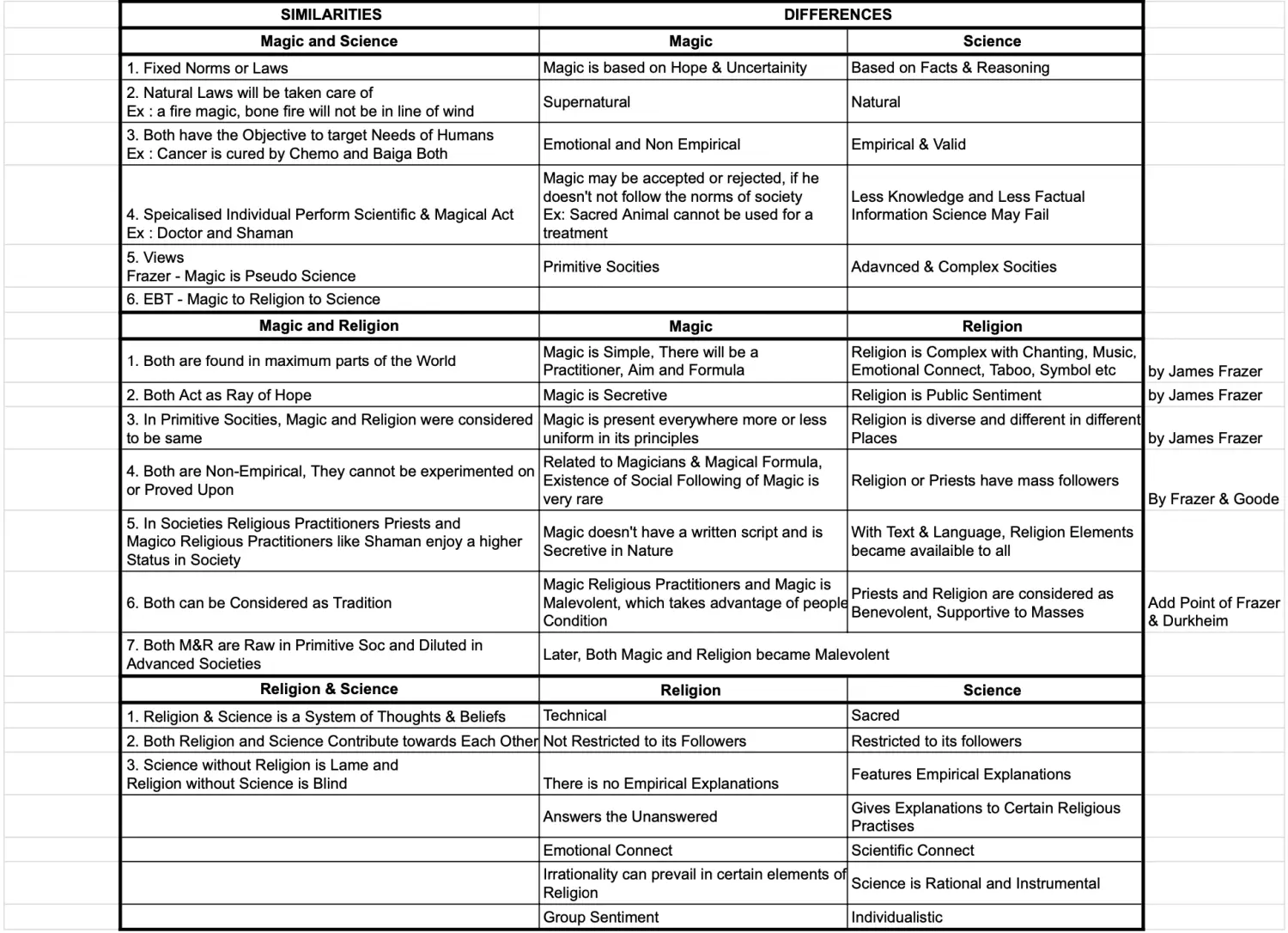
Magico Religious Functionaries & Practitioners
Introduction
Magico Religious Functionaries in One or Another Form are found in maximum Societies and are required based on the conditions and demands sometimes in health challenges or disaster like situations or crop failure or to overpower the spirits and even to take control over someones body
These Practitioners are having a Special Status in the Society and they get some sort of reward in cash or kind against there services
Shamans and Medicine Man
Maximum times Shaman is male who is proficient to perform certain magical rights.
The Concept of Shaman & Shamanism emerged from Ancient Siberia
They Know the Sacred Songs, Rituals and Formulae and use them to serve the Society
like curing the disease, controlling supernatural powers, or regulating the Anti Group Behaviour of Individuals
They have higher status in Society
Some Anthropologists call Shamans as Witch Doctors
Amazon Rain Forest, there are certain Ab Origins referred as Shuar or Jivaro Indians in Amazon Rainforest
This Group was studied by American Anthropologist Harner. Here he said that Shaman is not necessarily a male, she can be a female too.
They enter into a altered state of consciousness, here they have some spirits under their control
It is considered that Shamans, They are a connection between Natural and Super Natural
A Shaman takes Training from Pre Shaman
Sometimes they use Psychotropic Substances to get into trance state
They have painful and lengthy training may be even a decade
They can use Hypnotism, Drumming, Dancing, Singing etc
While this training happens they stay away from all sorts of distractions of common life
Example of Work : Shoot Arrows & Spirits
Example : Hoansi or Ju Bushmans of Kalahari
Priests / Priestess
Generally Found in Societies which are Resource Rich
Meaning They can Support a Full Time Occupational Specialist
These are Socially Initiated Position which are placed or inducted through certain ceremonies
They are placed very high in the Religious Organisation
Their Functions are
- Communication Medium between
- People and God
- People and Spirits
- God and Spirits
- To help common people to handle the Supernatural things
- Examples Buddhist Lamas
- Imams
- Pujari's
- Rabbis
- Monks
- Catholic Priests
- Communication Medium between
They have no Supernatural Powers and Spirits
They have some rituals and chantings which are effective against supernatural powers and rituals in the form of prayers which can regulate or control the supernatural powers and the spirits
Training Includes
- Fasting for Long Duration
- Fasting for Multiple Days
- Code of Conduct
- They Train for Long and have Rigorous
After Training
- They Dress Differently
- They have Different Hairstyle
- So that they can be recognised easily between the Masses
- They act as Representatives of Community in front of
- God
- Spirits
What do they Actually Do
Various Rituals for Rites of Passage
Example : Birth and Death Related Rituals etc
For Climatic and Epidemic
Better Agriculture Output
Anthropologist have observed that societies with full time religious specialists like priests are likely to be dependent on food production rather than food collection
They are likely to have economic exchange involving use of money, class stratification etc
One or the Other Type of Priests are Associated with One or the Other type of Society in primitive or Modern Times
- Sorcerers
Introduction
A Sorcerer is a Magician and Evil Figure (can be termed as black magician in certain practises)
involved in illegal, illegitimate, anto social deeds
Usually the sorcerer learns the Art and uses different techniques ans rituals for causing an effect maximally and negative impact on others
Sorcerers do the Contagious magic through hair, nails, clothes, body fluids of the victim
Case Study
In KIPSINGI of Kenya there are various sorcerers in a Hierarchy.
The most powerful one is ORGOIYAT who could perform sorcery against the whole tribe due to more powers in comparison to other sorcerers. These Less Powerful Sorcerers are termed as BONINDETS
James Frazer Studied magic and Sorcery, based on certain logical principles
Imitative Principles - Like Produces Like
i.e if an object resembles a person and the sorcerer mutilates the object, then the same thing will happen to the Person like the Famous Voodoo Doll
Example: In Dobus of Melanesia, Sorcerer’s Caste the Spells by imitating the symptoms of a disease
Contagious Principles - Power comes from Contact
i.e once coming in contact can be used in Rites and Spell, to make the things happen to that person like the use of hair clippings, body secretions, nails, jewellery even the Umbilical Cord
Societies in which Sorcerers Rest on Contagious Principles, people must dispose off their objects, they have been in contact with ; away from the reach of enemies or Sorcerers
- Witches and Witchcraft
Evans Pritchard differentiated between Witches and Sorcerer's in Africa. As Sorcerers rely on external powers where as witches have internal and inherited powers .
Both are common being anti social in character.
Witches are believed to Practise Cannibalism (they mainly eat children) or Incest, to increase their power
They Show deep sense of Greed Jealousy and Hatred.
A Witch is NOT always a women.
Examples: In Nupe Ethnic Group of Nigeria, Witch is always a Women
Examples: Whereas in the Near By Gwari Ethnic Group, A Witch can be a Man or Woman
Both Witches and Sorcerers use power to harm others, even death.
Witchcraft is commonly found in Maximum Societies and is not Restricted to Tribal Societies
Study → Witchcraft : A Study in Indian Occultism by R N Saletore
This Book Highlighted about prevalence of witchcraft in different parts of India. Pre dominantly in central and east Indian Tribes.
Example: Like in Oraons of East Central India, a grave ill individual suffering from Leprosy, Seizures is beaten with Sticks and Stone, sometimes till death to get rid of witchcraft
Even today witchcraft can be witnessed in many parts of India
Anthropologists consider witchcraft as the use of Psychic Power to cause harm to other
Sorcerer's Manipulate the Object or use the Object to cause the Harms, but witches directly harm the individuals
A Broader notion related to witchcraft is that its an evil force bringing misfortune to community like in Ibibio of Nigeria which are known to remove the soul of an individual and place it in an animal
Making the Person Sick and Ultimately Leading to Death
Witchcraft is like an Explanation of Events, based on the belief that certain individuals posses
Certain Individuals Posses innate Psychic power of causing harm or sickness or death
Even today, in maximum sub saharan African countries spread of HIV Aids is considered to be an outcome of Witchcraft
Intense or Raw form of Witchcraft can be found in many societies even today
Paper 1 - Unit 3.0 - Economic Organisation
Introduction
Define Economic Anthropology by Ralph Paddington
Two Types of Schools Emerged
Two Prominent Arguments Emerged in Economic Anthropology, in the form of substantivist and formalists
Substantivist’s
There is Little to be learned from Study of Market Economy in Anthropology because market economy on a prominent principle targeting profit or benefit
profit or benefit → Not Appropriately Extendable in Studying People, who do not exchange good or services for profits or gains
It Supporters are Kall Polany, Malinowski, Sahlins
Formalists
They Claimed that Economic Theory has actually to do with, the ways people get personal satisfaction in saving and storing things and distributing those scarce resources against some fixed arrangement (like money)
It Supporters are Herkovitz, R Firth, Birlings
The Formalists and Substantivist's Debate - Important Dictated
Introduction
Susbtantivism and Formalism constituted important streams of thought that have contributed to the growth of economic anthropology
For Sometime Anthropologists have borrowed theory and concepts from the discipline of Economics in an attempt to understand certain economic relationships between the people
Since the Discipline of Economics is concentrated around allocation of scarce goods and services in Industrial Society, it has become a matter of controversy and discussion as to what modifications must be made, so that economic theory becomes applicable to non industrial societies (simple small scale societies)
Some Anthropologists Adhere to the Point of View, that there is little to be learned from study of market economy where principle motivation is profit, in studying people who do not exchange good and service for gaining. This Stance is Susbtantivism.
There are other scholars who adhere to school of thought termed as formalism and claim that economic theory has really to do with the ways people get the personal satisfaction in saving the things and in distributing scarce resources. This is Formalists Approach.
Summarised Difference Between them
Google online
Substantivist Approach
It was first proposed by Karl Polanyi in his work the Great Transformation. He Argued that there can be two different meanings of Economics
A Formal Meaning and a Substantive Meaning
Formal - Refers to Economics of Logics & Rationality in decision making
Substantive - This Meaning Pre Supposes, Neither Rational Decision Making, Nor Conditions of Scarcity. It simply refers to study of how humans make a living from their social and natural environment.
A Societies Livelihood Strategy, is seen as an adaptation to its climate, environment and material condition through a process which may or may not involve utility maximisation
Polanyi’s great transformation refers to the divide between modern market dominated Societies (Particularly Western Societies) & Non Western Non Capitalist Pre Industrial Societies
Non Western Non Capitalist Pre Industrial Societies → Here, Individual Choice is not so much based on maximisation of economic benefits but rather on social benefits, cultural values or religious sentiments
Production in most of the Peasant Societies is for Producers, that is production for use as compared to production for exchange and profit in Industrial Capitalists Societies
According to Polanyi’s in modern capitalist economies, the concepts of formalism and susbtantivism coincide. Since People Organise their Livelihoods based on the Principle of Rational Choices. However, in Non Industrial Non Capitalists Pre Industrial Economy
This Assumption is not Valid
Another Key Aspect of Substantivism is Embeddedness. Rather than being a Distinct and Separate Sphere, Economy is Embedded in Both Economic and Non Economic Institutions
A Substantivist Analysis Focus on Economics being Profit Oriented and maximum utilisation of even the Scarce Resources
Whereas Economic Anthropology, talks about Raw forms of Economic Organisations or Systems which are Targeting Fulfilment of needs. So the Core Principles of Economics cannot be directly extended to Economic Anthropology. Hence, must be studied in the Socio Cultural Context of Society, Tribe or Group.
Formalists Approach
According to Formalists Economics is all about fulfilling the demands of humans, even with Limited or Scarce Resources. Economics need to allocate the Resources Efficiently
The Formalists Approach, makes certain assumptions like Individual Prefer Utility Maximisation by Choosing some alternative means. Individuals will do so based on Rationality to measure the cost and reaching upto a well studied decision
Formalists also consider that all individuals live under conditions of scarcity of means but with unlimited wants.
Formalists like Herkovitz and Firth asserted that No Classical Model of Economics can be applied to any society in its actual form, it has to be moulded as per the society. Hence, either the society is simple small scale or capitalists
Formalists said that “Maximising” in Economics is not always requiring money or market, even love affection and security can be maximised
Formalists wanted to demystify non western economic behaviour that even in other societies, people are rational
The Formalists approach preached that there is Reason and Rationality behind the behaviour of people which is the Governing Principle of Economics. Hence the Economic Theory is well applicable to all forms of societies in one or another way
What is Included in Economic Organisation
Acts Included are
- Production
- Consumption
- Sale
- Medium of Exchange
What are the examples of Economic Organisation
- Kula Ring Exchange System - Studied by Malinowski
- Moka System of Exchange in Papua New Guinea
- Jajmani System of India
- Pigs & Sweet Potato Based Economic Organisation - Kapauku Papuans
How is Economic Organisation Functional to Society ?
- Source of Balance based on Division of Labour
- Promotes Social Harmony & Social Stability
- Functional Society
- Sustenance
- Solidarity Cohesion
Traditional Economic Organisation
Introduction by Hoebel and Weaver
Economic Organisation are Behaviour and Actions targeted towards
- Production
- Allocation
- Distribution
- Consumption and Use
For Production of Goods and Services
Types of Societies where E/O is found
No Matter what form of Society it is, like
Simple / Complex
in Family there is some defined division of labour and this economic organisation which starts from family itself
Small Scale / Large
Rural / Urban
Savagers
In Hunting Gathering Societies there is Communal Ownership of Resources
Horticulturist
Generally marked by Issuance of Patta, as a patch of Land
Pastoral / Agriculturalists. Industrialists
Maximum E/O is based on defined DOL. This DOL is based on Gender and Age
Example: Savara Tribe of Andhra perform PODU → Shifting Cultivation
Here Tasks are done by
Adults
Adolescent's
Fetch Food, Water, Tools, Watch Over Something
Not Part of Labour
- Kids < 10 Years of Age
- Old Age > 70 Years of Age
Thus, this Savara Family Acts as a Unit of Production
As Society Advances from Simple Small Scale → Complex Modern Industrial Society
DOL - Changes
Roles Reversed
No Defined Task bound with a Gender
Different Economic Activities
- Hunting Gathering or Foraging
- Introduction
- They Gather and Collect Food, Directly from Natural World
- Hunting
- Fishing
- May Be By Hunting of Animals or May be from Wild Plants
- Fruits
- Vegetables
- Tubers
- Leaves
- Roots
- Homo Sapiens in its Present from are having history of Nearly 1,00,000 Years
- Domestication of Animals started 10,000 - 12,000 Years Ago
- Hence in the Rest of 90,000 Years of Homo Sapiens we were dependent upon Hunting and Gathering
- Hence, in Nearly 90% of the Existential Years of Homo Sapiens we have depended upon hunting gathering form of activities
- As of Now, very less part of human population is exclusively dependent on Hunting Gathering
- They Gather and Collect Food, Directly from Natural World
- Examples
- Some Studies Suggest that Hardly 2,50,000 people are presently there who are in totality dependent upon hunting gathering found in
- dense evergreen forest
- Sub Polar / Arctic Region
- Hot Deserts
- Examples: India there are very less no of examples
- Indian Mainland - Chenchus of Andhra Pradesh
- Andaman Islanders
- South India - Some Parts of Qadars in South India
- Some Versions of Paniays, Todas, Irulas
- Examples: World
- Pygmies of Africa
- Kulin’s of Australia
- Andes of Siroccos
- Indo Malaysian Tribals
- Innuits Eskimos of Polar Regions of Alaska
- Some Studies Suggest that Hardly 2,50,000 people are presently there who are in totality dependent upon hunting gathering found in
- Characteristics & Features of Hunting Gathering Society
It is all most a compulsion that they have to adopt nomadic behaviour to collect food
Some times due to seasonal movement there can be semi nomadism
Hence, They have to move in search of Food & Water
Except for the Hunter & Gatherers of Deserts, Rarely there is a Scarcity of Resource
They Collect food only for Consumption, there is no element of trade, storage or surplus food. After that there is no disturbance to Nature
They are very less in populations as well as population density
They use the most primitive forms of Technology
Hence, it can be safely concluded, They are Self Sufficient Population
They have no concept of Property. There may be some rules specified by Society
- Introduction
- Pastoralism
- Introduction
Pastorals are highly mobile as they follow their herds moving from one grazing area and water resource to another.
According to Seasons or on Exhaustion of Local Food or Water Resources.
They are not always sequential forms of Economic Activities
There are evidences that when we started domesticating animals, at the same time we started cultivating plants as well
Six Prominent Animals who are the most common forms of domestication
- Sheep
- Goat
- Cattle (Cow)
- Camels
- Donkeys
- Horses
- Examples
Found in Maximum Parts of the World
Europe, NZ, Africa, Middle East, Siberia, Central Asia
In India
- Bakarwals of Kashmir
- Bhutias of Uttarakhand
- Gaddis of Himachal
- Todas
- Maldharis (Semi Nomad Pastorals) of Kutch, Gujrat
Apart than these, some other animals found in pastoralism are
- Yaks - Higher Reaches of Himalayas & Tibets
- Reindeers - Sub Polar Arctic
- llamas - Highlands of Andes Mountains
In Examples
- Chukchee’s of Siberia
- Masai’s of Saharan Dessert
- Features of Interaction with Animals
There are less incidences of people killing these animals for consumption of meat
They Generally use the animals for Milk and Milk Product, but milk and milk products are NOT available throughout the years
Hence, they make ties and relations with others
Generally with Agriculturists and very seldom with foragers
The Mode of Exchange Found here is that of
- Pots
- Some Form of Manufactured or Handicraft Utensils
To Support the Animals, they need fresh pastures and continuos supply of water. It is not available everywhere especially in the semi arid areas and mountain height
- Characteristics of Pastoralism
They are Nomads and Semi Nomads
Once Settled, They have Sedentary Life Style
They have Lesser Population & They have Less Population Density
They Generally don’t have Land as their Property.
They have animals as their property
Storage & Surplus for providing animals with food emerged
There is some form of Leadership, Existence of very basic form of Political Organisation
They have permanent or Temporary Leaders
They can have trade ties as well
- Introduction
- Horticulture
Introduction
Horticulture for the First time was discovered in Middle East, nearly 10,000 Years Ago by Women
Horticulture is Fruits, Vegetables, Food which are consumed, Even small scale food grain production
In Most Parts Horticulture was started by Tribes by using simple tool and techniques
for Consumption, Storage and Trade, thus signifying concept of surplus
Examples
- Found in South Asia, Pacific Islands, Central Parts of Africa, Latin America can have extensive patches of Horticulture
- Food Produced are Tomato, Tans, Corps, Grains, Millets etc
- Example of Indian Tribes
- Gonds - Most Prominent Name for Horticulture
- Ao
- Naga
- Santhals
- Muriya
- Abor
- Miri
- Mishmi
- Examples of Tribes around the World
- Yano Mami’s of Brazil are Horticulturists
Features of Horticulture
They have permanent settlement, they only leave the place when there is exhaustion of soil minerals, thus signifying shifting culture
Hence, Shifting Culture can be considered as extension of Horticulture
Population Density & Population practising it is moderate
They use simpler technology and simpler techniques for their produce
Here Division of Labour is marked prominently based on age, sex, specialisation or skill
In Horticulture Societies, Children are the most employed ones
Generally Private Ownership is not seen.
There is a pattern of Communal Ownership with Rights to use patches of Land
Shifting Agriculture is NOT a Part of Horticulture
- Settled Agriculture
It is characterised by growing of crops on permanent patches of land
Various Method and techniques like, Ploughing, Weeding, Sowing, Irrigation etc are used
It is Intensive Economic Activity
It is very labour intensive work
Which in Turn paves way for High Population Density.
There is Division of Labour
Proofs of Settled Agriculture is seen from Neo Lithic Period at about 12,000 Years Old
It is practised in entire Earth.
We have complex tools and advance technologies being used
Use of Irrigations and modern technologies is employed
Land can be communally or individually owned
Sometimes it can take shape of Shifting Cultivation as well. Hence, Even Settled Agriculture can bes shifting at some points.
For Example, in Disaster Prone Areas, Excessive Rainfall Area
Examples of Tribals in India Practising Agriculture are
- Bhils
- Baigas
- Lepcha
- Oraons
- Ho
- Hunting Gathering or Foraging
Three Prominent Key Components of E/O
- Production
- What is Production
- When Human Being use their
- Physical Force & Certain Technique
- Over Some Natural Resource or any other Matter
- To Get Some Outcome like Goods and Services
- For Consumption
- Types
Food Collection
Done by Hunting Gathering Societies or for Foragers
Like Fishing, Hunt Wild Animals, Fruits and Tubers, Honey
Oldest Survival Strategy of Human Beings
Example : Onges, Jaravas, Sentinel's, Innuits of Sub Arctic Region, Arunta Tribe of Ab Origins of Australia
Even in present time, some hunting gathering can be found but with settled horticulture or agriculture
Example: Rabhas of Assam
Food Production
Horticulture
Simplest Method of Food Production USING Simple Tools and Techniques
There is No Use of Fertilisers and No Irrigation
It is Generally Performed, Not on a Fixed Land or Fixed Patch of Lands
Example : Swiddening (Shifting Agriculture)
There can be Domesticated Animals
But Dependence of Domesticated Animals is is Less
Pastoralism
But Dependence of Domesticated Animals is is More cuz they reside in
Grassland and Semi Arid Belts
Example: Maldharis of Banni Grassland of Kutch
They Move Seasonally
Nomadism is a Permanent from of Shifting.
Example Is : Transhumance
- Bakarwals Tribe
- Gaddis Tribe
- Bhotia Tribes
Settled Agriculture ( Intensive)
Even with Small Land Holdings, Maximum Production is Ensured by means of Irrigation, Fertilisers, Tools and Technique
2. Distribution & Exchange
Distribution → Effort Towards Equality
Distribution is when Some Portion of Total Production is given to Different Individual
This is a one way Transaction which is generally characterised by One to Many Type of Transaction
It is a Effort towards Equality
Exchange → Effort Towards Stability
Exchange is Specific Products (Goods or Services) given to each other
Types of Exchange
Summary
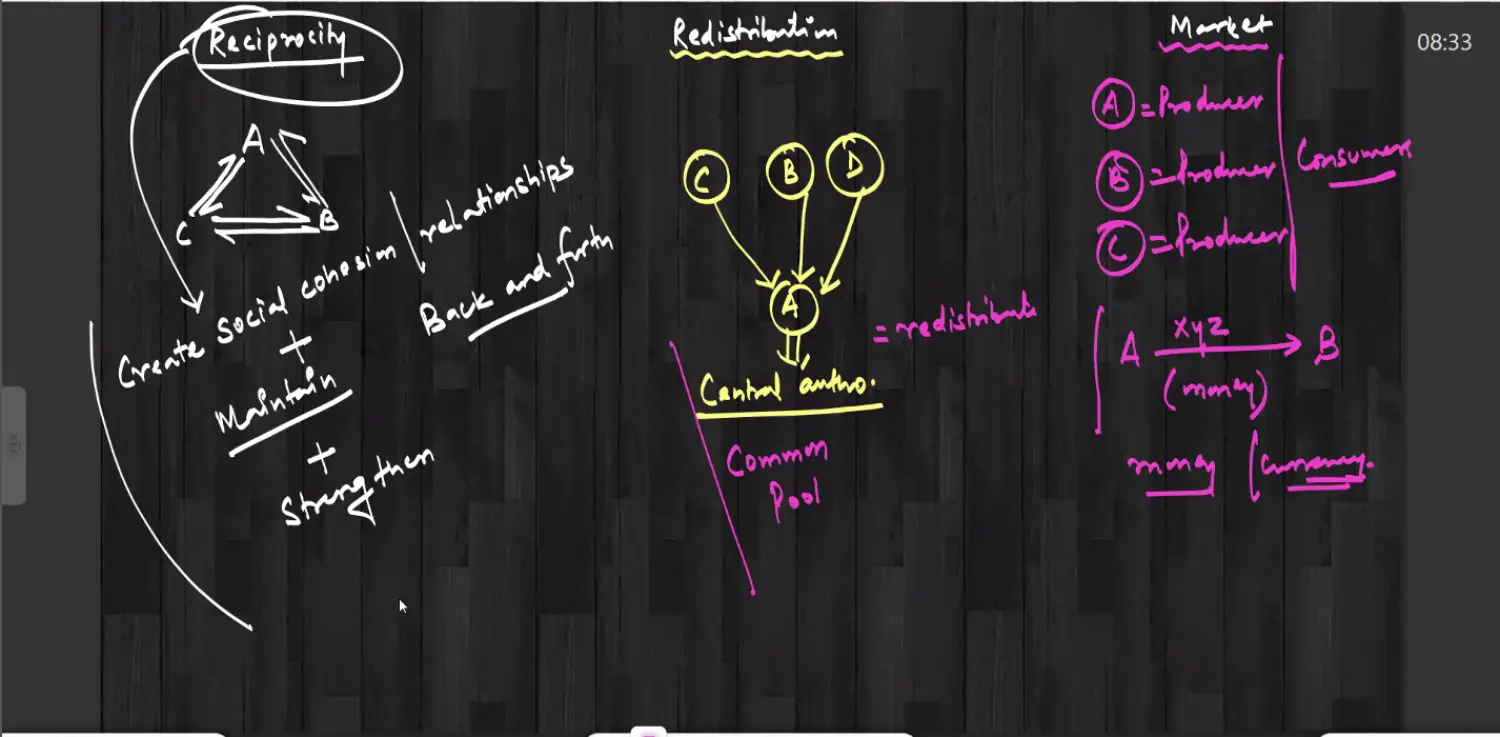
Reciprocity
- Introduction to Reciprocity
Objective
To Create Social Solidarity, Social Relationships
To maintain Social Relationships
To Strengthen Relationships
Here there is Back and Forth Movement of Products
- Study on Reciprocity
- Three Prominent Thinkers Here Are
- Marshal Mauss
- B Malinowski
- Marshal Sahlins
- Marshal Sahlins Gave Classification of Reciprocity as
Generalised
X → Y (X Not Expecting Anything in Return)
There may be some reciprocation, but it is not excepted
Value of Gift is Not Calculated and time of Re Payment is Not Specified
Balanced / Symmetrical
Introduction
X → Y → X is giving something to Y & expecting a good & timely return. Sometimes place is also decided
Whatever is Surplus to X may be given to Y
Whatever is deficient to X may be supplied by Y
General Example: Indian Kanyadan
General Example: in Concept of Kanyadaan, Relatives Help Brides Family through Kanyadaan
Later when Relatives Daughter is getting married, they are expected to arrange items for Kanyadaan
Specific Example: Kula Ring System By Malinowski
Summary
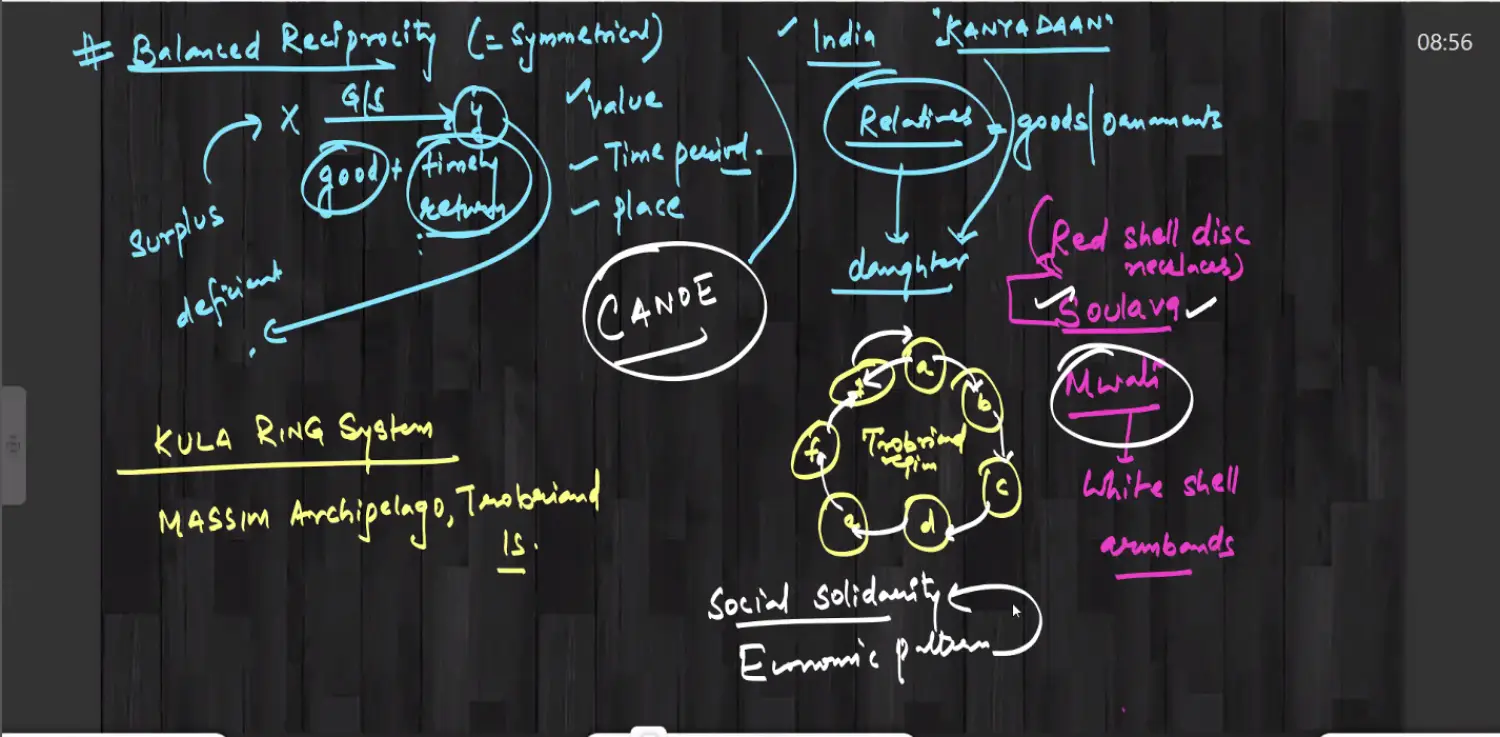
- Studied at Massim Archipelago in Trobriand Islanders
- There are Two Entities
Soulava - Moving in Clock Wise
Red Shell Disc Necklace
Mwali - Moving in Anticlockwise
White Shell Armbands
Specific Example: Wasi System by Rapaport
It is a Study based on New Guinea Study
People on Shore Give Island Material to Mountain People
Mountain People Give Horticulture Product to Island people
Specific Example: Maring System by Rapaport
In the hilly areas of Papua New Guinea, Pig Feast is organised as a gesture of social gathering. It is a classical example of balanced reciprocity
Here Mutual Exchange of Gifts Take Place, also political alliances are formed here.
Specific Example: Moka System by Marshal Sahlins
in Mt Hagen Area of Papua New Guinea Area
It is based on concept of Big Man → A Person who is aspiring for political power or dominance, they increase their gift (in the form of pigs) value
Example:
X → 2 2 Pigs
Y → 3 3 Pigs
Z → 4 4 Pigs
It is based on Pig Economy and Big Man Concept studied by Martial Sahlins in Mt Hagen Area of Papua New Guinea
Moka are Reciprocal Gifts of Pigs, Given to people to show the dominance or influence or political recognition by the big man
The Value of Gift is Generally Increased in comparison to the Earlier Value
Negative / Asymmetrical
- One is trying to get benefit against the others, generally practised with strangers and enemies. Here one or the other person is at loss either directly or indirectly
- Generally at Place where Resources are Scarce
- Example: Novajo Americans
- Example : Silent Trade of Veddah of Sri Lanka
Image
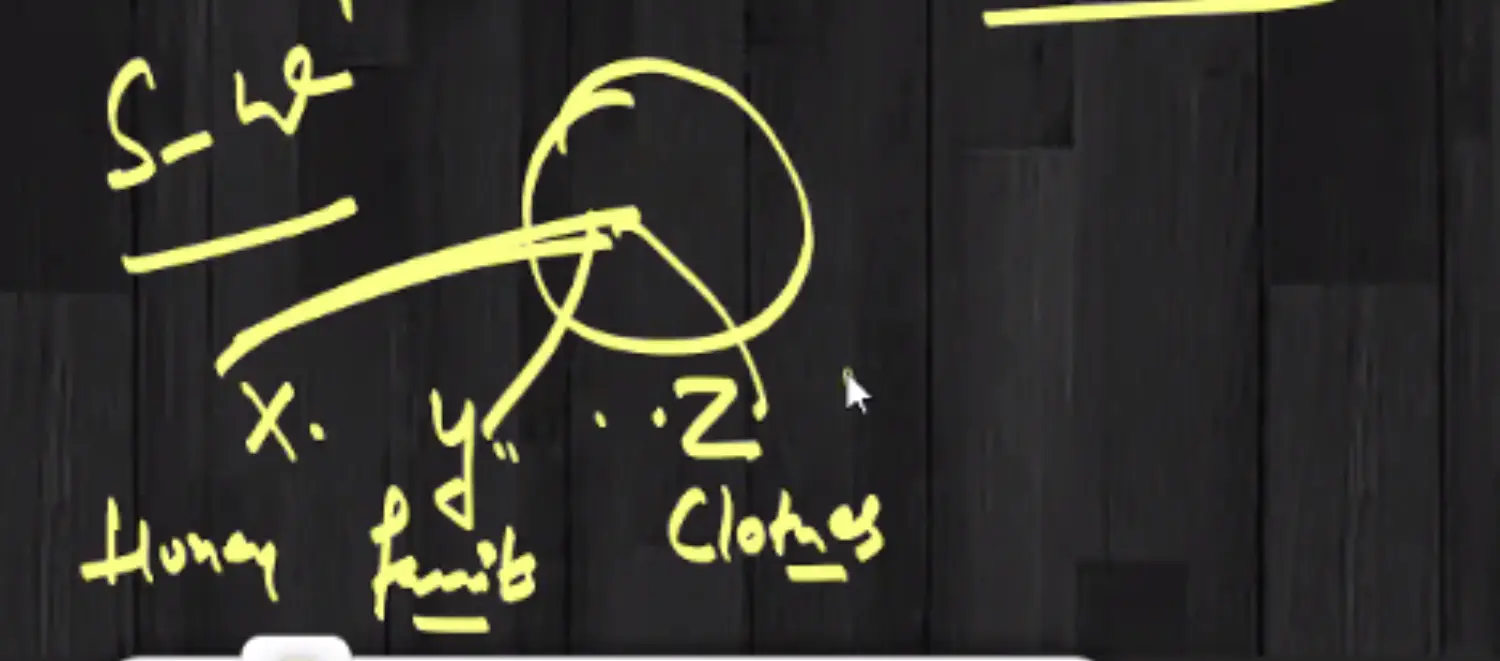
- Three Prominent Thinkers Here Are
- Introduction to Reciprocity
Redistribution
Defintion
Production by Multiple Authority Saved with a Central Authority
Studies on Re Distribution - Potlach & Joint Family
- Theme is Central Authority
- It is arrangement between 2 or more members or groups
Image Depiction
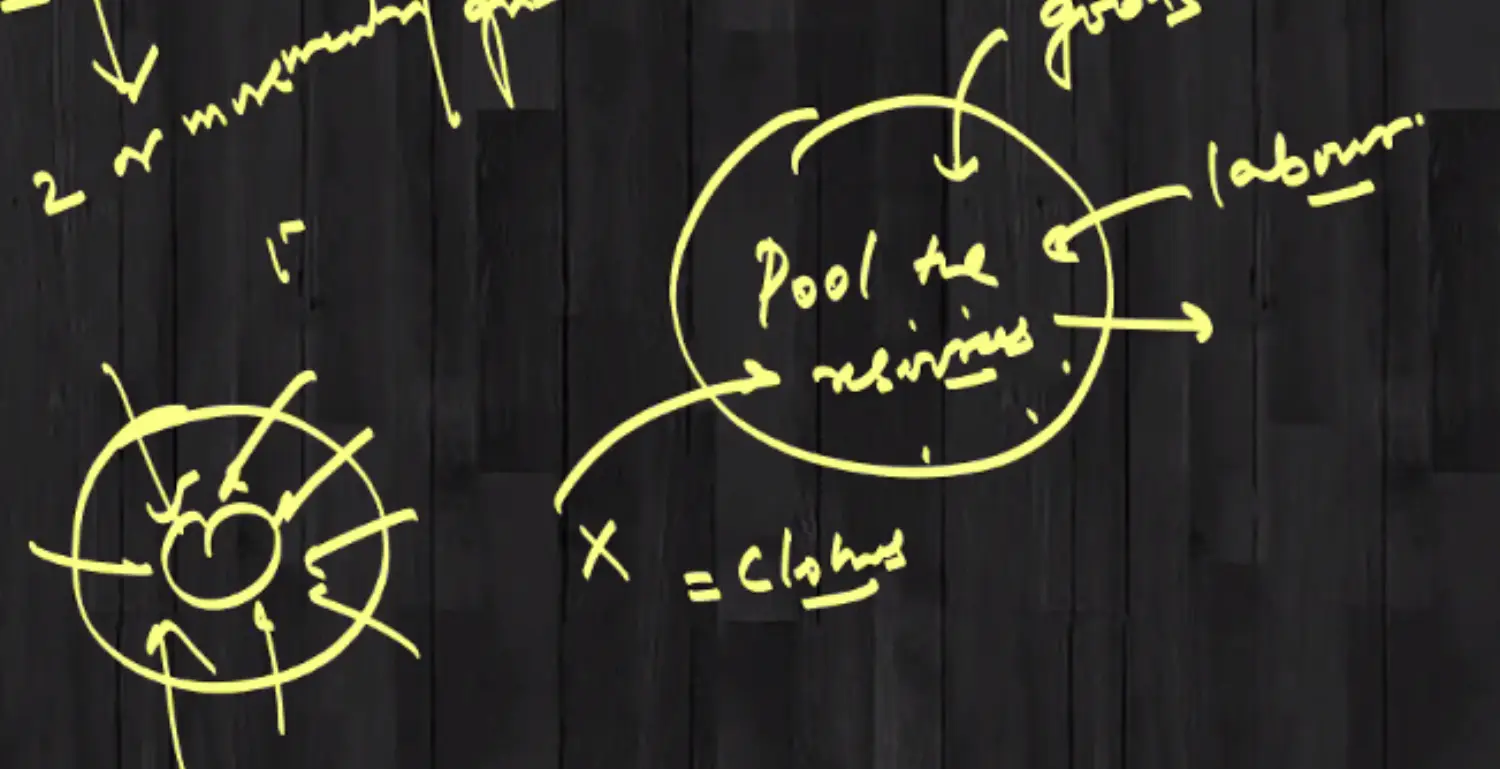
Example: Potlatch by Chinook Indian of Rocky Mountain Area
- Its a Ceremony
- Practised by Rocky Mountains Area of Chinook Indians
**Example:**Traditional Indian Joint Family System
Market
Multiple Producers and Consumers with no set of fixed way of transaction, anyone can act as anyone
It is based on exchange of money
3. Consumption & Utilisation
Types
Utilisation → Using - Cloth
Consumption → Consuming Something - Food
There is concept of
- Minimalism
- Consumerism
Paper 1 - Unit 4.0 - Political Organisation & Social Control
- What is Political Anthropology
- Those Organisations & Institutions’ and Mechanisms which are
- either well-defined or (formal)
- not well defined (not formal/informal)
- Characterised by
- Decision Making
- Conflict Resolution
- Hence, Creating & Imparting - Social → Law & Order
- Those Organisations & Institutions’ and Mechanisms which are
- Prominent Political Organisations
Classification by Elman Service
Uncentralised Political Organisation
- Bands
- Tribe
Centralised Political Organisation
- Chiefdom
- States
Whether Centralised or Decentralised, A Political Organisation talks about
How Power, Law and Order, Rules and Regulations are Framed and Put into Use within a sociocultural environment
These Political Organisations / Systems / or their Components are Related to
- They frame Law
- They constitute Political Formations
- Help in Conflict Resolution
- Help in Social Control Mechanism
- Features of Political Organisations
- Orderly Arrangement of Members
- Hierarchical Divisions
- Equality in the Organisation
- First Amongst the Equals
- There are Certain Set of Rules for Entry and Exit of Members
- Who Will Head the Next ? Perpetuity will be maintained
- Set of Rules, directions, for the members
- It’s an Autonomous Unit with INternal Regulation of its Members
- Orderly Arrangement of Members
Types of Political Organisation by Service
Mind Map
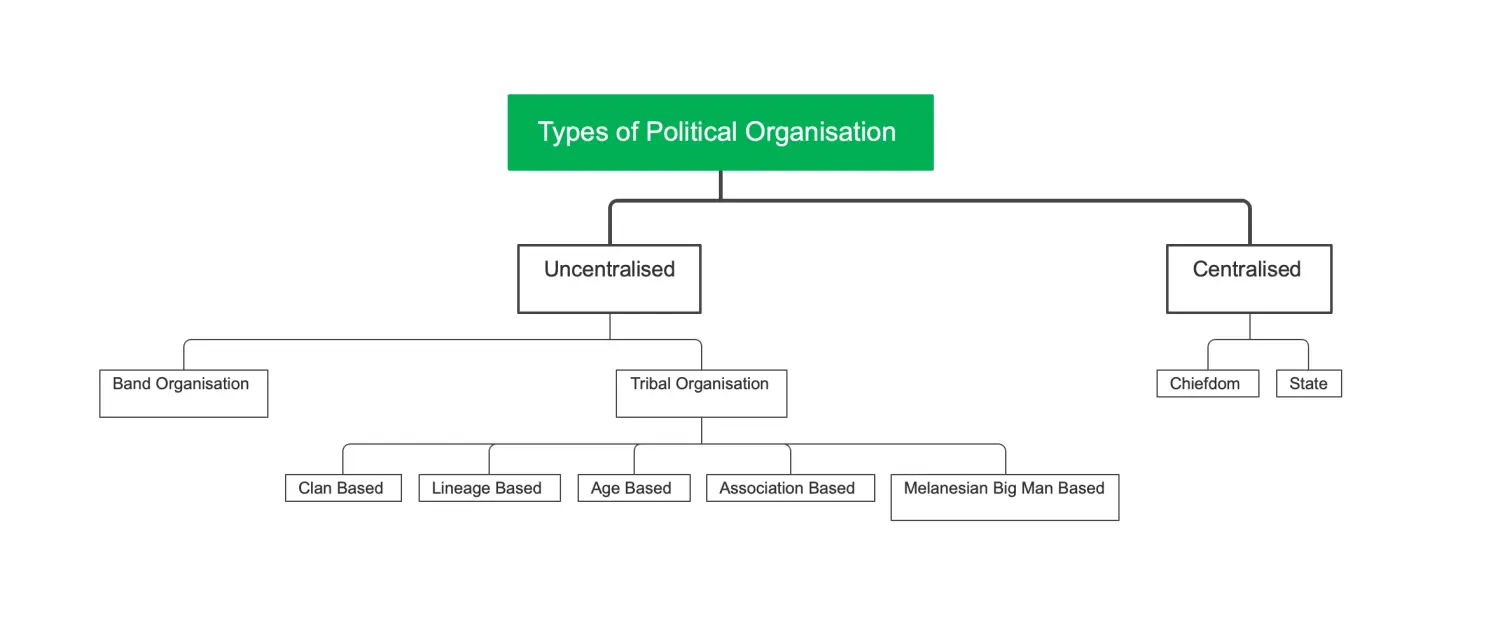
Uncentralised - Diffused Power & Authority - Pending from Lecture
Band Organisation
- Introduction
- Mainly Associated with Hunting Gathering Societies
- Meaning it is associated with the Foragers
- Strength of Band may vary from 10,20,50,100 People
- They are related to each other by means of
- Familial Contact
- Same Tribal Groups
- Same Geography
- Because of Nomadic Lifestyle of Hunter Gatherers, Membership of Band is NOT Permanent, it is more of a flexible nature
- If one person has some serious disagreement with some members or the rules of the band. That one person can leave the band and join another band
- In Situations of threat he will choose a Band Leader which is situation based and Temporary
- Sometimes they Pick Eldest Members so that Experience based Advice can be taken
- Hence
- No Superiority or Inferiority
- No Social Organisation
- No Hierarchy
- It is concept of First Amongst the Equals
- Elman Service said that one or Another form of Band will be found in Maximum Societies
- Examples
- Tribal Groups of Andaman and Nicobar
- Chola Naikans of Kerala
- Kungs’ of Africa
- Kalahari of Africa
- Innuits of
Types of Bands
- Patrilocal
- A kind of band exogamy, means there will continuous entry of new women after marriage. Wife will come in band of husband
- This is the most common form of band organization
- Occurrence of this form of band grp is almost inevitable to the society
- Here the band is rejuvenated, replenish by marriage +alliance
- Composite
- If a grp is under war, diseases, disasters and is not following any sort of exogamy also ,thus this group will lose their typical character. the remaining members will form a cohesive unit. The members from other groups will come together and form composite band.
- Band exogamy can take place after the disaster
- Anomalous band
- Found in societies with fragmented social structures . means as a unit family is there is ,there is no social organization .
- No formation of social grp, family is a band.
- Primarily found in eskimos with typical characteristic of fragmented social structure i.e typical socio cultural organizations are missing except family. Family is acting as a band or a unit of integration
- Introduction
Tribal Organisation
- Introduction
- There is no Typical Organisation Seen in Tribal Organisation like No Leader, No Authority, No Hierarchical Division
- In Bands we talk about Foragers, In Tribal Organisation we talk about Pastorals and Horticulturists
- They Bind the Members together so that a particular tribal group can function as a Self Sufficient Group
- Clan Based Organisation
Within a Tribal Organisation there can be Multiple Number of Tribal Organisations
Each Clan has its own seat of authority and power
Example:
Winnebago Red Indians - 12 Different Red Indians - We have Different Different Political Functions
Out of these 12 we will choose a Tribal Chief & the Chief will be from the Thunderbird Clan
Thunderbird Clans duty is to maintain Harmony, Social Order & Law Order
- Beat Clan - To Beat the People to get Rules Implemented
- Warrior Clan - Duty to fight from Outsiders
- Hunter Clan, Water Clan etc
Clan based organisations have a defined division of labour
- Lineage Based Organisation
Very Rare form of Tribal Organisation
Example
- Nuers of Sudan by Evans Pritchard → Pastorals
- Tivs of Burkina Faso Nigeria Regions → Horticulturists
Segmentary Lineages are Formed - Society is divided in different Groups based on Lineages
They have their own traditions but they do not have any defined law
No Person to another person, no council to another person can reward a punishment
Nuers are divided into different 6 groups based on lineages and these lineage they have certain rules but they do not have any defined law ,thus there is no defined punishment. No person can reward a punishment to another person no council can reward punishment to any person
people will settle the dispute with the help of intermediator called as leopard skin. This intermediator do not have any defined law to resolve the dispute, he will resolve based on the situation w/o any biases in mind. Dispute are mostly settled on the tit for tat principle
if the member of one lineage has killed member of another lineage the latter one has all the rights to kill the person who committed this act or any other group members. In this system it's an act not only for revenge but also to restore the balance if dispute becomes out of control leopard skin. Chief will act as an mediator again to stop the blood shaded. lineage based political organization can be found in oraons of eastern india and there lineage system is termed as Khunt
- Age Based
Examples Are
- most commonly found in oceania
- certain ab origins of USA of Hawaiian islands
- certain tribal groups of Africa
Sample Case Study
V1 → Village 1
V2 → Village 2
A1 → Age Grade 1,
A2 → Age Grade 2
(same age grp in two different villages) → will form grade organization - E1+E2
Each age grade is an organized group of people with their membership decided by their age. People of the same age group irrespective of the kinship or territorial lines/village will belong to the same age grade /organization
Every age group will have its functions/duties to be performed for eg- adults can be involved in lighter task and adults may be involved in wars
Examples:
- Kipsigis of eastern grasslands of Africa
- has two different age groups based on age - warriors and senior elders
Warriors: are involved in defenced and bagating many children,when warriors are not physically capable enough they pass into the age grade of senior elders involved in ceremonial activities ,resolution of disputes ,organising the people and army etc
Masais of Sahara Desert also have this form of political organization, were the societies are divided into childhood, junior warrior hood, junior warrior hood, junior elderhood and senior elderhood
- Association
- When people form associations based on common interest
- Example: People they form military clubs, hunting societies, peace seekers, violent club/revenge club
- Example: Cheyenne warrior club-> these are native american in great plains
- Cheyenne’s have divided there societies into 7 different military societies
- Boy have to prove he is a warrior ,he should be not at all varied by any threat ,the boy can enter into the warrior club
- All the 7 societies are involved in different functions.
- Even social functions, ceremonies, rituals are also done
- Melanesian Big Man Based
- Context: Pigs, Horticulture, Polygamy, Bride Price
- Big man is self proclaimed leader based on economic resources and to maintain this leadership big man will start doing tribal welfare like-organizing pig feast,horticulture
- Big Man is called Tonowi → Due to ownership of economic resources he will have followers
- Introduction
Centralised - Concentrated Power & Authority
Chiefdom / Kingdom
- Kind of Authority given to Individual / Group of Individual
- This can be Hereditary, Titles or Assumption of Some Office
- They are mainly found in groups with Larger Populations and Higher Populations Density
- There is a Demand of High Productivity
- There is a Demand of Control over the Resources
- Due to all these factors, a concept of centralised authority, this led to emergence of centralised leader
- Sometimes there are more than one leader, where they share the authority
- Hereditary Aspect of Chiefdom
- From Parents to Offspring, Social Rankings are Defined
- One Having Highest Social Ranking will be the Leader of the Group
- Along with Chiefs and Descendants of Chief there can be people working for chief, they are placed at a higher as compared to common man
- Hence we have
- Family of the Chief
- People working under or close to chief
- Families of common people
- Generally interconnection and intermarriages between commoners and (Chief family/Family of Worker) families is totally prohibited
Combination
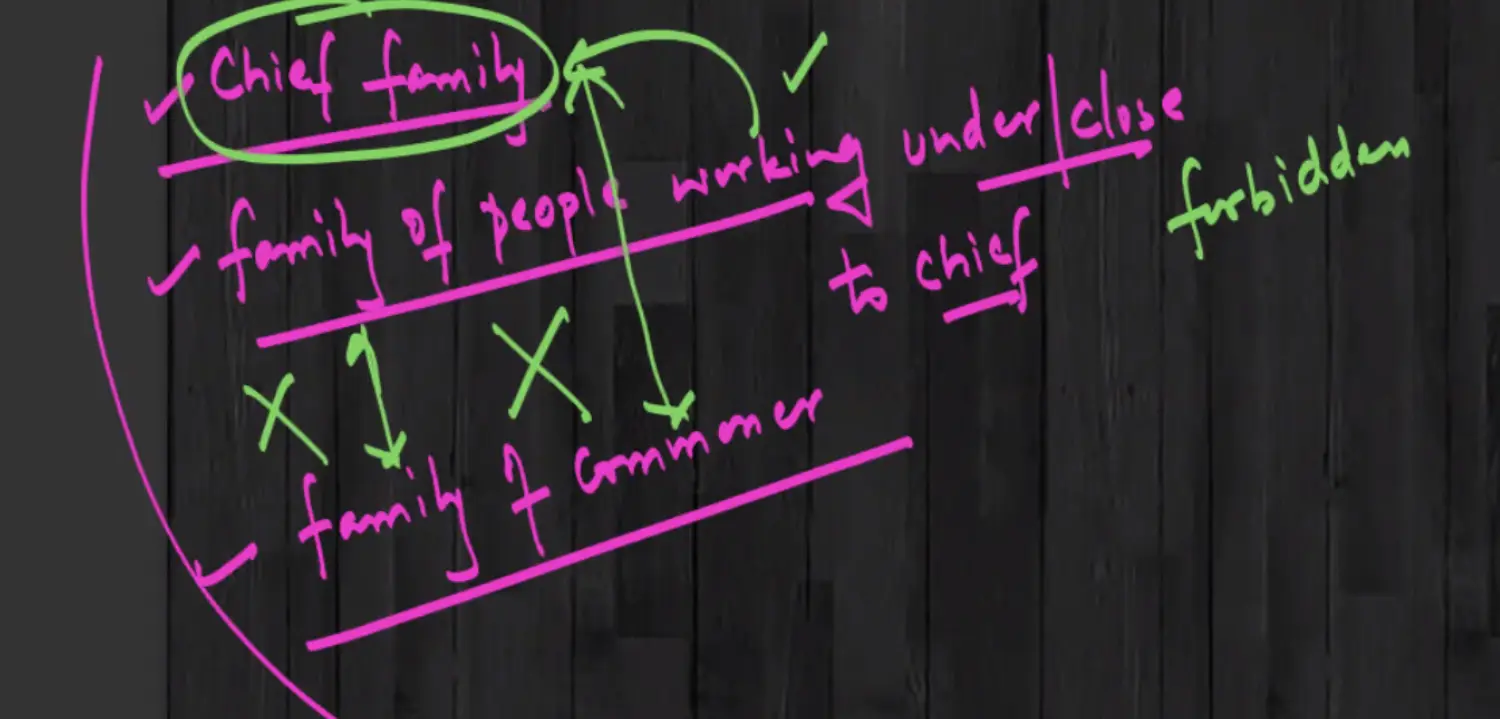
Here Chief will have Luxurious Life Style and More Resources
He is expected to help when people are in need
There can be pooling of resources and resources can come to chief
Hence Production & Re Distribution is done by Chief
Example
Zulus of South Africa are on the Classical Example of Chiefdom
When there is some situation of internal conflict there will be resolution by chief
There can be Ascribed Status of Chief in the Chiefdom. Ascribed status is by means of Chief Dom
There are certain Charismatic Leaders with Extraordinary Leadership skills who can also become chief
Accumulation of Wealth can also lead to Attainment of Chiefdom
Example: Iroquois of South Western US and Nearby Mexico
State
Its a Political Organisation with
Temporary Executives - Politicians
Permanent Executives - Bureaucrats
The Govt Structure can be
- Presidential form of Govt
- Parliamentary form of Govt
- Democratic Form of Govt
- Ceremonial Head from og Govt
There is a Hierarchy of Centralised Control
State defines the rights of citizens, state also defines responsibilities of citizens
Even before that, State Defines who are its Citizens
They Maintain forces to Handle Internal or External Conflicts
States collect and maintain demographic data
States have ownership of Resources
State Ensures Re Distribution of Resources
They Maintain Law and Order for Social Control
Voluntaristic Theory of State Formation by Childe is of the Opinion that the Governments and State Authorities emerged because of Voluntary Surrender of Some Part of Autonomy and Ownership of Resources under control of state.
So that, Redistribution of the Resources and Stability in the Social System can take place
Important Trend Analysis
Summary
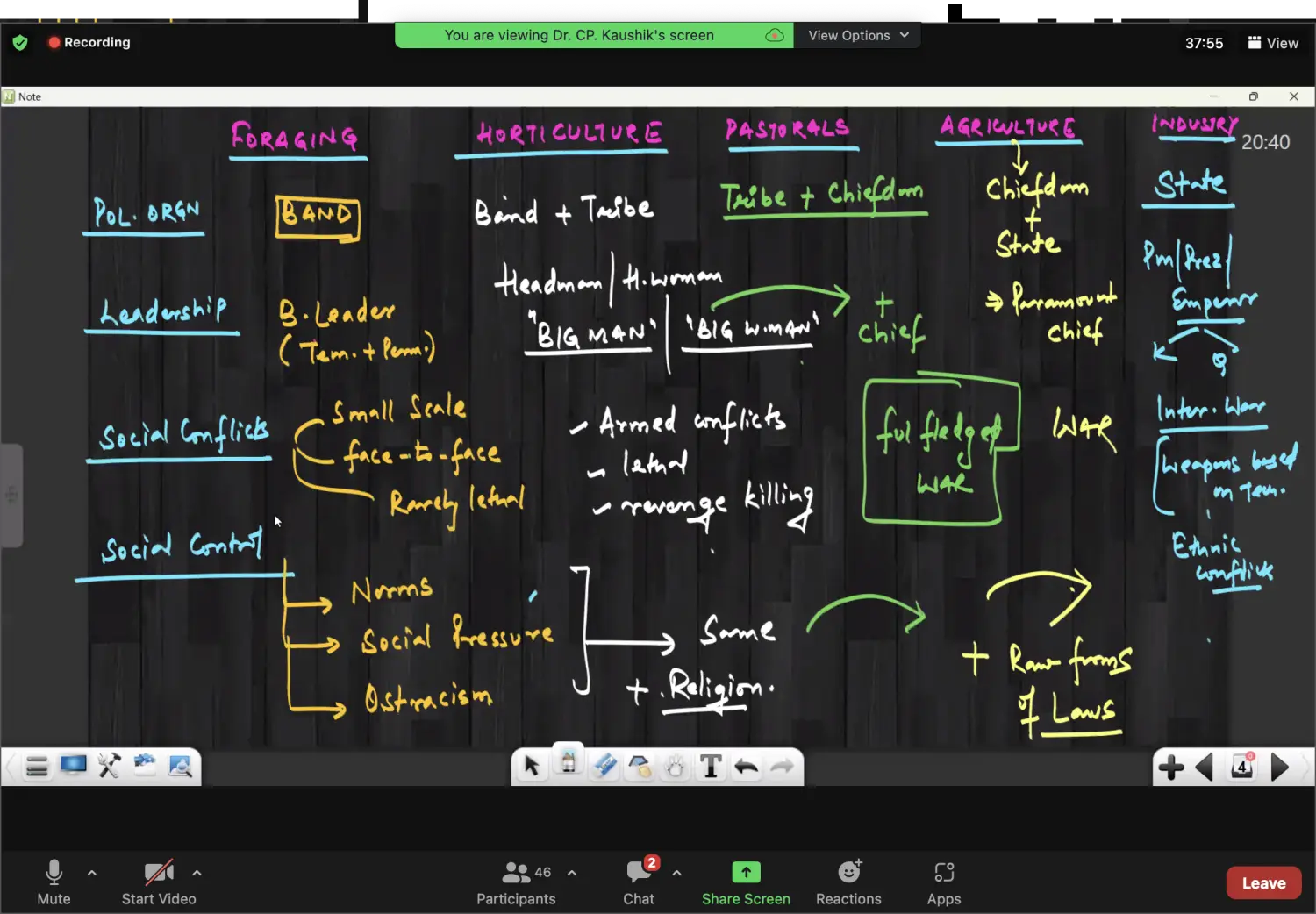
Table
| Themes | Foraging Society | Horticulture Society | Pastoral Society | Agriculture | Industry | | --- | --- | --- | --- | --- | --- | | Political Organisation | Band | 1. Band 2. Tribe | 1. Tribe + Chiefdom | Chiefdom and State | State | | Leadership | Band Leader (Generally Temp, Rarel Permanent) | 1. Head Man / Woman 2. Big Man / Big Woman | 1. Big Man / Big Woman 2. Chief | Paramount Chief | PM/President/ Emperor | | Social Conflicts | 1. Small Scale 2. Face to Face 3. Rarely Lethal | 1. Armed Conflicts 2. Lethal 2. Revenge Killing | 1. Full Fledged War 2. Generally Lethal | War | International War Ethnic Conflicts Weapon Based War | | Methods of Social Control | 1. Norms of Society 2. By Means of Social Pressure 3. by Means of Ostracism (Boycott) | 1. Norms of Society 2. By Means of Social Pressure 3. by Means of Ostracism (Boycott) 4. Religion | 1. Norms of Society 2. By Means of Social Pressure 3. by Means of Ostracism (Boycott) 4. Religion | Raw forms of Laws | Formal Control
- Law
- Judiciary 3.Imprisonment
- Capital Punishment
Informal Control
- Religion Extra |
Trend Seen
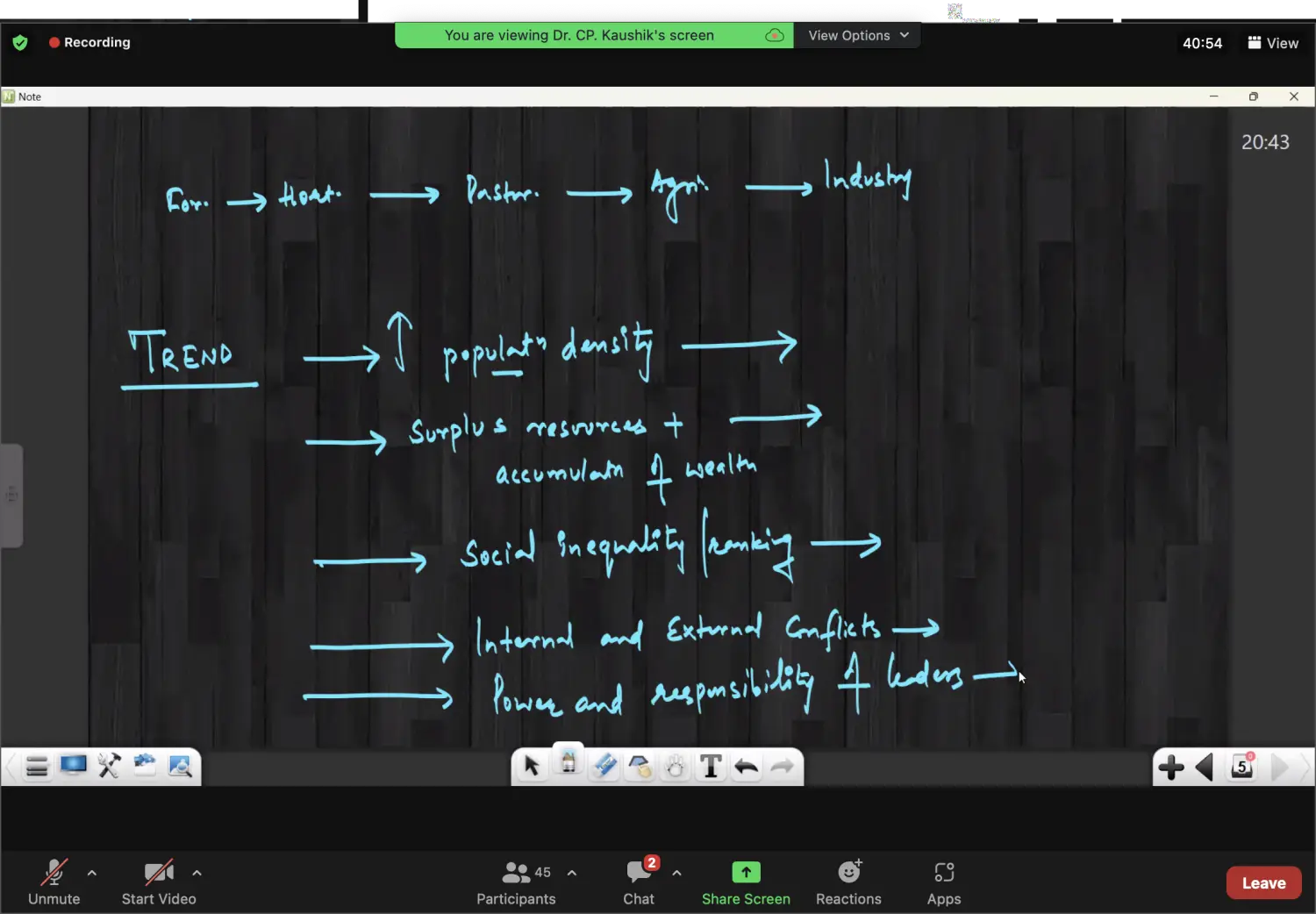
- Increased Population Density
- Increased Social Inequality or Ranking
- Increased Internal & External Conflict
- Increased Power & Responsibility of Leaders
Power Authority and Legitimacy
Introduction
- Power is Capability to do certain things as per wish and will
- Authority is moulding the power of others. Capable to direct people
- R A Dahl (Sociologist) → Legitimate Power is Authority
- Sheriff and Sheriff defined power as Relative Weight of Behaviour of Group Members
- Weber said that if you are able to do what you want irrespective of resistance
- Zero Sum View of Power by Max Weber: Total Power in Society is always constant
- Weber said this that the total amount of power in a society is always constant
- Meaning if someone gains power then it is Loss of Power for some other Society Members
- Sociologically authority in power are loosely differentiated and have been found to be overlapping most of the times
Power
Power can be Legitimate or Illegitimate
Legitimate Power on Exercise, Becomes Authority
Legitimate Power can be by Customs and Traditions
There are : Legal Power and Traditional Power
Legal Powers - By State and Law → Later Becomes Legal and Rational Authority
Traditional Powers - Religious Leaders
Based on Charisma due to some peculiar quality or character of a Leader
There are : Structural Power and Positional Power
Structural Power
Positional Power
Authority
- Introduction
- Legitimised Power is Authority by R A Dahl
- Institutionalised Power is Authority
- Ability / Right to take decision for others to issue commands
- Its a Legal Rational Based on Rules, Procedures and Protocols
- Types of Authority
- Traditional Authority - Due to Tradition
- Charismatic Authority - Due to Charisma of Leader
- Legal Rational Authority - Due to Law
- Introduction
Difference Between Power and Authority
| Power | Authority | | --- | --- | | Can be Legal and Illegal | Is Always Legal | | It is to Regulate Self Wish | It is to Regulate Others Wish | | Not Necessary for Power | It is more democratic & Based on Rules | | Restricted to Simple Small Scale Societies | Can be for both Small Scale & Large Scale Societies | | Power is not Necessarily Hierarchical | Authority is Hierarchical |
Legitimacy
- Origin of Word Legitimacy is from Latin Word: Legitimas meaning Law Based
- Its a connection between Power and Authority
- Power will only become Authority, Only when there is Consent & this consent is only useful when the consent is Legitimacy
- Legitimacy is a kind of approved consent by a larger society which makes power a form of authority
- Legitimacy is a degree of right and wrong
- Legitimacy Makes De Facto Govt, a De Jure Govt
- According to Max Weber, Legitimacy Can be
- Traditional
- Charismatic
- Legality
- Estons Classification of Legitimacy. According to Eston, Legitimacy can be
- Ideological : Based on Ideology prevailing in society
- Structural : When You accept the Structure of Legitimacy
- Personal : Parallel to Charismatic Legitimacy of Weber, Based on Behaviour, Personality and Characteristics of Individual
Social Control - Law & Order in Primitive & Modern Societies
- Social Control is Regulating / Handling and promoting an accepted social behaviour
It is done by means of
- Norms of Society
- Religious Beliefs
- Educational Knowledge
- Parenting
- Law
Aim of Social Control is
- Social Order can be Maintained
- Welfare of Society
- It is done by means of Social Suggestions and Perceptions
Methods of Social Control are Highly Variable for Different Societies
Foragers, Horticultures & Pastorals
Less Chances of Written Rules & Defined Law & Order is Generally Missing in
Social Control Method is more of a Informal Methods based on Ideologies, Folklore, Mores, Customs/Beliefs
Mores are characteristic customs or conventions of the society, generally acceptable to larger society
Agricultures and Industrial Society
- Formal Means of Social Control like Civil, Criminal Law & Written Rules etc
Modern Society
- Socialization by any means of Family, School, Social Institutions & Peer Group, these groups de facto inculcate social control
- With Socialisation, Social Control is Ipso Facto
Why Social Control is Needed
- Maintain Order / Balance / Harmony in Society
- To Maintain Old Order / Norms
- Social Solidarity Promotions
- Insider v/s Outsider Recognition
- Sanctity of a Particular
- To Check Socio Cultural Mal Adjustments
Methods of Social Control - Most Accepted way to classify social norms
E A Ross on Social Control
- gave the Description of Social Control Methods in Raw Form, Any Society Since Beginning of Humanity, uses one or another method of social control.
- It is is not necessary to have a Constitution but there can be Law, Customs, Religion, Moral & Ethics, Folkways, Mores, Public Opinion or Social Suggestion
Bernard on Social Control
He Gave 2 Sets of Criteria
Summary
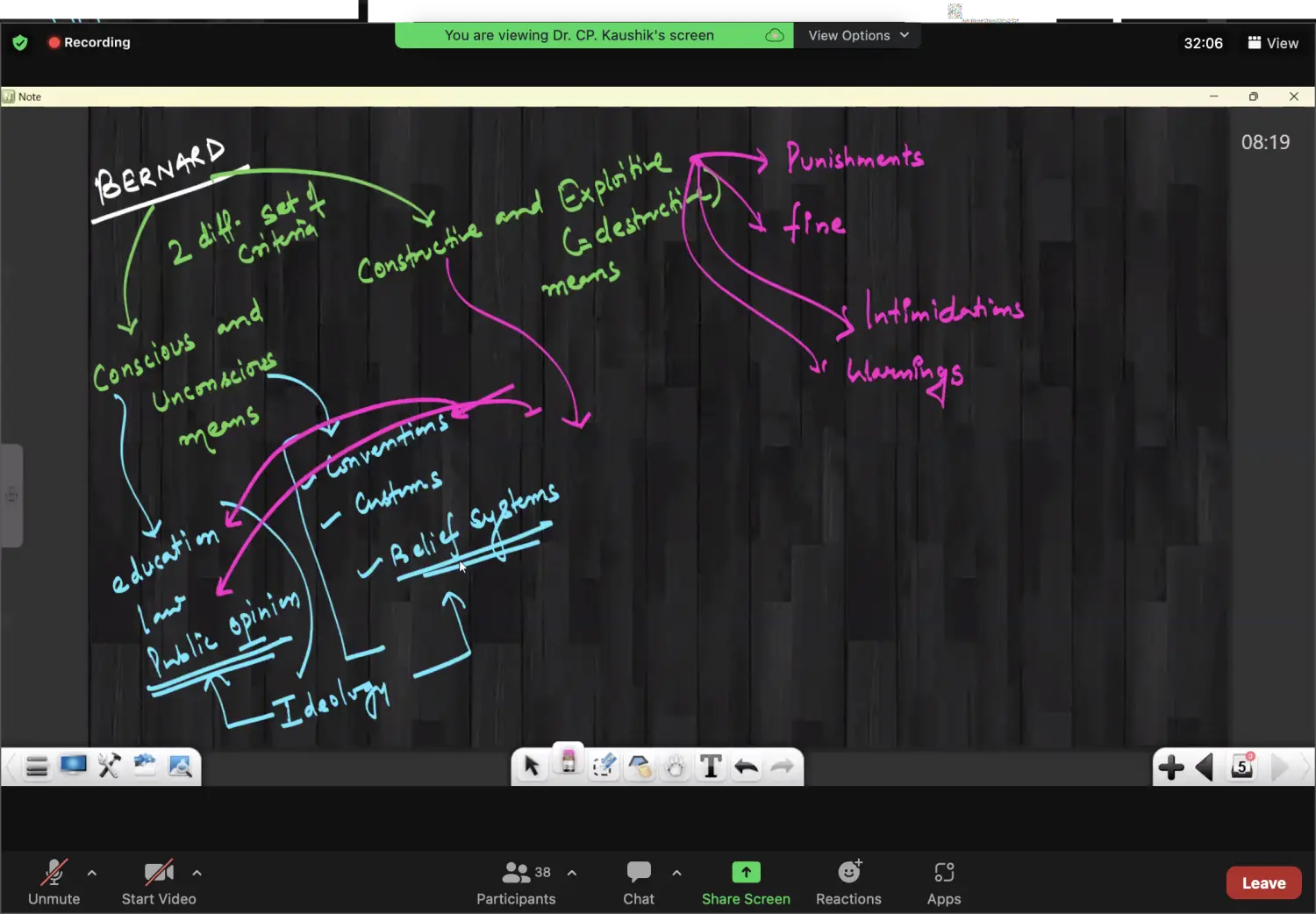
Social Control can be based on
Ideology can be in both
- Conscious Means - Education, Law, Public Opinion
- Unconscious Means - Conventions, Customs, Belief Systems
He Proposed Two Means of Social Control
- Constructive → Asking For / Guiding Light → Education, Law, Public Opinion
- Exploitive (Destructive) → Coercing in / Forcing Into → Punishment, Fine, Intimidations, Warnings
Most Accepted Means of Social Control by Many Sociologists & Anthropologists
- Informal Method
- With time, it emerged in society & people, they started accepting these
- Its Characteristics Are
- No Special Efforts is needed to reach upto these social control
- No Special Agency
- No Special Agreement
- Types of Informal Methods are
- Belief Systems
- Sin & Concept of Karma
- Examples of Azandes of Sudan & their Notions related to witchcraft
- Social Suggestions
- Behave Like Gandhi Ji
- Ideologies
- Fascist, Narcissist, Gandhian, Leninism
- Folkways and Mores
- Customs and Traditions
- Art & LIterature
- Comedy
- Belief Systems
- Formal Method
- Law
- It Constitutes
- Most Important Method of Social Control
- Rules
- Legal Anthropology
- Anthropology
- Defines Legal Social Relationships
- Appropriate Behaviour in these Relationships
- Law decides Authority for Implementation of Rules, For Coercion
- It Makes Social Relationships Dynamic and Flexibility
- Law in Itself is Dynamic, Meaning Old Rules often change into New Rules
- It Constitutes
- Education
- Coercion and Prescribed Punishments
- Law
- Informal Method
Law and Justice in Primitive Societies
Defined by Malinowski
- Law is an
- Obligation for one person
- Rightful Claim on another person
- There's No Psychology and Belief but by a defines social machinery of force or coercion
- Law is an
Law in Band Clan Tribe
No Defined Law → Band / Clan / Tribal Leaders used to define the Law → Legitimacy of Law was rooted through Kinship Bonds
It was based on Public Opinion based on Morality and ethics
There was no difference of Public or Private Wrongs. Cause of Other may affect the Group
Fear of Sins guided the Ethics
Focus was on Criminal Law and Not on Civil Laws
Intentions are of No Use
Example of Eskimos
If a Man Steals the Wife of a Man, then the Person who has stolen wife will have to listen to Songs sung by the person aggrieved
Concept of Social Sanctions by Radcliffe Brown
- Negative Sanctions - Forced to Do Something
- Positive Sanctions - Reversal of Negative Sanction
C Wright Mills further elaborated Concept of Social Sanction
Sanction is a Kind of Externalised Social Control
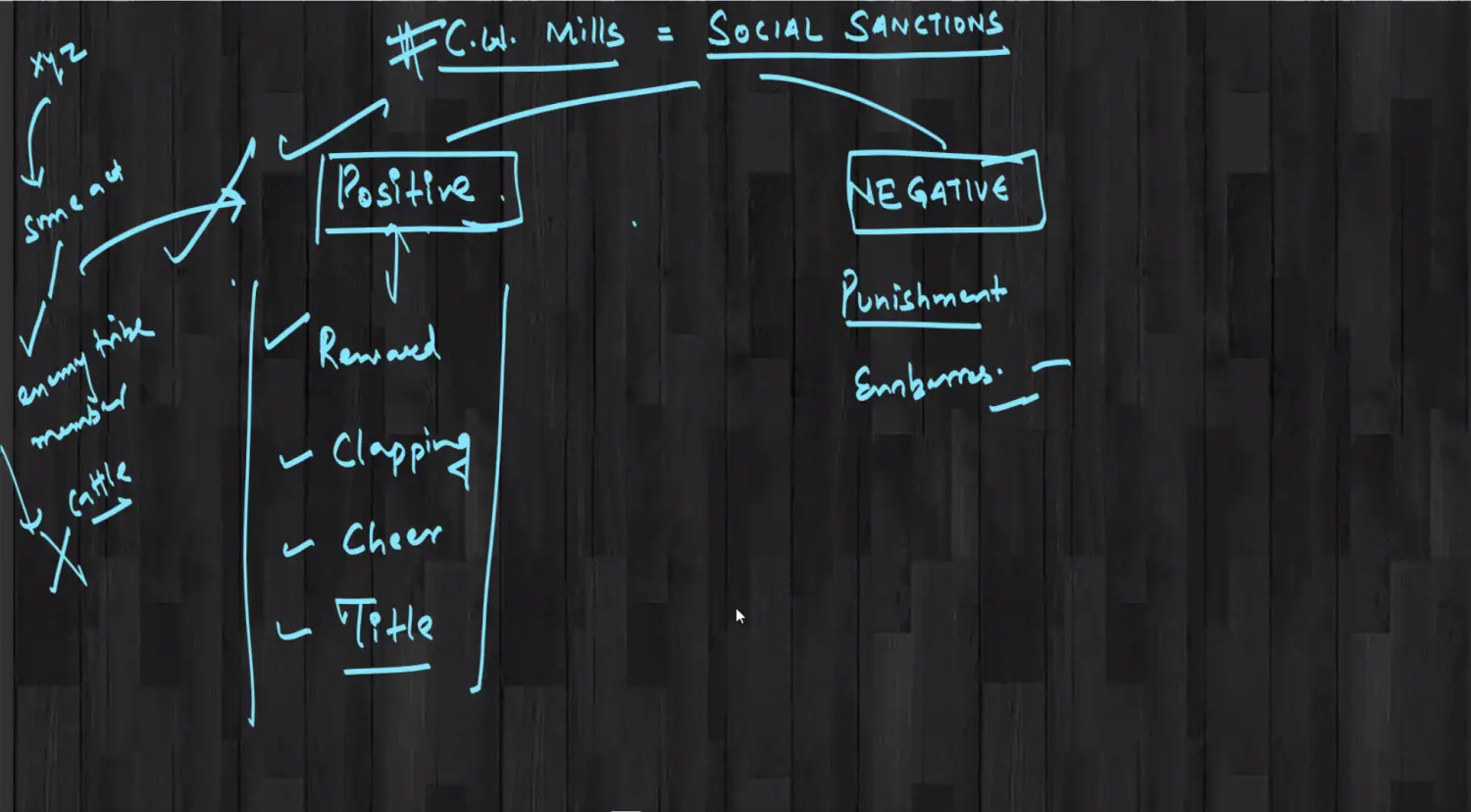
Resolution of Conflict
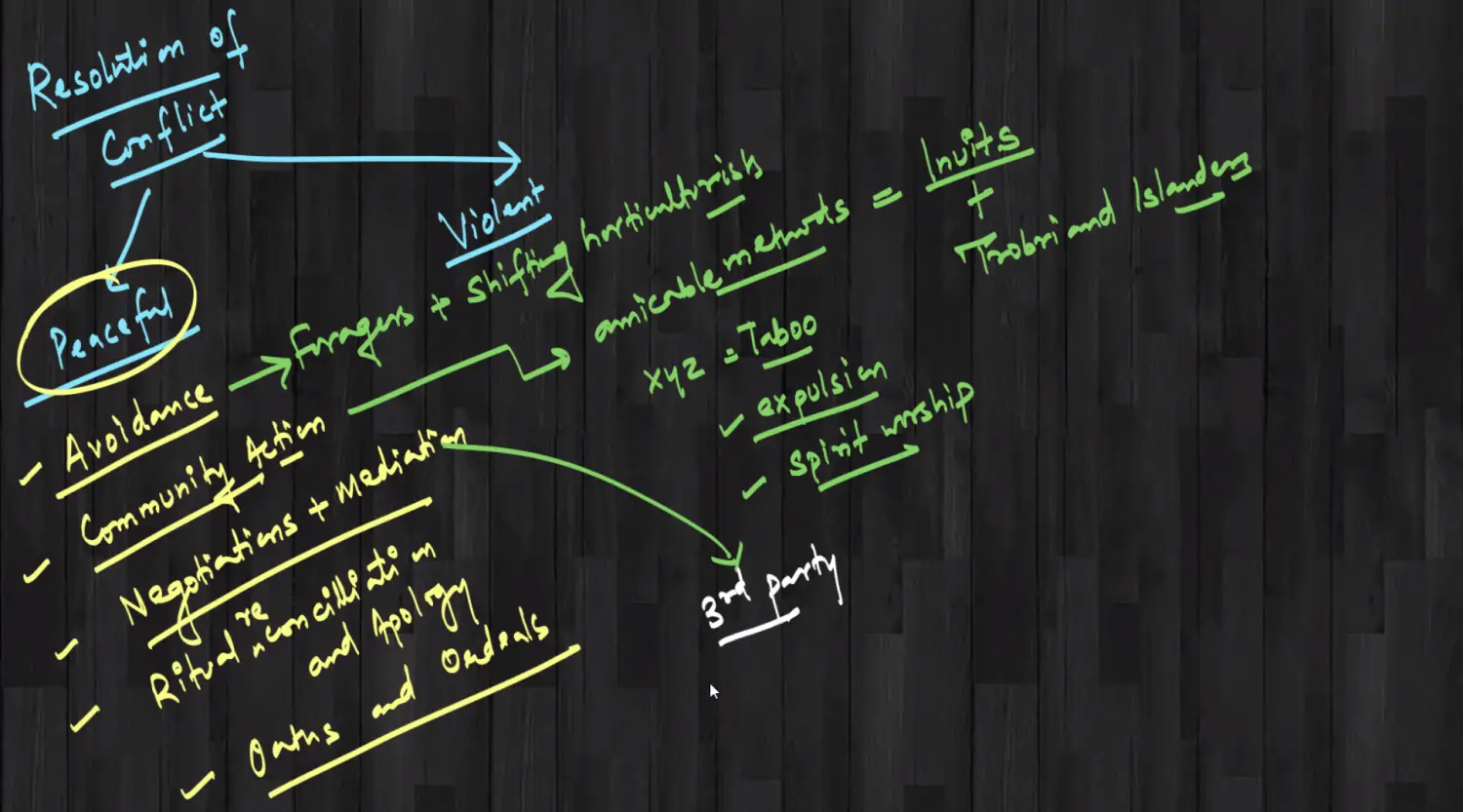
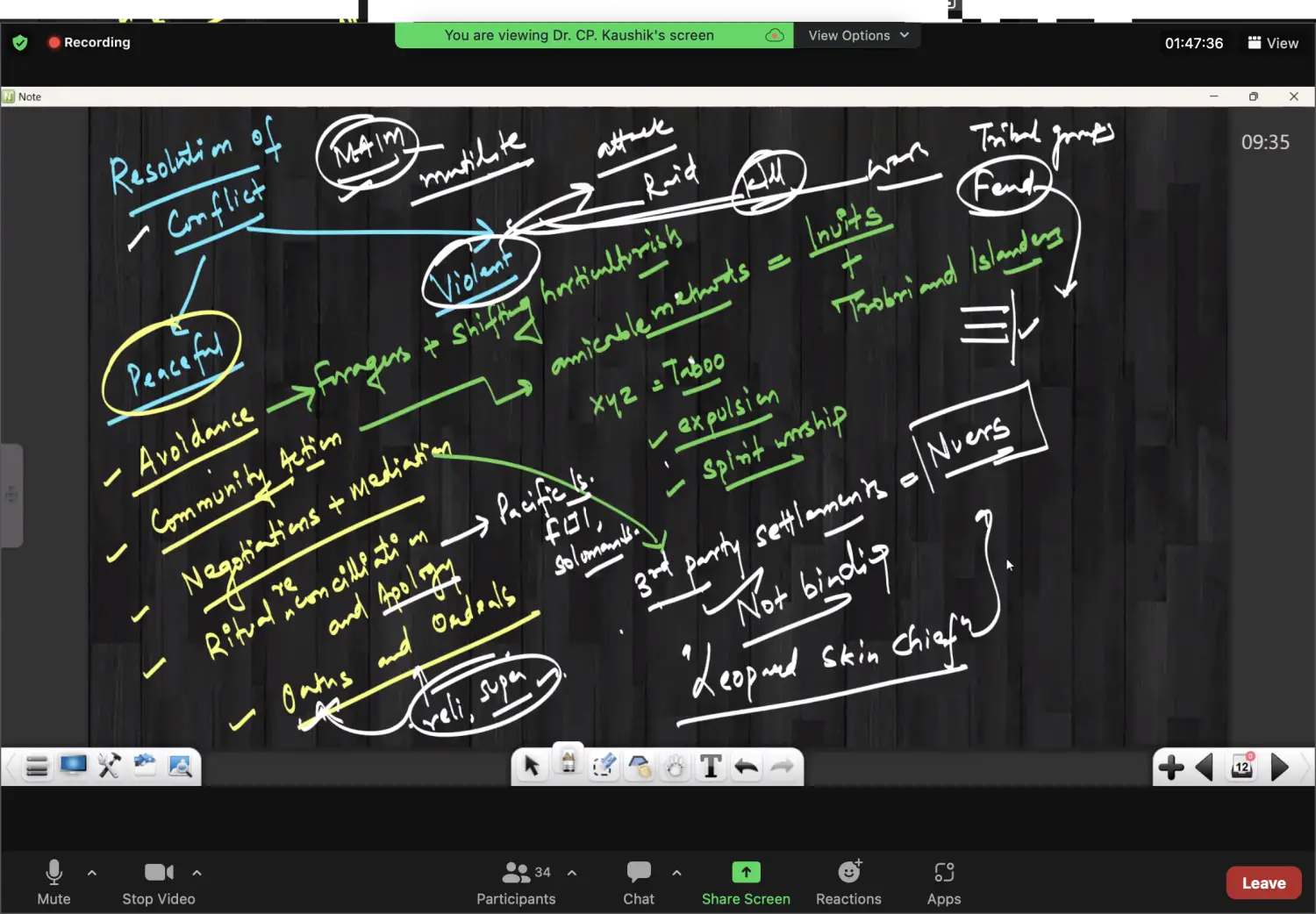
- Law & Customs
Definition of Law
- According to Malinowski Law is an obligation for one person and is the Claim of another Person
- It is not Based on Psychological or Emotional Motives or Aspects
- There is a Defined Social Machinery behind that
- Hence, Law is a Formal Method of Social Control.
- It acts as an Agency or Social Institutions
Definition of Customs
- It is long term established way of living.
- It is the Habits of People and Social Behavior
- It is based on Folkways and Mores
Difference Between Them
| Law | Customs | | --- | --- | | Well Defined Norm | Not Well Defined | | Formulation, Enactment, Enforcement is by a Special Agency | No Special Agency is Required. They are Passed from One Generation to Another | | Specific or Unique to Some Aspects | It is not Specific, It is Generalised | | Framed on Intentional Basis, These are Deliberate Efforts to achieve some specific targets | It is a Kind of Group Process that Emerged Gradually & Unintentionally | | It is Dynamic in Nature It is Flexible It is Adaptive | Less Adjustable Less Flexible | | Special Effect or Law is Required to Abolish a Law | When Society is not Following Some Custom or Norm. It will gradually disappear | | They are generally codified in Single Book | They are NOT Codified in Single Book |
Similarities Between Them
They are Supplementary and Complementary to Each Other
Some Customs are followed Unconsciously without any Special Effort, When they serve a Function to Society, they are framed as Law
Social Sentiments and Society Members Sentiments are kept in Consideration while framing Laws
Sentiments, Customs and Norms are Guiding Lights Behind Law
In the Same way Law Enforces the Customs
Examples of Laws Based on Customs
Example: Laws were Framed Against Sati
Example: Laws were framed for Preservation of Milch Animal from Butchering
They Both act as Method of Social Control
- Primitive & Modern Law
Difference Between them
| Primitive Law | Modern Law | | --- | --- | | Simple Small Scale Societies | Complex Industrial Societies | | Not Well Defined | Well Defined | | Not Written | Maximum Times it is Written | | Slow and Gradual Onset | Result of Deliberate Planning | | Kinship Ties & Binds | Geographical or Territorial Jurisdiction | | Concept of Sins Talk About Supernatural Things | No Concept of Sins, More as a Concept of Crime or Deviance (Civil Disputes) | | Supernatural Punishments | Prescribed Punishments | | Predominantly Criminal Law No Concept of Civil Law | Both Criminal and Civil Law | | Based on Collective Conscience, Norms and Customs | Based on Rationality (Can be Shaped by Customs) | | Collective Responsibility | Individual Based Responsibility | | No Police No Court of Law | Policing System and Court of Law | | No Distinction Between Crimes in Public & Private Spheres
Example: Smoking is a Sin | Distinction and Variance of Law Between Crimes in Public and Private Spheres Example: Smoking is ok in private, Smoking is a crime in Public |
Durkheim Talked ABout
- Simple Small Scale Societies
- There Members Are Bound by Mechanical Solidarity
- Mechanical Solidarity → All Members are Almost Same
- Here Individual Consciousness it totally shaped by Collective Consciousness → What Society thinks, I think
- They Work as a Unit
- Here Mechanical Solidarity is Parallel to
- Repressive Law
- They Try to restore collective consciousness
- Complex Industrial Society
Bound by Organic Solidarity
Here there is Defined Division of Labour (DOL)
Every Person has his own type of Employment
Here Organic Solidarity is Parallel to
Law is not Repressive, it is mainly in the Form of Restitution → Leading Restitutive Law
It doesn't target punishment but restoration of Social Order
Durkheim Called Break Down of Social Order as Anomie
- Simple Small Scale Societies
- What is Political Anthropology