2.2 Ecological Anthropology
Part 2 - Physical Anthropology
Unit 9.7 - Concepts & Methods of Ecological Anthropology
Ecological Anthropology
Ecology : is the interaction of living beings with other living beings with their physical environment
Anthropology : is the study of man
Ecological Anthropology : is about interaction of man with environment. Man reacts with environment through biological (adaptation, acclimatization etc) & cultural (houses ways of construction, fooding habits etc) means
A sub field of anthropology which is the study of cultural adaptations to a specific environment i.e study of relationship between human populations and there bio physical environment
Research of ecological anthropology is more concerned about how cultural believes and practices helped human populations to adapt to their environment. Also, how people used their elements of culture to maintain their ecosystems.
Andrew Voyada and Rappaport incorporated principles of biological ecology into study of cultural ecology to make it a single science of ecological anthropology
Man reacts with environment in 2 aspects
- biologically
- culturally
Concept of cultural ecology emerged in anthro through the studies of Julien Stewards (neo evolutionist with an argument that culture does not exist as a separate sphere but involves reciprocal involvement with environment)
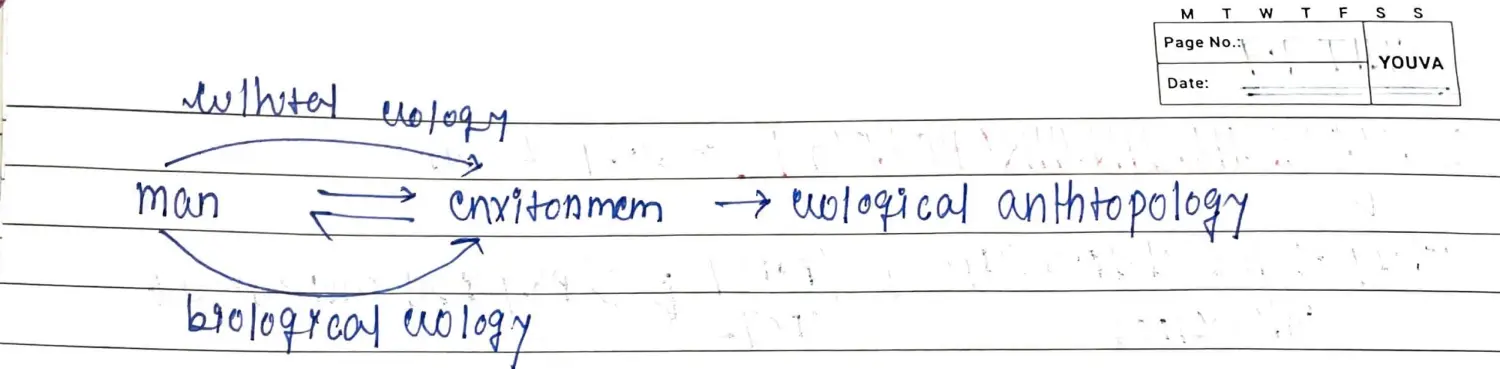
In the concept of cultural ecology as explained by stewards some domains of cultural have strong and direct relationship with environment (Cultural core) and some have indirect relationship with env.
Various facets of culture like habitations ,dressing and fooding habits are governed by environmental factors
Example 1 : Bhungas are traditional houses in kuch region of Gujarat made up of special huski material (not allowing easy entry of heat)
Example 2 : Traditional attire of populations in Arab region is mainly of lighter colors specially white to minimise the absorption of heat
💡 Ecological Anthropology is clubbed with biological ecology and cultural ecologyAcclimatization, Adaptability, and Adaptation
Summary
| Concept | Definition | Nature | Timeframe | Examples | | --- | --- | --- | --- | --- | | Acclimatization | Process of adjusting to a new environment | Temporary | Short-term, reversible | - Increased melanin production in response to sun exposure
- Preference for specific foods in different climates
- Extra red blood cells production at high altitudes | | Adaptability | Flexibility to adjust to the environment | Dynamic | Short to medium-term | - Cultural responses to food, clothing, and habitation
- Physiological changes for better adjustment in climatic conditions | | Adaptation | Special changes in structure or mechanisms | Evolutionary | Long-term, irreversible | - More red blood cells and increased lung capacity at high altitudes
- Homeotherms (endotherms) maintaining constant body temperature
- Poikilotherms fluctuating body temperature with the environment |Concepts
Introduction
Acclimatization, Adaptability, and Adaptation are processes by which living beings, including humans, respond to specific environmental and climatic demands. They involve changes in structural, functional, physiological, and cultural characteristics to ensure better survival and evolution.
Adaptability refers to the flexibility or adaptability of humans to their environment. It includes both biological and cultural components, and it leads to advancements in lifestyle, such as food habits, clothing, and habitation
Ability to adapt to something, here Genetic Diversity plays a very Important Role.
Example 1 : Grains
Wheat : Cultivation in some parts of India only seen, Generally scarcity of wheat is seen
Rice : Cultivated everywhere, due to better genetic diversity
Example 2 : Humans
- Race & Population → having better genetic diversity → There are 4 Prominent Race : Mongolites, Caucasian, Indo Aryans & Dravidians, Negrotes
- Not good Adaptability → Inbreeding Depression → Reduced Genetic Bio Diversity
Acclimatization is the process of getting accustomed to a new environment through biological or cultural changes. These changes are generally temporary and reversible.
Adaptation, on the other hand, involves special changes in body structure (anatomical) or mechanisms (physiological) to fulfill specific demands of a particular condition. Adaptations are generally evolutionary changes that help species sustain and ensure survival, reproduction, and continuity in specific climatic conditions.
Common Example
- Acclimitisation
- Cultural : Alcohol in Mountain
- Biological : Increased RBC
- Adpatation
- Cultural : White Color Less Dress
- Biological : High Altitude → High RBC, More Layer of Fat
Examples
Acclimatization Example 1: Examples of acclimatization include increased melanin production in response to sun exposure in tropical regions and preference for specific foods in different climates
When a British person comes to India, their body produces more melanin to protect the skin from strong tropical sunrays. This production decreases when they return to Britain
Acclimatization Example 2: Cultural acclimatization can occur in different climates, where food choices may be influenced by cooling or heating effects on the body
Acclimatization Example 3: Extra red blood cells are produced to counter altitude sickness. A Perosn living in a plain has in general less RBC as comapred to a person living in a hilly area
Adaptation Example 1: People living in high-altitude areas have more red blood cells and increased lung capacity to efficiently supply oxygen
Adaptation Example 2: Different temperature regulation strategies exist in organisms
Thermoregulations : Hypothalamus Acts & Thermo Regulatory Centre
| Adaptation Examples | Homeotherms (Endotherms) | Poikilotherms (Ectotherms) | | --- | --- | --- | | Definition | Organisms that maintain constant body temperature. | Organisms whose body temperature fluctuates with the environment. | | Nature | Warm-blooded, able to generate and retain body heat. | Cold-blooded, reliant on external sources for body heat. | | Examples | Mammals (e.g., Humans), Birds. | Fishes, Amphibians, Reptiles. | | Thermoregulation | Capable of thermoregulation (maintaining constant body temperature). | Unable to thermoregulate (body temperature fluctuates with the environment). |
Laws Governing These Changes
- Allen's Law: Describes the relationship between body shape and temperature tolerance. Longer extremities in hot areas dissipate more heat, while shorter extremities in cold areas retain more heat.
- Bergmann's Law: Relates body size and structure to temperature. Populations in cold areas tend to have larger body sizes for better heat tolerance, while those in hot areas have smaller sizes for less heat retention.
- Vasodilation: Expansion of blood vessels near the skin surface, which helps in heat dissipation.
- Vasoconstriction: Constriction of arteries, reducing heat loss.
- Human Glands: Apocrine and Eccrine glands are categories of sweat glands. Eccrine is the major sweat gland of the body, opening towards the skin surface, while apocrine glands open into hair follicles, armpits, pubic area, and head.
Mans Physiological and Cultural Response to Heat
Introduction
Like other mammals humans are homeotherms, maintaining a constant internal body temperature through the thermoregulation regulated by hypothalamus
Extreme hot weather and heat waves can cause death of the individuals as body cannot retain larger heat for longer periods
In 2003 around 35 to 50 K people die in heat waves in Europe as the individuals were suddenly exposed to heat and death happened due to multiple organ failure
Example : Heat Waves is 2019/20 Andhra Telangana heat waves leading to death of more than 50 people
Example : In hot deserts and other hotter areas heat stress can be handle at biological or cultural levels
Biological → Can be physiological, genetic or anatomical adaptations to handle the heat stress
A body experiencing heat stress, attempt to get rid of internal (produced by body mechanism) and external (through outside air temperature) derived heat sources
Biological/Physiological Adaptations to Heat
Genetic Adaptations as per Allens Law and Bourgmans Law
i.e larger extremities to maximise heat loss form the body
Example 1 : Pigmies of Kalahari and Jarawa’s of Andaman’s and Aborigins of South East Asia i.e relatively smaller body size and less weight to reduce the metabolic rate
Genetic Adaptations as per Vasodilations
Expansion of blood vessel near the surface of the body to release maximum heat
Example : The red face of person in hot environment Is visible
Genetic Adaptations as per Sweating
Thermo Regulatory Center - i.e hypothalamus triggers sweating in humans which is one of the most imp response of the body for thermos regulation mainly by Eccrine Glands
Genetic Adaptation as per Body Hair
Sweating is less effective in areas of body having dense hair as compared to areas having little or no hair. During the course of human evolution, the body hair witnessed a general loss.
Genetic Adaptation as per Gender
Over all women are less able to tolerate heat than men due to presence of greater body fat and hence reduced the ability of efficient vasodilation
Cultural Adaptations to Heat
Introduction
It pertains to creation and maintainace of favourable env. Conditions very near to the individuals and populations through the elements of material culture like habitation, clothing ,fooding etc to avoid the heat stress
Habitation
people adopt special housing structure to minimise the impact of heat and hot winds like
- Like Bhungas construction of GJ are covered by special husky material which is not allowing the entry of heat inside the house
- In some parts of north and north western India a buddy or clay covering is pasted over the walls of habitations particularly with kutcha houses to provide heat resistancE
- Pueblo Indians (south western USA+Mexico) and some middle east communist constructed their houses serval meters below the ground to avoid direct exposure to hot winds and sunrise and also the sub soil temperature is much comfortable than that of surface soil
- In tropical areas people prefer to stay within or near forest or besides the water bodies to witness the cooling impacts
- In hotter areas houses are generally constructed with insulating materials having high heat resistance such as slat stones and adobe stones like in parts of RJ
Clothing
Light coloured clothing for maximum reflection of the radiation and minimum expansion of heat
Example : arbas in northern Africa and west Asia
Fully covered body surface to avoid minimum exposure to hot winds and sun raises even the head areas like use of turbans and traditional caps in western part of India and Arabic world
Chhamb arabs are tribal grps of sahara were people adopt the layering of clothing to minimise the conduction of heat upto the skin surface as the layers will act as insulating chambers
Food
- Certain fooding habits like dependence on fruits and hydrating food resources to minimise the water imbalance in the body
- also dependence upon animal products with minimum fact content so that body metabolism can be regulated
Conclusion
biocultural adaptations in extreme climatic conditions like the hot areas are supplementing and complementing each other’s responses to ensure survival, reproduction and maintain ace of populations in these extreme climatic conditions
Mans Physiological and Cultural Response to Cold
Introduction
- Severe cold stress is experienced mainly in
- polar and subpolar areas i.e high latitudes like arctic region
- in hilly areas with permanent habitations at an altitude above 10k feet or 3500 meters
- in temperate areas during colder seasons
- Exposure to very low temperature and cold winds can cause hypothermia low body temperature and is the biggest challenge in these conditions
- Permanent habitations in these conditions can be found in
- wrt Latitude : Alaska , Northern Canada, Scandinavia
- wrt Altitude : Siberia, Himalaya, Alps, Peruvian Andes, Tibetan
- Note
- Arctic (polar) - high latitudes
- Sub-polar - high latitudes
- High altitude - of high more than 10 K feet (nearly 350 mm)
- Severe cold stress is experienced mainly in
Biological/Physiological Adaptations to Cold
Vaso Constriction
It is one of the first response of the human body against the cold stress i.e decreasing the diameter of blood vessels to reduce the blood flow towards the body surface
Shivering
It is the chief mechanism to produce heat in the body
High Basal Metabolic Rate
- to generate more heat in the body
- it is amount of calories/energy required by the body to accomplish its most basic functions to sustain life like breathing, circulation of blood etc
Allen’s law
smaller extremities to retain the heat
Bergman’s law
bulkier body size with extra fatty deposits
Example : Inuites, Eskimos are classical example of following Allen’s Law & Bourgmans Law. They have one of the highest BMR
Cultural Adaptations to Cold
These are ways of handling the cold stress through special habitations, dietary pattern, fooding habits and also through various practices and rituals
Igloos (Ice/Snow Built Houses)
- eskimos and people in polar areas construct ice and snow houses as ice is a thermo insulating material. it will not allow the easy entry of clod winds.
- they put a place of source of heat usually an oil or coal based lamp at lower level of multistorey.
- so that warm air will rise to upper level where people live ; maintaining an internal temperature of 10 to 20 degree Celsius despite of sub-zero temperature outside
Thermo Insulating Clothing
- made up of cold resistance material like
- fur of Caribo Rain Deer in Alaska and arctic regions
- pashmina or angora wool in high reaches of Himalaya
- made up of cold resistance material like
Use of Kangri
by Kashmiris to provide warmth to the body
Bushman or Kalahari
- They are exposed to moderate chronic cold stress during nights so they
- Sleep in the groups of 4/5 within the families
- Group of same gender outside the families
- They use clothing during night and remain naked at day time
- They are exposed to moderate chronic cold stress during nights so they
Tibetan Populations
- handles the stress of cold through Higher BMR achieved through general adaptions
- Dietary habits including high animal fats rituals of dances to generate heat in the body or sleeping naked around the camp fire to improve the retention of heat in the body are some other cultural responses to handle the cold stress
Mans Physiological and Cultural Response to Altitude
Introduction
- Himalayan belt > more than 15K feet
- Peruvian Andes > permanent habitations above 19K feet
- Tibetan Highlands > more than 15K feet
- Alps in Europe
Challenges in these Areas
- Rough and difficult terrain, which leads to skeleton changes
- Biggest challenge : very low temperatures and cold & dry winds
- Handling Hypoxia - Less Availability of O2
Occurs due to low concentration of gases so as to improve O2 supply in body
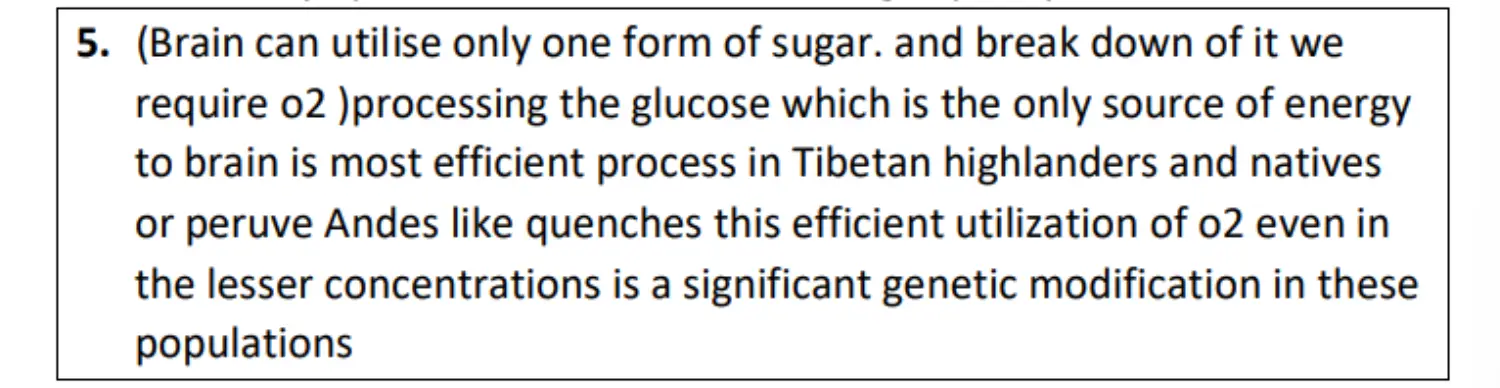
improved efficiency to transport and utilize O2 must be achieved through bio cultural adaptations mainly through biological adaptations
Biological Adaptations May Include
- Circumference of Chest Cavity
- Lung Capacity
- Chest Cavity Broader
- RBC production high
- Heart Rate High
- Capture O2 More - Breathing Rate High
- Save O2 More - Increased Iron Rich Supplement in Blood
Primary Biological adaptations are primary adjustments to handle the low o2 stress
Biological / Physiological Adaptation to Altitude
Greater Heart and Lung capacity like in the native Tibetans
More RBCs in the blood to efficiently supply the available o2 to different body parts
Higher Lung Capacity :
Spitians in himachal and Bods in Ladakh have larger chest size in relation to their body stature as a developmental adaptation to accommodate better lung capacity
Larger chest circumference in highlander as compare to low land populations to increase the lung capacity
Cultural Adaptation to Altitude
Certain cultural practises like traditional India medicine like Sova Rigpa uses certain meditation techniques to improve the lung capacity and efficient utilization of o2